
A complete issue · 16 pages · 1893
Judge — September 30, 1893
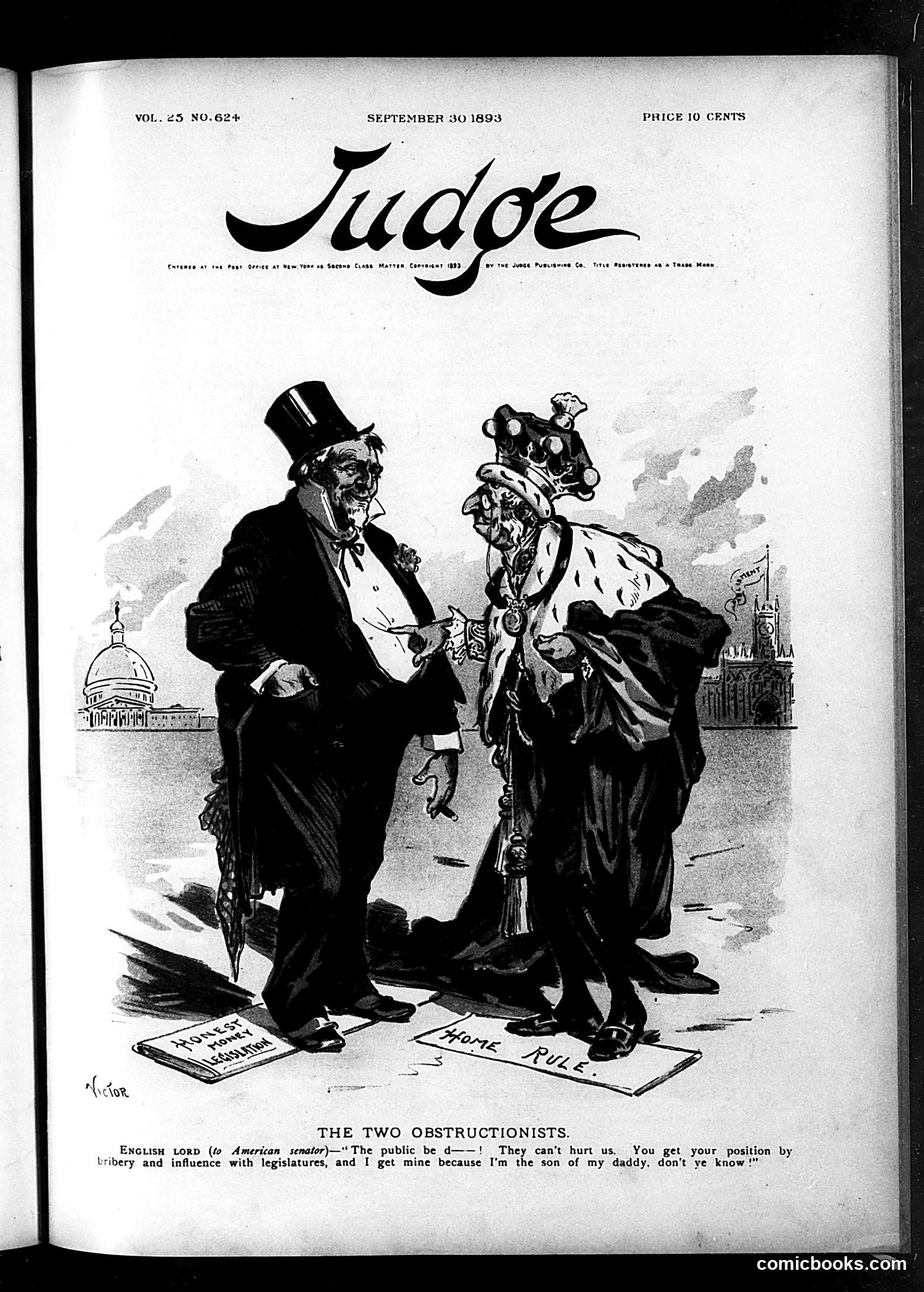
This political cartoon depicts two caricatured figures labeled as "obstructionists" blocking progress. The left figure is identified as an "English Lord" addressing an "American Senator." The dialogue mocks their mutual obstruction: the English lord claims they can't hurt each other through bribery and influence with legislators, boasting about inherited position ("I'm the son of my daddy"). The cartoon satirizes political corruption and nepotism in both nations. The "Home Rule" and "Protection" placards likely reference contemporary trade disputes and Irish Home Rule debates dividing American and British politics in 1893. The satire suggests both figures prioritize personal privilege over public interest, making them equally obstructionist to progress.
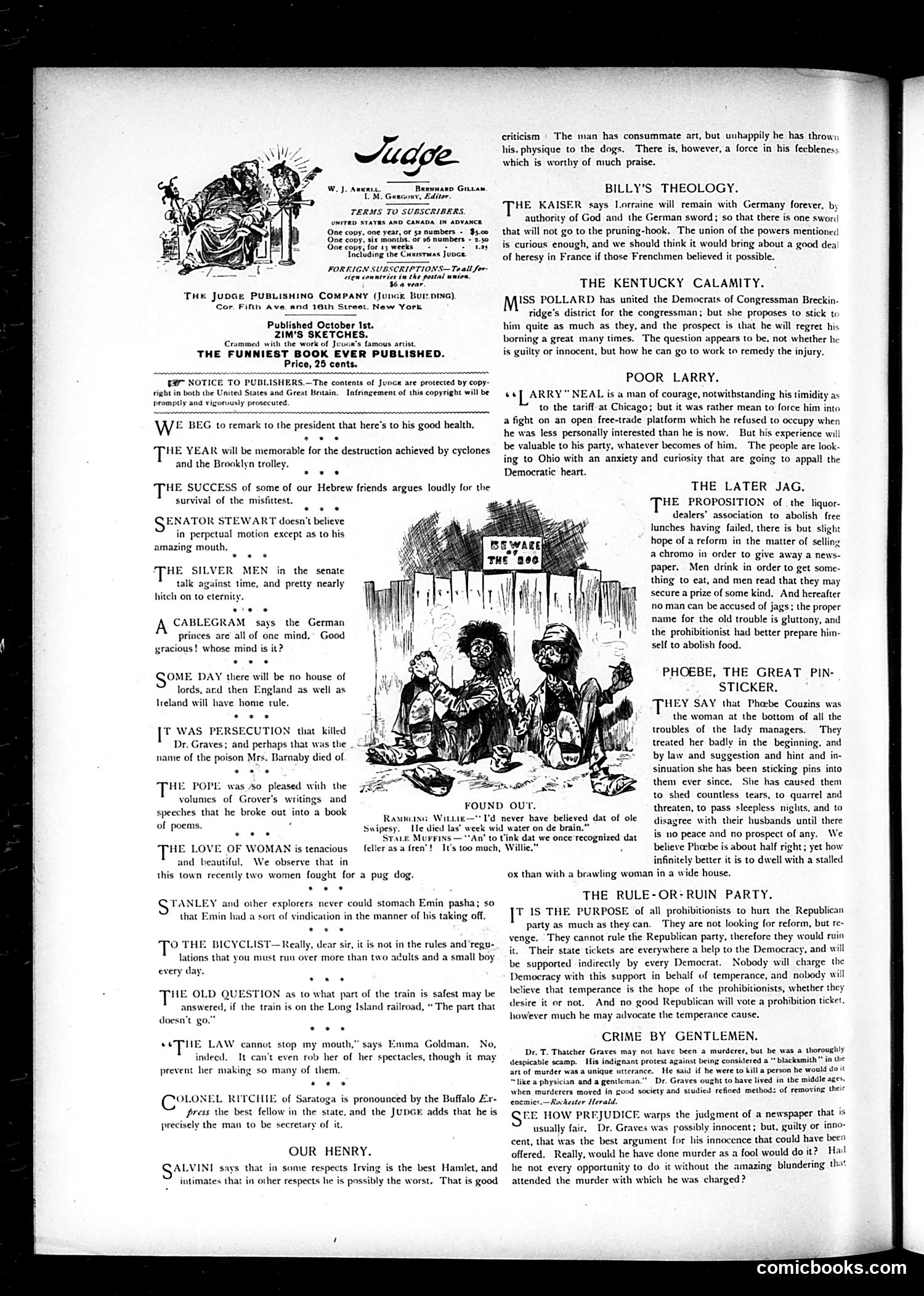
The main cartoon titled "FOUND OUT" depicts street urchins examining a sign reading "BEWARE THE DOG." The accompanying text explains the satire: despite warnings, the children have discovered the supposed guard dog is actually harmless—it's all bluster with no real threat. This appears to be political allegory. The caption "FOUND OUT" suggests the cartoon mocks something pretending to be dangerous but proven toothless. Given Judge's satirical nature, this likely references a political figure or policy presented as threatening but revealed as ineffectual. Without additional context about the magazine's publication date, the specific target remains unclear, though the setup—exposing false danger—is typical of Judge's political mockery of its era.
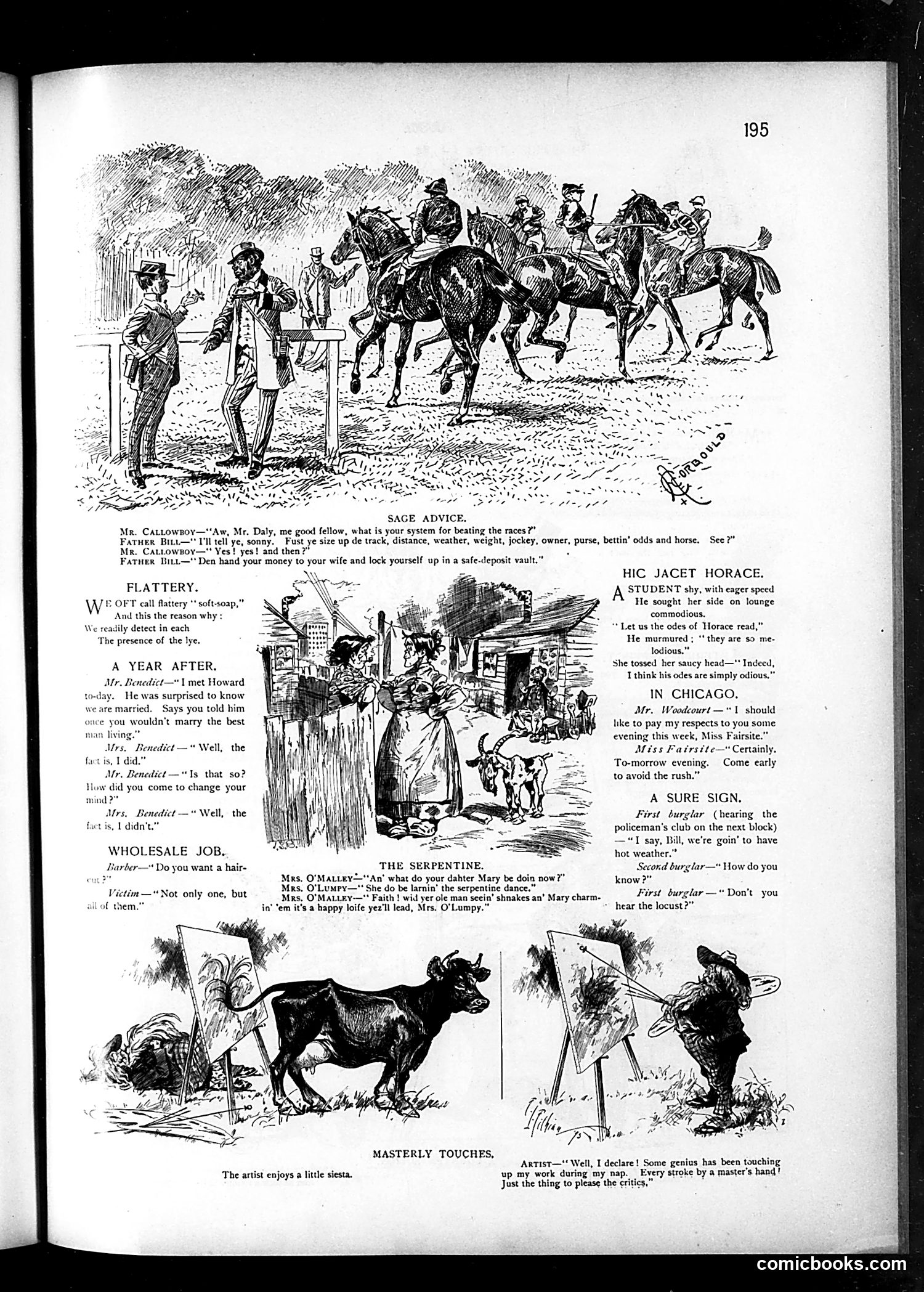
This page from *Judge* magazine contains several satirical sketches typical of late 19th-century humor: **"Sage Advice"** depicts a father (Father Bill) offering cynical marriage counsel to a young man, suggesting dishonesty about finances and infidelity—standard misogynistic humor of the era. **"Flattery"** and **"A Year After"** show a romance's trajectory from courtship to disillusionment, mocking both romantic idealism and married life. **"Hic Jacet Horace"** presents a student with odd-looking eyes, likely poking fun at physical appearance or academic pretension. **"Wholesale Job"** and **"Masterly Touches"** are brief comedic dialogues about work and artistic criticism. The bottom illustrations show animals (cow and dog) positioned near signs, playing on visual puns or absurdist humor. The overall tone reflects *Judge*'s characteristic social satire focused on relationships, social climbing, and everyday follies.
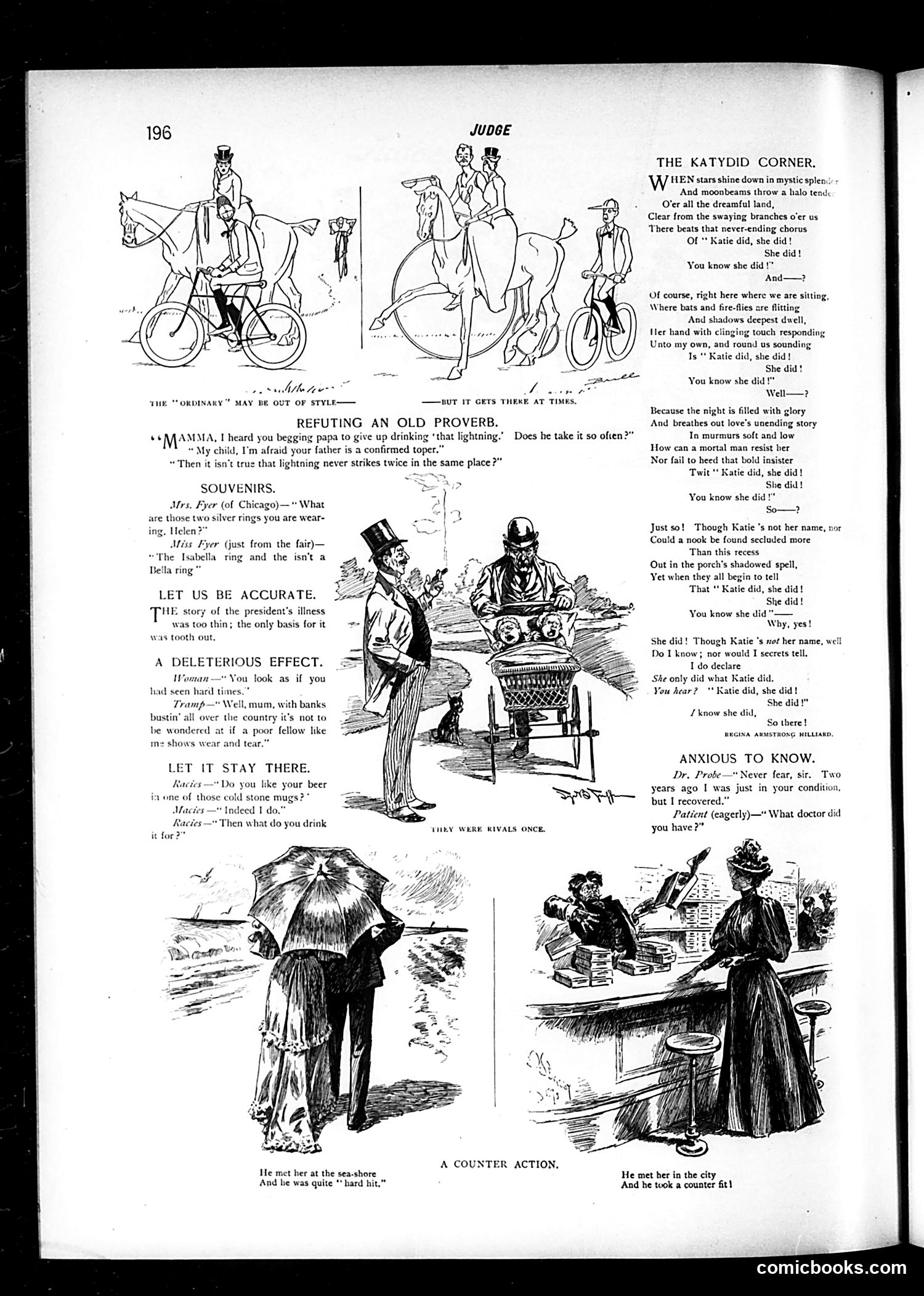
This page contains several brief humorous sketches typical of Judge's satirical style: **"Refuting an Old Proverb"** jokes about a habitual drunk father—the child misapplies the saying "lightning never strikes twice" to his repeated drinking habits. **"Let Us Be Accurate"** mocks recent presidential health rumors as baseless gossip ("tooth out" = dental extraction, not serious illness). **"A Deleterious Effect"** shows a tramp blaming bank failures for his shabby appearance—satirizing economic anxiety from banking collapses. **"The Katydid Corner"** is a romantic poem playing on the insect's "Katie did" sound, using it as backdrop for young couples' courtship on porches—gentle mockery of sentimental Victorian romance. **"A Counter Action"** presents a couple meeting at seaside ("hard hit" = smitten) then encountering each other in the city where he deliberately ignores her—reversal of romantic expectation. The page blends social commentary (banking panic, presidential gossip) with gentle domestic humor typical of 1890s Judge magazine.
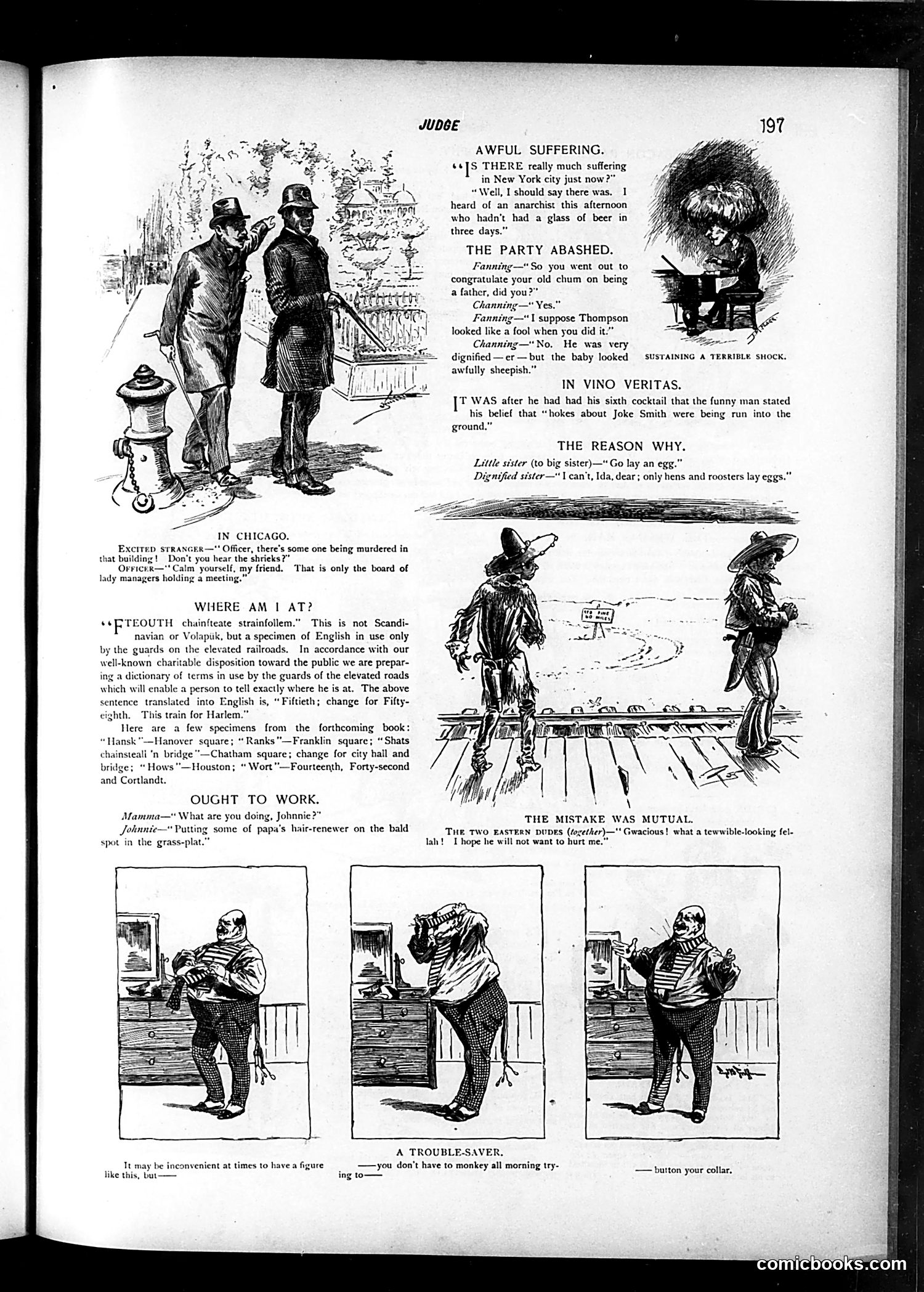
This 1890s humor page uses short jokes and cartoons to mock contemporary American life: **"Awful Suffering"** jokes about anarchists—referencing the era's labor unrest and anti-anarchist sentiment by treating an anarchist's beer deprivation as society's real problem. **"The Party Abashed"** satirizes new fathers looking foolish, with the punchline that the baby (not the father) appears sheepish. **"In Vino Veritas"** uses the Latin phrase (truth in wine) to mock drunk men's complaints about tired jokes. **"Where Am I At?"** ridicules the garbled English of NYC elevated railroad guards, promising a dictionary to decode their dialect—satirizing working-class speech patterns. **"Chicago" sketch** jokes about female charity board meetings as violent/chaotic. **"The Mistake Was Mutual"** depicts Eastern dudes (fashionable city men) meeting rough Western characters, each finding the other frightening. The page reflects 1890s urban anxieties: labor radicalism, class differences, and regional stereotypes. The tone is lighthearted mockery of American social life.
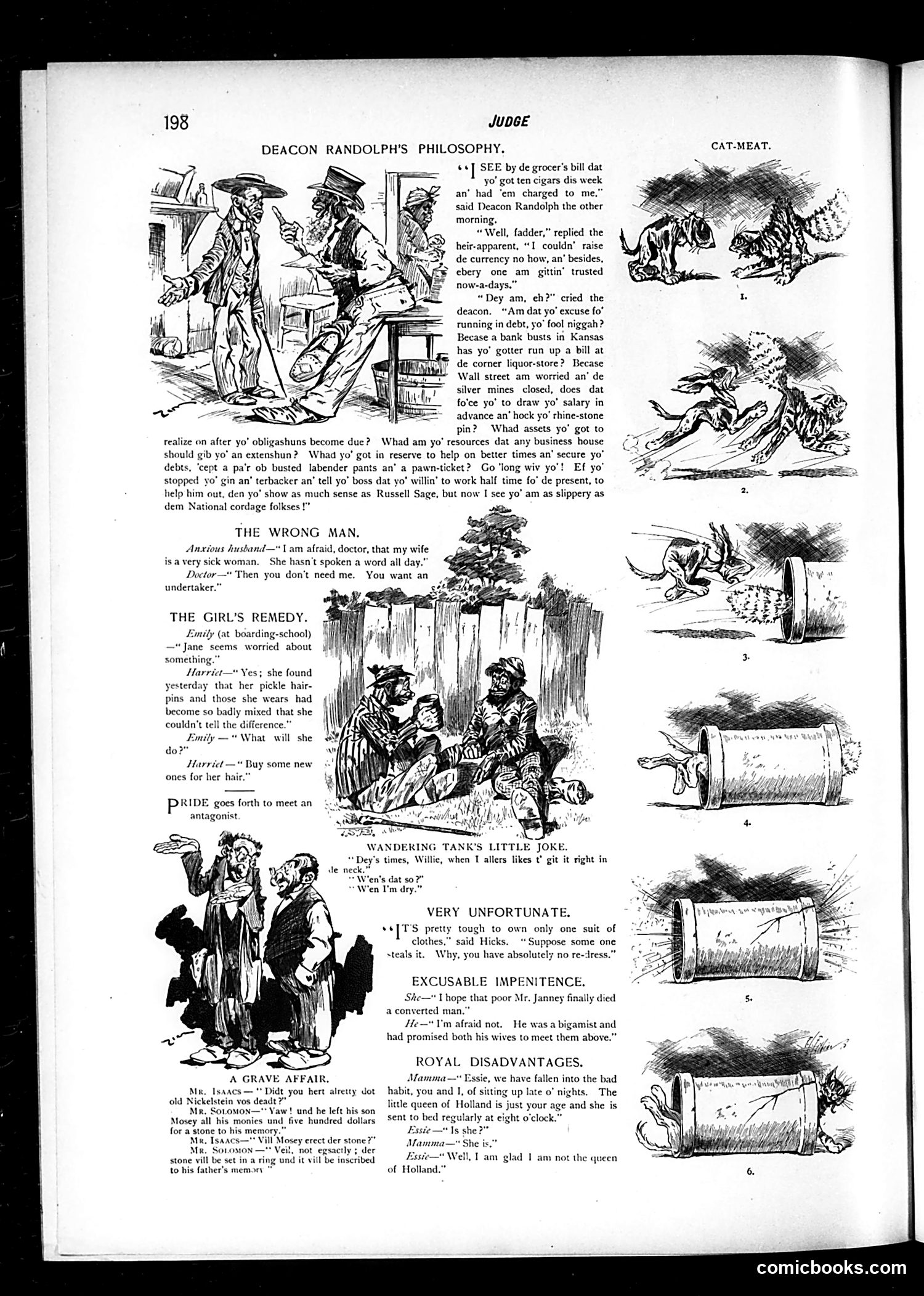
This page from *Judge* magazine contains several brief satirical sketches typical of late-19th-century American humor: **"Deacon Randolph's Philosophy"** uses a dialectal Black character (reflecting the era's offensive racial stereotyping) to satirize a young man's financial irresponsibility. The deacon lectures his son about using bank failures and market troubles as excuses for debt—a critique of those blaming external economic conditions rather than taking personal financial responsibility. **Other sketches** include standard domestic humor: a doctor's quip about an unresponsive wife, a boarding-school girl's hair-pin mix-up, and jokes about clothing theft and late bedtimes. **"A Grave Affair"** uses Yiddish-inflected dialect (another period stereotype) to joke about a miserly man's funeral monument becoming a family heirloom ring. The overall tone reflects *Judge*'s satirical approach to contemporary social anxiety—financial instability, class concerns, and domestic life—filtered through ethnic caricature that was standard (if offensive by modern standards) in Gilded Age humor.
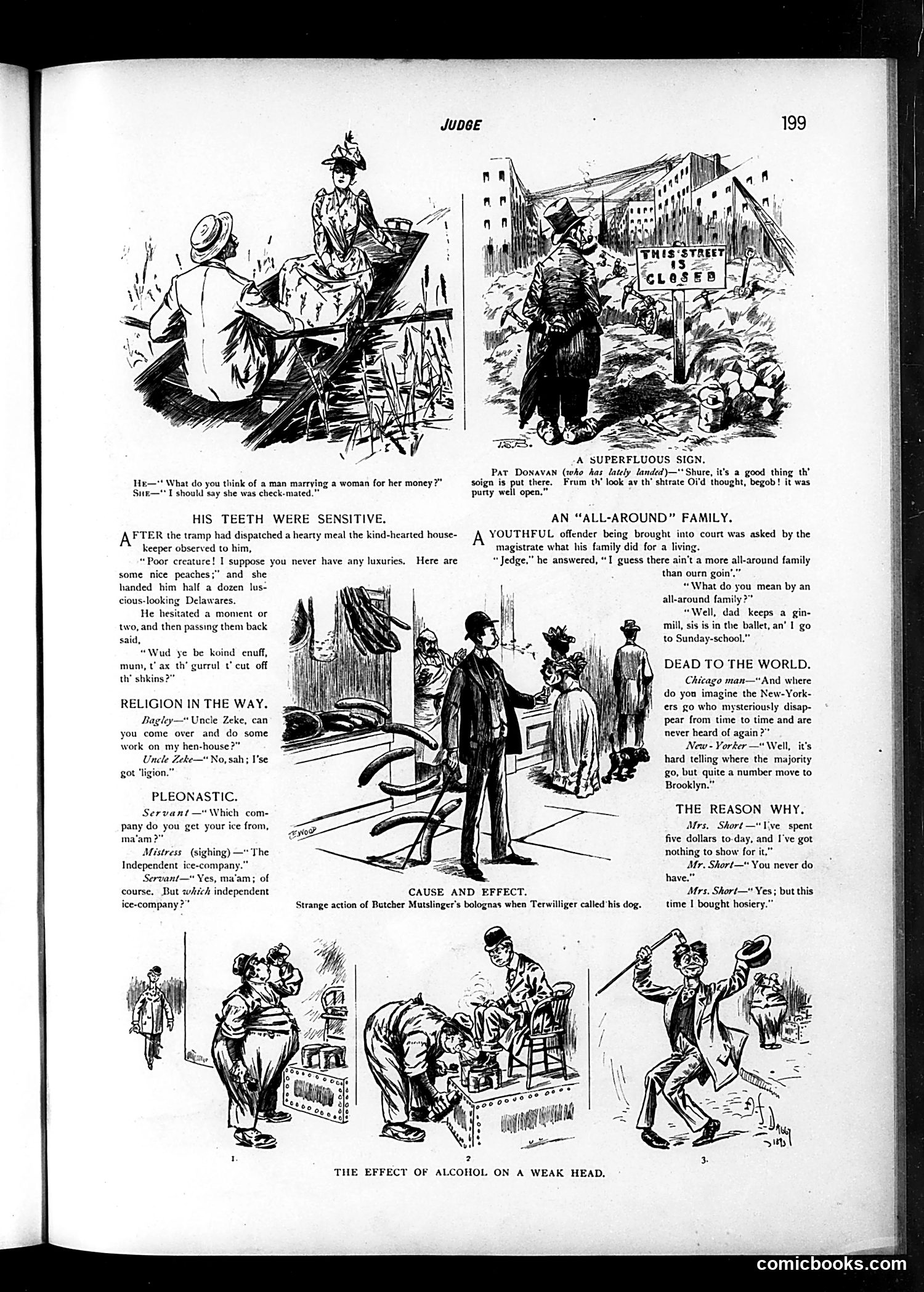
This page contains several brief jokes typical of late 19th-century American humor, touching on marriage, class, and social behavior: **Top jokes** mock marital economics ("check-mated" when a woman has money) and Irish immigrant speech patterns (Pat Donavan's dialect humor about a "closed street" sign). **"All-Around Family"** satirizes working-class occupations: the father runs a gin mill (illegal alcohol operation), the sister works in ballet (implying loose morals), and only the son attends Sunday school—suggesting hypocrisy about respectability. **Other sketches** play on dialect humor (African American and Irish characters), domestic tensions (wives' spending habits), and mild social commentary (the tramp's class status, religion as excuse). **"Effect of Alcohol on a Weak Head"** depicts physical comedy of intoxication. The page reflects period attitudes: casual ethnic stereotyping through exaggerated dialect, class-based humor, and gender dynamics treating women's autonomy with skepticism. These were standard Judge magazine fare for contemporary readers.
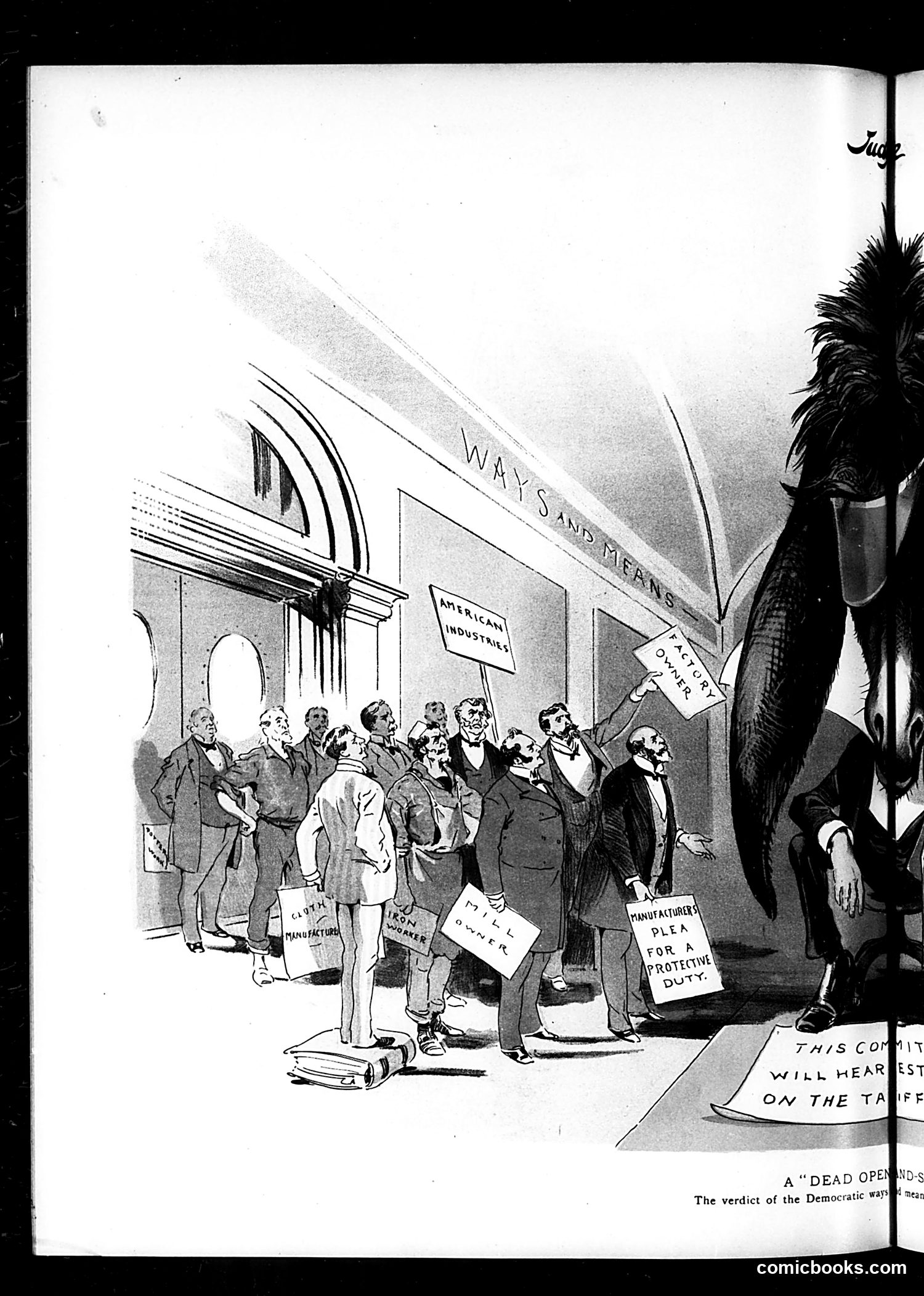
This cartoon satirizes Democratic Party divisions over tariff policy. A group of men in formal dress, carrying signs reading "MANUFACTURER'S PLEA FOR PROTECTIVE DUTY" and similar appeals, stand outside what appears to be a closed government building labeled "WAYS AND MEANS" (referring to the House Ways and Means Committee). The cartoon's title, "A Dead Open Door," suggests the Democrats' inability to act decisively on tariff protection despite manufacturers' requests. The figures represent business interests petitioning the Democratic leadership, while the closed door implies their pleas fall on deaf ears—satirizing Democratic inaction or internal disagreement on protective tariffs, a significant economic policy debate of the era.
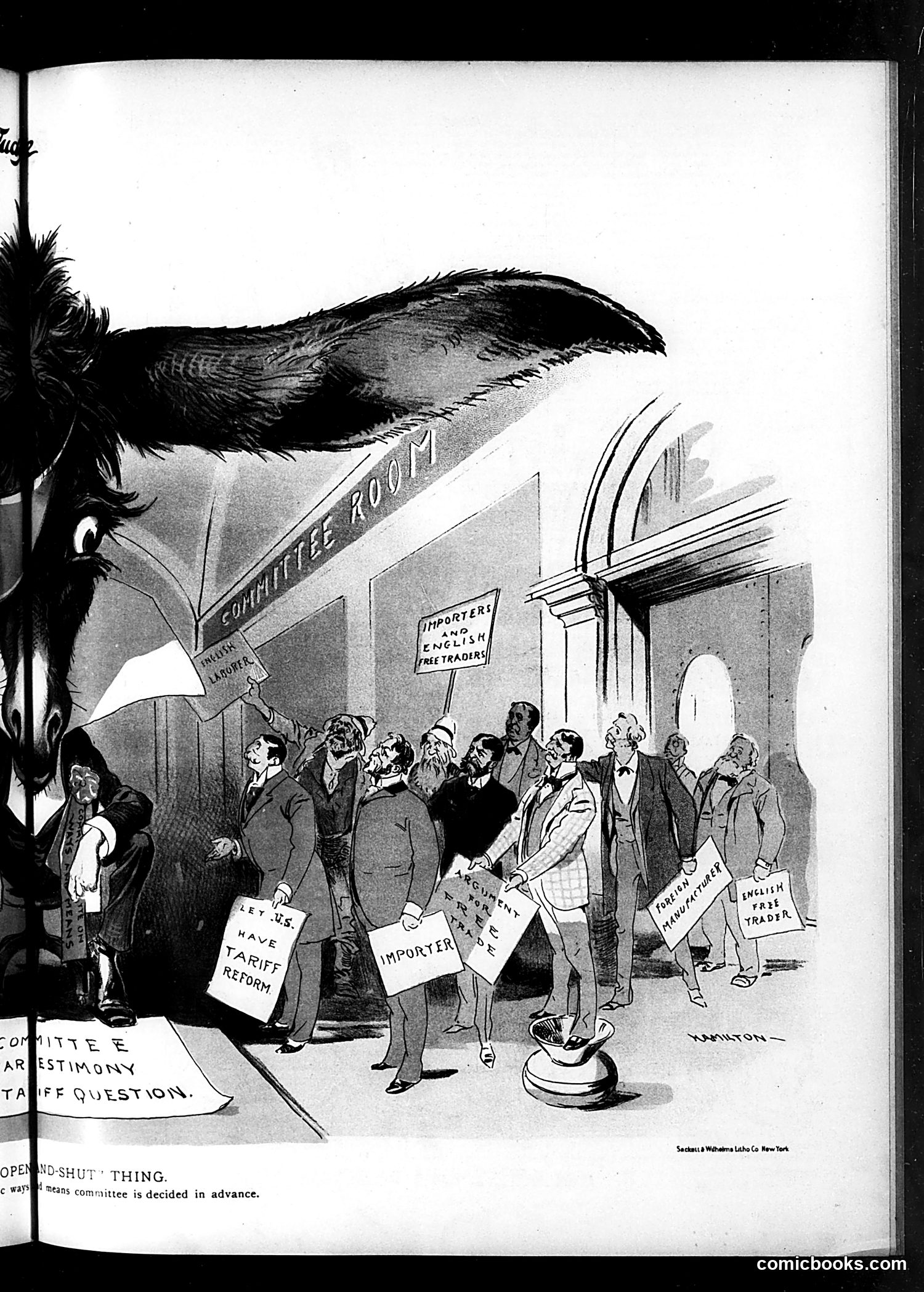
This editorial cartoon satirizes a congressional committee hearing on tariff reform. A large rooster perches atop a "Committee Room" building, symbolizing predetermined outcomes—the "open-and-shut thing" of the caption. Below, various businessmen carry protest signs: "Let us have Tariff Reform," "Importer," "Free Trader," and "Importers and English Free Traders." They're testifying before the committee, but the cartoon suggests their testimony is meaningless since the decision is already made. The rooster likely represents either arrogance or corruption—the committee's predetermined verdict regardless of evidence presented. This reflects Progressive-era skepticism about whether congressional committees genuinely considered public input or merely performed theater for predetermined political outcomes. The satire criticizes legislative processes as rigged spectacles.
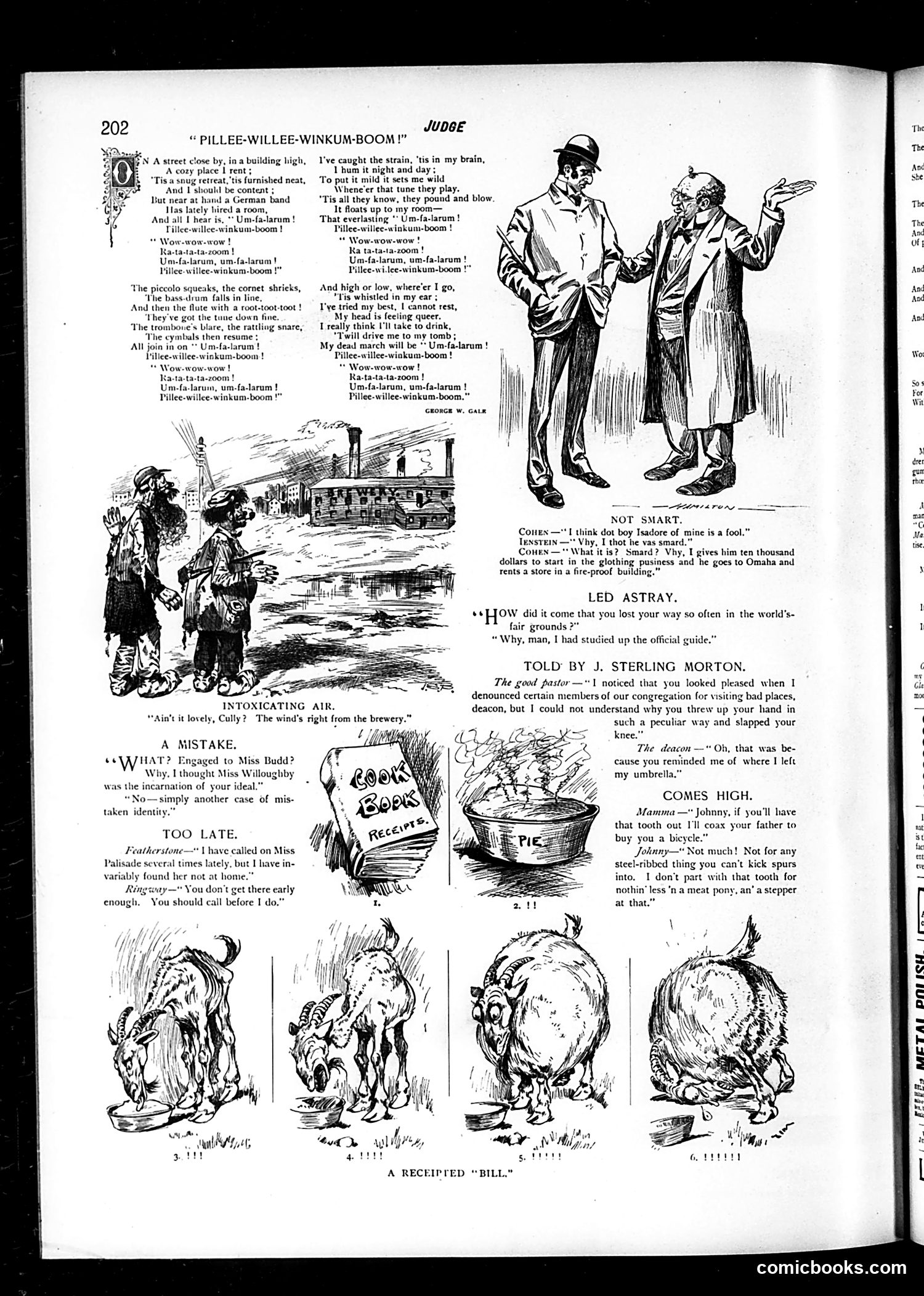
This page contains several short humorous pieces typical of Judge's satirical format: **"Pillee-Willee-Winkum-Boom"** is a complaint-song about a neighbor's German brass band playing the same irritating tune repeatedly. The satire targets German immigrants and stereotypes them as musically incompetent and culturally annoying—reflecting late 19th-century American prejudice against German communities. **"A Mistake"** and **"Too Late"** are brief romantic comedies about confused identities and missed social calls—lighthearted domestic humor requiring no historical context. **"Led Astray"** and **"Told by J. Sterling Morton"** are anecdotal jokes. Morton was a prominent Nebraskan figure, lending prestige to his attributed humor. **"Comes High"** depicts a child negotiating with his mother over extracting a tooth—playing on children's resistance to dental work. **"A Receipted Bill"** shows a cow repeatedly trying to eat from a pie dish—a visual gag requiring no explanation. The page reflects Judge's mix of immigrant satire, domestic humor, and visual comedy.
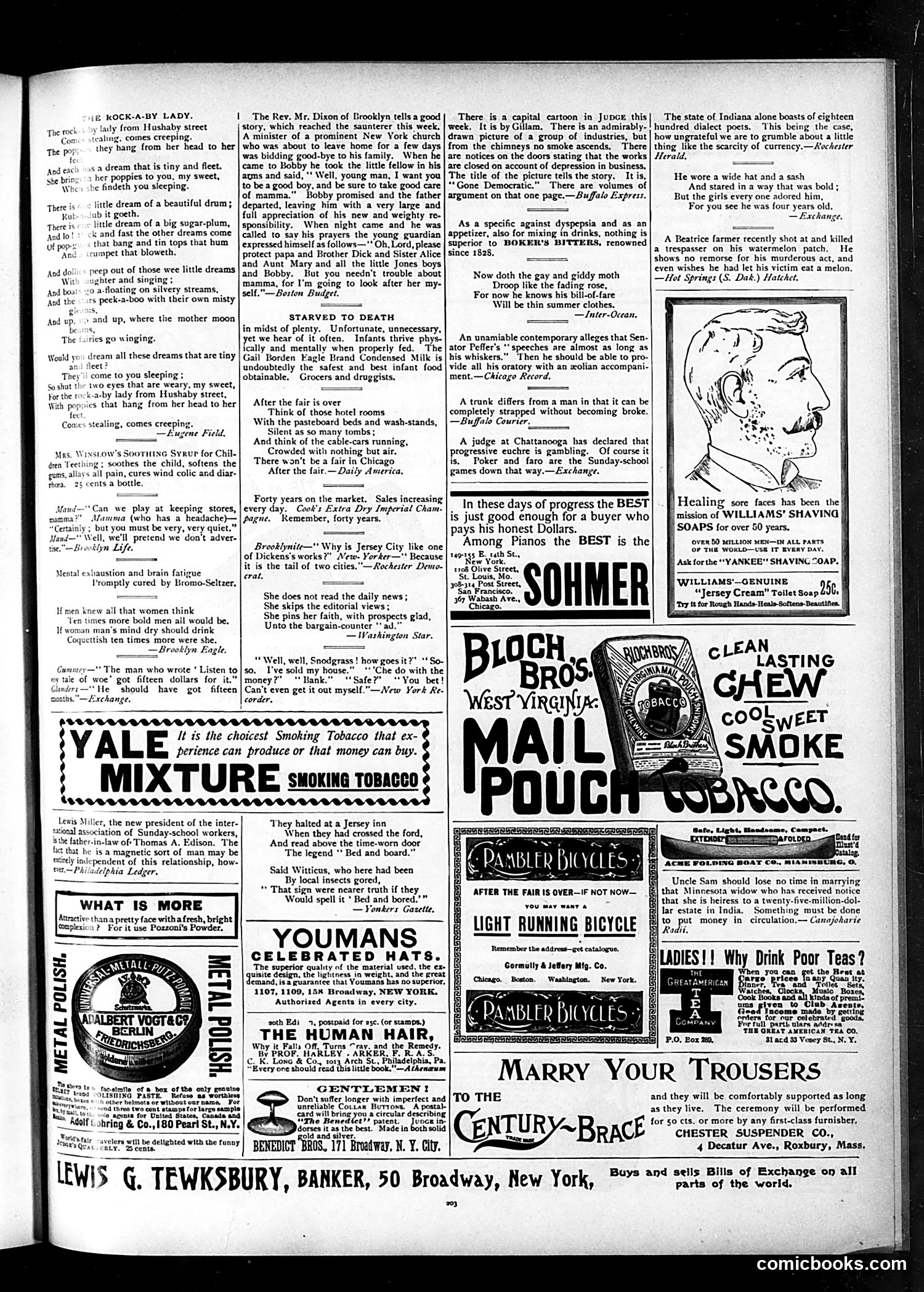
This page from Judge magazine consists primarily of **poetry, light humor, and advertisements** rather than political cartoons. The main content includes: **Literary pieces:** - "Rock-a-By Lady," a sentimental poem about childhood dreams - "Starved to Death," an advertisement disguised as moral commentary promoting condensed milk - Brief humorous anecdotes about a Brooklyn minister's son and other social situations **Social satire:** The scattered jokes mock domestic life and gender relations (e.g., "If women man's mind dry should drink / Coquettish ten times more were she"). The pieces reflect turn-of-century American anxieties about motherhood, children's welfare, and proper behavior. **Advertising dominates:** The page is cluttered with product ads (tobacco, hats, bicycles, powders, shaving soap), typical of Judge's business model. There is **no identifiable political cartoon** with caricatured figures on this page. The content is domestic humor and commercial material rather than topical political satire.
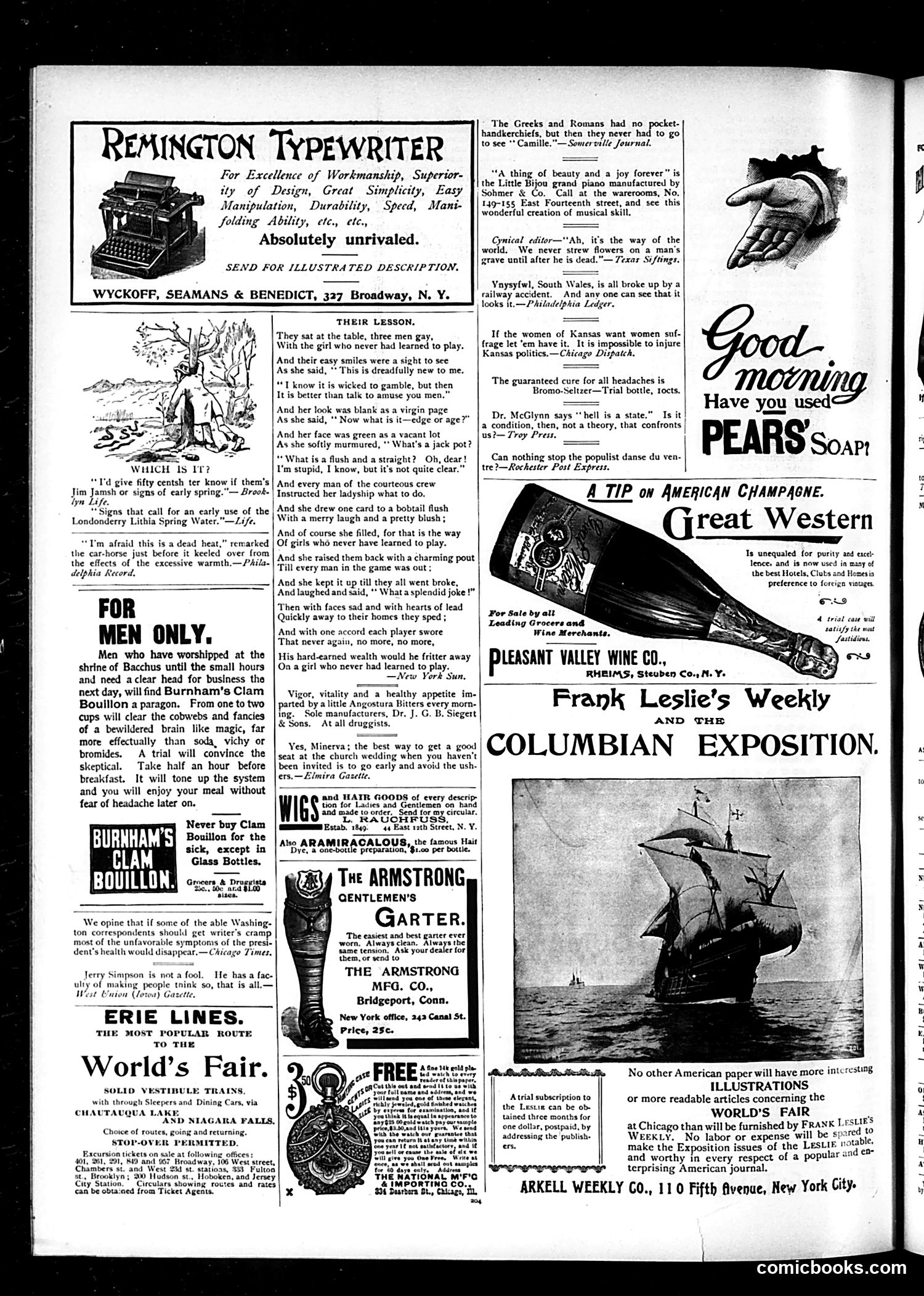
This page is primarily **advertising**, with one significant cartoon narrative titled "Their Lesson." **The Main Cartoon ("Their Lesson"):** The illustrated story depicts a cautionary tale about three men who teach card-playing to an inexperienced young woman at a social gathering. The satire inverts gender expectations: despite her claims of innocence ("I've never learned to play"), the woman systematically wins all their money through poker, leaving the men financially ruined and sworn never to gamble with her again. **The Satire's Point:** The piece mocks naive male gallantry and the false assumptions men make about women's inexperience. The woman's apparent helplessness ("I'm stupid, I know") masks shrewd card-playing ability. The moral subverts Victorian assumptions: gentlemen shouldn't underestimate women, particularly regarding games of chance and wit. **Context:** Published in Judge (a humor magazine), this reflects late-19th-century anxieties about changing gender roles and women's intelligence, presented through entertainment rather than serious social commentary. The remaining page content consists of period advertisements for typewriters, patent medicines, and transportation services.
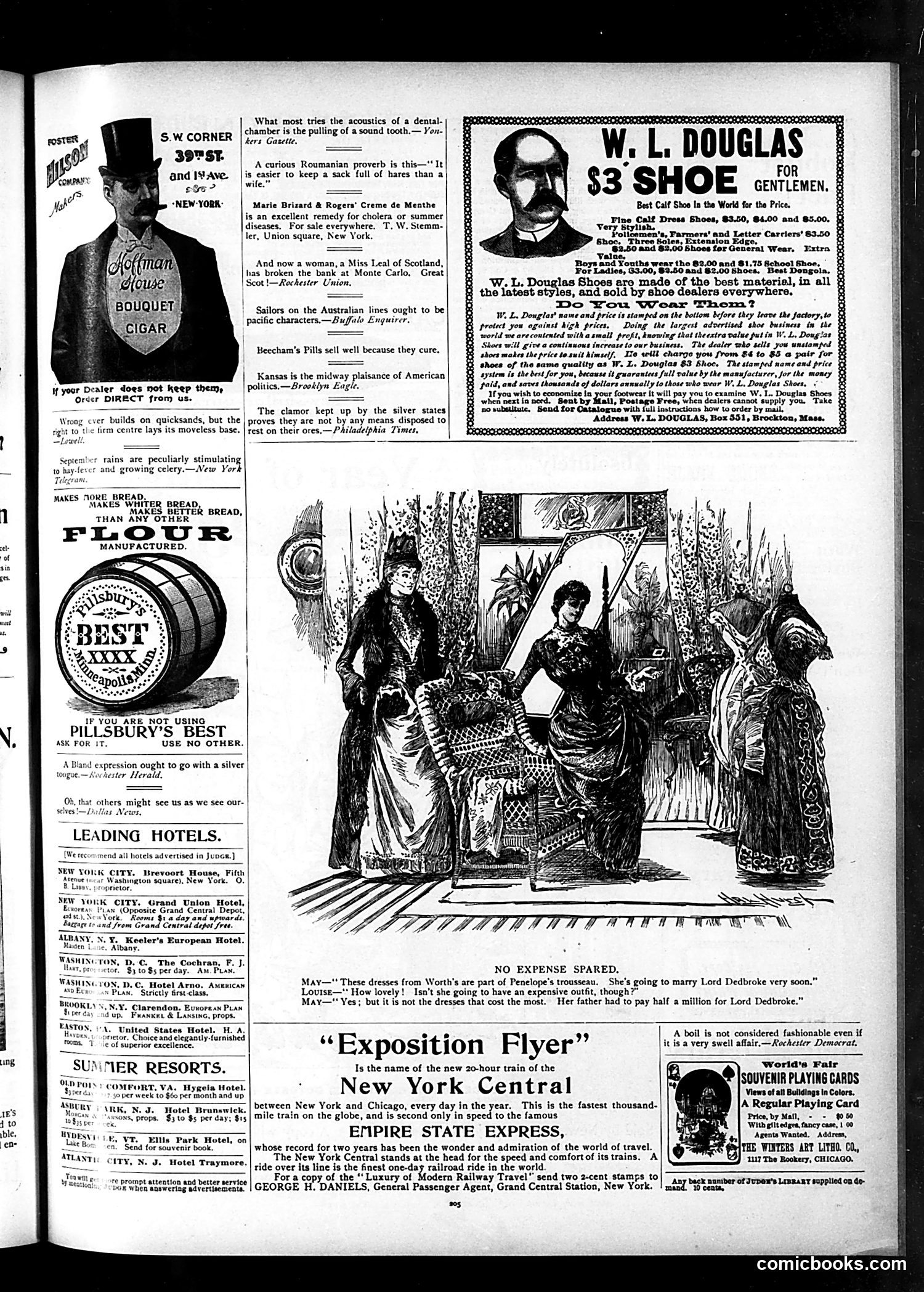
This page is primarily **advertisements and filler content** rather than satirical cartoons. The main visual element is an illustration labeled "NO EXPENSE SPARED," depicting a social scene where women discuss a trousseau for an aristocratic marriage to "Lord Dedbroke." The dialogue satirizes **wealth and class pretension**: one woman boasts about designer dresses from Worth (the famous Parisian couturier), but the joke—cut off mid-sentence—implies the *real* expense isn't the clothes but something else (likely the father's bribes or settlements required for the aristocratic match). The surrounding content consists of **period advertisements** (W.L. Douglas shoes, Pillsbury flour, patent medicines) and **brief humorous observations** on dental work, Romanian proverbs, and Kansas politics—typical filler for 19th-century magazines. The cartoon gently mocks **nouveau riche social climbing** and the transatlantic marriage market where wealthy American heiresses married impoverished European aristocrats.
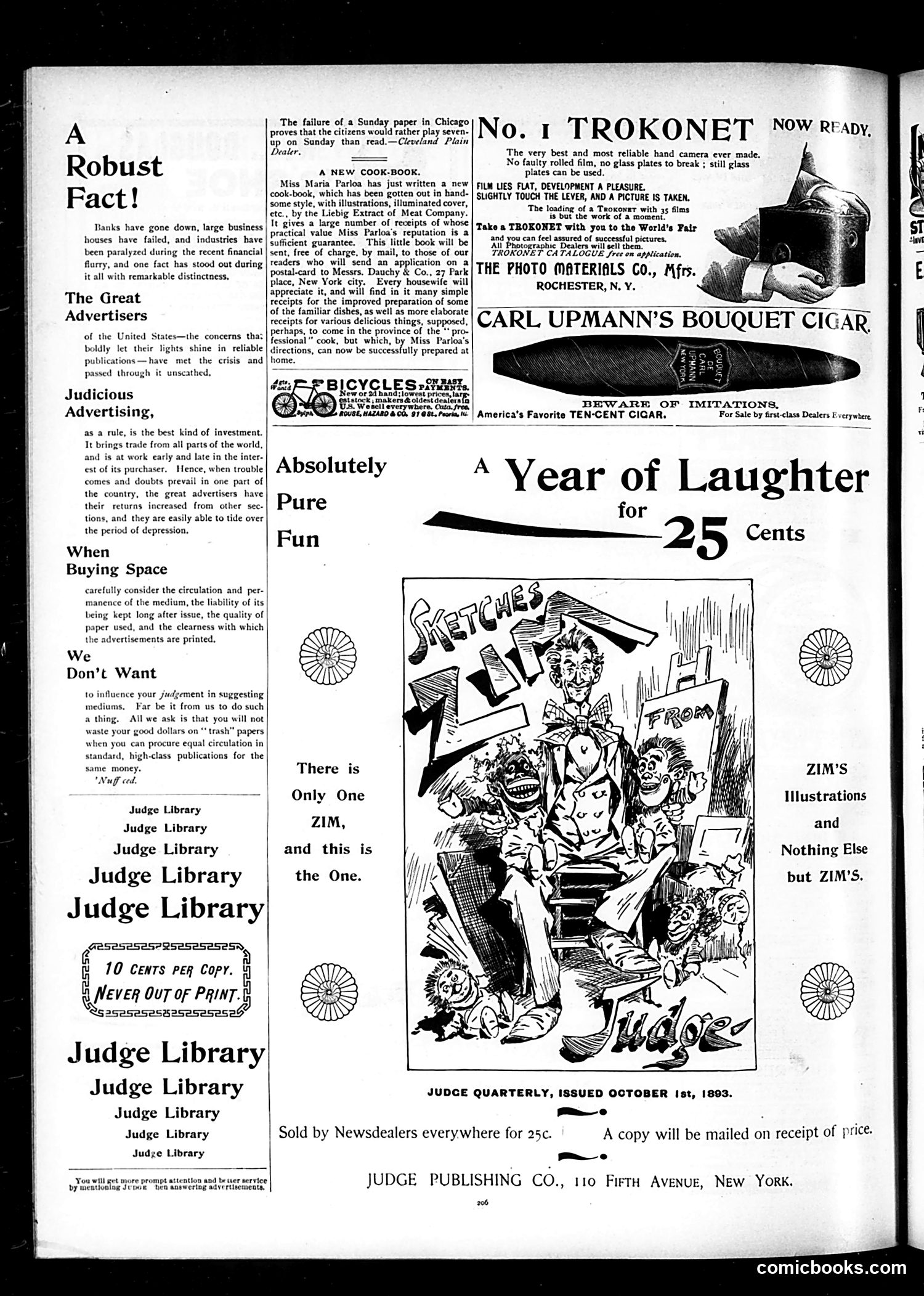
This page is primarily **advertising and editorial content** rather than political satire. The main elements are: **Left Column:** Editorial arguing that "great advertisers" of reliable publications survived the recent financial crisis better than non-advertisers—essentially advocating that smart companies should buy ad space in quality magazines like *Judge*. **Central Cartoon:** A humorous illustration titled "Sketches from Judge" showing exaggerated, grotesque figures in a chaotic scene. The caption states "There is Only One ZIM, and this is the One"—promoting *Judge's* cartoonist ZIM and his illustrations. **Advertisements:** The page features multiple ads for products including Trokonet cameras, bicycles, cook-books, and cigars—typical of 1890s magazine advertising. **Context:** This appears designed to simultaneously promote *Judge* magazine itself (through the ZIM illustration) while demonstrating advertiser confidence by filling the page with paid ads. The financial "flurry" mentioned likely references the 1893 economic panic.
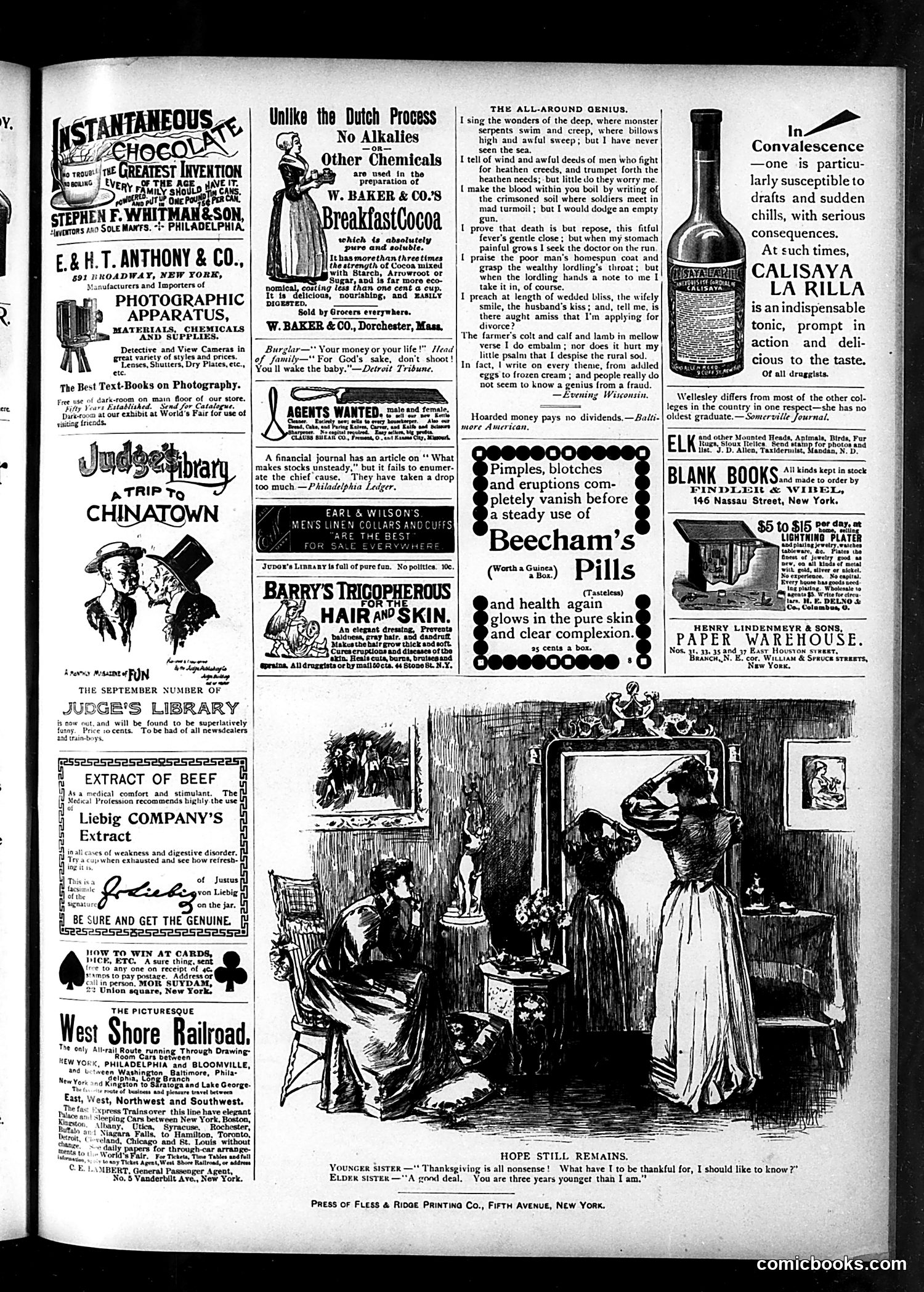
This page's main cartoon is a **satirical poem** mocking the hypocrisy of writers and public figures. The poem describes someone who writes eloquently about grand, noble themes—the sea, war, the poor man's virtue, married love—yet personally exhibits the opposite values. He avoids actual danger, seeks money from the wealthy despite criticizing them, applies for divorce while praising marriage, and despises rural life despite romanticizing it. The joke is that this "genius" is a complete **fraud**—preaching ideals he doesn't practice, writing with emotional passion about experiences he avoids. The final lines make explicit that readers don't notice the contradiction between his flowery words and his actual behavior. This targets the **hypocrisy of Victorian-era writers and journalists** who profited from sentimental or radical rhetoric while living conventionally self-interested lives. It's a scathing critique of insincerity in published commentary.
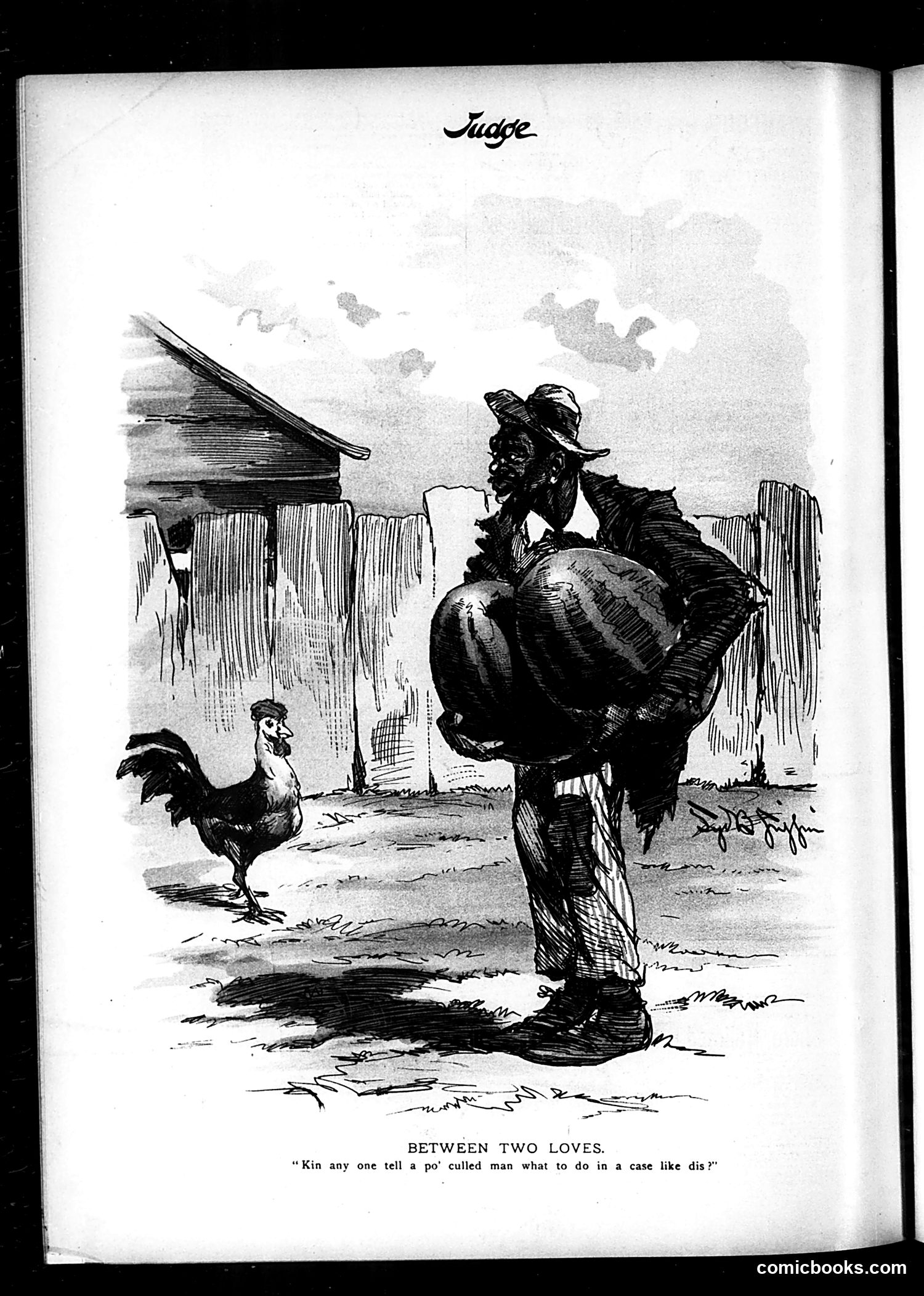
This cartoon uses racist dialect and caricature typical of early 20th-century American satire. It depicts a Black man caught between two "loves"—literally holding a large globe/world while a rooster (suggesting infidelity or romantic entanglement) stands nearby. The figure appeals for advice on his romantic dilemma. The satire likely comments on Black male identity or labor during this era, possibly referencing immigration, economic competition, or social positioning. The "globe" he carries may represent the world's burdens or opportunities. However, without clearer historical context or date information from the Judge magazine, the specific political or social reference remains unclear. The humor relied on racist stereotypes and dialect that were standard in period publications but are deeply offensive today.