
A complete issue · 16 pages · 1893
Judge — September 16, 1893
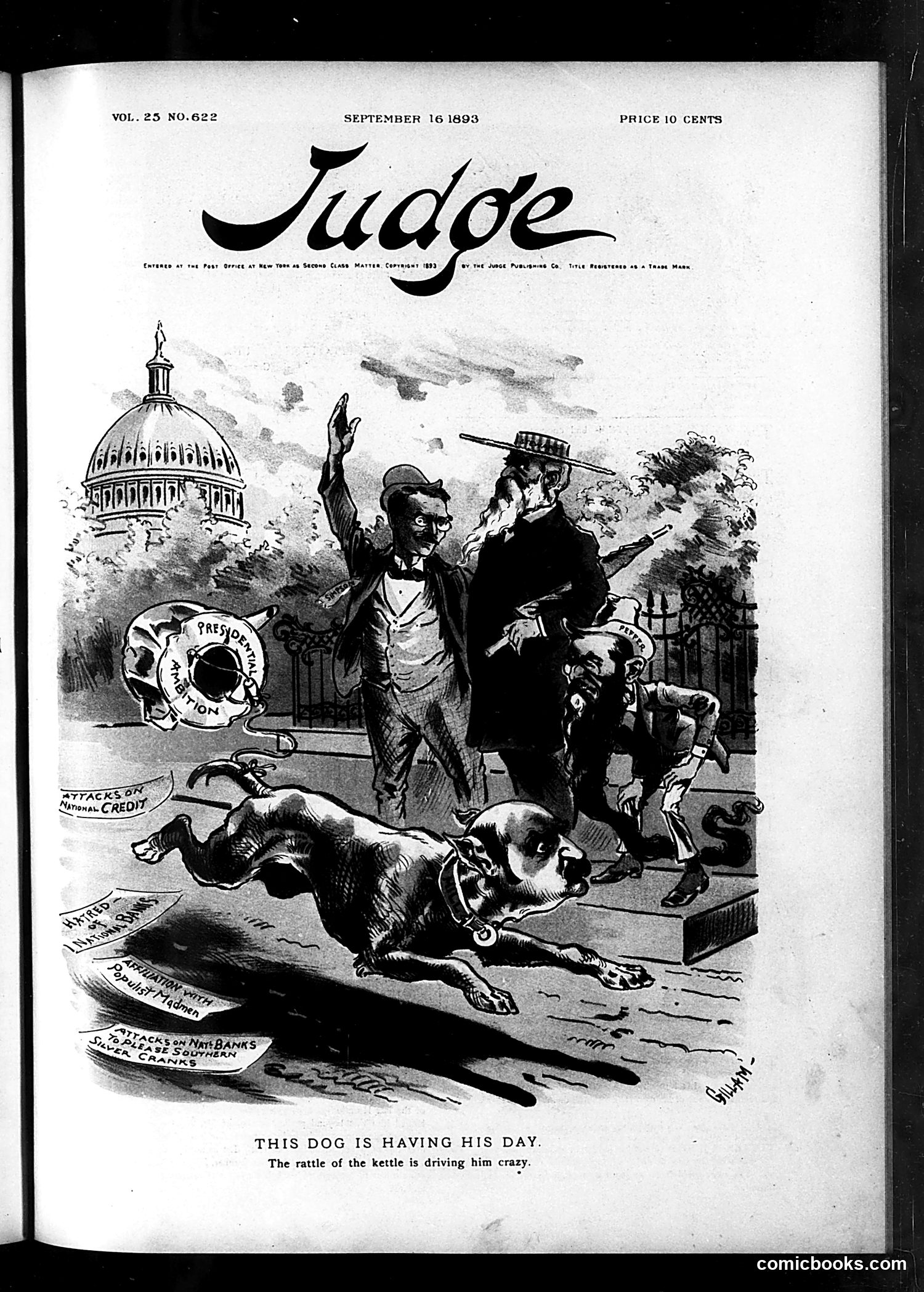
This is an 1893 *Judge* political cartoon satirizing financial and political turmoil. The central dog represents the economy or banking system—note labels referencing "attacks on national credit" and issues with banks and silver currency. Two figures in the background (likely political leaders) appear helpless as the dog writhes chaotically. The Capitol building looms behind them, suggesting Congressional inability to control the crisis. The "rattle of the kettle" subtitle puns on financial instability ("kettle of fish") while mocking how political noise agitates economic panic. The cartoon critiques how politicians failed to manage the severe financial panic affecting America in 1893—blaming leadership for allowing economic chaos to spiral beyond control.
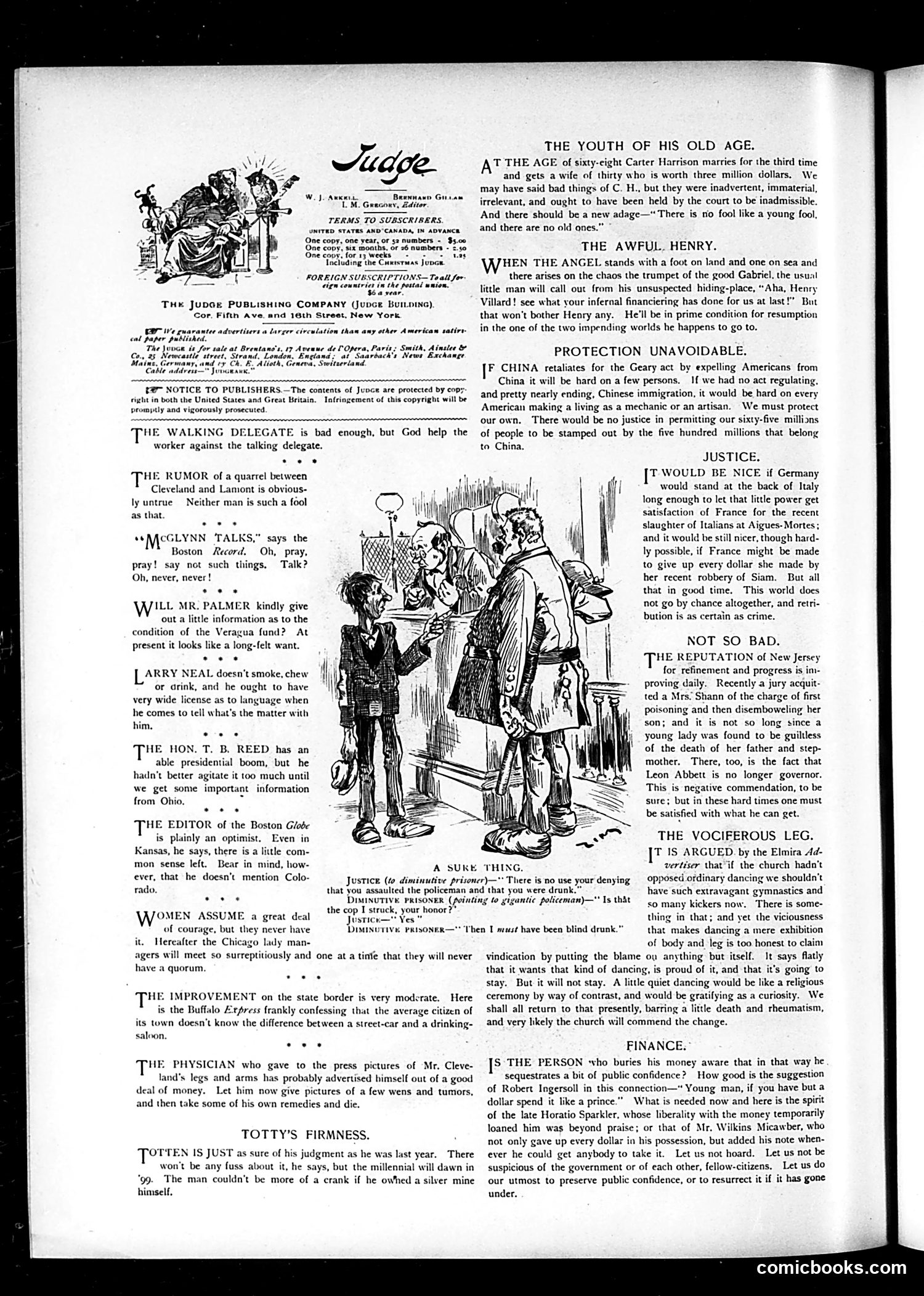
The main cartoon depicts a police officer confronting a drunk man, with the officer saying "There is no use your denying you assaulted the police officer and that you were drunk." The drunk responds he must have been blind drunk, creating the satirical point: the man claims blindness as his excuse, but the officer's logic suggests obvious guilt either way. The surrounding text contains brief political commentary items typical of Judge's format, including critiques of political figures and social conditions. These snippets address topics like Chinese immigration policy, German-Italian relations, New Jersey legal cases, and dancing morality—standard subjects for American satirical commentary of the era. The page demonstrates Judge's mix of visual humor and short-form social criticism.
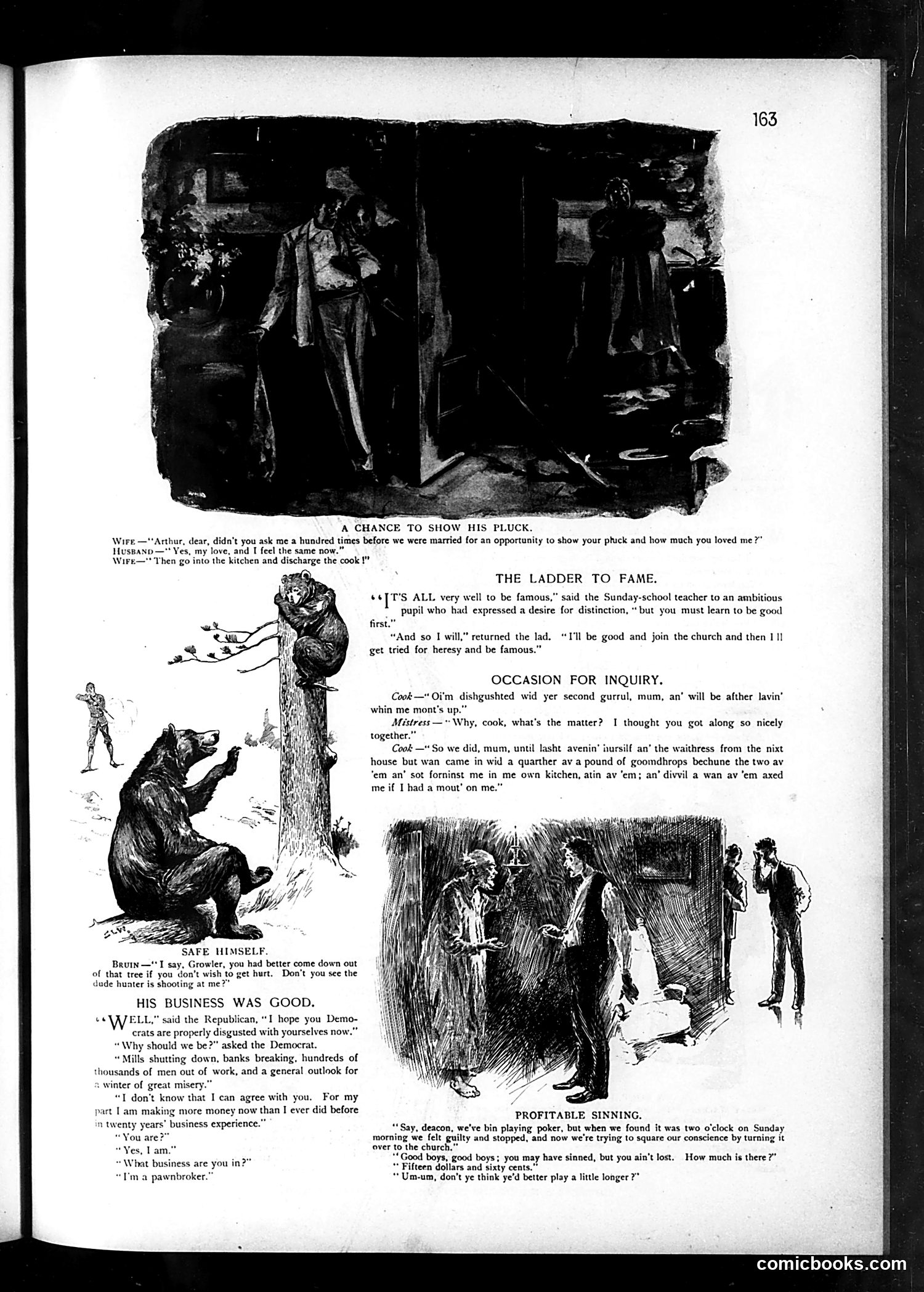
This page contains several short humorous sketches typical of Judge magazine's satirical humor: **"A Chance to Show His Pluck"** depicts marital discord—a wife reproaches her husband for lacking ambition and accomplishment, then sarcastically suggests he prove himself by doing housework. **"The Ladder to Fame"** mocks an ambitious schoolboy's naïve belief that goodness and church attendance lead to distinction. **"Occasion for Inquiry"** shows a cook defending herself against accusations of theft by blaming neighborhood incidents for missing items. **"His Business Was Good"** features a pawnbroker and Democrat debating economic policy, with the pawnbroker claiming prosperity from his business experience. **"Profitable Sinning"** depicts deacons caught gambling on Sunday, attempting to minimize their transgression. These sketches satirize everyday hypocrisy, failed ambitions, and moral compromises among ordinary Americans.
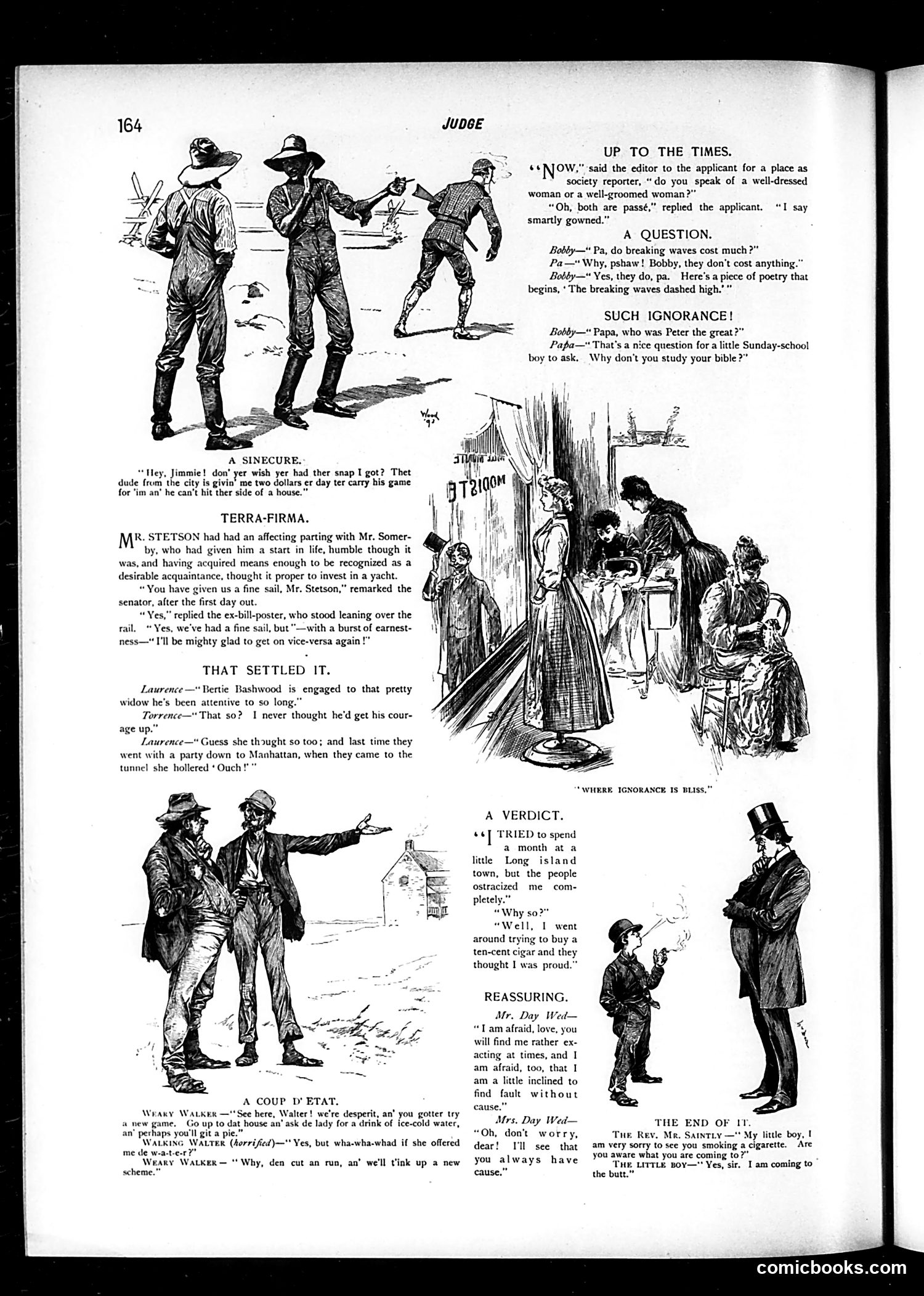
This page from *Judge* contains multiple short satirical pieces mocking social pretension and ignorance of the era: **"Up to the Times"** ridicules fashion terminology—a job applicant uses the newest phrase "smartly gowned" instead of older descriptors. **"A Question" and "Such Ignorance!"** feature a child character named Bobby exposing adult absurdity: waves costing money (misreading poetry), and a father unable to answer basic historical questions. **"Terra-Firma"** mocks newly wealthy social climbers—an ex-bill-poster (working-class origin) buys a yacht to gain respectability but admits he prefers solid ground. **"A Coup d'État"** shows street urchins ("Weary Walker," "Walking Walter") as con artists trying to scam women for food. **"A Verdict"** satirizes small-town snobbery—a visitor is ostracized for buying cheap cigars, interpreted as arrogant. The remaining pieces gently mock courtship, marriage anxieties, and smoking. Overall, the humor targets class anxieties, social climbing, and pretension—common *Judge* themes lampooning Gilded Age society.
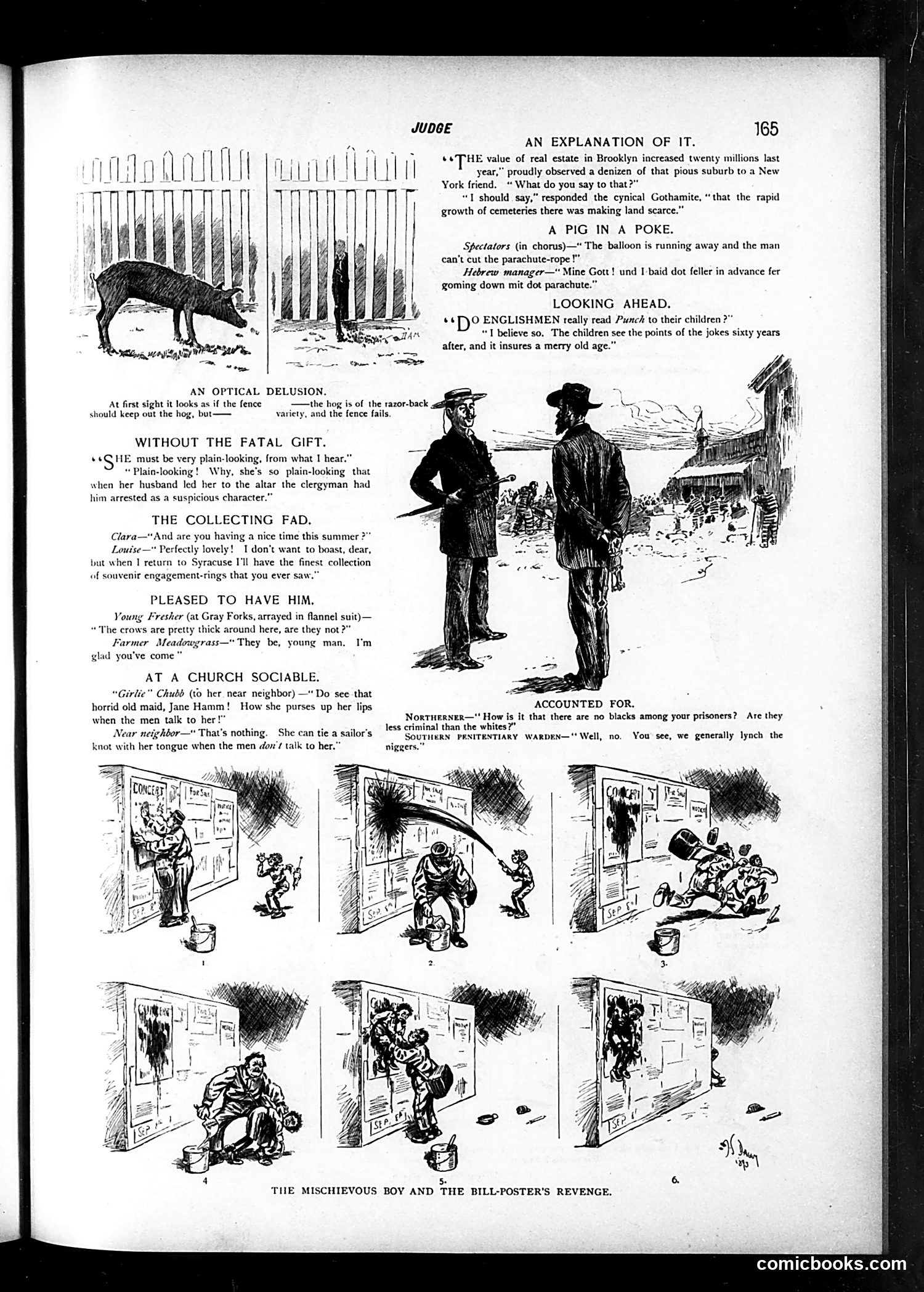
This page contains multiple brief satirical jokes typical of late 19th-century American humor: **"An Explanation of It"**: A New York cynic deflates Brooklyn boosterism about rising real estate values by quipping that rapid cemetery growth there actually makes land scarce—dark humor about the suburb's mortality rate. **"A Pig in a Poke"**: A Hebrew manager (stereotype dialect included) has paid in advance for a parachutist performer, only to watch the balloon escape—the joke being he's been swindled. **"The Collecting Fad"**: A woman brags about collecting "souvenir engagement-rings" from Syracuse—implying she's serially engaged but unmarried. **"Accounted For"**: The final cartoon presents a deeply offensive racial joke. A Southern prison warden explains having no Black prisoners by stating they "lynch the niggers" instead of imprisoning them. This documents historical lynching as contemporary "humor." The page reflects period attitudes: ethnic caricature, misogyny, and—most disturbingly—casual acceptance of racial violence as comedic material. These items illuminate what mainstream American publications considered entertaining.
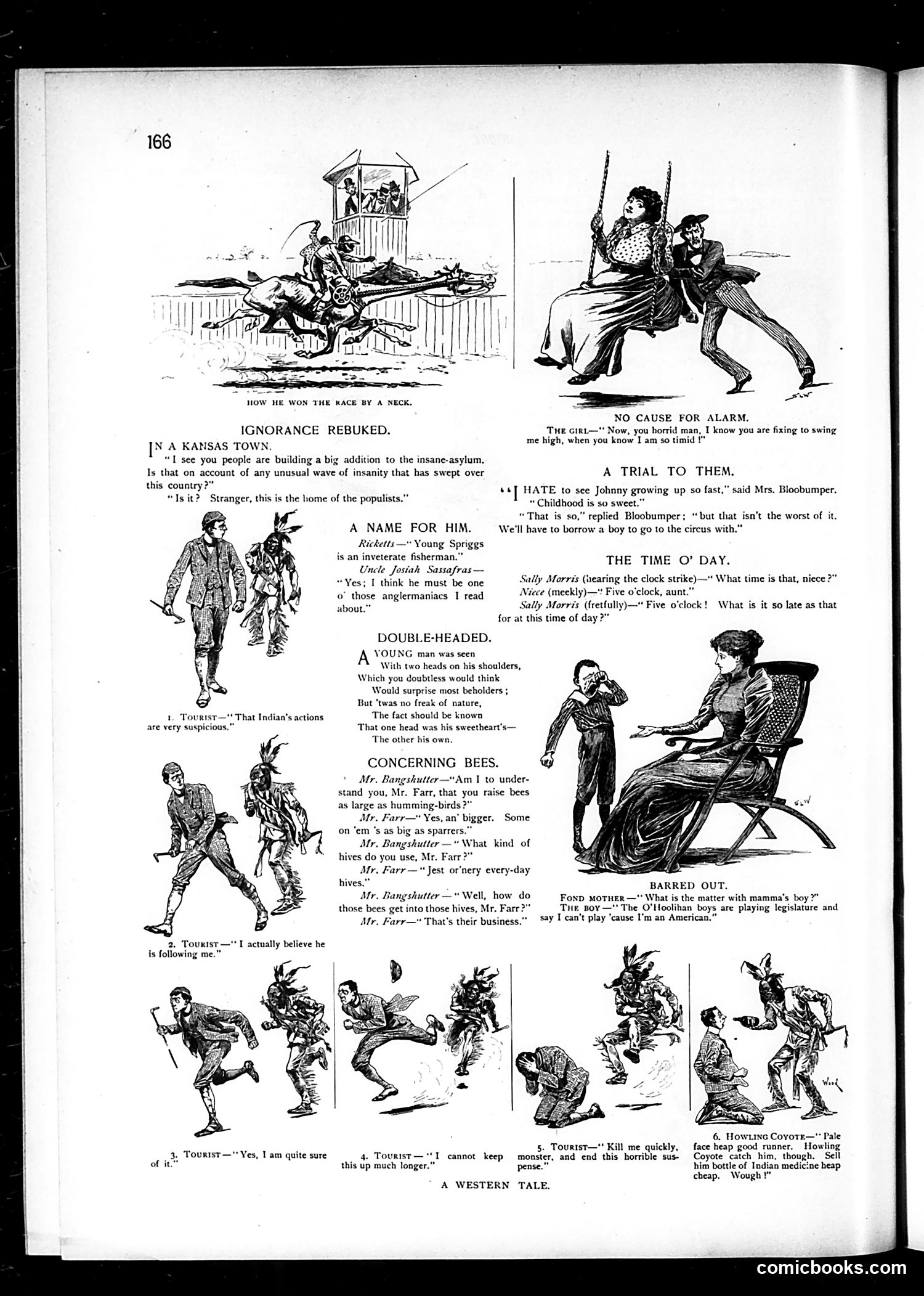
This page contains multiple satirical vignettes mocking various American figures and behaviors circa the late 19th century: **"Ignorance Rebuked"** ridicules Kansas residents (likely referencing the Populist Party's strength there) by having a character suggest the state needs an asylum expansion—implying Populists are insane. **"A Name for Him"** plays on "angler" vs. "anglermaniac," mocking obsessive fishermen as mentally unbalanced. **"Double-Headed"** presents a young man controlled by two heads—his own and his sweetheart's—satirizing male weakness to romantic influence. **"No Cause for Alarm"** jokes about a woman refusing a man's courtship proposition while swinging. **"Concerning Bees"** features tall tales about absurdly large bees, mocking rural storytelling conventions. **"A Western Tale"** shows a tourist terrorized by Native Americans and a fake "Indian medicine" con artist—reflecting period stereotypes and frontier anxiety. Throughout, the cartoons ridicule rural Americans, Westerners, and Populists through exaggeration and ethnic caricature typical of Judge's satirical approach.
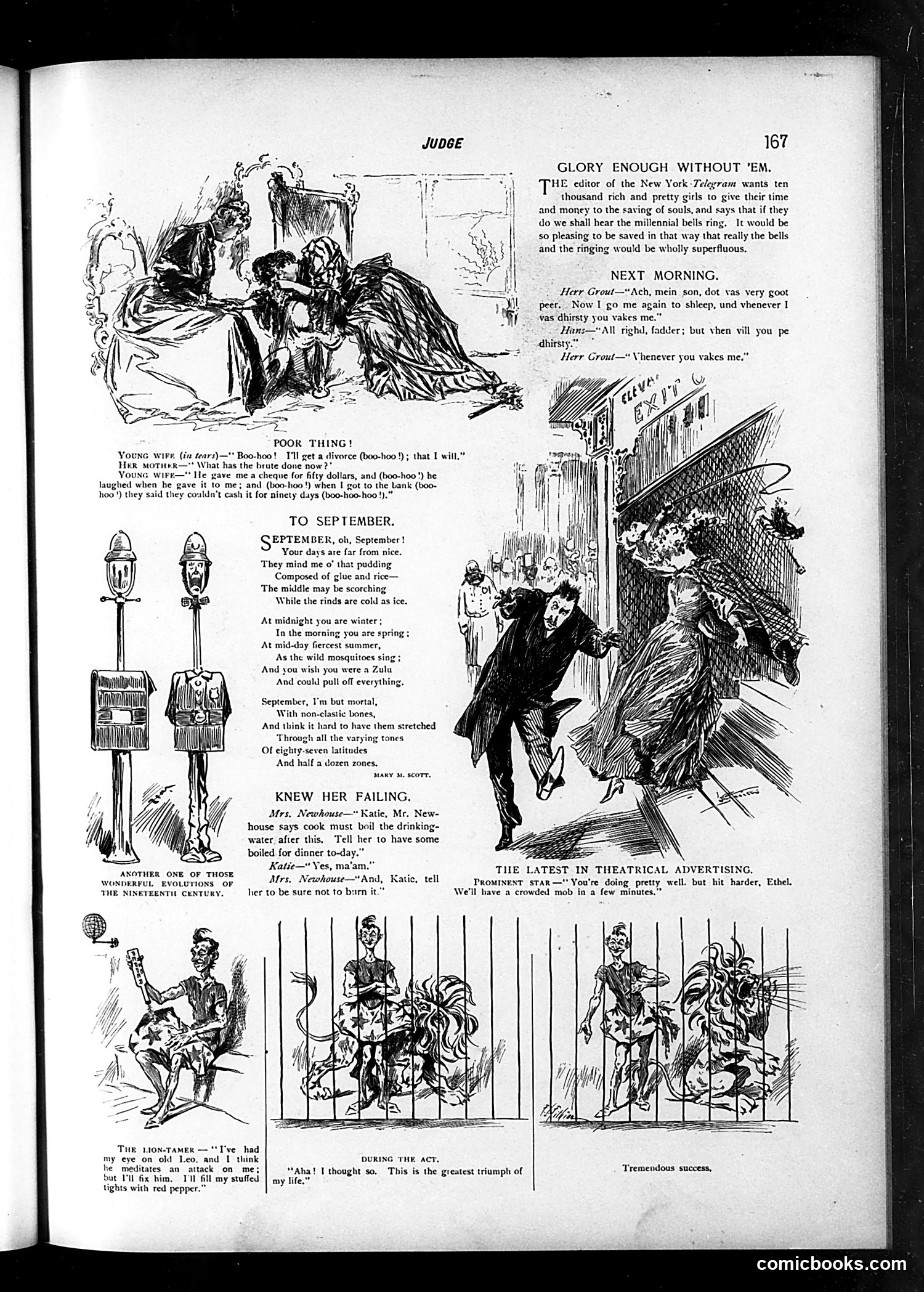
This page contains several disconnected satirical pieces typical of Judge magazine's format: **"Glory Enough Without 'Em"** mocks a *New York Telegram* editor's proposal that wealthy women donate time and money to religious salvation efforts—sarcastically suggesting the scheme is so appealing that church bells couldn't adequately celebrate it. **"Next Morning"** depicts a German immigrant father and son in a circular logic joke about drinking water and sleep, playing on ethnic dialect humor common to the era. **"Poor Thing!"** satirizes a young wife's absurd complaint: she's divorcing her husband because he laughed when giving her a $50 check—which the bank won't cash for 90 days. The joke mocks female frivolousness and entitlement. **"To September"** is a humorous poem personifying the unpredictable weather month. **"Knew Her Failing"** and theatrical advertising sketches complete the page with domestic and show-business humor. The page exemplifies Judge's mix of social satire, ethnic caricature, and domestic comedy aimed at upper-class readers.
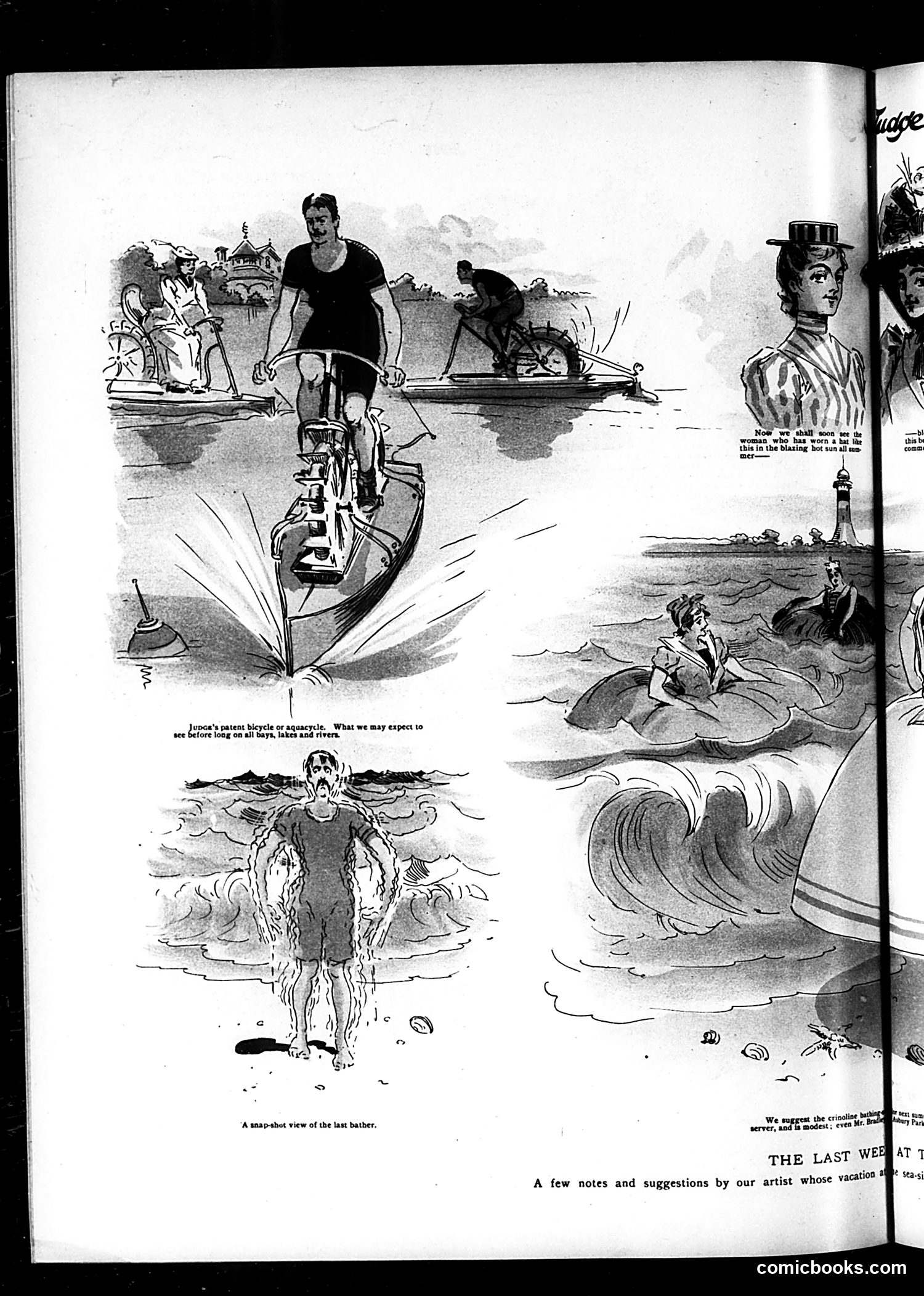
This Judge magazine page satirizes summer leisure activities and bathing culture, likely from the late 1800s. The main cartoon shows a man on an absurd "aquacycle"—a bicycle-boat hybrid—navigating water while observers in boats and on shore watch. The satire mocks impractical inventions and the Victorian obsession with mechanizing recreation. The lower panel, captioned "A snap-shot view of the last bather," depicts a drenched figure emerging from water, suggesting the end of summer swimming season. The accompanying beach scenes on the right show fashionable beachgoers and bathers. The humor targets both technological overambition and the social pretensions of summer leisure pursuits popular among the affluent classes Judge typically mocked. The tone is lighthearted mockery of contemporary vacation culture and dubious mechanical innovations.
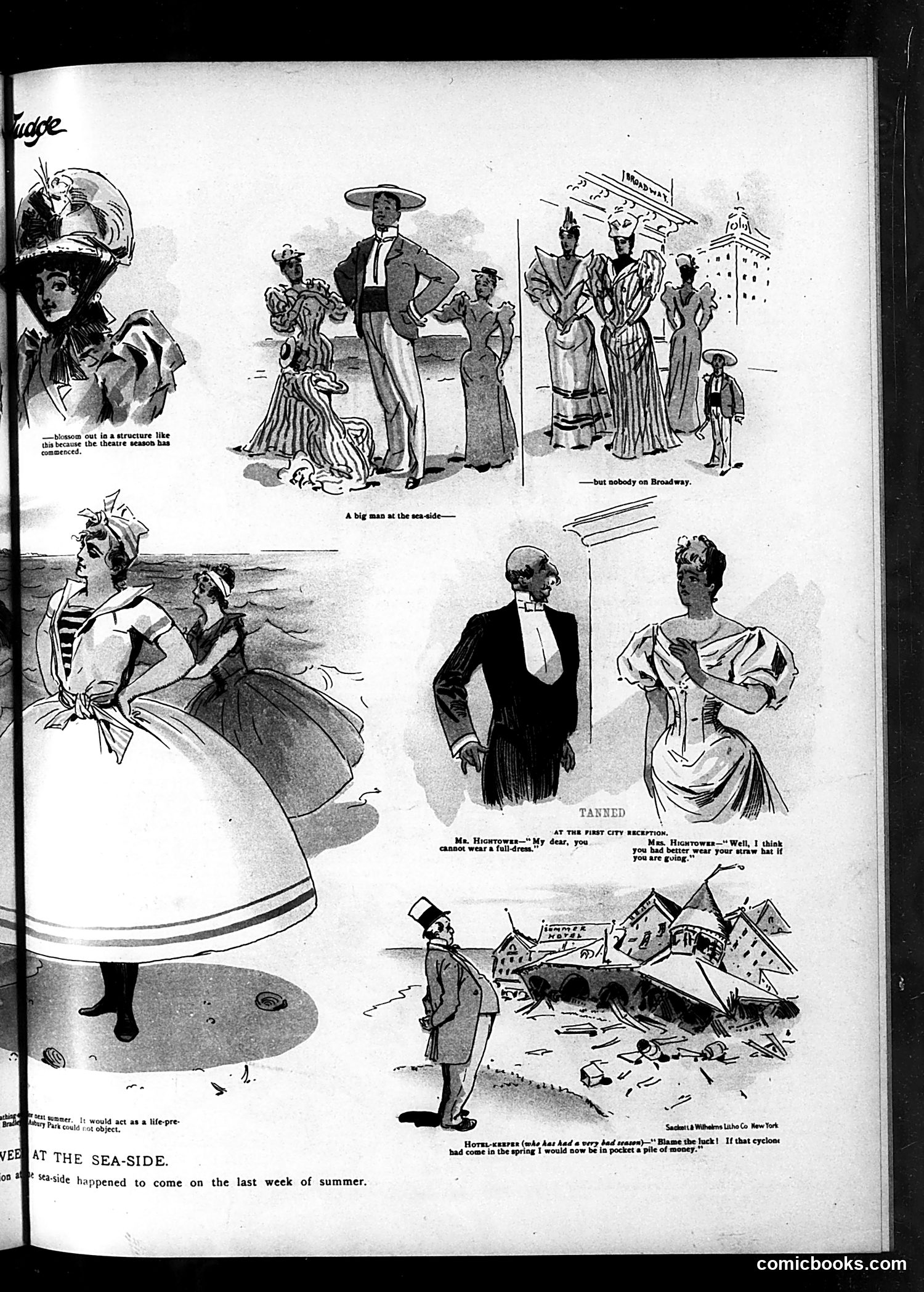
This page contains satirical sketches about summer social life, likely from the early 1900s. The main sections include: **"A Big Man at the Sea-Side"**: Depicts a well-dressed man in a sombrero surrounded by admiring women and children on a beach—satirizing male vanity and pretension at seaside resorts. **"At the Sea-Side"**: Shows a woman in elaborate dress, mocking the impracticality of fashionable clothing for beach settings. **"Tanned at the First City Reception"**: Features dialogue between Mr. and Mrs. Hicks about sun-tanning—apparently a new or noteworthy phenomenon, suggesting indoor city life versus outdoor summer activities. **Bottom panel**: A disgruntled character amid ruins mentions losing money due to "bad season" and cyclone damage—likely satirizing theatrical producers' complaints about summer weather affecting business. The overall humor targets upper-class leisure culture, fashion absurdities, and the seasonal anxieties of entertainment industry figures.
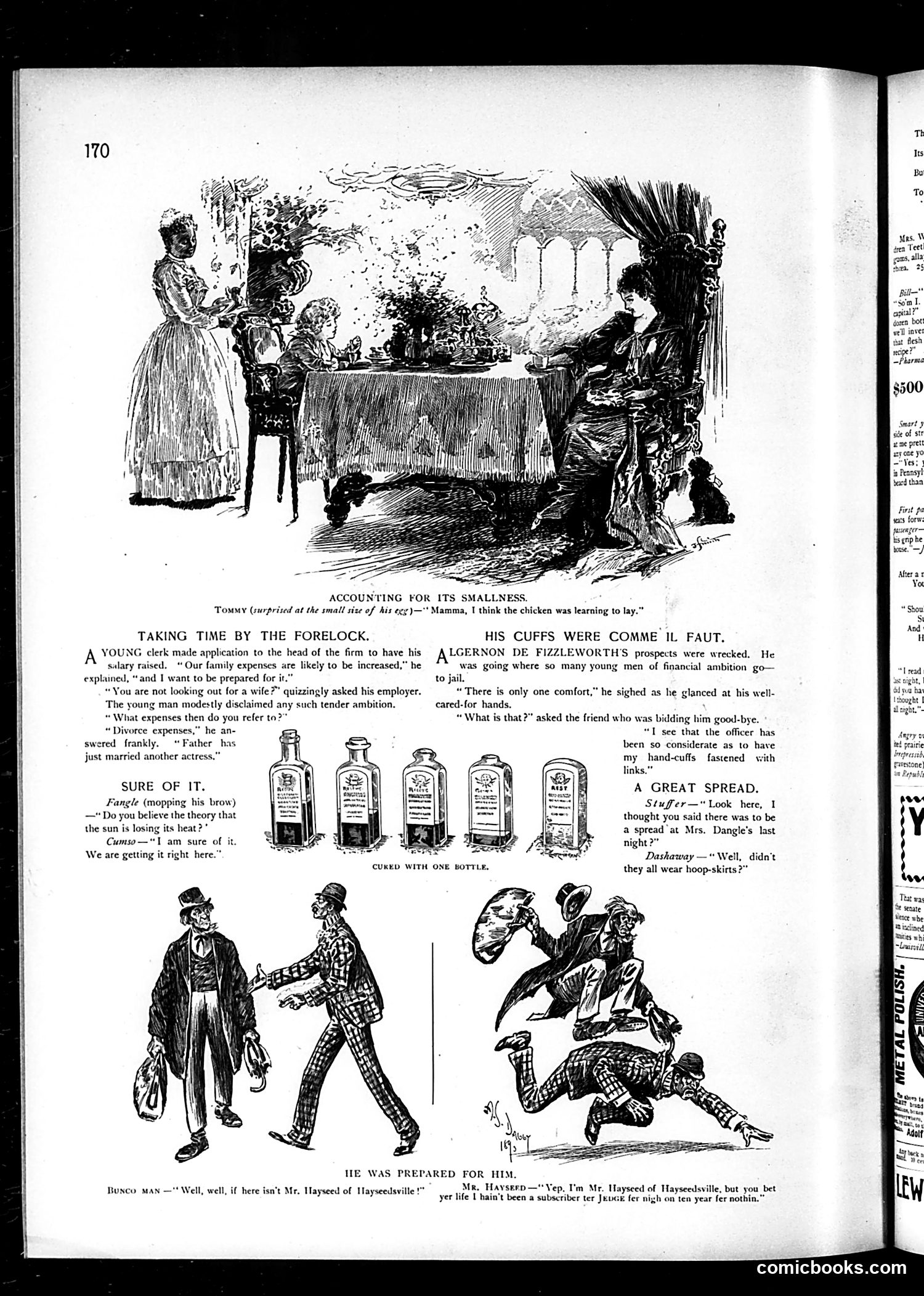
This page contains six separate jokes typical of late 19th-century American humor: 1. **"Accounting for Its Smallness"**: A child's innocent observation about an undersized egg—simple domestic humor. 2. **"Taking Time by the Forelock"**: A young clerk seeks a raise because his father just remarried an actress, anticipating *divorce expenses*. The satire mocks both the clerk's presumption and contemporary stereotypes about actresses as unsuitable wives. 3. **"Sure of It"**: Weather-related wordplay about the sun losing heat versus local summer warmth. 4. **"His Cuffs Were Comme Il Faut"**: A financially ruined man (Algernon de Fizzleworth) faces jail but finds comfort that his handcuffs are fastened with proper metal *links* rather than rope—absurd vanity in desperation. 5. **"A Great Spread"**: A joke about fashionable women's hoop-skirts preventing them from sitting closely at a dinner table. 6. **"He Was Prepared for Him"**: A rural visitor encounters someone who recognizes him—the punchline emphasizes the visitor's brand loyalty to Judge magazine.
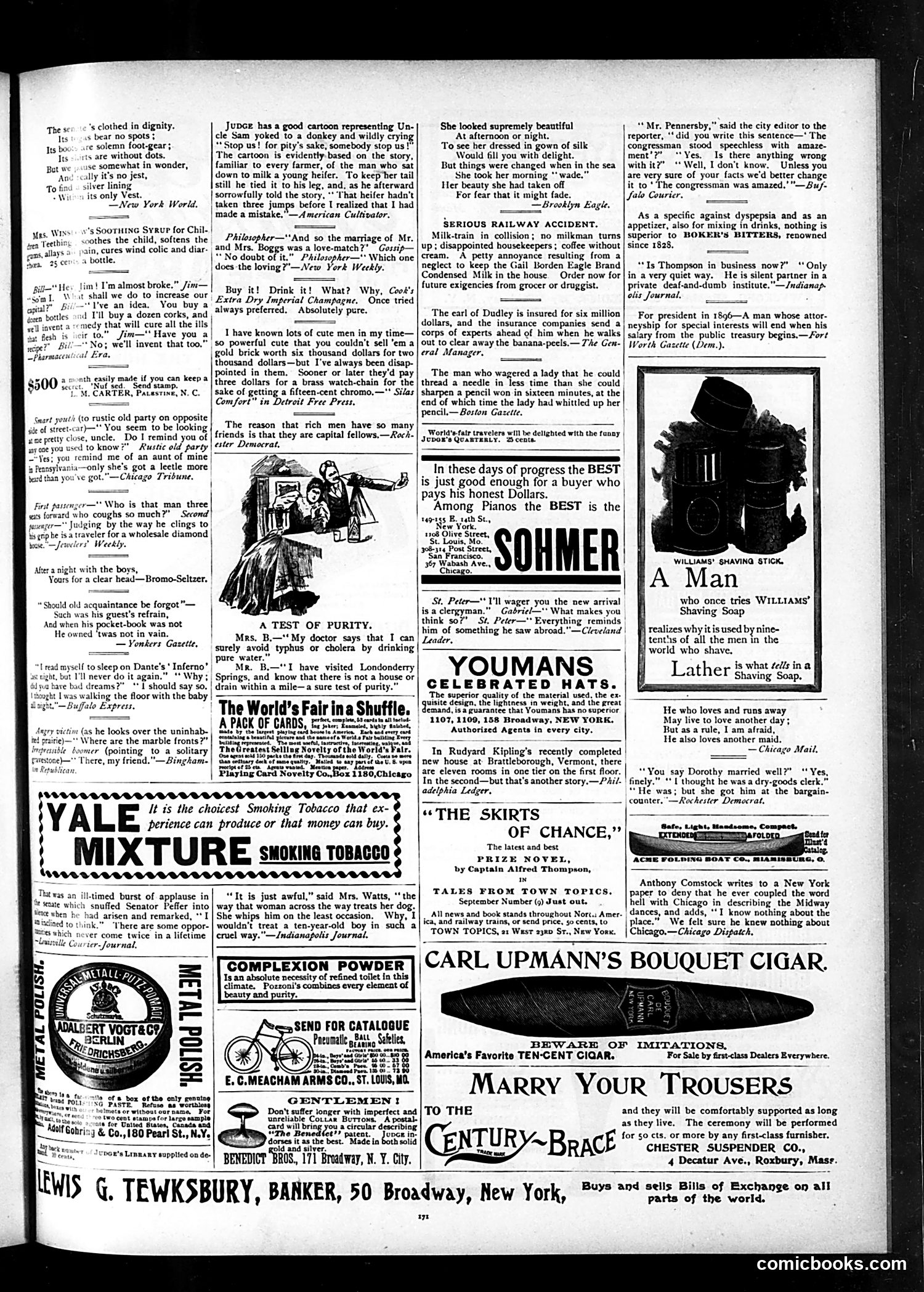
This page is primarily **advertisements and brief humorous anecdotes** rather than political cartoons. The content reflects turn-of-the-century American life. **Key references:** - **Uncle Sam cartoon**: Depicts Uncle Sam yoked to a donkey, unable to stop—satirizing American government as uncontrollable, compared to a farmer's mistake tying a heifer's tail to his leg. This critiques government overreach or mismanagement. - **Bromo-Seltzer ad**: References hangover cure, satirizing heavy drinking culture among businessmen ("a night with the boys"). - **Various one-liners mock**: Social pretension (marble-front homes), marital problems, wealth-based friendships, and urban life. The page reflects **Gilded Age anxieties**: rapid industrialization, class consciousness, gender relations, and skepticism toward business ethics. Most humor targets common people's follies rather than specific political figures, making this a snapshot of period attitudes rather than focused political satire.
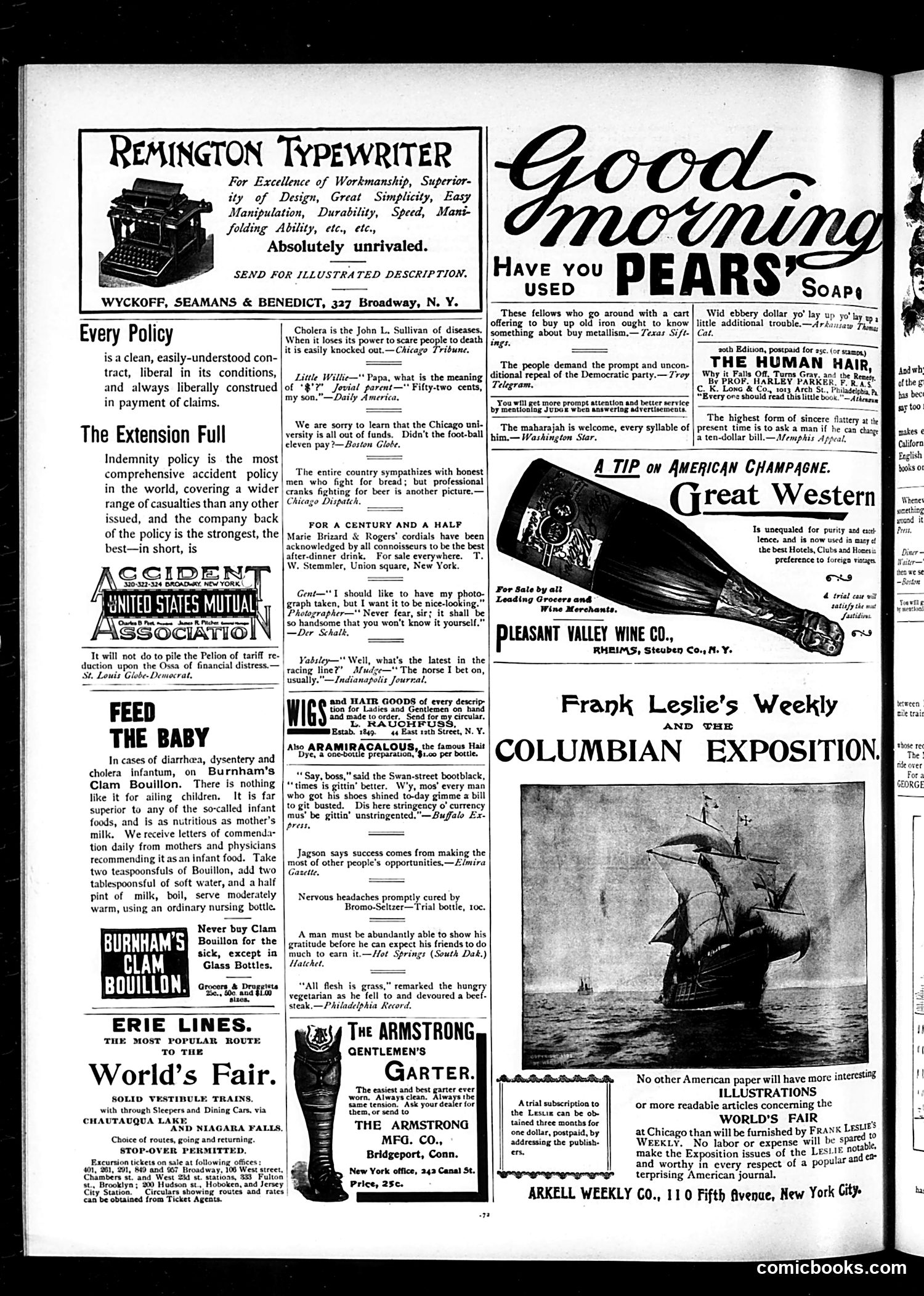
This page is primarily **advertisements and miscellaneous content** rather than political satire. However, it contains scattered brief satirical "quips"—short jokes on current events. The most identifiable reference is **John L. Sullivan**, the famous heavyweight boxing champion, used metaphorically in a quip: "Cholera is the John L. Sullivan of diseases. When it loses its power to scare people to death it is easily knocked out." This compares the disease's declining threat to Sullivan's fighting prowess—recognizable to readers familiar with the era's boxing celebrity. Other quips reference financial distress, Chicago University's funding problems, and social commentary on "professional cranks fighting for beer." The bootblack's dialogue jokes about currency stringency during what appears to be an economic downturn. The bulk of the page consists of product advertisements (typewriters, insurance, cordials, infant food, rail transportation) and notices. No prominent political cartoons are visible—this appears to be a typical Judge issue mixing advertising revenue with light satirical commentary accessible primarily to contemporary readers.
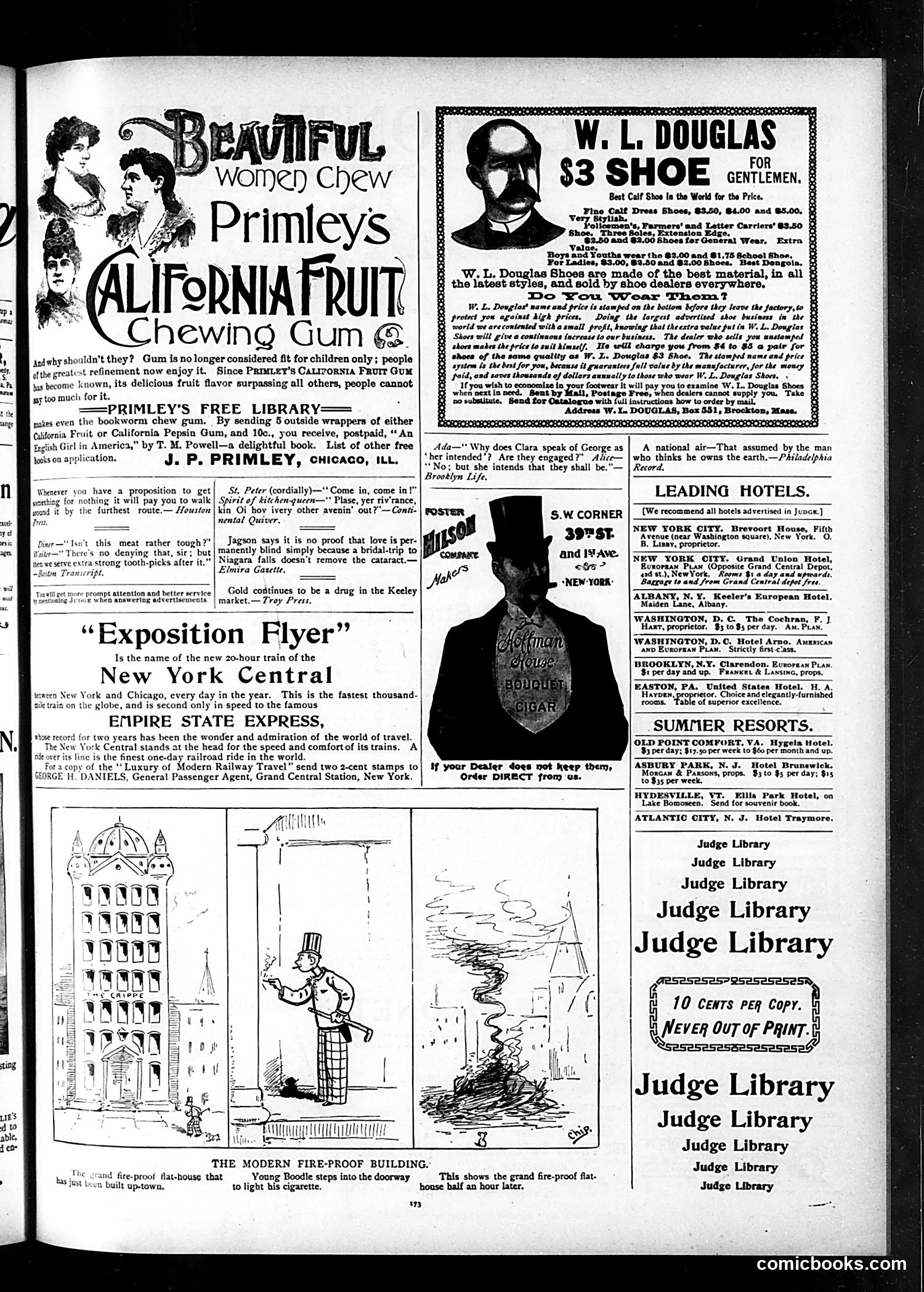
This page is primarily **advertising** for products and services, with minimal political cartoon content. The main illustrated features are: 1. **"Exposition Flyer"** - Advertisement for New York Central Railroad's new 20-hour train service between New York and Chicago, promoting it as the world's fastest passenger train (second only to the "Empire State Express"). 2. **Product advertisements** - Including Primley's California Fruit Chewing Gum (marketed to "beautiful women"), W.L. Douglas $3 shoes, and Foster & Hatch cigars. 3. **Hotel listings** - Recommendations for leading hotels in major cities. The page contains some small humorous one-liners and jokes typical of *Judge* magazine, but these are minor fillers rather than substantive political satire. The overall purpose is commercial—promoting consumer goods and rail travel to *Judge*'s affluent readership during the Gilded Age.
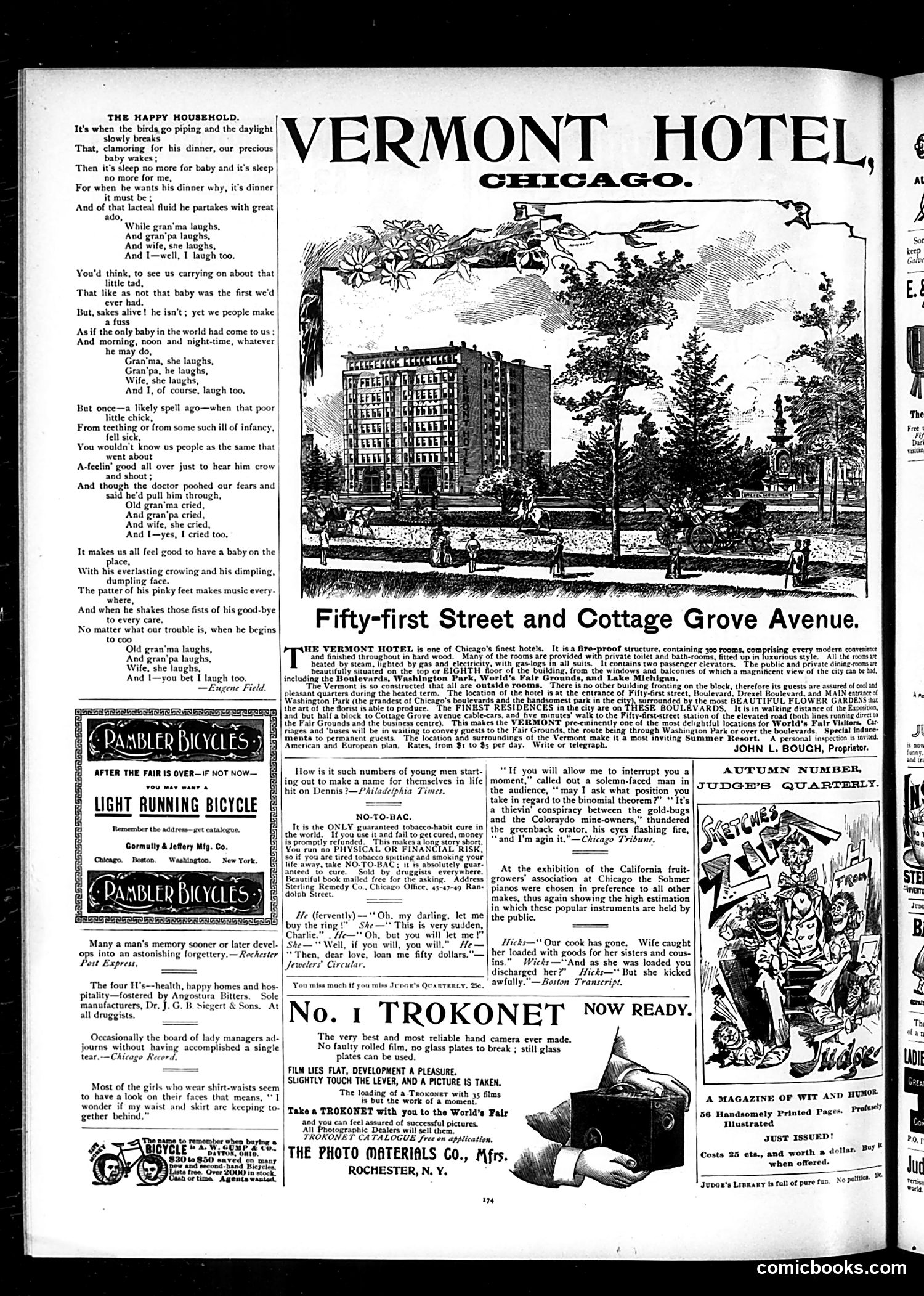
This page is primarily **advertising and poetry**, not political satire. **Main Content:** - A sentimental poem by Eugene Field titled "The Happy Household" celebrates domestic life—a baby's cries, family laughter, and the emotional response when the child falls ill. **The Vermont Hotel Advertisement:** The large illustrated ad dominates the right side, promoting Chicago's Vermont Hotel (Fifty-first Street and Cottage Grove Avenue). It emphasizes luxury amenities: 300 fireproof rooms, private bathrooms, elevators, top-floor dining rooms with city views including the World's Fair Grounds, and manicured gardens. **Other Advertisements:** Rambler and Dambler bicycles, Trokonet cameras, and Judge's own quarterly magazine are advertised. **No Clear Political Satire:** Unlike typical Judge content, this page lacks caricatured public figures or political commentary. The humor is domestic and gentle—Field's poem gently mocks how families dote over babies. The advertisements reflect the Gilded Age consumer culture and recent innovations (bicycles, cameras, elevators).
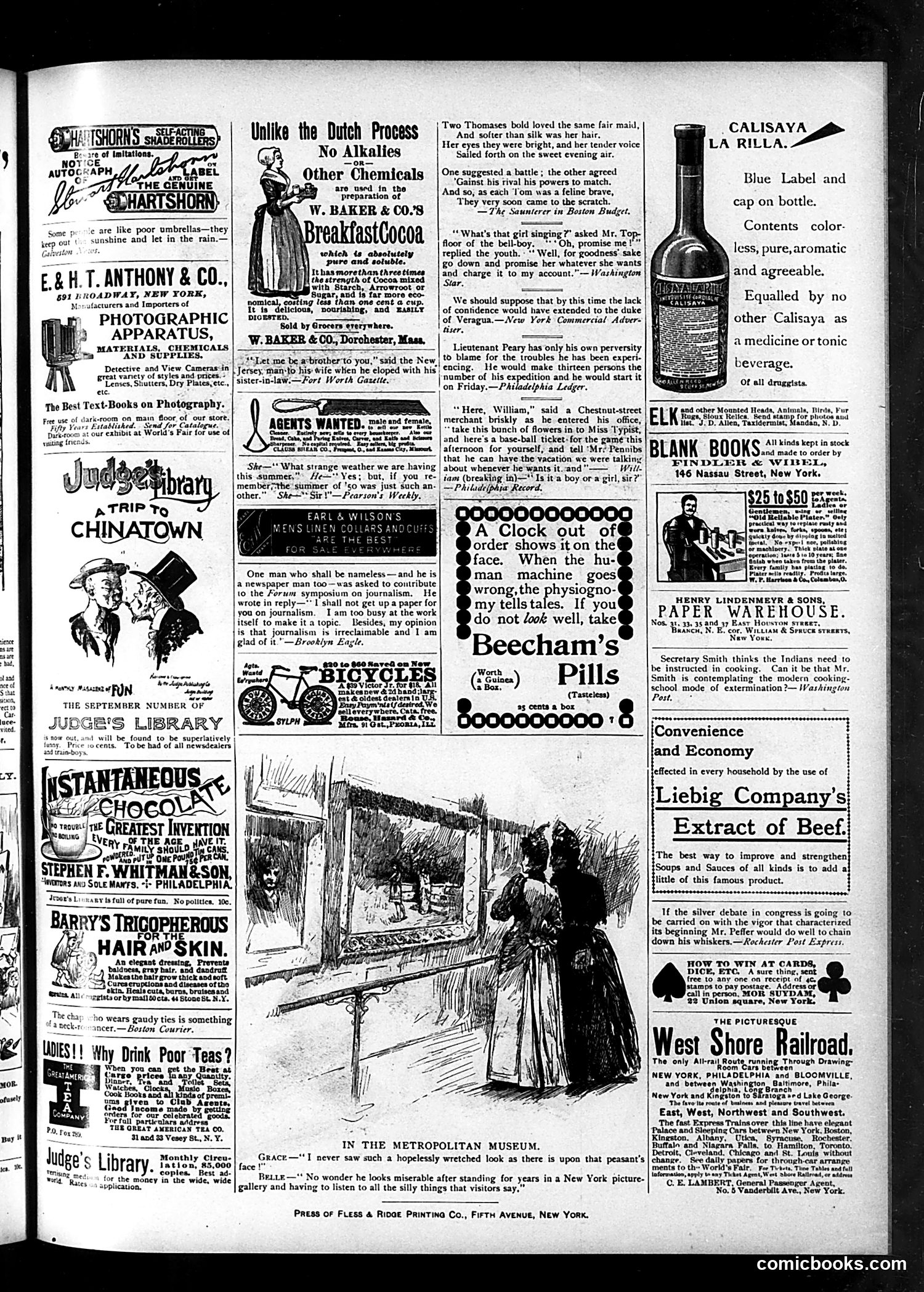
This appears to be primarily an **advertising page** from Judge magazine, with minimal political content. The main satirical elements are brief humor items scattered among product advertisements. The few jokes present mock contemporary figures and situations: references to **Lieutenant Peary's arctic expedition troubles** (suggesting he was blamed for poor planning—starting with 13 people on a Friday); a jab at the **Duke of Veragua** (losing public confidence); and gentle workplace humor about office dynamics and romantic entanglements. The page is dominated by **period product advertisements**—cocoa, bicycles, hair treatments, tea, photographic equipment—typical of 1890s American magazines. These ads reveal consumer goods and health claims of the era (Barry's Trichopherous hair dye, Beecham's Pills, Extract of Beef). The central illustration shows figures in a **museum setting** with a humorous caption about peasants' "hopeless stretched look." Overall, this is a **commercial rather than political page**, showcasing advertising revenue that funded satirical publications.
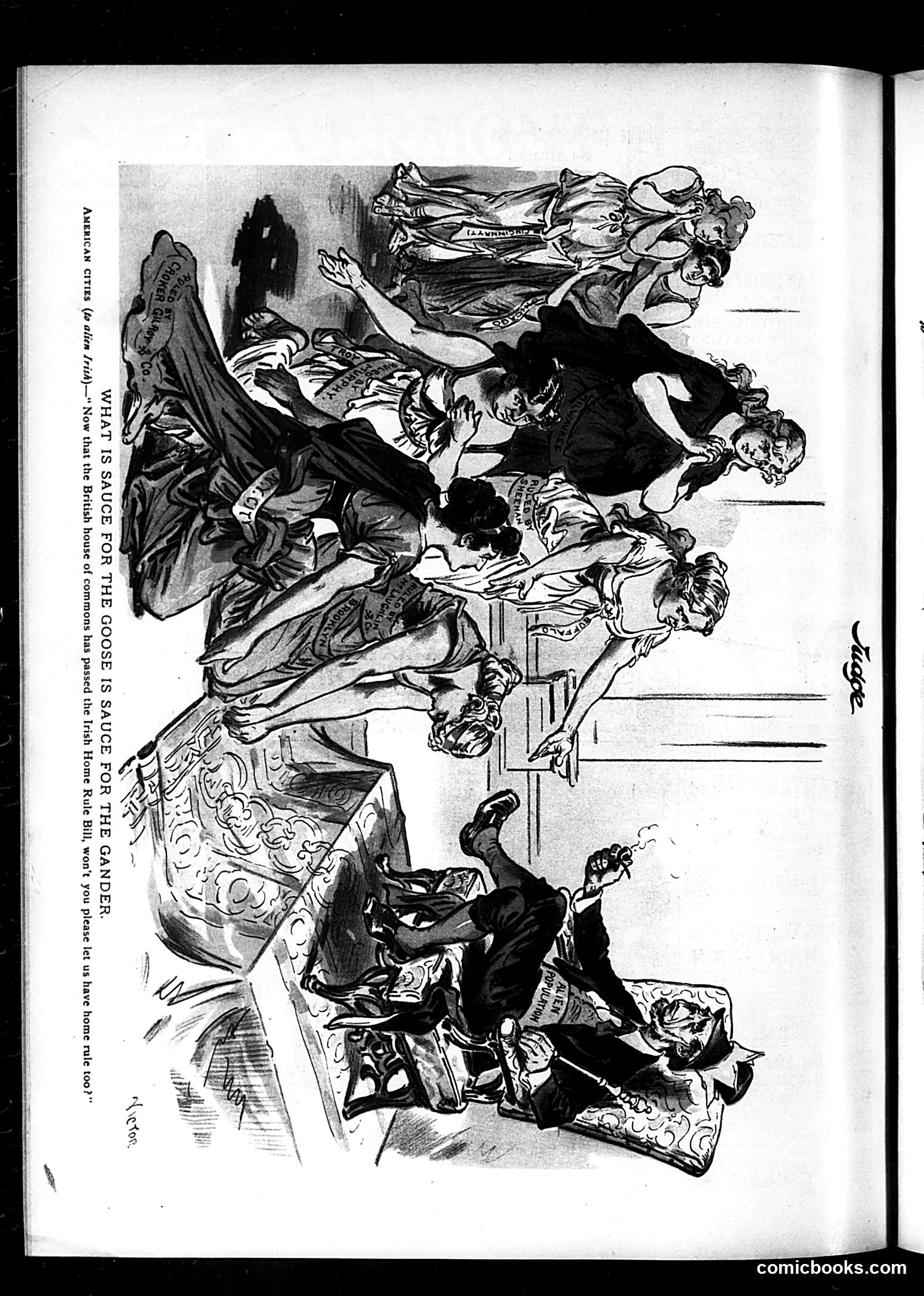
This page appears to be mostly a single political cartoon printed upside-down (or sideways). The OCR text is minimal and unhelpful—just a website attribution. The illustration depicts what appears to be a formal or ceremonial scene with multiple figures in period dress, including someone in military or formal attire. Without clear visible text identifying the specific figures or political context, I cannot reliably determine which politicians, events, or social issues are being satirized. The artistic style suggests late 19th or early 20th-century American political satire, but I cannot confidently identify the specific people or situation being mocked without additional textual context or caption information visible on the page. To properly analyze this cartoon's meaning, clearer identification labels or caption text would be necessary.