
A complete issue · 16 pages · 1893
Judge — August 26, 1893
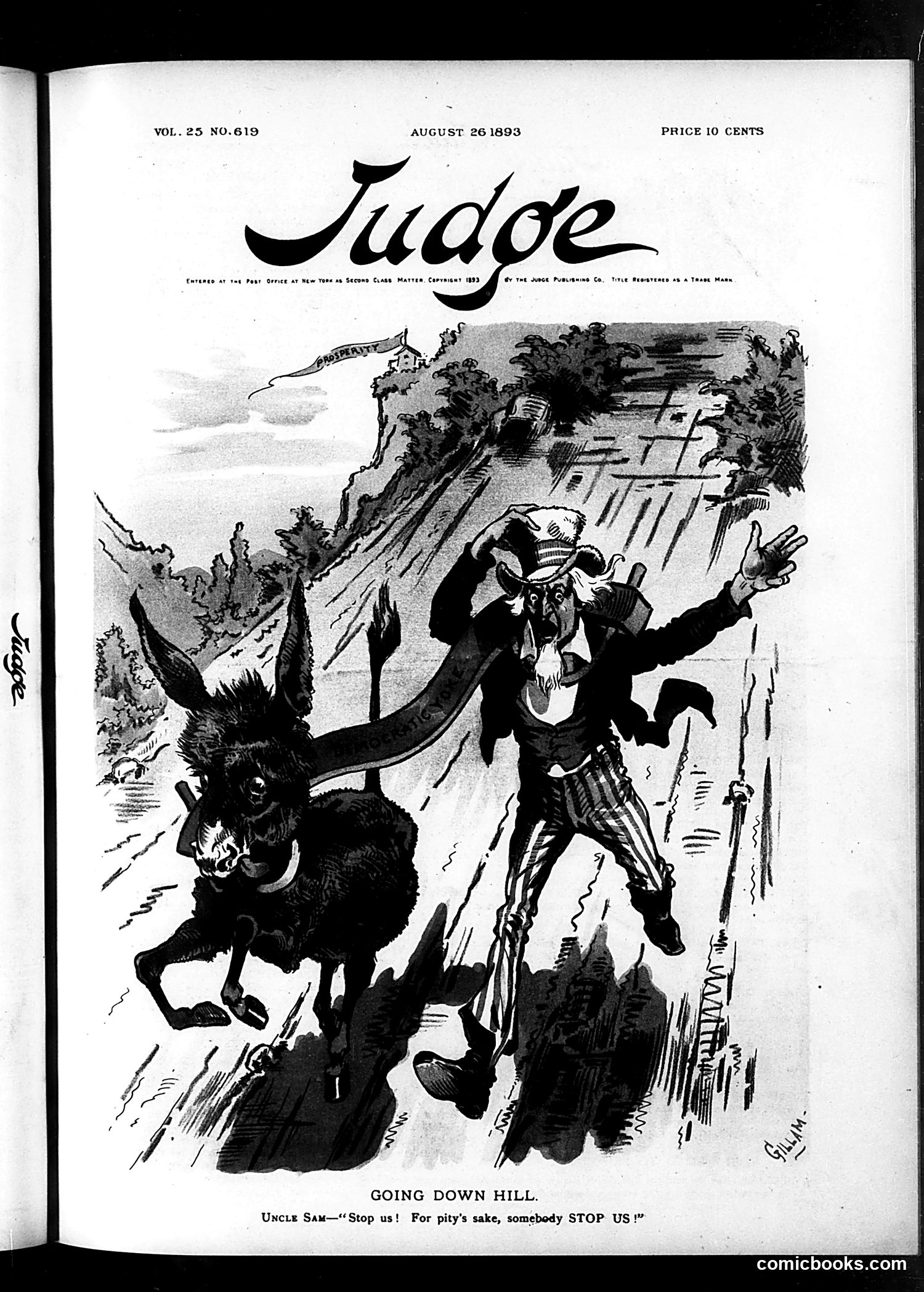
This is the cover of *Judge* magazine from August 26, 1893. The cartoon depicts Uncle Sam (identifiable by his characteristic star-spangled hat and goatee) losing control on a downhill slope, riding a donkey labeled "POLITICS" while being chased by what appears to be a devil or demon figure. The caption reads: "Uncle Sam—'Stop us! For pity's sake, somebody STOP US!'" The satire comments on American politics spiraling out of control during the 1890s, a period of economic depression and political turmoil. The image suggests that political forces have become wild and dangerous, with Uncle Sam unable to manage or restrain them. The runaway descent symbolizes the nation's loss of control over its political direction.
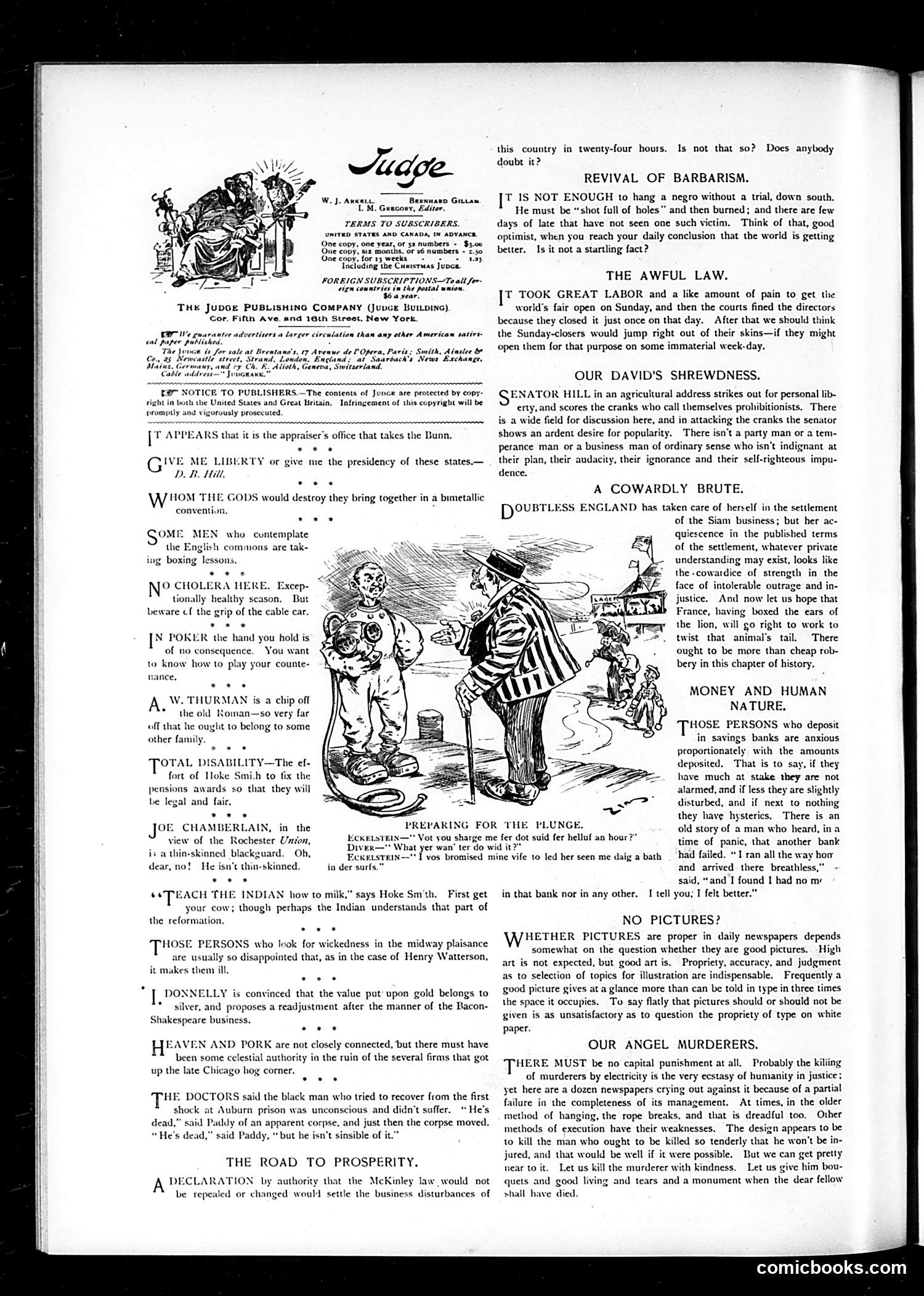
The main cartoon depicts two figures: a man in striped pants (appearing to be a wealthy businessman or politician) looking anxiously at a bathtub, while another figure holds his hand reassuringly. The caption reads: "DIVES—'What yer want ter do wid it?' / FOGERTY—'I vos promised mine wife to led her seem me take a bath in der subs.'" This is satirical commentary on financial panic and banking anxiety. The "plunge" likely references stock market crashes or financial speculation of the era. The Jewish-dialect humor (typical of Judge's era) associates the immigrant working class with financial desperation, contrasting sharply with the wealthy figure's nervous hesitation to risk money. The bathtub metaphor represents taking financial risks—going "under" economically.
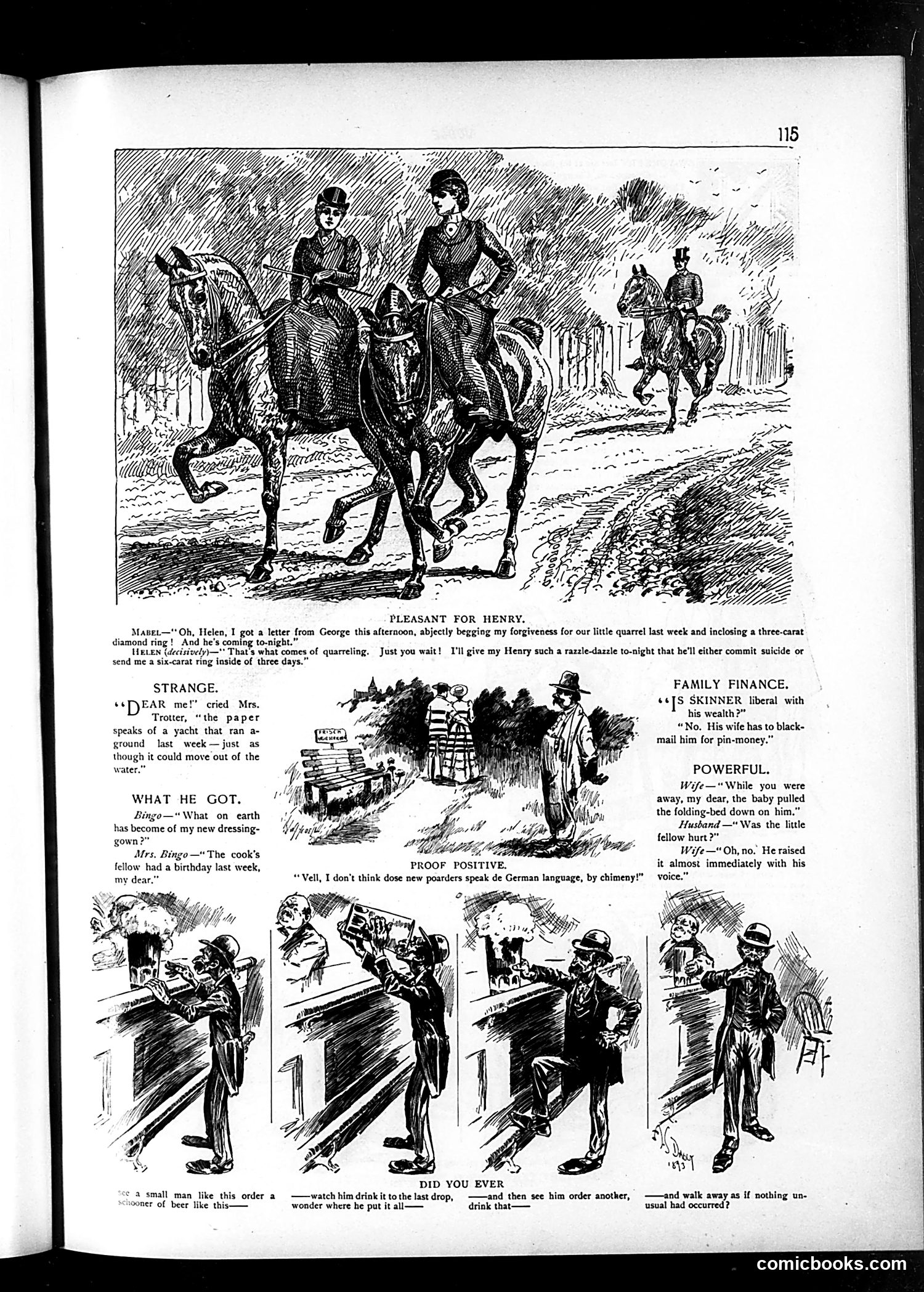
This page contains several brief satirical sketches typical of Judge's humor: **"Pleasant for Henry"** (top): Women on horseback discuss marital quarrels, with one threatening to make her husband Henry commit suicide or join the military within three days—dark comedy about domestic discord. **"Strange"** and other shorts: Quick jokes about absurd situations—a woman shocked by a yacht accident, a cook's birthday, and German-speaking parrots. **"Did You Ever"** (bottom four panels): A visual gag showing a man ordering progressively smaller beer glasses, culminating in him drinking from an impossibly tiny vessel, then mysteriously walking away—satirizing either drinking habits or restaurant absurdity. The other titled sections ("Family Finance," "Powerful," "Proof Positive") contain short quips about wealth, children, and social pretension. These represent Judge's typical mix of domestic humor and social commentary targeting middle-class American life.
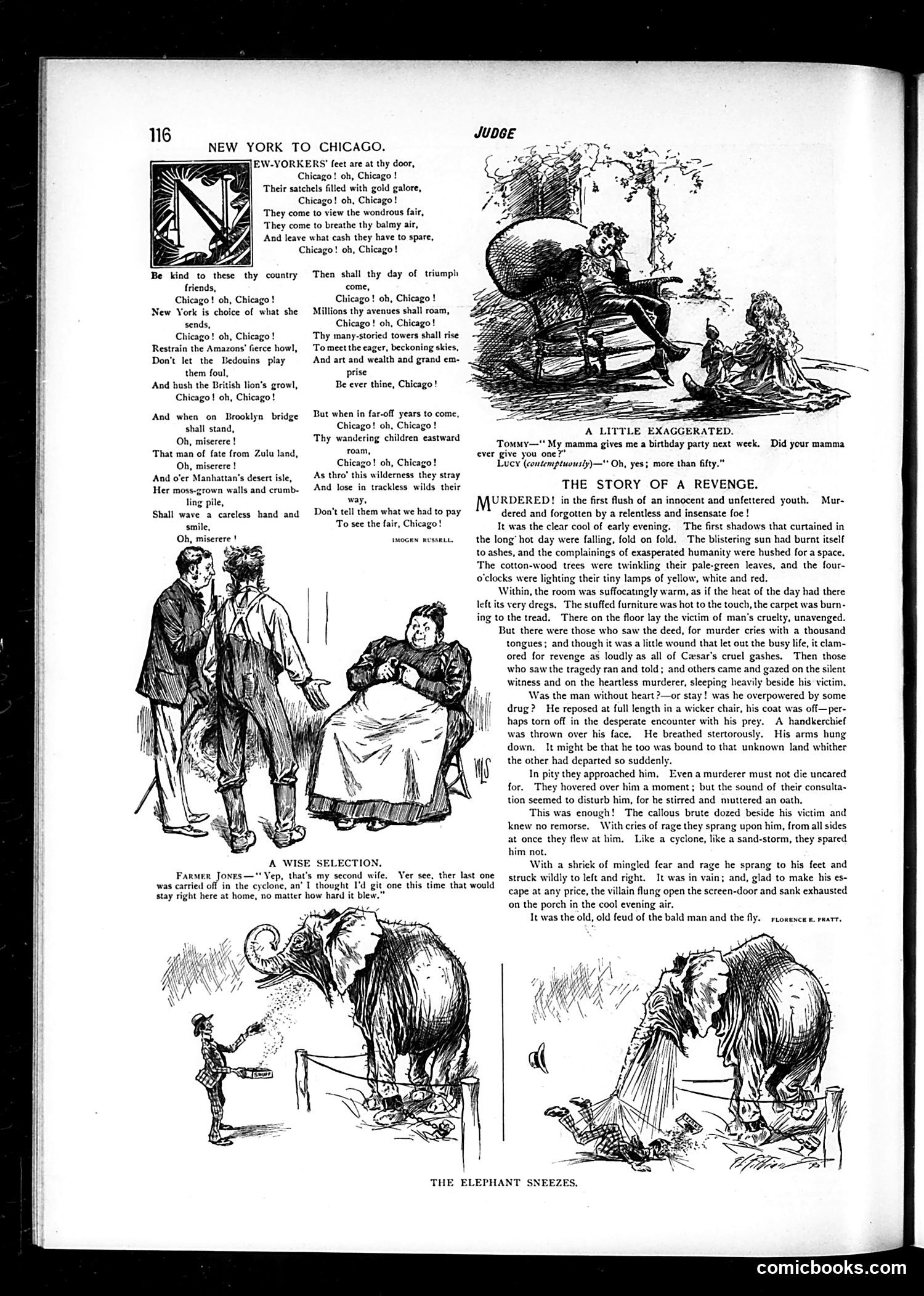
This *Judge* magazine page contains several unrelated humorous pieces typical of late 19th-century American satire: **"New York to Chicago"** is a poem mocking wealthy New Yorkers visiting the 1893 World's Columbian Exposition in Chicago, warning them not to brag about their expenses back home. References to "Amazons," "Bedouins," and "British lion" are vague ethnic/national stereotypes common to the era. **"A Little Exaggerated"** is a simple joke about a child's exaggeration—Lucy claiming 50+ birthday parties versus Tommy's one. **"The Story of a Revenge"** appears to be a dramatic short story (possibly satirizing melodramatic fiction) about discovering a murder victim—the "murderer" turns out to be the victim's killer sleeping nearby, prompting mob justice. **"A Wise Selection"** and **"The Elephant Sneezes"** are brief jokes: the first about a farmer replacing his wife lost in a cyclone; the second about an elephant sneezing. The page reflects *Judge's* mix of political satire, gentle humor, and melodrama typical of 1890s American magazines.
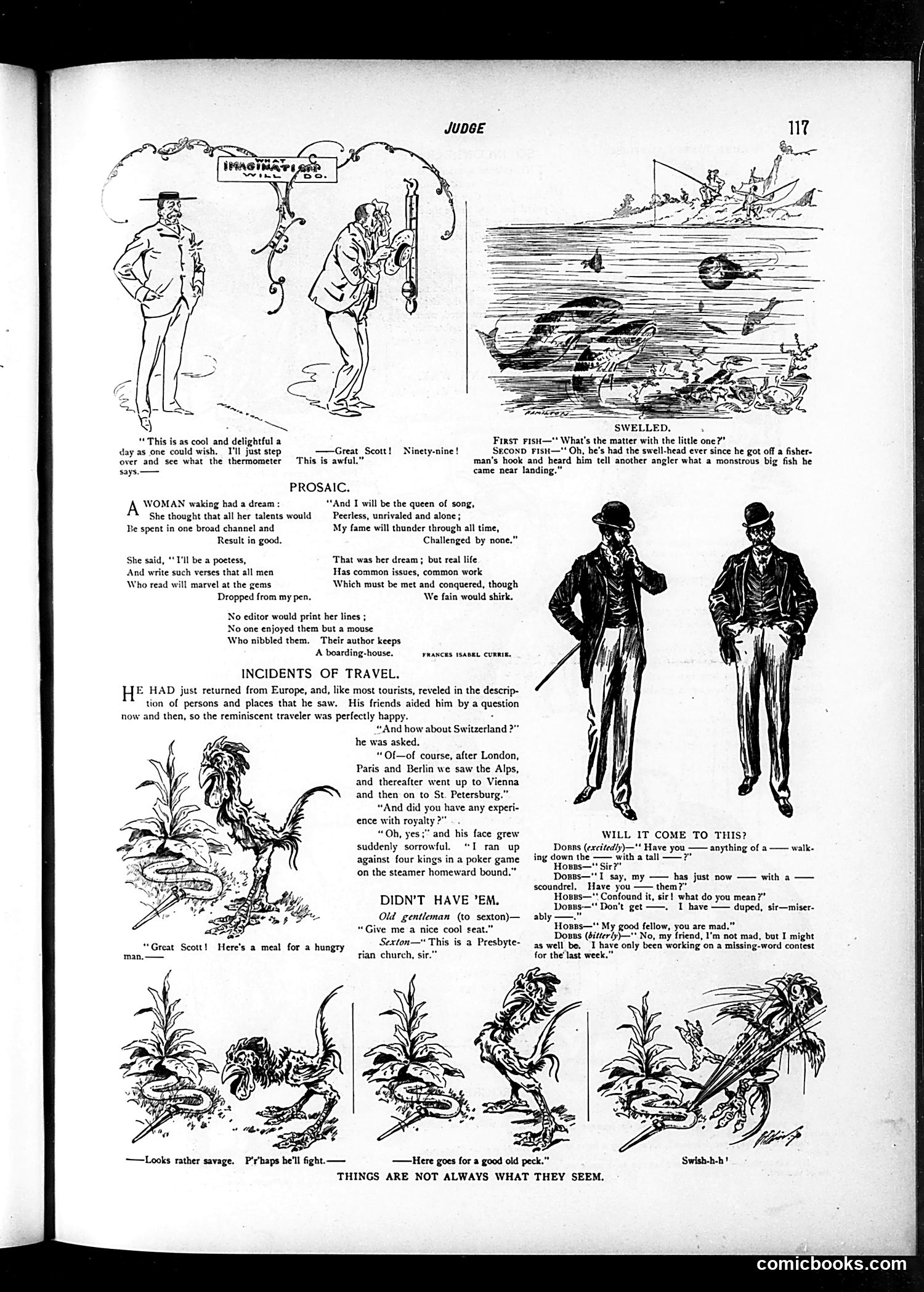
This page contains multiple satirical pieces typical of Judge's humor: **"Prosaic"** mocks the gap between romantic ideals and mundane reality—a woman dreams of becoming a celebrated poet but ends up running a boarding house, her verses read only by a mouse. **"Incidents of Travel"** satirizes travelers' boastfulness. A returned European tourist claims to have played poker with four kings aboard ship—a transparent exaggeration meant to illustrate how travelers embellish their stories for social status. **"Didn't Have 'Em"** jokes about Presbyterian austerity: a man requests a "cool seat" in church; the sexton's reply that it's Presbyterian (implying Presbyterians don't provide comfort) becomes a dig at the denomination's perceived severity. **"Swelled"** uses fish as metaphor—one fish has become arrogant after overhearing an angler's tall tale about "the one that got away." **"Will It Come To This?"** shows a man driven mad by a newspaper missing-word puzzle contest, his speech fragmented like the puzzle itself. The overall theme: **things aren't what they seem**—dreams fade, travelers lie, and obsessions distort reality.
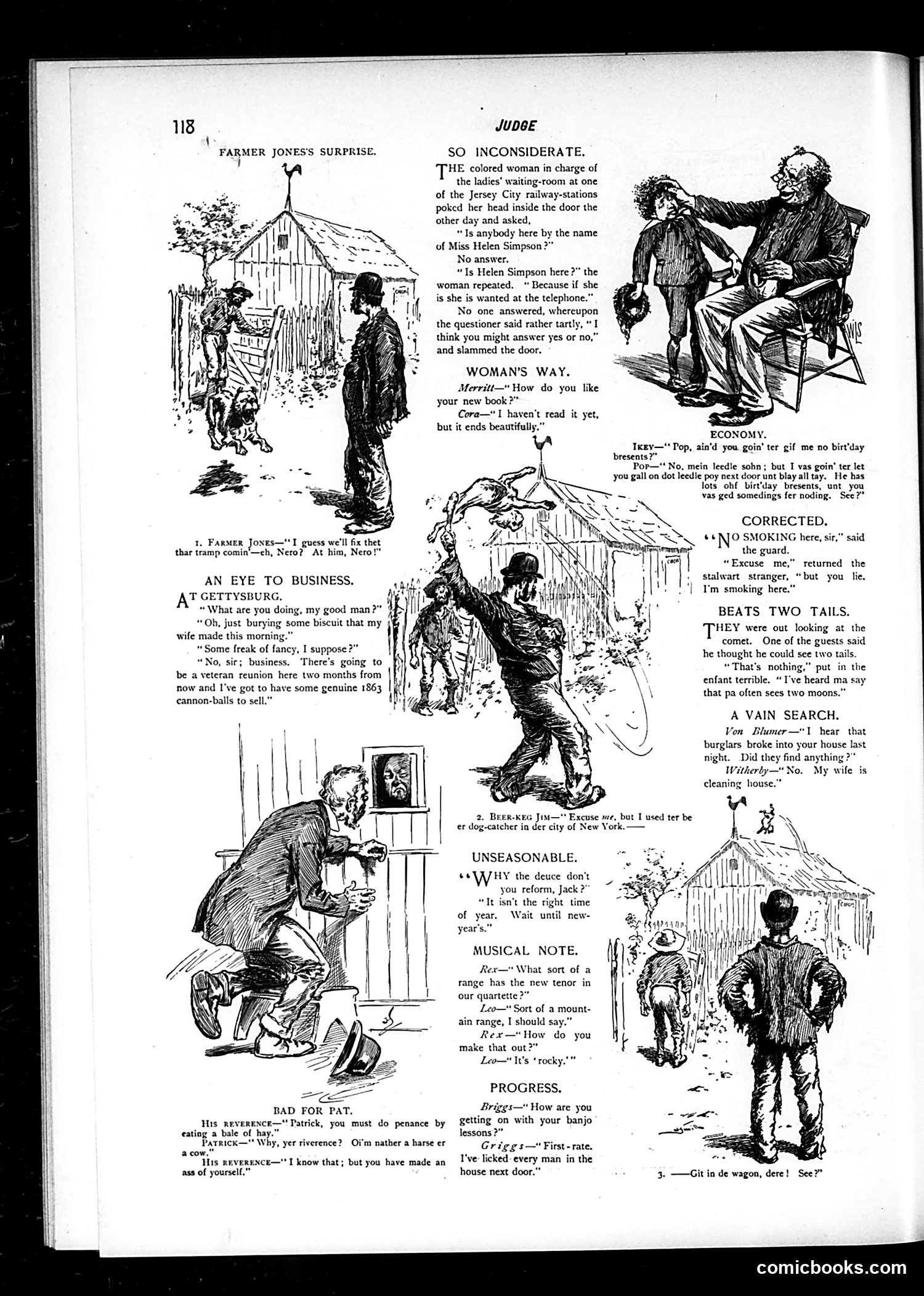
This page contains eight brief satirical sketches typical of Judge's humor circa 1880s-1890s: **"So Inconsiderate"** mocks a Black railroad station attendant for her directness when seeking a passenger, suggesting her manner is rude. **"Woman's Way"** jokes that women judge books by endings without reading them. **"An Eye to Business"** depicts a man burying biscuits before a Civil War veterans' reunion, planning to sell them as authentic 1863 "cannon-balls"—satirizing opportunistic commercialism. **"Bad for Pat"** uses ethnic Irish dialect humor, with a priest assigning penance to a man who's "made an ass of himself." **"Economy"** features Yiddish-accented dialect humor about a father planning to let his son play with a neighbor's toys instead of buying birthday presents. **Other sketches** include mild domestic humor about comet-watching, burglary, and musical talent—standard period fare. The page reflects Judge's reliance on ethnic caricature and working-class mockery as primary comedic sources.
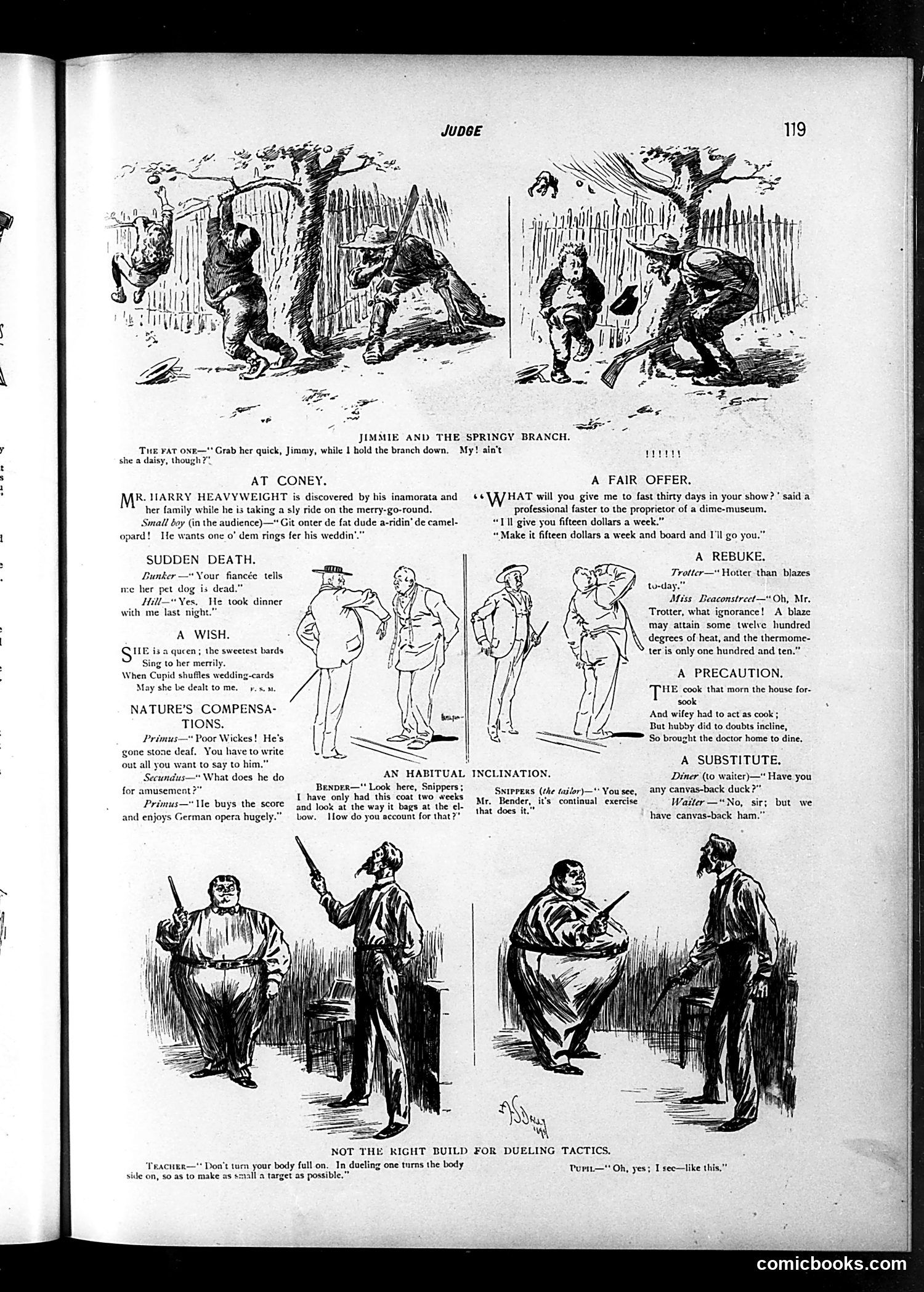
This page contains multiple unrelated comic sketches typical of Judge's humor. The top features "Jimmie and the Springy Branch," a children's mischief scene at Coney Island amusement park. Below are brief satirical vignettes: **"At Coney"** mocks an obese man (Harry Heavyweight) on a carousel, observed by working-class spectators using period slang ("Git onter de fat dude"). **"Sudden Death"** jokes darkly about a pet dog dying after dining with someone, implying the host's cooking is lethal. **Other sketches** satirize: a woman's pedantic correction of casual speech ("hotter than blazes"), a tailor's explanation for coat wear as "continual exercise," and a restaurant substituting ham for expensive canvas-back duck. **"Not the Right Build for Dueling Tactics"** depicts a humorously obese man attempting fencing instruction, unable to turn sideways properly—physical comedy based on body size. The humor reflects late-19th-century Judge's focus on class commentary, physical comedy, and everyday absurdities rather than specific political events.
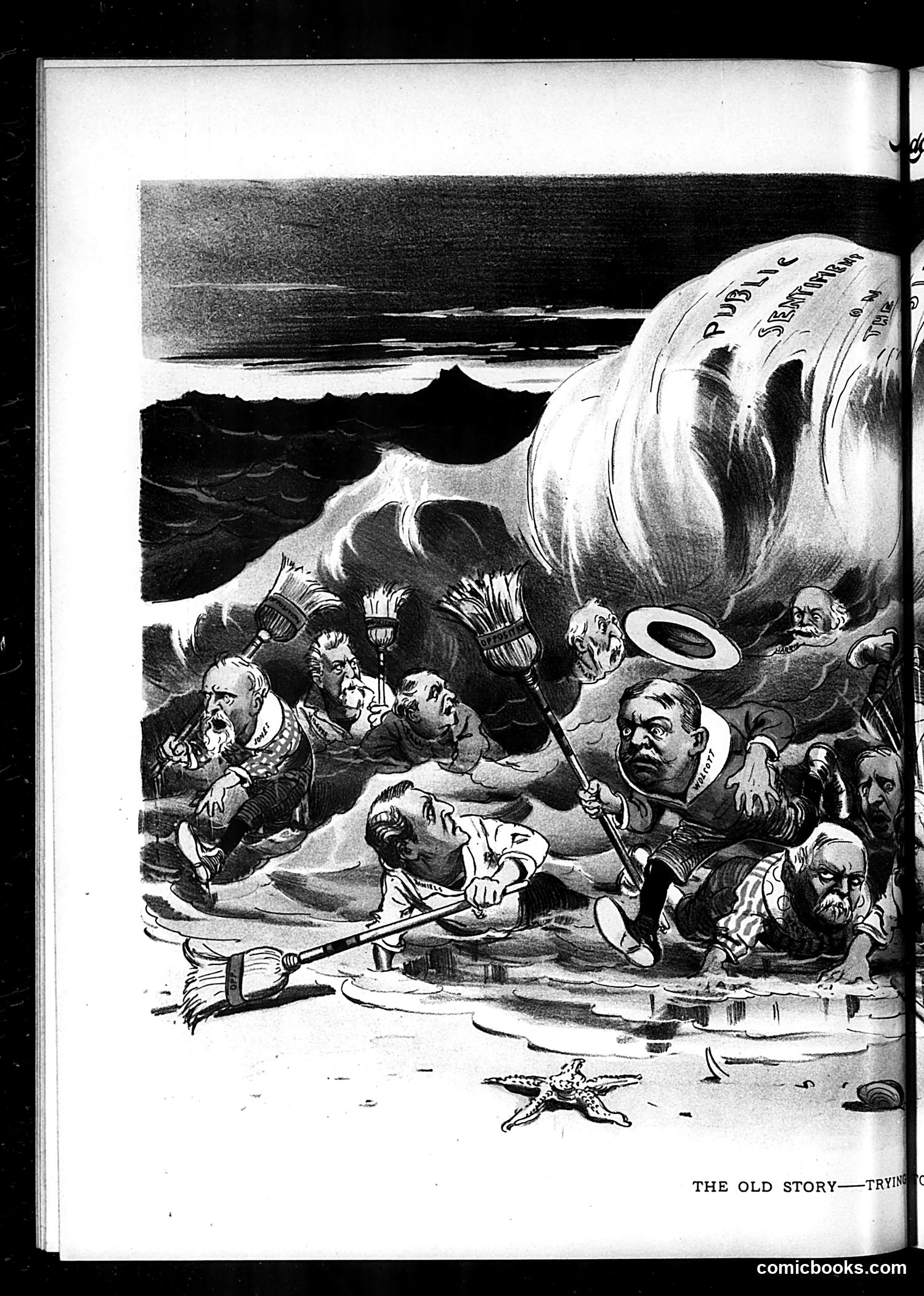
This appears to be a satirical Judge magazine cartoon depicting a group of caricatured men (likely politicians or public figures) struggling with an enormous barrel or container labeled "DEBT" or similar fiscal burden. The men are depicted as diminutive figures attempting to manage or control something vastly larger than themselves, using tools like nets and poles. The satire likely critiques government financial mismanagement or political inability to address mounting national debt. The title "The Old Story—Tryin'" suggests this is a recurring, frustrating cycle—politicians repeatedly attempting and failing to solve fiscal problems. The exaggerated physical disproportion between the figures and the barrel emphasizes the overwhelming nature of the problem relative to political capacity to address it. This reflects persistent early 20th-century anxieties about government spending and fiscal responsibility.
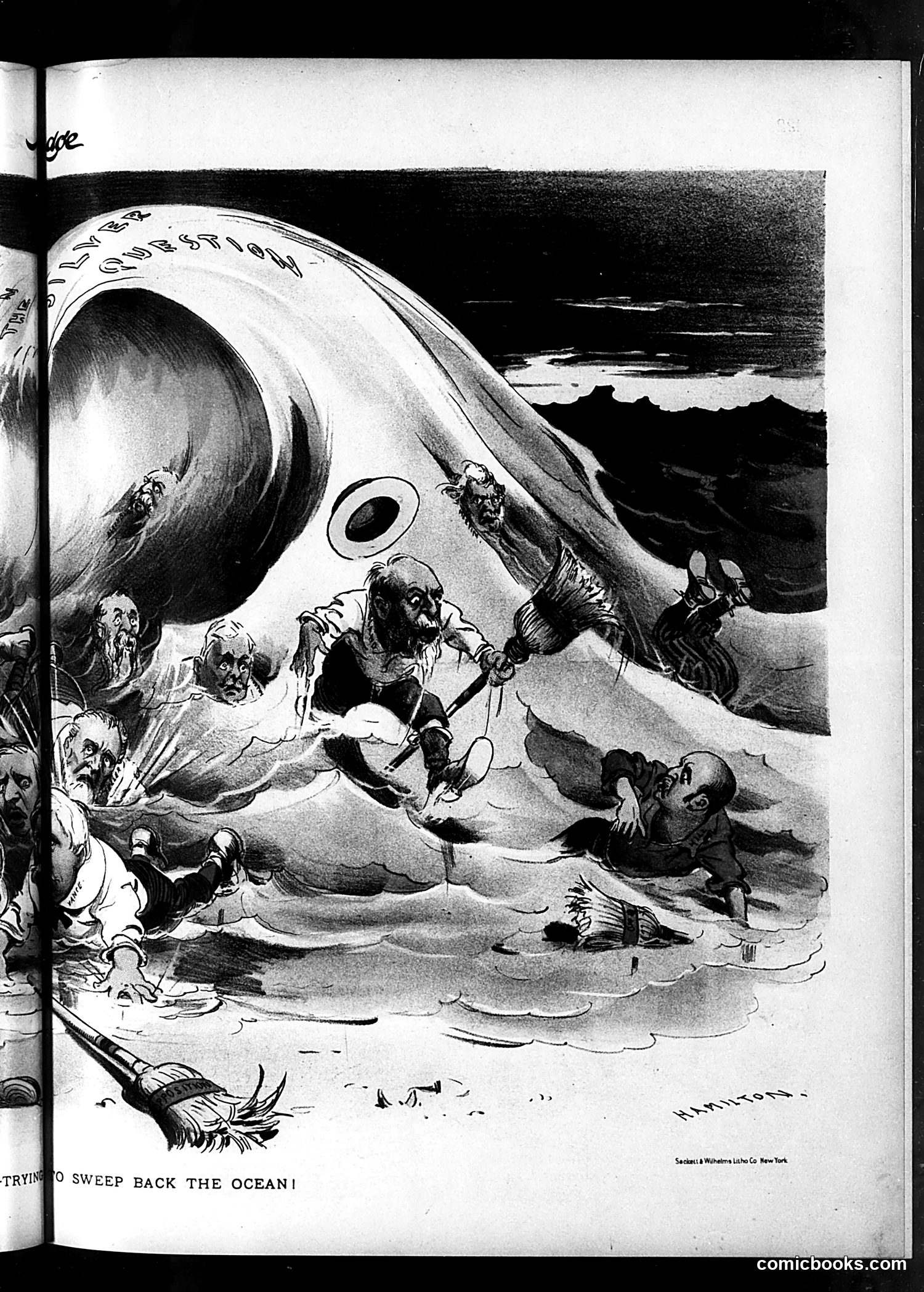
This political cartoon depicts multiple distressed figures attempting to sweep back ocean waves using brooms—a futile, absurd task. The cartoon satirizes efforts to resist inevitable forces or changes, using the classical allusion to King Canute, who famously attempted to command the tides. The specific political context remains unclear without a date or additional text, but the imagery suggests criticism of politicians or leaders attempting to reverse some unstoppable trend—possibly immigration, economic forces, or social change. The exaggerated, struggling figures emphasize the hopelessness and ridiculousness of their endeavor. The cartoon's message: certain forces cannot be stopped through mere willpower or traditional methods; resistance is futile.
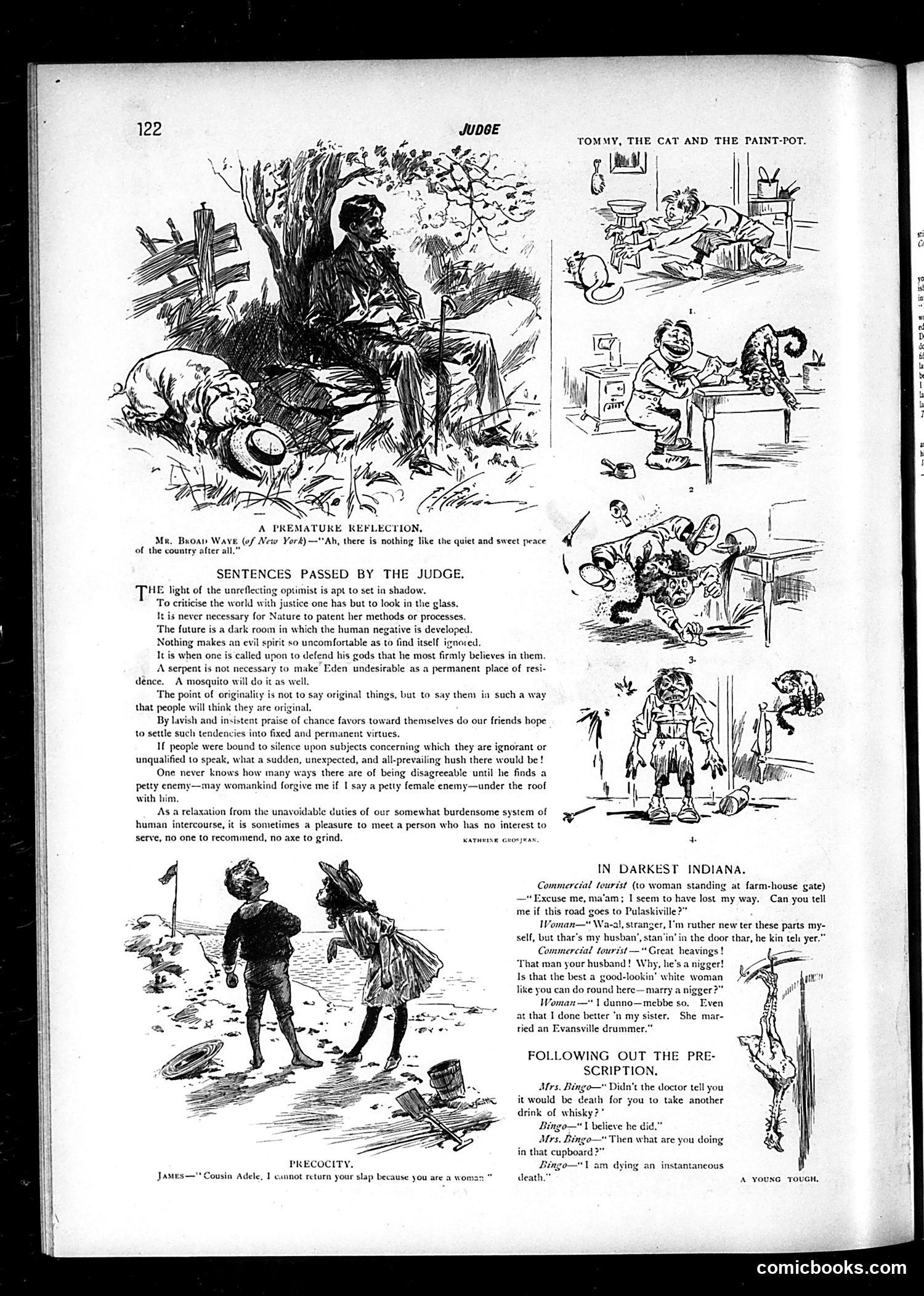
This page contains several distinct satirical pieces typical of Judge's late 19th/early 20th-century format: **"Sentences Passed by the Judge"** is a collection of philosophical aphorisms mocking optimism and human nature—cynical observations about criticism, originality, and annoying acquaintances. **"In Darkest Indiana"** satirizes both racist attitudes and rural ignorance. A traveling salesman is shocked that a white woman married a Black man, considering it inferior to her sister marrying a traveling salesman—the joke targeting the salesman's own presumed low social status while also reflecting the magazine's casual racism. **"Following Out the Prescription"** jokes about a man ignoring doctor's orders against drinking whisky by hiding in a cupboard—playing on the contradiction between following instructions and breaking them. **"Precocity"** shows a young boy refusing to return a woman's slap because "you are a woman"—mocking both exaggerated chivalry and precocious child behavior. The cartoons and text together represent Judge's mix of social commentary, mild moralizing, and period-typical racial humor.
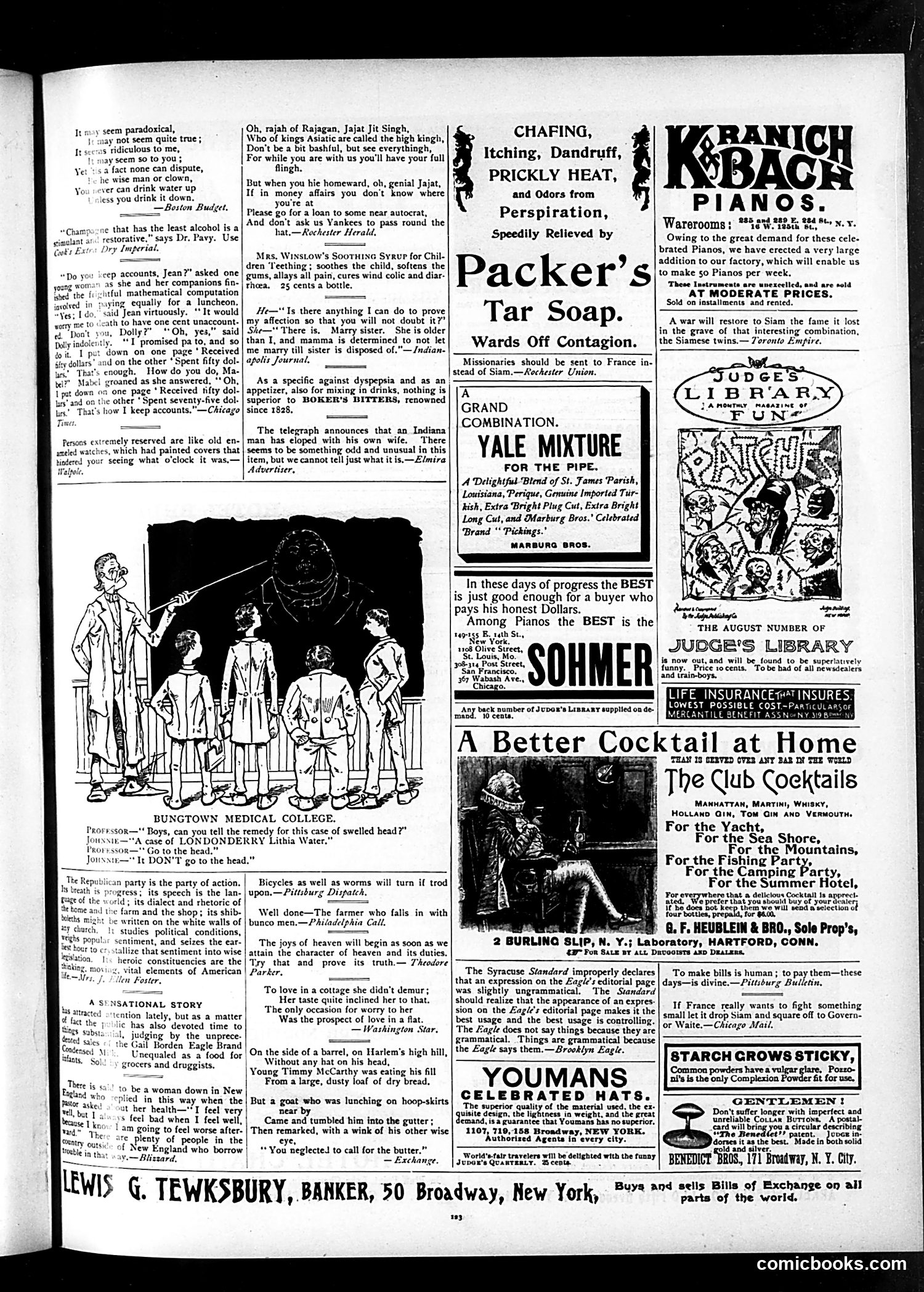
This page is primarily **advertising and humor fillers** rather than political cartoons. The main illustrated content shows the "Bungtown Medical College" cartoon: a professor asking students to identify a remedy for "swelled head," with the joke being that the cure is a commercial product (Londonderry Lithia Water). The page contains numerous brief jokes and advertisements typical of Judge magazine's format. Notable content includes: - **Political reference**: A poem mocking "Rajah of Rajagan, Jajat Jit Singh" (likely an Asian dignitary visiting America), joking that he shouldn't ask Americans for money while visiting - **Gender humor**: Jokes about women's accounting and romantic expectations - **Commercial satire**: Multiple product advertisements integrated as editorial content The overall tone reflects **late 19th/early 20th-century American attitudes** toward foreign visitors, women's roles, and commercial culture. The page demonstrates how Judge mixed political/social commentary with advertising in a format designed for quick, cynical laughs rather than substantive critique.
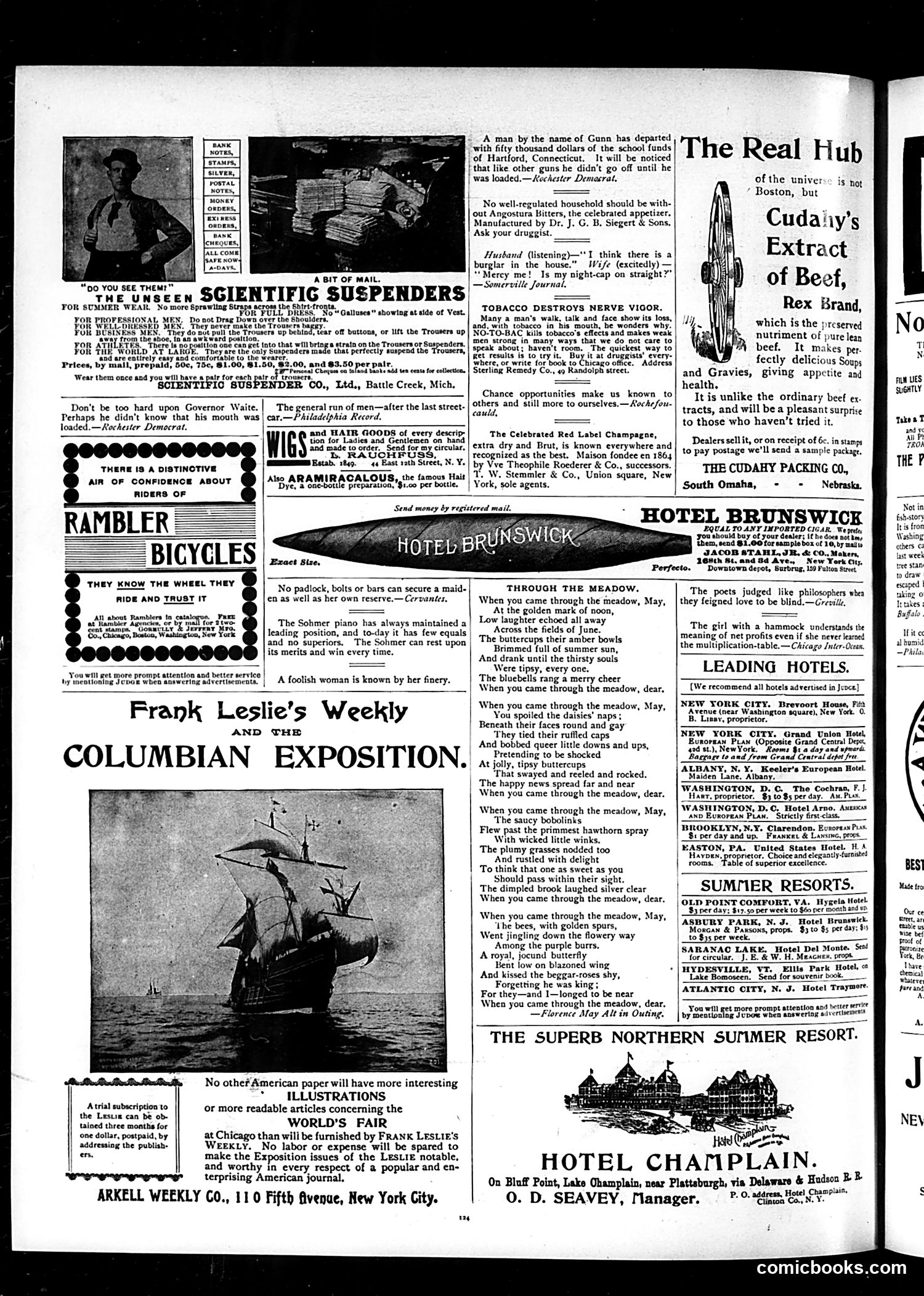
This page is primarily **advertising and promotional material** rather than political satire. The main content includes: **"Scientific Suspenders"** ad: A humorous pitch for an invisible/concealed suspender system, contrasting with visible "galluses" (suspenders) that showed through clothing—a fashion concern of the era. **Two brief jokes** appear at top and middle: - A quip about "Governor Waite" with a loaded mouth (a generic political jab) - A marital joke about a wife concerned with her nightcap during a supposed burglary **"Rambler Bicycles"** advertisement emphasizing rider confidence. **Hotel and resort advertisements** dominate the right side, promoting establishments like Hotel Brunswick and Hotel Champlain. The page also includes ads for tobacco cessation products, champagne, beef extract, cigars, and hair goods—typical of late-19th-century magazines. There's no significant political cartoon or satirical commentary. The "joke" content is mild domestic humor rather than pointed social criticism.
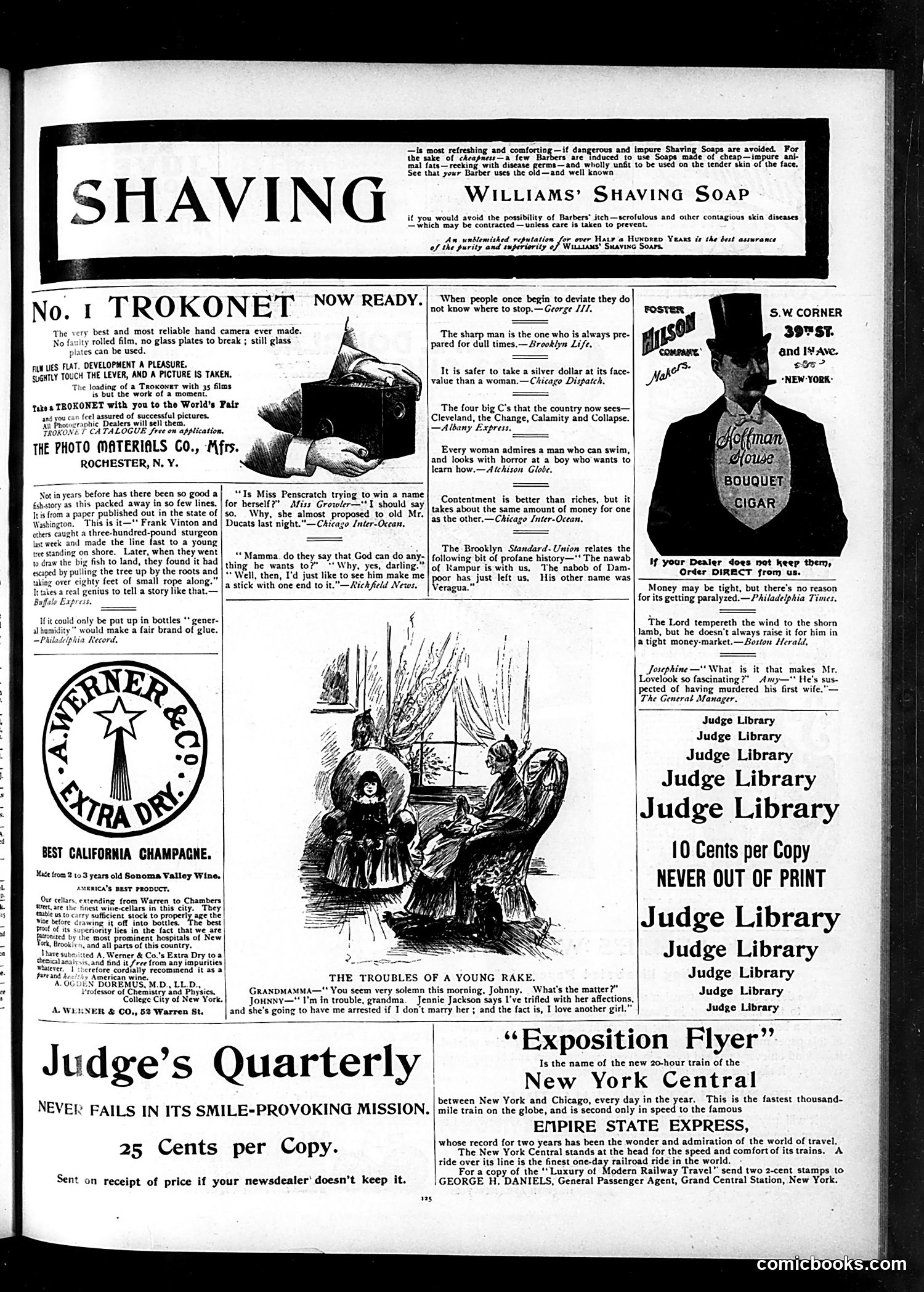
This page is primarily **advertising** rather than editorial satire. The dominant content includes: **Main Advertisements:** - Williams' Shaving Soap (top) — emphasizing purity and safety against barber's itch and contagious diseases - Trokonet camera — promoting its reliability and portability for the World's Fair - A. Werner & Co.'s Extra Dry champagne — California wine marketed as the finest product **Small Cartoon/Illustration:** A domestic scene (center-right) showing a grandmother and children in conversation. The dialogue implies a grandmother warning a young boy against learning to swim — satirizing the irrational fears some parents held about water safety. **Brief Humorous Quotes:** Scattered one-liners on various topics (courtship, divinity, politics, fishing) offering light social commentary typical of Judge magazine's style. **Context:** This appears to be a late 19th-century issue. The "World's Fair" reference likely indicates the 1893 Chicago Columbian Exposition. The page reflects period anxieties about hygiene, product safety, and social propriety.
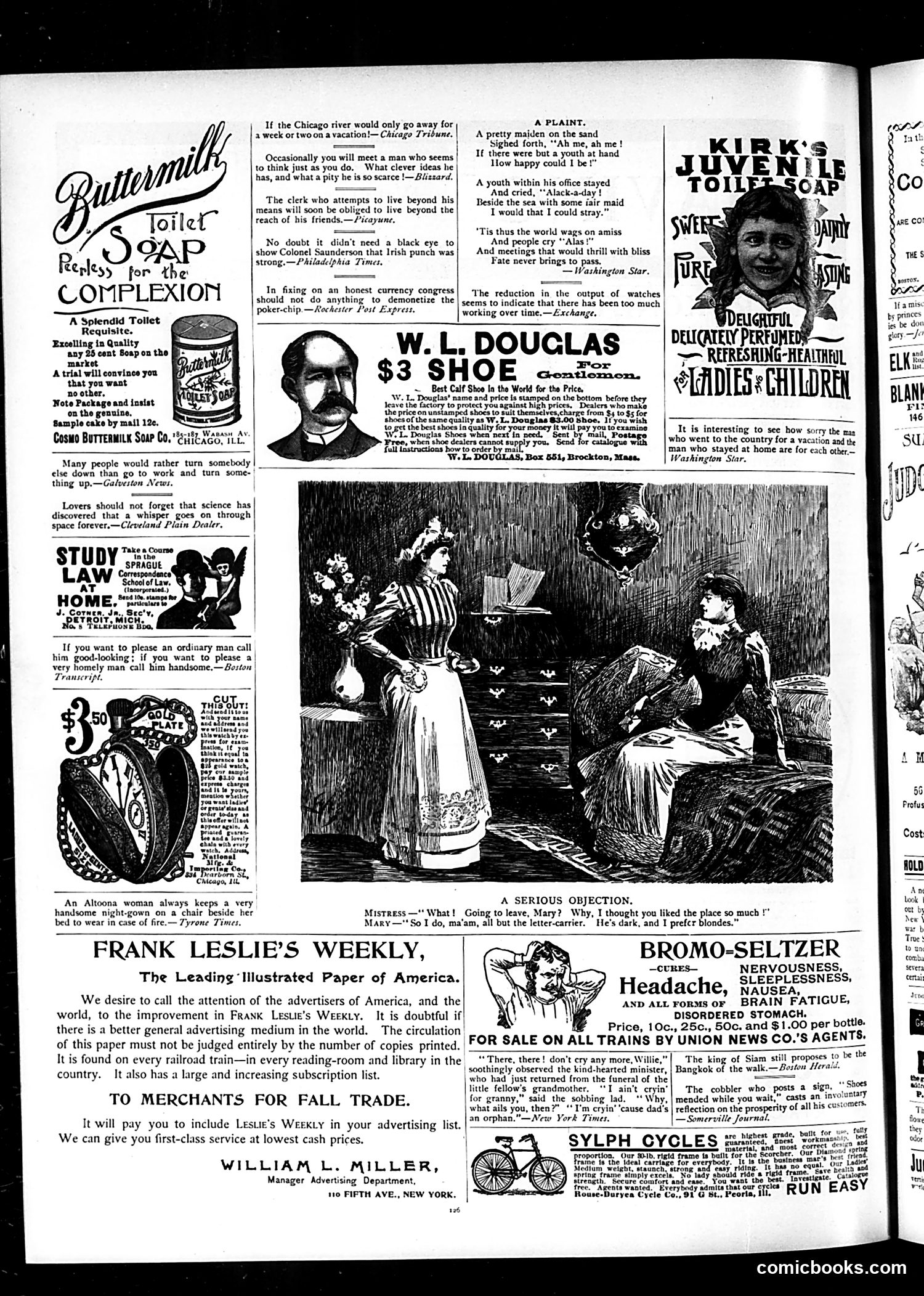
This page is primarily **advertisements and filler content** rather than political satire. The main elements include: **Advertisements:** Buttermilk toilet soap, W.L. Douglas shoes ($3), Kirk's Juvenile Toilet Soap, Bromo-Seltzer, and Sylph Cycles dominate the layout. **Short humor pieces:** Brief one-liners on relationships, work, and social behavior—typical magazine filler of the era (e.g., "Many people would rather turn somebody else down than go to work and turn something up"). **Two illustrated items:** 1. A poem titled "A Plaint" about a lovelorn maiden and youth—sentimental Victorian verse 2. "A Serious Objection"—a domestic comedy sketch where a servant prefers the letter-carrier because "he's dark, and I prefer blondes"—reflecting period racial/ethnic attitudes **Bottom section:** Frank Leslie's Weekly's self-promotion claiming superiority as an advertising medium. The page contains no discernible political commentary or sharp satire—it's standard late-19th-century magazine content mixing ads with mild, domestic humor.
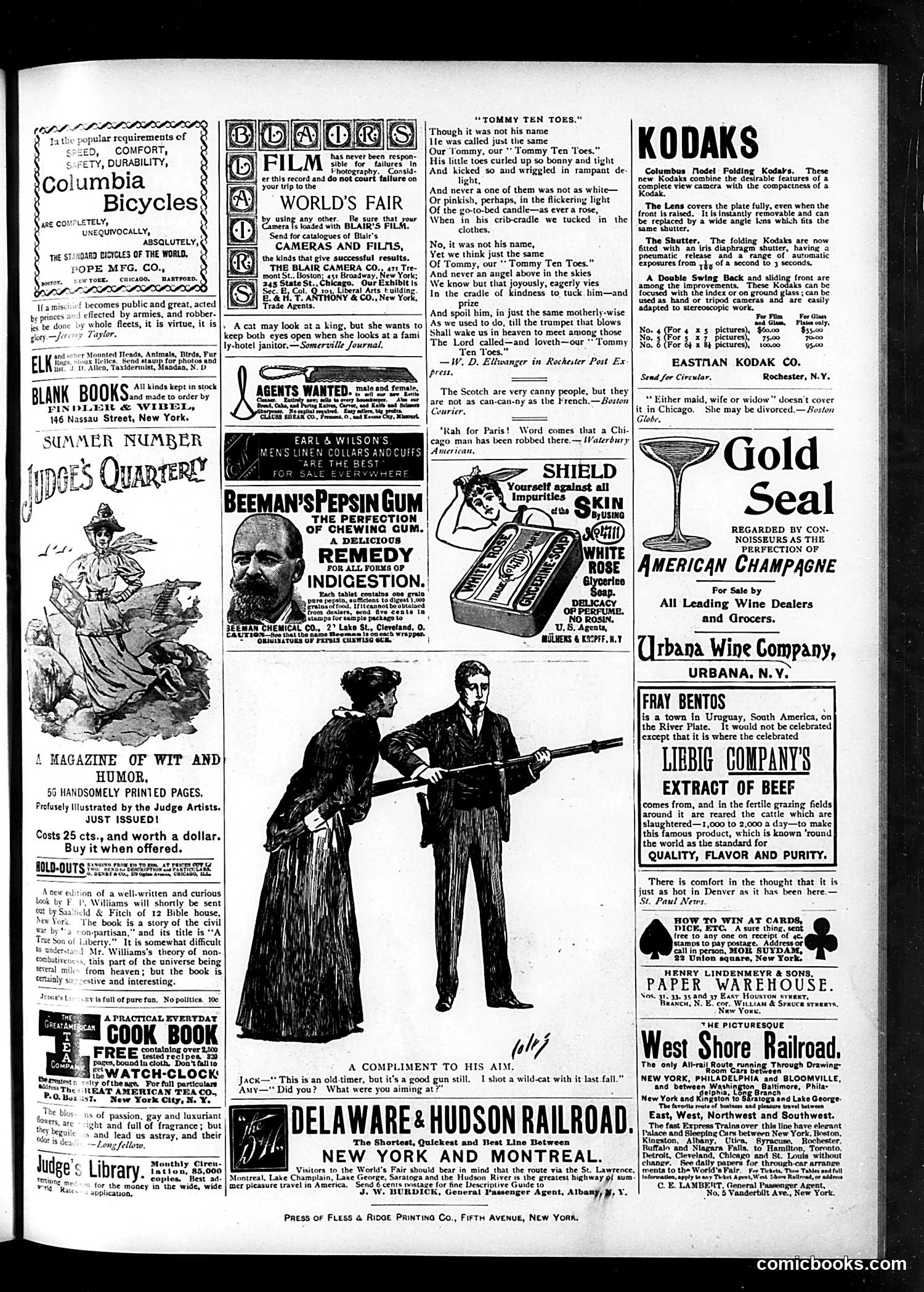
This is primarily an **advertising and miscellaneous content page** from Judge magazine, with only one clear cartoon titled "A Compliment to His Aim." ## The Cartoon The illustration shows two men—one appears to be aiming or holding a rifle at the other, who stands calmly beside him. The dialogue reads: Jack says "This is an old-timer, but it's a good gun still. I shot a wild-cat with it last fall." Amy replies: "Did you? What were you aiming at?" **The joke**: Amy's final question implies the man *missed* the wild-cat and hit something (or someone) else instead—a sarcastic compliment to his poor marksmanship. It's a mild, domestic humor piece typical of Judge's style. The rest of the page consists of period advertisements (bicycles, cameras, champagne, railroad services) and miscellaneous content including a sentimental poem about a baby nicknamed "Tommy Ten Toes." There is no significant political or social satire on this particular page.
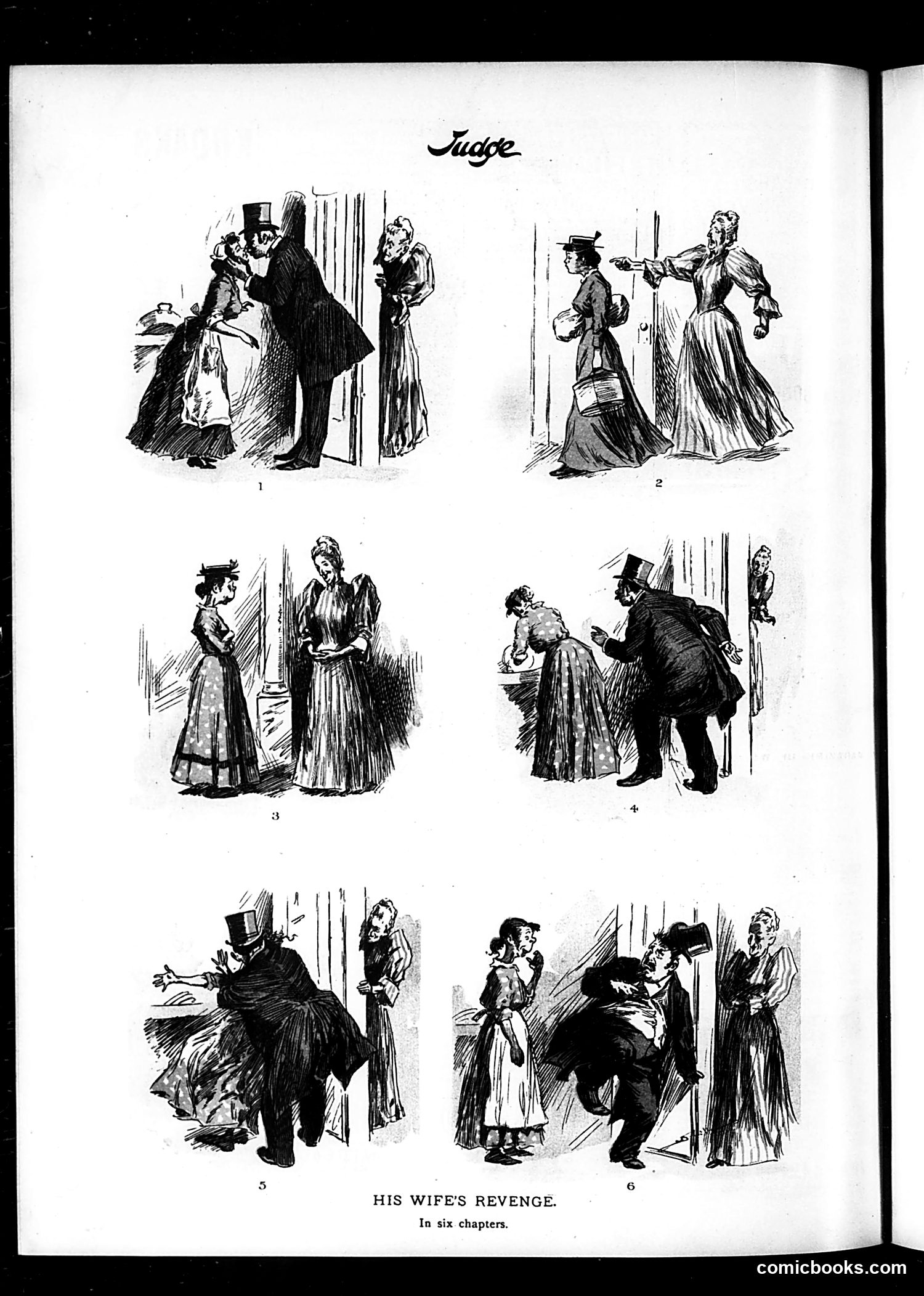
This six-panel satirical comic depicts a domestic dispute told from the wife's perspective. The narrative appears to show a husband's wrongdoing (possibly infidelity or mistreatment) followed by his wife's calculated retaliation. The strip uses exaggerated Victorian-era clothing and body language typical of Judge's visual style. Each panel escalates the marital conflict, with the wife progressing from confrontation to active revenge—likely involving public humiliation or social consequences for the husband. The satire targets Victorian gender dynamics, mocking both the husband's apparent transgressions and the wife's dramatic response. The title's emphasis on "HIS WIFE'S REVENGE" inverts typical power dynamics of the era, suggesting female agency in addressing marital wrongs—a pointed joke about women's limited legal recourse in late 19th-century marriage.