
A complete issue · 16 pages · 1893
Judge — August 12, 1893
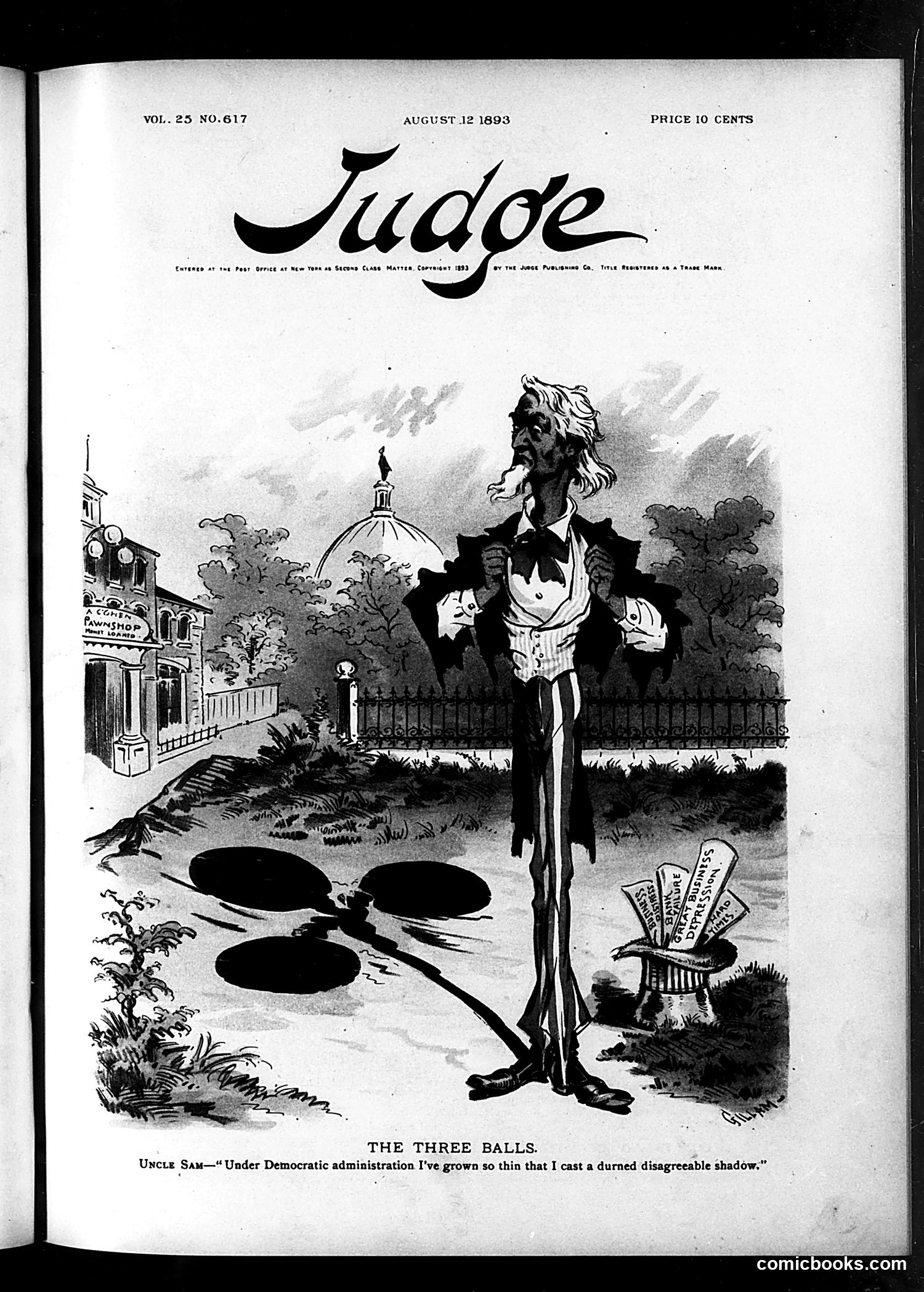
This is a political cartoon titled "The Three Balls," showing Uncle Sam as an emaciated, haggard figure standing before the U.S. Capitol. Three dark spheres (representing burdensome issues or failures) loom in the foreground, while Uncle Sam holds what appears to be a fan listing grievances or problems. The caption reads: "Under Democratic administration I've grown so thin that I cast a dwarfed disagreeable shadow." This cartoon critiques the Democratic administration (likely President Cleveland's second term, which began in 1893 during an economic depression). The "three balls" symbolize specific policy failures or crises, while Uncle Sam's skeletal appearance represents America's perceived economic and political decline under Democratic governance. The cartoon is partisan Republican propaganda attacking the sitting Democratic administration's competence.
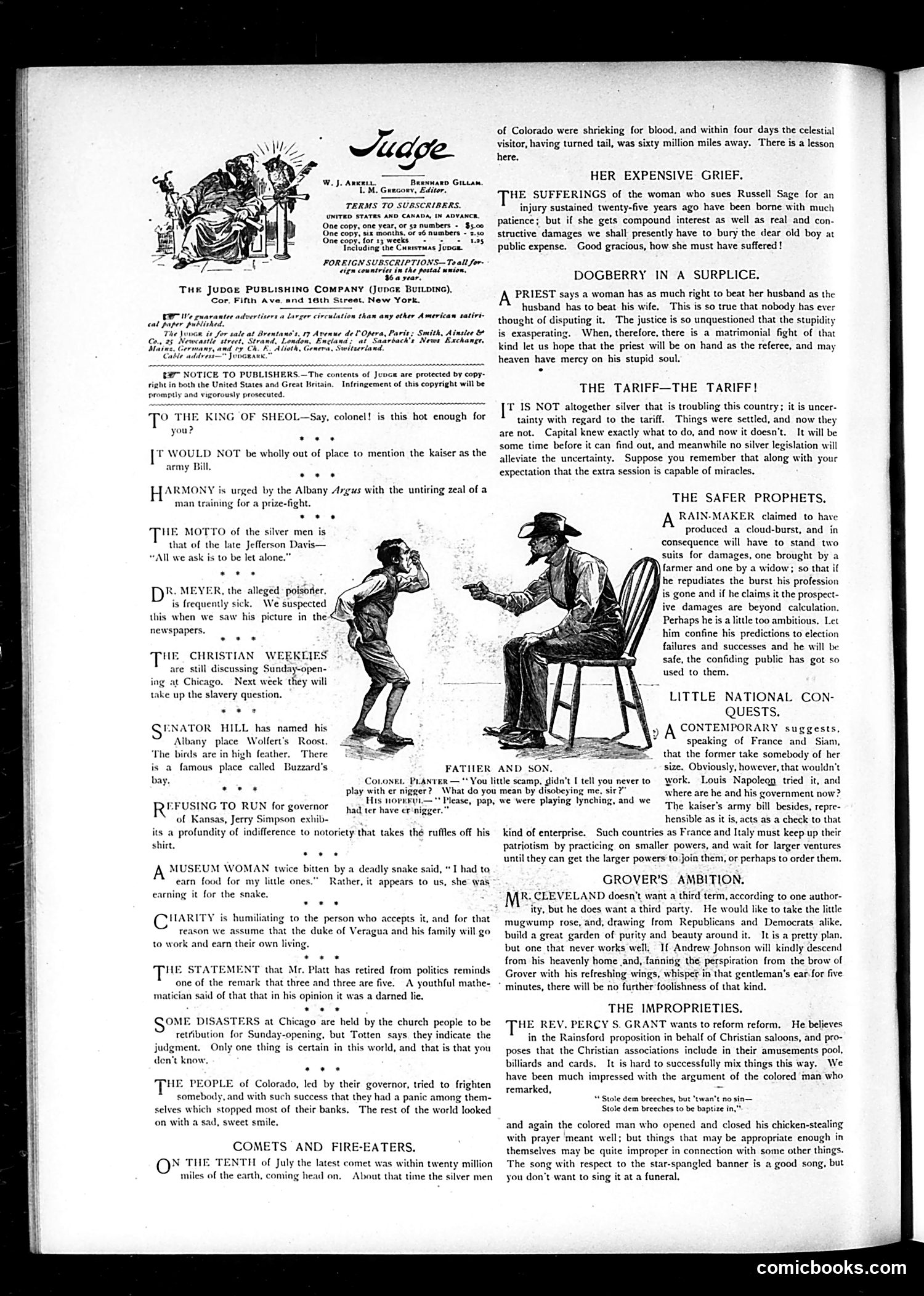
This page contains satirical commentary on contemporary issues rather than a single unified cartoon. The illustrated vignette titled "Father and Son" depicts a confrontation between what appears to be a colonial figure and a young boy—likely satirizing imperialism or paternal government control, with dialogue about "playing" and obedience. The text sections mock various targets: tariff uncertainty, a rainmaker's false weather predictions, religious reformers, political ambitions, and improprieties involving saloons and churches. References to "the colored man" and segregation-era social commentary appear without clear specific context. The magazine's satirical approach targets incompetence in government, fraudulent claims, religious hypocrisy, and social pretension—typical Judge themes from the Gilded Age period.
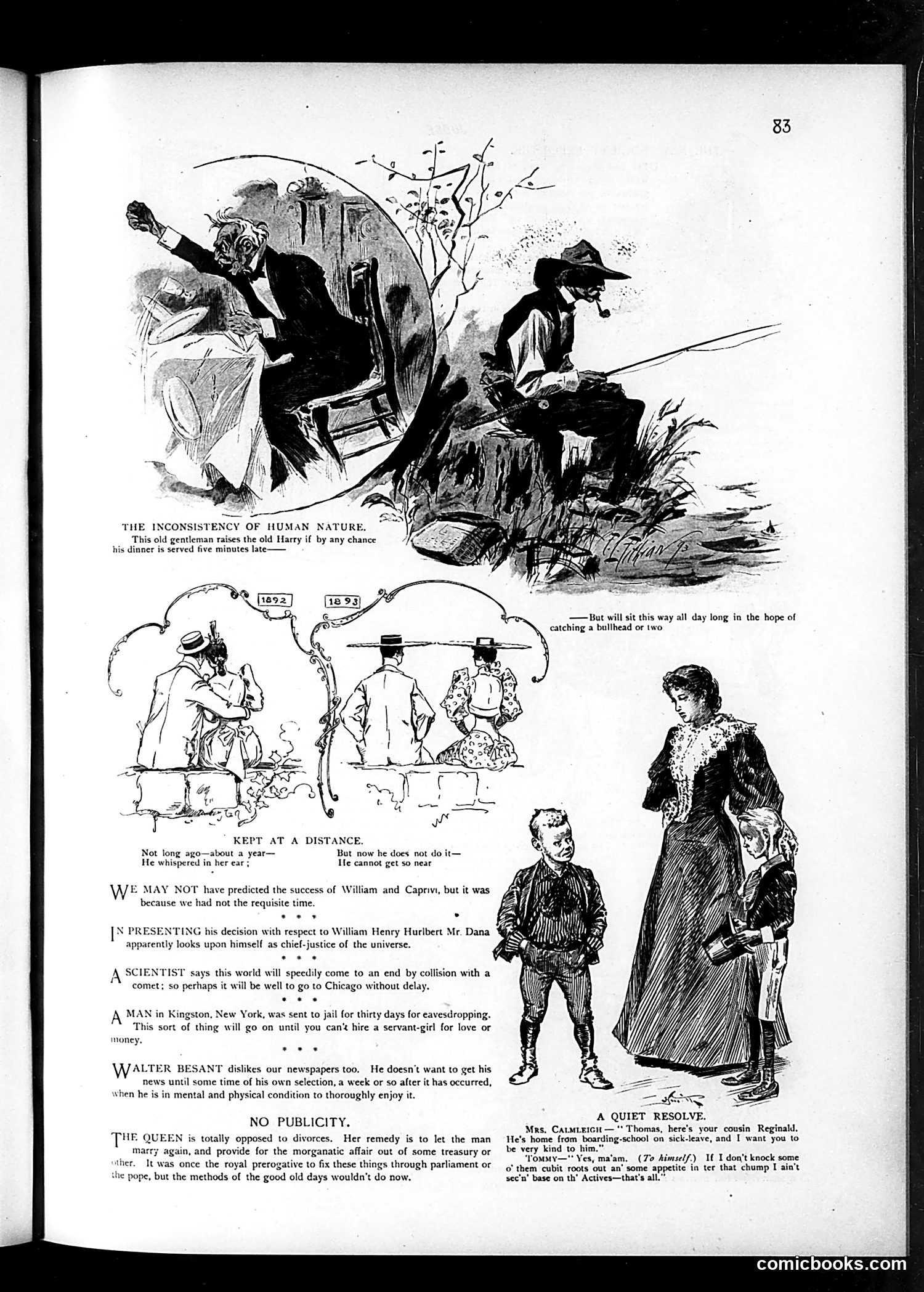
This page contains several loosely-connected satirical vignettes about human inconsistency and social hypocrisy: **Top cartoon**: "The Inconsistency of Human Nature" mocks an elderly gentleman who abandons fishing the moment his dinner arrives—abandoning his patient fishing companion. **Middle section**: "Kept at a Distance" satirizes social pretense, showing how people maintain false distance from those they secretly wish to befriend. **Text items** ridicule various targets: a scientist's doomsday prediction about a comet collision, a man jailed for eavesdropping, Walter Besant's newspaper complaints, and "The Queen" regarding divorce remedies and parliamentary procedures. **Bottom sketch**: "A Quiet Resolve" shows a woman addressing a boy about his cousin Reginald returning from boarding school. The overall theme critiques Victorian-era social contradictions and human nature's hypocrisies through humor.
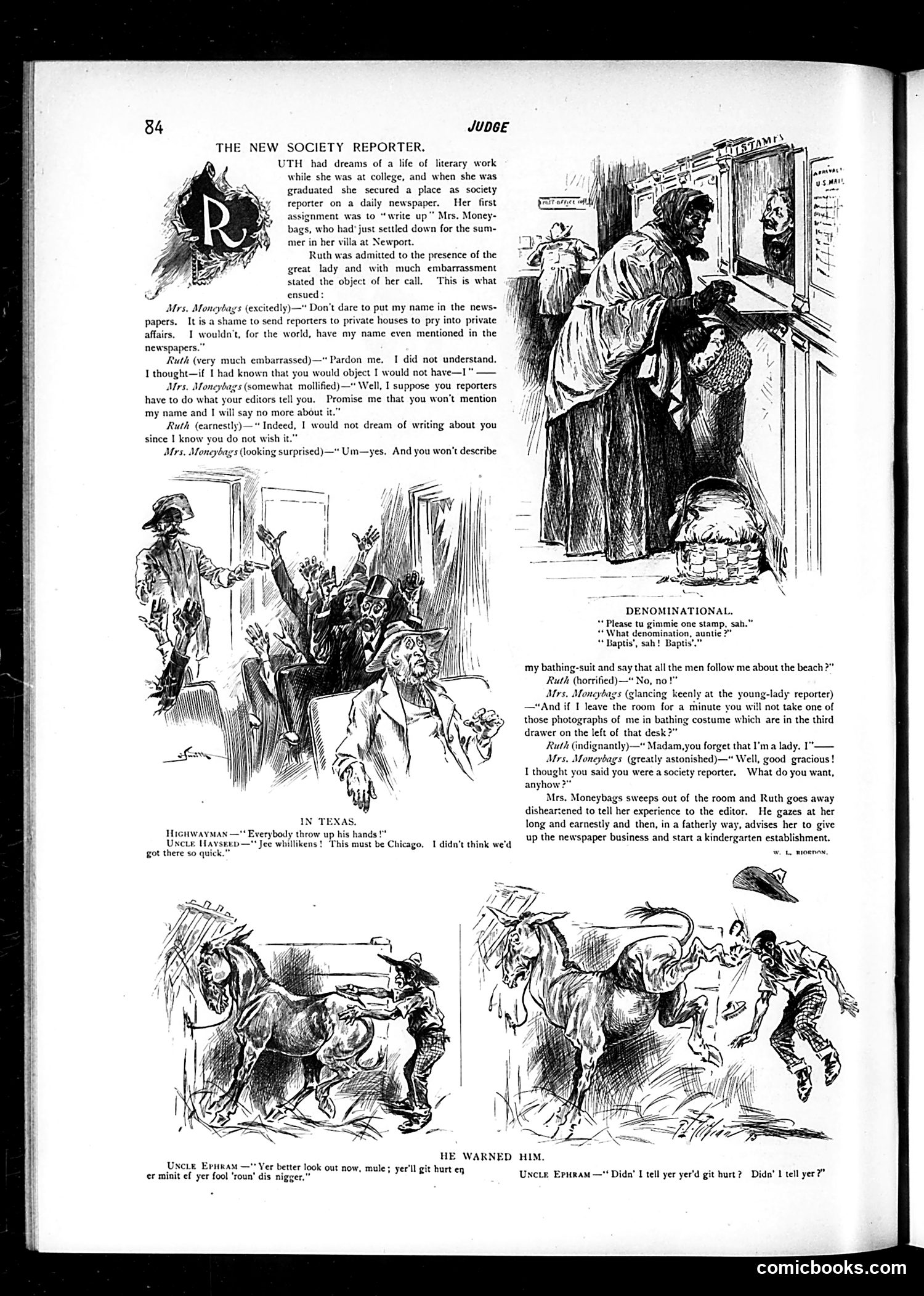
This satirical story mocks both society reporting and wealthy socialites' hypocrisy. Ruth, a young newspaper reporter, visits Mrs. Moneybags (a caricature of wealthy Newport residents) to write a society piece. Mrs. Moneybags indignantly refuses publicity, claiming it's improper—yet immediately begins volunteering scandalous details: boasting about men following her on the beach, mentioning bathing photos in her desk. The irony is sharp: she demands privacy while eagerly gossiping about herself. The editor's response—advising Ruth to abandon journalism for kindergarten teaching—reflects period attitudes that serious newspaper work was unsuitable for women. The bottom cartoons appear unrelated: one shows comic cowboy/ranch humor; the other uses offensive racial dialect and imagery typical of era stereotyping, depicting an interaction between a white character and a Black worker.
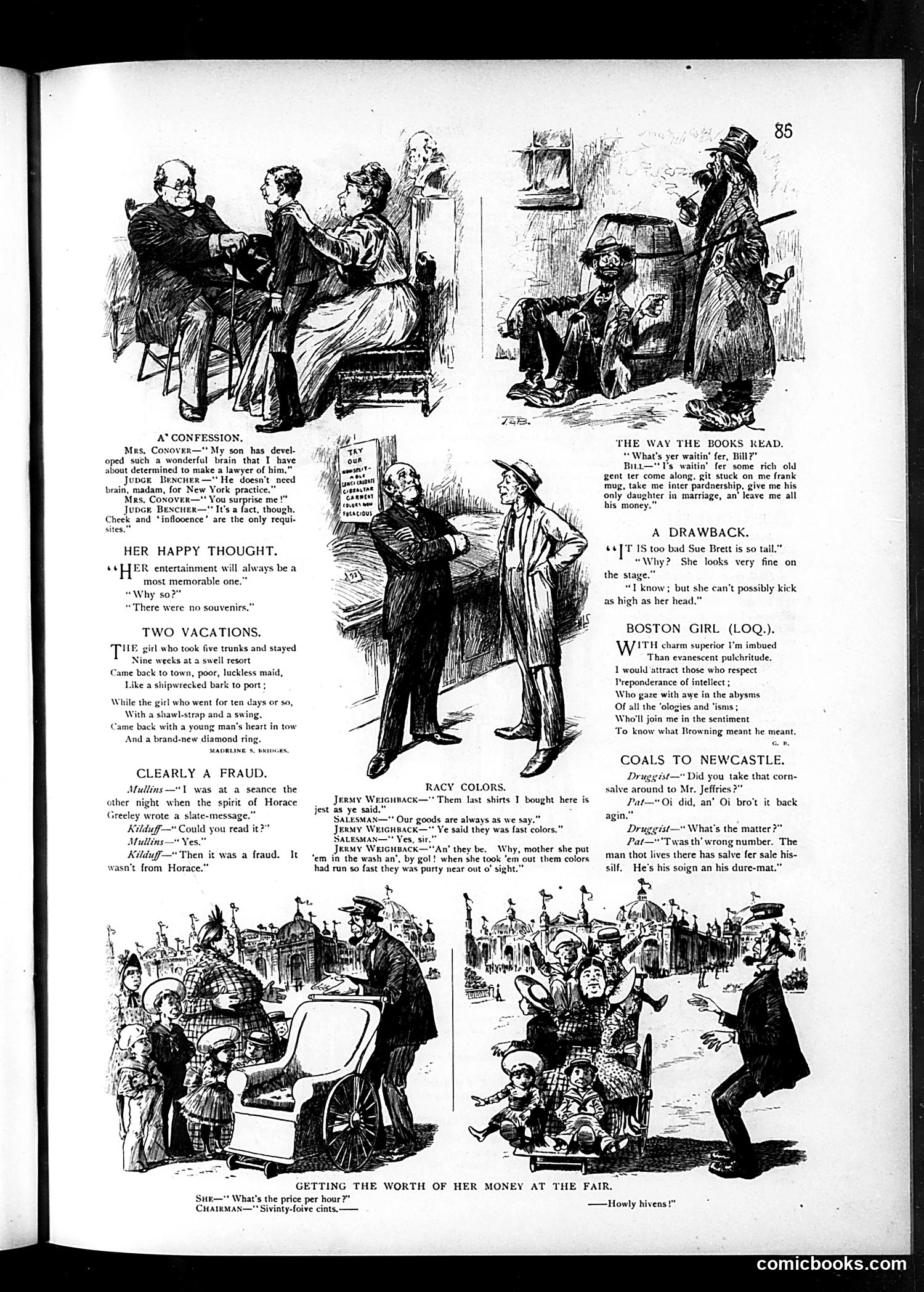
This page contains several short satirical pieces typical of late 19th-century Judge magazine: **"A Confession"** mocks New York legal practice, with a judge asserting that lawyers need "cheek and influence" rather than brains—skewering courtroom corruption. **"Two Vacations"** contrasts a girl who spent lavishly on a long resort trip (returning broke) with one taking a brief vacation who returns engaged with a diamond ring—satirizing women's priorities and marriage-market calculations. **"Racy Colors"** features an Irish immigrant (indicated by dialect) complaining that "fast colors" shirts aren't actually colorfast—a play on words mocking both poor product quality and possibly the vendor's honesty. **"Boston Girl"** parodies pretentious intellectual women who admire abstract philosophy and Robert Browning over actual beauty. **"Coals to Newcastle"** jokes that an Irish man returned corn-salve because the recipient (appears to be boxer Jim Jeffries) already sells salves himself—referencing a famous contemporary athlete. The page uses ethnic stereotypes and class humor typical of the era's satirical journalism.
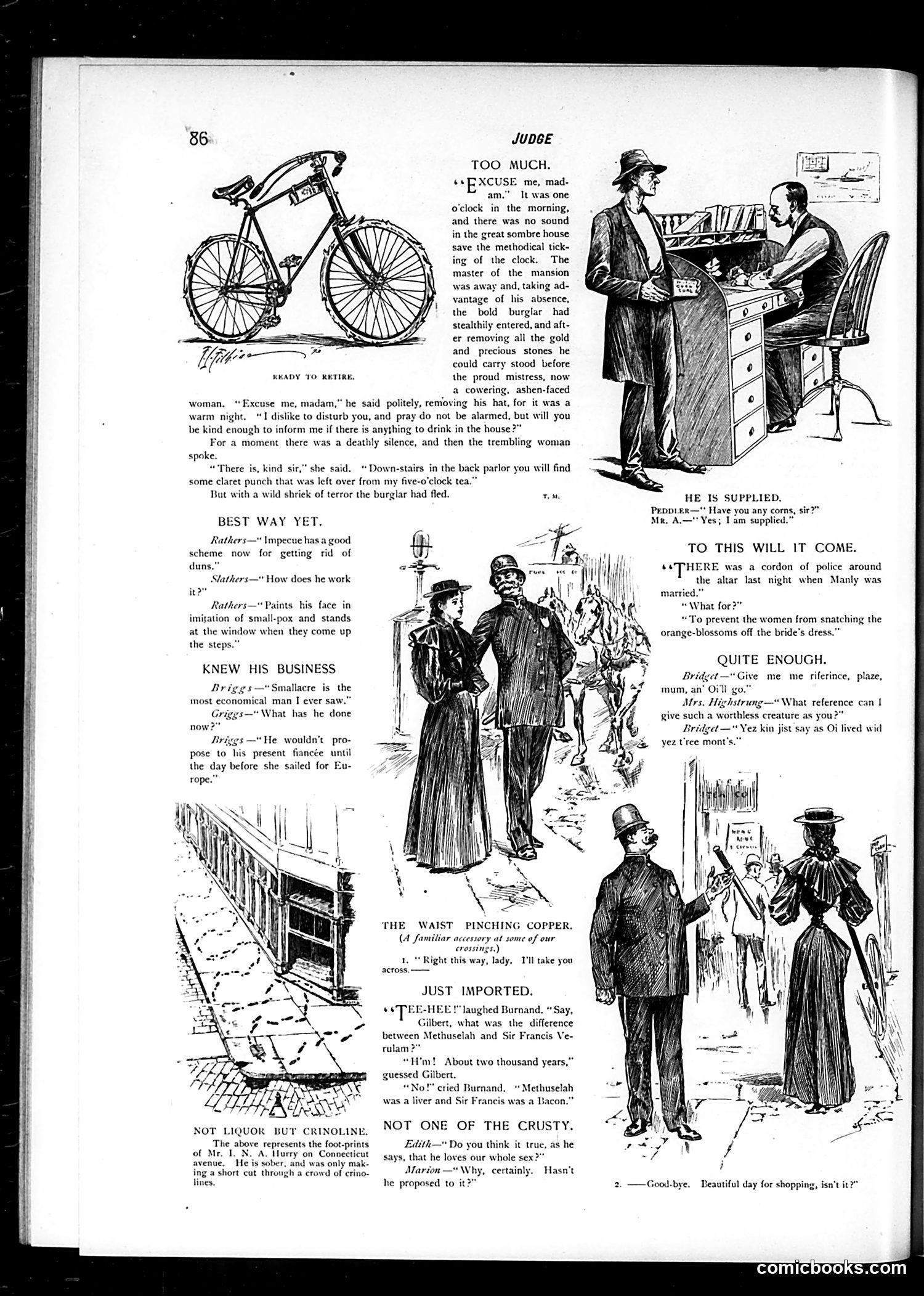
This page contains six separate humorous vignettes satirizing Victorian social conventions and behavior: **"Too Much"**: A burglar politely robs a woman but flees in terror when she mentions claret punch—satirizing excessive temperance anxiety of the era. **"Best Way Yet"**: A man avoids creditors by feigning smallpox, mocking debt avoidance schemes. **"He Is Supplied"**: A podiatrist's patient claims to have corns already—a pun on self-sufficiency. **"To This Will It Come"**: Police guard a wedding altar to prevent women from stealing orange blossoms from the bride's dress, mocking obsessive floral theft. **"Quite Enough"**: An Irish maid (Bridget) offers three months of employment as a reference, satirizing Irish immigrant stereotypes and domestic service standards. **"The Waist Pinching Copper"**: A traffic officer assists women across streets, referencing the enormous crinolines that made crossing difficult—mocking both fashion excess and genteel paternalism. The overall tone ridicules Victorian propriety, fashion excess, servant hierarchies, and social anxieties.
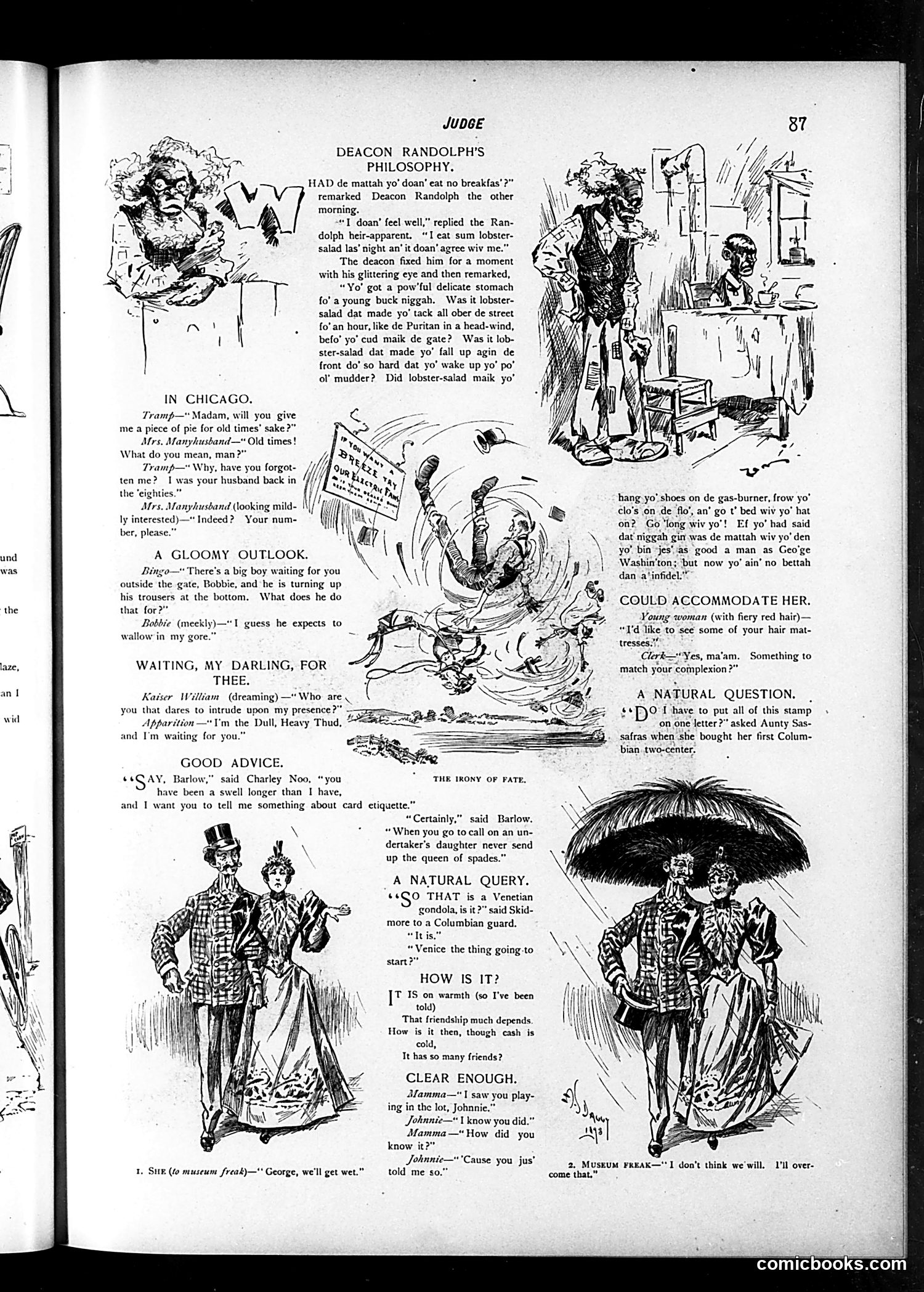
This page contains multiple satirical cartoons and jokes typical of late 19th/early 20th-century American humor, with problematic racial stereotyping throughout. **"Deacon Randolph's Philosophy"** uses exaggerated dialect to mock an African American character lecturing his son about dishonesty—the deacon suggests the young man's claimed lobster-salad illness masks drunkenness and misbehavior. The satire targets youthful excess rather than race specifically, though the racial caricature is offensive by modern standards. **Other segments** include: a Chicago joke about a woman with multiple ex-husbands; "The Irony of Fate" mocking German Kaiser Wilhelm; various domestic humor pieces about etiquette, hair color, postal stamps, and friendship. The cartoons employ visual exaggeration and crude stereotypes common to Judge's era. Most jokes rely on wordplay, class humor, or domestic situations rather than political commentary. The artistic style and printing quality are typical of early 1900s American satirical magazines.
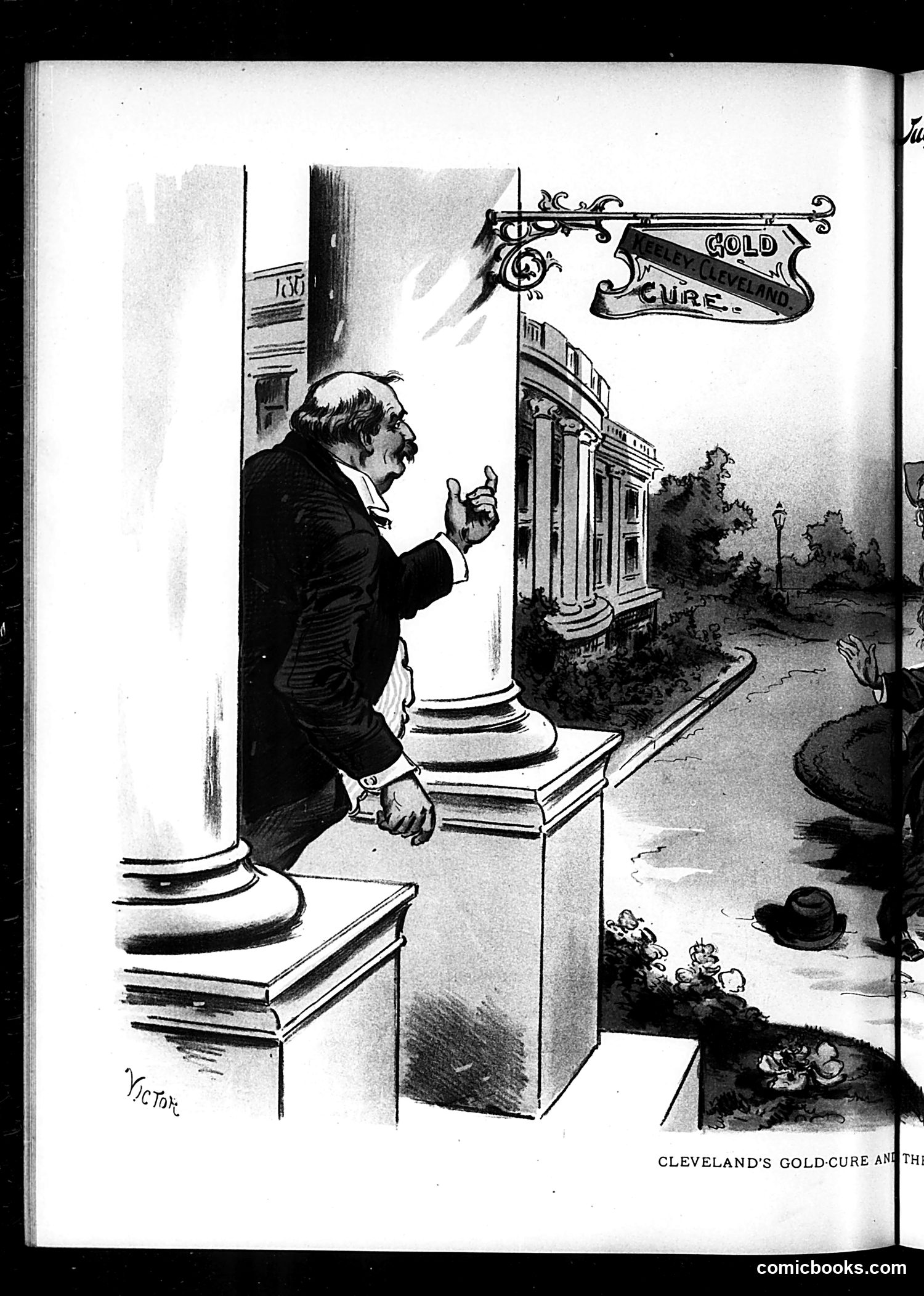
This cartoon from *Judge* magazine satirizes President Cleveland's "Gold Cure" policy. The caricatured figure (Cleveland) stands at a classical government building, gazing at a signpost reading "Gold Cure" pointing toward Cleveland. The visual joke centers on Cleveland's efforts to maintain the gold standard during economic crisis—depicted as him literally following his own cure remedy, suggesting the policy is self-serving or circular rather than economically sound. The stack of books beneath his feet may represent accumulated economic or political burden. The elegant building in background represents governmental authority. The satire critiques Cleveland's monetary policy as ineffective or hypocritical, portraying him as obsessed with the "cure" to the point of absurdity.
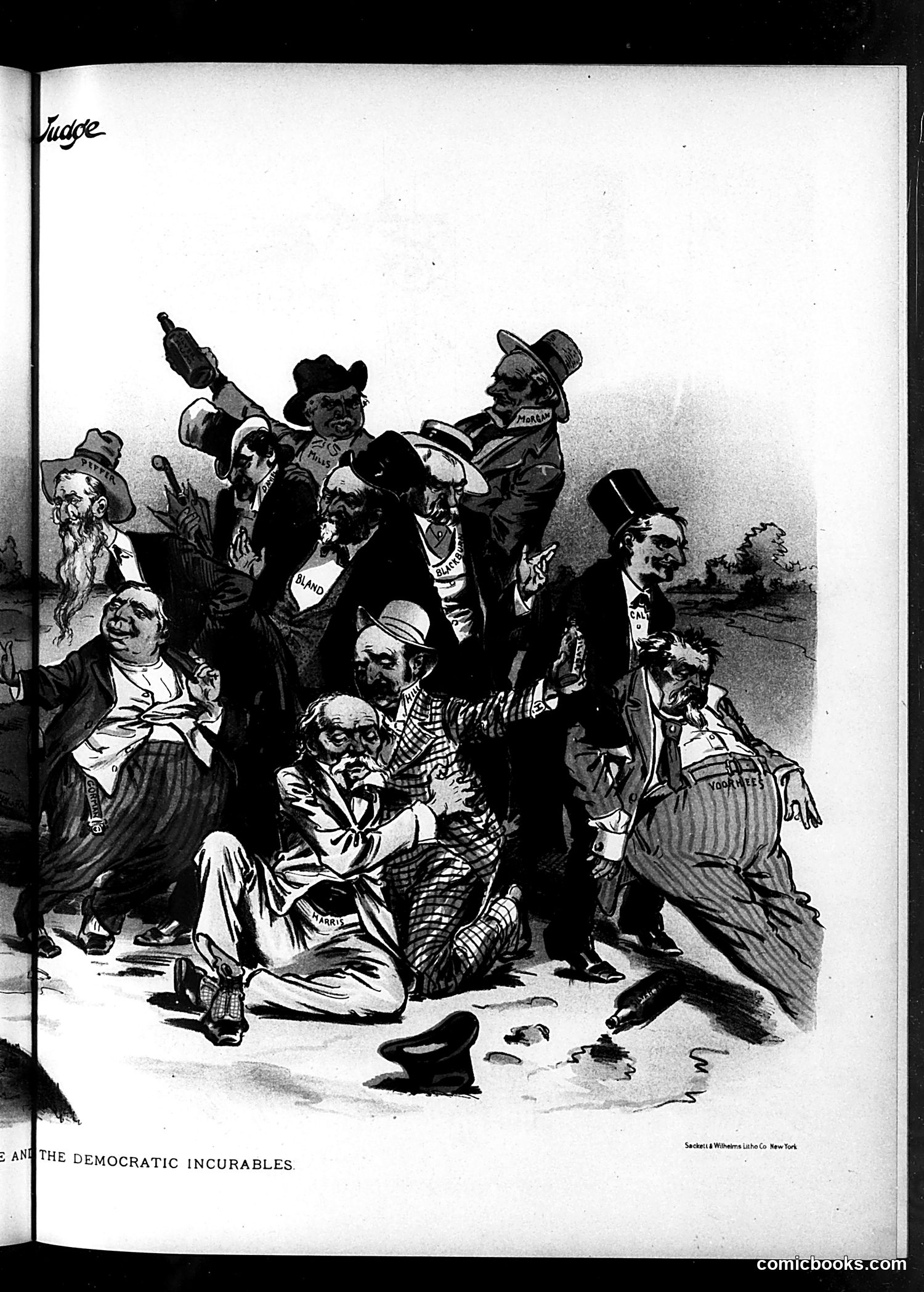
This political cartoon satirizes the Democratic Party as a collection of hopelessly dysfunctional figures. The title "Democratic Incurables" suggests these party members are beyond reform or help. The caricatures appear to represent various Democratic politicians or factions of the era, depicted with exaggerated features in a manner typical of Gilded Age satirical cartooning. Several figures wear labels (partially visible), and they're arranged in a chaotic group scene suggesting internal discord and incompetence. The satire's specific targets remain somewhat unclear without clearer label visibility, but the overall message is that the Democratic Party is plagued by corrupt, incompetent, or hopelessly divided members who cannot be salvaged—hence "incurable." This reflects a common Republican criticism during this period of Democratic political dysfunction.
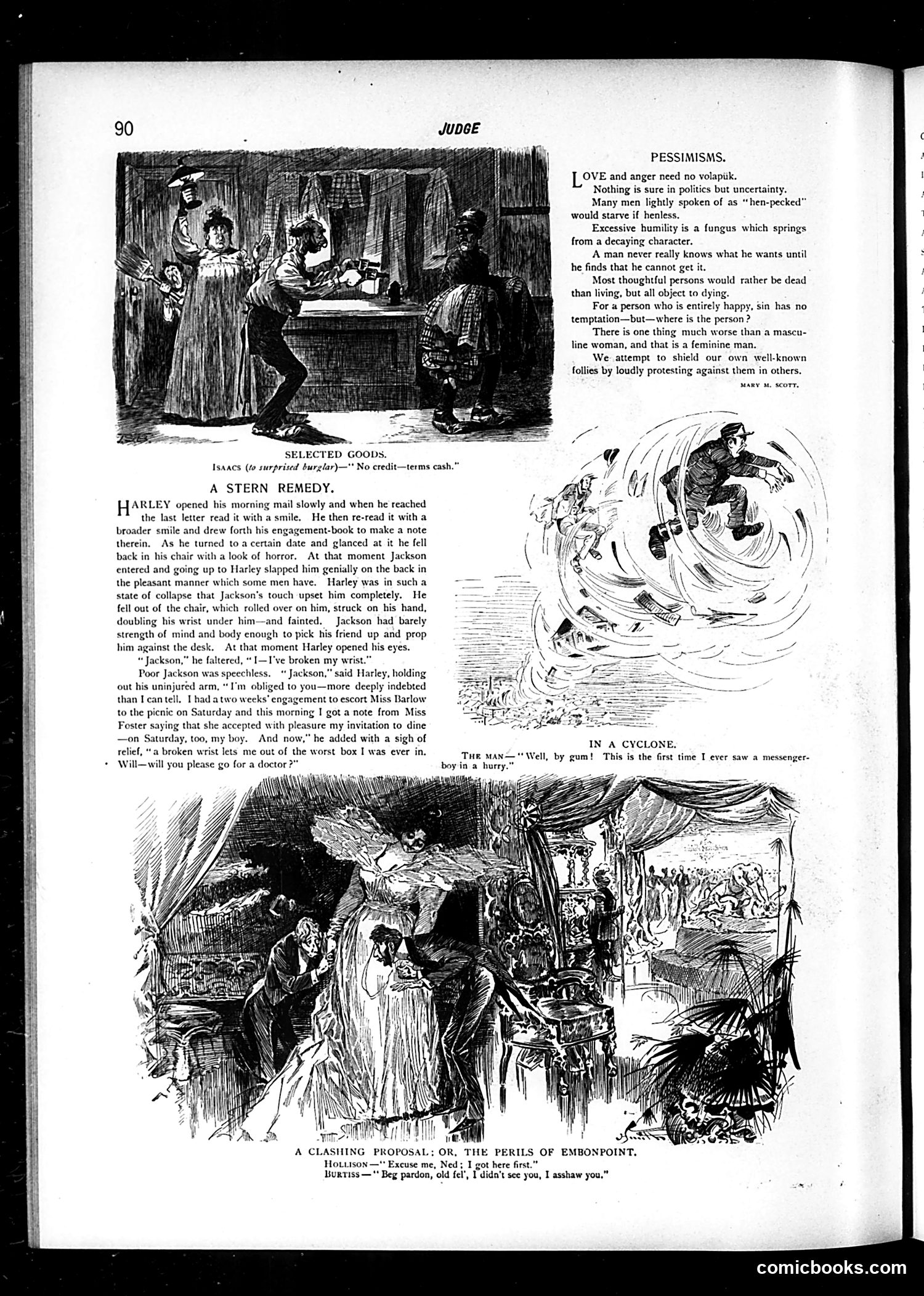
This page contains three distinct satirical pieces: **"Pessimisms"** presents cynical observations about human nature—remarking that men called "hen-pecked" would starve without wives, that excessive humility indicates decay, and that people shield their own flaws by criticizing others' identical ones. These are aphoristic jabs at Victorian hypocrisy. **"A Stern Remedy"** satirizes a man named Harley who receives an engagement letter, then breaks his wrist in a comedic accident. Rather than distressing him, the injury conveniently cancels conflicting social obligations (a picnic and dinner on the same Saturday). The joke mocks the desperation of navigating overlapping social commitments—his "broken wrist" becomes welcome relief. **"A Clashing Proposal; or, The Perils of Embonpoint"** (partially visible) appears to involve romantic entanglement, with the caption joke hinging on someone arriving "first" at a meeting. The illustrations employ typical Victorian-era sketch styles. The humor targets social pretense, the burdens of courtship rituals, and the gap between polite society's demands and actual desire.
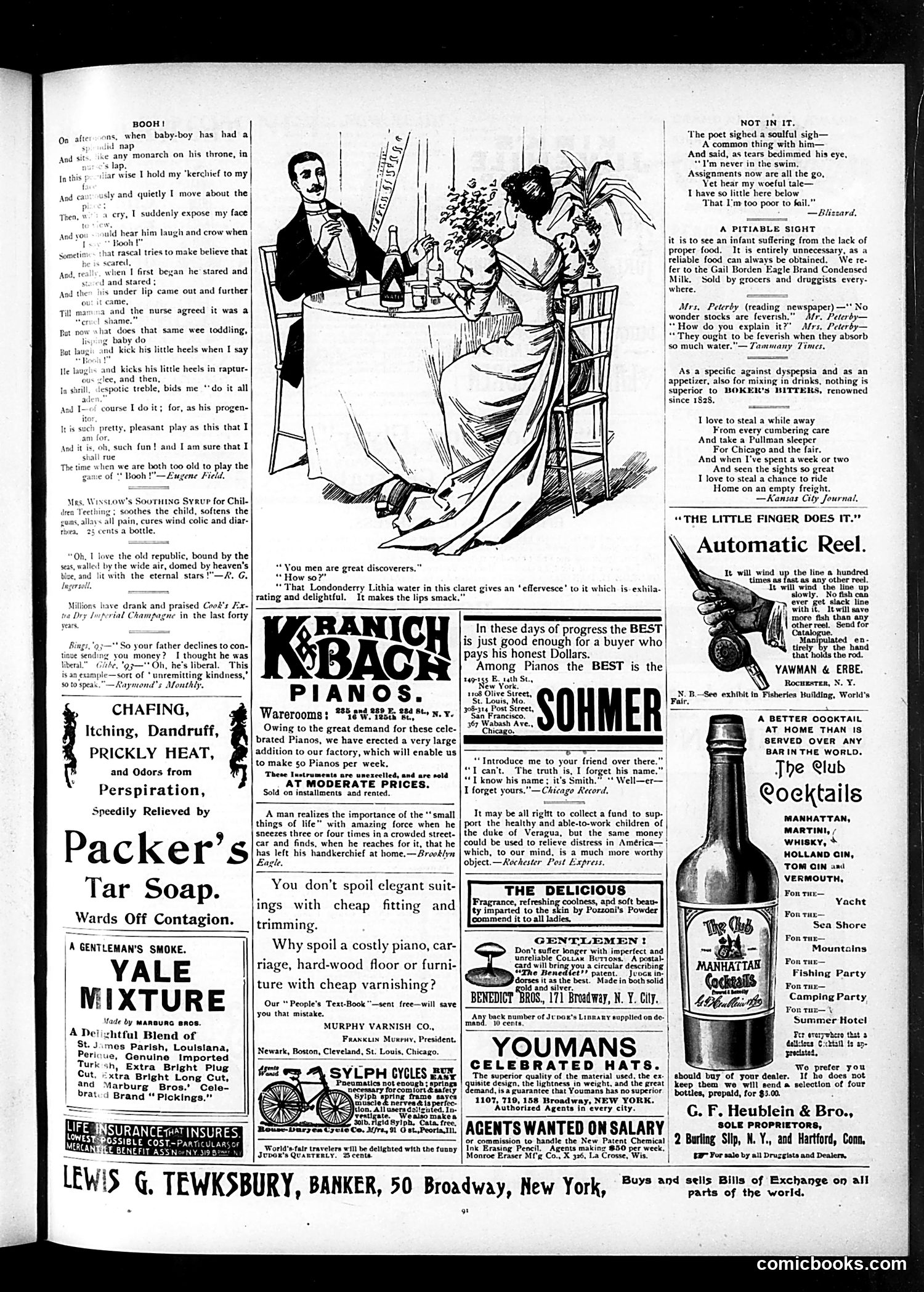
This page is primarily **advertising**, with minimal satirical cartoon content. The main illustrated section shows a domestic scene of a man and woman at a dining table—likely depicting a social interaction or flirtation over drinks, with accompanying caption about "Londonderry Lithia water" enhancing wine's appeal. The page's satirical elements are modest: - A brief **poetry section** mocking poor poets who claim poverty prevents success ("too poor to fail") - **Small joke snippets** about fathers refusing money and the importance of handkerchiefs The bulk of the page consists of **product advertisements**: pianos, soap, tobacco, champagne, mineral water, condensed milk, and financial services. These ads reflect late 19th-century consumer culture. Without clearer identification of specific political figures or dated events, the page appears to be a typical Judge issue blending light social satire with commercial advertising rather than hard-hitting political commentary.
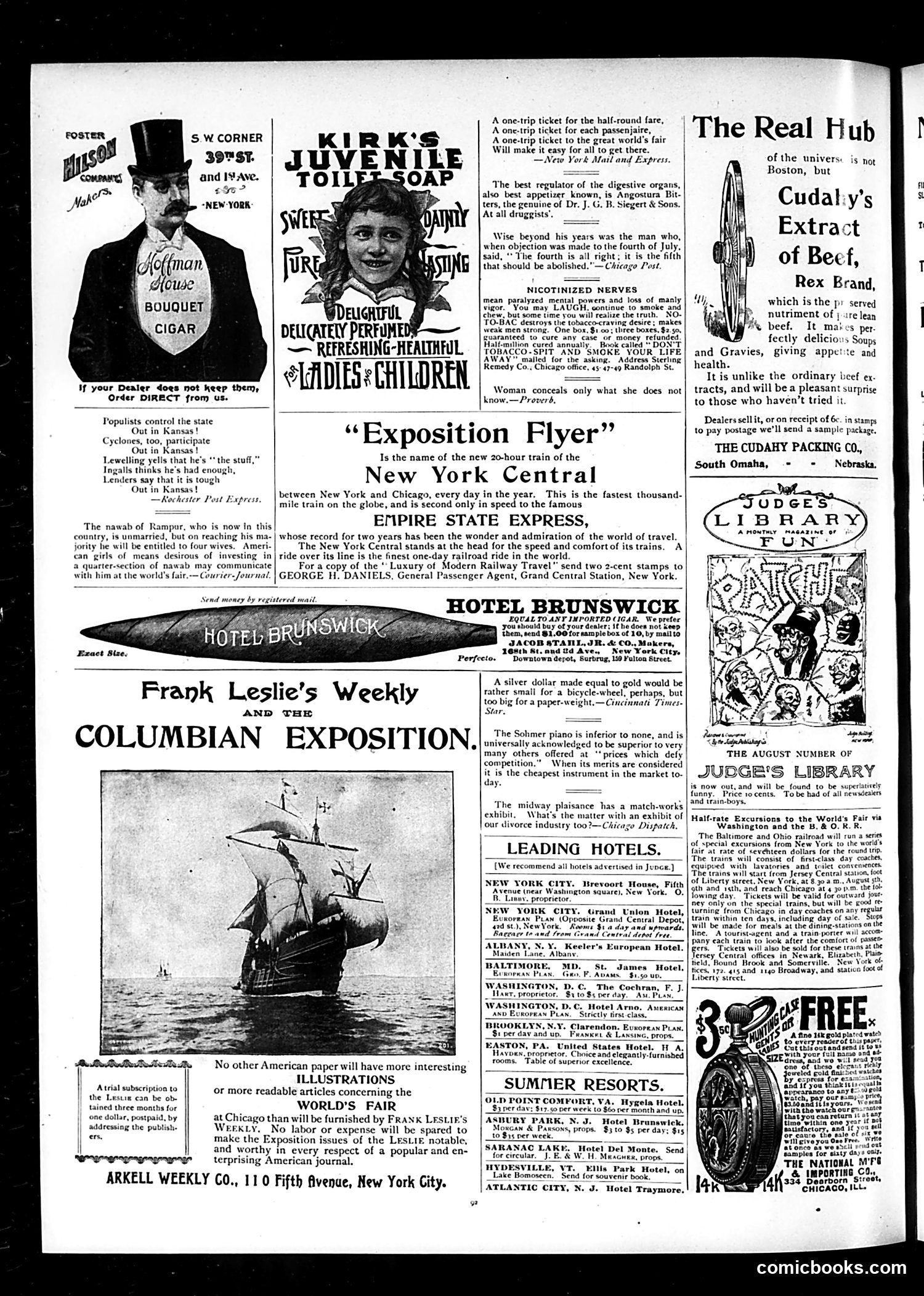
This page consists primarily of **advertisements and filler content** rather than editorial cartoons, with one notable satirical poem. The only substantive satirical content is a brief verse about **Kansas Populism**, mocking the political upheaval there. It references "Lewelling" (likely Governor Lorenzo Lewelling) and Kansas Senator "Ingalls," criticizing the Populist Party's control of the state while poking fun at the region's hardships—cyclones and financial difficulties for lenders. The tone treats Populism as absurd and worthy of ridicule. The remainder consists of product advertisements (cigars, soap, patent medicines) and travel notices promoting Frank Leslie's Weekly's coverage of the 1893 Columbian Exposition in Chicago. There's also a small joke about coinage and a poem mocking Kansas conditions. The page represents typical late-19th-century magazine format: commercial content subsidizing editorial matter.
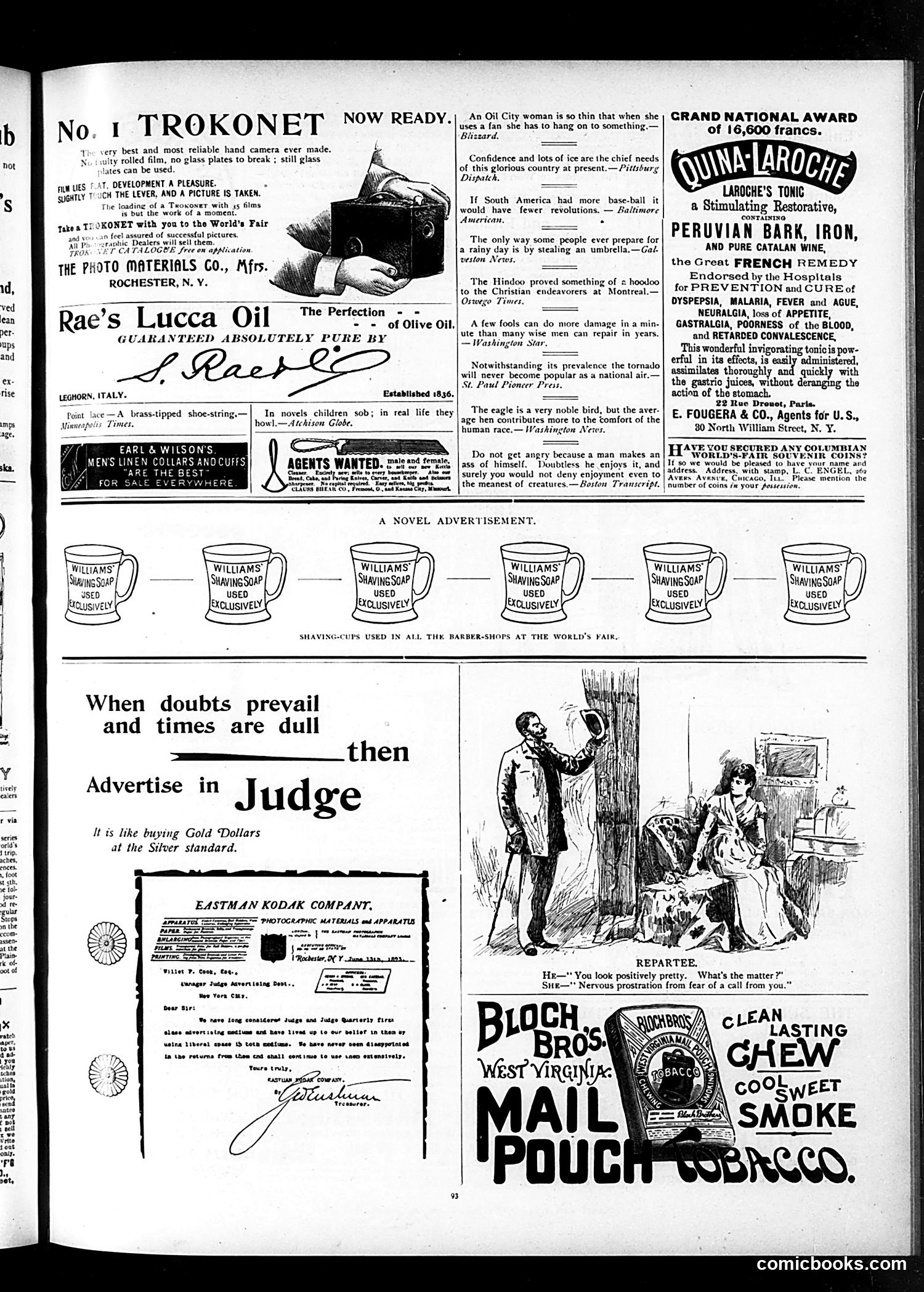
This is primarily an **advertising page** from Judge magazine, circa 1890s. The main content consists of product advertisements and brief satirical quips rather than a unified political cartoon. **Key elements:** The **satirical snippets** scattered throughout mock American life: an Oil City woman so thin she needs to hold onto her fan; commentary on South American revolutions; criticism of tornado weather; observations about eagles versus hens' utility. These are typical Judge-style one-liners targeting contemporary absurdities. **The "Repartee" cartoon** (bottom right) shows a mild flirtation joke: a man compliments a woman's appearance; she attributes it to "nervous prostration from fear of a call from you"—a Victorian-era dig at unwanted male attention. **Advertising dominates**: Trokonet cameras, Rae's Lucca Oil, Williams Shaving Soap, Bloch Bros tobacco, and Kodak prominently feature. The Kodak letter is a testimonial praising Judge's advertising effectiveness—meta-promotion. This reflects Judge's business model: satirical commentary interwoven with commercial promotion to affluent readers.
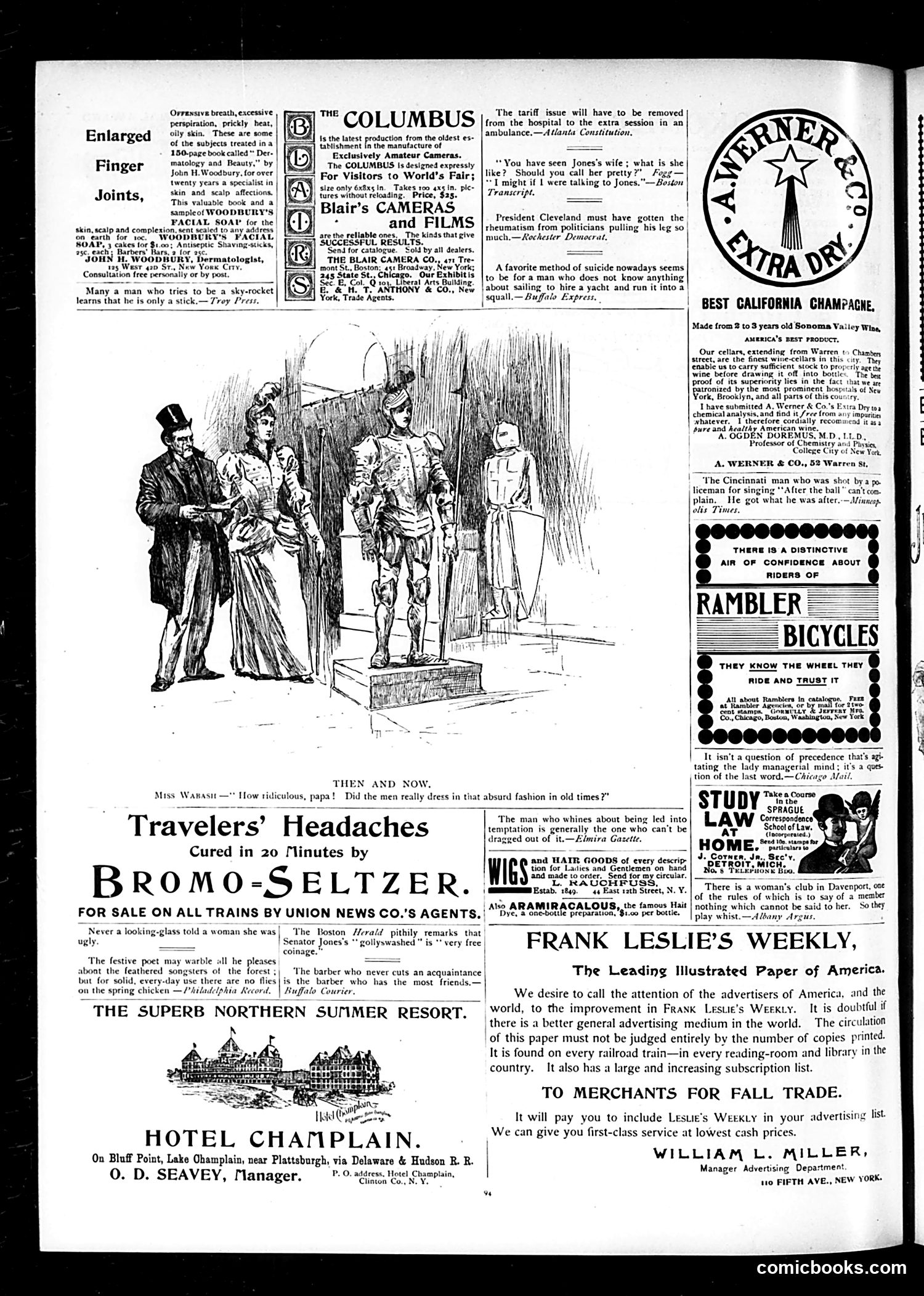
This is primarily an **advertising page** from Judge magazine, with minimal editorial content. The page features: **Main Cartoon ("Then and Now"):** A small sketch showing a woman commenting on absurdly formal historical fashion, suggesting social progress in women's dress standards. **Quotable Quips:** Brief satirical observations—such as one mocking President Cleveland as having rheumatism from politicians "pulling his leg," and another noting men who attempt fancy sailing without knowledge deserve their fate. These reflect turn-of-the-century American humor about politics and social folly. **Advertisements:** The page is dominated by ads for cameras (Columbus, Blair), skincare (Woodbury's), bicycles (Rambler), Bromo-Seltzer headache remedy, champagne, wigs/hairgoods, and correspondence law schools—all typical commercial content of the era. The satire is light and topical rather than pointed political commentary. The page shows Judge as a vehicle for both humor and commercial advertising to readers of the 1890s-1900s.
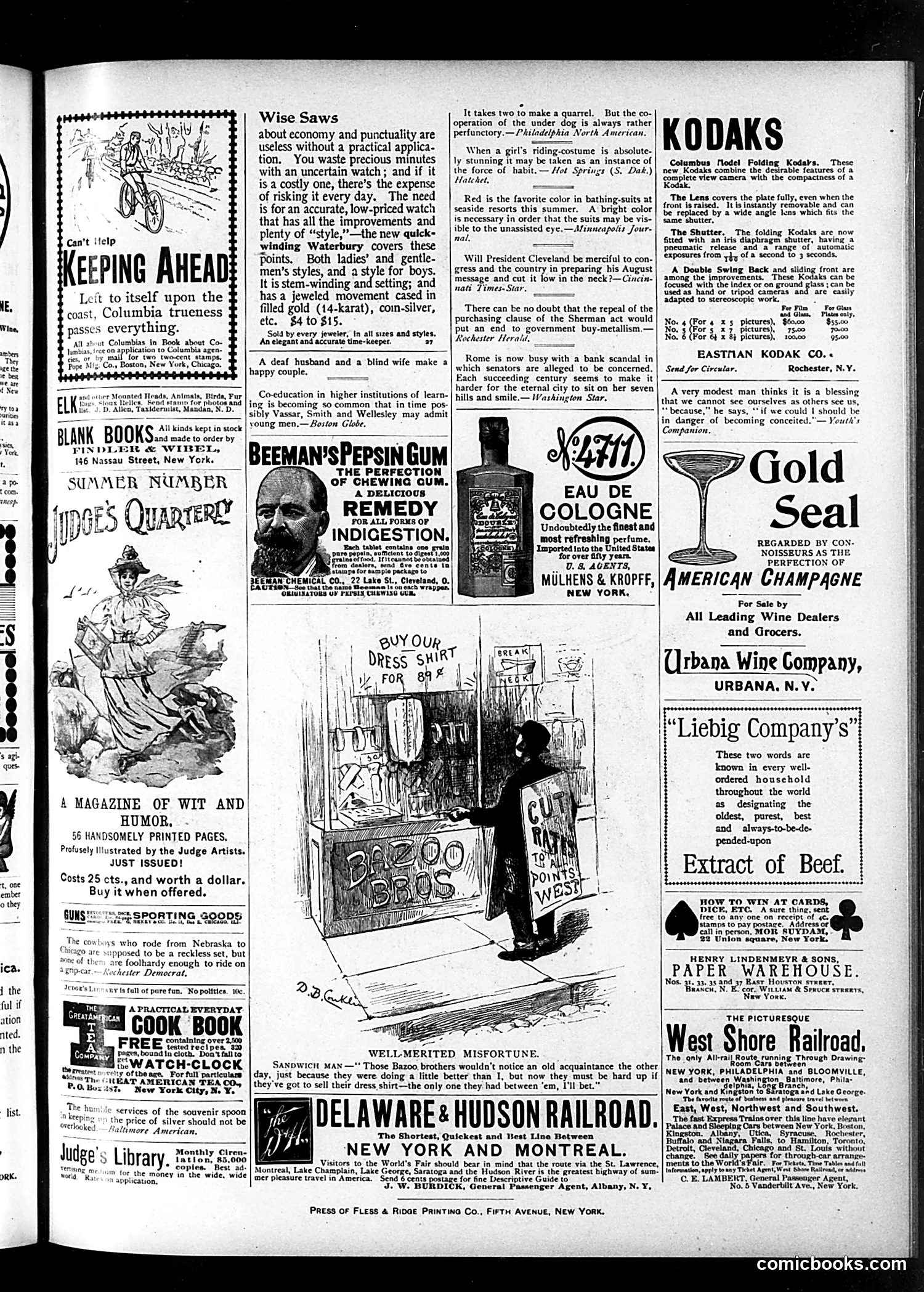
This page is primarily **advertisements and filler content** typical of Judge magazine, with minimal editorial cartooning. The main cartoon—"Well-Merited Misfortune"—depicts a figure at a storefront window displaying "Dress Shirts for 89¢." The caption references "Those Bacon brothers" and their misfortune. Without additional context, it appears to be a local or topical reference (possibly a failed business or scandal involving merchants named Bacon), but the specific historical event is **unclear from this page alone**. The bulk of the page consists of **commercial advertisements** for products like Kodak cameras, Beeman's Pepsin Gum, eau de cologne, Judge's Quarterly magazine, and railroad services. There are also brief "Wise Saws"—aphoristic observations on contemporary life (bathing suit colors, co-education, presidential politics under Cleveland). The political references are minimal: a passing mention of President Cleveland and the Sherman Act repeal debate. These were topical 1890s issues but appear incidental to the magazine's primary function here: entertainment and advertising revenue.
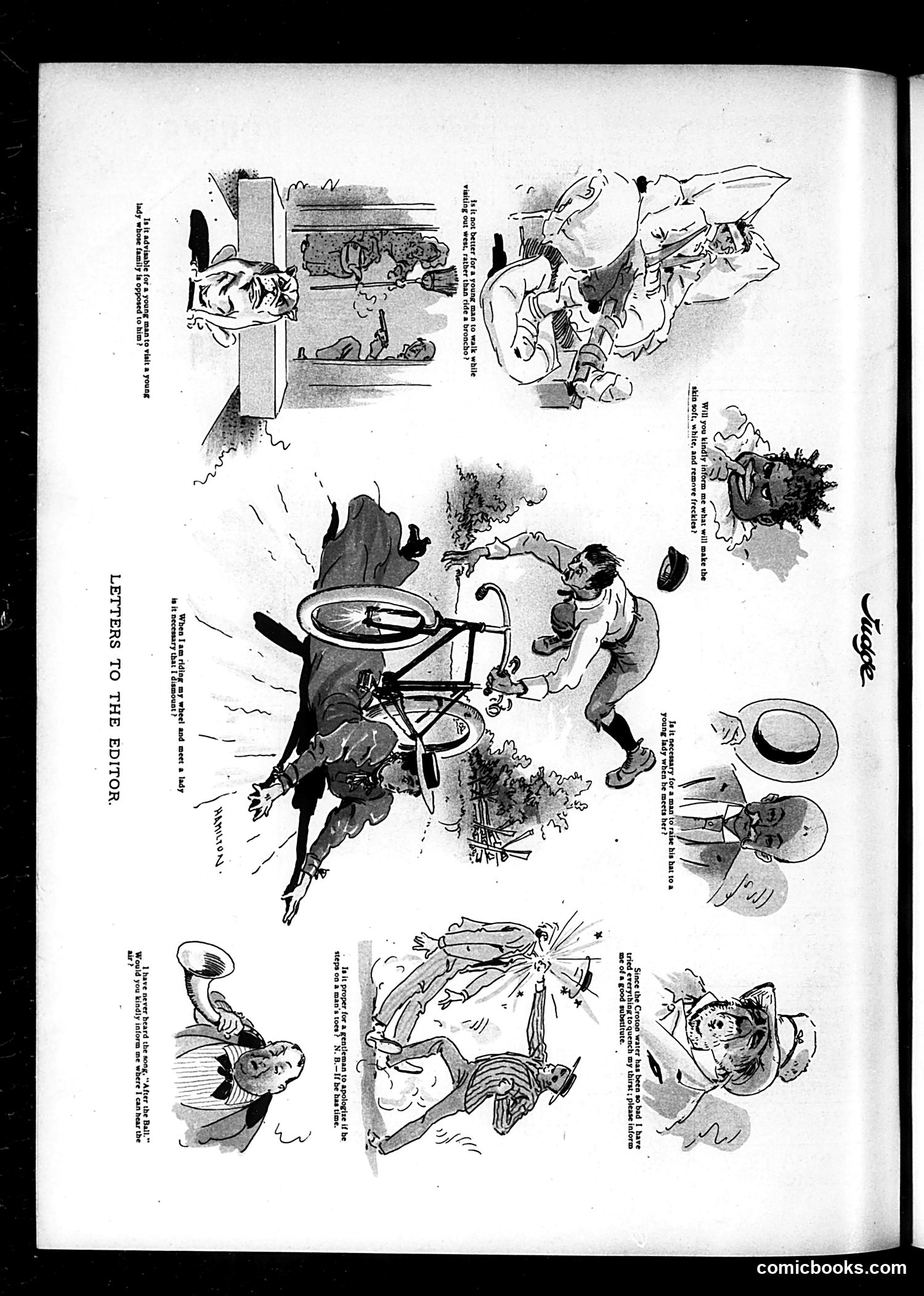
I cannot reliably read the OCR'd text on this page—it appears heavily corrupted or inverted. While I can see this is a page from *Judge* magazine containing multiple political cartoons arranged vertically, the image quality and text legibility prevent me from identifying specific figures, events, or satirical targets with confidence. To accurately explain what these cartoons mean to a modern reader, I would need either: clearer OCR text, visible captions/titles for each cartoon, or confirmation of the publication date. Without these, asserting specific identifications or political references would violate the accuracy-first rule you've requested. If you can provide a clearer version of the text or the page date, I can offer a proper analysis.