
A complete issue · 16 pages · 1893
Judge — July 22, 1893
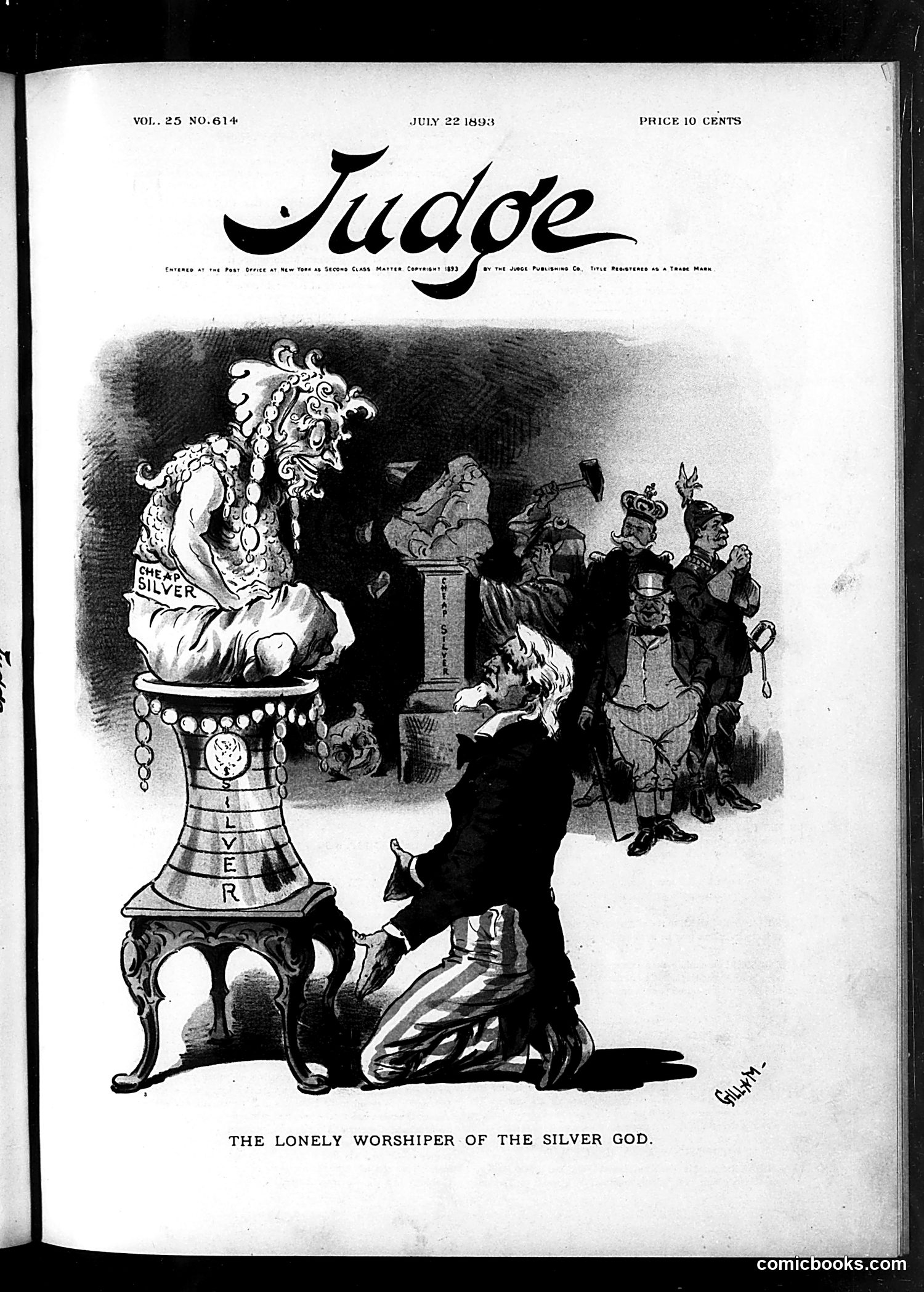
This political cartoon satirizes American devotion to silver currency. A kneeling figure worships an ornate pedestal topped with a grotesque idol labeled "THE SILVER" — personifying silver as a false god. The pedestal bears "SILVER" vertically, suggesting a shrine or altar. In the background, military and political figures in elaborate uniforms and regalia observe indifferently, suggesting establishment elites stand apart from this worship. The lone worshipper appears isolated in his devotion. The cartoon likely critiques the late-19th-century "free silver" movement — the political push to expand silver coinage as currency. The satire mocks silver advocates as religious fanatics pursuing an economically destructive policy while establishment powers watch skeptically. The imagery frames monetary policy debate as irrational zealotry.
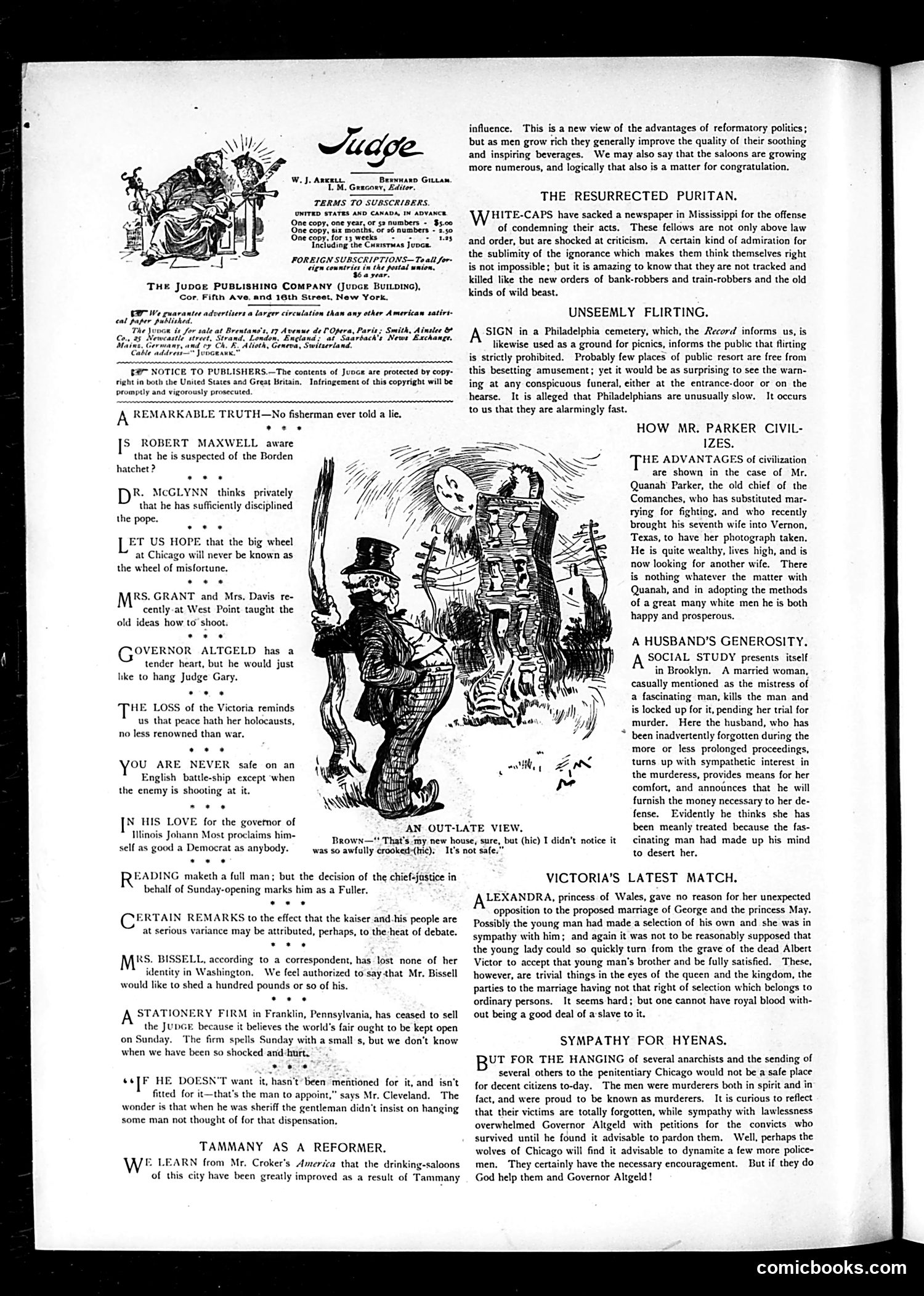
The main cartoon, titled "AN OUT-LATE VIEW," shows two figures—one in formal dress (top hat and tails) and another in working-class clothing—examining what appears to be a dilapidated house. The dialogue reads: "Haven—'That's my new house, sure, but (he) I didn't notice it was so strictly knocked (He). It's not safe.'" This satirizes the poor housing conditions of the era, likely critiquing either slumlord practices or inadequate working-class housing. The contrast between the well-dressed observer and the modest dwelling suggests commentary on class inequality and unsafe living standards. The page also contains brief satirical notes on various political and social topics, including references to governance, marriage, and civic matters typical of Judge's editorial commentary on American politics and society.
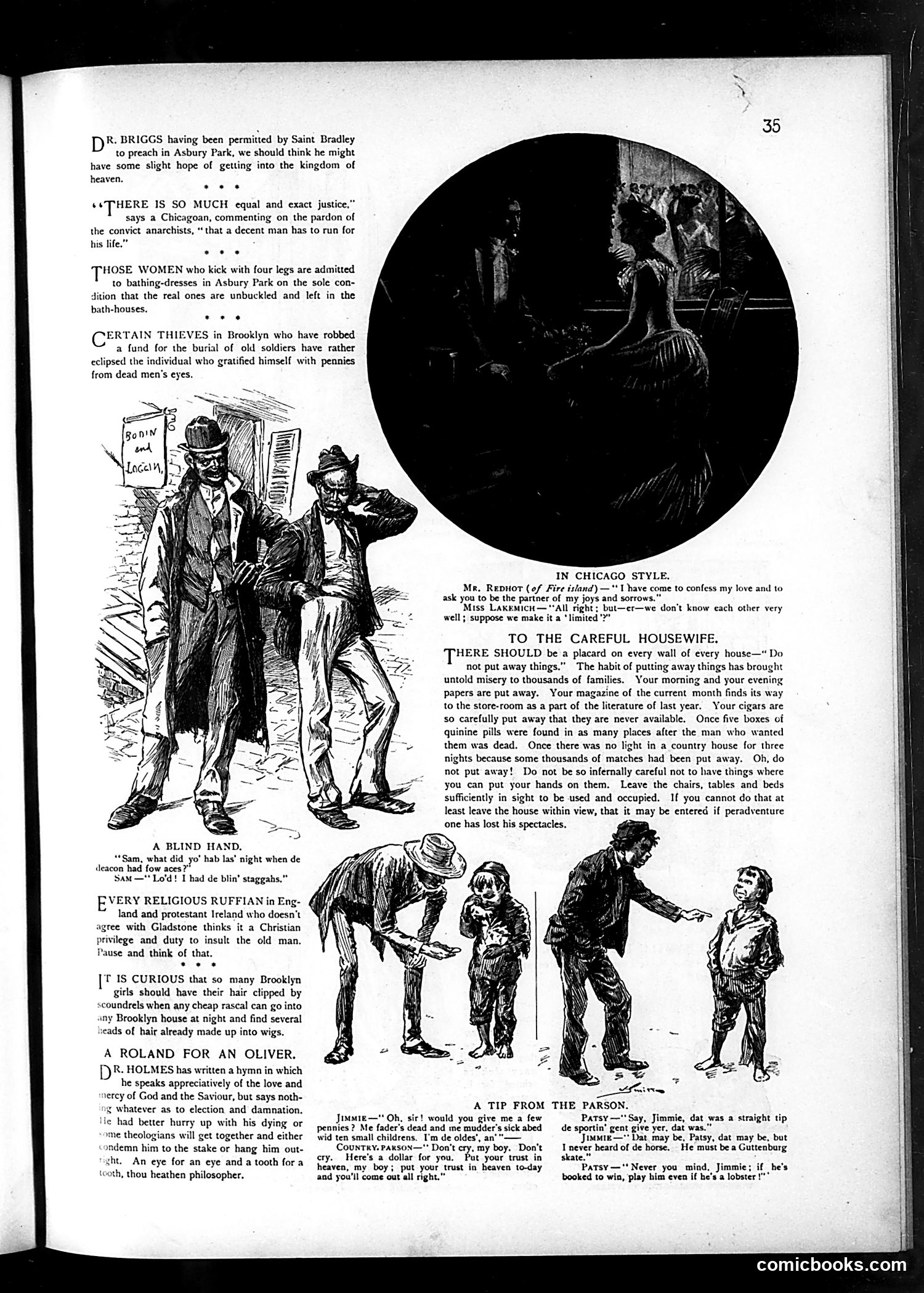
This page contains several satirical items from Judge magazine: **"A Blind Hand"** (left sketch): Shows two poorly-dressed men near a "Rents and Lodgings" sign, with dialogue about a "deacon" with "low shoes." The satire appears to target hypocrisy among religious figures regarding charity and the poor. **"In Chicago Style"** (large circular illustration): Depicts what appears to be a romantic or dramatic scene. The caption references confessing love and making "a limited" arrangement, suggesting satire of Chicago social conventions or romantic entanglements. **"To the Careful Housewife"**: Sarcastically advises against putting away household items—papers, cigars, matches—ironically warning that their absence causes family misery. This mocks wasteful or careless household management. The page uses typical Judge-style satirical humor targeting social hypocrisy, domestic life, and urban manners of its era.
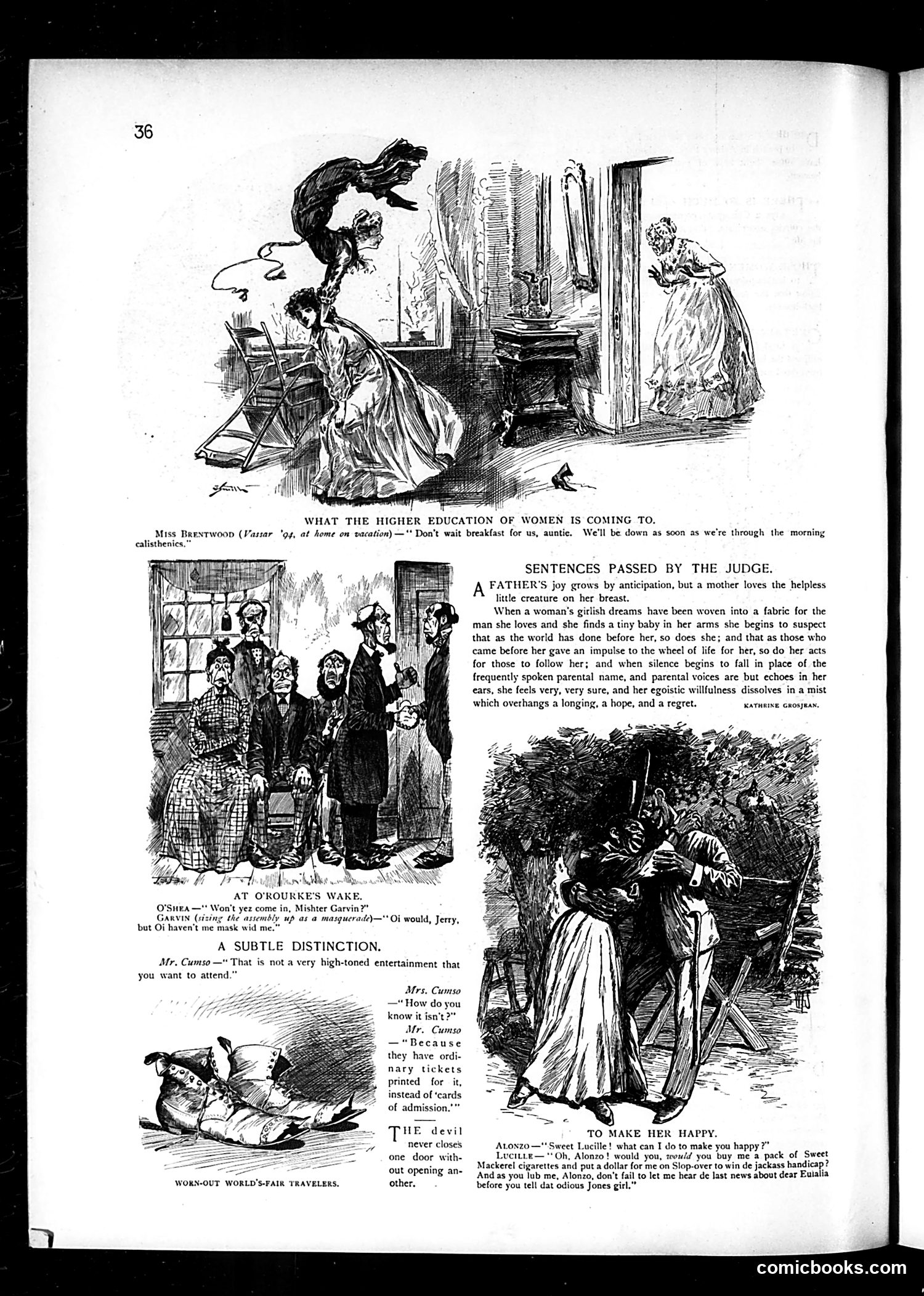
This *Judge* magazine page satirizes several targets: **"Higher Education of Women"**: A Vassar student claims she and her aunt must complete "morning calisthenics"—implying educated women prioritize physical exercise over domestic duties like preparing breakfast, mocking concerns that higher education made women neglect traditional roles. **"O'Rourke's Wake"**: An Irish immigrant (O'Shea) invites Garvin to a wake, but Garvin can't attend without his mask, suggesting the event is actually a masquerade party—satirizing the Irish working class's social pretensions. **"A Subtle Distinction"**: Wealthy snobs distinguish themselves by using "cards of admission" rather than "ordinary tickets"—mocking class-conscious affectation over substance. **"Sentences Passed"**: A sentimental piece about motherhood contrasts with the page's mockery, offering earnest reflection. **"To Make Her Happy"**: A working-class woman requests cigarettes, gambling bets, and gossip—stereotyping lower-class female interests as vulgar and materialistic. Overall, the page ridicules both women's education and class pretension.
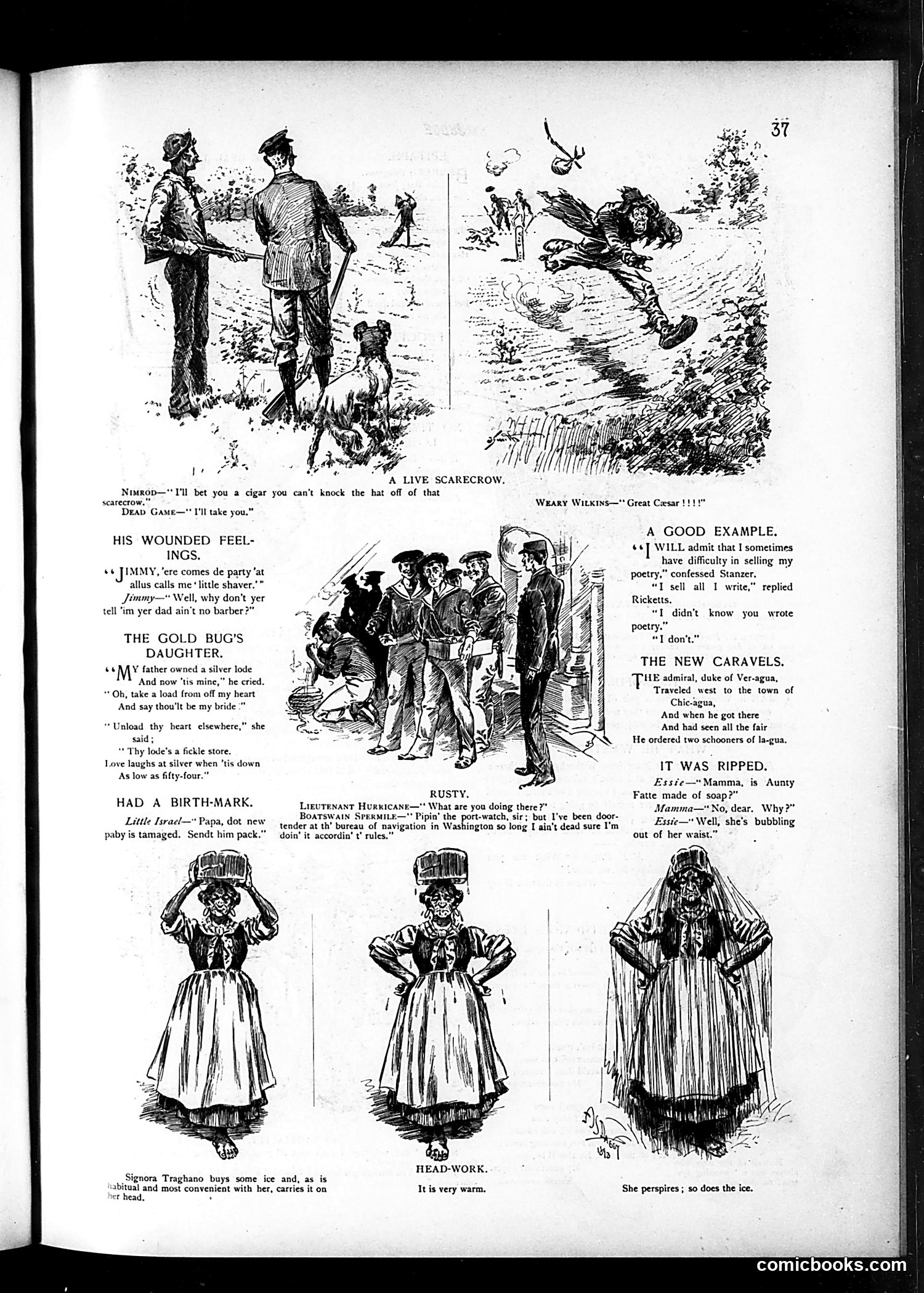
This page contains multiple short humorous pieces typical of late 19th-century American satirical magazines: **"A Live Scarecrow"** and **"Rusty"** appear to be simple sight gags with no political content—one about tricking someone, another about military naval duty confusion. **"The Gold Bug's Daughter"** satirizes the silver currency debate of the 1890s. The woman rejects a suitor because his silver wealth is unstable ("down as low as fifty-four"), referencing the actual silver price fluctuations that drove fierce political debate between gold and silver standard advocates. **"The New Caravels"** is a light ethnic joke about a visiting admiral mispronouncing Chicago and requesting water in Spanish-accented English. The remaining items—"His Wounded Feelings," "A Good Example," "Had a Birth-Mark," and "Head-Work"—are domestic humor sketches with no clear political meaning. This page mixes political satire (the currency reference) with simple domestic and ethnic comedy typical of Judge's content.
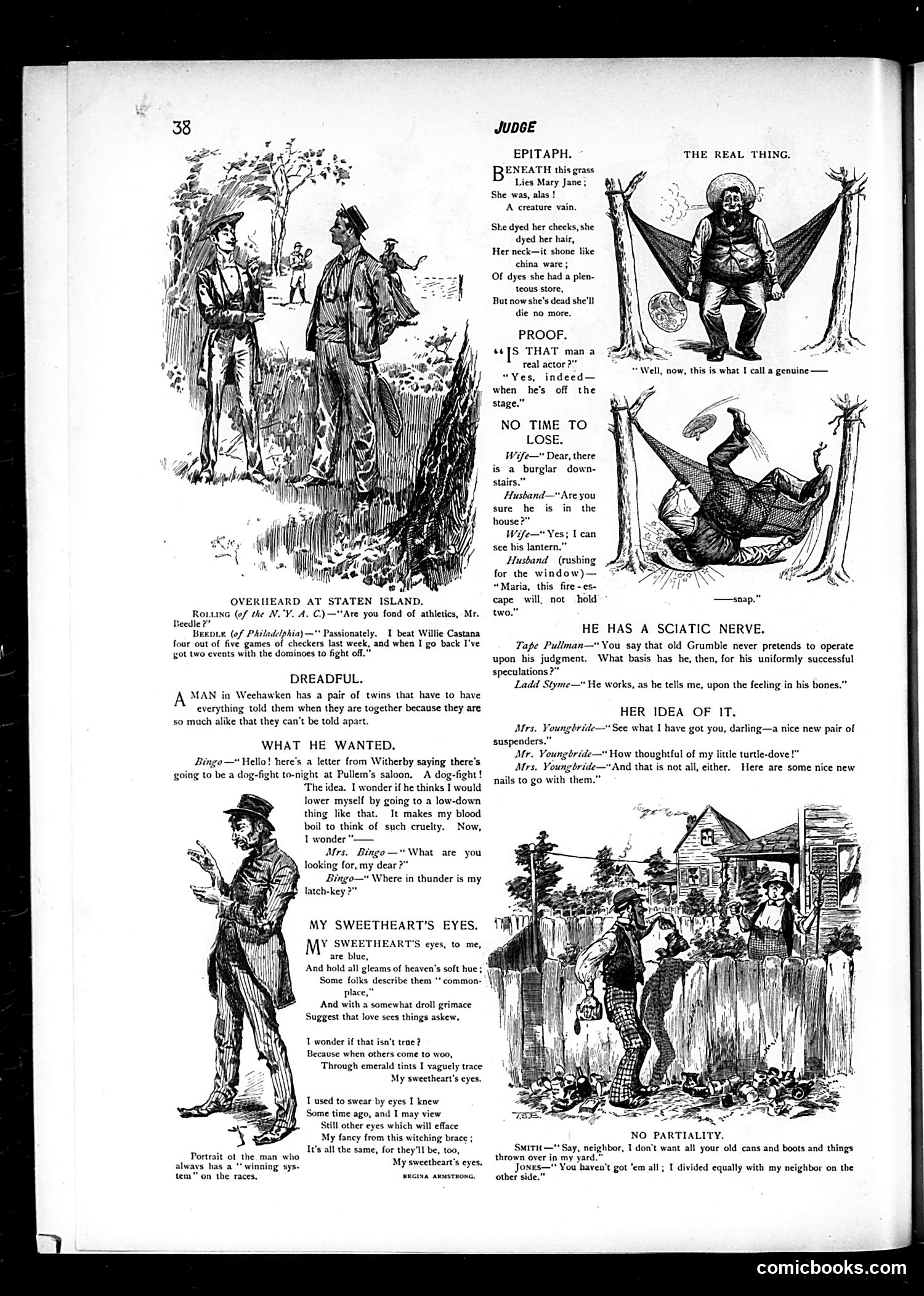
This page from *Judge* (a major American satirical weekly) contains multiple brief humor pieces typical of the publication's format. The main items mock contemporary social types and domestic situations: - "What He Wanted" satirizes hypocrisy: a man denounces dog-fighting as cruel, then immediately demands his wife find his lost key—revealing his moral posturing is selective. - "The Real Thing" is a sardonic epitaph mocking vanity: a vain woman spent life dyeing her appearance, but death ended her efforts permanently. - Domestic vignettes ("No Time to Lose," "Her Idea of It") use marital misunderstandings for humor—a husband worried about a burglar on the fire escape, a wife's "thoughtful" gift of suspenders with nails. - "My Sweetheart's Eyes" is sentimental verse about love's blindness. - Minor jokes reference the N.Y. Athletic Club and racing. The cartoons illustrate these brief humor pieces with period-appropriate line drawings. The satire targets bourgeois pretension, marital comedy, and the gap between professed values and actual behavior—standard *Judge* fare for the Gilded Age.
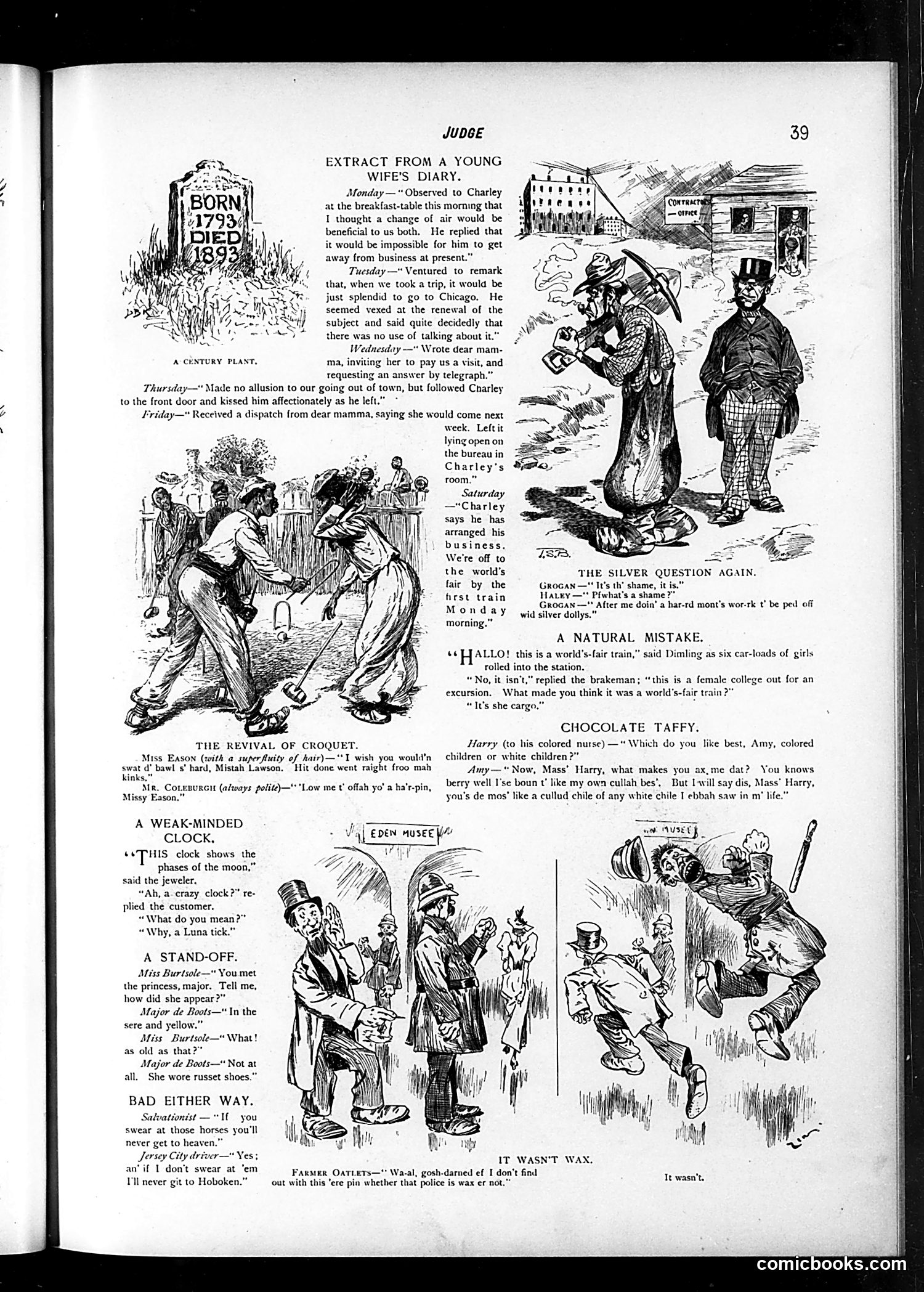
This page contains multiple brief satirical sketches typical of 1890s American humor: **Main Content:** - **"Extract from a Young Wife's Diary"**: Satirizes marital dynamics—a wife manipulates her reluctant husband into a Chicago trip by leaving her mother's visit invitation conspicuously displayed, forcing his hand. - **"The Silver Question Again"**: A vagrant begs, claiming poverty; when offered silver dollars, he refuses, requesting paper instead—likely mocking 1890s currency debates over silver vs. gold standards. - **"A Natural Mistake"**: A trainman confuses a female college excursion with the World's Fair crowd, dismissed as "just cargo"—mocking both women's education and the era's famous 1893 World's Columbian Exposition. - **"Chocolate Taffy"**: A patronizing exchange with a Black nurse about racial preference—typical of period racism presented as "humor." Other sketches mock a defective clock, female fashion excess, and a farmer testing whether a policeman is made of wax. The humor relies on period-specific references (World's Fair, silver currency debates) and reflects contemporary prejudices.
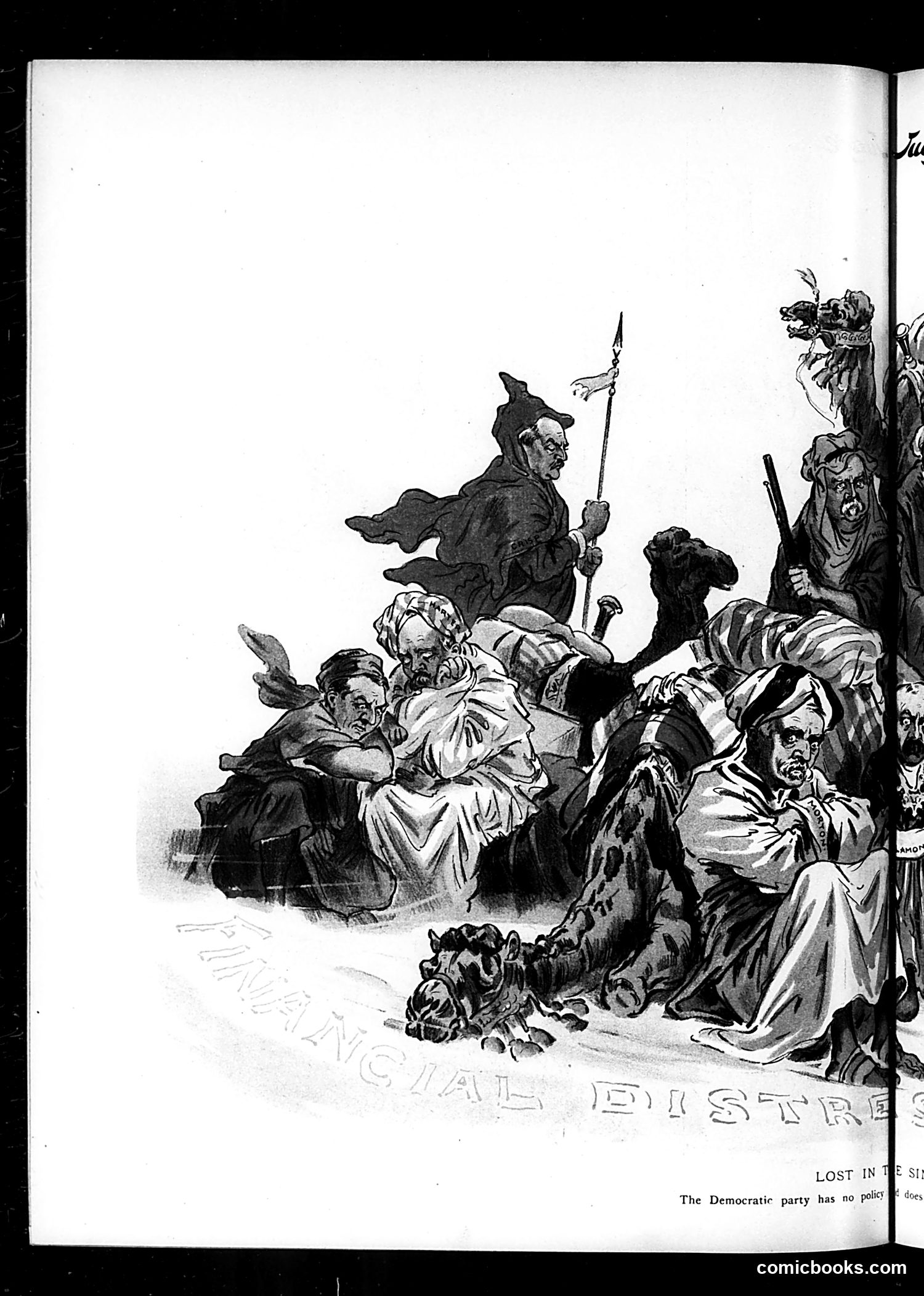
This Judge magazine illustration depicts a chaotic scene labeled "LOST IN THE SWAMP" (partially visible). The cartoon shows multiple figures in distress or confusion, appearing to represent members of the Democratic Party navigating through difficult circumstances. The caption states: "The Democratic party has no poli..." (text cuts off, likely "policy"). The imagery uses the metaphor of being "lost in a swamp" to satirize Democratic Party disorganization or lack of clear direction during what appears to be a political crisis. The crowded, jumbled composition with various figures suggests internal confusion or disagreement. Without the complete caption and publication date, the specific historical event referenced remains unclear, but the satire clearly mocks Democratic leadership or strategy.
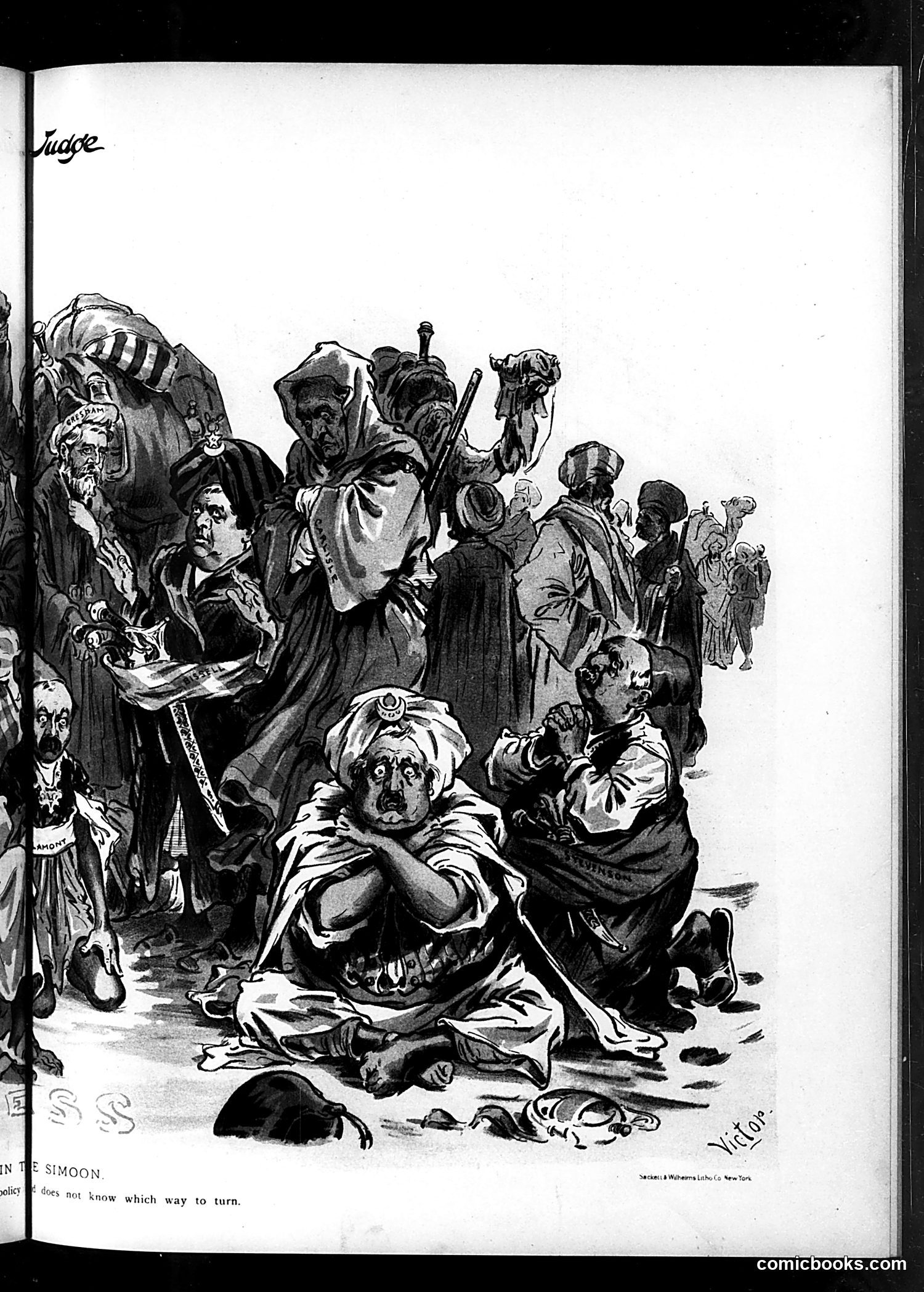
This appears to be a political cartoon titled "In the Simoon" (visible at bottom left). The image depicts a group of figures in distress or confusion—some wearing robes and military dress, others in civilian clothes. A central figure sits crouched and bewildered in the foreground. The partial caption reads: "does not know which way to turn." Without clearer text or date information, the specific political situation remains unclear. However, the "simoon" (a hot desert windstorm) metaphorically suggests chaos or disorientation affecting leadership. The mixed dress of the figures—military, religious, civilian—implies this addresses government confusion during a particular crisis or scandal. The cartoon's point: those in power are lost and directionless.
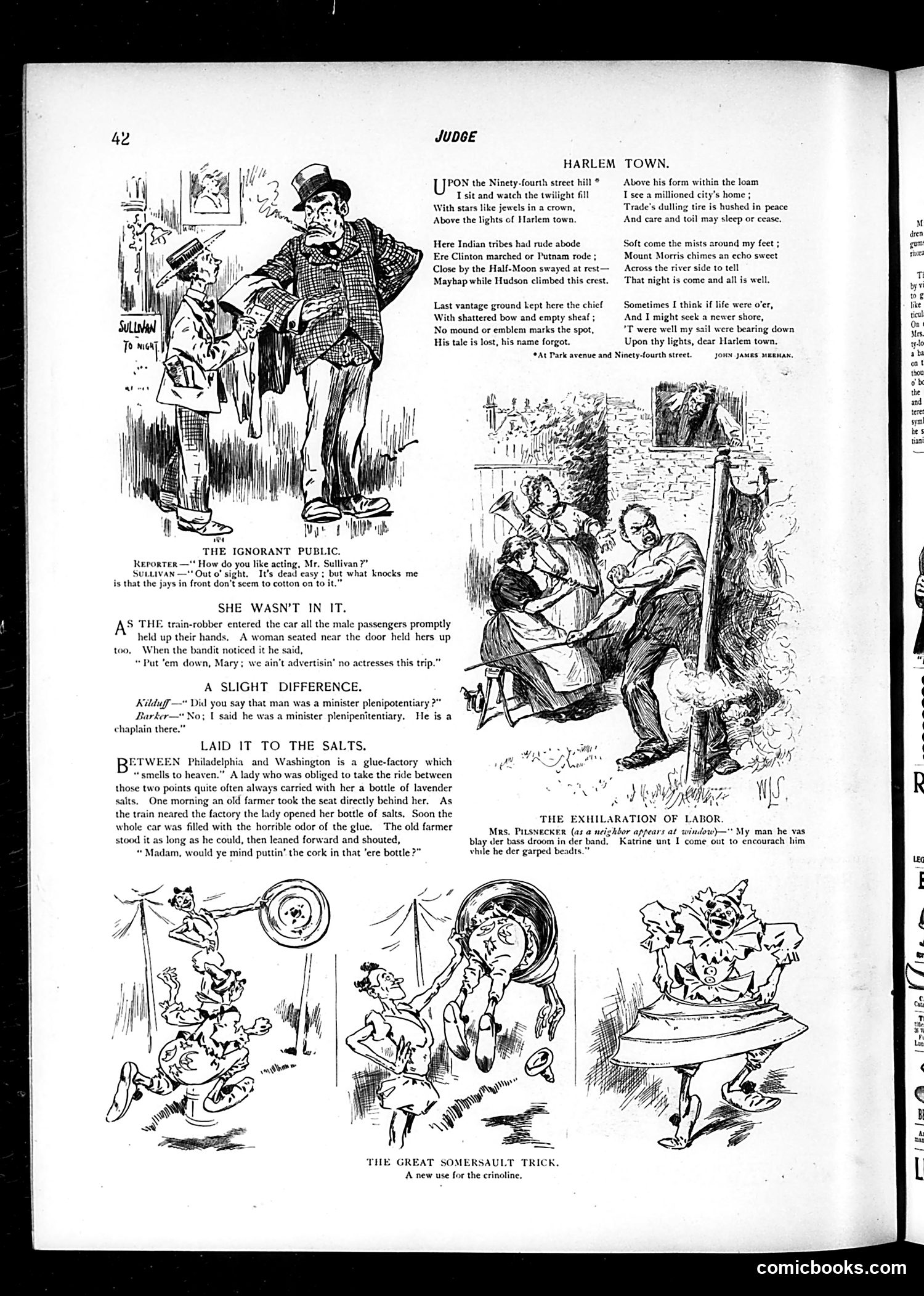
This page contains several unrelated satirical pieces typical of Judge magazine's format: **"Harlem Town"** is a sentimental poem about the history of upper Manhattan, reflecting on Native American heritage and the area's transformation into the developed city of Harlem. **"The Ignorant Public"** mocks theater audiences, with an actor complaining that paying customers don't understand his performance—satire on both performers' vanity and public taste. **"She Wasn't in It"** jokes about a train robbery where a woman raises her hands, but the robber dismisses her as "not an actress" this trip—implying she's a prostitute or performer, not a "proper" woman worth robbing. **"A Slight Difference"** is a pun on ministerial titles (plenipotentiary vs. plenipenitentiary). **"Laid It to the Salts"** describes a woman's smelling salts inadvertently releasing awful glue-factory odors during a train ride—blaming the wrong source for bad smells. The remaining items are brief comic sketches with exaggerated immigrant dialect humor typical of the era's casual ethnic stereotyping.
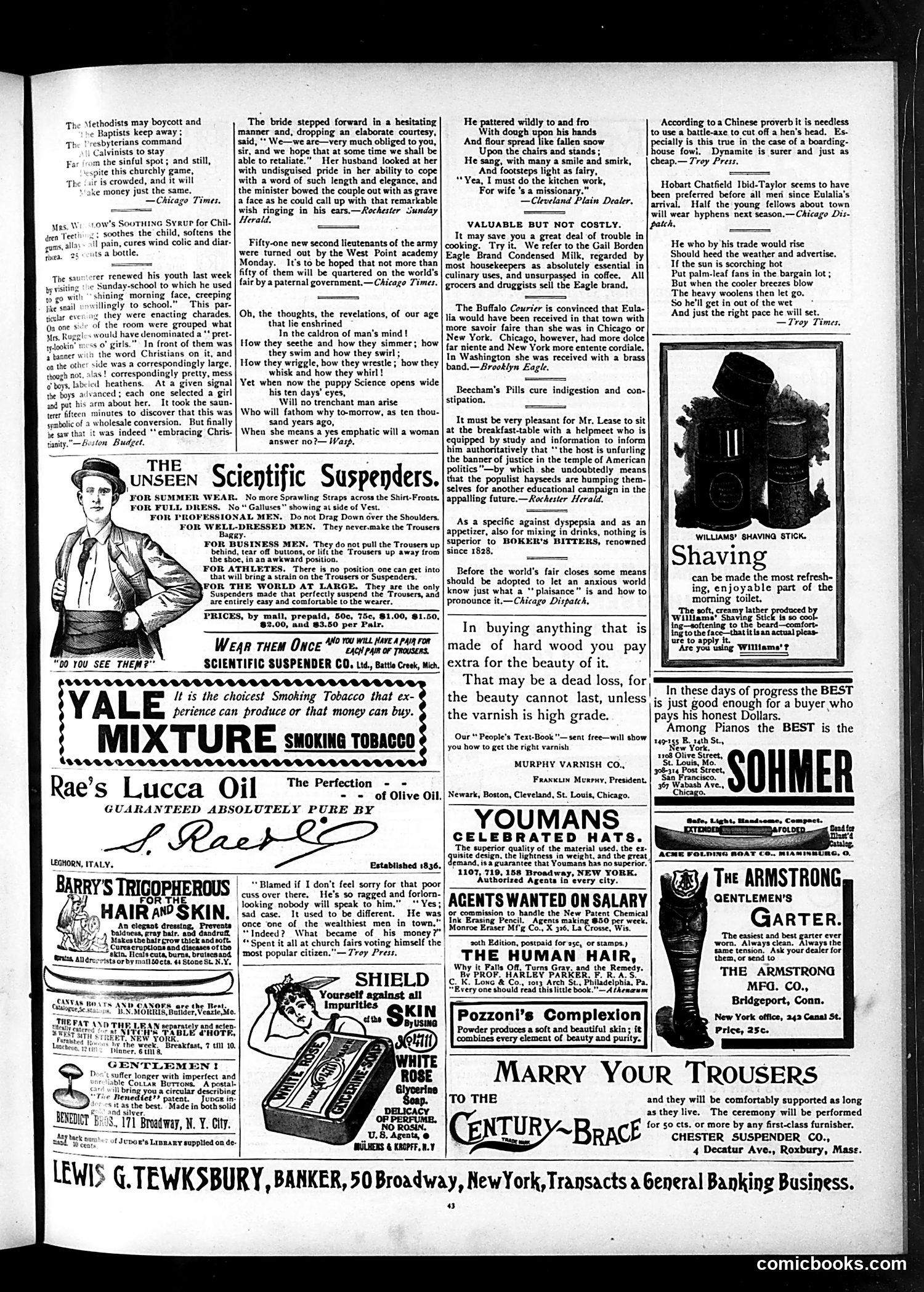
This page is primarily **advertising**, featuring dozens of product advertisements for late-19th/early-20th-century goods (suspenders, hair oil, tobacco, soap, shaving products). The small **satirical content** includes: 1. **Church boycott commentary**: A brief quote from the Chicago Times mocking various Protestant denominations (Methodists, Baptists, Presbyterians, Calvinists) threatening to boycott some unspecified venue—yet money flows in regardless. This satirizes religious hypocrisy and the conflict between stated moral principles and practical financial interests. 2. **"Embracing Christians" charade**: An anecdote about Sunday school children acting out "conversion," with boys selecting girls from opposite sides labeled "Christians" and "Heathens." The joke satirizes the superficiality of religious conversion rhetoric. 3. **Philosophical verse**: A brief poem ironically questioning why women say "no" when they mean "yes"—a tired stereotype about feminine contradiction meant as genteel humor. The advertisements reveal period consumer culture: products marketed by dubious health claims (hair restoration, indigestion cures) alongside practical goods, reflecting Victorian-era marketing practices.
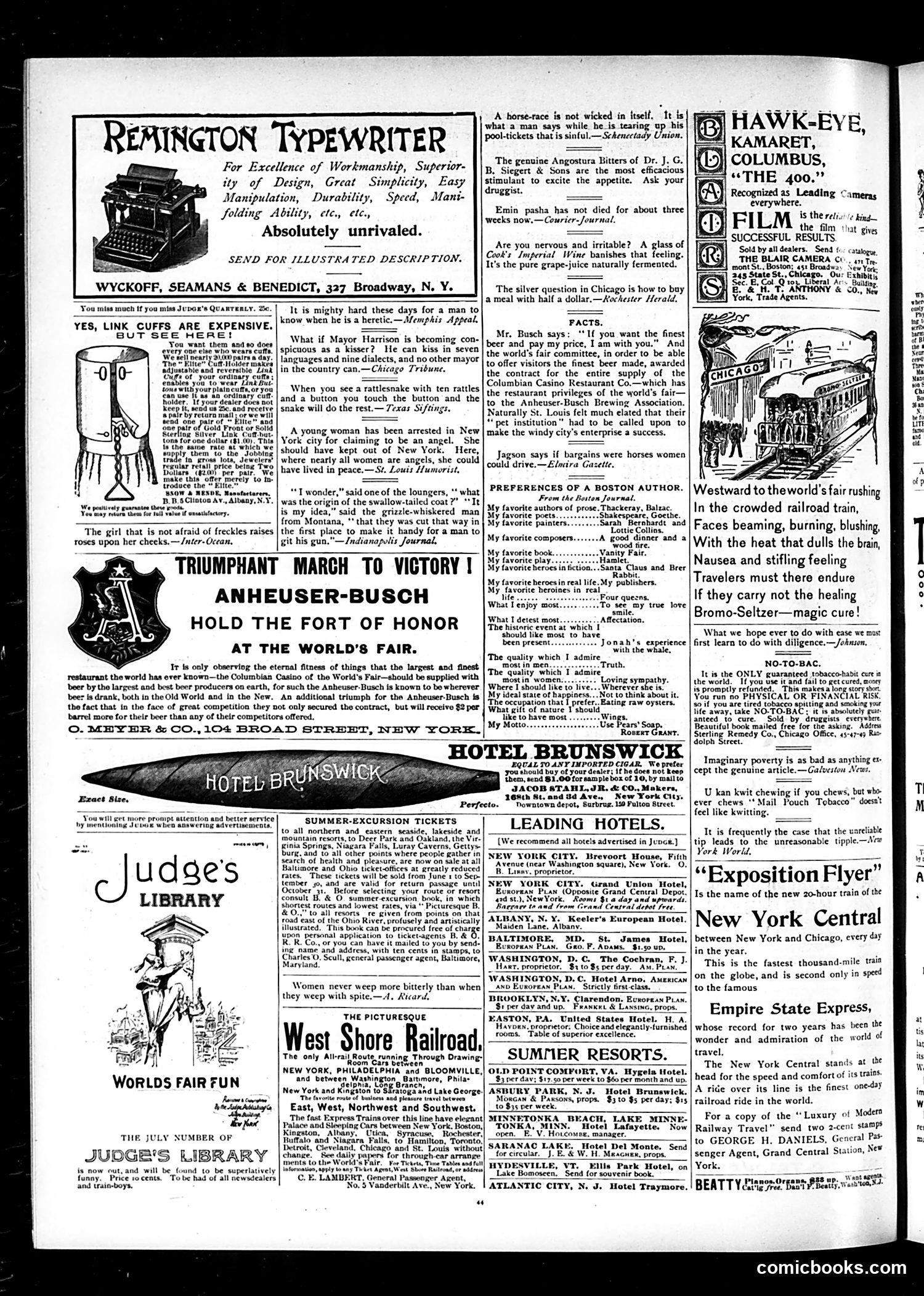
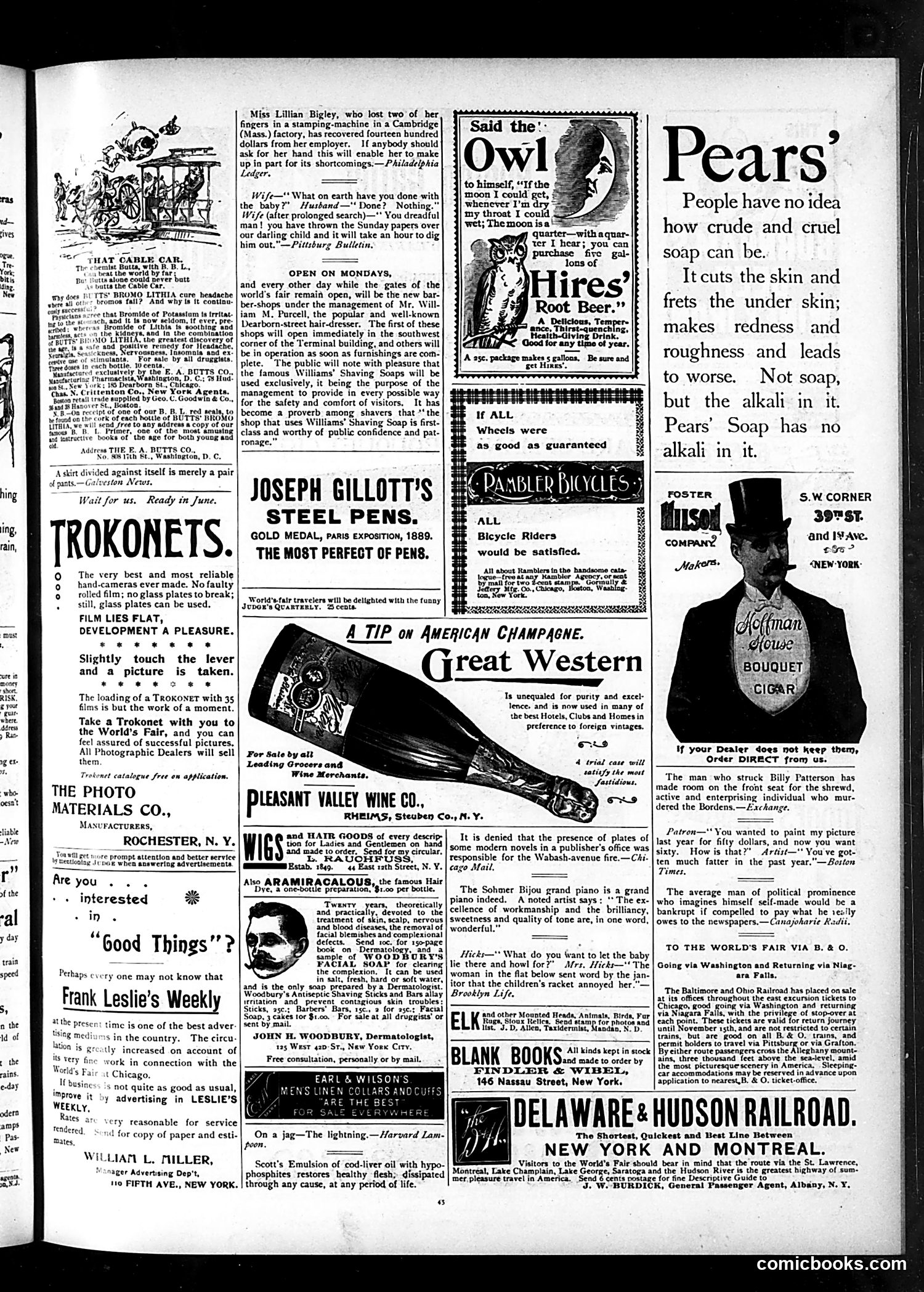
This page is primarily **advertisements and brief humorous anecdotes**, not political cartoons. The notable content includes: **"That Cable Car"** – A satirical quip about a woman who lost two fingers in machinery and received $1,400 compensation, with dark humor suggesting she can now "make up" for her missing hand when seeking marriage. **Marital humor pieces** – Short jokes about absent-minded husbands (one threw a baby under newspapers; another did nothing with the baby). **World's Fair references** – Multiple ads reference Chicago's 1893 World's Columbian Exposition, indicating this is from that era. Barbershop and camera advertisements capitalize on expected fair visitors. **Product advertisements** – Steel pens, cameras, medicinal tonics, wines, railroads, and cigars dominate the page—typical Judge magazine content mixing commerce with satire. The "Owl" and "Pears' Soap" advertisements are standard commercial notices without political meaning. Overall, this reflects Judge's format: light social satire mixed with commercial sponsorship.
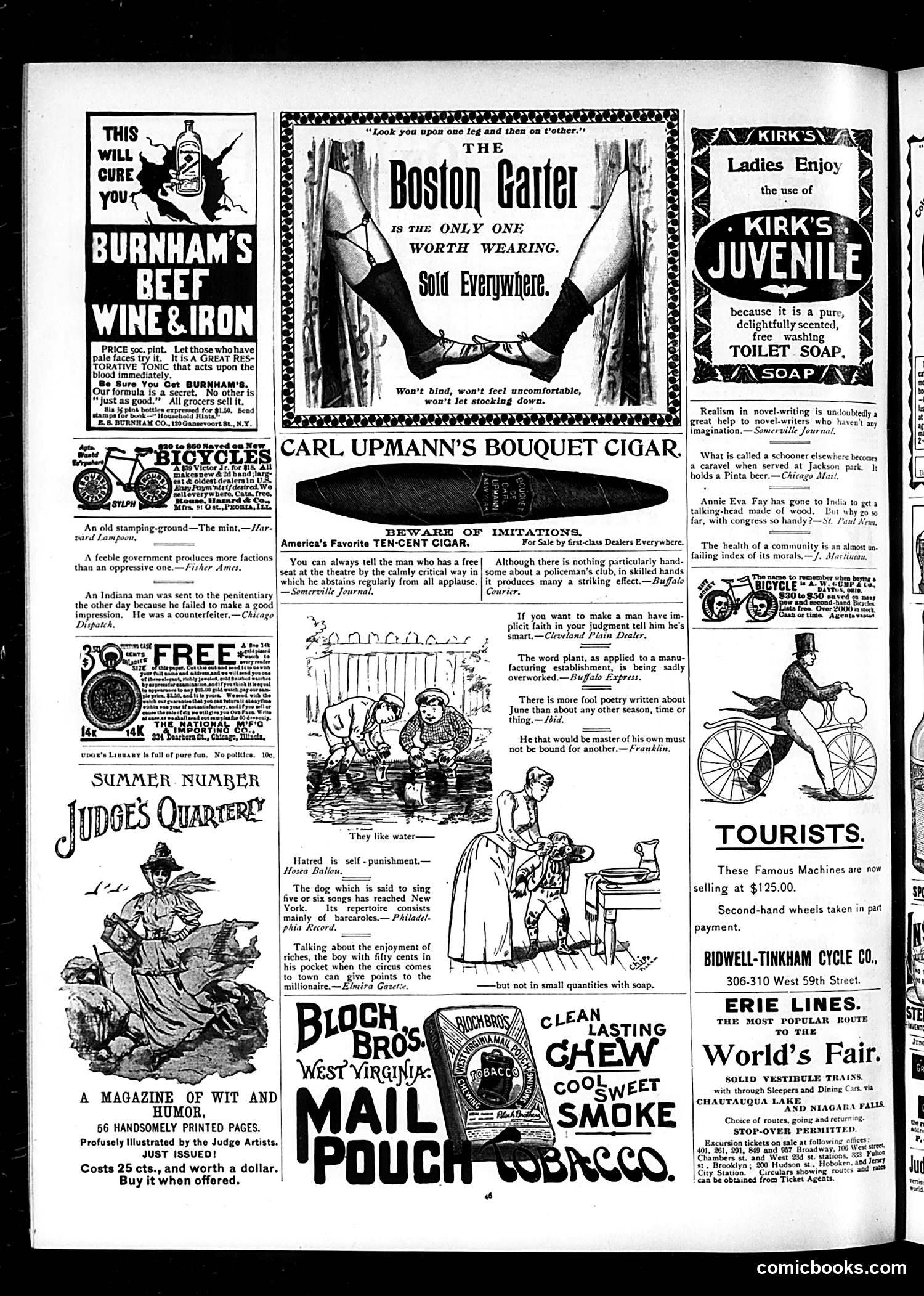
This page from *Judge* magazine is primarily advertising, with scattered short humorous quotes and one central cartoon about a Boston garter (men's sock supporter). The Boston Garter illustration shows a woman's legs with the caption that it's "the only one worth wearing" and "won't let stocking down." This advertises the garter's practical functionality—a common concern in an era before modern elastic. The page is dominated by commercial ads for products (wine, bicycles, cigars, soap, a magazine) interspersed with brief satirical quotations on various subjects. One joke involves a counterfeiter sentenced to prison for "failing to make a good impression"—a pun on the counterfeiter's job of making fake currency impressions. The humor is light, wordplay-based, and disconnected. There are no political cartoons or significant social commentary visible. This appears to be a typical magazine back-matter page mixing advertisements with filler jokes rather than substantive satire.
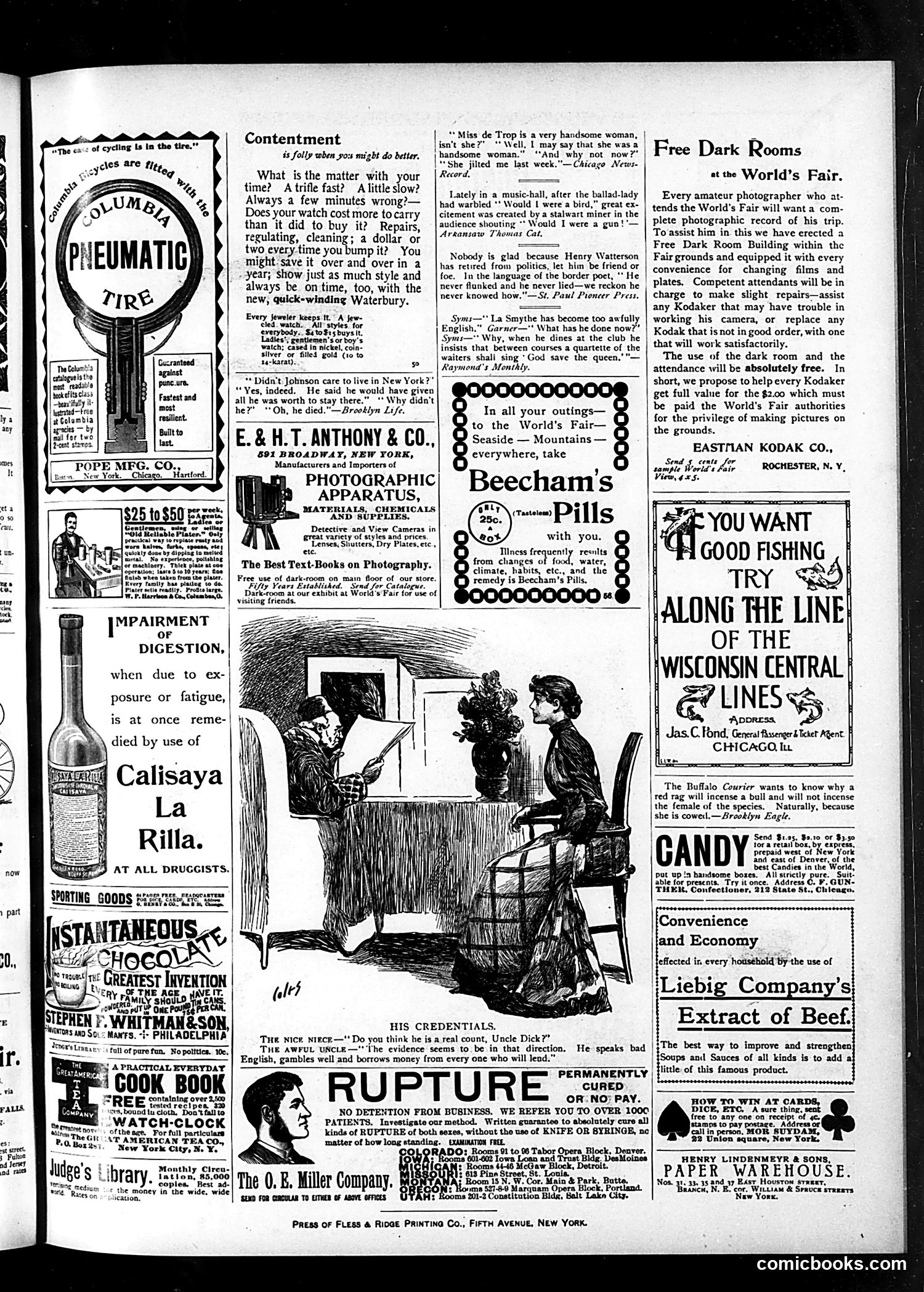
This page is primarily **advertising** for the 1893 World's Fair in Chicago, with brief joke columns typical of Judge's satirical format. The **main cartoon** (center) shows a photographer taking a woman's portrait — likely satirizing the practice of posed studio photography. The caption "HIS CREDENTIALS" appears to mock the photographer's legitimacy or skill. The **joke snippets** scattered throughout mock contemporary figures: - **Henry Watterson** (political editor) is praised upon his retirement in a folksy quote, suggesting respectful mockery of his influence. - Multiple brief jokes mock vanity and social pretense (people claiming false accomplishments, affectations at dining clubs). The page reflects the **World's Fair context**: Kodak advertises free darkrooms for amateur photographers attending the fair; E&H.T. Anthony promotes photography equipment; travel ads promote fair visits. The humor targets **everyday human folly**—vanity, pretense, romantic rejection—rather than specific political events. This reflects Judge's satirical stance toward social behavior rather than partisan politics.
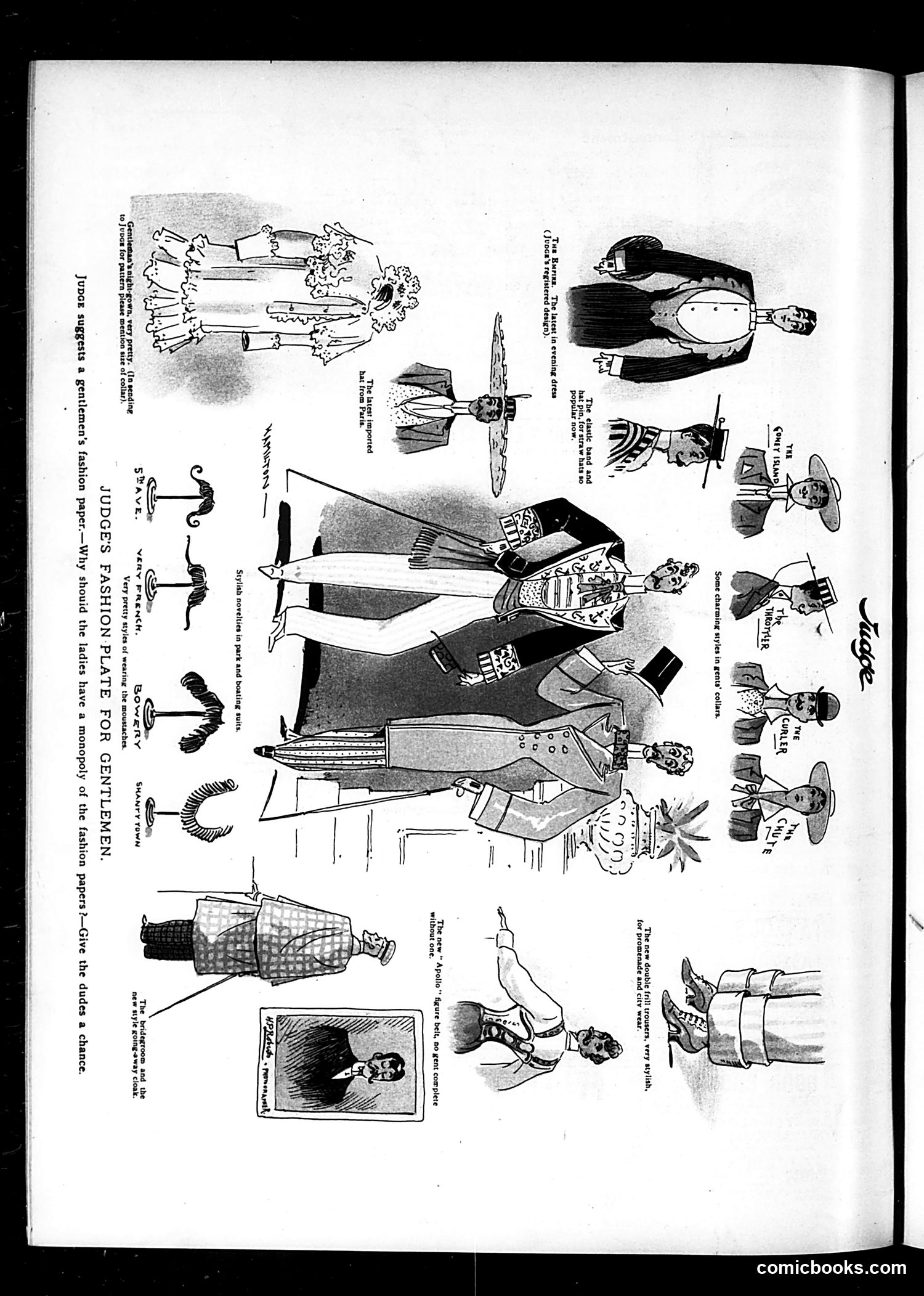
This is a satirical fashion plate mocking men's fashion obsession. The page presents exaggerated "gentlemen's fashions" with absurd items like elastic bands for hat pins, novelty belts, and elaborate moustache-wearing styles—treating male grooming with the same breathless detail typically reserved for women's fashion magazines. The satire targets "dudes" (fashionable young men concerned with appearance) and challenges the gender assumption that only women need fashion guidance. The caption explicitly states: "Why should the ladies have a monopoly of the fashion papers?—Give the dudes a chance." This ridicules both male vanity and the emerging "fashion plate" magazine genre itself, suggesting that men obsessing over appearance is as absurd as women doing so. The exaggerated styles and fussy details underscore Judge's mockery of fashionable masculinity during the Gilded Age.