
A complete issue · 16 pages · 1893
Judge — July 15, 1893
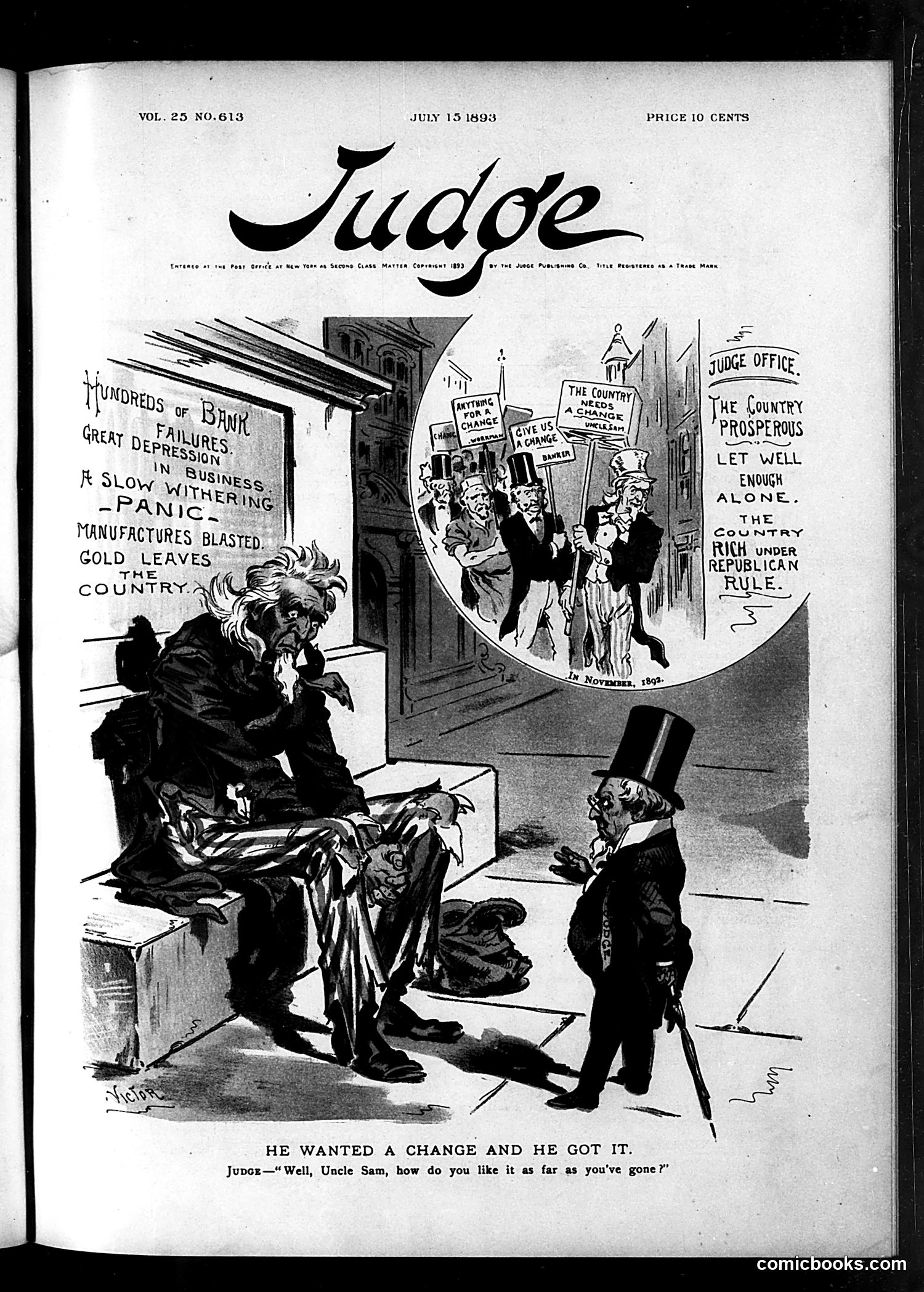
This July 1893 *Judge* cartoon satirizes the economic crisis of the early 1890s Depression. The left panel shows a distressed "Uncle Sam" figure buried under lists of catastrophes: bank failures, business collapse, manufacturing decline, and economic panic. The right panel depicts politicians (likely Republican leaders, given the "Republican Rule" reference) celebrating in November 1892, demanding "change" from the previous administration. The cartoon's message: Uncle Sam got the "change" he wanted through electoral change, but conditions actually worsened under the new leadership. The satire criticizes whoever took power for failing to improve—or possibly worsening—the economic crisis, making their campaign promises of improvement hollow.
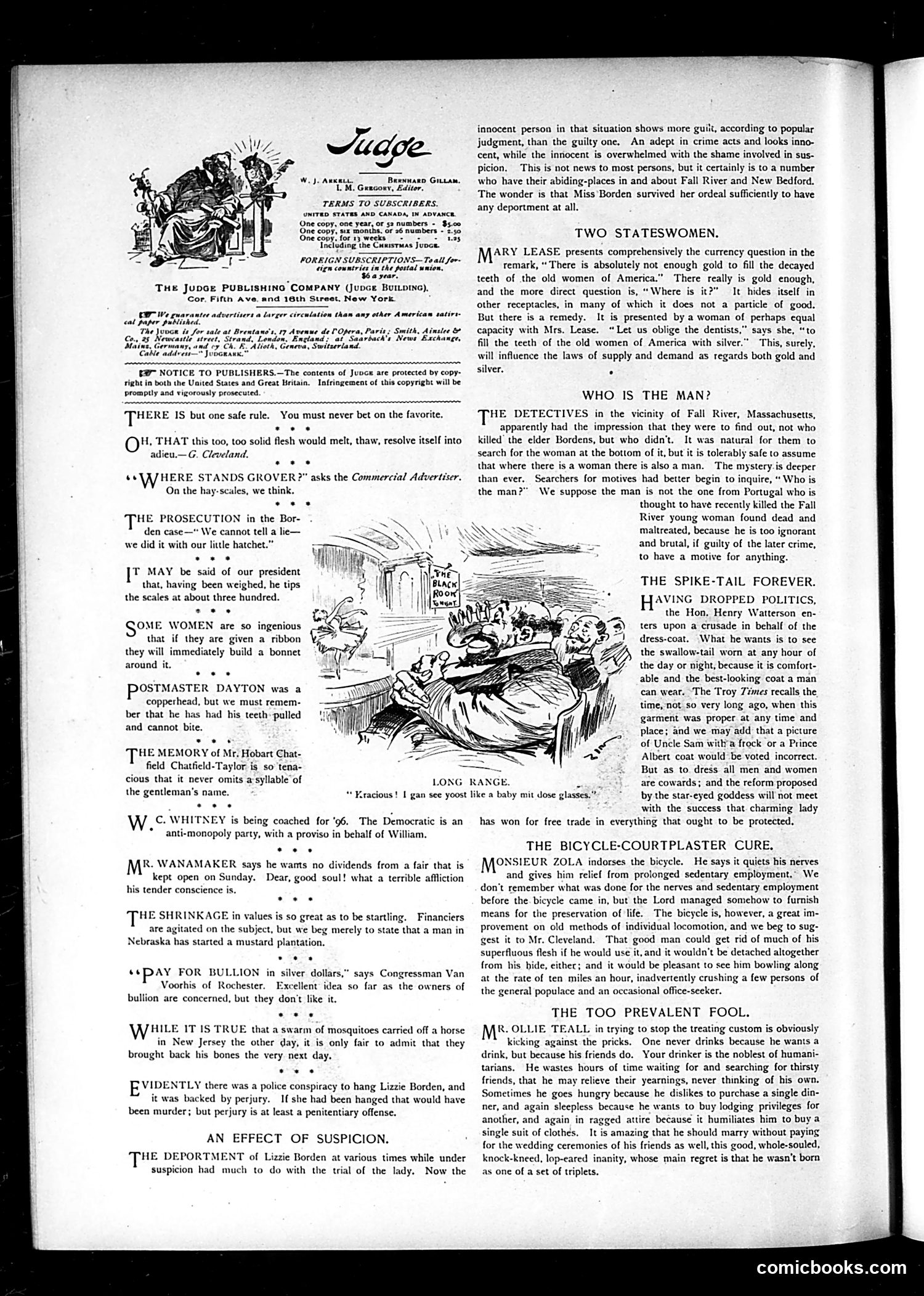
This page contains editorial commentary and satirical columns rather than cartoons. The visible illustration ("Long Range") depicts a woman in bed, apparently illustrating a piece about dress codes. Key content includes: - **"Two Stateswomen"**: Mary Lease presents arguments about currency policy, with commentary suggesting women's economic perspectives deserve attention. - **"Who Is the Man?"**: References the Fall River case (likely the Lizzie Borden trial), discussing detective work and speculation about the actual perpetrator. - **"The Strike-Tail Forever"**: Satirizes Republican dress-code debates, mocking concern over whether coats are fashionable versus practical. - **"The Bicycle-Court Plaster Cure"**: Jokes about bicycles as health treatment. - **"The Too Prevalent Fool"**: Criticizes foolish social behavior. The magazine addresses late-19th-century politics, crime, fashion, and social customs through satirical humor.
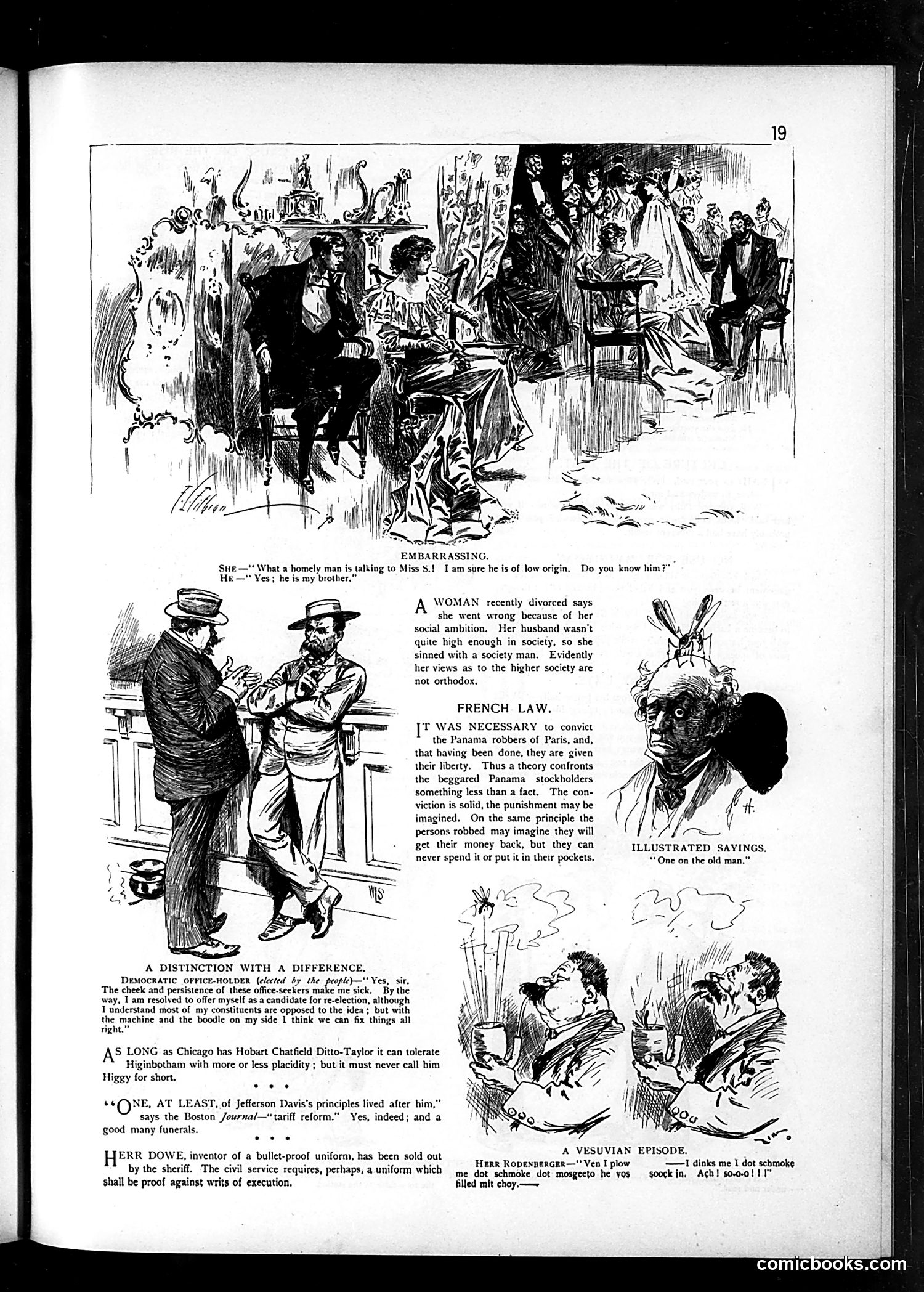
This page contains several unrelated satirical pieces typical of Judge magazine's format: **"Embarassing"** (top): A drawing-room scene mocking class pretension, where a woman boasts about a "homely man" of "low origin," implying social climbing and snobbery. **"French Law"** and other sections discuss legal and social absurdities—conviction of Parisian robbers, Panama stockholders' losses, and Chicago politics under Mayor Gould (appears to reference local corruption). **"Illustrated Sayings"** features small cartoon vignettes with captions poking fun at human nature and behavior. **"A Vesuvian Episode"** (bottom right) appears to be a humorous domestic scene. The page exemplifies Judge's approach: mixing visual satire targeting class anxiety, political corruption, and social hypocrisy with brief witty commentary. Without specific date context, precise historical references remain unclear.
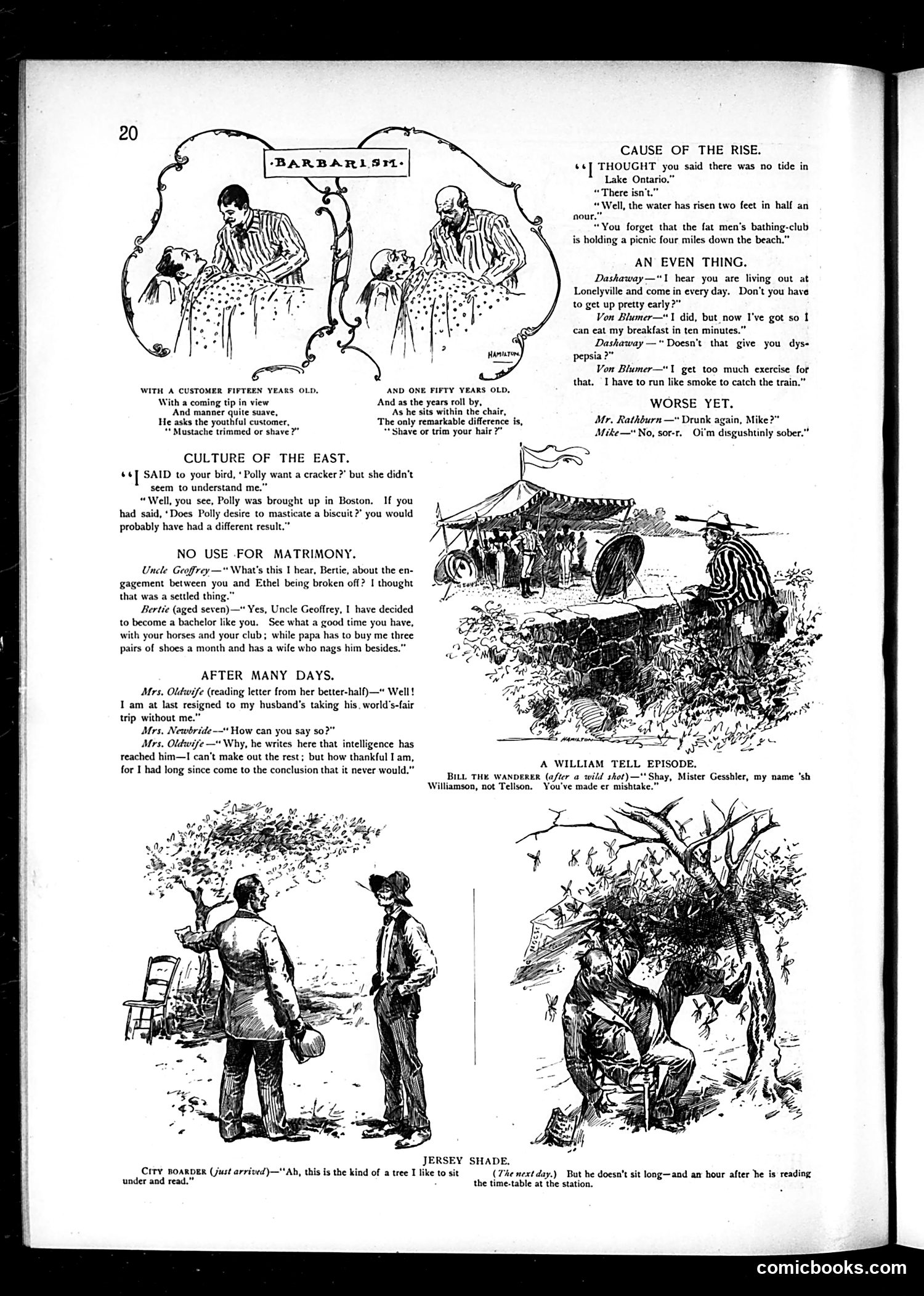
This page contains multiple short humorous sketches typical of late-19th-century American satire: **"Cause of the Rise"** jokes that fat men's bathing club caused Lake Ontario's water level to rise—a body-shaming gag. **"An Even Thing"** depicts a commuter so rushed catching trains that he eats breakfast in ten minutes, causing digestive problems he avoids through exercise—satirizing urban commuting stress. **"Culture of the East"** mocks Boston's pretentious speech, suggesting Bostonians use unnecessarily formal language ("masticate a biscuit" instead of "eat a cracker"). **"No Use for Matrimony"** has a seven-year-old reject his engagement, preferring bachelorhood because his father must buy three shoe pairs monthly and endure a nagging wife—dark humor about marriage burdens. **"After Many Days"** shows a long-suffering wife relieved her husband is away at the World's Fair. **"Jersey Shade"** depicts a man seeking tree shade who immediately abandons it for the train station—joke about New Jersey's supposedly poor conditions. The humor targets urban life, marriage, regional stereotypes, and class anxieties of the Gilded Age.
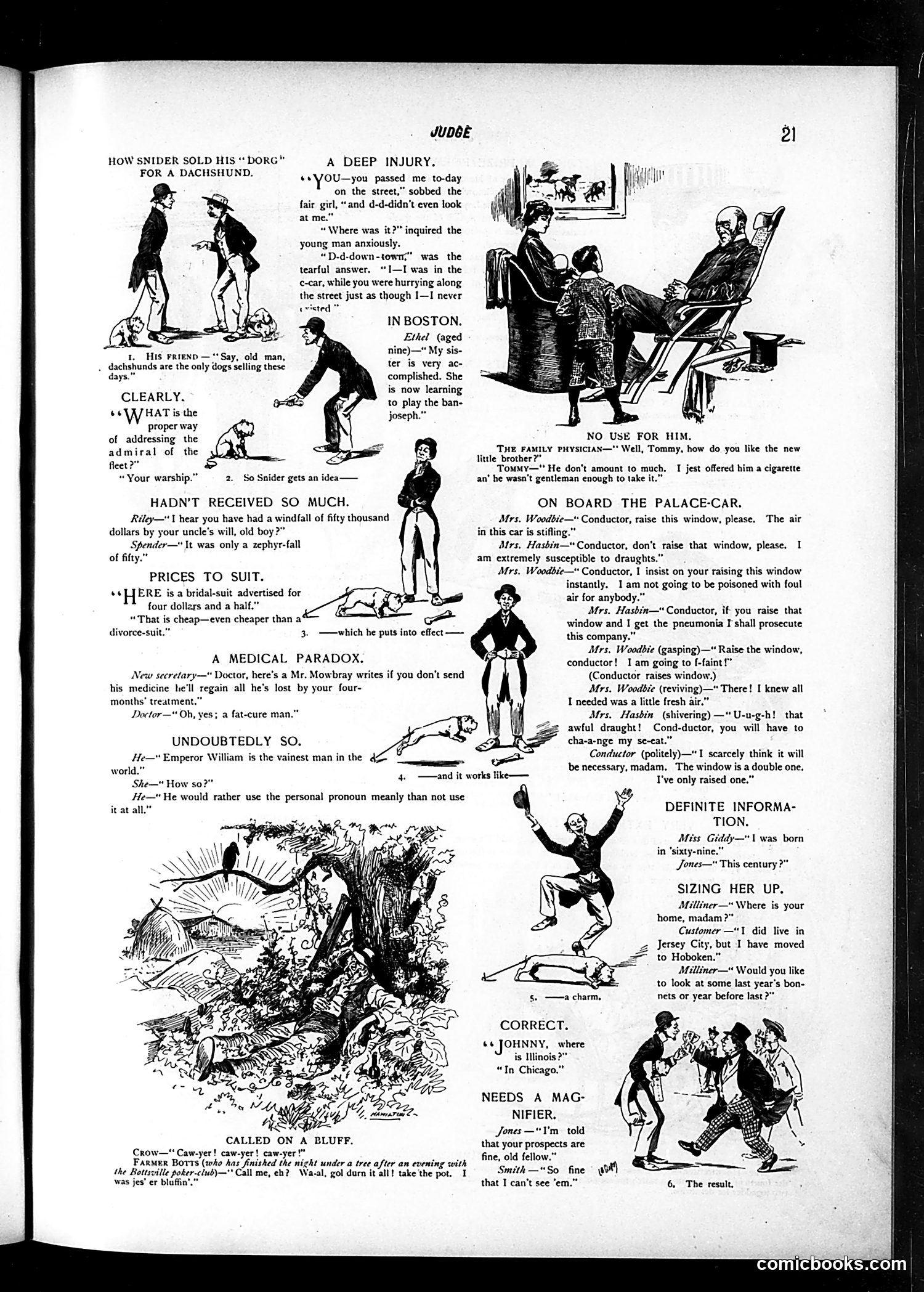
This page contains multiple brief humorous sketches typical of early 20th-century American satire. Key items include: **"How Snider Sold His Borg for a Dachshund"** satirizes wartime commodity shortages—the dachshund (a German dog breed) became unpopular due to anti-German sentiment during or around WWI, so Snider exploits their sudden salability to dupe his friend. **"On Board the Palace-Car"** mocks hypocritical, querulous passengers: Mrs. Woodbie demands the window open, then closed, then open again for fresh air, while Mrs. Hasbin complains of drafts—the conductor's final comment about the double window suggests he's barely moved it. **"No Use for Him"** presents dark humor about a new baby—Tommy insults the infant's masculinity for refusing a cigarette. Other sketches include wordplay about addressing admirals ("your warship"), a doctor's weight-loss paradox, and mistaken geography ("Illinois" being in Chicago). The satire targets social pretension, hypocrisy, and absurd behavior among the middle class.
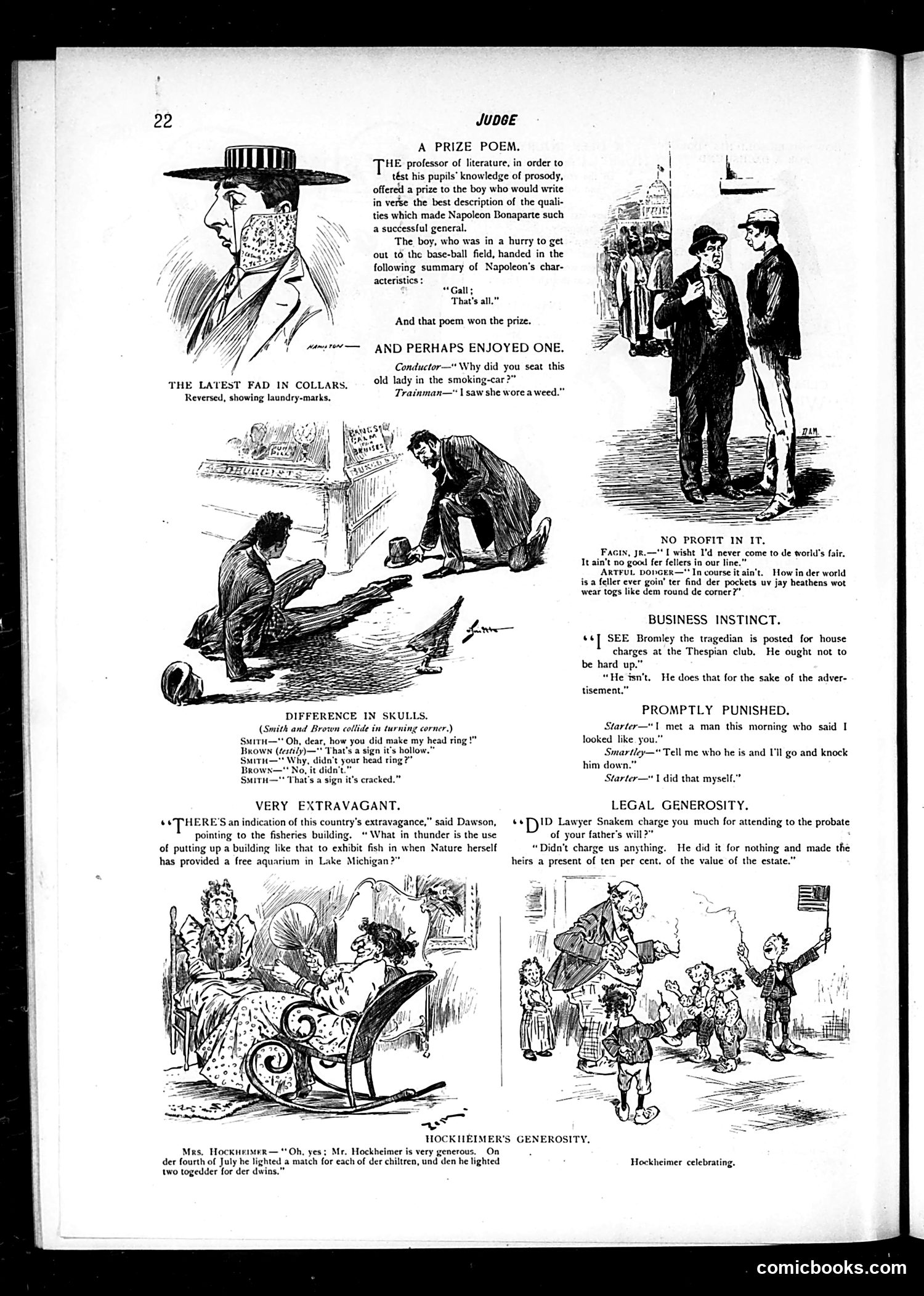
This page contains multiple short satirical pieces typical of late 19th-century American humor magazine *Judge*: **"A Prize Poem"** mocks lazy students and educational shortcuts—a boy wins a prize for describing Napoleon's genius as simply "Gall; That's all," rushing to play baseball instead of genuine study. **"Difference in Skulls"** is a crude joke playing on phrenological pseudo-science: two men colliding blame each other's head shape (one "hollow," one "cracked"). **"Very Extravagant"** satirizes wasteful spending on exposition buildings (likely the 1893 Chicago World's Fair), when nature already provides free exhibits. **"Legal Generosity"** uses irony—a lawyer claiming he charged nothing while actually taking 10% of the estate anyway. **"Hockheimer's Generosity"** employs ethnic dialect (German-Jewish character) for humor, describing stingy behavior presented as generosity: lighting one match per child on July 4th, then combining matches for twins to save money. The page emphasizes period obsessions: social climbing, financial trickery, and immigrant stereotypes.
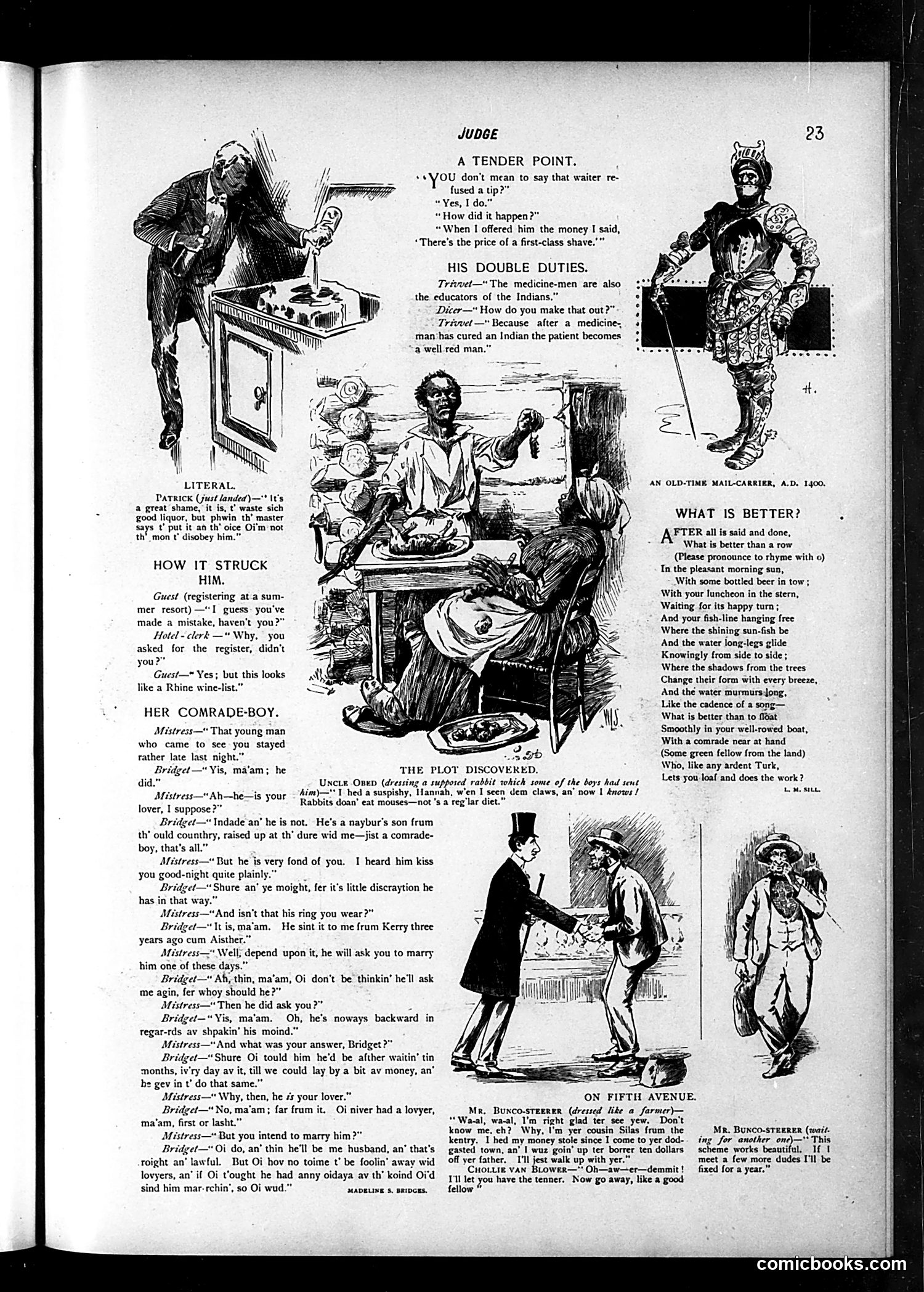
This page from *Judge* contains several short satirical pieces typical of late 19th-century American humor: **"A Tender Point"** mocks class pretensions: a diner insults a waiter by comparing his tip to "the price of a first-class shave," suggesting the waiter's social status is low. **"His Double Duties"** makes a crude pun about Native Americans, playing on "medicine man" and "well red man"—a period-typical offensive stereotype. **"Her Comrade-Boy"** depicts an Irish immigrant servant (Bridget) defending her relationship with a young man to her employer-mistress, using exaggerated Irish dialect. The satire targets both working-class Irish immigrants and middle-class employers' concerns about servants' morality. **"What Is Better?"** is a nostalgic poem celebrating leisure fishing, likely targeting idle wealthy men. **"The Plot Discovered"** shows a cook finding a suspicious rabbit—unclear if this is satirical commentary or simple domestic humor. The page reflects turn-of-the-century American attitudes toward class, ethnicity, and gender roles, employing dialect humor and social stereotyping common to the era.
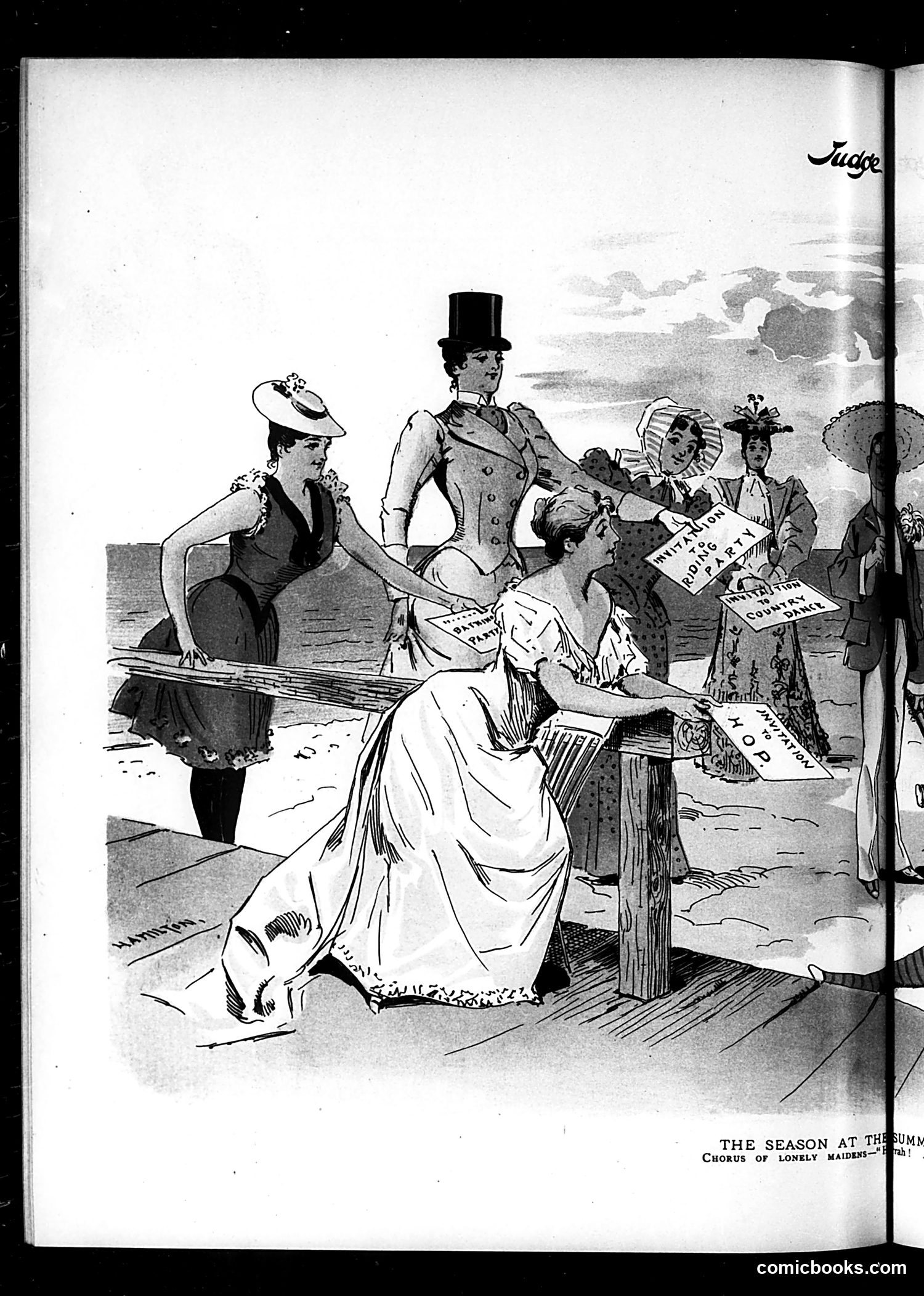
This satirical cartoon depicts fashionable women at what appears to be a social gathering or beach resort. The women hold papers labeled "WAITING" or similar text, suggesting they are waiting for suitors or romantic attention. The satire targets the social anxiety of unmarried women during the marriage season—likely the late 19th or early 20th century, when "the season" referred to the formal social period for courtship. The "chorus of lonely maidens" humorously portrays women as eager participants in the marriage market, dressed in elaborate fashions yet still waiting hopefully for male attention. The joke mocks both female desperation for matrimony and the ritualistic nature of upper-class courtship during this era.
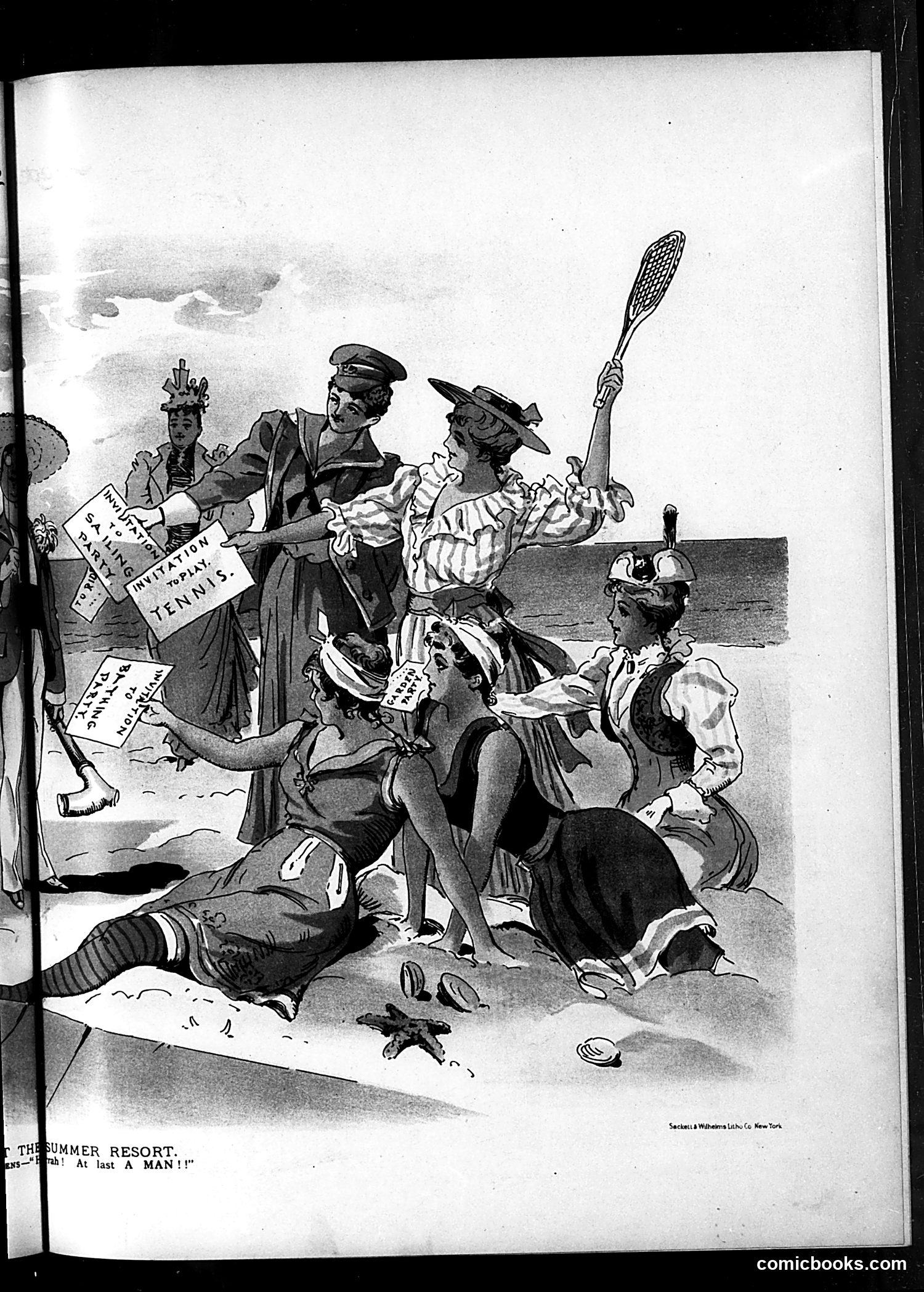
This satirical cartoon depicts a beach scene where a man (center, in dark suit and cap) appears to be the only male among numerous fashionably dressed women. The women hold various recreational items—tennis rackets, parasols—suggesting leisure activities. Several women wear labels that appear to reference specific locations or establishments (text on their clothing is partially legible). The satire's point seems to be mocking the gender dynamics at popular summer resorts of the era, where women vastly outnumbered men. The man's prominence and the caption "At last A MAN!" suggests commentary on either the scarcity of eligible men at such venues or the women's desperation for male attention. The cartoon likely parodies social anxieties about courtship, marriage prospects, and the leisure activities of the wealthy during the Gilded Age or early 20th century.
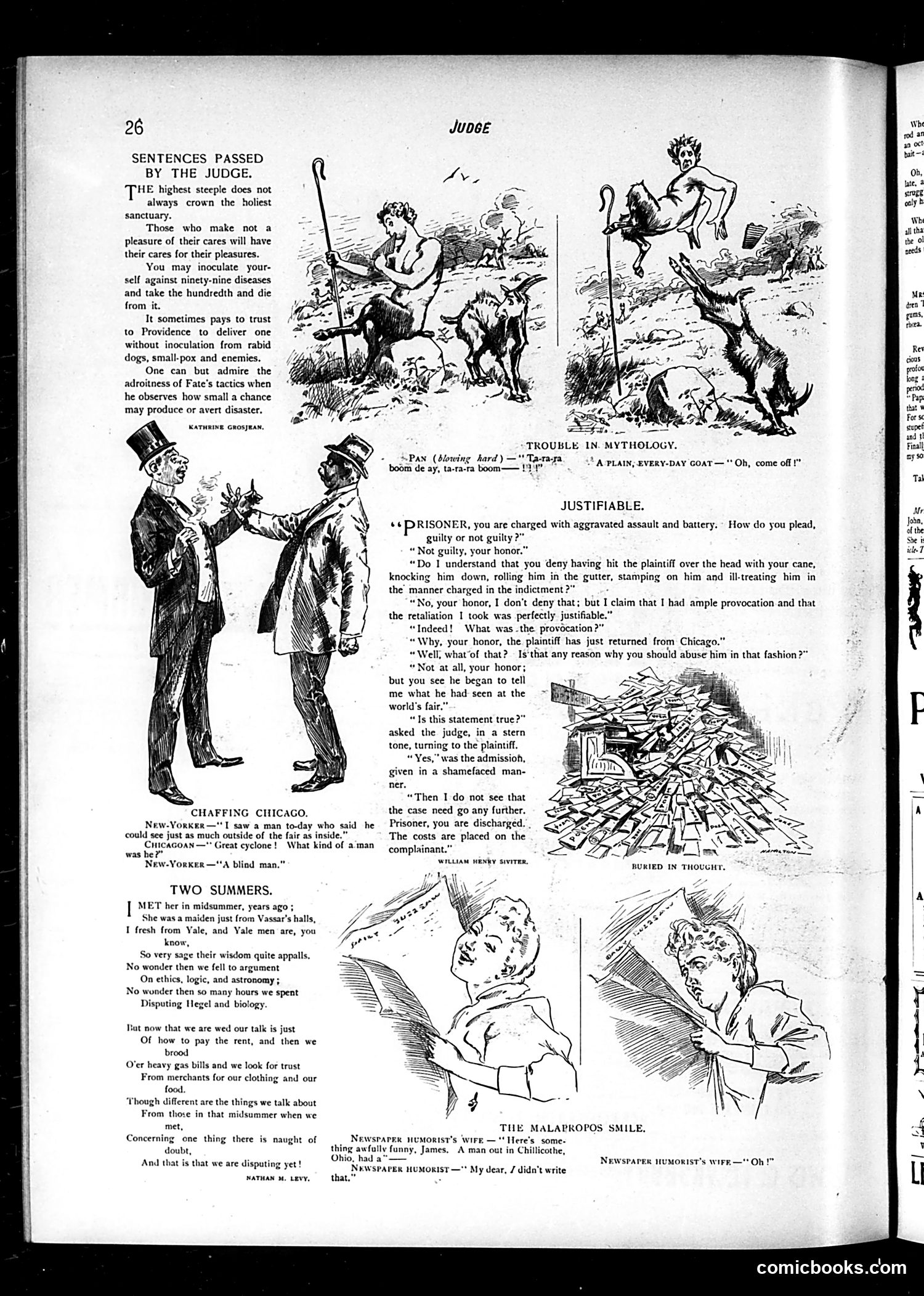
This page contains three satirical pieces: **"Justifiable"** mocks the 1893 Chicago World's Fair. A prisoner beats someone with a cane; the judge dismisses charges when learning the victim had just returned from Chicago and threatened to describe the fair's exhibits. The satire suggests that hearing tedious descriptions of the fair's attractions justifies violence—a jab at both the fair's infamous dullness and the public's exhaustion with its constant promotion. **"Chaffing Chicago"** directly attacks Chicago's fair. A New Yorker claims one can see as much *outside* the fair as inside; calling him blind is the punchline—suggesting the fair itself is blindingly mediocre or fraudulent. **"Two Summers"** contrasts a couple's philosophical debates during courtship with their present preoccupation with paying rent and bills—a common domestic satire on marriage's financial realities. The illustrations are period-appropriate line drawings accompanying these texts.
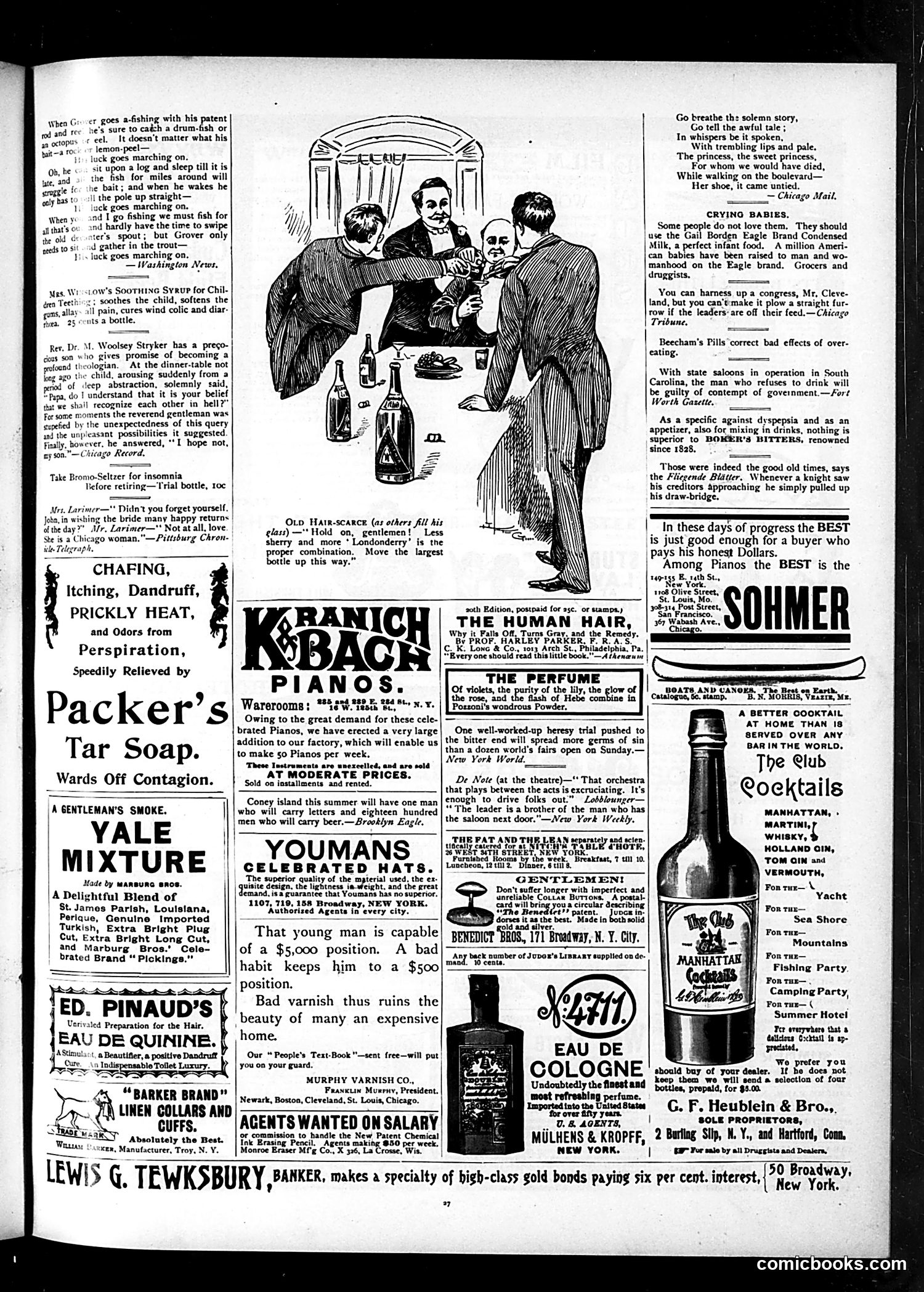
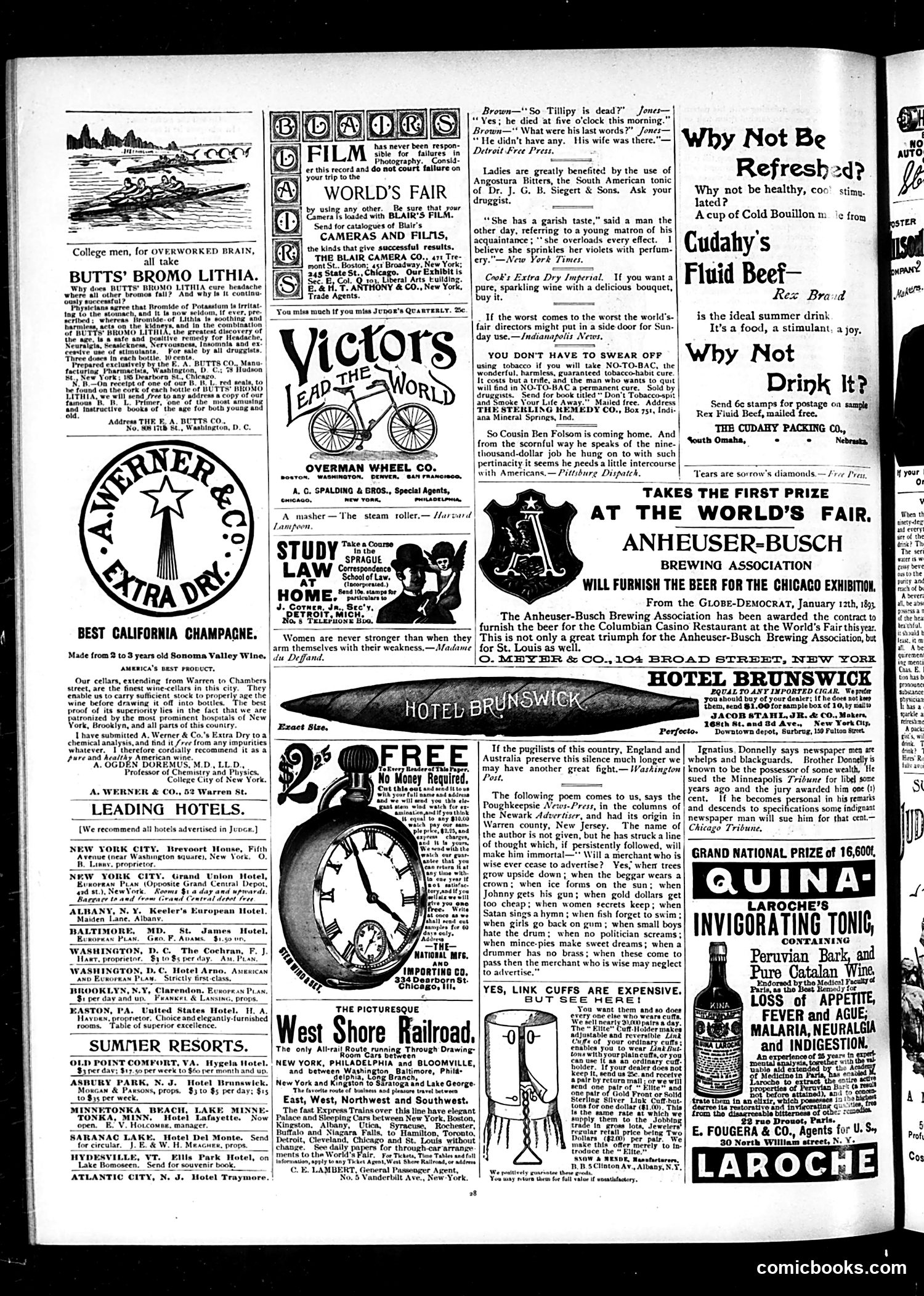
This page from the satirical magazine **Judge** is primarily **advertisements** interspersed with brief jokes and miscellaneous content—typical of early American magazines. The main text items include: **"Tillipy is dead?"** — A brief joke playing on the cliché that wives talk endlessly. The humor: a dying man has no "last words" because his wife monopolizes the conversation. **The "masher" reference** — A topical allusion. A "masher" was slang for an aggressive flirt or street harasser (common concern in this era). The quoted lines about women using "weakness" as a weapon reflect period attitudes about gender dynamics and manipulation. **"Victors" bicycle advertisement** — A straightforward product ad with an illustration of a bicycle, no satire intended. **World's Fair references** — Multiple ads reference the World's Columbian Exposition (Chicago, 1893), indicating this magazine is from that era. Blair Camera Company prominently markets filming the Fair. The page contains numerous hotel and resort advertisements, patent medicine ads (Bromo Lithia for headaches, Angostura Bitters), and champagne advertising—all period-authentic marketing with exaggerated health claims typical of the 1890s.
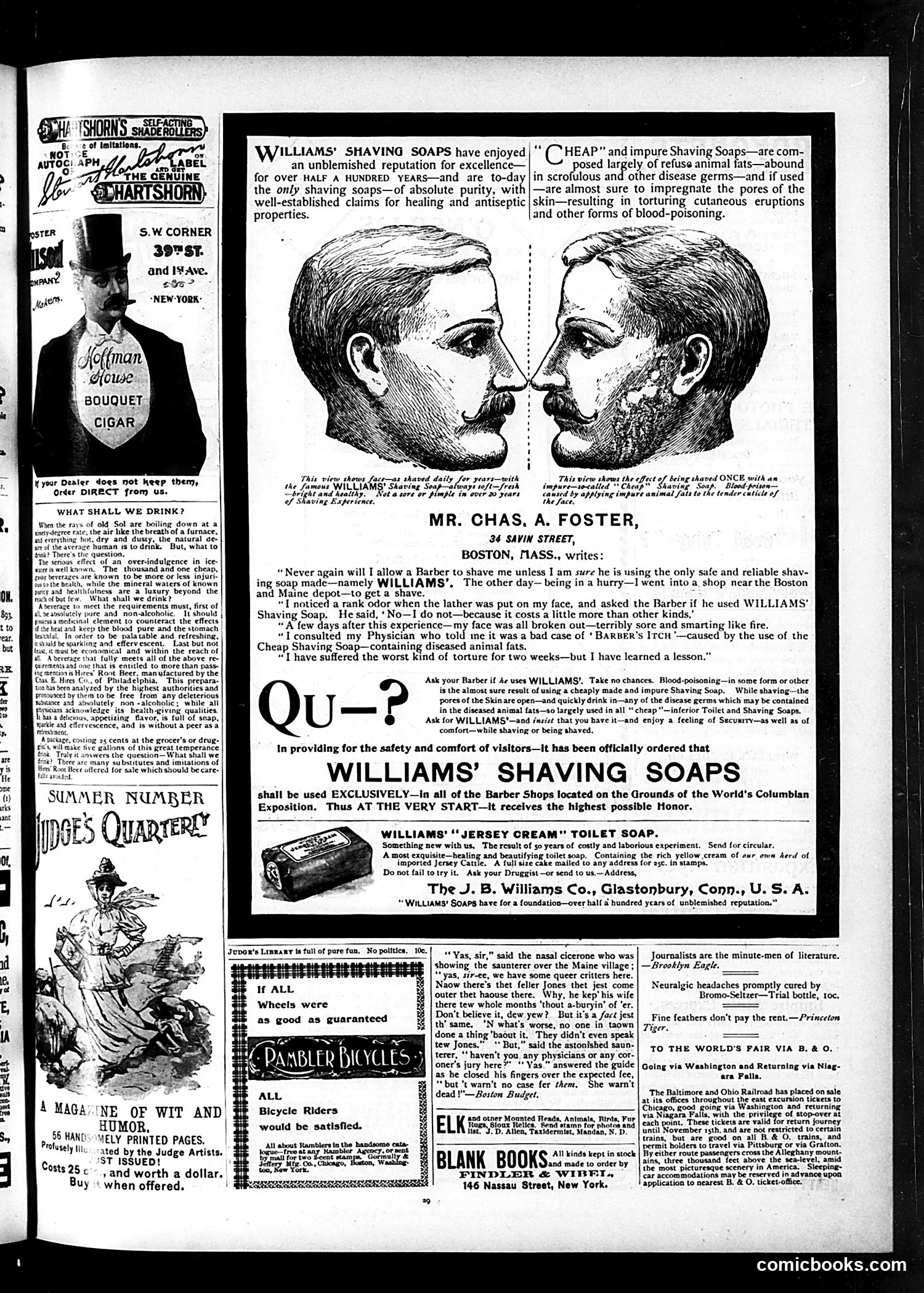
This page is primarily a **product advertisement** for Williams' Shaving Soaps, not political satire. The centerpiece shows two contrasting male faces: one healthy and smooth (left) from 30 years of using Williams' soap, the other (right) diseased and scarred from a single use of cheap soap. The ad features a testimonial from Charles A. Foster of Boston, who claims cheap shaving soap gave him "barber's itch" (a fungal infection). Williams uses fear-based marketing, warning that cheap soaps contain "refuse animal fats" and "disease germs" that penetrate open skin pores during shaving, causing blood-poisoning and cutaneous eruptions. The ad prominently notes Williams' soaps were officially mandated for exclusive use at barber shops at the **World's Columbian Exposition** (1893 Chicago World's Fair), framing this as highest honor and endorsement. This represents late-19th-century advertising that exploited genuine health anxieties about sanitation and product quality.
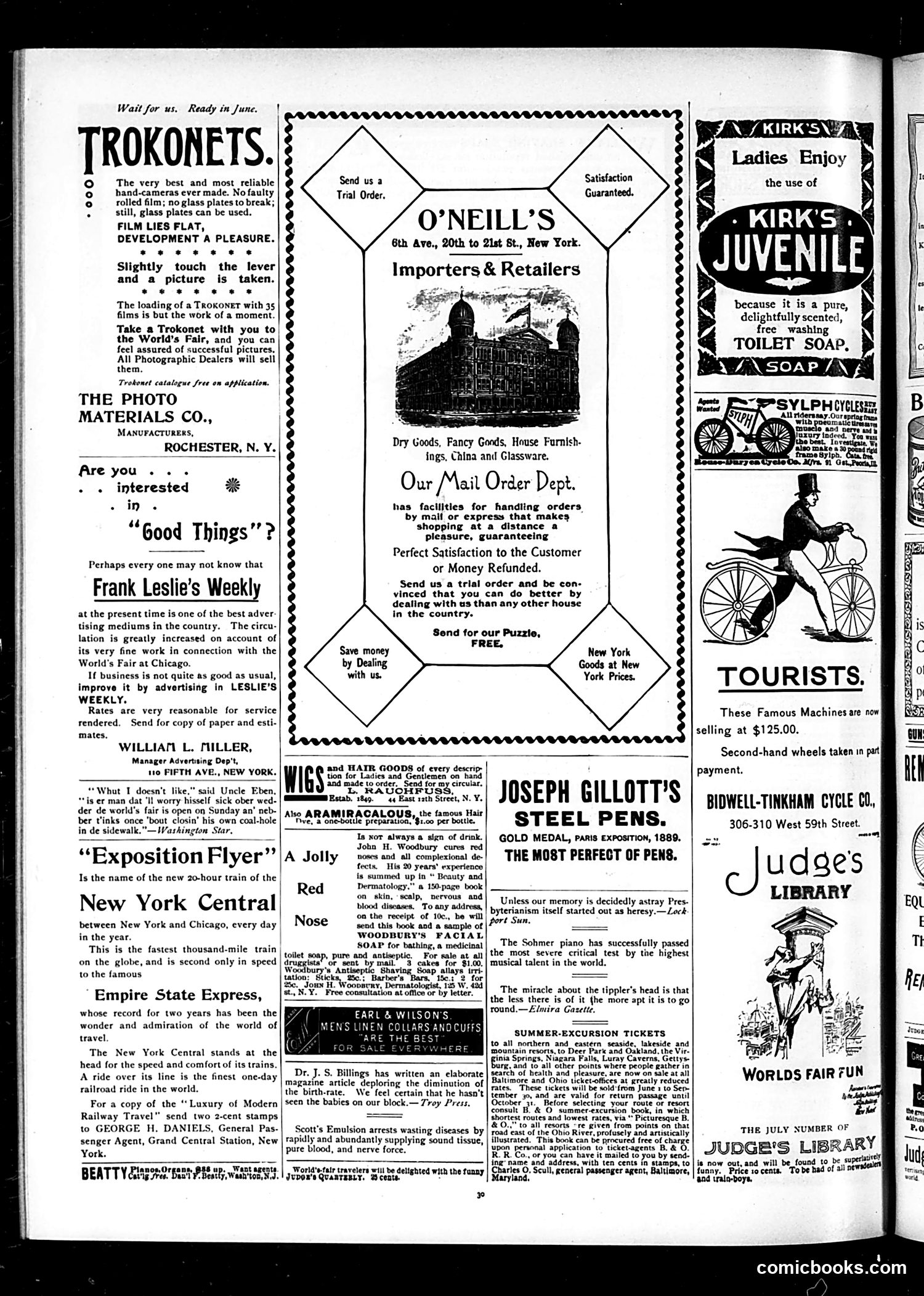
This is primarily an **advertising page** from Judge magazine, circa 1893 (based on World's Fair references to Chicago). Rather than political satire, it contains commercial advertisements interspersed with brief humorous items. **Notable content:** The page features ads for photographic equipment (Trokonets cameras), department stores (O'Neill's), bicycles (Sylphocycles, Bidwell-Tinkham), and patent medicines (Woodbury's Dermatological Soap, hair treatments). **Small humor items** include: - An "Uncle Eben" dialect joke about a man worrying over World's Fair Sunday closures rather than his own coalhole (appears to mock obsessive fair-going) - A reference to the New York Central's fast trains ("Exposition Flyer," "Empire State Express") - A brief quip from *Troy Press* mocking Dr. J.S. Billings's article lamenting declining birth rates, suggesting he should visit the speaker's neighborhood The page reflects 1890s consumer culture and advertising practices rather than editorial political commentary.
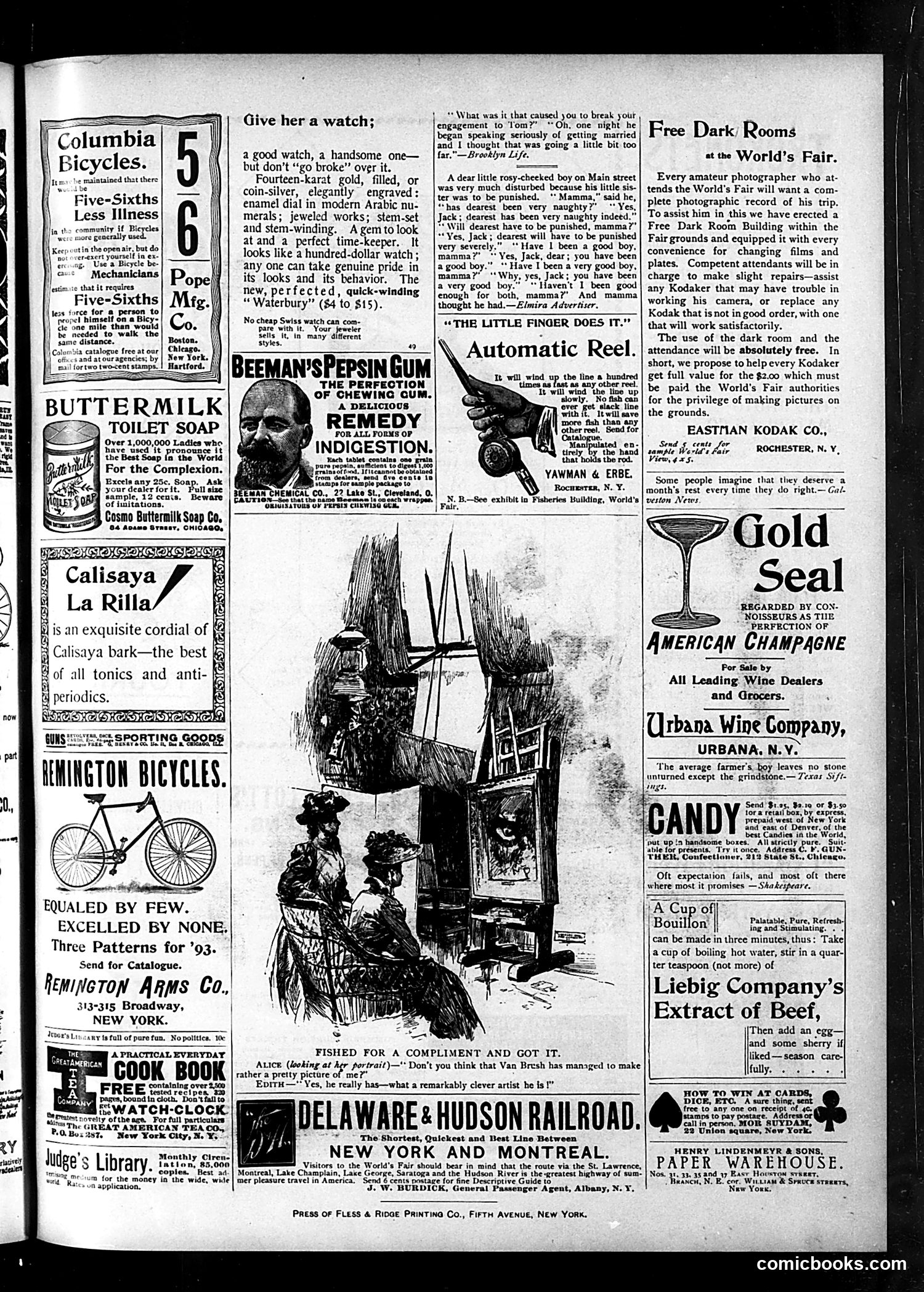
This page consists primarily of period advertisements interspersed with comic anecdotes and a central illustration titled "Fished for a Compliment and Got It." The cartoon shows two figures in period dress (appears to be late 19th-century) in an domestic interior scene. The caption—"Don't you think that Van Brush has managed to make rather a good picture of me?"—followed by "Exactly, he really has—what a remarkably clever bit of work!"—satirizes social hypocrisy. The joke concerns polite flattery: the speaker asks whether a portrait artist has captured their likeness well, but the responder's enthusiastic agreement suggests they're complimenting the artist's skill rather than the subject's appearance, creating an unintended insult masked as courtesy. The page otherwise consists of product advertisements (bicycles, soap, watches, railroad services) common to Judge magazine's business model. The comic anecdotes scattered throughout (children's dialogue, broken engagements) are typical filler humor characteristic of 1890s periodicals.
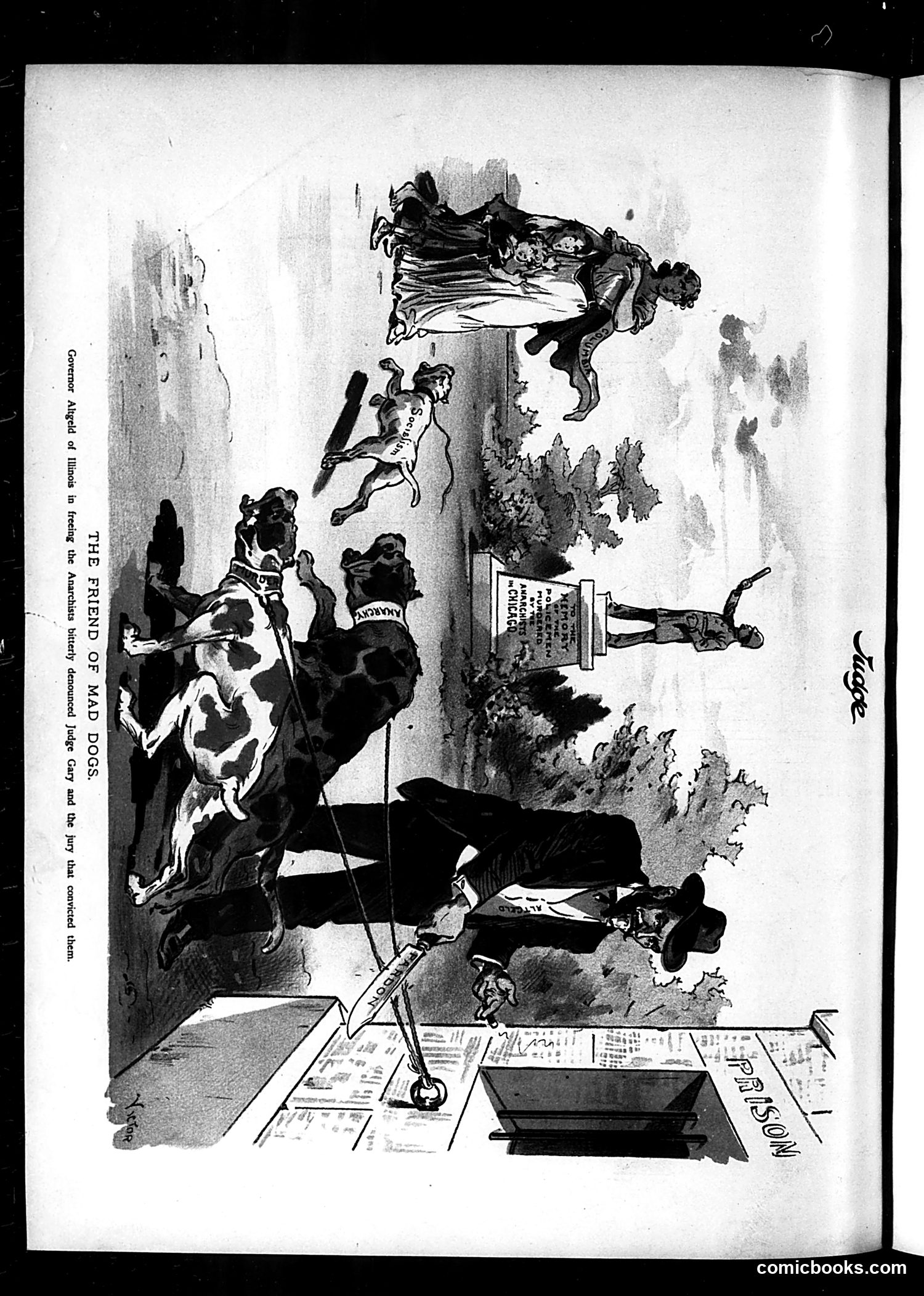
This cartoon critiques Illinois Governor John Altgeld's 1893 pardon of anarchists convicted in the Haymarket bombing case. The title sarcastically calls Altgeld a "friend of mad dogs"—equating the pardoned anarchists with dangerous animals. The image shows Altgeld (identifiable by the caption reference) alongside figures representing the freed anarchists, while Judge Gary (who presided over their trial) appears denounced. The cartoon satirizes Altgeld's decision to free the convicted men and his public attacks on both Judge Gary and the jury, suggesting he's protecting dangerous radicals rather than upholding justice. *Judge* magazine, a conservative publication, opposed the pardon as misguided leniency toward violent revolutionaries. The cartoon expresses the contemporary backlash against Altgeld's politically controversial act of clemency.