
A complete issue · 16 pages · 1893
Judge — April 22, 1893
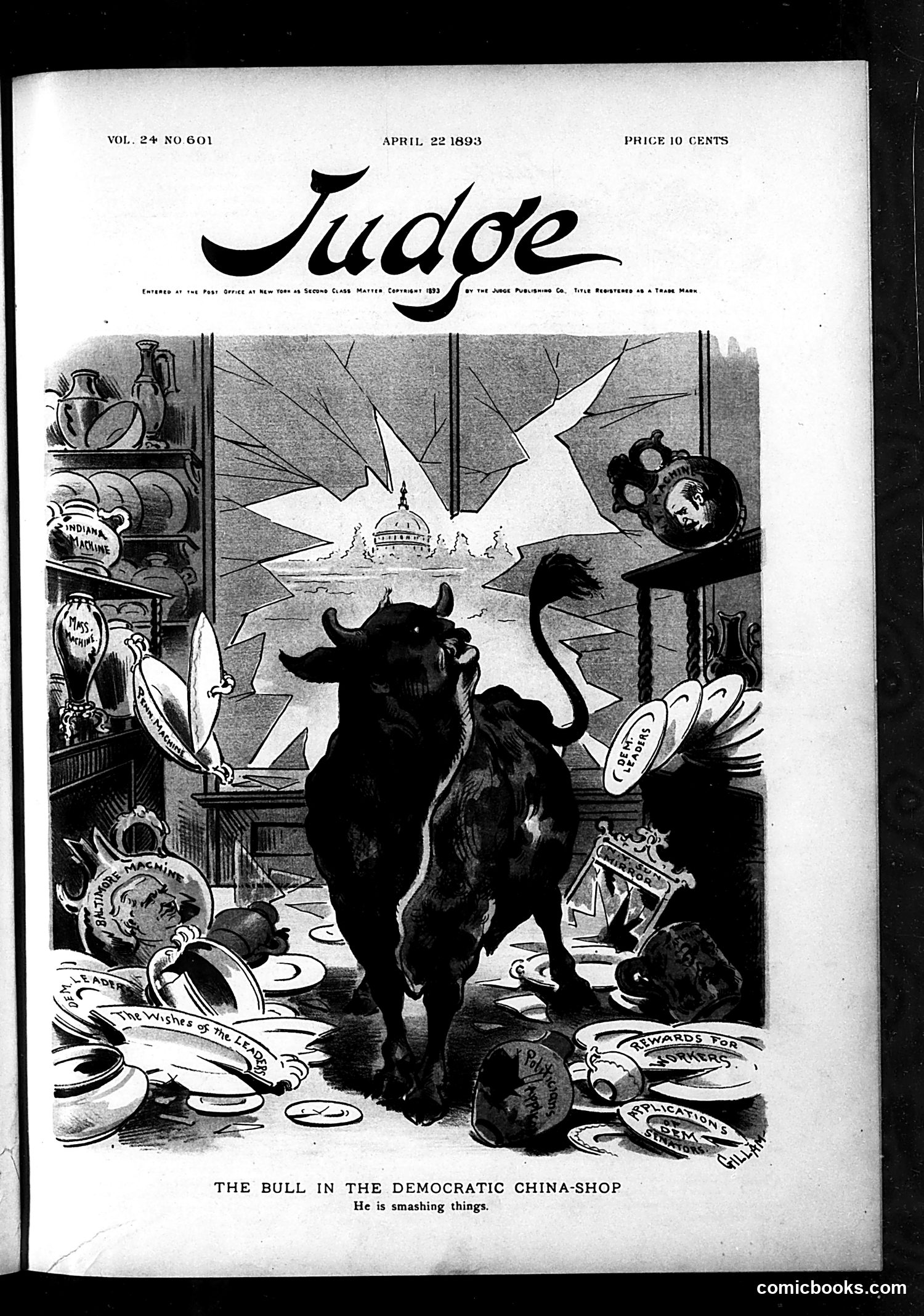
This 1893 *Judge* cartoon satirizes the Democratic Party as a destructive force in American governance. The bull represents the Democratic administration (likely President Grover Cleveland's second term, which began in 1893), depicted smashing delicate items in a shop—a visual metaphor for damaging the nation's institutions and stability. The shelves display labeled items including what appear to be references to tariffs, economic policies, and political awards—suggesting Democrats are recklessly destroying important governmental structures and economic arrangements. The "china-shop" metaphor implies careless, heavy-handed governance causing collateral damage. This reflects Republican criticism of Democratic economic and political policies during a period of economic crisis and political tension over tariff reform and currency issues.
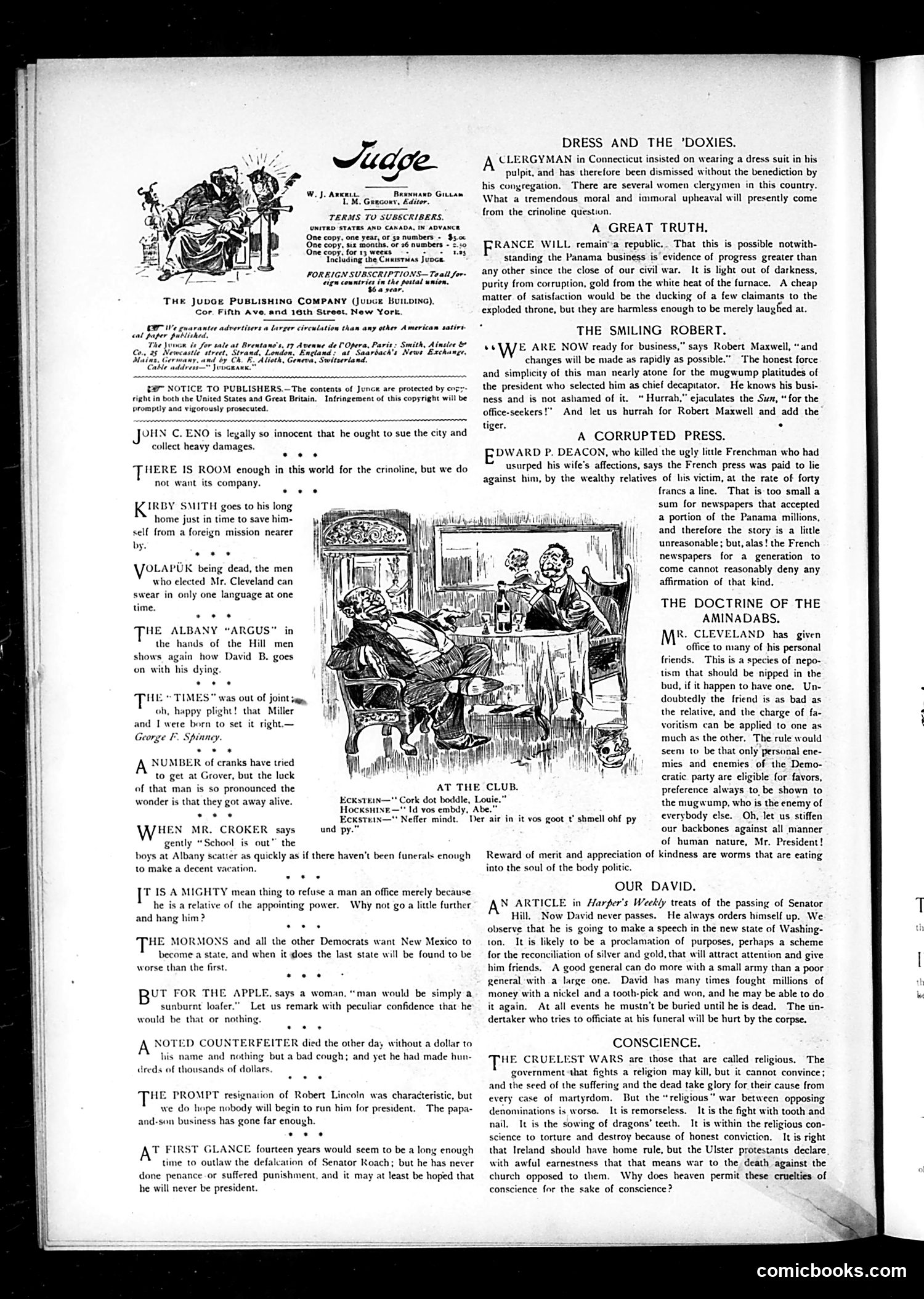
This page contains political commentary and satirical short pieces rather than a single coherent cartoon. The visible illustration shows figures at a club, accompanying a piece titled "AT THE CLUB." The text includes sharp critiques of contemporary issues: a clergyman dismissed for wearing a dress suit; criticism of the Panama Canal business and French press corruption; mockery of Cleveland's office patronage practices; and commentary on Mormon polygamy and Democratic Party factionalism. References to "Senator Roach," "Senator Hill," "David," and "Robert Maxwell" suggest specific political figures of the era (likely 1890s), though OCR errors complicate identification. The pieces attack institutional hypocrisy, political corruption, and nepotism—typical Judge magazine targets of the Gilded Age.
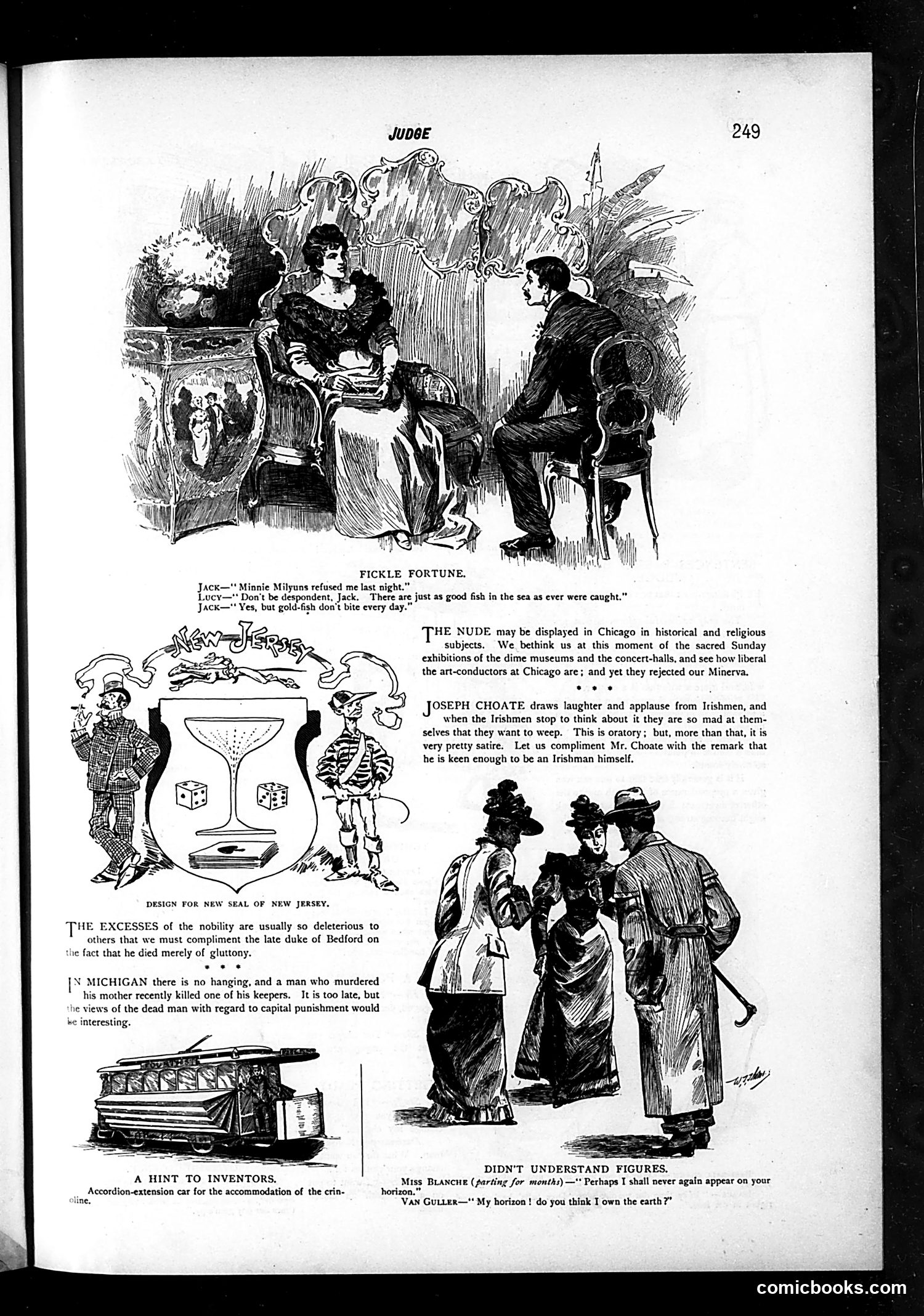
This page contains several satirical items typical of Judge's humor: **"Fickle Fortune"**: A social comedy sketch about a woman (likely wealthy) receiving fish from someone named Jack, who boasts they're superior to gold-fish. The joke satirizes class pretension and romantic duplicity. **"Design for New Seal of New Jersey"**: A visual pun showing a balance scale with dice, mocking New Jersey's reputation for corruption or gambling. **"Joseph Choate"**: A commentary on the Irish-American politician/lawyer Choate, praising his wit while gently mocking Irish stereotypes. **"A Hint to Inventors"**: Sketches an accordion-extension railway car, satirizing impractical invention proposals. **"Didn't Understand Figures"**: A domestic comedy about a woman (Miss Blanche) and a man (Van Guller) misunderstanding financial obligations. The magazine targets wealthy society, ethnic stereotypes, and contemporary absurdities with light satirical humor.
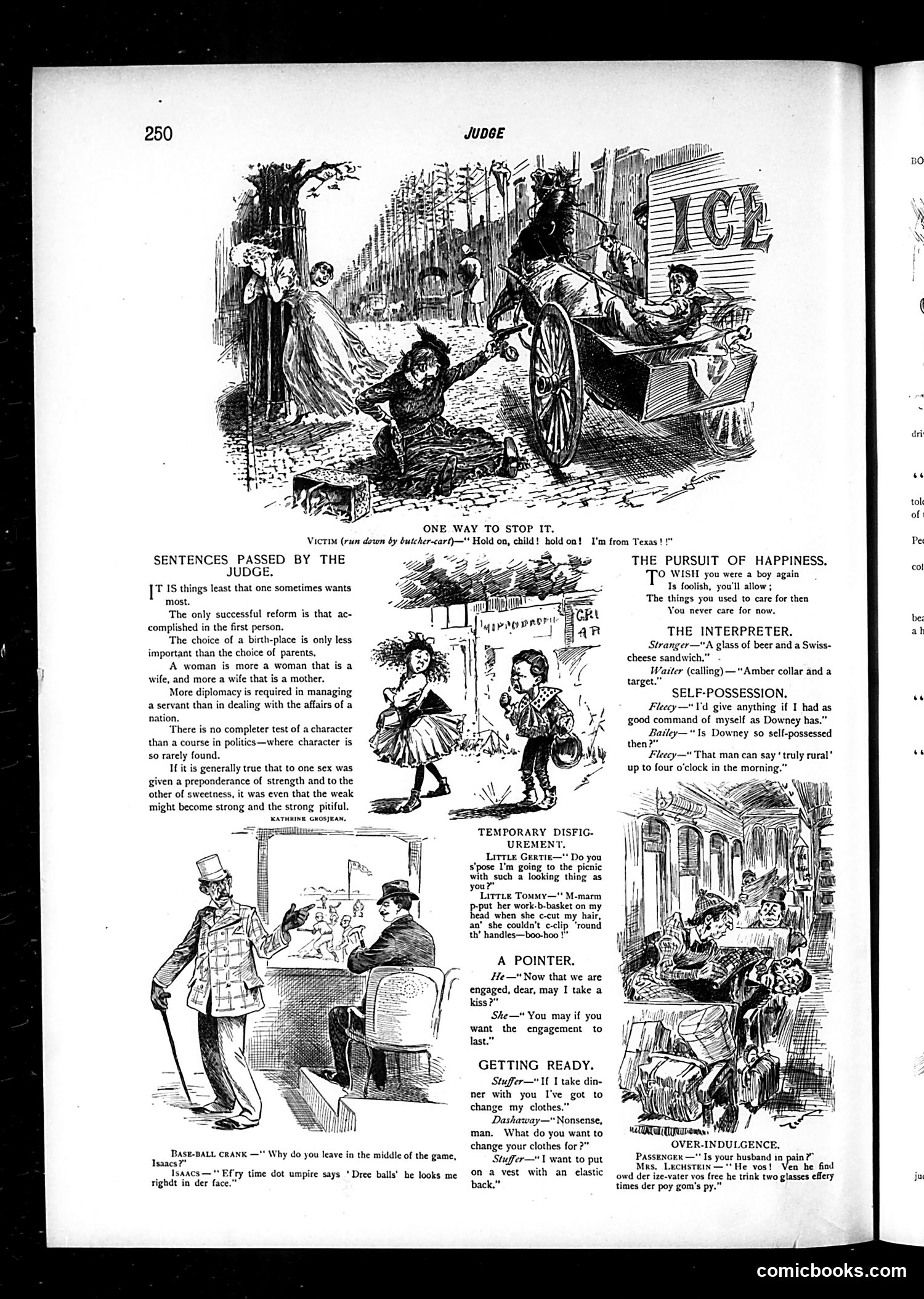
This page from *Judge* contains multiple brief satirical sketches typical of late-19th-century American humor magazines. **"One Way to Stop It"** depicts a Texas victim hit by a butcher's cart, claiming Texans are tough—likely referencing the exaggerated reputation of Texans as hardy, violent frontiersmen. **"Sentences Passed by the Judge"** are aphoristic observations on life, morality, and character—the magazine's editorial commentary disguised as witty wisdom. The remaining items are short comic vignettes: a baseball fan offended by an umpire's stare, children's mishaps, romantic banter about engagement, a stammering boy, nostalgic reflections on youth, a waiter misunderstanding foreign accents, someone's ability to pronounce tongue-twisters, and a wife's complaint about her husband's drinking—all employing period stereotypes (dialect humor, class observations, gender dynamics) typical of *Judge*'s entertainment approach.
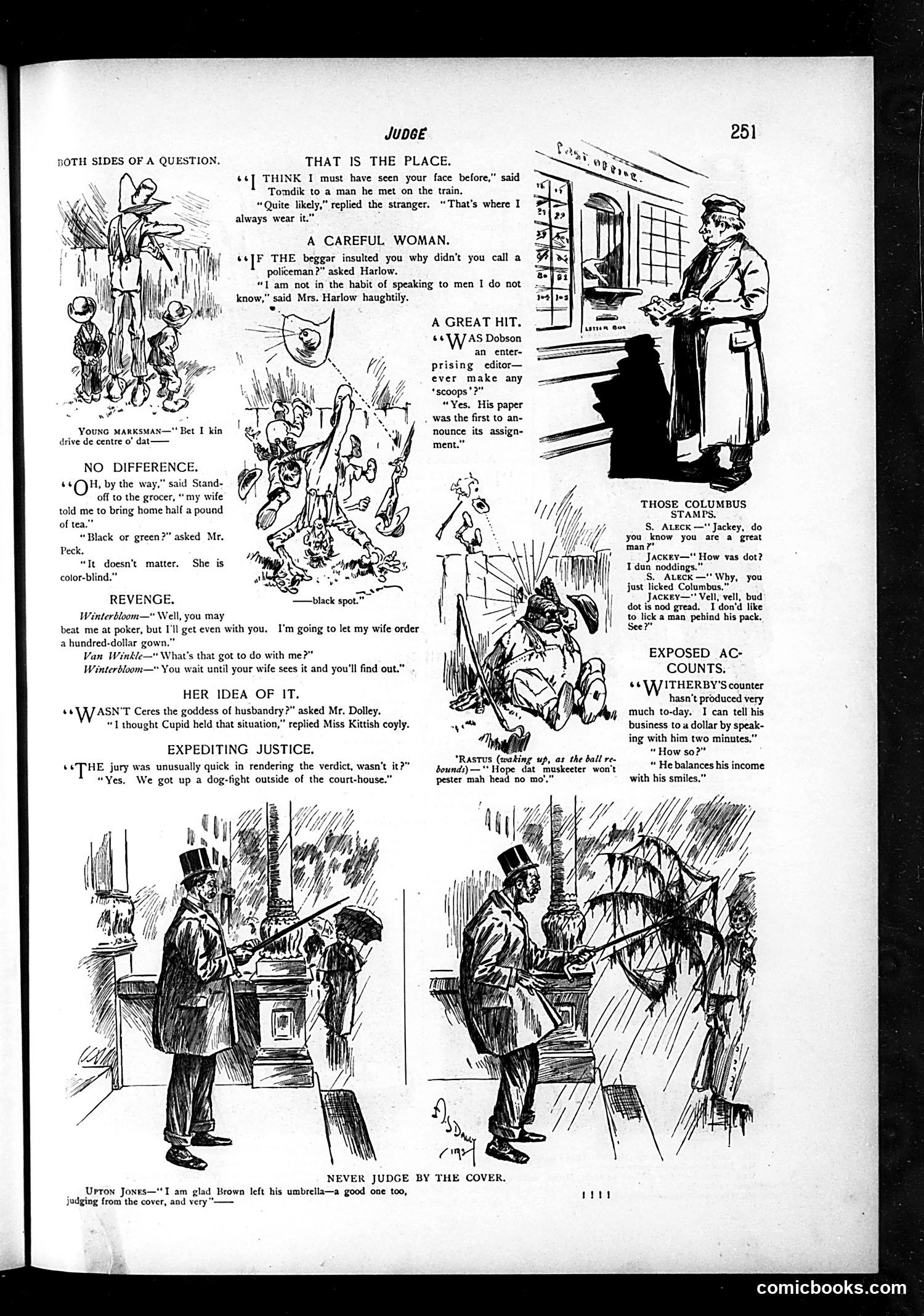
This page contains multiple short humor pieces typical of Judge's satirical format: **"That Is the Place"** and **"A Careful Woman"** are brief conversational jokes playing on literal vs. figurative meaning and social pretension. **"A Great Hit"** mocks an editor whose newspaper was notable only for announcing its own bankruptcy ("assignment")—satirizing incompetent journalism. **"No Difference"** jokes about a color-blind wife, reflecting period attitudes toward domestic absurdity. **"Revenge"** and **"Her Idea of It"** are domestic humor pieces about marital conflict and female ignorance, common Judge tropes. **"Expediting Justice"** uses a racist caricature (the "Rastus" figure) for crude humor about courtroom efficiency. **"Those Columbus Stamps"** references Columbus commemorative stamps, with ethnic dialect humor (likely Irish or Eastern European immigrant stereotypes). **"Never Judge by the Cover"** offers a pun about umbrellas and judgment. The page reflects Judge's typical early-20th-century approach: domestic satire, ethnic stereotypes, and jokes targeting incompetence or vanity.
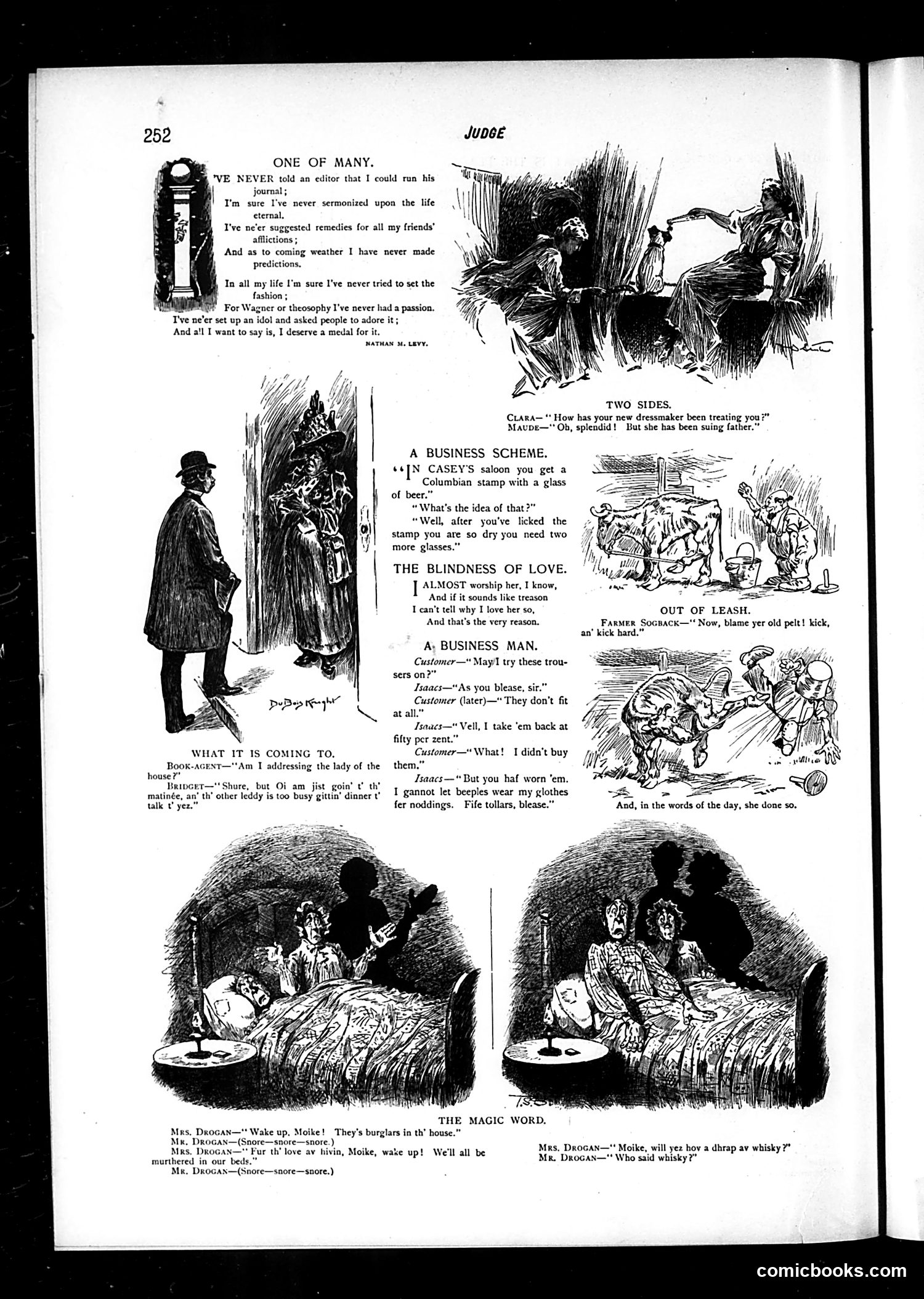
This page contains multiple satirical sketches typical of late 19th-century American humor: **"One of Many"** mocks self-righteous people who boast about their modesty and restraint—the joke being that announcing you deserve a medal for *not* doing annoying things is itself annoying. **"Two Sides"** jokes about a dressmaker suing the father while the daughter praises her services—social commentary on class relations and lawsuit culture. **"A Business Scheme"** satirizes a saloon's marketing gimmick: Colombian stamps on beer glasses that, when licked, make customers thirsty enough to buy more beer. **"A Business Man"** stereotypes a Jewish tailor (Isaacs) with exaggerated dialect, using dishonest business practices—reflecting common ethnic stereotyping of the era. **"The Magic Word"** depicts an Irish couple (Mr. and Mrs. Drogan, indicated by dialect) where the wife can only wake her sleeping husband from a burglary by mentioning whisky—stereotyping Irish alcoholism. The page combines gentle social satire with period-typical ethnic caricature and dialect humor.
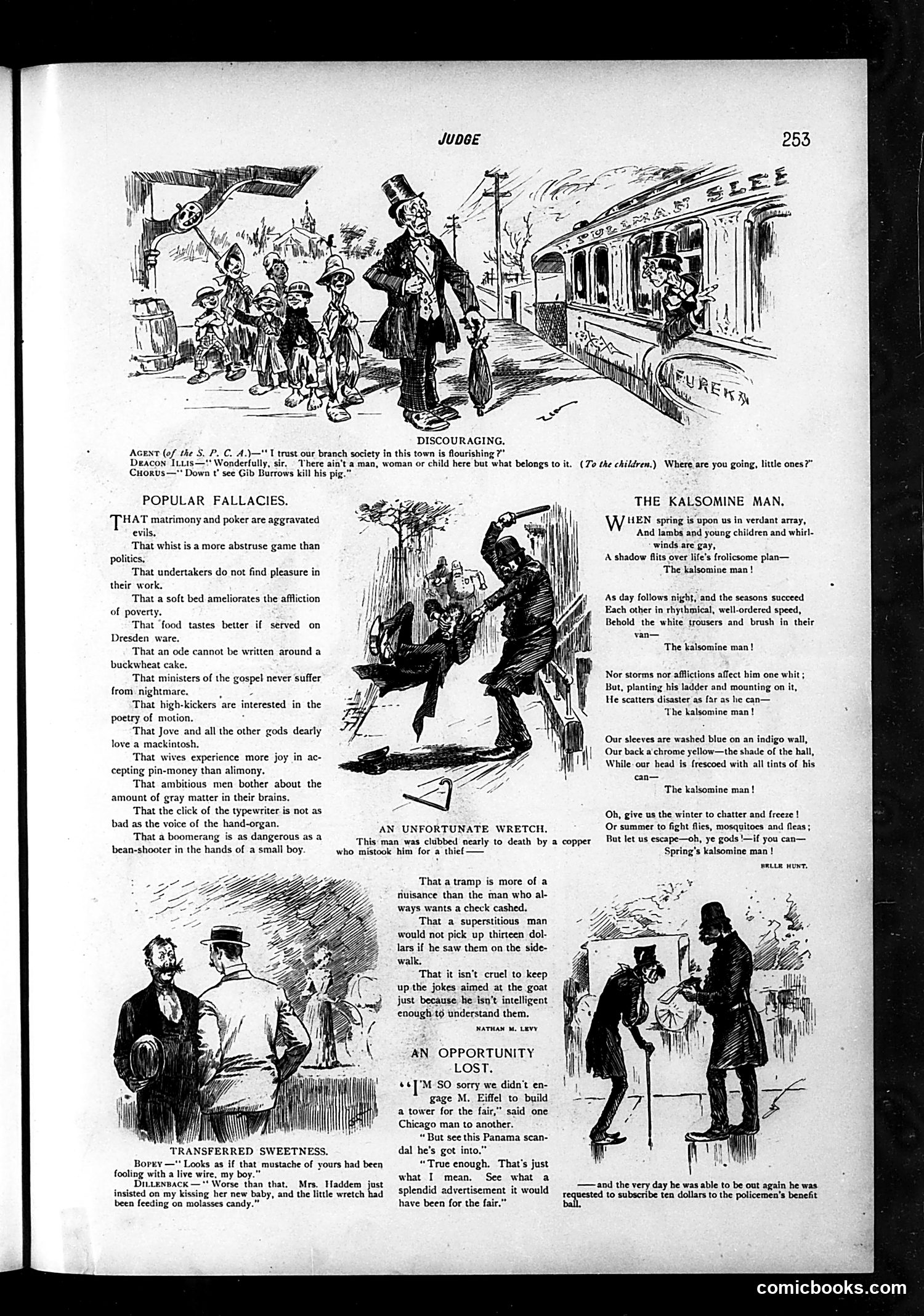
This page contains multiple satirical items typical of Judge's format: **"Discouraging"** (top): Mocks the Society for Prevention of Cruelty to Animals (S.P.C.A.) by showing a deacon claiming universal membership, then revealing the town's real interest is watching someone kill a pig—satirizing hypocrisy about animal welfare. **"Popular Fallacies"**: A humorous list of supposed misconceptions about everyday life, from marriage to typewriters to bean-shooters. These are lightweight social observations rather than political commentary. **"The Kalsomine Man"**: A humorous poem about the spring tradition of house-painting, personifying the seasonal nuisance as an almost unstoppable force that covers everything—including people—in whitewash. Relatable domestic humor. **"An Unfortunate Wretch" and related sketches**: Brief anecdotes about misfortune and social awkwardness. **"An Opportunity Lost"**: References M. Eiffel and a Panama scandal, suggesting early 1890s context when both were newsworthy. Overall, this is entertainment-focused satire with minimal political content—targeting pretension, social conventions, and domestic annoyances rather than specific political figures.
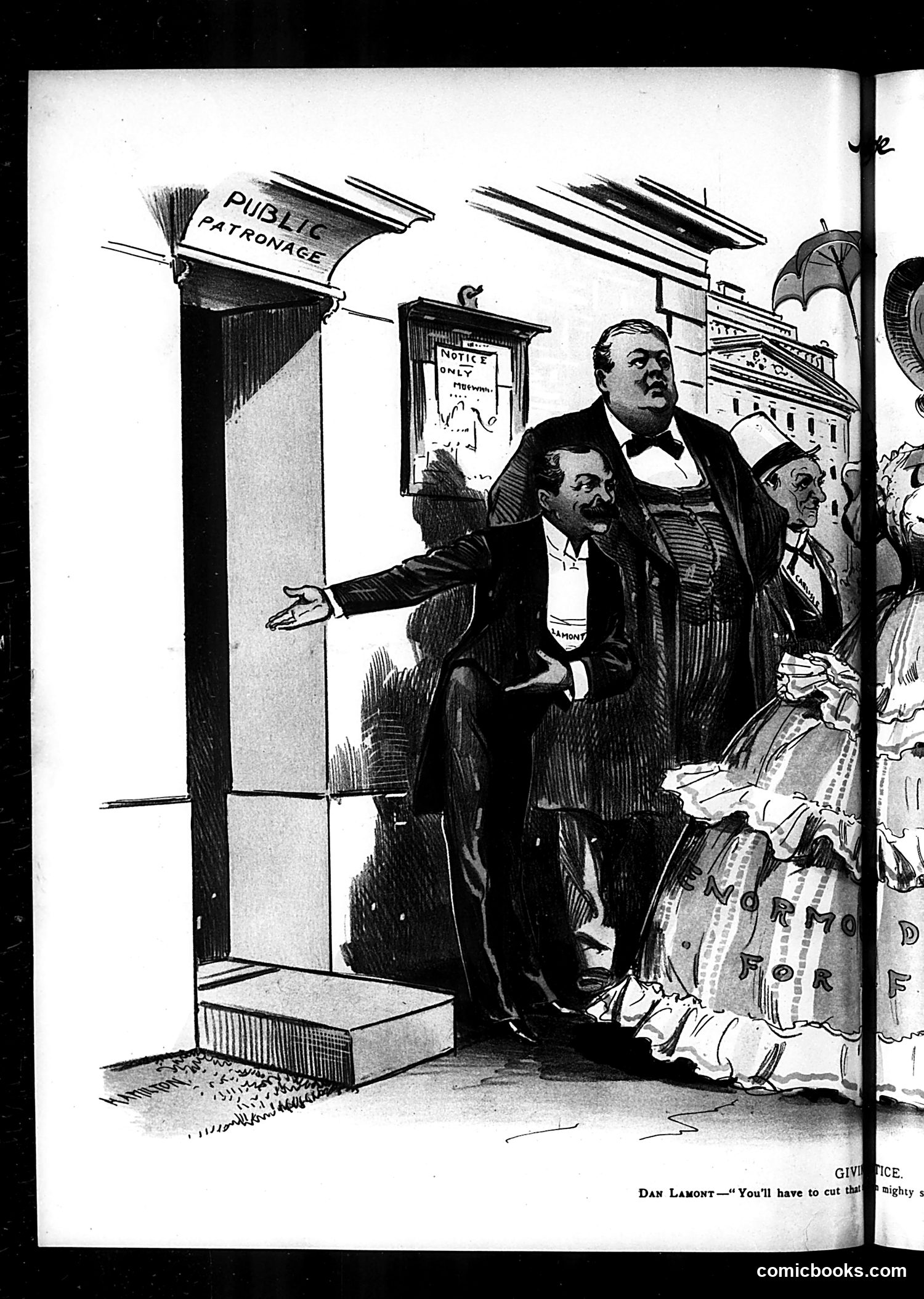
This Judge magazine cartoon depicts a scene at what appears to be a government building (marked "PUBLIC PATRONAGE"). A man identified as "Dan Lamont" is being directed or ejected by officials, with the caption suggesting he "will have to cut" something "mighty" — likely a reference to reducing patronage or government spending. The cartoon satirizes **political patronage and corruption** — the practice of distributing government jobs and resources to political allies. The crowded scene of well-dressed men and women represents those seeking favors or positions through public patronage. Dan Lamont (likely Secretary of War under President Cleveland, 1893-1897) appears to be facing pressure or criticism regarding patronage practices. The satire suggests hypocrisy or failure to reform the system despite claims to do so.
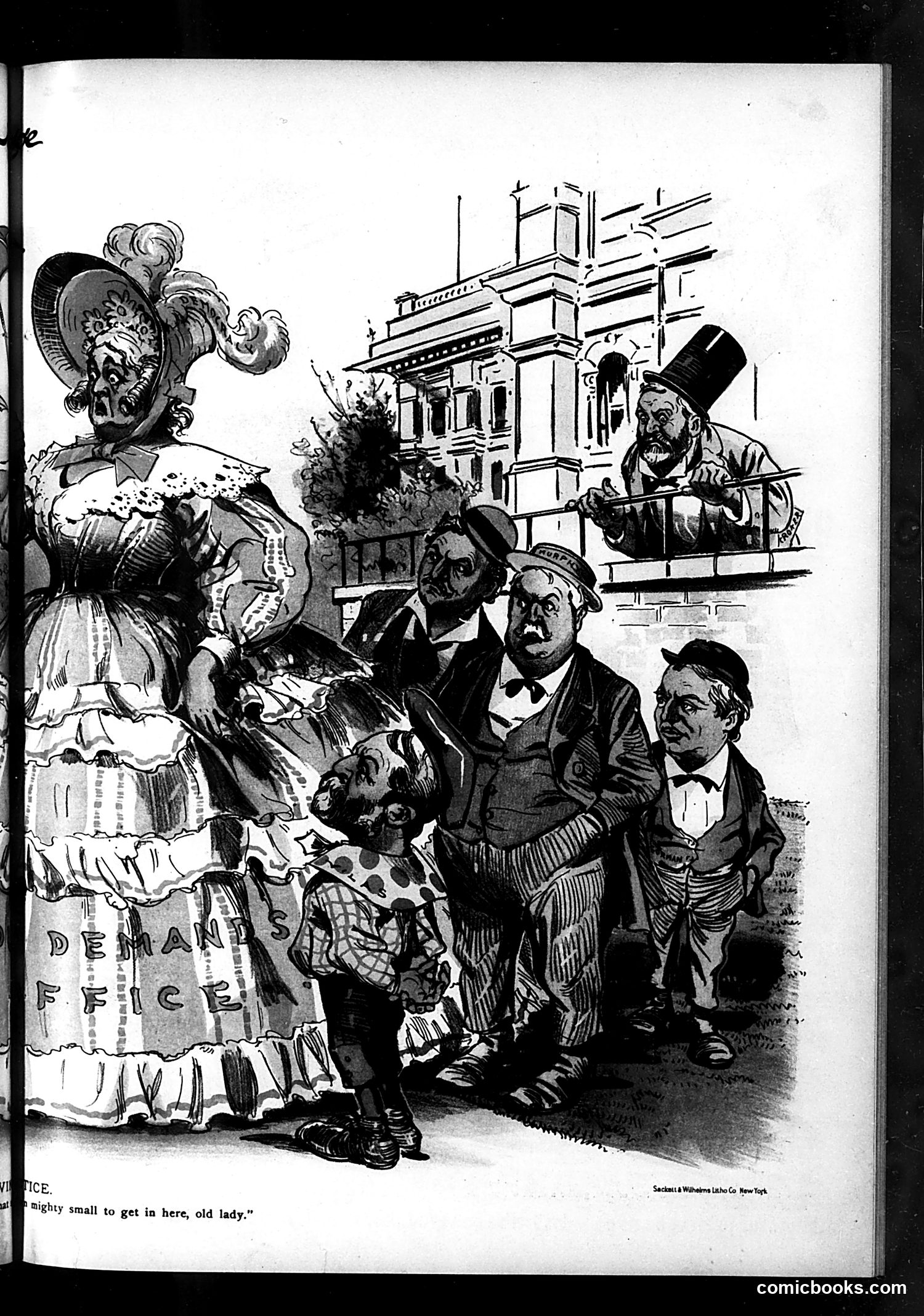
This political cartoon satirizes access to exclusive social venues. A fashionably dressed woman with an elaborate feathered hat stands at what appears to be an upscale building or club entrance. Several working-class men in modest clothing gaze at her admiringly or seek entry. The caption reads "Mighty small to get in here, old lady," suggesting the woman is blocking or controlling access—likely commenting on class barriers or exclusivity in Gilded Age society. The satire targets wealth and social pretension: the ornately dressed woman represents privilege and gatekeeping, while the humble men represent those excluded from high society. The humor lies in the ironic contrast between her elaborate appearance and the dismissive comment about her size, implying that despite her social status, she's merely a physical obstacle to opportunity.
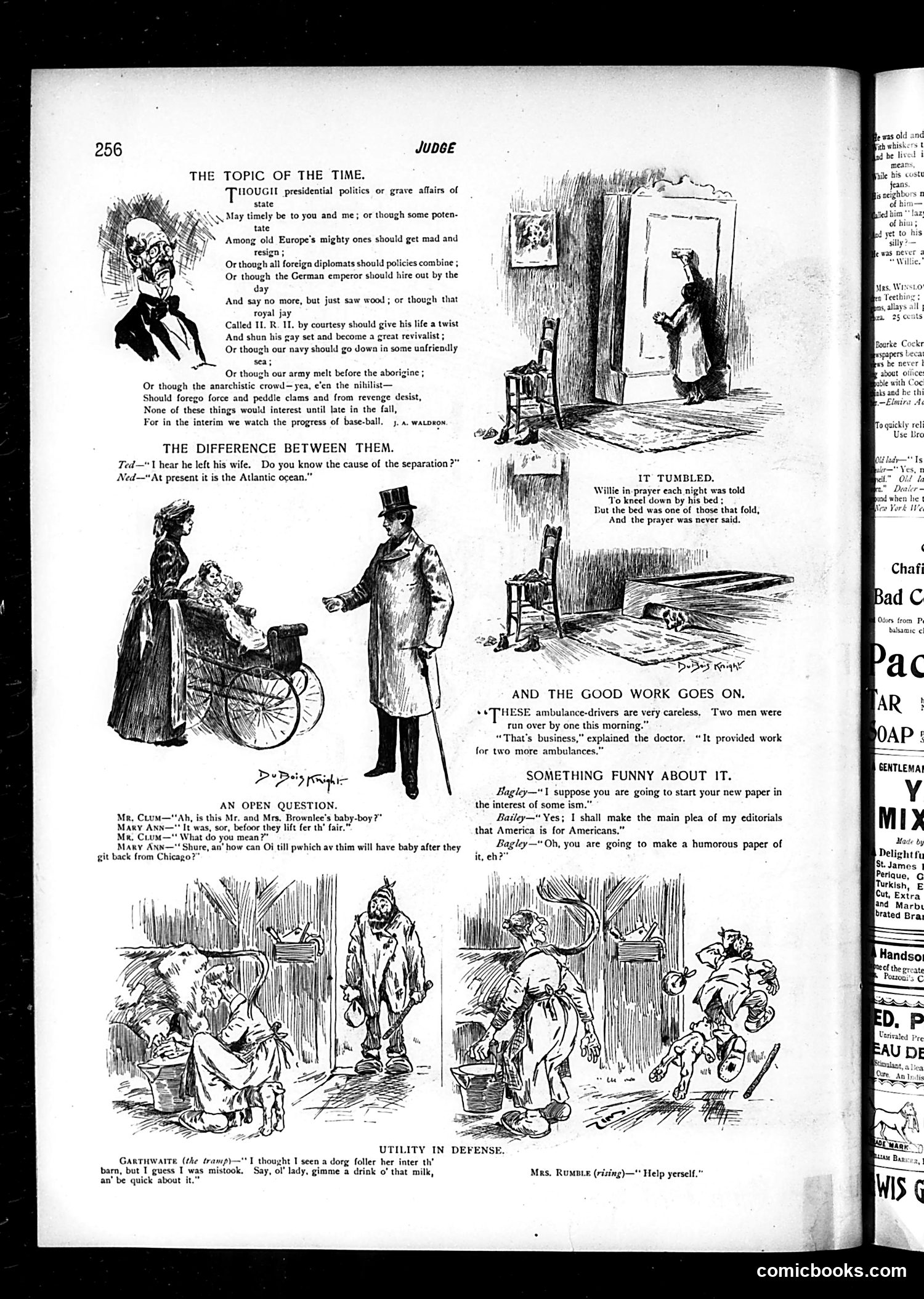
This page from *Judge* contains several brief satirical pieces typical of the era: **"The Topic of the Time"** mocks Americans' obsession with baseball, suggesting that regardless of major political crises—foreign diplomacy, German emperors, naval defeats, anarchists—nothing matters until baseball season concludes in the fall. **"The Difference Between Them"** is a brief joke about marital separation, where the "cause" is literally the Atlantic Ocean separating an estranged couple. **"An Open Question"** satirizes Irish immigrants (indicated by dialect spelling), joking that a couple visiting the Chicago World's Fair cannot be identified as the Brownlees because they might return with a baby—making it unclear which child is theirs. **"And the Good Work Goes On"** darkly jokes that ambulance drivers' carelessness creates more business for ambulances—a cynical commentary on profiteering. **"Something Funny About It"** plays on the phrase "America for Americans"—likely referencing contemporary nativist sentiment or isolationism, with the joke implying such patriotic slogans sound inherently humorous. The cartoons use exaggerated character types and ethnic stereotypes common to the period.
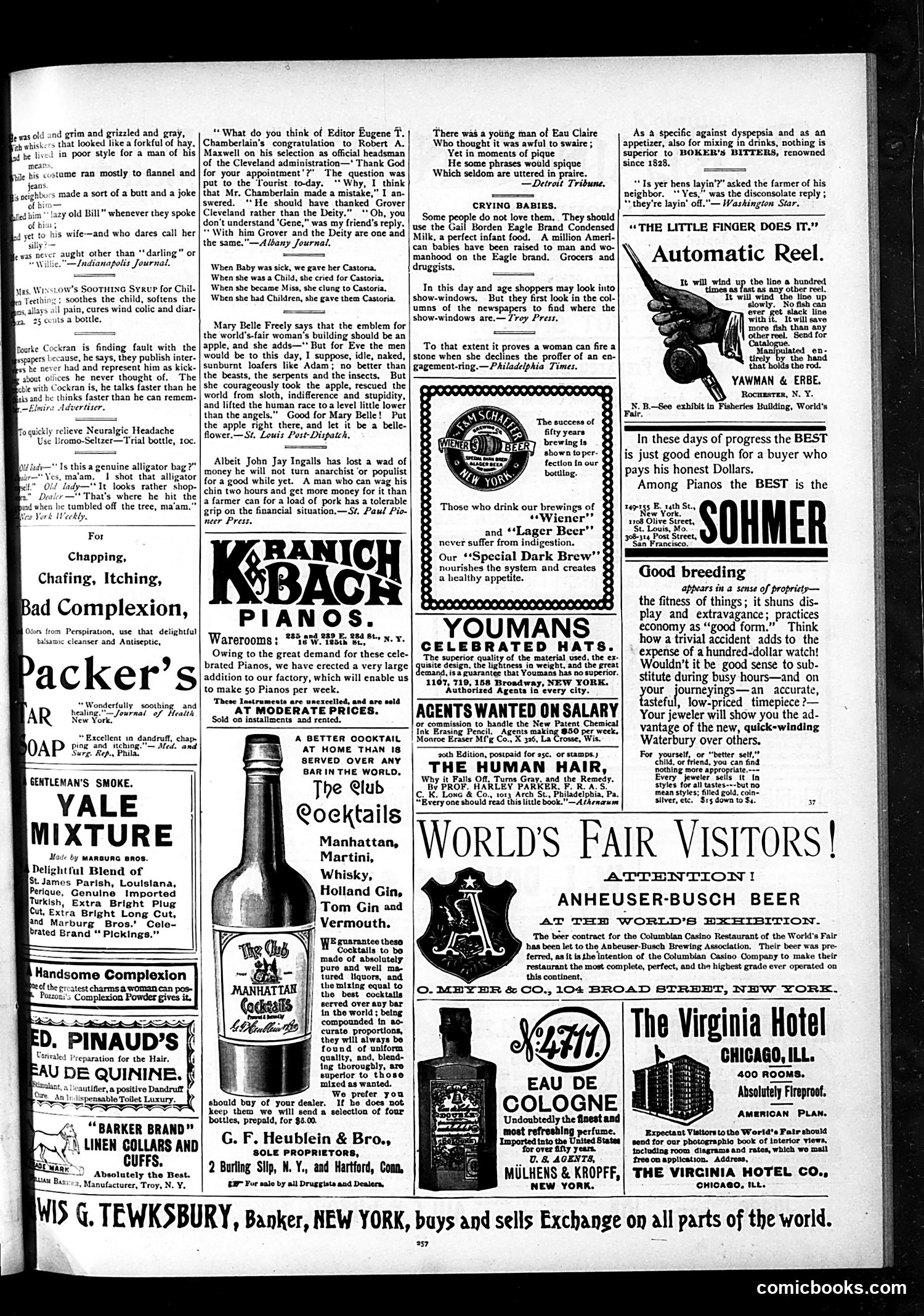
This page is primarily **advertising with miscellaneous humor pieces** rather than a coherent political cartoon. The advertisements dominate—for pianos, beer, hotels, cologne, and various patent medicines typical of the era. The humor pieces are brief anecdotes with mild satire: - A joke mocking Editor Eugene T. Chamberlain's excessive praise of a Cleveland administration official, suggesting Chamberlain conflates Grover Cleveland with God - A quip about a woman's accomplishments (referencing the World's Fair Women's Building debate) - Light verse about a young man from Eau Claire who swears despite his principles - Wordplay about an alligator handbag The page reflects **late 19th-century concerns**: women's roles, religious fervor in politics, and consumerism. Most humor targets minor public figures or social pretension rather than major political issues. The heavy advertising suggests Judge relied substantially on commercial revenue, limiting space for substantive satire.
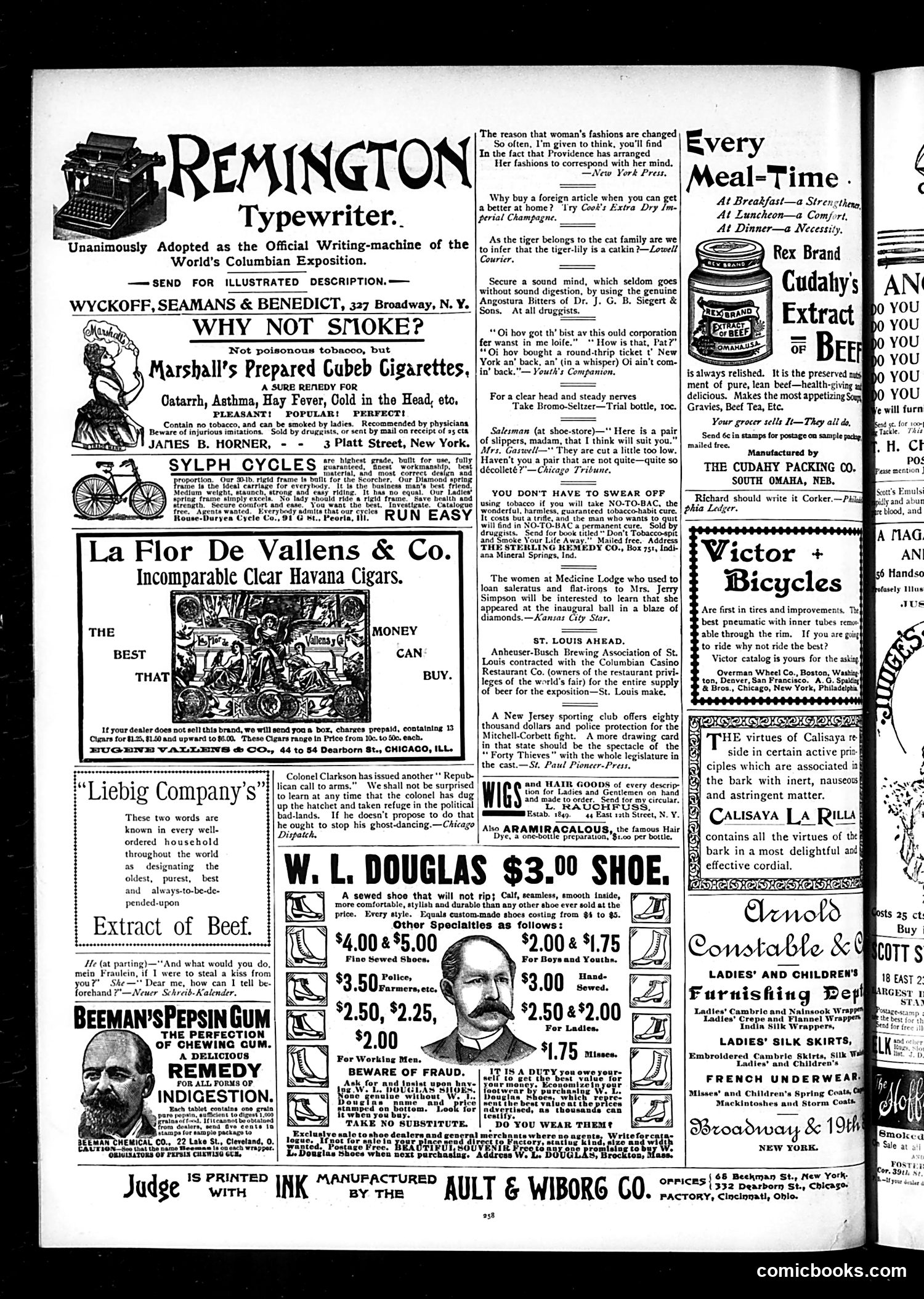
This is primarily an **advertising page** from Judge magazine, with minimal editorial cartoon content. The ads promote products like Remington typewriters, Marshall's medicinal cigarettes, bicycles, cigars, and shoes—typical late 19th-century commercial pitches. The one notable satirical item is a brief Colonel Clarkson joke referencing Republican politics and "ghost-dancing" (likely alluding to Native American resistance or political theatrics). The text mocks Clarkson for "digging up the hatchet" in political bad-lands, suggesting he's engaged in divisive or outdated political posturing. Most content consists of social commentary snippets—jokes about women's fashion fickleness, a pun about tiger-lilies, and anecdotes about shoes and tobacco. The magazine primarily uses this page for **revenue through advertising** rather than substantive political satire or comics. The cartoons present are minimal and ancillary to the commercial content.
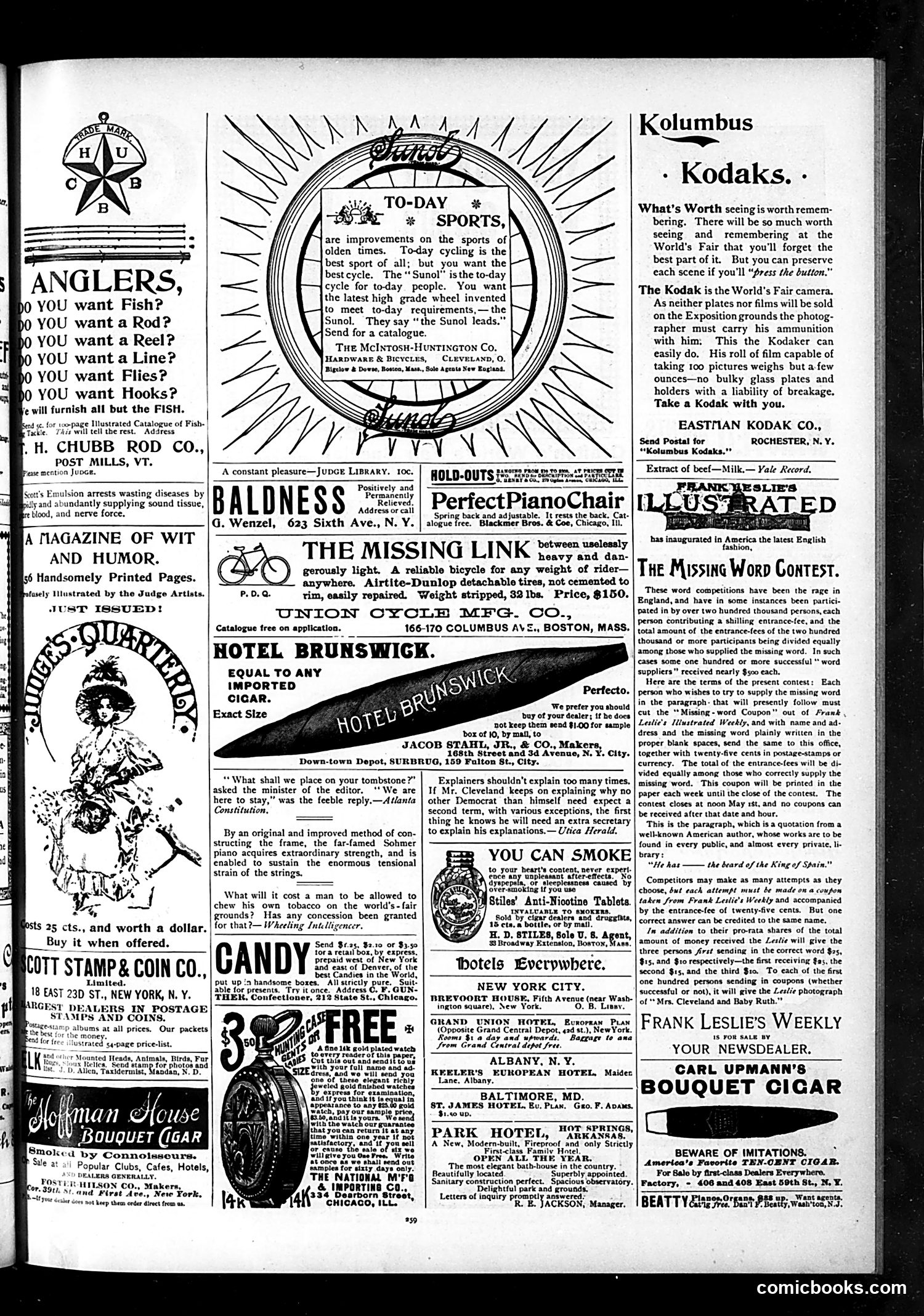
This page is **primarily advertising**, typical of Judge magazine's format. The advertisements promote late-1890s consumer goods: fishing equipment, bicycles, pianos, cigars, and notably, **Kodak cameras**. The Kodak ads are historically significant—they're marketing photography to ordinary people for the 1893 World's Columbian Exposition in Chicago, using the famous slogan "You press the button, we do the rest." This represents early consumer photography democratization. The small editorial content includes a joke about an editor claiming his newspaper will "stay," implying permanence despite mortality—a light satirical jab. Another quip questions what it costs to smoke tobacco at the fair's grounds, suggesting commercial exploitation. **The "Missing Link" bicycle advertisement** uses Darwinian language (evolutionism was popular post-Darwin) to position their product as the perfect middle ground between heavy and light bicycles. The overall page reflects Gilded Age commercialism and early mass-marketing techniques targeting middle-class consumers attending America's most famous world's fair.
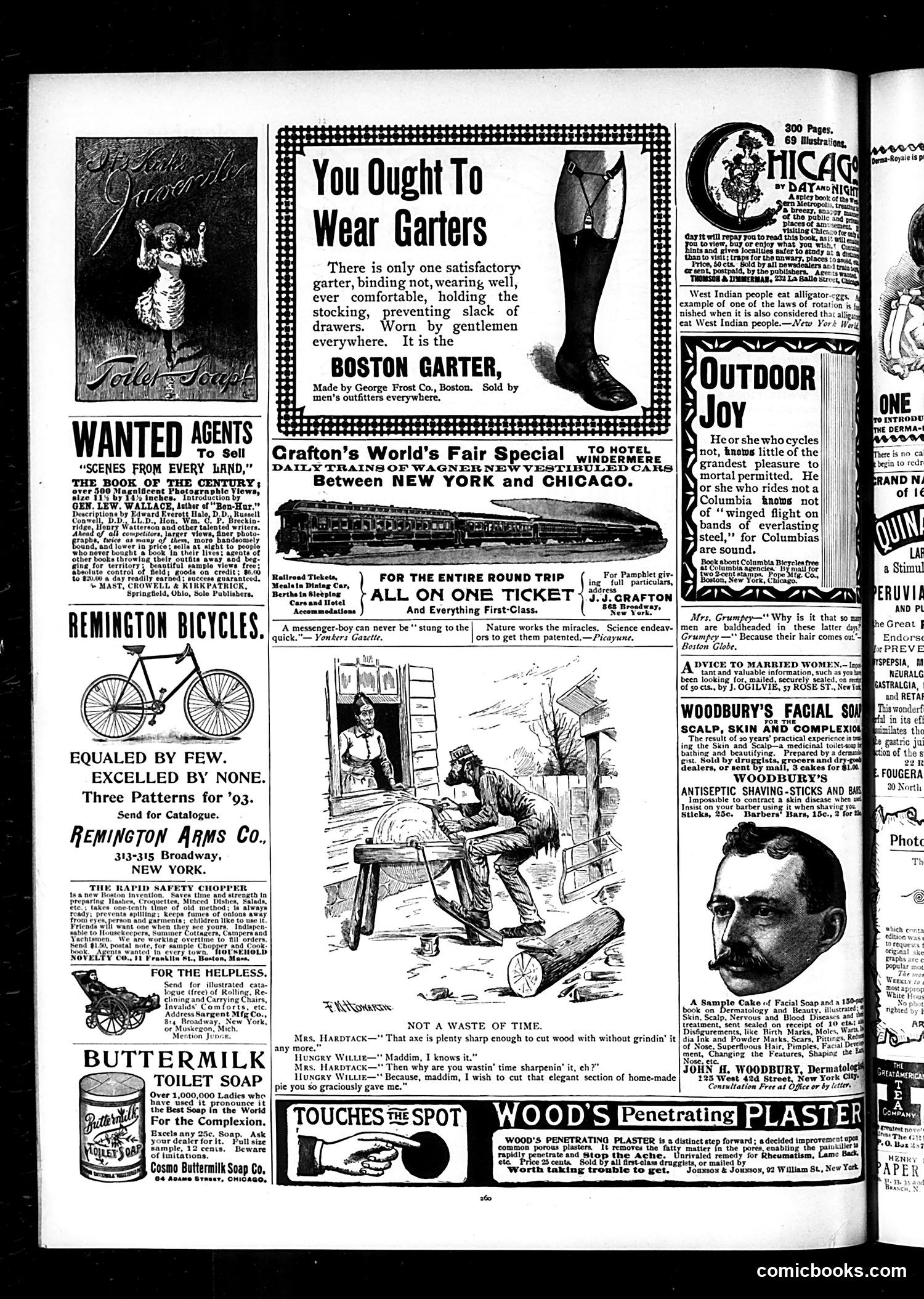
This page is **primarily advertising** from what appears to be the 1890s (note references to "Three Patterns for '93"). While it contains one small satirical cartoon labeled "NOT A WASTE OF TIME," the page is dominated by product advertisements. ## The Main Cartoon The cartoon depicts a domestic scene where a man (Hungry White) is sharpening an axe while a woman (Mrs. Hardtack) questions why he's sharpening it further. His reply—that he wants to cut pie more elegantly—is the joke: he's found a humorous pretext for avoiding work, framing unnecessary effort as enhancing a trivial task. ## Advertising Context The page advertises bicycles, garters, soap, train tickets, and medical products typical of the 1890s consumer market. Most notably, "Outdoor Joy" promotes bicycles as providing "winged flight," while Woodbury's products promise to cure various skin conditions and facial blemishes—reflecting period anxieties about appearance and bodily imperfection.
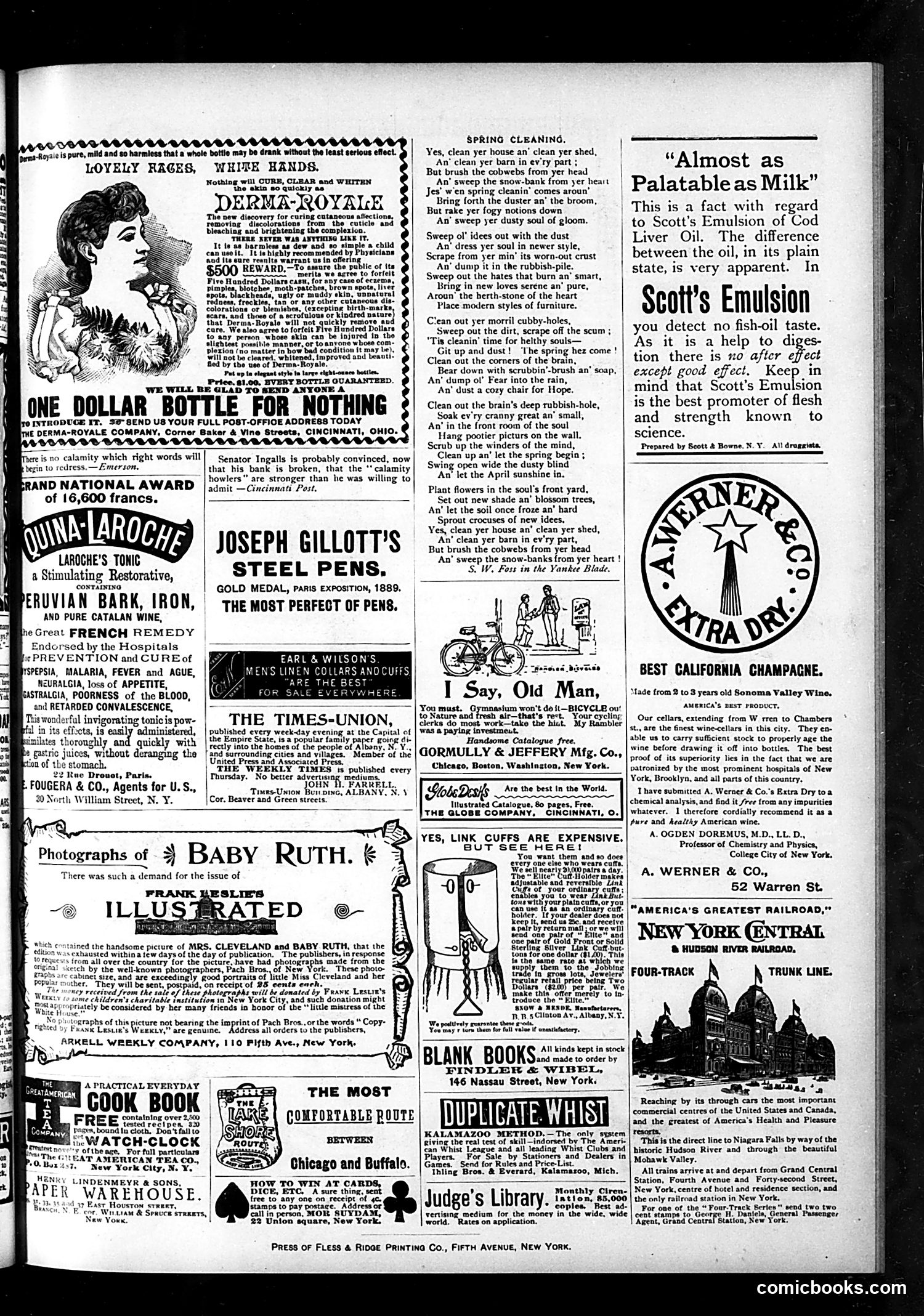
This page is primarily **advertisements and commercial content** rather than political satire. The dominant imagery consists of product ads for patent medicines and consumer goods typical of the late 19th century. The notable text element is a poem titled "Spring Cleaning" that uses domestic spring-cleaning as a metaphor for moral and intellectual renewal—urging readers to "brush the cobwebs from yer head," "rake yer fogy notions down," and "sweep yer dusty soul of gloom." This reflects popular Victorian self-improvement rhetoric. The only political reference appears in a brief mention of **Senator Ingalls**, noting he's "probably convinced" that "calamity howlers are stronger than he was willing to admit" after his bank broke—referencing a specific financial event, though details aren't provided on this page. The bulk of the page advertises dubious remedies (Derma-Royale skin cream, Laroche's Tonic) and conventional products (steel pens, collars), reflecting the era's unregulated patent medicine industry.
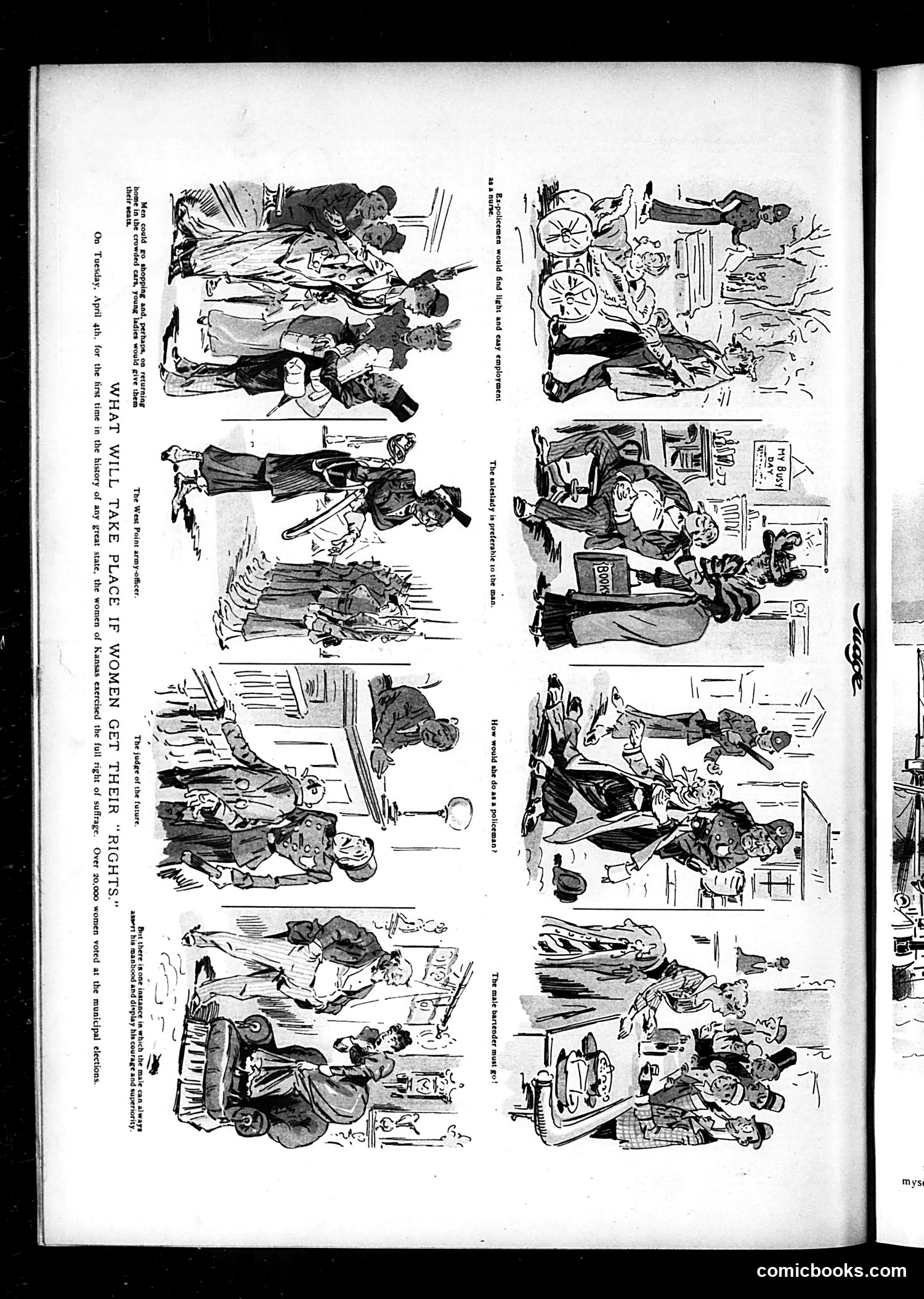
This satirical comic from *Judge* magazine mocks women's suffrage through exaggerated, dystopian scenarios. The central premise—referencing Kansas women's 1912 municipal voting—presents absurd consequences of female enfranchisement. The cartoons depict role reversals: women becoming aggressive voters/politicians while men assume domestic duties (shopping, childcare). The satire suggests that granting women voting rights would fundamentally disorder society—that women would neglect traditional feminine roles and men would be emasculated. The title's sarcastic quotation marks around "rights" signals the cartoonist's skepticism about suffrage itself. This represents common anti-suffrage propaganda of the era: the false claim that voting would make women unfeminine, destroy families, and create social chaos. The humor relies on contemporary gender anxiety about women's expanding public roles and political power.