
A complete issue · 16 pages · 1893
Judge — February 4, 1893
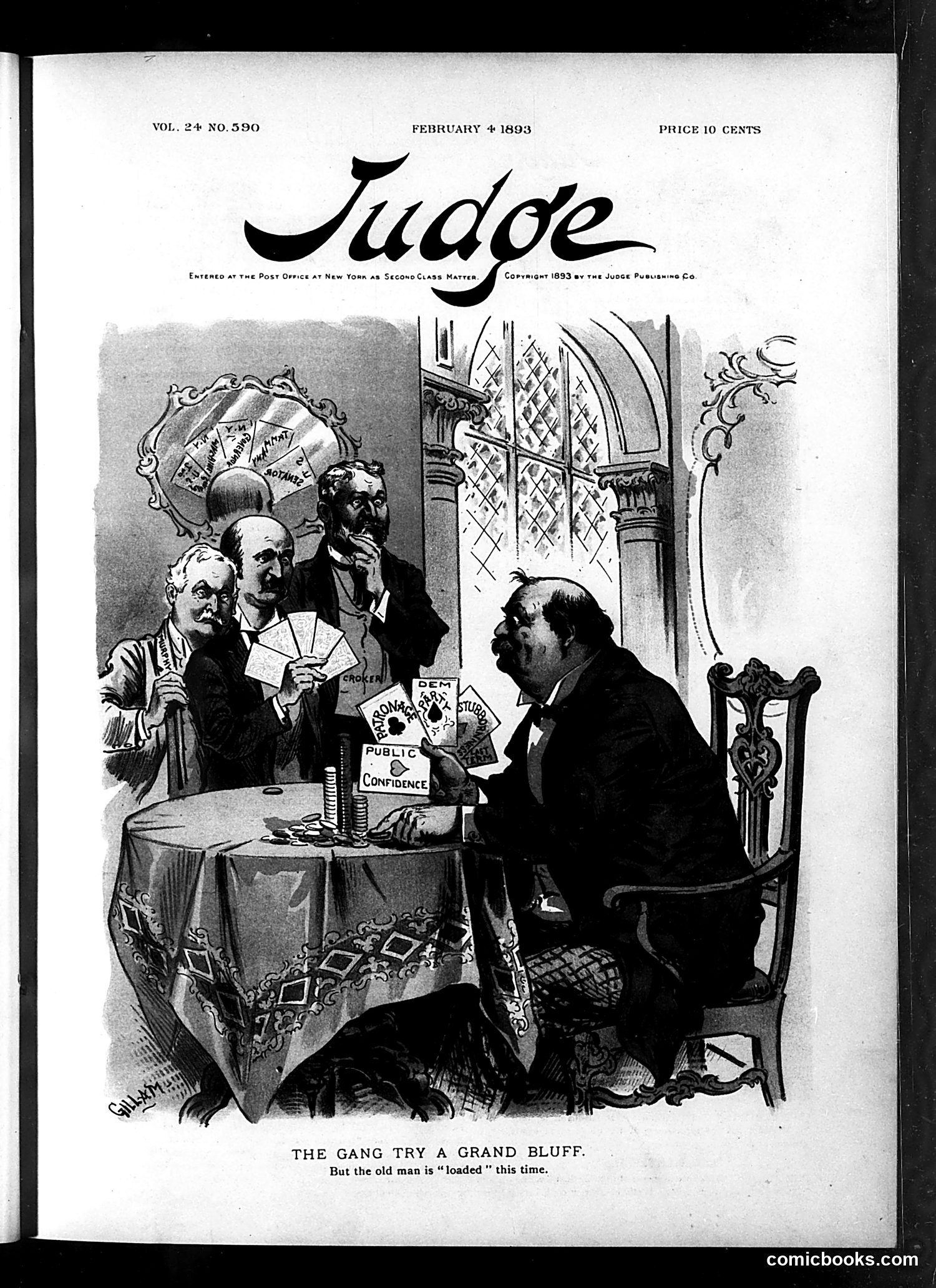
This cartoon from Judge (February 1893) depicts what appears to be a confidence game or card trick. Three men stand behind a table displaying various fan-shaped cards labeled with words like "BROKEN," "STOCK," and "PUBLIC CONFIDENCE." A fourth man sits opposite them, seemingly suspicious. The caption—"But the old man is 'loaded' this time"—suggests the seated figure has anticipated their scheme. This likely satirizes financial manipulation or political deception common during the 1890s panic period, where groups attempted to manipulate public sentiment or market confidence through false claims. The "gang" appears to represent speculators or politicians attempting fraud, while the seated man represents someone (possibly the public or government) who has caught on to their tricks.
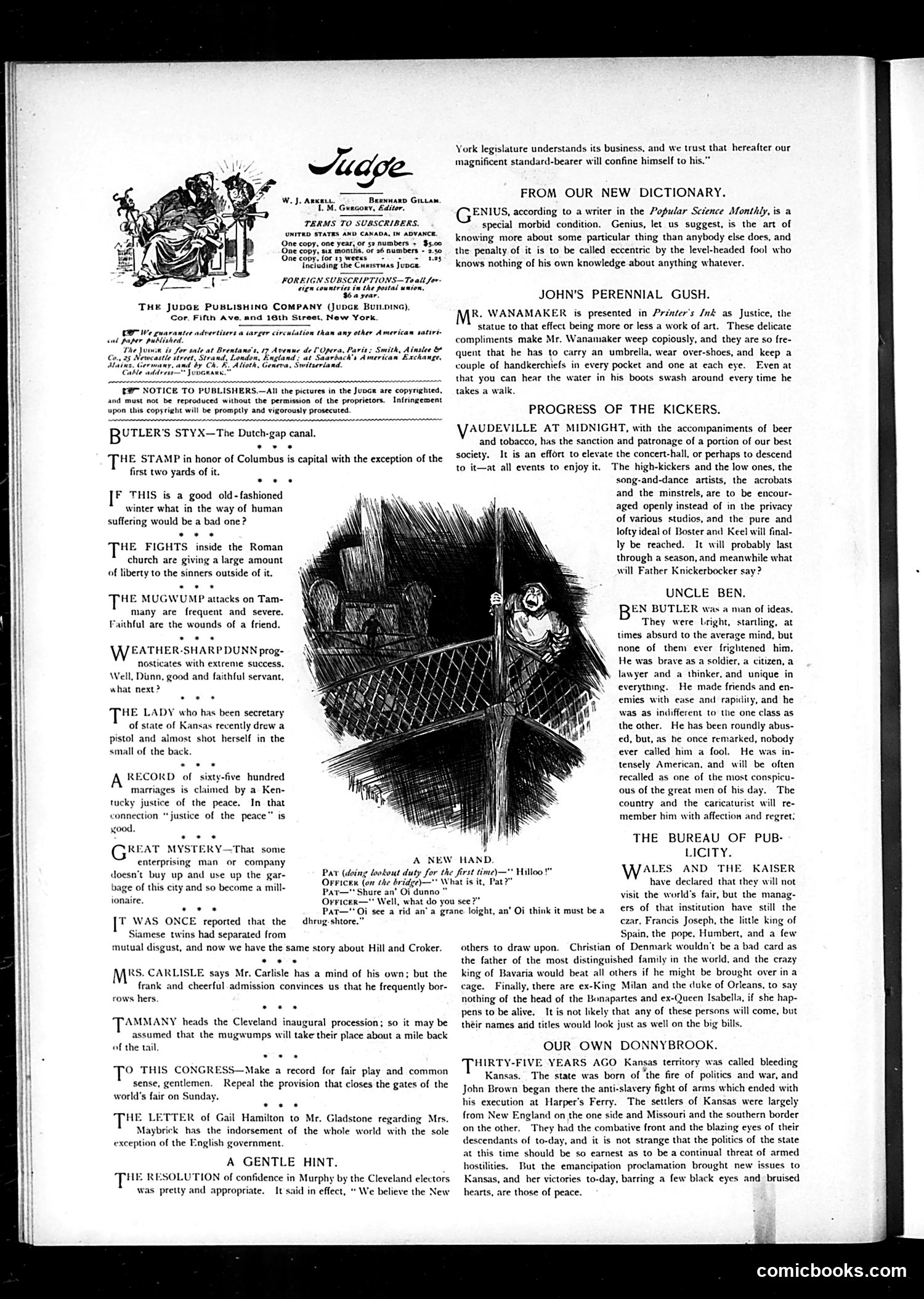
The page contains satirical commentary rather than a single cartoon. The main illustration titled "A NEW HAND" depicts a figure at a ship's wheel in stormy conditions, likely representing political leadership navigating turbulent times. The text sections mock various public figures and situations: - "JOHN'S PERENNIAL GUSH" ridicules someone named Wanamaker - "UNCLE BEN" discusses Butler as a man of contradictions—brave as soldier, lawyer, thinker, but indifferent to suffering - Multiple brief satirical items target politicians and public figures The "WALES AND THE KAISER" section discusses European royalty's potential visit and political complications. "OUR OWN DONNYBROOK" references Kansas's violent political history (likely Bleeding Kansas era disputes). Without visible publication date, specific attribution remains unclear, though content suggests late 19th-century American politics.
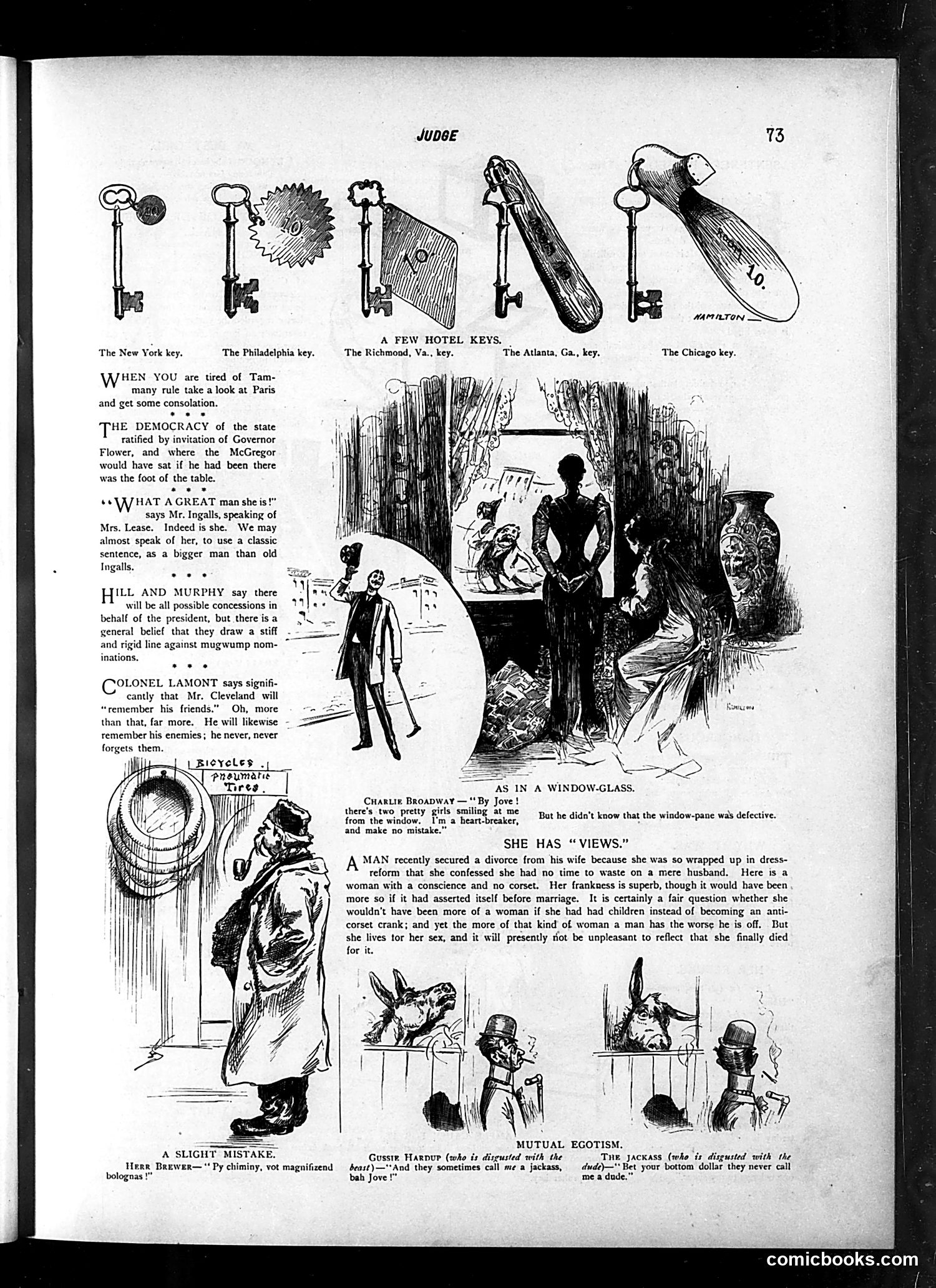
This page combines political commentary with humorous social satire. The top section displays various hotel keys from American cities (New York, Philadelphia, Richmond, Atlanta, Chicago), likely satirizing the prevalence of infidelity or illicit affairs among traveling politicians and businessmen. The text passages mock Democratic political figures—referencing Governor Flower and the McGregor case—and critique political corruption and patronage. References to "Hill and Murphy" suggest commentary on political machines and their resistance to reform. The lower cartoons ridicule social pretensions: "A Slight Mistake" mocks snobbish affectation; "Mutual Egotism" satirizes vanity among the wealthy or fashionable classes. The "Window-Glass" segment appears to joke about marital infidelity and deception. Overall, the page blends political and social satire typical of Gilded Age humor publications targeting corruption and class hypocrisy.
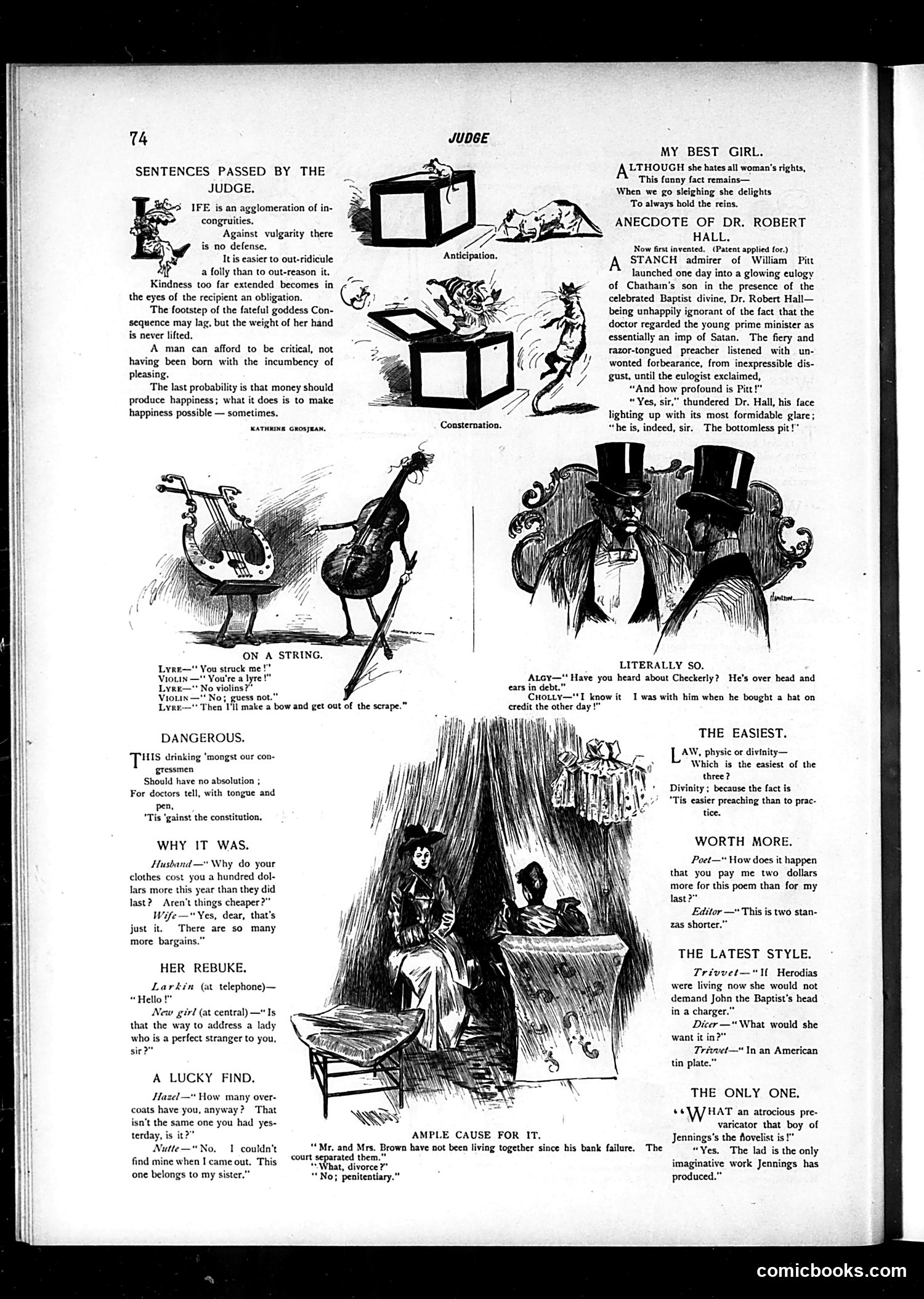
This page from *Judge* contains satirical humor typical of late 19th/early 20th-century American magazines. The content includes: **"Sentences Passed by the Judge"** — Philosophical one-liners mocking human nature and society, written by Katherine Grosjean. **Short comic dialogues** include: - "On a String" — A pun-based joke between musical instruments (lyre/liar, violin) - "Dangerous" — Satire about congressmen drinking, calling it unconstitutional - "Why It Was" — Marital humor about wives' spending on "bargains" - "Her Rebuke" — A telephone operator rebuking a man's informal greeting **Anecdotes and jokes** mock various targets: William Pitt (through Dr. Hall's wordplay on "bottomless pit"), debts, preaching versus practice, modern fashion ("tin plate" instead of chargers), and literary pretension. The page reflects *Judge's* mix of social commentary, domestic humor, and wordplay—entertainment for educated readers mocking vanity, dishonesty, and contemporary fashions without specific political targets visible here.
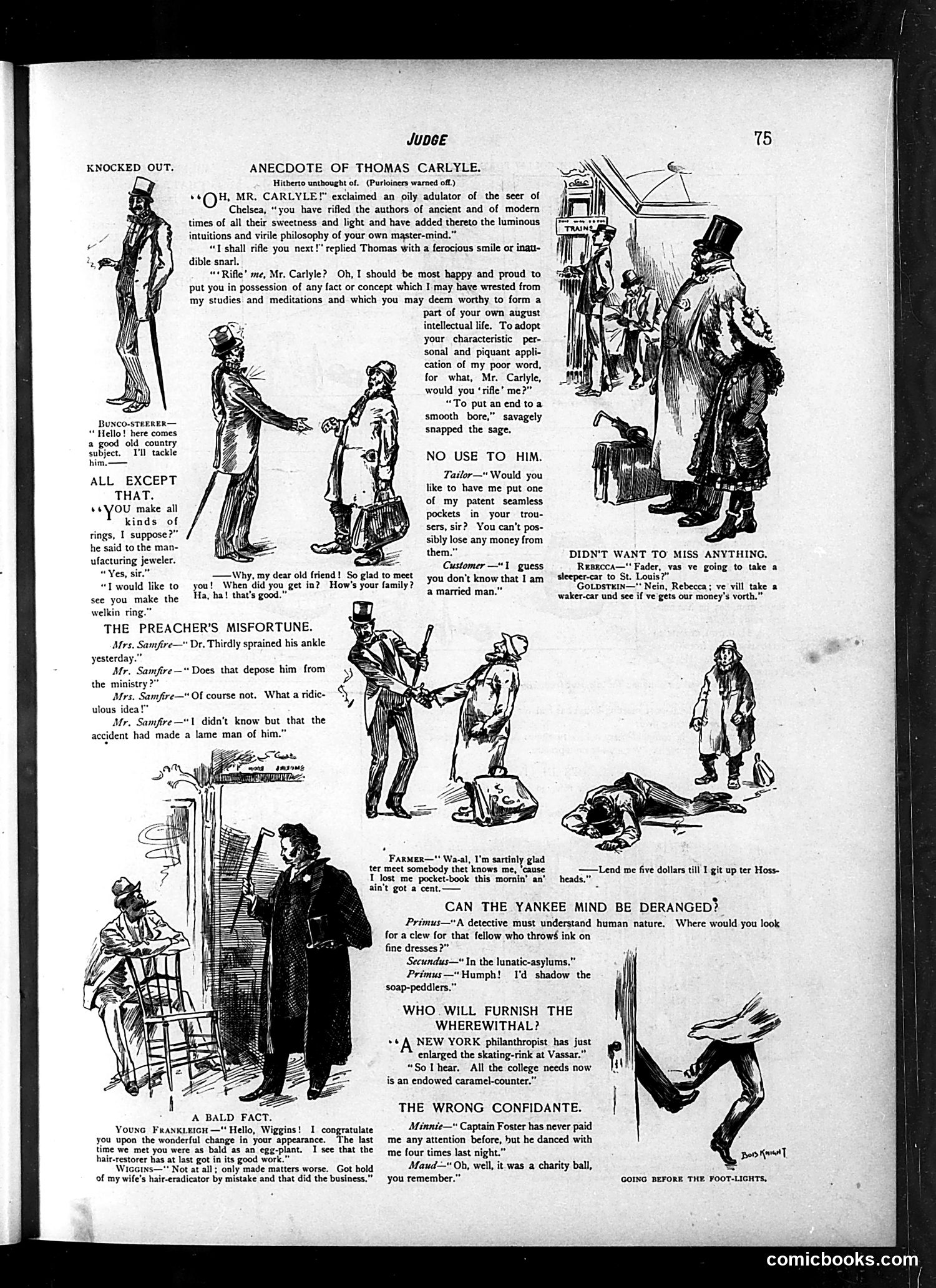
This page collects brief humorous anecdotes and jokes typical of late-19th-century American satire. The main pieces include: **"Anecdote of Thomas Carlyle"**: A jab at the famous Scottish philosopher-historian (1795-1881), portraying him as a gruff, irritable intellectual who rudely dismisses an obsequious admirer. **Recurring joke format**: Most items mock social types—overeager tailors, dense farmers, pretentious detectives, gossiping women. The humor relies on wordplay and character stereotypes (a rural farmer losing his wallet, a bald man confusing hair-restorer with hair-remover). **Social commentary**: Several jokes target wealth disparities ("endowed caramel-counter" at Vassar) and gender dynamics (women's gossip, infidelity). The "Yankee mind deranged" section suggests anxiety about urban crime and moral decline. **Visual style**: Pen-and-ink illustrations accompany each anecdote, enhancing the comedic timing through exaggerated facial expressions and body language. The page is primarily entertainment—lighthearted domestic and social humor rather than serious political satire.
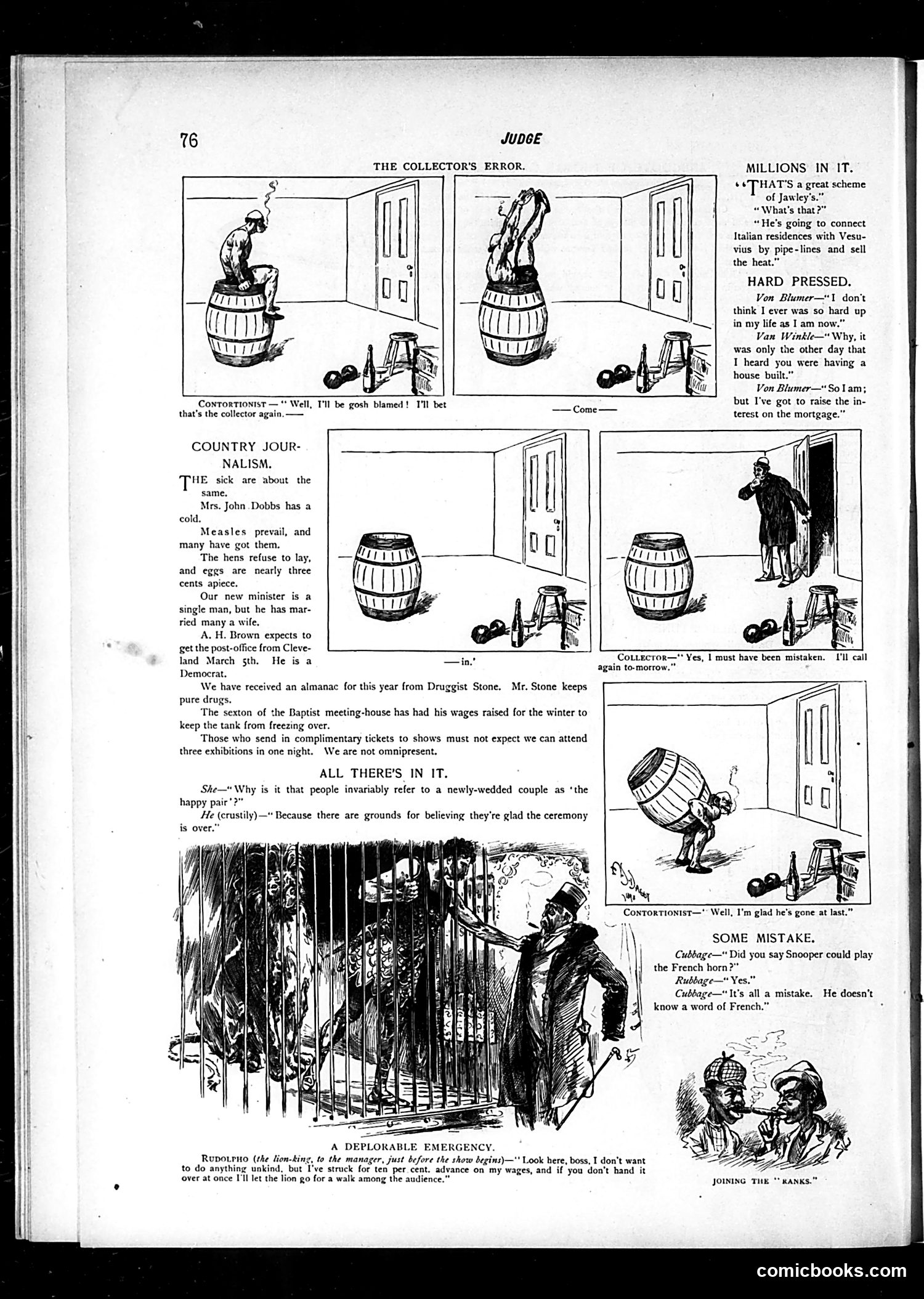
This page contains multiple short humor pieces typical of 1880s-90s American satirical journalism. **"The Collector's Error"** depicts a contortionist repeatedly stuffed in a barrel by a debt collector—visual comedy about financial hardship and evasion. **"Millions in It"** mocks a scheme to pipe volcanic heat from Italian volcanoes—absurdist satire on get-rich-quick entrepreneurship. **"Hard Pressed"** shows two wealthy men discussing financial strain despite outward signs of prosperity (building houses)—commentary on the precarious finances of the affluent. **"Country Journalism"** parodies small-town newspaper banality—trivial local news, malapropisms ("married many a wile"), and self-serving notices. **"All There's in It"** uses a marriage joke about the term "happy pair." **"Some Mistake"** plays on linguistic confusion (a French horn player who doesn't know French). **"A Deplorable Emergency"** shows a lion performer demanding wage increases or threatening audience safety—satire on labor disputes and performer power. The humor targets financial anxiety, rural simplicity, labor relations, and pretense.
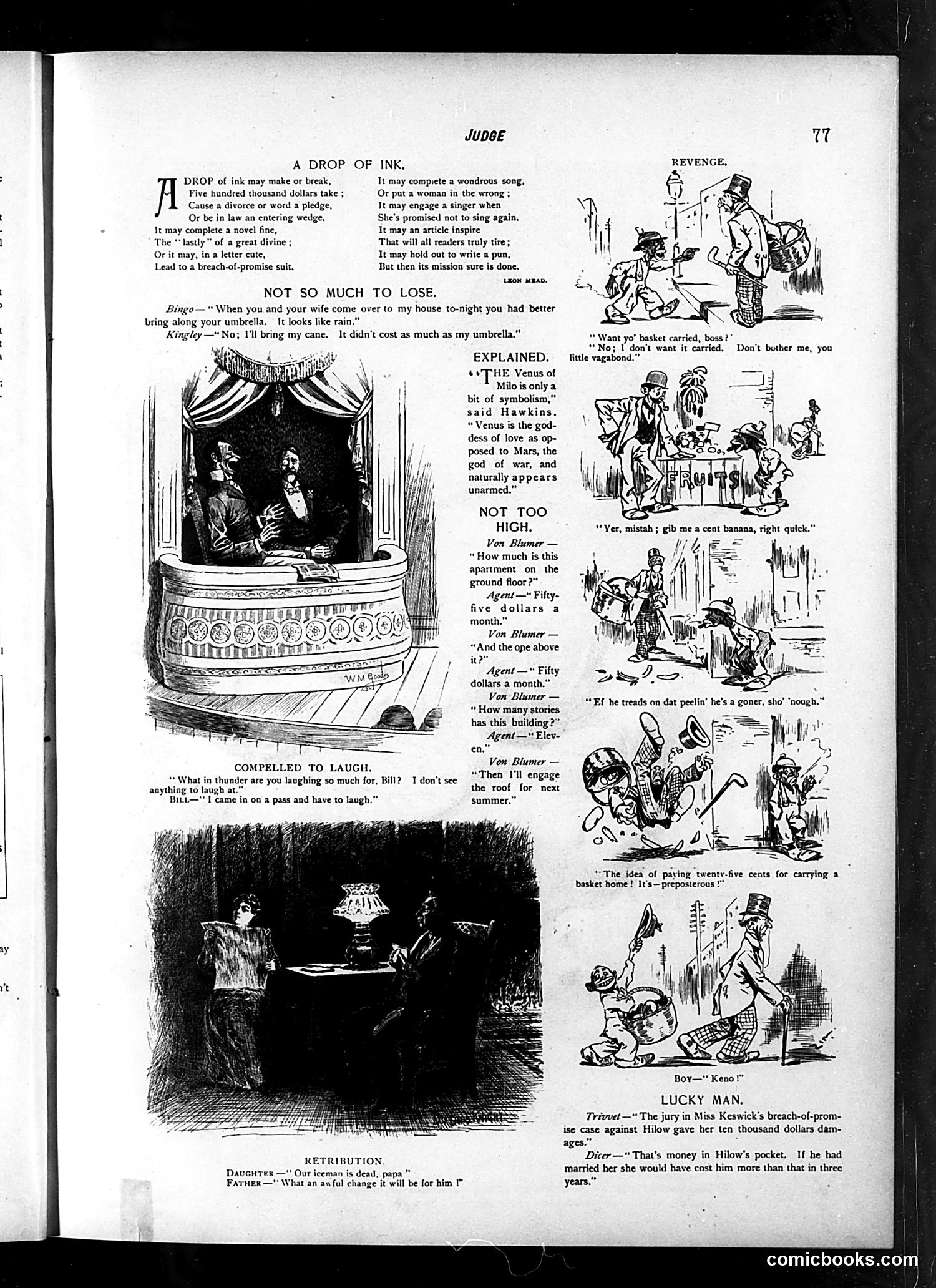
This page from Judge magazine contains multiple short satirical pieces typical of late-19th/early-20th-century American humor: **"A Drop of Ink"** is a poem about journalism's power—how words can make or break fortunes, end relationships, or inspire great works. **The cartoon sketches** depict working-class and racial stereotypes common to the era: a Black porter offering to carry a basket, and dialogue about cheap housing and urban life. These reflect period attitudes rather than progressive satire. **"Not So Much to Lose"** jokes about a man preferring to bring his cheaper cane rather than his expensive umbrella to a dinner party. **"Not Too High"** satirizes a haggling tenant negotiating apartment rent with an agent. **"Lucky Man"** concludes with dark humor: a man dodges marriage expenses by paying court damages instead—the implication being marriage costs more than a legal settlement. The overall tone reflects genteel, middle-class satire focused on domestic life, class pretension, and legal/financial mishaps rather than political commentary.
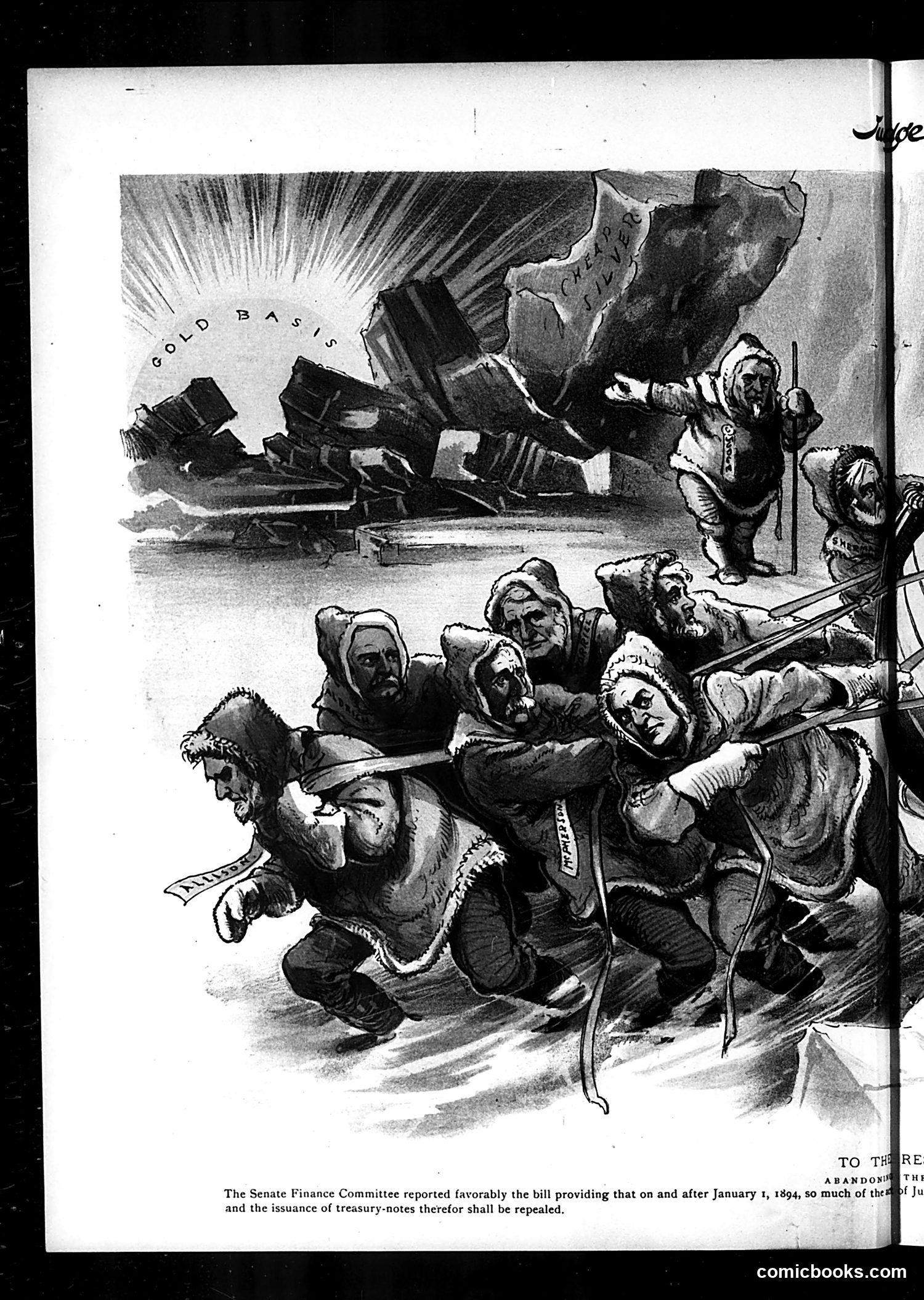
This Judge magazine cartoon satirizes the 1894 Senate Finance Committee's favorable report on repealing treasury-note issuance. The illustration depicts caricatured figures (appearing to represent politicians or financial interests) in chaotic retreat or panic, with "GOLD BASIS" radiating light in the background—suggesting the return to gold standard currency. The figures' exaggerated, distressed poses suggest the cartoon mocks those opposing the repeal as panicked or desperate. The text references a specific January 1, 1894 policy change regarding treasury-notes. This relates to late-19th-century American monetary debates between gold standard advocates and those supporting broader currency circulation. The satire likely ridicules either those resisting monetary reform or the financial chaos surrounding currency policy during this economically turbulent period.
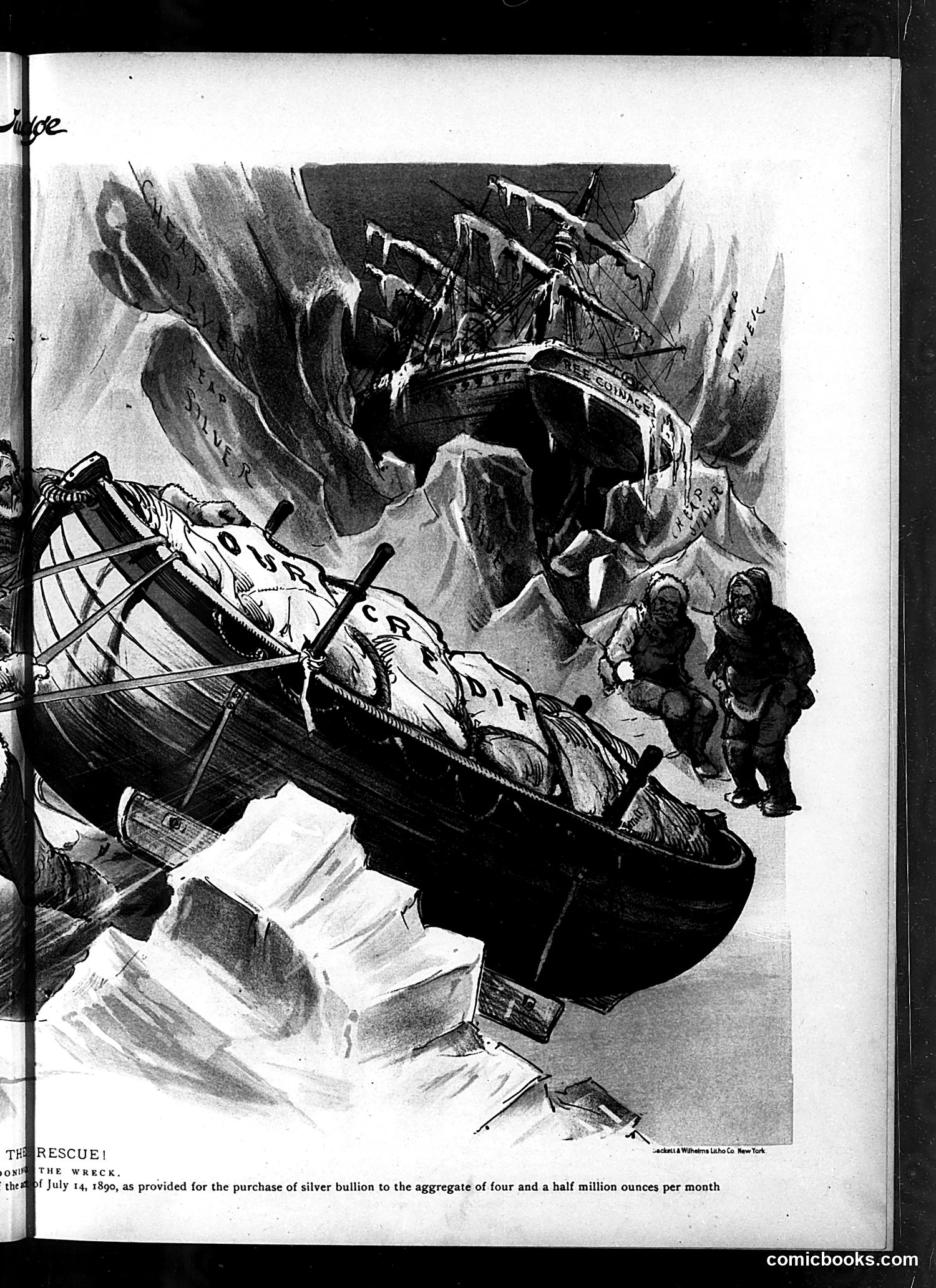
This illustration depicts "The Rescue" of a wrecked ship, serving as political allegory. The damaged vessel appears to represent the American economy or government, while the figures being rescued likely symbolize citizens or economic interests. The reference to "July 14, 1890" and "silver bullion to the aggregate of four and a half million ounces per month" suggests this satirizes the Sherman Silver Purchase Act (passed July 14, 1890), which mandated federal silver purchases. The cartoon likely critiques whether this legislation would effectively "rescue" the economy or worsen the crisis. The dramatic imagery—treacherous waters, precarious rescue—suggests skepticism about the policy's efficacy. Judge magazine frequently mocked government economic interventions, so this likely presents the silver purchase mandate as an inadequate or risky solution to contemporary financial troubles.
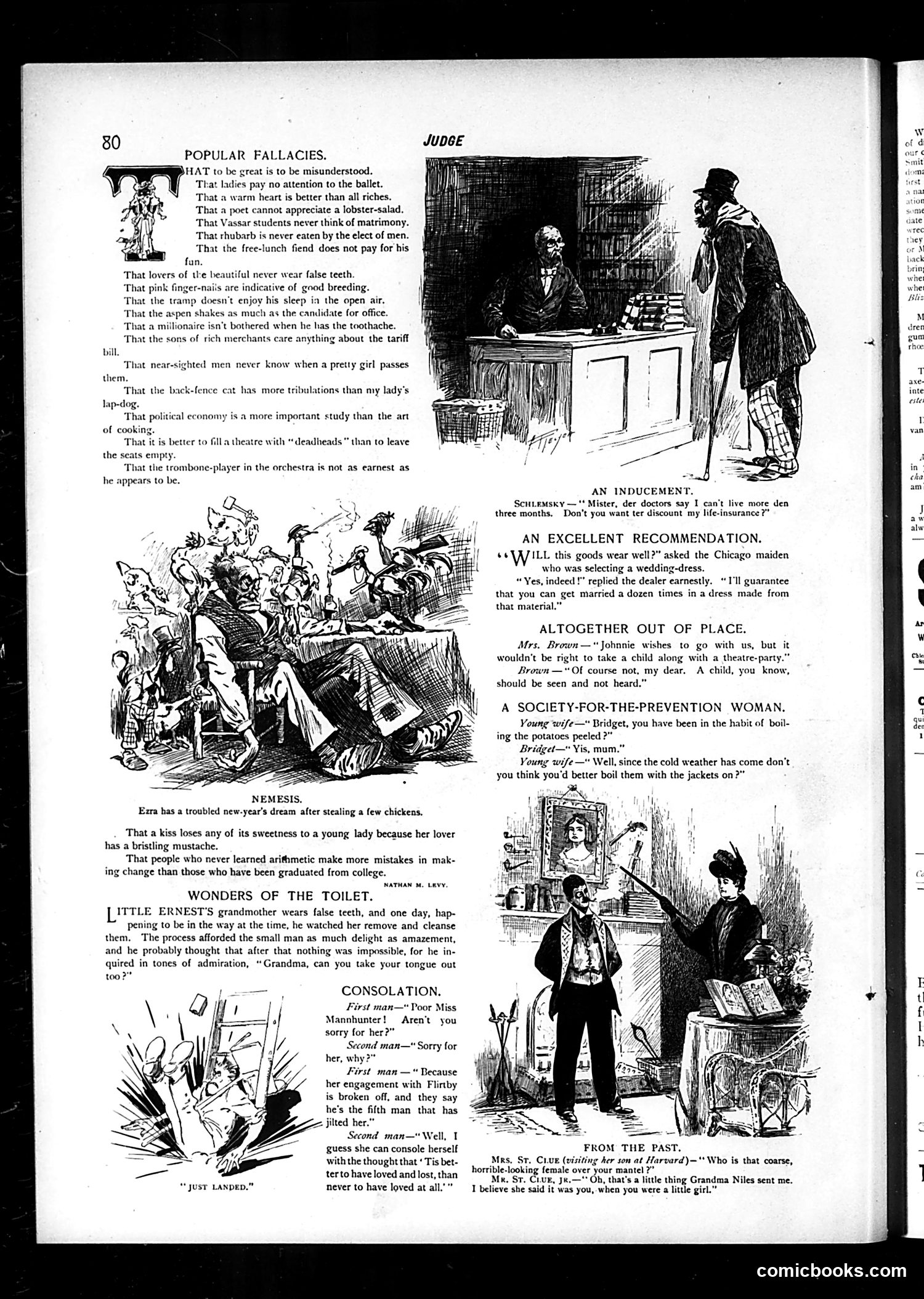
This page from Judge magazine presents satirical short humor pieces mocking common misconceptions and social pretensions of the era. The "Popular Fallacies" section lists ironic observations—like claiming politicians don't shake as much as aspens, or that rich merchants' sons care about tariffs—inverting expected behavior to comic effect. The accompanying vignettes mock specific social situations: a desperate man trying to sell life insurance, a merchant guaranteeing a wedding dress will enable multiple marriages, and concerns about propriety (children shouldn't attend theaters). A recurring target is servant management—a wife instructing her maid "Bridget" on potato preparation, reflecting period class anxieties. The "Wonders of the Toilet" anecdote portrays a child's innocent shock at removable teeth, while the closing exchanges mock relationship desperation and family embarrassment. Overall, the humor targets vanity, social climbing, servant-employer dynamics, and romantic misadventures—typical concerns of Judge's middle-to-upper-class readership.
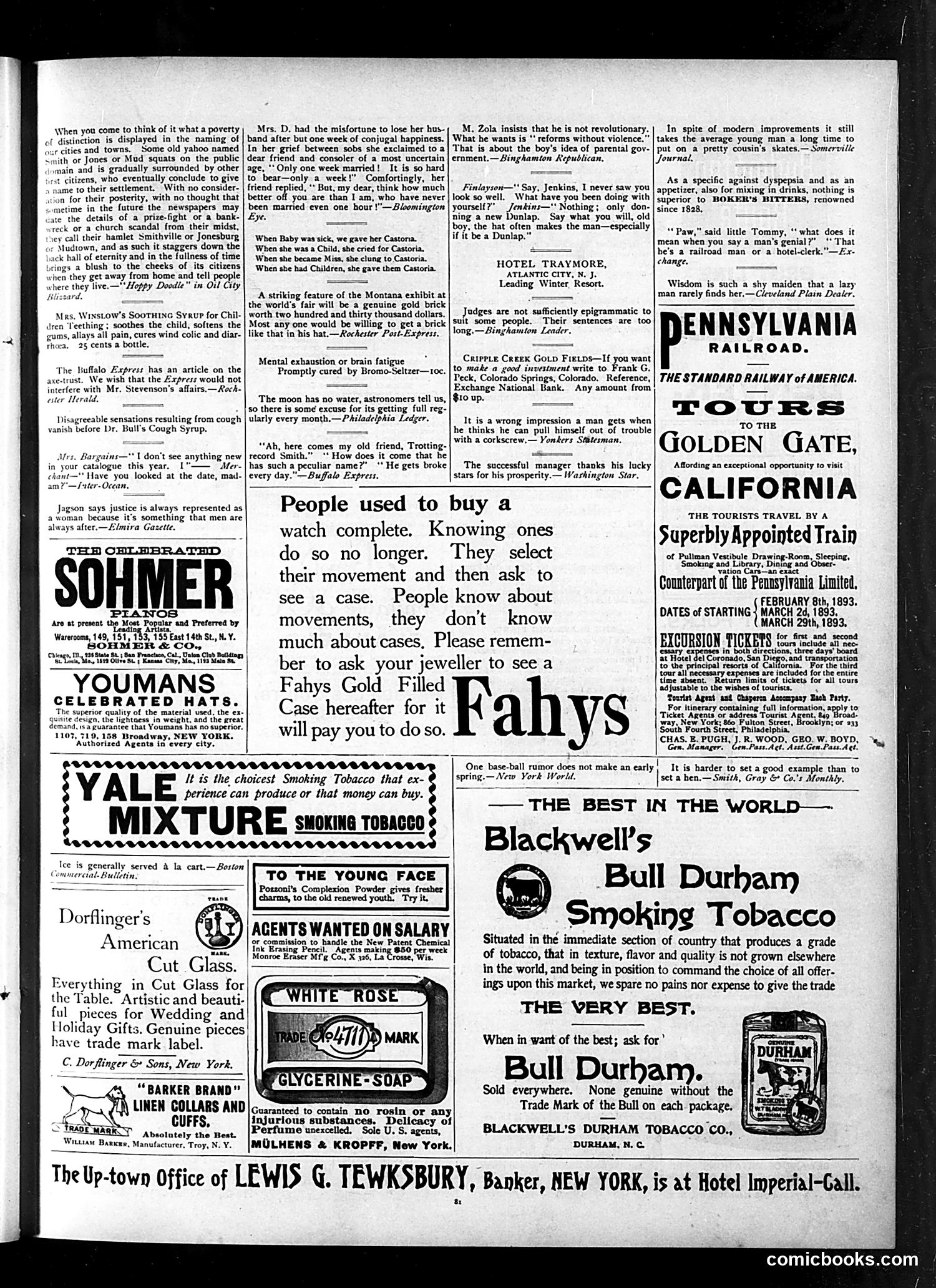
This page is primarily **advertising and humorous commentary** rather than a political cartoon. The content includes: **Humorous Observations:** The opening piece satirizes American town-naming practices—criticizing how settlements named after early settlers (Smith, Jones, Mud) lack distinction and cause embarrassment to residents who must state their origin elsewhere. **Other Jokes:** Various brief anecdotes mock contemporary life: a widow consoling herself after losing her husband after one week of marriage; a pun about a horse named "Trotting-record Smith" who breaks records daily; commentary on French author Zola's claim to want reform "without violence" (likened mockingly to parental discipline). **Advertisements:** The bulk of the page features ads for pianos (Sohmer), hats (Youmans), tobacco (Yale Mixture, Blackwell's Bull Durham), and other period products—with no apparent satirical intent. The tone is lighthearted, domestic humor rather than sharp political satire. No significant political figures or events are referenced.
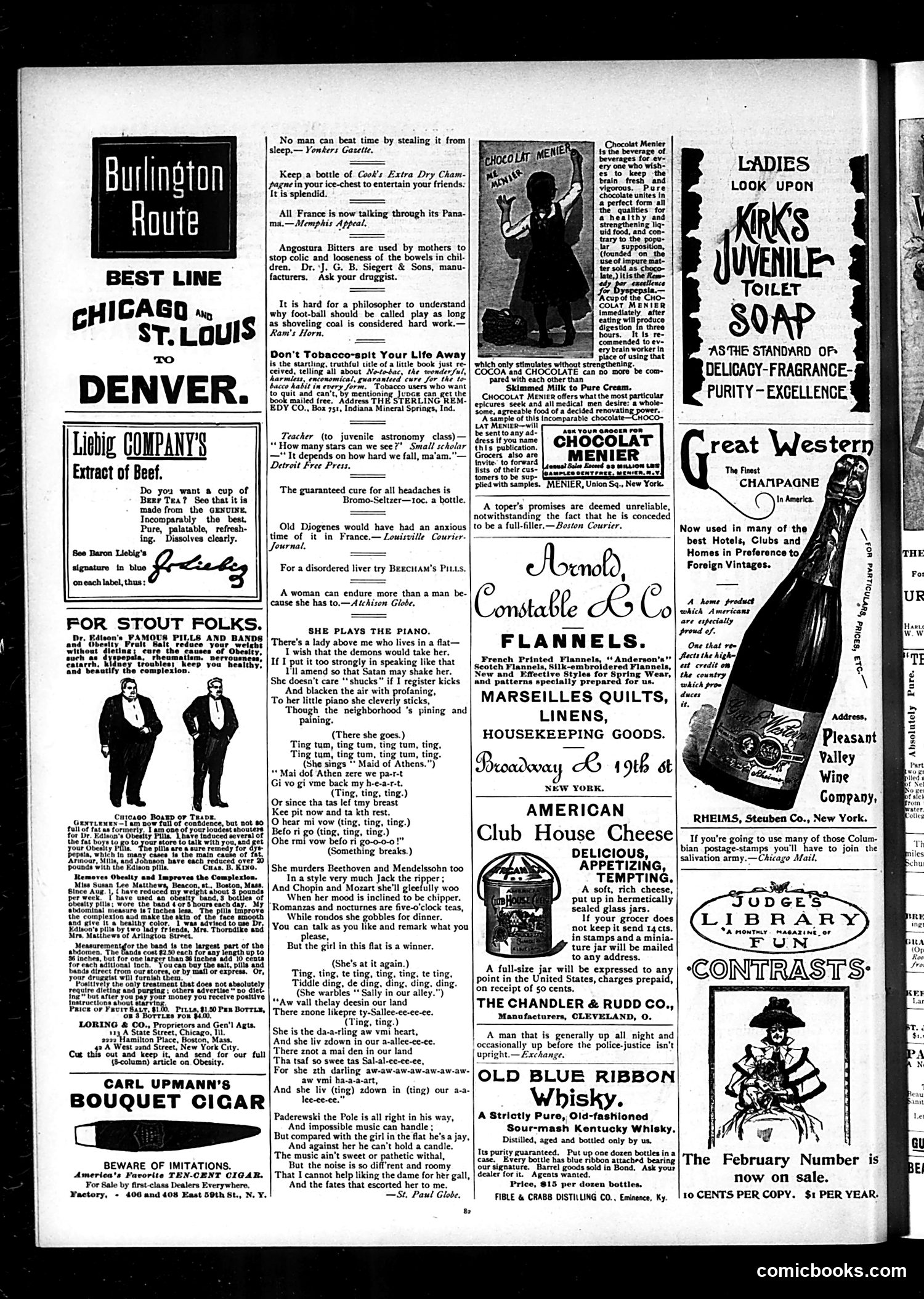
This page is primarily **advertising with miscellaneous comic quips**, not a cohesive political cartoon. The advertisements promote consumer goods typical of the era: beef extract, obesity pills, cigars, champagne, and liqueurs. The scattered text items are brief satirical observations on contemporary life—ranging from sleep-deprivation, to the Panama Canal (France's involvement), to tobacco addiction, to a woman's loud piano-playing. The "For Stout Folks" section advertises Dr. Edison's obesity pills, featuring testimonials claiming weight loss. The piano joke at bottom mocks a neighbor's musical nuisance. There is **no identifiable political satire or specific caricatured figures** on this page. It reflects Judge's typical format: commercial advertisements interspersed with one-liner social humor about everyday annoyances—piano noise, tobacco habits, philosophical contradictions—rather than political commentary. The page serves primarily as a revenue vehicle through advertising.
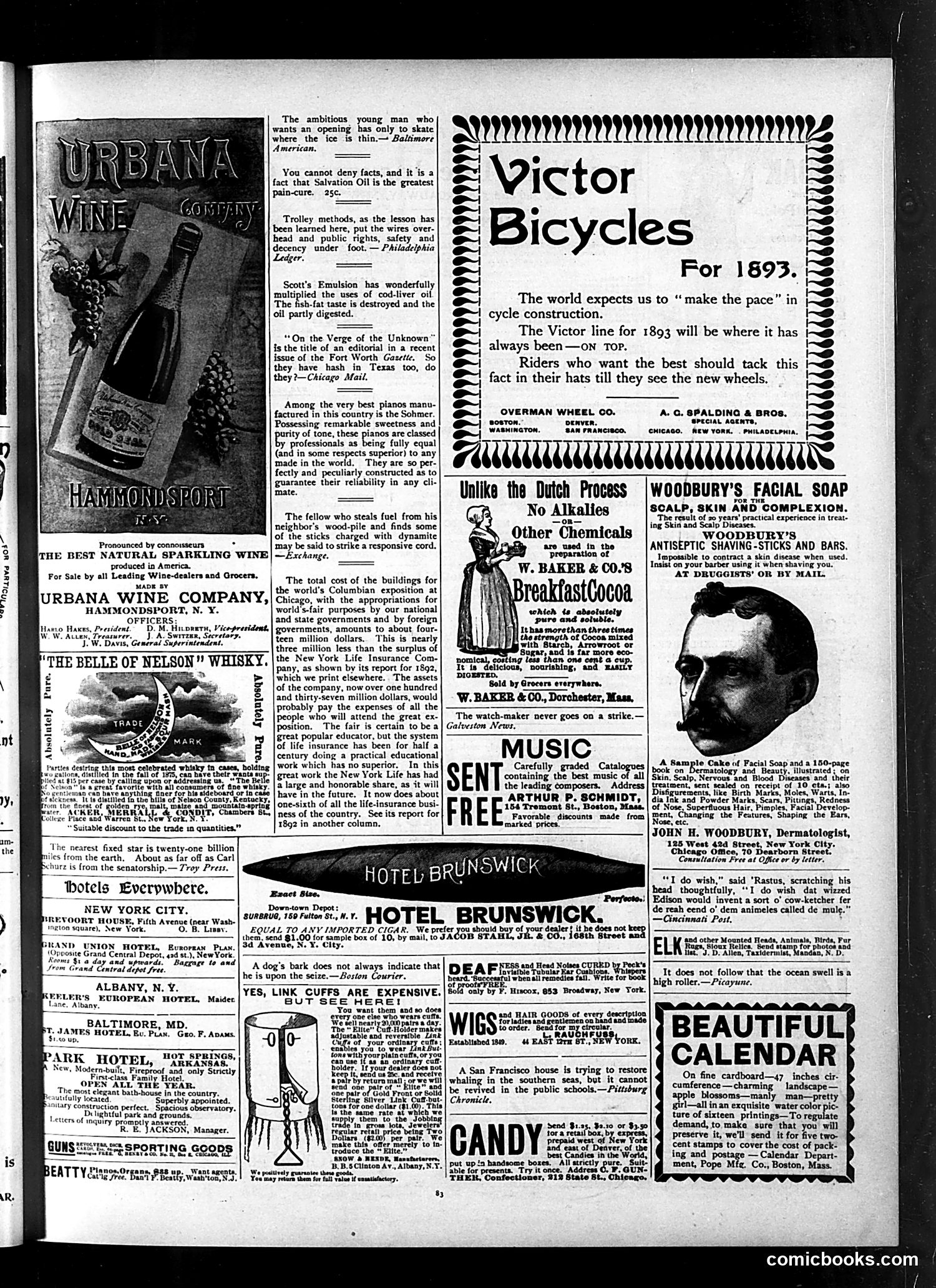
This page is primarily **advertising**, not political cartoons. It's from Judge magazine (likely 1892-1893 based on dates visible) and consists almost entirely of commercial advertisements interspersed with short quoted jokes and witticisms clipped from various newspapers. The brief text snippets are typical Judge filler content—short, punchy observations on contemporary life: jokes about ambitious young men, trolley systems, piano quality, and life insurance. These aren't elaborate satires but rather pithy one-liners mocking everyday subjects. Notable ads include Victor Bicycles (promoting their 1893 line), Urbana Wine, whiskey, breakfast cocoa, and various hotels. The only visual element approaching cartooning appears to be small illustrations accompanying some product advertisements—standard commercial imagery rather than political satire. This is essentially a magazine page showing how Judge filled space between major articles with both advertisements and brief humorous observations.
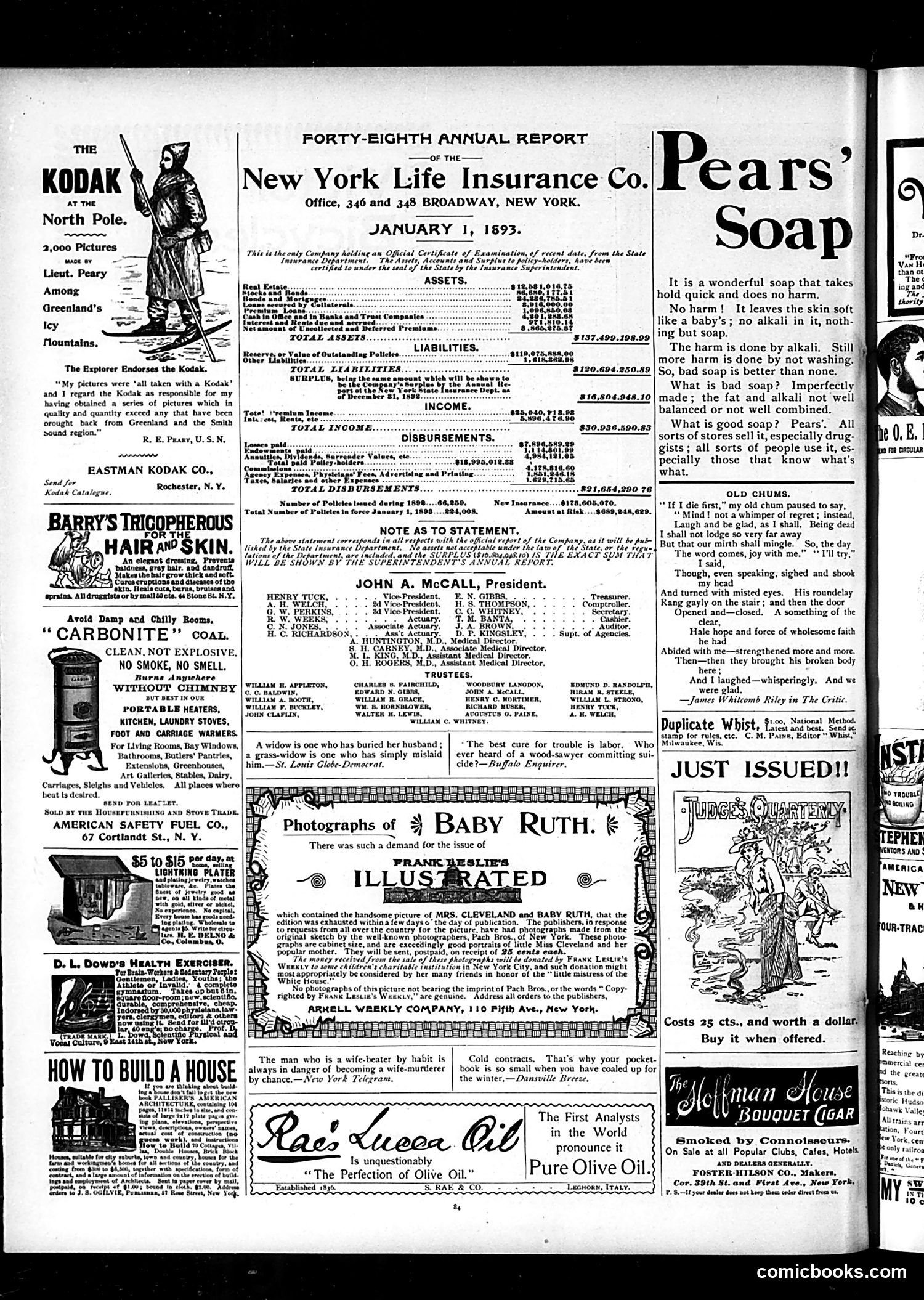
This page is dominated by advertisements and a formal insurance company report rather than political cartoons or satire. The New York Life Insurance Company's 48th annual report (January 1, 1893) occupies the center, listing assets, liabilities, and financial details. The scattered ads—Kodak cameras, heating stoves, soap, hair treatments—represent typical magazine advertising of the era. The only humor appears to be brief, mild jokes: one distinguishes a "widow" from a "grass-widow" (a woman separated from her husband), and another jokes that trouble-afflicted people should try labor. There's a reference to photographs of "Mrs. Cleveland and Baby Ruth" (President Cleveland's family), being sold to fund charitable purposes—likely referring to the popular First Lady. This page contains no significant political satire or social commentary visible in the image.
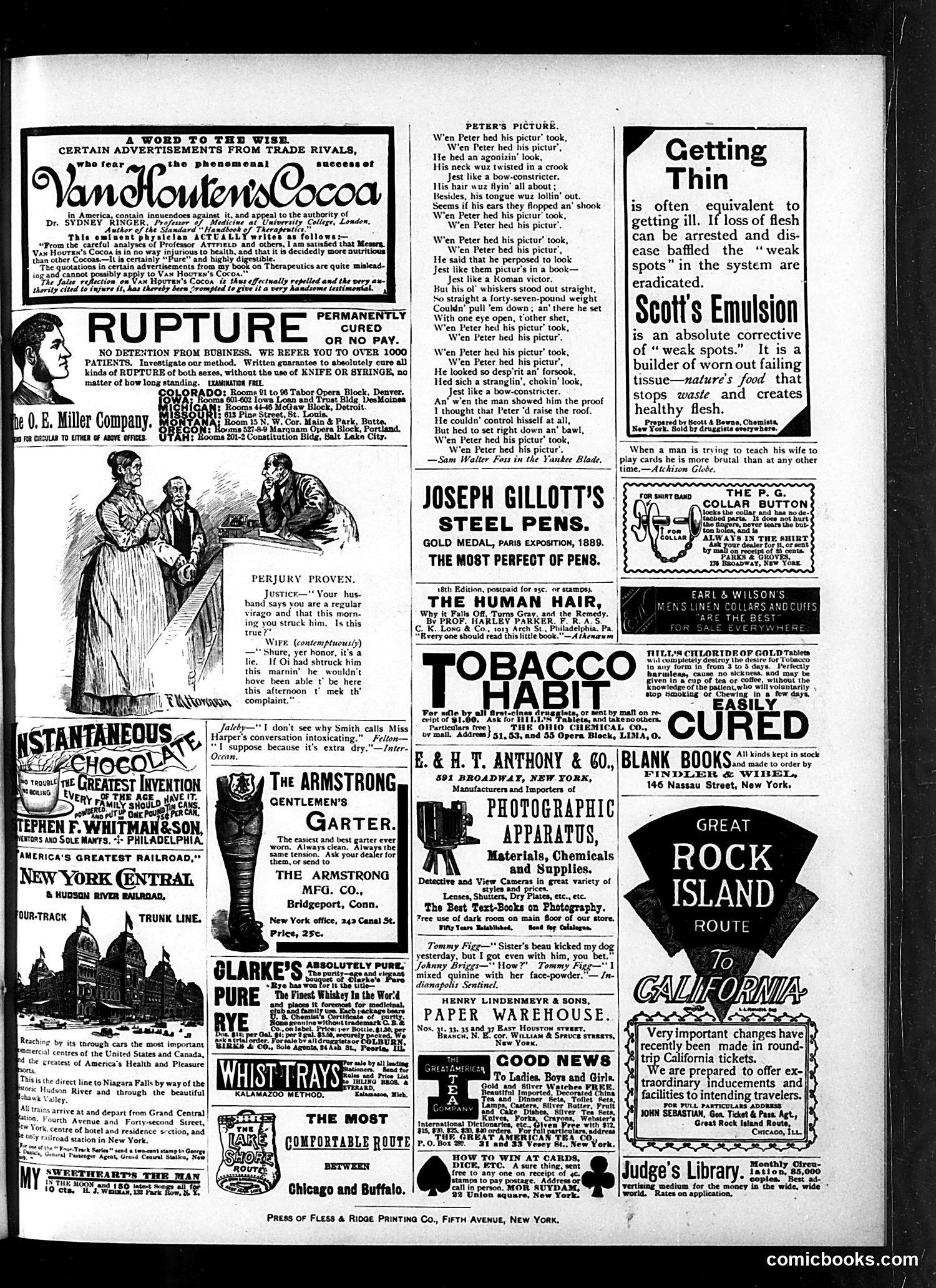
This page is primarily advertising with one featured poem. **"Peter's Picture"** (by Sam Walter Foss) is a humorous verse about a man named Peter who grimaces horribly during a photograph session—his neck twists, tongue lolls out, ears flop, whiskers stand straight up, and he looks like he's choking. The joke is that Peter cannot control his facial expressions while sitting for the camera, producing an absurd and unflattering portrait. The poem satirizes the then-common difficulty of early photography: long exposure times required subjects to sit perfectly still, and many people found it nearly impossible to maintain a natural expression, resulting in grotesque photographs. This was a relatable complaint of the era—getting one's picture taken was an ordeal. The surrounding advertisements (for cocoa, rupture cures, pens, hair treatments) are unrelated to the poem's content and represent typical Judge magazine filler.
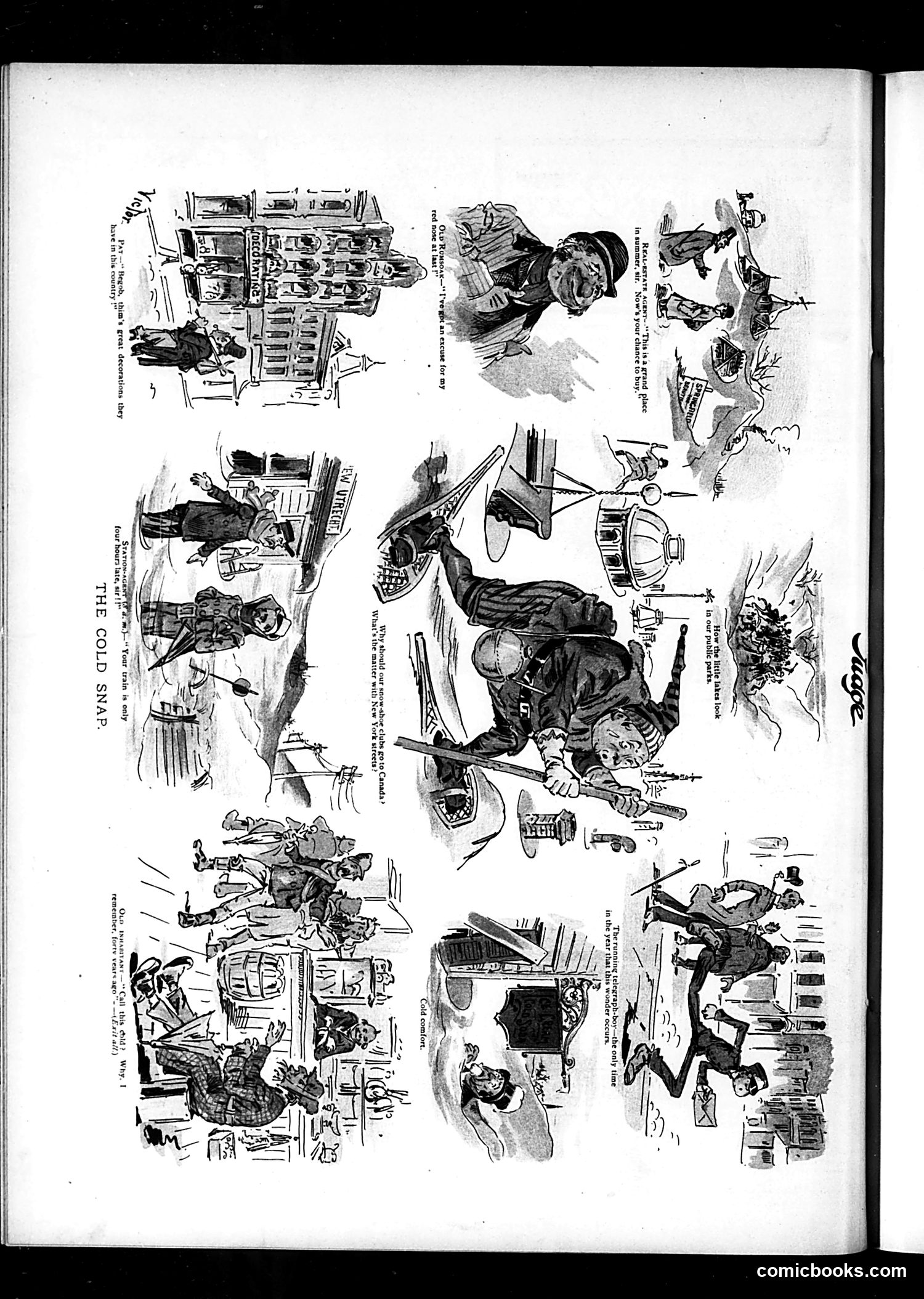
This page contains multiple cartoons satirizing **winter street conditions in New York City**. The central joke questions why snowshoe clubs need to travel to Canada when New York streets provide equally challenging terrain. The cartoons depict New York streets as treacherously icy and snow-covered, with figures struggling, slipping, and falling. One caption includes an Irish character's comment about "decorations," sarcastically referring to the accumulated snow and ice as if they were intentional civic improvements. The satire targets **municipal neglect of street maintenance** during winter—a chronic complaint about New York City governance. Rather than depicting winter sports as requiring distant travel, the cartoonist argues that simply navigating everyday city streets offers sufficient adventure and danger, mocking the city's failure to clear and maintain safe passages.