
Judge, 1893-02-04 · page 10 of 16
Judge — February 4, 1893 — page 10: what you’re looking at
What you’re looking at
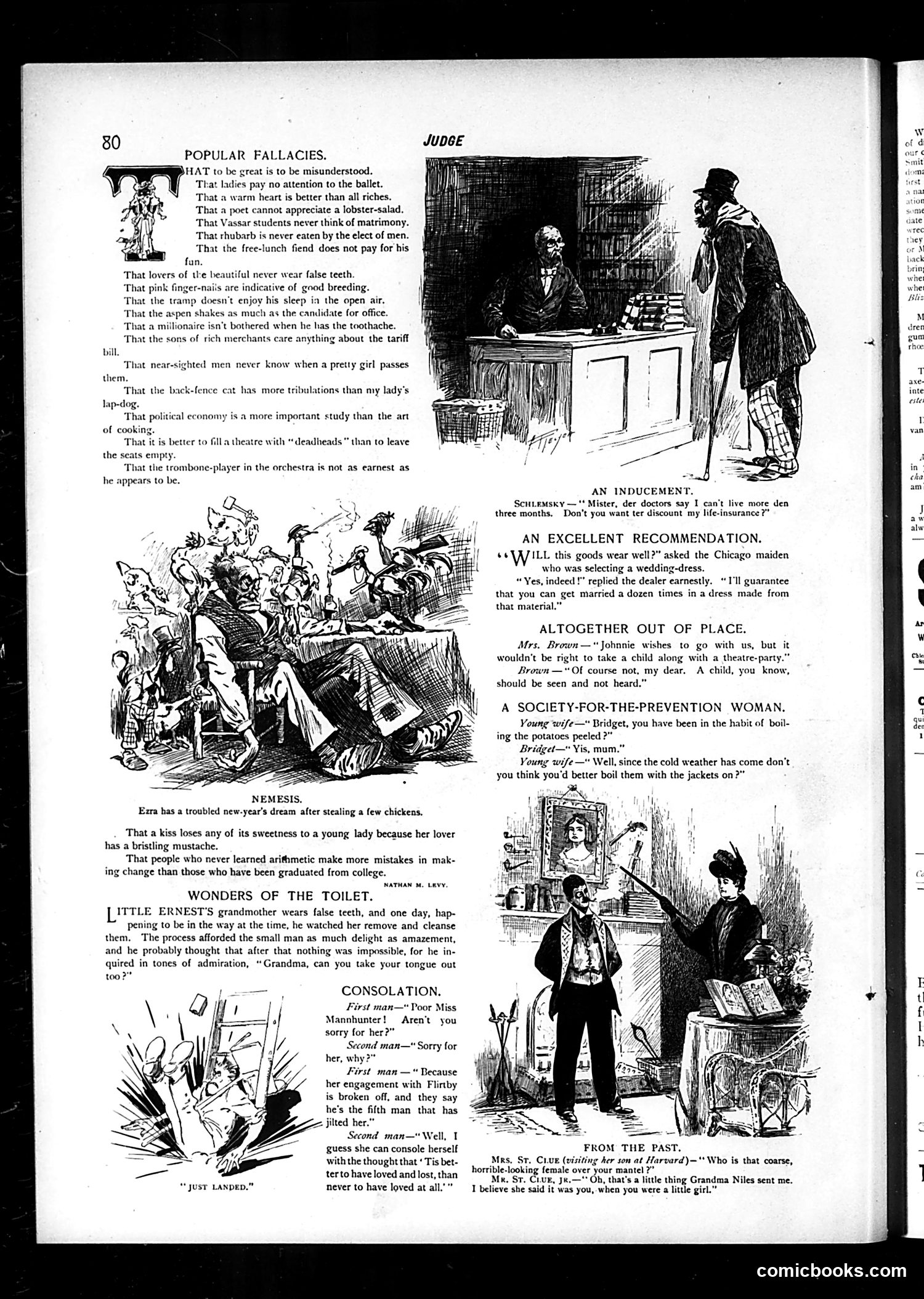
This page from Judge magazine presents satirical short humor pieces mocking common misconceptions and social pretensions of the era. The "Popular Fallacies" section lists ironic observations—like claiming politicians don't shake as much as aspens, or that rich merchants' sons care about tariffs—inverting expected behavior to comic effect. The accompanying vignettes mock specific social situations: a desperate man trying to sell life insurance, a merchant guaranteeing a wedding dress will enable multiple marriages, and concerns about propriety (children shouldn't attend theaters). A recurring target is servant management—a wife instructing her maid "Bridget" on potato preparation, reflecting period class anxieties. The "Wonders of the Toilet" anecdote portrays a child's innocent shock at removable teeth, while the closing exchanges mock relationship desperation and family embarrassment. Overall, the humor targets vanity, social climbing, servant-employer dynamics, and romantic misadventures—typical concerns of Judge's middle-to-upper-class readership.
📄 Transcribed text from this page (OCR, searchable)
Machine-transcribed from the original scan — historical spelling and the odd misread are preserved.
POPULAR FALLACIES. HAT to be great is to be misunderstood. That ladies pay no attention to the ballet. That a warm heart is better than all riches. That a poet cannot appreciate a lobster-salad. ‘That Vassar students never think of matrimony. ‘That rhubarb is never eaten by the elect of men. That the free-lunch fiend does not pay for his fun. That lovers of the beautiful never wear false teeth. That pink finger-naiis are indicative of good breeding. ‘That the tramp doesn’t enjoy his sleep in the open air. ‘That the aspen shakes as much as the candidate for office. That a millionaire isn’t bothered when he has the toothache. That the sons of rich merchants care anything about the tariff bill. ‘That nearsighted men never know when a pretty girl passes them. That the back-fence cat has more tribulations than my lady's lap-dog. That political economy is a more important study than the art of cooking That it is better to filla theatre with “deadheads " than to leave the seats empty. That the trombone-player in the orchestra is not as earnest as he appears to be. AN INDUCEMENT. ScHLEMsKY —"' Mister, der doctors say I can't live more den three months, Don't you want ter discount my life-insurance 2” AN EXCELLENT RECOMMENDATION. SHYVILL this goods wear well?” asked the Chicago maiden who was selecting a wedding-dress. “Yes, indeed !” replied the dealer earnestly. “I'll guarantee that you can get married a dozen times in a dress made from that material.” ALTOGETHER OUT OF PLACE. Mrs. Brown—" Johnnie wishes to go with us, but it wouldn't be right to take a child along with a theatre-party.” Brown —“ Of course not, my dear. A child, you know, should be seen and not heard.” A SOCIETY-FOR-THE-PREVENTION WOMAN. Young wife—" Bridget, you have been in the habit of boil- ing the potatoes peeled 2” Bridget— Vis, mum.” Young wife —" Well, since the cold weather has come don’t you think you'd better boil them with the jackets on?” NEMESIS. Ezra has a troubled new-year’s dream after stealing a few chickens. ‘That a kiss loses any of its sweetness to a young lady because her lover has a bristling mustache. That people who never learned arithmetic make more mistakes in mak- ing change than those who have been graduated from college. WONDERS OF THE TOILET. LITTLE ERNEST'S grandmother wears false teeth, and one day, hap- pening to be in the way at the time, he watched her remove and cleanse them, The process afforded the small man as much delight as amazement, and he probably thought that after that nothing was impossible, for he in- quired in tones of admiration, “Grandma, can you take your tongue out too?" CONSOLATION. First man— Poor Miss Mannhunter! Aren't you sorry for her?” Second man—" Sorry for her, why?” First: man —“ Because her engagement with Flinby is broken off, and they say he's the fifth man that has Second man—"Well, 1 guess she can console herself FROM THE PAST. with the thought that ‘ Tis bet- Mrs, St. Ci.ve (visiting her son at Harvard)—"* Who is that coarse, = tertohave loved and lost, than "orrible-looking female over your mant a 7 ha Mx. St. Cig, Jx,—" Oh, that’s a little thing Grandma Niles sent me. JUST LANDED, never to have loved at all. 1 believe she said it was you, when you were a little girl.” comicbooks.com