
A complete issue · 16 pages · 1893
Judge — January 28, 1893
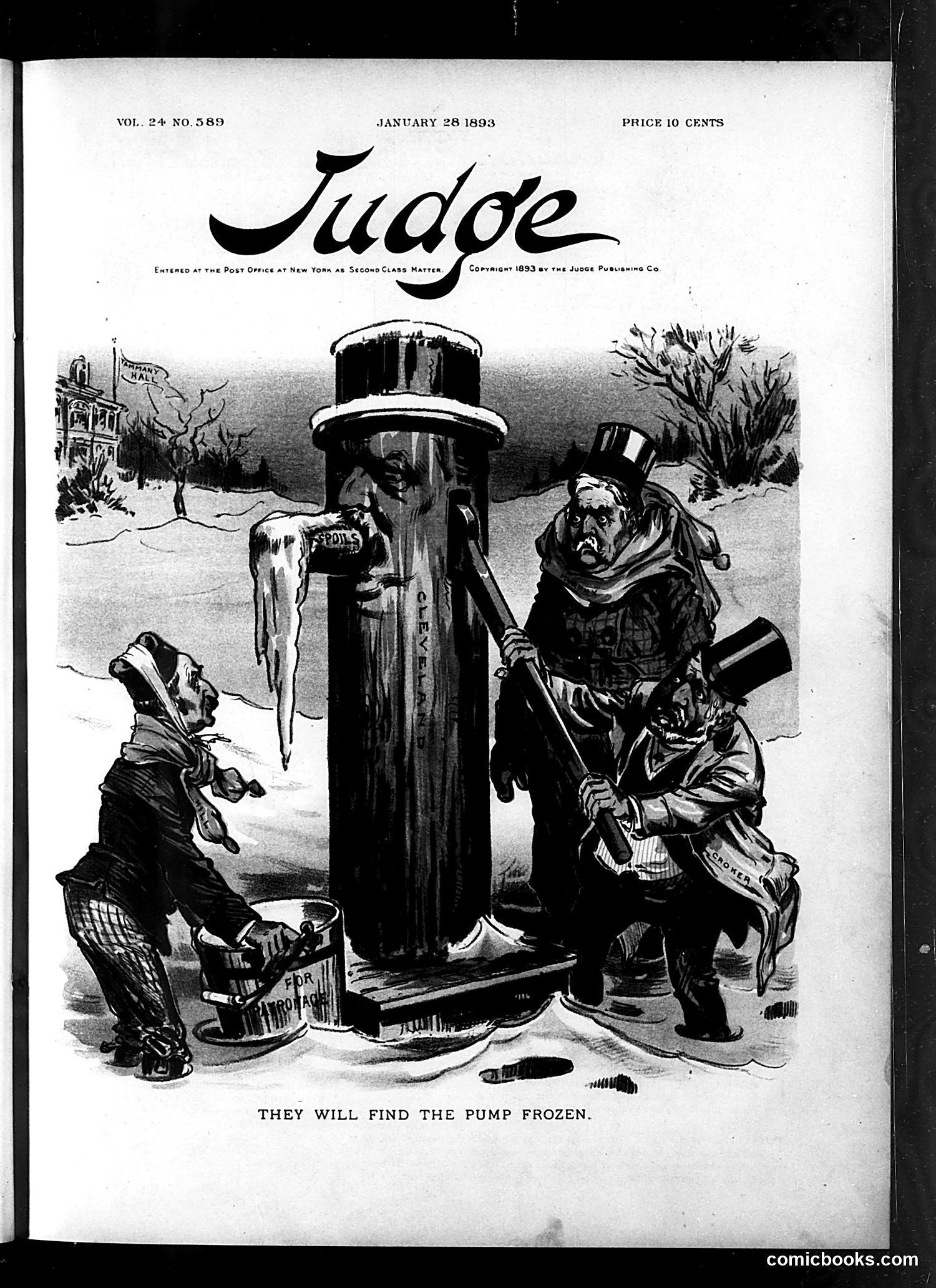
This cartoon depicts three figures—appearing to be poor or working-class men—gathered around a frozen water pump in winter. The caption "THEY WILL FIND THE PUMP FROZEN" suggests political satire about inadequate public services or infrastructure. The specific identity of the figures remains unclear from the image alone, though their caricatured features and ragged clothing suggest they represent either immigrant groups or the urban poor—common subjects of 1890s political commentary. The frozen pump likely symbolizes failed government provisions or promises, particularly relevant during the economically troubled 1890s. Without additional context about Judge magazine's specific targets that week, the precise political meaning remains uncertain, though the satire appears to criticize public neglect of working-class citizens' basic needs.
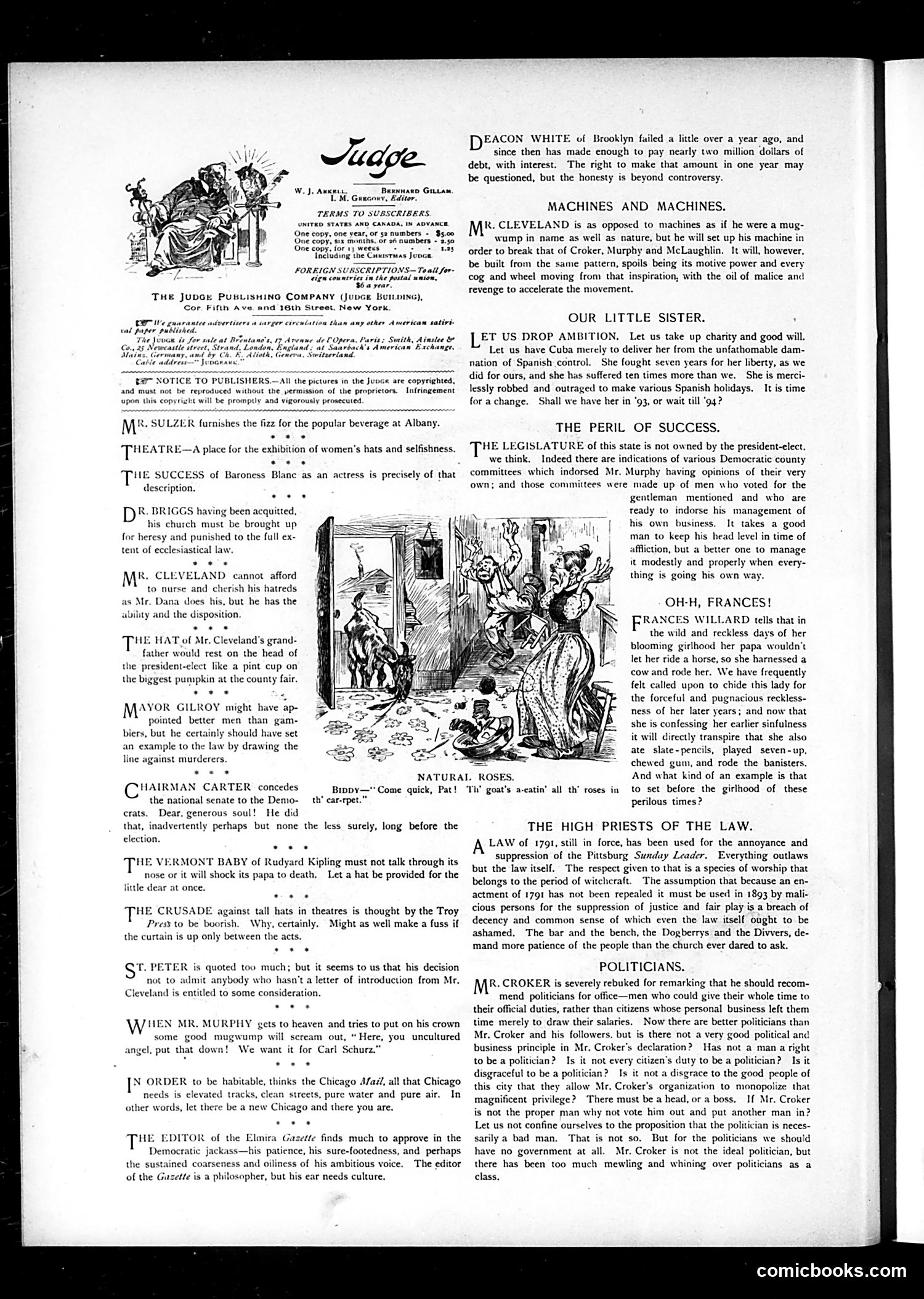
This page contains multiple brief satirical items and a central cartoon. The cartoon depicts a chaotic domestic scene with children in disarray, illustrating the article "OUR LITTLE SISTER" about a mischievous girl who has caused household damage and chaos. The text items mock various public figures: Mr. Cleveland regarding machines, Dr. Briggs, Mayor Gilroy, St. Peter, and others. One section criticizes politicians like Mr. Croker, arguing that politicians should serve as good examples rather than merely pursuing office. The "HIGH PRIESTS OF THE LAW" section discusses an 1791 law used to suppress the Pittsburgh *Sunday Gazette*, suggesting judicial authority is being abused. The overall tone is typical Judge satire: punching at politicians, social hypocrites, and absurd public figures through brief, pointed commentary.
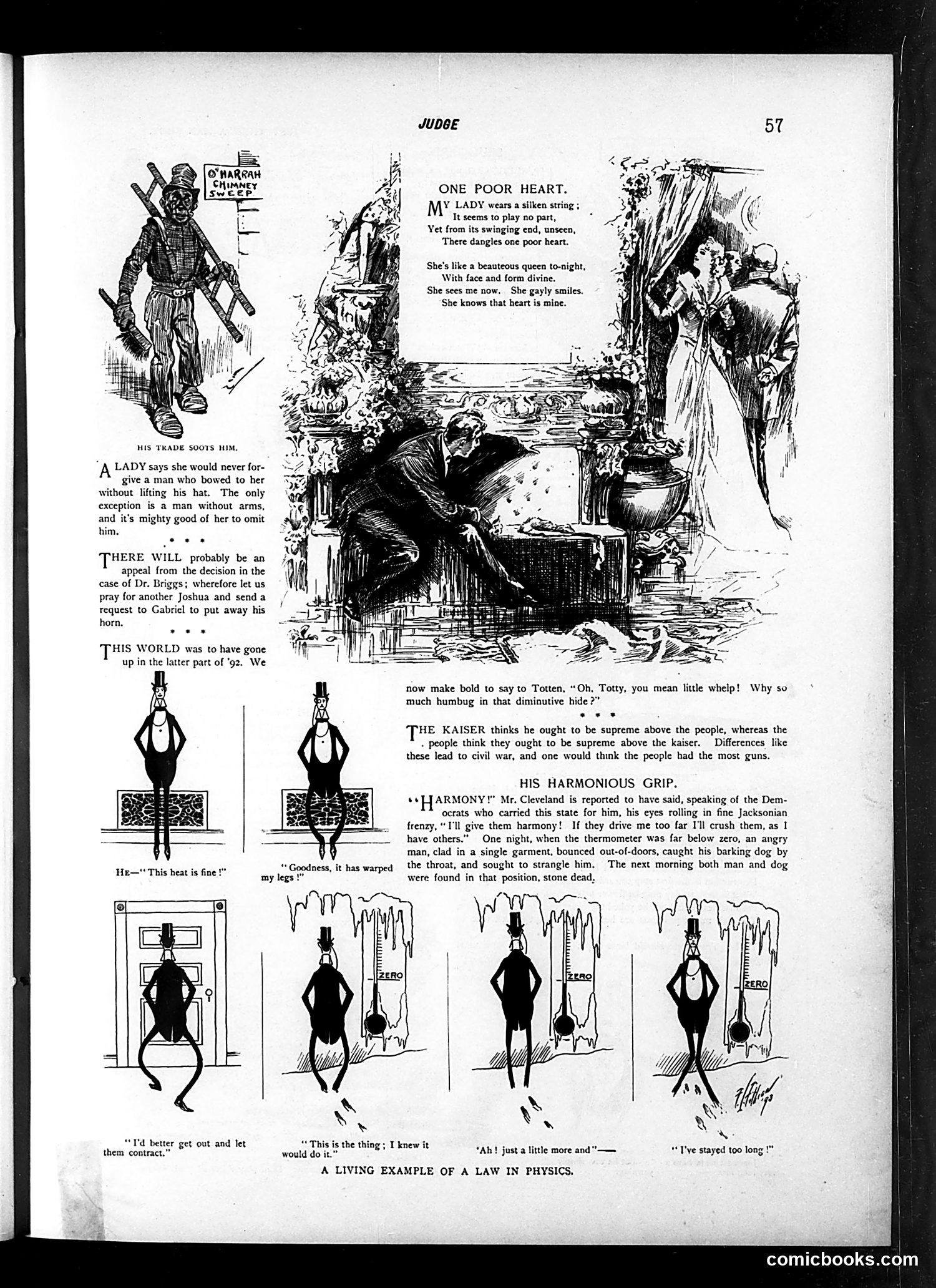
This page satirizes **President Theodore Roosevelt** (identifiable by the "O'Haram" caricature with characteristic teeth and aggressive posture on the left). The main cartoon mocks Roosevelt's **imperialist foreign policy**, particularly his pursuit of the Panama Canal. The "ONE POOR HEART" poem depicts a woman (likely representing a nation or the American people) emotionally conflicted about Roosevelt's aggressive leadership. The bottom section, titled "A LIVING EXAMPLE OF A LAW IN PHYSICS," shows a figure being stretched on a scale marked "ZERO"—satirizing Roosevelt's economic or political policies causing strain or instability. The repeated phrase about "harmony" references Roosevelt's attempts to appear diplomatic while pursuing expansionist goals, mocking the contradiction between his stated intentions and actual aggressive actions.
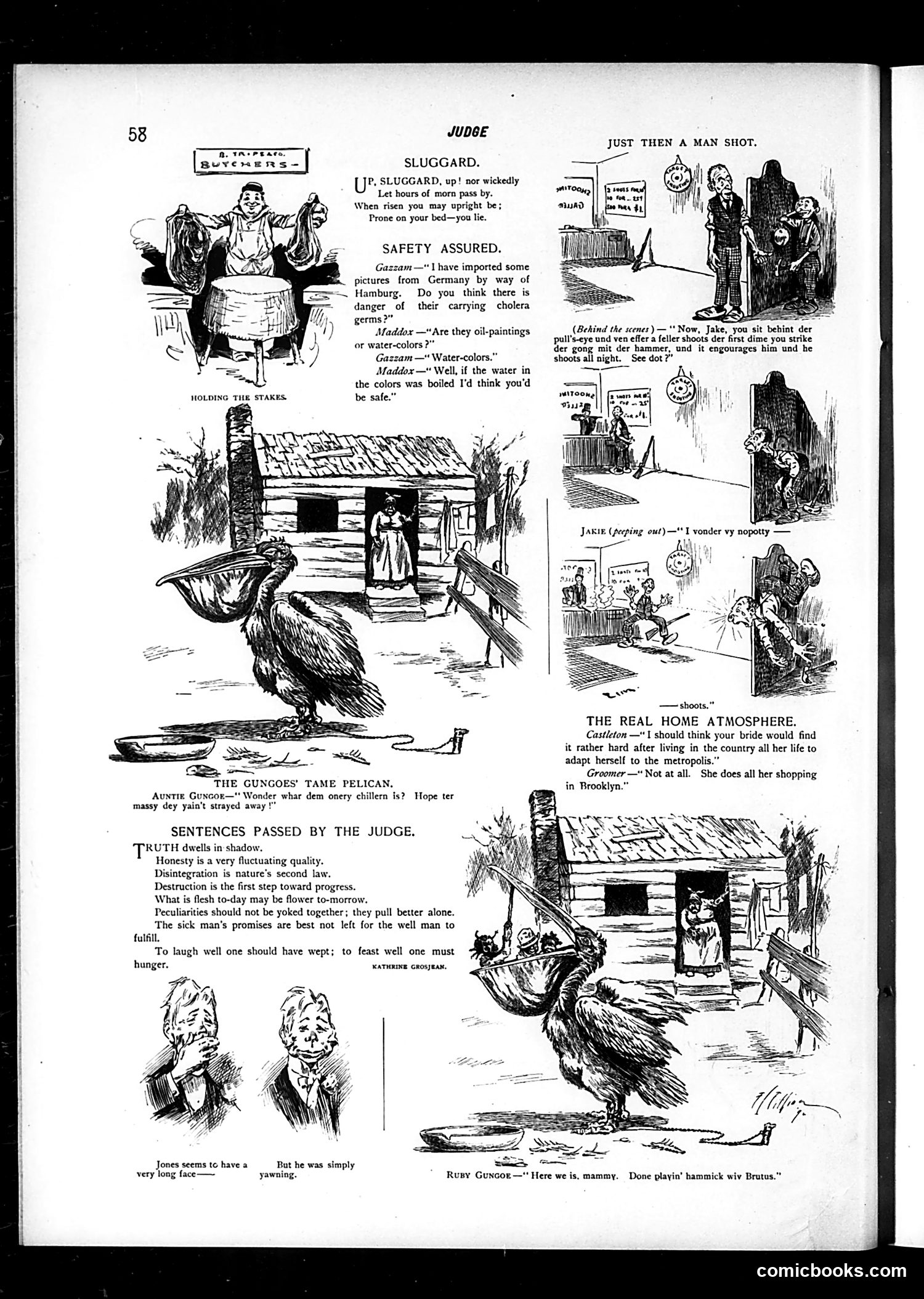
This page contains multiple satirical pieces typical of late 19th-century American humor: **"Safety Assured"** jokes about cholera fears from German imports—a reference to cholera epidemics that periodically threatened America, playing on anxieties about disease transmission through foreign goods. **"The Gungoes' Tame Pelican"** features racial caricature dialect humor common to the era, depicting an African American character. **"Just Then a Man Shot"** appears to satirize theater or entertainment safety practices, with Germanic-accented dialogue suggesting immigrant workers. **"The Real Home Atmosphere"** is a marriage joke: a bride adapts to city life by shopping in Brooklyn (then semi-rural), implying Brooklyn remains countrified despite being part of New York. **"Sentences Passed by the Judge"** offers philosophical one-liners in the magazine's characteristic sardonic style. The page mixes social commentary, ethnic stereotyping (typical of the period), and domestic humor targeting middle-class anxieties about modernity, disease, and marriage.
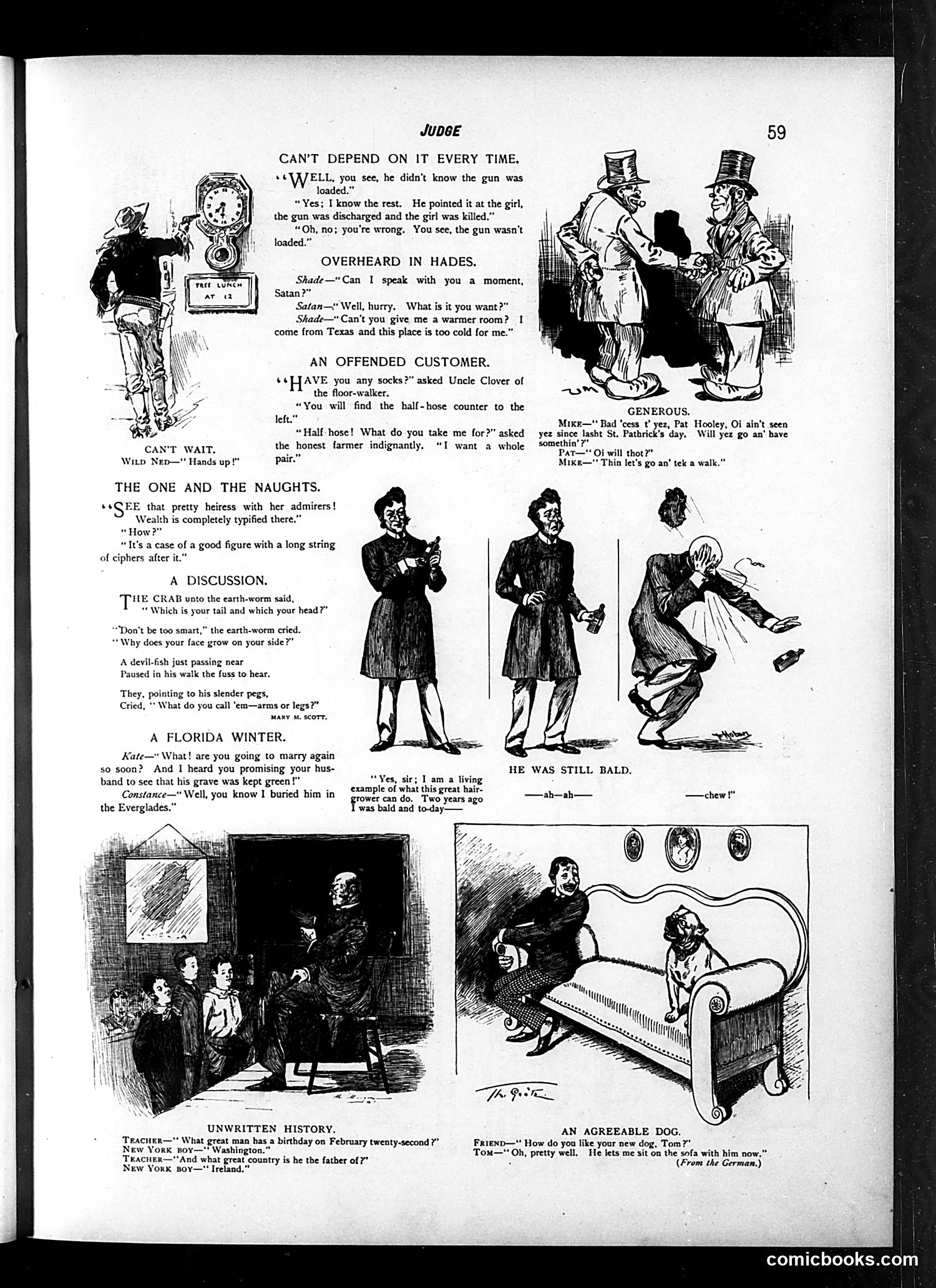
This page contains multiple brief humorous sketches typical of *Judge* magazine's satirical format: **"Can't Depend On It Every Time"** plays on the "gun wasn't loaded" excuse—a darkly ironic joke about unpredictable consequences. **"Overheard in Hades"** satirizes regional pride, with a Texan complaining hell is too cold, mocking Southern boastfulness. **"The One and the Naughts"** jokes that wealthy heiresses are valuable only because of their money ("ciphers")—critiquing how wealth defines social status. **"A Discussion"** uses animal characters (crab, earthworm, devil-fish) in absurdist wordplay about anatomy. **"A Florida Winter"** contains ethnic humor and darker satire about a widow burying her husband in swamps, then remarrying. **"Unwritten History"** is a children's joke where a New York boy mistakes "Washington" (the person) for Irish identity—mocking student ignorance. **"An Agreeable Dog"** contains a German-sourced joke about a dog allowing someone on the sofa, likely involving class commentary. The humor ranges from wordplay to ethnic caricature typical of early 20th-century American satire.
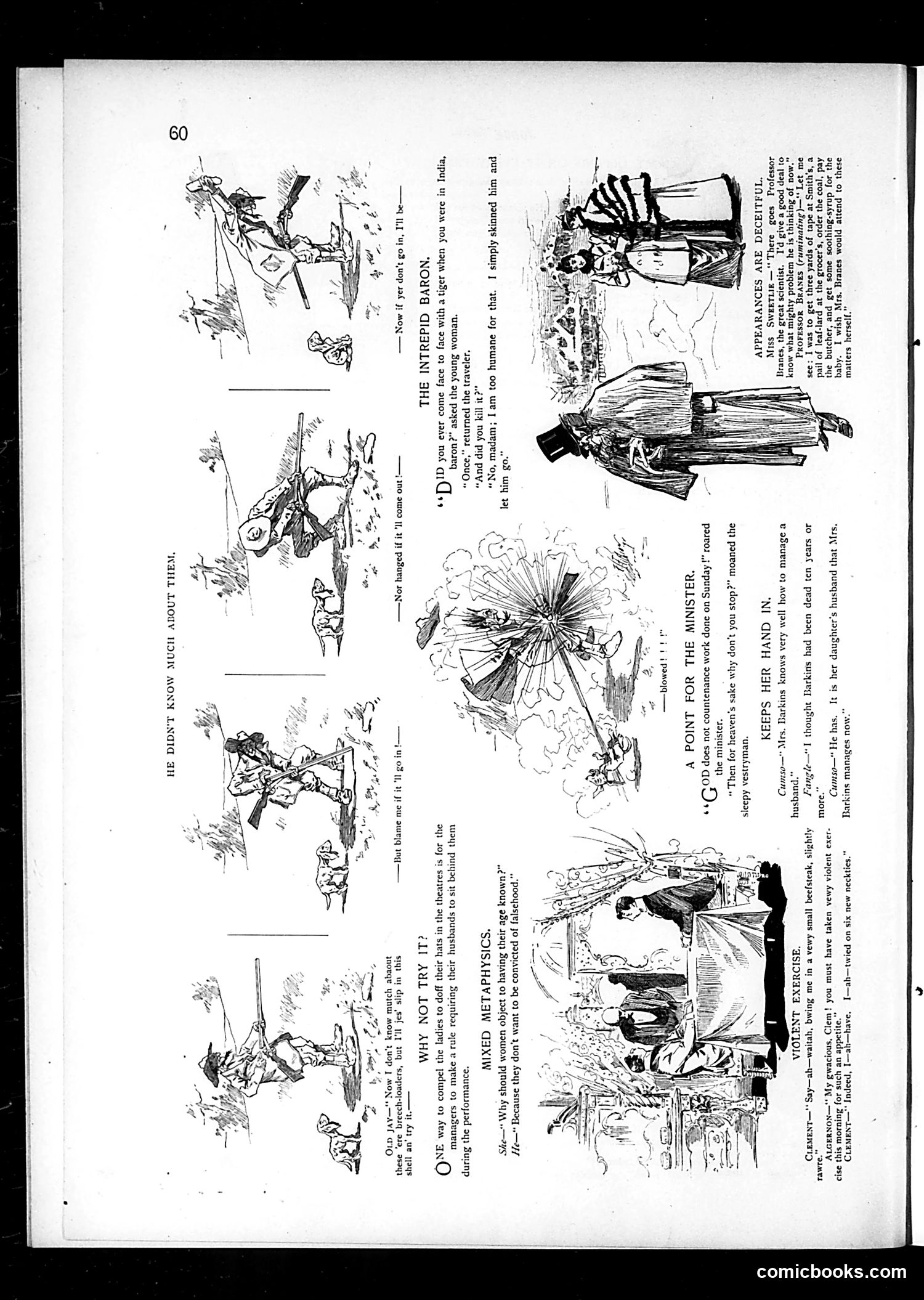
This is a satirical page from Judge magazine using cartoons and dialogue to mock political or social figures. The OCR text is severely corrupted and largely illegible, making precise identification difficult. However, based on visible cartoon panels showing figures in various confrontational or absurd situations, the page appears to ridicule contemporary politicians or public figures through exaggerated scenarios. The title "HE DIDN'T KNOW MUCH ABOUT IT" suggests the satire concerns someone's ignorance or incompetence regarding an important matter. Without clearer text or caption legibility, the specific political event or figure being lampooned cannot be definitively identified. The cartoon style and layout are typical of Judge's early 20th-century satirical approach—using visual humor and dialogue to critique public figures and current events.
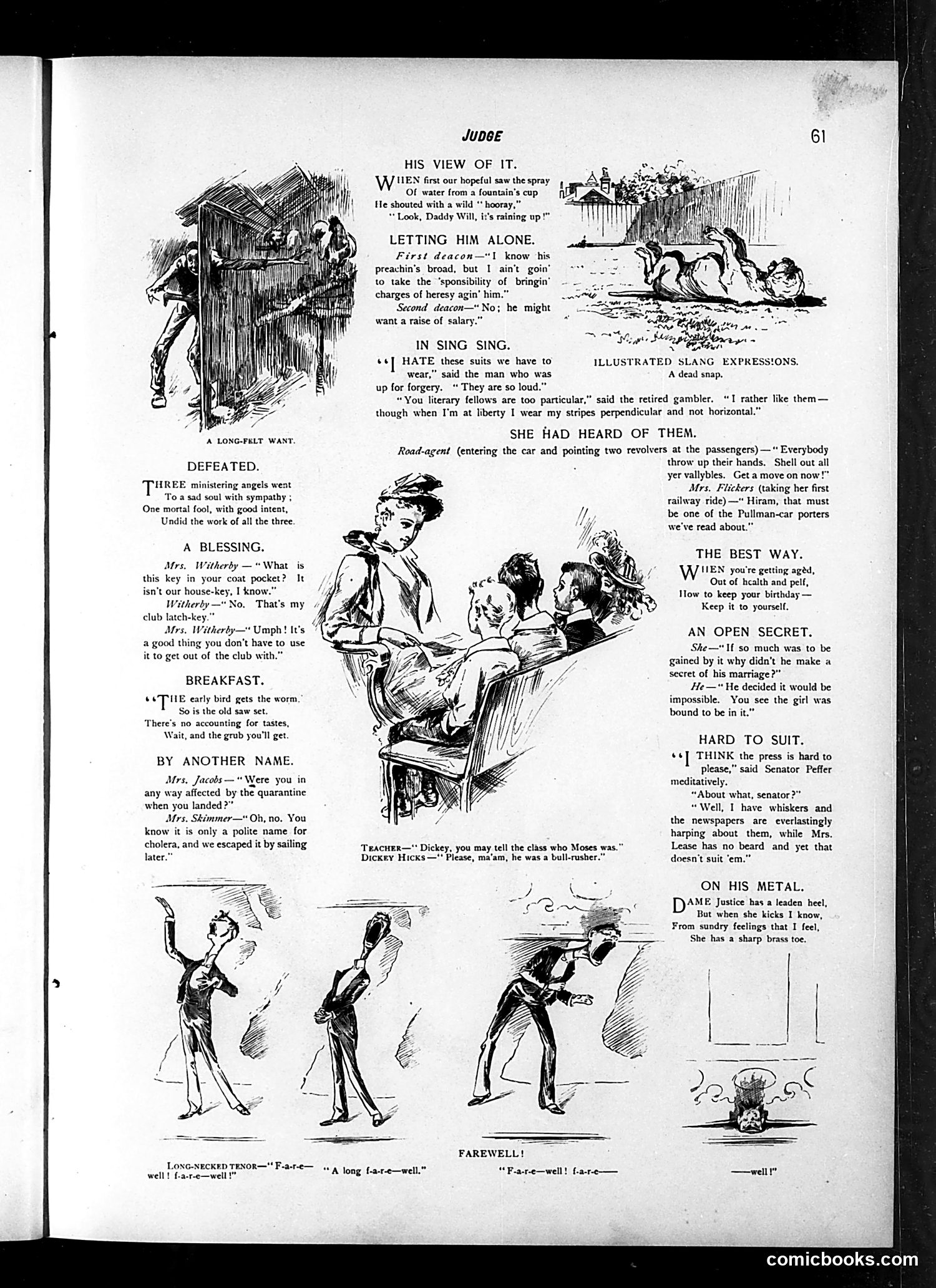
This page contains brief satirical humor pieces typical of Judge magazine's social commentary. Key items include: **"IN SING SING"**: A prisoner complains about prison uniforms being "loud"—a pun, since he's incarcerated for forgery, making the complaint absurd. **"BY ANOTHER NAME"**: A woman claims she avoided quarantine by sailing later, treating quarantine as merely a "polite name" for cholera—satirizing either public health euphemisms or immigrants' casual attitude toward disease. **"SHE HAD HEARD OF THEM"**: A female train passenger mistakes a railroad conductor for a "Pullman-car porter," referencing Pullman porters as a known service class. **"HARD TO SUIT"**: Senator Peffner is mocked for his whiskers while simultaneously criticizing Mary Lease (a Kansas Populist politician) for having none—satirizing political absurdity and gender expectations. **"ON HIS METAL"**: A sardonic poem about Lady Justice having a painful "brass toe," suggesting the legal system delivers harsh punishment. The page mixes domestic humor, political jabs at contemporary figures, and social satire typical of 1890s American periodicals.
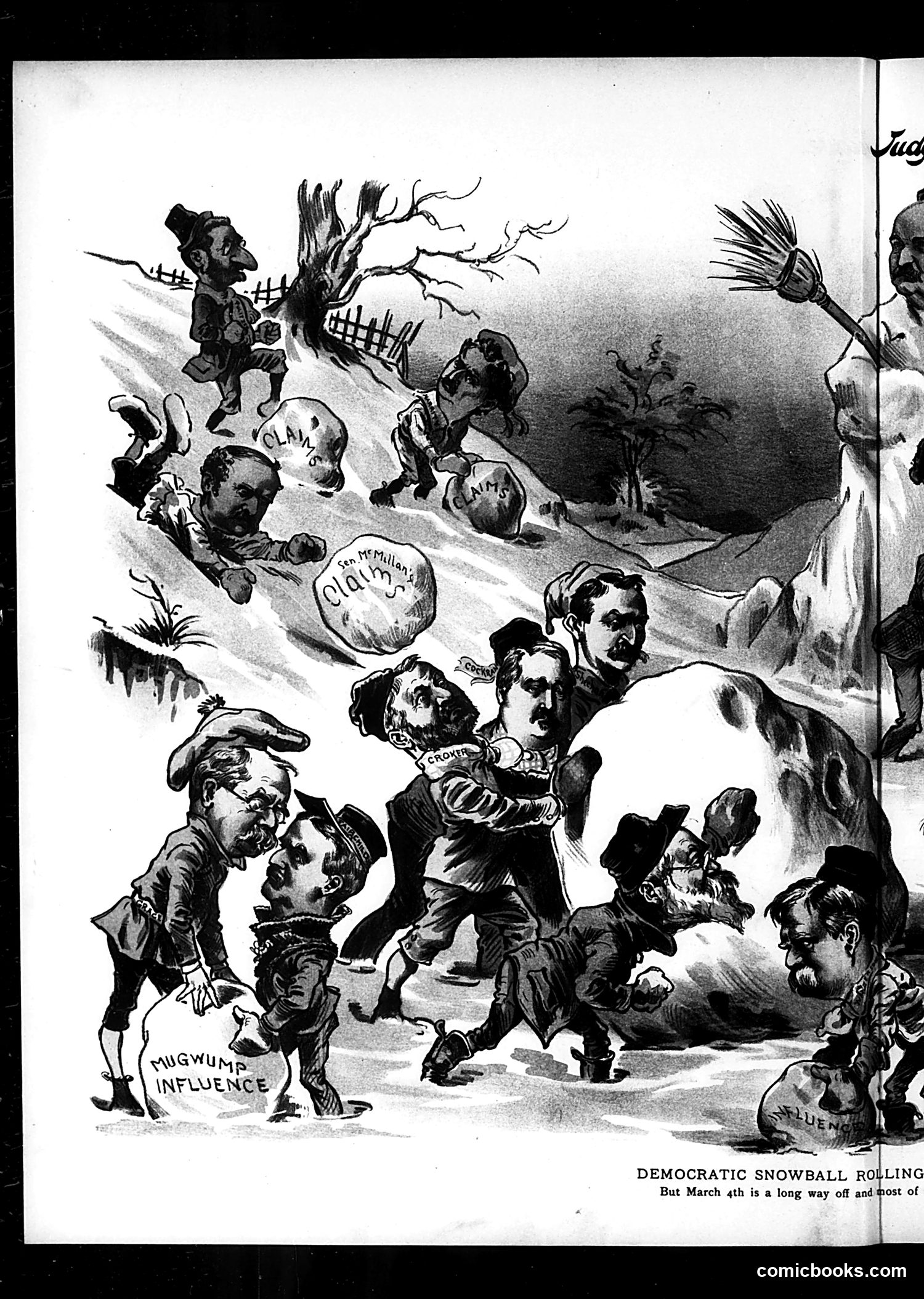
This political cartoon satirizes the Democratic Party's growing momentum leading up to an election. The caption references March 4th as a distant deadline, suggesting the party's advantage may dissipate before then. The image shows caricatured political figures rolling a large snowball downhill—a metaphor for unstoppable momentum gaining size and speed. Labels visible include "MUGWUMP INFLUENCE" and what appears to be references to various political factions or constituencies being absorbed into the Democratic effort. The desolate, winter landscape with bare trees suggests harsh political conditions. The cartoon mocks the Democratic Party's apparent unity while implying this momentum is temporary or fragile, dependent on time and circumstances—hence the qualifying phrase that March 4th remains "a long way off." This appears to be from the late 19th century, reflecting internal party dynamics of that era.
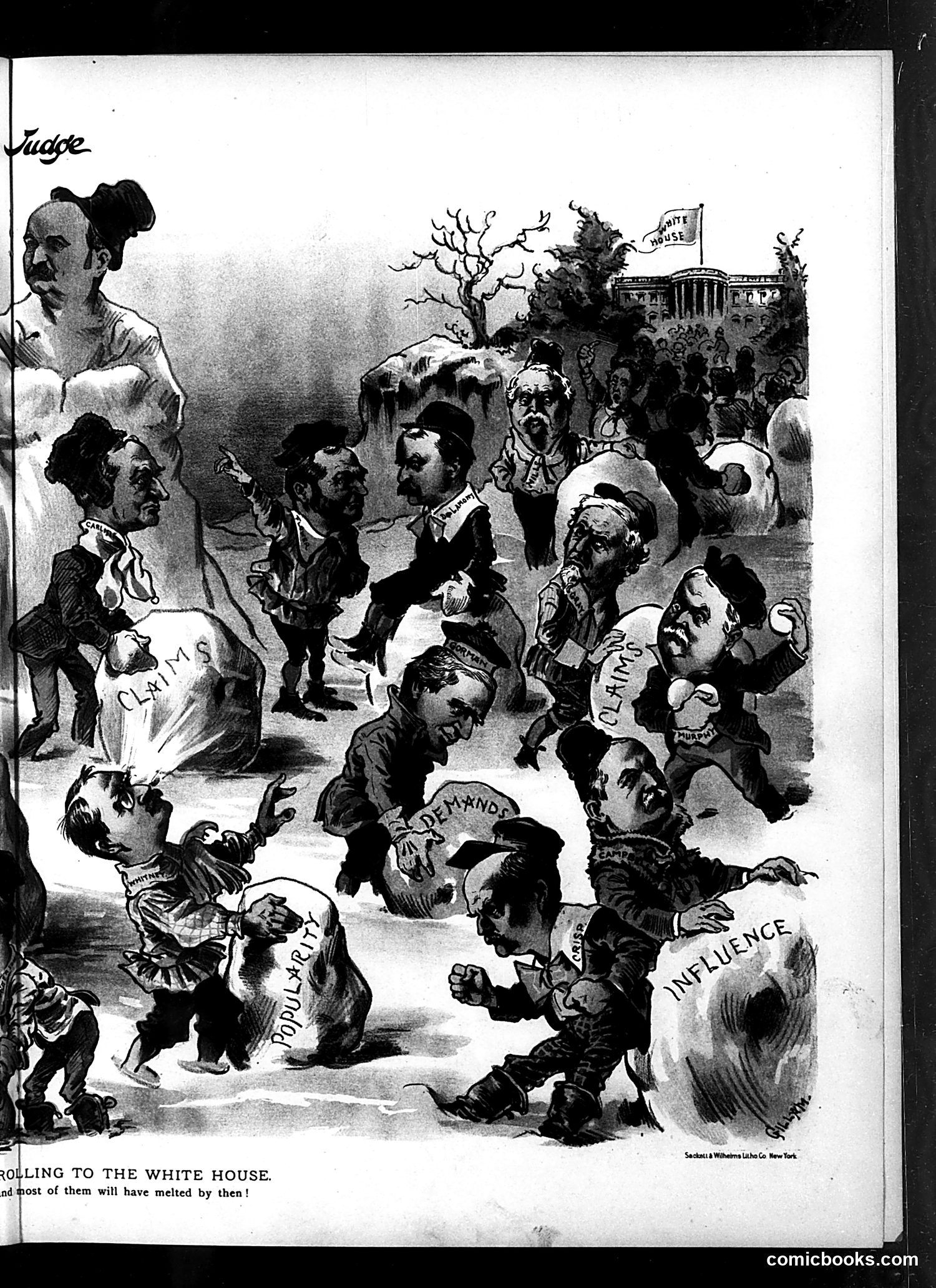
This political cartoon satirizes political corruption and influence flowing toward the presidency. The large figure in the upper left appears to be a judge or authority figure overlooking the scene. Below, various personified forces—labeled with words like "CLAIMS," "DEMANDS," "INFLUENCE," and "POPULARITY"—depicted as crawling or rolling figures, converge toward the Capitol building in the distance. The caption's cynical sentiment ("most of them will have melted by then") suggests the cartoonist is mocking how political pressures and corrupting influences that seem powerful during a campaign dissolve once someone reaches the White House. The imagery critiques the gap between campaign promises and actual governance, portraying political demands as temporary, self-serving forces rather than genuine public interests. The cartoon likely dates from the Gilded Age or Progressive Era, when such corruption critiques were common.
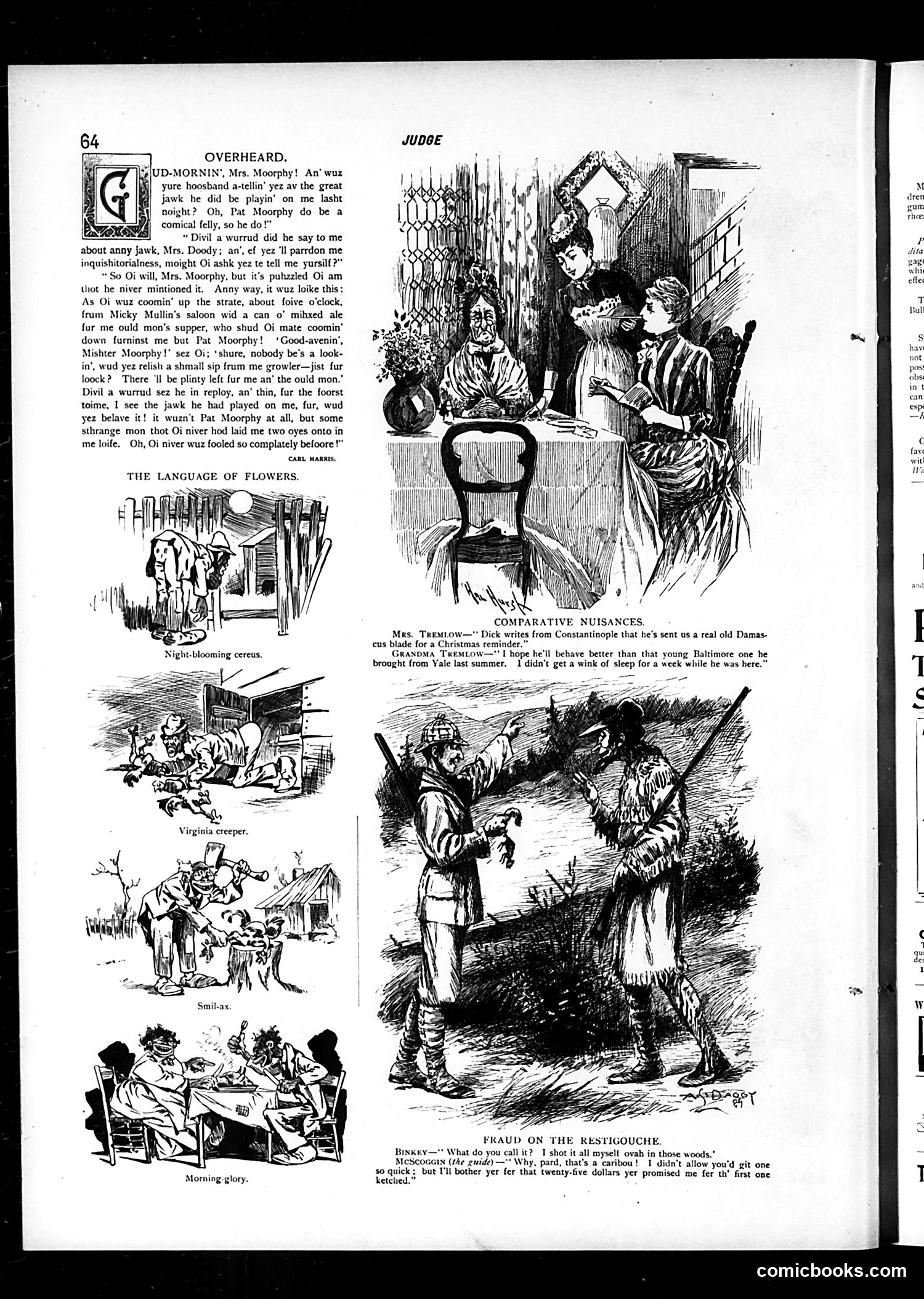
This page contains three distinct satirical pieces: **"Overheard"** mocks Irish immigrant dialect and working-class culture. Two Irish women discuss a prank: Mrs. Doody, carrying ale for her husband, encounters a stranger she mistakes for Pat Moorphy and offers him a drink from her "growler" (beer can). The joke relies on ethnic stereotyping through exaggerated Irish brogue. **"The Language of Flowers"** presents small vignettes with floral names (Night-blooming cereus, Virginia creeper, Simial, Morning-glory) as visual puns about human behavior—likely social commentary on courtship or domestic life coded through flower symbolism. **"Fraud on the Kestigouche"** satirizes wealthy sportsmen. A hunter claims he shot a caribou "all myself," but his guide recognizes the obvious lie and demands payment for actually catching it—mocking the pretensions of rich tourists who hire guides but take false credit for kills. All three target class, ethnicity, or social pretension through humor typical of *Judge*'s satirical approach.
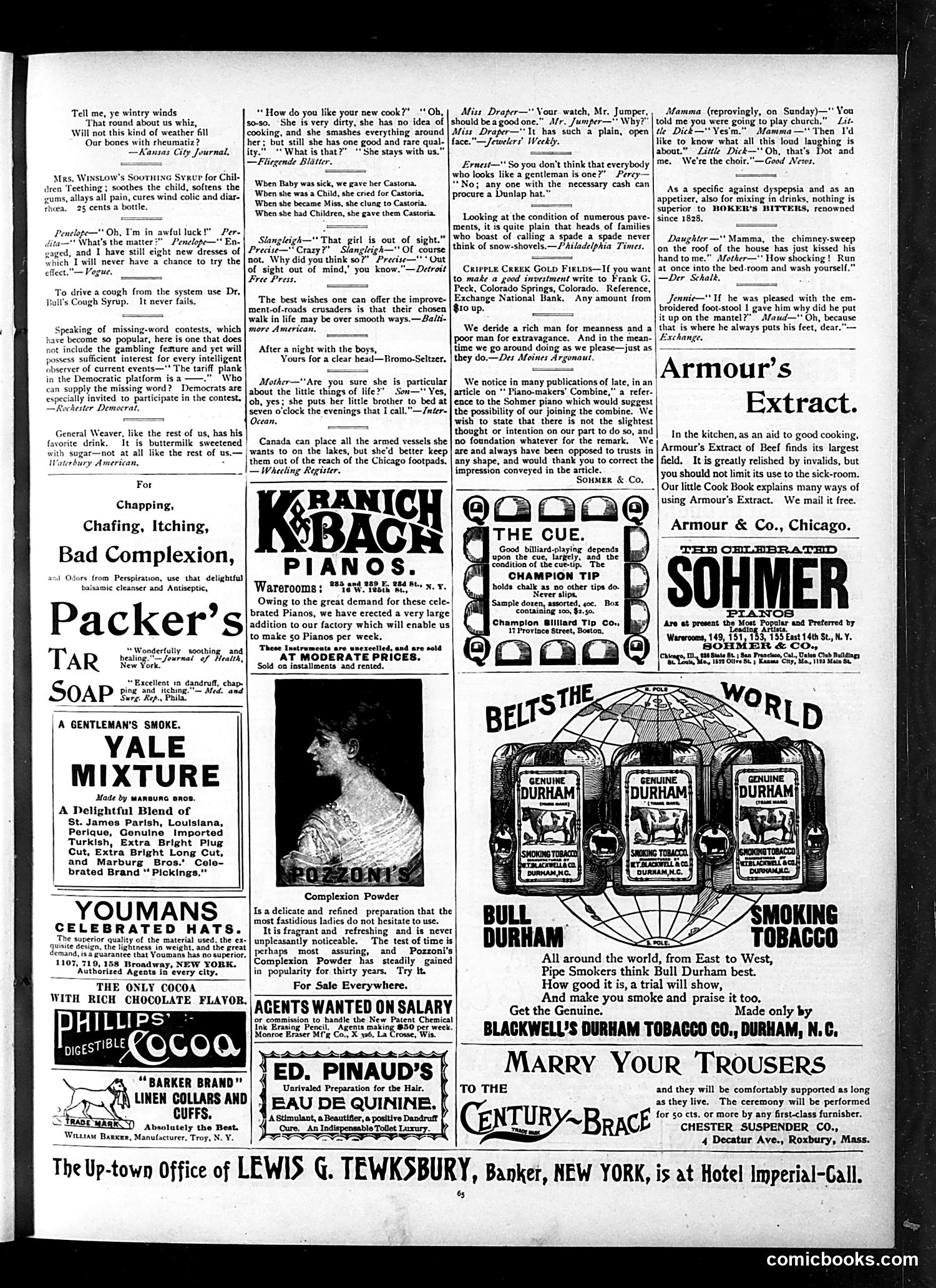
This page is primarily **advertising**, with scattered light humor and social commentary typical of late 19th-century American satire magazines. The cartoons/jokes visible include: **Political/Social References:** - A missing-word contest mocking Democratic Party indecision on tariffs (a major political issue of the era) - References to General Weaver (likely James B. Weaver, Populist candidate), suggesting current political figures as humor fodder - Jokes about servants, dating customs, and domestic life reflecting contemporary middle-class concerns **The Satire:** The humor is gentle, relying on wordplay and mild social observation rather than sharp political critique. Examples include puns about a cook who "stays" despite incompetence, and comments on Canada's military vessels versus Chicago crime. **Dominant Content:** The page is overwhelmingly advertisements for consumer products (Packer's Tar Soap, patent medicines, pianos, tobacco, hats) typical of Judge's revenue model. The ads themselves sometimes include small jokes, blurring lines between advertising and editorial content. This reflects Judge's role as both satirical commentary and commercial marketplace for the 1890s American consumer.
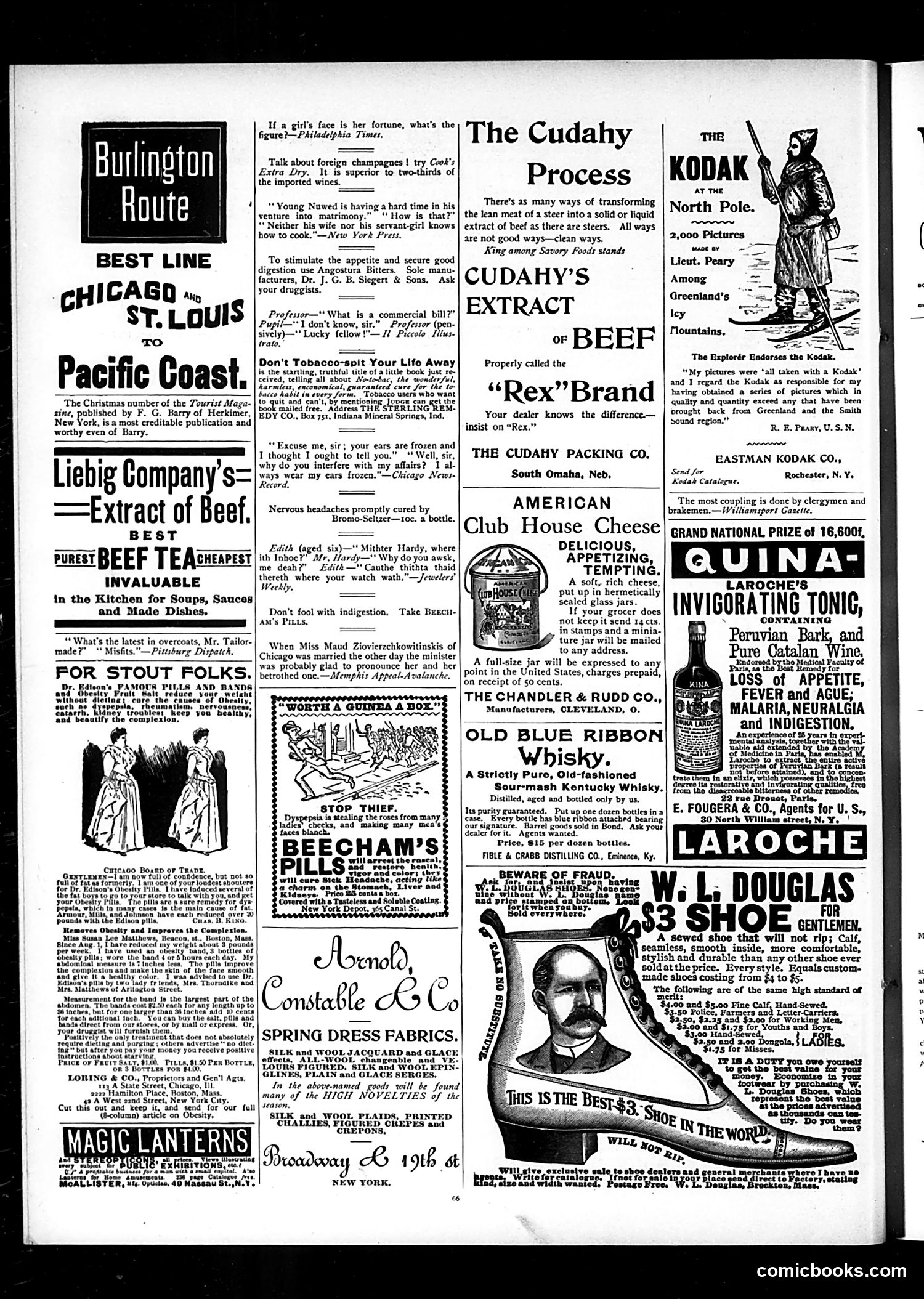
This page is primarily **advertising**, not political satire. It's a typical Judge magazine page from around 1916 featuring commercial product advertisements (beef extract, whisky, cheese, shoes, pills) interspersed with brief humorous quips and jokes targeting contemporary domestic life—marital troubles, servants, courtship mishaps, and fashion. The small cartoons and jokes mock everyday situations: newlyweds who can't cook, frozen ears worn as fashion, women's complicated names, and tobacco addiction. There's no identifiable political content or caricatured public figures. The sole non-commercial element is an endorsement by Lieutenant Peary regarding Kodak cameras used during Arctic exploration—presented as celebrity advertising rather than satire. The page reflects early 20th-century consumer culture and period humor standards.
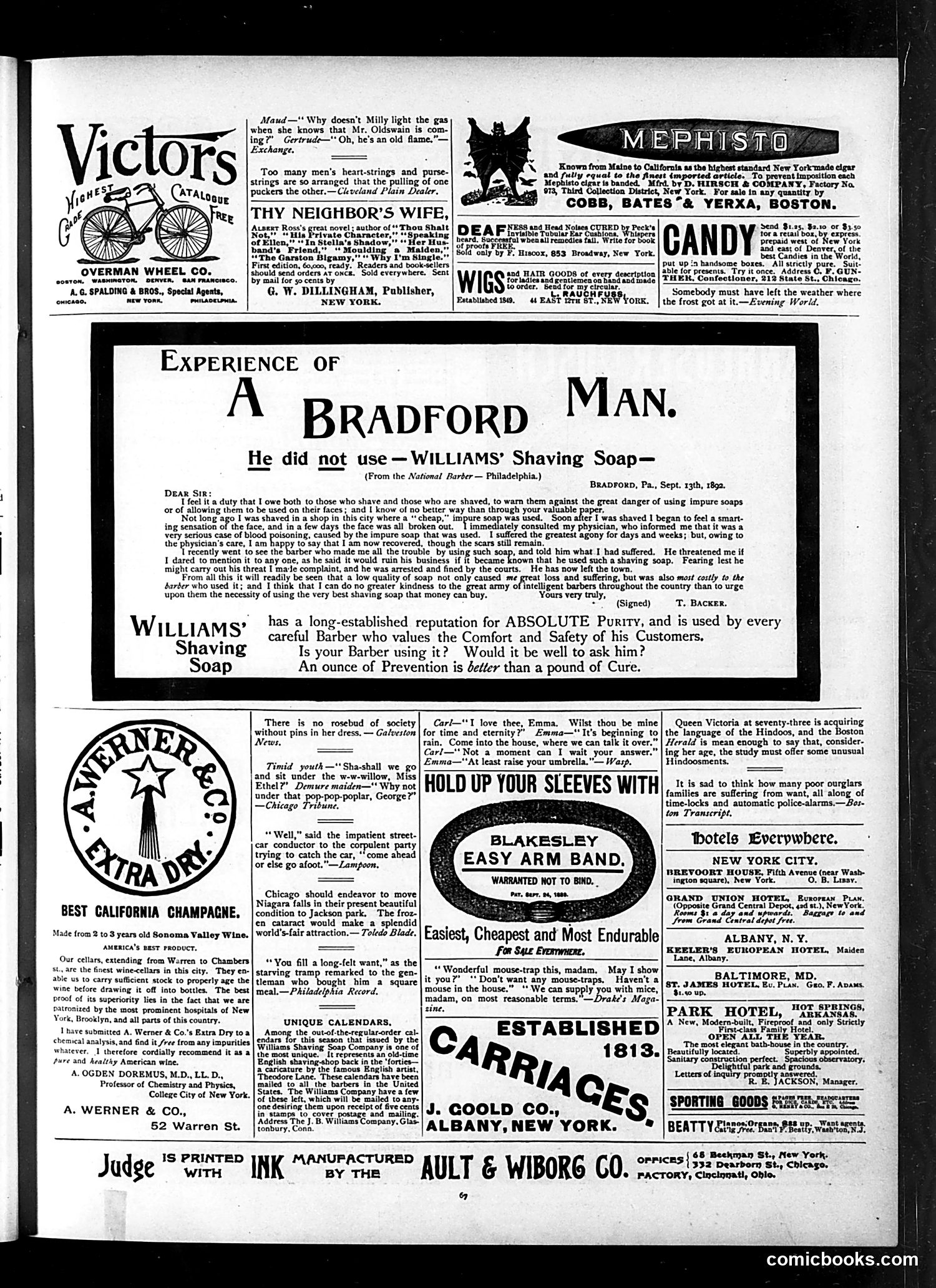
This page is primarily **advertising**, not political satire. It contains multiple product advertisements typical of 1890s magazine content: bicycles, cigars, wigs, candy, ear cushions, and other goods. The main content piece is a testimonial letter from "T. Backer" of Bradford, Pennsylvania, endorsing Williams' Shaving Soap. Backer describes suffering a severe facial infection after being shaved with cheap, impure soap at a barbershop. He warns against low-quality soaps and praises Williams' product for its "absolute purity." The letter functions as period advertising—a common format where endorsements from ordinary citizens (or purported citizens) built consumer confidence. The dramatic medical consequence (blood poisoning) was meant to convince readers that soap quality mattered for health and safety. The page includes one small joke at the top about a woman named Milly not lighting gas because her suitor is "an old flame"—a pun on romantic history. This is essentially a commercial page masquerading as editorial content.
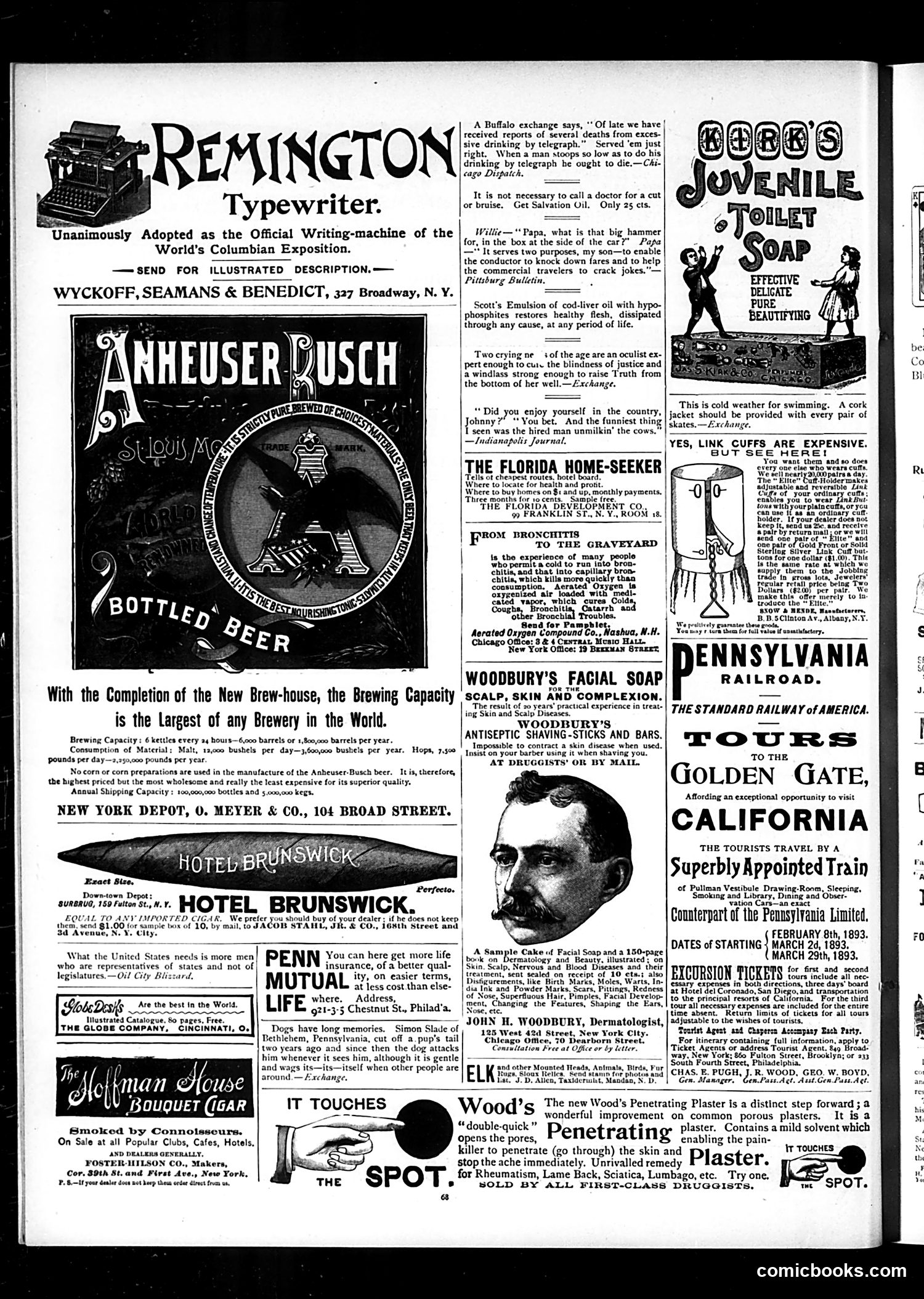
This page is primarily a collection of **advertisements** from the 1890s rather than political satire or editorial cartoons. The content includes: **Major ads:** - Remington Typewriter (official machine of the 1893 World's Columbian Exposition) - Anheuser-Busch beer, boasting the world's largest brewing capacity - Hotel Brunswick and other hospitality services - Pennsylvania Railroad "Tours to the Golden Gate" (California) - Various patent medicines (Wood's Penetrating Plaster, Aerated Oxygen for bronchitis) **Minor humorous items** (filler between ads): - A joke about a vengeful dog with a docked tail - A quip about a man conducting "drinking by telegraph" - A child's joke about a railroad hammer for traveling salesmen to "crack jokes" There is **no significant political or social satire** on this page. It functions as a typical late-Victorian magazine advertisement section with incidental, mild humor. The "point" is purely commercial—selling products and services to affluent readers.
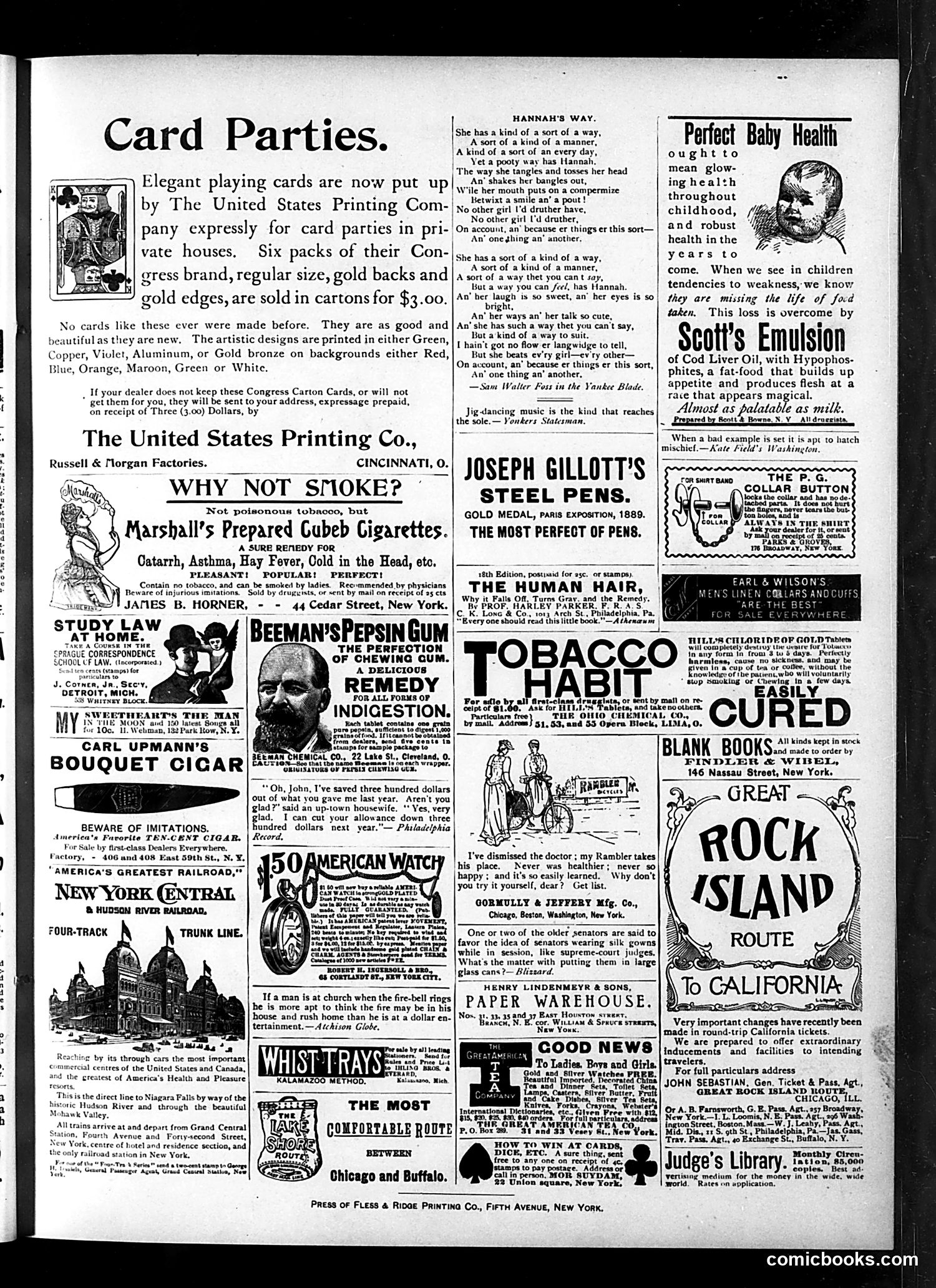
This page is primarily **advertisements** with minimal editorial content. The main items are: **Card Party Advertisement**: The United States Printing Company advertises luxury playing cards with artistic designs and gold edges for $3.00—a premium product positioned for wealthy private entertainers. **Patent Medicine Ads**: Multiple advertisements for dubious remedies typical of the era—Marshall's Gubeb Cigarettes (claimed to cure asthma and catarrh), Beeman's Pepsin Gum (for indigestion), and others. These reflect the pre-FDA era when such products made extravagant health claims without regulation. **Transport & Travel**: Ads for railroads (New York Central, Great Rock Island Route to California) and cigars appeal to affluent male readers. **Brief Humor**: Two short jokes appear—one about a wife saving money only to have her husband cut her allowance, another about men rushing from church if a fire-bell rings, fearing their own homes are burning. The page reflects **Gilded Age consumerism** and the satirical magazine's affluent audience, while also documenting the era's snake-oil marketing practices.
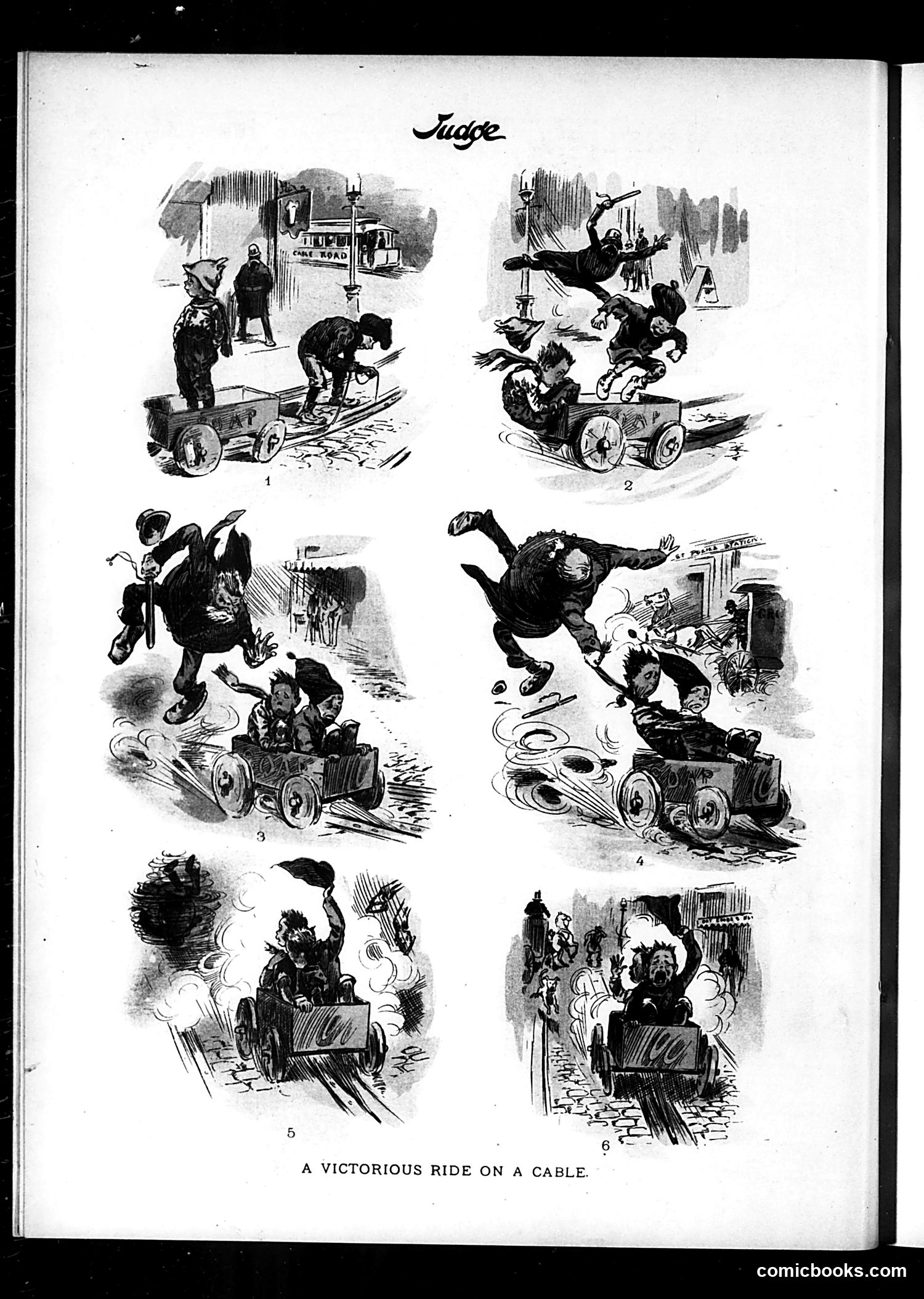
This six-panel Judge cartoon satirizes cable car transportation—likely referencing the new cable car systems operating in American cities (particularly San Francisco's, which opened in 1873). The sequence depicts increasingly chaotic mishaps as passengers ride atop a cable car: 1. Orderly boarding 2. Passengers fly off during motion 3. A rider becomes entangled with the cable 4. Violent derailment or collision 5. Explosive chaos with debris 6. Survivors emerging from wreckage The title's irony—"victorious"—undercuts the disaster depicted. The joke mocks cable cars as dangerously out-of-control contraptions, despite their novelty and promise. This reflects contemporary public anxiety about new transportation technology and its safety, presented through Judge's characteristic slapstick visual humor of the era.