
A complete issue · 18 pages · 1893
Judge — January 21, 1893
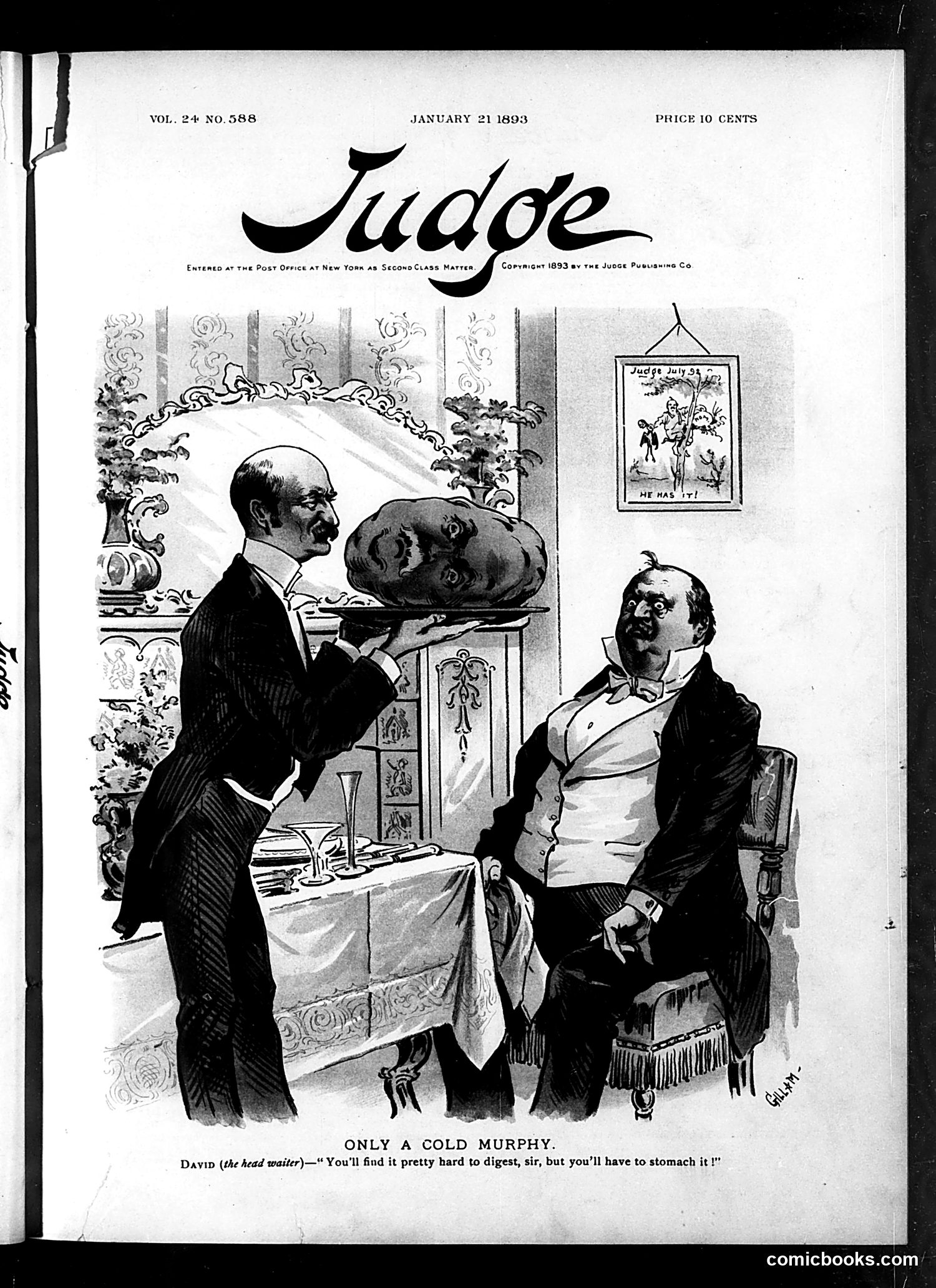
This *Judge* magazine cover (January 21, 1893) presents a satirical cartoon titled "Only a Cold Murphy." A waiter (identified as "David, the head waiter") presents a grotesque pig's head on a platter to a seated diner, commenting: "You'll find it pretty hard to digest, sir, but you'll have to stomach it!" The cartoon appears to be political satire targeting someone named Murphy—likely a public figure of 1893. The pig's head is a deliberate insult, and the waiter's quip plays on digestive metaphors to suggest Murphy must accept something distasteful or humiliating. Without additional context, the specific political situation remains unclear, but the crude visual mockery and forced consumption imagery indicate harsh criticism of Murphy's position or character.
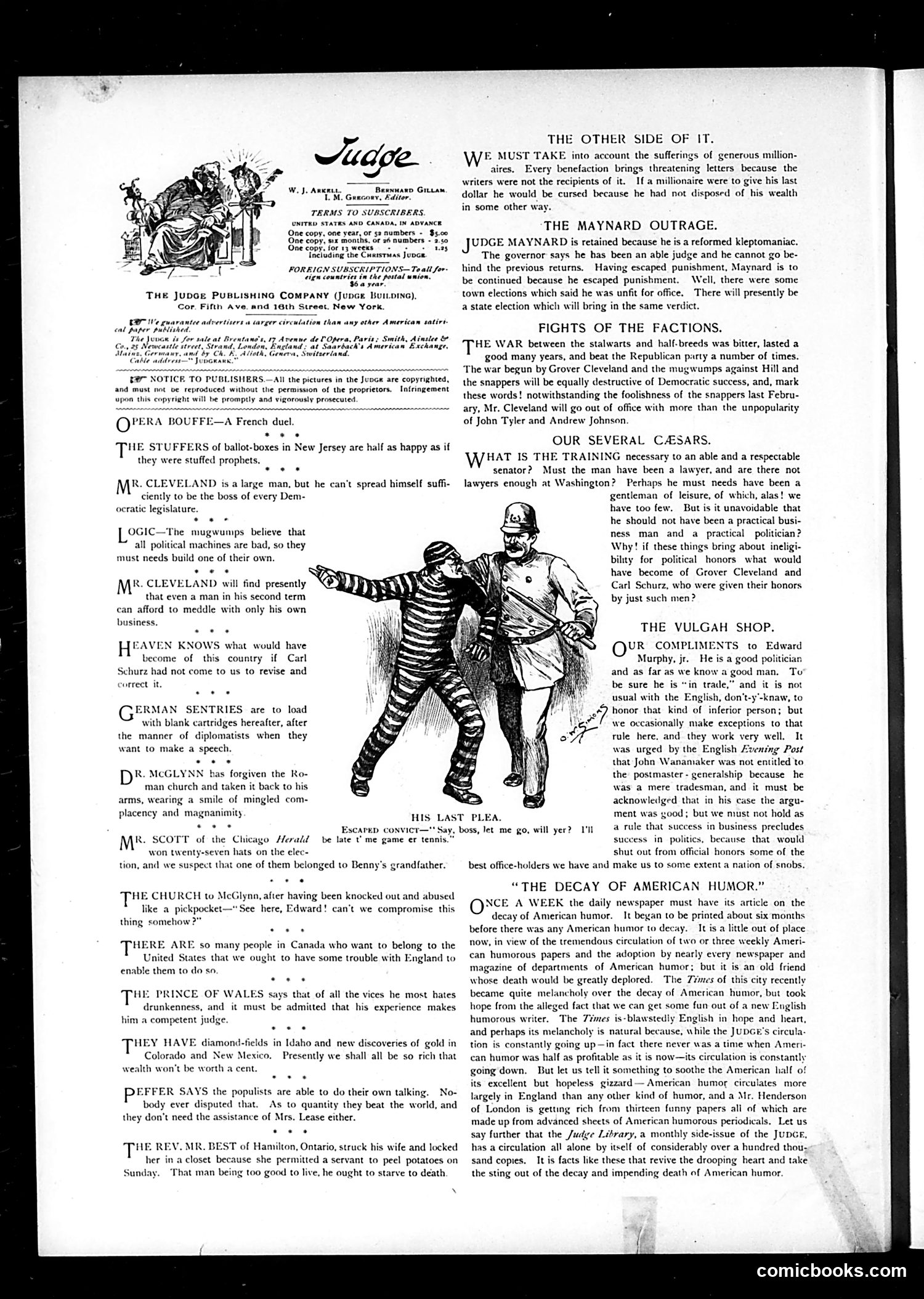
This page contains political commentary rather than a single cartoon. The main illustration shows two figures in a physical struggle—one in striped clothing (appearing to represent a convict or prisoner) grappling with a uniformed official or guard. The accompanying text discusses factional fighting within the Republican Party between "stalwarts" and "half-breeds," referencing a conflict begun by Grover Cleveland and involving figures like John Tyler and Andrew Johnson. The satire criticizes Cleveland's fitness for office and judges' qualifications for political positions. Other brief items mock various politicians and political situations, including Cleveland's inability to "spread himself sufficiently to be boss of every Democratic legislature." The specific historical references and candidates remain unclear without additional context about the publication date.
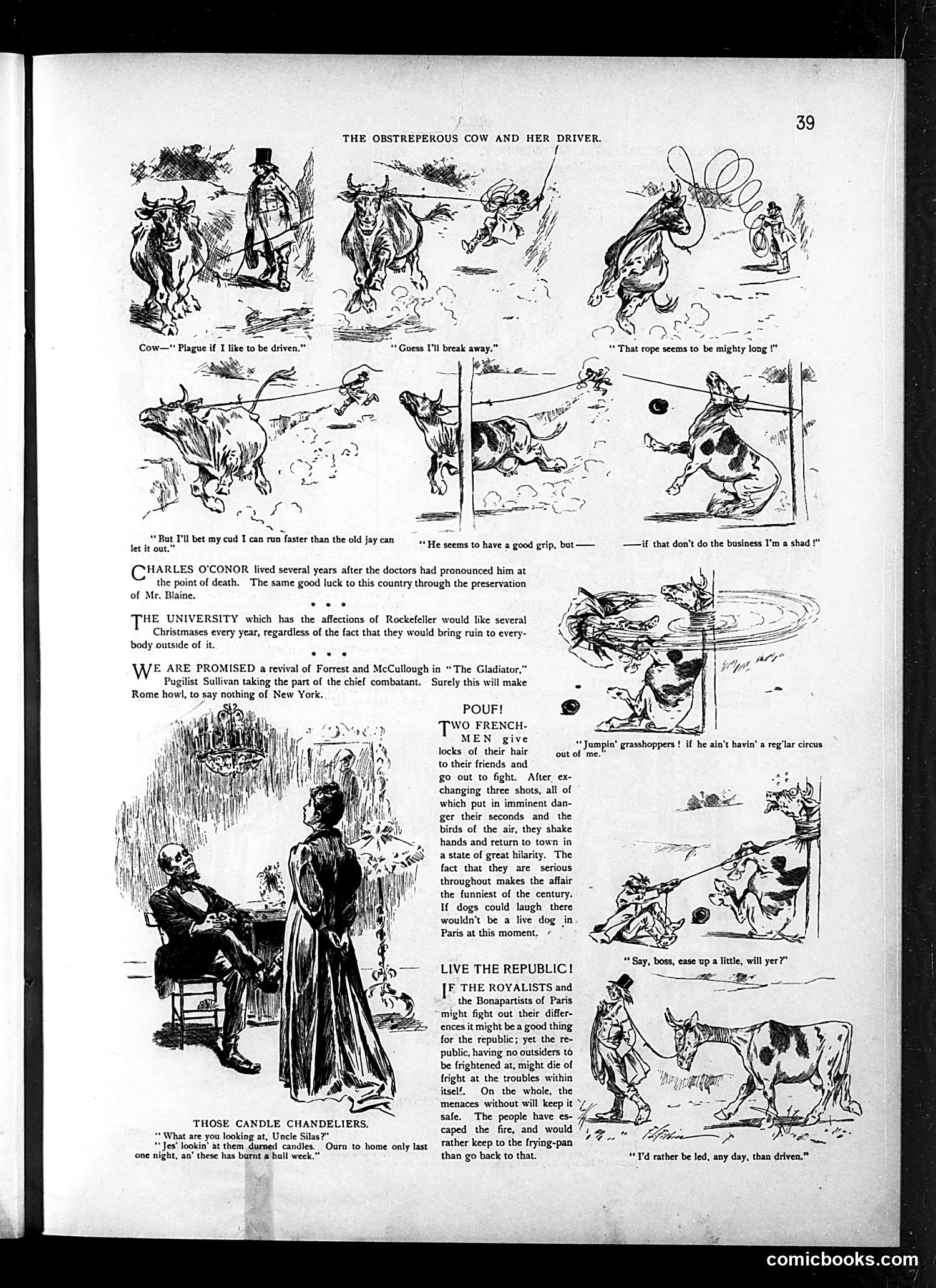
This page satirizes the difficulty of controlling an unruly cow—likely a political allegory for governing an ungovernable entity or population. The sequential comic panels show a driver attempting various methods to manage the cow, which resists through bucking, running away, and general obstinacy. Captions like "Plague if I like to be driven" and "I'd rather be led, any day, than driven" suggest commentary on coercion versus willing cooperation. The accompanying text discusses Charles O'Connor, university endowments, and French dueling, but these appear tangential. The "Live the Republic!" section addresses Parisian political conflict. The central satire seems to critique attempts at forceful control—whether of animals, populations, or government—suggesting such resistance is inevitable when legitimacy is absent.
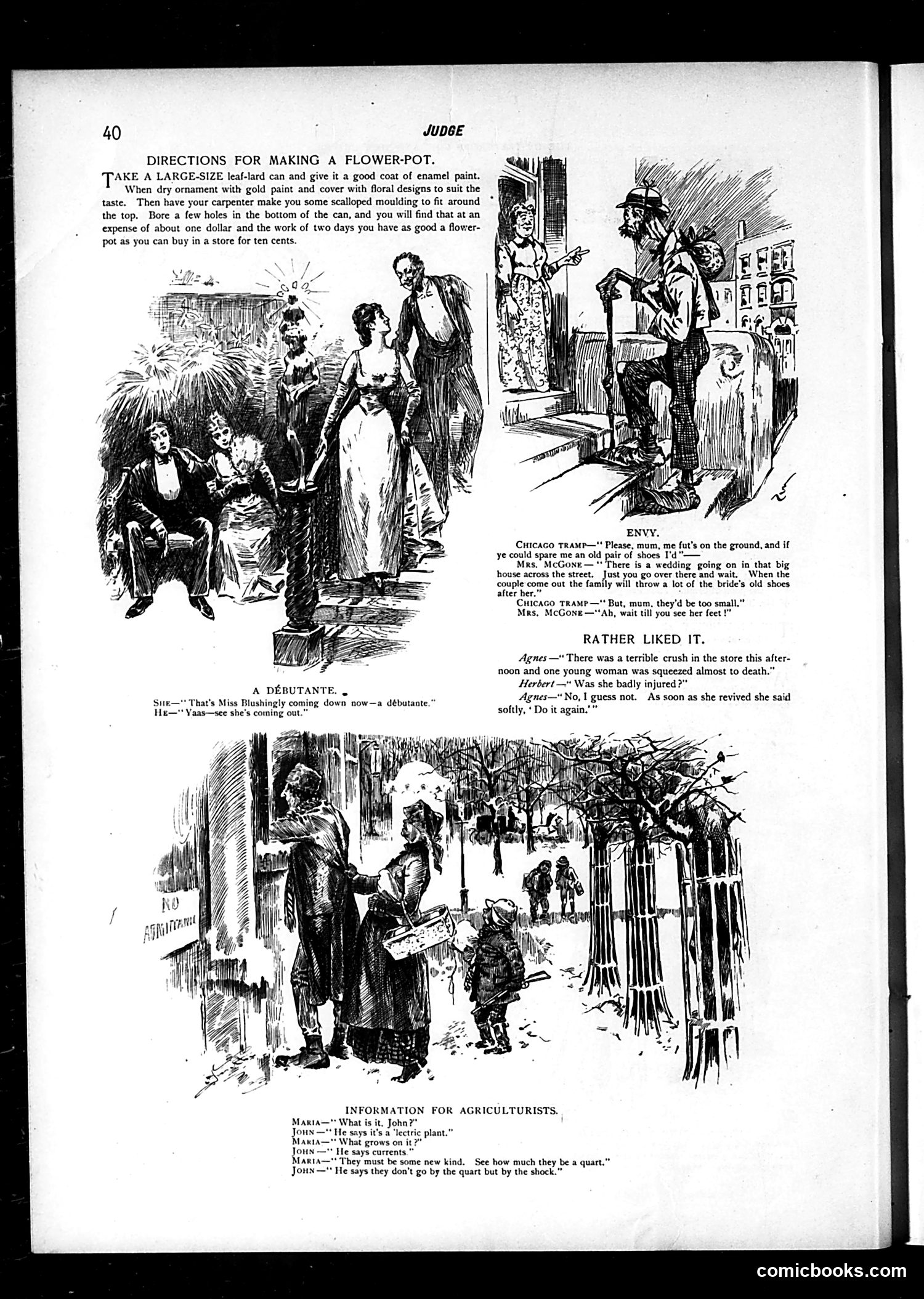
This page contains several satirical humor pieces typical of late-19th/early-20th-century American comedy: **"Directions for Making a Flower-Pot"** mocks middle-class pretension by describing an elaborate, expensive process (using a lard can, hiring carpenters, gold paint) to create something that costs ten cents in stores—satirizing wasteful DIY affectation. **"A Débutante"** jokes about a woman being nearly crushed in a store crush but asking to repeat the experience, playing on contemporary stereotypes about debutantes (young wealthy women making social debuts) as vapid or desperate for male attention. **"Rather Liked It"** and **"Information for Agriculturists"** are brief pun-based jokes exploiting double meanings ("electric plant/currents," "do it again"). The **Chicago Tramp** dialogue satirizes both class attitudes and physical appearance—a poor man seeks shoes, and a wealthy woman snidely suggests he wait for wedding castoffs, then jokes cruelly about the bride's large feet. These pieces reflect period attitudes toward class, gender, and immigrants, typical of Judge's satirical content.
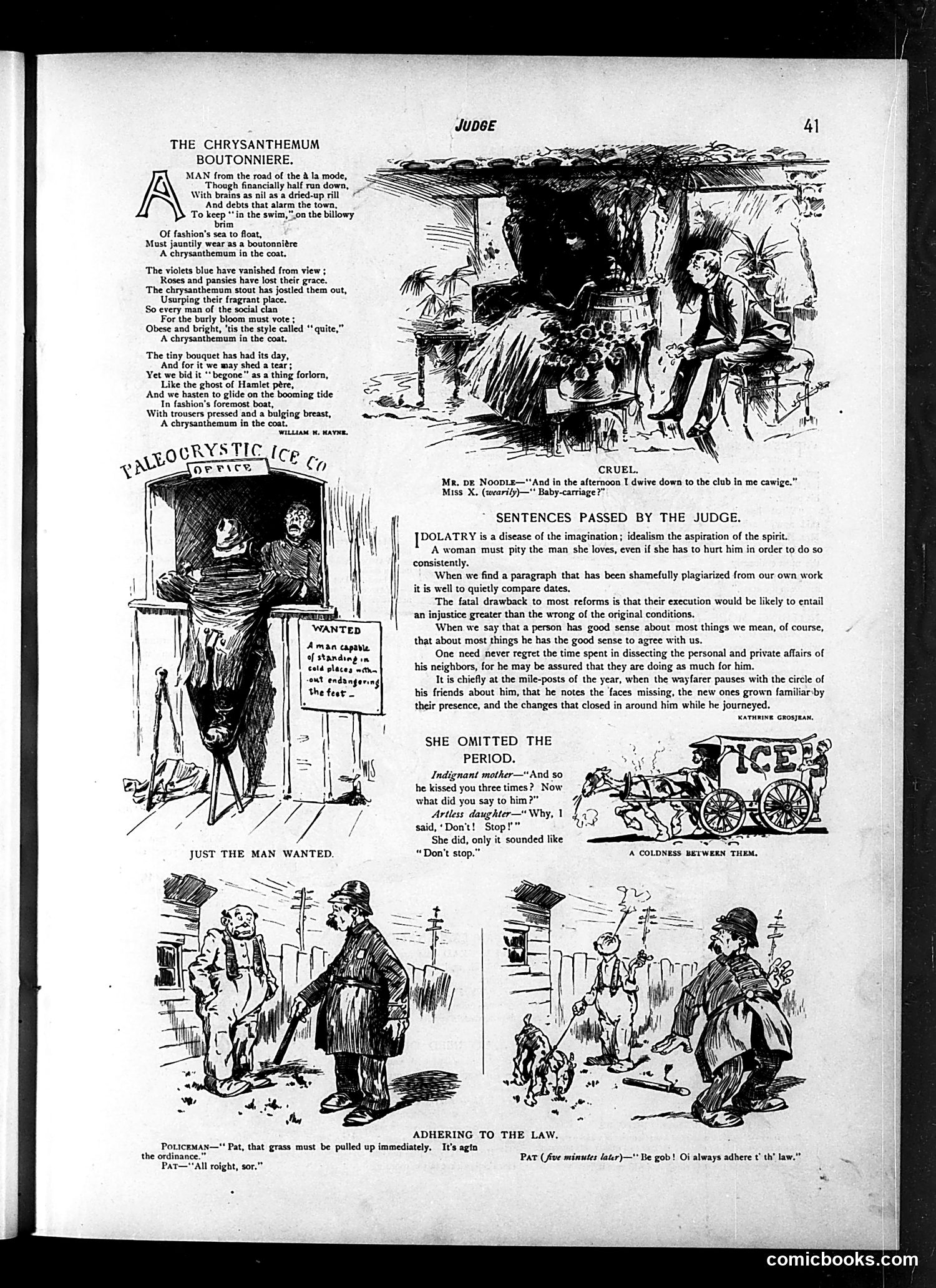
**"The Chrysanthemum Boutonniere"** mocks fashion-obsessed wealthy men who maintain appearances despite financial ruin. The poem satirizes how fashionable society men must wear chrysanthemums as buttonhole flowers to stay "in the swim"—even broke ones with "brains as nil as a dried-up rill." **"She Omitted the Period"** is a wordplay joke: a daughter tells her mother she said "Don't! Stop!" to a boy's kisses, but without the punctuation pause, it sounds like "Don't stop"—implying accidental consent. **"Adhering to the Law"** shows an Irish immigrant (Pat, suggested by dialect and name) comically misunderstanding: ordered to remove grass violating ordinance, he simply pulls it up and claims to obey the law literally—satirizing either Irish stereotypes or bureaucratic absurdity depending on intended audience. The page demonstrates *Judge*'s typical blend of social-class satire, gender humor, and ethnic caricature common to Gilded Age periodicals.
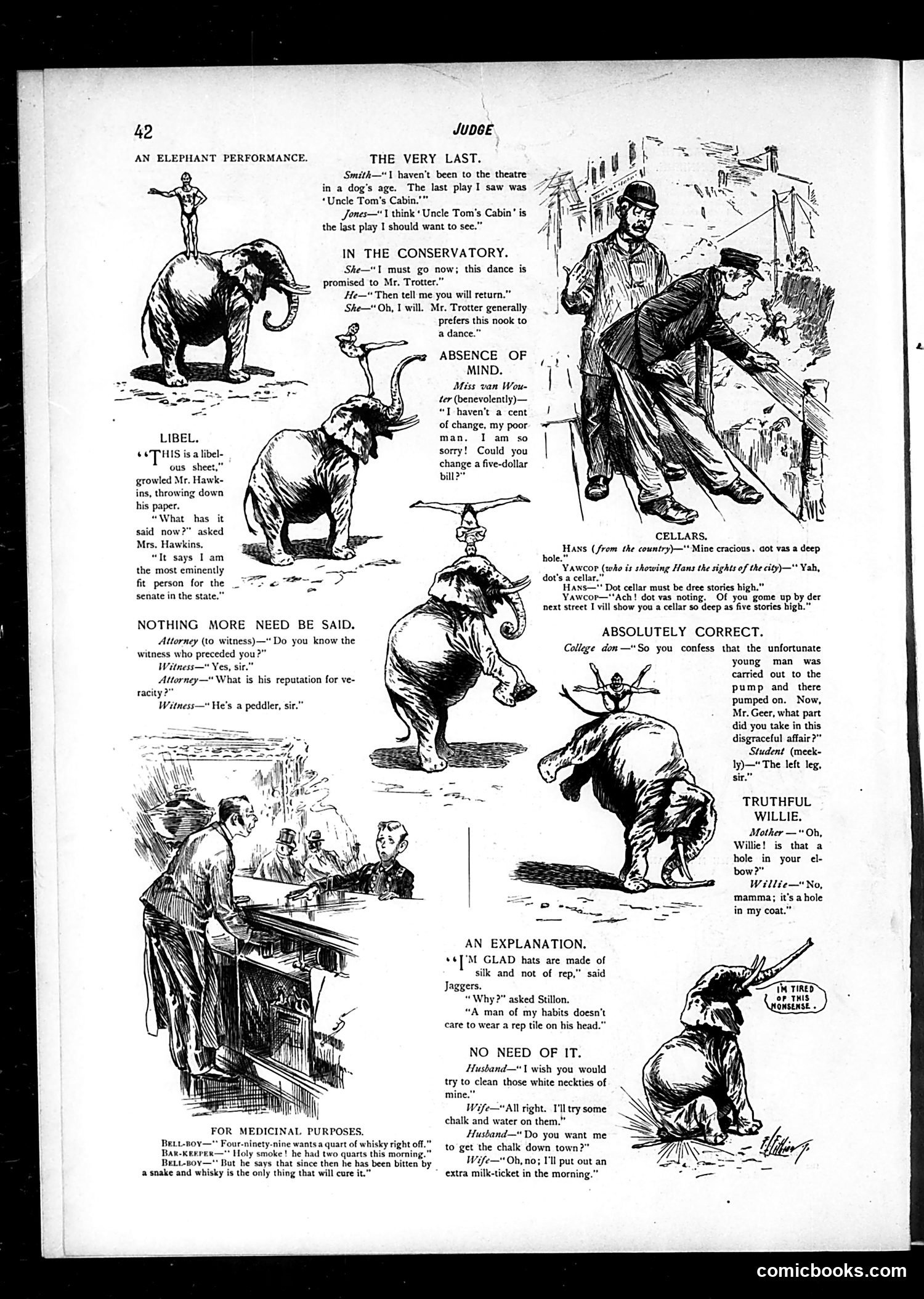
This page contains multiple short humorous sketches typical of late 19th-century American satirical magazines. The cartoons mock everyday social situations and character types: **"An Elephant Performance"** jokes about outdated theater tastes, with one character claiming *Uncle Tom's Cabin* as the last play he saw. **"Libel"** satirizes a newspaper's libel suit—a man complains the paper called him "the most eminently fit person for the senate," suggesting this is insulting rather than complimentary, mocking political corruption. **"Nothing More Need Be Said"** plays on witness credibility—a peddler's reputation for dishonesty needs no elaboration. The remaining sketches are domestic and ethnic humor: a conservatory flirtation, absent-mindedness, German immigrant characters mispronouncing "cellar," a student admitting to theft ("the left leg"), and a wife's impractical domestic solution using chalk on neckties. The elephant drawings appear decorative rather than referring to a specific political figure, though Judge frequently used elephants as Republican Party symbols during this era.
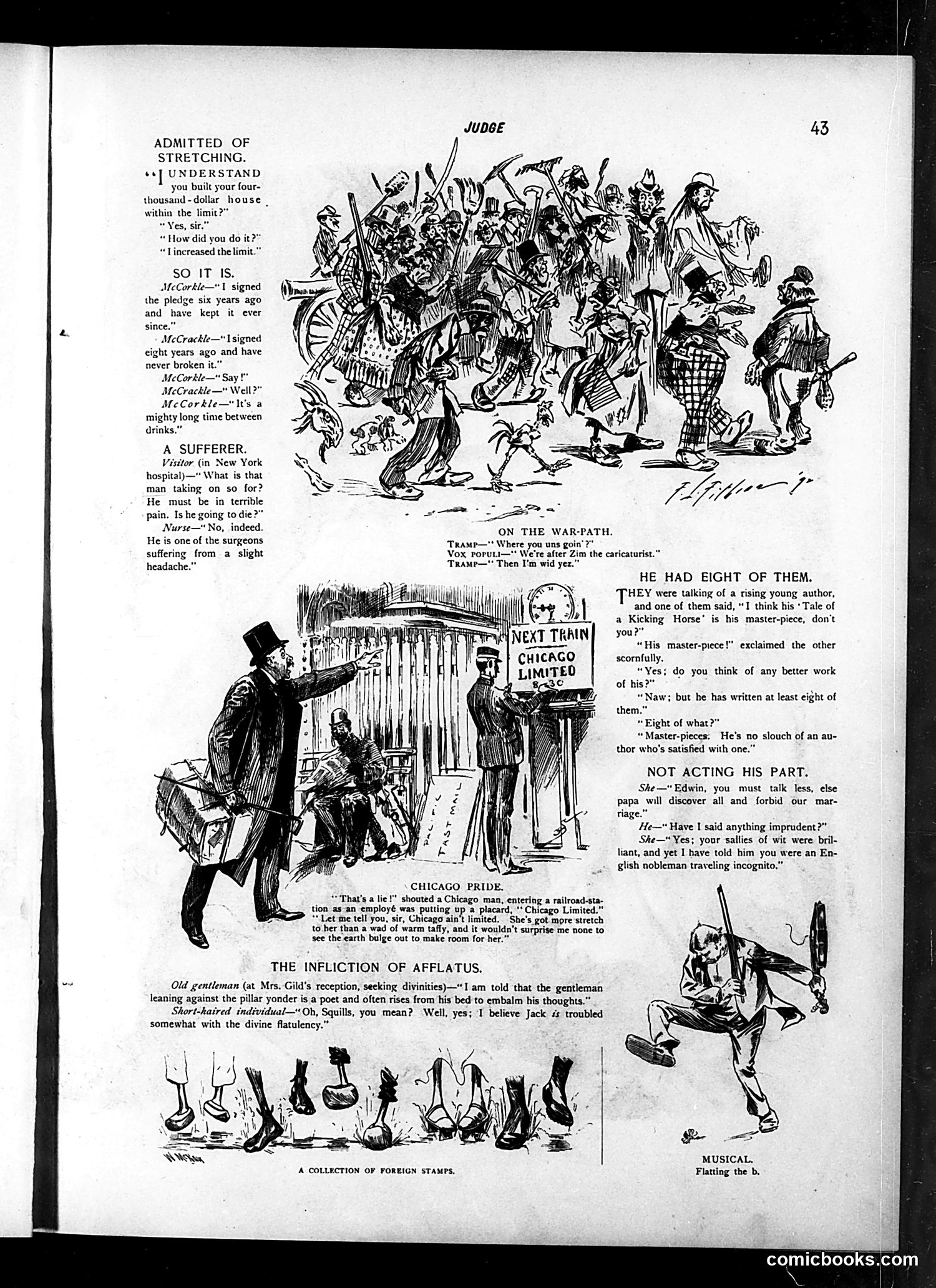
This page contains multiple brief humorous sketches typical of Judge's satirical style: **"Admitted of Stretching"**: Mocks flexible civic regulations—a man built a house exceeding zoning limits by simply "increasing the limit," satirizing corruption or lax enforcement. **"Chicago Pride"**: A Chicago railroad employee boasts that his city cannot be "limited," claiming it has infinite "stretch"—satirizing Midwestern civic boosterism and exaggerated municipal pride. **"He Had Eight of Them"**: Parodies pretentious literary criticism and an author's self-delusion. Critics debate whether his "Kicking Horse" is a masterpiece, only to learn he's written eight "master-pieces," mocking both prolific mediocrity and inflated artistic self-assessment. **"On the War-Path"**: References "Zim the caricaturist" (likely Zimmer, a Judge cartoonist), with tramps humorously pursuing him—likely self-referential satire about the magazine's own artists. **Other sketches** cover marriage deception, surgical complaints, and poetic pretension ("divine flatulency"), all employing wordplay and social observation typical of Judge's humor.
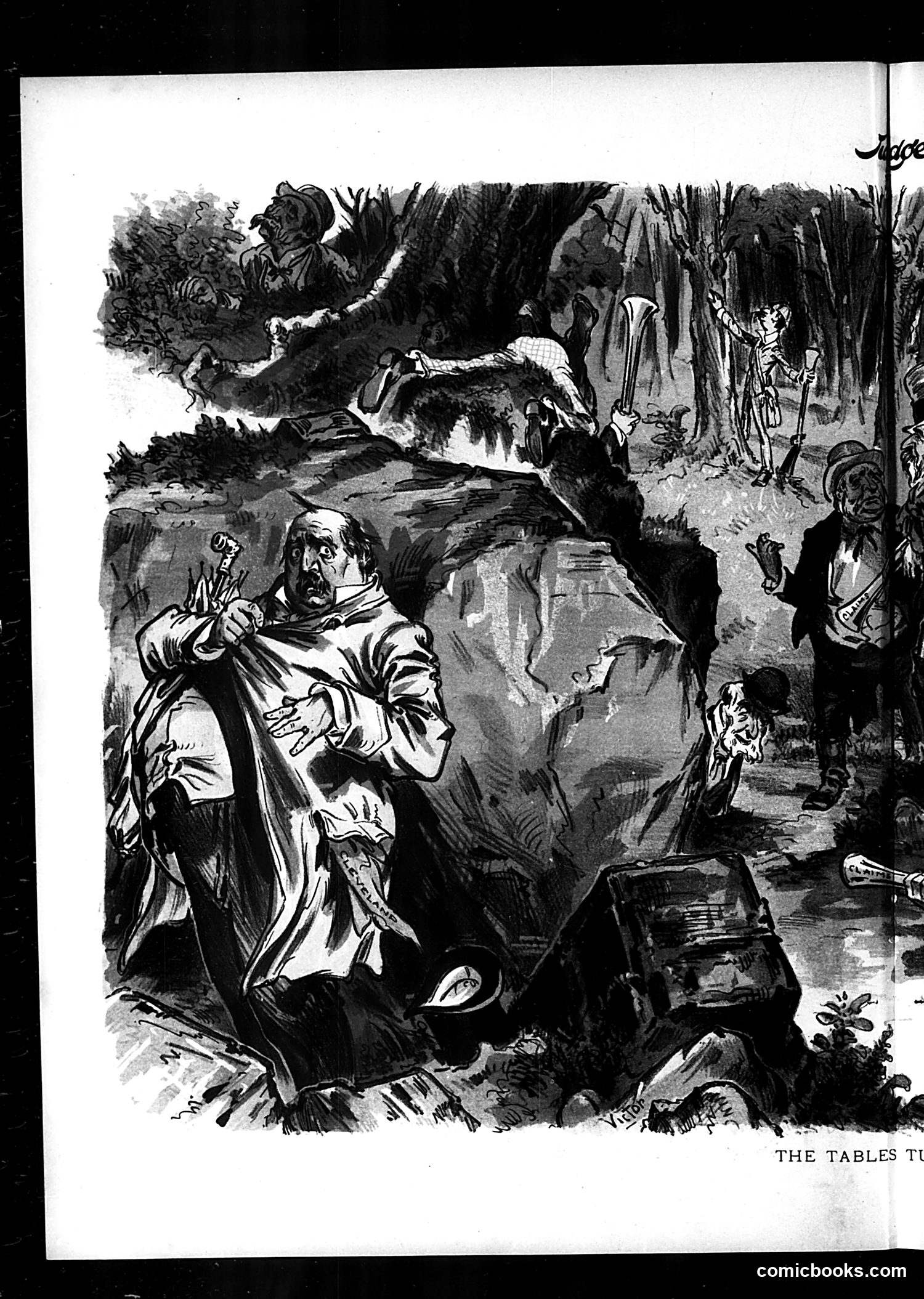
This appears to be a dramatic illustration from *Judge* magazine showing a scene of apparent conflict or confrontation in a wooded or natural setting. The main figure in the foreground displays exaggerated facial features characteristic of period satirical art, and appears distressed or alarmed. Multiple other figures are visible in the background among trees. The partial title "THE TABLES T[URNED]" suggests a reversal of fortune or roles. However, **without the complete text or caption, I cannot identify the specific political or social reference this cartoon addresses.** The style and composition suggest commentary on a particular incident or social situation, but the incomplete OCR text and lack of visible caption prevent me from determining which figures are caricatured or what specific event is being satirized.
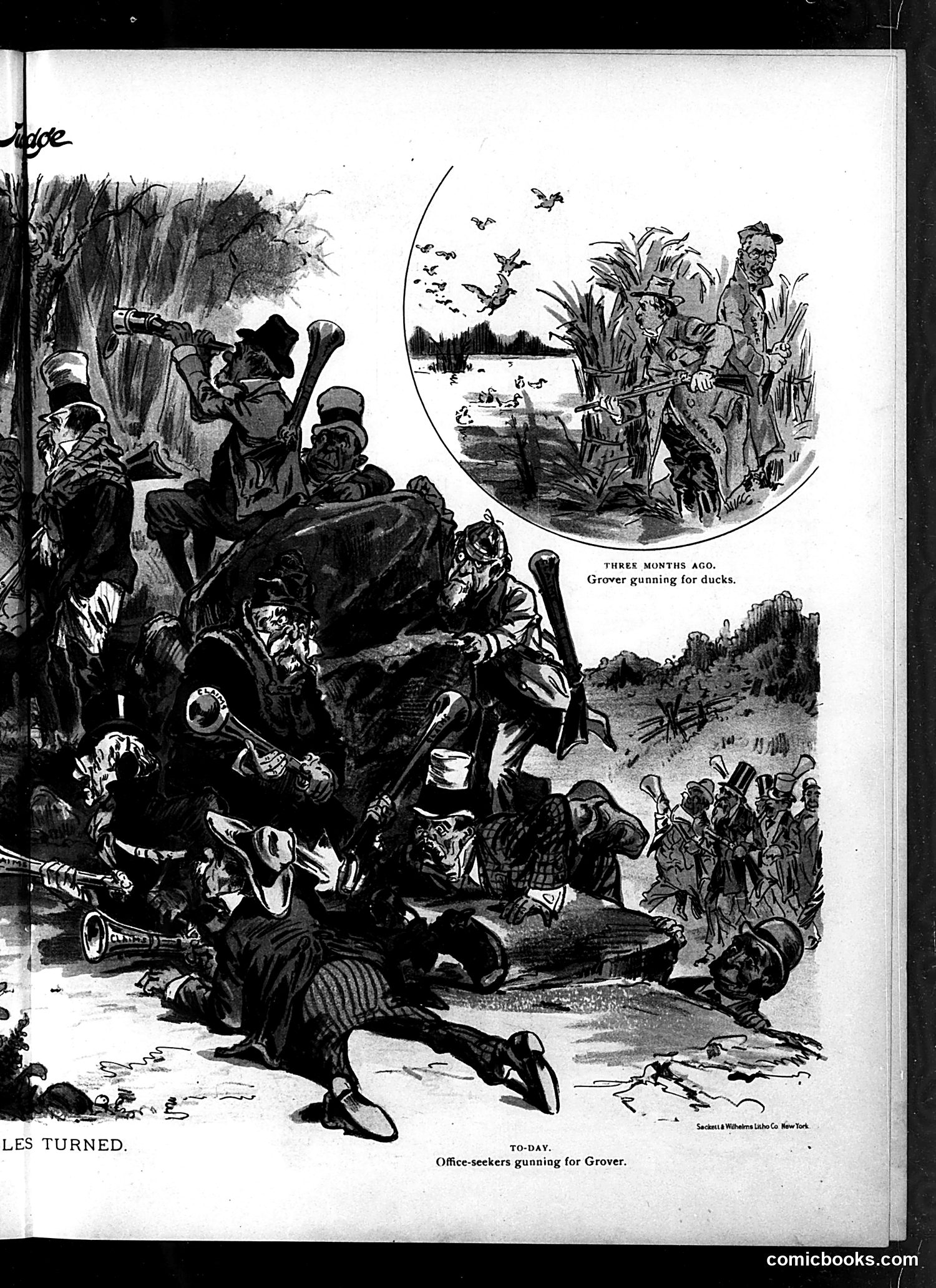
This Judge magazine cartoon uses a before-and-after comparison to satirize President Grover Cleveland's changing fortunes. **Top panel ("Three Months Ago"):** Cleveland leisurely hunts ducks—depicted as carefree and in control. **Bottom panel ("To-Day"):** The imagery inverts: Cleveland is now hunted by "office-seekers" (politicians and appointees seeking government positions), shown as aggressive armed figures pursuing him. The satire suggests Cleveland's presidency has shifted from a position of power to one where he's besieged by patronage-hungry politicians demanding positions. The "Les Turned" (tables turned) caption reinforces this reversal of power dynamics. This likely references Cleveland's handling of civil service reform or appointment politics during his presidency, showing how quickly political fortunes can reverse.
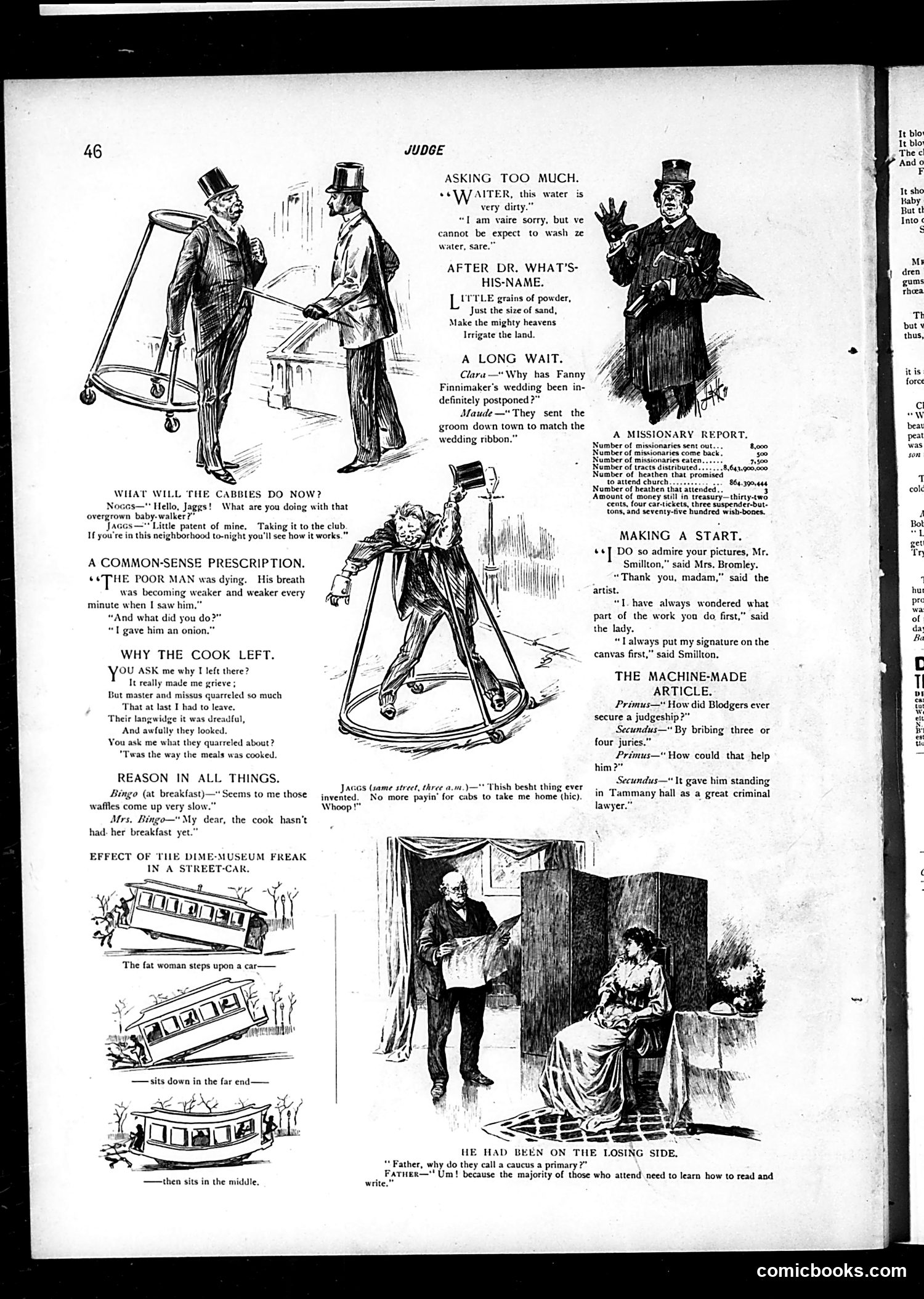
This page from the satirical magazine *Judge* contains multiple short jokes and cartoons mocking various social issues of the era (likely early 1900s): **Key Content:** - **"What Will the Cabbies Do Now?"** jokes about a new baby-carriage design, implying it might replace horse-drawn cab services - **Social satire** includes mockery of servants (cooks leaving over domestic quarrels), class hierarchies, and ineffectual remedies - **"Effect of the Lime-Museum Freak in a Street-Car"** shows a humorous sequence of a streetcar tipping when a heavy woman boards—visual slapstick humor - **"The Machine-Made Article"** critiques Tammany Hall (NYC's corrupt political machine), suggesting judges were obtained through bribery and that primary voters were illiterate - **"A Missionary Report"** satirizes missionary organizations' inflated claims and poor financial management The humor relies on class stereotypes (immigrant dialect in the water-waiter joke), physical comedy, and **political corruption** references. Overall, it's period satire targeting inefficiency, fraud, and social hypocrisy.
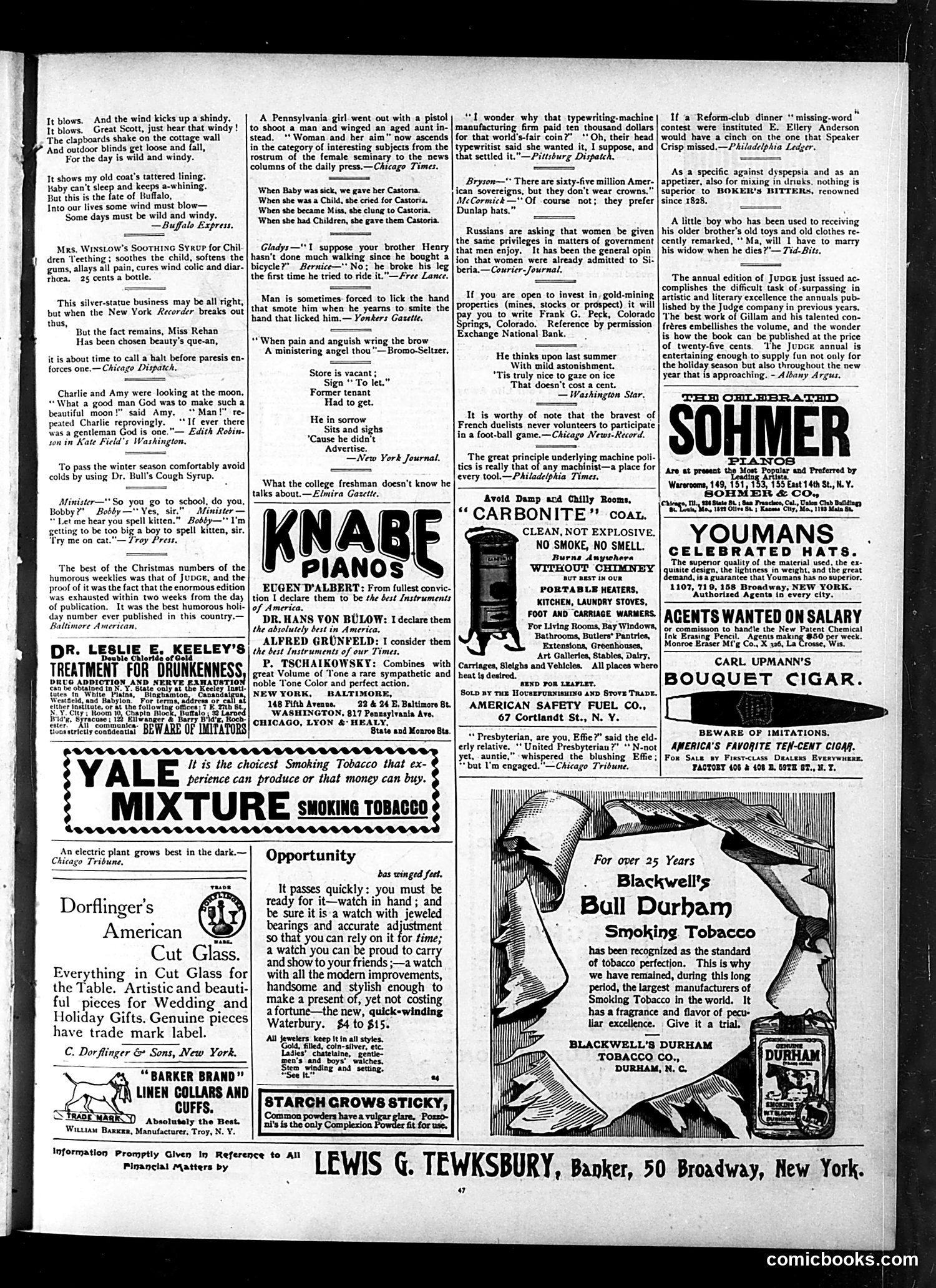
This is primarily an **advertising and miscellaneous content page** rather than a political cartoon page. The layout consists mostly of advertisements and brief humorous excerpts typical of Judge magazine's format. The notable content includes: **Humorous snippets:** Short jokes and observations about everyday life—a windy day in Buffalo, a woman shooting at a man and hitting her aunt (commentary on "woman and her aim"), a college freshman who talks about things he doesn't understand. **Advertisements:** Prominent ads for Knabe Pianos (with endorsements from composers), Carbonite Coal, Yale Smoking Tobacco, Blackwell's Bull Durham Tobacco, Dorfinger's Cut Glass, and various patent medicines (Mrs. Winslow's Soothing Syrup, Dr. Bull's Cough Syrup, Bromo-Seltzer, Dr. Keeley's treatment for drunkenness). **Context for modern readers:** The page reflects late 19th-century American consumer culture and advertising saturation, along with light social humor about gender, technology (bicycles), and domestic life. There are no identifiable political figures or significant satire—this appears to be a typical Judge filler/advertisement page.
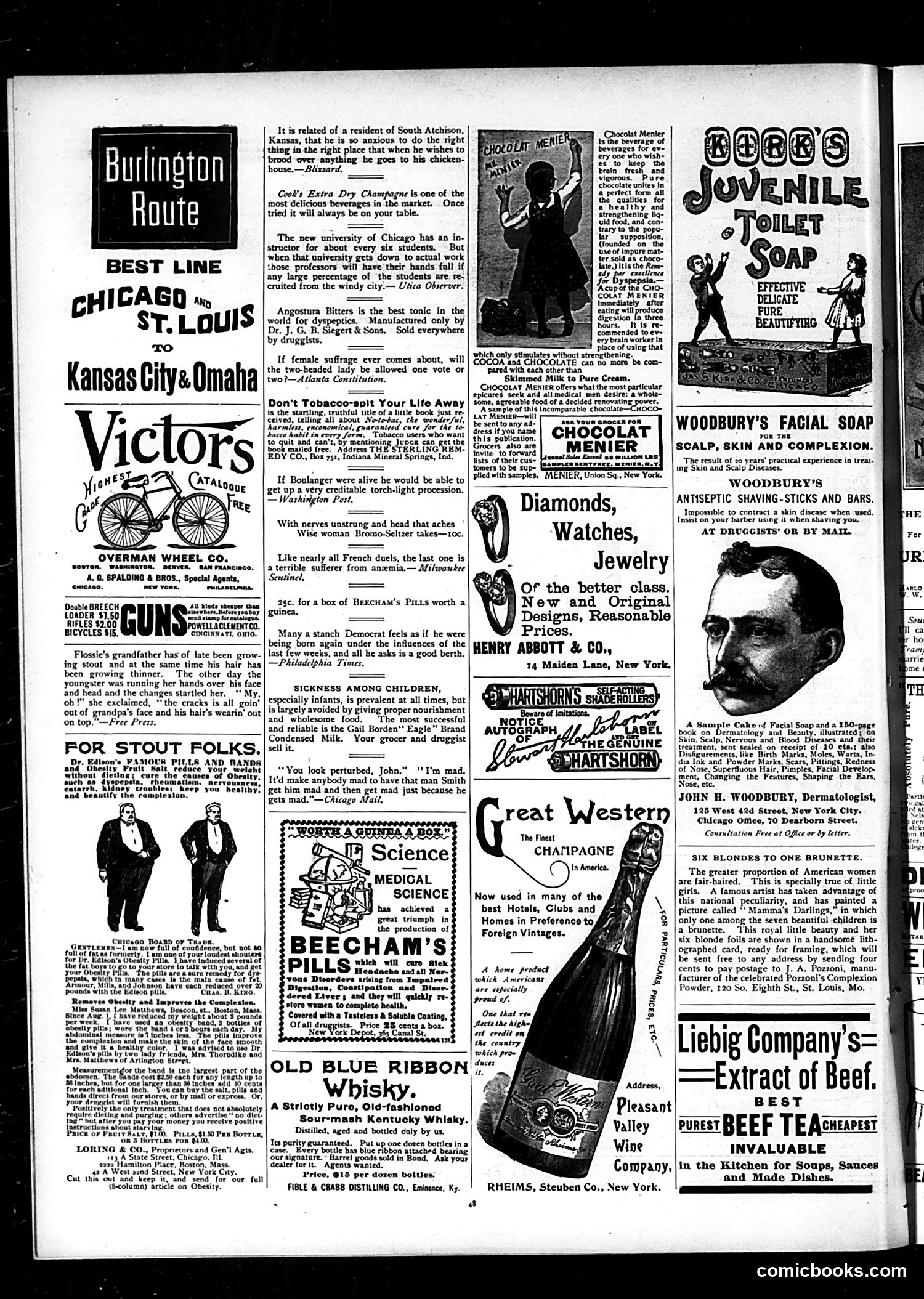
This page is primarily **advertising**, with brief humorous anecdotes interspersed. The actual satirical content is minimal. The main visual element is "FOR STOUT FOLKS," advertising obesity pills and a reduction band, featuring testimonials from people claiming weight loss. This reflects late-19th-century attitudes toward body image and patent medicine marketing. The scattered jokes are period commentary: - A reference to **Boulanger** (likely General Georges Boulanger, French political figure) suggests outdated relevance by the article's date - Quips about women's suffrage ("If female suffrage...will the two-headed lady...") reflect contemporary debates - Jokes about the University of Chicago and Kansas reflect regional stereotypes The remainder comprises patent medicine, bicycle, and whisky advertisements typical of Judge's revenue model. No significant political cartoons appear on this page—it's essentially a standard advertising-heavy issue of a satirical magazine from the 1890s era.
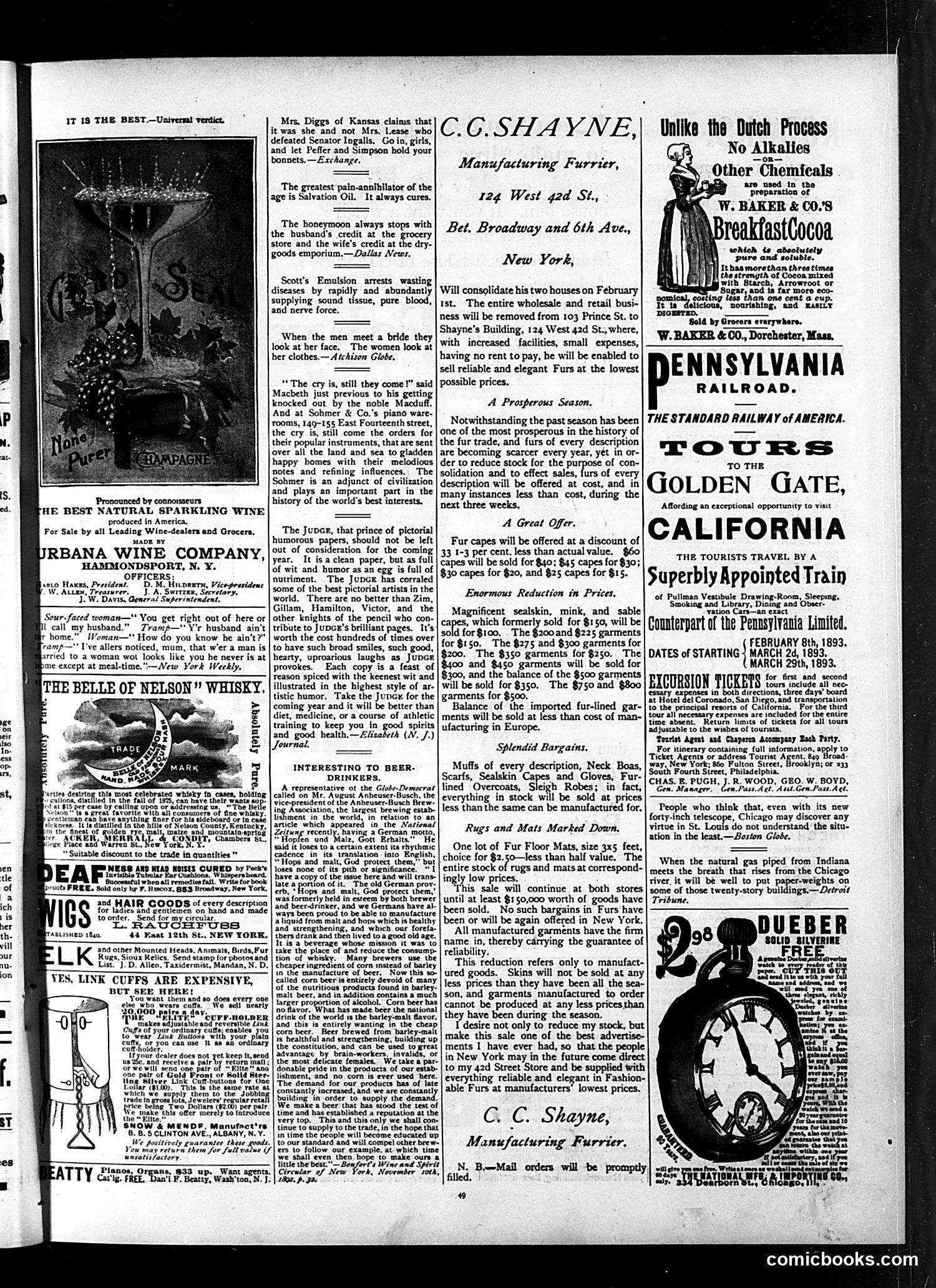
This page is primarily **advertising with minimal editorial cartoon content**. The main visual humor appears in a small domestic scene showing a sour-faced woman confronting her husband about coming home late. The joke relies on the tired trope that an unattractive wife drives her husband away from home—the wife assumes her husband avoids her because of her appearance. The page is dominated by **late 19th-century advertisements** for products like wine, whiskey, breakfast cocoa, railroad tours to California, cuff holders, and hair goods. These ads reflect the commercial nature of Judge magazine, which subsidized satirical content through extensive advertising. The scattered **editorial fragments** discuss minor social gossip (Mrs. Diggs vs. Mrs. Lease in Kansas politics) and cynical observations about marriage and consumer culture typical of Judge's satirical tone. The overall page demonstrates how satirical magazines of this era balanced editorial humor with commercial revenue.
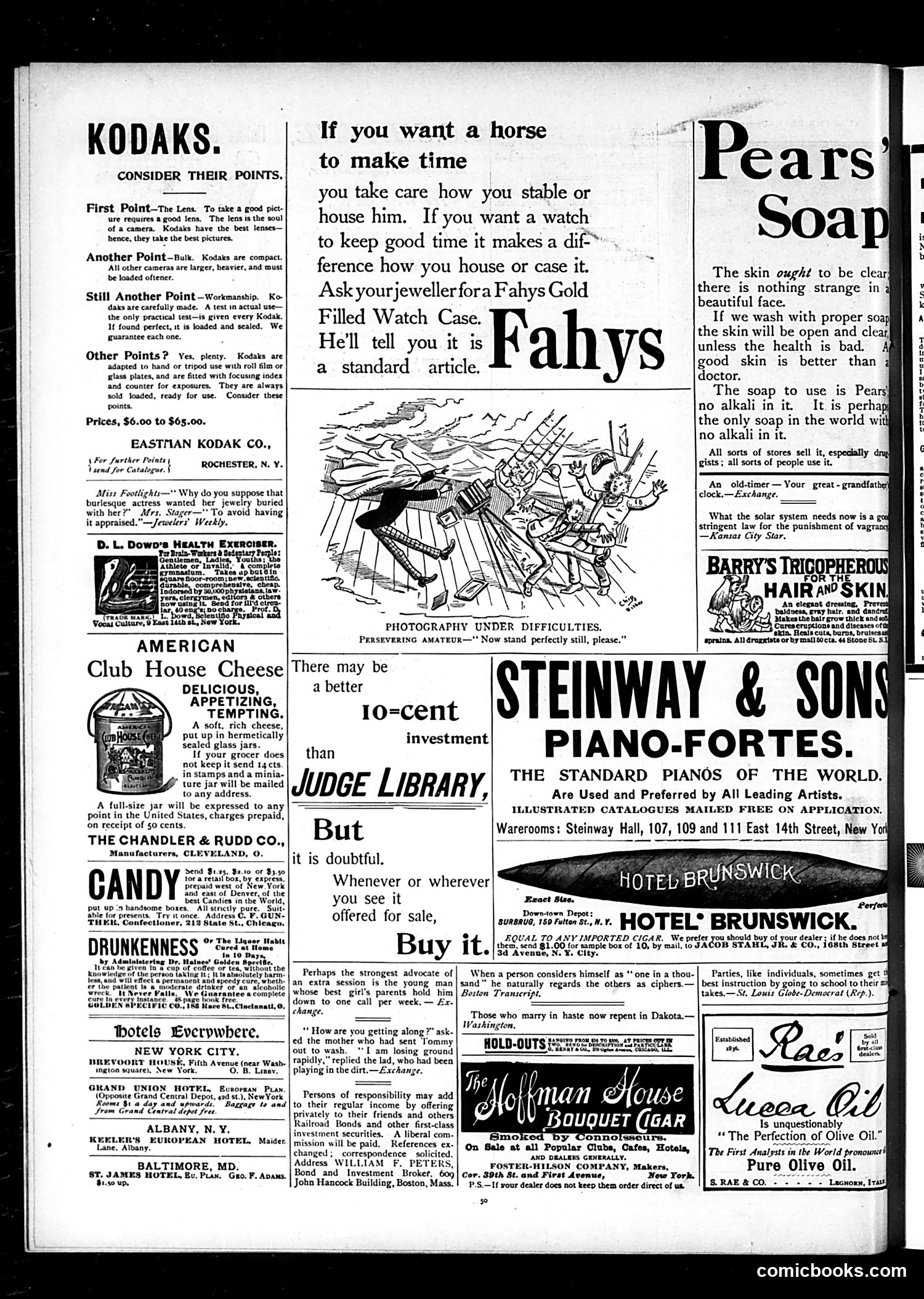
This page is primarily **advertisements** with one modest cartoon. The main visual content is a sketch labeled "PHOTOGRAPHY UNDER DIFFICULTIES," showing an amateur photographer struggling with his camera and tripod—a gentle joke about the awkwardness of early photography equipment. The advertisements promote late 19th/early 20th-century consumer goods: Kodak cameras (emphasizing portability and reliability), Fahys watch cases, Pears' Soap (notably "no alkali"), Steinway pianos, and various other products. These ads reveal period consumer anxieties: the need for quality products, reliability, and proper maintenance. One text joke mocks a burlesque actress wanting jewelry buried with her to avoid appraisal—commentary on vanity and insurance fraud concerns of the era. The page also includes a quote about young men constrained by strict courtship rules (calling once weekly)—reflecting Victorian social customs around romance and parental control. Overall, this reflects Judge's mix of light satire, product advertising, and period social commentary targeting affluent readers.
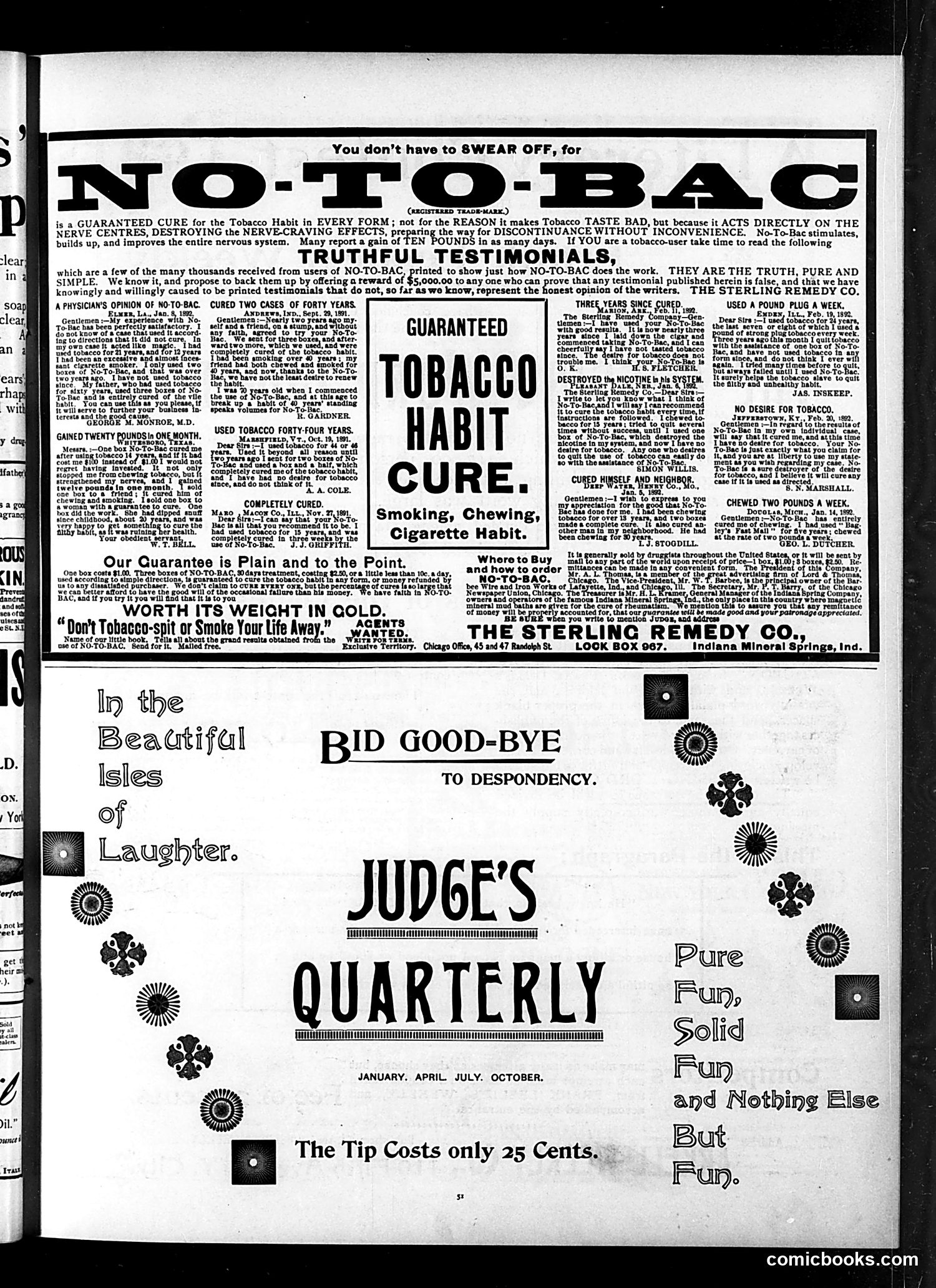
This page is **primarily a patent medicine advertisement**, not a political cartoon. It promotes "No-To-Bac," a guaranteed cure for tobacco addiction claiming to act directly on nerve centers to eliminate cravings. **Key elements:** - **The product promise**: Users need not "swear off" tobacco; the remedy works by destroying nerve-craving effects rather than making tobacco taste bad - **Marketing strategy**: Multiple testimonials from alleged users (dated 1882-1892) claiming successful cures after decades of heavy use (40-year habits, "pound plugs a week") - **The guarantee**: $5,000 reward offered to anyone proving testimonials false - **Bottom section**: An unrelated advertisement for *Judge's Quarterly* magazine **Historical context for modern readers**: This reflects the late 19th-century patent medicine era when unregulated products made extravagant health claims with fabricated testimonials. The emphasis on "truthful" testimonials and monetary guarantees was a common—but frequently fraudulent—sales tactic. No regulatory bodies like the FDA existed to verify such claims.
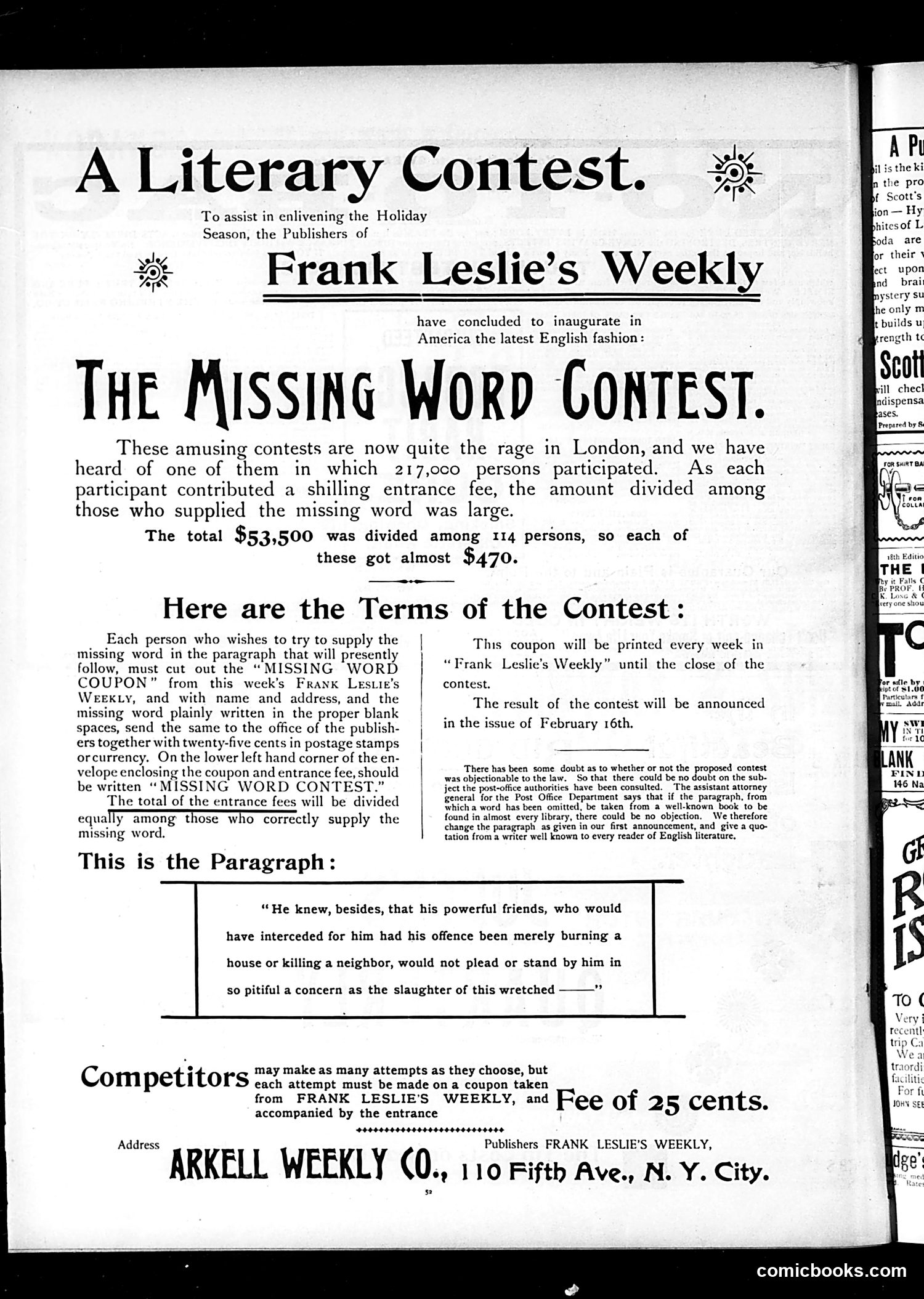
This is primarily **advertising content**, not a political cartoon. Frank Leslie's Weekly is promoting "The Missing Word Contest," a literary game modeled on a popular English fashion that had drawn 217,000 participants in London. The contest mechanics are straightforward: readers pay 25 cents, cut out a coupon, fill in a missing word from a provided paragraph (sourced from an unnamed "well-known book"), and submit their answer. Prize money from all entrance fees—totaling $53,500 in the London version, divided among 114 winners—goes to those who guess correctly. The paragraph excerpt concerns someone whose "powerful friends" would help if he'd merely burned a house or killed a neighbor, but won't aid him regarding "the slaughter of this wretched"—the final word omitted. **Historical context**: This reflects how newspapers monetized reader engagement through contests before modern sweepstakes regulations. The Post Office Department's approval is noted, suggesting legal scrutiny of such schemes was already emerging. The mechanics parallel modern puzzle contests, though the stakes and participation were notably different.
This page is primarily **advertisements** from a late 19th-century publication, with small humorous filler pieces between ads. The **satirical content** includes brief jokes: - A street-car quip about farmers (implying they rise early, so wouldn't be riding at this hour) - Two "dudes" discussing missed social recognition while wearing eye-glasses - A complaint about the pronunciation of "chrysanthemum" - A joke about a slow horse being perfect for an elopement These are **mild social humor** targeting contemporary urban life: the pretensions of wealthy "dudes," pronunciation anxieties among the genteel class, and rural/urban contrasts. The **advertisements** reveal period concerns: Scott's Emulsion (consumption/tuberculosis treatment), tobacco-habit cures, hair products, and notably, a secret remedy (Hilton's Chloride of Gold tablets) to destroy tobacco desire without the user's knowledge—reflecting both addiction struggles and paternalistic attitudes toward medical consent. No political cartoons appear on this page.
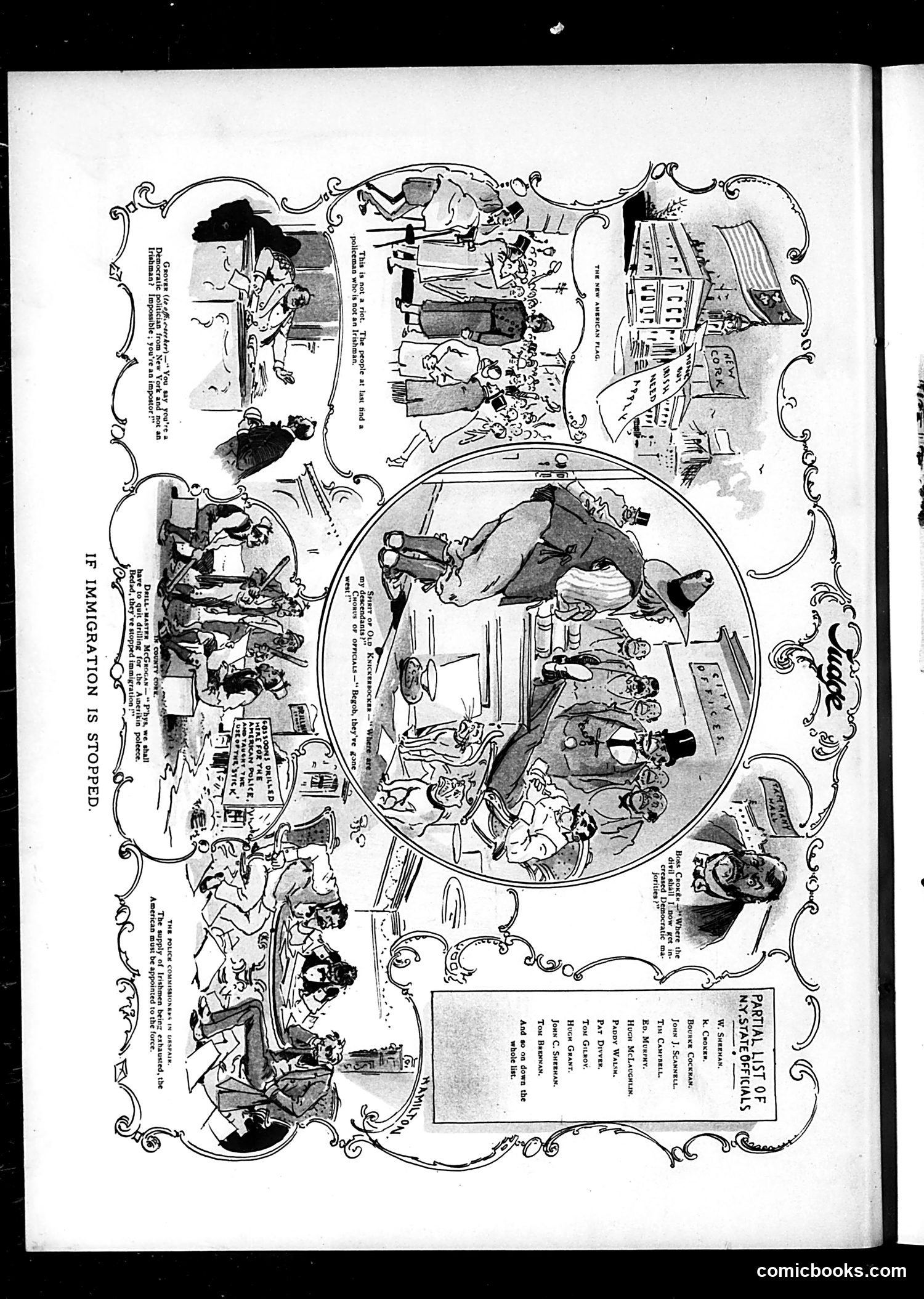
This Judge magazine satirical illustration presents a dark comedic scenario imagining consequences of halting immigration to America. The central large circle depicts an idealized domestic scene, while surrounding vignettes show exaggerated outcomes. The cartoon appears to critique restrictionist immigration policies by sarcastically depicting what proponents claimed would happen—presumably showing Americans forced into manual labor, domestic work, and other jobs traditionally filled by immigrants. The ornate decorative border frames multiple scenes suggesting various occupations and social disruptions. Without being able to read all OCR text clearly, the satire's point seems to be mocking nativist arguments by showing how stopping immigration would supposedly transform American life, likely suggesting such claims were impractical or absurd. This reflects early 20th-century debates about immigration restriction that culminated in 1920s-era quota systems.