
Judge, 1893-01-21 · page 5 of 18
Judge — January 21, 1893 — page 5: what you’re looking at
What you’re looking at
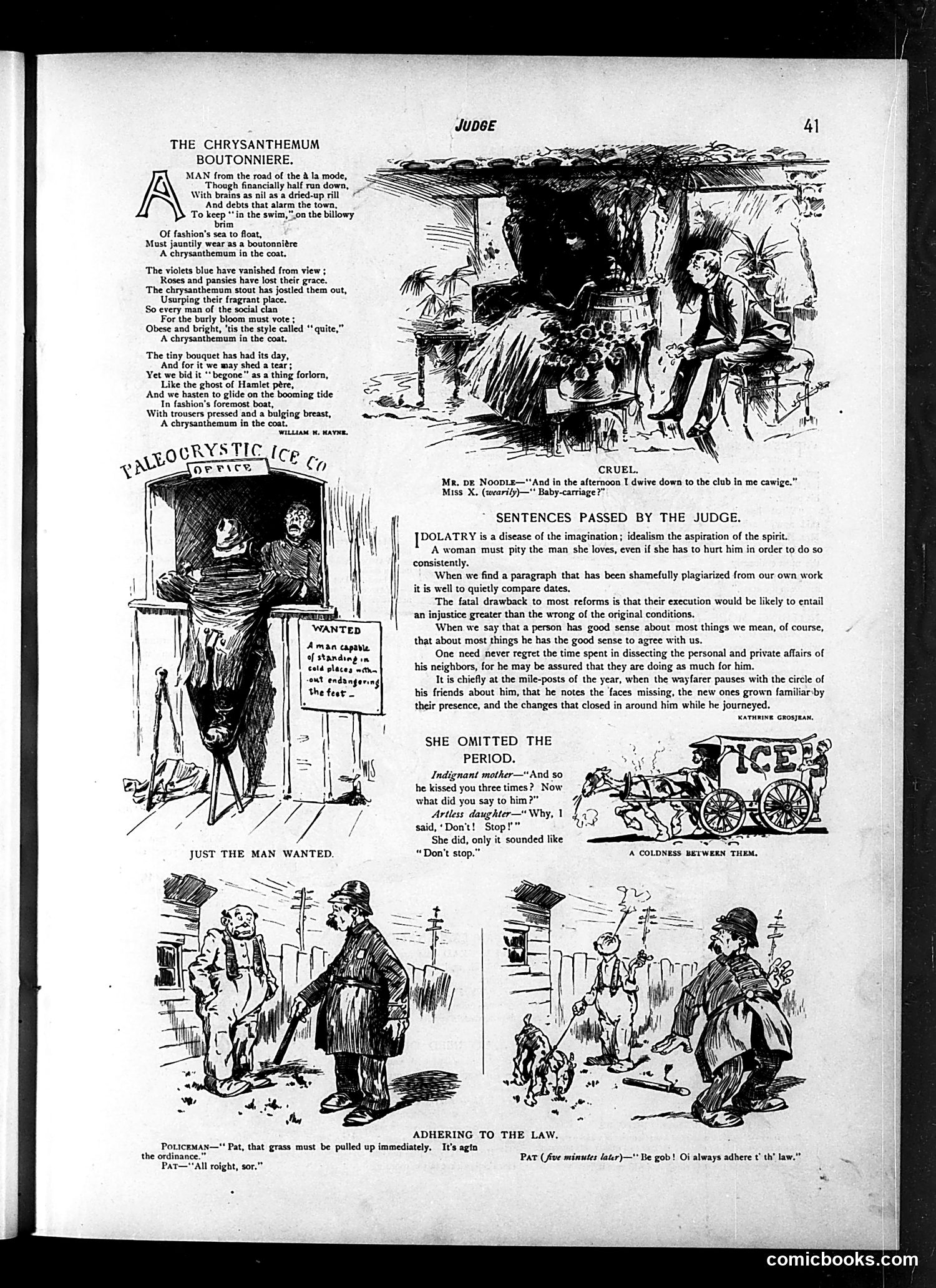
**"The Chrysanthemum Boutonniere"** mocks fashion-obsessed wealthy men who maintain appearances despite financial ruin. The poem satirizes how fashionable society men must wear chrysanthemums as buttonhole flowers to stay "in the swim"—even broke ones with "brains as nil as a dried-up rill." **"She Omitted the Period"** is a wordplay joke: a daughter tells her mother she said "Don't! Stop!" to a boy's kisses, but without the punctuation pause, it sounds like "Don't stop"—implying accidental consent. **"Adhering to the Law"** shows an Irish immigrant (Pat, suggested by dialect and name) comically misunderstanding: ordered to remove grass violating ordinance, he simply pulls it up and claims to obey the law literally—satirizing either Irish stereotypes or bureaucratic absurdity depending on intended audience. The page demonstrates *Judge*'s typical blend of social-class satire, gender humor, and ethnic caricature common to Gilded Age periodicals.
📄 Transcribed text from this page (OCR, searchable)
Machine-transcribed from the original scan — historical spelling and the odd misread are preserved.
THE CHRYSANTHEMUM BOUTONNIERE. MAN from the road of the & la mode, ‘Thoogh financially half ran down, With brains as nil as a dried-up rill" ¢ And debts that alarm the town, To keep “‘in the swim,”,on the billowy brim Of fashion’s sea to float, Must jauntily wear as a boutonnitre ‘A chrysanthemum in the coat. ‘The violets blue have vanished from view ; Roses and pansies have lost their grace. The chrysanthemum stout has jostled them out, Usurping their fragrant place. So every man of the social clan For the burly bloom must vote ; Obese and bright, ‘tis the style called “quite,” ‘A chrysanthemum in the coat. The tiny bouquet has had its day, ‘And for it we may shed a tear; Yet we bid it ‘*begone” as a thing forlorn, Like the ghost of Hamlet pére, ‘And we hasten to glide on the booming tide In fashion’s foremost boat, With trousers pressed and a bulging breast, ‘A chrysanthemum in the coat. Mr. pr NoopLe—"‘And in the afternoon I dwive down to the club in me cawige.”” Miss X. (wearily) —"* Baby-carriage?” SENTENCES PASSED BY THE JUDGE. [DOLATRY is a disease of the imagination; idealism the aspiration of the spirit. A woman must pity the man she loves, even if she has to hurt him in order to do so consistently. When we find a paragraph that has been shamefully plagiarized from our own work it is well to quietly compare dates. The fatal drawback to most reforms is that their execution would be likely to entail an injustice greater than the wrong of the original conditions. When we say that a person has good sense about most things we mean, of course, Deracrin that about most things he has the good sense to agree with us. ; : of standiep vm One need never regret the time spent in dissecting the personal and private affairs of sald places c his neighbors, for he may be assured that they are doing as much for him. out endangering It is chiefly at the mile-posts of the year, when the wayfarer pauses with the circle of the feet his friends about him, that he notes the faces missing, the new ones grown familiar:by their presence, and the changes that closed in around him while he journeyed. XATHRINE GROSJRAN. SHE OMITTED THE PERIOD. Indignant mother—"And so he kissed you three times? Now what did you say to him?” Artless daughter—" Why, 1 said, ‘Don't! Stop!'” She did, only it sounded like “Don’t stop.” ADHERING TO THE LAW. Poriceman—"* Pat, that grass must be pulled up immediately. It’s agin the ordinance.” Pat (five minutes later)—* Be gob! Oi always adhere t’ th’ law.” PaT—"Alll roight, sor.” comicbooks.com