
A complete issue · 18 pages · 1892
Judge — December 17, 1892
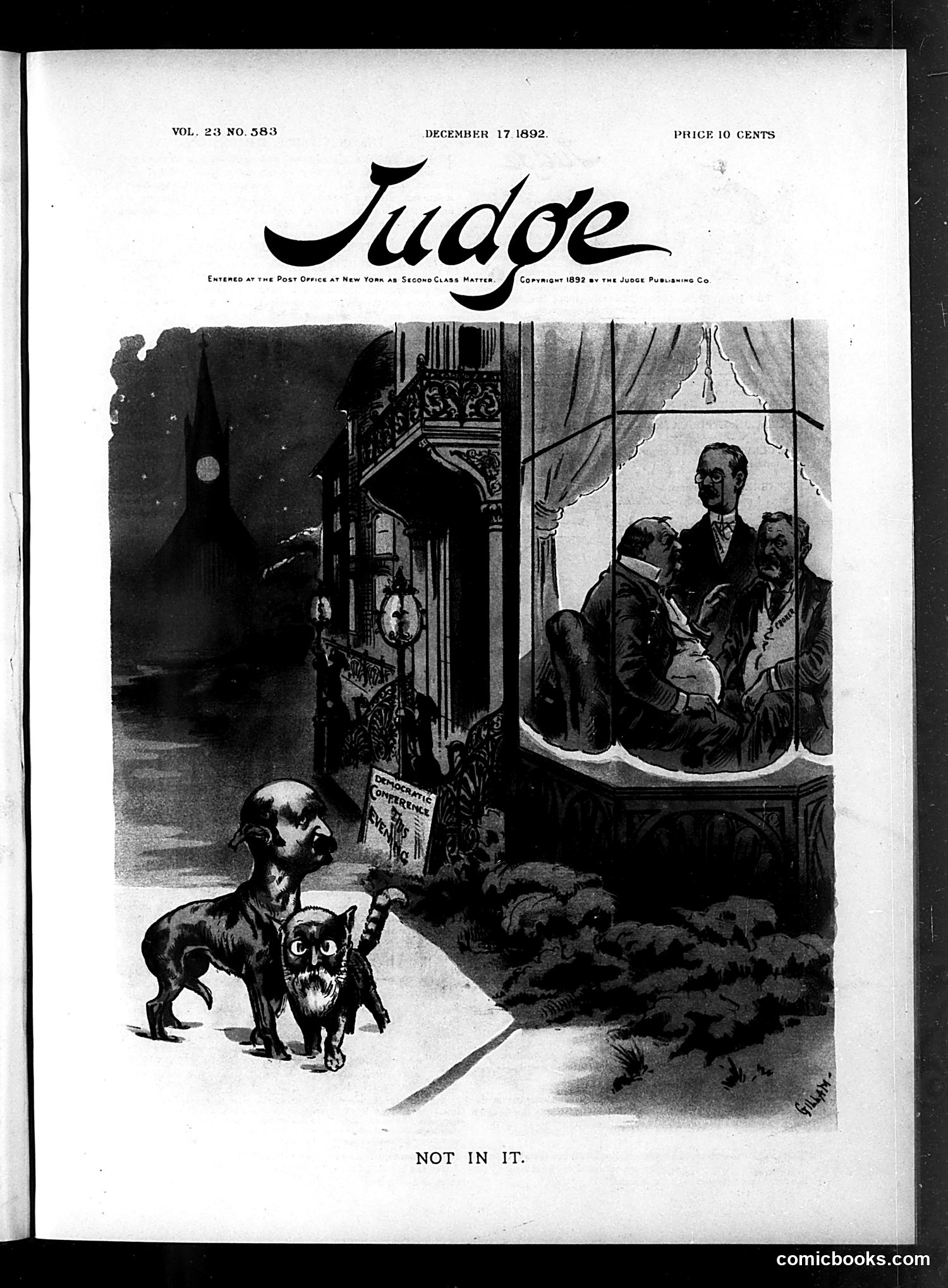
This cartoon satirizes someone's exclusion from a desirable social or political position. The image shows a demonic or devilish figure with an owl—symbolic of foolishness or dark deception—standing outside in the cold and snow, looking in through a window at well-dressed gentlemen gathered warmly indoors around what appears to be a formal meeting or celebration. The title "Not In It" suggests the excluded figure sought admission to this exclusive group but was rejected. Without additional context identifying the specific figures or event referenced, the cartoon's exact political target remains unclear, though it likely mocks a prominent public figure's failed attempt at gaining acceptance into an important position or organization during the 1892 period.
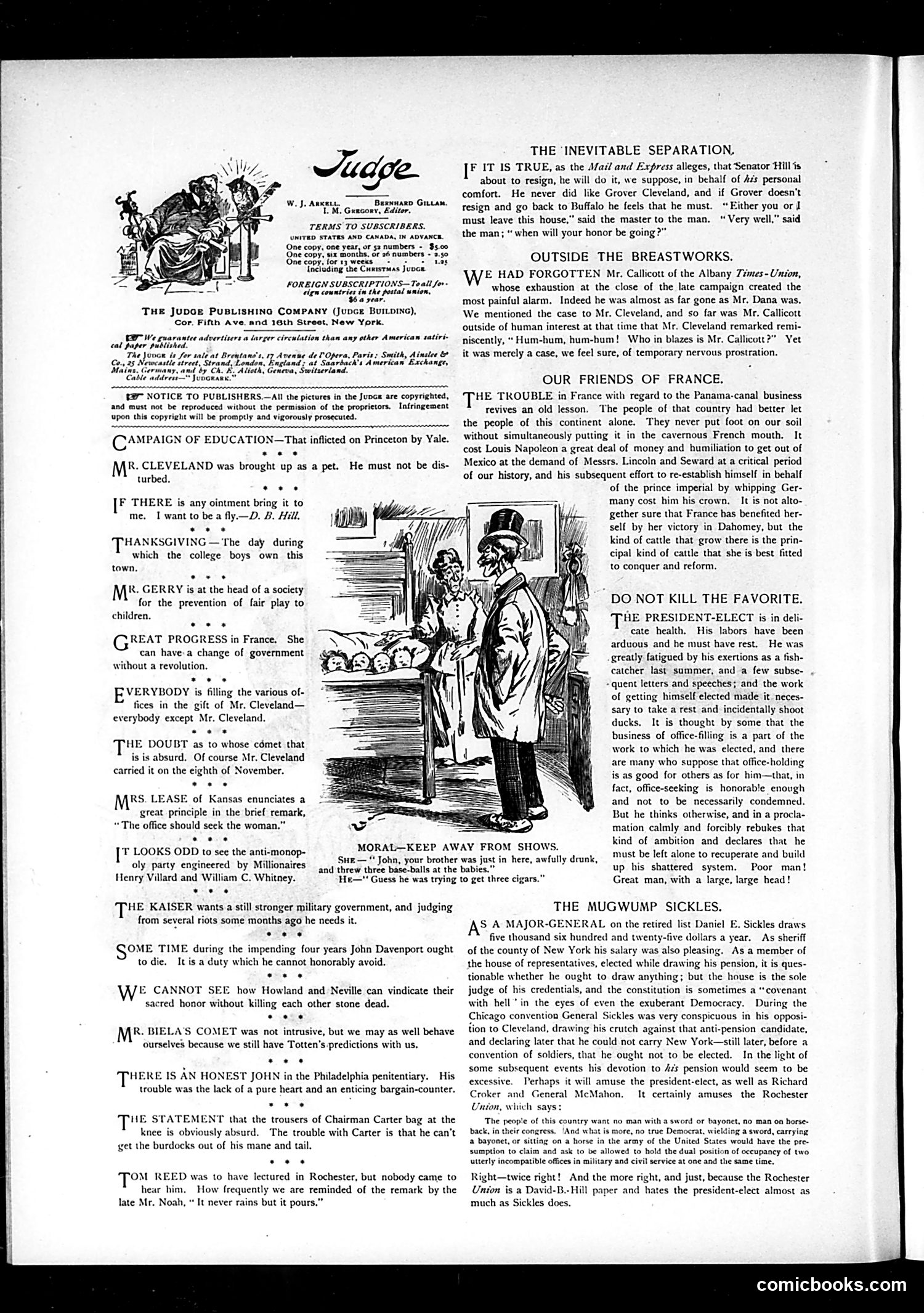
This page contains editorial commentary rather than a single cartoon. The main illustration shows two men in conversation outside "breastworks" (fortifications), likely referencing Civil War-era politics. The text discusses Cleveland (appearing to reference President Grover Cleveland), criticizing his health and suggesting he shouldn't seek re-election. References to "office-filing" and "office-seeking" satirize bureaucratic ambition. Another section critiques General Daniel E. Sickles, a Civil War figure, regarding his credentials and political conduct—apparently he sought a diplomatic position. The page mixes commentary on American political figures with criticism of ambition, health fitness for office, and military-civilian role confusion. Without dated context visible, the specific election year remains unclear, though Cleveland's political situation is central to the satire.
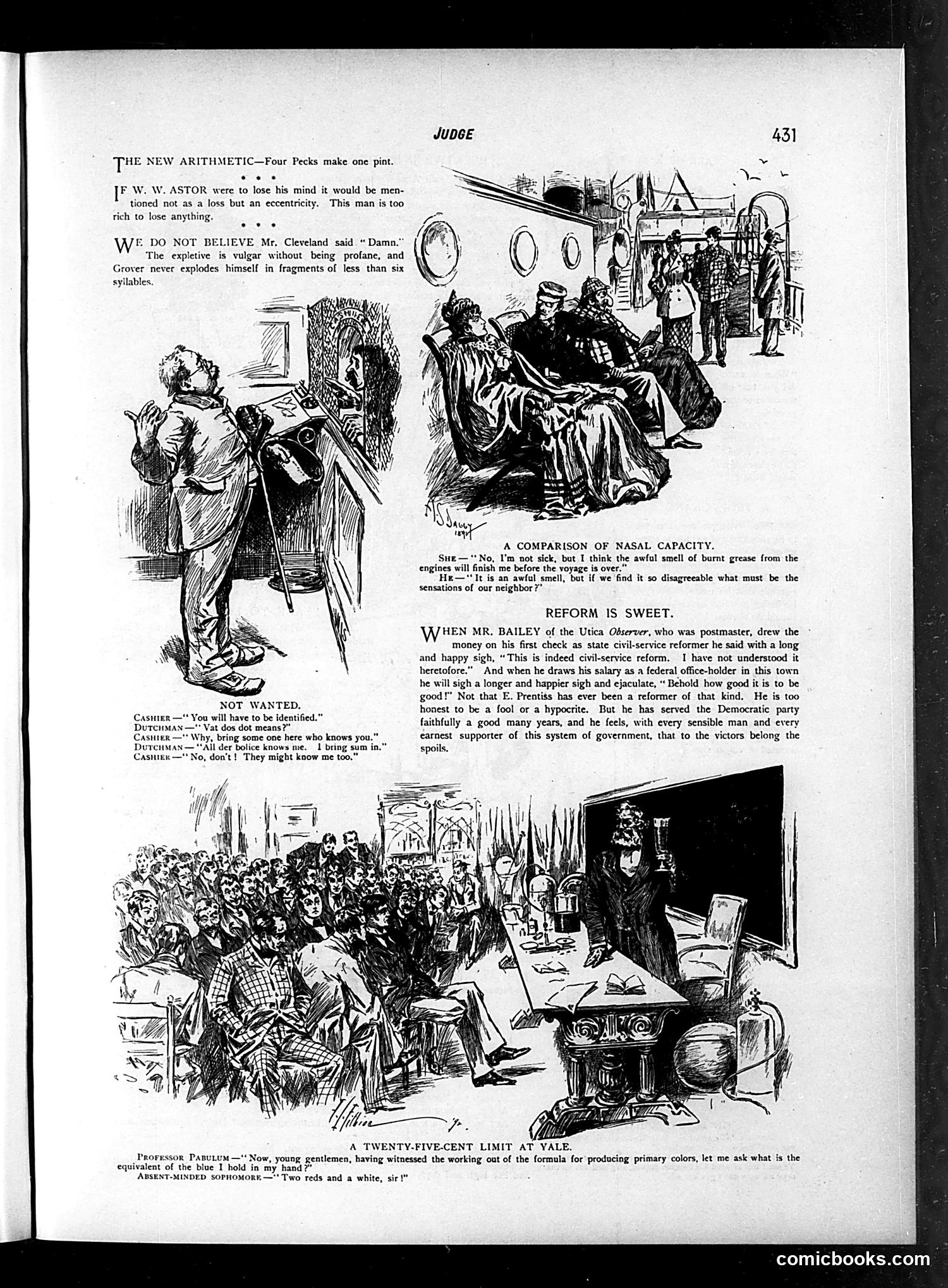
This page contains four separate satirical pieces: 1. **"The New Arithmetic"** mocks W.W. Astor's wealth, suggesting his financial status should be counted as an "eccentricity" rather than a loss. 2. **"We Do Not Believe"** criticizes Cleveland's use of profanity, noting Grover Cleveland "never explodes himself in fragments of less than six syllables." 3. **"A Comparison of Nasal Capacity"** uses a ship illustration to joke about unpleasant smells from passengers. 4. **"Reform is Sweet"** discusses Mr. Bailey of the Utica Observer, a postmaster appointed through civil-service reform. The satire questions whether civil-service reform actually improves governance, suggesting Bailey—though decent—benefits from Democratic patronage rather than merit. The bottom cartoon depicts a classroom lecture, likely satirizing academic pretension or teaching methods.
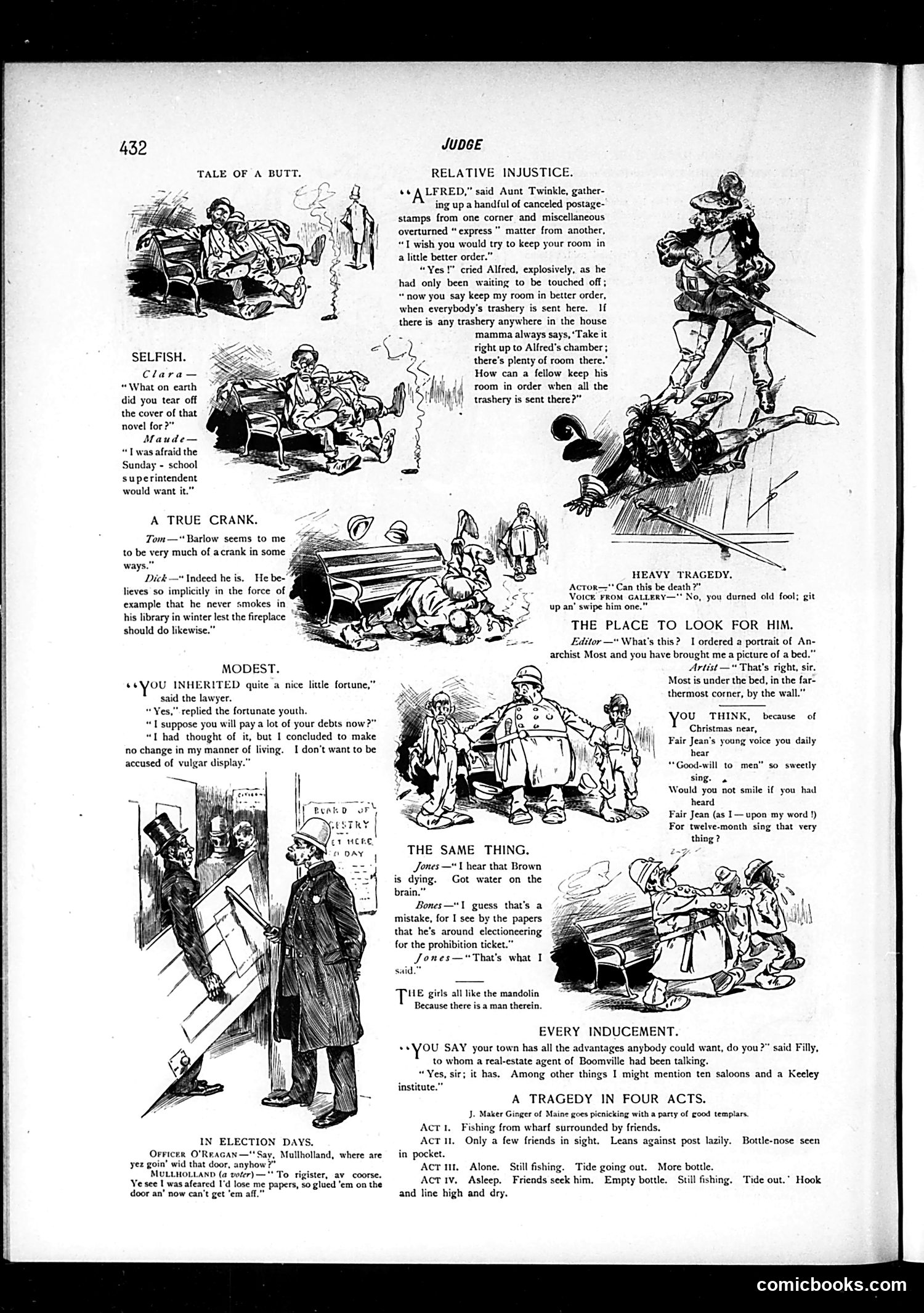
This page contains multiple brief satirical sketches typical of Judge magazine's humor: **"Relative Injustice"** mocks a boy defending his messy room—his aunt assigns all household clutter to his space, then complains about disorder. The satire targets hypocrisy in domestic discipline. **"The Place to Look for Him"** references an "Anarchist Most" (likely Johann Most, a notorious anarchist), with a joke about hiding "under the bed"—contemporary anxiety about anarchists as shadowy threats. **"Election Days"** shows an Irish voter (stereotyped dialect) who glued voter registration papers to his door and now can't remove them—mocking both immigrant voting confusion and election irregularities of the era. **"A Tragedy in Four Acts"** depicts a temperance advocate ("good templars") who progressively drinks while fishing, ending drunk and passed out—satirizing hypocrisy among prohibition supporters. The sketches employ ethnic stereotypes (Irish caricatures) and target specific contemporary issues: anarchism fears, voting fraud, and temperance movement contradictions.
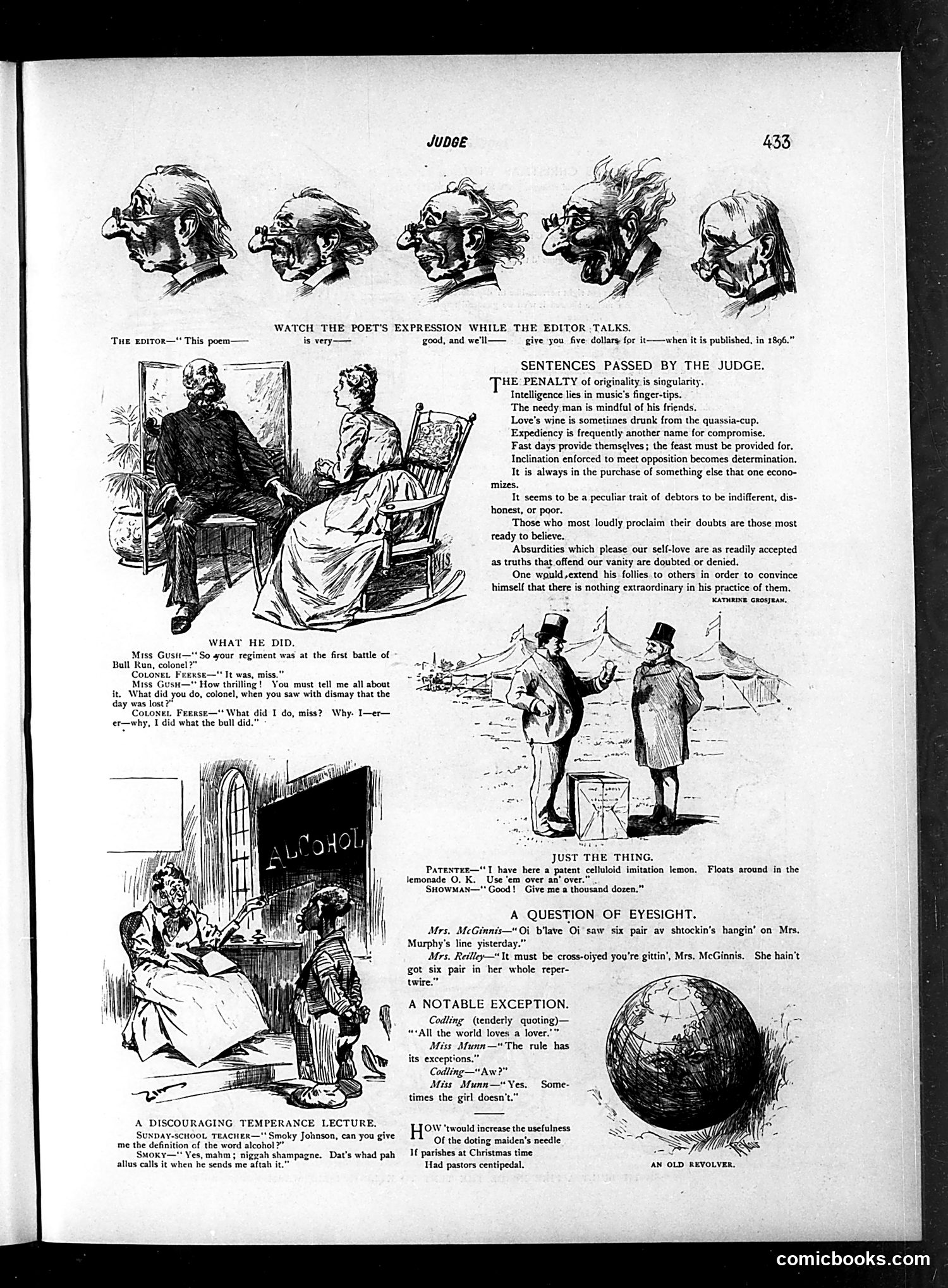
This page from Judge contains multiple satirical sketches targeting common social foibles of the era: **"Watch the Poet's Expression"** mocks struggling writers—an editor promises payment only after publication in 1896 (years away), revealing the publishing industry's exploitation of desperate poets. **"What He Did"** ridicules military incompetence, with a Civil War colonel admitting he simply fled like the bull at Bull Run—a humiliating defeat still fresh in public memory. **"Sentences Passed by the Judge"** comprises witty philosophical observations about human nature—the selfishness of the needy, self-deception, and how people rationalize their flaws. **Other brief sketches** include Irish immigrant women gossiping ("Mrs. McGinnis," "Mrs. Reilley"), a patent celluloid lemon scam, unrequited romance, and temperance humor about alcohol. The tone throughout is cynical about human weakness: vanity, dishonesty, hypocrisy, and self-interest. Period-specific details (Civil War references, Irish dialect humor) anchor these universal critiques to 1890s American society.
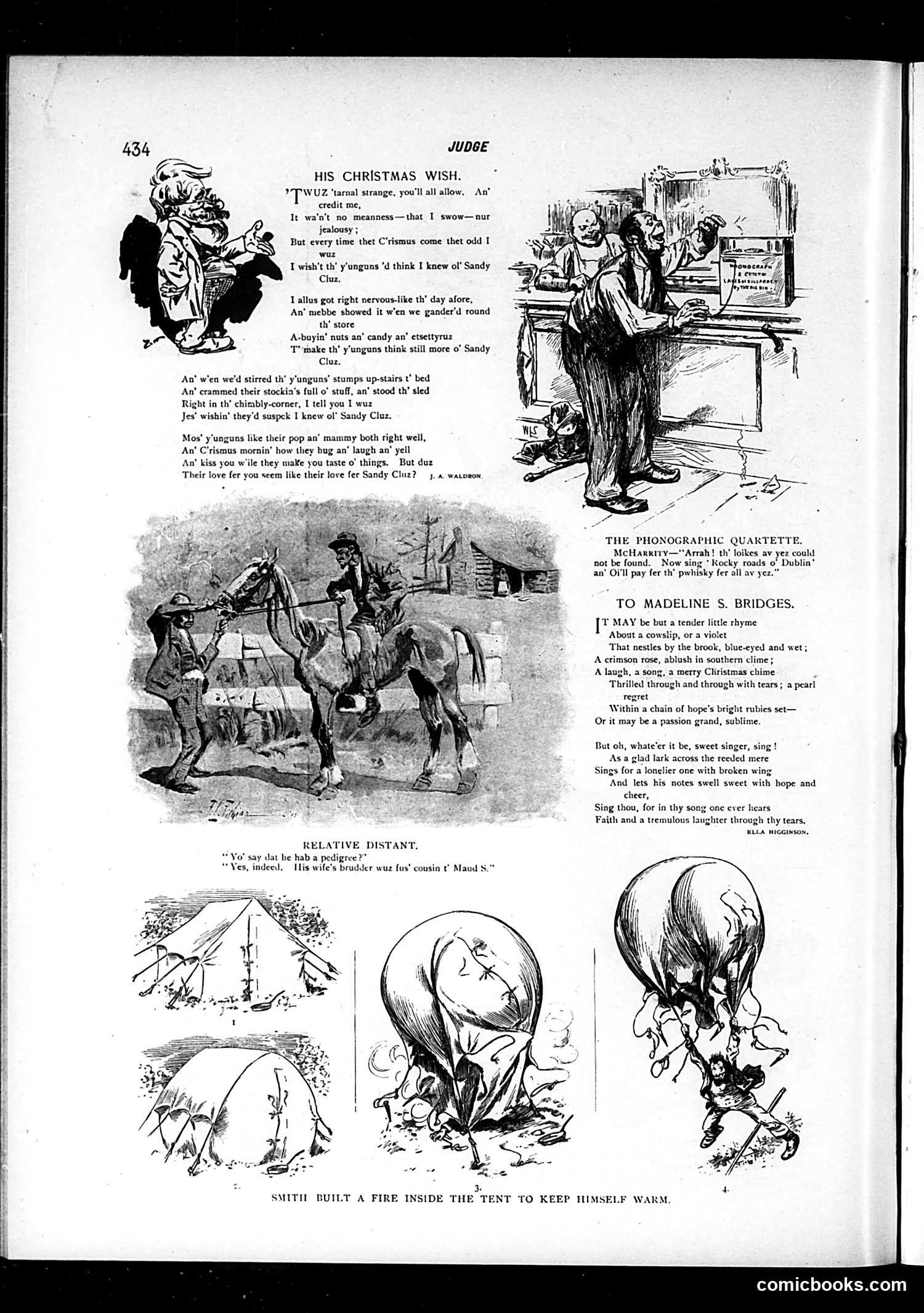
This page contains three distinct pieces of humor: **"His Christmas Wish"** depicts a working-class father's emotional vulnerability. Written in dialect, the poem reveals a man's longing for his children to believe *he* is Santa Claus—to credit him with Christmas magic rather than attributing it to Sandy Claus. The satire gently mocks male sentimentality while exploring class anxiety: a poor man cannot compete with the mythic gift-giver, only with practical provisions. **"The Phonographic Quartette"** appears to be a brief Irish-dialect joke about a man (McHarty) using a phonograph to perform music, promising whiskey payment—likely satirizing early recording technology or Irish stereotypes. **"Relative Distant"** is a short joke playing on "pedigree": when asked if someone has one, the response reveals absurdly distant family connections (a wife's brother's cousin), mocking pretensions to aristocratic lineage. "Maud S." was likely a famous racehorse of the era, making the comparison humorous. The cartoons throughout employ working-class and ethnic dialects typical of Judge's approach to humor.
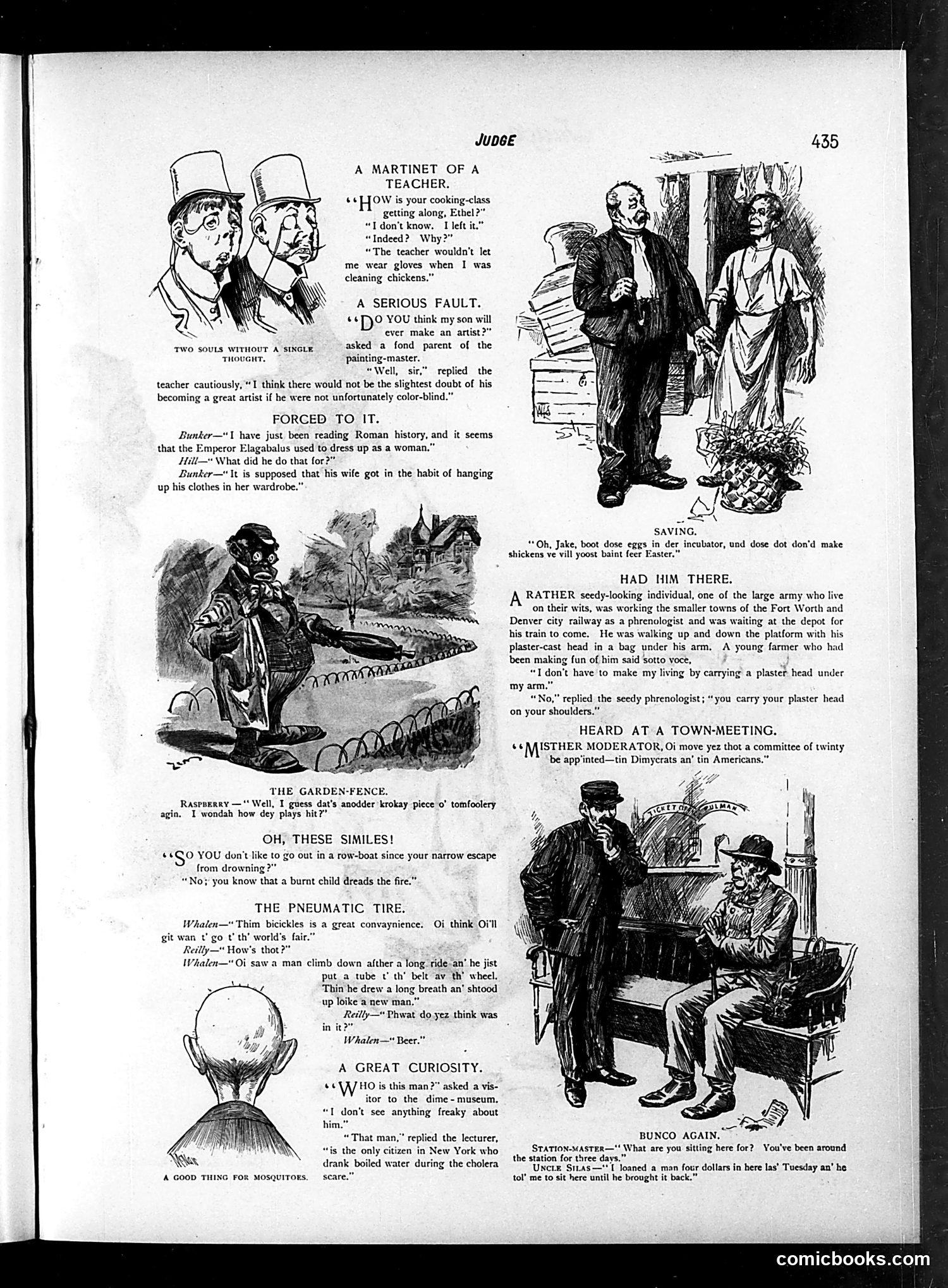
This page contains multiple brief comedic sketches satirizing American social types and immigrant stereotypes common in 1890s humor: **"A Martinet of a Teacher"** mocks overly strict instructors with absurd rules (forbidding gloves while cleaning chickens). **"A Serious Fault"** jokes that color-blindness would be the *only* thing preventing an artistically mediocre son from succeeding—implying nepotism and low standards in the art world. **"Had Him There"** features a con-artist phrenologist (fake skull-reader) with a witty comeback to a farmer's insult about carrying a plaster head. **"Heard at a Town-Meeting"** satirizes Irish-American political participation through thick dialect, suggesting they're separate from "Americans" despite citizenship. **"The Pneumatic Tire"** presents Irish characters marveling at bicycle pneumatic tubes, with one attributing the rejuvenating effect to beer rather than air. **"A Great Curiosity"** praises New York's only person drinking boiled water during cholera—dryly implying the city's terrible sanitation. The humor relies on ethnic caricature and class mockery typical of period satire.
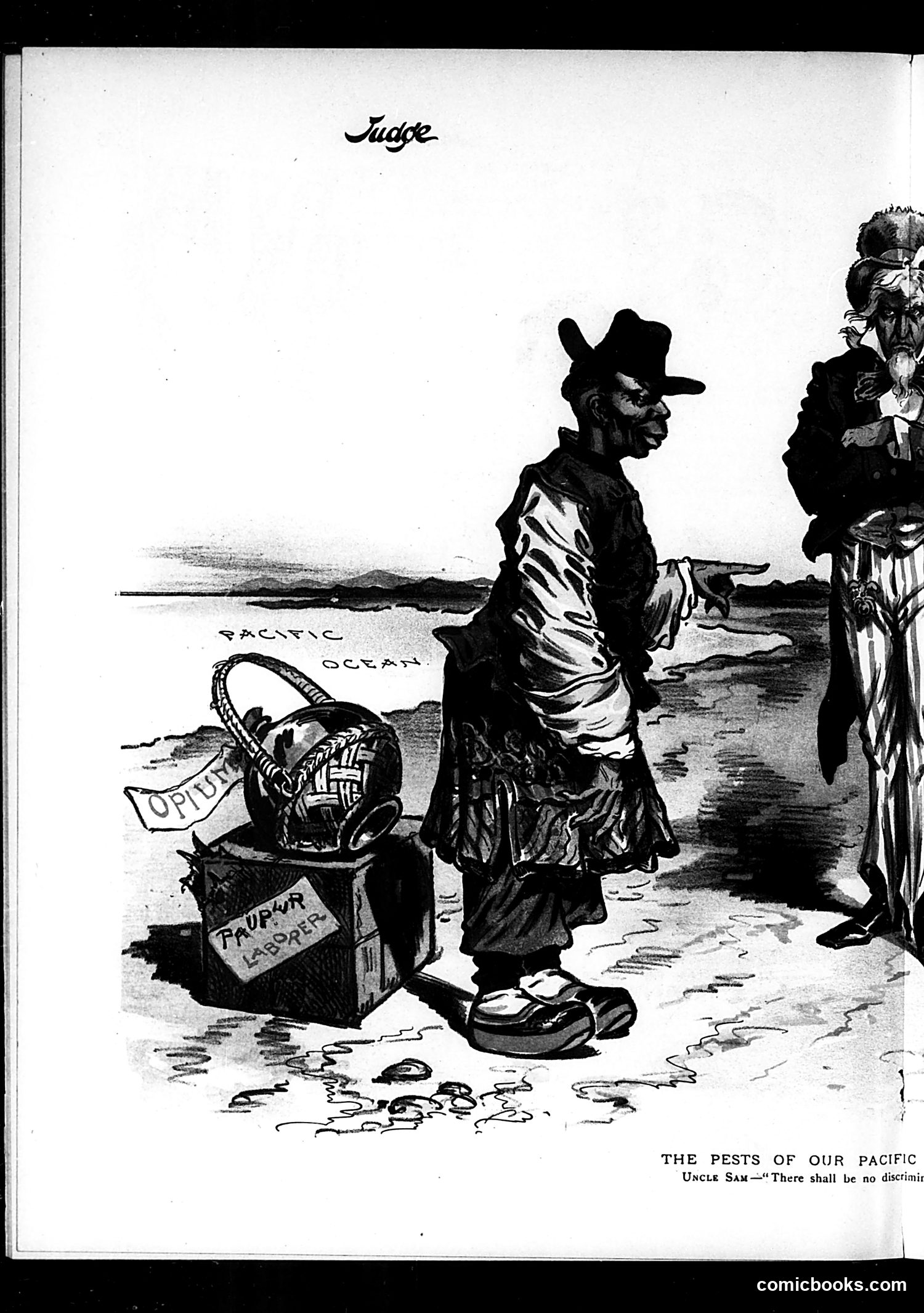
This political cartoon depicts Uncle Sam (representing the United States) confronting an Asian figure on a beach labeled "Pacific Ocean." The figure carries luggage marked "Opium" and "Coolie Labor"—references to Chinese immigration and the perceived problems associated with it. A basket overflows with what appears to be money or valuables. The cartoon satirizes anti-Chinese sentiment prevalent in late 19th/early 20th-century America. The caption's incomplete quote from Uncle Sam ("There shall be no discrimination") appears ironic, suggesting the cartoon criticizes either actual discriminatory policies or their ineffectiveness. The figure is caricatured in the offensive style typical of that era's racist imagery. The cartoon likely reflects anxiety about Pacific trade, immigration, and labor competition during a period of significant anti-Chinese political sentiment in America.
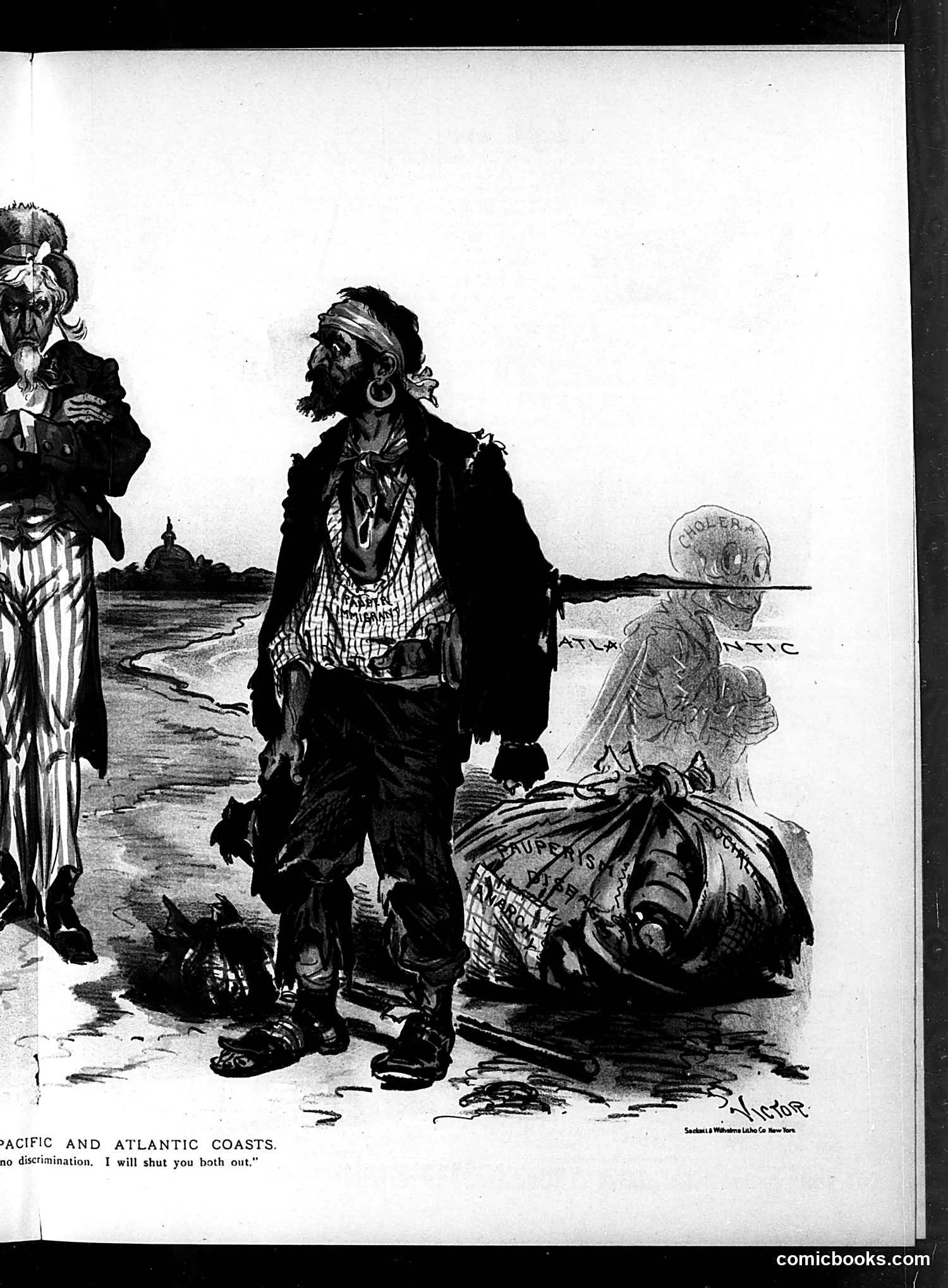
This cartoon depicts a Chinese immigrant (identifiable by period stereotypical features: headband, facial hair, clothing) standing between two figures representing the Pacific and Atlantic coasts. The figure holds a bag labeled with Chinese characters and appears to be addressing exclusionary policies. The caption—"no discrimination, I will shut you both out"—satirizes anti-Chinese immigration sentiment of the late 19th century. The cartoon criticizes the hypocrisy of coastal regions that claimed to oppose "discrimination" while simultaneously supporting Chinese Exclusion Act policies that banned Chinese immigration entirely. The Chinese figure represents those caught between competing American economic interests, all of whom wanted to exclude Chinese labor despite profiting from it. This is Judge magazine's commentary on discriminatory immigration policy and the self-serving nature of American protectionism.
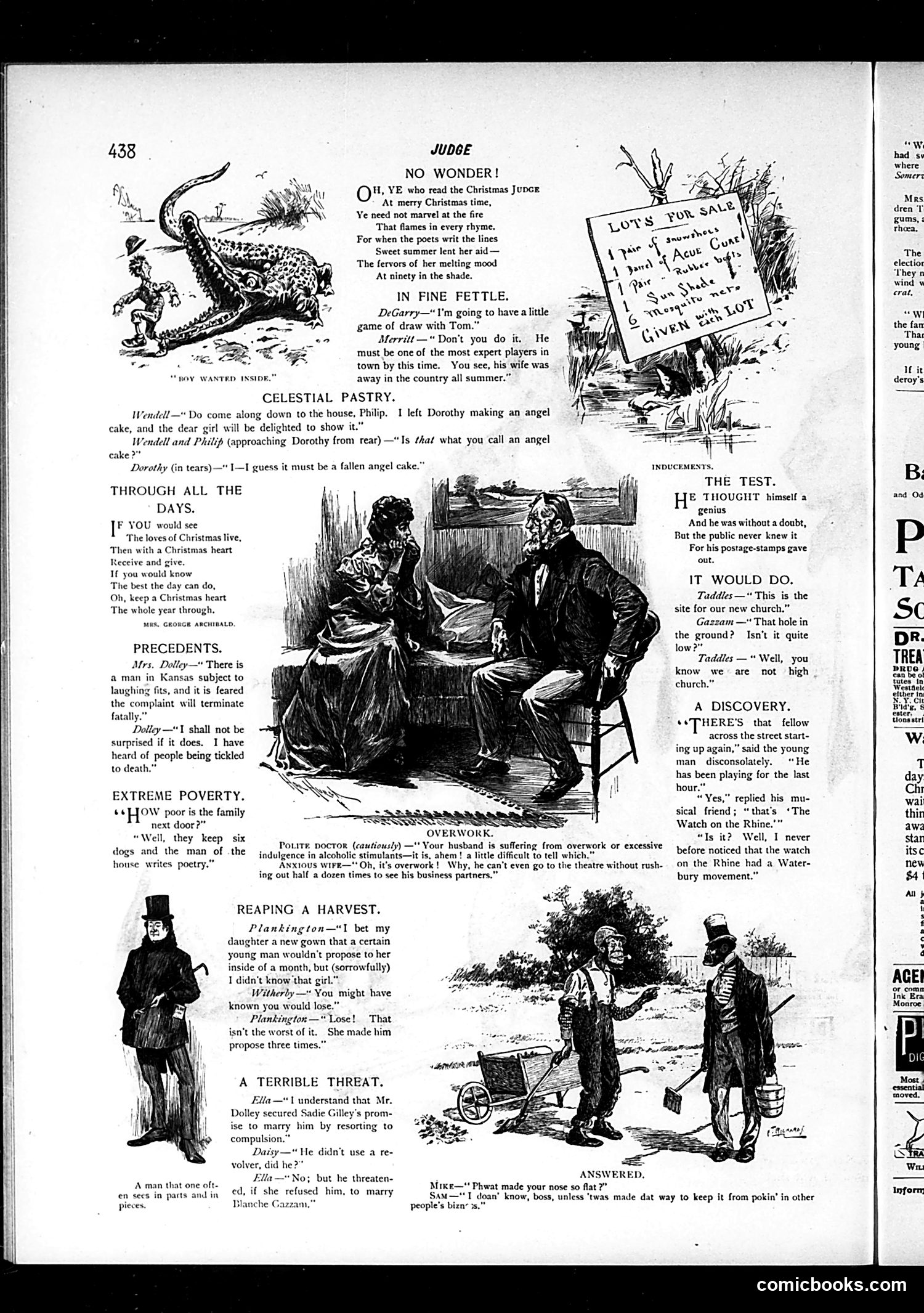
This page from *Judge* magazine contains multiple short humor pieces typical of the publication's satirical style: **Main cartoons and jokes:** - **"No Wonder!"** — A poem explaining why Christmas poetry is passionate: poets write it in summer heat (at 90 degrees), accounting for the emotional intensity. - **"In Fine Fettle"** and related pieces use a common Victorian humor device: wordplay and domestic/romantic misunderstandings among named characters (DeGarry, Merritt, Dorothy, etc.). - **"The Test"** mocks a unsuccessful "genius" who lacks resources (his postage stamps ran out) to gain recognition. - **"A Discovery"** jokes about a street musician playing "The Watch on the Rhine" — the punchline being that the watch mentioned has a "Waterbury movement" (a cheap American watch brand), deflating the romantic German melody. The humor relies on puns, class commentary (poverty, overwork, domestic life), and gentle mockery of social pretension — typical of *Judge*'s genteel satirical approach for educated readers of this era.
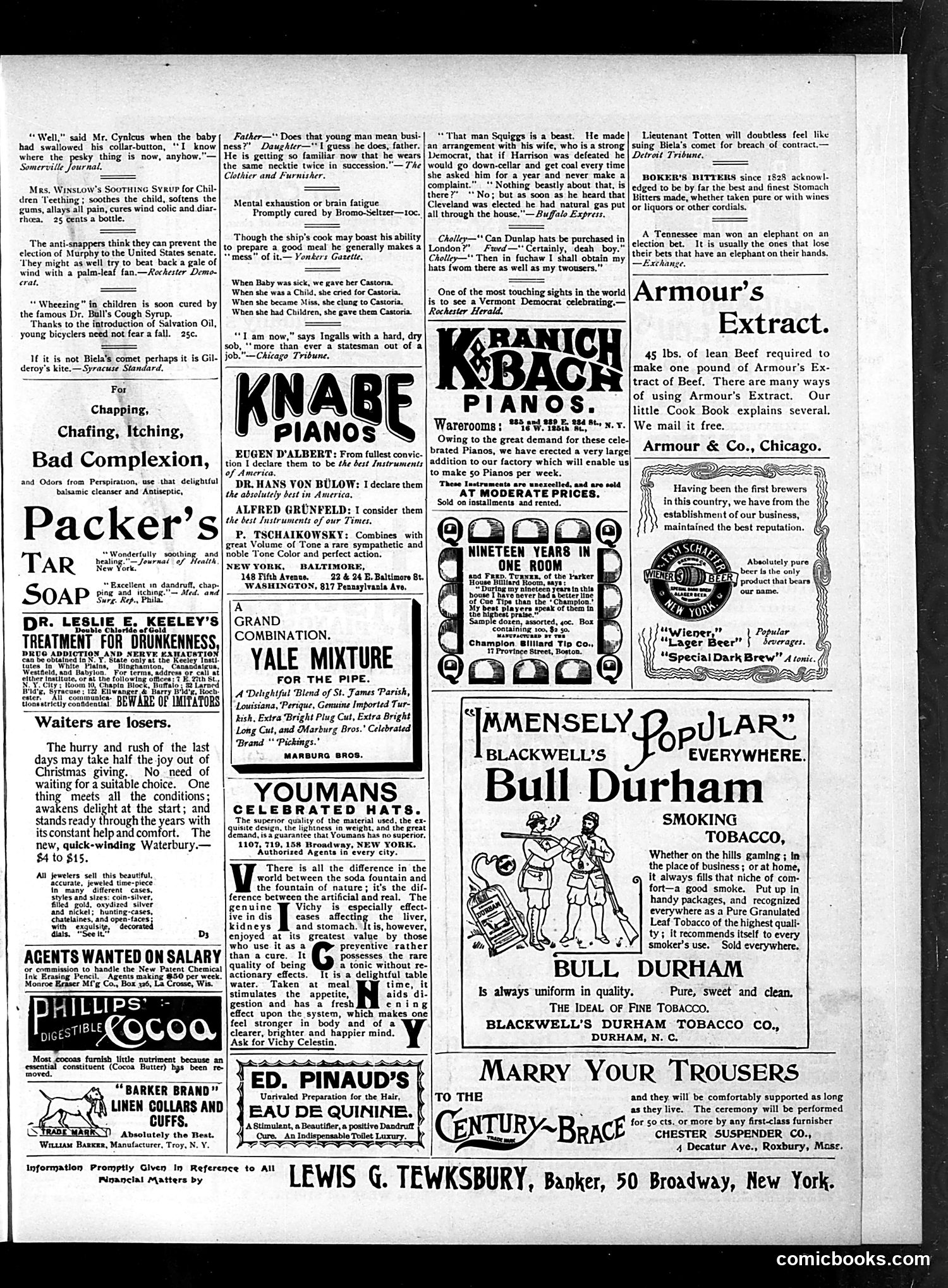
This is primarily an **advertising page** from Judge magazine, not a political cartoon page. However, there are two brief humorous items worth noting: 1. **"Well," said Mr. Cynicus** (top left): A joke about a baby swallowing a collar button—the father's grim quip being that at least now he knows where the lost button is. The humor relies on the absurdist irony of finding a "missing item" through an unfortunate accident. 2. **The "Father-Daughter" joke** (top middle): A father questions whether a young suitor's intentions are serious; the daughter replies he must mean business because he's now wearing the same necktie twice—implying economic desperation or commitment. The satire mocks both casual courtship and shabby gentility. The rest of the page consists of patent medicines, pianos, soaps, and other commercial advertisements typical of 1890s American magazines. No major political figures or significant satirical content appears here.
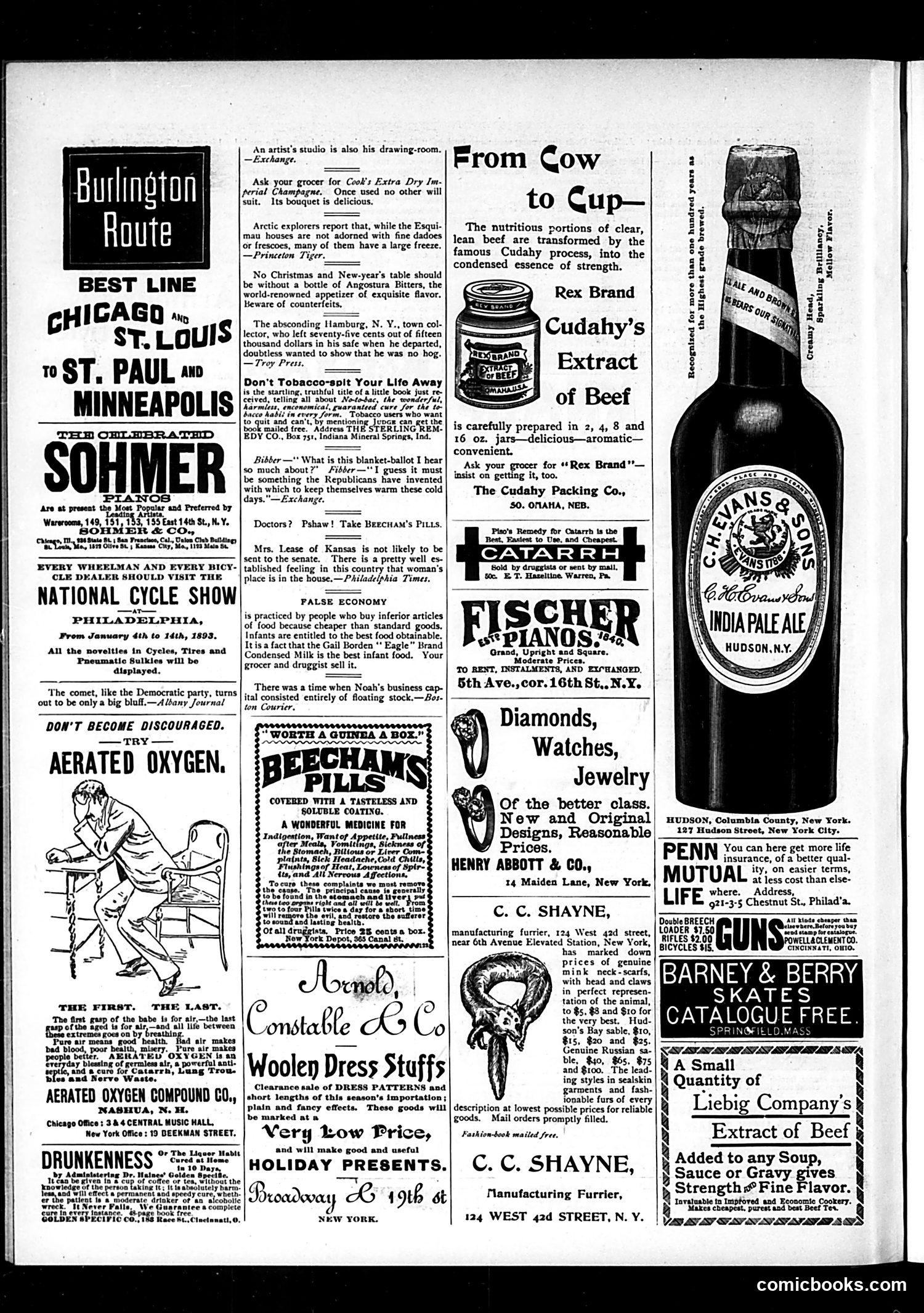
This page is primarily **advertising** with minimal editorial content. The most notable cartoon appears in the left column: a simple political joke equating the Democratic Party to a comet—both are "big bluffs" that disappoint. This is a brief jab at Democratic credibility, likely referencing the party's recent electoral setbacks or unfulfilled promises. Another brief satirical item mocks Mrs. Lease of Kansas (a prominent Populist activist and women's suffrage advocate) by suggesting women belong "in the house"—a sexist dismissal of her political ambitions and women's political participation generally. The page is otherwise dominated by late-19th-century product advertisements: patent medicines (Beecham's Pills, Aerated Oxygen), food products (Cudahy's Extract, condensed milk), jewelry, guns, and transportation services (Burlington Route railroad). These ads reflect the era's unregulated marketing of dubious health remedies and consumer goods.
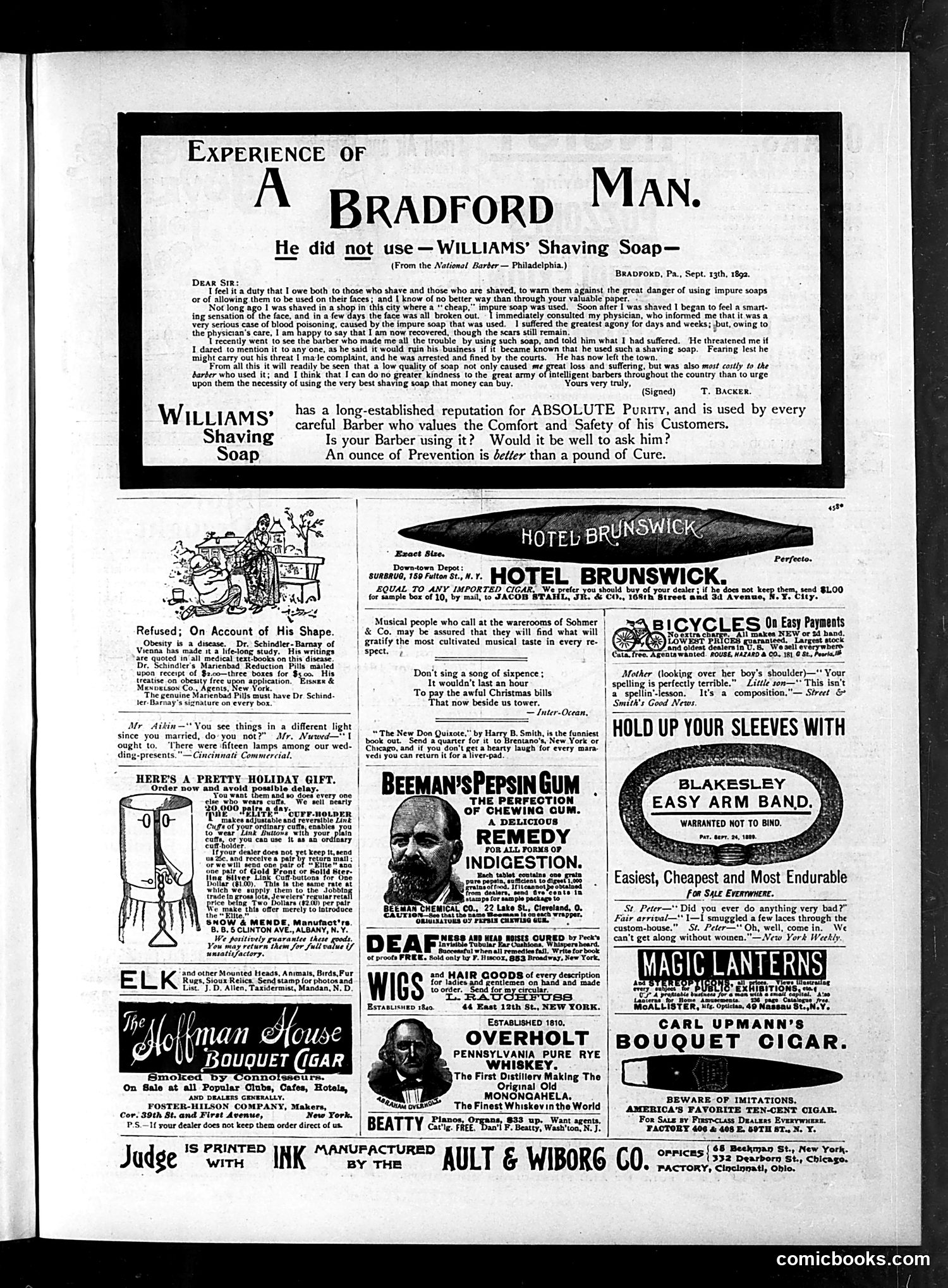
This page is primarily **advertising**, not political satire. It features testimonial ads for consumer products popular in the 1890s. The dominant content is a full-page advertisement for **Williams' Shaving Soap**, presented as a letter from "T. Backer," a Bradford, Pennsylvania barber. The testimonial describes a cautionary tale: Backer allegedly suffered severe blood poisoning from impure soap used by another barber, leading to the offending barber's arrest and fine. The advertisement's message is straightforward product promotion wrapped in a health-scare narrative—a common Victorian marketing tactic emphasizing "purity" and safety. The remainder of the page contains typical late-19th-century advertisements for bicycles, cigars, hotels, wigs, hair goods, patent medicines (obesity pills, indigestion remedies), and musical instruments. The small humor snippets are conventional jokes unrelated to the ads. **No political satire is evident.** This appears to be a standard advertising-heavy page from Judge's editorial content, demonstrating how 1890s magazines funded themselves through extensive product endorsements.
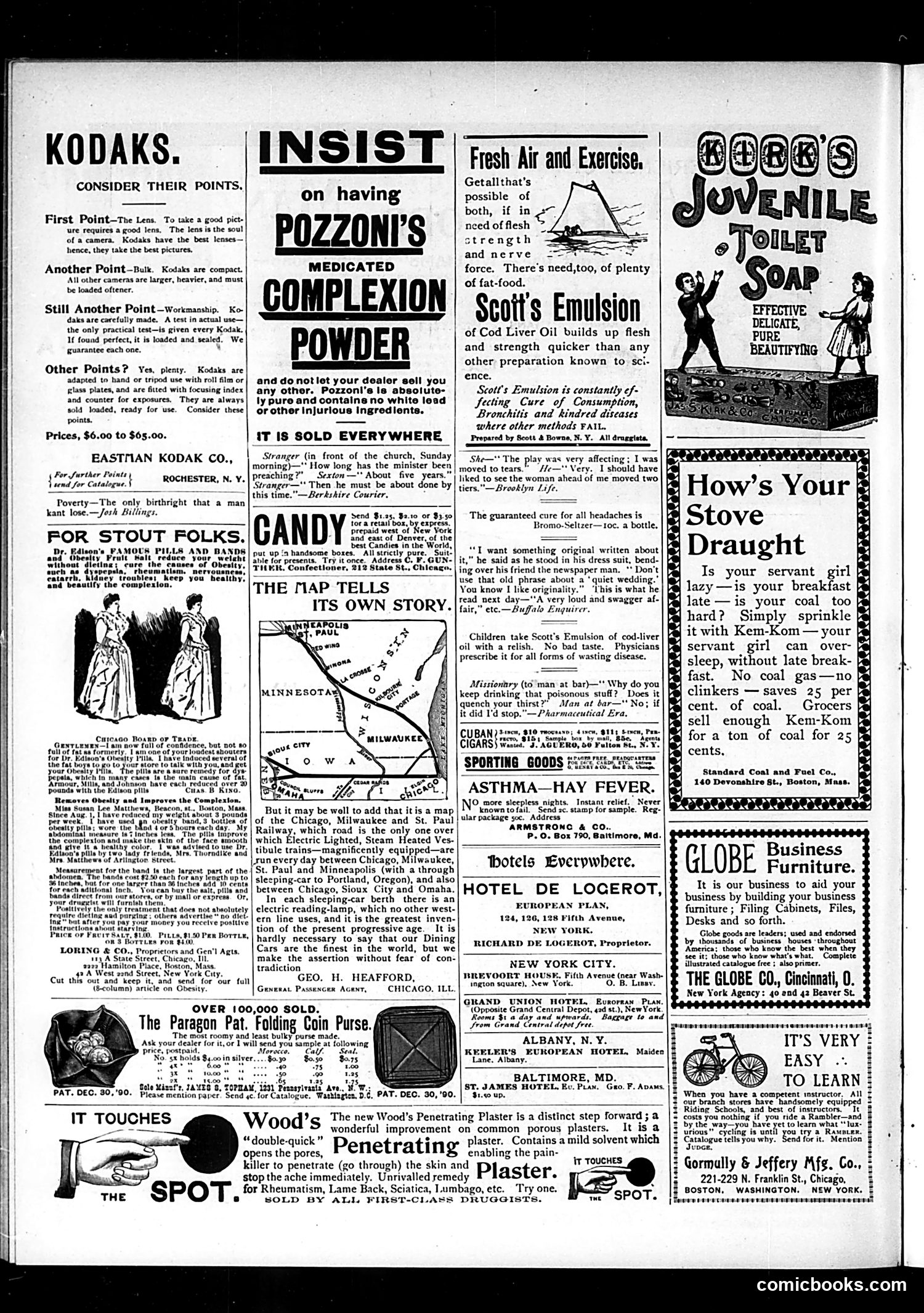
This page is **primarily advertising**, typical of early 1900s periodicals. Judge magazine pages mixed editorial content with paid advertisements. The notable **cartoon/editorial content** is minimal: 1. **"The Nap Tells Its Own Story"** - A map showing Chicago, Milwaukee & St. Paul Railway routes. This appears to be railroad advertising presented as a humorous item about a minister's sermon duration (a brief joke precedes it). 2. **"For Stout Folks"** - A testimonial-style piece advertising obesity pills and bands, featuring before-and-after claims from users. This reflects early 1900s attitudes toward weight reduction products (many dubious or dangerous by modern standards). The rest consists of product advertisements: Kodak cameras, Pozzoni's complexion powder, candy, asthma remedies, hotels, furniture, bicycles, and patent medicines. **Historical context**: These ads reveal period concerns (obesity "cures," complexion products without harmful lead, railway travel) and unregulated patent medicine marketing practices that would later face FDA scrutiny.
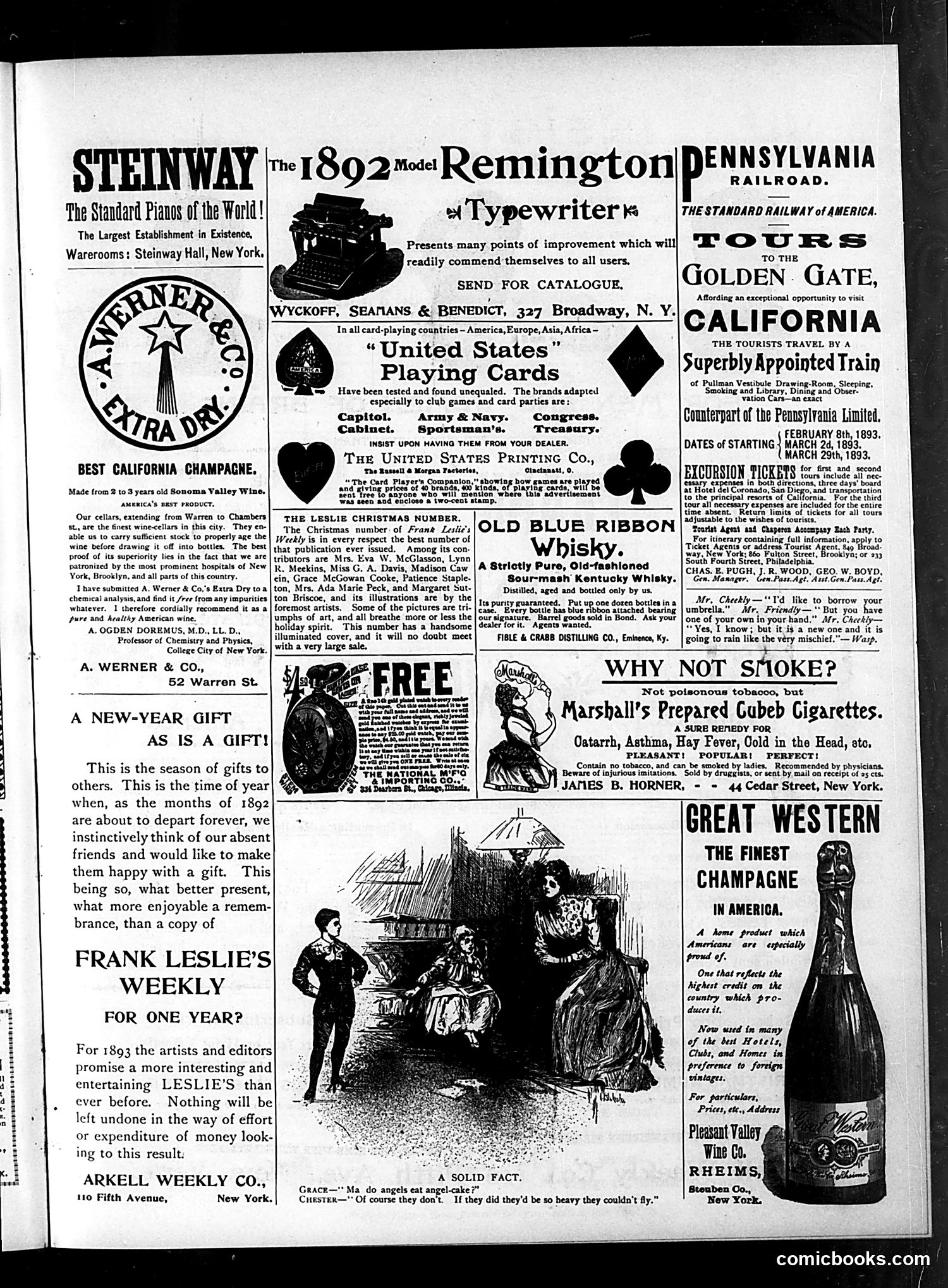
This page is primarily **advertising**, not satirical content. It showcases products and services marketed to affluent 1892-93 readers: Steinway pianos, Remington typewriters, Pennsylvania Railroad California tours, playing cards, champagne, and Frank Leslie's Weekly magazine. The single **cartoon** appears at bottom-center, captioned "A SOLID FACT," depicting two figures (labeled "Grace" and "Chester") in conversation. A woman asks a man if angels eat angel-cake, and he responds that they don't because "they'd be too heavy they couldn't fly." This is mild domestic humor—a playful pun on "angel-cake" (the dessert) and angels themselves. The cartoon contains **no political satire**. It's simply light, family-friendly wordplay typical of period magazines. The page reflects 1893 consumer culture and advertising practices rather than social commentary.
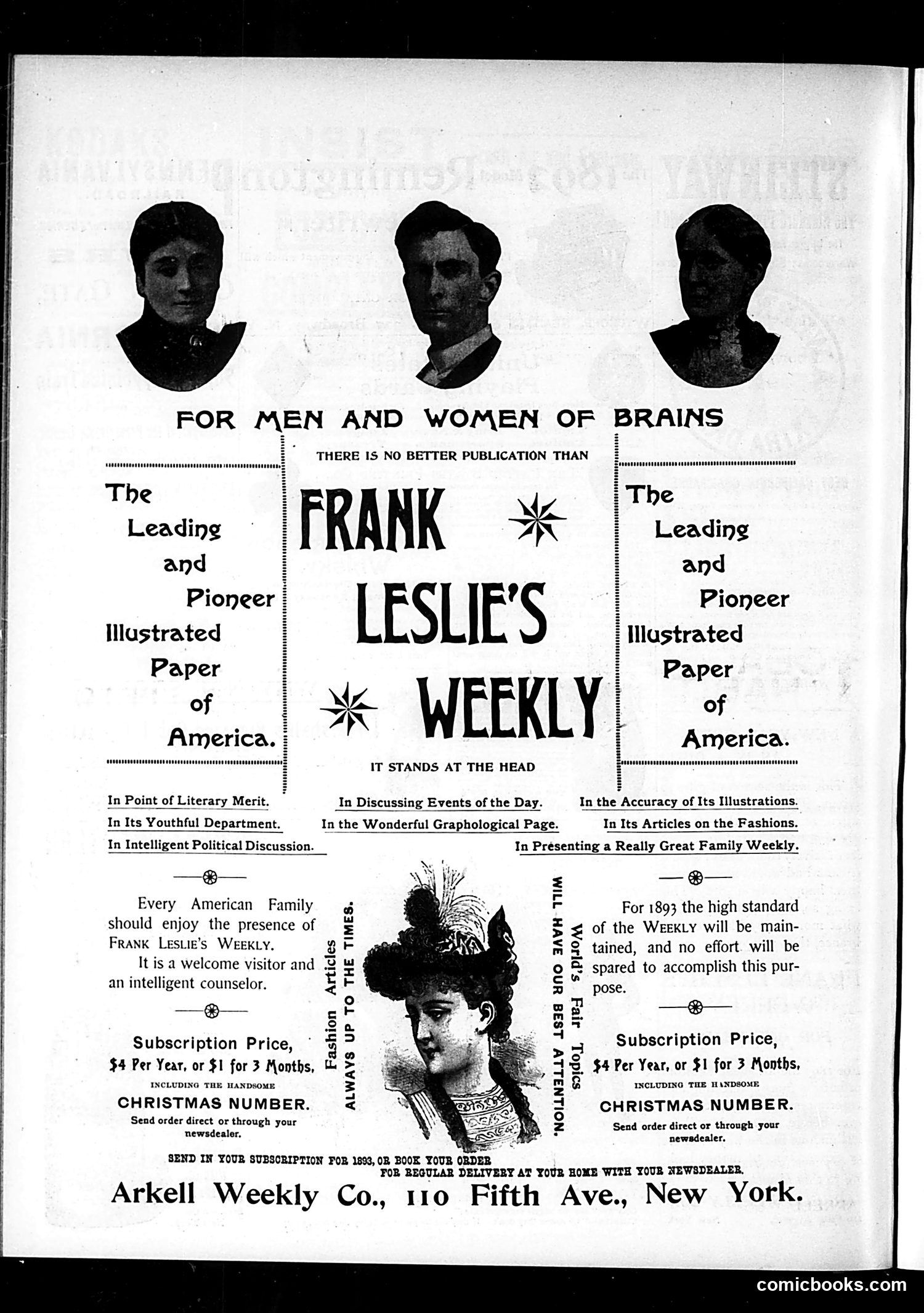
This is primarily an **advertisement**, not a political cartoon. It promotes Frank Leslie's Weekly, a prominent illustrated American magazine, to potential subscribers for 1893. The page features three portrait photographs at the top (identities unclear from the image alone) representing the magazine's appeal to "men and women of brains." The central illustration shows a fashionable woman with an elaborate feathered hat, representing the publication's coverage of current fashion and events. The advertisement emphasizes the magazine's strengths: literary merit, political discussion, fashion coverage, and illustrations. It claims the publication "stands at the head" of American illustrated papers and positions itself as "a welcome visitor and intelligent counselor" for American families. The subscription price ($4 annually or $1 for three months) and the mention of including "the handsome Christmas number" were typical marketing tactics of the era. This represents late-19th-century magazine promotion targeting educated, affluent readers.
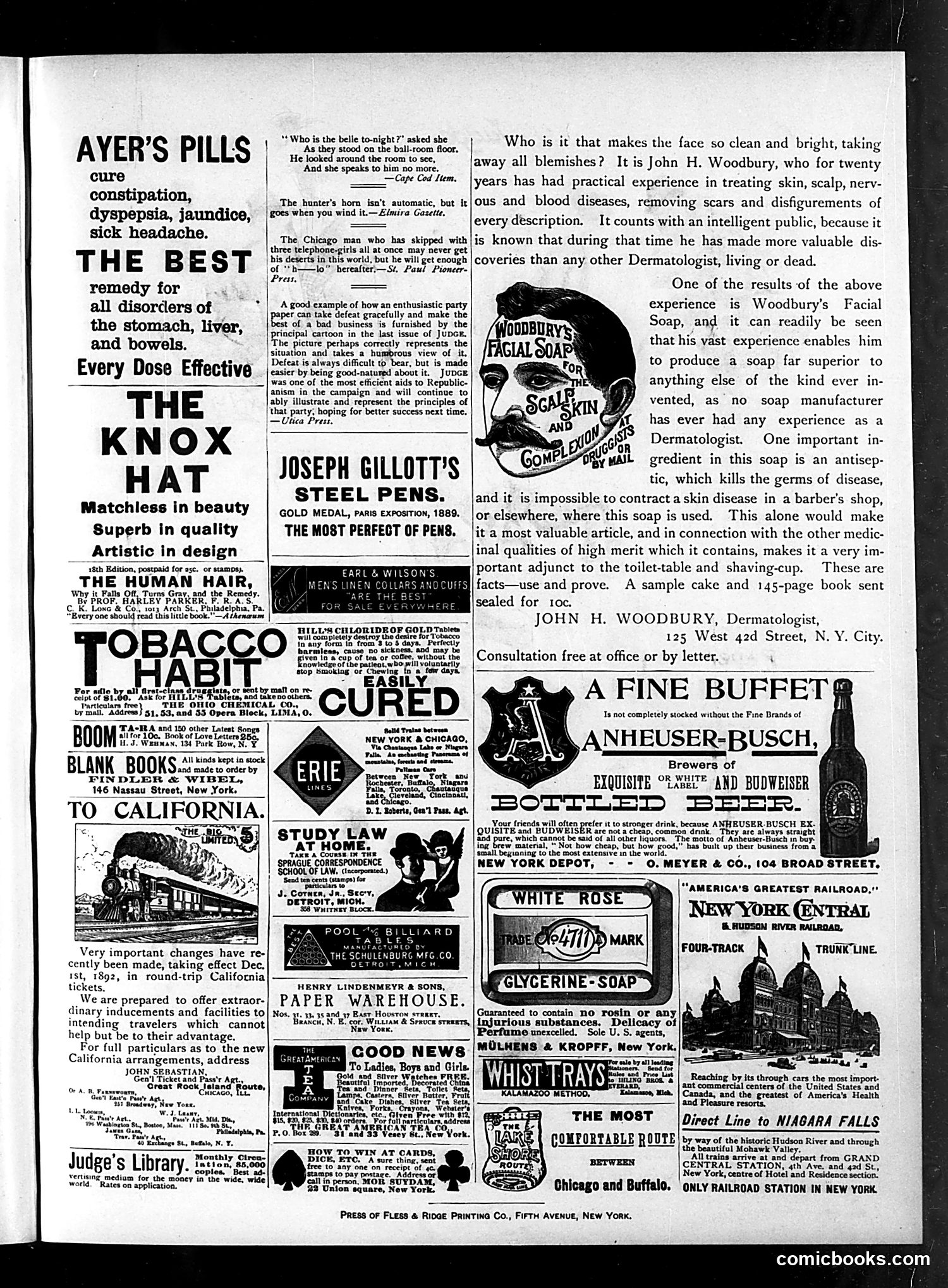
This is primarily an **advertising page** from Judge magazine, circa 1892, featuring patent medicines and consumer products typical of the Gilded Age. The main content is John H. Woodbury's advertisement for his facial soap and dermatological services. Woodbury was an actual practicing dermatologist who marketed himself as uniquely qualified—claiming twenty years of experience treating skin diseases. His soap, promoted as antiseptic and germ-killing, represented a new commercial appeal to emerging germ theory and scientific authority. The surrounding ads promote nostrums (patent medicines) like Ayer's Pills and "Tobacco Habit" cure—remedies making unsubstantiated health claims that were legal and common before FDA regulation. The page reflects Victorian consumer culture's fascination with medical "cures" and personal improvement products. The scattered poetry excerpts and short humorous items were typical Judge filler, offering light social commentary unrelated to the advertisements.
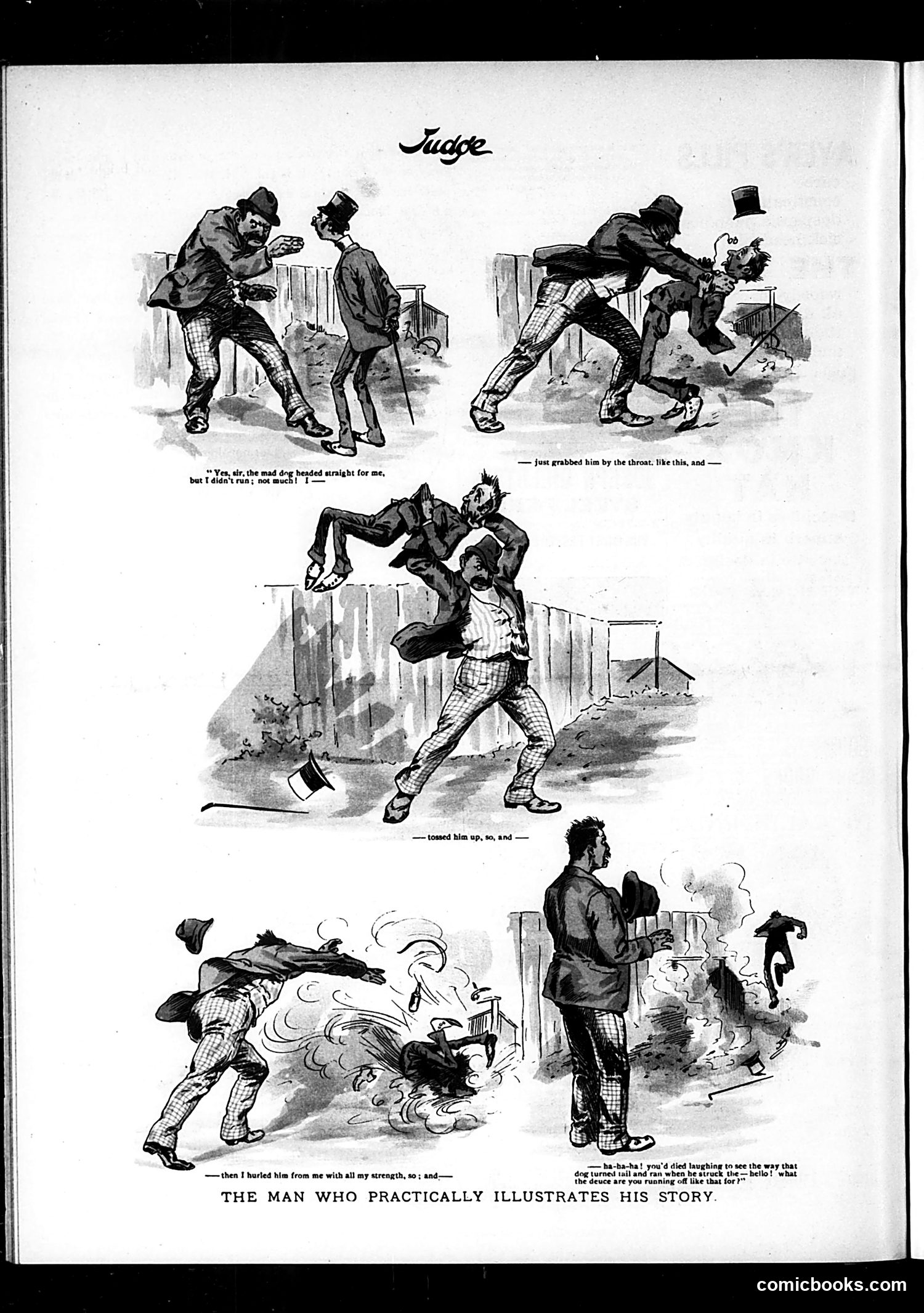
This Judge page satirizes a common social type: the overly enthusiastic storyteller who physically acts out his narrative rather than simply telling it. Through four sequential panels, a man recounts what appears to be a street fight, progressively demonstrating each action—grabbing, throwing, dodging—with exaggerated physical gestures. The final panel shows the chaos this creates: his audience scrambles, furniture overturns, and the room descends into disorder as his "practical illustration" becomes an actual altercation. The satire targets men (likely working-class or lower-middle-class based on dress) who can't simply narrate events but must mime every detail with aggressive physicality, turning a mere anecdote into a public disturbance. It's gentle social humor about mannered speech and masculine performance.