
Judge, 1892-12-17 · page 5 of 18
Judge — December 17, 1892 — page 5: what you’re looking at
What you’re looking at
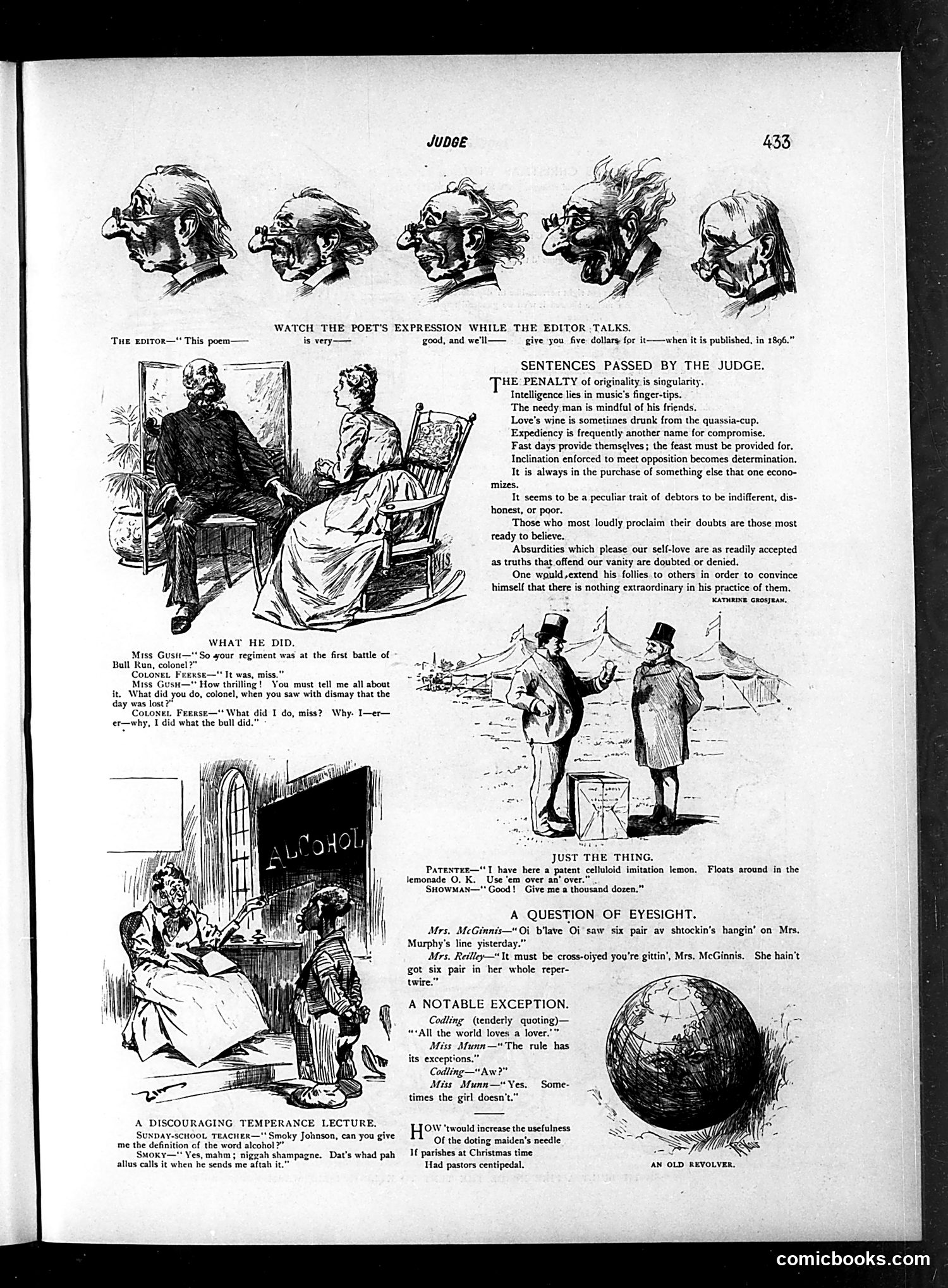
This page from Judge contains multiple satirical sketches targeting common social foibles of the era: **"Watch the Poet's Expression"** mocks struggling writers—an editor promises payment only after publication in 1896 (years away), revealing the publishing industry's exploitation of desperate poets. **"What He Did"** ridicules military incompetence, with a Civil War colonel admitting he simply fled like the bull at Bull Run—a humiliating defeat still fresh in public memory. **"Sentences Passed by the Judge"** comprises witty philosophical observations about human nature—the selfishness of the needy, self-deception, and how people rationalize their flaws. **Other brief sketches** include Irish immigrant women gossiping ("Mrs. McGinnis," "Mrs. Reilley"), a patent celluloid lemon scam, unrequited romance, and temperance humor about alcohol. The tone throughout is cynical about human weakness: vanity, dishonesty, hypocrisy, and self-interest. Period-specific details (Civil War references, Irish dialect humor) anchor these universal critiques to 1890s American society.
📄 Transcribed text from this page (OCR, searchable)
Machine-transcribed from the original scan — historical spelling and the odd misread are preserved.
WATCH THE POET'S EXPRESSION WHILE THE EDITOR -TALKS. ‘THE EDIToR—" This poem— is very— good, and we'll—— give you five: dollars for it——when it is published, in 1896." SENTENCES PASSED BY THE JUDGE. THE PENALTY of originality is singularity. Intelligence lies in music’s finger-tips. The needy man is mindful of his friends. Love's wine is sometimes drunk from the quassia-cup. Expediency is frequently another name for compromise. Fast days provide themselves; the feast must be provided for. Inclination enforced to meet opposition becomes determination. It is always in the purchase of something else that one econo- mizes. It seems to be a peculiar trait of debtors to be indifferent, dis- honest, or poor. Those who most loudly proclaim their doubts are those most ready to believe. ‘Absurdities which please our self-love are as readily accepted as truths that offend our vanity are doubted or denied. One would,extend his follies to others in order to convince himself that there is nothing extraordinary in his practice of them. KATURIXE GROSJEAN, WHAT HE DID. Miss Gusit—'*So your regiment was at the first battle of Bull Run, colonel?” CoLoneL Frexse—'* It was, miss, sH—" How thrilling! You must tell me all about 1u do, colonel, when you saw with dismay that the Frerse—" What did I do, miss? Why. I—er— er—why, I did what the bull did.” JUST THE THING. Patenter—''I have here a patent celluloid imitation lemon. Floats around in the lemonade O, K. Use ‘em over an’ over.” . Suowman—" Good! Give me a thousand dozen.” A QUESTION OF EYESIGHT. Mrs. McGinnis—" Oi bilave Oi’ saw six pair av shtockin's hangin’ on Mrs. Murphy's line yisterday.” Mrs, Reilley— It must be cross-oiyed you're gittin’, Mrs. McGinnis. She hain’t got six pair in her whole reper- A NOTABLE EXCEPTION. Codling (tenderly quoting)— “*All the world loves a lover.’” Miss Munn—"The rule has its exception: Codling—"Aw?" Miss Munn—"Yes. Some- times the girl doesn’t.” FERANCEZLECTURE SS OW ‘would increase the usefulness Smoky Johnson, can you give aot: tho word elcoksl Of the doting maiden’s needle ‘es, mahm ; niggah shampagne. Dat's whad pah If parishes at Christmas time allus calls it when he sends'me aftah it." Had pastors centipedal. AN OLD REVOLVER. comicbooks.com