
A complete issue · 52 pages · 1892
Judge — December 3, 1892
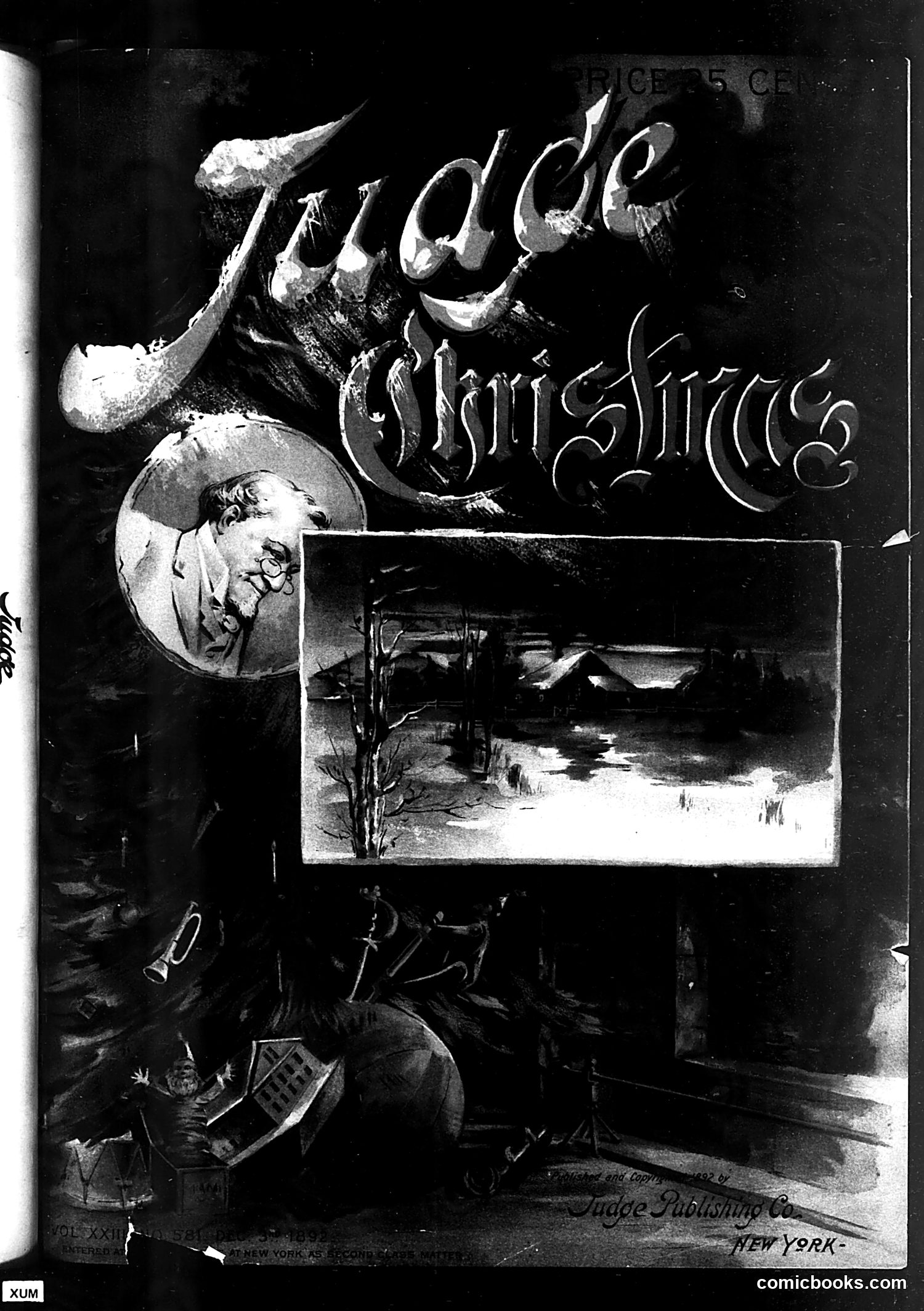
This appears to be a cover or title page for "Judge" magazine, though the OCR text is too degraded to read clearly. The visual composition shows decorative grotesque figures at the top and a circular portrait of a bespectacled man on the left side, likely a political or public figure being satirized. Below is a landscape scene with water and vegetation. The ornate "Judge" masthead and decorative styling are typical of late 19th/early 20th-century American satirical publications. Without legible text identifying the specific figure, date, or issue context, I cannot definitively state which political event or person this cartoon targets. The grotesque imagery and composition suggest social or political commentary characteristic of Judge's satirical purpose, but the specific meaning requires clearer text or additional context.
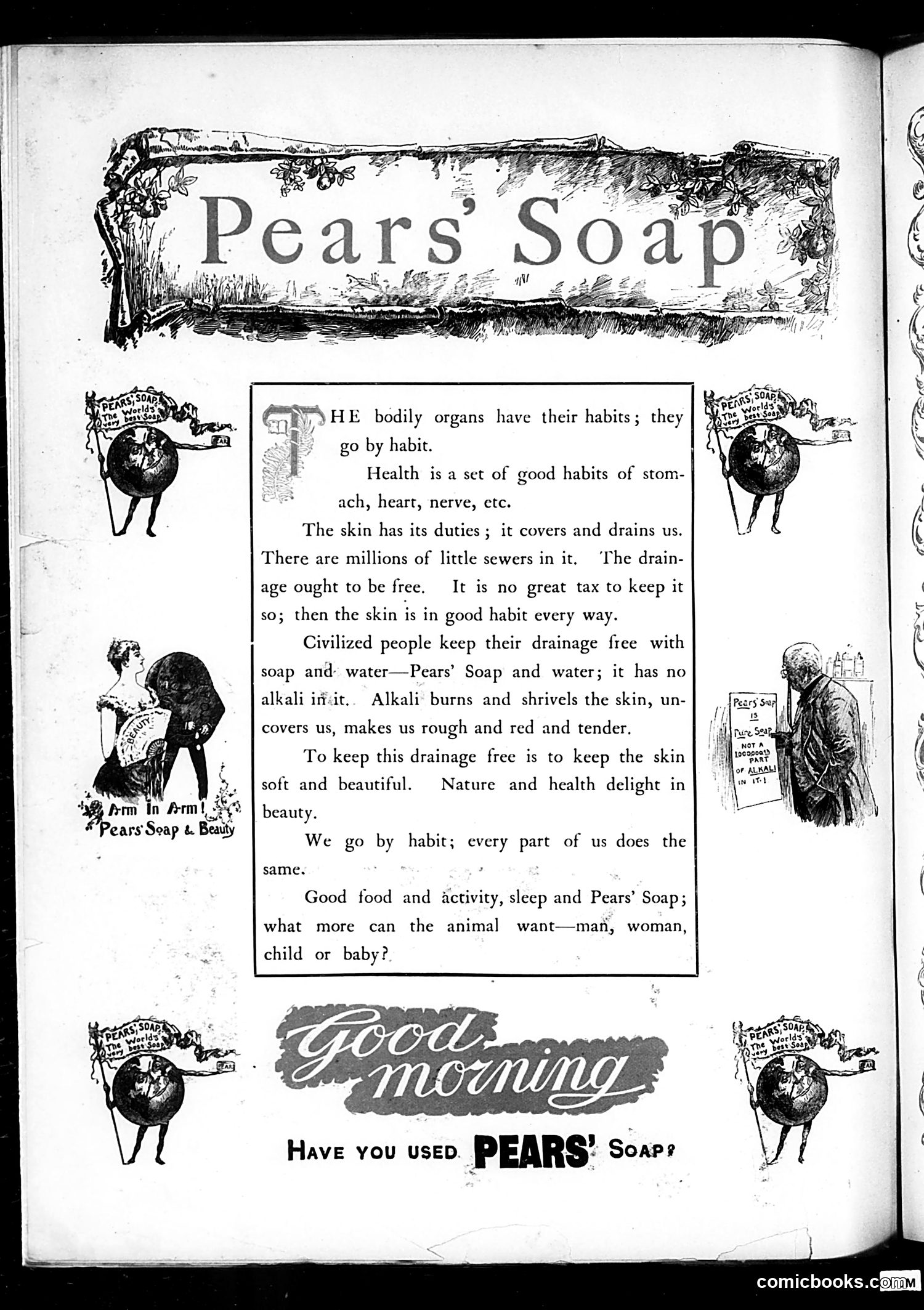
This is a **Pears' Soap advertisement**, not satire. The page presents pseudo-scientific health claims typical of late-19th-century advertising. The text argues that skin health depends on keeping pores clear through regular washing with Pears' Soap—which supposedly contains "no alkali" (a selling point, since alkaline soaps were known to irritate skin). The ad uses humorous illustrations of a personified "Germ" or disease character alongside proper Victorian figures to contrast uncleanliness with civilization and beauty. The core message: good health habits include using Pears' Soap alongside food, activity, and sleep. The rhetorical question "what more can the animal want?" frames soap use as essential to human dignity and health—a common advertising strategy that conflated cleanliness with morality and wellness.
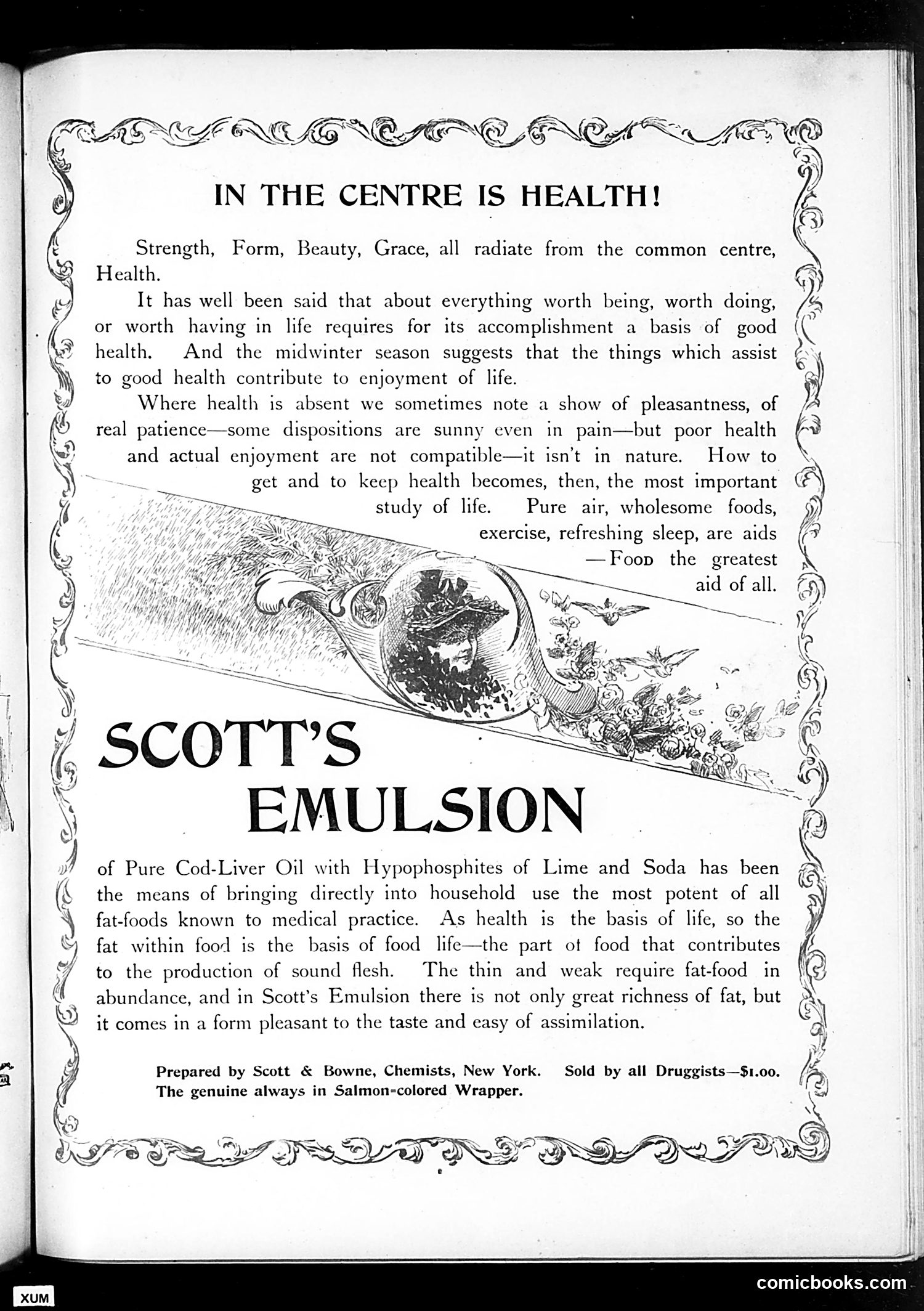
This page is **primarily an advertisement**, not satirical content. It's a Scott's Emulsion product ad for cod-liver oil supplement, dressed in the elaborate decorative style typical of early 20th-century advertising. The illustrated figure appears to be a cornucopia or horn of plenty overflowing with food and vegetables—a traditional symbol of abundance and nourishment. The ad's heading "IN THE CENTRE IS HEALTH!" uses this imagery to suggest that Scott's Emulsion (containing cod-liver oil, lime, and soda) represents the nutritional foundation for good health. The text emphasizes health's importance and positions fatty foods as essential nutrition, particularly for "the thin and weak." This reflects period medical beliefs about fat-based remedies. The product cost $1.00 and was sold by druggists in salmon-colored wrappers. No political satire is evident here—this is straightforward vintage pharmaceutical marketing.
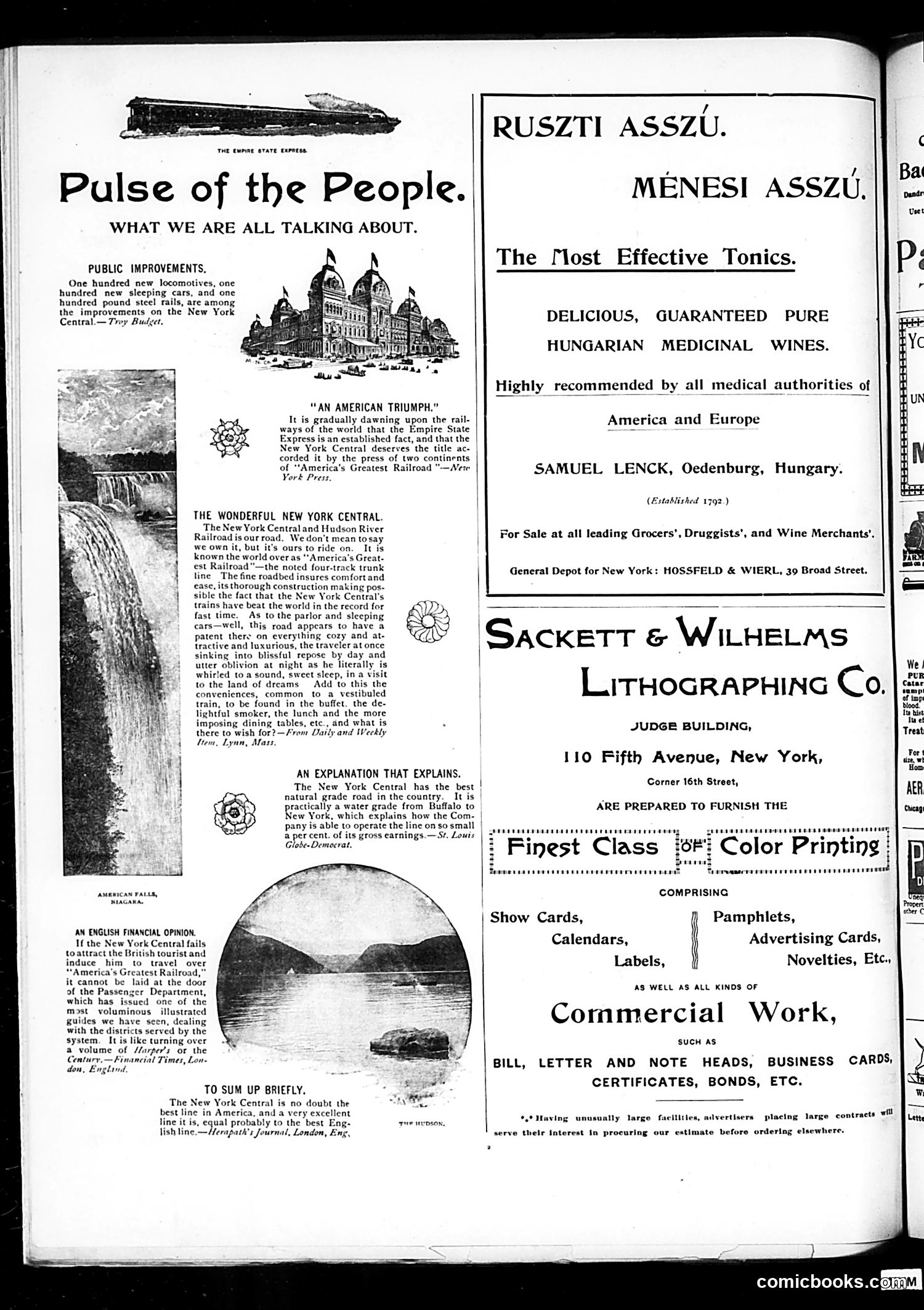
This page is primarily **celebratory advertising** rather than political satire. The left side contains promotional content praising the **New York Central Railroad's Empire State Express** as an American achievement. Multiple quoted endorsements—from newspapers, financial journals, and travel publications—tout the train's speed, comfort, and superiority over English railways. The satirical element is mild: the repeated breathless praise of the railroad's luxuries (parlor cars, dining service, sleeping accommodations) gently mocks American boosterism and the railroad industry's self-promotion. The "Pulse of the People" framing suggests these are genuine public sentiments, but the hyperbolic tone suggests irony about collective enthusiasm for commercial enterprise. The right side contains straightforward **commercial advertisements** for Hungarian medicinal wines and a lithography company—typical period print advertising unrelated to the editorial content. This appears to be an advertiser-friendly magazine mixing light satire with paid promotion.
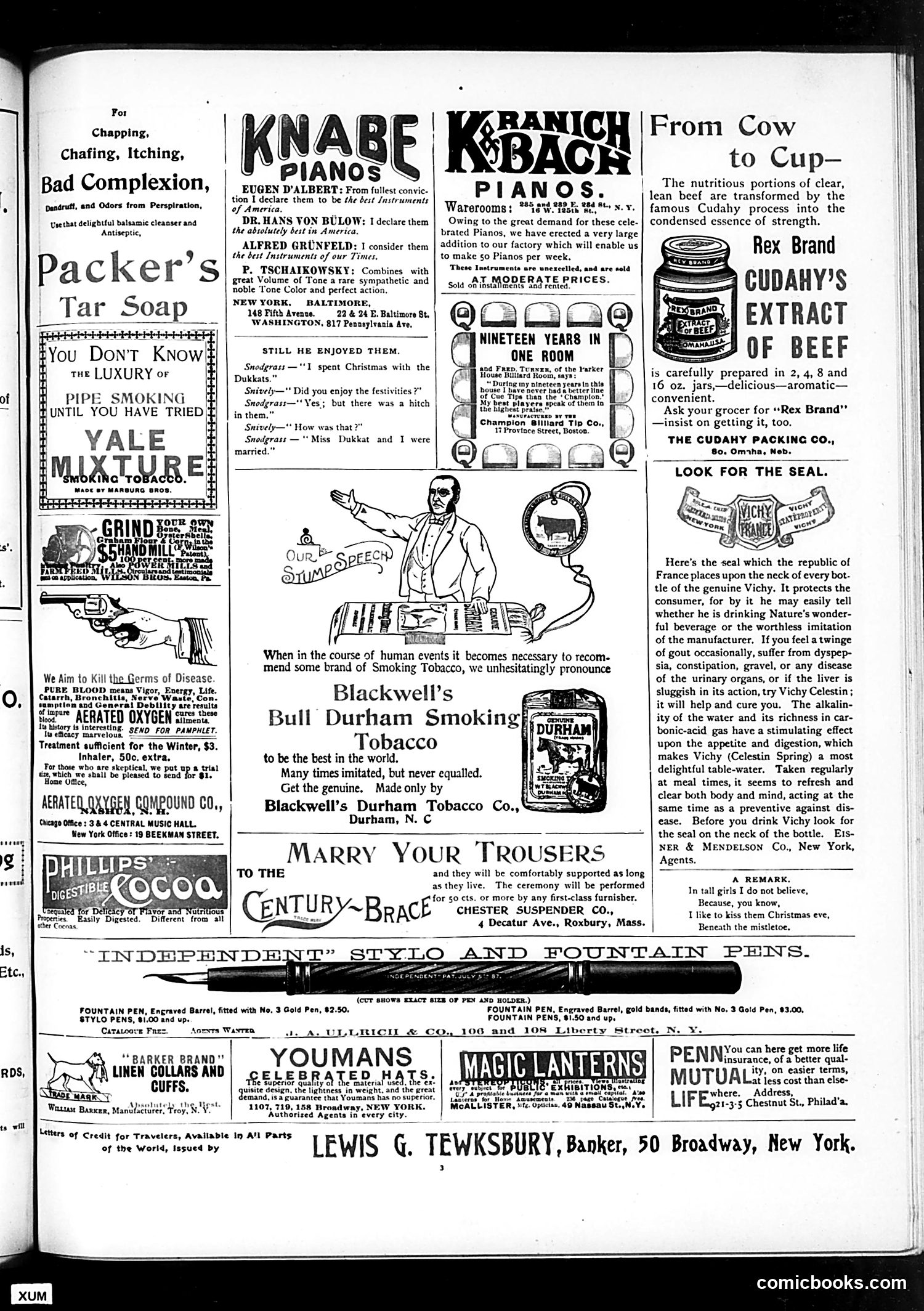
This page from *Judge* magazine is primarily **advertisements** rather than editorial content or political cartoons. The ads are for late 19th/early 20th-century consumer goods: soap, pianos, smoking tobacco, beef extract, medicinal compounds, and clothing. The one small humorous piece labeled "STILL HE ENJOYED THEM" is a brief social joke: a man says Christmas with the "Dukkats" was pleasant except for "a hitch"—his surprise marriage to Miss Dukkat. This is gentle domestic humor about unexpected matrimony, typical of period magazines. The advertisements reflect contemporary attitudes toward health and commerce. Several dubious medical products (like "Aerated Oxygen Compound") claim to cure serious diseases. The *Vichy* water ad emphasizes its supposedly curative mineral properties. Such ads reveal common consumer beliefs and marketing tactics of the era—essentially commercial content masquerading as health advice. The page contains no political satire or recognizable caricatures of public figures.
This page is **primarily a product advertisement**, not political satire. It's a Van Houten's Cocoa advertisement from Judge magazine promoting their Dutch cocoa product. The ad uses persuasive marketing copy claiming cocoa perfection, superior quality to tea or coffee, and value ("goes farthest"). The decorative border and ornate typography are typical period advertising design (likely early 20th century). There is **no political cartoon or social satire present**. This represents Judge's business model: the magazine funded itself through paid advertisements alongside its satirical content. The lavish product claims and emphatic language ("Best & goes farthest") reflect Victorian/Edwardian marketing conventions but don't constitute commentary or humor directed at contemporary events or figures.
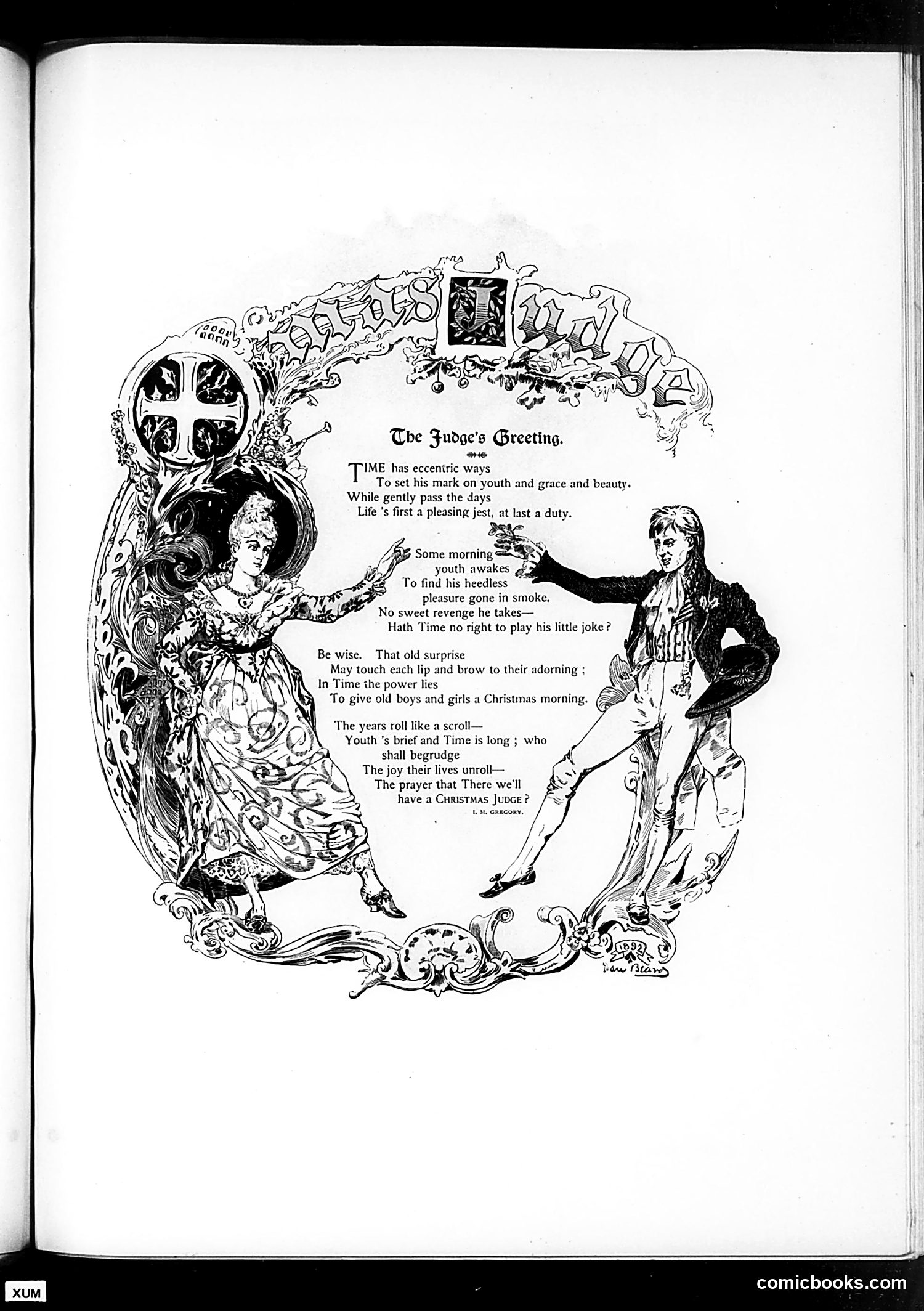
This is an editorial poem from *Judge* magazine's masthead, personifying Time as a figure (left) addressing a young man (right). The piece is philosophical rather than satirical—it's the magazine's seasonal greeting to readers. The message warns youth that pleasure fades ("pleasure gone in smoke") and time inevitably marks us all. However, it offers consolation: time also grants wisdom and the ability to find joy later in life ("give old boys and girls a Christmas morning"). The closing prayer asks that readers experience "a Christmas Judge"—likely meaning they'll have the magazine's companionship through life's passages. The ornate decorative border and allegorical figures reflect *Judge*'s fin-de-siècle aesthetic. This is uplifting verse rather than satire—a meditation on aging and resilience framed as holiday sentiment for the magazine's audience.
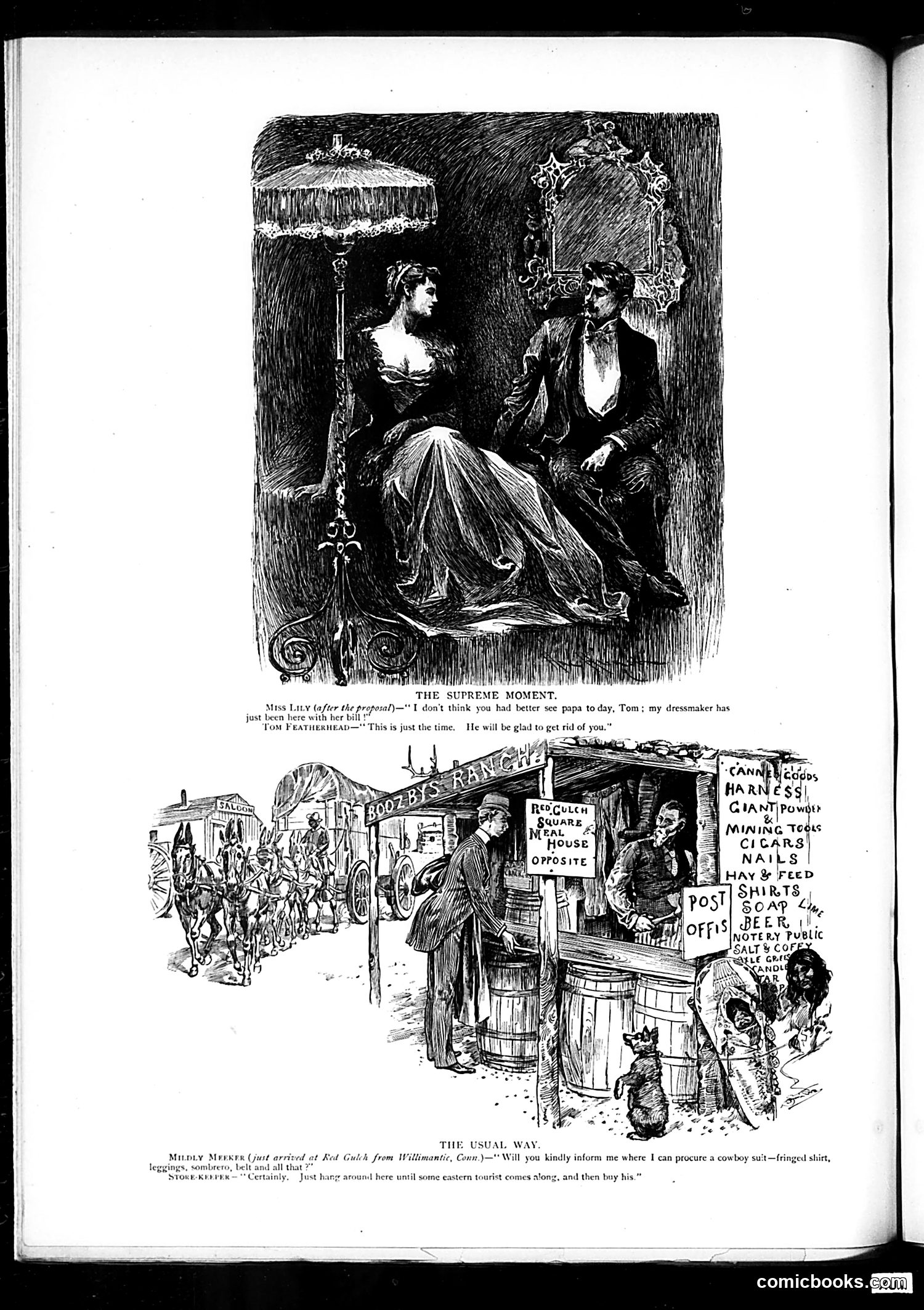
**Top Cartoon ("The Supreme Moment"):** A newly engaged couple discusses seeing her father. The joke: the woman fears her father will be angry about the dressmaker's bill, but the fiancé (Tom Featherhead) welcomes meeting him because he hopes the expensive bill will make the father eager to marry her off—thus getting rid of her as his financial burden. This satirizes both the mercenary aspects of Victorian courtship and the stereotype of expensive women's fashion consumption. **Bottom Cartoon ("The Usual Way"):** A man newly arrived from Connecticut at a mining camp (Red Gulch) asks a store clerk where to buy "cowboy suit" attire. The satire targets Eastern tourists visiting the West who arrive with romantic, theatrical notions of frontier life and attempt to costume themselves as "cowboys"—poking fun at both naive Eastern urbanites and their fantasized version of the Wild West.
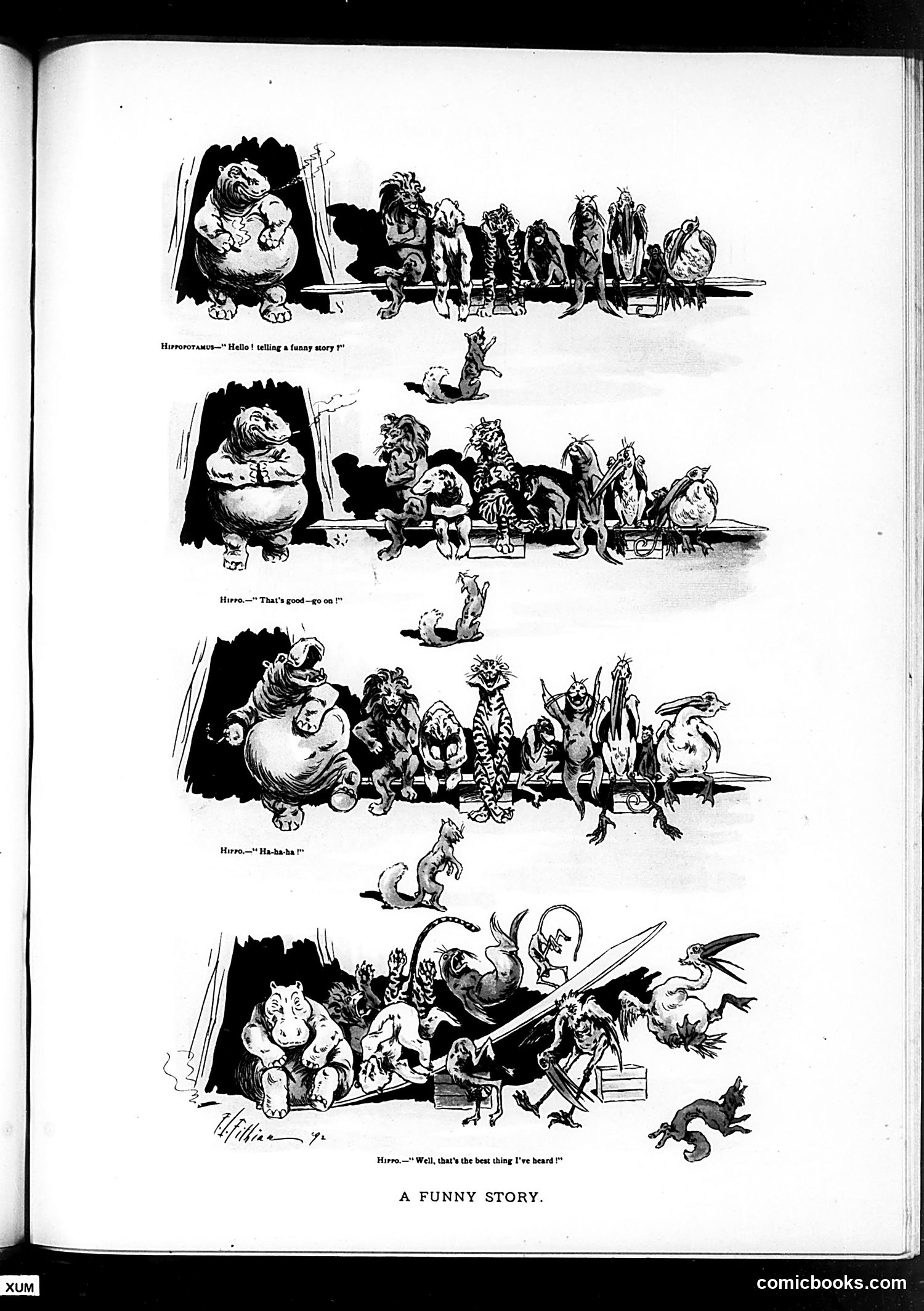
This is a four-panel sequential comic titled "A Funny Story" showing a hippopotamus telling jokes to an audience of various animals. The dialogue progresses: "Hello! telling a funny story?" → "That's good—go on!" → "Ha-ha-ha!" → "Well, that's the best idea I've heard!" The joke appears to be visual rather than political: the hippopotamus is such a poor or unintelligible storyteller that the audience's best response is to suggest he *stop talking* rather than continue. The humor derives from the animals' enthusiasm for silence—a commentary on bad public speaking or amateur comedians. The final panel shows the animals actively encouraging the hippo to shut up, celebrating this as the "best idea." This is likely generic satirical humor rather than topical political commentary.
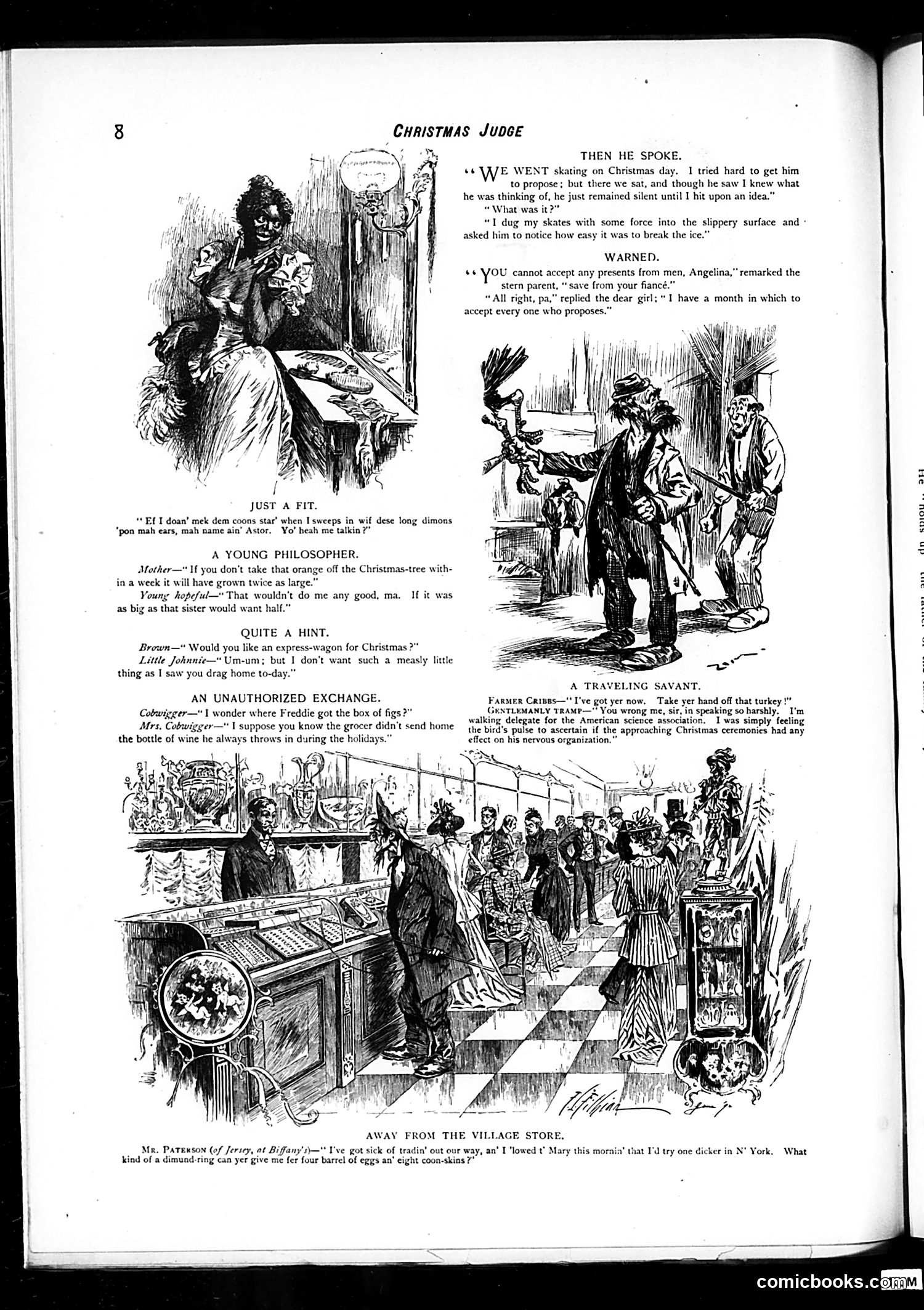
This satirical page from Judge magazine contains multiple comic vignettes mocking various social pretensions and absurdities of the era. **"Just a Fit"** uses racist dialect humor (common in period magazines) to mock aspirational working-class people imitating wealth—a Black woman comparing her jewelry to the Astor family's status symbols. **"A Young Philosopher"** jokes about sibling rivalry and greed. **"Quite a Hint"** satirizes parents' struggles with children's material expectations at Christmas. **"Warned"** plays on courtship customs—a stern father warns his daughter against accepting gifts from suitors, but she jokes she'll accept presents from *all* proposing men within a month. **"A Traveling Savant"** depicts a tramp fraudulently claiming to be a "walking delegate" for the American Science Association to justify stealing a turkey, checking its "pulse" with pseudoscientific pretension. **"Away from the Village Store"** mocks a rural man attempting city commerce, offering eggs and pelts for a diamond ring—satirizing class and regional differences. The page's overall theme: Christmas exposes human greed, social climbing, and pretension across class lines.
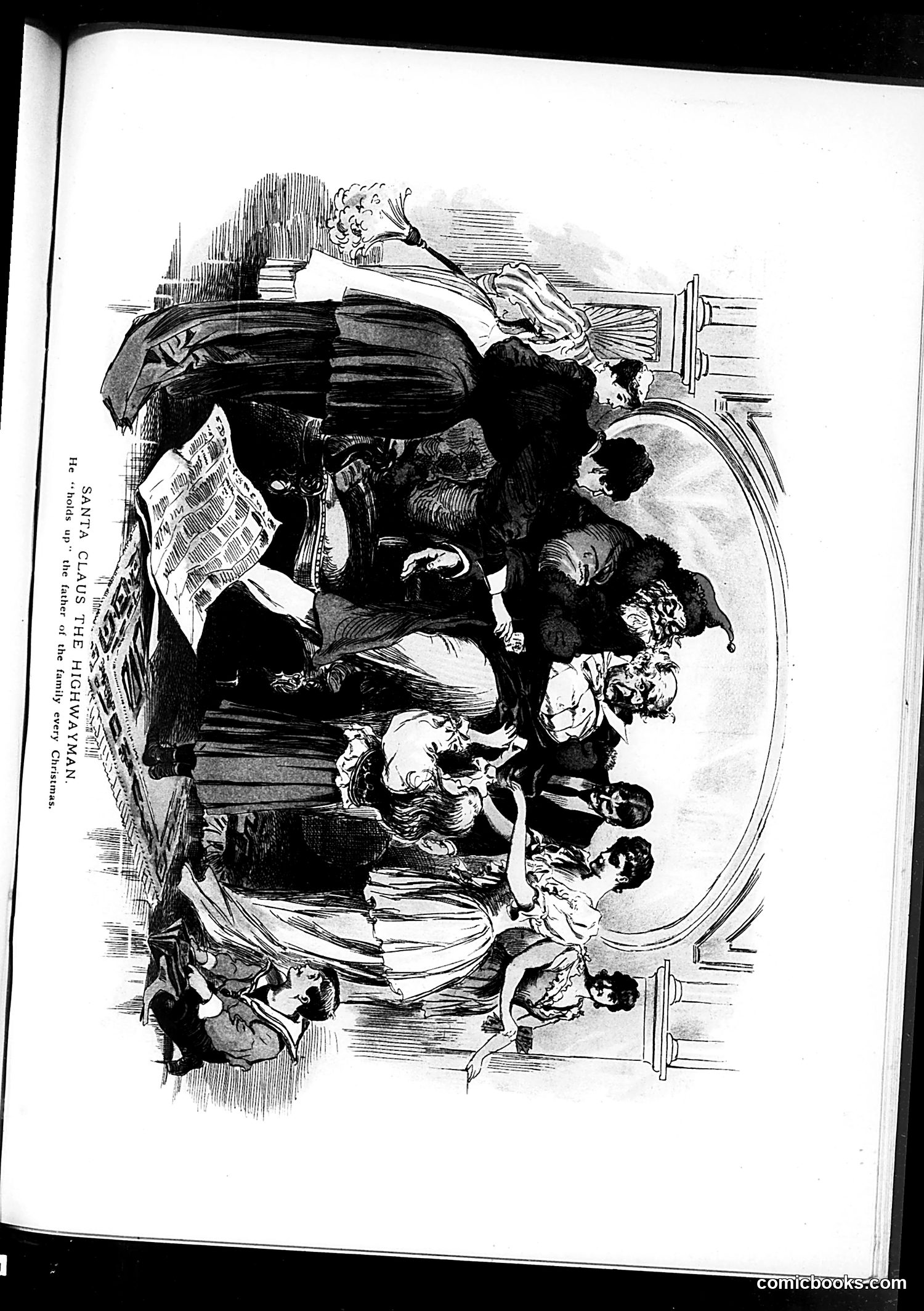
This appears to be a satirical illustration from Judge magazine depicting Santa Claus as a night watchman or security guard. The image shows Santa surrounded by children and figures in what appears to be an indoor setting, with Santa wearing dark clothing typical of a security uniform rather than traditional red. The satire likely comments on the commercialization of Christmas or critiques how Santa has become associated with retail/consumer culture and surveillance rather than genuine gift-giving. The "night watchman" role suggests Santa monitoring purchases or children's behavior for commercial purposes, rather than embodying traditional holiday generosity. Without a clear publication date visible, the specific historical context remains unclear, though this reflects common late 19th-century critiques of Christmas's shift toward commercialism.
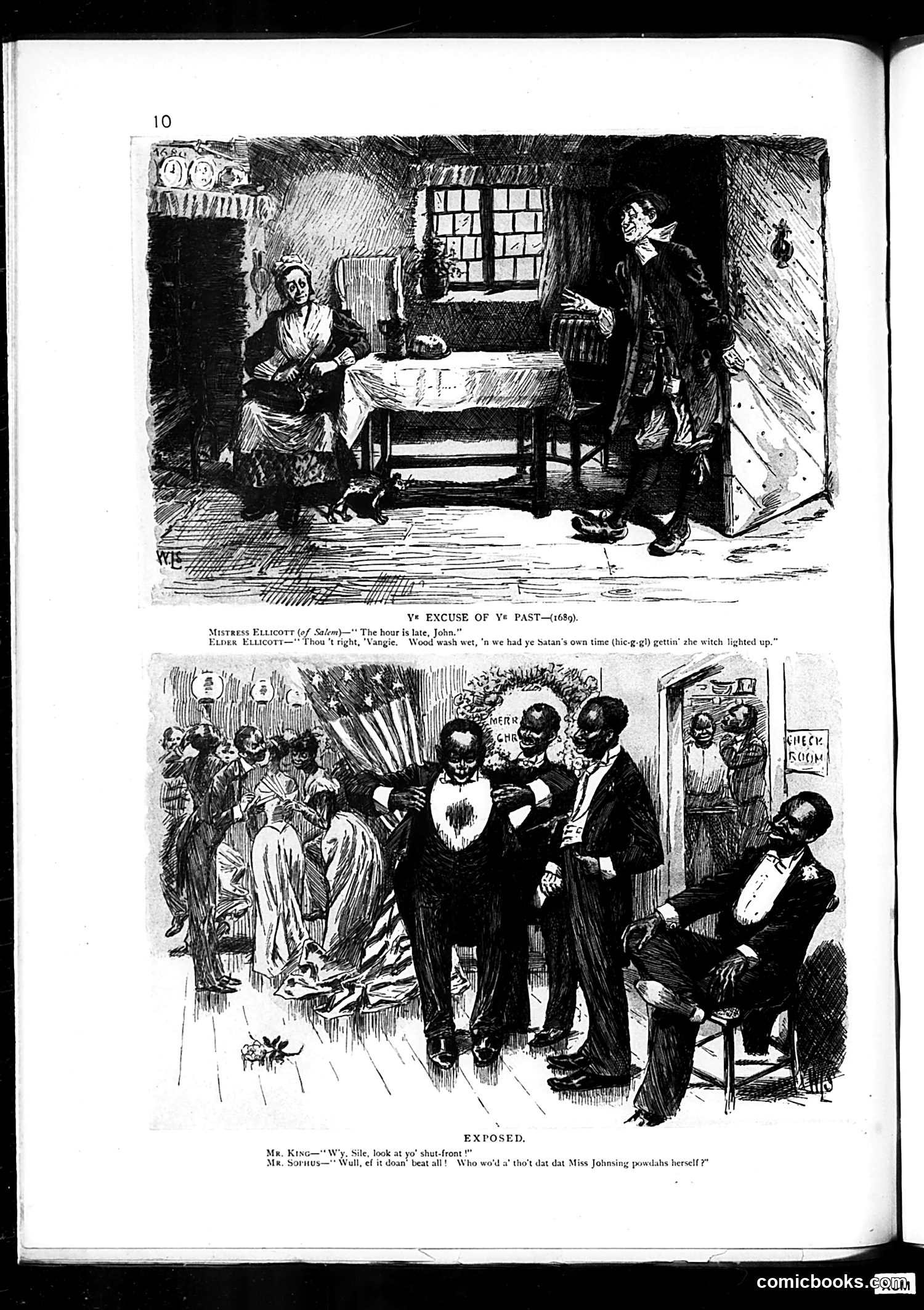
This page contains two satirical cartoons using historical scenarios to comment on contemporary hypocrisy. **Top cartoon ("Excuse of Ye Past"):** References the 1689 Salem witch trials. A couple speaks in mock-colonial dialect about difficulty "getting the witch lighted up"—darkly joking that even supernatural evil takes effort. The satire likely criticizes how people invoke historical injustices to excuse present wrongs. **Bottom cartoon ("Exposed"):** Shows a social gathering where a woman is caught using cosmetic powder (likely face powder, a vanity product). Mr. King and Mr. Soritus express mock shock that "Miss Johnsing powders herself." The joke exposes the hypocrisy of Victorian society: people publicly condemn women's cosmetic use as immodest while privately accepting it. Both cartoons mock how society selectively applies moral judgment—condemning past cruelties or women's minor deceptions while ignoring contemporary double standards.
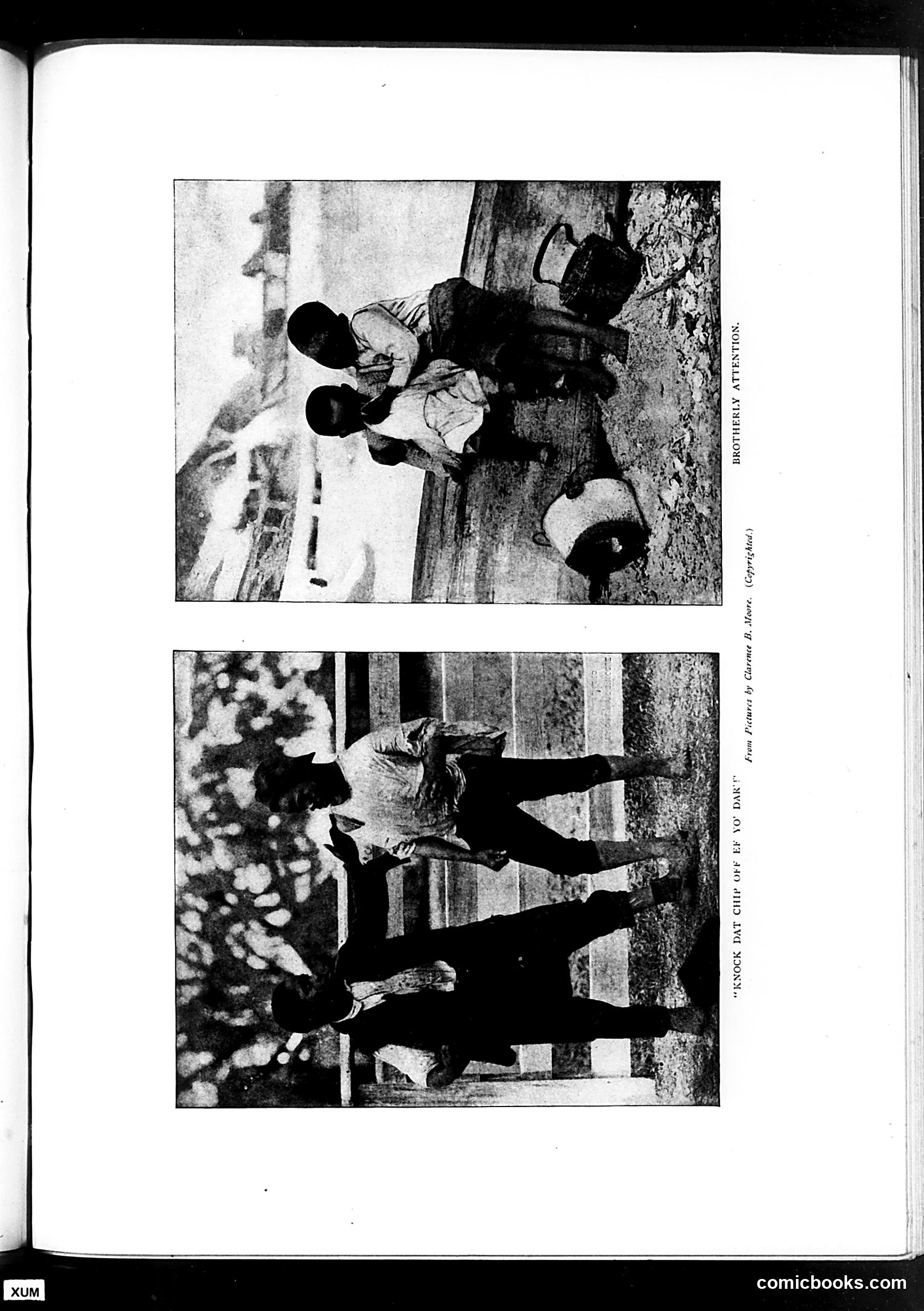
This page contains two black-and-white photographs labeled "BROTHERLY AFFECTION" and "VERLOCK BAT CIPHER BY W. DANE" (text is partially unclear in OCR). The images appear to be theatrical or entertainment photographs rather than political cartoons. The top photo shows two figures in period costume interacting outdoors. The bottom photo shows figures in formal dress in what appears to be an interior setting. Without clearer text or caption information, I cannot definitively identify the specific figures, events, or satirical references these photographs document. The captions suggest they may reference theatrical performances or entertainers from the era, but the OCR text is too corrupted to confirm the intended satire or social commentary. **I cannot reliably explain the meaning to a modern reader without clearer source material.**
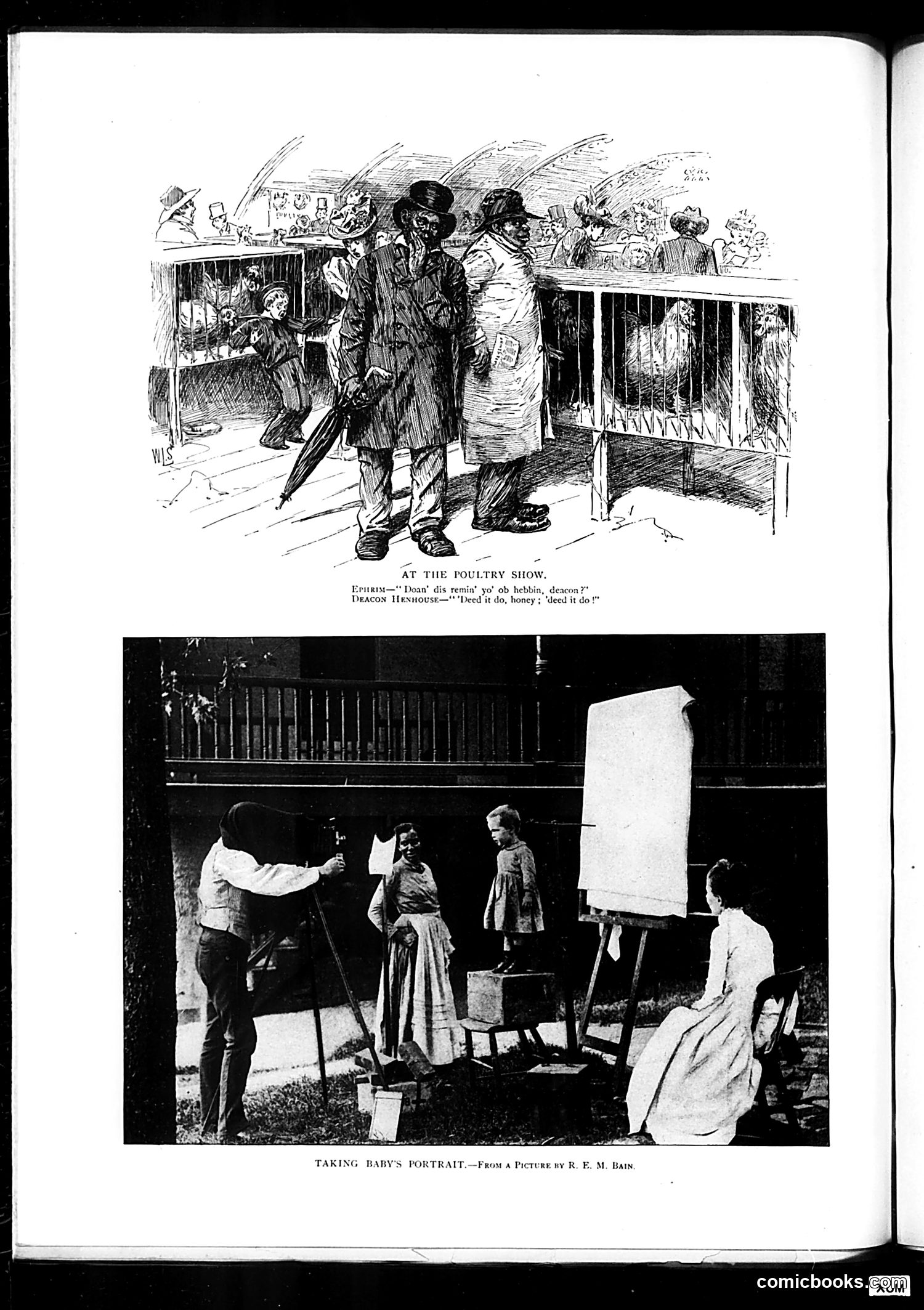
This page contains two separate illustrations: **Top:** "At the Poultry Show" depicts a satirical scene with exaggerated dialect dialogue. Two figures with racist caricature features exchange remarks in heavily stereotyped African American vernacular, commenting that the poultry exhibition resembles heaven. This reflects the period's offensive minstrel-show humor conventions common in late 19th/early 20th-century American satire. **Bottom:** "Taking Baby's Portrait" shows a photography session outdoors. A photographer operates a camera on a tripod while subjects pose. This appears to humorously document early portrait photography techniques, likely satirizing either the awkwardness of photo sessions or photography's technical demands. Both illustrations employ period drawing styles typical of Judge magazine's comic commentary on contemporary American life.
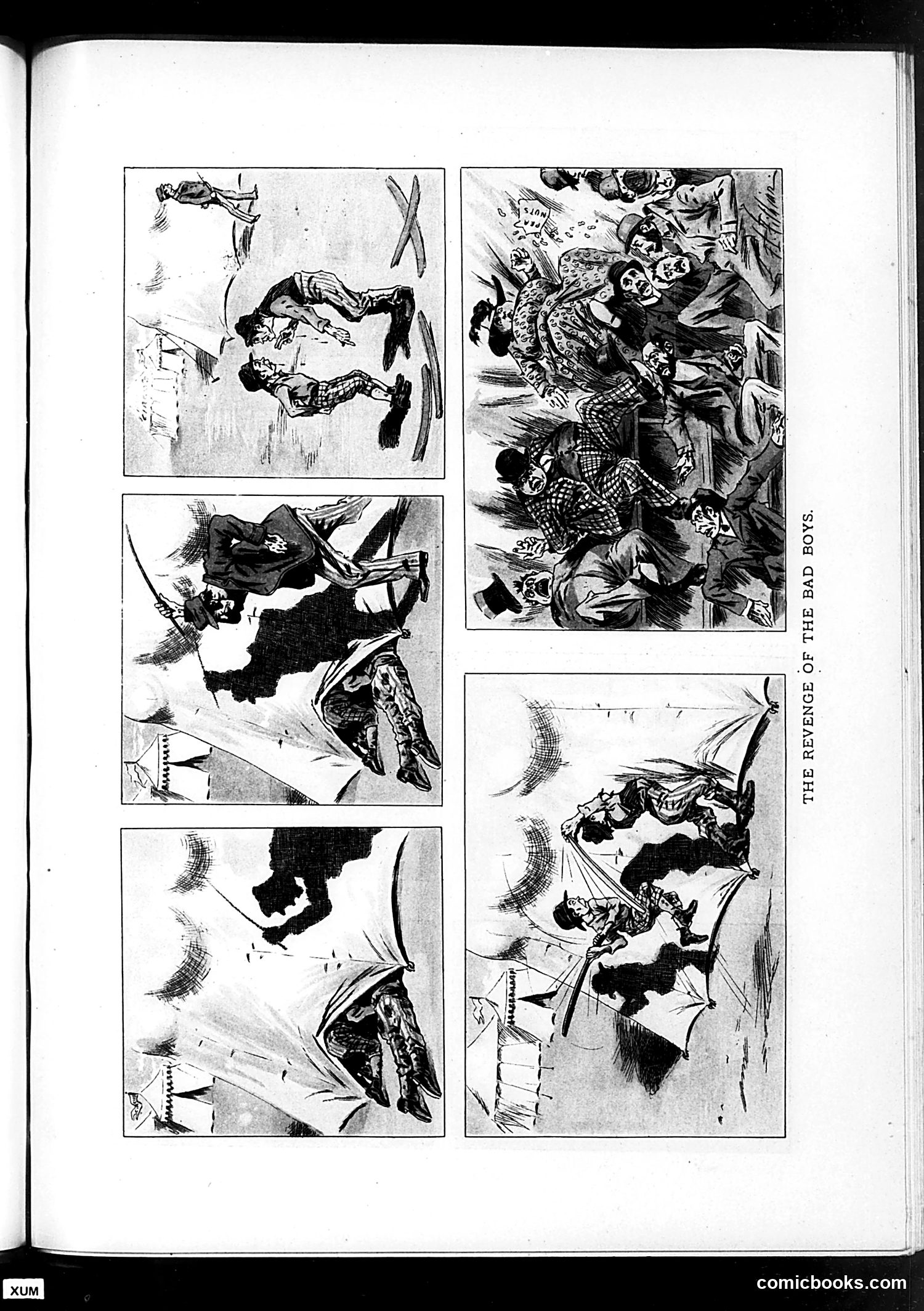
This page appears to be a sequential comic strip or narrative illustration series showing chaotic scenes of mischief and mayhem. The title "The Revenge of the Bad Boys" suggests a story about troublemakers causing disruption, though the OCR text is corrupted and illegible. The black-and-white illustrations depict figures in dynamic, tumultuous poses—people falling, fighting, or fleeing amid scattered objects and environmental chaos. The style is typical of Judge magazine's satirical humor from the late 19th or early 20th century. Without clearer OCR text or additional context, I cannot identify specific political figures or social references being lampooned. The images suggest slapstick comedy or social commentary about youth misbehavior, but the precise satirical target remains unclear from the corrupted text.
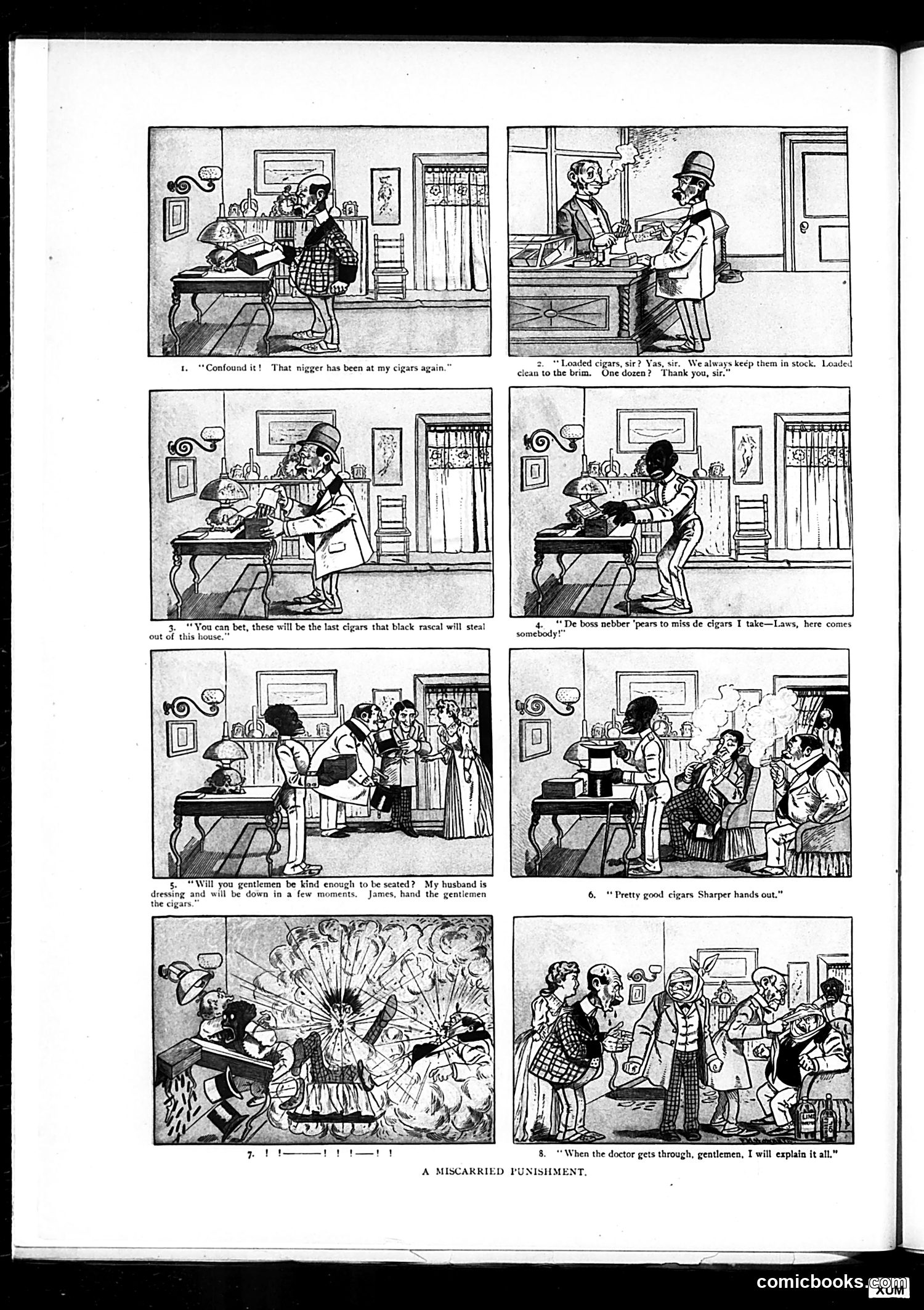
This comic strip satirizes racial stereotypes and depicts a scenario involving a Black servant stealing cigars from his white employer's cigar shop. The narrative follows the theft and subsequent punishment: the employer discovers cigars are missing, suspects the servant, and devises a plan to teach him a lesson by giving him "loaded" (exploding) cigars. The final panels show the cigars exploding when the servant attempts to smoke them, with the doctor arriving to treat the injuries. The title "A Miscarried Punishment" suggests the employer's scheme backfires or produces unintended consequences. The comic relies on racist dialect and caricature typical of early 20th-century American humor, depicting theft and violence against a Black character as comedic material.
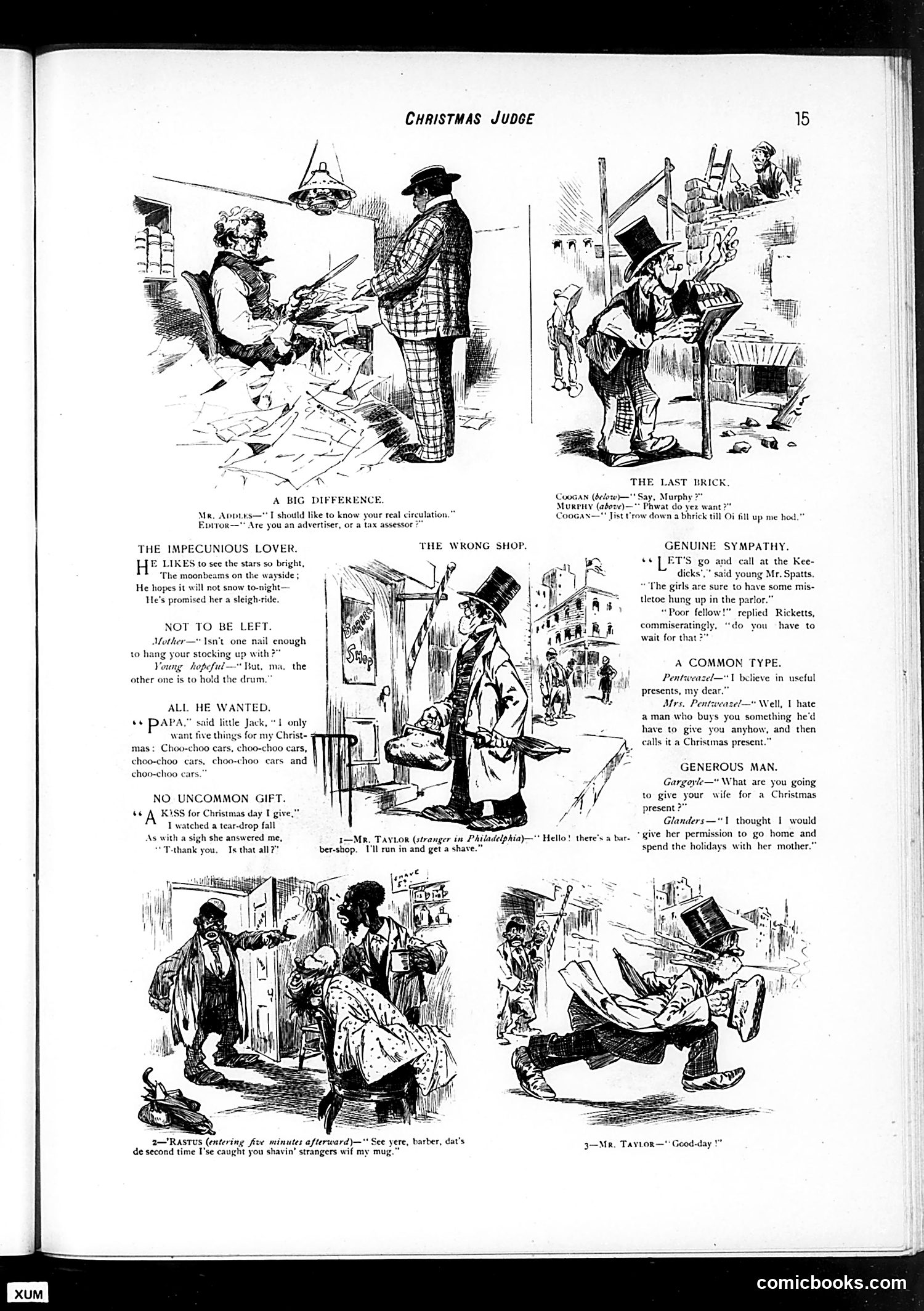
This page contains multiple brief satirical vignettes typical of Judge magazine's humor: **"A Big Difference"** mocks newspaper circulation claims—an editor deflects a advertiser's inquiry about real circulation numbers by asking if he's a tax assessor, implying publishers inflate figures. **"The Last Brick"** shows Irish laborers (stereotypical "Murphy" character) in comic dialect, playing on period anti-Irish prejudice. **"The Impecunious Lover"** jokes about a poor suitor unable to afford a sleigh-ride date—contemporary working-class romance humor. **"The Wrong Shop"** depicts a man entering a barber shop seeking mistletoe, confusing it with a different establishment. **"The Wrong Shop"** (center) satirizes naive Christmas gift-giving and marital dynamics—a wife criticizing gifts her husband "had to give anyway." **"Rastus" sketches** appear to mock African American characters through dialect and stereotypes common to the era. The page represents typical Gilded Age American satire: class-based humor, ethnic caricature, domestic comedy, and light social criticism—standard for Judge's audience but reflecting period prejudices.
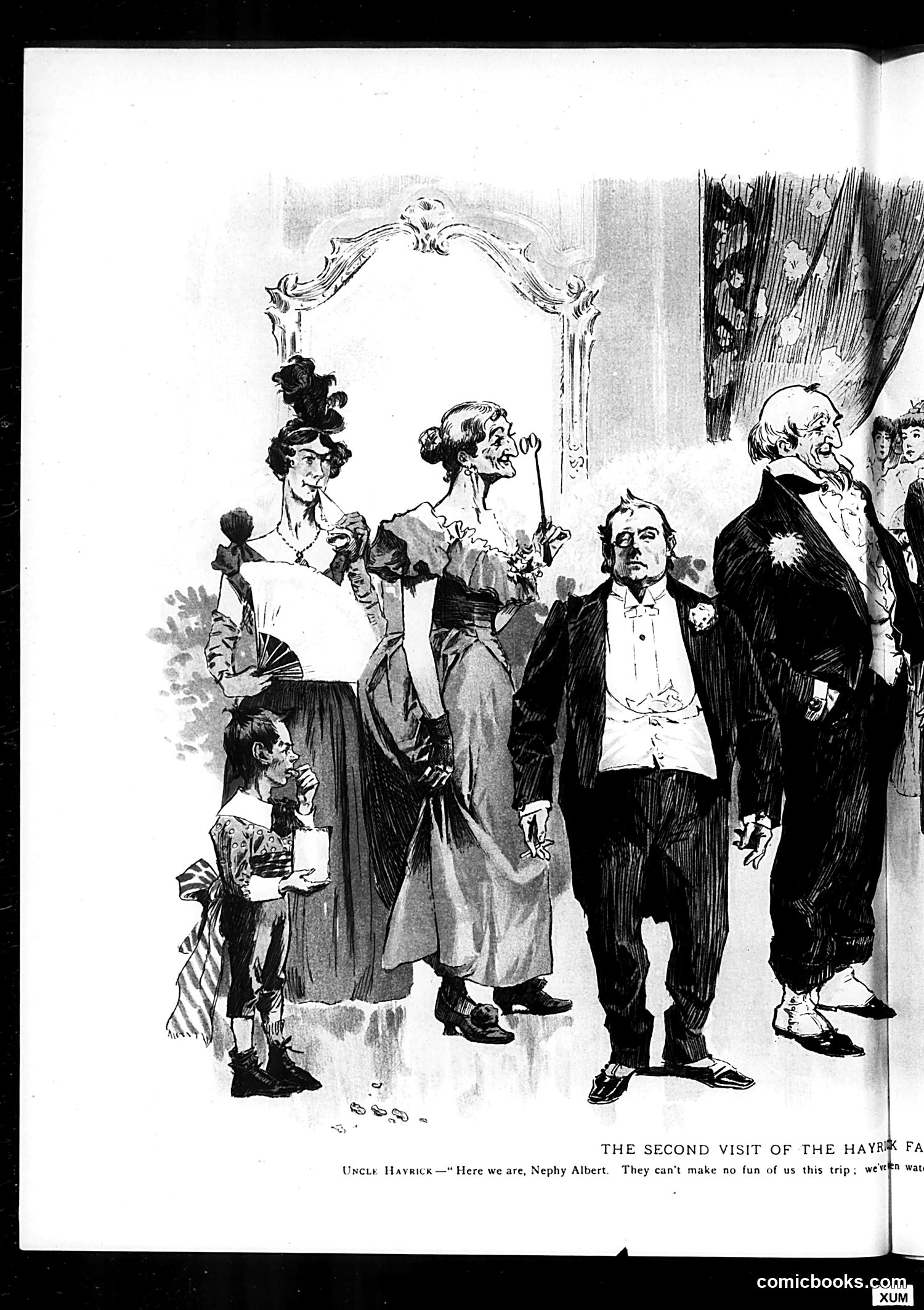
This cartoon depicts "Uncle Hayrick" and "Nephew Albert" visiting what appears to be a formal social setting, indicated by the ornate mirror and well-dressed attendees in evening wear. The caption suggests Uncle Hayrick is confident they won't be mocked this time during their visit. The humor likely stems from class or cultural contrast—these characters apparently represent rural or working-class figures attempting to navigate sophisticated urban society. The title references "The Second Visit," implying their first visit was embarrassing or resulted in ridicule, and Uncle Hayrick believes they've now learned how to fit in properly. The specific reference to "Hayrick" (hay-related) reinforces rural characterization typical of Judge magazine's satirical commentary on American class divisions during the early 20th century.
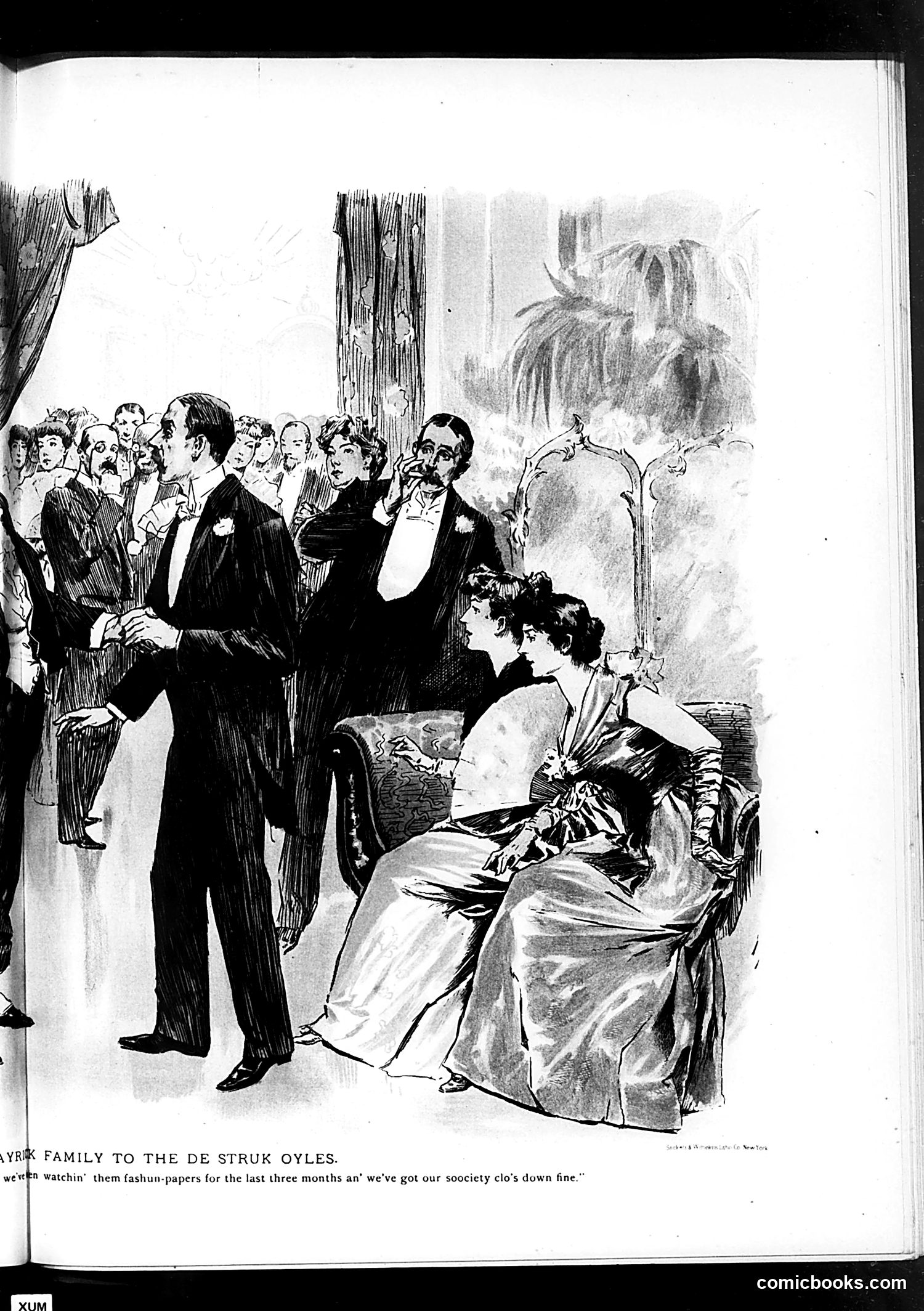
This cartoon satirizes social climbing and snobbery among New York's wealthy families. The caption references "the De Struk Oyles" (a pun on "destructible oils"—likely mocking nouveau riche oil barons). The scene shows well-dressed men presenting themselves to seated women in an elegant interior, with the subtitle suggesting the family has been closely monitoring society gossip in fashion papers for three months to maintain their social standing. The satire targets the pretension and artificial status-consciousness of the upper class, mocking their obsessive attention to social appearance and their anxiety about maintaining reputation. The caricatured expressions emphasize the artificiality of these social interactions and the shallowness of wealth-based hierarchies.
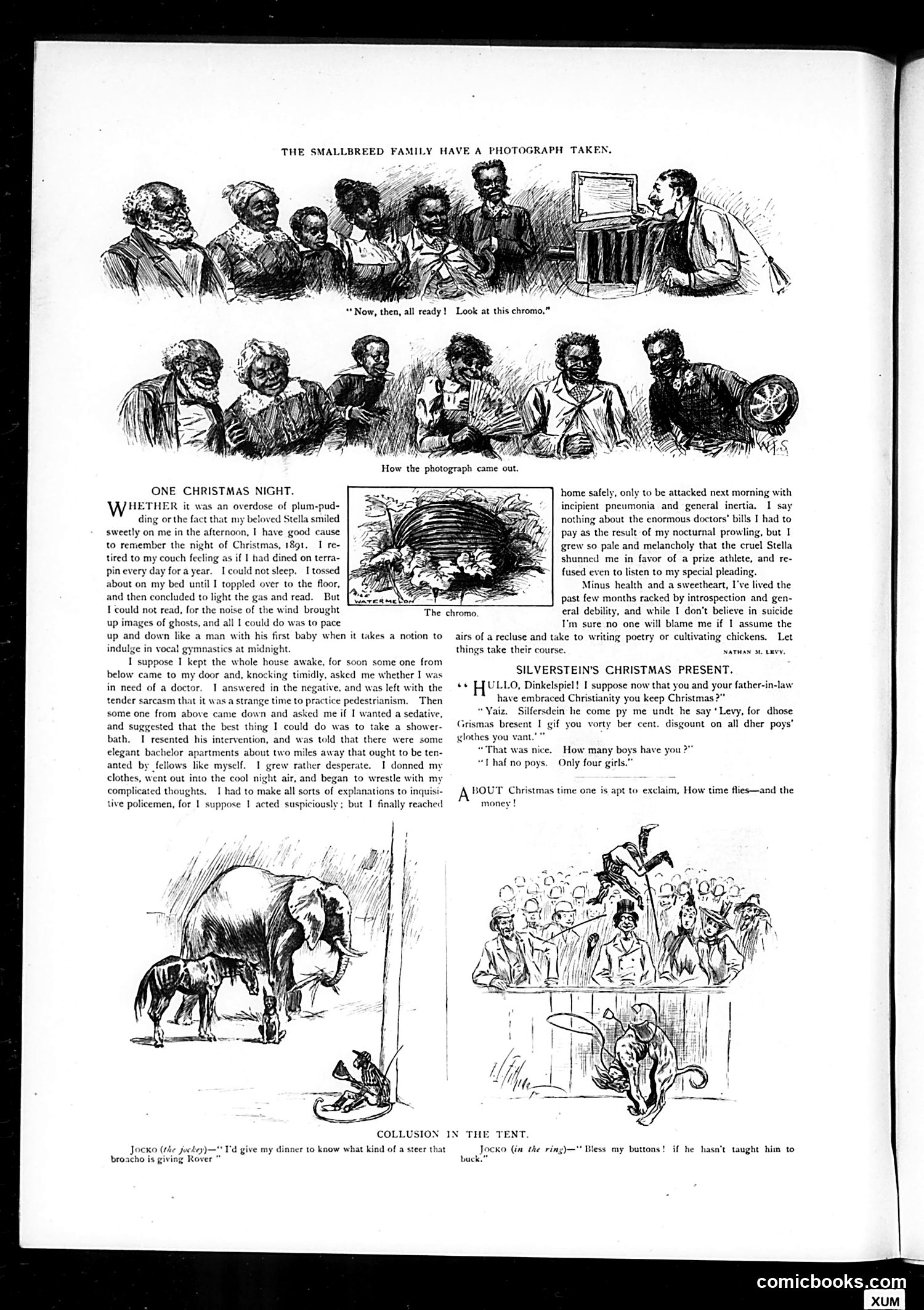
This page contains satirical domestic humor typical of 1890s American magazines. **Top section:** "The Smallbreed Family Have a Photograph Taken" shows a family's chaotic attempt at getting their picture taken—a common source of Victorian-era humor about new photographic technology and family awkwardness. **Main story:** A humorous first-person narrative about a man's Christmas night insomnia, restless wandering, and subsequent illness that causes him to lose his sweetheart to a "prize athlete." It's genteel comedy about middle-class domestic life and romantic misfortune. **Two separate jokes below:** - "Silverstein's Christmas Present": A dialect joke featuring Jewish characters (Dinkelspiel, Silverstein, Levy) discussing a father-in-law's stingy Christmas discount on boys' clothes—the punchline being he only has four daughters, making the discount useless. Reflects period ethnic stereotyping. - "Collision in the Tent": A brief circus scene with jockeys and horses. The page reflects 1890s sensibilities: photographic novelty, sentimental domestic mishaps, and casual ethnic humor now considered offensive.
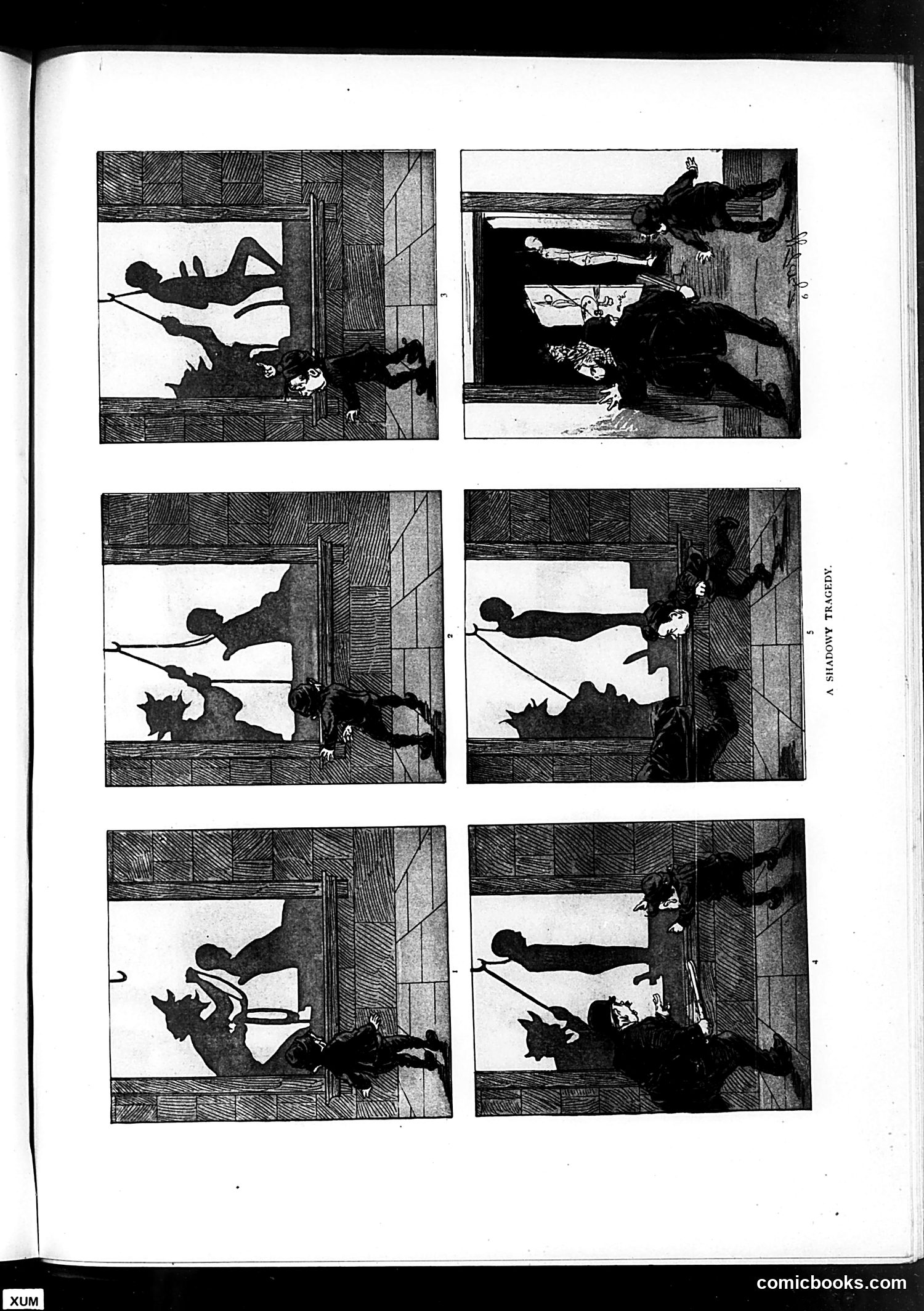
This six-panel comic strip depicts a person repeatedly falling into snow while attempting various activities—sledding, walking, and other winter pursuits. Each panel shows the figure tumbling or sprawling into snowdrifts, with what appears to be a dog or animal also involved in the mishaps. The title "A Snowy Therapy" suggests the cartoon is satirizing the supposed health benefits of winter activities or cold-weather recreation that were popular talking points in the period. The repeated slapstick failures humorously undermine claims that snow-based activities were therapeutic or beneficial, instead depicting them as physically chaotic and undignified. The joke targets the gap between wellness claims and reality.
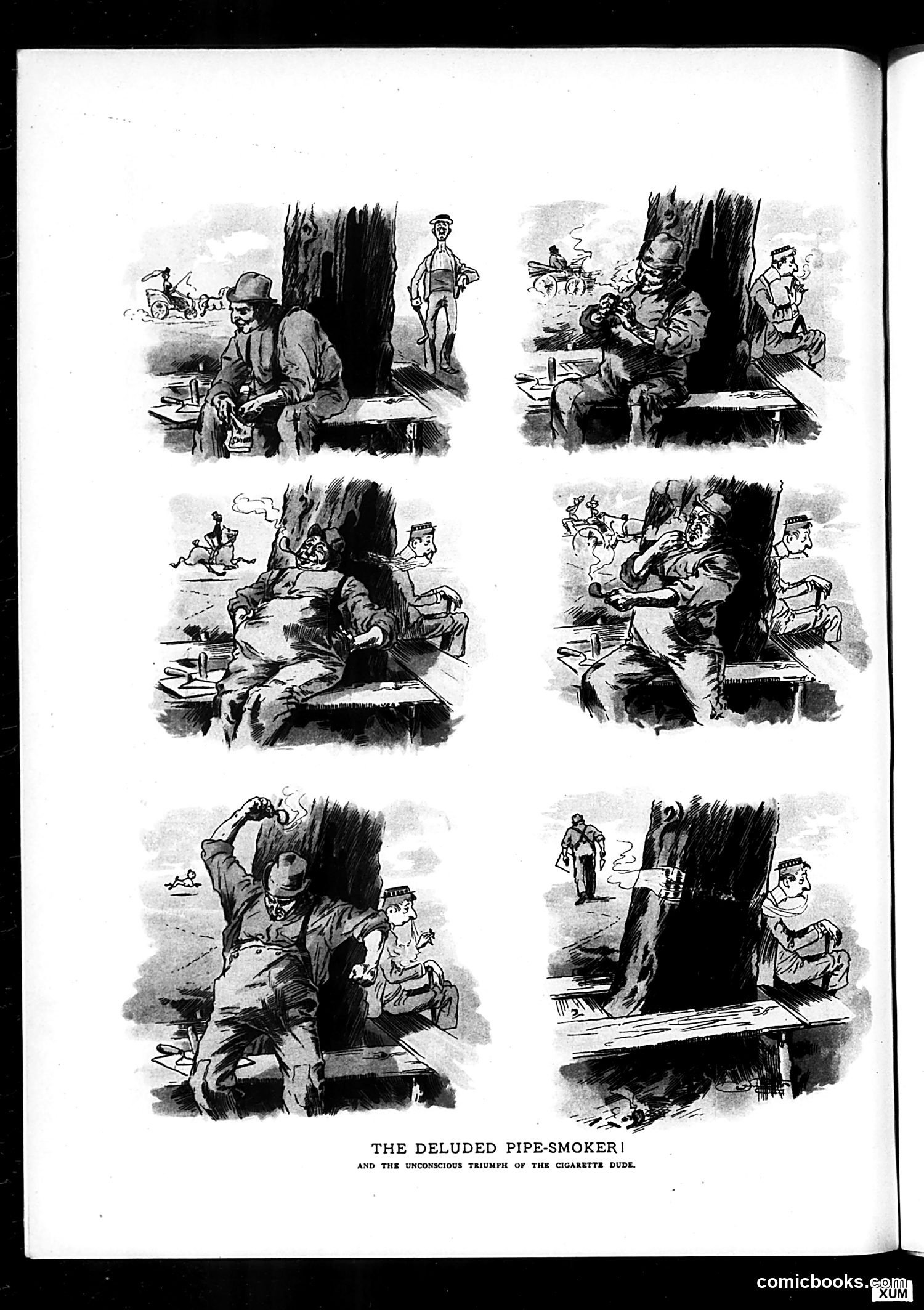
This is a six-panel satirical comic titled "The Deluded Pipe-Smoker and the Unconscious Triumph of the Cigarette Dude." The cartoon depicts a bearded man smoking a pipe who appears confident and superior, sitting beneath a large tree. Meanwhile, a younger man with cigarettes repeatedly intrudes upon or interrupts him across the panels, seemingly oblivious to his presence. The satire mocks the pipe-smoker's false sense of dignity and superiority—he considers himself refined and established—while the cigarette smoker, portrayed as an unthinking "dude," unknowingly undermines and displaces him. The joke appears to satirize the clash between old-fashioned masculinity (pipes, beards, tradition) and modern, casual smoking culture (cigarettes, youth). This reflects late-19th/early-20th-century anxieties about cigarettes replacing pipes as the dominant smoking method among younger men.
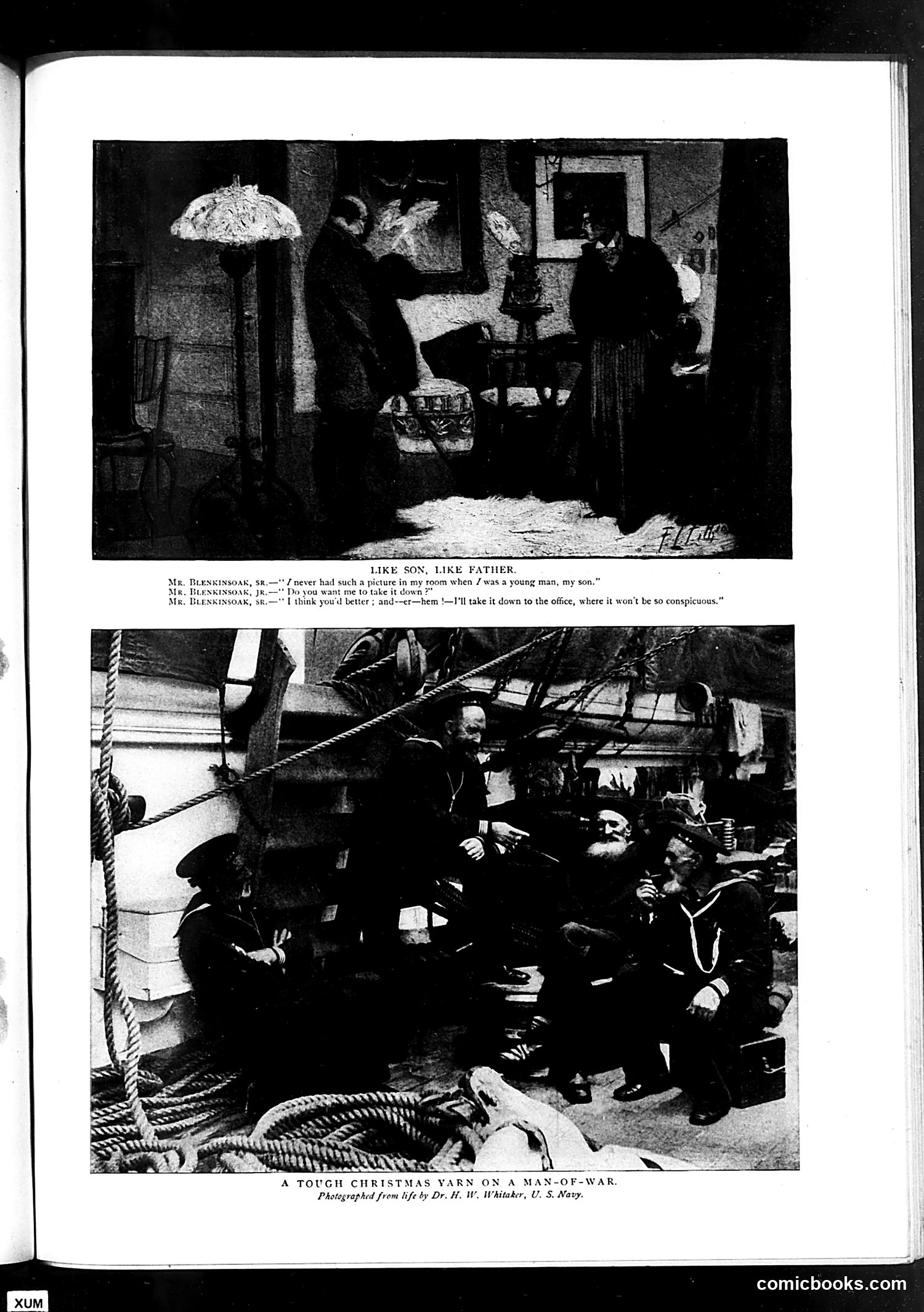
**Top cartoon** ("Like Son, Like Father"): A father objects to his son displaying a suggestive picture in his bedroom, arguing it's inappropriate. The son promises to move it to the office instead—suggesting adults are hypocritical about morality, hiding similar behavior at work while lecturing youth about propriety. **Bottom image** ("A Tough Christmas Yarn on a Man-of-War"): Sailors gathered below deck, apparently sharing stories. The caption credits Dr. H.W. Whitaker of the U.S. Navy. This appears to document naval life rather than satirize it—showing servicemen's informal social customs during Christmas, likely illustrating wartime camaraderie or morale-building activities aboard ship. The page contrasts domestic hypocrisy with military brotherhood.
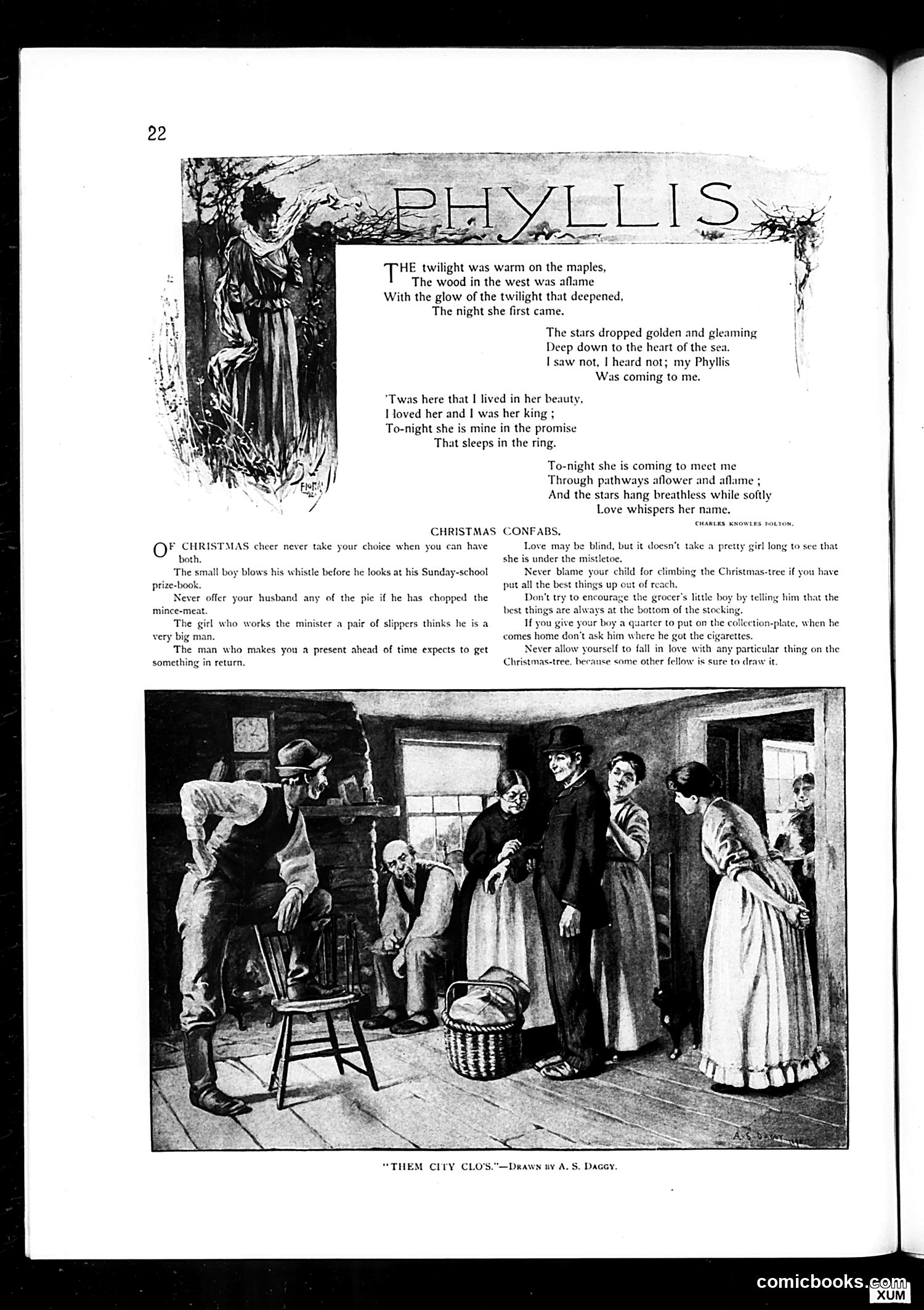
This page contains a romantic poem "Phyllis" by Charles Knowles Holton celebrating an engagement (referenced by "the ring"), followed by humorous Christmas-season advice under "Christmas Confabs." The cartoon at bottom, titled "Them City Clo's" (drawn by A.S. Daggy), depicts rural figures examining urban clothing—likely factory-made or ready-made garments—with expressions of bemusement or skepticism. This satirizes the contrast between rural and urban fashion sensibilities during the period when mass-produced clothing was becoming available but still seemed foreign to country people. The Christmas advice is gentle satire targeting domestic situations: foolish husbands, overzealous ministers' admirers, selfish gift-givers, and children tempted by improperly-displayed Christmas ornaments. These mock-aphorisms humorously expose common holiday hypocrisies and social pretensions rather than attack serious targets. Overall, the page blends sentimental romance with light domestic humor typical of Judge's satirical approach to American life.
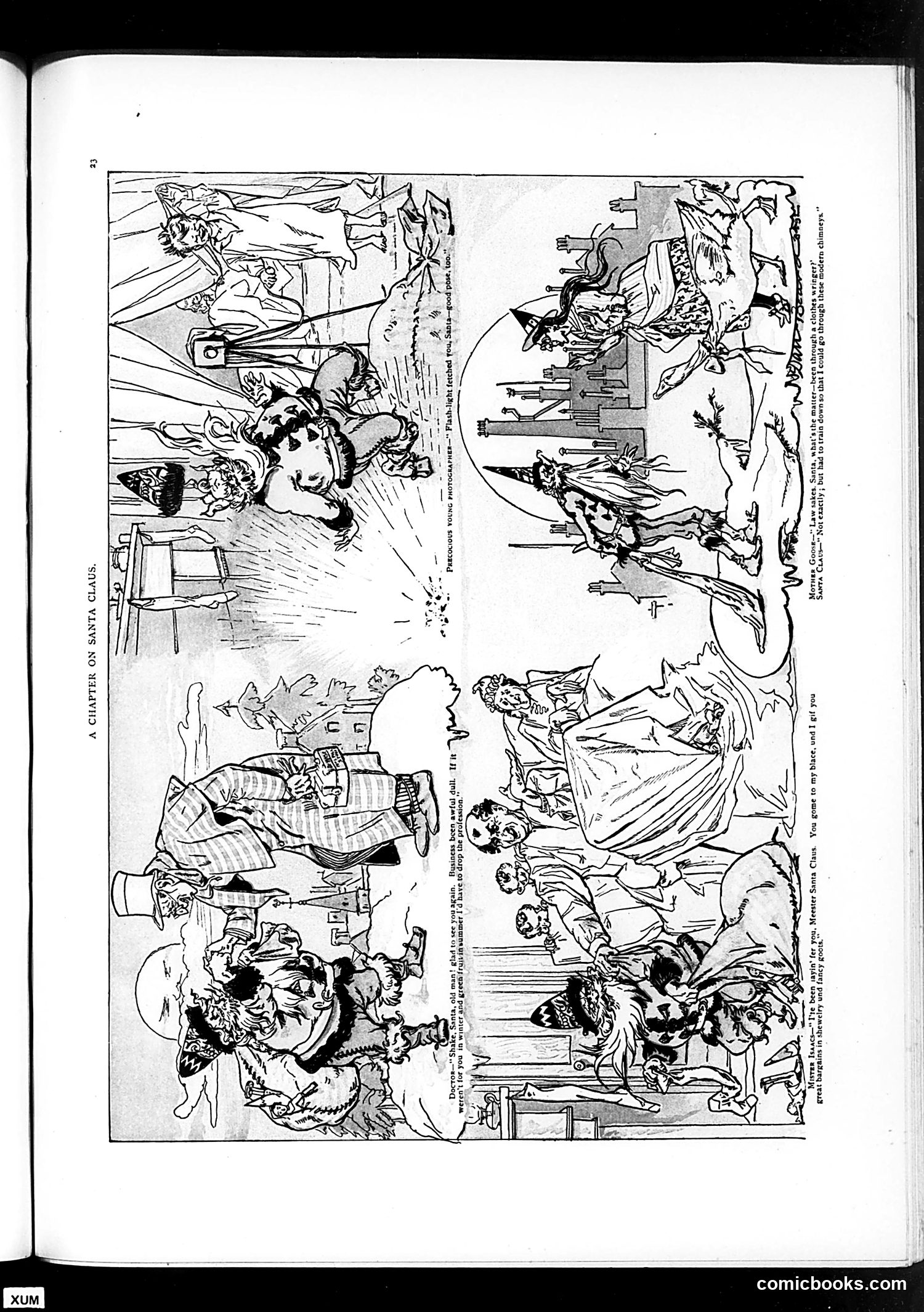
I can see this is a page from *Judge* magazine containing multiple cartoon panels arranged vertically, but the image quality and orientation make it difficult to read the specific text and identify particular figures with confidence. The cartoons appear to depict social or political scenes with multiple characters in period dress, suggesting late 19th or early 20th-century satire. Without being able to clearly read the captions or definitively identify the individuals caricatured, I cannot accurately explain the specific political or social references these cartoons address. The OCR text provided doesn't clarify the content either. To properly explain these cartoons' meaning to a modern reader, I would need higher resolution or clearer source material.
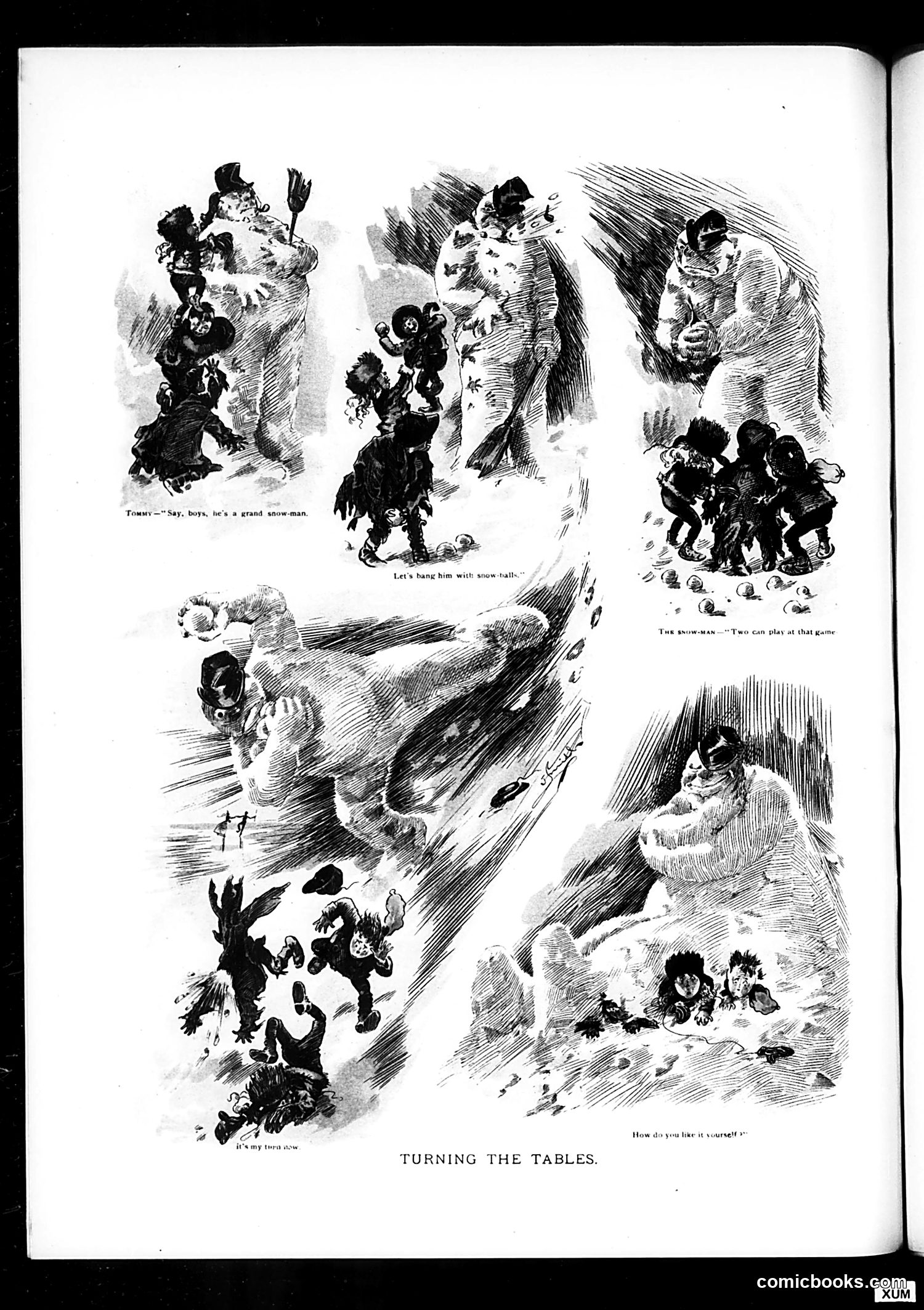
This page presents a series of winter vignettes centered on snowmen and snow play. The title "Turning the Tables" suggests role reversals or comeuppance scenarios. The visible captions reference building a grand snowman, hanging someone with snowballs, and children playing snow games. The central large panel depicts what appears to be a giant snowman or snow figure towering over small human figures below, with children engaged in snow activities around its base. The repeated phrase "How do you like it yourself?" suggests ironic reversal—possibly depicting children or smaller figures gaining advantage over larger antagonists through winter play. Without additional historical context about Judge magazine's publication date and contemporary events, the specific political or social targets remain unclear, though the tone suggests satirical commentary on power dynamics or social hierarchies rendered through accessible winter imagery.
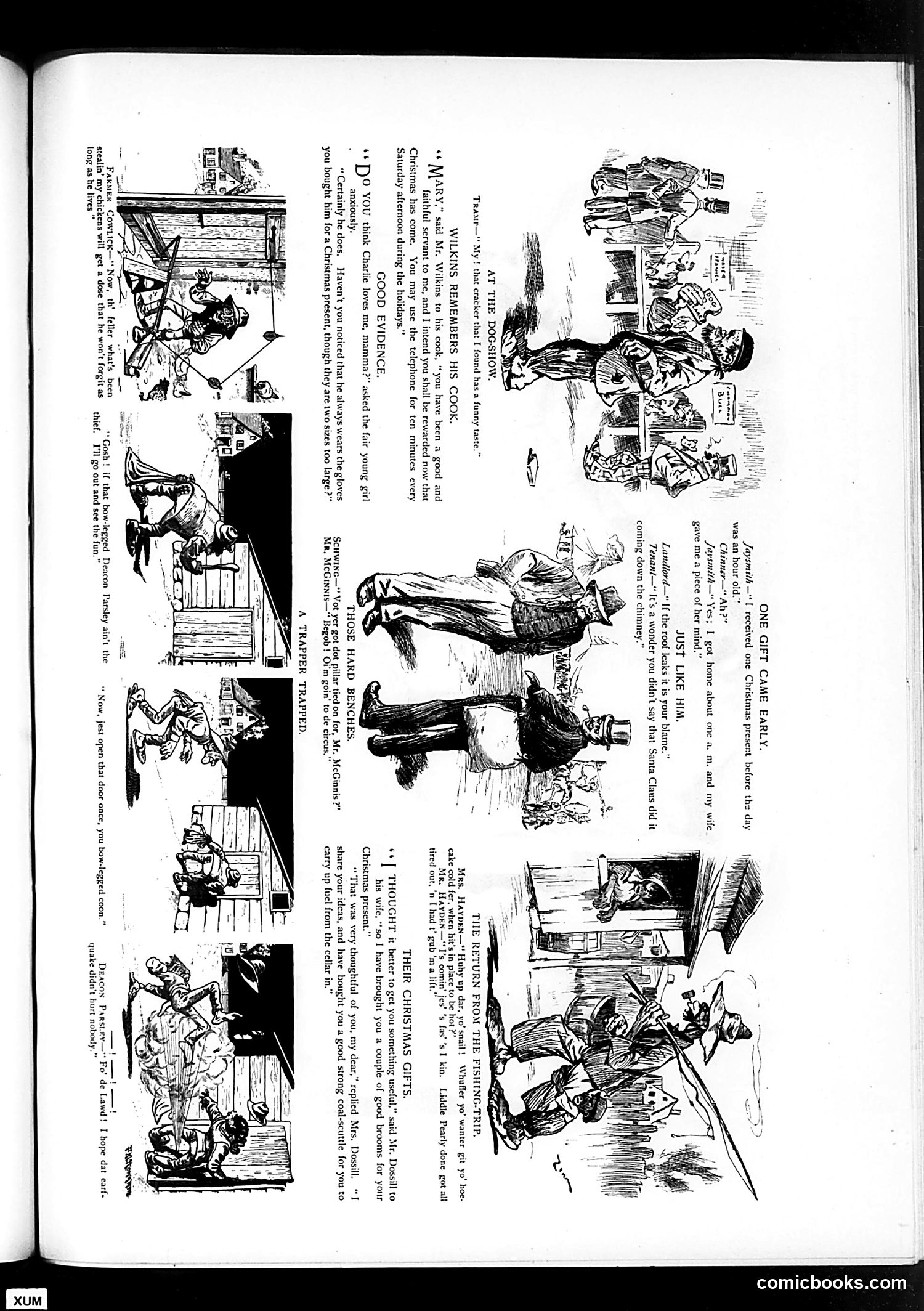
This page contains six unrelated short comic strips and jokes, all centered on Christmas gift-giving and holiday mishaps—typical of Judge magazine's satirical humor. The strips mock domestic life: a husband gets "a piece of his wife's mind" as an early Christmas present; a tenant suggests the landlord blame Santa Claus for roof leaks; a dog-show attendee finds a mysterious "cracker" with odd taste; an employer "rewards" a servant with ten minutes of telephone use daily; a girl interprets her boyfriend wearing ill-fitting gloves as proof of his love; and a farmer sets a trap for a chicken thief, only to have a neighbor join in anticipation of the "fun." The final strip shows Mr. Dossill giving his wife practical (and insulting) gifts—brooms and a coal-scuttle—rather than sentimental ones, satirizing cheap or ungracious husbands. The humor relies on situational irony, class commentary, and domestic tension typical of early 20th-century American magazines.
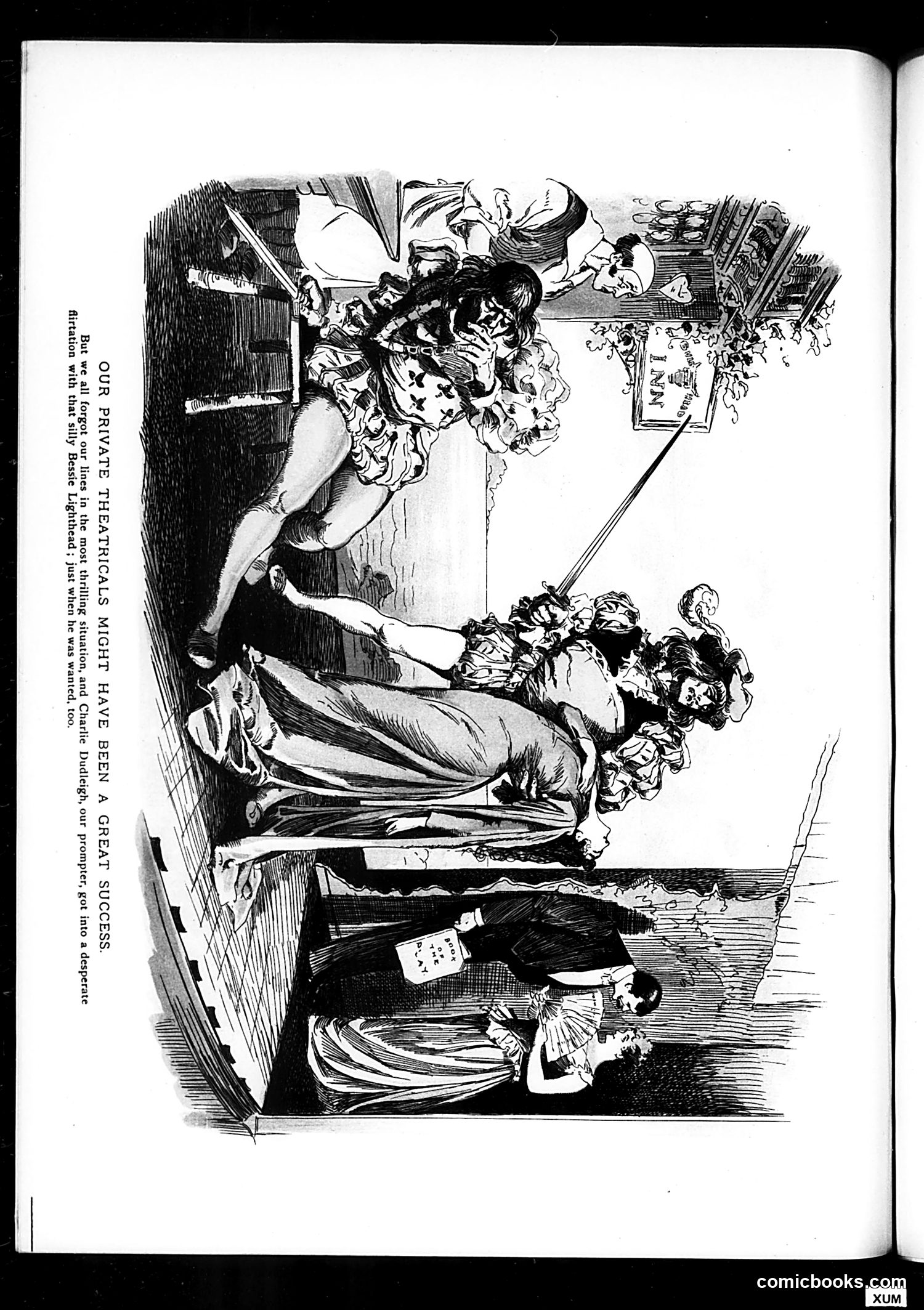
This appears to be a humorous domestic scene rather than political satire. The cartoon depicts an amateur theatrical performance gone awry—the caption references actors forgetting their lines during a crucial moment. The illustration shows the chaos: performers in costume are tangled together, someone appears to be falling or collapsing, and the scene is comically disorganized. The humor centers on the prompter, Charlie Dudleigh, abandoning his duty to flirt with "that silly Bessie Lighthead" at the critical moment when the actors needed his help. This is classic parlor-comedy satire—poking fun at Victorian-era amateur theatricals (private home performances), the vanity of aspiring actors, and romantic distraction interfering with responsibilities. The title's "might have been a great success" is ironic understatement given the visible disaster depicted.
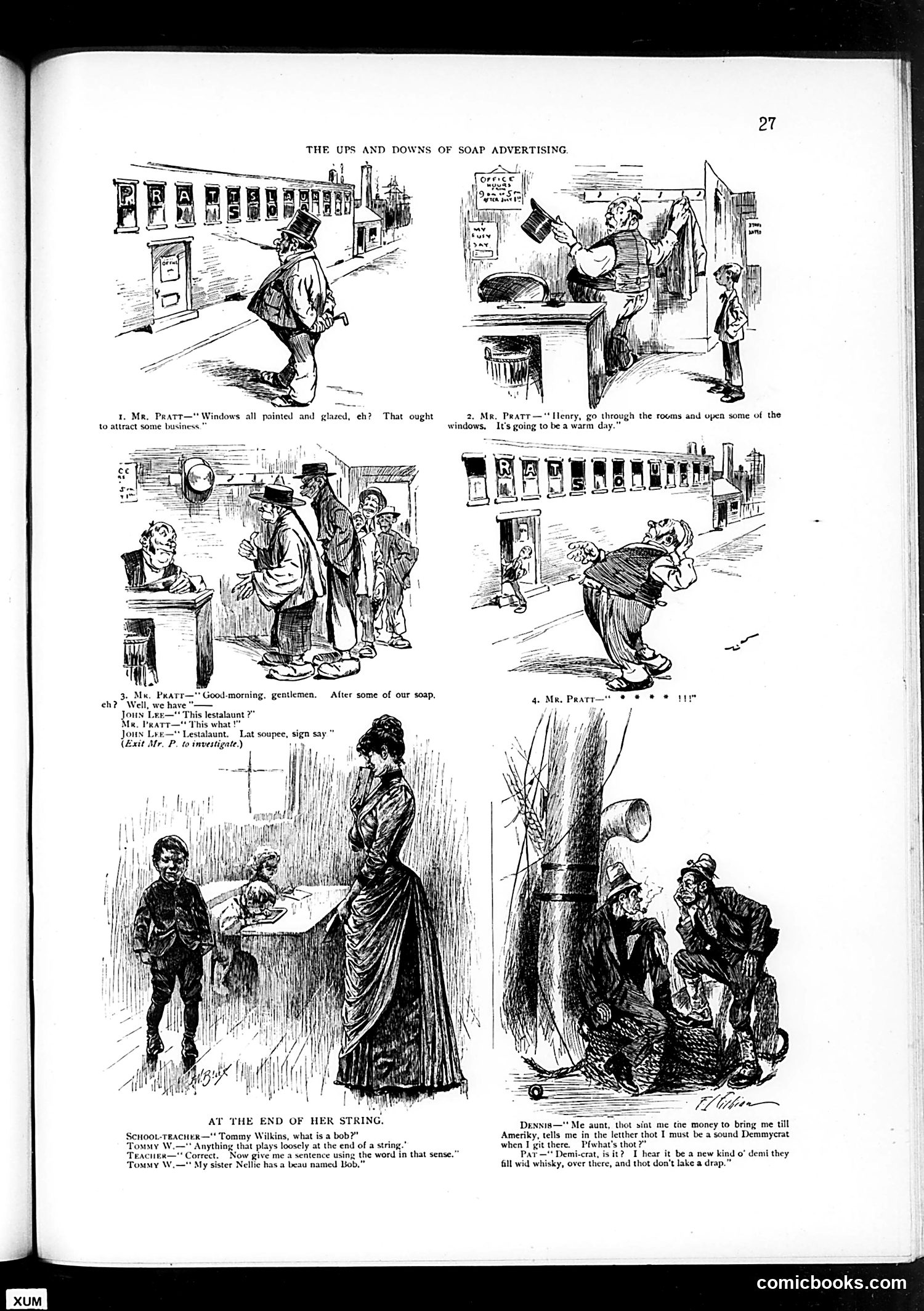
This satirical page mocks soap advertising's ineffectiveness through six comic scenarios. Mr. Pratt, a soap vendor, attempts various promotional tactics—painting shop windows, airing rooms for warmth—yet struggles to attract customers. The humor derives from the contrast between his efforts and their futility. Lower panels shift to unrelated jokes: a schoolteacher's lesson on the word "bob" (a dangling object) where a student misapplies it to his sister's boyfriend; and an immigration scene where poor immigrants discuss remittances and whiskey, using thick dialect. The page satirizes both failed commercial advertising and, in the lower section, contemporary stereotypes about working-class and immigrant life. The "ups and downs" title suggests both the fluctuating fortunes of advertising and literal physical comedy throughout the panels. The overall tone is lighthearted mockery of American commercial culture and social classes.
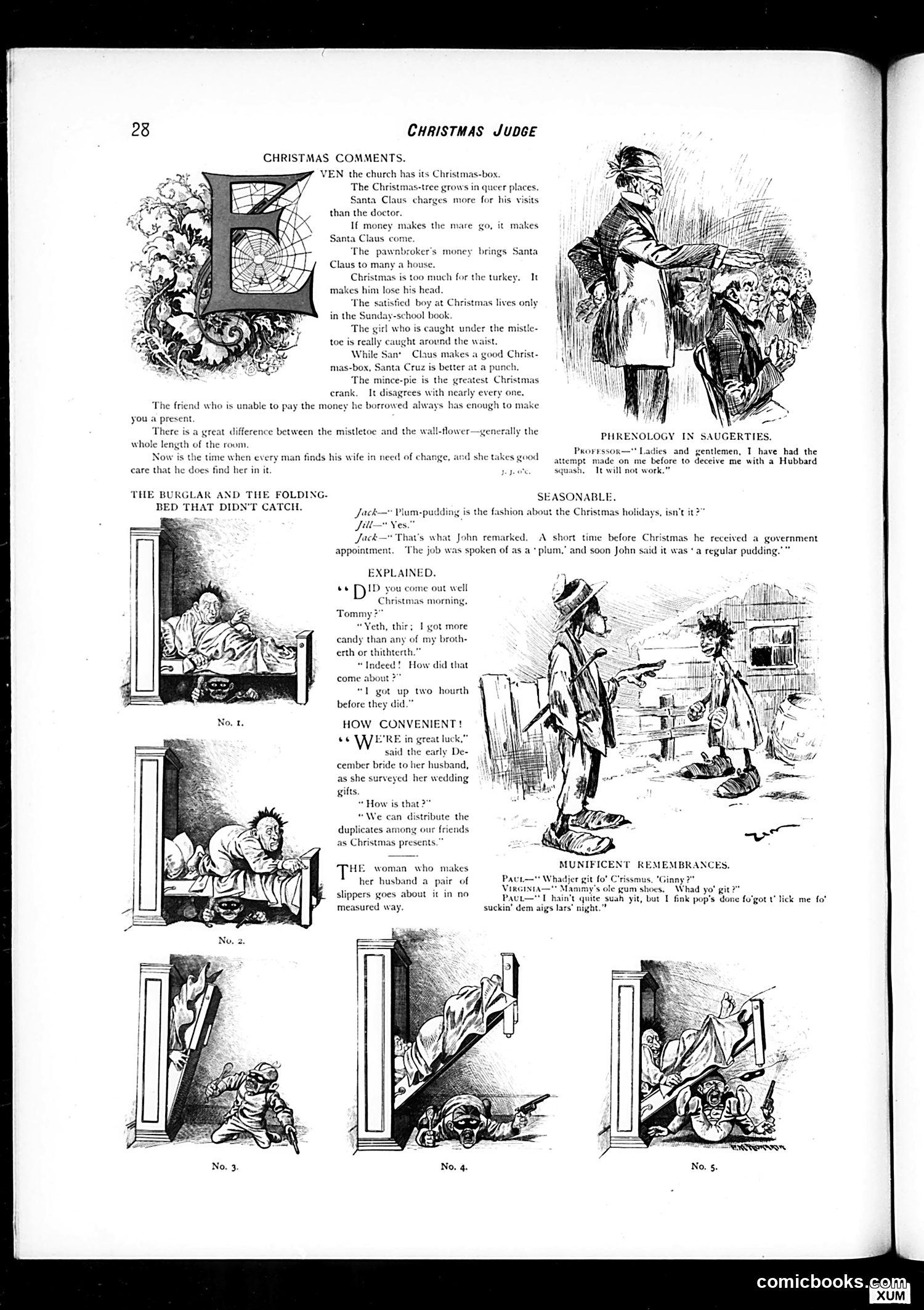
This is a Christmas-themed satirical page from *Judge* magazine featuring multiple brief jokes and comic observations about holiday traditions and customs. **Main Content:** The "Christmas Comments" section offers cynical one-liners mocking Christmas commercialism and social hypocrisy—Santa Claus charges more than doctors, money motivates gift-giving, borrowed money mysteriously appears for presents despite debts. **The Burglar Series** (Nos. 1-5): A sequential comic showing a burglar attempting to hide in a folding bed that keeps collapsing on him—visual slapstick humor about the era's unreliable furniture. **Additional sketches** include wordplay about plum pudding versus government appointments, a bride's convenient duplicate wedding gifts for regifting to friends, and dialogue between what appear to be rural or working-class characters discussing Christmas gifts. The satire targets consumer materialism, social pretense, and the gap between Christmas ideals (Sunday-school morality) and actual behavior (debt, regifting). The tone is genteel mockery typical of *Judge*'s audience.
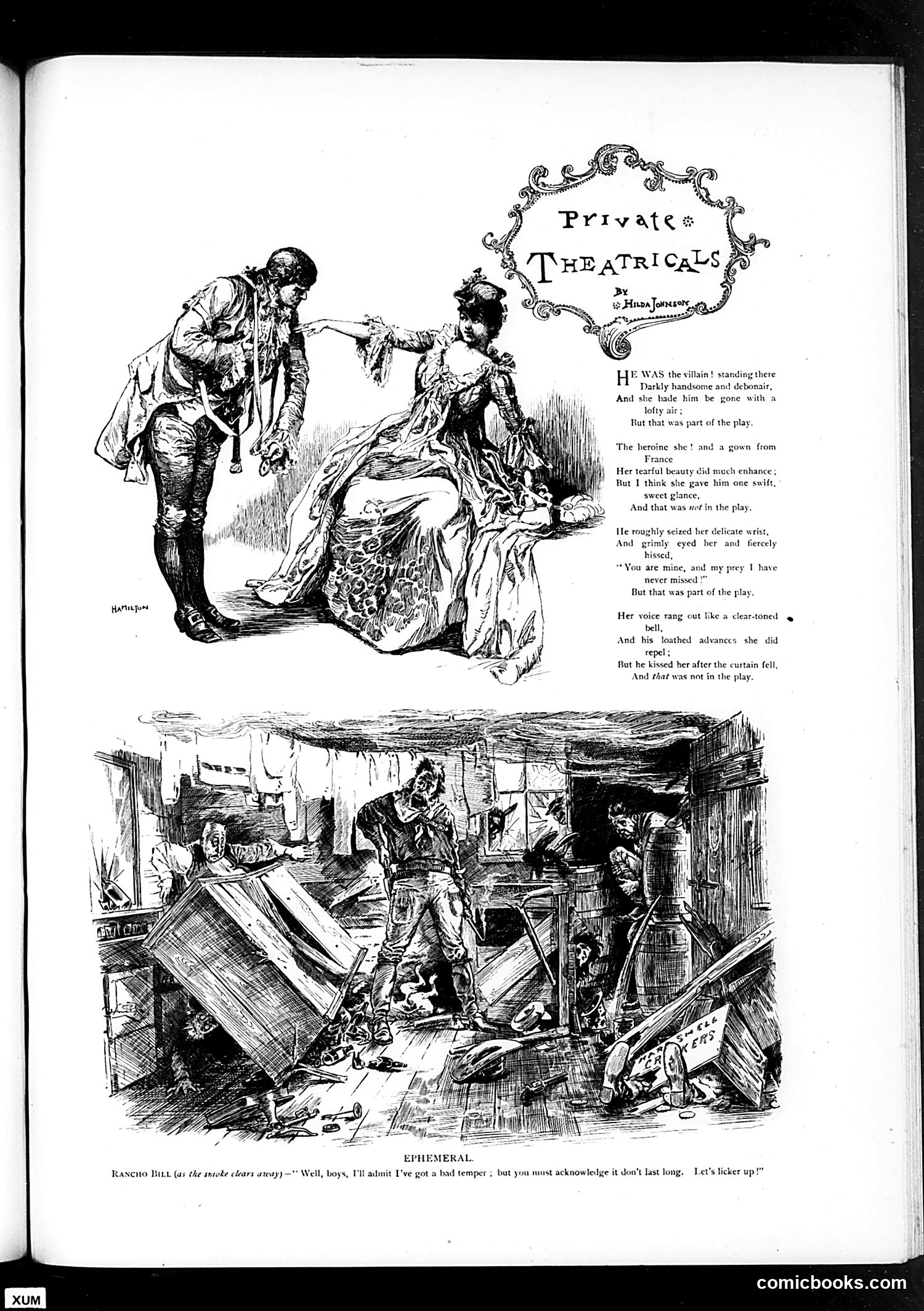
This page satirizes the gap between stage performance and real behavior. The poem describes a theatrical melodrama where actors play villain and heroine—he's menacing and forceful per the script, she's properly resistant. But the humor lies in what happens *off-stage*: the heroine gives the villain "one swift, sweet glance" (not in the play), and crucially, "he kissed her after the curtain fell, / And that was not in the play." The implication is that the actors are romantically involved despite their staged antagonism. The lower cartoon shows "Rancho Bill," apparently a rough character in smoke-filled chaos, apologizing for his bad temper but claiming it "don't last long"—before suggesting everyone drink ("licker up"). The joke appears to be similar: real behavior contradicts claimed character, or promises to reform are immediately undermined by actions.
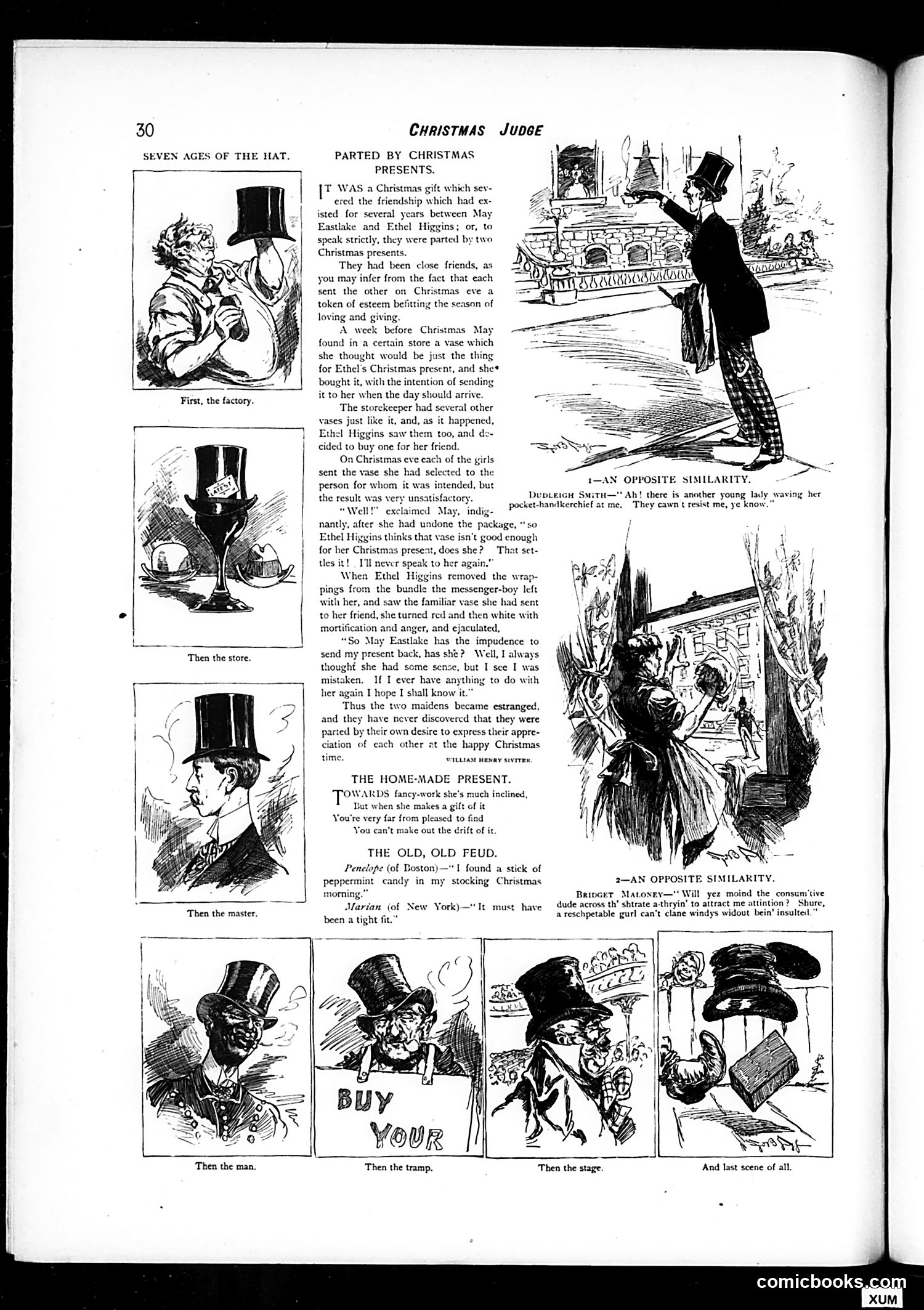
This page from *Judge* magazine contains several Christmas-themed satirical pieces satirizing Victorian social conventions and gift-giving etiquette. The main story "Parted by Christmas Presents" ridicules the absurdity of wounded pride between close friends. May and Ethel unknowingly both purchase identical vases as gifts for each other. Each receives the same vase back, each interpreting it as rejection—leading to permanent estrangement, neither realizing they both made the identical choice. The satire mocks how easily superficial misunderstandings destroy relationships. "Seven Ages of the Hat" shows how a top hat transforms through different social roles (factory worker, store clerk, gentleman, and finally poor man/tramp/street performer/worn-out vagrant). The brief items "The Home-Made Present" and "The Old, Old Feud" joke about poorly-executed homemade gifts and regional American pretensions respectively. The page satirizes Victorian sensitivities, class anxiety, and how material goods become fraught with social meaning during the gift-giving season.
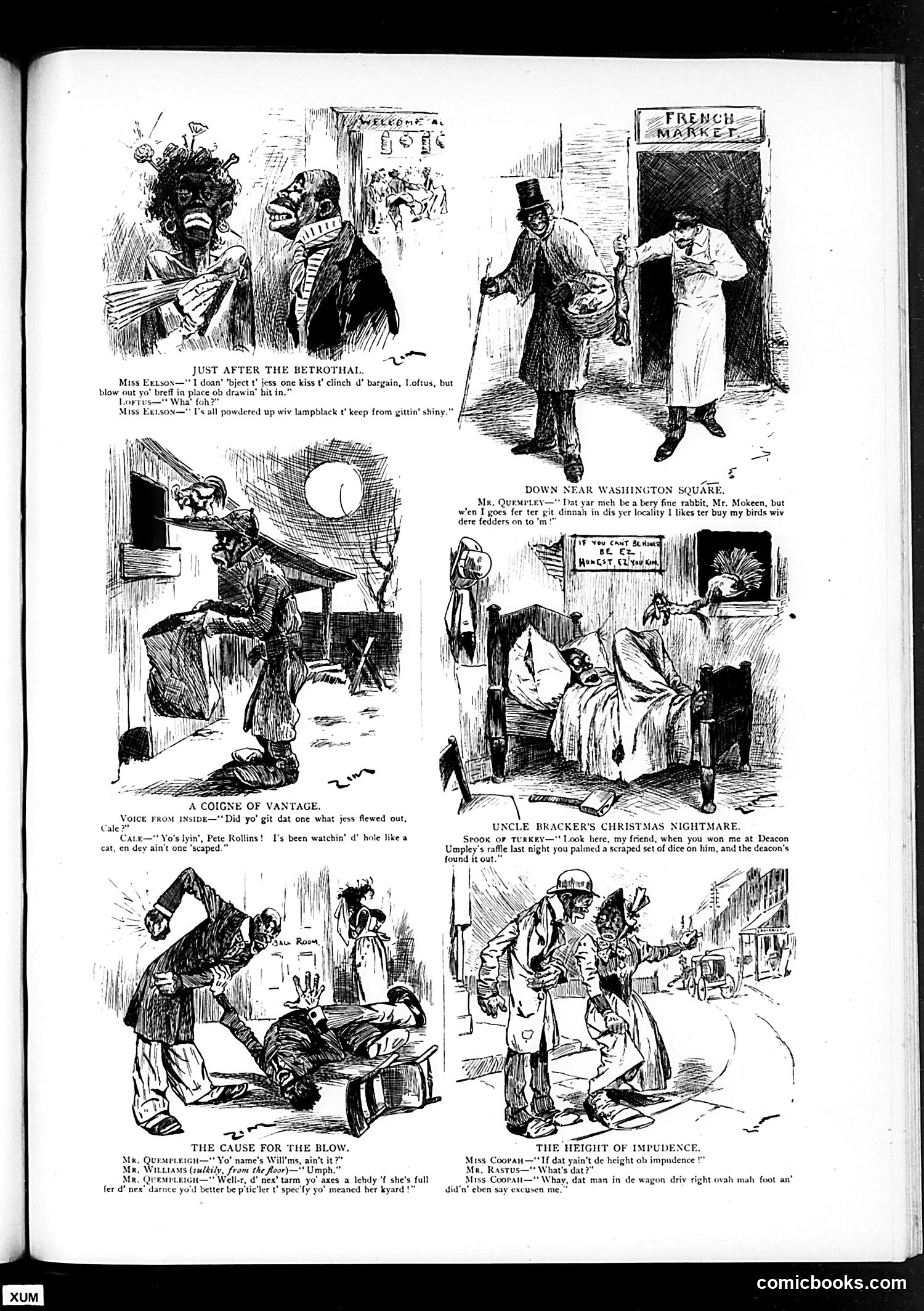
This page contains six separate satirical comic strips, all featuring racist caricatures of Black Americans with exaggerated dialect and stereotypical situations—reflecting the deeply prejudiced content common in late 19th/early 20th-century American humor magazines. The strips mock Black courtship, domestic disputes, gambling, church raffles, and street encounters. Each presents scenarios designed to demean through dialect spelling ("doan'," "yo'") and portraying Black characters as foolish, violent, or immoral. "Uncle Bracker's Christmas Nightmare" depicts someone winning another person in a raffle—dehumanizing imagery. The "humor" relies entirely on racial stereotyping and caricature rather than political satire or social commentary. Unlike political cartoons targeting specific policies or figures, these strips simply present degrading scenarios about Black life as inherently comedic. This represents the systemic racism embedded in popular entertainment of the period.
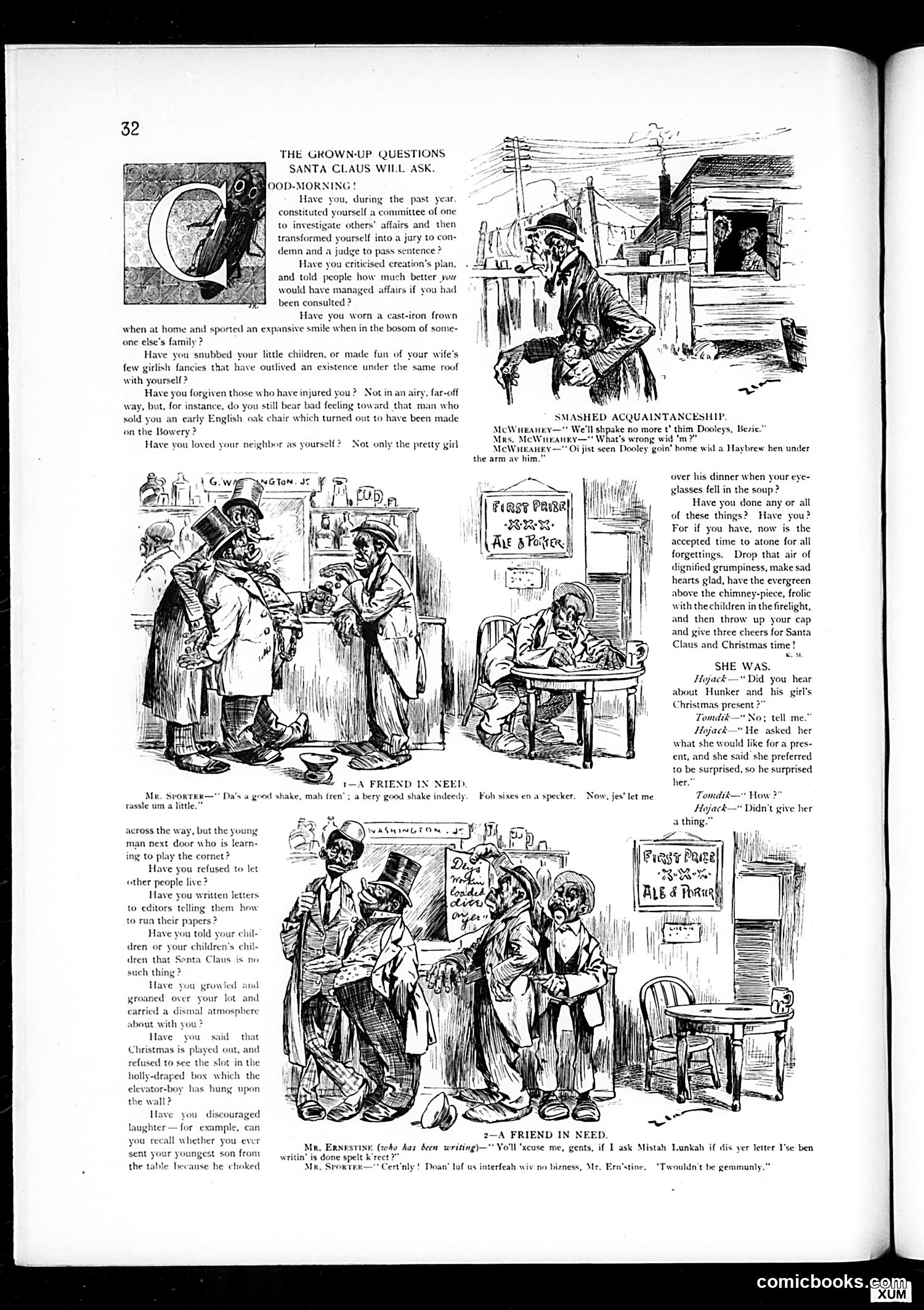
This page presents satirical commentary on adult hypocrisy during the Christmas season. **"The Grown-Up Questions Santa Claus Will Ask"** (top) is a mock interrogation listing behaviors Santa should judge: investigating others' affairs, hypocrisy between home and social conduct, unforgiveness, criticizing neighbors and newspapers, discouraging children's joy, and general grumpiness. The satire targets middle-class self-righteousness and lack of charity. **The three illustrated scenes** ("A Friend in Need" and "She Was") depict working-class and immigrant characters—identifiable by dialect and caricature—in moments of simple human interaction: offering help, experiencing romantic surprise, and conducting correspondence. The contrast is deliberate: while wealthy adults fail moral tests, these humble figures display genuine decency. This reflects Judge's typical progressive critique of class hypocrisy—the "respectable" classes preach virtue while the poor practice it naturally. The page advocates genuine Christmas spirit over performative morality.
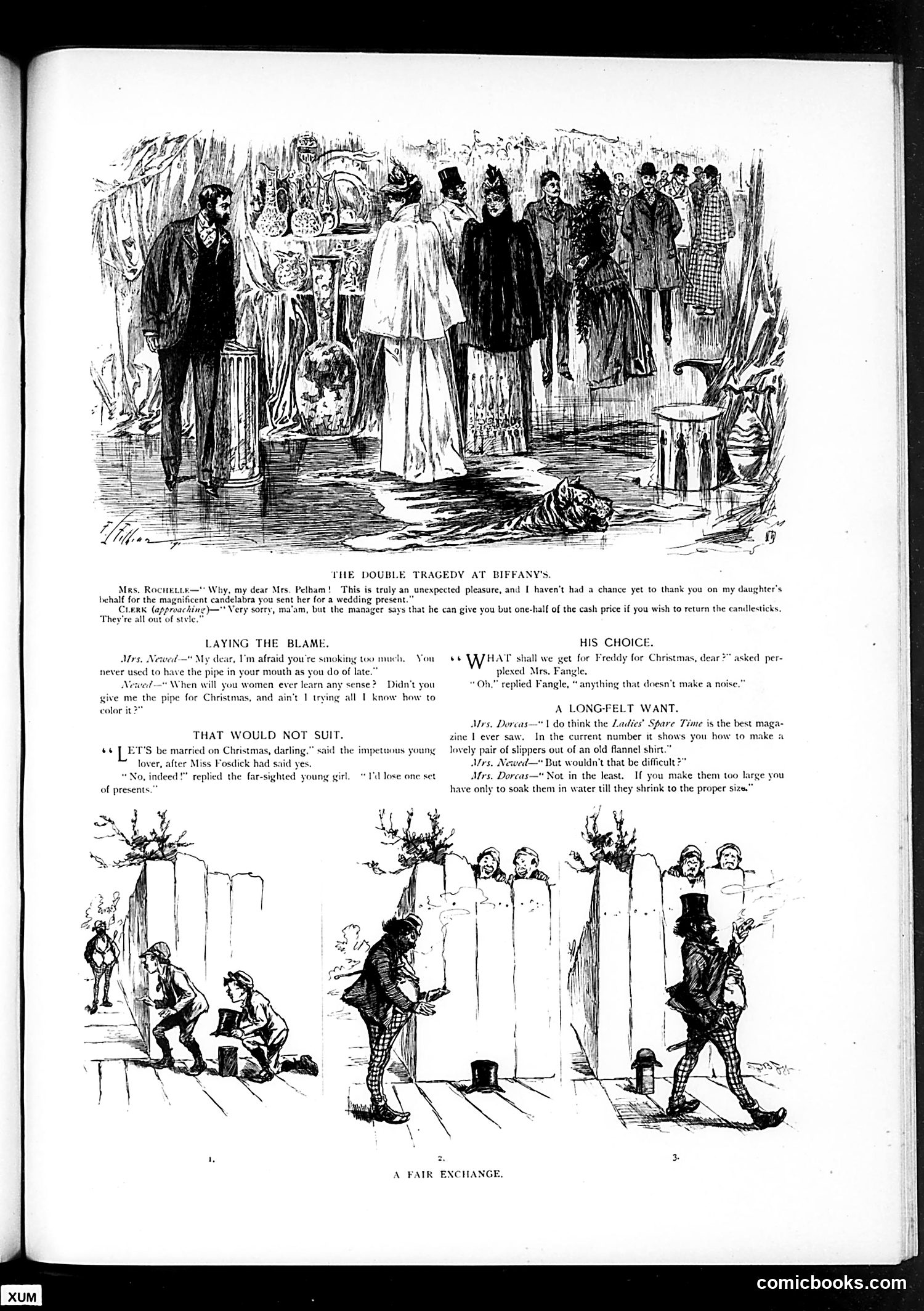
This page from *Judge* contains several brief satirical sketches about Victorian-era domestic life and consumer culture: **Top illustration**: "The Double Tragedy at Biffany's" mocks the practice of returning wedding gifts. A woman discovers that a luxury goods store (likely parodying Tiffany's) will only refund half the gift's value, making returns economically unwise—a "tragedy" for both the gift-giver's gratitude and the recipient's finances. **Lower sketches** address marital friction: a husband blames his wife for giving him a pipe he's over-smoking; a couple debates Christmas wedding timing (she wants to avoid doubling gift-giving); a father wants children's gifts that are quiet; and wives discuss a magazine about repurposing old clothing. The satire targets **consumer culture expectations**, **gender roles in marriage** (wives blamed for husbands' habits; wives managing domestic economy), and the **emerging middle-class anxiety** about proper etiquette, gift-giving, and spending during the Victorian holiday season.
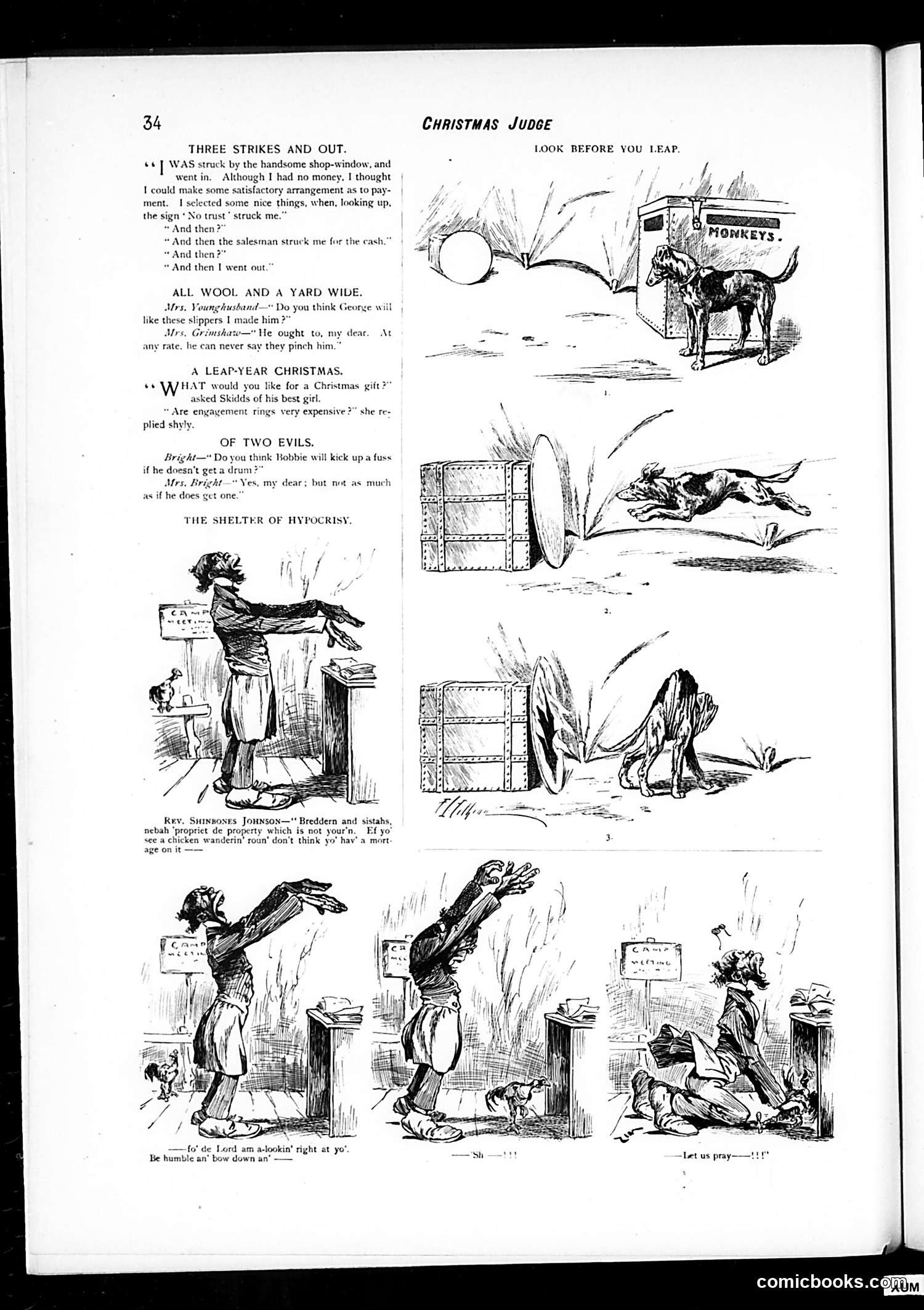
This page from *Judge* magazine contains several brief humorous anecdotes satirizing everyday social situations: **"Three Strikes and Out"** mocks poor shoppers attempting to purchase without money, playing on the baseball term "three strikes." **"All Wool and a Yard Wide"** jokes about homemade slippers as a Christmas gift—the humor lying in their poor fit. **"A Leap-Year Christmas"** references the Victorian tradition where women propose to men during leap years; the girl hints she wants an engagement ring rather than a typical gift. **"Of Two Evils"** contrasts parental anxieties: a drum as a Christmas gift creates noise; *not* receiving one causes a tantrum. **"The Shelter of Hypocrisy"** satirizes a hypocritical reverend who preaches against theft while his dialect and phrasing suggest moral compromise. The sequential illustrations mock his performative religiosity. The right-side illustrations show a dog escaping from a barrel—a slapstick visual gag titled "Look Before You Leap." These are typical *Judge* fare: gentle social satire targeting domestic life, materialism, and moral pretense among middle-class Americans.
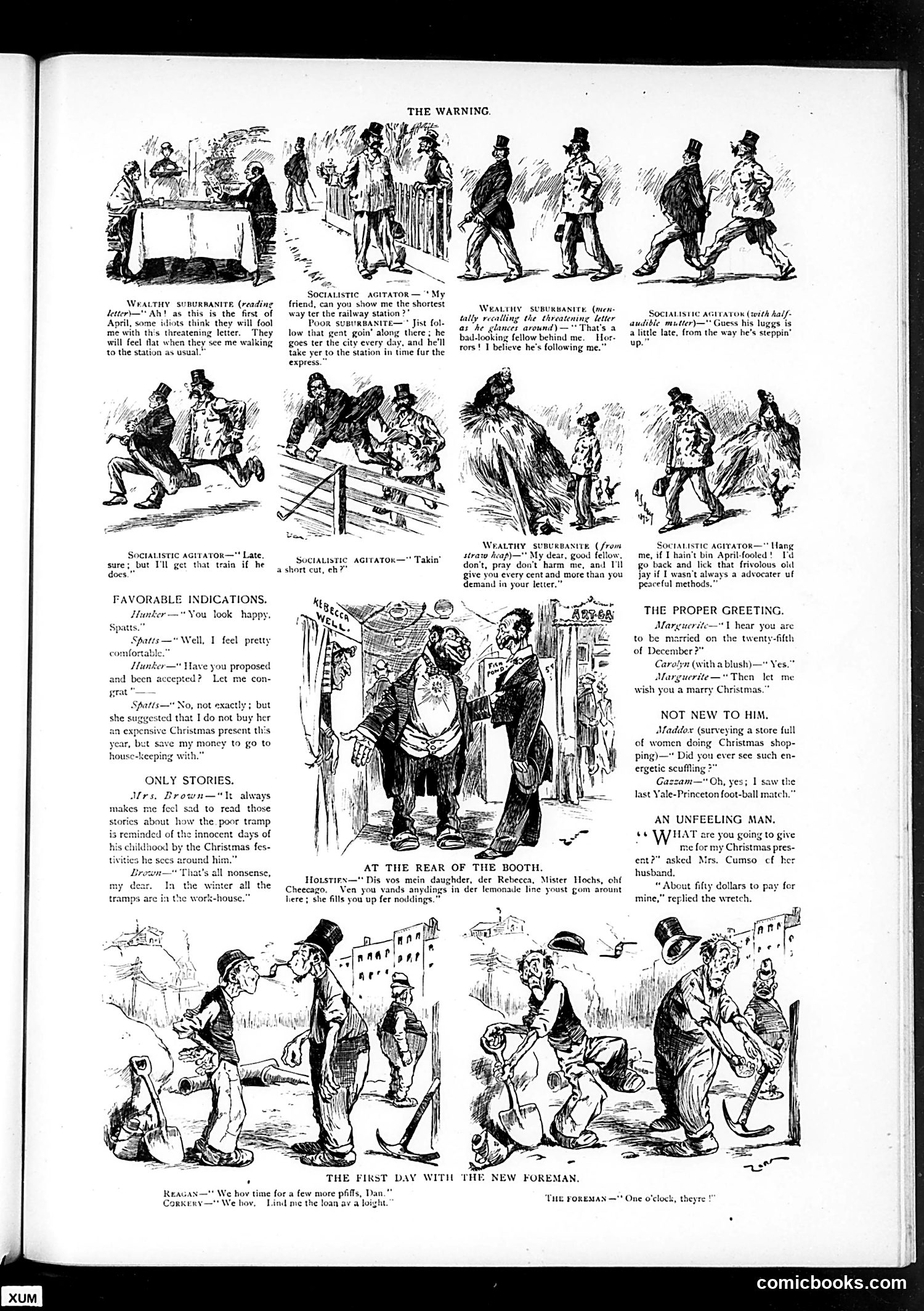
This page from *Judge* magazine satirizes wealthy suburbanites' fear of socialist agitators during the early 20th century. The main cartoon "The Warning" depicts a nervous wealthy man who receives a threatening letter on April Fools' Day. Convinced it's a genuine threat, he becomes paranoid that every stranger—particularly a poorly-dressed man following him—is a dangerous socialist revolutionary intent on robbery or worse. The joke's irony: the "socialist agitator" is actually just a helpful commuter trying to follow the same train route. The suburbanite's class anxiety causes him to misread innocent behavior as sinister. The accompanying vignettes reinforce this theme of middle-class fear of working-class radicals and labor activism, which were genuine social anxieties in America during this era of growing socialist movements and labor unrest.
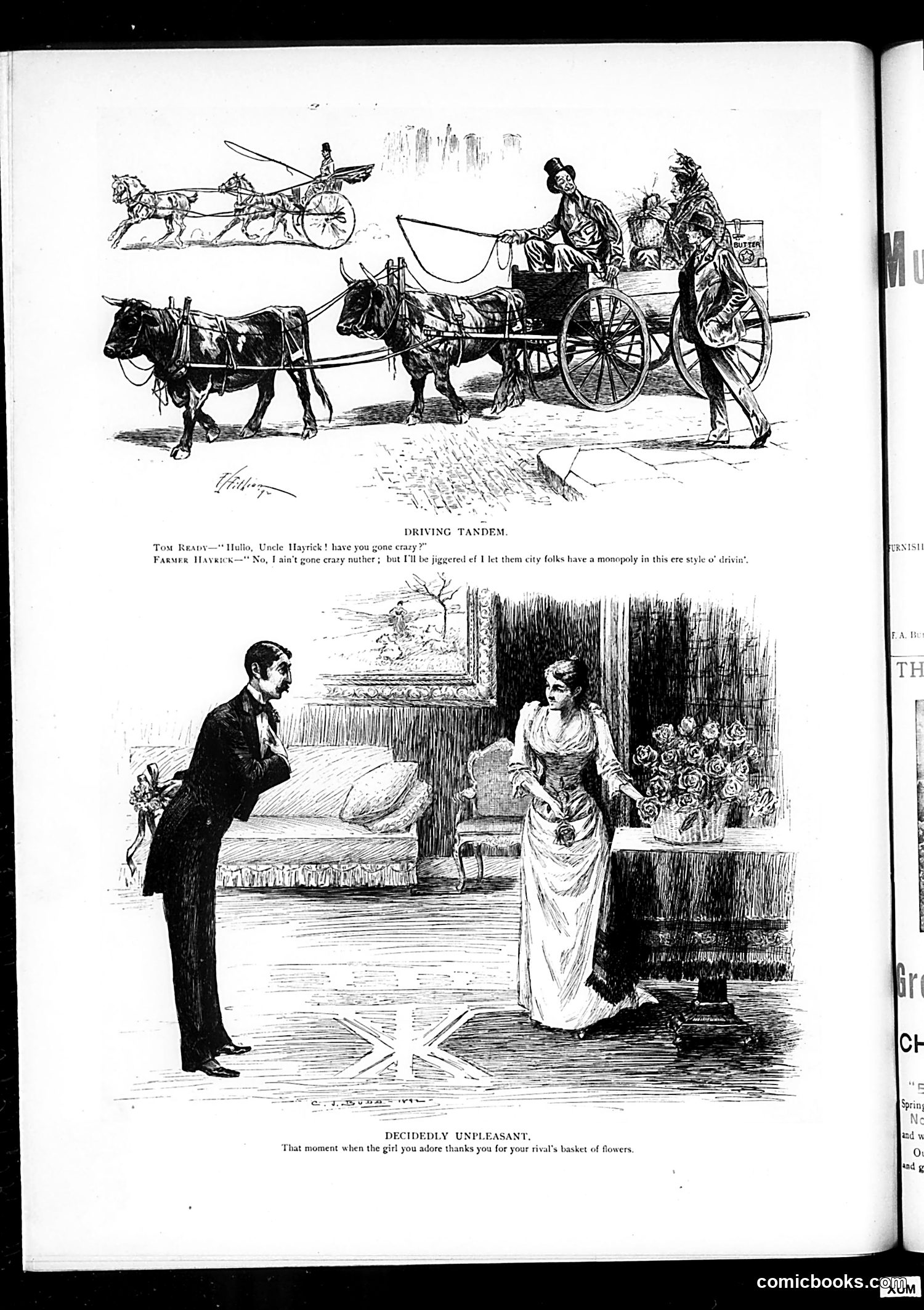
**"Driving Tandem"** (top): A rural farmer ("Farmer Hayrick") defends his unconventional two-vehicle setup to Tom Reapy, claiming he won't let city people monopolize fancy driving styles. The joke satirizes rural pride and resistance to urban affectation—the farmer's improvised "tandem" (oxen-drawn cart) is his rustic answer to fashionable city carriages. **"Decidedly Unpleasant"** (bottom): A well-dressed man holds flowers while watching a woman he loves thank him for them—except she's actually thanking him on behalf of a *rival* who sent them. The cartoon satirizes romantic disappointment and social awkwardness: he gets credit for nothing while his competitor reaps the romantic benefit. Both cartoons use gentle humor about class pretension and romantic misfortune typical of Judge's satirical approach.
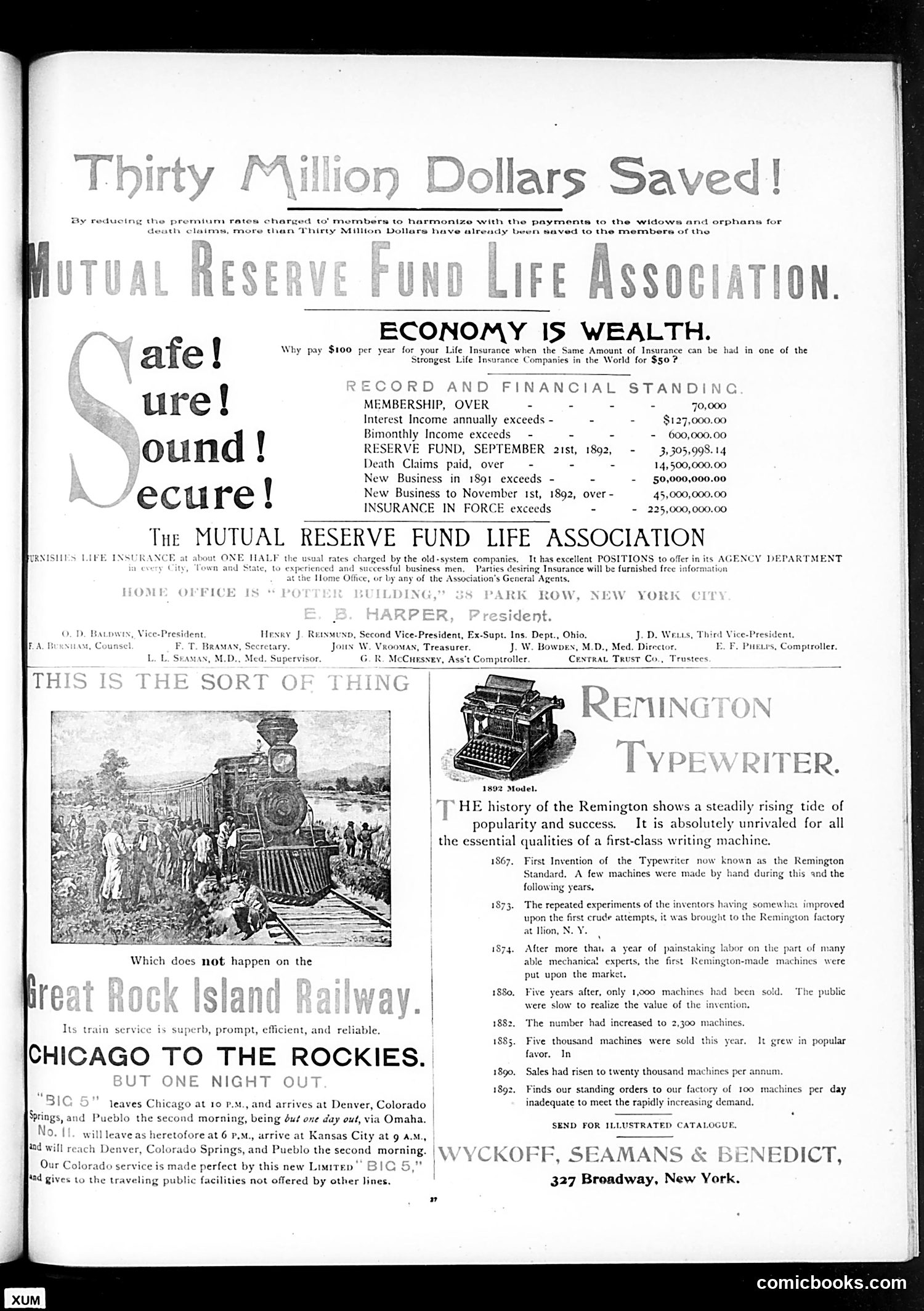
This is primarily an **advertising page**, not a satirical cartoon page. It contains three major advertisements: 1. **Mutual Reserve Fund Life Association**: An insurance company advertisement emphasizing economy—claiming customers can get the same coverage for $50/year versus competitors' $100/year. It displays financial statistics to establish credibility and trustworthiness. 2. **Remington Typewriter**: A history of the typewriter's commercial success, documenting its rise from slow initial adoption (1,000 machines sold five years after introduction) to mass production (100 machines per day needed by 1892). This reflects late-19th-century enthusiasm for new business technology. 3. **Great Rock Island Railway**: A train service advertisement promoting the "Big 5" express service from Chicago to Colorado destinations, emphasizing speed and reliability. The page reflects 1890s commercial culture: life insurance competition, industrial manufacturing success stories, and transportation modernization. No political satire is evident—this appears to be a standard advertising section from Judge magazine.
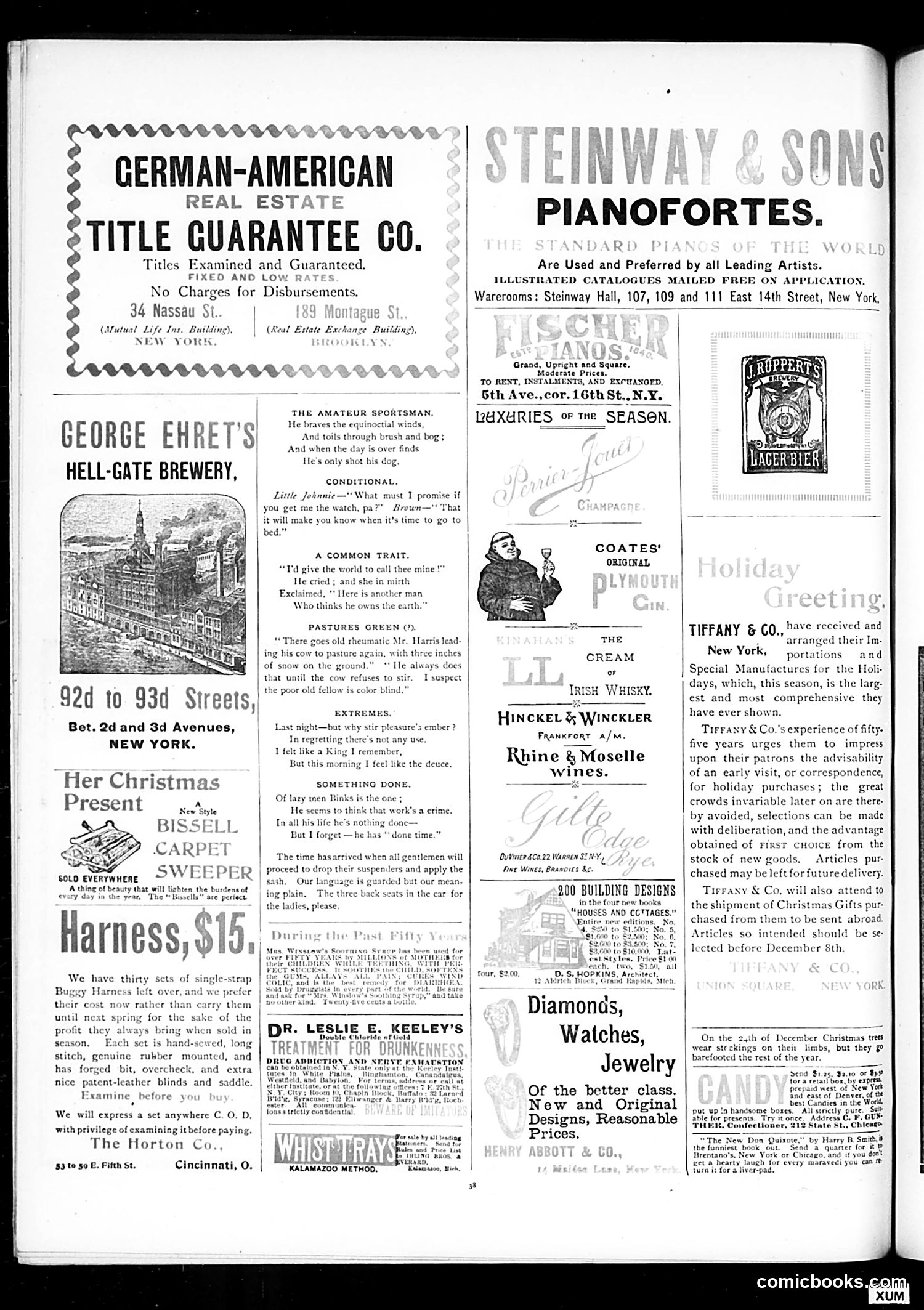
This page is primarily **advertising**, typical of Judge magazine's revenue model. The content includes real estate, brewery, pianos, jewelry, whiskey, and holiday gift services. The only notable **satirical content** appears in "The Amateur Sportsman" and scattered humorous anecdotes ("A Common Trait," "Pastures Green"). These brief jokes mock common types: the incompetent hunter who shoots his dog, the man obsessed with owning a pocket watch, the absent-minded fellow whose mood swings from "King" to "deuce." The cartoons lack the biting political satire Judge was known for. Instead, they present gentle, domestic humor—the kind of observational comedy about everyday life and human foibles that would resonate with middle-class readers of the era. The advertisements themselves reveal the magazine's target audience: affluent New Yorkers shopping for luxury goods and services during the Christmas season.
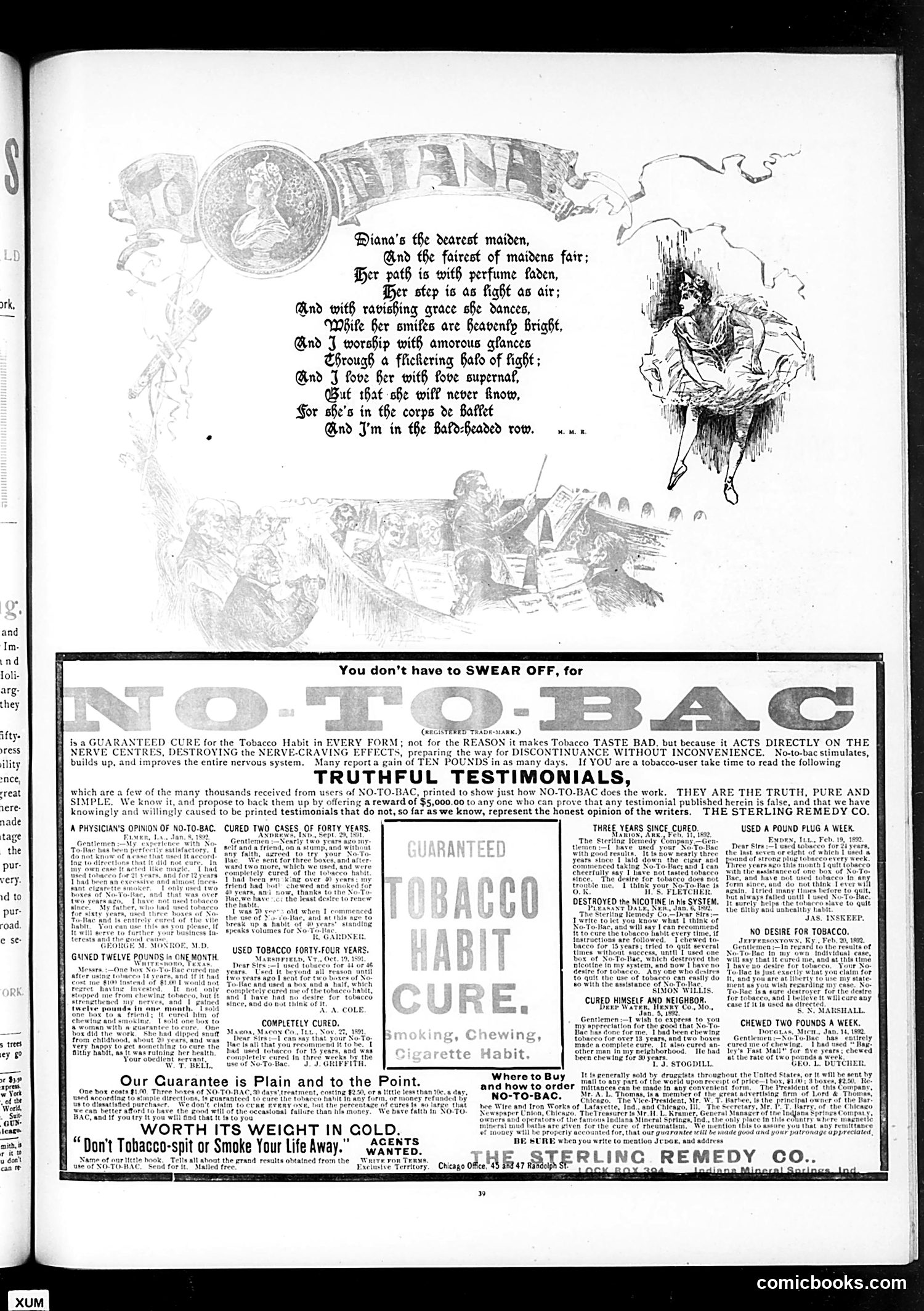
This page combines poetry with advertising. The verse at top depicts an unrequited love scenario: a male admirer ("I'm in the bald-headed row") pines for Diana, a ballet dancer ("corps de Ballet"), who will never know of his feelings. The romantic melancholy is typical of period light verse. The dominant content is a full-page advertisement for "No-to-bac," a purported tobacco cessation product. The ad claims the remedy works by acting on nerve cravings rather than making tobacco taste bad, and promises weight gain (ten pounds in days). It includes "testimonial" quotes from supposed users claiming they quit chewing substantial amounts weekly. This reflects turn-of-the-century patent medicine marketing—exaggerated health claims, fake testimonials, and promises of miraculous results. Modern readers should note such unregulated advertising was standard before FDA oversight, making such dubious products commonplace in publications like *Judge*.
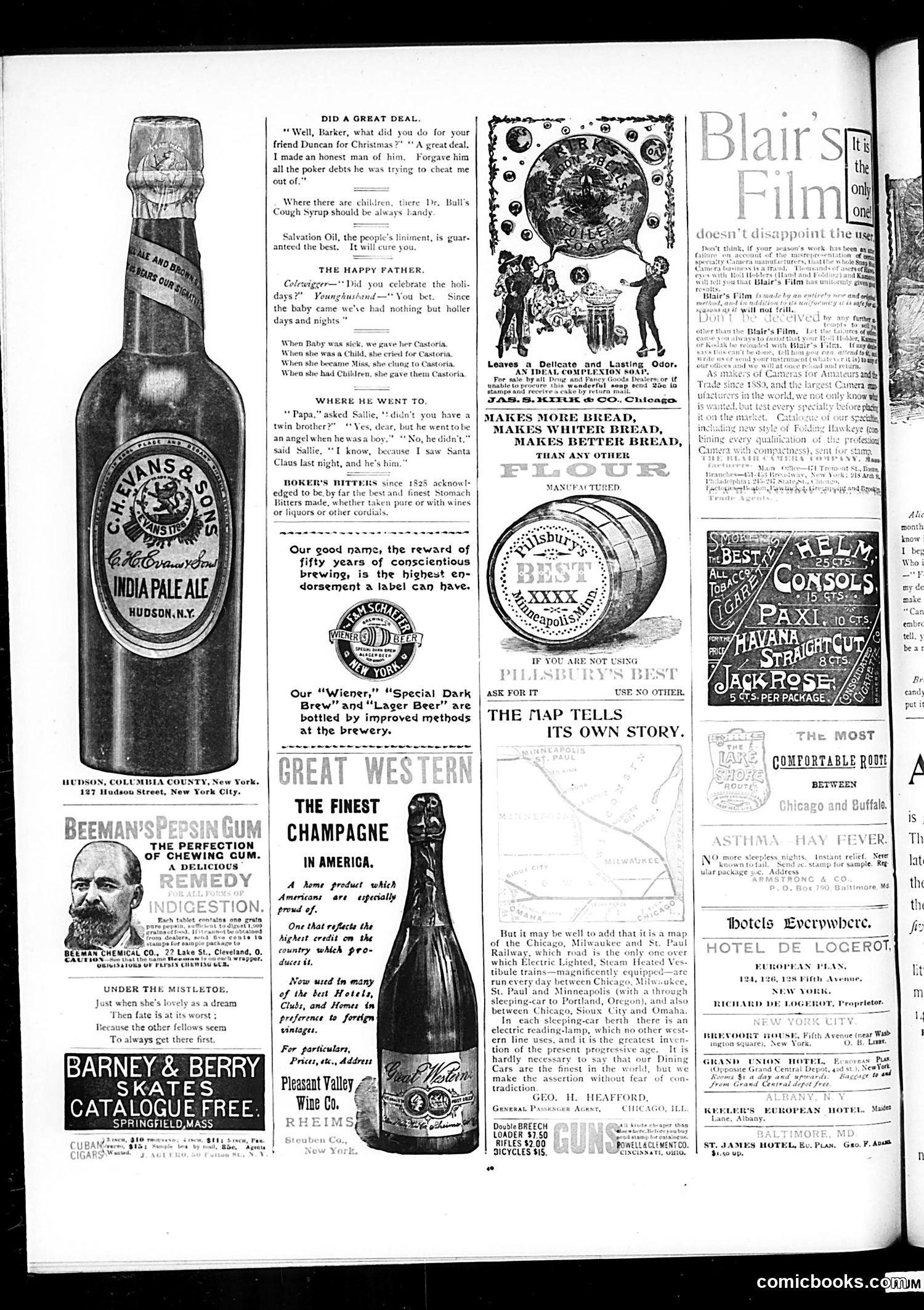
This page is primarily **advertising**, typical of Judge magazine's revenue model. The satirical content is limited to brief joke snippets interspersed among product advertisements. The two identifiable jokes are: 1. **"Did a Great Deal"**: A man claims he helped his friend Duncan by forgiving poker debts—presenting dishonesty as a favor. The satire targets male gambling culture and self-serving rationalization. 2. **"The Happy Father"**: A new father complains that since the baby arrived, there are only "holler days and nights" instead of holidays. This plays on the common Victorian-era joke about babies disrupting household peace. The remaining content consists of advertisements for beer (Chapin's India Pale Ale), champagne, gum, bicycles, hotels, and other period products. The page reflects Judge's dual purpose: delivering social satire while monetizing through commercial advertising. The actual comic content is minimal by modern standards.
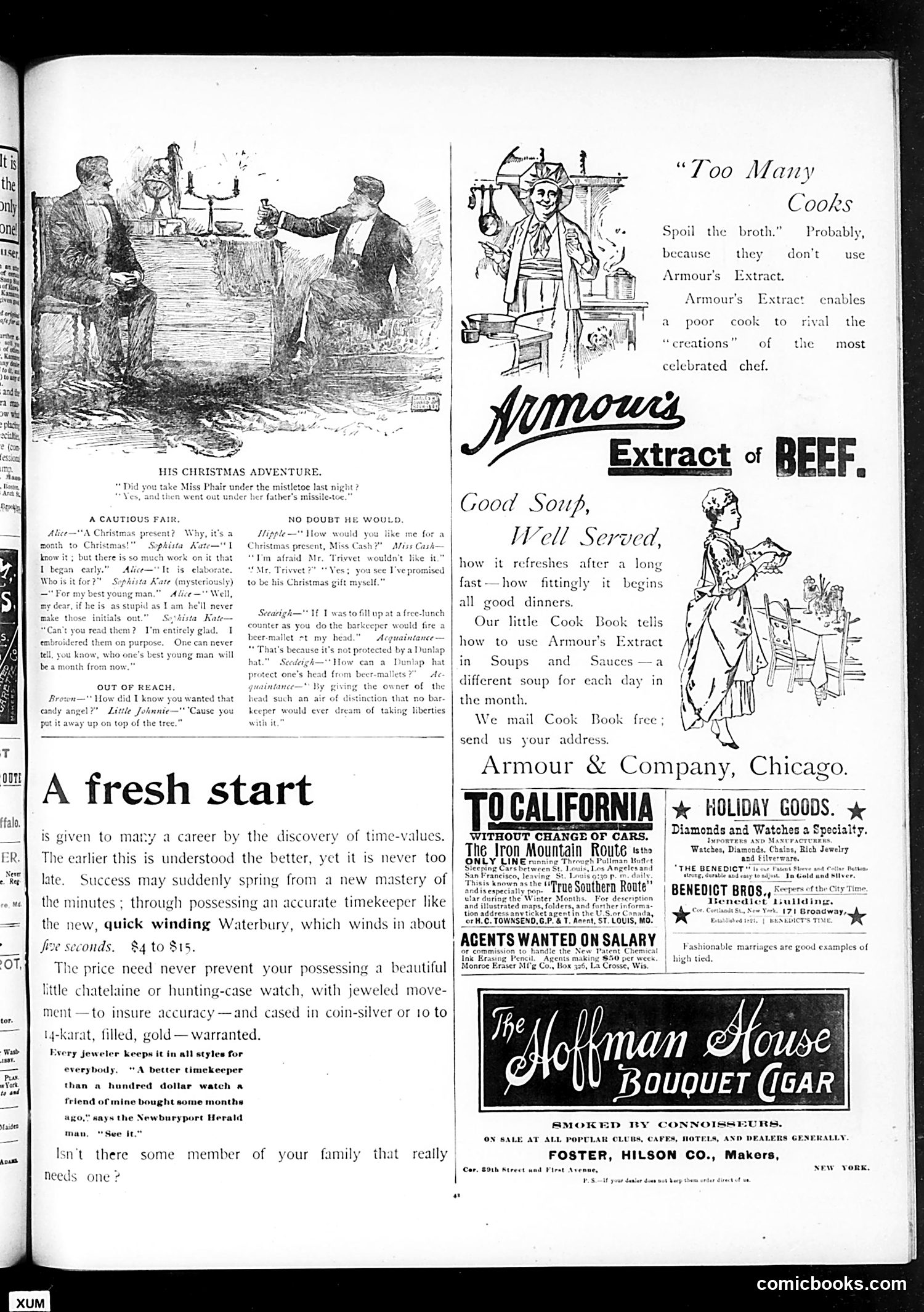
This page contains mostly **advertisements** rather than editorial cartoons. The small sketches at top left ("His Christmas Adventure," "A Cautious Pair," "Out of Reach") appear to be light humor vignettes typical of Judge magazine's filler content—depicting romantic or social awkwardness, though the text is partially illegible. The dominant content is advertising: Armour's Beef Extract (claiming it compensates for poor cooking skills), Waterbury watches (emphasizing accuracy and affordability), a California railroad route, and Hoffmann House cigars. These ads reflect turn-of-the-century consumer concerns: efficiency, quality timekeeping, travel, and luxury goods. The phrase "Too Many Cooks Spoil the Broth" heads the beef extract ad—a pun suggesting that even mediocre cooks can succeed using their product. This reflects the era's growing reliance on packaged/processed food supplements to standardize meal quality. The page is essentially a **commercial document** with minimal satirical content—representative of how Judge balanced editorial humor with revenue-generating advertisements.
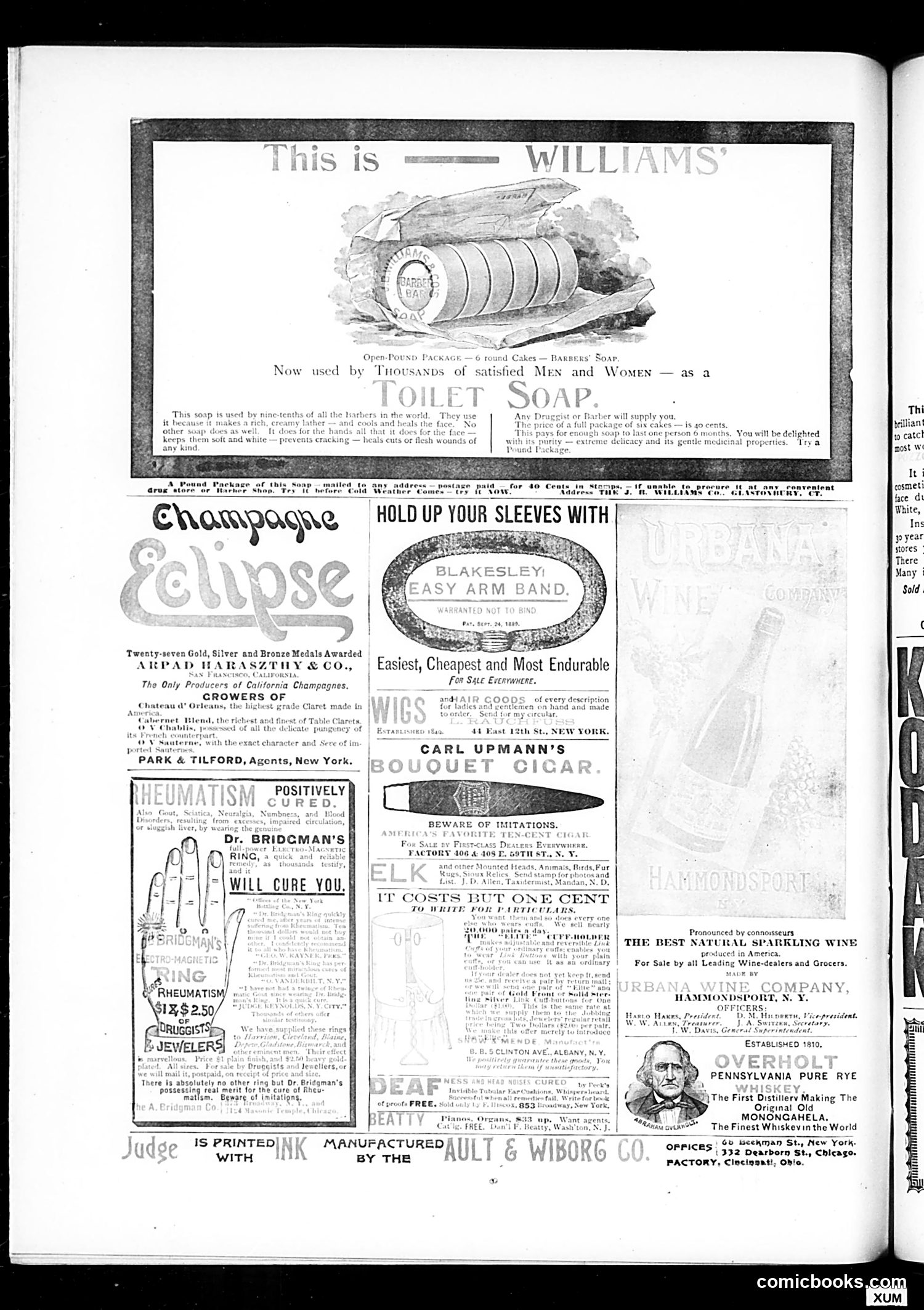
This page is primarily **advertising**, not political satire. It showcases various consumer products common to the late 19th/early 20th century, including: **Key advertisements visible:** - Williams' Toilet Soap (top) — marketed to "thousands of satisfied Men and Women" - Champagne Eclipse and Blakesley Easy Arm Band (sleeve garters) - Dr. Bridgman's Ring for rheumatism (left), promising a cure for $2.50 - Carl Upmann's Bouquet Cigar, warning against counterfeits - Pennsylvania Pure Rye whiskey (bottom right) **Notable element:** The Dr. Bridgman's rheumatism cure features a magnetic ring advertisement with an exaggerated hand illustration—typical of period patent medicine marketing that made dubious health claims. The page footer notes it was "printed with ink manufactured by the Ault & Wiborg Co."—a self-promotional statement from the printer itself. This represents Judge's revenue model: satirical editorial content subsidized by advertisements for contemporary consumer goods and patent medicines.
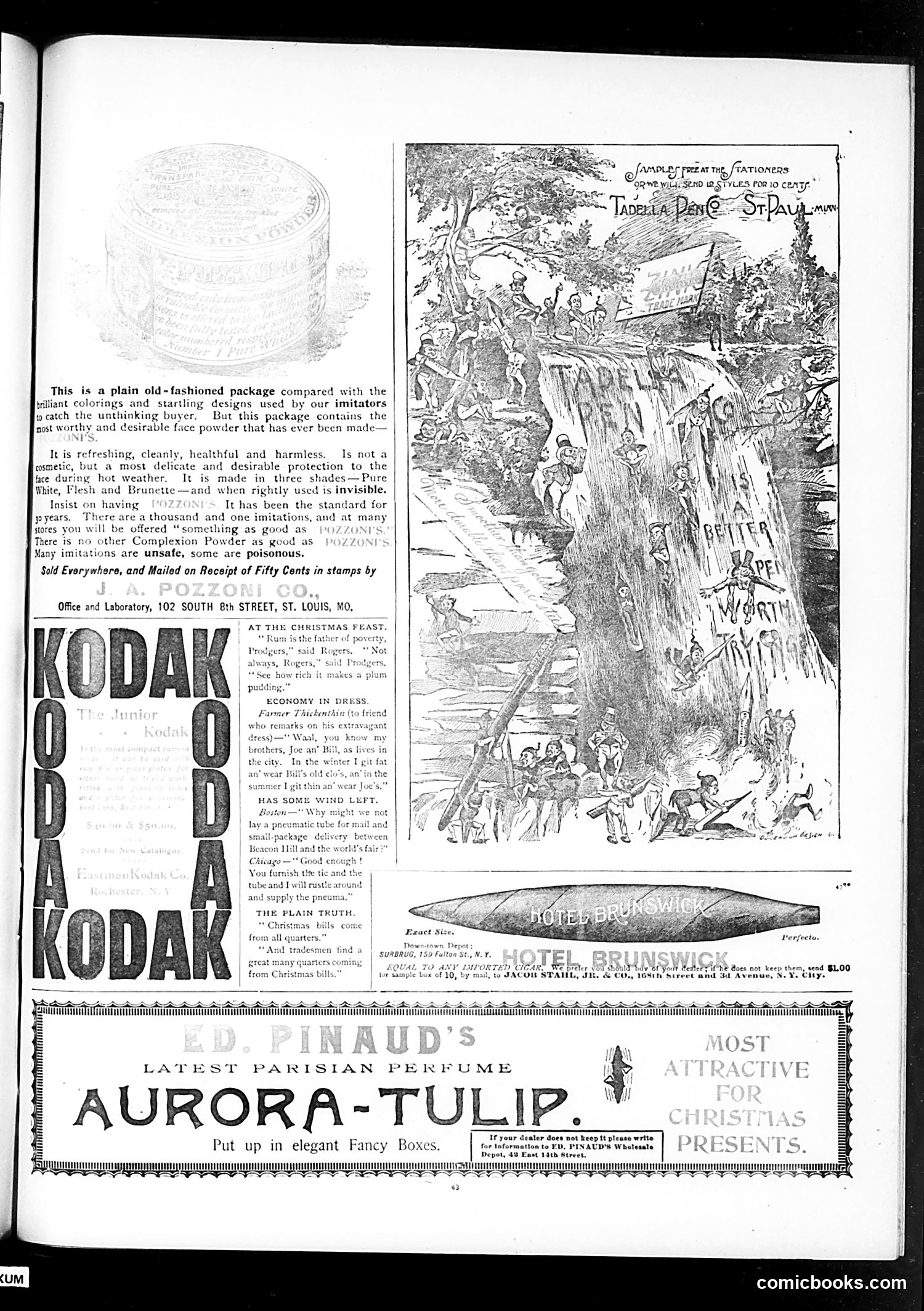
This page is **primarily advertising**, not political satire. It contains several product advertisements typical of late 19th/early 20th-century magazines: 1. **Ozoena face powder** (top left): A complexion powder marketed as superior to cheaper imitations, available in three shades. The ad emphasizes it's "harmless" and "invisible"—reflecting period anxieties about cosmetics safety and the stigma of visibly wearing makeup. 2. **Kodak cameras** (center left): "The Junior Kodak" advertisement, promoting consumer photography. 3. **"Tabula Dente-St Paula"** (top right): An illustrated advertisement featuring a bucolic scene with people and architecture, though the product purpose is unclear from visible text. 4. **John Brunswick cigars** (bottom center): A product advertisement. 5. **E.D. Pinaud's Aurora-Tulip perfume** (bottom): Marketed as "most attractive for Christmas presents." The page contains dialogue snippets labeled "At the Christmas Feast" and "The Plain Truth," but these appear to be filler content rather than coherent satire. Overall, this is a commercial page showcasing holiday-season gift merchandise.
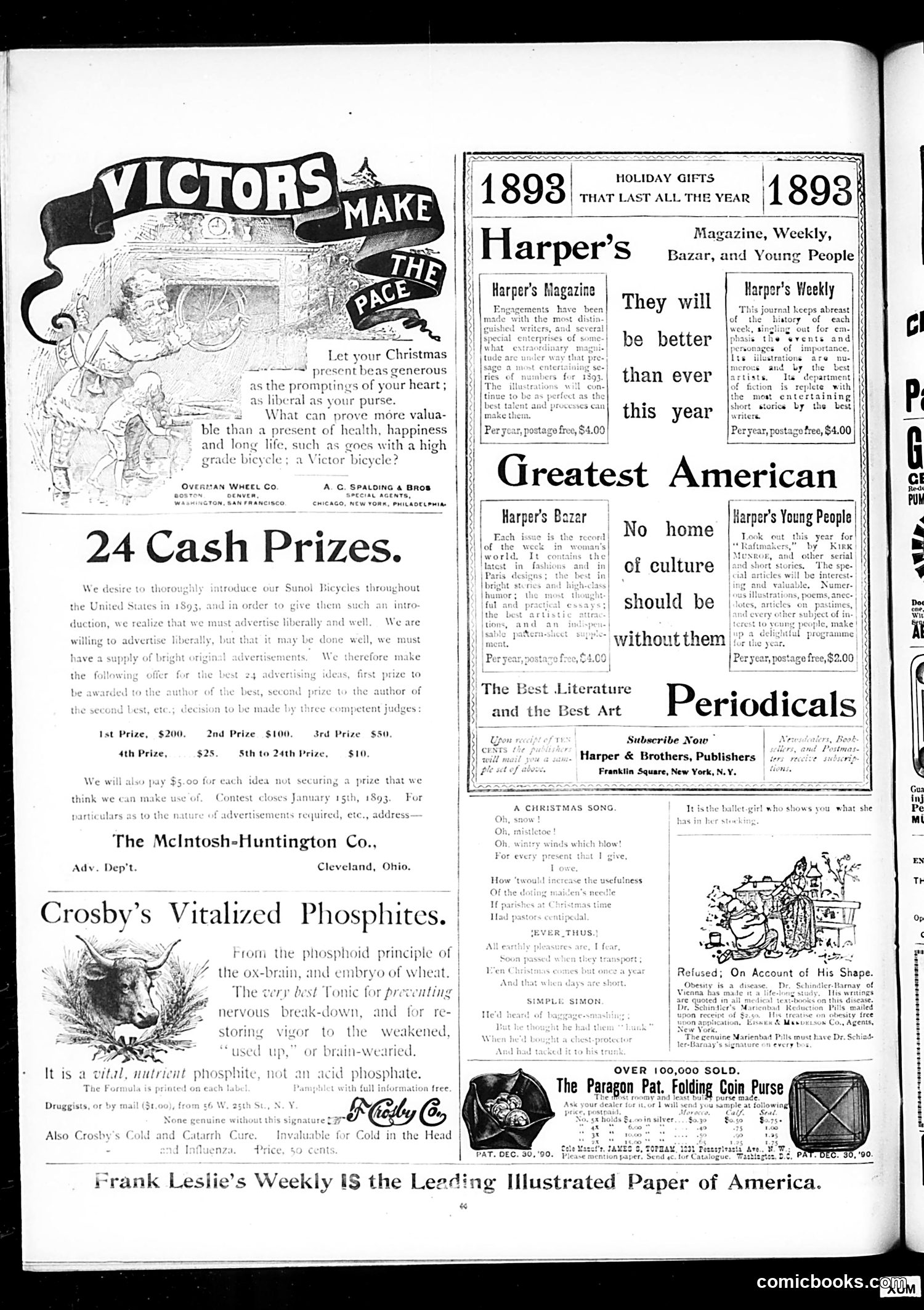
This is primarily a **advertising page** rather than a satirical cartoon page, though it opens with one notable image. The left side features **"Victors Make the Pace,"** a bicycle advertisement showing a well-dressed woman on a Victor bicycle. The ad promotes bicycles as Christmas gifts, emphasizing health, happiness, and longevity—reflecting the 1890s bicycle craze, when cycling represented modernity and independence, especially for women. The page contains: - A contest offering **24 cash prizes** (up to $200) for advertising ideas - **Harper's periodical subscriptions** promoting magazines as superior holiday gifts - **Crosby's Vitalized Phosphites** medicine advertisement claiming to prevent "nervous break-down" and restore vigor to the "brain-wearied"—typical 1890s patent medicine marketing - Various other product ads **The satire here is subtle**: the page itself satirizes consumer culture and the era's obsession with "modern" solutions (bicycles, magazines, tonics) as cure-alls for contemporary anxieties about health and vigor.
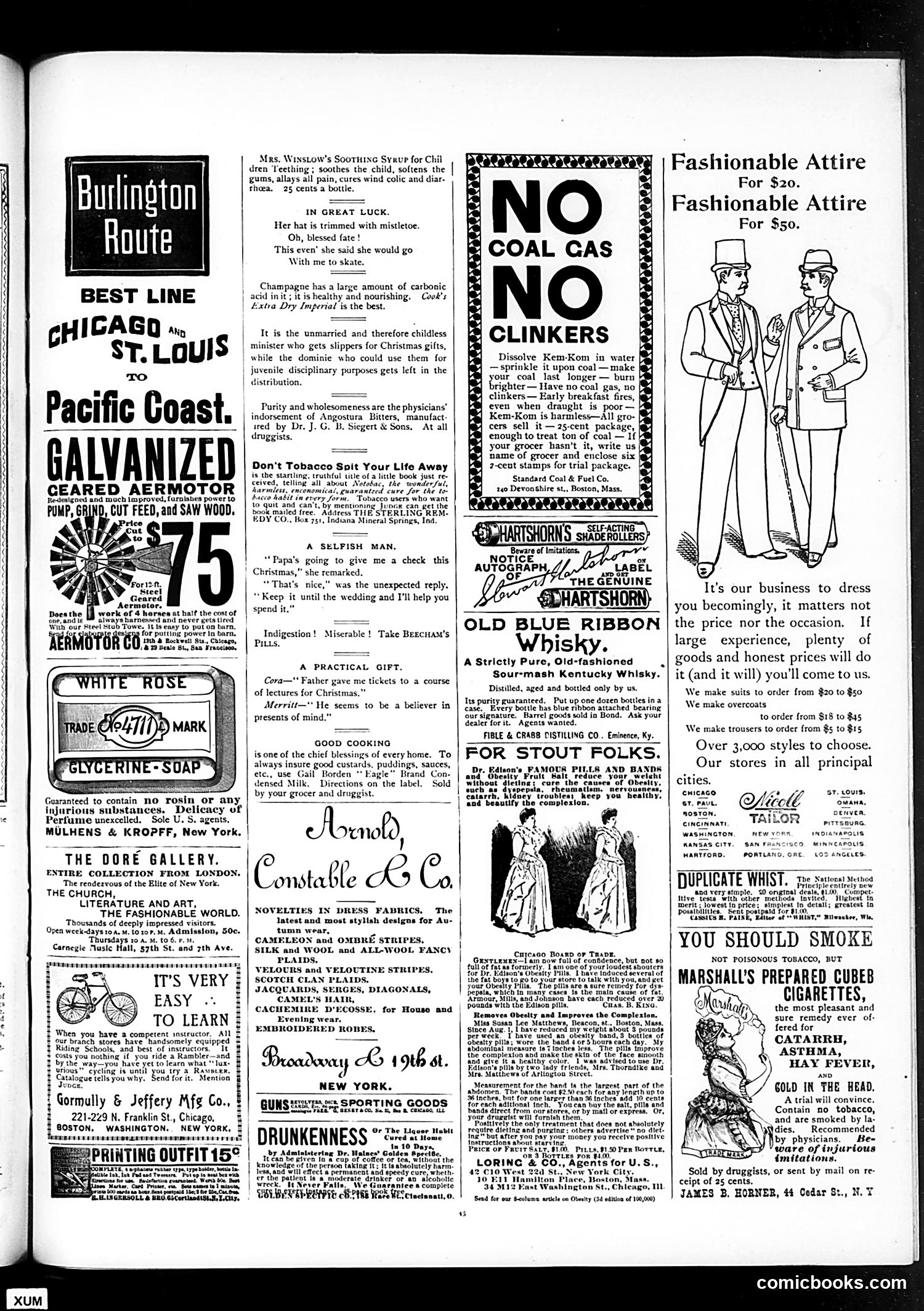
This page is primarily **advertising**, typical of Judge magazine's revenue model. Rather than containing political cartoons or satire, it features commercial advertisements interspersed with brief humorous anecdotes. The small jokes included—about mistletoe romance, a minister receiving slippers, and a woman receiving a check as a Christmas gift—reflect genteel humor of the era, offering gentle observations about courtship, domestic life, and gift-giving customs. The advertisements themselves are historically revealing: they promote products now considered dangerous (Mrs. Winslow's Soothing Syrup for children, tobacco cessation products, "Golden Specific" for treating drunkenness) alongside legitimate goods (soap, bicycles, clothing fabrics, farm equipment). The fashion advertisements on the right show men's formal attire and a tailor service, reflecting early-20th-century standards of respectability and class signaling through dress. This page demonstrates how Judge functioned as both satirical commentary and commercial vehicle for contemporary products and services.
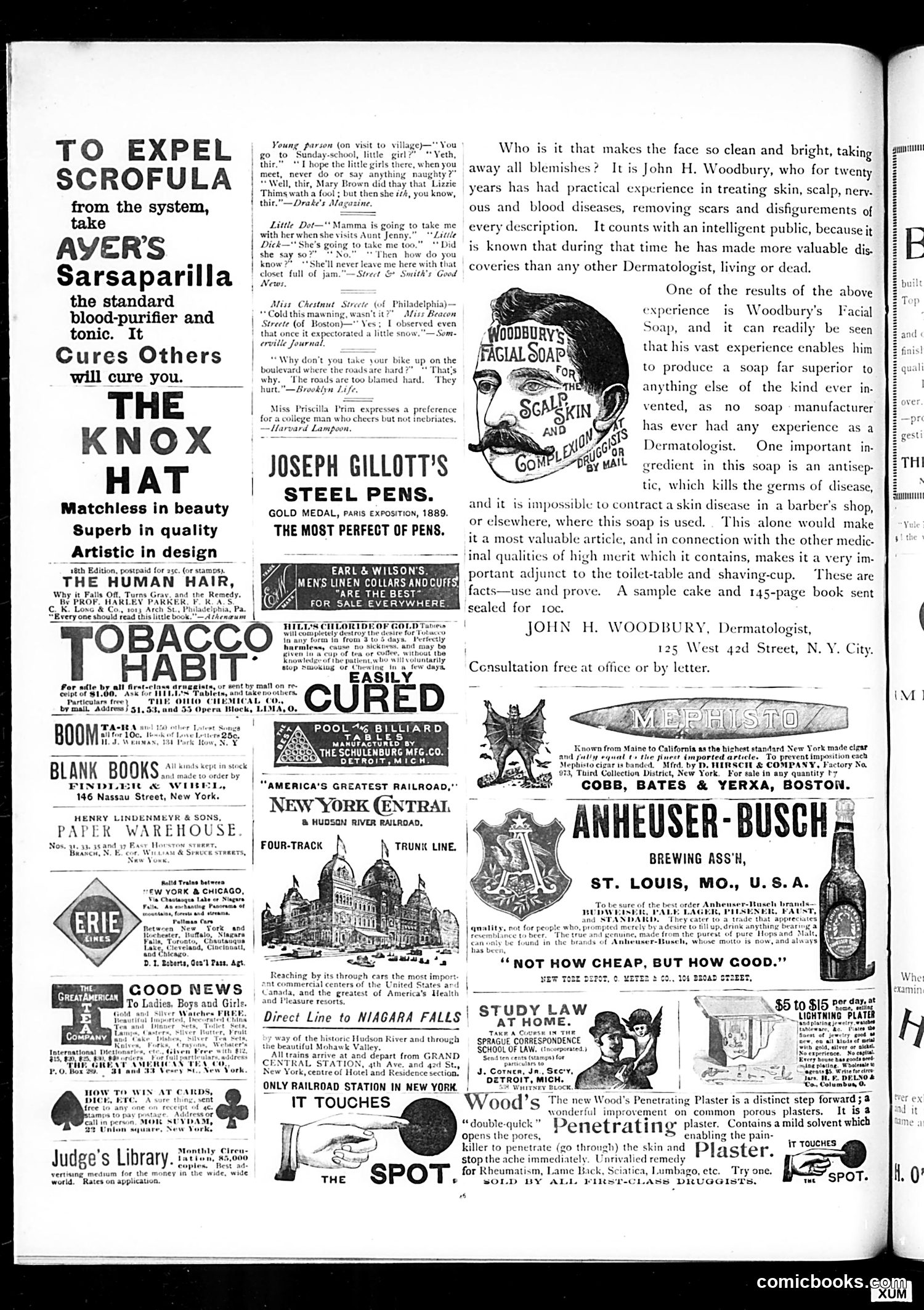
This page is primarily **advertisements with minimal editorial content**. The visible satirical elements are marginal: The small comic anecdotes at the top—including exchanges about Sunday and a woman's "closet full of jam"—represent Judge's typical **light domestic humor** aimed at middle-class readers. The jokes lack specific political targets; they're gentle social observations about manners and relationships. The bulk of the page features patent medicines (Ayer's Sarsaparilla for "scrofula"), haberdashery (Knox hats), office supplies, and transportation advertisements. One notable advertiser is John H. Woodbury promoting his dermatological soap as superior because of his medical credentials—a marketing approach that treats scientific authority as a selling point. The Anheuser-Busch and railroad advertisements represent major American industries of the period. Overall, this appears to be a typical **late 19th-century magazine page** mixing light humor with revenue-generating ads, rather than a page containing significant political satire or commentary.
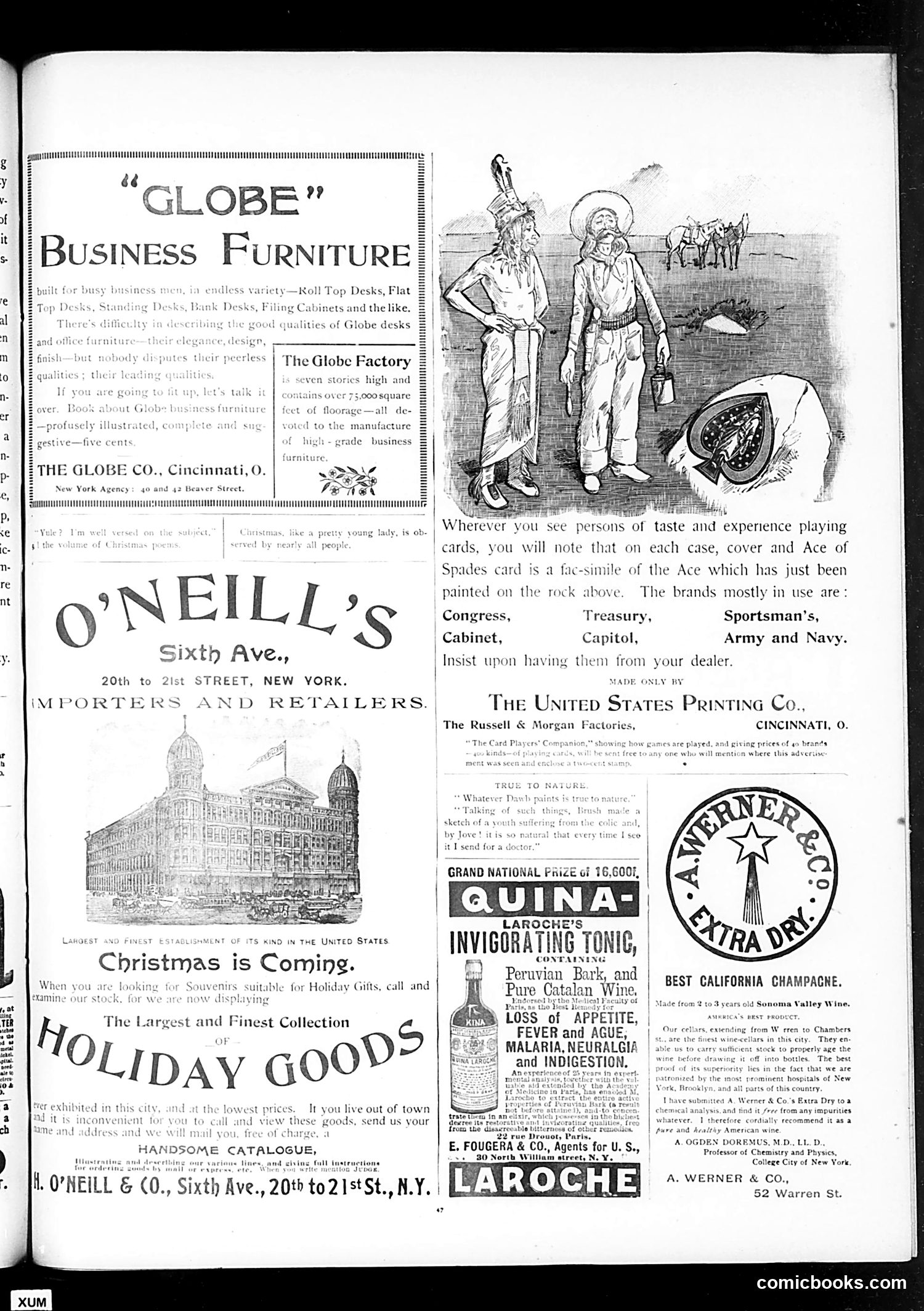
This page is primarily **advertising**, not political satire. It contains multiple commercial advertisements from the 1880s-90s era: The main content features ads for **Globe Business Furniture** (Cincinnati office desks), **O'Neill's** (New York department store promoting holiday shopping), and various patent medicines and luxury goods (Laroche champagne, Quina tonic for malaria/fever). The small illustration showing two figures playing cards is not satirical—it's a **product advertisement** for playing cards, demonstrating that quality card manufacturers like Congress, Treasury, and Sportsman's brands feature accurate ace-of-spades designs. There is **no political cartoon or satire on this page**. The illustration is purely commercial, designed to assure consumers of product quality and authenticity. The "joke" if any is implicit: that even in casual card games, one should insist on genuine branded cards rather than counterfeits. This is a typical late-19th-century magazine page mixing editorial space with paid advertisements—common practice in publications like *Judge*.
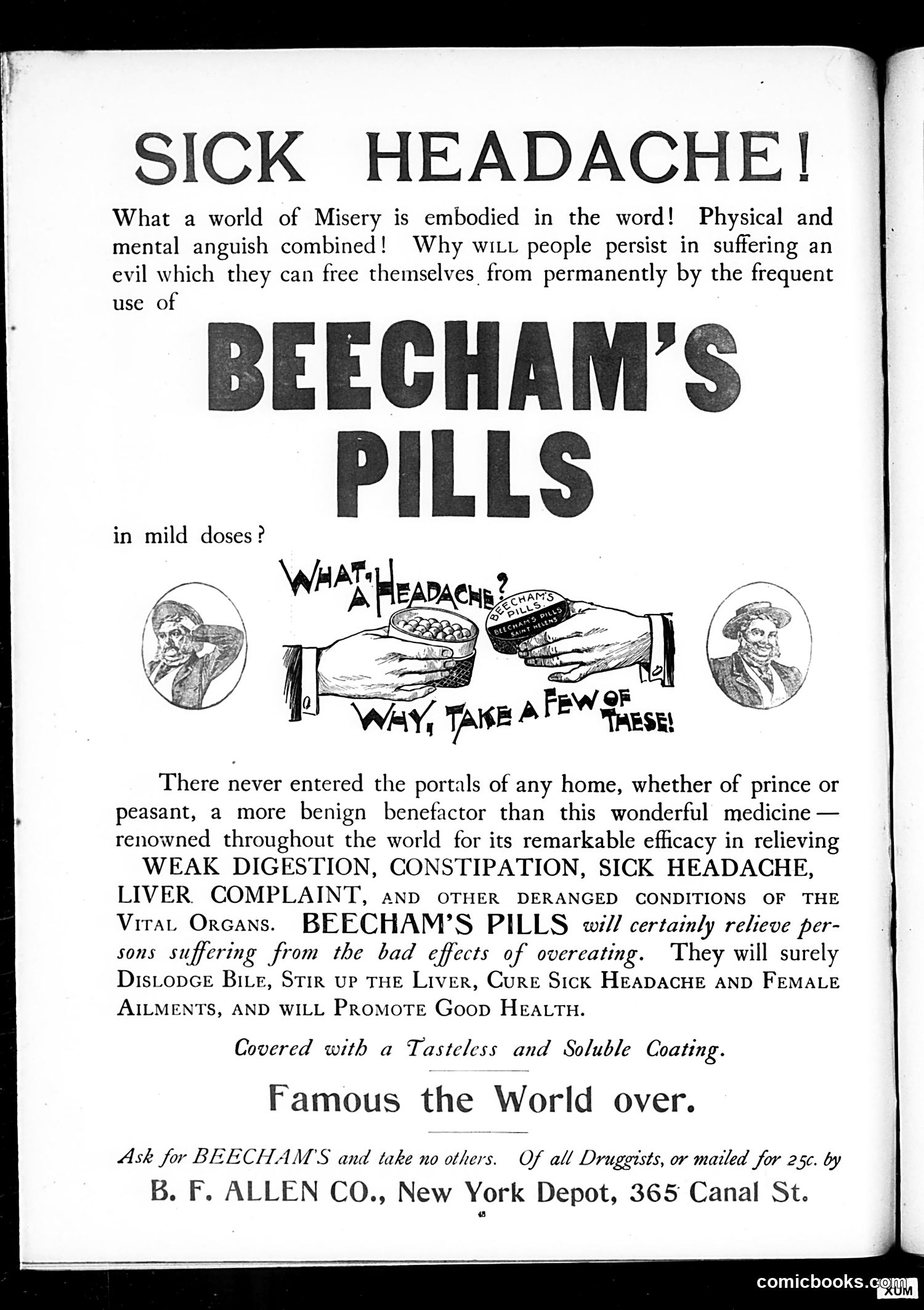
This is a **patent medicine advertisement**, not political satire. It promotes Beecham's Pills, a British laxative/digestive remedy popular in the late 19th/early 20th century. The page uses melodramatic language typical of the era, claiming the pills cure "sick headache," constipation, weak digestion, liver complaints, and "female ailments." The central illustration shows two hands exchanging a box of pills with the caption "What a headache! Why, take a few of these!"—depicting the product as a quick cure-all. The hyperbolic tone ("world of Misery," "benign benefactor") is characteristic of period advertising that made sweeping health claims. The phrase "Famous the World over" and availability through druggists or mail order (25¢) reflect how such patent medicines were widely distributed and heavily advertised in magazines like *Judge*. **For modern readers**: This represents an era before FDA regulation when unproven remedies made exaggerated medical claims in mainstream publications.
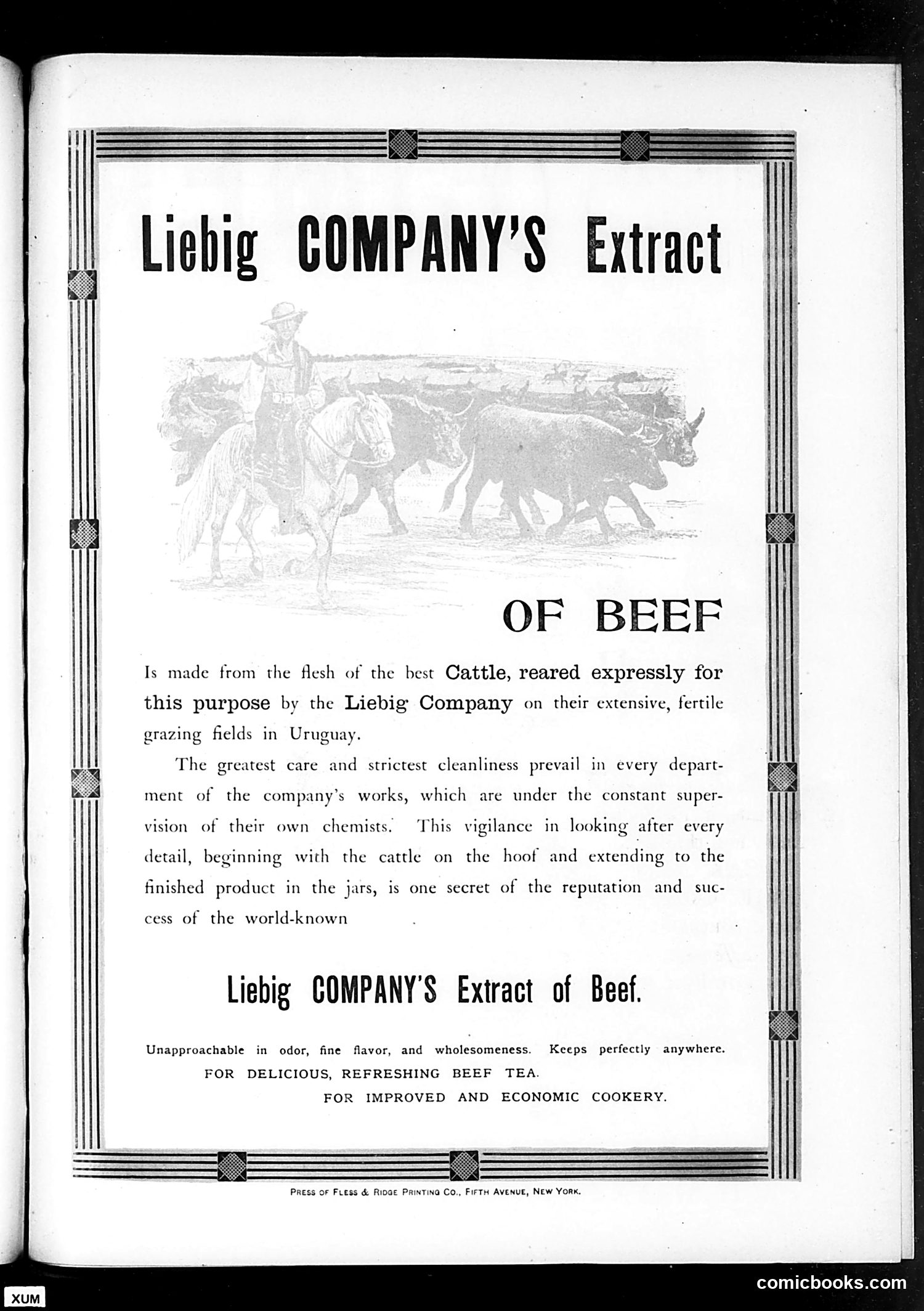
This is **not a cartoon or satirical content**—it's a straightforward advertisement for Liebig Company's Extract of Beef, a real commercial product popular in the late 19th/early 20th century. The page features an illustration of a gaucho (South American cowboy) herding cattle in Uruguay, establishing the product's origin. The ad emphasizes the company's quality control: cattle raised specifically for the extract, strict cleanliness standards, and chemist supervision throughout production. The product was marketed as a convenient, shelf-stable beef concentrate used for making "beef tea" (a broth) and economical cooking. This appears in *Judge* because the magazine accepted paid advertisements alongside its satirical content. There is no joke or political satire here—simply a period advertisement highlighting manufacturing standards as a selling point to consumers concerned about food safety.
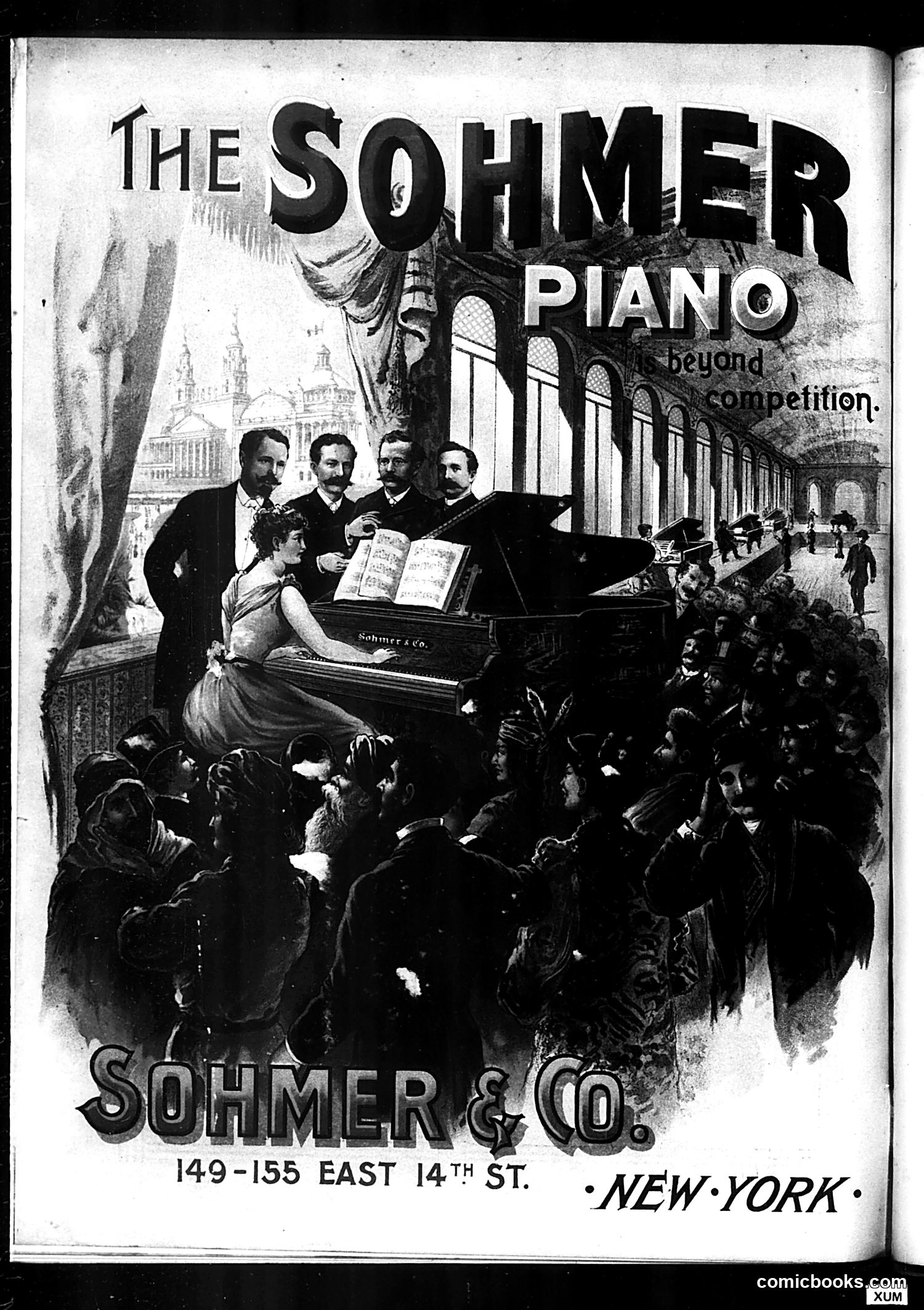
This is a **Sohmer & Co. piano advertisement**, not political satire. The page shows a grand piano in an ornate concert hall setting with an elegant female pianist performing before an appreciative audience of well-dressed gentlemen and spectators. The tagline "beyond competition" emphasizes the piano manufacturer's superior quality. The architectural backdrop and formal presentation suggest luxury and refinement—key selling points for high-end pianos in the late 19th/early 20th century. The address (149-155 East 14th St., New York) identifies Sohmer & Co.'s showroom location. This is essentially a full-page advertisement leveraging aspirational imagery and performance aesthetics to market premium pianos to wealthy consumers, typical of Judge magazine's commercial content alongside satirical cartoons.