
A complete issue · 16 pages · 1892
Judge — November 5, 1892
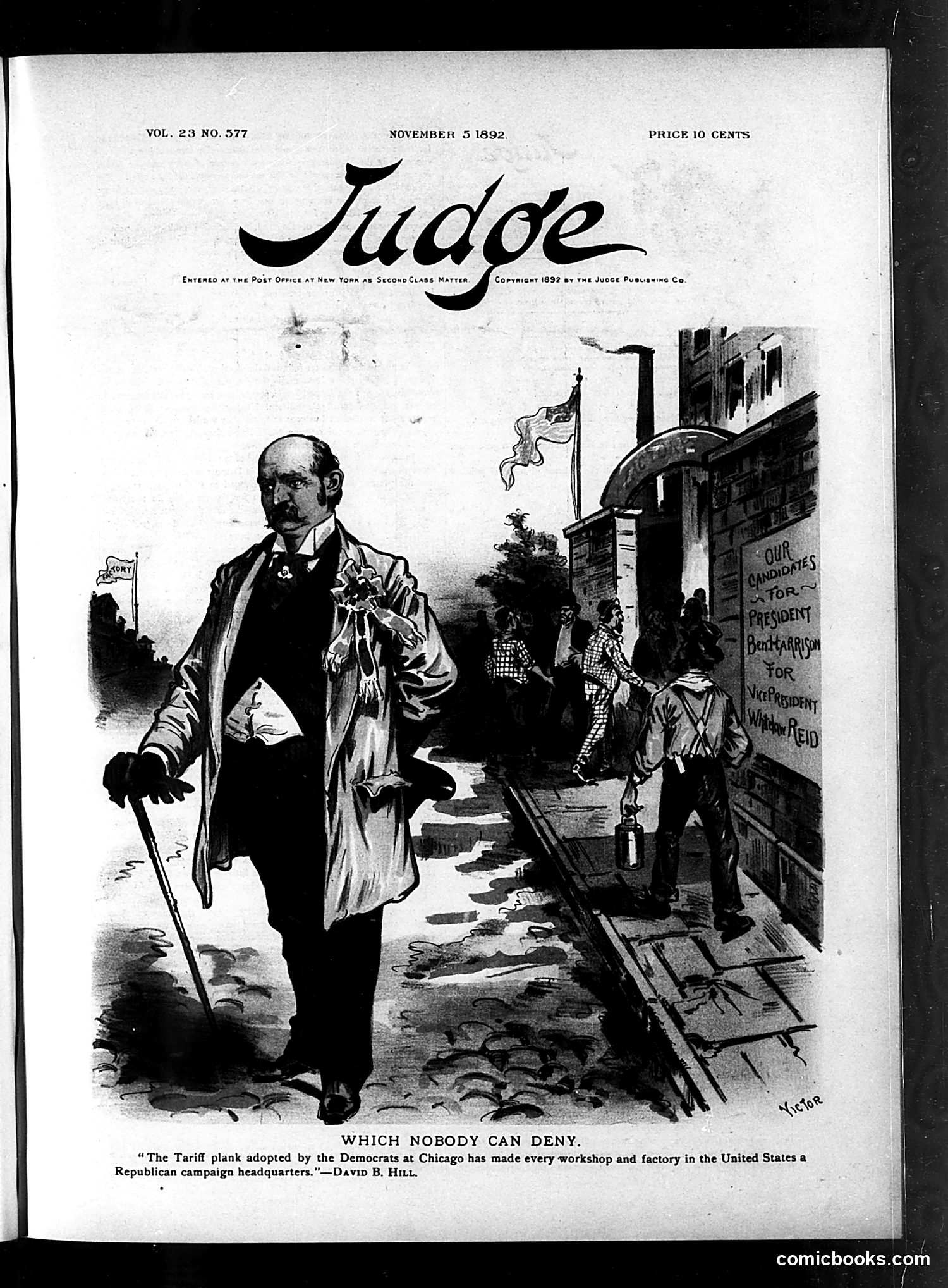
This November 5, 1892 *Judge* cartoon satirizes the Democratic Party's tariff policy. The well-dressed gentleman in the foreground, wearing a cape and holding a sword, represents a Republican figure surveying destruction—broken workshops and factories visible behind him. The sign reads "Our Candidates for President [Benjamin] Harrison for Vice-President [Whitelaw] Reid," identifying this as Republican campaign material. The caption quotes David B. Hill, a Democratic politician, claiming the Democratic tariff plank made American workshops and factories into Republican campaign headquarters. The satire suggests Democrats inadvertently helped Republicans by making tariff policy so damaging that factories themselves became symbols of Republican success, supporting the GOP's election campaign through economic hardship.
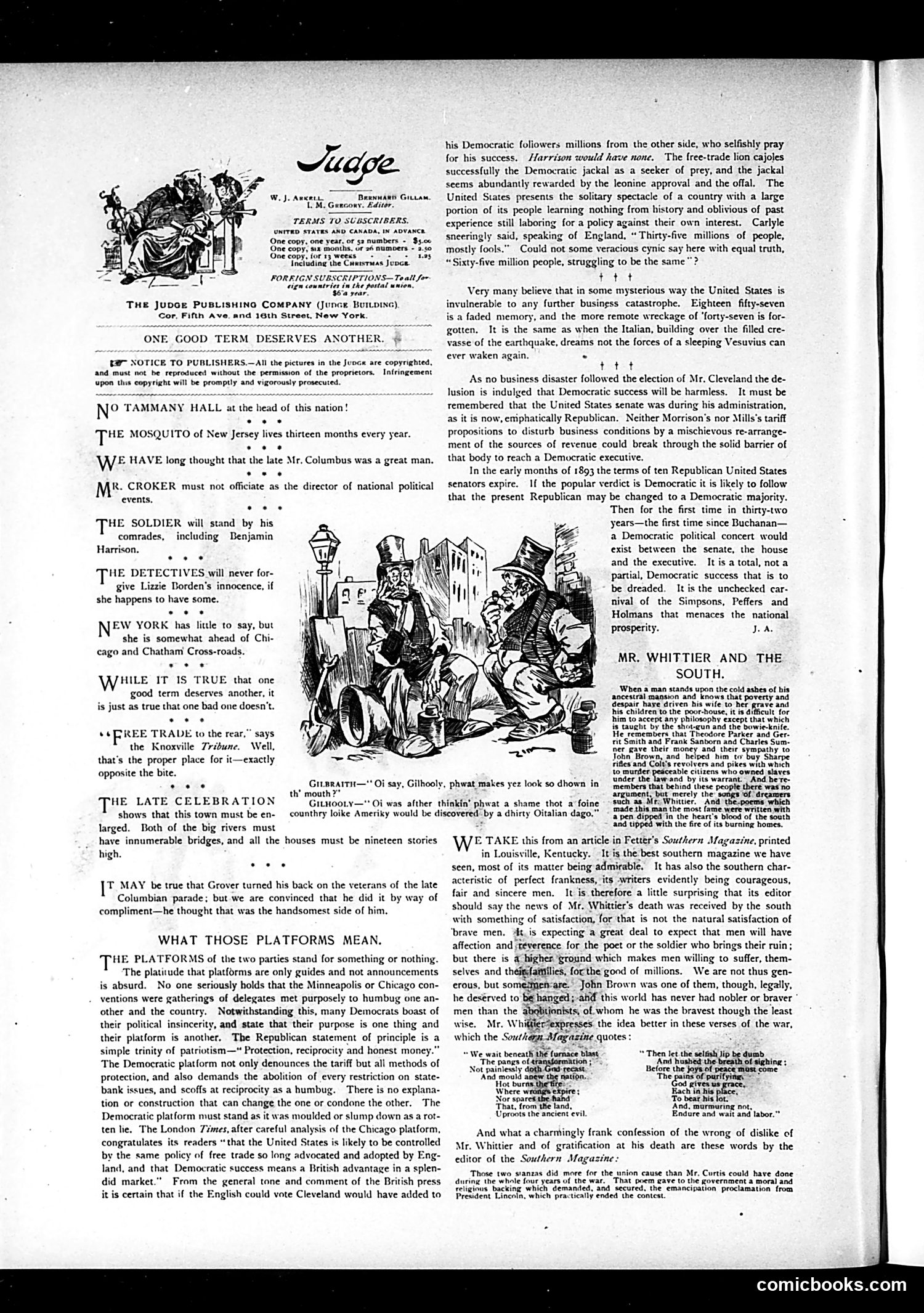
This page contains political commentary from Judge magazine during the Cleveland administration era. The main cartoon depicts urban chaos—figures in disheveled dress amid a cityscape, likely satirizing Democratic governance or urban mismanagement. The accompanying text criticizes Democratic politics and Cleveland specifically. It references failed Democratic policies, disputes with the Republican Senate, and suggests Democratic success threatens national stability. One section mocks Mr. Whittier and Southern Democrats, quoting a Southern Magazine article criticizing Whittier's death coverage as hypocritical—claiming the South praised him only after death despite prior animosity. The satire attacks Democratic credibility on tariffs, trade policy, and sectional politics, presenting Republicans as defenders of national prosperity. The overall message: Democratic rule produces disorder and fails economically.
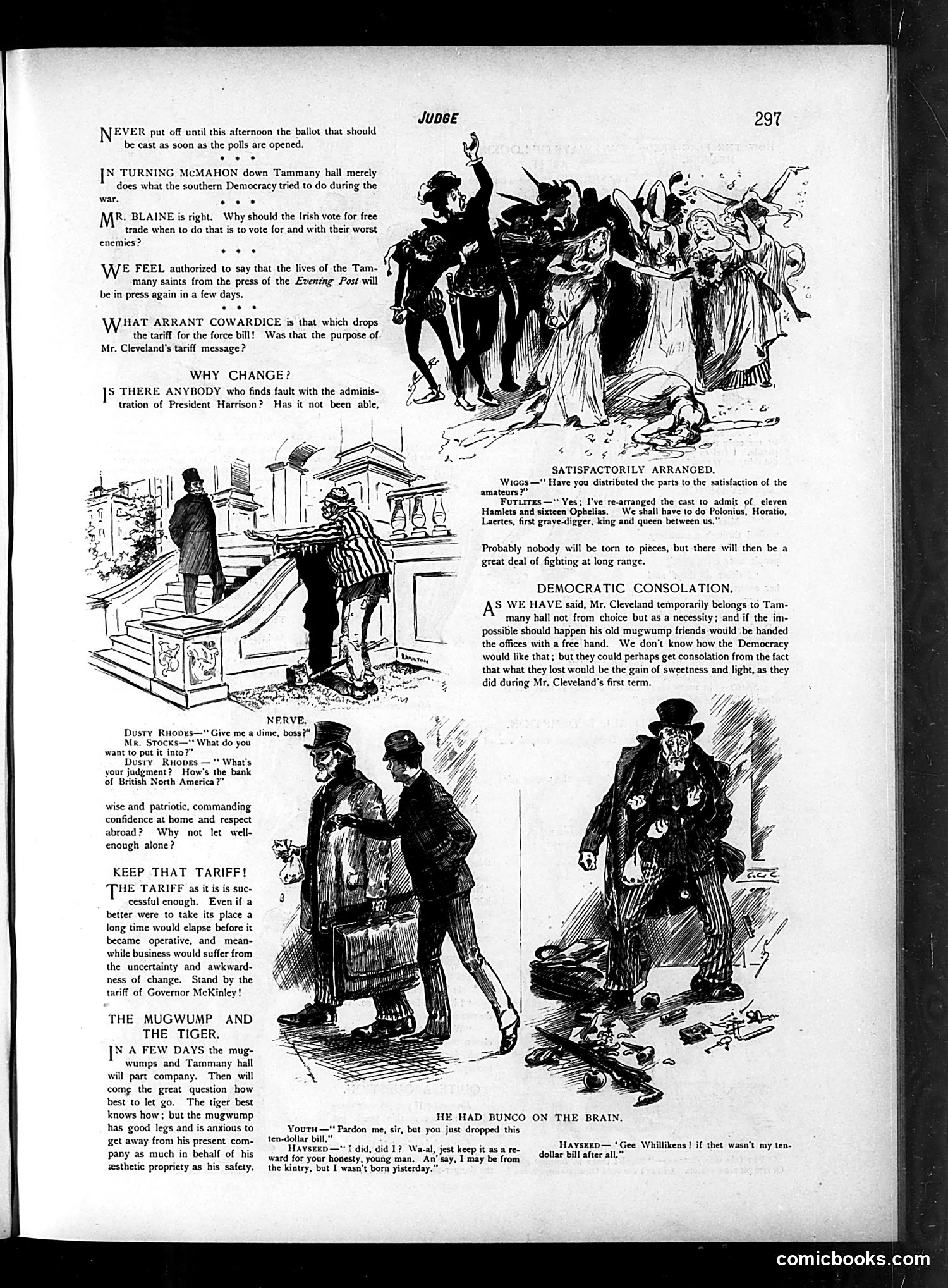
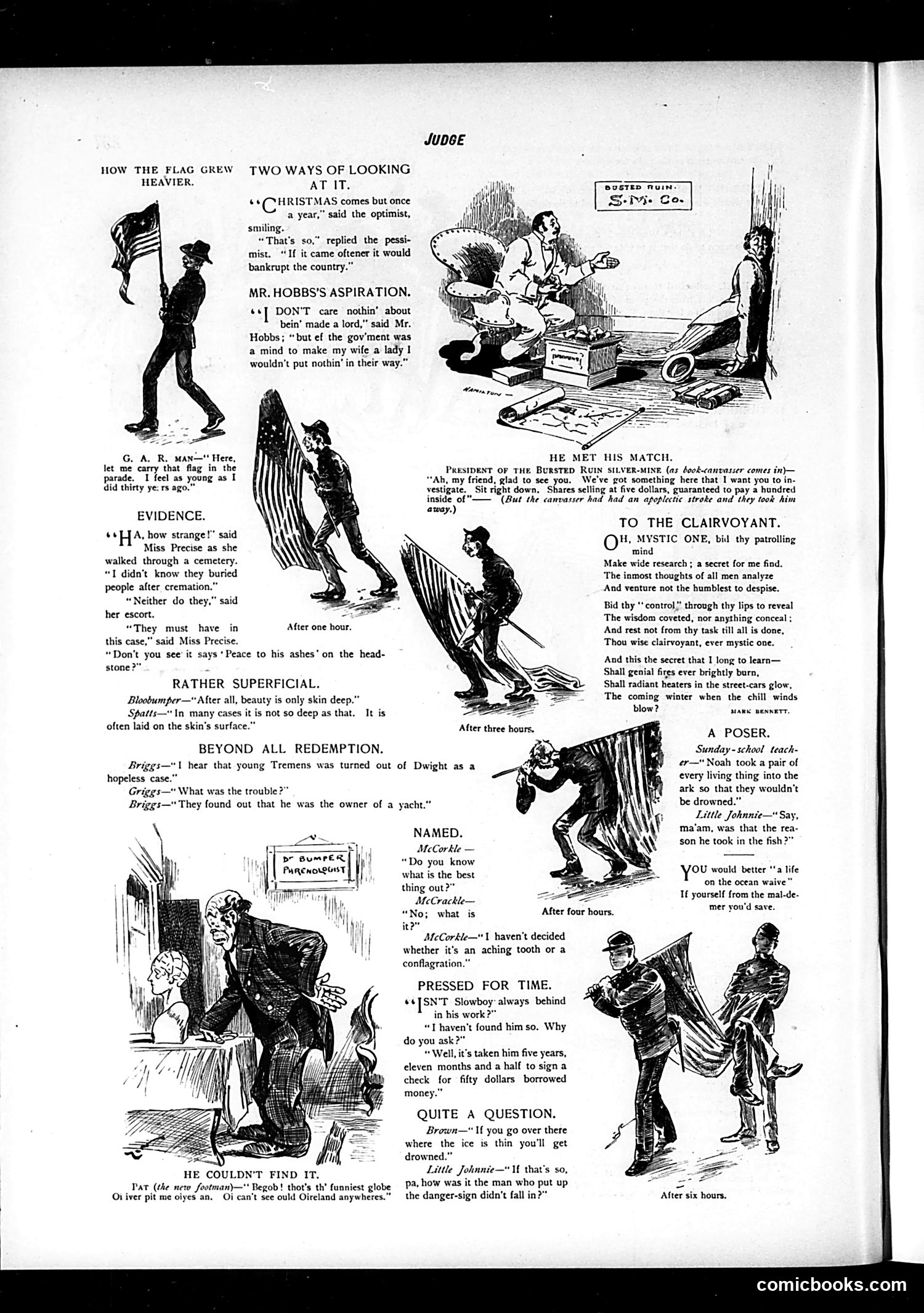
This page contains multiple brief satirical sketches typical of Judge magazine's humor format: **"How the Flag Grew Heavier"** and **"Two Ways of Looking at It"**: Simple optimist/pessimist jokes about Christmas and holiday spending—common themes in American magazines. **"Mr. Hobbs's Aspiration"**: Working-class humor about a man indifferent to nobility but wanting his wife elevated to "lady" status, reflecting period class anxieties. **"He Met His Match"**: A silver-mine company president's sales pitch proves so absurdly optimistic it gives the canvasser a stroke—satirizing the get-rich-quick schemes and stock fraud common in the Gilded Age. **"Beyond All Redemption"**: A young man's yacht ownership makes him "hopeless"—likely mocking wealthy parasites or inherited idleness. **Minor sketches** include cemetery humor, clairvoyant mockery, Irish servant comedy ("Pat the new footman"), and Sunday school absurdities—all reflecting period prejudices and social conventions. The overall tone is lighthearted, class-conscious, and focused on American social pretension rather than serious political satire.
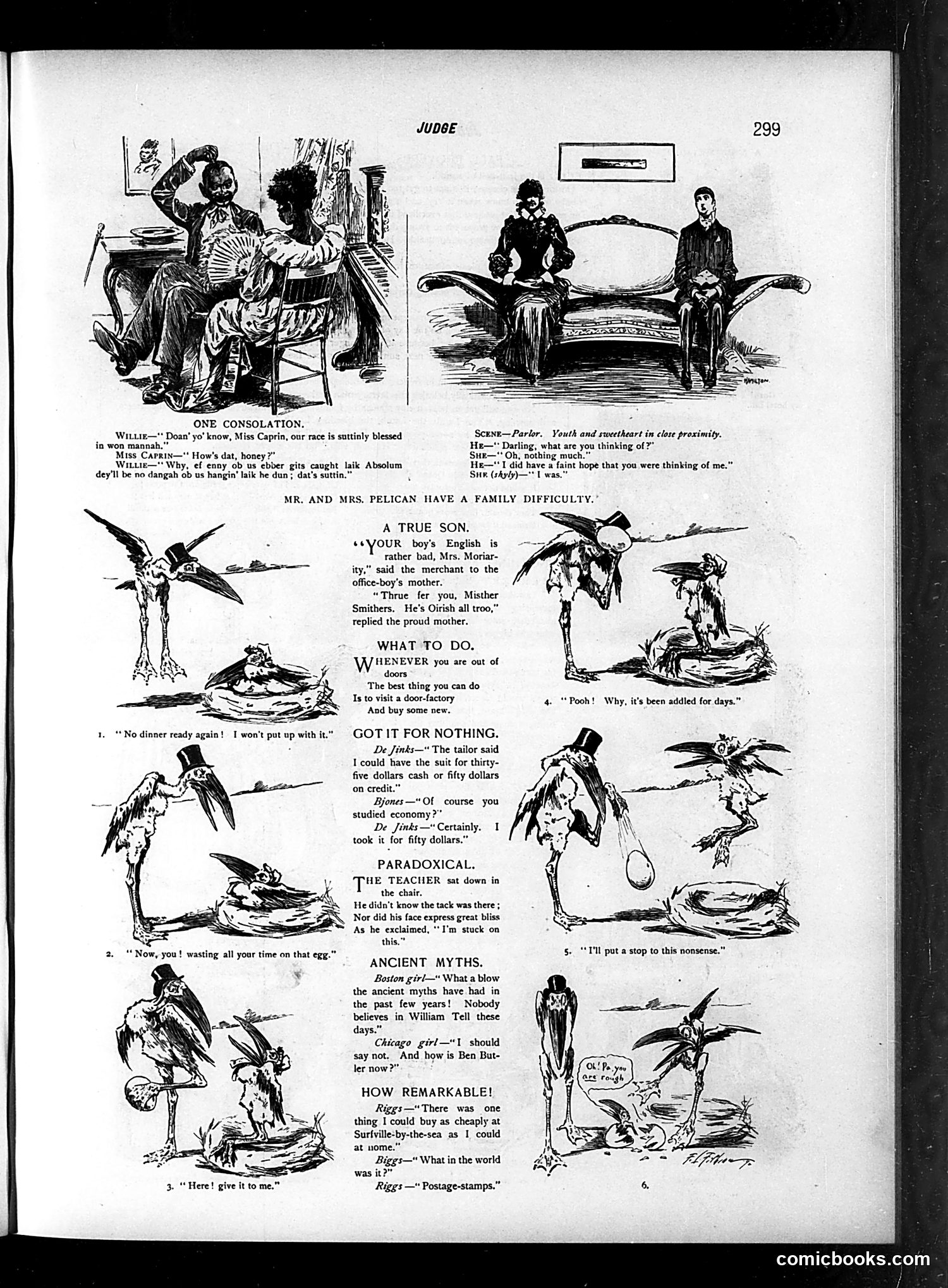
This page contains multiple brief humorous sketches typical of 1880s-90s satirical magazines: **"One Consolation"** mocks racist stereotypes through dialect humor about enslaved people. **"A True Son"** jokes about Irish immigrants, presenting the mother's pride in her son's poor English as absurdly backwards patriotism. **"Pelican Family Difficulty"** appears to be a visual joke using bird illustrations rather than human figures. **The remaining sketches** are light domestic humor: a young couple's flirtation, puns about door factories and tacks, and jokes about tailors and postage stamps. The cartoons reflect period attitudes—casual ethnic stereotyping and class humor were standard in Judge. Most rely on simple wordplay or situation comedy rather than political commentary. The page represents mainstream American humor of the era, which modern readers would find offensive in its stereotyping while finding the puns relatively innocuous.
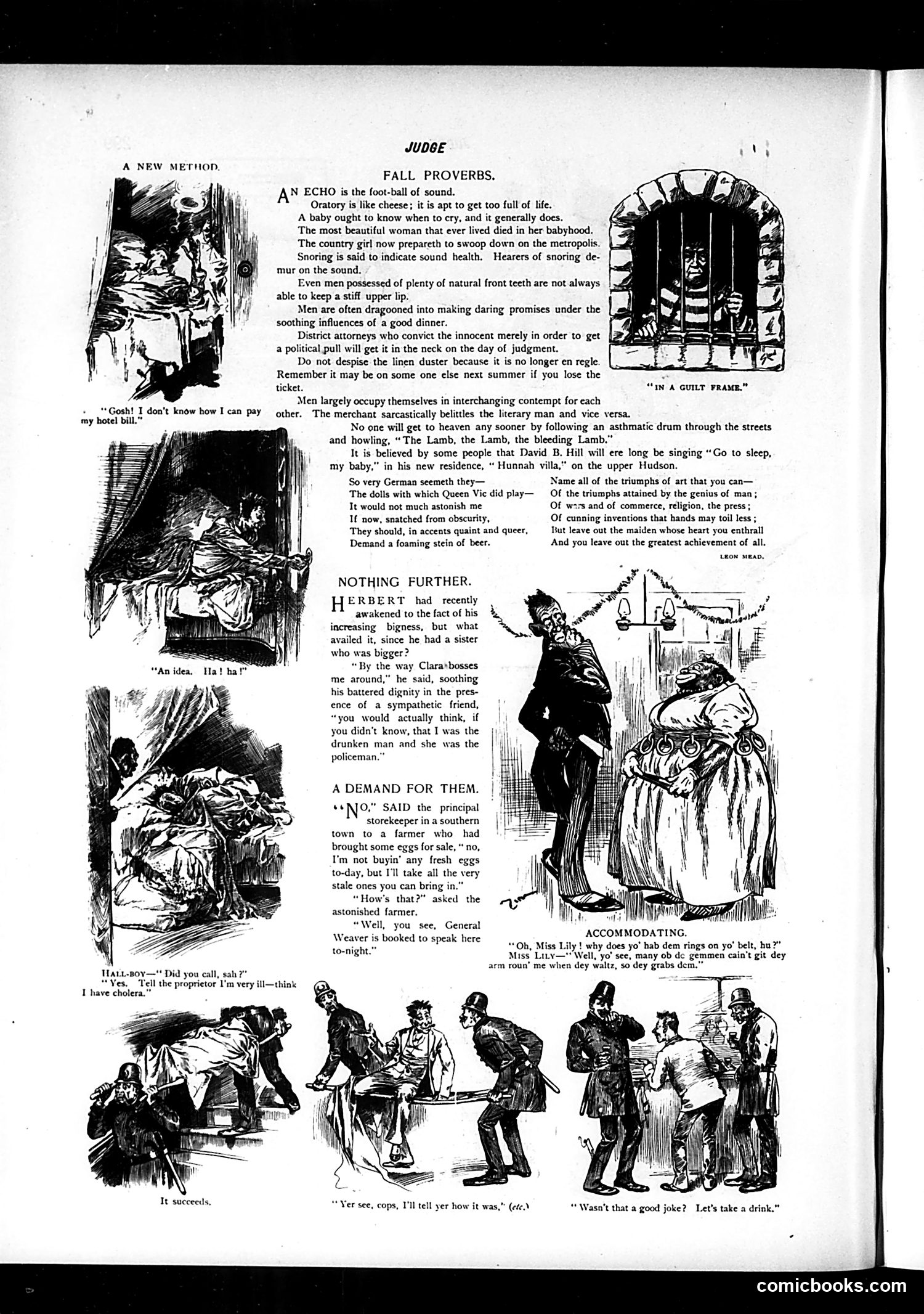
This page contains several satirical pieces typical of late-19th-century American humor: **"Fall Proverbs"** offers cynical observations on society—mocking oratory, politicians seeking power through conviction of the innocent, and German immigrants. References to "David B. Hill" (New York politician) and "General Weaver" (likely James B. Weaver, Populist candidate) suggest contemporary political figures as targets. **"Nothing Further"** presents a boy-versus-girl dominance joke: Herbert complains his sister bosses him around so much he appears the "drunken man" and she the "policeman"—inverting expected gender roles for comedic effect. **"A Demand for Them"** satirizes political deception: a storekeeper wants stale eggs because General Weaver's speech will draw crowds, implying politicians attract unsavory types or that political gatherings are associated with poor quality. The bottom cartoon uses racial caricature (typical for the era) in a joke about a Black woman's jewelry serving practical purposes during dancing. The illustrations throughout employ exaggerated line work characteristic of period satirical cartooning.
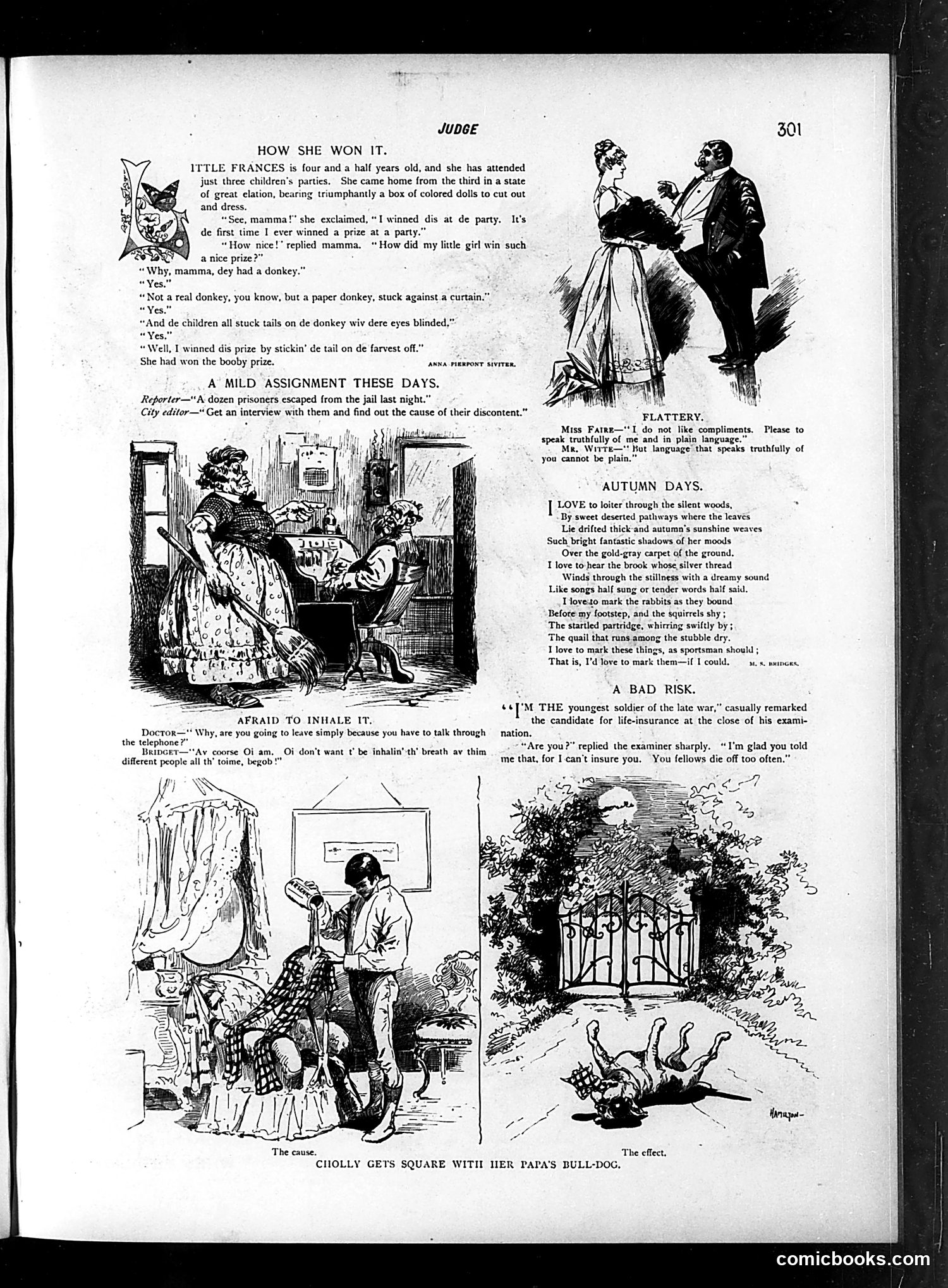
This page contains several humor pieces typical of late 19th-century American satirical magazines: **"How She Won It"**: A child's misunderstanding of a "pin-the-tail-on-the-donkey" party game. She believes winning the booby prize (the consolation prize for worst performance) represents genuine achievement—satirizing childhood innocence and competitive delusion. **"A Mild Assignment These Days"**: Topical humor about prison escapes, likely referencing contemporary crime concerns, with ironic editorial advice to interview escaped prisoners about their grievances. **"Afraid to Inhale It"**: An Irish domestic servant (Bridget, using period ethnic dialect) refuses telephone use, fearing she'll inhale others' breath—mocking both technological anxiety and working-class superstition. **"Flattery"**: A woman rejects compliments; a male writer retorts that honest compliments about her cannot be plain-spoken—gentle gender-based wit. **"A Bad Risk"**: A war veteran applying for life insurance reveals his age, causing the examiner to refuse coverage because soldiers "die off too often"—dark humor about Civil War casualty rates. The remaining content includes poetry and a dog-related joke.
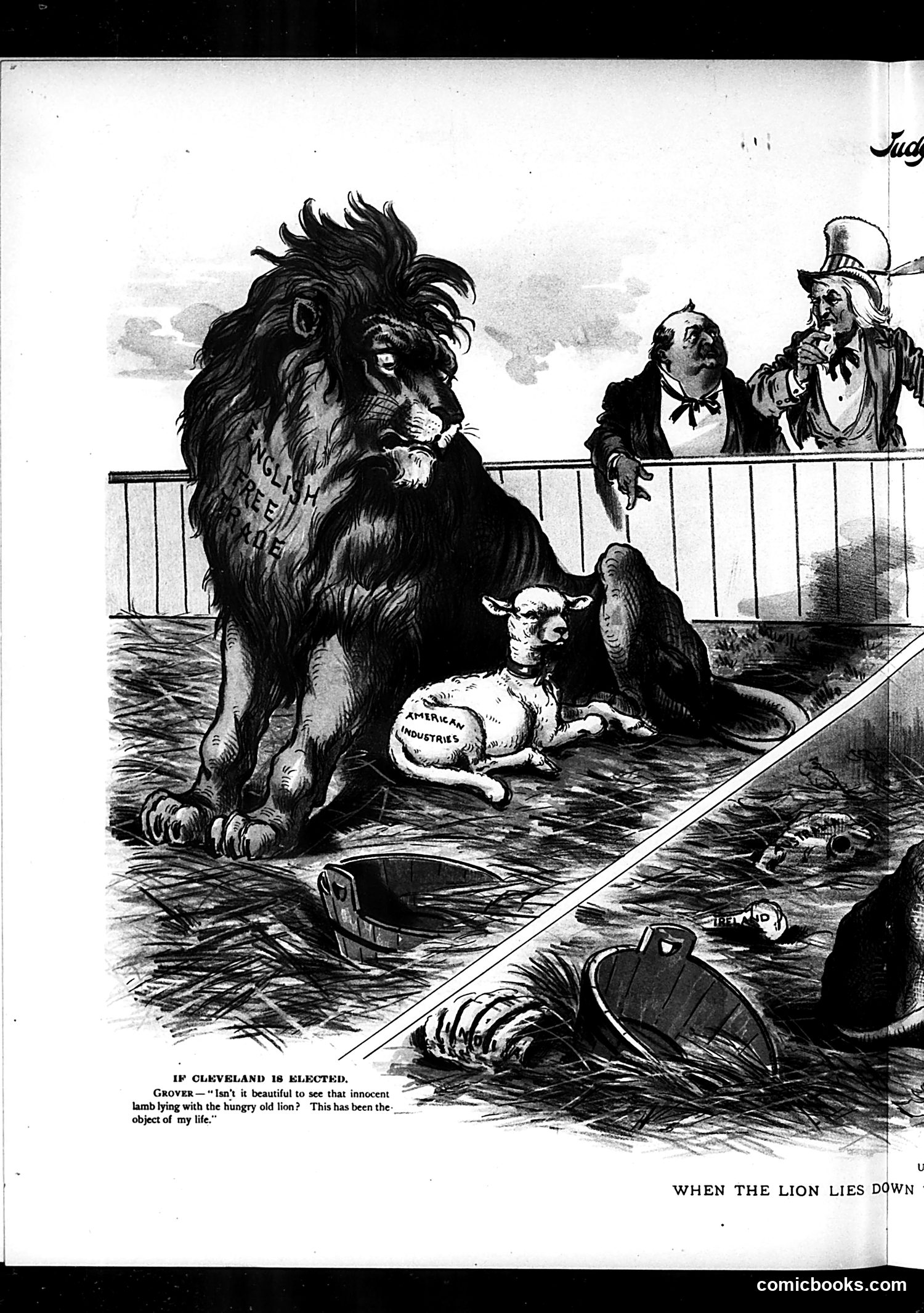
This is a political cartoon satirizing Grover Cleveland's election prospects. The "lion" represents a powerful force—likely either the Republican Party or big business interests—while the small "lamb" labeled "American Industries" symbolizes vulnerable American manufacturing and commerce. Cleveland, speaking as "Grover," expresses satisfaction at seeing these supposed enemies peacefully coexist. The satire suggests this is naive or dangerous: the cartoon implies that if Cleveland is elected, he will allow the "hungry old lion" to devour American industries without protection. The caption's framing as Cleveland's stated life goal mocks his political platform, likely his free-trade stance or opposition to protective tariffs that industrial interests wanted. The observing gentlemen at the railing appear skeptical of this outcome.
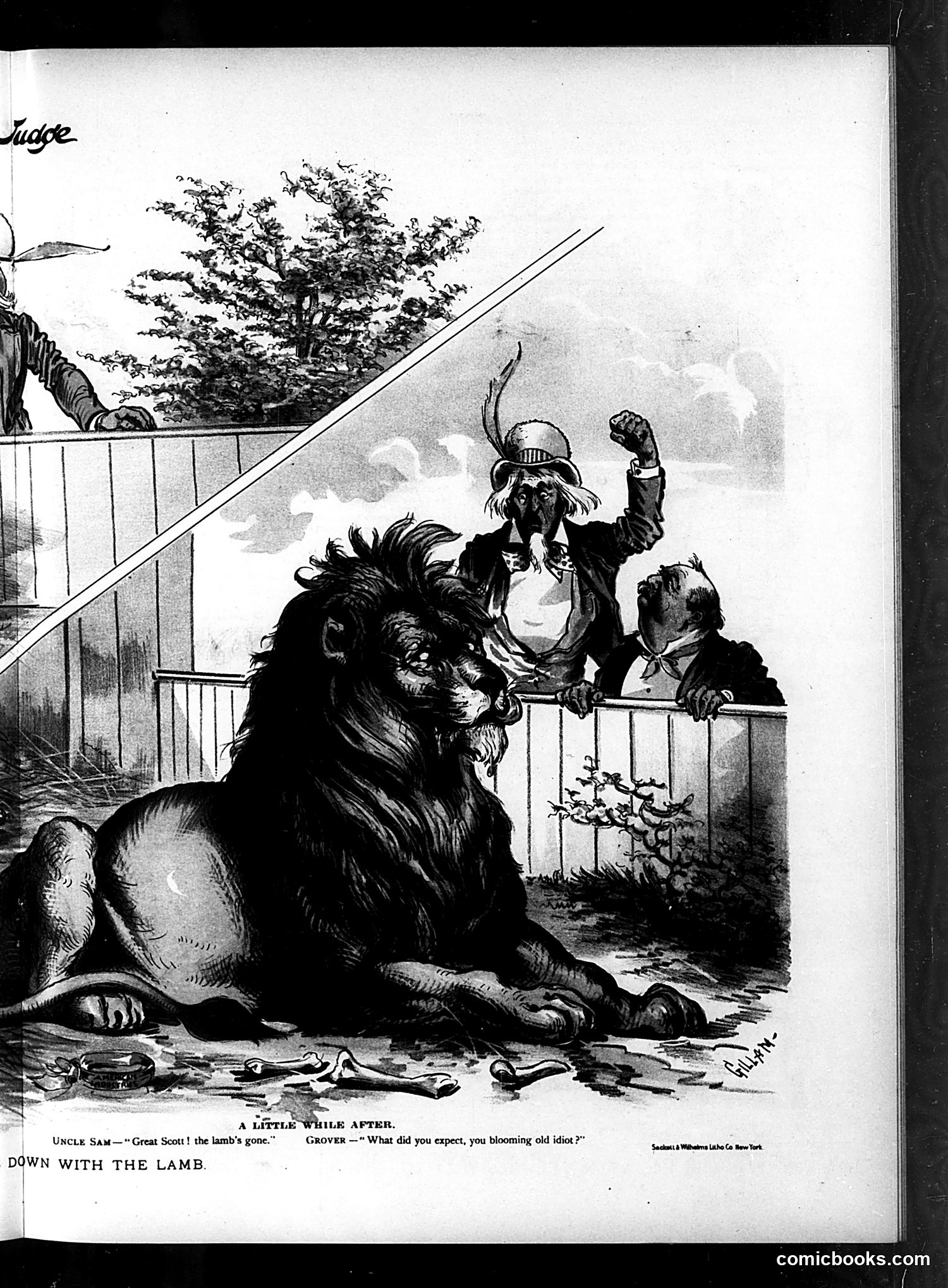
This political cartoon satirizes President Grover Cleveland's policies, likely regarding tariffs or trade. Uncle Sam (representing American interests) discovers "the lamb" is gone—a metaphor for a sacrificial or vulnerable economic entity. Cleveland, identified as "Grover," responds with hostility, suggesting the President deliberately harmed American economic interests through his policies. The title "Down with the Lamb" and the confrontational tone indicate this critiques Cleveland for prioritizing certain political goals over protecting American commerce or workers. Judge magazine, being Republican-leaning, frequently attacked Democratic policies. The lion in the foreground appears symbolic of danger or predatory forces, possibly representing foreign competition that Cleveland's policies allegedly enabled.
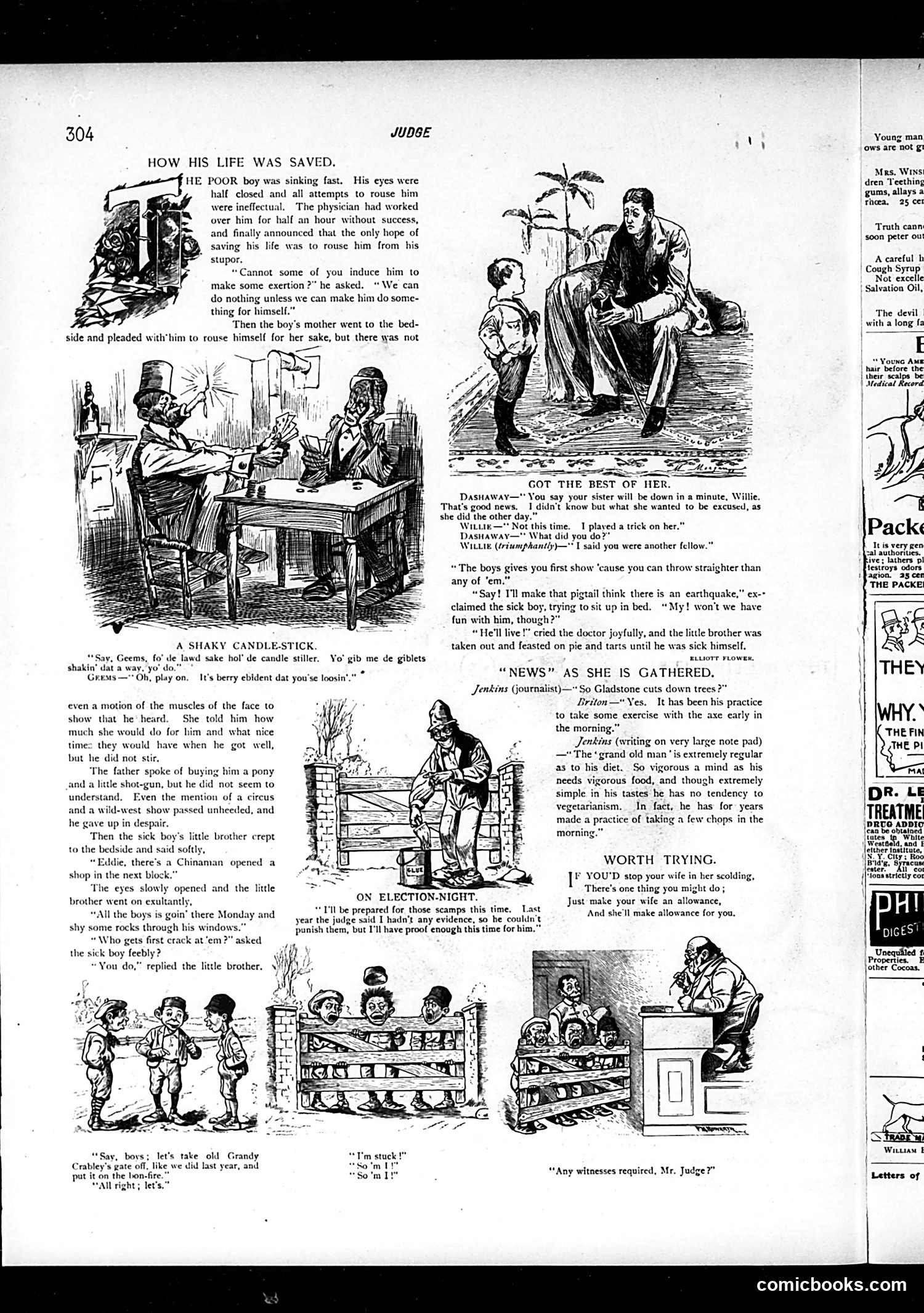
This page contains multiple short humorous stories and cartoons typical of Judge magazine's satirical format: **"How His Life Was Saved"**: A sickly boy won't respond to his parents' pleas or incentives (pony, circus), but immediately perks up when his little brother mentions a new Chinese shop opening nearby—implying the boys plan to harass the Chinese immigrant by throwing rocks through his window. The doctor celebrates the boy's recovery, oblivious to the racist cruelty motivating it. The satire targets anti-Chinese sentiment and xenophobic behavior among American youth in this era. **Other brief comedic pieces** include Election Night (a man preparing to punish neighborhood boys), a domestic joke about a girl outsmarting her suitor, and wordplay about Gladstone's tree-cutting being misreported as dietary habits. The page reflects Judge's typical mix of family humor, social commentary, and casual racism acceptable to its late-19th/early-20th-century audience. The Chinese immigrant story particularly reveals period attitudes toward Asian Americans.
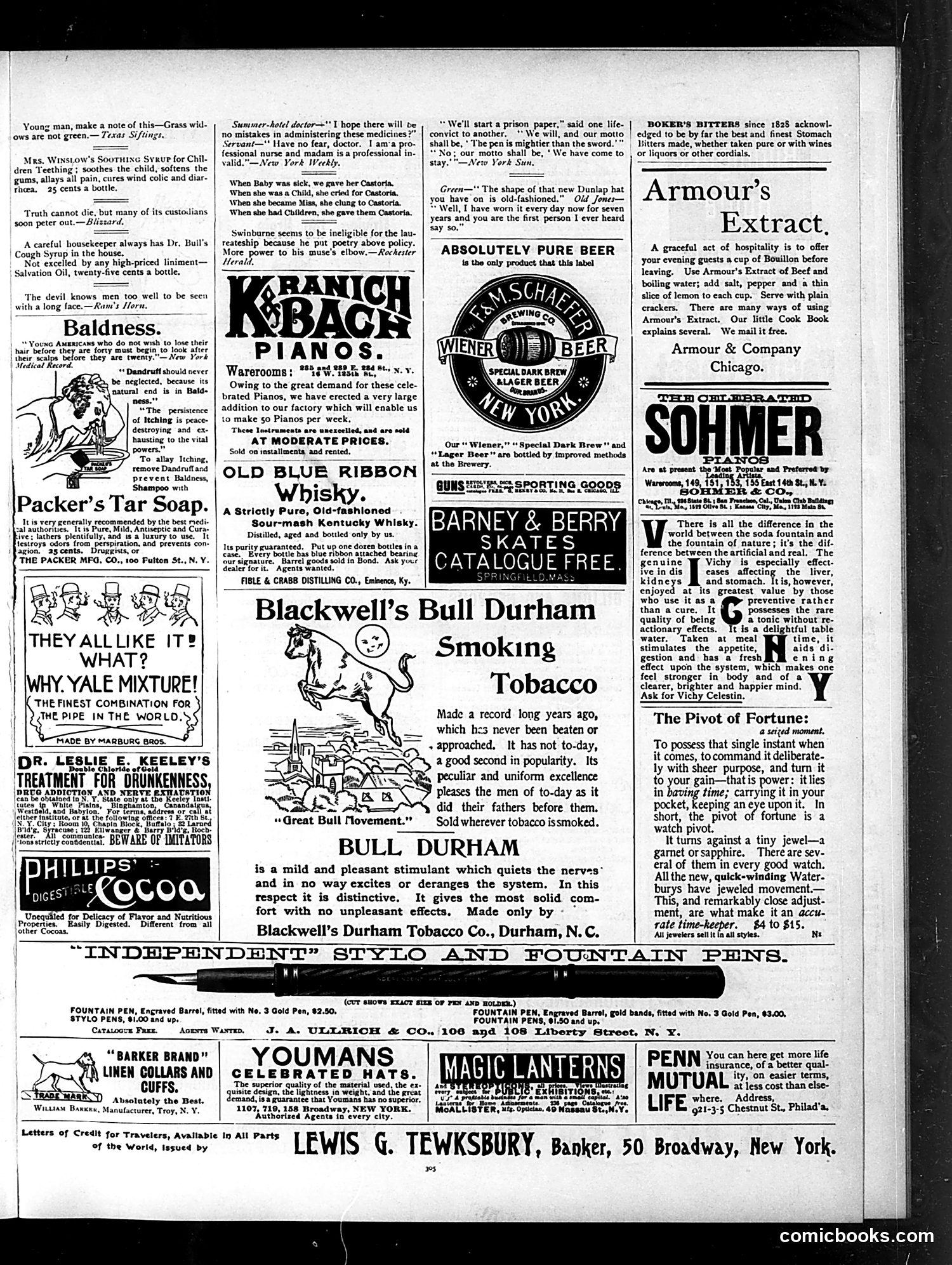
This page is primarily **advertising**, with minimal political or satirical cartoons. The dominant content consists of commercial advertisements for patent medicines, tobacco, pianos, and consumer goods typical of late 19th-century American magazines. The few joke items present are brief, non-political quips: - A joke about "grass widows" (divorced or separated women) - A prison paper joke playing on "the pen is mightier than the sword" - Humorous observations about baldness and danddruff Notable is **"Packer's Tar Soap"** with an illustrated figure promoting hair loss treatment—reflecting period anxieties about male baldness. The advertisements reveal common era concerns: drunkenness treatment (Dr. Keeley's), children's ailments, and tobacco products. **No identifiable political figures or satirical commentary appear.** This represents Judge magazine functioning primarily as a revenue-generating advertising vehicle rather than political satire on this particular page.
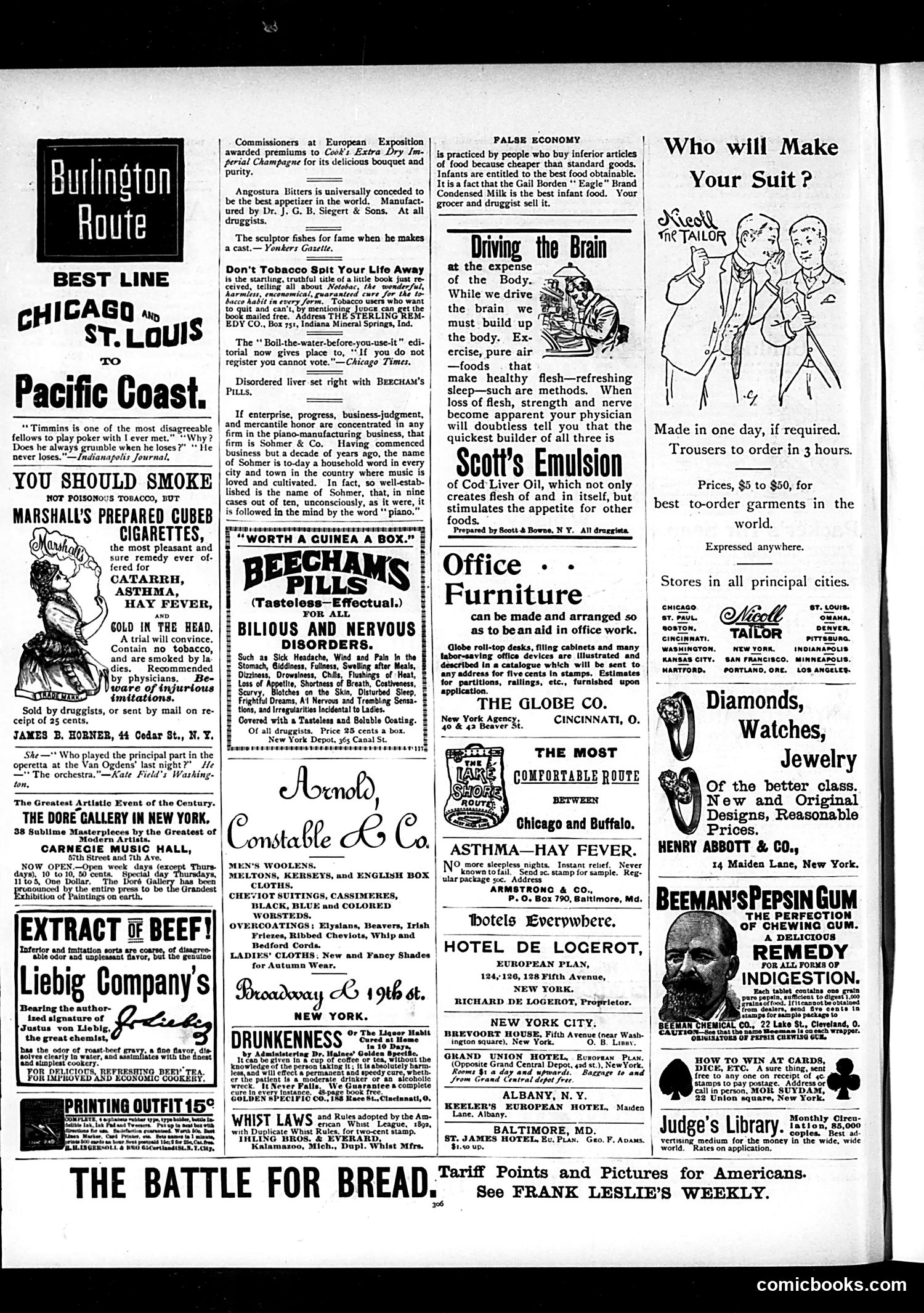
This page is primarily **advertising** with minimal editorial content. The main cartoon appears in the upper right: a simple illustration showing three tailors in conversation, advertising made-to-order suits. The cartoon's joke is straightforward: it promotes Stiell's tailoring services, claiming they can make custom trousers in three hours and complete suits in one day—implying remarkable speed compared to conventional tailors of the era. The surrounding advertisements reflect turn-of-the-century consumer concerns: patent medicines (Beecham's Pills for digestive issues, Marshall's Cubeb Cigarettes for asthma), nutritional products (Liebig's Beef Extract, Scott's Emulsion), and railway/hotel services. The page contains no apparent political satire or social commentary—it's a commercial publication dominated by period advertising and promotional content typical of Judge magazine's revenue model.
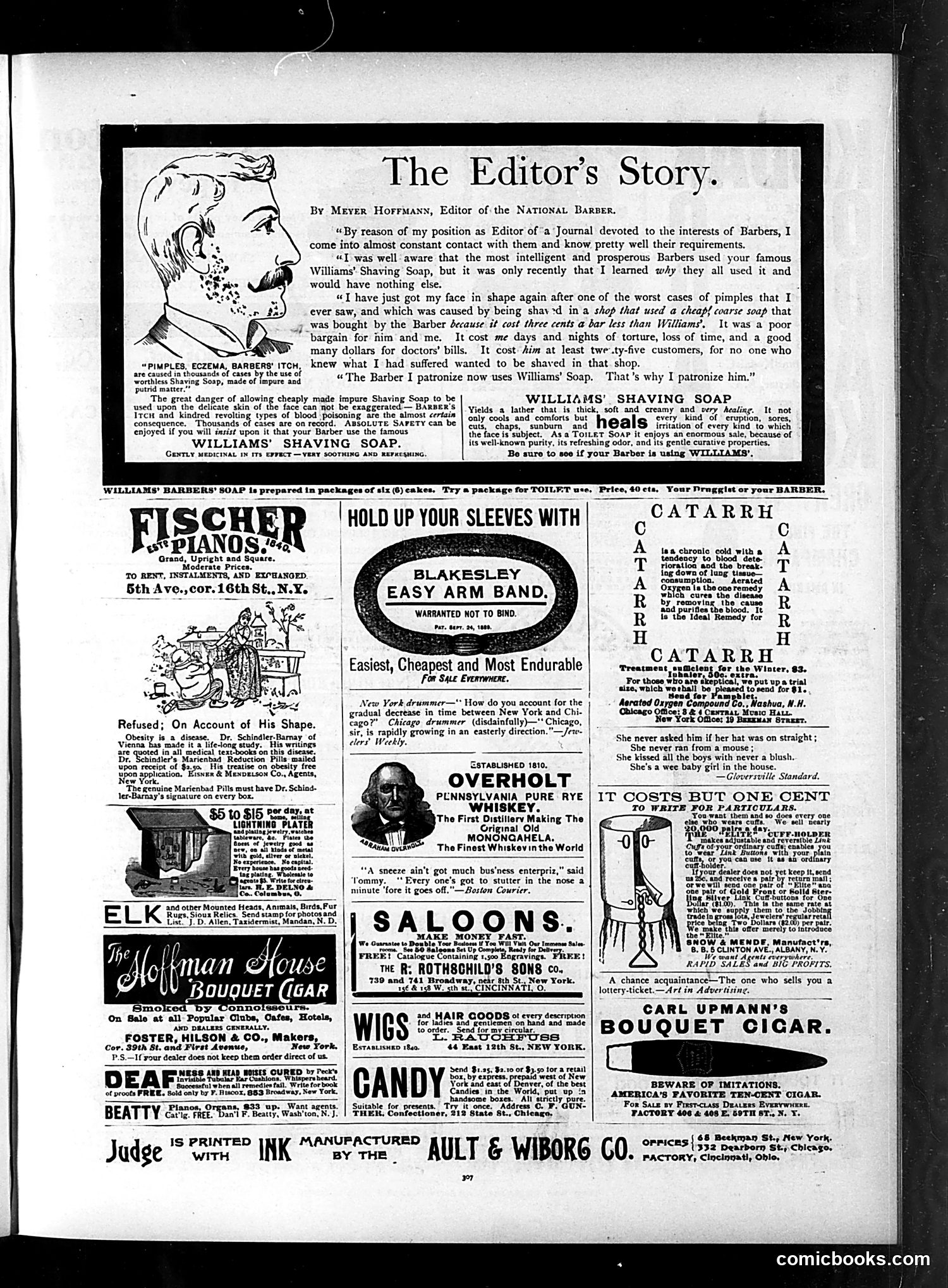
This page is primarily **advertising disguised as editorial content**. Meyer Hoffmann, identified as editor of "The National Barber" journal, endorses Williams' Shaving Soap by describing how cheap soap caused him severe facial pimples and lost customers for his barber. The "story" is a **testimonial advertisement** for Williams' Shaving Soap—a common early 20th-century marketing tactic. Hoffmann's narrative warns that bargain soaps cause skin infections like barbers' itch and eczema, positioning Williams' as the superior, medically-safe choice for professional barbers. The remainder of the page contains typical period advertisements: pianos, medical remedies (obesity pills, catarrh cure), cigars, and miscellaneous products. A small humorous exchange between traveling salesmen appears mid-page. The satire is **implicit rather than explicit**—Judge's presentation of transparently self-interested advertising as genuine editorial commentary may itself be satirizing the blurred line between journalism and marketing that characterized the era.
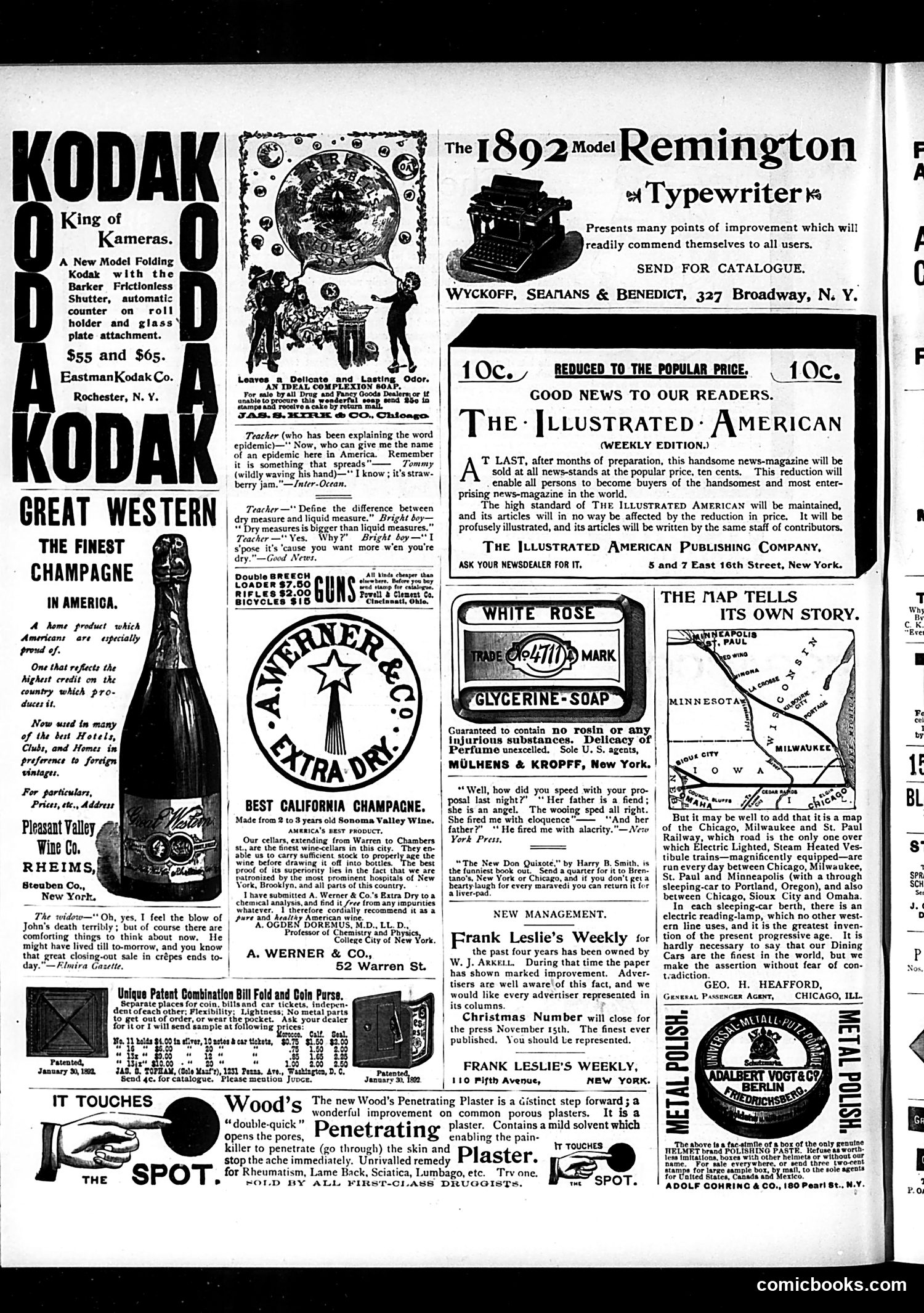
This is primarily an **advertising page** from Judge magazine, circa 1892. Rather than political cartoons, it features commercial advertisements interspersed with small humorous anecdotes typical of the era. The notable content includes: **The humor pieces** are mild social observations: a widow more concerned about a store's closing sale than her husband's death; children's malapropisms about "epidemics" (strawberry jam) and measurement units. **The advertisements** showcase products marketed to affluent Americans: Kodak cameras, California champagne (notably positioned as superior to French imports), typewriters, and soap. The champagne ads emphasize it's an American product worthy of "preference to foreign vintages"—reflecting late-19th-century American economic confidence and nationalism. **One notable detail**: A chemistry professor endorses wine's purity, lending scientific authority to alcohol sales—common practice before modern FDA regulations. The page reflects Gilded Age consumer culture and American industrial pride more than political satire. It's a snapshot of what affluent readers bought and found amusing in 1892.
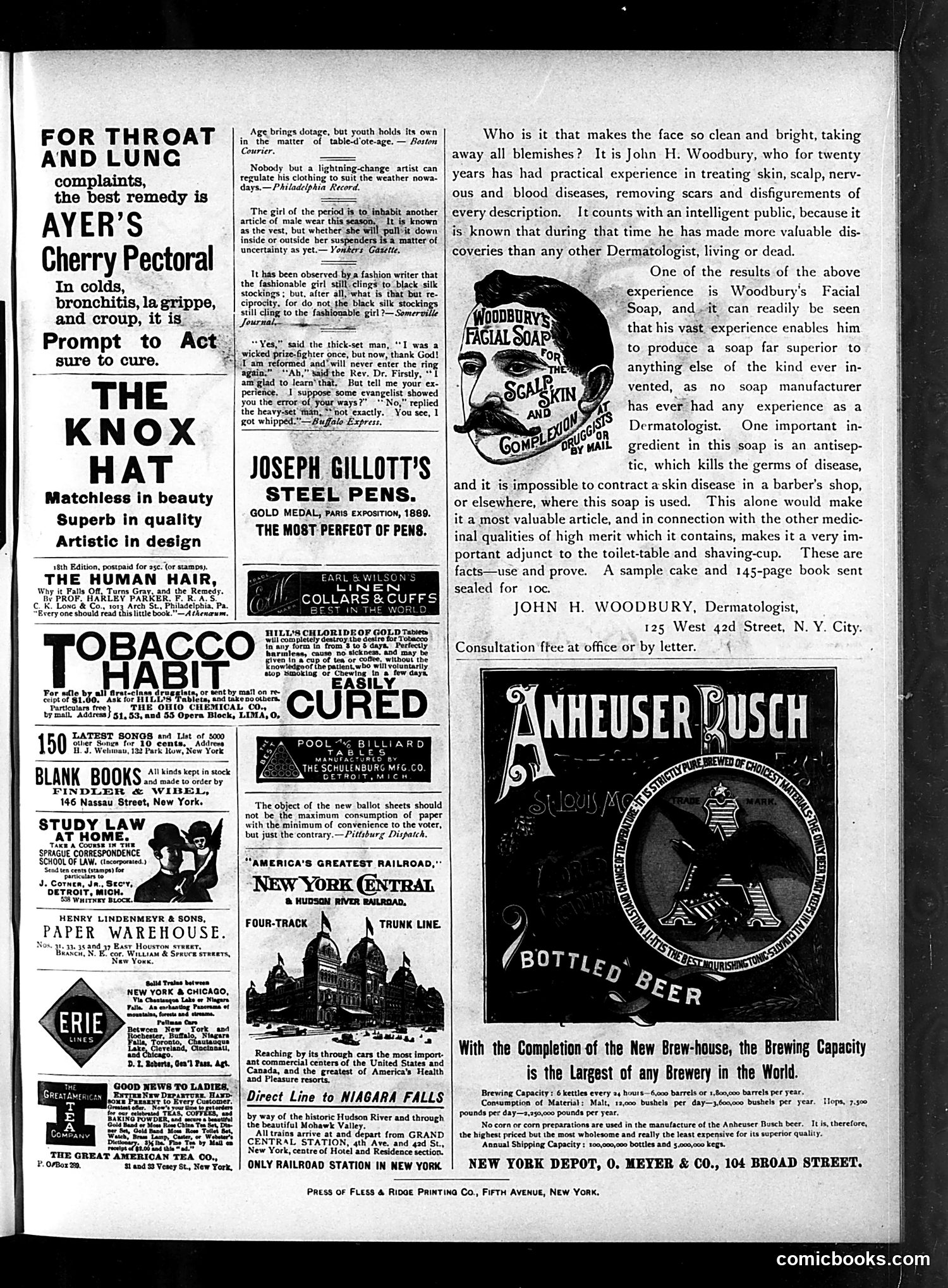
This page is primarily **advertising**, not satirical editorial content. It contains multiple product advertisements typical of the 1880s-1890s era: Ayer's Cherry Pectoral cough medicine, Knox hats, Joseph Gillott's steel pens, tobacco remedies, and Anheuser-Busch beer. The only satirical elements are small **humor filler pieces**—brief, attributed jokes from newspapers like the *Boston Courier* and *Buffalo Express*. These touch on contemporary social observations: fashion absurdities (women wearing vests), prize fighters' reformation, and aging. The humor is gentle social commentary rather than political satire. The Woodbury's Facial Soap advertisement is notable for claiming the product was developed by a dermatologist (John H. Woodbury), representing early marketing use of medical credibility to sell cosmetics—a common late-19th-century advertising strategy. No identifiable political figures or events are referenced on this page.
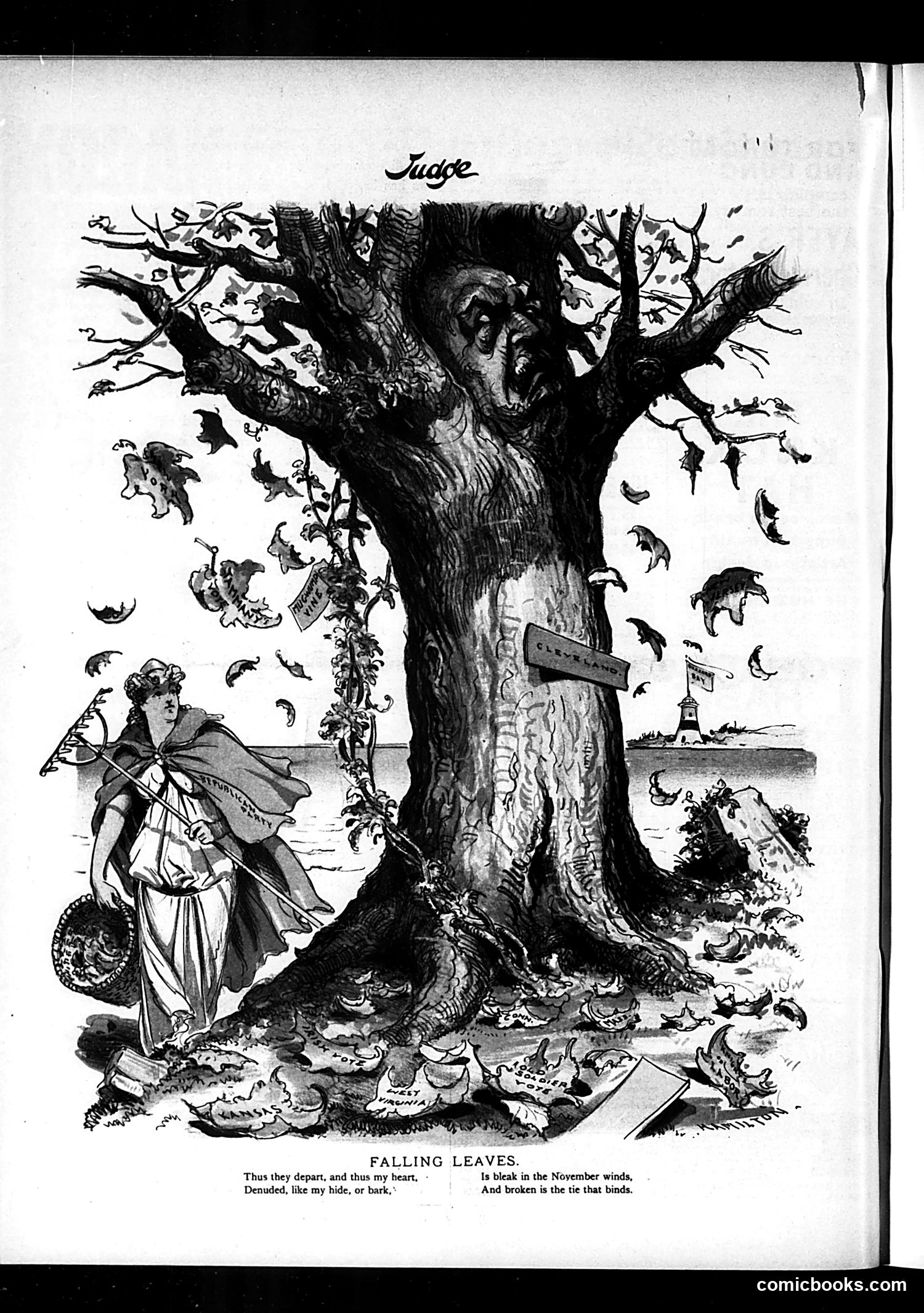
This allegorical cartoon depicts **Lady Justice** (identifiable by her classical robes and scales) standing beside a massive, decaying tree shedding its leaves. The falling leaves appear to represent departing supporters or allies, with various figures tumbling away. The accompanying verse uses the tree as metaphor for heartbreak and loss—"my heart, Denuded, like my hide, or bark" and "the tie that binds" is broken. The November setting reinforces themes of decline and abandonment. Without the publication date visible, the precise political reference remains unclear. However, this likely satirizes a **specific political figure or administration experiencing significant loss of support**—whether through electoral defeat, scandal, or defection of allies. The personification of Justice witnessing this decline suggests commentary on governmental or judicial corruption or failure.