
Judge, 1892-11-05 · page 5 of 16
Judge — November 5, 1892 — page 5: what you’re looking at
What you’re looking at
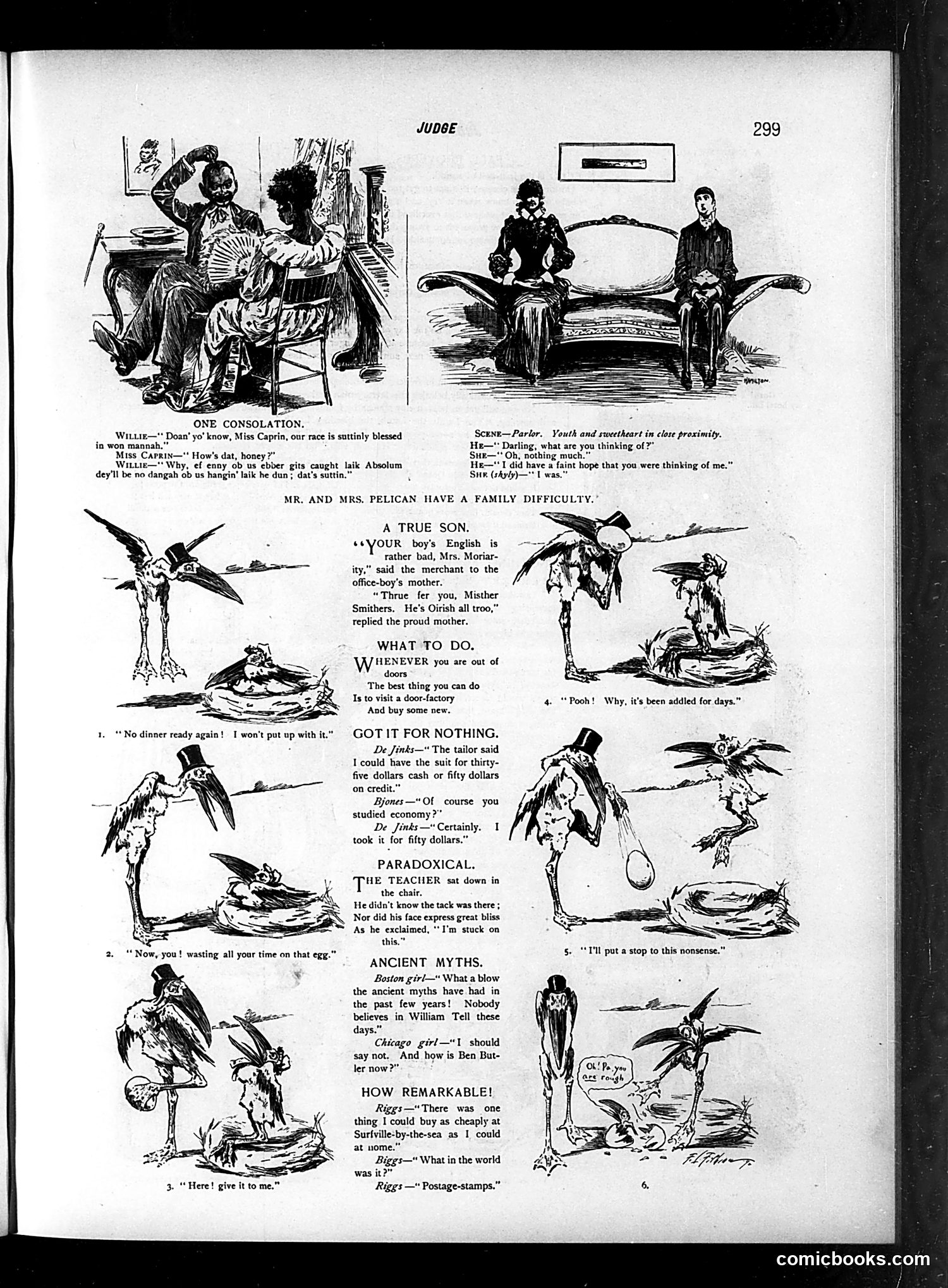
This page contains multiple brief humorous sketches typical of 1880s-90s satirical magazines: **"One Consolation"** mocks racist stereotypes through dialect humor about enslaved people. **"A True Son"** jokes about Irish immigrants, presenting the mother's pride in her son's poor English as absurdly backwards patriotism. **"Pelican Family Difficulty"** appears to be a visual joke using bird illustrations rather than human figures. **The remaining sketches** are light domestic humor: a young couple's flirtation, puns about door factories and tacks, and jokes about tailors and postage stamps. The cartoons reflect period attitudes—casual ethnic stereotyping and class humor were standard in Judge. Most rely on simple wordplay or situation comedy rather than political commentary. The page represents mainstream American humor of the era, which modern readers would find offensive in its stereotyping while finding the puns relatively innocuous.
📄 Transcribed text from this page (OCR, searchable)
Machine-transcribed from the original scan — historical spelling and the odd misread are preserved.
ONE CONSOLATION. * Doan’ yo' know, Miss Caprin, our race is suttinly blessed Scenz—Parlor. Youth and sweetheart in close proximity. in won mannah, He—" Darling, what are you thinking of ?” Miss Carrin—*' How's dat, honey ?” Suz—** Oh, nothing much.” Wittie—"* Why, ef enny ob us ebber gits caught laik Absolum He—"'I did have a faint hope that you were thinking of me.” dey'll be no dangah ob us hangin’ laik he dun ; dat's suttin.”” f Sue. (shyly)—"* 1 was.” MR. AND MRS, PELICAN HAVE A FAMILY DIFFICULTY.” A TRUE SON. S6YOUR boy's English is rather bad, Mrs. Moriar- ity,” said the merchant to the office-boy’s mother. “Thrue fer you, Misther Smithers. He's Oirish all troo,” replied the proud mother. WHAT TO DO. WHENEVER you are out of doors The best thing you can do Is to visit a door-factory And buy some new. GOT IT FOR NOTHING. De Jinks—" The tailor said I could have the suit for thirty- five dollars cash or fifty dollars on credit.” Bjones—“ Ot course you studied economy?” De Jinks —"Certainly. 1 took it for fifty dollars.” PARADOXICAL, HE TEACHER sat down in the chair. He didn’t know the tack was there ; Nor did his face express great bliss As he exclaimed, ** I'm stuck on this.” ANCIENT MYTHS. Boston girl—" What a blow the ancient myths have had in the past few years! Nobody believes in William Tell these days.” Chicago girl—1 should say not. And how is Ben But- ler now?” 2 HOW REMARKABLE! Riggs—“There was one thing I could buy as cheaply at Surfville-by-the-sea as 1 could at nome.” Biggs—" What in the world Ss was it?” 3. ‘Here! give it to me.” Riggs —" Postage-stamps.” comicbooks.com