
Judge, 1892-11-05 · page 2 of 16
Judge — November 5, 1892 — page 2: what you’re looking at
What you’re looking at
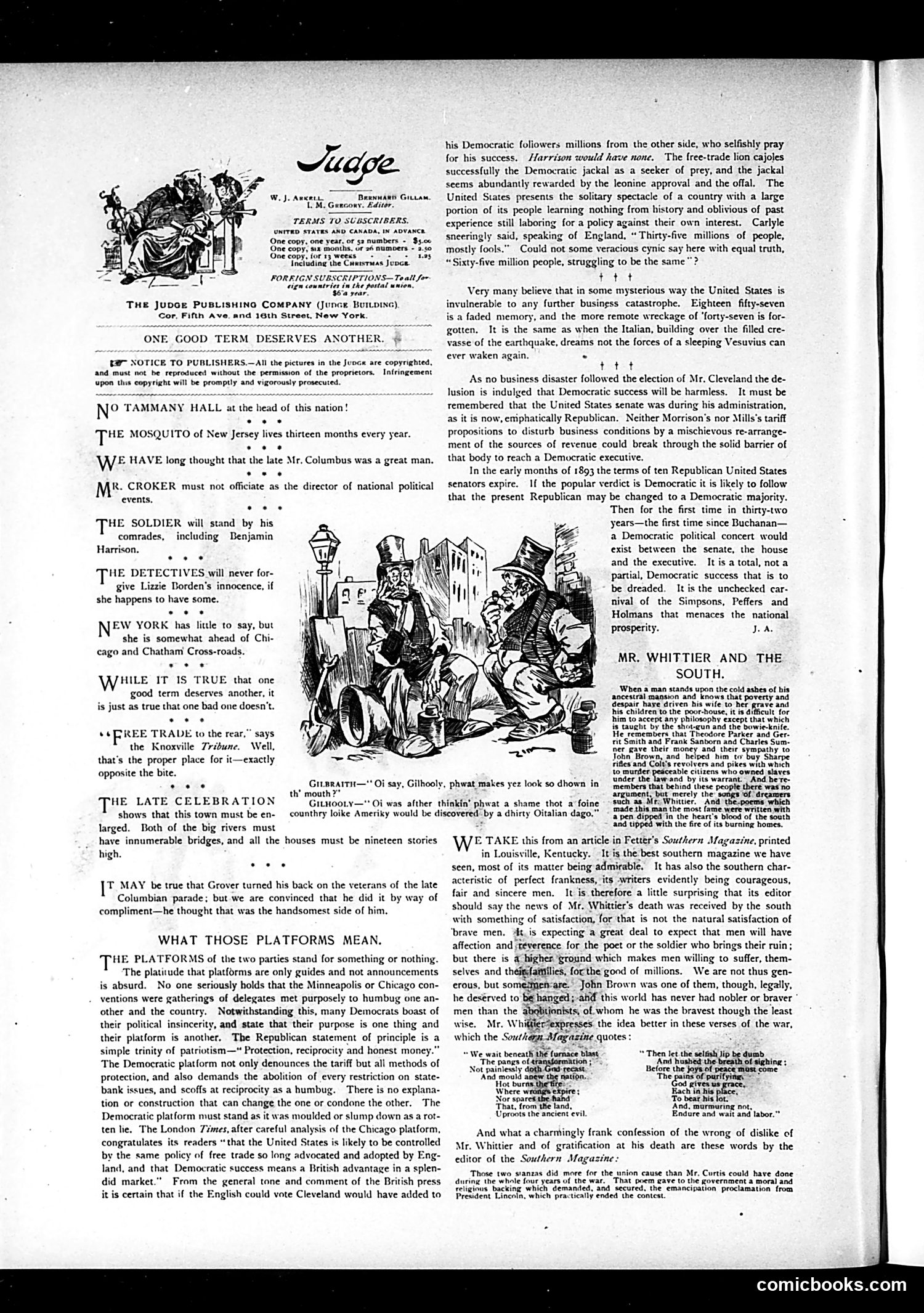
This page contains political commentary from Judge magazine during the Cleveland administration era. The main cartoon depicts urban chaos—figures in disheveled dress amid a cityscape, likely satirizing Democratic governance or urban mismanagement. The accompanying text criticizes Democratic politics and Cleveland specifically. It references failed Democratic policies, disputes with the Republican Senate, and suggests Democratic success threatens national stability. One section mocks Mr. Whittier and Southern Democrats, quoting a Southern Magazine article criticizing Whittier's death coverage as hypocritical—claiming the South praised him only after death despite prior animosity. The satire attacks Democratic credibility on tariffs, trade policy, and sectional politics, presenting Republicans as defenders of national prosperity. The overall message: Democratic rule produces disorder and fails economically.
📄 Transcribed text from this page (OCR, searchable)
Machine-transcribed from the original scan — historical spelling and the odd misread are preserved.
TERMS TO SUBSCRIBERS. UNITRD STATES AND CAKADA, IN ADVANCE One copy, one year. or s2 numbers ‘One copy, six months. of 26 num! One copy, for 13 weexs + = Incliding the Cwerstsas Jupce. FORFIGN. ign THE JuDoe PUBLISHING COMPANY (JuncE BUILDING). Cor, Fifth Ave. and 16th Street, New York. {2 NOTICE TO PUBLISHERS.—AII the pictures in the Juoce are copyrighted, And must not be reproduced without the permission of the proprietors. Infringement upon this copyright will be promptly and vigorously prosecuted. N° TAMMANY HALL at the head of this nation! THE MOSQUITO of New Jersey ive Dineen sera every year. WE HAVE long thought teats ine dire Colaibus eis'e great man. R. CROKER must not officiate as the director of national political events. THE SOLDIER will stand by his comrades, including Benjamin Harrison. THE DETECTIVES will never for- give Lizzie Borden's innocence, if she happens to have some. EW YORK has little to say, but she is somewhat ahead of Chi- cago and Chatham Cross-roads. WHILE IT IS TRUE that one good term deserves another, it is just as true that one bad one doesn’t. +4 BREE TRADE to the rear,” says the Knoxville 7ridune. Well, that’s the proper place for it—exactly opposite the bite. see HE LATE CELEBRATION shows that this town must be en- larged. Both of the big rivers must have innumerable bridges, and all the houses must be nineteen stories high. Grneartit—" Oi say, th’ mouth?” [7 MAY be true that Grover turned his back on the veterans of the late Columbian parade; but we are convinced that he did it by way of compliment—he thought that was the handsomest side of him. WHAT THOSE PLATFORMS MEAN. HE PLATFORMS of the two parties stand for something or nothing. The platitude that platforms are only guides and not announcements is absurd. No one seriously holds that the Minneapolis or Chicago con- ventions were gatherings of delegates met purposely to humbug one an- other and the country. Notwithstanding this, many Democrats boast of their political insincerity, and state that their purpose is one thing and their platform is another, The Republican statement of principle is a simple trinity of patriotism—" Protection, reciprocity and honest money.” ‘The Democratic platform not only denounces the tariff but all methods of protection, and also demands the abolition of every restriction on state- bank issues, and scoffs at reciprocity as a humbug. There is no explana- tion or construction that can change the one or condone the other. The Democratic platform must stand as it was moulded or slump down as a rot- ten lie, The London 7#mes, after careful analysis of the Chicago platform, congratulates its readers “that the United States is likely to be controlled by the same policy of free trade so long advocated and adopted by Eng- land, and that Democratic success means a British advantage in a splen- did market.” From the general tone and comment of the British press it is certain that if the English could vote Cleveland would have added to ilhooly, phwat makes yez look so dhown in GILHooLy—"* Oi was afther thinkin’ phwat a shame thot a°foine counthry loike Ameriky would be discovered’ by a dhirty Oitalian dago.” his Democratic foliowers millions from the other side, who selfishly pray for his success. Harrison would have none. The free-trade lion cajoles successfully the Democratic jackal as a seeker of prey, and the jackal seems abundantly rewarded by the leonine approval and the offal. The United States presents the solitary spectacle of a country with a large portion of its people learning nothing from history and oblivious of past experience still laboring for a policy against their own interest. Carlyle sneeringly speaking of England, “Thirty-five millions of people, mostly fools.” Could not some veracious cynic say here with equal truth, ixty-five million people, struggling to be the same”? ttt Very many believe that in some mysterious way the United States is invulnerable to any further busingss catastrophe. Eighteen fifty-seven is a faded memory, and the more remote wreckage of ‘forty-seven is for- gotten, It is the same as when the Italian, building over the filled cre- vasse of the earthquake, dreams not the forces of a sleeping Vesuvius can ever waken again. 3S tetat As no business disaster followed the election of Mr. Cleveland the de- lusion is indulged that Democratic success will be harmless. It must be remembered that the United States senate was during his administration, as it is now, eniphatically Republican. Neither Morrison's nor Mills’s tariff propositions to disturb business conditions by a mischievous re-arrange- ment of the sources of revenue could break through the solid barrier of that body to reach a Democratic executive. In the early months of 1893 the terms of ten Republican United States senators expire. If the popular verdict is Democratic it is likely to follow that the present Republican may be changed to a Democratic majority. Then for the first time in thirty-two. years—the first time since Buchanan— a Democratic political concert would exist between the senate, the house and the executive. It is a total, not a partial, Democratic success that is to be dreaded. It is the unchecked car- nival of the Simpsons, Peffers and Holmans that menaces the national prosperity. JA MR. WHITTIER AND THE SOUTH. ‘When a man stands upon the cold ashes of bis ancestral mansion and knows that poverty and despair haye driven his wife to her grave and his children to the poor-house, it is difficult for him to accept any philosophy except that which is taught by the shot-gun and the Dowie-knife. He remembers that Theodore Parker and Ger- rit Smith and Frank Sanborn and Charles Sum- her gave their money and their sympathy to John Brown, and helped him to buy Sharpe rifles and Coit’s revolvers and pikes with which to murter pedceable citizens who owned slaves under the law.and by its warrant. And bere- members that behind these people there was no argument, but merely the: songs ‘of. dreamers such as Mr Whittier. And the. ‘which made this man the most fame were written with pen dipped in the heart's blood of the south and tipped with the fire of its burning homes. WE TAKE this from an article in Fetitr's Southern Magazine, printed in Louisville, Kentucky. It is the best southern magazine we have seen, most of its matter being admirable. It has also the southern char- acteristic of perfect frankness, its writers evidently being courageous, fair and sincere men. It is therefore a little surprising that its editor should say the news of Mr. Whittier's death was received by the south with something of satisfaction, for that is not the natural satisfaction of ‘brave men. At. is expecting a great deal to expect that men will have affection and teverence for the poet or the soldier who brings their ruin; but there is achigher ground which makes men willing to suffer, them- selves and théigefamtlies, forthe good of millions. We are not thus gen- erous, but somesen-are.” John Brown was one of them, though, legally, he desérved to behanged ; ah this world has never had nobler or braver * men than the abgbitionists; of. whom he was the bravest though the least wise. Mr. Whigtlerexpresses. the idea better in these verses of the war, which the Southern Magazine quotes : S © We wait beneath the furnace b The pangs of 4ransformation Not painlessly doth Gad: recast And mould apew the nation.. Hot burns Where e Nor spares ‘That, from the land, Upronts the ancient evil. And, murmuring not, Endure and wait and labor.” And what a charmingly frank confession of the wrong of dislike of Mr. Whittier and of gratification at his death are these words by the editor of the Southern Magazine: Those two sianzas did more for the union cause than Mr. Curtis could have done during the whole four years of the war. That poem eave to the government a moral and religious backing which demanded, and secured, the emancipation proclamation from President Lincoln, which practically ended the contest. comicbooks.com