
A complete issue · 16 pages · 1892
Judge — October 1, 1892
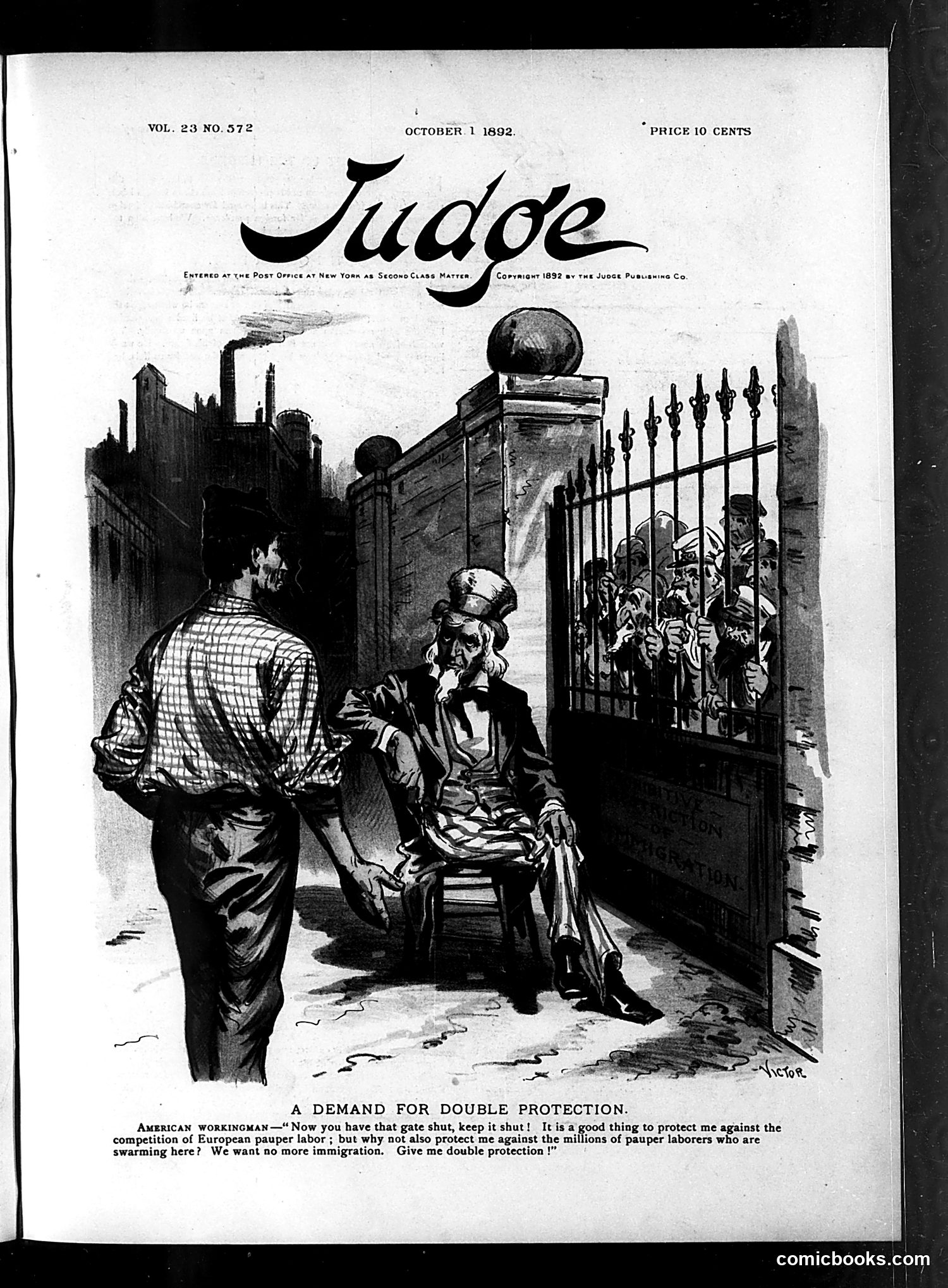
This cartoon satirizes nativist labor protectionism. An American workingman (identified by his checkered shirt) demands the factory gate be closed against European pauper laborers competing for jobs. However, the cartoon's central joke critiques the contradiction in his position: he wants tariff protection against imported *goods*, yet simultaneously demands immigration restriction against imported *workers*. The caption's ironic tone—"It is a good thing to protect me against the competition of European pauper labor; but why not also protect me against the millions of pauper laborers who are swarming here?"—exposes the hypocrisy of selective protectionism. The workingman seeks "double protection" yet ignores that existing immigration already undercuts his wages, making his demands internally inconsistent.
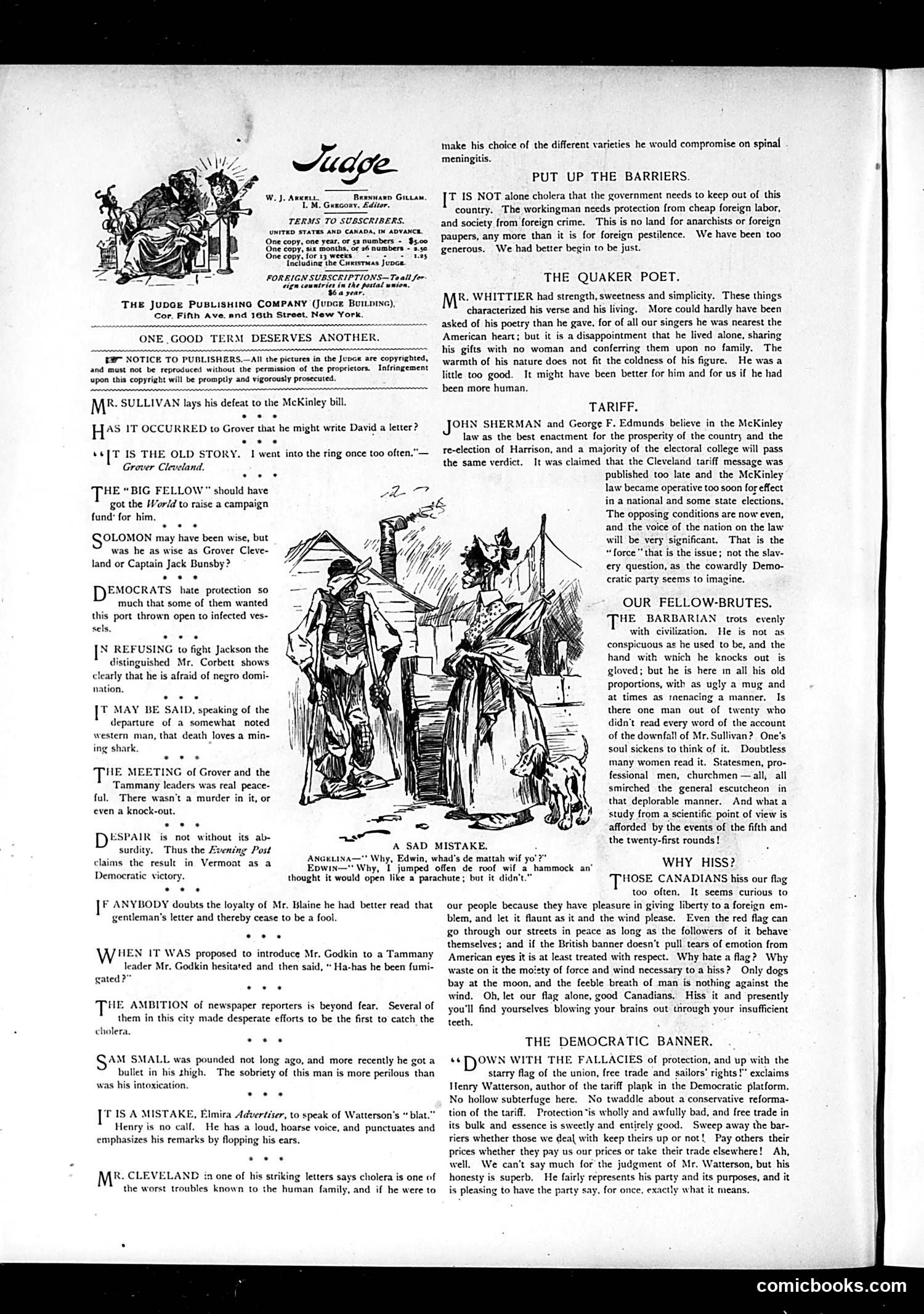
This page contains political commentary from Judge magazine, likely from the 1890s. The main cartoon depicts what appears to be a confrontation at a port or fortification, illustrating an article titled "PUT UP THE BARRIERS" discussing keeping foreign threats out of America. The text sections mock various Democratic political figures and positions, including references to Cleveland, Grover (likely Grover Cleveland), and debates over tariffs and trade policy. "The Quaker Poet" criticizes a poet's lack of engagement with real-world issues. "Our Fellow-Brutes" appears to satirize violent or uncivilized behavior, while "Why Hiss?" defends the British flag against what the text calls Canadian mockery. The overall theme suggests Republican/conservative criticism of Democratic economic and foreign policies during the Gilded Age era.
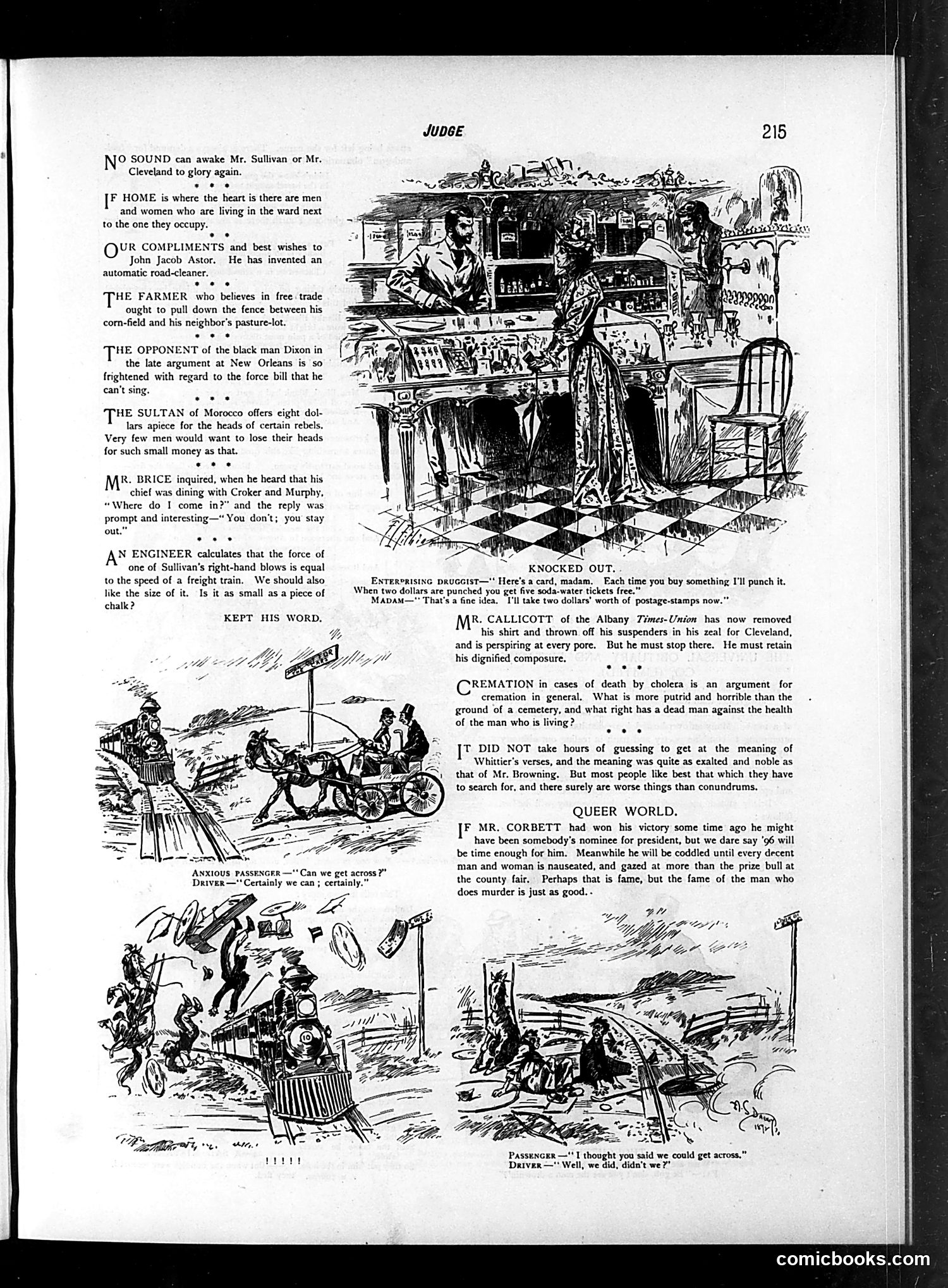
This page from *Judge* magazine contains several brief satirical commentary pieces alongside illustrations. The main cartoon titled "KNOCKED OUT" depicts a druggist selling soda-water tickets as a scheme—a jab at commercial deception. Other items mock various figures: Sullivan and Cleveland (likely political references), a farmer advocating fence removal between properties, a Moroccan sultan offering money for rebels' heads, and Jacob Astor's invented "automatic coal-feeder." A piece titled "QUEER WORLD" questions whether Corbett's potential presidential candidacy would be appropriate given his involvement in murder cases, suggesting contemporary debate about a boxer's (likely James J. Corbett) fitness for office. The cartoons employ exaggeration and irony to critique commercial fraud, political ambitions of celebrities, and social hypocrisy of the era.
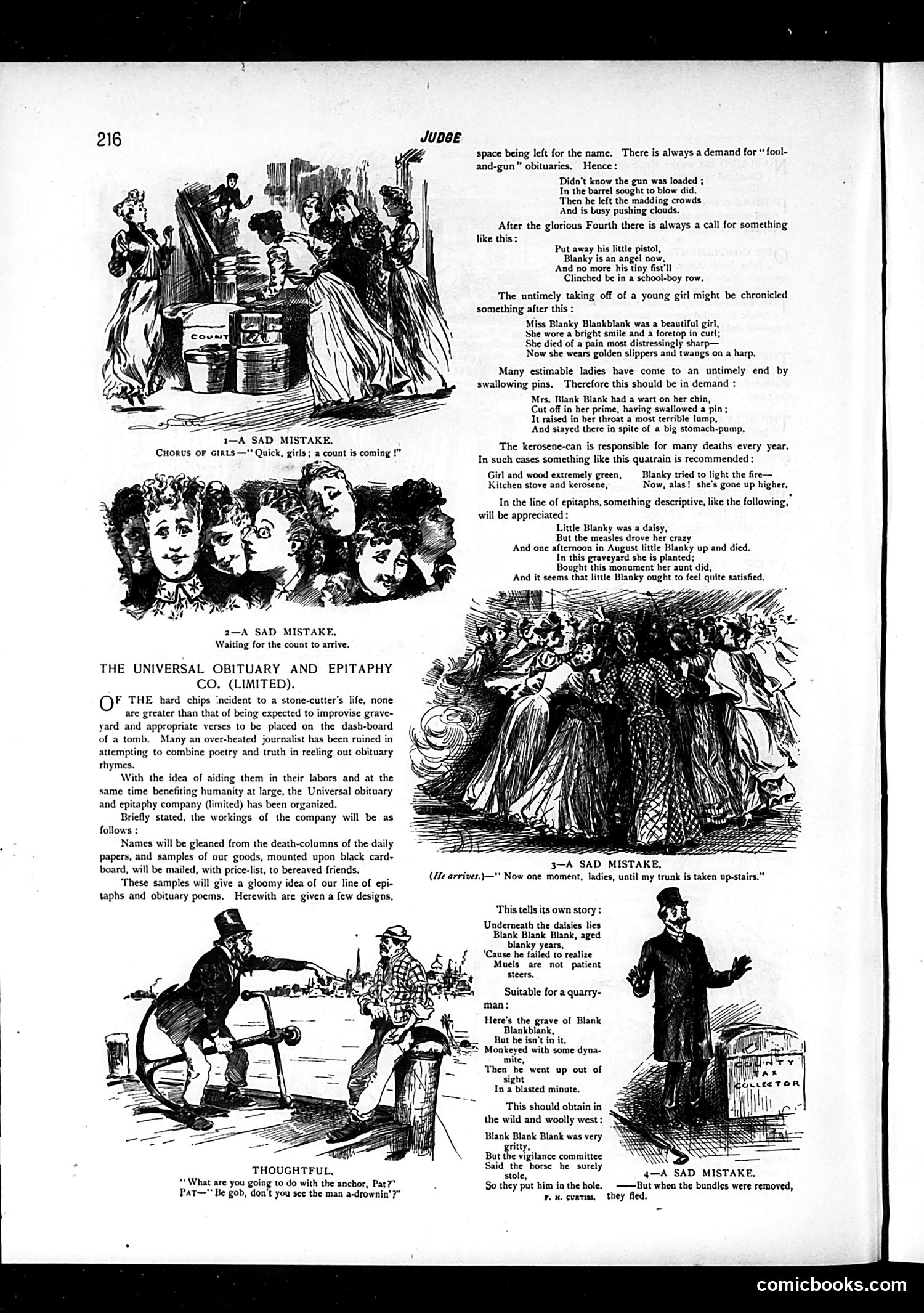
This page satirizes Victorian-era social anxieties through two main features: **"A Sad Mistake" cartoons** mock courtship rituals. Young women anticipate a visiting "count," but he arrives to find his trunk still needs carrying upstairs—deflating romantic expectations with practical embarrassment. **"The Universal Obituary and Epitaphy Co."** parodies the era's morbid fascination with elaborate memorial verses. The company offers pre-printed epitaph templates for bereaved families, with darkly comic examples addressing common death causes: accidental gun discharge, kerosene accidents, swallowed pins, and (in the "wild and woolly west") vigilante justice. The satire targets both the publishing industry's hack journalists forced to compose funeral poetry and middle-class pretension about commemorating the dead. By making death notices into mass-produced commodities with formulaic, often absurd verses, Judge ridicules Victorian sentimentality and commercialism around mortality. The Irish workman dialogue ("be gob") adds class commentary typical of period humor.
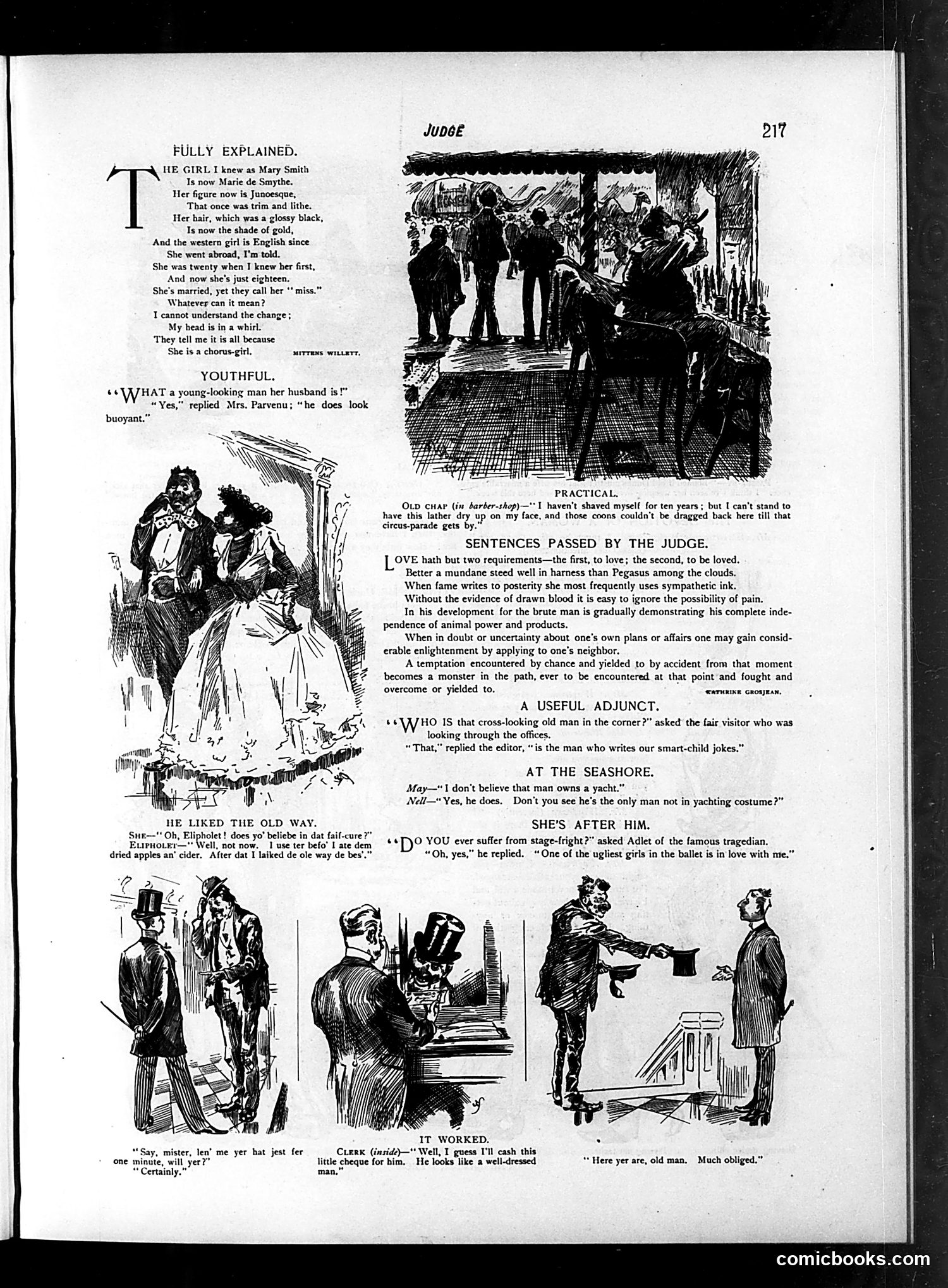
This page from *Judge* (likely late 1800s) contains several satirical sketches mocking social pretension and absurdity: **"Fully Explained"** ridicules American women who adopt affected European personas abroad—changing names from "Mary Smith" to "Marie de Smythe," claiming youth, and altering appearance—particularly targeting chorus girls seeking social elevation through European affectation. **"Youthful"** jokes that a man appears "buoyant" (lively) because he's nouveau riche and oblivious to how ridiculous he looks. **"The Old Way"** and **"He Liked the Old Way"** present rustic dialect humor common to period magazines, mocking rural speech patterns. **"Practical"** depicts a barber avoiding shaving because Black workers (derogatorily termed "coons") won't return until the circus leaves—reflecting period racial attitudes. The remaining pieces mock vanity, stage fright, and yachting pretension. The overall tone targets social climbers, affected elites, and cultural posturing typical of *Judge's* satirical approach to Gilded Age society.
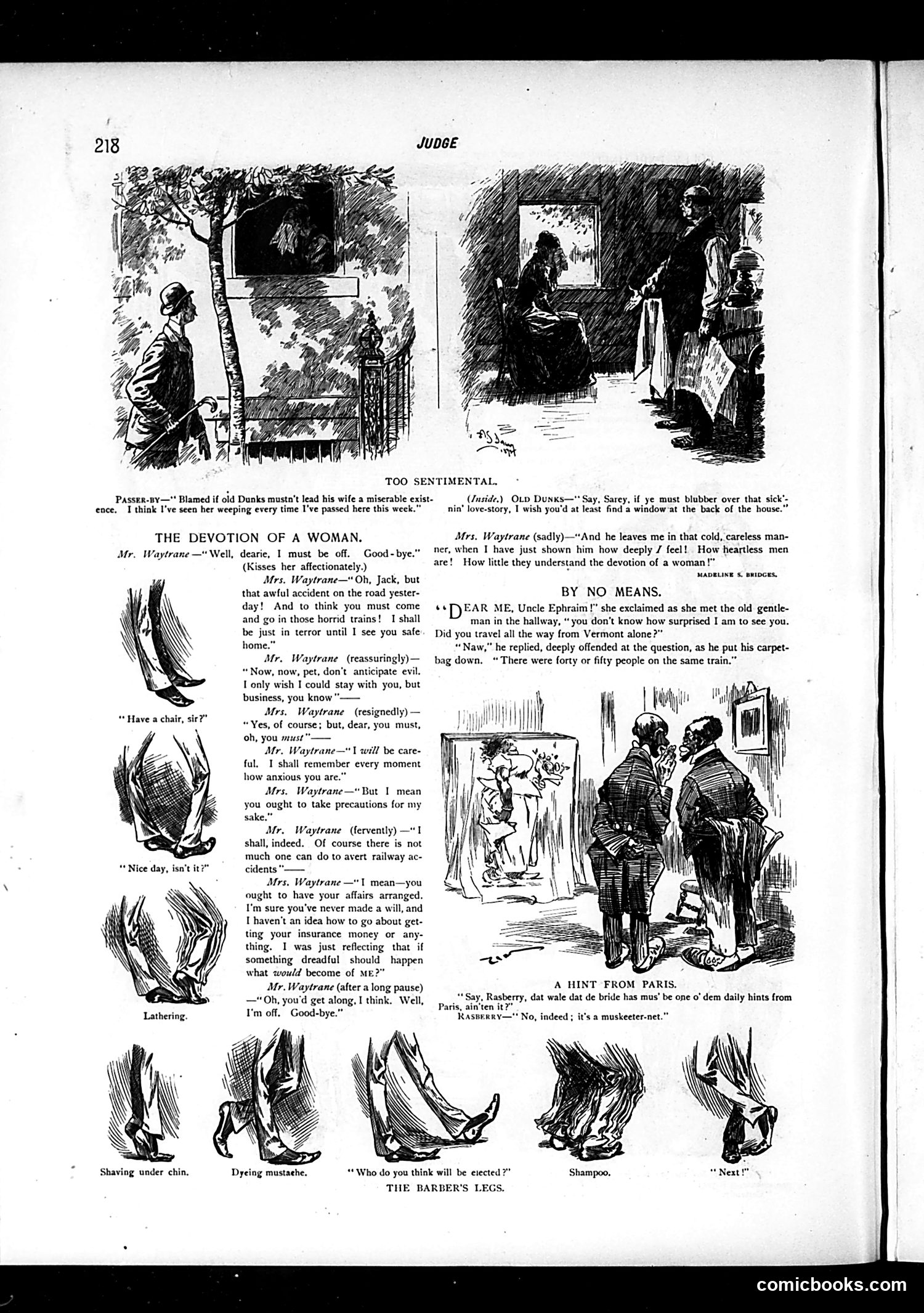
This page contains multiple Victorian-era satirical sketches mocking domestic and social pretenses: **"The Devotion of a Woman"** ridicules wives who emotionally manipulate husbands with anxiety about train accidents, then reveal their real concern: arranging wills to access insurance money. The humor targets supposedly selfless female devotion as actually mercenary. **"Too Sentimental"** mocks a woman weeping over a sentimental novel indoors while her husband complains she's making a public spectacle of emotion. **"By No Means"** plays on an old man's defensive pride about traveling alone—he reframes it by claiming forty or fifty others were on the same train, exposing human vanity. **"A Hint from Paris"** uses dialect humor about a bride's veil, with a pun suggesting it's actually a mosquito net (possibly satirizing French fashion affectations). **"The Barber's Legs"** is a humorous visual series of leg positions during barbershop grooming. These sketches reflect late 19th-century attitudes: skepticism toward female emotional expression, class-conscious dialect comedy, and gentle mockery of human pretension and vanity.
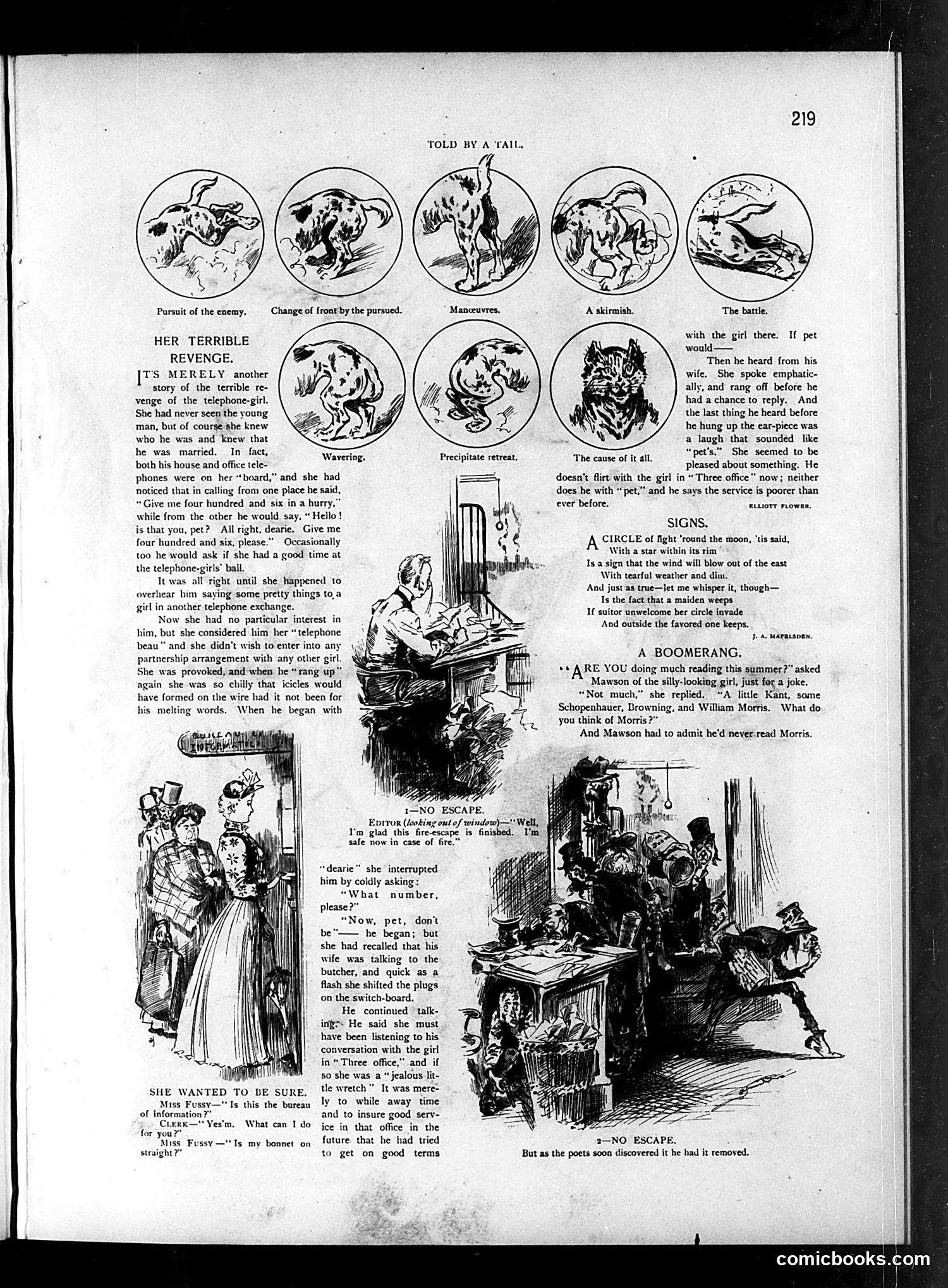
This page satirizes the power dynamics of telephone operators in early 20th-century America. The main story, "Her Terrible Revenge," depicts a female telephone operator who overhears a married man's flirtations with another woman. Though she has no personal stake ("she was provoked"), she weaponizes her control of the telephone switchboard—literally cutting off his calls and connecting him to his wife at an opportune moment. The joke exposes how telephone operators, predominantly young women working as intermediaries for all communication, wielded surprising social power. By monitoring conversations and controlling connections, this "telephone girl" orchestrates consequences the man cannot escape. The circular vignettes at top ("Pursuit," "Maneuvers," "Battle") humorously illustrate the escalating conflict using military metaphors, treating domestic telephone drama as warfare. The secondary jokes ("Signs," "A Boomerang") are unrelated brief gags about courtship and literary pretension.
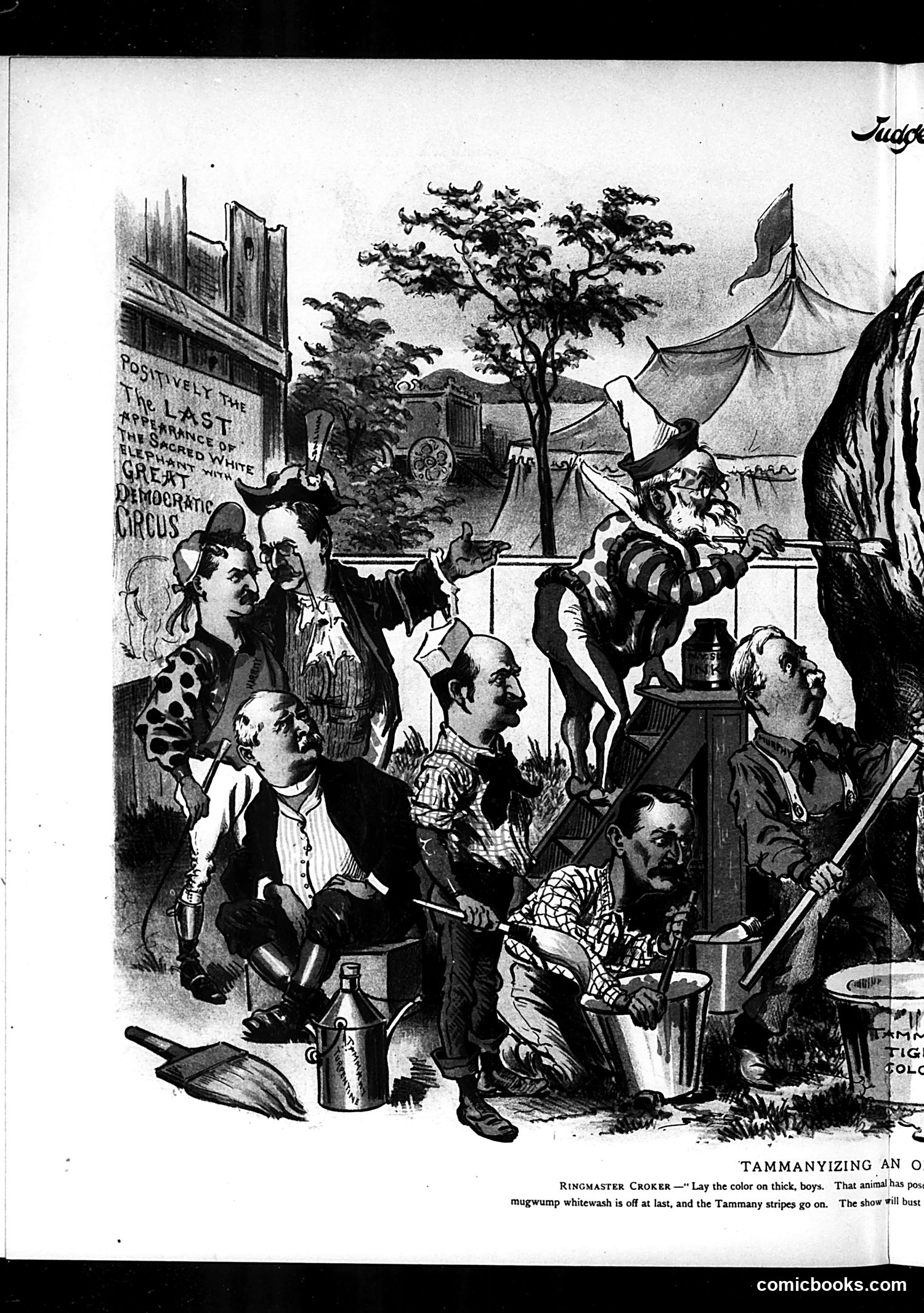
This political cartoon satirizes **Tammany Hall**, New York's infamous Democratic political machine. The caption references "Ringmaster Croker"—likely **Richard Croker**, Tammany's leader—who is depicted as a circus ringmaster "tammanyizing" (corrupting) what appears to be a donkey or similar animal. The satire suggests Tammany is repainting or rebranding something (possibly a political candidate or the organization itself) with "Tammany stripes," removing "mugwump whitewash" (cosmetic reformist veneer). The circus metaphor criticizes Tammany as theatrical and deceptive. The cartoon mocks the machine's ability to strip away reform pretenses and reassert its characteristic corruption and partisan control. This reflects late 19th-century reformist criticism of Tammany Hall's notorious patronage system and political manipulation.
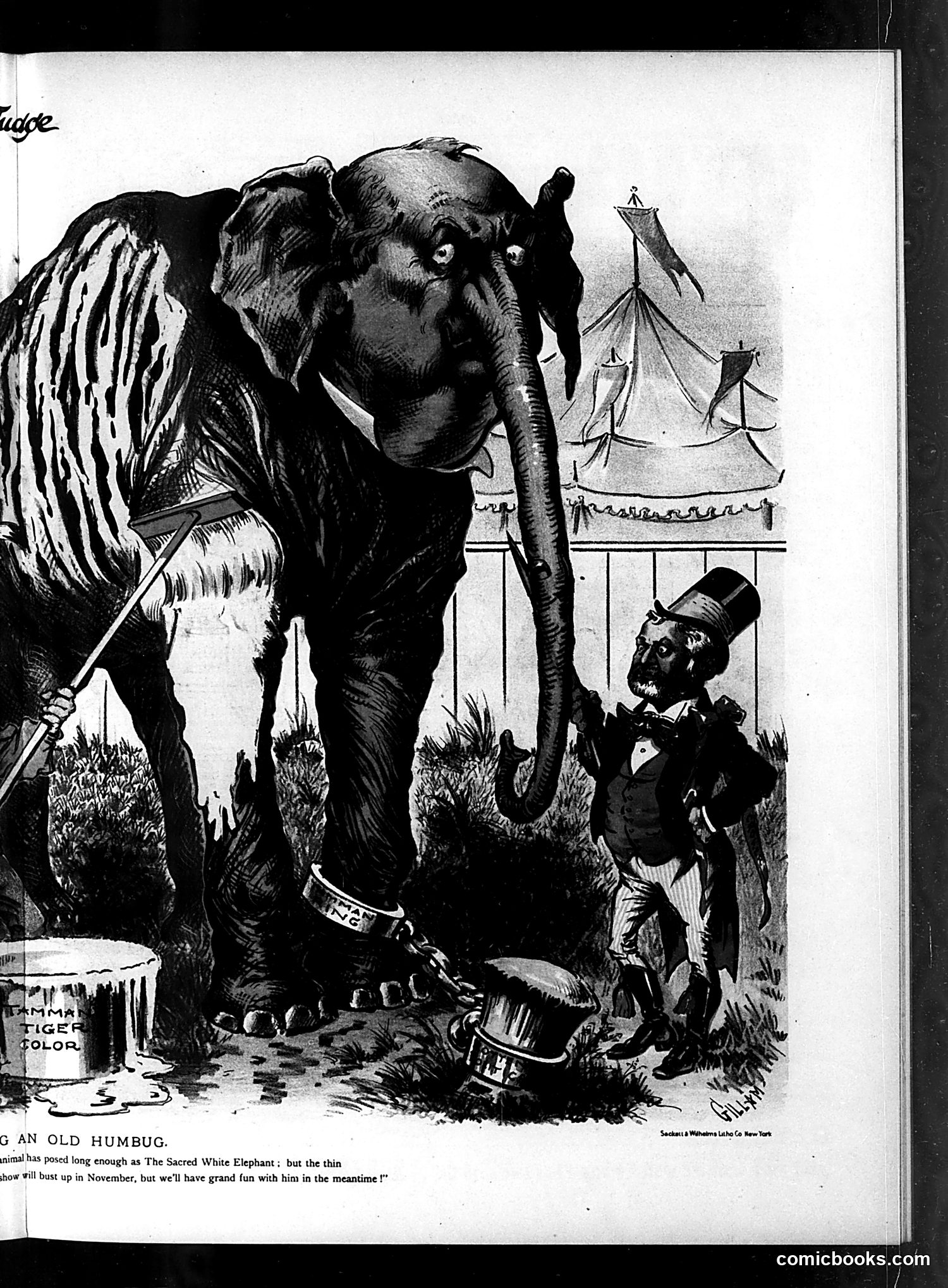
This Judge cartoon depicts a large elephant (representing the Republican Party) with a well-dressed ringmaster or circus operator beside it. The caption references "The Sacred White Elephant" and mentions something "busting up in November" with "grand fun" beforehand. The satire mocks a political figure or administration as a circus act—a fraud ("humbug") that's worn out its welcome. The elephant, traditionally the Republican symbol, is portrayed as managed/controlled by a manipulative showman. The November reference likely indicates an upcoming election where voters will finally reject this "act." Without a visible date, the specific political target remains unclear, though the cartoon criticizes Republican leadership as theatrical deception masquerading as legitimate governance.
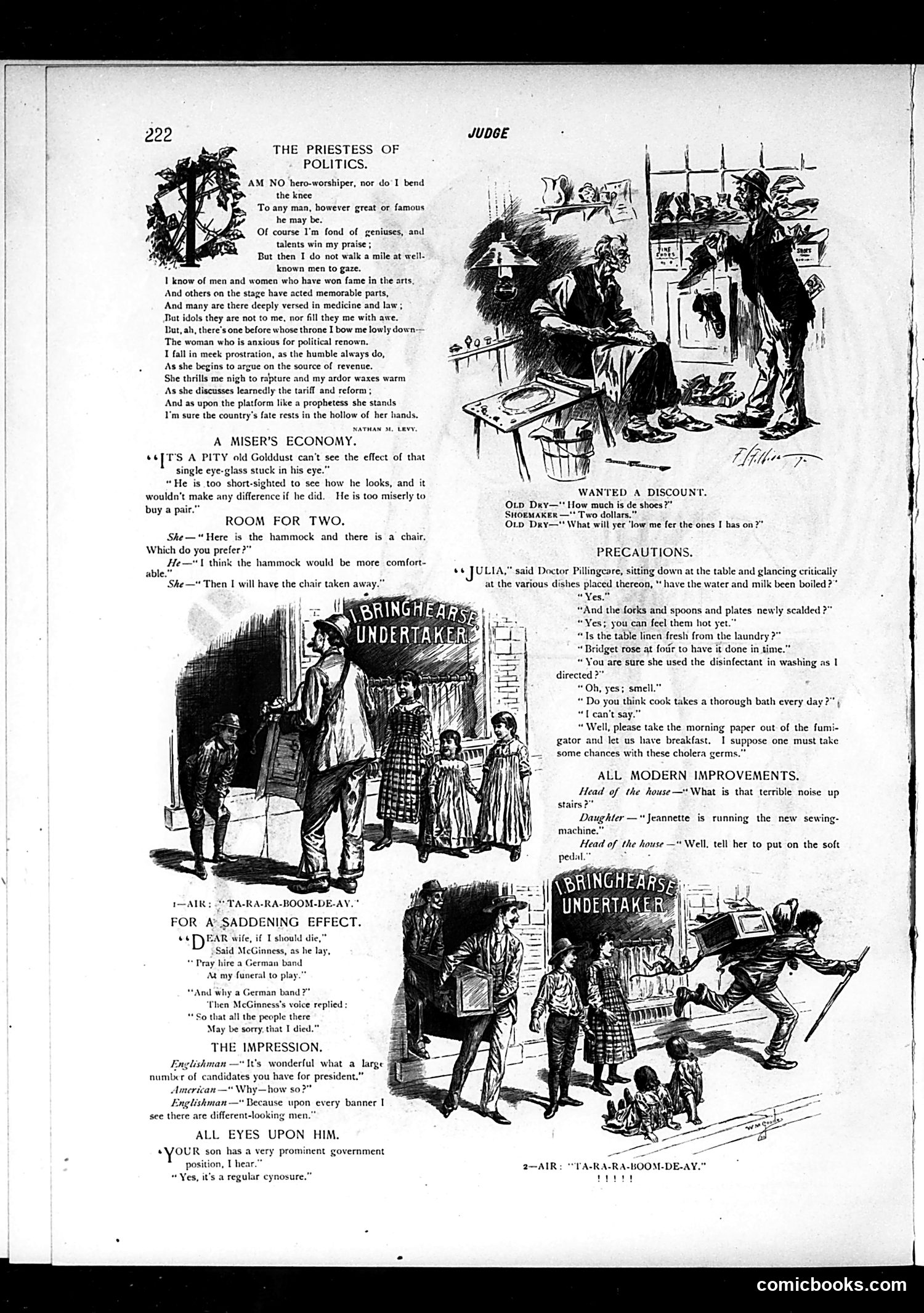
**"The Priestess of Politics"** mocks women's increasing political activism in the late 19th/early 20th century. The poem sarcastically elevates women concerned with political reform—tariffs, revenue, and platform speaking—to near-religious status, suggesting such involvement is absurdly pretentious for women who should know their place. **The remaining items are unrelated humor:** - **"A Miser's Economy"**: A cheapskate won't buy proper eyeglasses - **"Room for Two"**: A woman manipulatively removes a chair rather than share a hammock - **Undertaker cartoons**: Visual gags about a funeral business - **"The Impression"**: A British visitor mistakes different political candidates on banners for separate men - **"Precautions"**: A doctor obsesses over hygiene (boiled water, sterilized dishes, disinfectant) yet accepts cholera risk from breakfast newspaper—mocking excessive but selective concern with sanitation - **"All Modern Improvements"**: A sewing machine's noise disturbs the household—satirizing new technology's disruption The page reflects period anxieties about women's suffrage and changing social roles.
This is primarily an **advertising page** from Judge magazine, with one small satirical item at the top. The sole cartoon/joke is a brief editorial squib about **simplified spelling reform**. A sub-editor presents an article favoring simplified English spelling, written by someone named "Smythe"—but the humor lies in the irony that the author's own name is spelled in the old-fashioned way (rather than "Smith"). This mocks the contradiction of advocating spelling simplification while using archaic spelling oneself. The rest of the page is commercial advertising for consumer goods typical of the era: pianos, hats, patent medicines (complexion powder, cough syrup), collars, watches, tobacco, and clothing tailoring services. There is also a humorous verse about disappointed ambitions (wanting to become president, settling for paying grocery bills). The page reflects late 19th-century American commerce and consumer culture rather than political satire.
This page is primarily **advertisements and brief satirical quips**, not a unified political cartoon. The few jokes target contemporary figures and practices: - **Cleveland and Hill** (Democratic politicians) are mocked for lacking hair—a personal insult suggesting they're worn-out or aging. - **Isaac Pusey Gray** (likely an Indiana politician) is ridiculed for building political enthusiasm "on the installment plan," having only reached the "barbecue stage"—suggesting he's slow or insincere in campaigning. - A jab at **Buzzard's Bay** (Massachusetts location associated with wealthy vacationers) jokes about fishing with "wrong bait," implying foolishness. Most content, however, consists of patent medicine ads (Beecham's Pills, Angostura Bitters), product advertisements (Baker's Cocoa, pianos, clothing), and personal services (weight loss treatments). This reflects *Judge*'s advertising-heavy business model and the era's unregulated medical advertising. The satire is light and fragmented rather than a cohesive political statement.
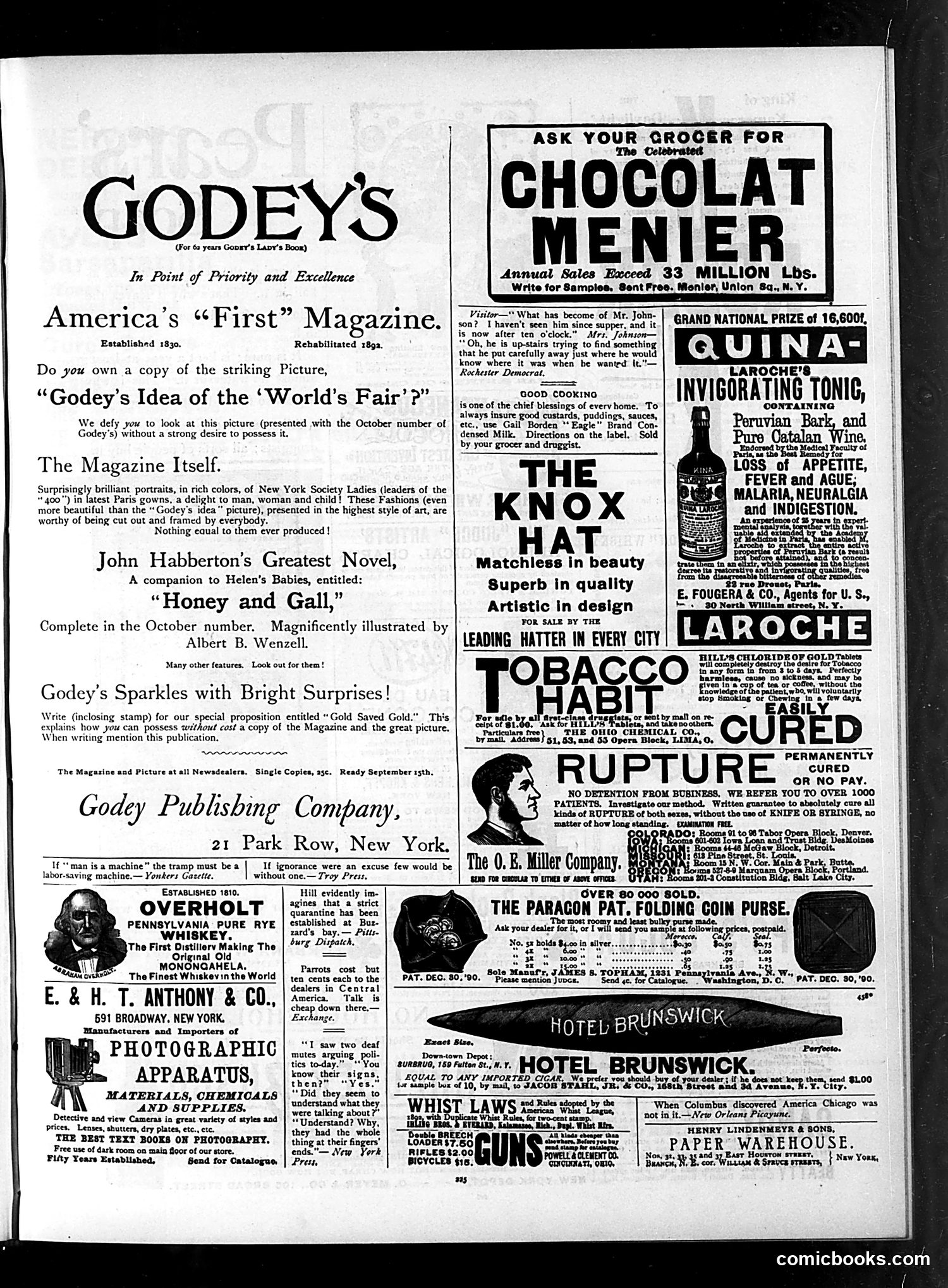
This page is primarily **advertising**, not political satire. It's from Judge magazine and consists almost entirely of period product advertisements (chocolate, whiskey, hats, rupture cures, photographic equipment) interspersed with promotional material for *Godey's* magazine itself. The few non-advertisement items are: - Brief humorous quips (about tramps being "labor-saving machines," ignorance as excuse) - A domestic joke about a husband hiding things so carefully he forgets where they are There are **no identifiable political cartoons or caricatures** on this page. The only illustration of a person is a profile sketch advertising rupture treatment—not satire. For modern readers: this reflects how 19th-century magazines monetized through dense advertising, and how humor was often confined to brief one-liners rather than visual satire. The page demonstrates period attitudes toward advertising (promoting alcohol, patent medicines for conditions like rupture without modern medical scrutiny).
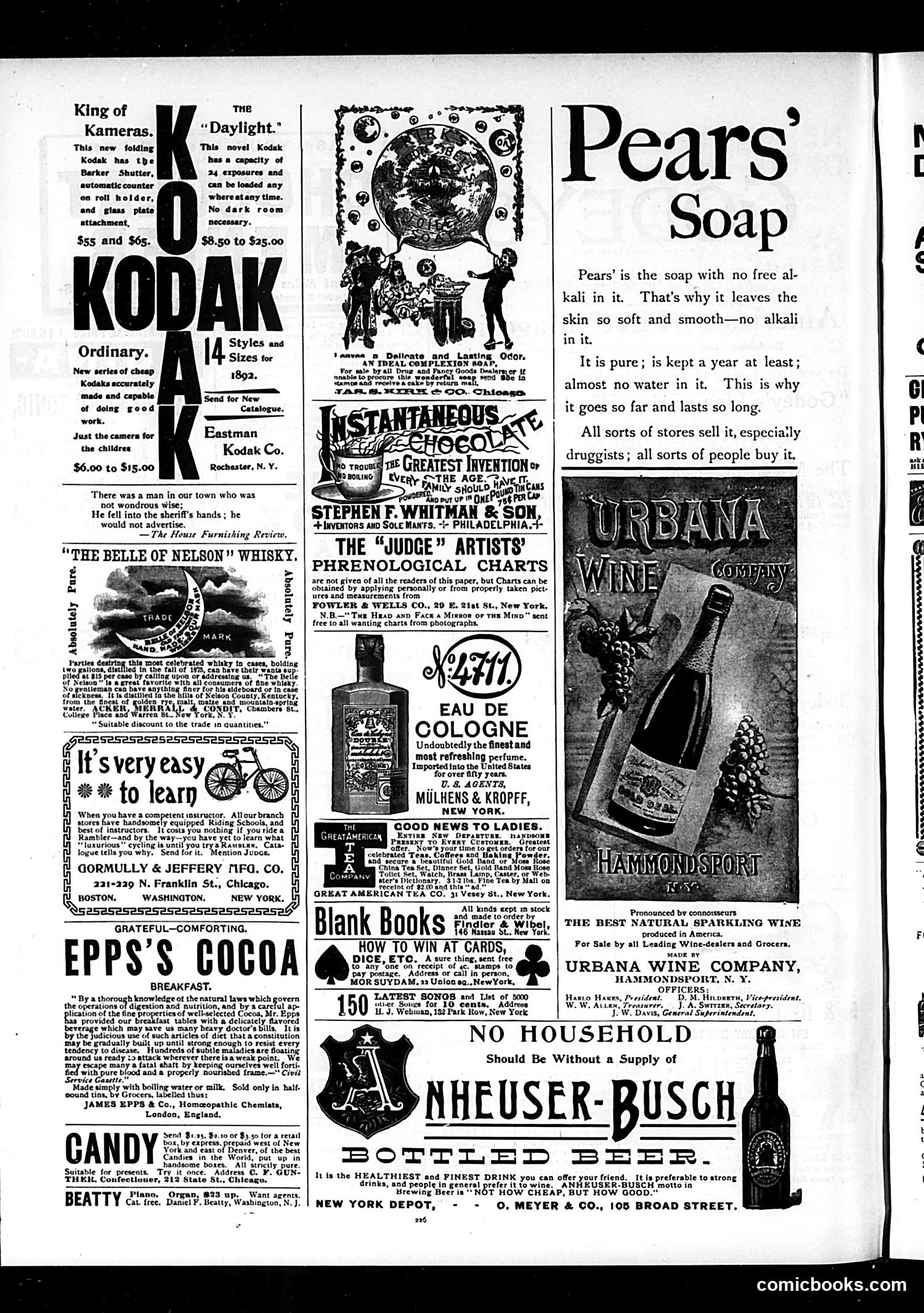
This is primarily an **advertising page** from Judge magazine (circa 1892, based on visible dates). Rather than political satire, it features commercial advertisements for diverse products: photography equipment (Kodak cameras), whiskey, bicycles (Ramblers), cocoa, soap, cologne, wine, beer, and various other goods. The only satirical content is a brief poem mocking a man who refuses to advertise his business, suggesting he'll end up in legal trouble—a meta-joke about advertising's importance, fitting for a magazine dependent on ad revenue. The "Judge Artists' Phrenological Charts" reference phrenology, a pseudoscientific practice popular in the 1890s claiming skull shape revealed character and ability. This was marketed as entertainment, though phrenology was already scientifically discredited by serious scholars. The page reflects late 19th-century consumer culture and advertising practices rather than political commentary.
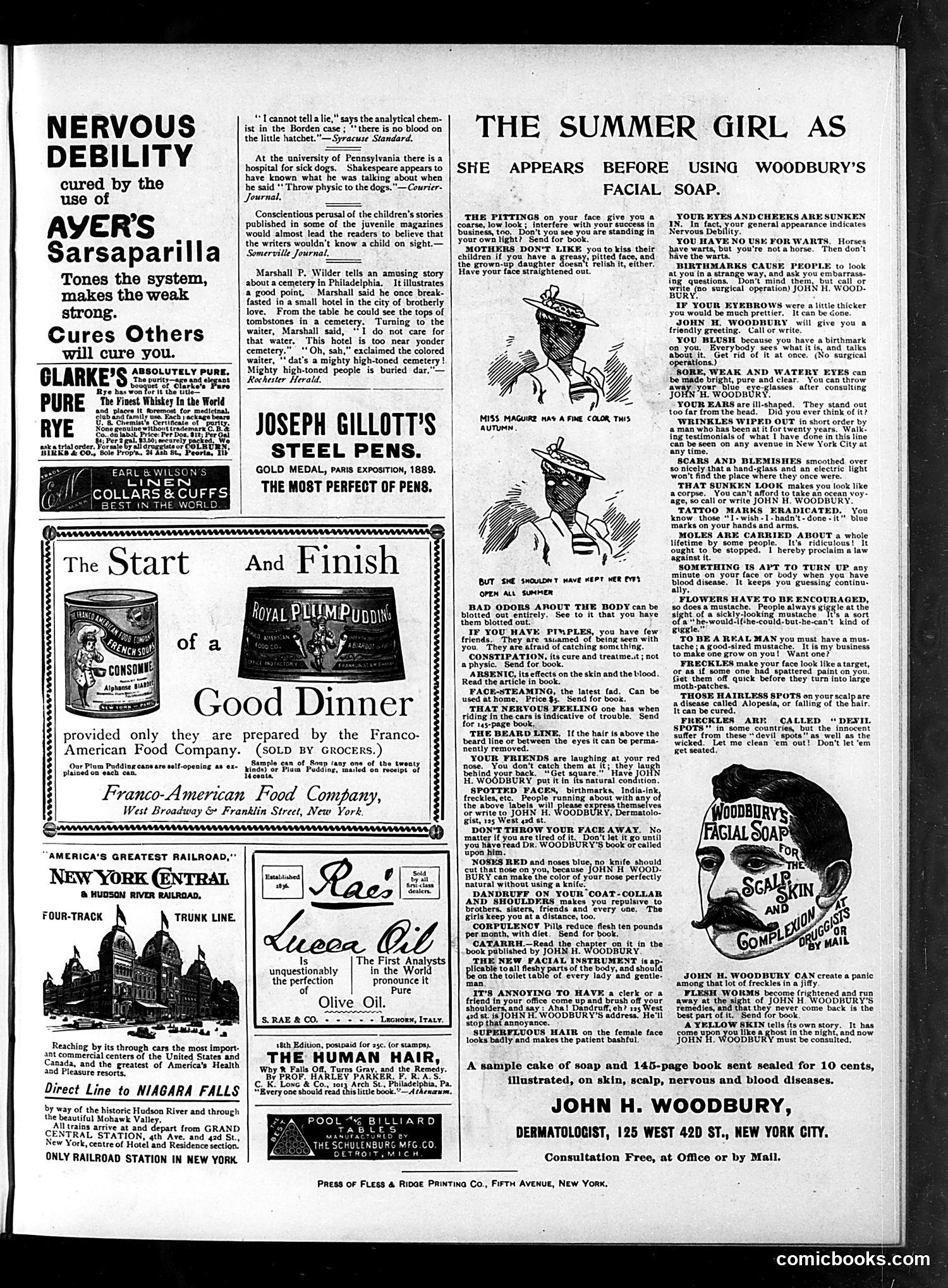
This page is primarily **advertising** with minimal satirical content. The cartoons on the right side illustrate Woodbury's Facial Soap marketing, showing a "summer girl" before and after using the product. The exaggerated before-image mocks female appearance—pitted skin, sunburn, and general neglect—while promising transformation through proper skincare. The satirical text blocks scattered throughout (about analytical chemists, dog hospitals, cemetery stories) are brief humor snippets typical of *Judge* magazine, poking fun at contemporary absurdities. The remainder is straightforward product advertising: patent medicines (Ayer's Sarsaparilla), pens, railroad services, and food products. The soap advertisement's implicit message reflects period beauty standards and class anxieties—suggesting that poor skin reflects moral or social failure, particularly for women.
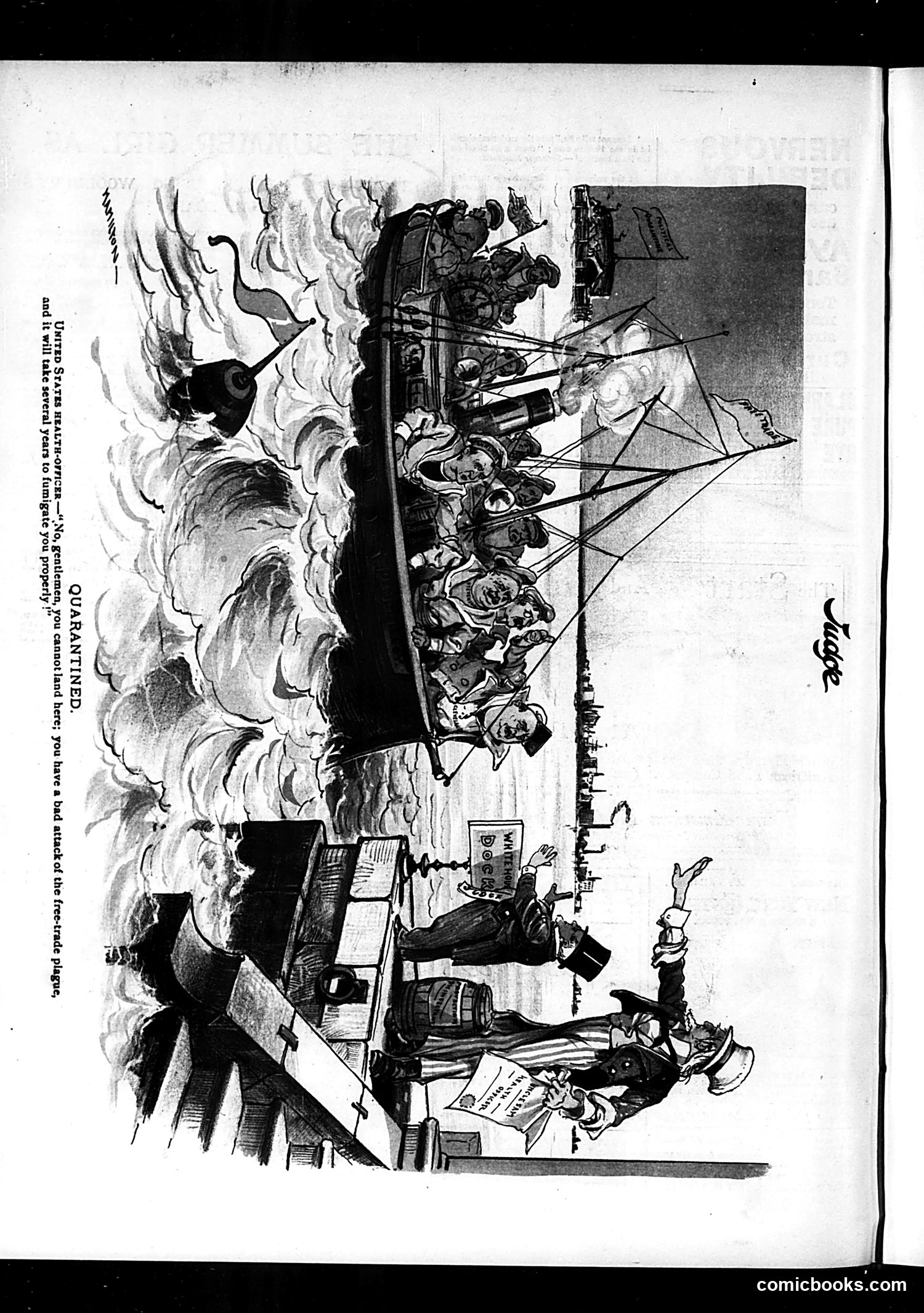
This is a protectionist trade cartoon satirizing free-trade advocacy. A U.S. Health Officer blocks a ship's passengers from landing, claiming they carry a "free-trade plague" requiring years of quarantine to cure. The cartoon represents **protectionist sentiment** — the belief that free trade harms American workers and industry. The figures on the ship appear to be **foreign traders or representatives** attempting to enter the U.S. market. By framing free trade as a disease requiring quarantine, Judge magazine mocks pro-free-trade advocates while supporting tariffs and trade restrictions to protect domestic American business. This reflects late-19th-century American political debates over tariff policy, when protectionists argued trade barriers safeguarded workers and manufacturers from foreign competition.