
Judge, 1892-10-01 · page 2 of 16
Judge — October 1, 1892 — page 2: what you’re looking at
What you’re looking at
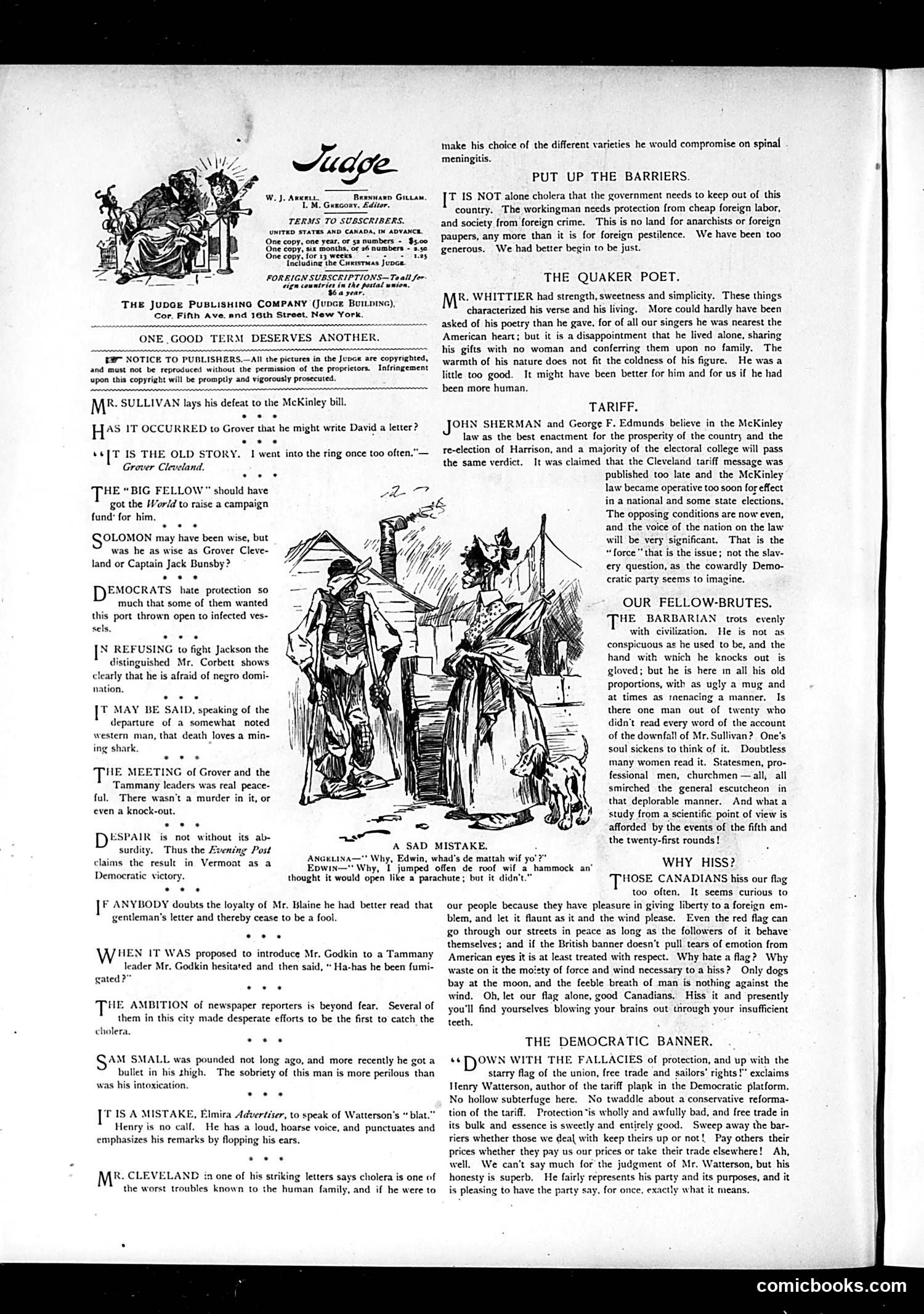
This page contains political commentary from Judge magazine, likely from the 1890s. The main cartoon depicts what appears to be a confrontation at a port or fortification, illustrating an article titled "PUT UP THE BARRIERS" discussing keeping foreign threats out of America. The text sections mock various Democratic political figures and positions, including references to Cleveland, Grover (likely Grover Cleveland), and debates over tariffs and trade policy. "The Quaker Poet" criticizes a poet's lack of engagement with real-world issues. "Our Fellow-Brutes" appears to satirize violent or uncivilized behavior, while "Why Hiss?" defends the British flag against what the text calls Canadian mockery. The overall theme suggests Republican/conservative criticism of Democratic economic and foreign policies during the Gilded Age era.
📄 Transcribed text from this page (OCR, searchable)
Machine-transcribed from the original scan — historical spelling and the odd misread are preserved.
W. J. Ament. Braxuaro Gittam, 1M. Gi Editor. TERMS TO SUBSCRIBERS. UNITED STATES AMD CAKADA, IN ADVANCE, One copy, one year. or s2 numbers - $5.00 One copy, six months, or 26 numbers - 2.50 One copy. forty weeks = == ay Including the Cwerstsas Juoce. FOREIGN SUBSCRIPTIONS—Teall for ‘ign countries in the postal union, $6.0 year. THE JUDGE PUBLISHING COMPANY (Jupce Buitpinc), Cor, Fifth Ave. and 16th Street. New York. ONE GOOD TERM DESERVES ANOTHER. §9~ NOTICE TO PUBLISHERS.—All the pictures in the Junce are copyrighted, and must not be reproduced without the permission of the proprietors. Infringement upon this copyright will be promptly and vigorously prosecuted. M®: SULLIVAN lays his defeat to the McKinley bill. eee H‘s IT OCCURRED to Grover that he might write David a letter? eee oe [t IS THE OLD STORY. I went into the ring once too often.” — Grover Cleveland. THE “BIG FELLOW" should have got the Wor/d to raise a campaign fund: for him. OLOMON may have been wise, but was he as wise as Grover Cleve- land or Captain Jack Bunsby? DEMOCRATS hate protection so much that some of them wanted this port thrown open to infected ves- sels. N REFUSING to fight Jackson the distinguished Mr. Corbett shows clearly that he is afraid of negro domi- nation, T MAY BE SAID, speaking of the departure of a somewhat noted western man, that death loves a min- ing shark. THE MEETING of Grover and the Tammany leaders was real peace- ful. There wasn’t a murder in it, or even a knock-out. DESPAIR isnot without its ab- surdity, Thus the Evening Post claims the result in Vermoat as a Democratic victory. Epw F ANYBODY doubts the loyalty of Mr. Blaine he had better read that gentleman's letter and thereby cease to be a fool. WHEN IT WAS proposed to introduce Mi leader Mr. Godkin hesitated and then sai gated ?” Godkin to a Tammany “ Hachas he been fumi- THE AMBITION of newspaper reporters is beyond fear, Several of them in this city made desperate efforts to be the first to catch the cholera, SAM SMALL was pounded not long ago, and more recently he got a bullet in his thigh. The sobriety of this man is more perilous than was his intoxication. T IS A MISTAKE, Elmira Advertiser, to speak of Watterson’s “ blat.” Henry is no calf, He has a loud, hoarse voice, and punctuates and emphasizes his remarks by flopping his ears. R, CLEVELAND in one of his striking letters says cholera is one of the worst troubles known to the human family, and if he were to A SAD MISTAKE. —" Why, Edwin, whad's de mattah wif yo" EDwin—" Why, I jumped offen de roof wif a hammock an’ thought it would open like a parachute; but it didn’t.” make his choice of the different varieties he would compromise on spinal meningitis. PUT UP THE BARRIERS. [7 1S NOT alone cholera that the government needs to keep out of this country, ‘The workingman needs protection from cheap foreign labor, and society from foreign crime. This is no land for anarchists or foreign paupers, any more than it is for foreign pestilence. We have been too generous. We had better begin to be just. THE QUAKER POET. R. WHITTIER had strength, sweetness and simplicity. These things characterized his verse and his living. More could hardly have been asked of his poetry than he gave, for of all our singers he was nearest the ‘American heart; but it is a disappointment that he lived alone, sharing his gifts with no woman and conferring them upon no family. The warmth of his nature does not fit the coldness of his figure. He was a little too good. It might have been better for him and for us if he had been more human. TARIFF. OHN SHERMAN and George F, Edmunds believe in the McKinley law as the best enactment for the prosperity of the country and the re-election of Harrison, and a majority of the electoral college will pass the same verdict. It was claimed that the Cleveland tariff message was published too late and the McKinley law became operative too soon for effect in a national and some state elections. The opposing conditions are now even, and the voice of the nation on the law will be very significant. That is the “force” that is the issu jot the slav- ery question, as the cowardly Demo- cratic party seems to imagine. OUR FELLOW-BRUTES. THE BARBARIAN trots evenly with civilization, He is not as conspicuous as he used to be, and the hand with which he knocks out is gloved; but he is here in all his old proportions, with as ugly a mug and at times as menacing a manner. Is there one man out of twenty who didn’t read every word of the account of the downfall of Mr. Sullivan? One's soul sickens to think of it. Doubtless many women read it. Statesmen, pro- fessional men, churchmen —all, all smirched the general escutcheon_ in that deplorable manner. And what a study from a scientific point of view is afforded by the events of the fifth and the twenty-first rounds! WHY HISS? HOSE CANADIANS hiss our flag too often, It seems curious to our people because they have pleasure in giving liberty to a foreign em- blem, and let it flaunt as it and the wind please. Even the red flag can go through our streets in peace as long as the followers of it behave themselves; and if the British banner doesn’t pull tears of emotion from American eyes it is at least treated with respect. Why hate a flag? Why waste on it the moisty of force and wind necessary to a hiss? Only dogs bay at the moon, and the feeble breath of man is nothing against the wind. Oh, let our flag alone, good Canadians. Hiss it and presently you'll find yourselves blowing your brains out through your insufficient teeth. THE DEMOCRATIC BANNER. 66 POWN WITH THE FALLACIES of protection, and up with the starry flag of the union, free trade and sailors’ rights!” exclaims Henry Watterson, author of the tariff plank in the Democratic platform. No hollow subterfuge here. No twaddle about a conservative reforma- tion of the tariff. Protection “is wholly and awfully bad, and free trade in its bulk and essence is sweetly and entirely good. Sweep away the bar- riers whether those we deal with keep theirs up or not! Pay others their prices whether they pay us our prices or take their trade elsewhere! Ah, well. We can’t say much for the judgment of Mr. Watterson, but his honesty is superb. He fairly represents his party and its purposes, and it is pleasing to have the party say. for once, exactly what it means. comicbooks.com