
Judge, 1892-10-01 · page 5 of 16
Judge — October 1, 1892 — page 5: what you’re looking at
What you’re looking at
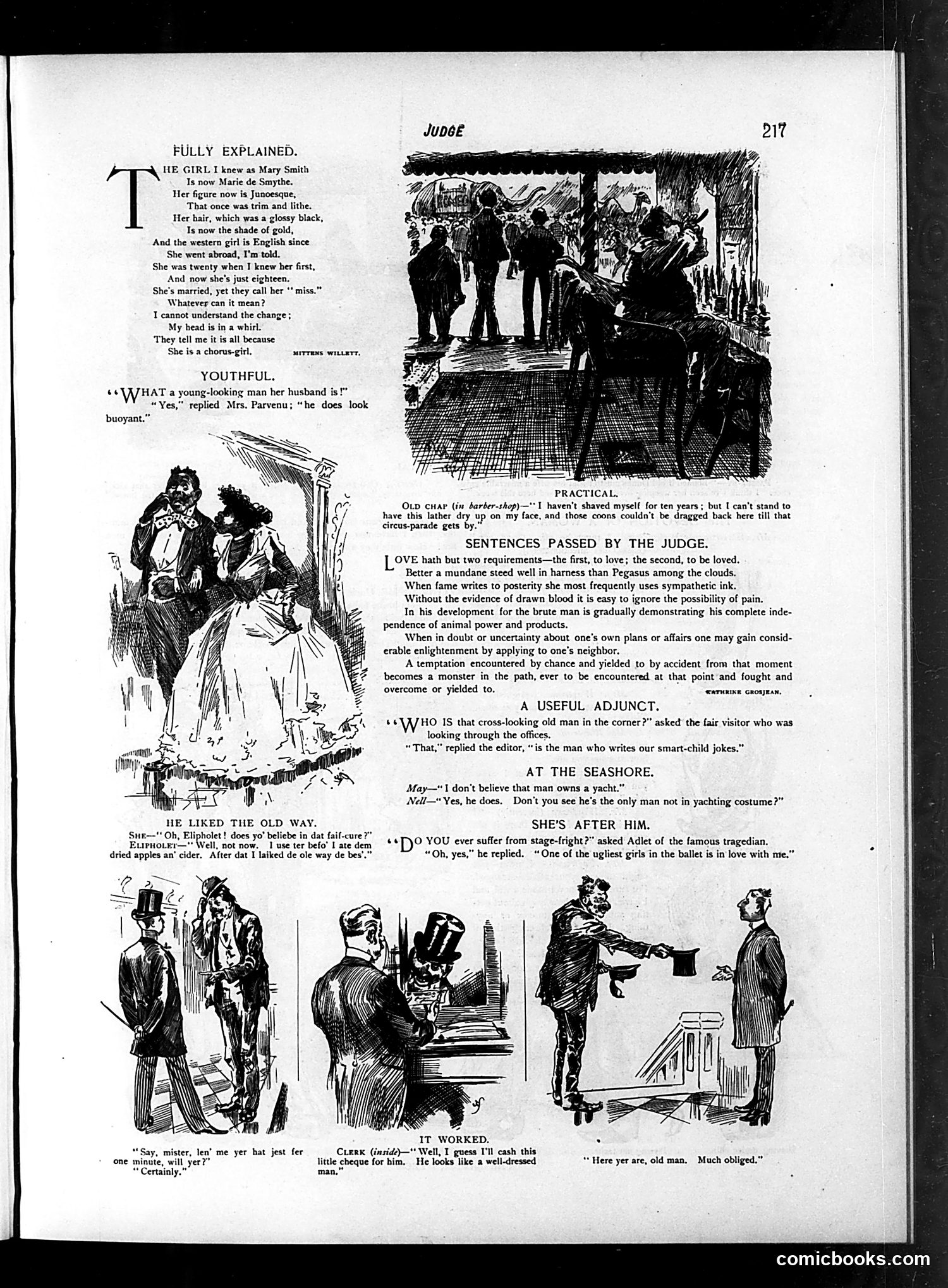
This page from *Judge* (likely late 1800s) contains several satirical sketches mocking social pretension and absurdity: **"Fully Explained"** ridicules American women who adopt affected European personas abroad—changing names from "Mary Smith" to "Marie de Smythe," claiming youth, and altering appearance—particularly targeting chorus girls seeking social elevation through European affectation. **"Youthful"** jokes that a man appears "buoyant" (lively) because he's nouveau riche and oblivious to how ridiculous he looks. **"The Old Way"** and **"He Liked the Old Way"** present rustic dialect humor common to period magazines, mocking rural speech patterns. **"Practical"** depicts a barber avoiding shaving because Black workers (derogatorily termed "coons") won't return until the circus leaves—reflecting period racial attitudes. The remaining pieces mock vanity, stage fright, and yachting pretension. The overall tone targets social climbers, affected elites, and cultural posturing typical of *Judge's* satirical approach to Gilded Age society.
📄 Transcribed text from this page (OCR, searchable)
Machine-transcribed from the original scan — historical spelling and the odd misread are preserved.
FULLY EXPLAINED. HE GIRL I knew as Mary Smith Is now Marie de Smythe. Her figure now is Junoesque, ‘That once was trim and lithe. Her hair, which was a glossy black, Is now the shade of gold, And the western girl is English since She went abroad, I'm told. She was twenty when I knew her first, And now she’s just eighteen. She's married, yet they call her ‘* miss.” Whatever can it mean? I cannot understand the change ; My head is in a whirl. ‘They tell me it is all because She is a chorus-girl. YOUTHFUL. ¢¢\VHAT a young-looking man her husband is!" “Yes,” replied Mrs. Parvenu; “he does look buoyant.” HE LIKED THE OLD WAY. Sur—"' Oh, Elipholet ! does yo" beliebe in dat faif-cure?” Euruoies Well, not now. 1 use ter befo’ I ate dem dried apples an’ cider. After dat I laiked de ole way de bes’.” “Say, mister, len’ me yer hat jest fer one minute, will yer?” * Certainly.” man,” little cheque for him. PRACTICAL, OLD cHar (in barber-shop)—"' 1 haven't shaved myself for ten years; but I can’t stand to have this lather dry up on my face, and those coons couldn't be dragged back here till that circus-parade gets by.” SENTENCES PASSED BY THE JUDGE. LOVE hath but two requirements—the first, to love; the second, to be loved. Better a mundane steed well in harness than Pegasus among the clouds. When fame writes to posterity she most frequently uses sympathetic ink. Without the evidence of drawn blood it is easy to ignore the possibility of pain. In his development for the brute man is gradually demonstrating his complete inde- pendence of animal power and products. When in doubt or uncertainty about one’s own plans or affairs one may gain consid- erable enlightenment by applying to one’s neighbor. A temptation encountered by chance and yielded to by accident from that moment becomes a monster in the path, ever to be encountered at that point-and fought and overcome or yielded to. cerunixe Grosjean, A USEFUL ADJUNCT. S¢YVHO IS that cross-looking old man in the corner?" asked the fair visitor who was looking through the offices. “That,” replied the editor, “is the man who writes our smart-child jokes.” AT THE SEASHORE. May—"1 don’t believe that man owns a yacht.” Nell—"Yes, he does. Don't you see he’s the only man not in yachting costume?” SHE'S AFTER HIM. ‘6 PO YOU ever suffer from stage-fright?” asked Adlet of the famous tragedian. “Oh, yes,” he replied. “One of the ugliest girls in the ballet is in love with me.” IT WORKED. CuerK (inside)—"* Well, I guess I'll cash this He looks like a well-dressed comicbooks.com