
A complete issue · 16 pages · 1892
Judge — September 24, 1892
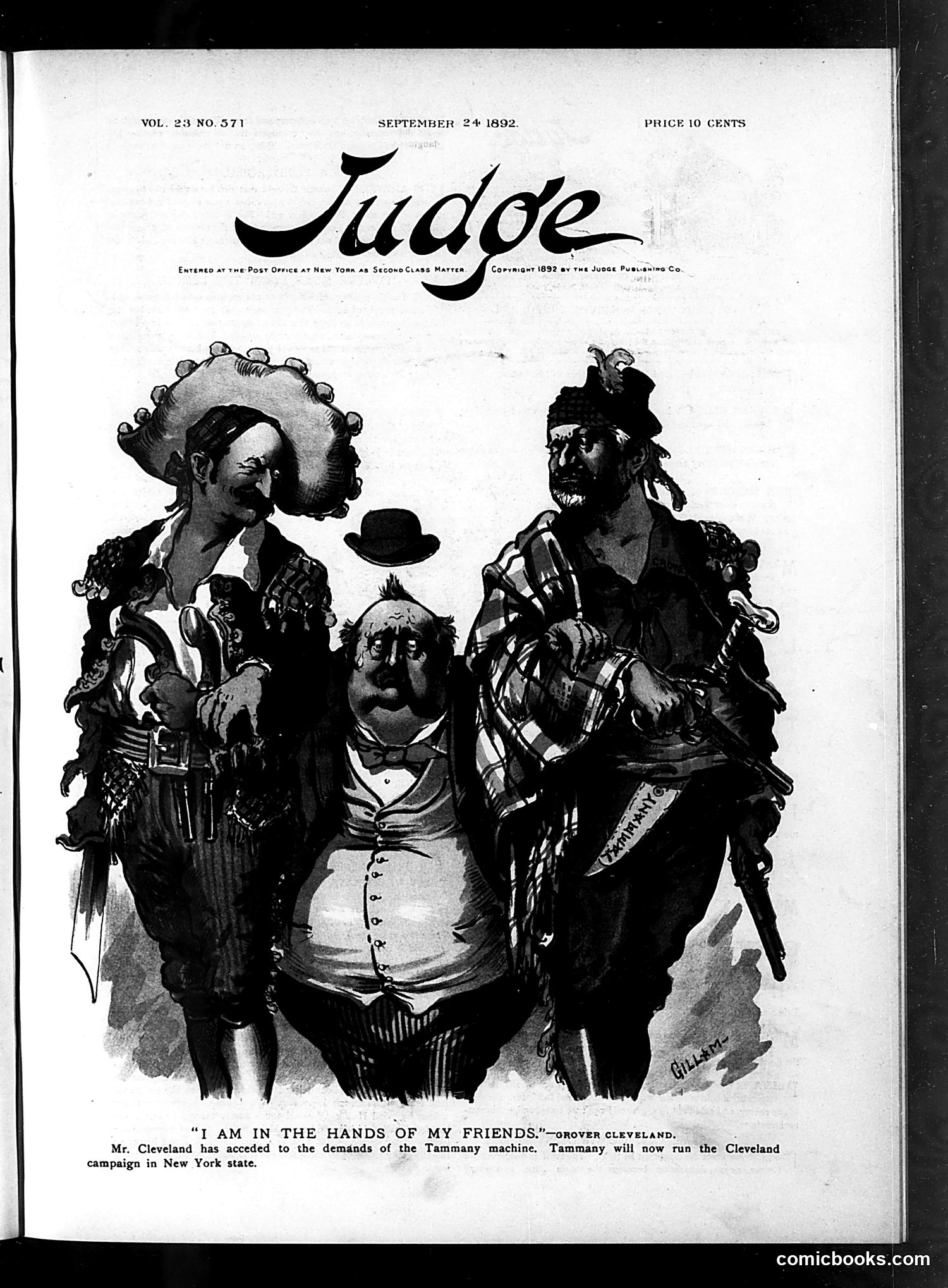
This political cartoon satirizes President Grover Cleveland's capitulation to the Tammany Hall political machine in New York. The caption quotes Cleveland: "I am in the hands of my friends," and the explanatory text notes that "Mr. Cleveland has acceded to the demands of the Tammany machine. Tammany will now run the Cleveland campaign in New York state." The three caricatured figures represent Tammany Hall bosses who have effectively taken control of Cleveland's re-election campaign. The cartoon's point is satirical mockery—depicting Cleveland as a helpless captive literally in the grip of corrupt political operatives, suggesting he has surrendered his independence and integrity to machine politicians in exchange for electoral support.
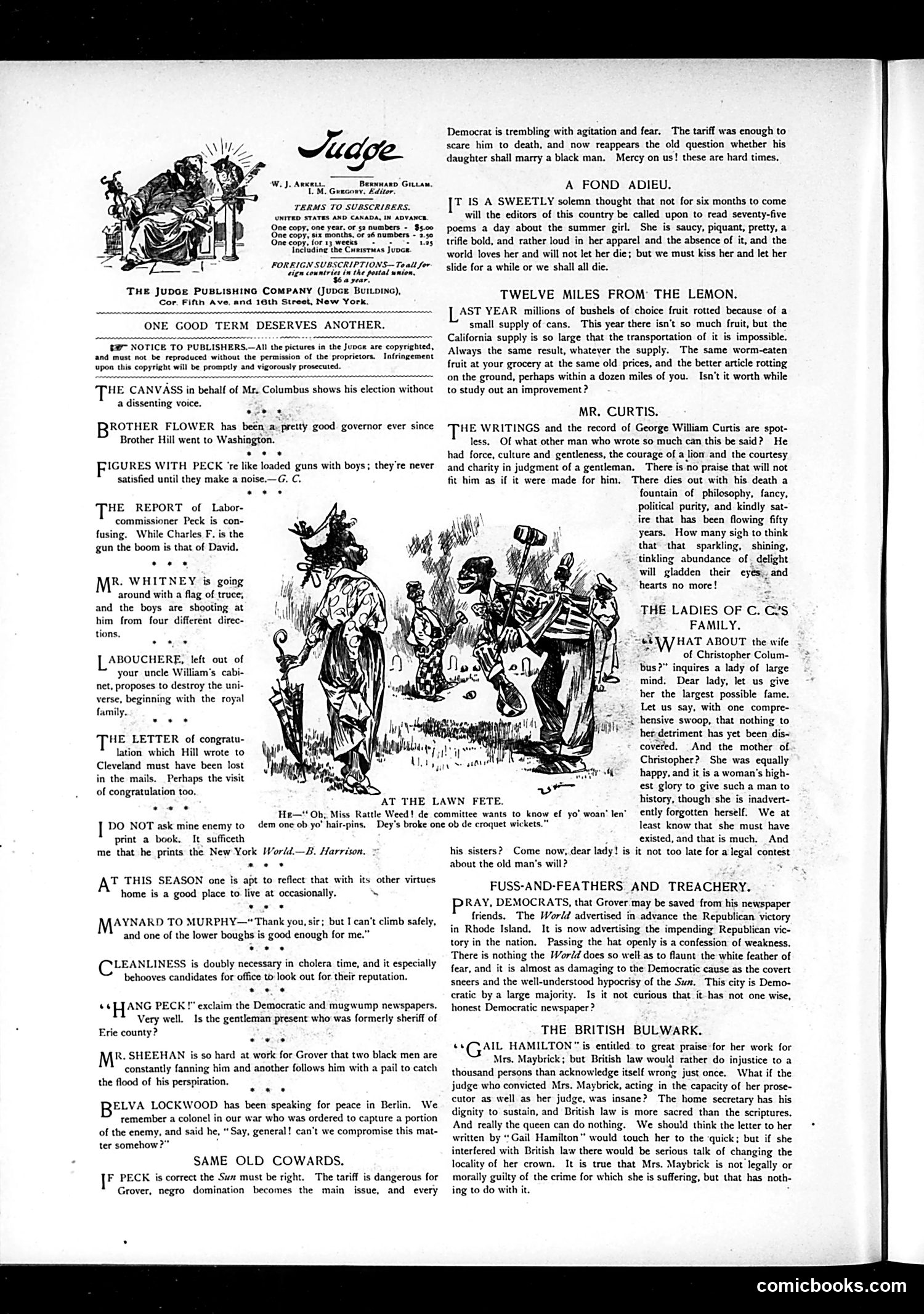
This page contains political commentary and satirical items rather than a single coherent cartoon. The main illustrated section, "AT THE LAWN FETE," depicts a social gathering where a character asks "Oh, Miss Rattle Weed! de committee wants to know if yo' woan' lend us yo' hair pins! Day's broke one ob de report wickets!" The humor appears to target class pretensions and racial stereotypes common to 1890s-era satire. Other items mock political figures: references to "Democrat" trembling with fear, criticism of Labor Commissioner Peck, and commentary on various political figures including Whitney and Shepihan. The page's tone suggests internal Republican criticism of Democratic weakness on tariff and labor issues—typical Judge magazine fare promoting Republican positions during the Gilded Age.
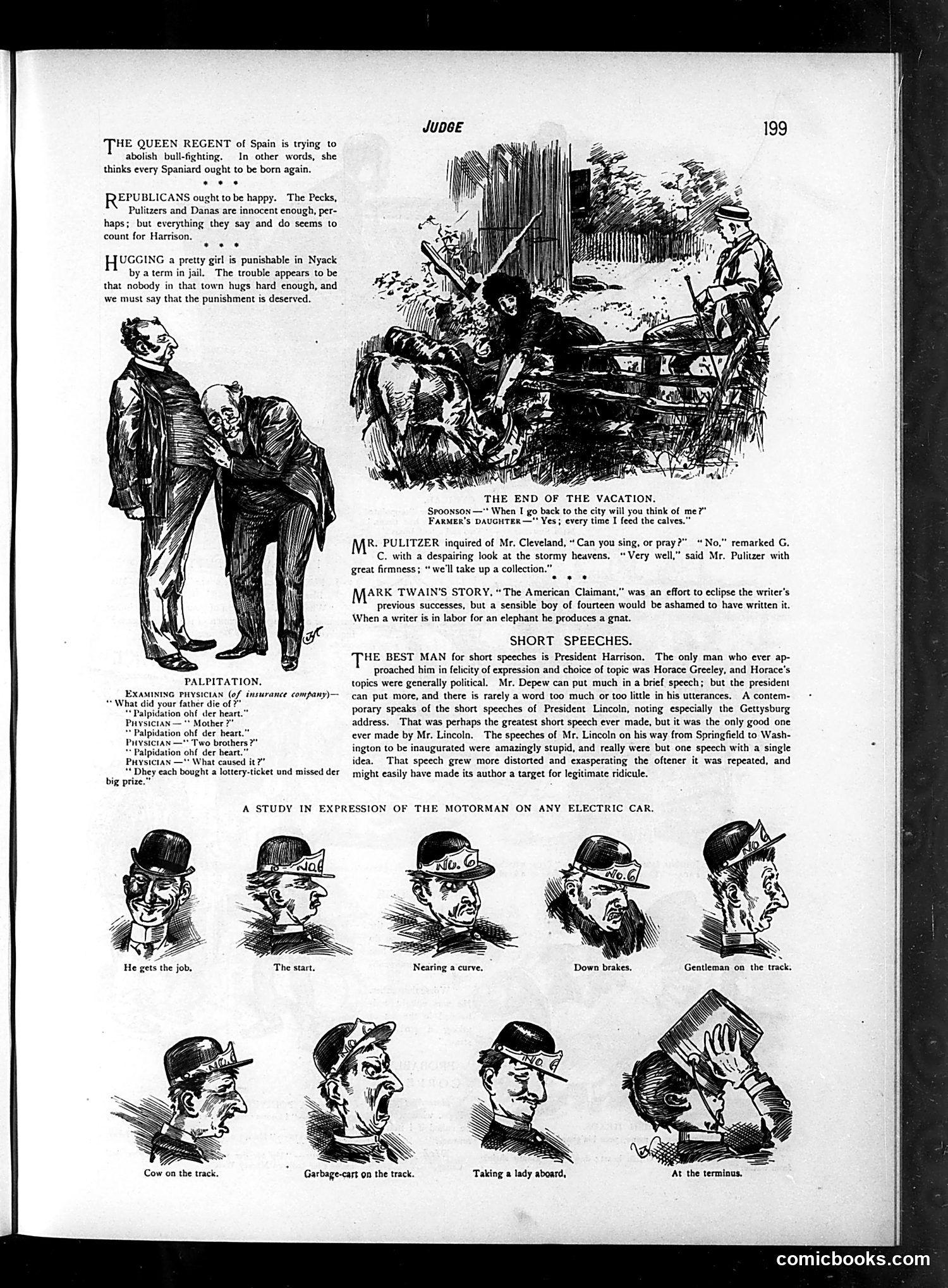
This page contains several distinct satirical pieces. The top section critiques Spanish politics, Republican political figures, and discusses corporal punishment in Nyack. **"The End of the Vacation"** cartoon depicts a farmer's daughter saying goodbye to a city visitor, with commentary on urban life versus rural existence. **"Palpitation"** shows two men discussing a father's death and insurance matters—satirizing the emotional and financial aspects of inheritance. **"Short Speeches"** compares President Harrison's oratory unfavorably to Lincoln's Gettysburg Address, mocking contemporary political rhetoric. **"A Study in Expression of the Motorman on Any Electric Car"** presents nine facial expressions showing an electric streetcar operator's reactions to various situations—from getting the job through arriving at the terminus. This humorously depicts the occupational stress and monotony of early-20th-century urban transit work.
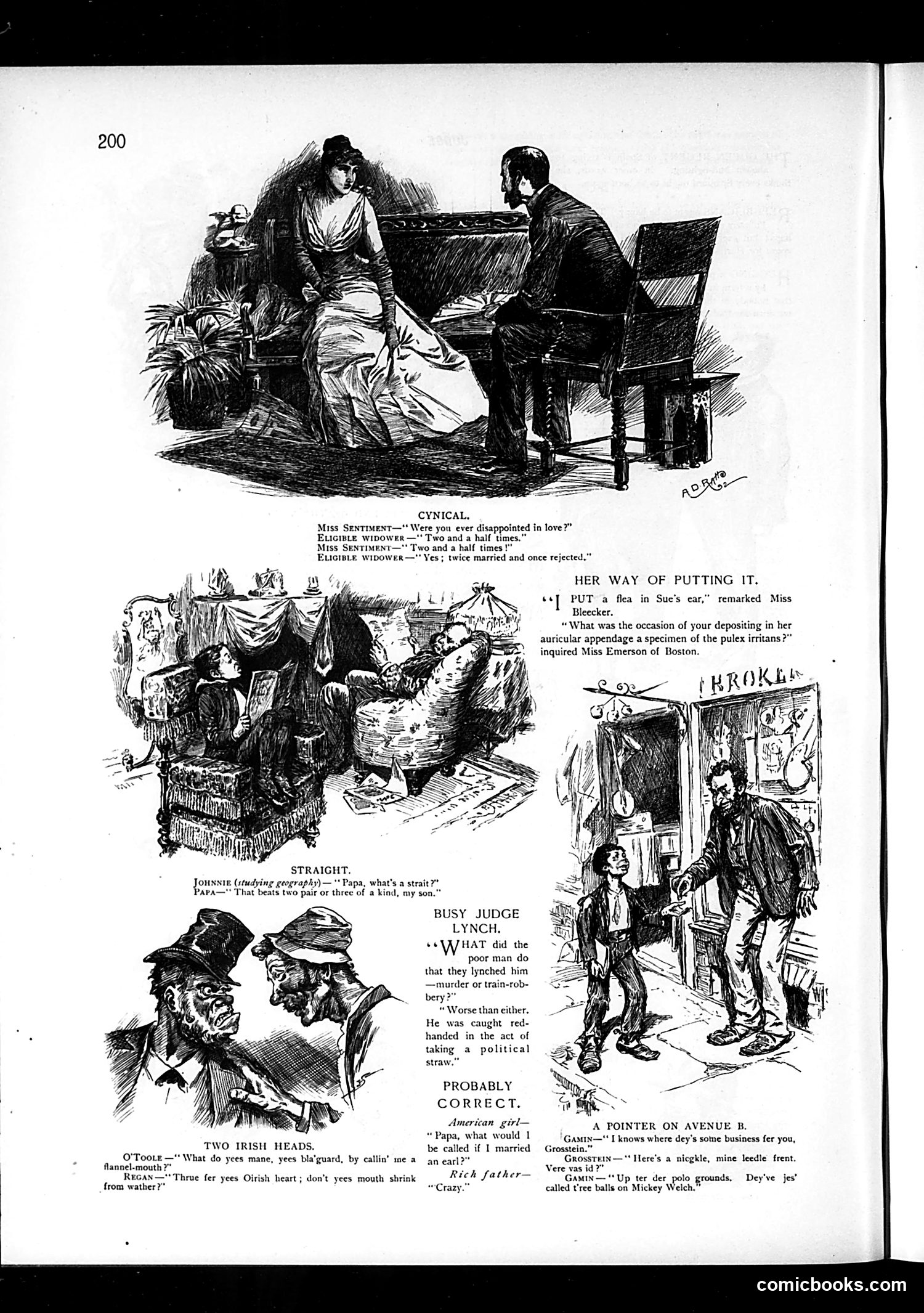
This page contains multiple satirical sketches mocking various social groups and contemporary issues: **"Cynical"** jokes about marriage and disappointed romance among the upper classes, with women quipping that they've been married multiple times or rejected. **"Her Way of Putting It"** satirizes affected Boston society women using pretentious language ("auricular appendage," "pulex irritans") for simple concepts like "putting a flea in someone's ear." **"Busy Judge Lynch"** darkly satirizes lynching by suggesting a man was lynched for "taking a political straw"—likely referencing the arbitrary, absurd justifications for racial violence in the South. **"Two Irish Heads"** and **"Probably Correct"** use heavy stereotypical Irish and Jewish immigrant dialects to mock working-class foreigners and their speech patterns. **"A Pointer on Avenue B"** similarly mocks Jewish immigrants with exaggerated Yiddish-influenced English. The page reflects Judge's typical Gilded Age approach: punching down at immigrants and poor people while treating elite pretension as merely ridiculous rather than harmful. The lynching reference is particularly revealing of the era's casual treatment of racial violence.
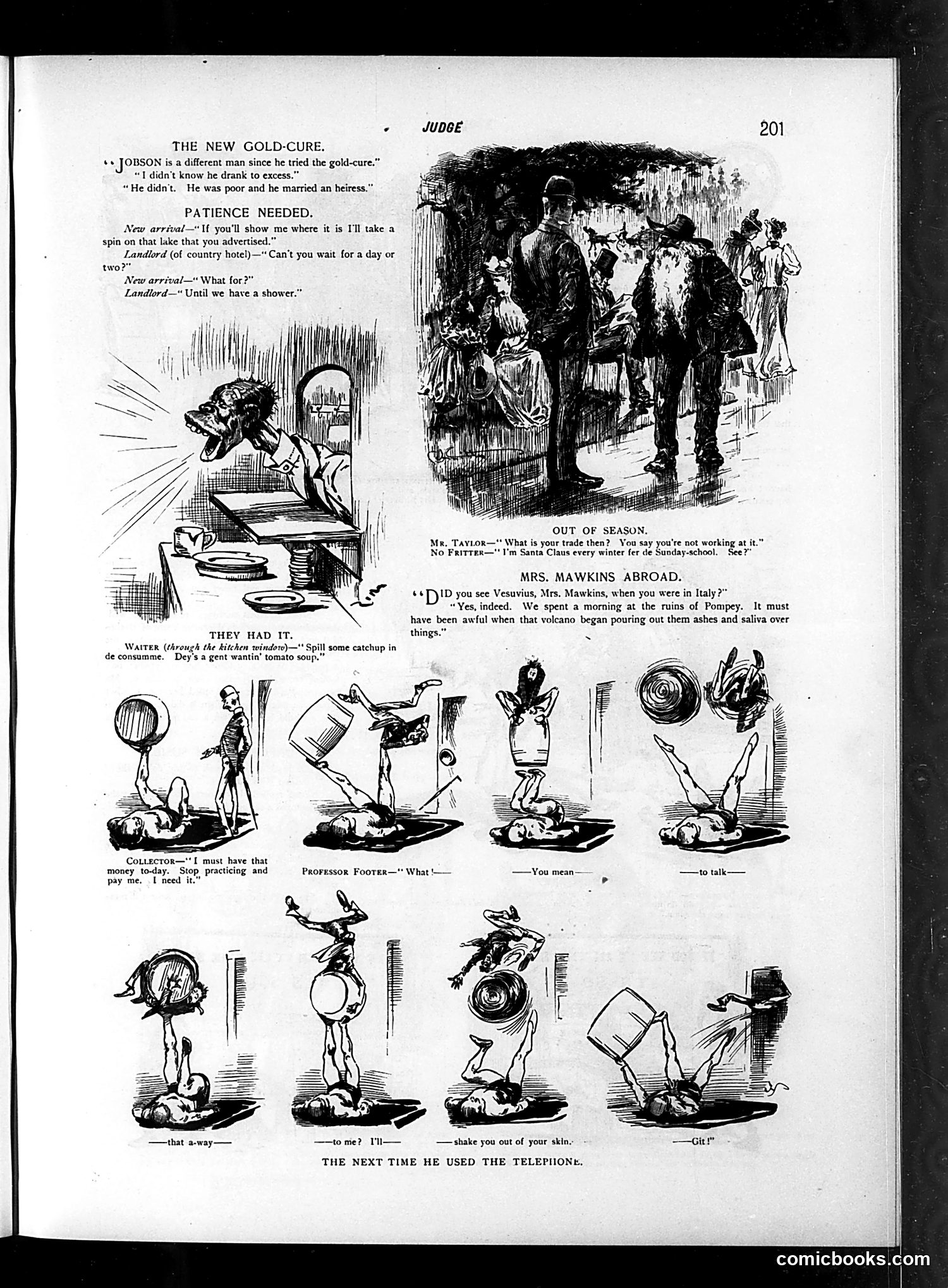
This page contains multiple unrelated satirical vignettes typical of Judge's humor: **"The New Gold-Cure"**: Jokes that a man became "different" after marrying an heiress—implying wealth transforms people, satirizing gold-digger marriages. **"Patience Needed"**: A landlord delays showing a lake to a tourist until it rains, mocking rural hospitality and false advertising. **"Out of Season"**: A man claims to work as Santa Claus only seasonally for Sunday schools, satirizing part-time or questionable employment. **"Mrs. Mawkins Abroad"**: A woman confuses Pompeii with Vesuvius, claiming the volcano erupted "saliva"—mocking ignorant tourists and malapropisms. **"They Had It"**: A waiter adds ketchup to consumé to pass it off as tomato soup—satirizing cheap restaurant fraud. **"The Next Time He Used the Telephone"**: A series of sight-gags showing a man being beaten with household objects by a collector, professor, and others during phone conversations—physical comedy about debt collection. These are disconnected jokes targeting class pretensions, rural/urban misunderstandings, and everyday absurdities.
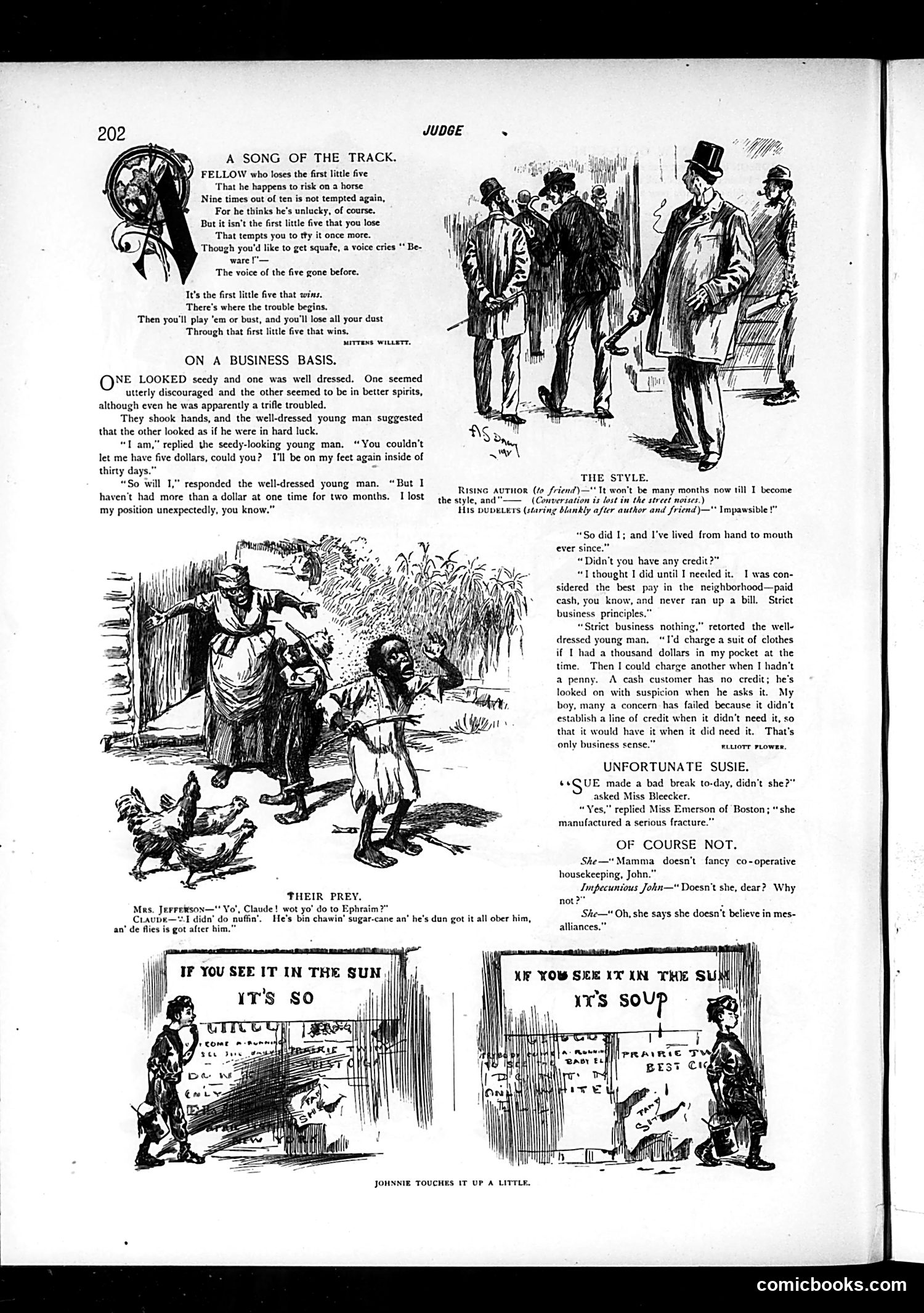
This page from *Judge* contains multiple satirical pieces on gambling, poverty, and social hypocrisy circa the early 1900s. **"A Song of the Track"** warns against horse-racing gambling, specifically how initial small losses lead to compulsive betting to "get square"—a common social problem of the era. **"On a Business Basis"** satirizes the paradox of American credit: the well-dressed man explains that maintaining credit requires *spending* beyond one's means, while the poor man who paid cash lost all creditworthiness. This mocks how financial institutions discriminate against the financially responsible. **"Their Frey"** appears to be a racist dialect sketch about enslaved or formerly enslaved people (the language and imagery reflect period prejudices). The bottom cartoons mock food adulteration—a real contemporary scandal where businesses sold contaminated or misrepresented goods. "If you see it in the sun it's so [clean], if you see it in shadow it's soup [garbage]" jokes about deceptive food marketing practices that would later trigger food safety regulations.
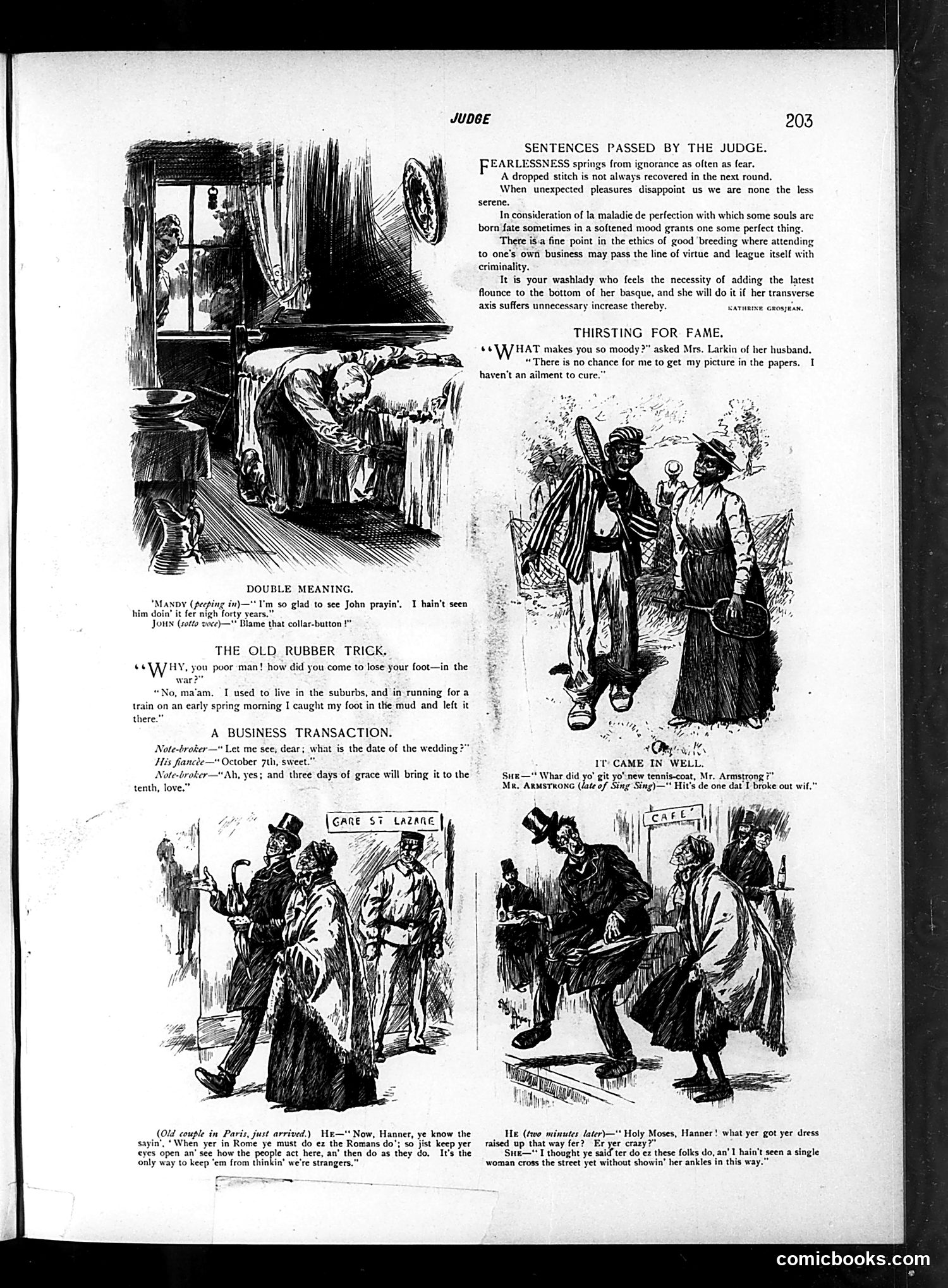
This page presents various short comedic sketches typical of Judge magazine's satirical format. The cartoons mock everyday social situations and human nature: **"Thirsting for Fame"** ridicules a man's desire for newspaper publicity, lamenting he lacks even an ailment newsworthy enough to print. **"Double Meaning"** plays on a pun: a man appears devout praying, but he's actually cursing a stuck collar button. **"The Old Rubber Trick"** and other vignettes feature working-class characters whose misadventures—losing a foot to suburban mud, lost train commutes—are presented as absurd alternatives to wartime injury. **"It Came in Well"** and the Paris couple sketches use sexual innuendo and crude humor about respectability and imitation of local customs. The opening "Sentences" section offers genteel aphorisms about proper conduct and social etiquette. Overall, the page blends genteel moralizing with crude working-class humor—typical of Judge's appeal to middle-class readers amused by both refined wit and vulgar pratfalls.
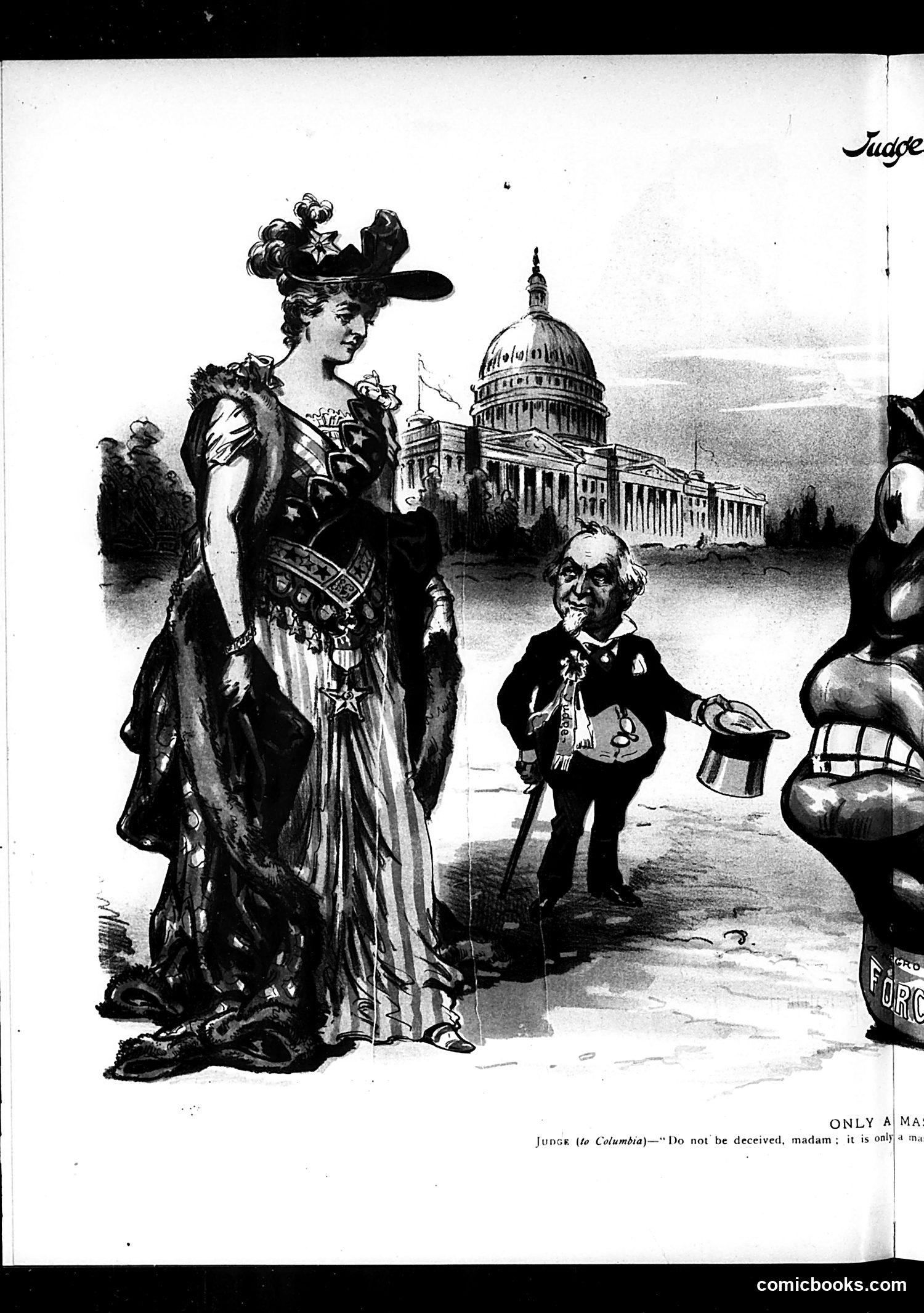
This is a satirical cartoon titled "Judge (to Columbia)" featuring an allegorical scene. Columbia—the female personification of America, identifiable by her elaborate classical dress and plumed hat—stands before the U.S. Capitol building. A small, caricatured male figure (appears to be a political judge or official) addresses her with the caption: "Do not be deceived, madam; it is only a ma[sk]" (text cuts off). The cartoon satirizes political deception, warning that appearances in government are misleading. The judge figure seems to be cautioning America herself against trusting surface-level political rhetoric or the facade of governmental institutions. The Capitol serves as backdrop, emphasizing the setting is Washington politics. Without the complete caption or publication date, the specific political situation referenced remains unclear, though the theme warns against political manipulation of the American public.
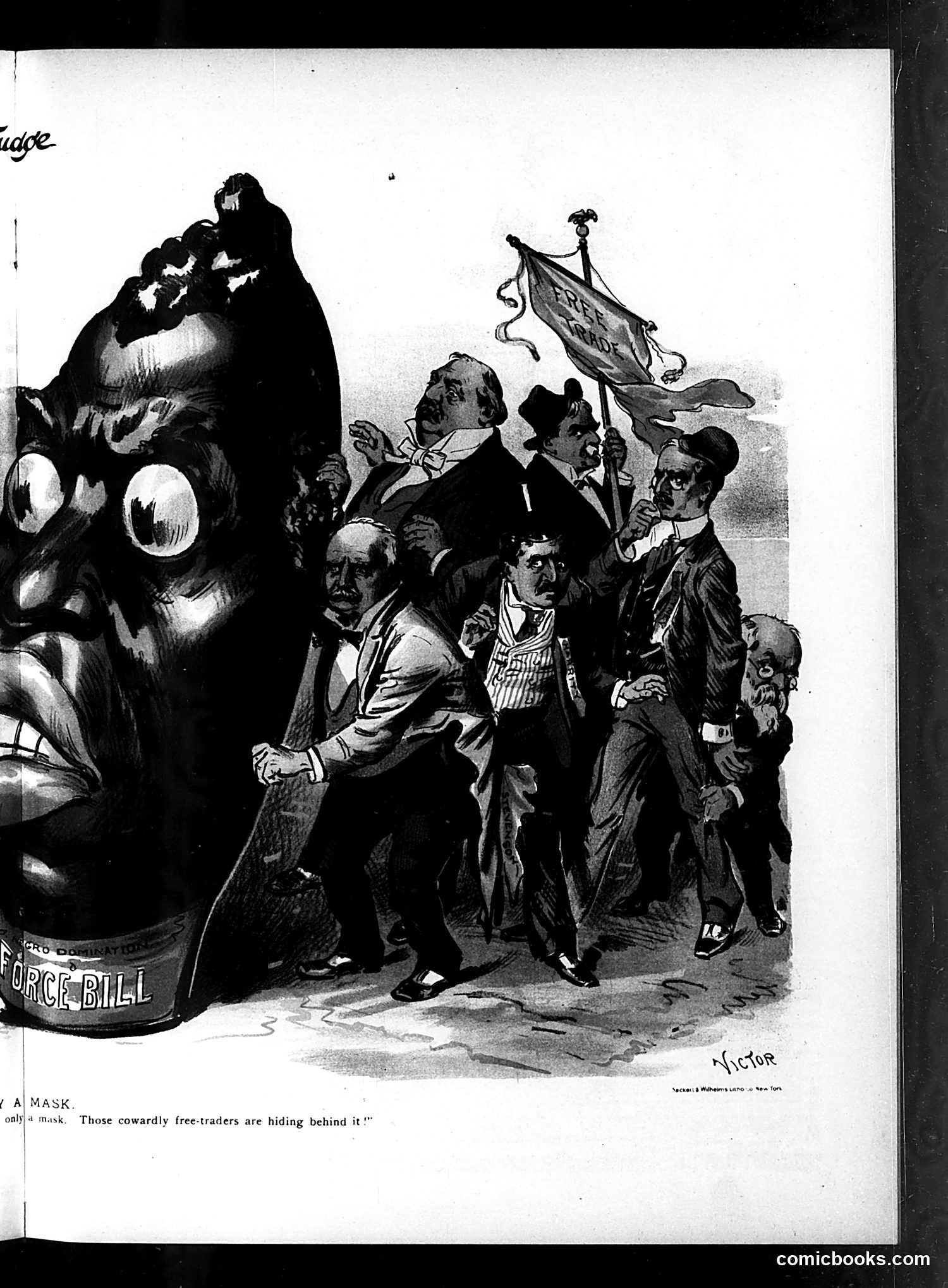
This cartoon criticizes protectionist politicians hiding behind the "Force Bill" — legislation masking their true protectionist agenda. The large menacing figure on the left represents the Force Bill itself, depicted as a mask or disguise. The group of men on the right (appearing to be politicians or legislators) clutch a flag labeled what appears to be related to tariffs/trade policy. The speaker's caption suggests that "cowardly free-traders" are using the Force Bill as cover for their actual protectionist goals. The satire targets the hypocrisy of politicians claiming one thing (free trade) while pursuing another (protectionism) through legislative disguise. Without knowing the specific historical date, this likely addresses 19th-century American tariff debates where protection/free trade was a major political dividing line.
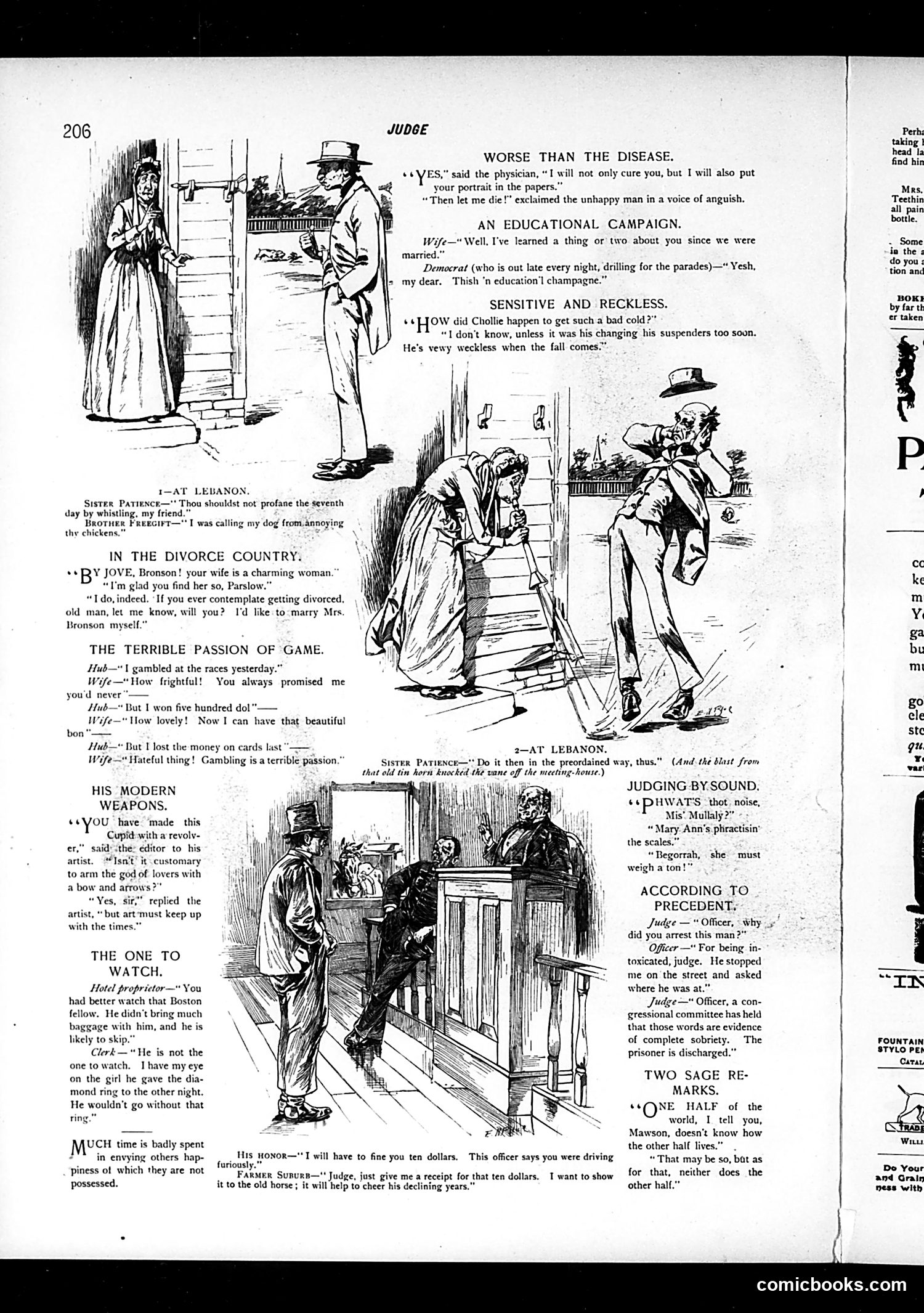
This page contains multiple brief satirical vignettes typical of Judge's humor circa early 1900s: **"Worse Than the Disease"**: A doctor offers to cure a patient AND publish his portrait in newspapers. The patient prefers death—mocking invasive newspaper publicity and vanity. **"Divorce Country"**: Social satire on easy divorce in certain states; a man compliments another's wife, then asks to marry her if he divorces—suggesting marital commitment meant little to some. **"Terrible Passion of Game"**: A wife celebrates her husband winning money gambling, then condemns him losing it—satirizing inconsistent morality and women's financial self-interest. **"Modern Weapons"**: Cupid depicted with a revolver instead of bow-and-arrows, suggesting modern romance is more violent/dangerous than traditional courtship. **"One to Watch"**: A hotel clerk ignores a suspicious guest but watches the woman who received his diamond ring—mocking male anxiety about women leaving with valuables. **Other sketches** mock various social absurdities: religious hypocrisy, political drunkenness, and pretentious claims about class knowledge. The overall tone is cynical about marriage, money, and social pretense.
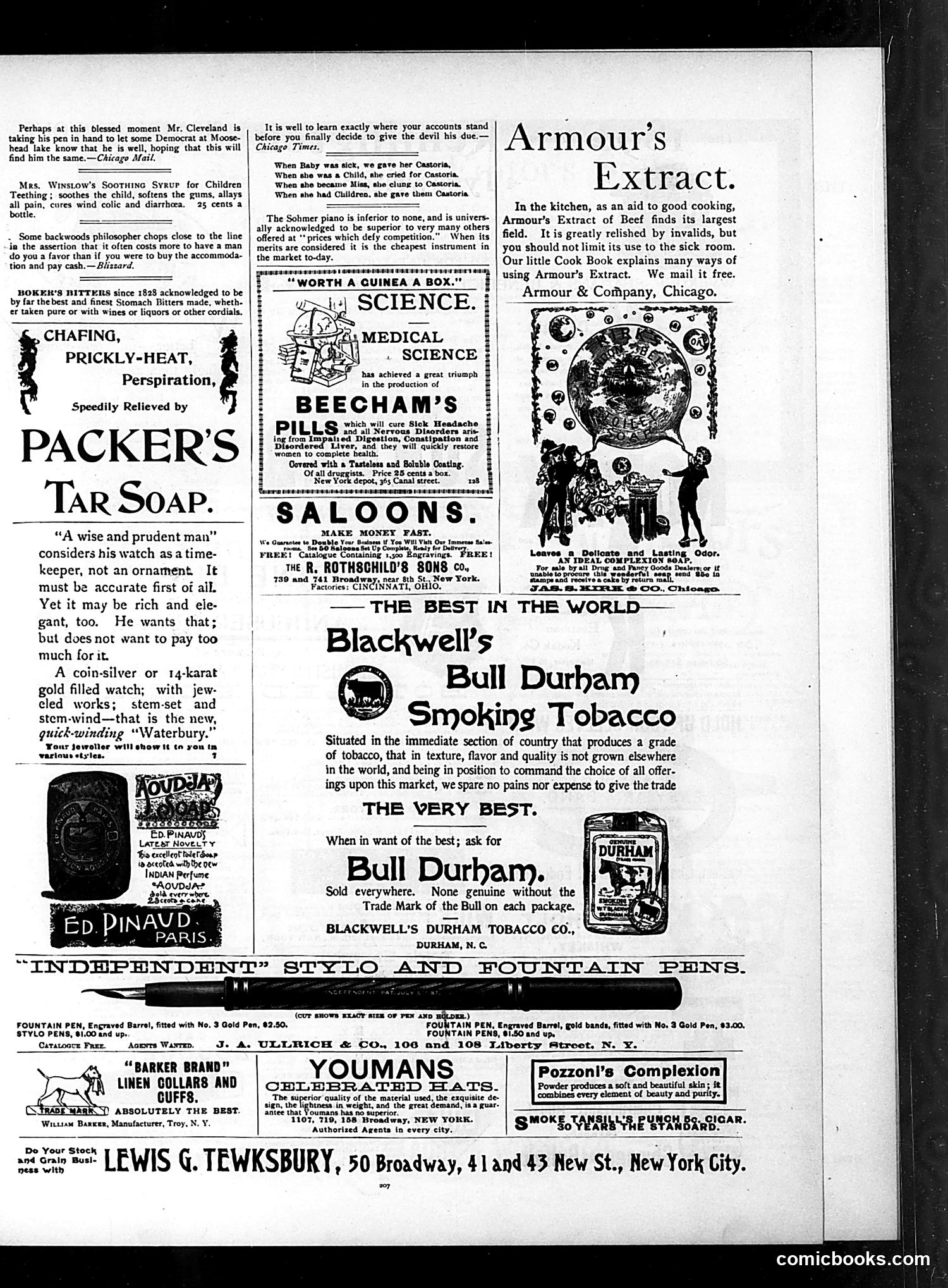
This page is primarily **advertising**, not political satire. It contains numerous product advertisements from the late 19th/early 20th century, with minimal editorial content. The few editorial elements present include brief quips—one references President Cleveland (appearing to allude to him retreating to Moose Head Lake, likely during a political controversy), and another is a generic backwoods philosopher observation about the cost of favors. The advertisements themselves reflect period concerns: patent medicines (Beecham's Pills, Mrs. Winslow's Soothing Syrup), consumer goods (Armour's Extract, Blackwell's Bull Durham tobacco), and luxury items (Waterbury watches). These ads reveal what middle-class readers valued and what ailments were commonly self-treated with over-the-counter remedies. Rather than satire, this page documents **commercial culture and consumer anxiety** of the era—the emphasis on "the best" product and testimonial-style claims characterizes advertising strategy of the period.
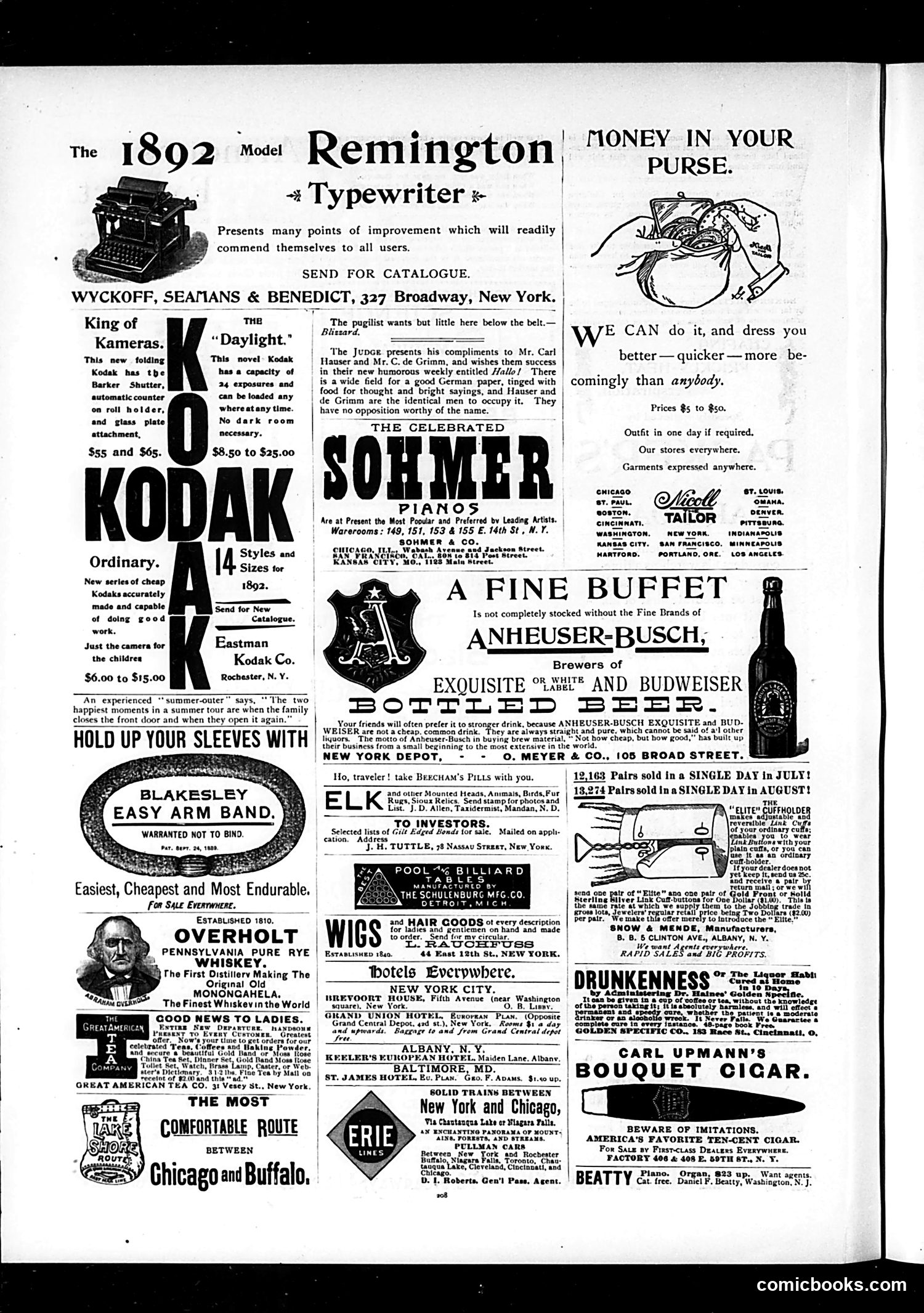
This is primarily an **advertising page** from Judge magazine, circa 1892. Rather than containing political cartoons, it showcases commercial advertisements typical of the Gilded Age. Notable advertisers include: - **Kodak cameras** ("King of Kameras")—promoting the new portable photography technology - **Remington typewriter**—marketing modern business equipment - **Sohmer pianos**—luxury goods for middle-class homes - **Anheuser-Busch beer**—German-American brewing giants - **Overholt whiskey**—American spirits - **Clothing and tailoring services** The single textual reference to satire appears to be a brief **Blissard quote** about pugilists ("The pugilist wants but little here below the belt"), likely a joke about prizefighters' physical focus. The page reflects **1890s consumer culture**: photography, typewriters, and imported beer represented modernity and status. The advertisements reveal both American industrial innovation and the era's robust German-American commercial presence.
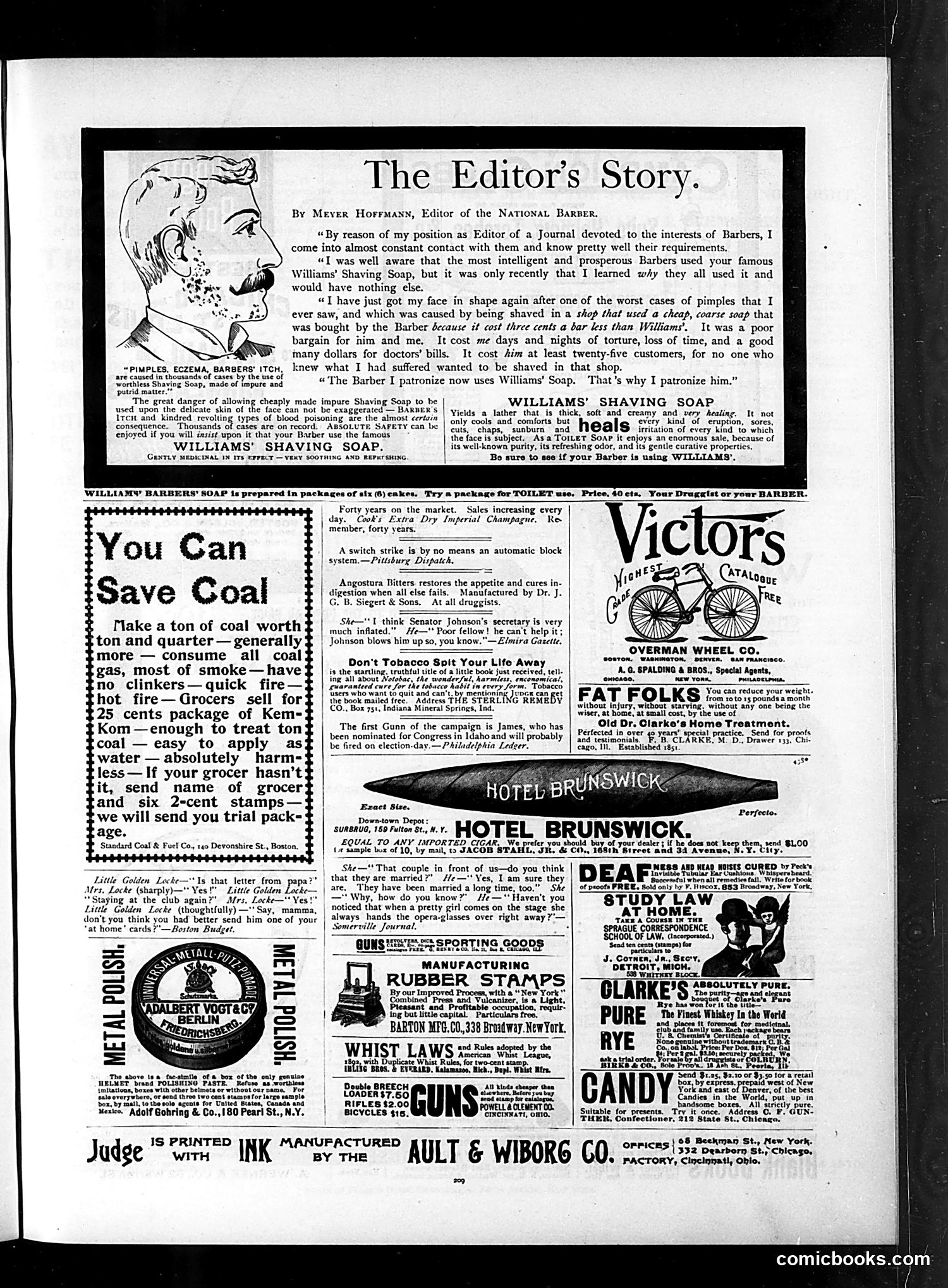
This page is primarily a **product advertisement** for Williams' Shaving Soap, presented as editorial content. The "story" is a testimonial from Meyer Hoffmann, editor of the *National Barber* journal, describing how cheap barber soap caused him severe facial problems (pimples, eczema, infection) costing him money, time, and customers' trust. He credits Williams' Soap—used by "intelligent and prosperous Barbers"—with solving the problem. The satire is subtle: the piece sarcastically frames product loyalty as a matter of professional reputation and health, turning a mundane soap advertisement into a cautionary tale. The accompanying fine-print warnings about "blood poisoning" and "ABSOLUTE SAFETY" humorously inflate soap's importance. The page also contains numerous other period advertisements (coal products, bicycles, whiskey, firearms, candy) typical of Judge's revenue model. There is **no political cartoon** on this page—it's primarily commercial content dressed as editorial journalism.
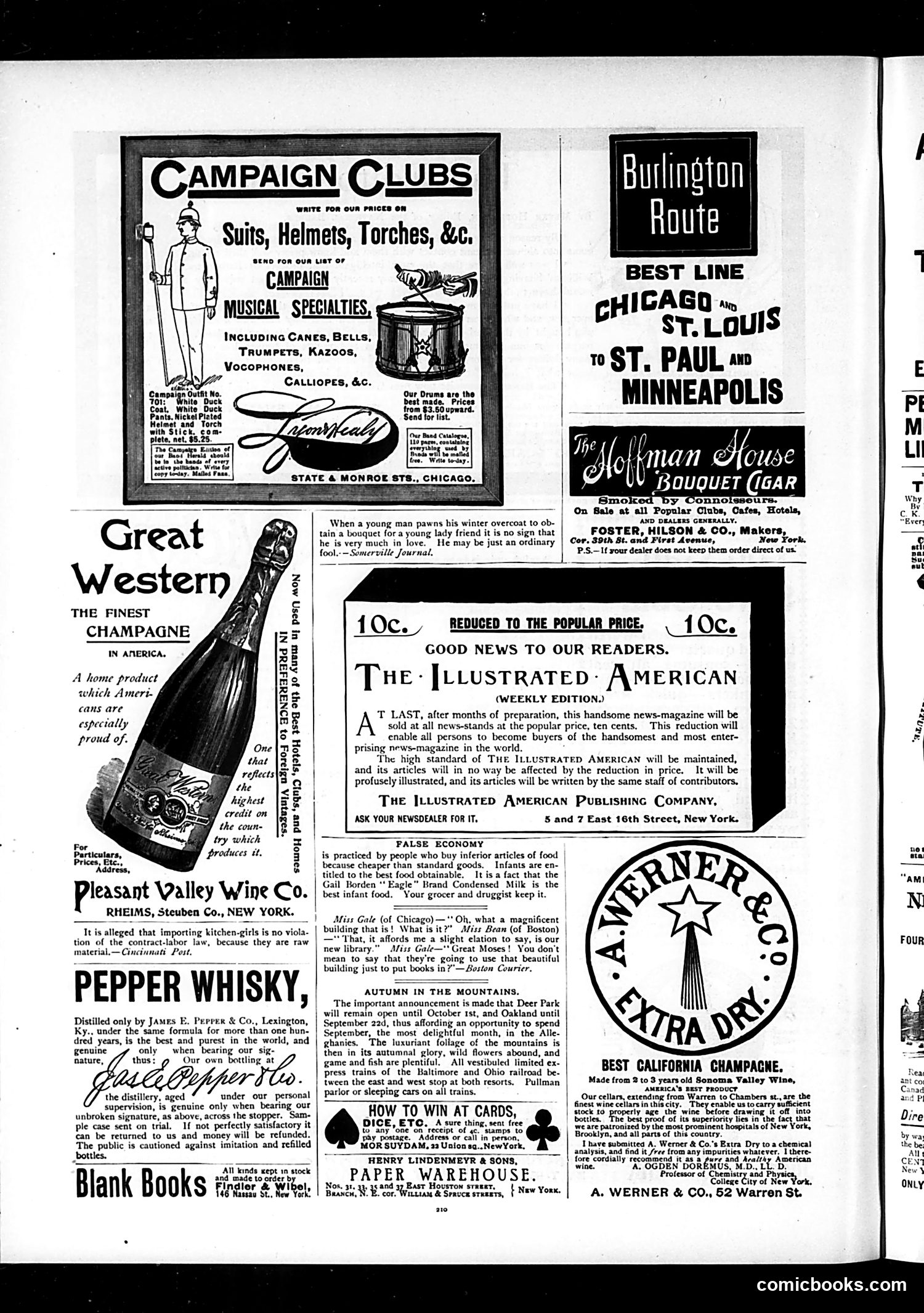
This is primarily an **advertising page** from Judge magazine, not a political cartoon. The page features commercial advertisements for various products popular in the late 19th century: campaign supplies, champagne, whiskey, cigars, and blank books. The only satirical content appears to be brief **humorous observations**: - A joke about young men pawning winter coats for bouquets—mocking romantic pretense masking financial desperation - A quip about importing "kitchen-girls" as "raw material" to evade contract-labor laws—satirizing legal loopholes exploited by employers - A Chicago/Boston dialogue mocking regional attitudes toward libraries The page's main purpose is **commercial**: promoting consumer goods to Judge's affluent readership. The "False Economy" section uses consumer psychology to pitch Gail Borden condensed milk for infants, arguing cheapness shouldn't compromise quality for babies. The prominent announcement reducing *The Illustrated American* magazine price to 10 cents represents a significant publishing development—democratizing access to illustrated news content.
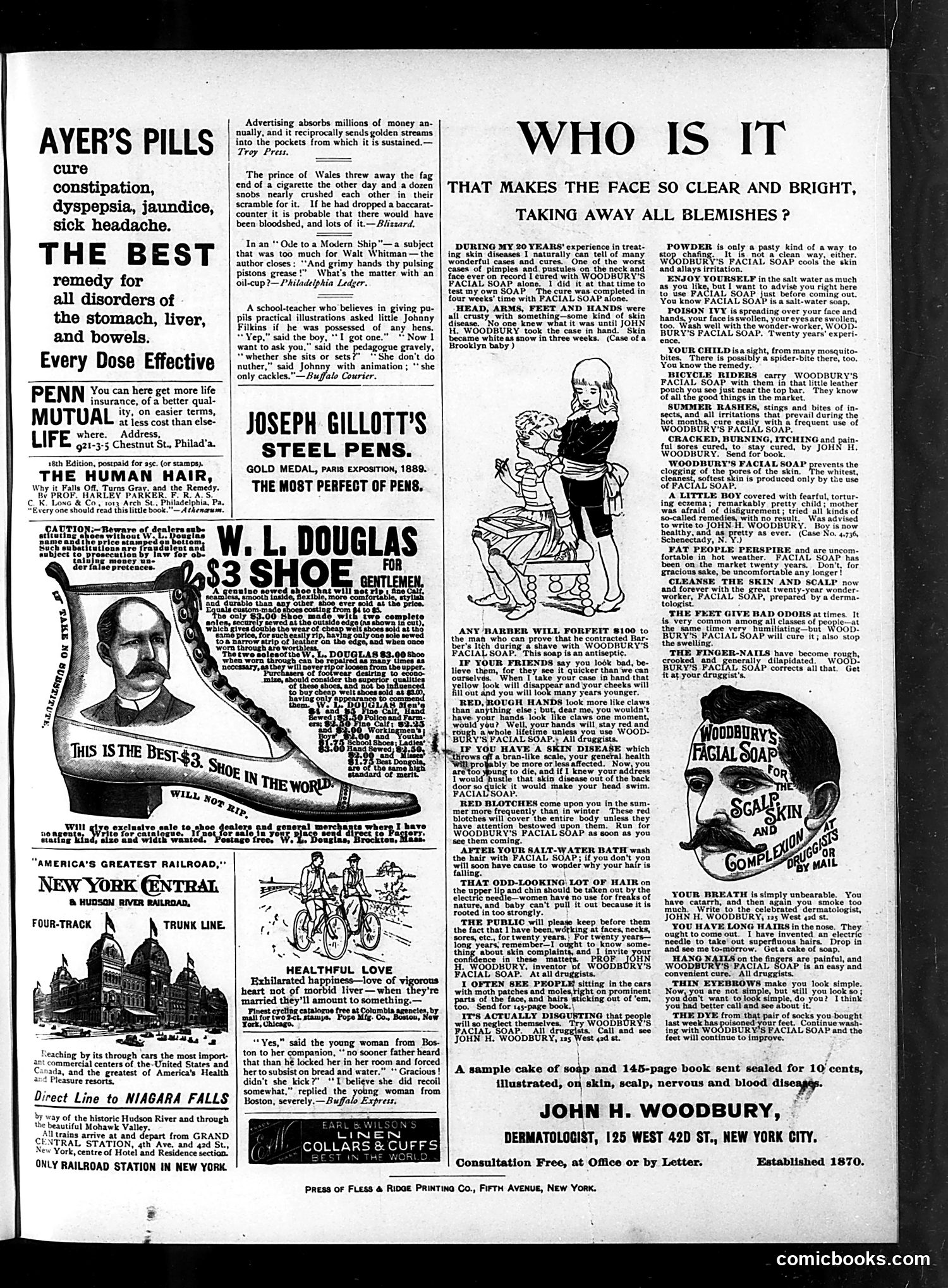
This is primarily an **advertising page** rather than satirical editorial content. The page is dominated by product advertisements (Ayer's Pills, Penn Mutual Life, W.L. Douglas shoes, Joseph Gillott's steel pens, and notably Woodbury's Facial Soap). The small editorial content consists of brief humor snippets: jokes about the Prince of Wales' vanity, Walt Whitman's overly flowery poetry style, and a schoolteacher's confusion over grammar ("sits" vs. "sets"). These represent typical light social satire of the era—poking fun at affectation and misuse of language. The **Woodbury's Facial Soap advertisement** occupies the right half and features testimonials about treating skin conditions. This reflects early 20th-century advertising's adoption of quasi-scientific medical claims and celebrity endorsements (including a dermatologist, Dr. John H. Woodbury). The overall page demonstrates how **Judge monetized itself through advertising** while filling space with filler humor that required no topical knowledge or artistic sophistication—content designed to fill pages between major satirical pieces.
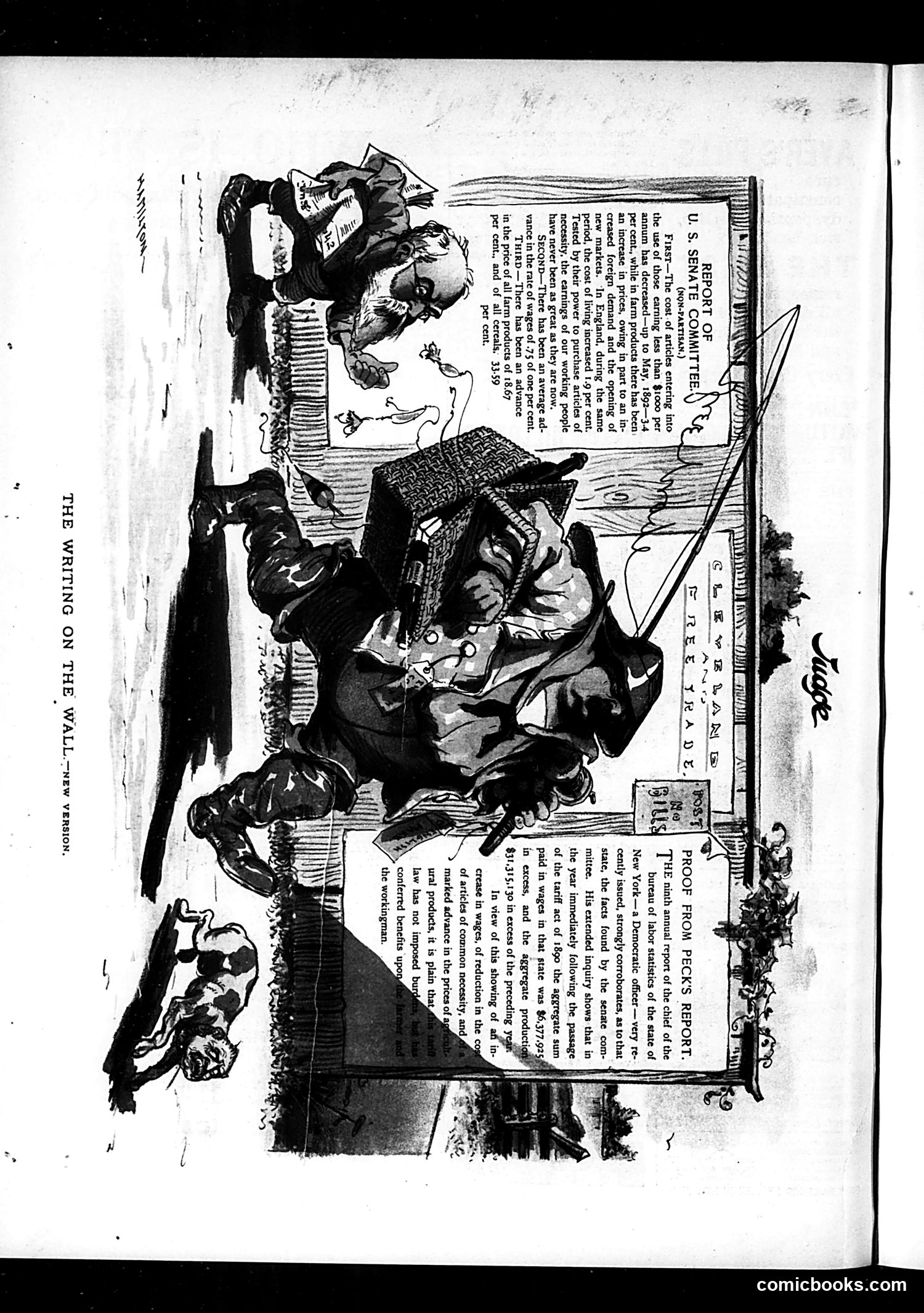
This Judge magazine page satirizes Republican economic claims during the early 1890s. The main cartoon depicts a figure (likely representing a Democratic or opposing politician) recoiling in alarm at official statistics presented as "writing on the wall"—a biblical reference to inevitable doom. The text presents U.S. Senate Committee reports claiming economic success: decreased cost-of-living for workers earning under $1,000 annually, wage increases of 0.75%, and product price increases of 18.67%. It cites a New York state labor report corroborating these findings. The satire's point appears to be mocking the contradiction: while wages barely rose, product prices skyrocketed—meaning workers' purchasing power actually declined despite official claims of prosperity. The "writing on the wall" warns of economic trouble the administration's statistics tried to deny or obscure, suggesting ordinary people could see through the manipulated data.