
A complete issue · 16 pages · 1892
Judge — September 17, 1892
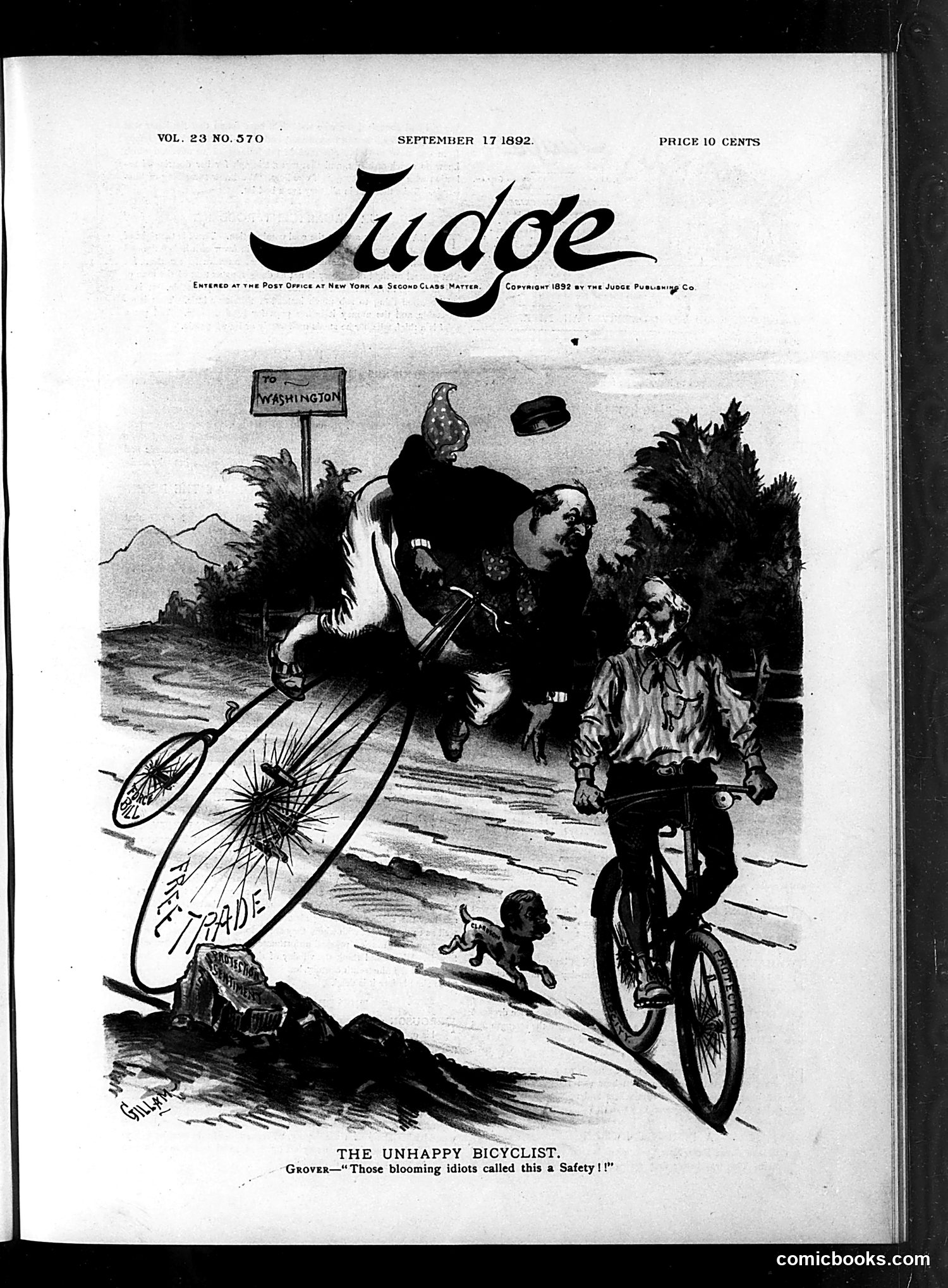
This cartoon satirizes the bicycle craze of the 1890s and safety concerns. A well-dressed man riding a "Safety" bicycle—the new design with two equal-sized wheels (versus the dangerous high-wheel penny-farthing)—encounters chaos on a country road to Washington. The bicyclist is beset by hazards: a runaway horse-drawn carriage labeled "Trade," a small dog, and rough road conditions. The ironic caption—"Those blooming idiots called this a Safety!"—mocks the bicycle industry's marketing claims. The cartoon suggests that despite being engineered as "safer" than older designs, bicycles still faced real dangers from traffic, animals, and infrastructure. It's commentary on the gap between advertising promises and practical reality during the bicycle boom era.
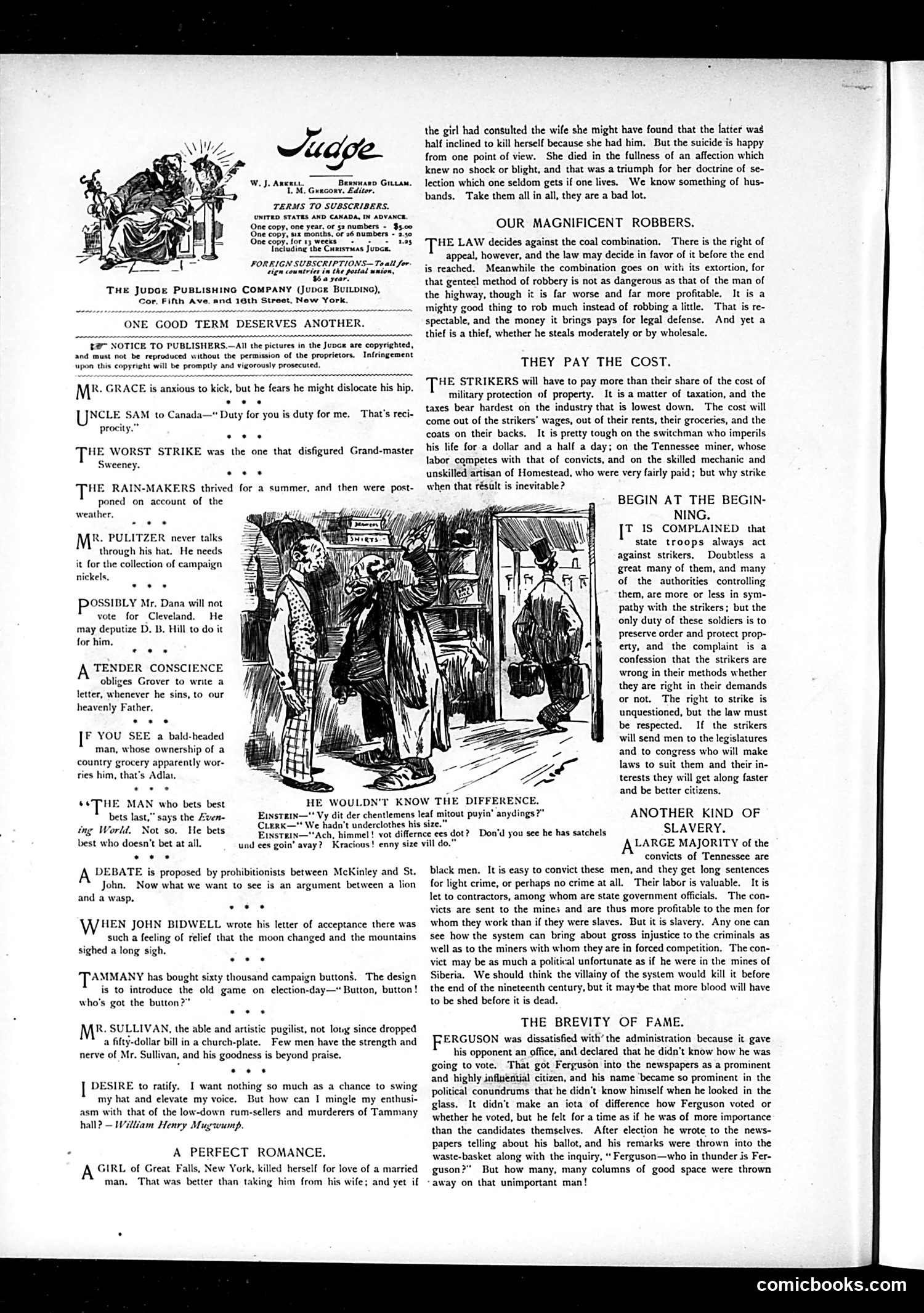
This page contains editorial commentary on labor strikes and law enforcement, likely from the early 1900s. The main cartoon, titled "He Wouldn't Know the Difference," depicts what appears to be a confrontation between strikers and authorities at a shop or factory entrance. The accompanying articles argue that strikers bear financial costs of strikes themselves (wages, rent, groceries) and question whether state troops sent to control strikes are truly impartial peacekeepers or sympathetic to strikers' methods. The commentary suggests strikers lack legal standing to demand change, positioning the magazine against labor activism. Other brief items mock political figures (Cleveland, McKinley, Grover, Dana) and discuss convicts and elections, reflecting Judge's conservative editorial stance on labor and politics of the era.
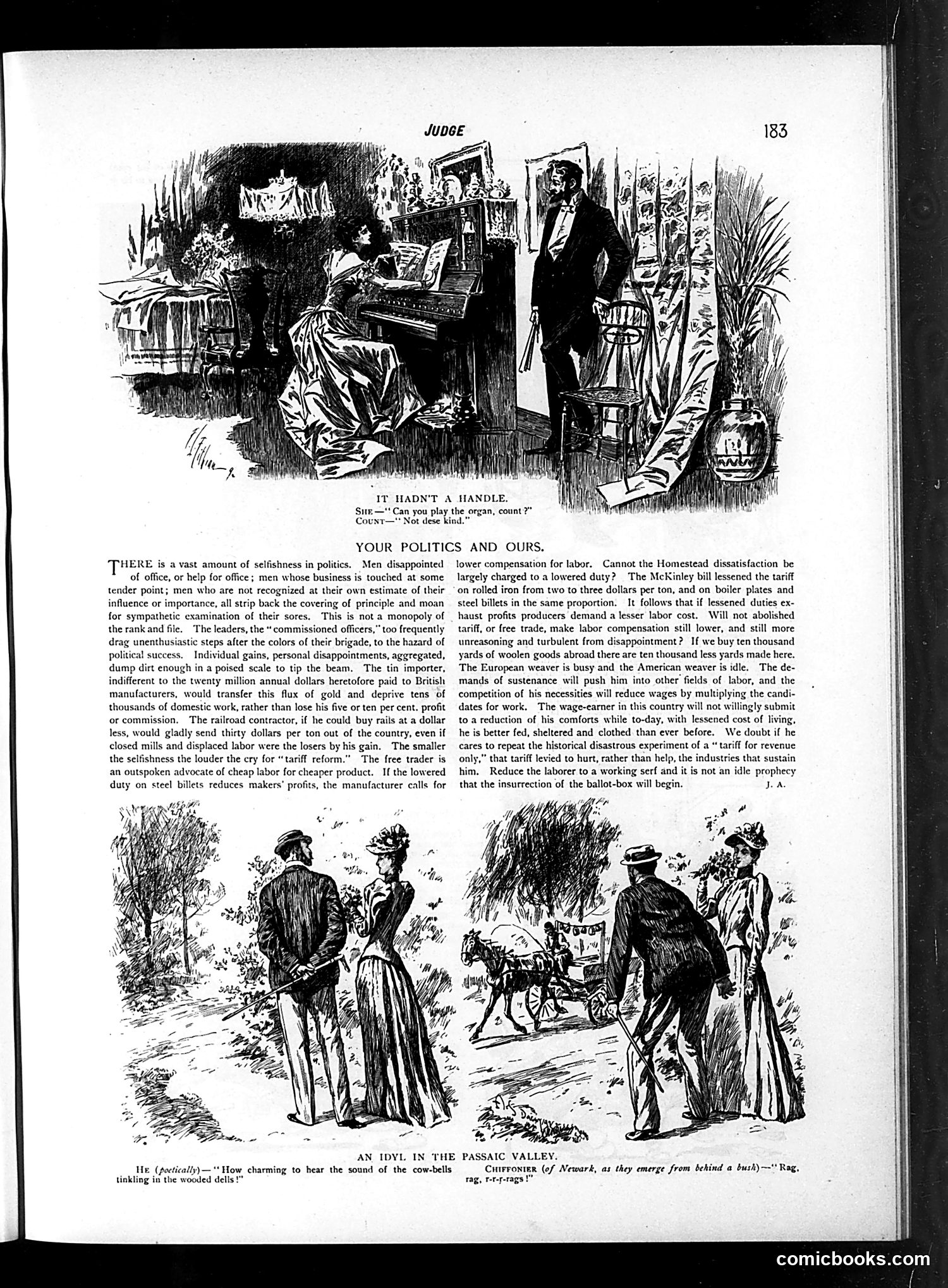
**Top Cartoon:** "It Hadn't a Handle" A woman plays organ for a count, who asks if she can play it. The joke is unclear from the image alone, likely a sexual or social double entendre about "handling" something. **Main Article:** "Your Politics and Ours" This editorial argues against tariff protectionism. It criticizes politicians who champion "tariff reform" to benefit wealthy industrialists while claiming to help workers. The author argues tariffs actually harm laborers by raising prices on goods while manufacturers exploit cheaper foreign competition. The piece advocates for removing tariffs to genuinely improve workers' conditions rather than preserving profits for industrialists. **Bottom Cartoon:** "An Idyl in the Passaic Valley" Rural figures discuss hearing cowbells—a sarcastic commentary on industrial pollution or development destroying pastoral landscapes.
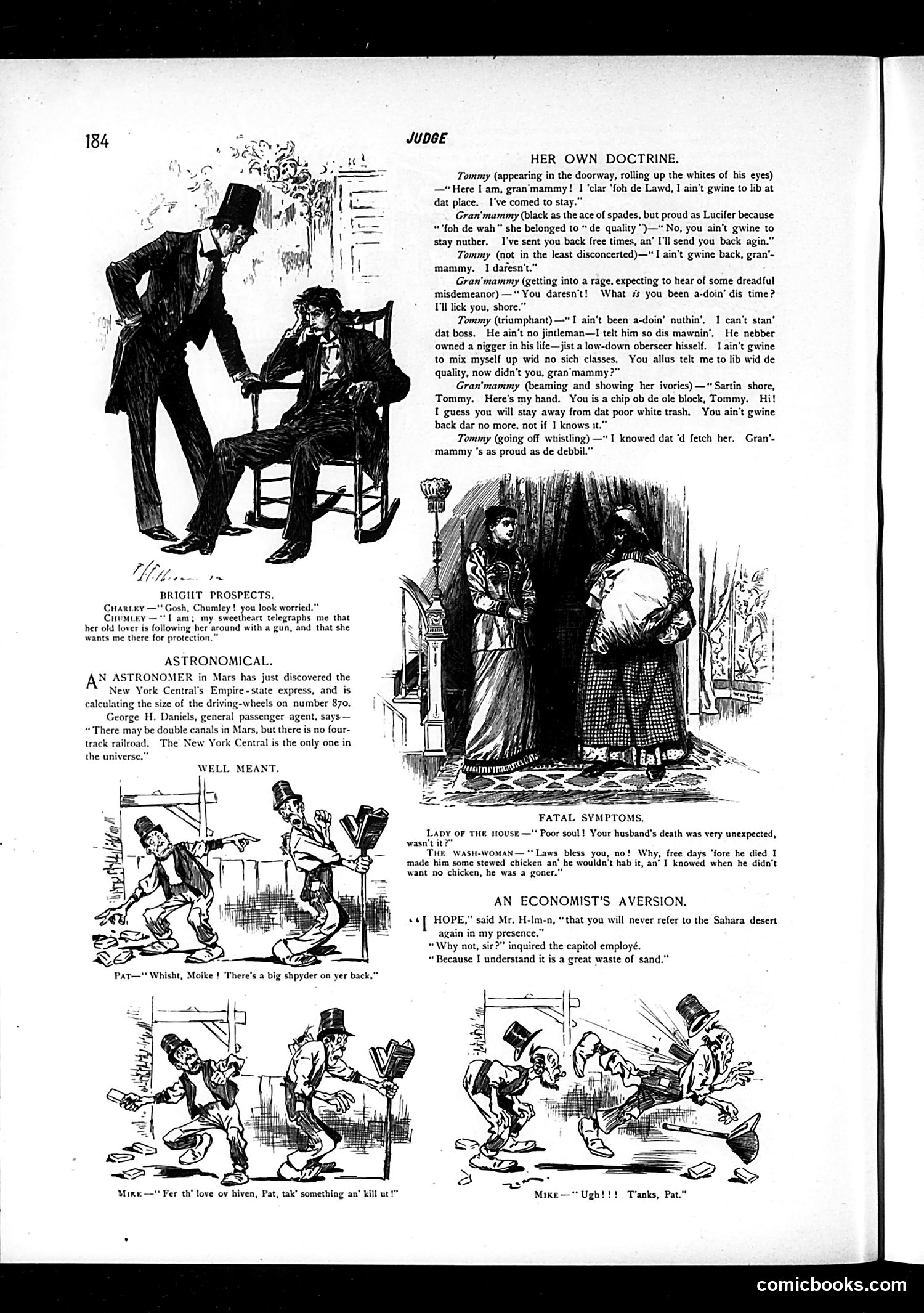
This page contains several satirical pieces typical of late 19th-century American humor: **"Her Own Doctrine"** presents a racist caricature dialogue between a formerly enslaved grandmother and her grandson Tommy. The satire targets the grandmother's class pretensions—she claims superiority based on pre-Civil War service to "quality" white people. Tommy cleverly uses her own snobbish doctrine against her, refusing to work for a "low-down overseer" (poor white man) because he's not "quality." The joke mocks both the absurdity of inherited class pride among formerly enslaved people and perhaps critiques post-Reconstruction class anxieties. The remaining items are brief wordplay jokes: **"Bright Prospects"** jokes about a jealous rival with a gun—light romantic humor. **"Astronomical"** puns on the New York Central railroad as so massive it could be observed from Mars. **"Fatal Symptoms"** and **"Economist's Aversion"** are simple punchline gags about chicken and desert "waste." The page reflects Judge's mix of satirical social commentary and light comedy, though the racial material uses period-offensive dialect and stereotypes.
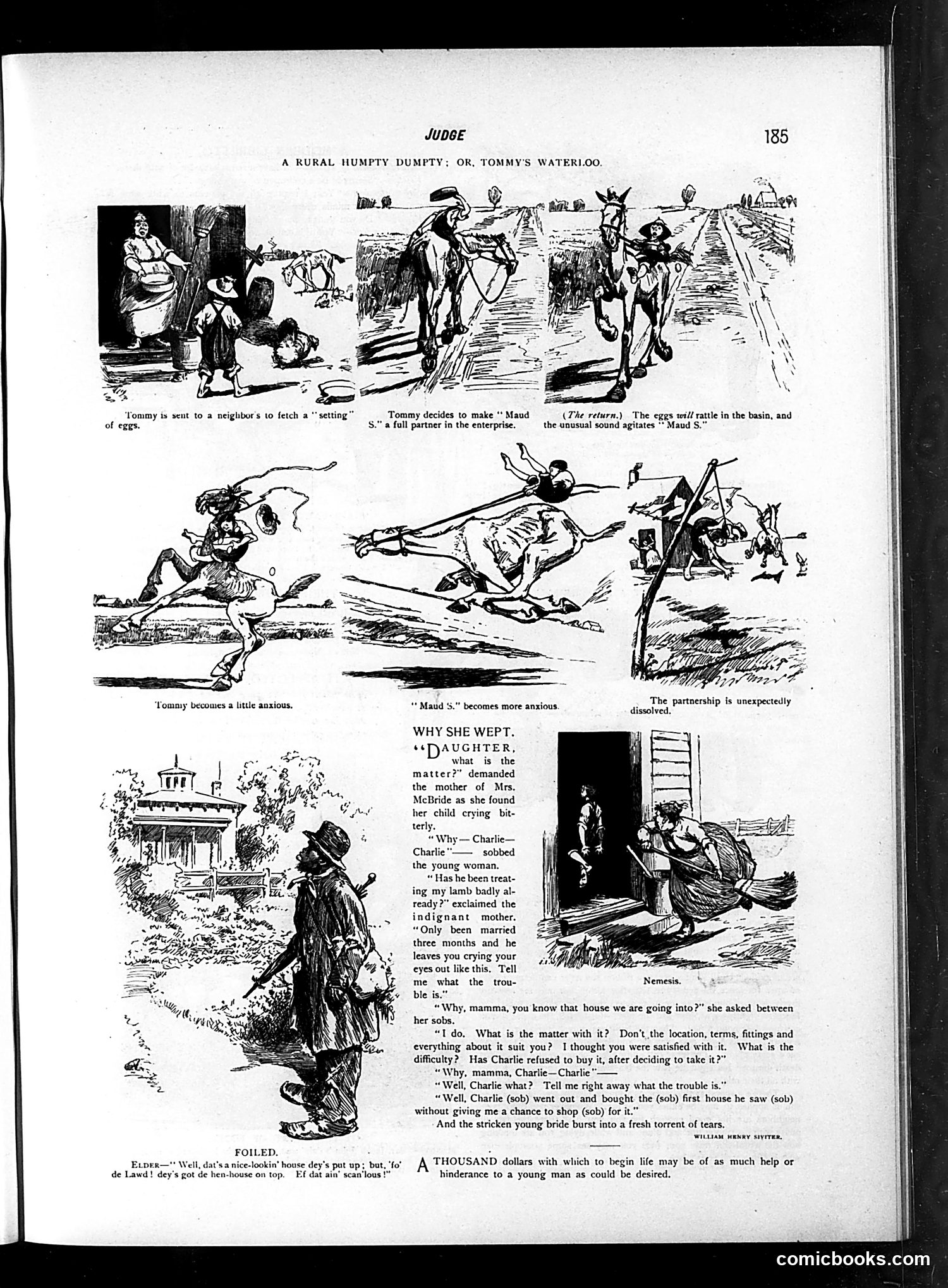
This page contains three separate satirical sketches typical of Judge magazine's humor: 1. **Top strip**: "Tommy's Waterloo" mocks rural life through a slapstick sequence where a boy named Tommy carries eggs in a basin while riding a horse named "Maud S." The eggs' rattling disturbs the horse, causing comic chaos. The satire targets both rustic incompetence and the contrast between genteel society (Maud S. appears to be a racehorse name) and farmyard reality. 2. **"Why She Wept"**: This sketch ridicules newlywed women's obsession with shopping and home decoration. A bride weeps because her husband bought their house without consulting her on furnishings—satirizing female consumer culture and marital expectations of the era. 3. **"Foiled"**: A brief caption mocking rural architectural absurdity, where someone builds a hen-house atop their home. The sketches collectively mock rural/working-class life, female materialism, and domestic incompetence through exaggerated character types typical of late-19th-century American satire.
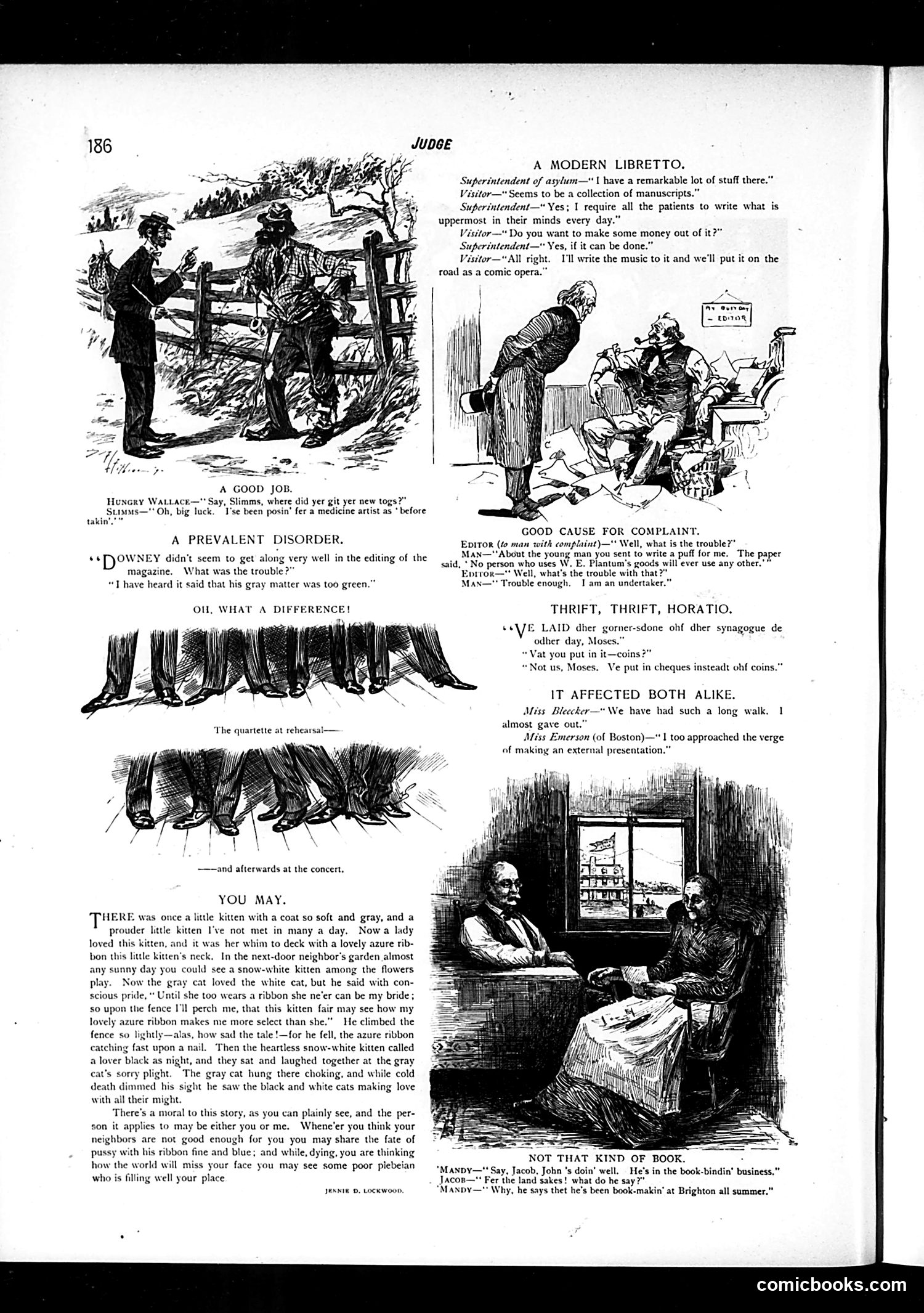
This page contains multiple satirical vignettes typical of late 19th-century American humor: **"A Modern Libretto"** mocks the therapeutic practice of having asylum patients write daily. A visitor suggests turning their writings into a comic opera—satire on both psychiatry's trendy methods and the commercialization of human suffering. **"A Good Job"** shows a Black man (Slimms) who's been posing as a model for a "medicine artist"—likely advertising patent medicines. The joke plays on exploitation of poor laborers. **"A Prevalent Disorder"** jokes about a newspaper editor complaining that a young writer hired to write promotional "puffs" (advertisements) was too inexperienced—satirizing both puff journalism and editorial incompetence. **"You May"** is a sentimental fable about a proud gray cat wearing a blue ribbon, rejected by a white cat, who then dies watching the white cat with a black cat. The moral warns against social snobbery based on status symbols. The remaining sections use ethnic humor and class-based jokes typical of the era. Overall, the page satirizes contemporary institutions (asylums, medicine, journalism) and social pretension.
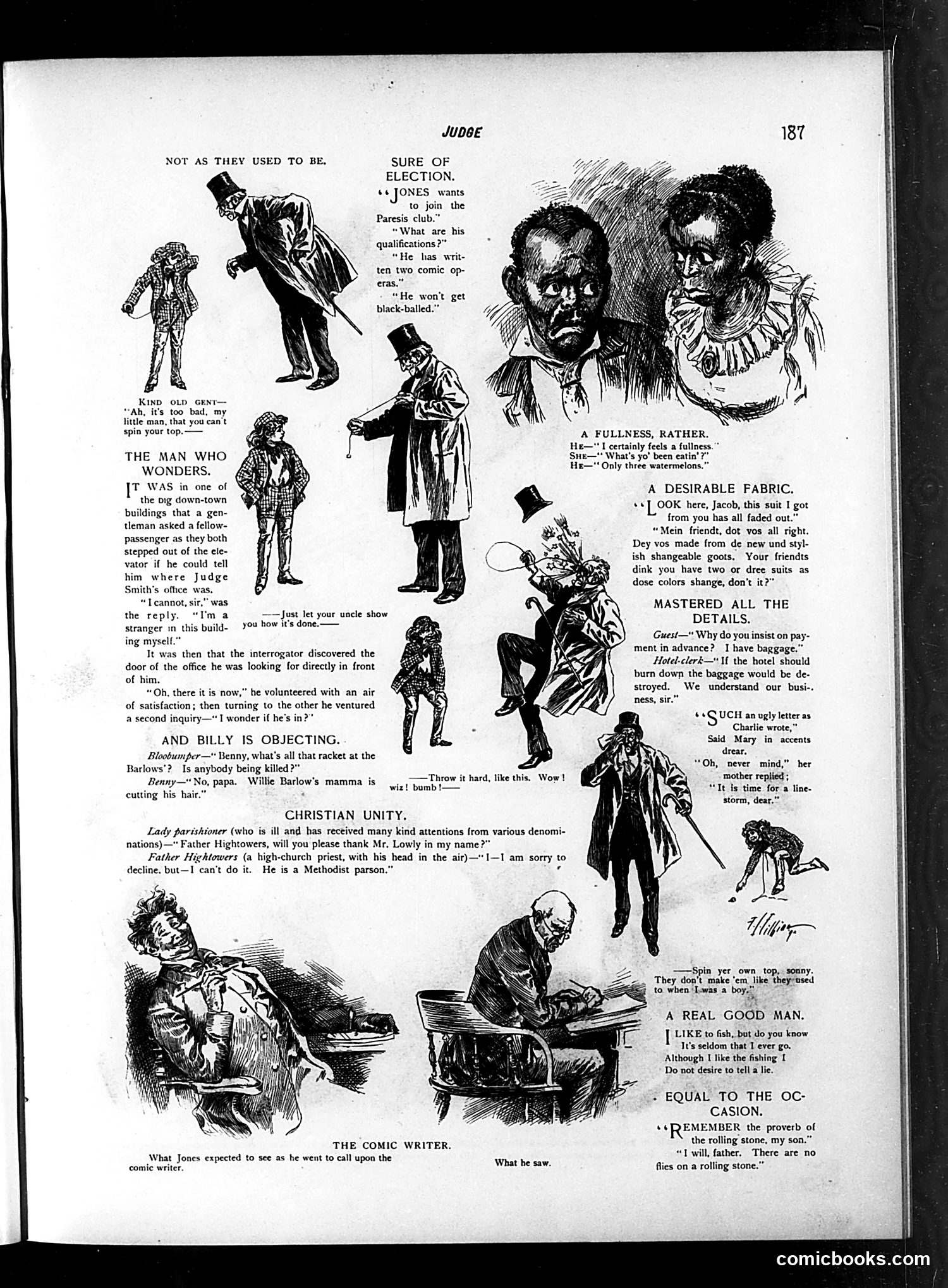
This page contains multiple satirical vignettes mocking various social pretensions and absurdities of the era: **"The Man Who Wonders"**: A man asks a passenger directions but discovers the office door was directly in front of him—satire on absent-mindedness or obliviousness. **"Sure of Election"**: Jones qualifies for the Paresis Club (a real social club for theater people) because he wrote comic operas, despite the implication that he won't be "blackballed"—likely mocking theatrical self-importance. **"Christian Unity"**: A Catholic priest refuses to thank a Methodist minister on behalf of an ill parishioner, satirizing sectarian religious snobbery and hypocrisy despite stated Christian unity. **Other sketches** mock dialect humor (Jewish tailor, rural characters), domestic quarrels, and fabrications—typical Judge fare using ethnic stereotypes and class-based humor common to the era. The overall tone targets social pretension, religious bigotry, and foolish behavior across classes, characteristic of Judge's satirical approach.
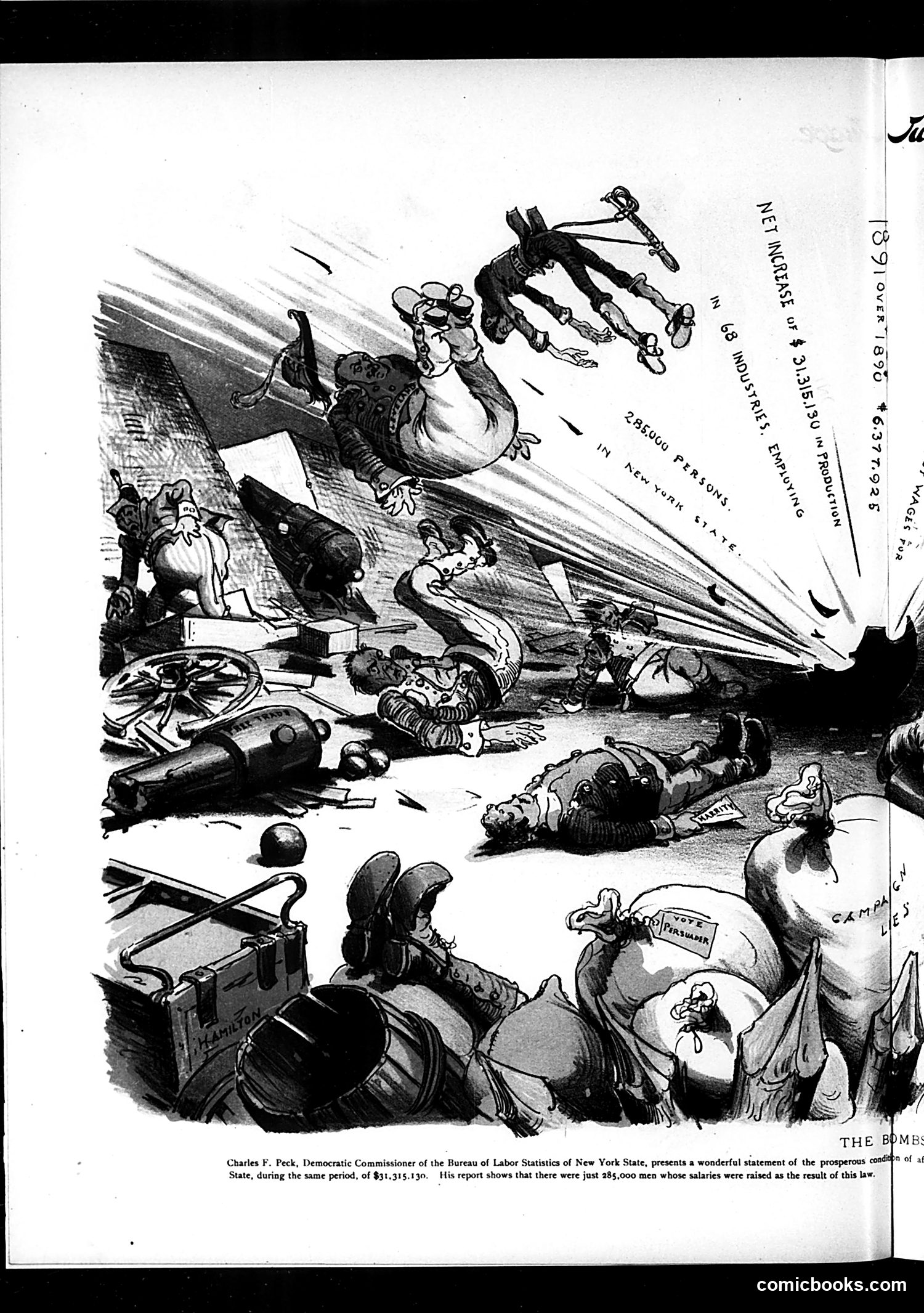
This political cartoon satirizes Charles F. Peck, Democratic Commissioner of the New York State Bureau of Labor Statistics, and his claims about the benefits of labor legislation (likely a minimum wage or salary increase law). The cartoon depicts an explosion of chaos—dead and injured bodies, scattered weapons and debris—to mock Peck's "wonderful statement" that only 285,000 workers received salary raises despite the state spending $31,315,130. The visual contradiction is the joke: Peck presents rosy statistics about prosperity and worker gains, but the imagery suggests the law caused economic devastation instead. This appears to be Republican/conservative criticism of Democratic labor policy, using dark humor to argue that expensive government intervention on behalf of workers actually harmed the economy rather than helping it.
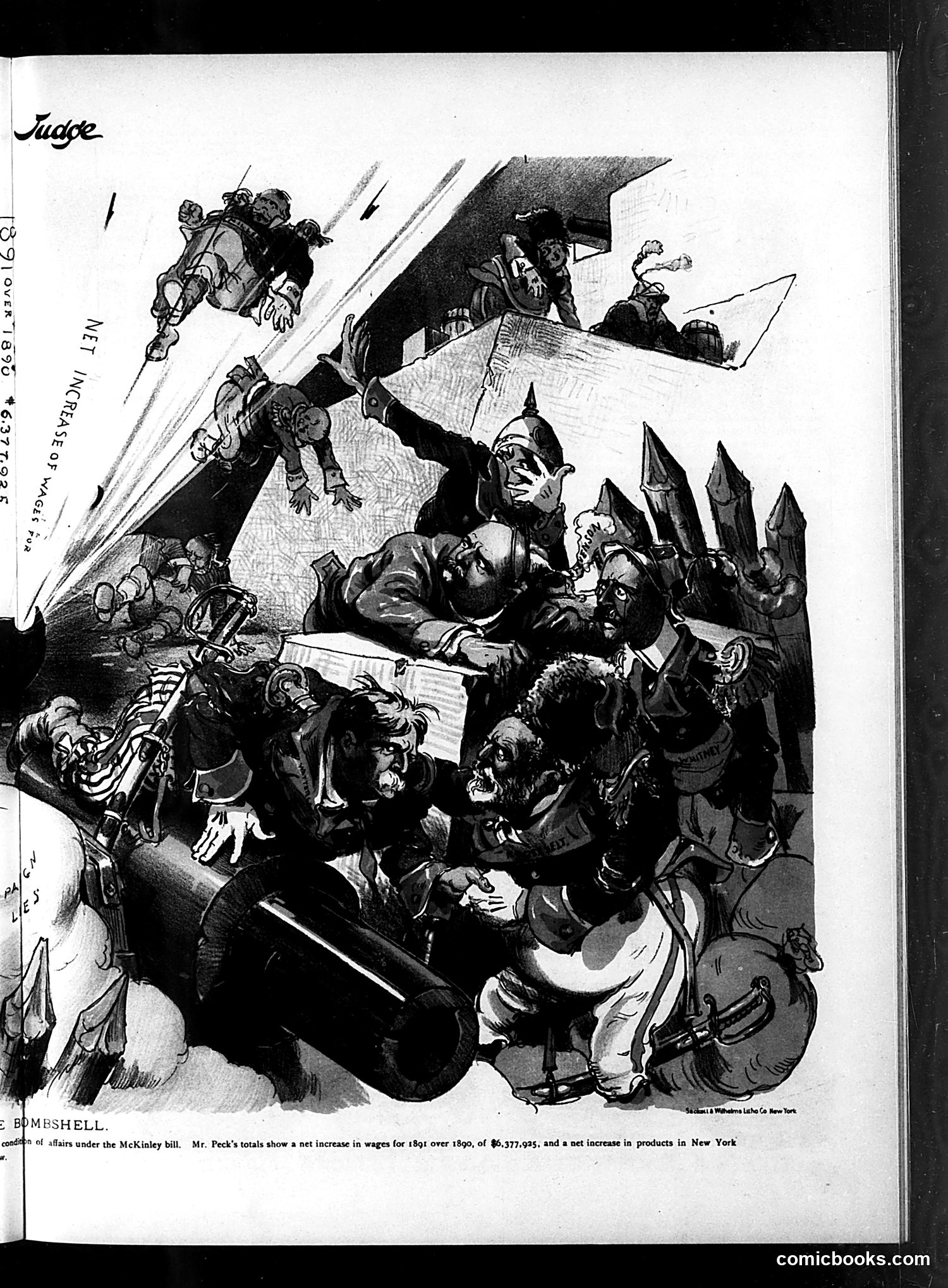
This Judge magazine cartoon satirizes the McKinley Tariff Bill's economic claims. The illustration depicts figures in military/governmental dress (appearing to represent McKinley administration officials) presenting statistics to what looks like industrial workers or citizens below—rendered with exaggerated, somewhat grotesque features typical of period satirical art. The "bombshell" refers to Mr. Peck's wage statistics showing a $6.3 million net increase in wages for 1891 over 1890, supposedly proving the tariff's success. The cartoon's dramatic military imagery and chaotic composition suggest satirical skepticism: the cartoonist implies these rosy economic figures are being "dropped" on the public as propaganda rather than representing genuine worker benefit. The satire targets the gap between official tariff rhetoric and lived economic reality for ordinary Americans.
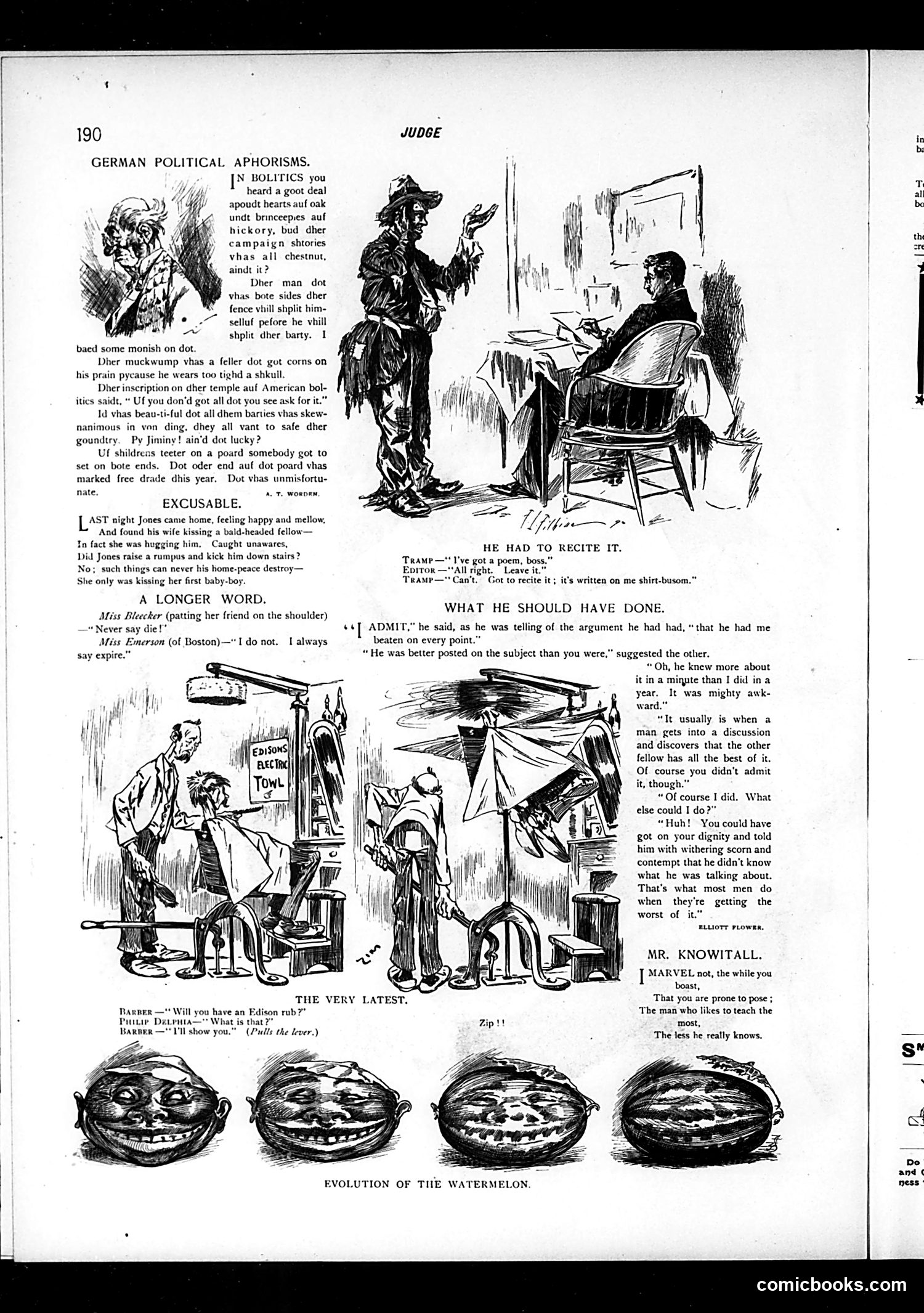
This page collects several satirical pieces typical of late 19th-century American humor: **"German Political Aphorisms"**: Mock-German dialect commentary on American politics, mocking both German immigrants and political hypocrisy. The aphorisms ridicule politicians who claim patriotism while pursuing self-interest, and satirize political flip-flopping ("free trade this year"). **"Excusable"**: A brief joke about a man finding his wife kissing a bald man—the "excusable" punchline being she's kissing their infant son, not committing infidelity. **"A Longer Word"**: Genteel Boston vs. practical Bostonian: one says "never say die," the other says "expire"—mocking pretentious euphemism. **"What He Should Have Done"**: Satirizes male pride in arguments; the moral is that dignity and false superiority matter more to men than intellectual honesty. **"The Very Latest"**: An Edison rub appears to be an electrical novelty device, mocked as absurd. **"Evolution of the Watermelon"**: Four progressive watermelon faces suggest minstrel-show imagery, likely racist caricature typical of the era.
This page is primarily **advertising**, with minimal editorial cartoon content. The few jokes present are brief one-liners: **The jokes that appear:** - A dying millionaire threatens to disinherit his heirs, forcing them to fight over his estate with lawyers—satirizing both family greed and the legal profession's parasitic nature. - A quip about the new quick-winding Waterbury watch ruining comedians' jokes about slow watches. - A comment on tariff debates being as difficult to follow as tracking ship movements at sea—likely referencing late-19th-century protectionist trade policy disputes. **The rest is advertising** for pianos, tobacco, watches, pens, suspenders, and patent medicines—typical of Judge's revenue model. Notable is an ad for Mrs. Winslow's Soothing Syrup, a real product containing laudanum (opium), legal at the time but now recognized as dangerous. The page reflects *Judge's* dual nature: satirical commentary on contemporary life alongside commercial messaging.
This page is primarily **advertising**, typical of late 19th-century magazines. The layout includes dozens of product advertisements (whiskey, cocoa, candy, bicycles, hotels) interspersed with brief humorous items and jokes. The small satirical content includes: - **A joke about luck and poverty**: "If you are poor do not take the knob off the front door so that Luck couldn't get in"—poking fun at superstitions and the poor's desperate hopes. - **Gender humor**: A woman's new dress fits so tightly "I can hardly move or breathe in it"—mocking restrictive Victorian fashion. - **Political jab at Queen Victoria**: Comparing her favorably to American politicians by saying she's "not sulking," likely referencing contemporary political complaints about petulant American leaders. The page reflects Gilded Age consumer culture and period attitudes toward women's fashion, class, and politics. Most space is devoted to selling products rather than satire.
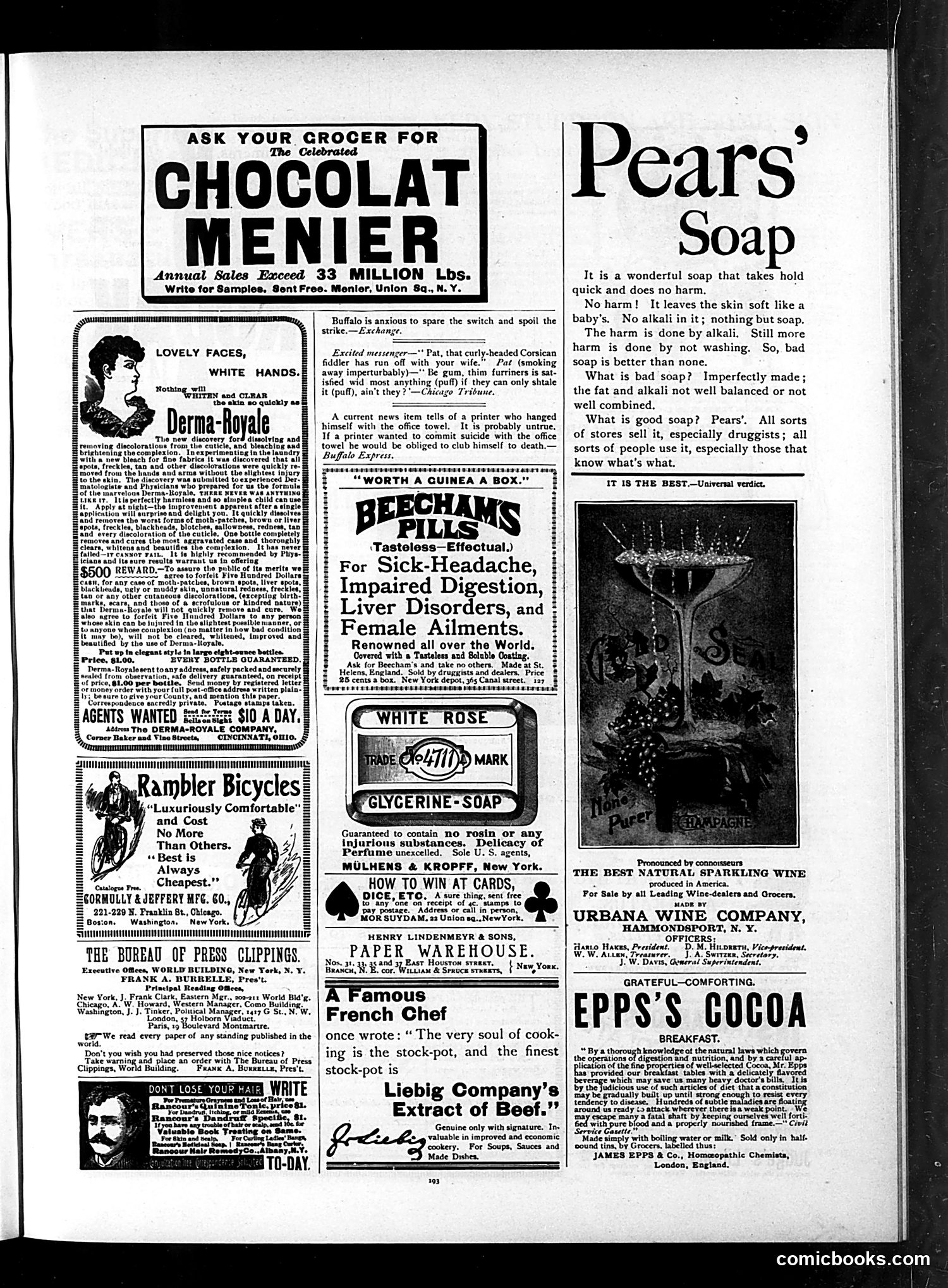
This is primarily an **advertising page** from Judge magazine, not a political cartoon. The page consists almost entirely of period advertisements for consumer products typical of the late 19th/early 20th century. Key advertisements include: - **Chocolat Menier**: Chocolate product with huge sales figures - **Derma-Royale**: Skin whitening cream promising to remove "moth-patches" and "brown spots"—reflecting era prejudices about complexion ideals - **Beecham's Pills**: Patent medicine for digestive and "female ailments" - **Pears' Soap**: Marketed as gentle and alkali-free - **Rambler Bicycles** and various other goods The few brief text items are minor jokes: one about a Corsican "fiddler" (likely referencing stereotypes), another mocking a suicide attempt using an office towel. The page illustrates how Judge functioned partly as a vehicle for advertising rather than primarily satire, and reveals period attitudes toward race, gender, and dubious patent medicines.
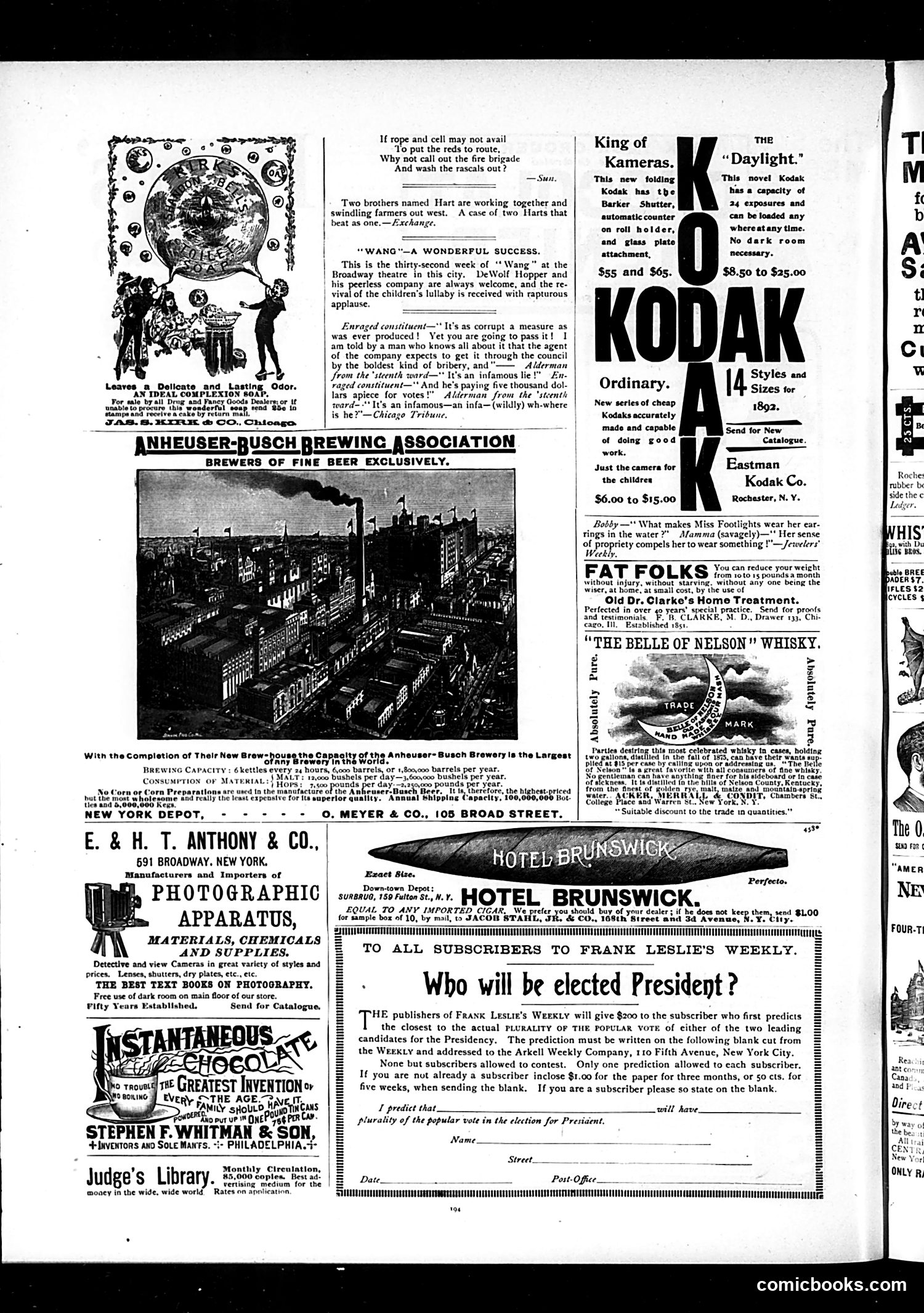
This page is primarily **advertising** with minimal editorial cartooning. The notable satirical content appears in brief **text-based jokes** rather than visual cartoons: **"WANG" Theater Reference**: A brief note mocking the "thirty-second week" of a theatrical production called "Wang," suggesting it's an unexpectedly long run for what may be considered lowbrow entertainment. **Alderman Corruption Joke**: The main satirical piece depicts an "enraged constituent" confronting a corrupt alderman about bribery in city council. The alderman's defensive denials—interrupting with "It's an infamous lie!"—while asking *where* the bribe-giver is located, satirizes urban political corruption of the Gilded Age. The humor lies in the alderman's implicit confirmation of guilt through his anxious questions. **Context**: Judge magazine regularly mocked urban machine politics and municipal corruption, common targets in 1890s American satire. The page is otherwise dominated by product advertisements (Kodak cameras, beer, soap, whisky) typical of period magazines.
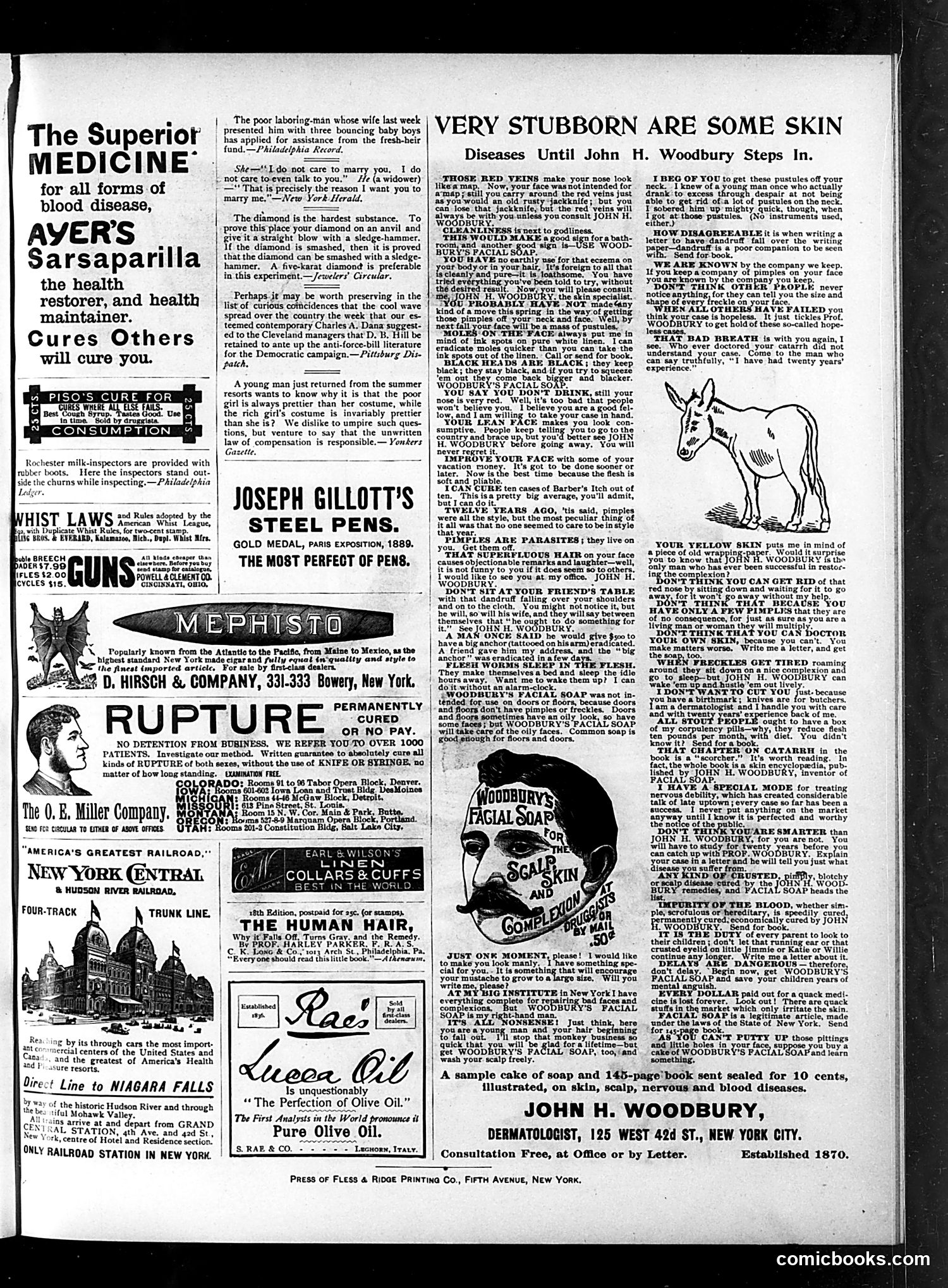
This page is predominantly **advertisements and brief satirical news items**, typical of Judge magazine's format. The main satirical content consists of short, punchy jokes about contemporary American life: - A jab at welfare: a poor laborer applies for "fresh-heir fund" assistance after his wife bears triplets - A widow-remarriage quip about a sheriff's counter-intuitive logic - A deadpan "experiment" proving diamonds can break (mocking pseudo-scientific claims) - A commentary on political maneuvering, comparing a Democratic campaign suggestion to a "cool wave" - Social satire on why poor girls seem prettier than their clothes, while rich girls' clothes outshine them The remaining content is period advertising for patent medicines (Ayer's Sarsaparilla for blood disease), steel pens, rupture cures, railroads, and other commercial products—standard for 1890s magazines. A dermatologist's advertisement for "Woodbury's Facial Soap" appears prominently at bottom. The overall tone is mildly cynical about marriage, wealth disparity, and government—characteristic Judge humor for this era.
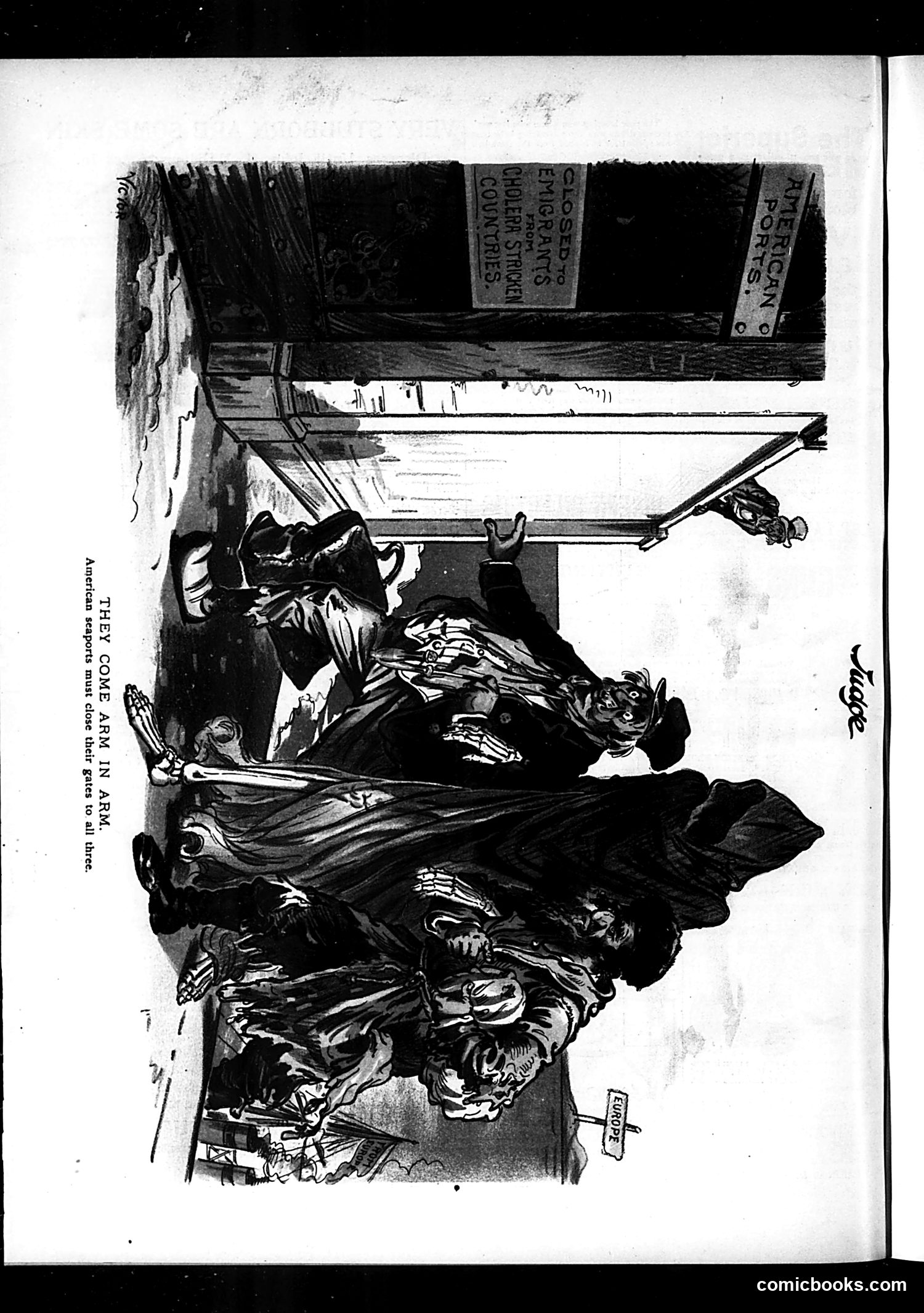
This appears to be a satirical cartoon from *Judge* magazine criticizing immigration or foreign influence at American ports. The image shows three figures "arm in arm" entering through a doorway or gateway, suggesting unwanted arrivals or alliances. The caption "They Come Arm in Arm" and the subtitle about closing seaport gates suggest the cartoon warns against allowing certain groups or nations entry to America. Given the historical context of *Judge* (a late 19th/early 20th-century publication), this likely references xenophobic anxieties about immigration or international relations during that period. However, **without clearer identification of the specific three figures**, I cannot definitively state which nationalities, political movements, or groups are being caricatured. The cartoon's exact satirical target remains unclear from the image alone.