
Judge, 1892-09-17 · page 3 of 16
Judge — September 17, 1892 — page 3: what you’re looking at
What you’re looking at
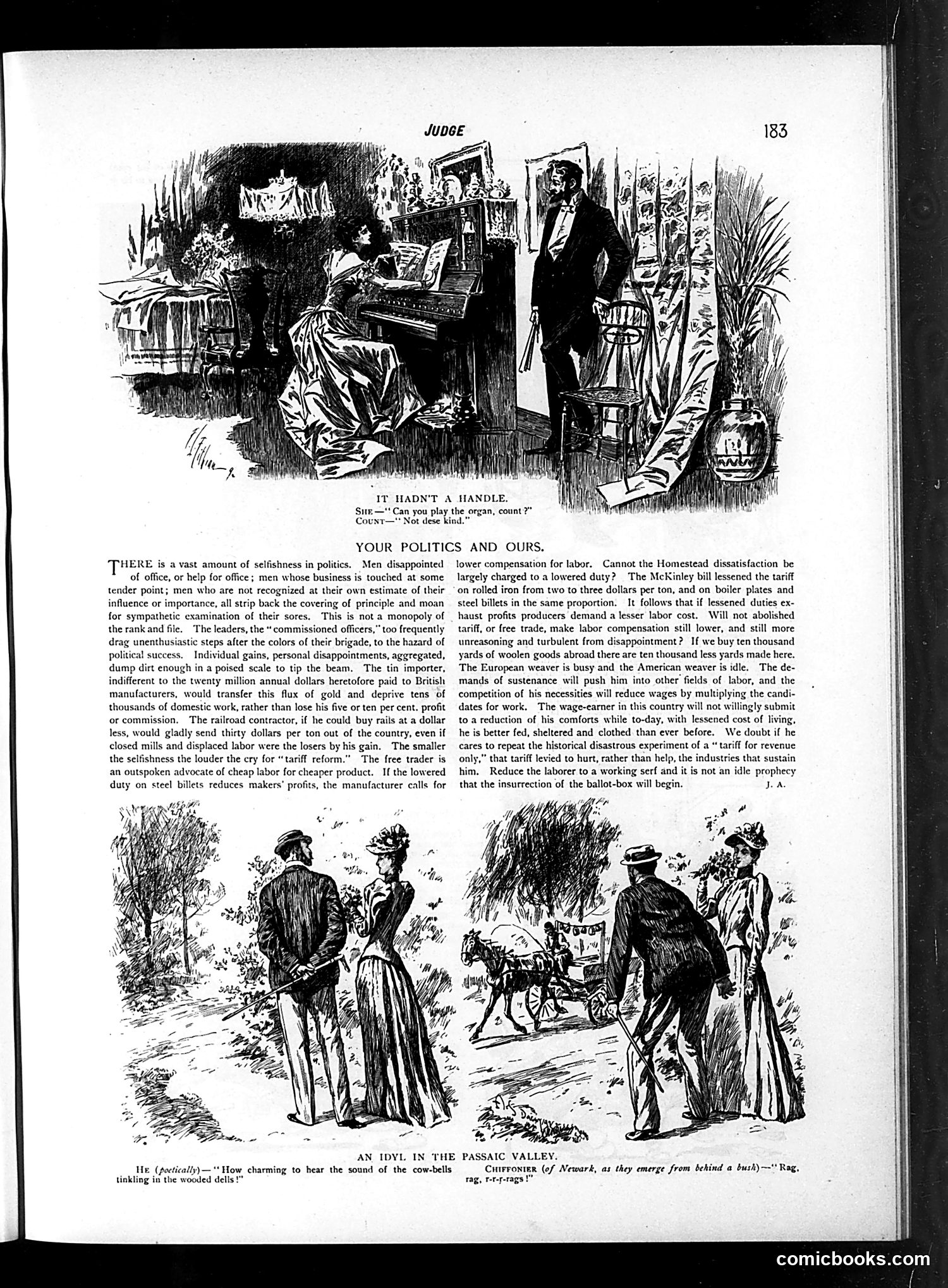
**Top Cartoon:** "It Hadn't a Handle" A woman plays organ for a count, who asks if she can play it. The joke is unclear from the image alone, likely a sexual or social double entendre about "handling" something. **Main Article:** "Your Politics and Ours" This editorial argues against tariff protectionism. It criticizes politicians who champion "tariff reform" to benefit wealthy industrialists while claiming to help workers. The author argues tariffs actually harm laborers by raising prices on goods while manufacturers exploit cheaper foreign competition. The piece advocates for removing tariffs to genuinely improve workers' conditions rather than preserving profits for industrialists. **Bottom Cartoon:** "An Idyl in the Passaic Valley" Rural figures discuss hearing cowbells—a sarcastic commentary on industrial pollution or development destroying pastoral landscapes.
📄 Transcribed text from this page (OCR, searchable)
Machine-transcribed from the original scan — historical spelling and the odd misread are preserved.
WEA \( Si hi you play the organ, count ?” Not dese kind.” YOUR POLITICS AND OURS. THERE is a vast amount of selfishness in politics. Men disappointed of office, or help for office; men whose business is touched at some tender point; men who are not recognized at their own estimate of their influence or importance, all strip back the covering of principle and moan for sympathetic examination of their sores, This is not a monopoly of the rank and file. The leaders, the “commissioned officers,” too frequently drag unenthusiastic steps after the colors of their brigade, to the hazard of political success. Individual gains, personal disappointments, aggregated, dump dirt enough in a poised scale to tip the beam. The tin importer, indifferent to the twenty million annual dollars heretofore paid to British manufacturers, would transfer this flux of gold and deprive tens of thousands of domestic work, rather than lose his five or ten per cent. profit or commission, The railroad contractor, if he could buy rails at a dollar less, would gladly send thirty dollars per ton out of the country, even if closed mills and displaced labor were the losers by his gain. The smaller the selfishness the louder the cry for “tariff reform.” The free trader is an outspoken advocate of cheap labor for cheaper product. If the lowered duty on steel billets reduces makers’ profits, the manufacturer calls for lower compensation for labor. Cannot the Homestead dissatisfaction be largely charged to a lowered duty? The McKinley bill lessened the tariff on rolled iron from two to three dollars per ton, and on boiler plates and steel billets in the same proportion. It follows that if lessened duties ex- haust profits producers demand a lesser labor cost. Will not abolished tariff, or free trade, make labor compensation still lower, and still more unreasoning and turbulent from disappointment? If we buy ten thousand yards of woolen goods abroad there are ten thousand less yards made here. The European weaver is busy and the American weaver is idle. The de- mands of sustenance will push him into other’ fields of labor, and the competition of his necessities will reduce wages by multiplying the candi- dates for work. The wage-earner in this country will not willingly submit to a reduction of his comforts while to-day, with lessened cost of living, he is better fed, sheltered and clothed than ever before. We doubt if he cares to repeat the historical disastrous experiment of a “ tariff for revenue only,” that tariff levied to hurt, rather than help, the industries that sustain him. Reduce the laborer to a working serf and it is not an idle prophecy that the insurrection of the ballot-box will begin. AN IDYL IN THE PASSAIC VALLEY. He (poetically) —‘* How charming to hear the sound of the cow-bells tinkling in the wooded dells !" Cirronter (of Newark, as they emerge from behind a bush)—" Rag, rag, rr-y-rags !" comicbooks.com