
Judge, 1892-09-17 · page 2 of 16
Judge — September 17, 1892 — page 2: what you’re looking at
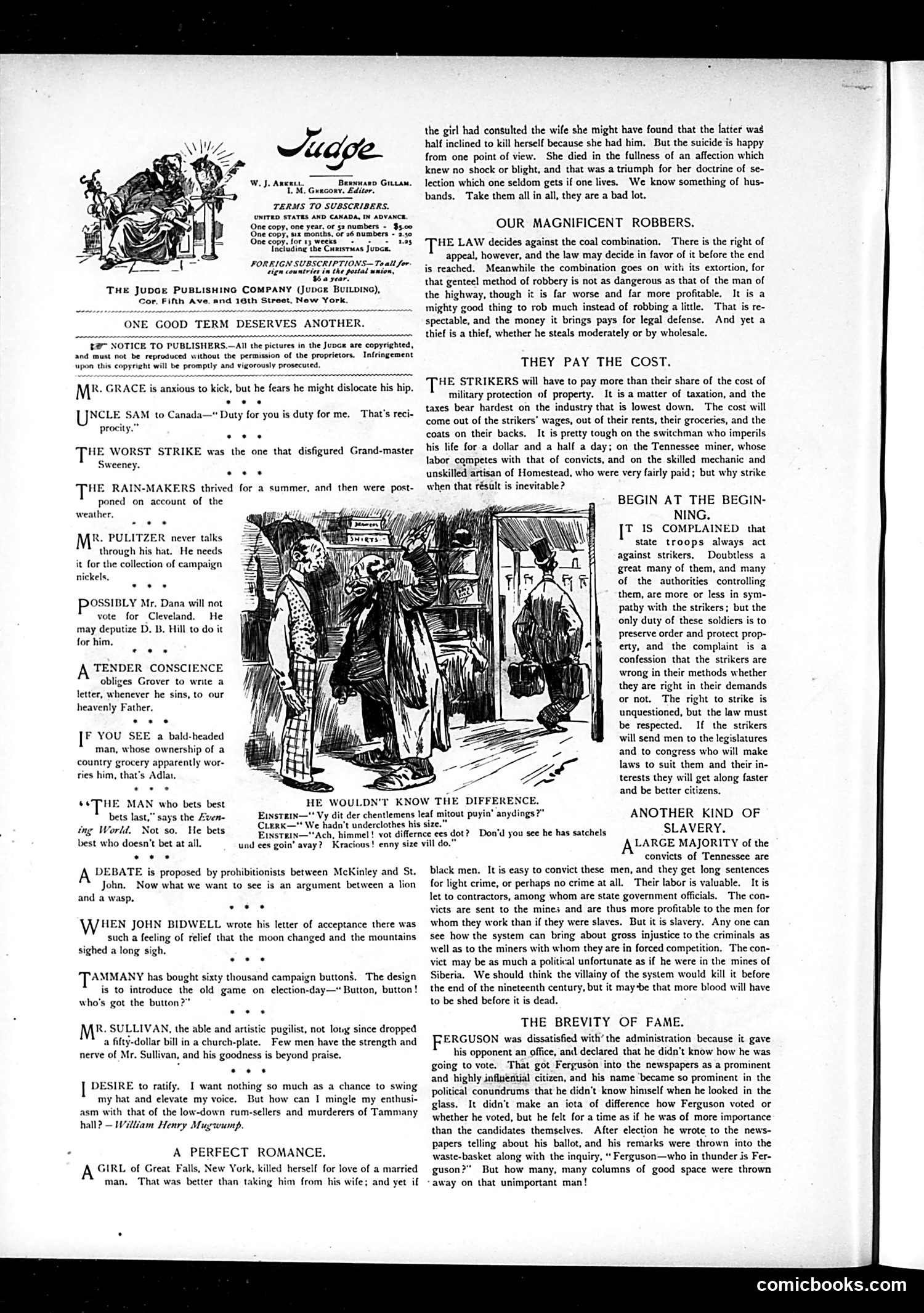
What you’re looking at
This page contains editorial commentary on labor strikes and law enforcement, likely from the early 1900s. The main cartoon, titled "He Wouldn't Know the Difference," depicts what appears to be a confrontation between strikers and authorities at a shop or factory entrance. The accompanying articles argue that strikers bear financial costs of strikes themselves (wages, rent, groceries) and question whether state troops sent to control strikes are truly impartial peacekeepers or sympathetic to strikers' methods. The commentary suggests strikers lack legal standing to demand change, positioning the magazine against labor activism. Other brief items mock political figures (Cleveland, McKinley, Grover, Dana) and discuss convicts and elections, reflecting Judge's conservative editorial stance on labor and politics of the era.
📄 Transcribed text from this page (OCR, searchable)
Machine-transcribed from the original scan — historical spelling and the odd misread are preserved.
omard GILLAM. uncony, Editor, TERMS TO SUBSCRIBERS. UNITRD STATES AND CAKADA, IN ADVANCE. One copy, one year, of 52 numbers - $5.00 One copy, six months, or 26 numbers - 2.30 One copy. for iy weeks === ag Including the Cumistwas Juocs. FOREIGN SUBSCRIPTIONS—Tealt for ‘ign countries in the pottal ‘a year. THE JUDGE PUBLISHING COMPANY (Jupcr BuILpINc), Cor. Fifth Ave. and 16th Street, New York. ONE GOOD TERM DESERVES ANOTHER. £27 NOTICE TO PUBLISHERS.—AIl the pictures in the Jupon are copyrighted, and must not be reproduced without the permission of the proprietors. Infringement upon this copyright will be promptly and vigorously prosecuted. M®: GRACE is anxious to kick, but he fears he might dislocate his hip. eee SAM to Canada—* Duty for you is duty for me. That's reci- Sweeney. HE RAIN-MAKERS thrived for a summer, and then were post- poned on account of the weather, oe MB: PULITZER never talks through his hat. He needs it for the collection of campaign nickels, POSSIBLY Mr. Dana will not vote for Cleveland. He may deputize D. B, Hill to do it for him. . R_ CONSCIENCE Grover to write a letter, whenever he sins, to our heavenly Father. TENDE A ob! IF YOU SEE a bald-headed man, whose ownership of a country grocery apparently wor- ries him, that’s Adlai. who bets best bets last,” says the Zven- ing World, Not so. He bets best who doesn’t bet at all. seTHE MAD WOULD: KNO! 'y dit der chentlemens | ‘e hadn't underclothes his und ees goin’ avay? Kracious! enny size . . A DEBATE is proposed by prohibitionists between McKinley and St. John, Now what we want to see is an argument between a lion and a wasp. WHEN JOHN BIDWELL wrote his letter of acceptance there was such a feeling of relief that the moon changed and the mountains sighed a long sigh. ‘TAMMANY has bought sixty thousand campaign button’. The design is to introduce the old game on clection-day— Button, button! who's got the button?” MB: SULLIVAN, the able and artistic pugilist, not long since dropped a fifty-dollar bill in a church-plate, Few men have the strength and nerve of Mr. Sullivan, and his goodness is beyond praise. | DESIRE to ratify. I want nothing so much as a chance to swing my hat and elevate my voice. But how can I mingle my enthusi- asm with that of the low-down rum-sellers and murderers of Tammany hall? — William Henry Mugwump. see A PERFECT ROMANCE. A GIRL of Great Falls, New York, killed herself for love of a mat man, ‘Ach, himmel ! vot differnce ees dot? That was better than taking him from his wife; and yet if the girl had consulted the wife she might have found that the latter was half inclined to kill herself because she had him, But the suicide is happy from one point of view. She died in the fullness of an affection which knew no shock or blight, and that was a triumph for her doctrine of se- lection which one seldom gets if one lives. We know something of hus- bands. Take them all in all, they are a bad lot. OUR MAGNIFICENT ROBBERS. HE LAW decides against the coal combination. There is the right of appeal, however, and the law may decide in favor of it before the end is reached. Meanwhile the combination goes on with its extortion, for that genteel method of robbery is not as dangerous as that of the man of the highway, though it is far worse and far more profitable. It is a mighty good thing to rob much instead of robbing a little. That is re- spectable, and the money it brings pays for legal defense. And yet a thief is a thief, whether he steals moderately or by wholesale. THEY PAY THE COST. HE STRIKERS will have to pay more than their share of the cost of military protection of property. It is a matter of taxation, and the taxes bear hardest on the industry that is lowest down. The cost will come out of the strikers’ wages, out of their rents, their groceries, and the coats on their backs. It is pretty tough on the switchman who imperils his life for a dollar and a half a day; on the Tennessee miner, whose labor competes with that of convicts, and on the skilled mechanic and unskilled artisan of Homestead, who were very fairly paid; but why strike when that résult is inevitable ? BEGIN AT THE BEGIN- NING, It IS COMPLAINED that state troops always act against strikers, Doubtless a great many of them, and many of the authorities controlling them, are more or less in sym- pathy with the strikers; but the only duty of these soldiers is to preserve order and protect prop- erty, and the complaint is a confession that the strikers are wrong in their methods whether they are right in their demands or not. The right to strike is unquestioned, but the law must be respected. If the strikers will send men to the legislatures and to congress who will make laws to suit them and their in- terests they will get along faster and be better citizens. ANOTHER KIND OF SLAVERY. LARGE MAJORITY of the convicts of Tennessee are black men. It is easy to convict these men, and they get long sentences for light crime, or perhaps no crime at all. Their labor is valuable. It is let to contractors, among whom are state government officials. The con- victs are sent to the mines and are thus more profitable to the men for whom they work than if they were slaves. But it is slavery, Any one can see how the system can bring about gross injustice to the criminals as well as to the miners with whom they are in forced competition, The con- vict_ may be as much a political unfortunate as if he were in the mines of Siberia. We should think the villainy of the system would kill it before the end of the nineteenth century, but it maybe that more blood will have to be shed before it is dead. THE BREVITY OF FAME. FERGUSON was dissatisfied with’ the administration because it gave his opponent an office, and declared that he didn’t know how he was going to vote. That got Ferguson into the newspapers as a prominent and highly influential citizen, and his name ‘became so prominent in the political conundrums that he didn’t know himself when he looked in the glass. It didn't make an iota of difference how Ferguson voted or whether he voted, but he felt for a time as if he was of more importance than the candidates themselves. After election he wrote to the news- papers telling about his ballot, and his remarks were thrown into the waste-basket along with the inquiry, * Ferguson—who in thunder is Fer- guson?” But how many, many columns of good space were thrown “away on that unimportant man! W THE DIFFERENCE. leat mitout puyin’ anydings?” size,” Don'd you see he has satchels vill do.” comicbooks.com