
A complete issue · 16 pages · 1892
Judge — August 20, 1892
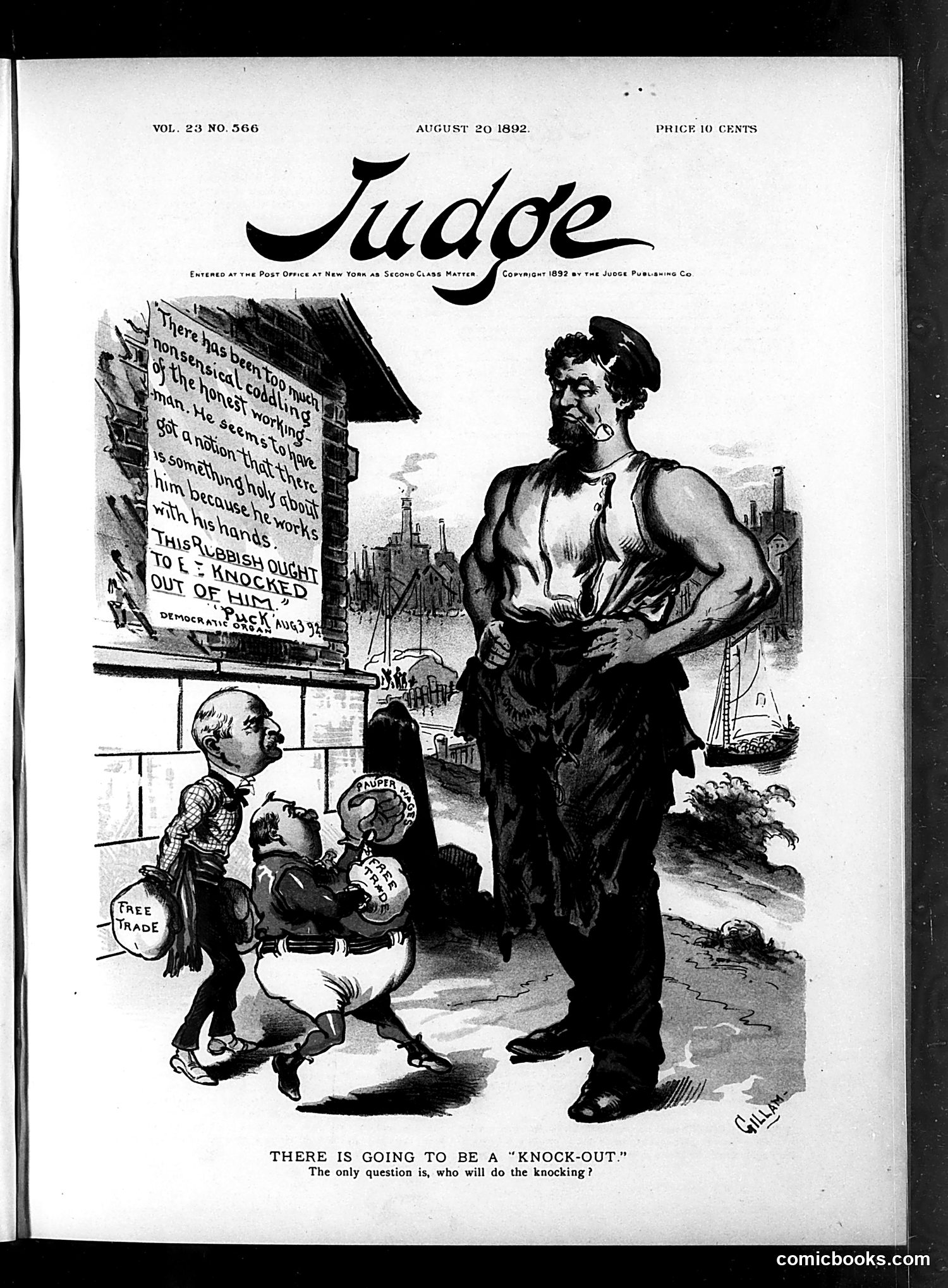
This satirical cartoon depicts a confrontation between a large, muscular worker figure and three smaller political figures labeled with "Free Trade," "Tariff," and other trade-policy positions. The placard behind references honest labor and working men being "knocked about" by political forces. The cartoon's title, "There is going to be a 'Knock-Out': The only question is, who will do the knocking?" suggests the 1892 presidential election centered on trade policy debates—likely protectionism versus free trade. The imposing worker represents American labor, portrayed as fed up with being pawns in political disputes. The smaller figures appear to represent competing political factions fighting over trade policy while the actual worker grows increasingly threatening.
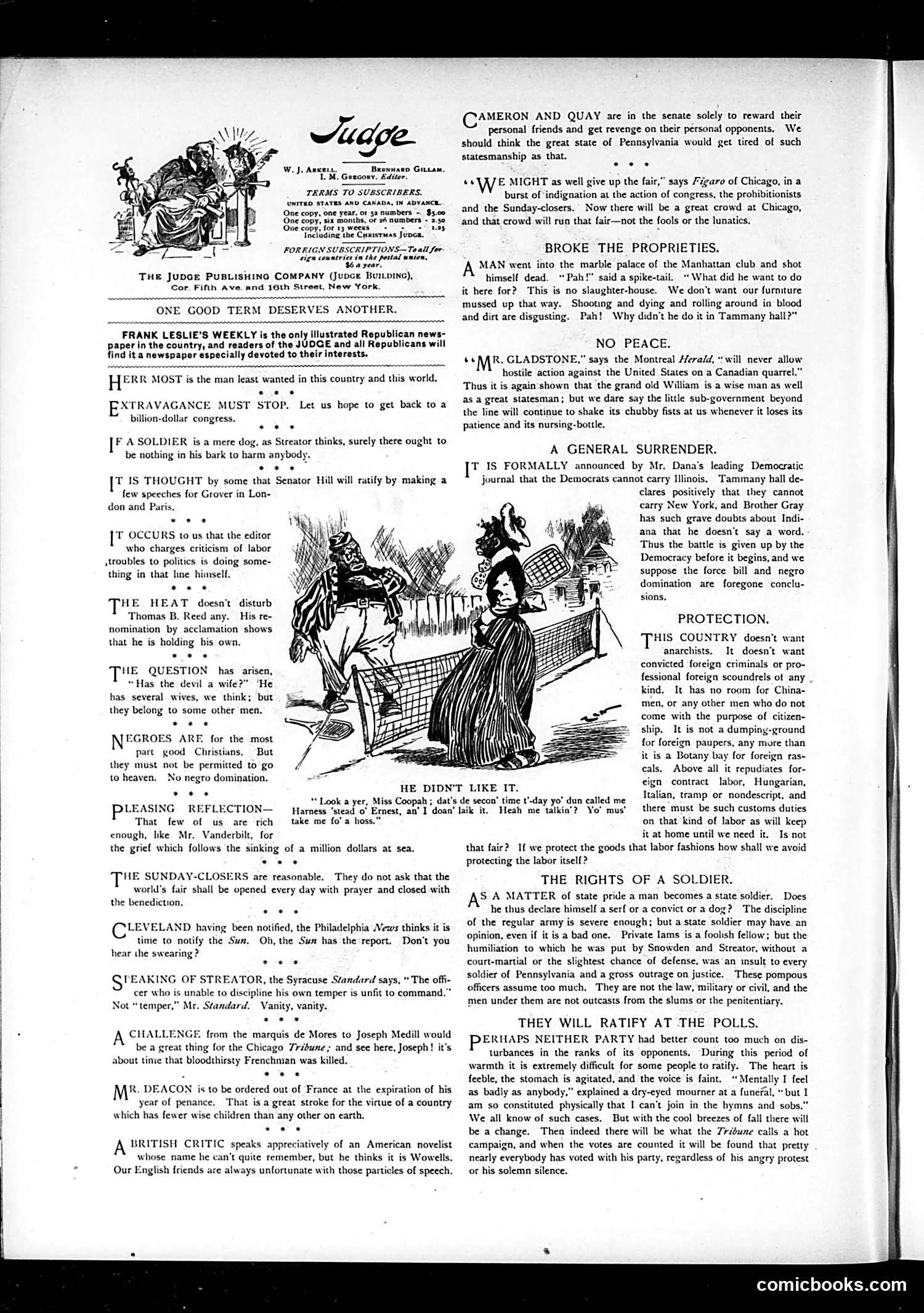
This page contains editorial commentary rather than traditional cartoons. The visible illustration depicts a domestic scene with a woman at a fence, appearing to reference social commentary about labor or domestic issues. The text references several political figures and issues: Senator Hill's potential candidacy for Grover Cleveland's position; Thomas B. Reed's nomination; debates about tariffs and "force bills"; and discussions of racial politics ("negroes," "negro domination"). The "He Didn't Like It" section mocks a specific incident involving horses and Ernest, suggesting personal/political embarrassment. References to the Tribune and Tribune newspaper indicate this page addresses contemporary 1890s political controversies. Without clearer image resolution, I cannot definitively identify all caricatures or specify exact events being satirized.
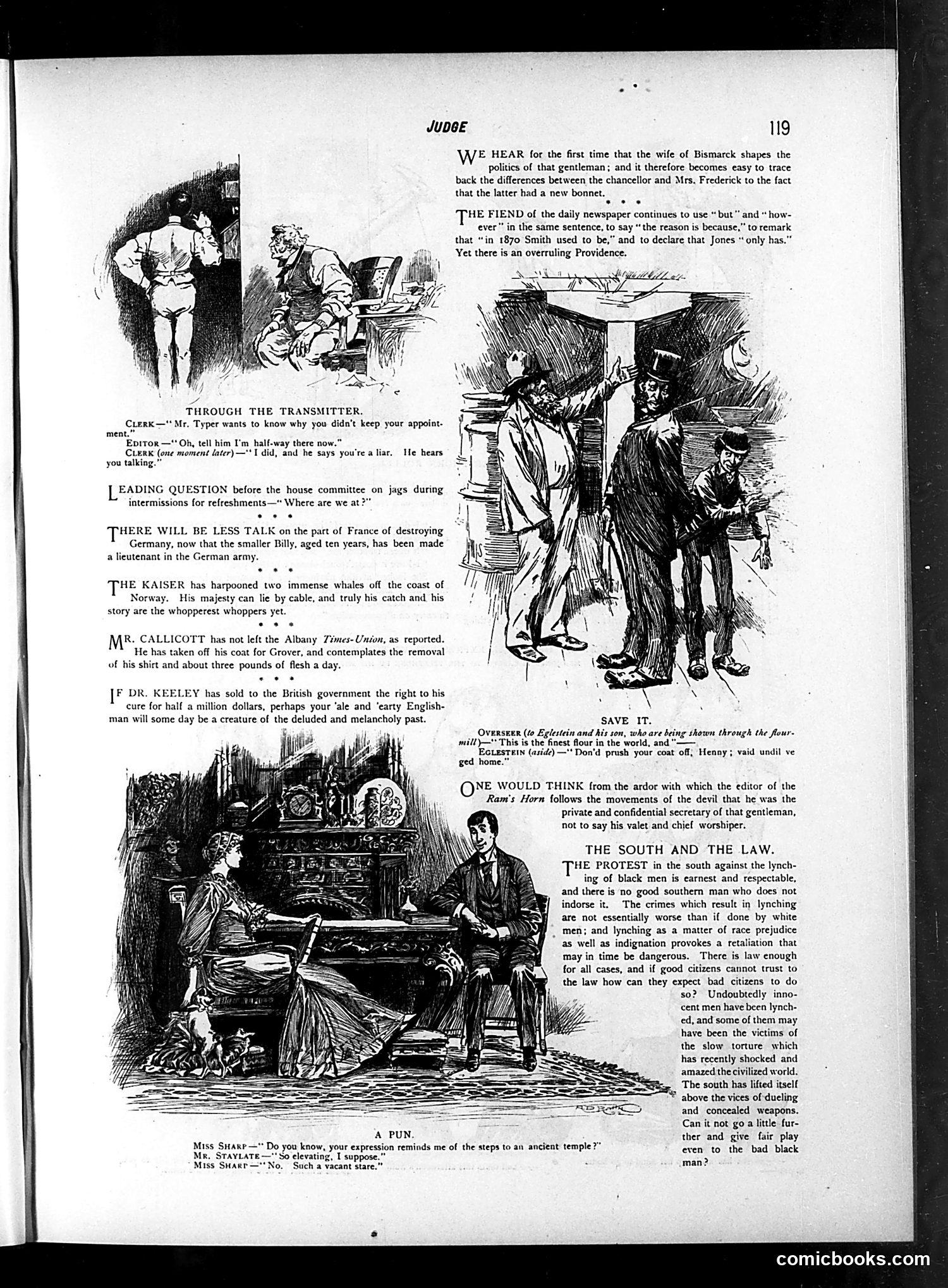
This page contains multiple satirical items addressing late 19th-century American politics and social issues: **"Through the Transmitter"** mocks newspaper gossip columns, showing a clerk relaying office rumors about someone named Typer missing an appointment. **"Save It"** appears to satirize political patronage, with an Overseer character warning about revealing secrets of a gentleman's private affairs. **"The South and the Law"** addresses lynching and racial violence in the American South. The text argues that while black criminals deserve punishment, lynch mobs undermine civil law. It advocates for fair legal proceedings even for "bad black men," suggesting that lynch violence disgraces southern society and undermines rule of law. The remaining items include brief satirical notes about political figures and social commentary typical of Judge's editorial approach.
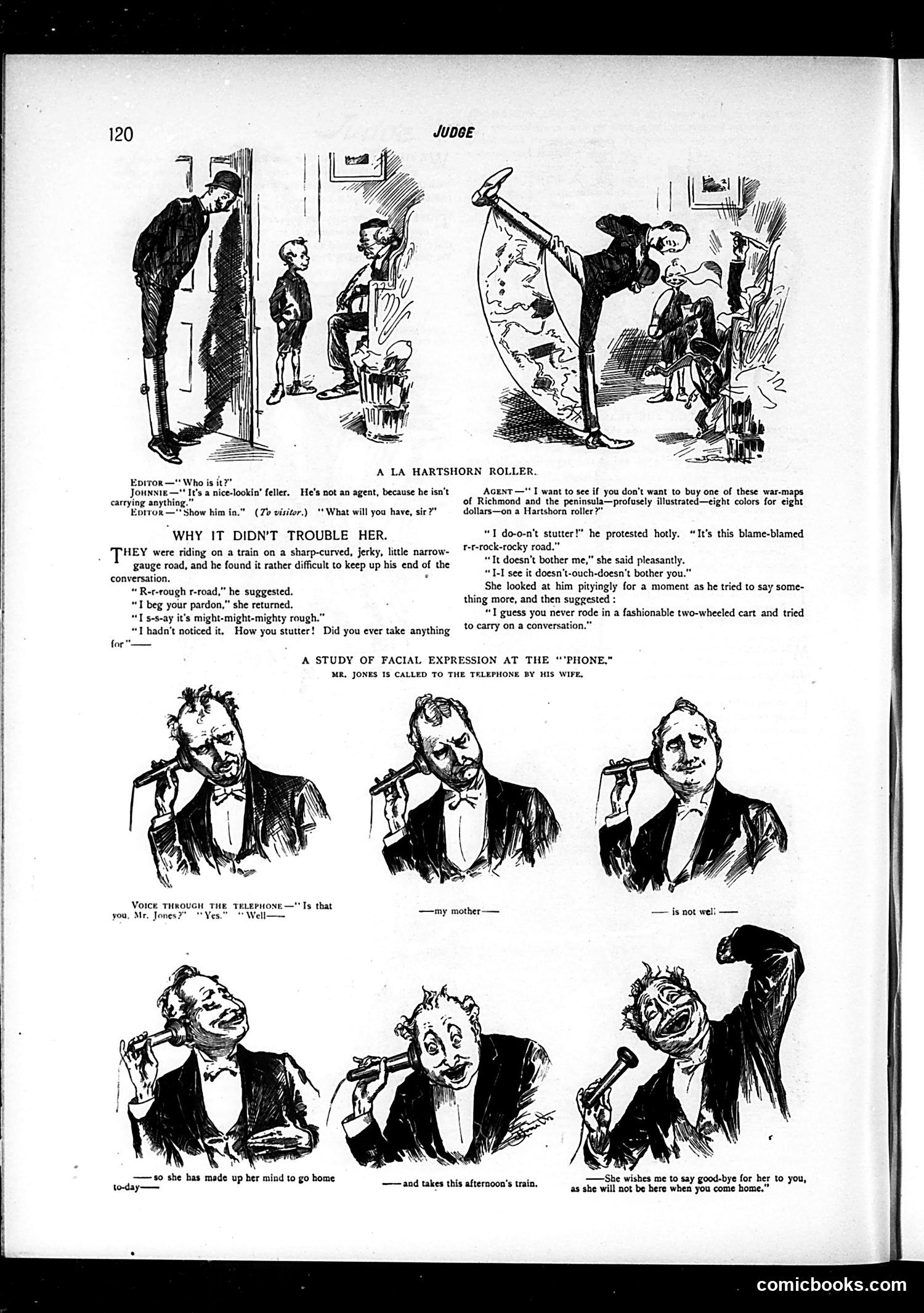
This page contains three satirical pieces typical of early 20th-century American humor. **"A la Hartshorn Roller"**: A visual gag about a magazine salesman pitching war maps (of Richmond and the peninsula, likely Civil War-era references) on a Hartshorn roller—a mechanical device for rolling up maps or documents. The humor plays on the absurdity of selling maps this way. **"Why It Didn't Trouble Her"**: Mocks a stuttering man trying to converse on a jerky train. His companion suggests he'd have similar difficulty maintaining conversation in a "fashionable two-wheeled cart"—satirizing both his speech impediment and the impracticality of courting in moving vehicles. **"A Study of Facial Expression at the Phone"**: Six panels showing Mr. Jones's increasingly dismayed expressions during a telephone call from his wife, who delivers bad news: her mother is visiting, has now decided to leave, and won't be home when he arrives. The satire targets domestic annoyances and the telephone's role in delivering unwelcome family news. All three pieces employ physical comedy and domestic situations for satirical effect.
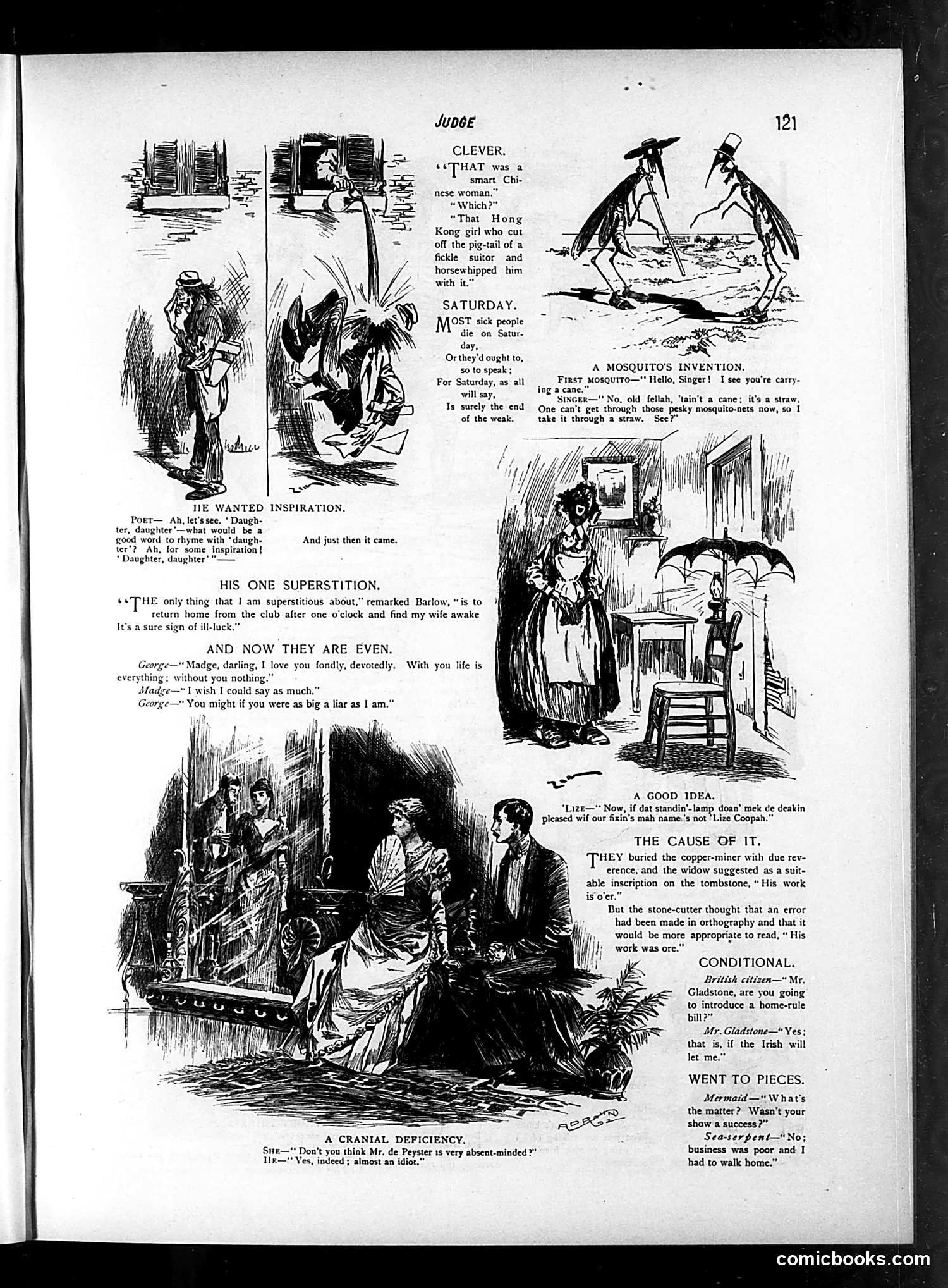
This page contains multiple brief satirical jokes typical of late 19th-century humor. Key items include: **"A Mosquito's Invention"**: Mocks mosquito nets (common malaria/disease prevention) by showing insects devising a workaround—using a straw to penetrate the netting. The humor targets both the pest problem and ineffective solutions. **"His One Superstition"**: A man claims his only superstition is bad luck when he returns home after 1 a.m. to find his wife awake—satirizing marital tension and nagging spouses as a common male anxiety. **"And Now They Are Even"**: Jokes about dishonesty in romance; a husband professes devotion, the wife admits she can't reciprocate, and he quips she'd need to be as big a liar as he is. **"The Cause of It"**: A pun on "His work is o'er" vs. "His work was ore"—a deceased copper-miner's tombstone inscription misread by a stone-cutter, playing on occupational vocabulary. **"Conditional"**: References William Gladstone and Irish home rule politics—the running debate of 1880s Britain. The page reflects genteel Victorian humor: marital comedy, puns, and political references for educated readers.
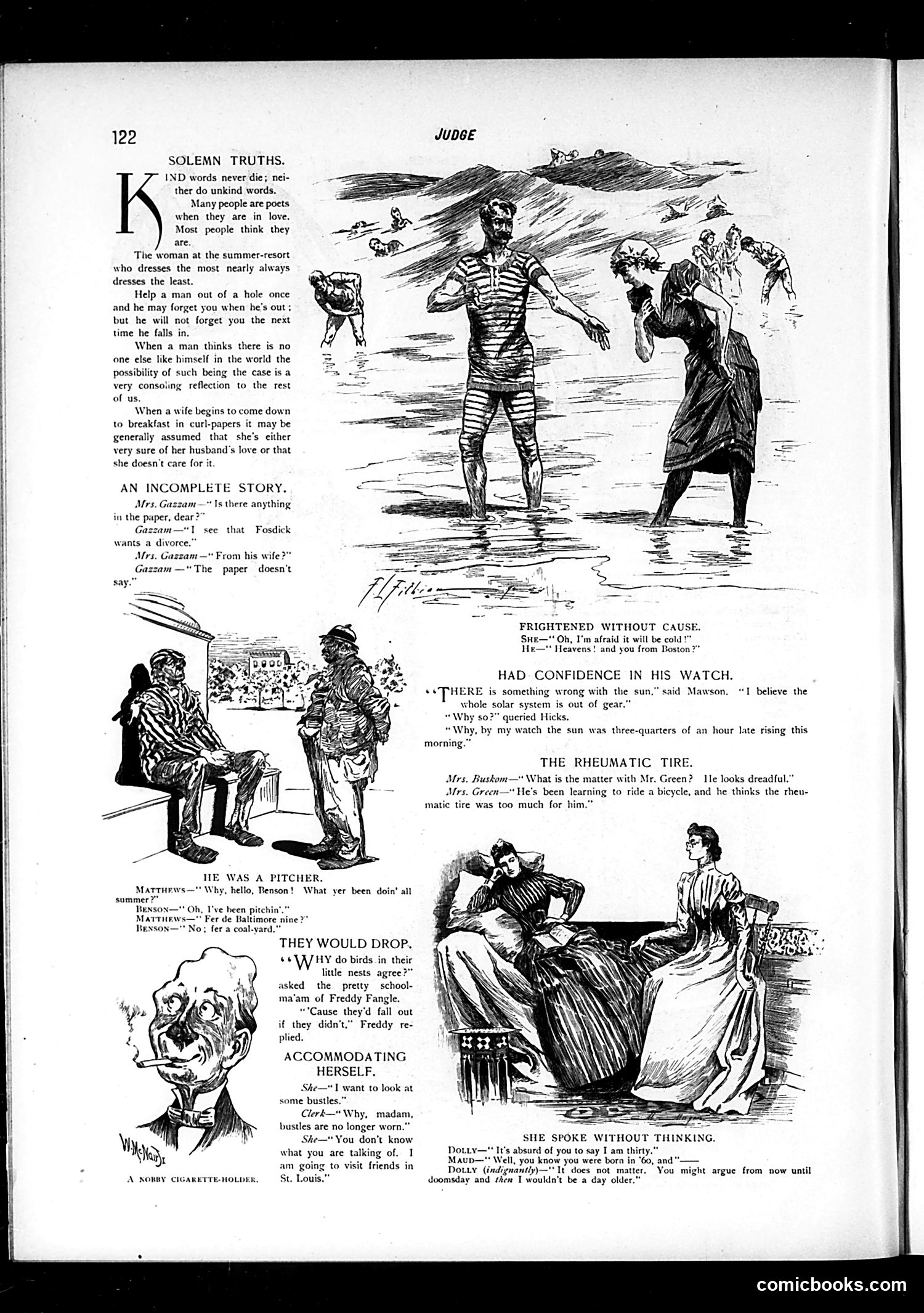
This page compiles brief humorous observations and comic vignettes typical of Judge's satirical format. The "Solemn Truths" section offers cynical social commentary—observations about human nature like "The woman at the summer-resort who dresses the most nearly always dresses the least" (mocking ostentatious wealth display). The individual cartoons mock everyday absurdities: a man confusing divorce proceedings, a failed baseball player, a woman's faulty logic about her age, and confused reasoning about sundials and bicycle tires. One sketch portrays outdated fashion (bustles), suggesting social critique of women's fashion cycles. The humor relies on period-specific references—bustles, bicycles, coal-yards—and conventional gender roles. The cartoons present stock scenarios (nagging wives, social pretension, generational gaps) designed for middle-class readers. The satirical thrust targets human vanity, logical fallacies, and social hypocrisy rather than specific political events, making this largely timeless social commentary with dated cultural markers.
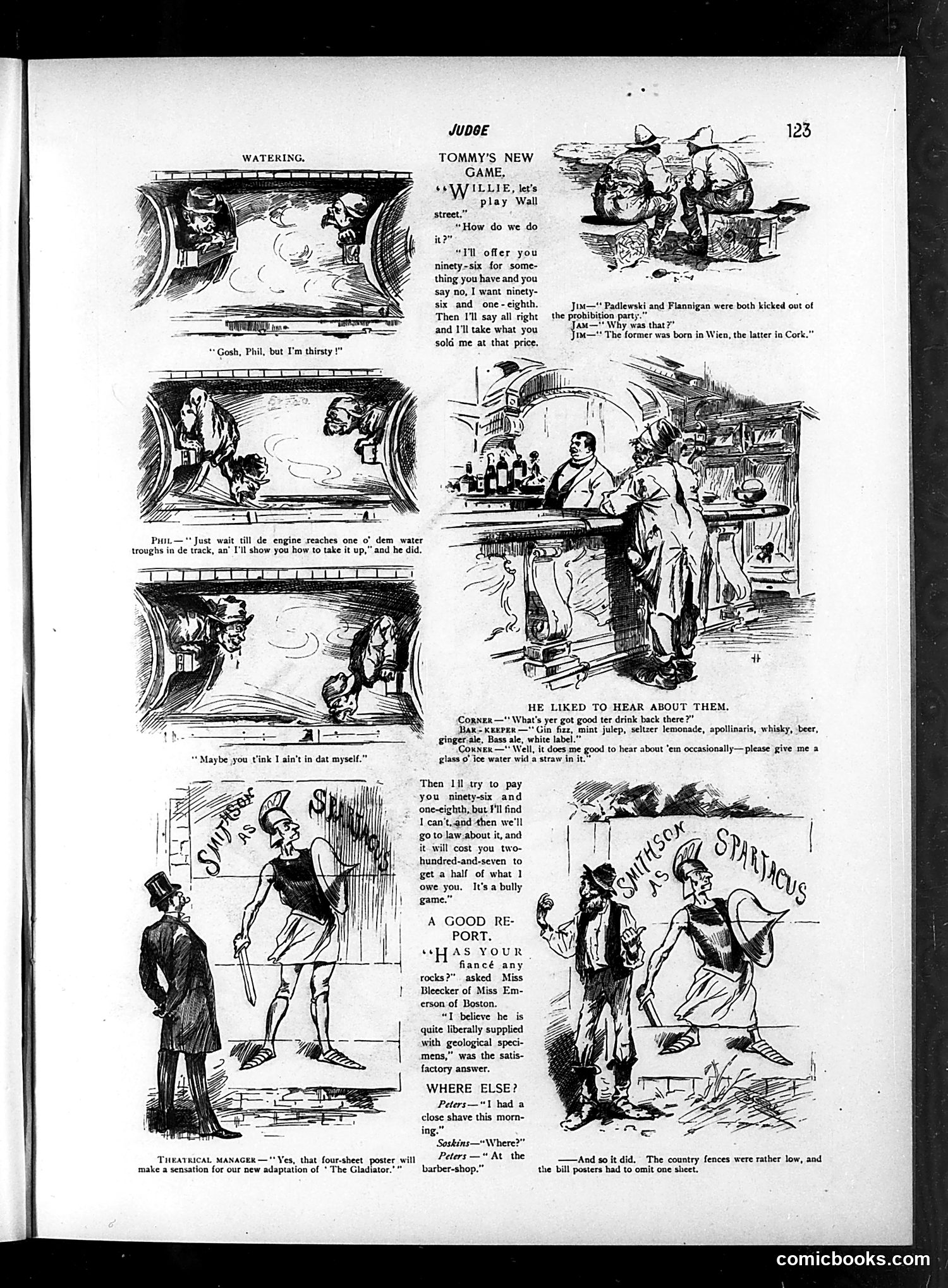
This page contains multiple brief satirical pieces typical of Judge magazine's format: **"Tommy's New Game"** mocks Wall Street stock trading through a child's simplistic game involving price manipulation and litigation—satirizing how real speculators engage in petty disputes that generate legal fees exceeding actual value. **"Watering"** appears to reference railroad practice of adding water to train engines at track stops, with a crude joke about the engine "taking it up." **"A Good Report"** plays on double meaning: when asked if her fiancé has "rocks" (slang for money/diamonds), the woman responds he has "geological specimens"—a clever wordplay suggesting he's wealthy in literal rocks/minerals rather than currency. **"Where Else?"** is a simple pun: a man got a close shave at a barber-shop (the obvious place for shaves). **The theatrical manager cartoon** jokes about poster sizing for a gladiator play adaptation, where low country fences forced bill-posters to omit sheets. These are light humor pieces rather than heavy political satire—typical Judge content mixing puns, social observation, and visual gags.
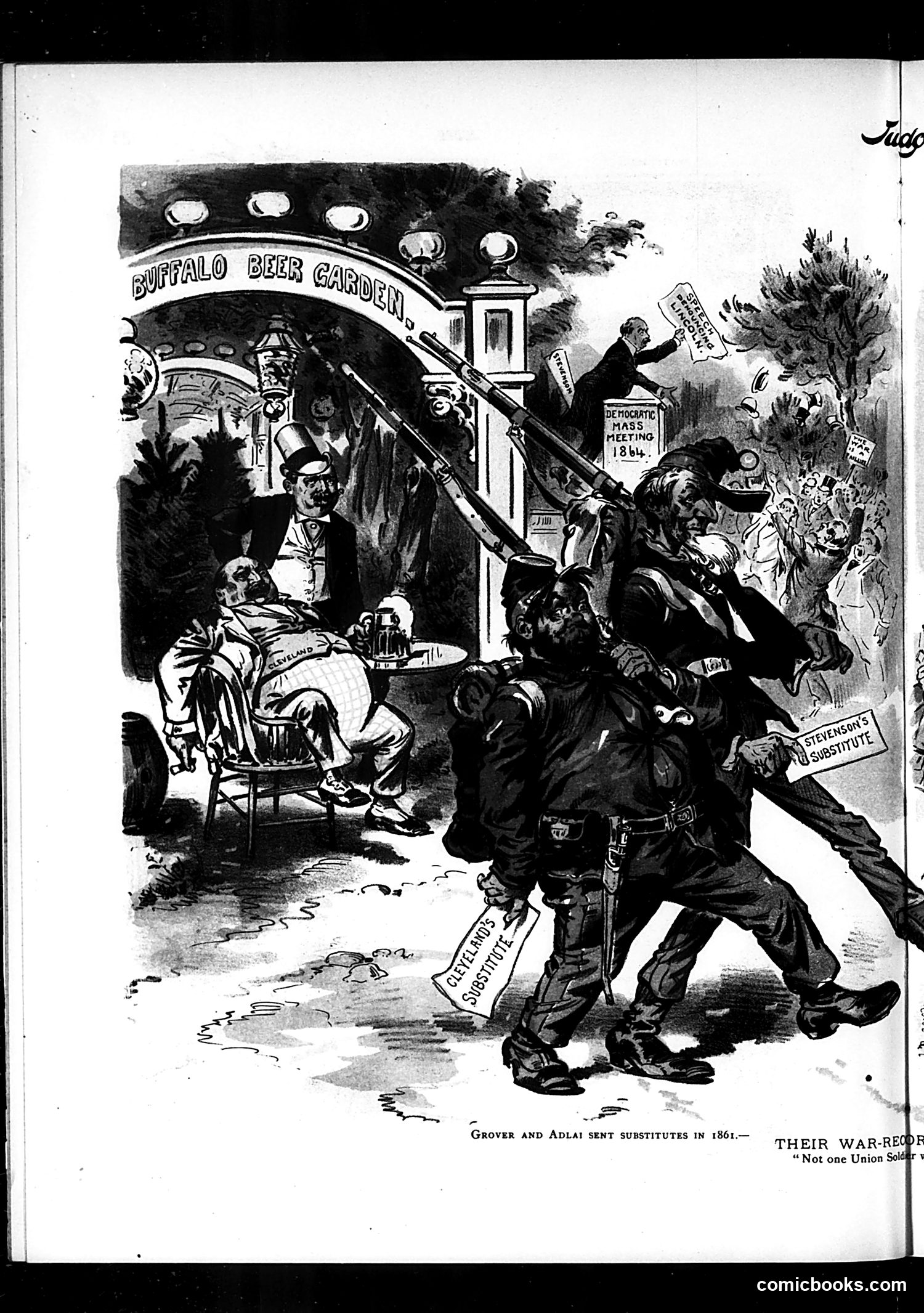
This Judge magazine cartoon satirizes Grover Cleveland and Adlai Stevenson (likely the 1892 Democratic ticket) by referencing their Civil War records. The title accuses them of sending substitutes to fight in 1861 instead of serving personally—a common practice among wealthy men who could afford replacements. The "Buffalo Beer Garden" setting and caricatured figures suggest these politicians enjoyed leisure while others fought. The visible signs referencing "Democratic Mass Meeting" and substitutes underscore the hypocrisy: they now claim patriotic credentials despite avoiding direct military service. This attacks their credibility as leaders, implying they avoided sacrifice during America's greatest crisis. The cartoon uses historical record to question their fitness for high office.
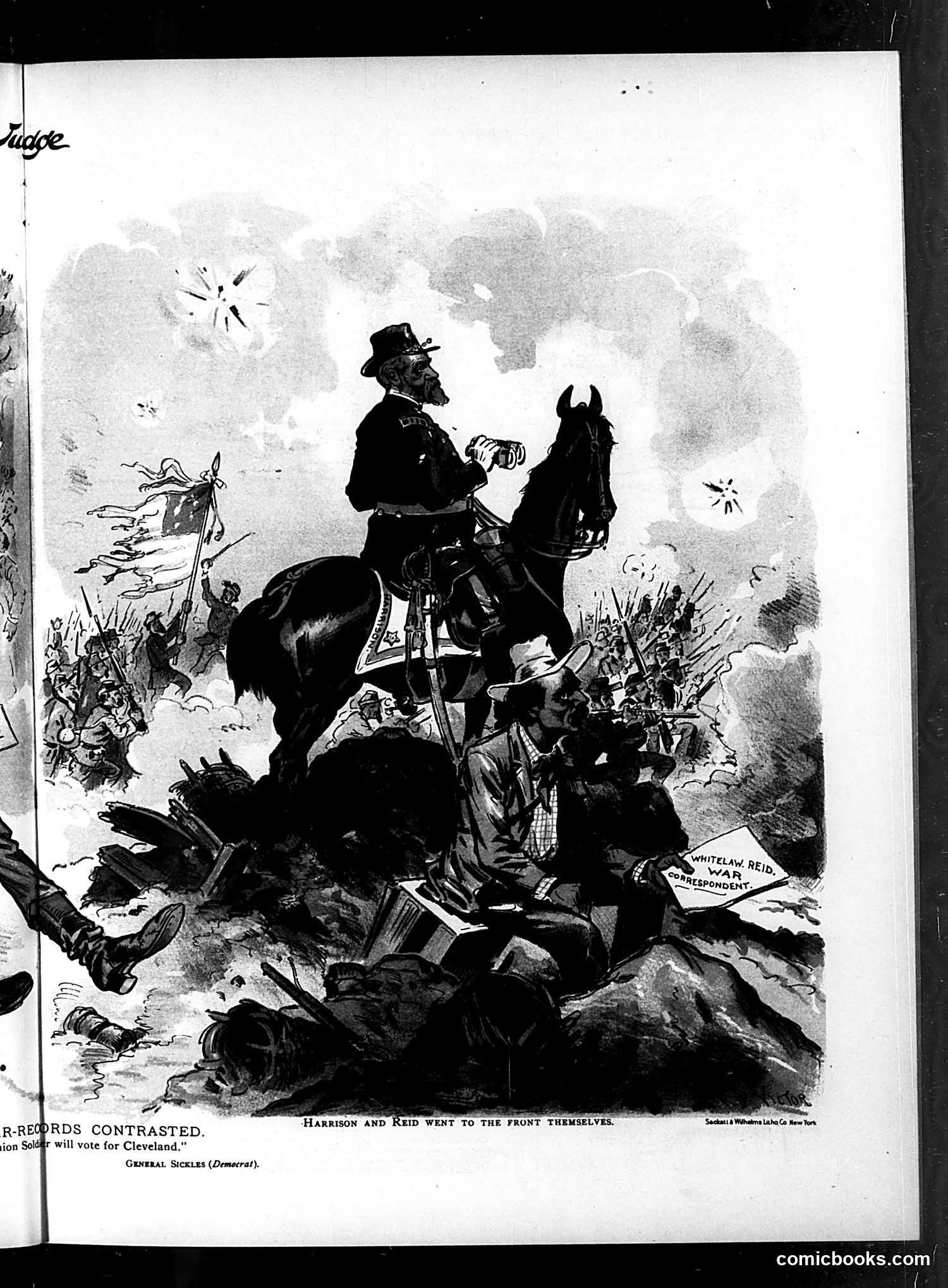
This Judge magazine cartoon contrasts military leadership records during what appears to be the late 19th century. The caption "Harrison and Reid went to the Front themselves" references Republican figures (likely President William Henry Harrison or Benjamin Harrison, and James G. Blaine's running mate Whitelaw Reid) who had military service records. The satire mocks Democratic General Sickles (identified in the OCR text), suggesting he lacked comparable front-line combat experience. The chaotic battle scene with explosions emphasizes actual warfare versus political claims. The phrase about soldiers voting for Cleveland references Democratic presidential candidate Grover Cleveland. The cartoon's purpose was to satirize Democratic candidates' military credentials while promoting Republican ones to voters—particularly soldiers—in what appears to be an election campaign context.
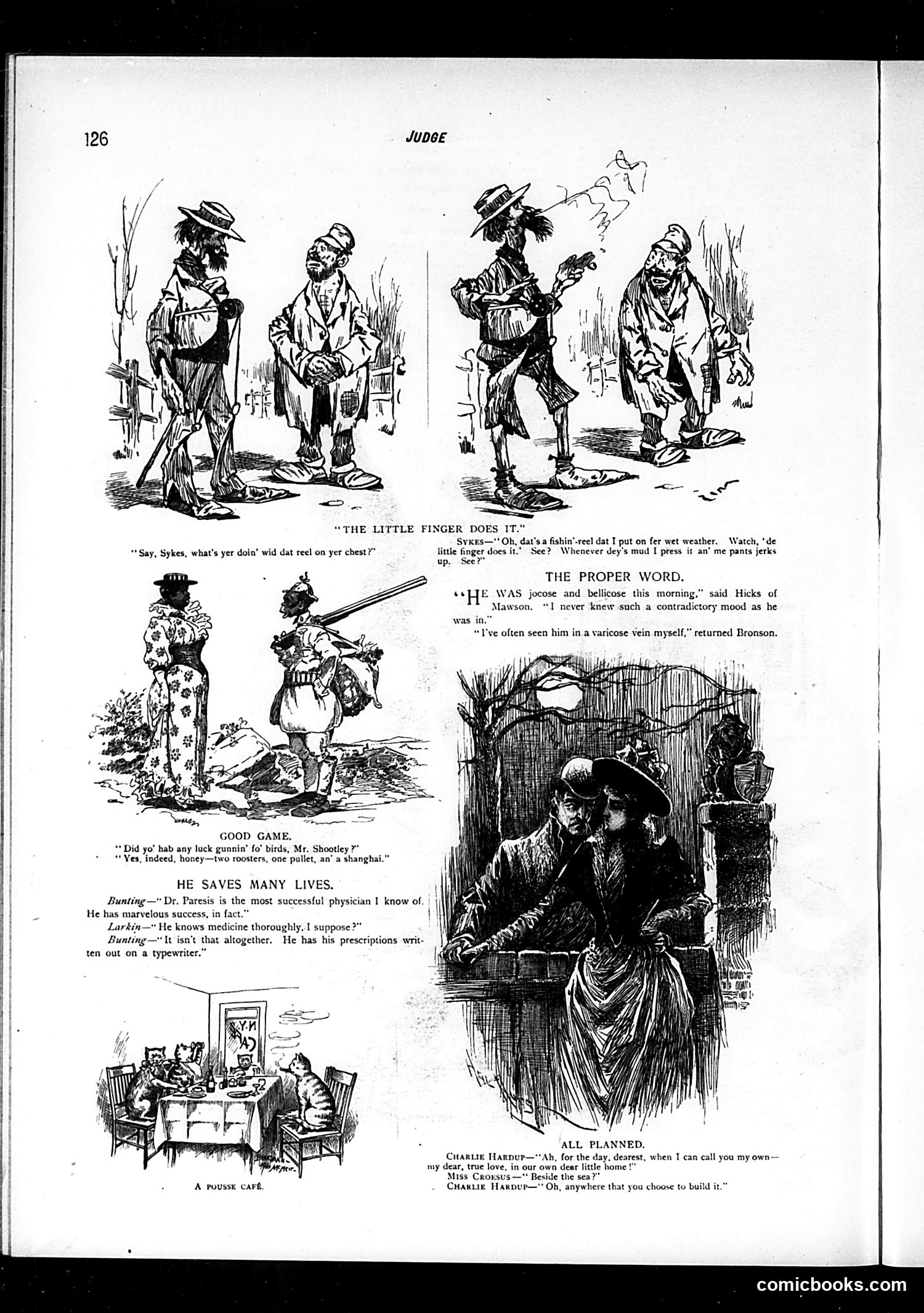
This page contains multiple brief satirical sketches typical of Judge's humor: **"The Proper Word"** mocks malapropisms—Bronson deliberately misuses "varicose vein" (a medical condition) instead of "various vein," playing on Hicks's use of "bellicose" and "jocose." The joke is the deliberate linguistic confusion. **"Good Game"** appears to satirize African American dialect humor (common but offensive in period satire), with someone listing game birds hunted. **"He Saves Many Lives"** jokes that Dr. Paresis succeeds not through medical knowledge but because his typewritten prescriptions are illegible—patients can't actually take the wrong medicine. **"The Little Finger Does It"** depicts working-class characters using improvised fishing equipment as clothing. **"All Planned"** is a romance joke: the woman agrees to marry only if she can choose where to build their home—implying she'll choose expensively, at his expense. These are lightweight social humor and wordplay typical of Judge's satirical content.
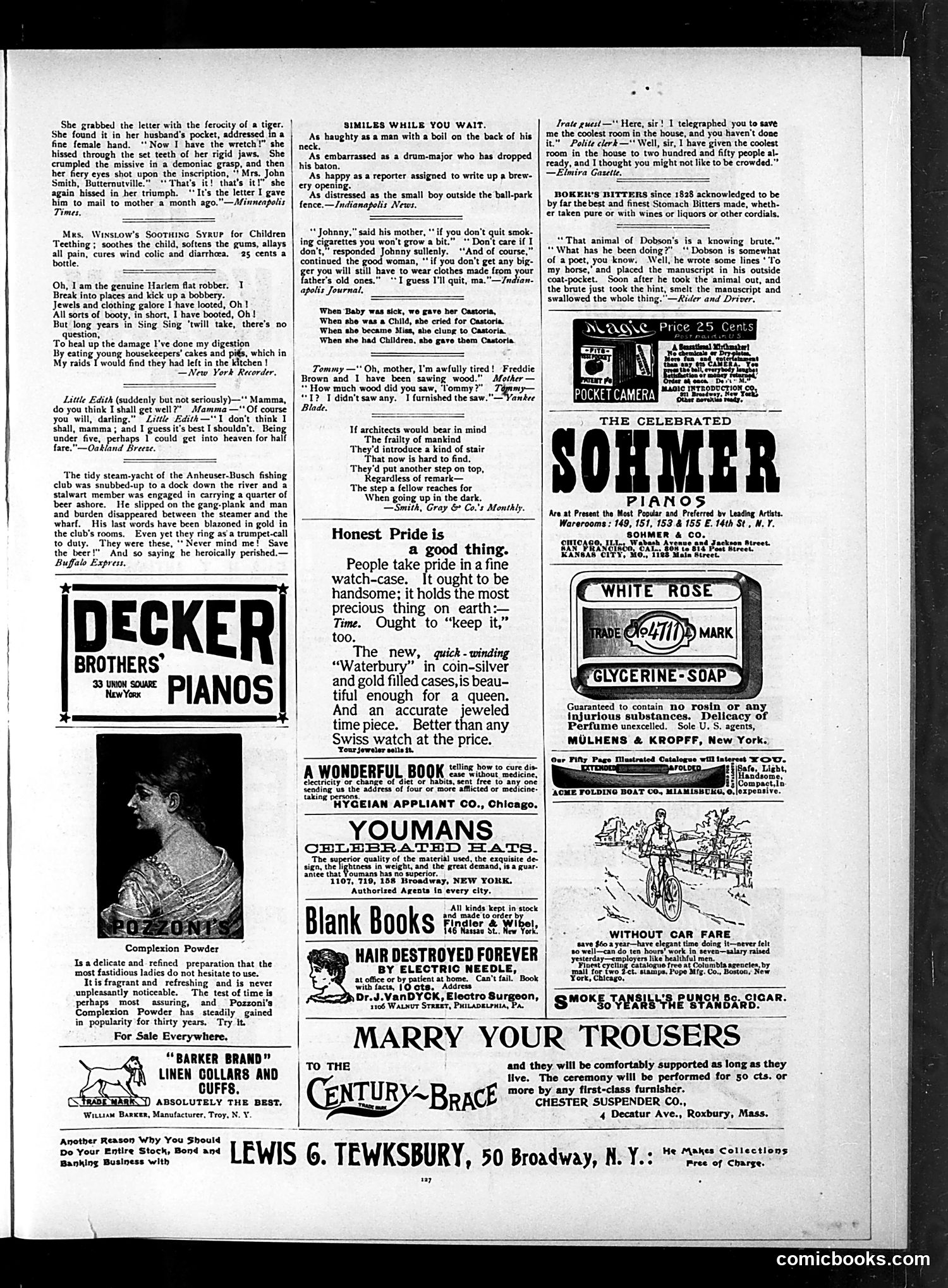
This page is primarily **advertising and humor filler**, not political satire. It contains: **Humorous anecdotes**: Brief jokes about domestic life (a wife finding an innocent letter), a "Harlem flat robber" lamenting his indigestion from stolen cakes, and children's witty remarks about heaven and cigarettes. **"Similes While You Wait"**: Comic comparisons (a man with a boil on his neck, a drum-major who dropped his baton). **Advertisements**: Piano makers, soap, tooth powder, blank books, hats, and other consumer goods typical of the era. **The only visual cartoon** appears to be a portrait labeled "Completion Powder," likely advertising Pozzoni's cosmetics. The page reflects **late 19th/early 20th-century Judge magazine style**: mixing mild domestic humor with advertising. The jokes assume no political knowledge—they're universal situations (marital suspicion, childhood mischief) that would resonate with any era's readers. This is entertainment filler between more pointed satirical content found elsewhere in the magazine.
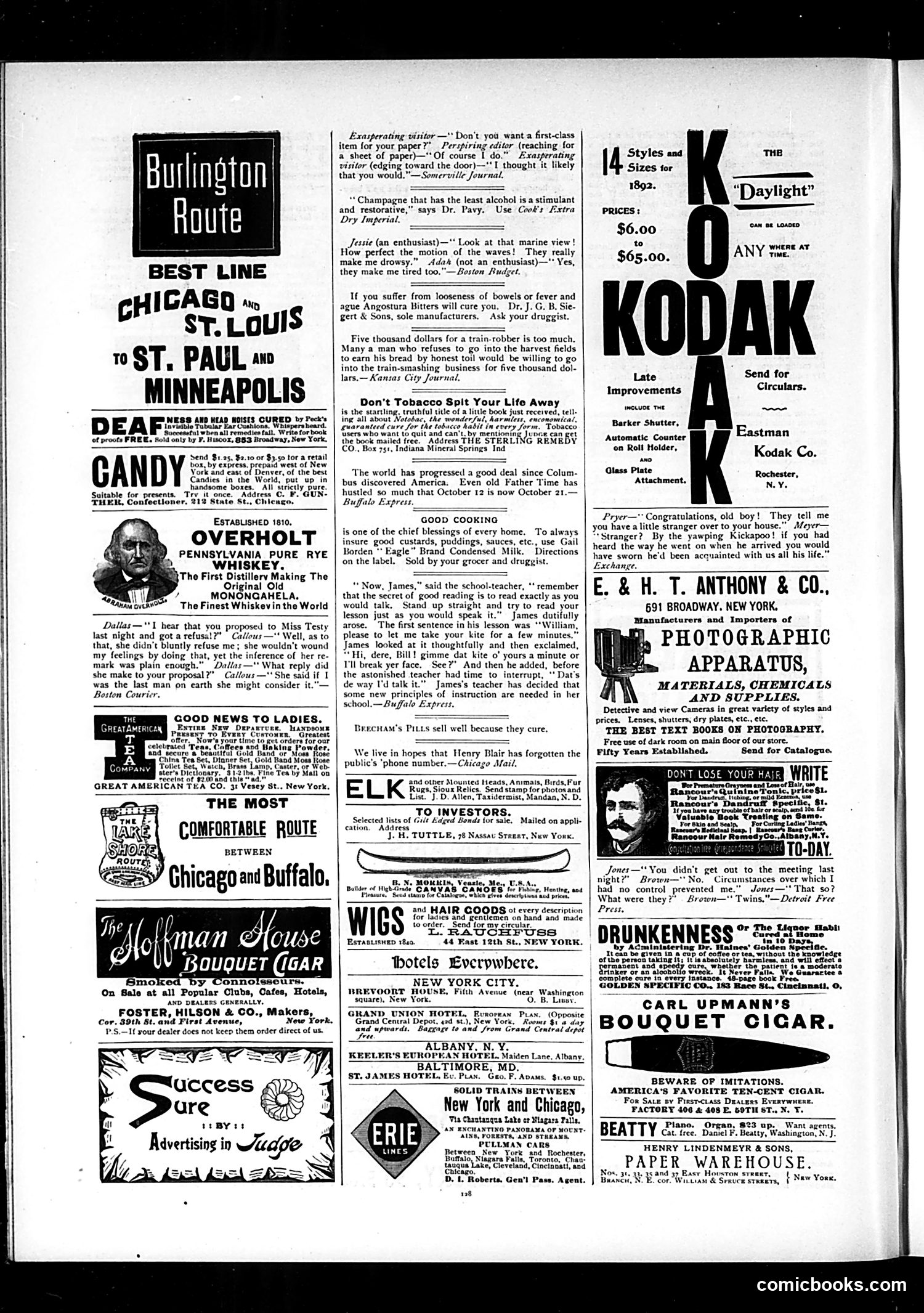
This page is primarily **advertisements and short humorous anecdotes**, not political cartoons. The content reflects late-Victorian American commercial culture. The brief jokes mock social conventions: a rejected suitor's euphemistic denial, a woman feigning drowsiness at seaside scenery, and a train robber's economic calculus. These are gentle satirical observations about human nature rather than political commentary. The advertisements reveal period concerns: remedies for "head noises," tobacco addiction cures ("Don't Tobacco Spit Your Life Away"), hair loss treatments, and alcohol products (whiskey, champagne, bitters). The inclusion of train-robbery humor suggests this era's anxiety about crime and industrial progress. One anecdote references Columbus and calendar reform, likely alluding to the 1892 Columbian Exposition's impact on date calculations, showing contemporary awareness of significant historical moments. The page demonstrates Judge's dual purpose: satirizing middle-class manners while profiting from advertisements targeting readers' anxieties about health, appearance, and respectability.
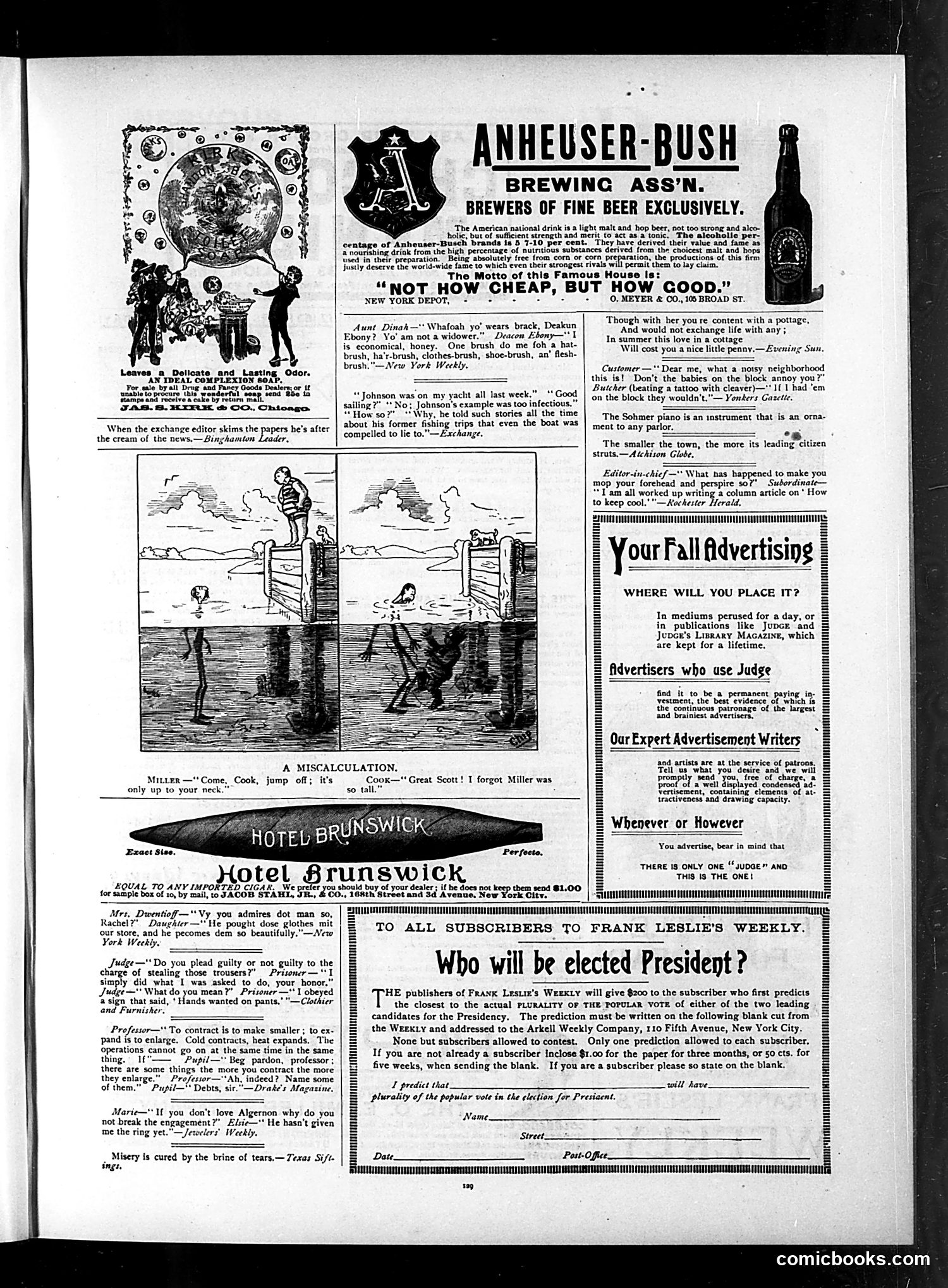
This page is primarily **advertising and filler content** rather than political satire. The dominant features are: 1. **Anheuser-Busch Beer Advertisement** (top center): The main pitch emphasizes the beer's nutritional value and purity—"not how cheap, but how good"—positioning it as a tonic rather than mere alcohol. This reflects early 1900s marketing that claimed beer's health benefits. 2. **Small Comic Panels & Jokes**: Brief, scattered humor pieces with ethnic stereotypes typical of the era (dialect humor involving "Aunt Dinak" and "Deacon Ebony," and Yiddish-inflected speech patterns). These are mild workplace or domestic gags rather than political commentary. 3. **Hotel Brunswick and Cigar Advertisements**: Standard commercial promotions. 4. **"Who Will Be Elected President?"** Contest (bottom): Judge magazine offered $500 to subscribers for the closest presidential prediction—a circulation-boosting gimmick. The page serves primarily as a revenue vehicle through advertising and subscriber engagement contests, with lightweight humor padding the space.
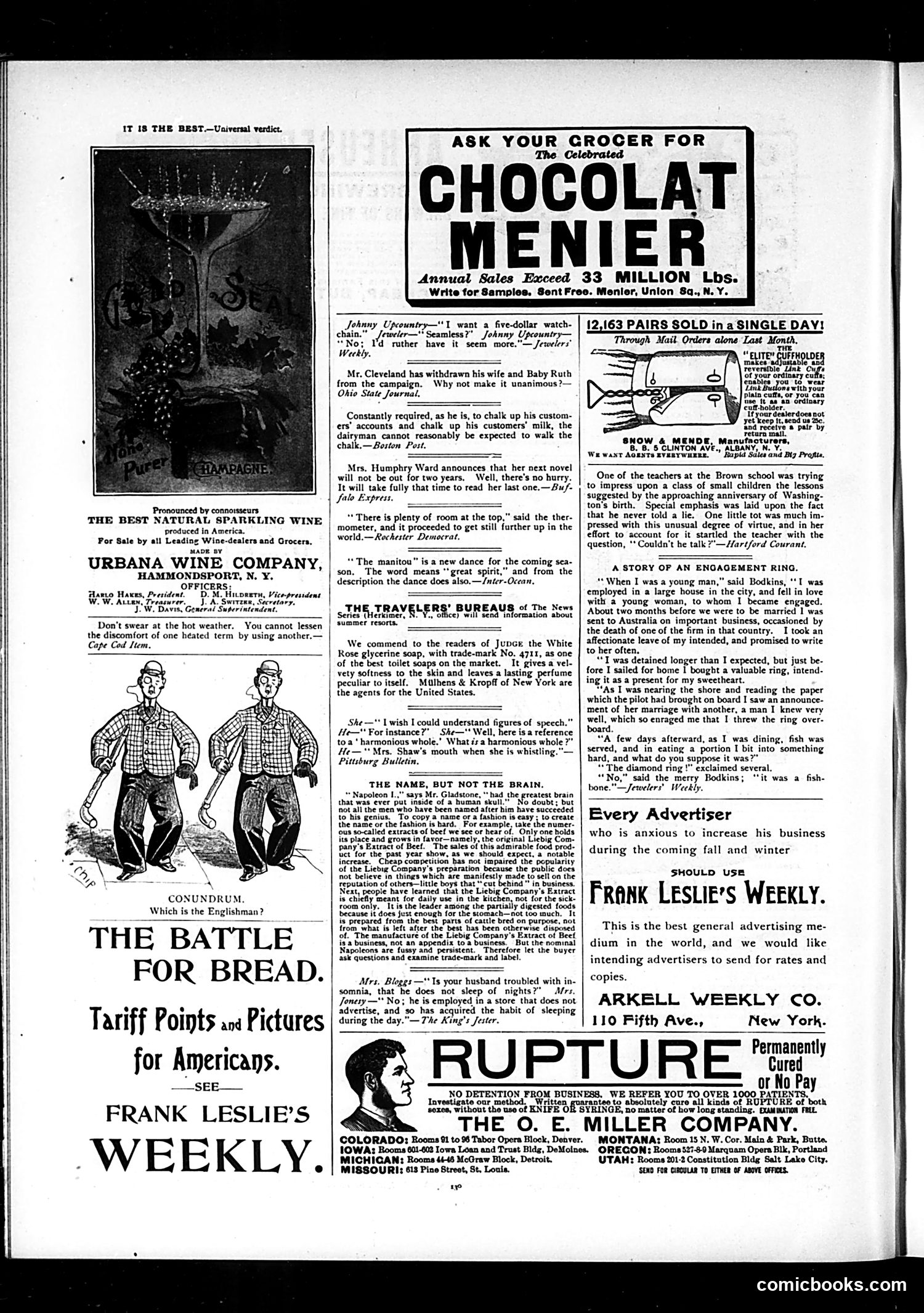
This page is primarily **advertising and humor filler**, typical of Judge magazine's format. The main content includes: **Key Elements:** 1. **"Conundrum" cartoon**: Two identical figures asking "Which is the Englishman?" — likely a visual joke about English vs. American appearance or behavior, though the specific reference is unclear without additional context. 2. **Multiple short jokes** on social topics: Cleveland's wife withdrawing from politics, dairymen's accounting practices, Mrs. Humphry Ward's novel delays, and a thermometer's pride — standard satirical commentary on contemporary figures and daily life. 3. **Large advertisements** for Chocolat Menier, Frank Leslie's Weekly, and Liebig Company's Extract of Beef dominating the page, reflecting how 19th-century magazines subsidized content through advertising. The jokes are gentle observational humor rather than sharp political satire. The page demonstrates how Judge blended advertising revenue with light editorial content for general audiences.
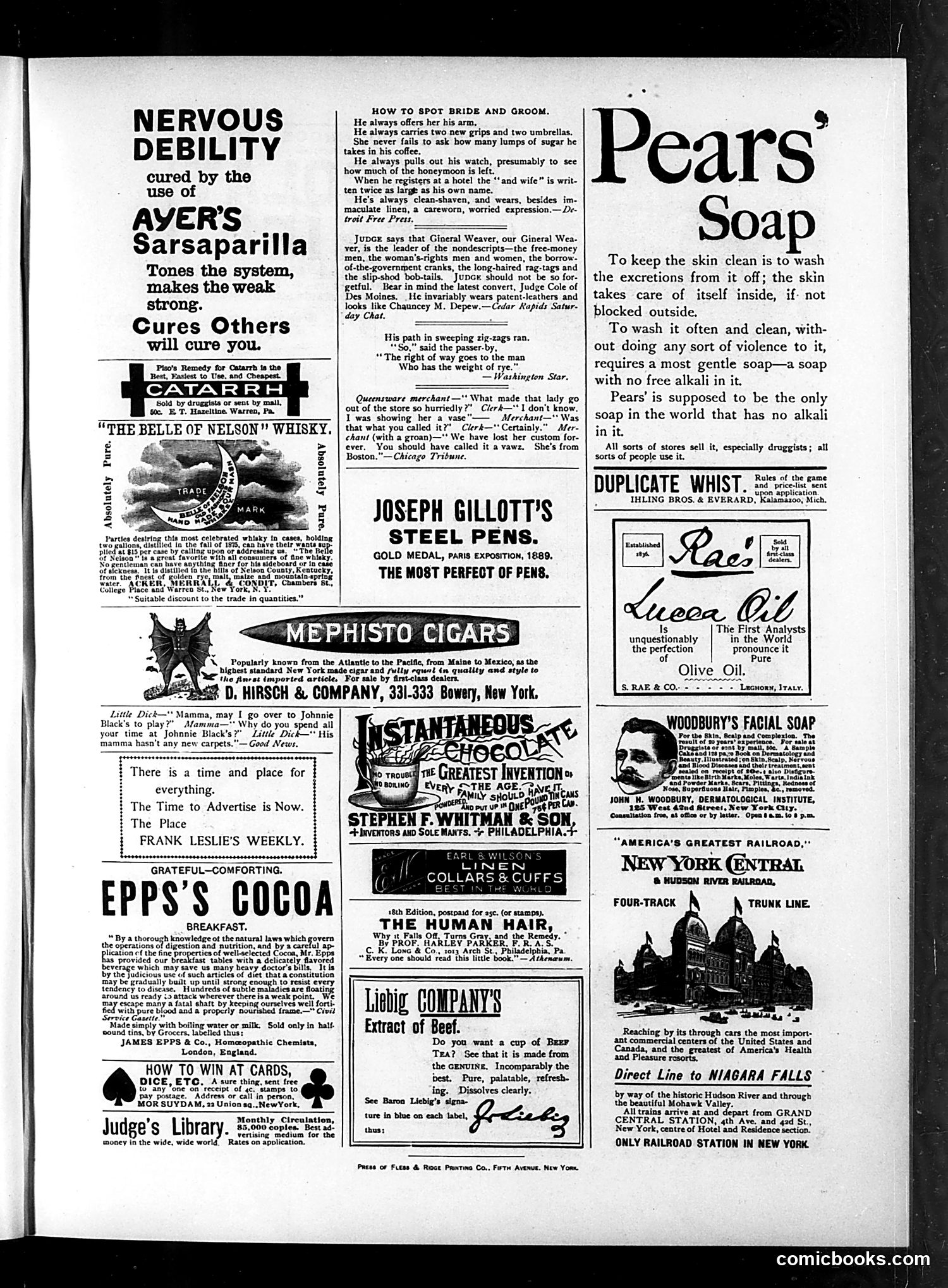
This page is primarily **advertisements** from what appears to be a 19th-century magazine. While labeled "JUDGE" (a satirical publication), this particular page contains minimal editorial content—mostly product ads for patent medicines, alcohol, cigars, soap, and railroads. The few jokes present are typical period humor: a "How to Spot Bride and Groom" section offering observations about newlyweds' behavior; light quips about merchants, drunks, and spousal dynamics. A brief reference mentions "Gineral Weaver" as leader of "nondescripts—the free-money men" (likely referring to Populist Party politician James B. Weaver, 1892 era context), but this receives minimal treatment. The ads themselves reflect period preoccupations: "nervous debility" cures, whiskey, and remedies for common ailments—now recognized as dubious or ineffective. **The satire isn't editorial; it's implicit in the advertisements themselves**, which modern readers would recognize as pseudoscientific and predatory marketing.
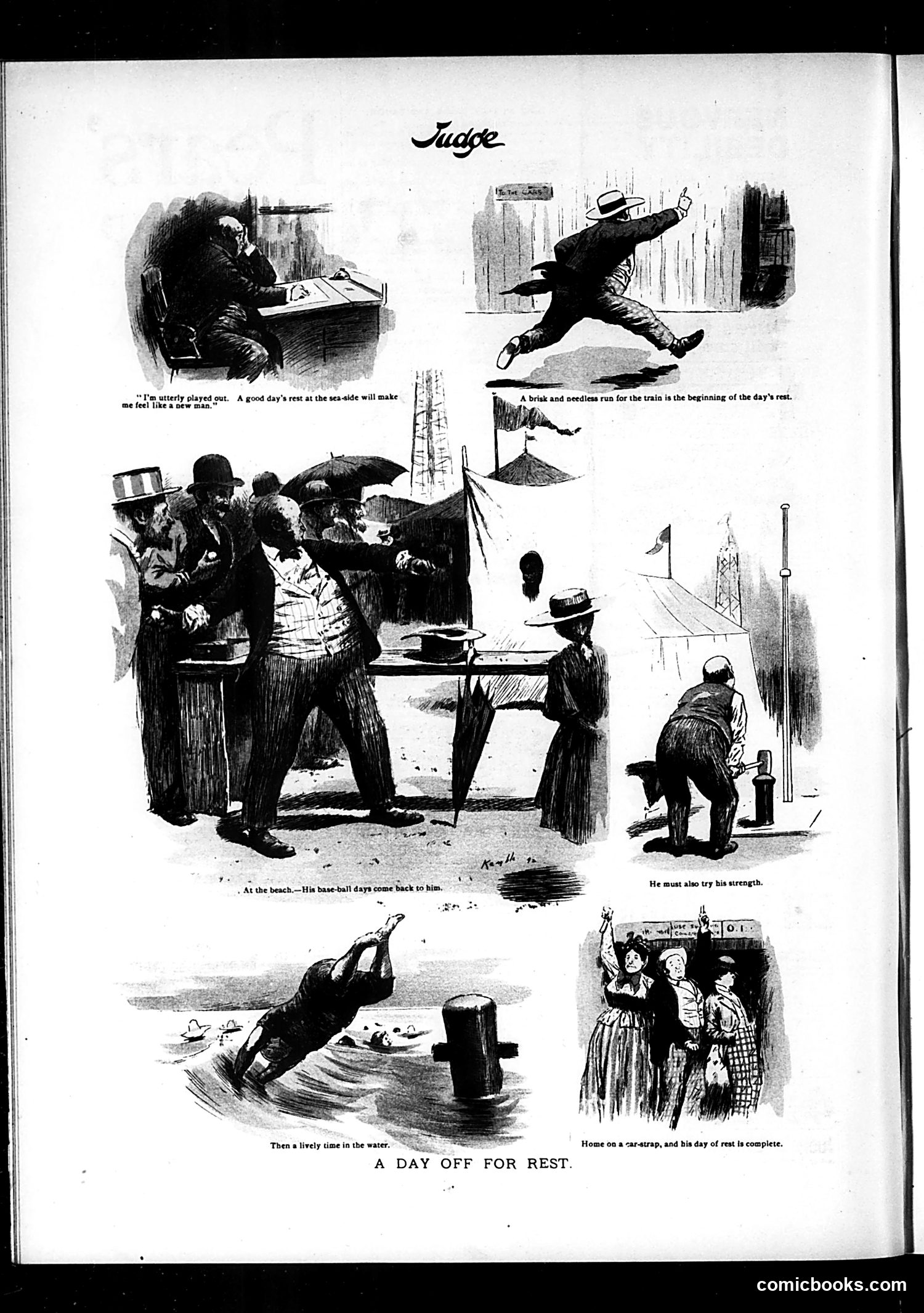
This Judge cartoon satirizes the concept of a "restful" day off for a judge or legal official. The narrative arc shows ironic contradiction: despite claiming exhaustion and needing seaside rest to feel "like a new man," the character engages in increasingly strenuous activities—running frantically for trains, being jostled at crowded beaches, swimming vigorously, and traveling home—culminating in being cramped on a car-strap (crowded public transit). The satire critiques how urban professionals of the era couldn't actually achieve genuine rest; supposed leisure became as exhausting as work. The busy, chaotic illustrations underscore that "relaxation" meant enduring crowds, chaos, and physical exertion rather than actual recuperation.