
A complete issue · 16 pages · 1892
Judge — July 30, 1892
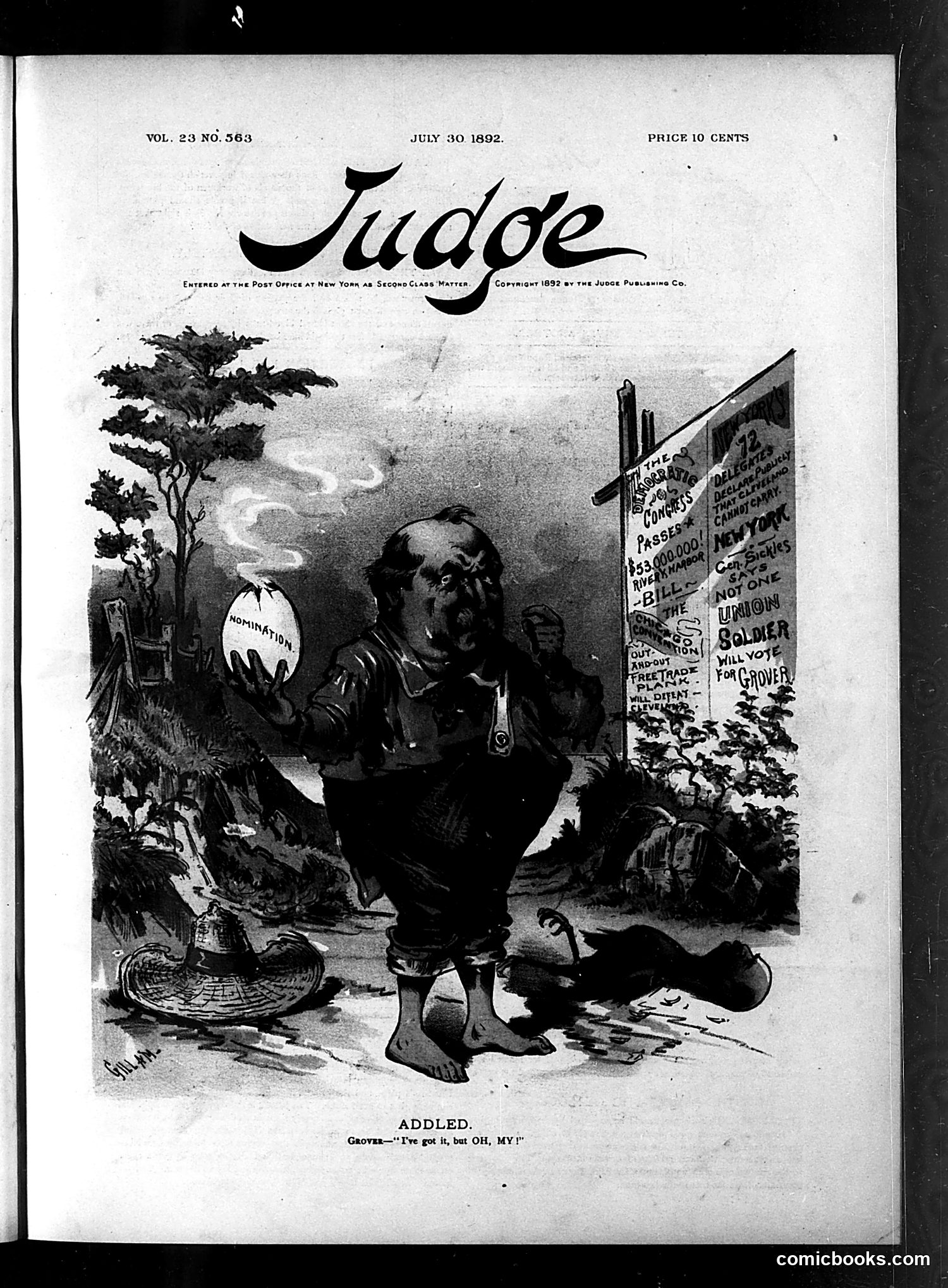
This political cartoon satirizes President **Grover Cleveland** during the 1892 election campaign. The figure, depicted as a monkey or ape in caricature style, holds a balloon labeled "NOMINATION" while standing amid campaign posters. Signs visible reference the presidential contest, including "WILL VOTE FOR GROVER." The cartoon's title, "Addled," suggests Cleveland's mental state or judgment was confused or impaired. The artist criticizes Cleveland's political position or candidacy through this crude anthropomorphic mockery—a common satirical technique of the era, though offensive by modern standards. The composition critiques both Cleveland's nomination and the political machinery surrounding it, presenting him as intellectually compromised or absurdly unsuited for office during this contentious election year.
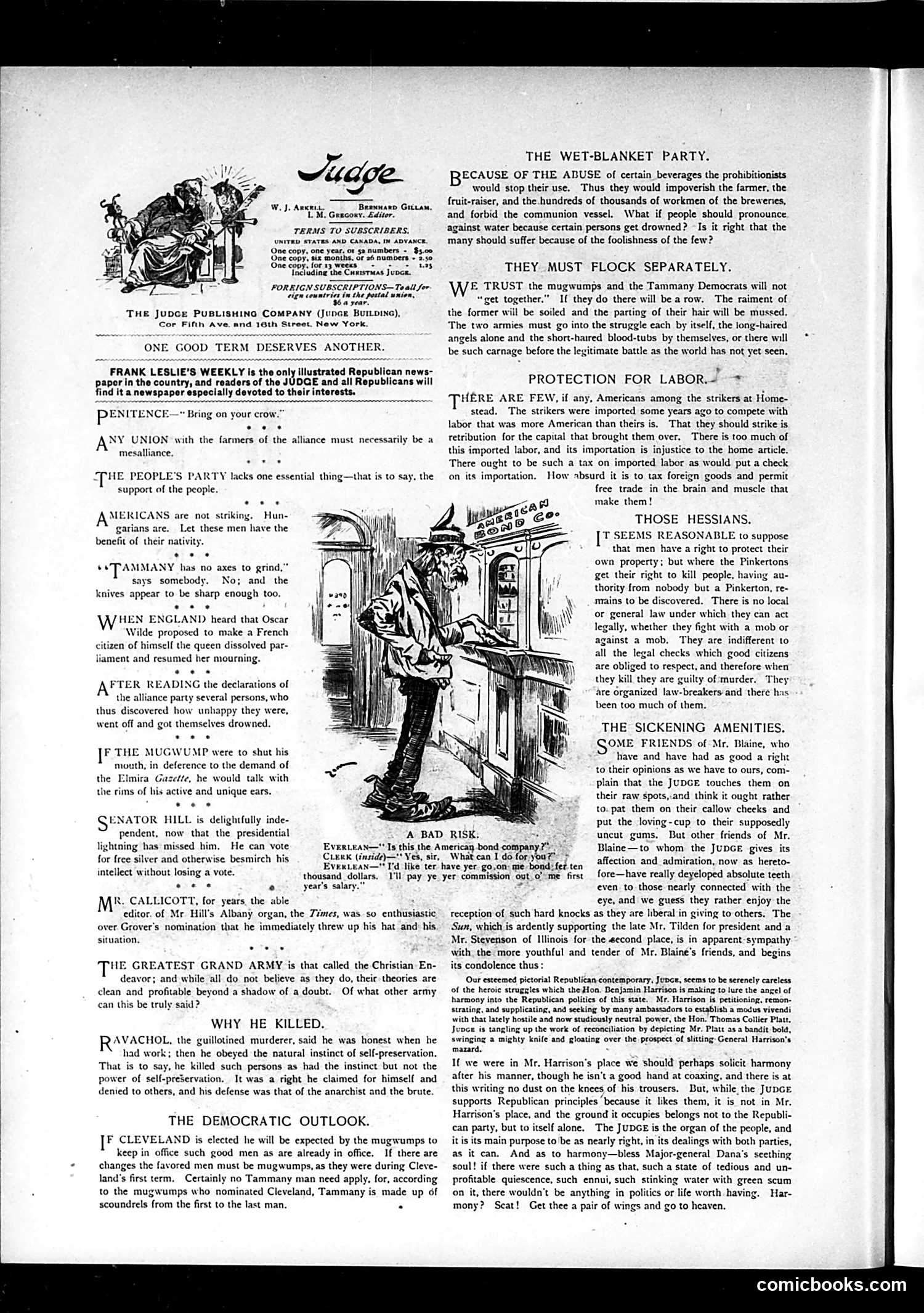
This page contains political commentary satirizing labor strikes and socialism circa the 1890s-1900s. The main cartoon labeled "A Bad Risk" depicts a man (likely representing immigrant or foreign labor) attempting to break into what appears to be a business or bank, illustrating nativist fears that imported workers threatened American property and commerce. The text sections criticize labor unions and socialist movements, particularly attacking the "Tammany" political machine and defending property rights. References to "Hessians" (mercenary soldiers) suggest unions are portrayed as foreign threats to American interests. The overall theme presents strikers and labor organizers as dangerous to capitalist enterprise and social stability—typical Judge magazine ideology opposing organized labor during the Gilded Age.
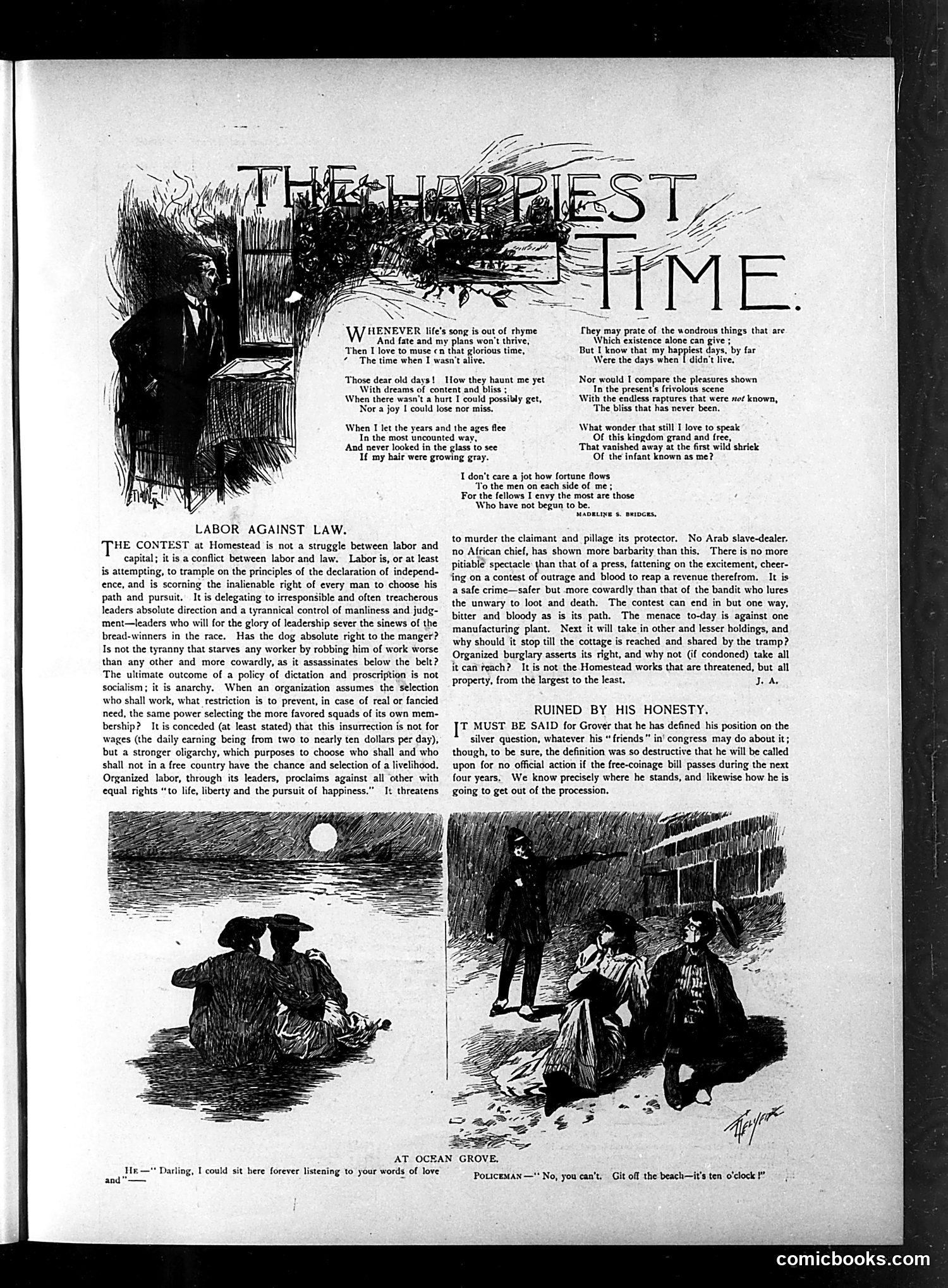
This page contains two main sections: **"The Happiest Time"** — A nostalgic poem about lost youth and aging, with an accompanying sketch of a solitary figure. **"Labor Against Law"** — A political editorial criticizing labor organizing. It argues that organized labor's coercive tactics—forcing workers to join, controlling who can work—violate democratic principles and individual liberty. The piece condemns labor leaders as tyrants and compares organized labor's methods unfavorably to even criminal activity. **"At Ocean Grove"** — A comic strip below showing a couple at a beach interrupted by a policeman enforcing a curfew ("ten o'clock"). The editorial represents Judge's anti-labor stance during the early-to-mid 20th century, opposing unionization as tyrannical while defending business interests and individual "freedom" to work without union participation.
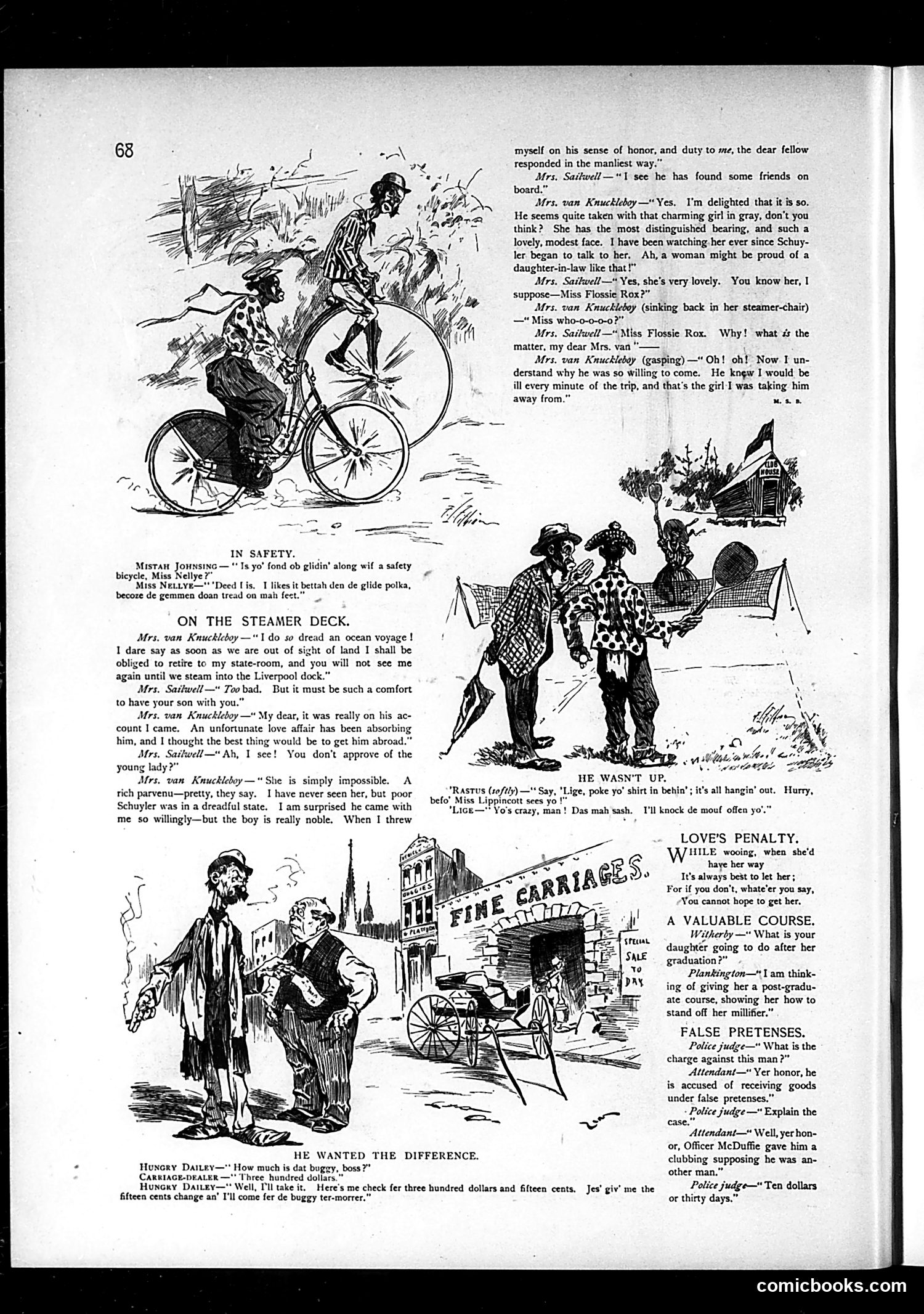
This page contains several satirical vignettes typical of late 19th-century humor: **"In Safety"** mocks the safety bicycle craze by having a woman prefer it to dancing because men won't step on her feet—contrasting modern transportation with traditional courtship hazards. **"On the Steamer Deck"** features social satire about class anxiety. A wealthy widow (Mrs. van Knuckleboy) takes her son abroad to separate him from a romance with "Flossie Rox," believing her a fortune-hunting "parvenu" (nouveau riche). The irony: the girl he's bonding with on deck *is* Flossie, so his mother's scheme backfires. **"He Wanted the Difference"** uses racial dialect humor (common then, offensive now) about a Black man buying a carriage—the "joke" being he wants change back, suggesting financial incompetence. **Minor items** include light domestic humor about courtship, millinery bills, and a police judge scene with mistaken-identity slapstick. The overall tone reflects period attitudes: class consciousness, skepticism toward social climbers, and casual racial stereotyping.
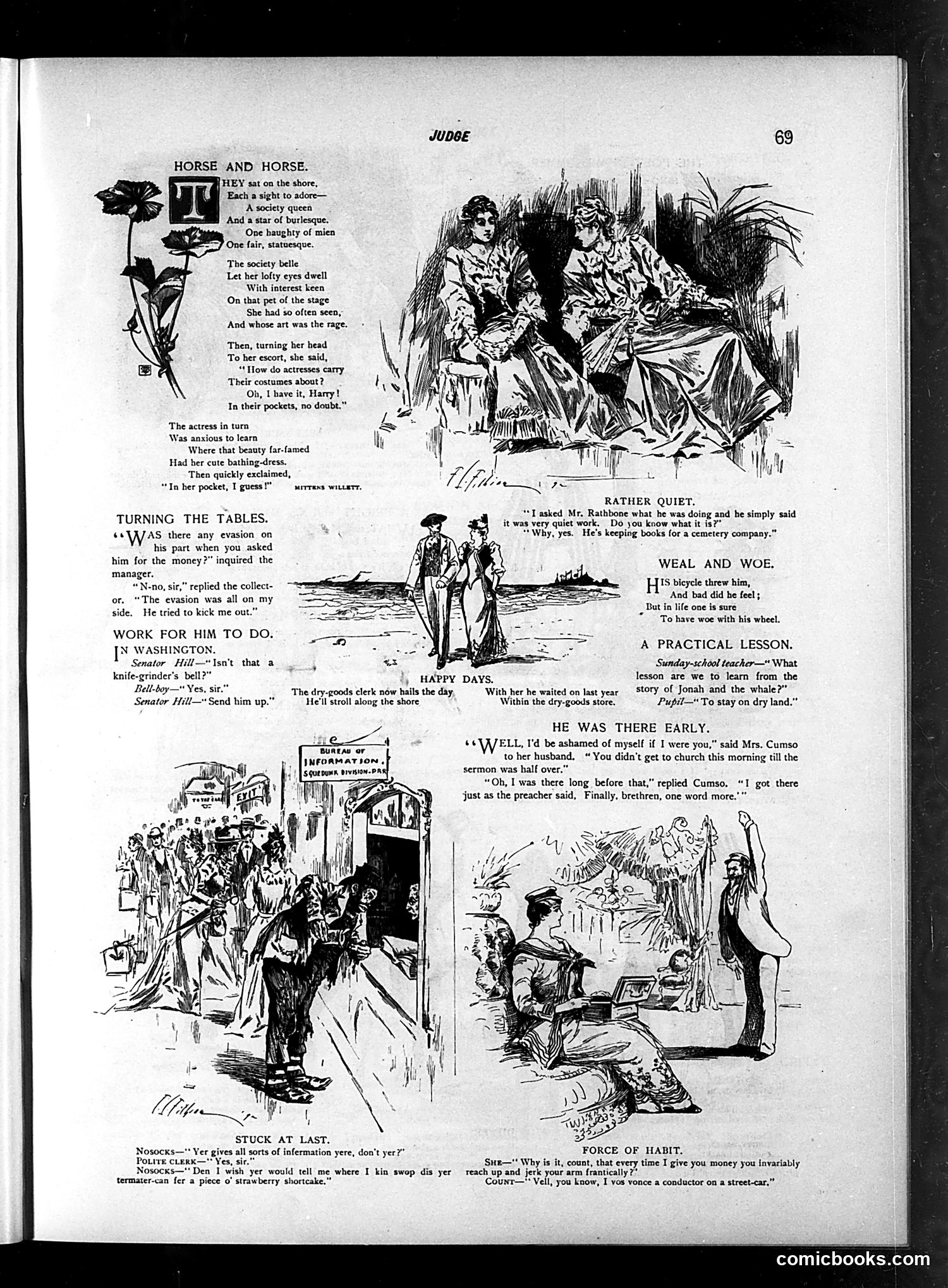
This page collects brief comedic sketches typical of Judge's satirical humor: **"Horse and Horse"** mocks class pretension through a dialogue between a society woman and a burlesque actress. Each assumes the other must carry her costume in her pocket—a jest at both women's intelligence and their mutual incomprehension of different social worlds. **"Turning the Tables"** is a simple reversal joke: a debt collector claims the debtor tried to "kick him out," flipping the expected power dynamic. **"Work for Him to Do"** appears to reference Senator Hill (likely David B. Hill, a prominent Gilded Age politician), with a joke about sending up a knife-grinder—likely satirizing politicians' uselessness or the chaotic Washington bureaucracy. The remaining items are lightweight puns and observational humor ("Stuck at Last," "Weal and Woe," "A Practical Lesson") typical of period magazine filler—gentle wordplay rather than pointed political satire. The Sunday school joke about Jonah exemplifies Judge's light, family-friendly approach to humor.
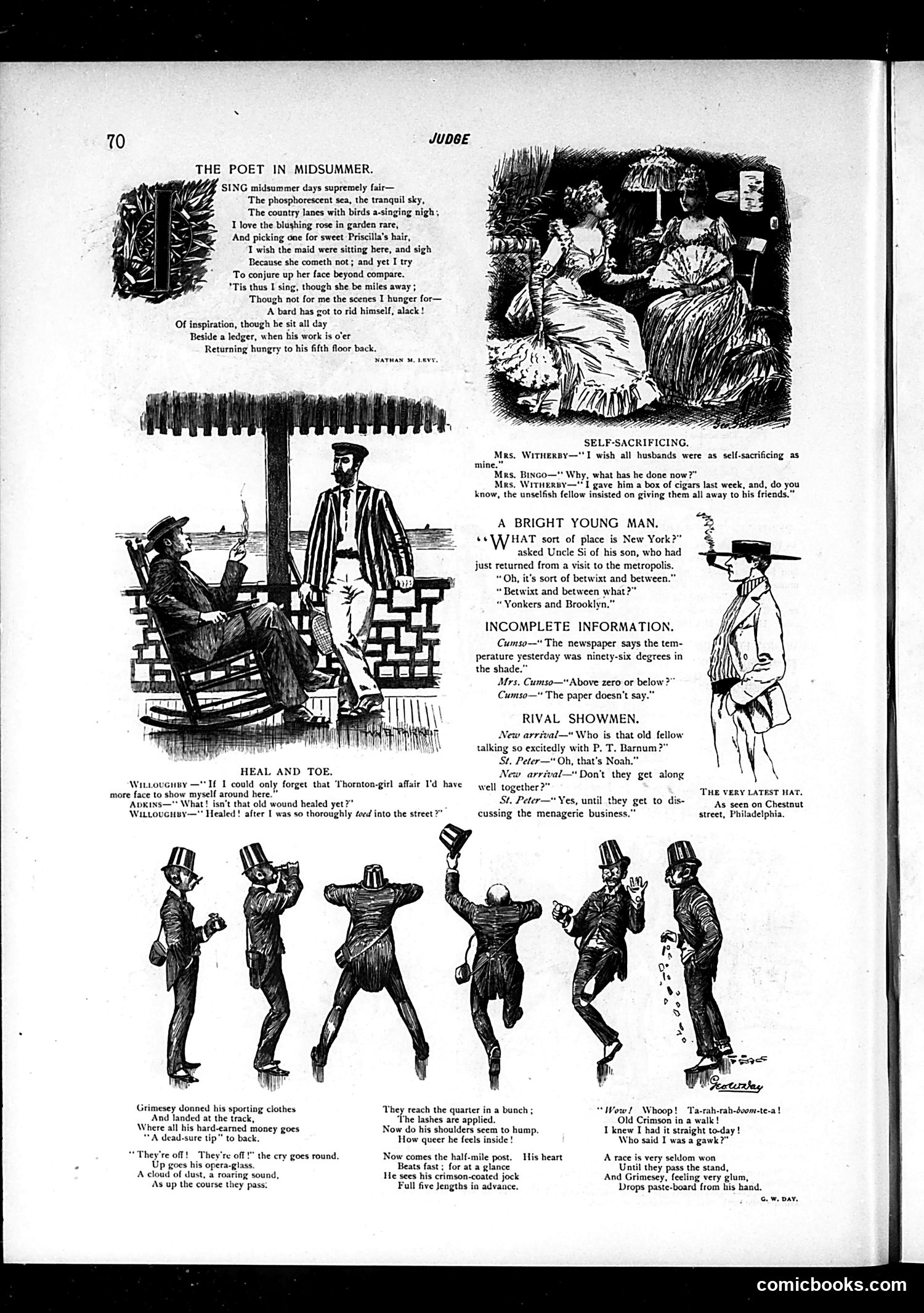
This page from Judge contains multiple satirical pieces targeting middle-class American life circa the 1880s-90s. **"The Poet in Midsummer"** mocks romantic poets who wax lyrical about nature while stuck at tedious day jobs—the narrator composes verse about love and countryside beauty while working as a ledger-keeper, returning hungry to his fifth-floor tenement. The satire targets the gap between artistic aspiration and dreary reality. **"Heal and Toe"** and related vignettes ridicule social embarrassment and romantic failure among gentlemen. **"Grimesey" sequence** satirizes gambling at horse races—a man loses his wages on a "sure tip," experiencing physical anxiety as his horse falls behind. The bottom section features jokes about naïveté (a young man's vague description of New York), journalistic incompleteness, and a gag pairing Noah with P.T. Barnum as rival showmen quarreling over menageries—playing on Barnum's famous circus. The overall tone mocks working-class pretension, failed romantic ambitions, and get-rich-quick schemes.
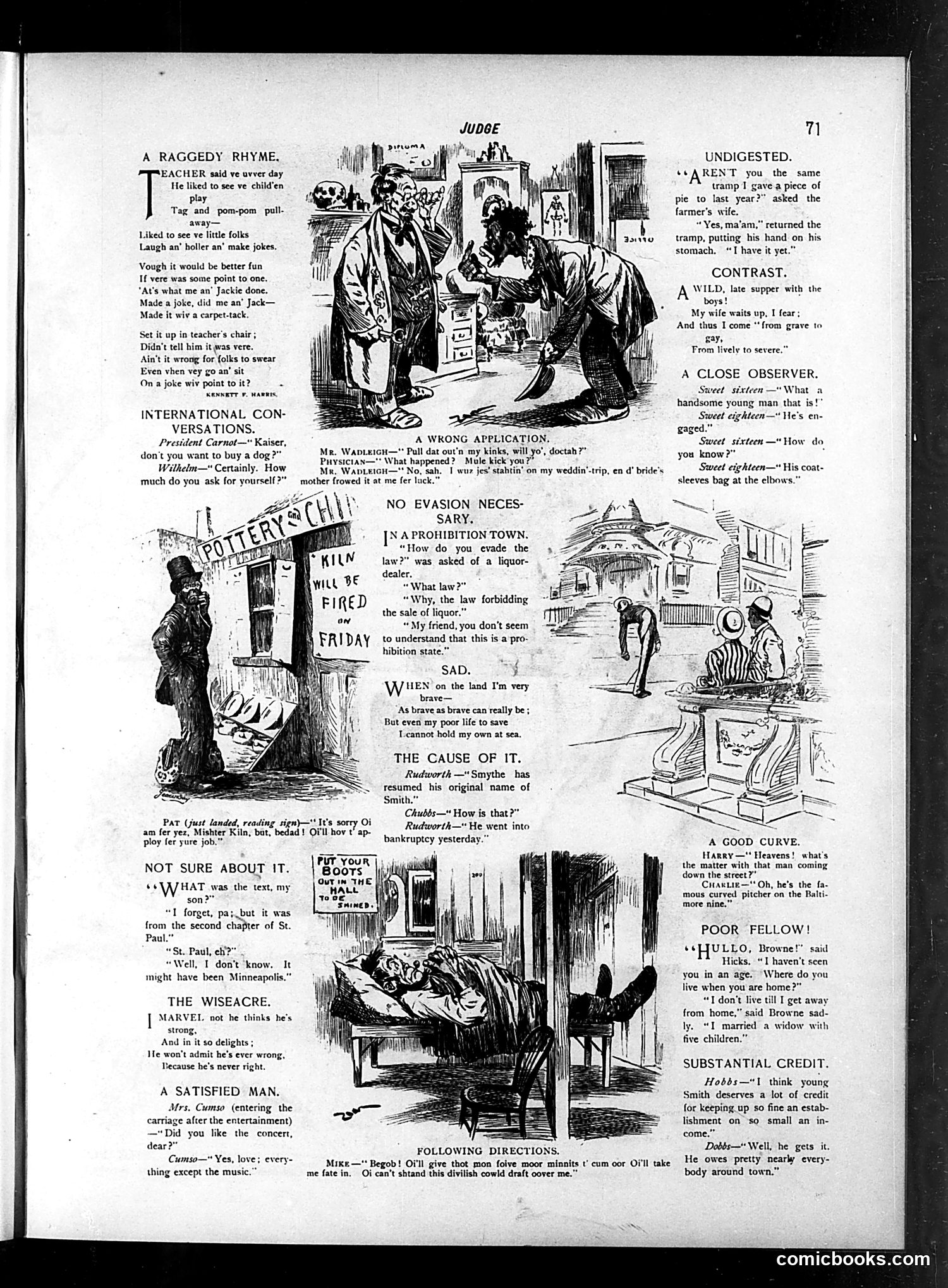
This page from Judge magazine contains multiple short jokes and satirical pieces typical of late 19th-century American humor: **"A Raggedy Rhyme"** mocks Irish immigrant speech patterns, depicting children playing a prank with a carpet tack on a teacher's chair. **"International Conversations"** offers political satire about European leaders—President Carnot of France and Kaiser Wilhelm of Germany—through a joke about purchasing a dog, likely referencing contemporary diplomatic tensions. **"A Wrong Application"** uses racial dialect humor about a Black man injured during his honeymoon, exploiting stereotypical speech. **"No Evasion Necessary"** satirizes Prohibition-era liquor dealers claiming they operate in prohibition states, hence face no evasion challenges. The remaining items are brief social observational humor about marriage, courtship, bankruptcy, and financial pretense—typical Judge content mocking middle-class American life. The page reflects period attitudes toward immigrants, race, and class that modern readers would find offensive.
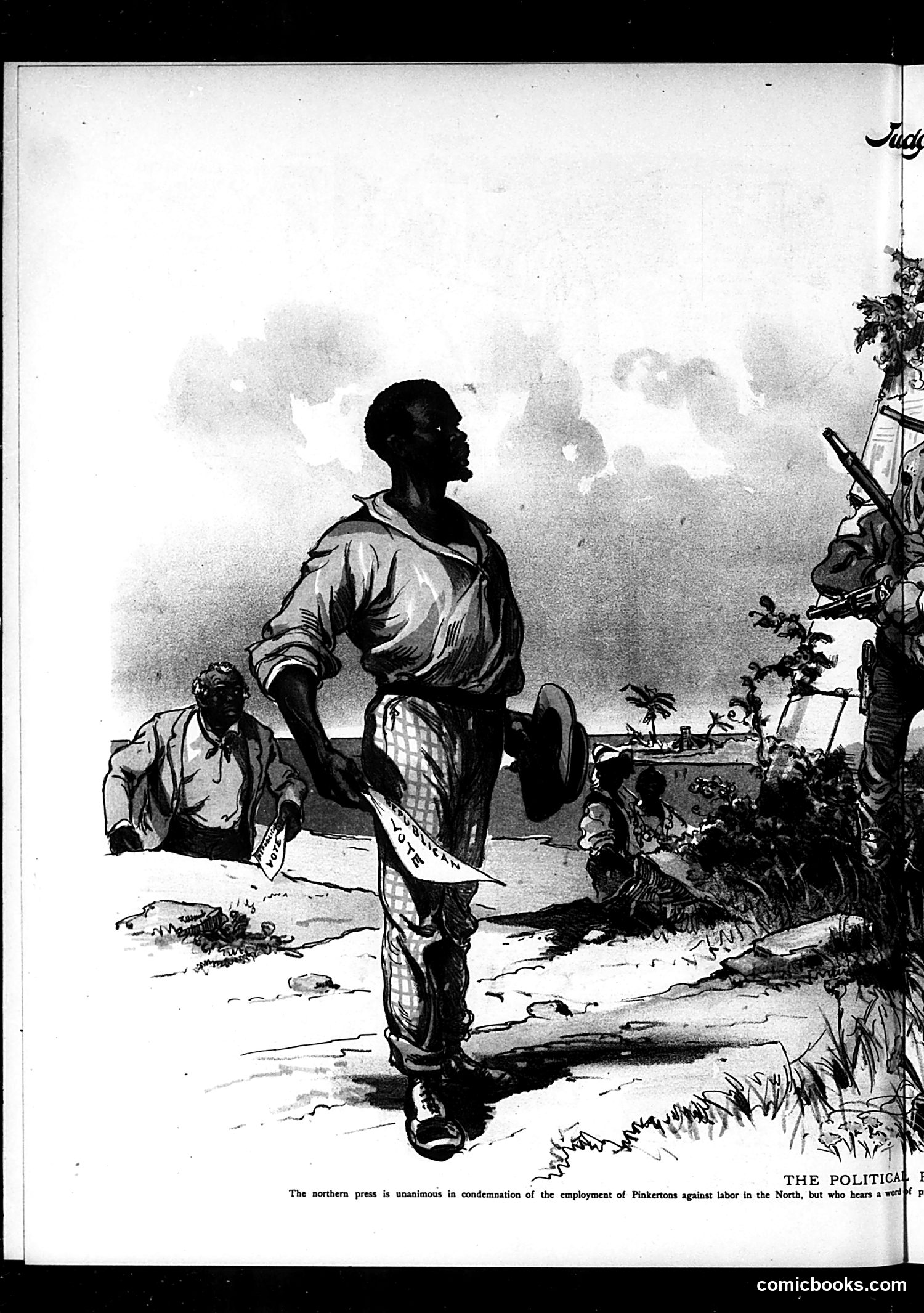
This appears to be a political cartoon criticizing hypocrisy regarding Pinkerton detective agency labor practices. The illustration shows a Black laborer in the North, while the caption indicates the northern press condemns Pinkerton employment "against labor in the North, but who hears a word" about it elsewhere—likely referring to their use against Black workers or labor in the South. The satire targets northern moral inconsistency: northern publications publicly oppose Pinkertons when they threaten northern (implicitly white) workers, but remain silent about Pinkerton tactics used against southern or Black laborers. The cartoon exposes this selective outrage as politically motivated rather than principled opposition to labor exploitation.
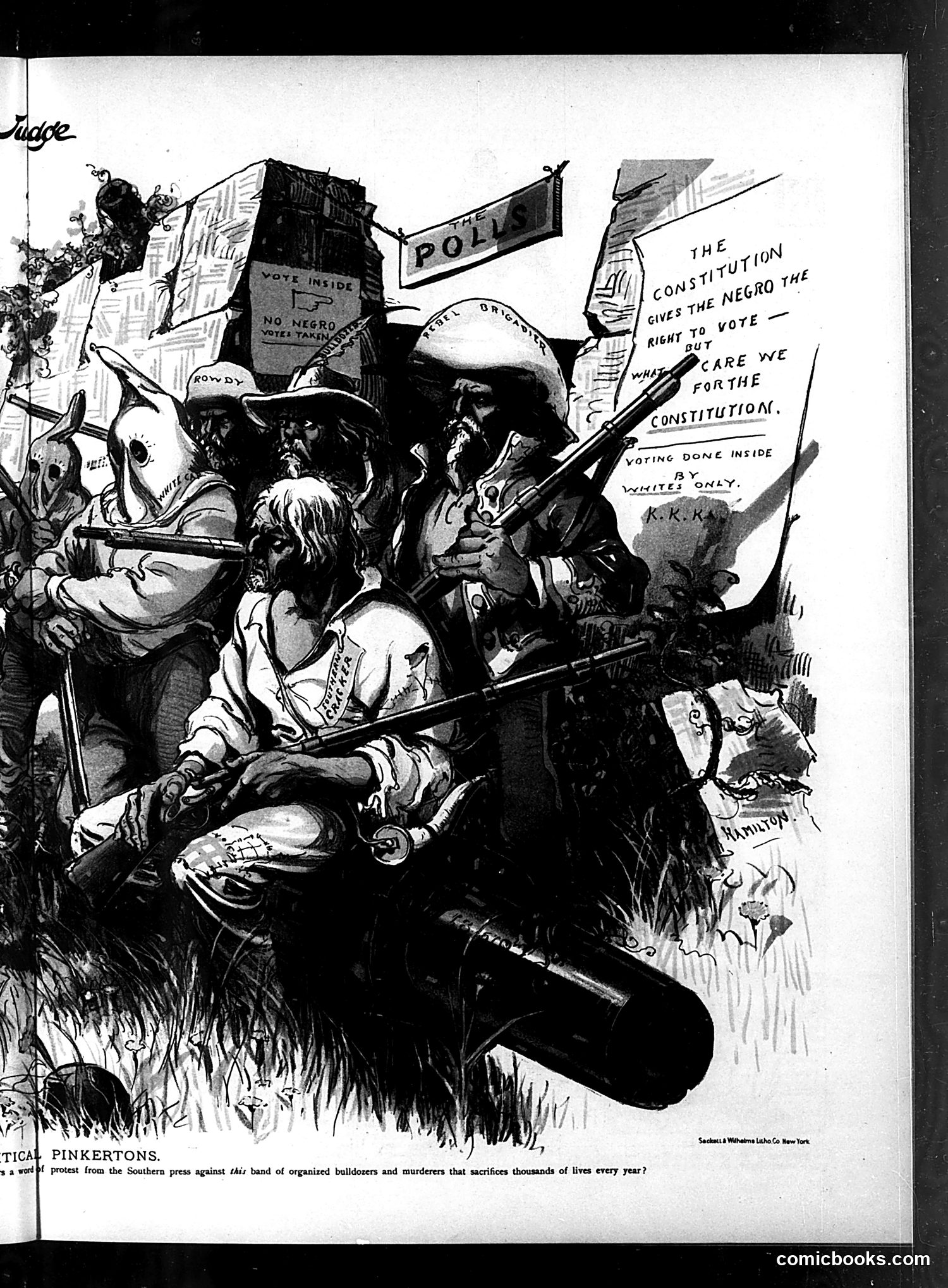
This cartoon satirizes the Pinkerton Detective Agency's role as hired enforcers for industrial interests. The armed, aggressive figures represent Pinkertons depicted as violent "bulldozers and murderers." The caption criticizes the Southern press for failing to protest against this "band of organized" operatives who cause mass casualties annually. The signs reference voting rights and the Constitution—suggesting Pinkertons suppressed Black suffrage and constitutional protections. The KKK reference indicates the cartoon equates Pinkerton violence with racist terrorism. The cartoon protests both Pinkerton brutality during labor disputes and their complicity in denying Black citizens political rights, criticizing Southern media silence on these abuses.
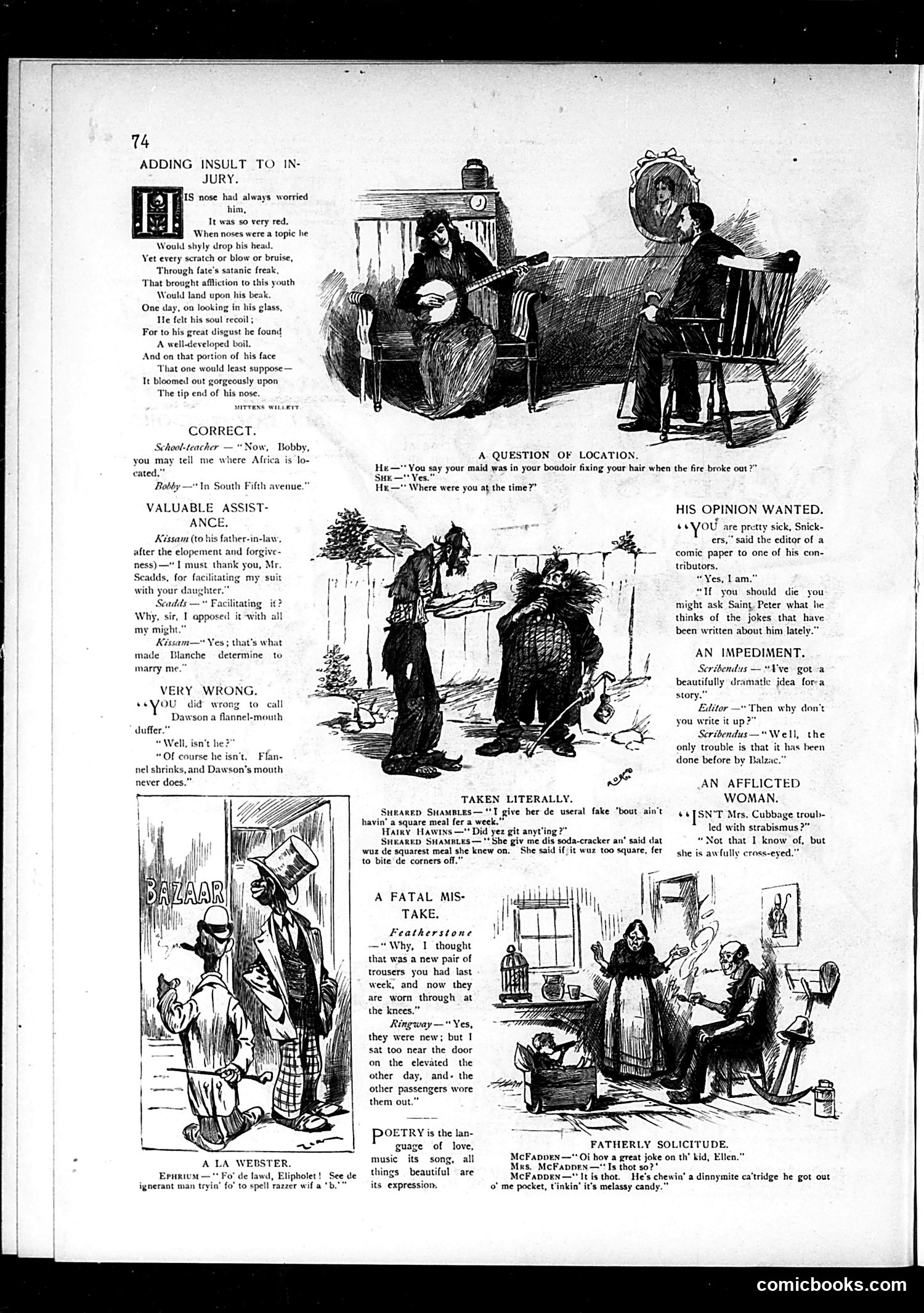
This page from the satirical magazine *Judge* contains multiple brief humorous sketches typical of late 19th-century American comedy: **"Adding Insult to Injury"** tells of a youth perpetually afflicted with a red nose who discovers a boil forming on its tip—a visual punchline about compounding misfortune. **"Correct"** and other brief dialogues mock everyday absurdities: a schoolboy's literal geographic answer, a father-in-law's paradoxical opposition actually encouraging marriage, and ethnic dialect humor (common then, offensive now). **"Taken Literally"** ridicules someone misinterpreting "square meal" as literally a square cracker. **"A Fatal Mistake"** uses worn trouser knees as a joke about crowded public transit. The remaining sketches lampoon writers, editors, and domestic situations with period-typical puns and wordplay. Throughout, the humor relies on literal interpretations, physical comedy, and casual ethnic caricature—reflective of turn-of-the-century American popular humor sensibilities that would be considered crude by modern standards.
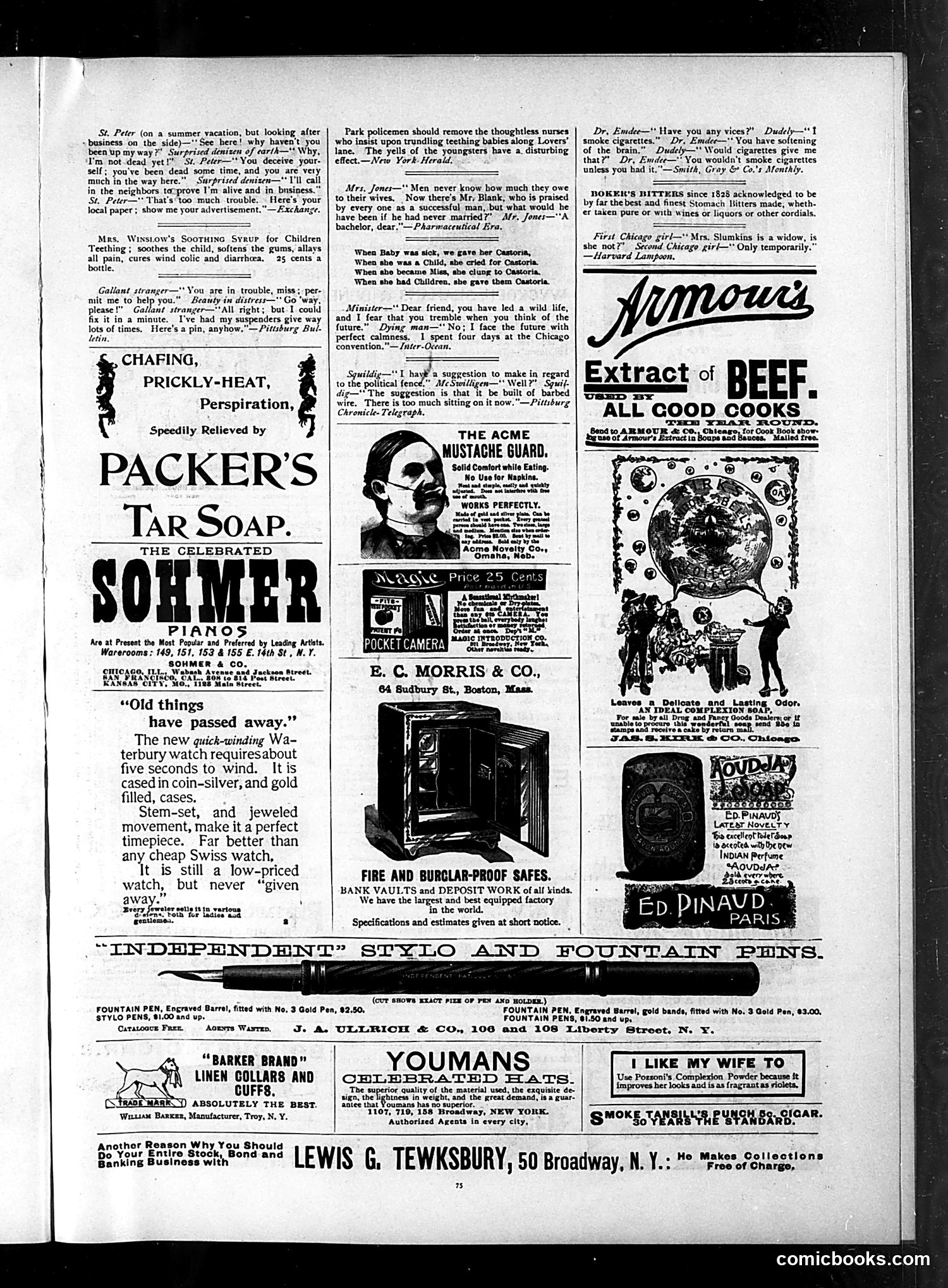
This page is primarily **advertising** interspersed with several short humorous pieces typical of *Judge* magazine's satirical content. The main cartoon/comic elements: 1. **"St. Peter" dialogue**: A recently deceased person insists they're still alive and doing business, while St. Peter suggests they've actually been dead for some time. The joke plays on the phrase "dead" as slang for being irrelevant or out of touch. 2. **Marriage commentary**: Several brief jokes mock marriage and husbands, a recurring *Judge* theme. One suggests a successful bachelor would have failed if married—satirizing contemporary attitudes about matrimony's burden on men. 3. **Medical humor**: A doctor jokes that cigarette smoking causes "softening of the brain," playing on period anxieties about tobacco's health effects. The rest consists of period advertisements: Packer's Tar Soap, Sohmer Pianos, Armour's Beef Extract, Waterbury watches, and safes—typical commercial content for a magazine of this era (appears to be early 1900s based on style and products). No specific political figures or events are referenced on this particular page.
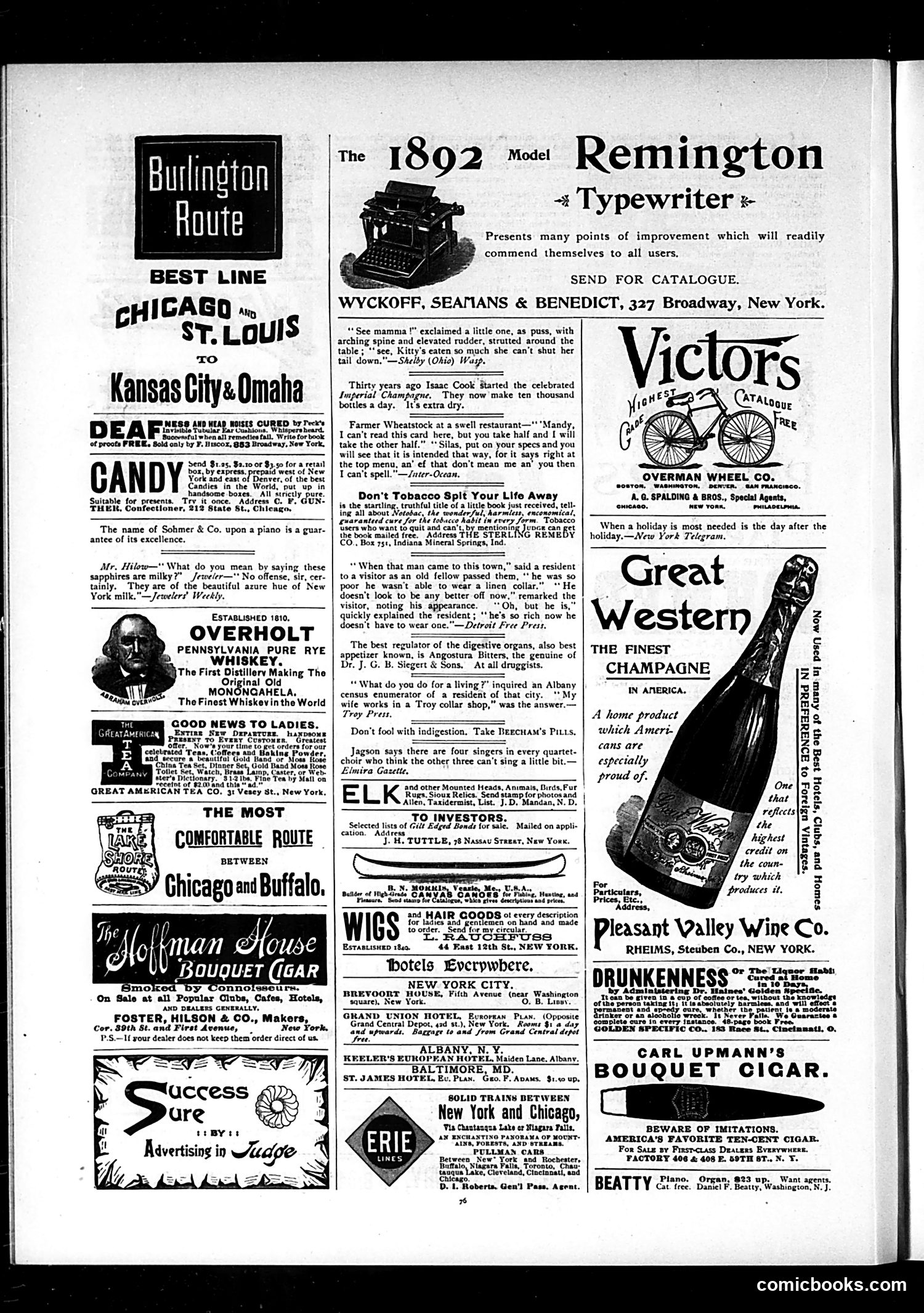
This page is primarily **advertisements**, not political cartoons. It consists of commercial ads for products and services typical of the 1890s: railroads (Burlington Route), liquor (Overholt whiskey, champagne), cigars, typewriters, pianos, and patent medicines. The few small humorous anecdotes scattered among ads are **light jokes**, not satire: - A jeweler joke about sapphires appearing "milky" - A child's observation about a cat's full stomach - Rural dialect humor about a farmer and menu - Census humor about a wife's employment These read as filler content, not editorial commentary. The page reflects Judge magazine's primary function as a vehicle for advertisements, with gentle, apolitical humor used to make ads more engaging. No significant political figures or movements are referenced—it's simply commercial messaging for a 1890s audience.
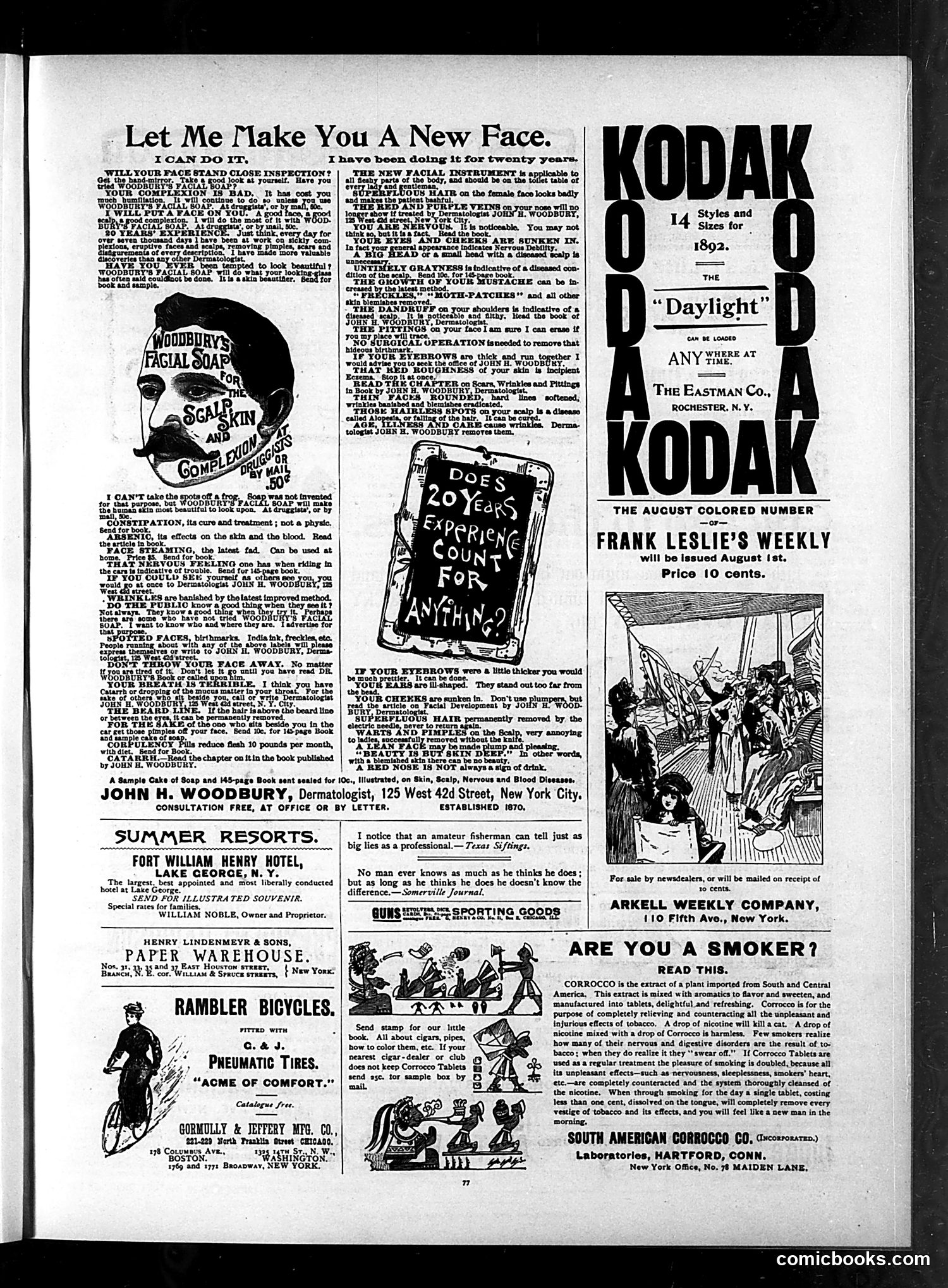
This page is primarily **advertising**, dominated by a large dermatology ad for Dr. John H. Woodbury's facial treatments and soap. The main cartoon features a caricatured man's face labeled with various skin conditions—acne, wrinkles, sunken cheeks, mustache problems—with Woodbury's product promising to cure them all. **The satire**: This mocks the era's dubious medical claims and aggressive beauty advertising. Woodbury promises to literally remake faces through his treatments, claiming 20 years of success. The exaggerated laundry list of "treatable" conditions reflects how such ads exploited insecurity. The page also includes unrelated period humor and ads (bicycles, firearms, summer resorts), plus a small joke about fishermen's tall tales. **Context**: Early 1900s advertising was largely unregulated; dermatologists freely made expansive medical claims. The earnest, pseudo-scientific tone makes the ad's absurdity evident to modern eyes.
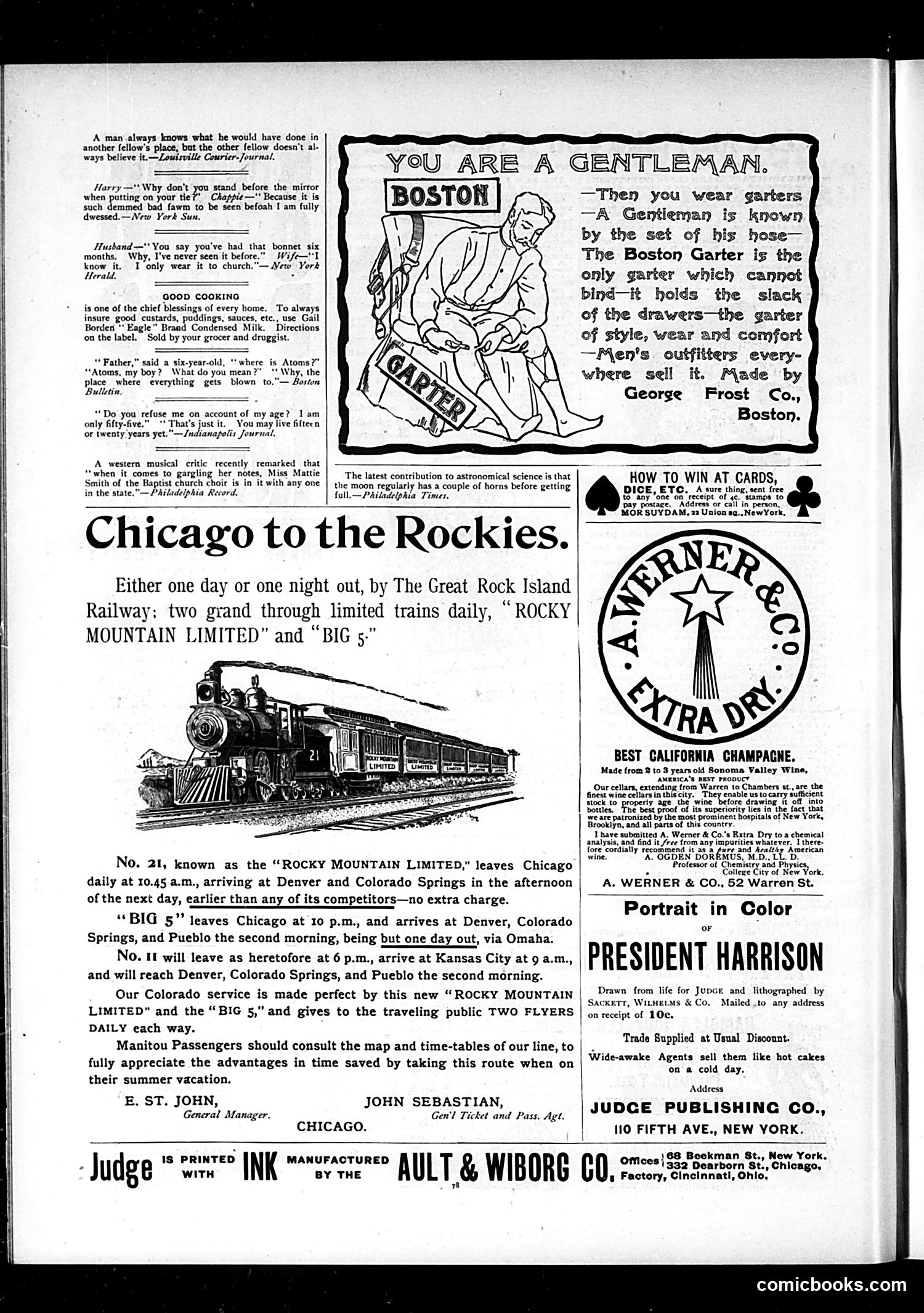
This page is primarily **advertising and filler content** rather than political satire. The main elements include: **Social humor snippets** at top: Brief, genteel jokes about marital dynamics and propriety (a husband surprised by his wife's hat, a suitor rejected for being too young to die soon). These reflect upper-class anxieties about appearance and courtship conventions. **The "Boston Garter" advertisement** features a gentleman adjusting his garter—the joke being that a "gentleman" is defined by proper hosiery support. This reflects late-19th/early-20th-century concerns with masculine respectability and grooming. **Transportation ads**: The Great Rock Island Railway advertises fast trains to Colorado; A. Werner & Co. promotes California champagne. **Bottom**: A portrait offer of President Harrison for 10 cents. The page reflects **Gilded Age consumer culture**—advertisements targeting affluent readers through appeals to refinement, novelty (train speed), and imported luxuries (champagne). There's no discernible political cartoon or social critique, merely marketing wrapped in genteel humor.
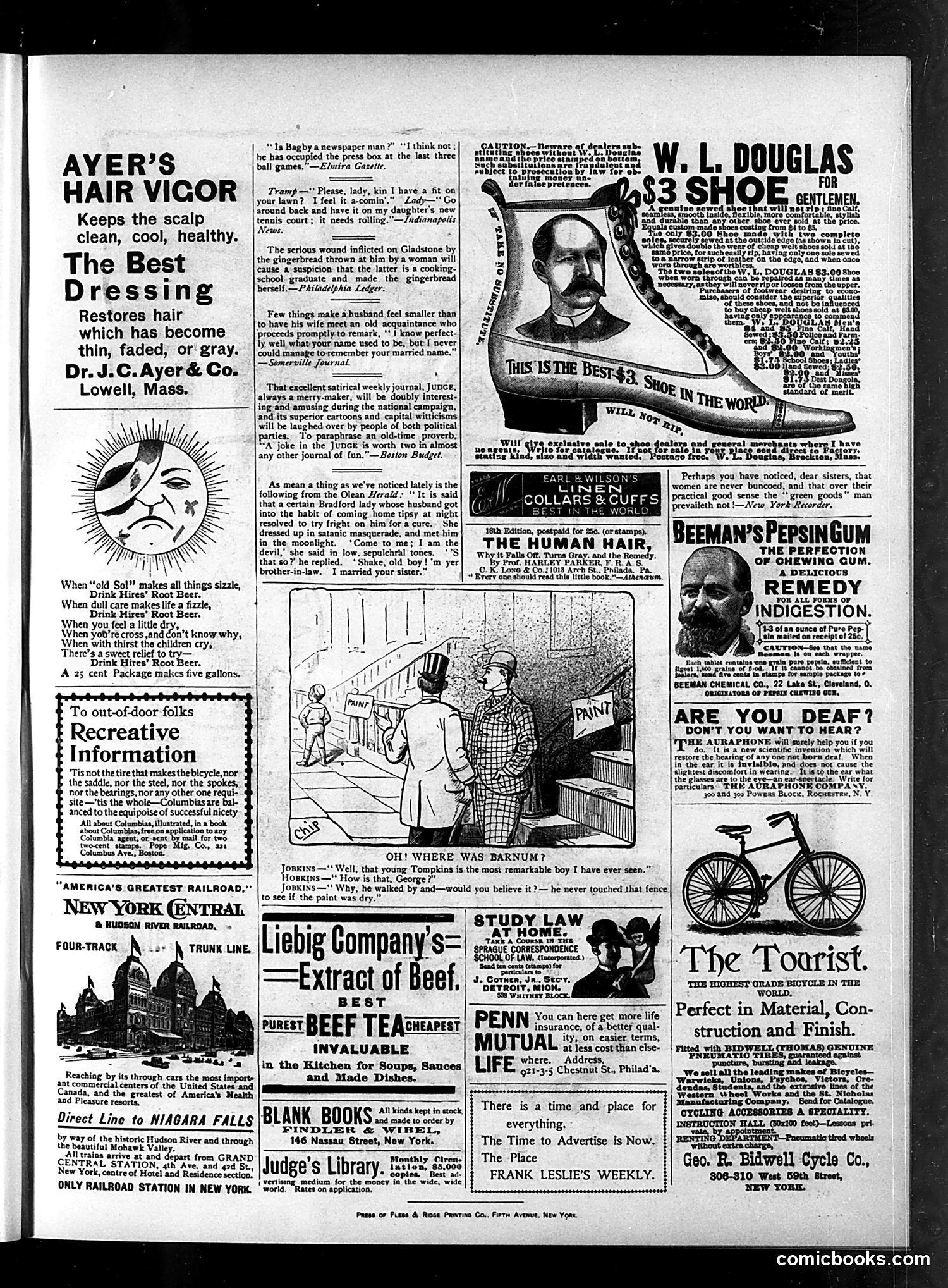
This page is primarily **advertisements and humorous filler content** rather than sustained political satire. The few cartoons present are light social humor: **The main cartoon** ("Oh! Where Was Barnum?") depicts a mundane domestic scene where a man has tracked paint across the floor. The joke references **P.T. Barnum**, the famous circus promoter, suggesting the messy situation would be worthy of his exhibition—a mildly amusing comparison of everyday mishaps to carnival oddities. **The other brief comic items** are genteel one-liners mocking: newspaper critics at baseball games, a tramp's presumed illness, Gladstone's injury from gingerbread (a contemporary news reference), and a husband who discovers his "devil" disguise doesn't frighten his brother-in-law. The page is dominated by period **product advertisements**: Ayer's Hair Vigor, Hires Root Beer, bicycles, railroads, beef extract, and the W.L. Douglas shoe. This reflects Judge's primary revenue model rather than editorial content. Overall: **light social comedy with no significant political dimension**, typical of magazine filler from this era.
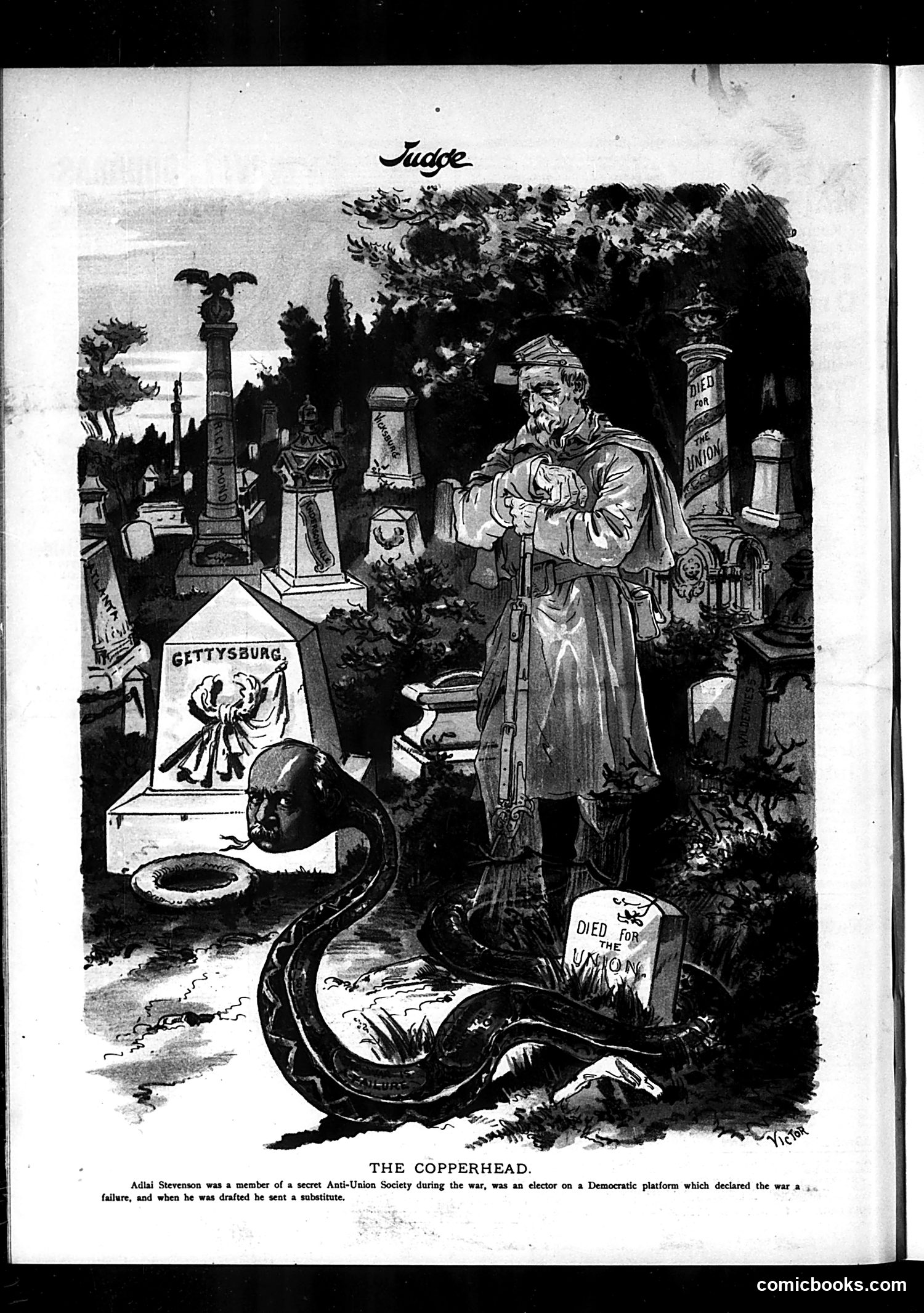
This political cartoon attacks Adlai Stevenson (likely the Civil War-era Vice President under Grover Cleveland) as a "Copperhead"—the derisive term for Northern opponents of the Union cause during the Civil War. The image depicts a figure in a cemetery standing over graves marked "Gettysburg" and "Died for the Union," with a snake (symbolizing treachery) coiled nearby. The satire condemns Stevenson for allegedly: belonging to an anti-Union secret society, supporting a Democratic platform calling the war a failure, and hiring a substitute rather than serving when drafted. The cartoon's message equates his actions with betrayal of fallen soldiers, arguing his political opposition prolonged the war and cost lives.