
Judge, 1892-07-30 · page 6 of 16
Judge — July 30, 1892 — page 6: what you’re looking at
What you’re looking at
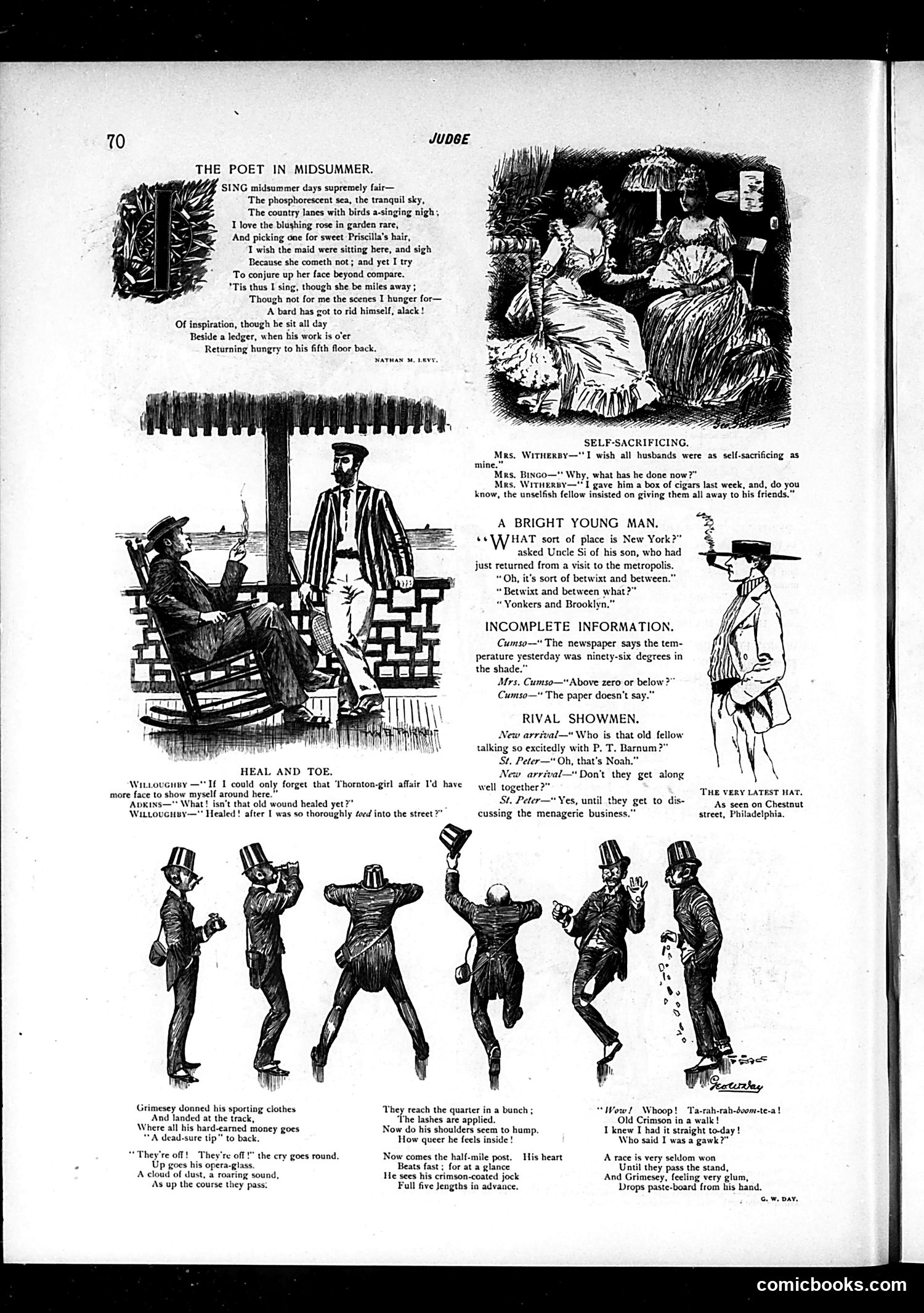
This page from Judge contains multiple satirical pieces targeting middle-class American life circa the 1880s-90s. **"The Poet in Midsummer"** mocks romantic poets who wax lyrical about nature while stuck at tedious day jobs—the narrator composes verse about love and countryside beauty while working as a ledger-keeper, returning hungry to his fifth-floor tenement. The satire targets the gap between artistic aspiration and dreary reality. **"Heal and Toe"** and related vignettes ridicule social embarrassment and romantic failure among gentlemen. **"Grimesey" sequence** satirizes gambling at horse races—a man loses his wages on a "sure tip," experiencing physical anxiety as his horse falls behind. The bottom section features jokes about naïveté (a young man's vague description of New York), journalistic incompleteness, and a gag pairing Noah with P.T. Barnum as rival showmen quarreling over menageries—playing on Barnum's famous circus. The overall tone mocks working-class pretension, failed romantic ambitions, and get-rich-quick schemes.
📄 Transcribed text from this page (OCR, searchable)
Machine-transcribed from the original scan — historical spelling and the odd misread are preserved.
THE POET IN MIDSUMMER. SING midsummer days supremely fair— ‘The phosphorescent sea, the tranquil sky, The country lanes with birds a-singing nigh, I love the blushing rose in garden rare, And picking one for sweet Priscilla’s hair, I wish the maid were sitting here, and sigh Because she cometh not; and yet I try To conjure up her face beyond compare. ‘Tis thus I sing, though she be miles away ; Though not for me the scenes I hunger for— A bard has got to rid himself, alack! Of inspiration, though he sit all day Beside a ledger, when his work is o'er Returning hungry to his fifth floor back. NATHAN M4 LEVY. HEAL AND TOE, Witioucusy —"If 1 could only forget that Thornton-girl affair I'd have more face to show myself around here. Apkins—** What! isn’t that old wound healed yet?” Wittovciuy—" Healed ! after I was so thoroughly foed into the street 7” Grimesey donned his sporting clothes And landed at the track, Where all his hard-earned money goes “A dead-sure tip” to back. “They're off! They're off !" the cry goes round. Ps Up goes his opera-glass. A cloud of dust, a roaring sound, As up the course they pass: ‘They reach the quarter in a bunch ; ‘The lashes are applied. Now do his shoulders seem to hump. How queer he feels inside ! Now comes the half-mile post. Beats fast ; for at a glance He sees his crimson-coated jock Full five Jengths in advance. what has he done now?” Mrs. WiTHERBY “% A BRIGHT YOUNG MAN. SS VHAT sort of place is New York?” asked Uncle Si of his son, who had just returned from a visit to the metropolis. “Oh, it’s sort of betwixt and between.” “Betwixt and between what ?” “Yonkers and Brooklyn.” INCOMPLETE INFORMATION, Cumso—"The newspaper says the tem- perature yesterday was ninety-six degrees in the shade. Mrs. Cumso—" Above zero or below ?” Cumso—" The paper doesn’t say.” RIVAL SHOWMEN. New arrival—* Who is that old fellow talking so excitedly with P. T. Barnum?” St. Peter—" Oh, that’s Noah.” New arrival—" Don't they get along well together?” St. Peter—" Yes, until they get to dis- cussing the menagerie business.” “Wow! Whoop! ‘Ta-rs Old Crimson in a wall I knew I had it straight to-day ! Who said I was a gawk?” His heart A race is very seldom won Until they pass the stand, And Grimesey, feeling very glum, gave him a box of cigars last week, an: know, the unselfish fellow insisted on giving them all away to his friends.” THE VERY LATEST HAT. As seen on Chestnut street, Philadelphia, Fah-boom-te-a! Drops paste-board from his hand. do you G. w, DAY, comicbooks.com