
A complete issue · 24 pages · 1892
Judge — June 11, 1892
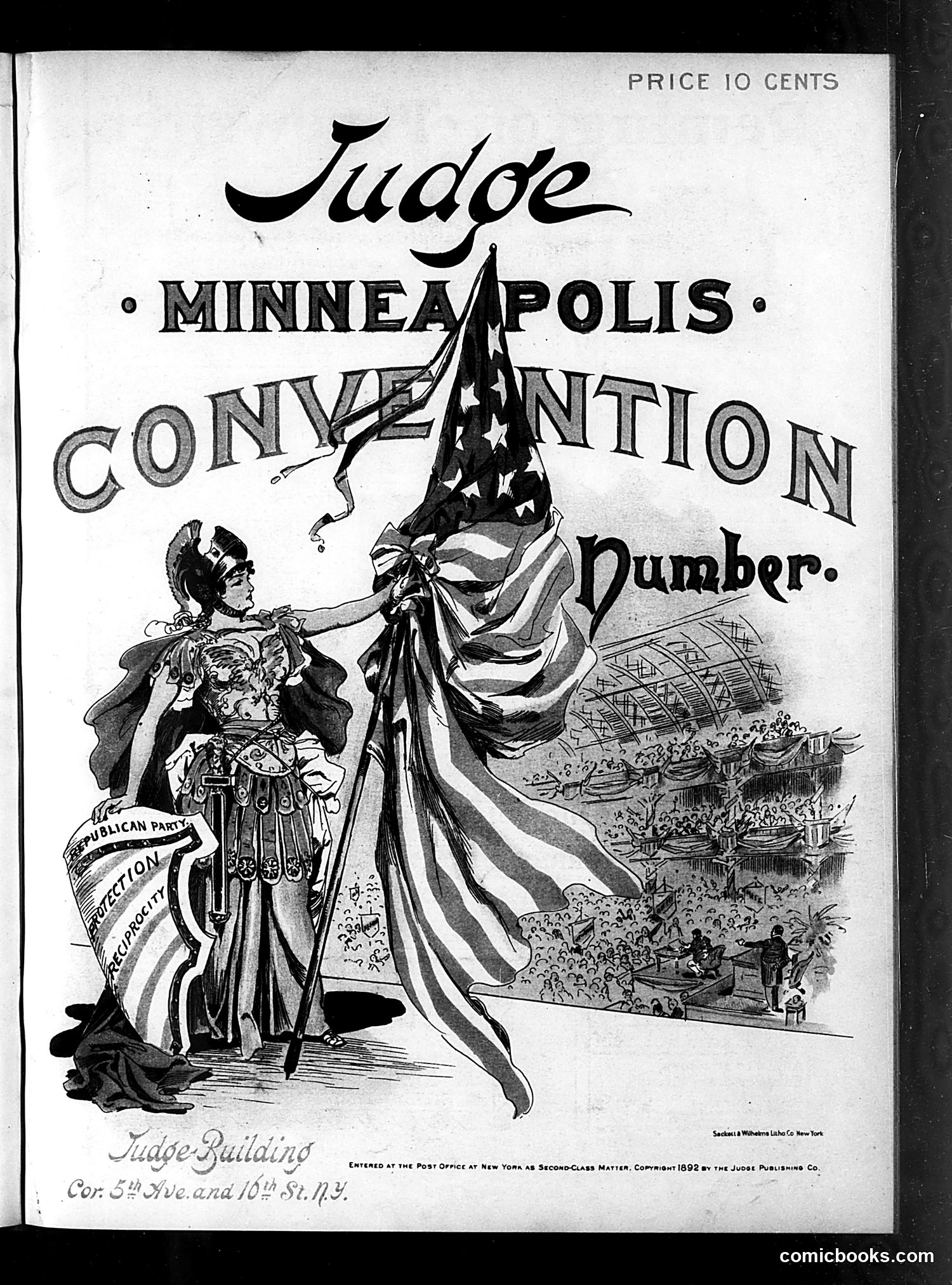
This is the cover of a special "Minneapolis Convention Number" from Judge magazine (price 10 cents), dated 1892 based on the copyright notice. The central image depicts Lady Liberty (in Roman armor) holding an American flag at a Republican Party convention. A child figure stands beside her. The convention hall is shown in the background, crowded with attendees. The "Republican Party" label visible on Liberty's garment indicates this issue covered the 1892 Republican National Convention held in Minneapolis. The satire appears celebratory of the convention itself rather than sharply critical—Liberty's prominent placement and heroic pose suggest endorsement of the Republican gathering and its nationalist themes. The Judge Building address (Cor. 54 Ave. and 16th St., N.Y.) appears at bottom left.
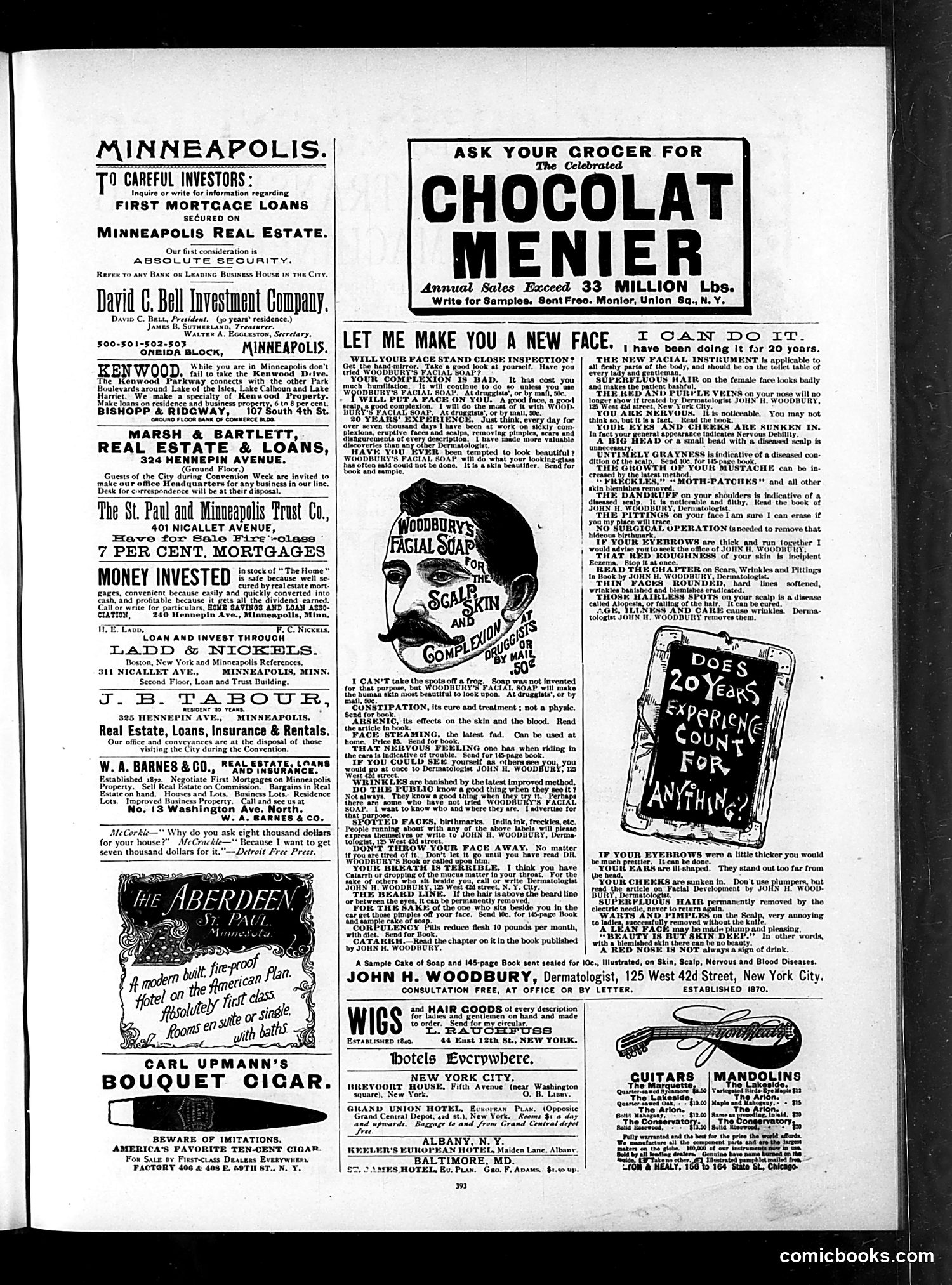
This page is primarily **advertising**, not political satire. The dominant content features two large ads: 1. **Woodbury's Facial Soap** - A lengthy advertisement promoting soap as a dermatological cure-all, addressing acne, wrinkles, freckles, and other skin conditions. The accompanying illustration shows a man's face with the product label overlaid. 2. **John H. Woodbury's Dermatology** - Promoting a book about skin care and blood diseases, offering consultation by mail. The page also contains various other advertisements for Minneapolis real estate investments, loans, hotels, hair goods, guitars, mandolins, and cigars—typical of early 20th-century magazine monetization. **No political cartoon or satirical content is present.** This appears to be a standard advertising page from *Judge* magazine, reflecting the publication's reliance on paid advertisements rather than editorial commentary.
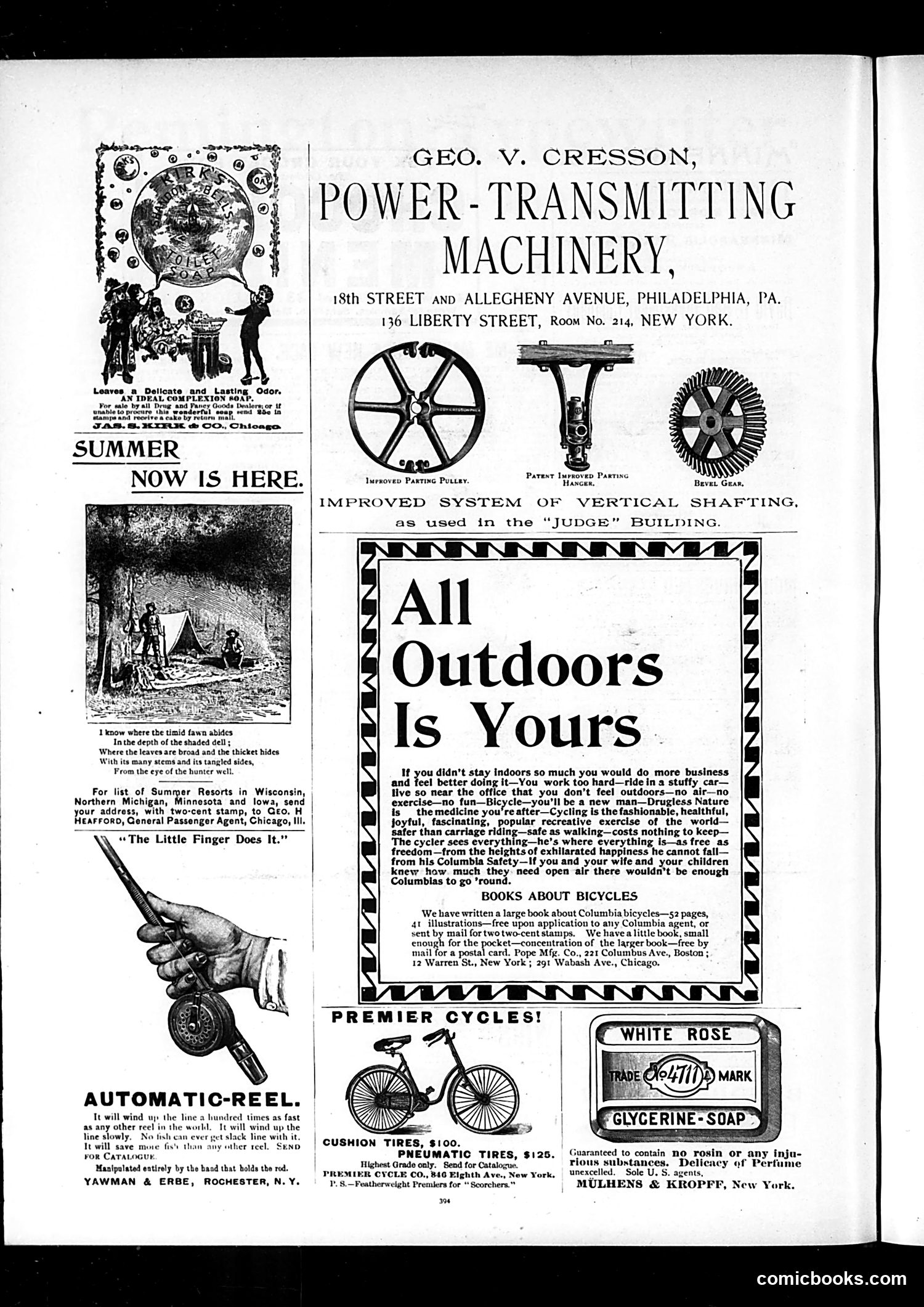
This page is **primarily advertising**, not satire or political commentary. It's from Judge magazine's advertising section circa 1890s. The content includes: - **Power machinery ads** (Cresson company) featuring industrial equipment like pulleys and gears - **Bicycle promotion** (Columbia and Premier brands) with an extended advertorial essay titled "All Outdoors Is Yours" arguing that cycling provides health, freedom, and business benefits—a common argument during the 1890s bicycle craze - **Fishing equipment** (automatic reel by Yawman & Erbe) - **Summer resort listings** and poetry about nature - **White Rose glycerin soap** advertisement The only potentially satirical element is the subtle irony in the bicycle ad's pitch: wealthy office workers are urged to escape their sedentary, unhealthy indoor lives through cycling—reflecting genuine anxieties about industrialization and urbanization in the 1890s. The repeated emphasis on "outdoors" and "nature" as medicine suggests these were perceived problems even then. Otherwise, this is straightforward period advertising reflecting consumer goods and leisure activities of the era.
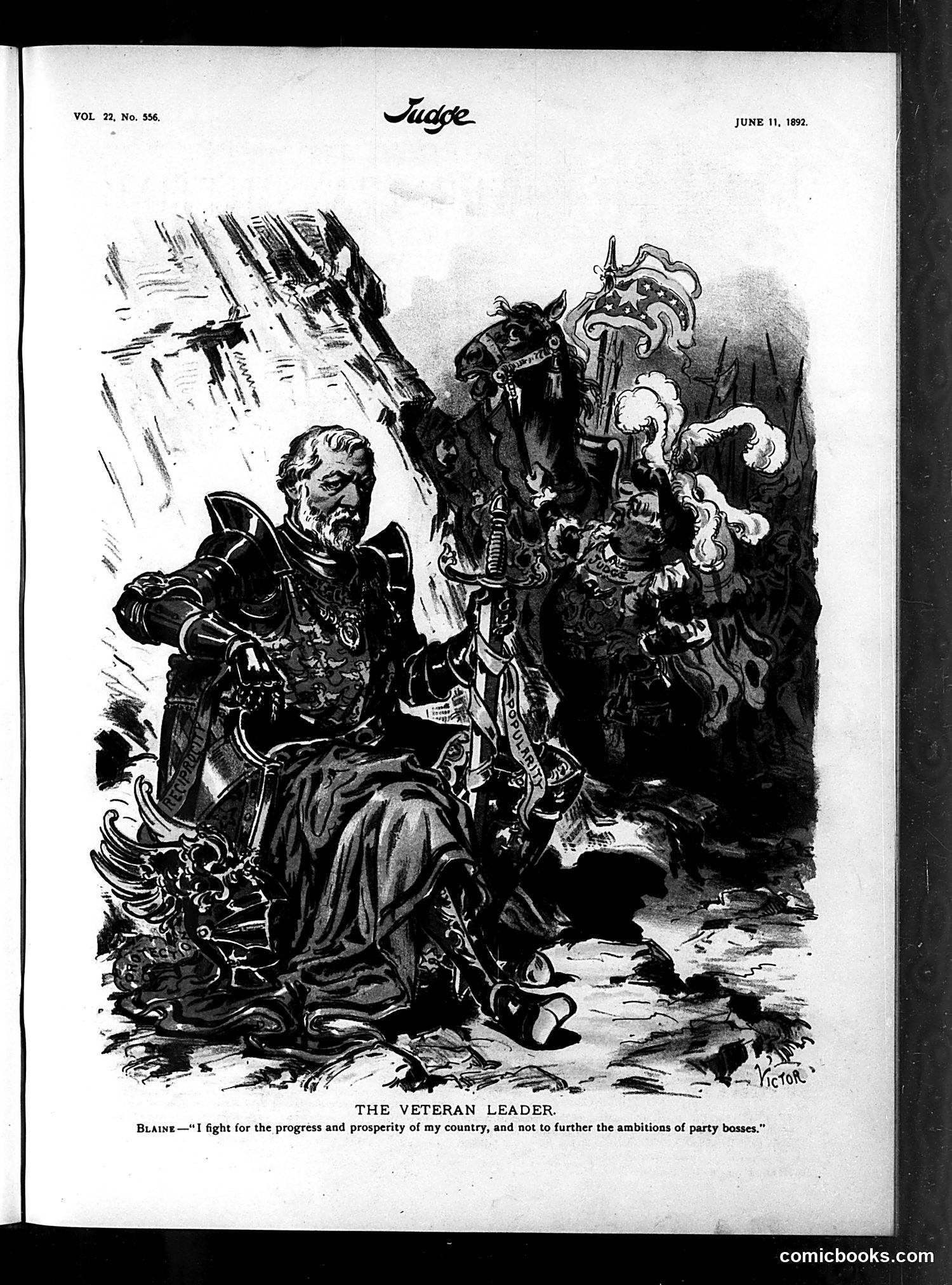
This political cartoon depicts **James G. Blaine**, a prominent Republican politician and former presidential candidate, seated amid demonic or monstrous figures representing "party bosses." Blaine's quote claims he fights for national progress rather than partisan ambitions—likely ironic commentary, as Blaine was himself accused of corruption and serving machine politics. The grotesque creatures surrounding him suggest Judge's skepticism about his stated independence. The 1892 context is significant: Blaine was considering another presidential run, and the cartoon critiques his rhetoric as hollow. The "veteran leader" positioning acknowledges his long political career while the satirical framing questions whether his patriotic claims mask continued entanglement with the corrupt party apparatus the Republican establishment represented.
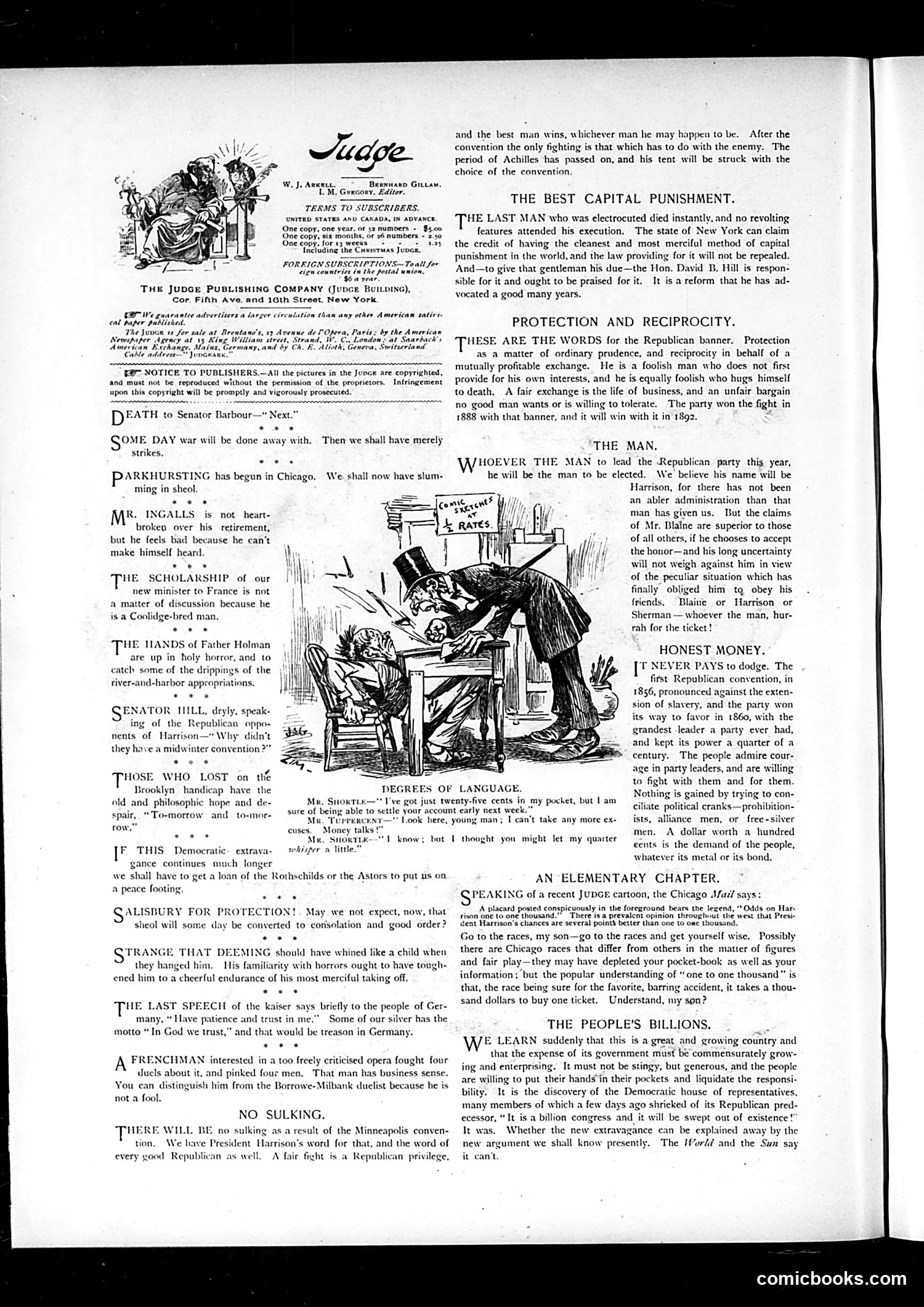
This page from Judge contains brief political commentary and jokes targeting Republican and Democratic figures circa 1892. Key references include: **Political Figures:** Senator Barbour (death wished upon him), Mr. Ingalls (retiring), Father Holman, Senator Hill, and prominent Republicans Harrison, Blaine, and Sherman—all potential 1892 presidential candidates. **The Main Cartoon** ("Degrees of Language") depicts two men in conversation about pocket money, satirizing class differences or economic disparity through their exchange. **Key Themes:** The editorial content defends Republican positions on capital punishment (electrocution), protection/reciprocity trade policies, and party unity. It advocates for either Harrison or Blaine as the presidential nominee while urging party solidarity. **Tone:** Typical of Judge's partisan Republican satire—mocking Democrats, praising Republican achievements, and using brief witticisms to comment on current events and political personalities. The page blends advertising information with political opinion characteristic of 1880s-90s American satirical journalism.
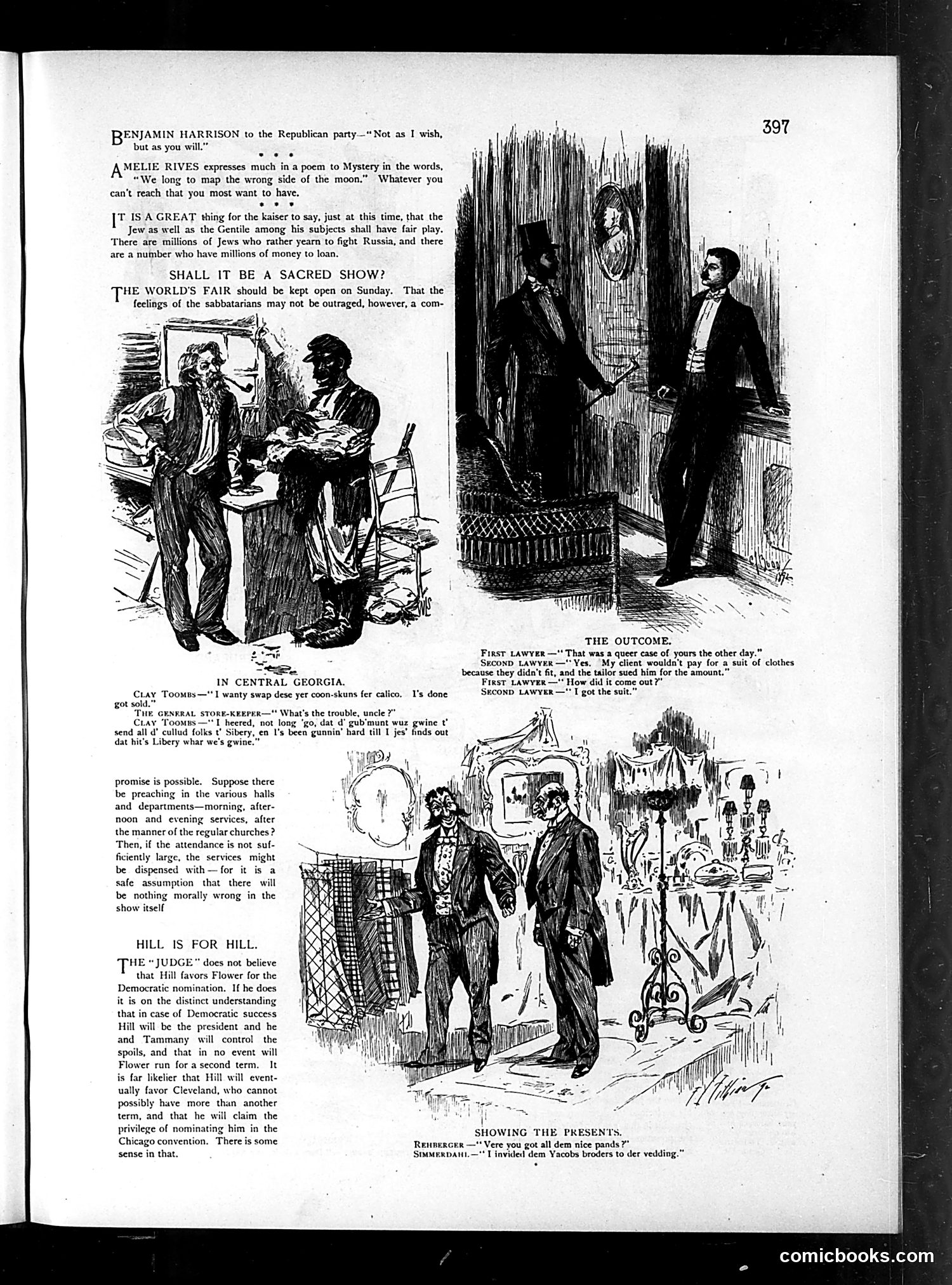
This page contains several satirical commentaries on 1890s American politics and society: **Top section**: References to Benjamin Harrison and Republican party politics, plus commentary on Kaiser Wilhelm II's claims of fair treatment for Jews—satirizing the kaiser's opportunism in courting Jewish support and their financial resources during tension with Russia. **"Shall It Be a Sacred Show?"**: Debates keeping the World's Fair open on Sundays, mocking religious objections while suggesting compromise solutions that might empty the venue anyway—satire on Sabbatarian vs. secular disputes. **Lower cartoons**: Depict ethnic stereotypes common to the era—a humorous legal dispute over clothing fit, and a Black character ("Clay Toomus") confused about government relocation rumors. **"Hill is for Hill"**: Political prediction about Democratic nomination politics involving Hill, Flower, Cleveland, and Tammany Hall—insider commentary on factional maneuvering. The cartoons employ period-typical caricature and dialect humor reflecting Judge's satirical approach to contemporary political gossip and social debates.
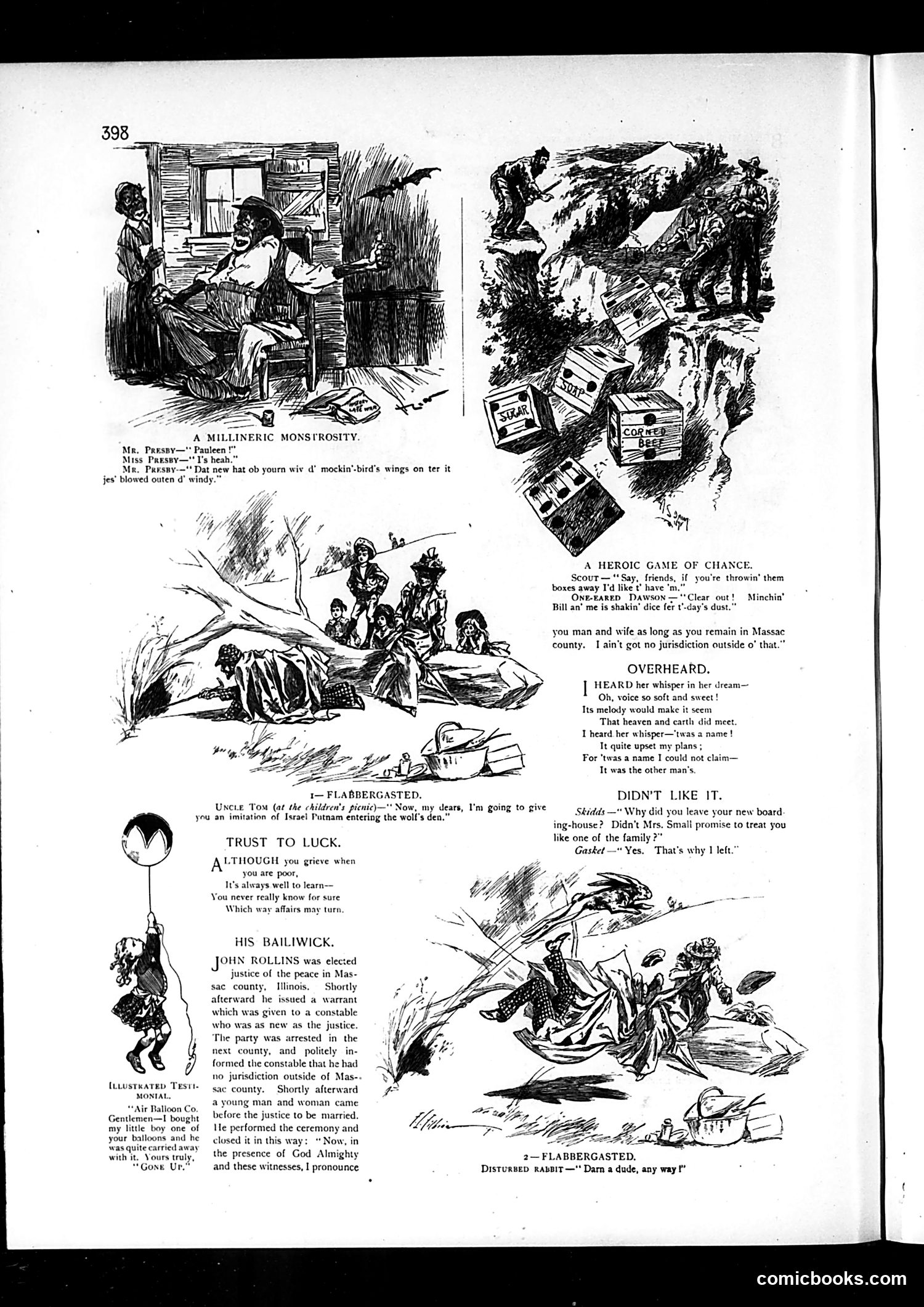
This page contains multiple satirical cartoons and humorous sketches typical of Judge magazine's style: **"A Millinery Monstrosity"** mocks African American dialect and fashion, showing a woman's hat with a mockingbird's wings blown away in the wind—satirizing excessive hat decoration trends. **"A Heroic Game of Chance"** depicts prospectors gambling over provisions during what appears to be a mining rush, with the humor in their casual dismissal of a newcomer wanting discarded boxes. **"His Bailiwick"** is a straightforward anecdote about a newly-elected justice of the peace who performs a marriage ceremony but comically limits his authority only to Massac County—satirizing bureaucratic limitation and incompetence. **"Flabbergasted"** shows Uncle Tom reenacting the Revolutionary War story of Israel Putnam escaping a wolf's den, and a disturbed rabbit watching—likely racial satire using a degrading minstrel-style reference. The page also includes sentimental poetry ("Overheard") and brief humorous dialogues. The overall content reflects late-19th/early-20th-century Judge humor, mixing racial caricature, domestic comedy, and social observation.
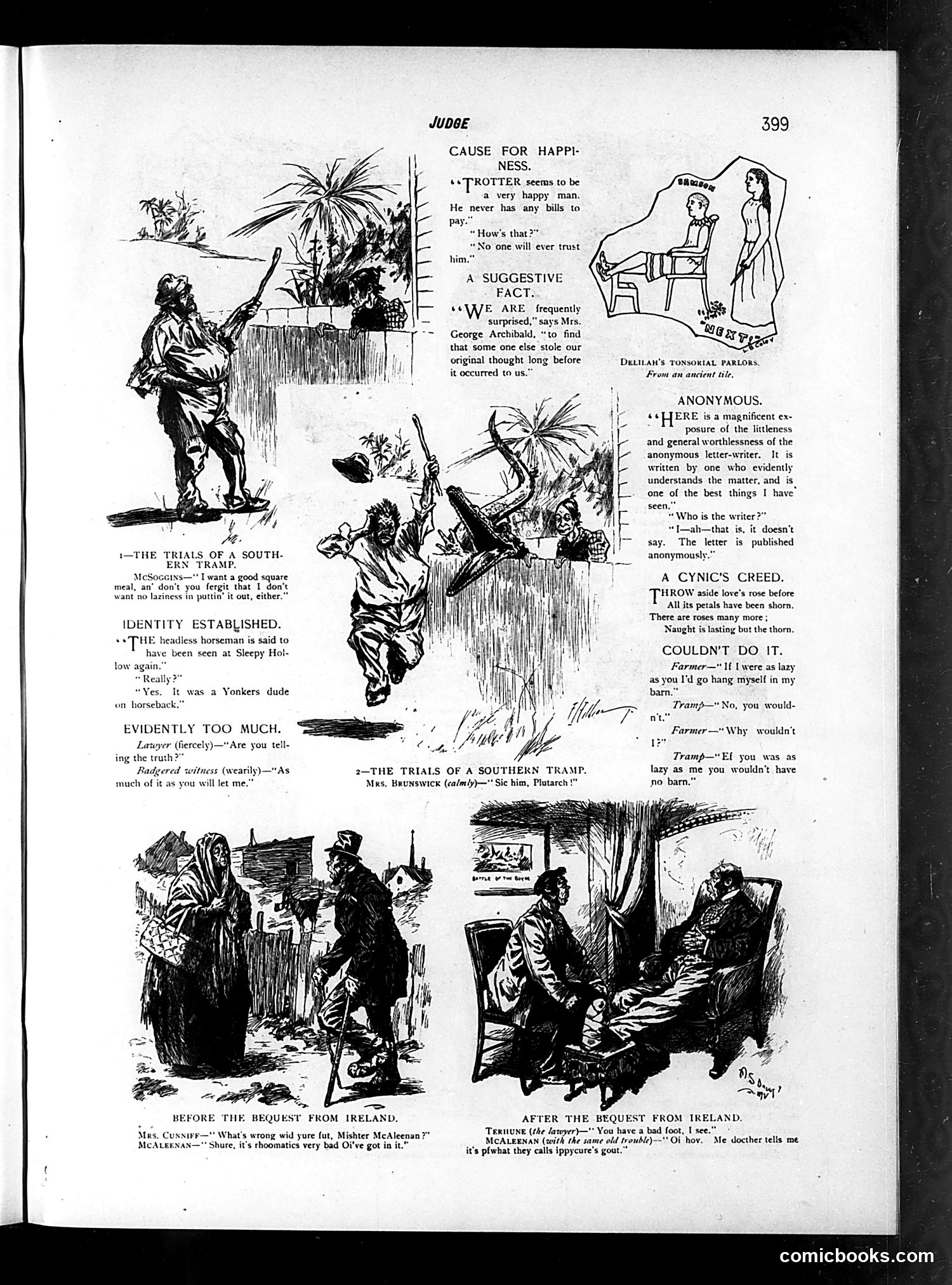
This page collects brief humorous sketches on various social themes, circa early-to-mid 20th century. **Key sketches:** 1. **"Trotter"**: A man happy because no one trusts him enough to extend credit—satire on chronic debtors. 2. **"Headless Horseman" reference**: An allusion to Washington Irving's legend, here joking that a Yonkers dandy on horseback resembles the ghost, mocking wealthy Manhattan-area dandies. 3. **"Southern Tramp"**: A vagrant's demands for food, establishing class/regional stereotypes. 4. **"Anonymous Letter-Writer"**: Satirizing cowardly anonymous criticism—a persistent social complaint. 5. **"Irish immigrant sketches** (bottom): Characters named McAleenan and Brunswick, using Irish dialect ("Shure," "Oi"), likely satirizing Irish-American immigrant communities and their supposed superstitions or medical complaints. The overall tone mocks debtors, social climbers, vagrants, anonymous cowards, and ethnic stereotypes—typical Judge magazine content targeting middle-class anxieties and social pretension.
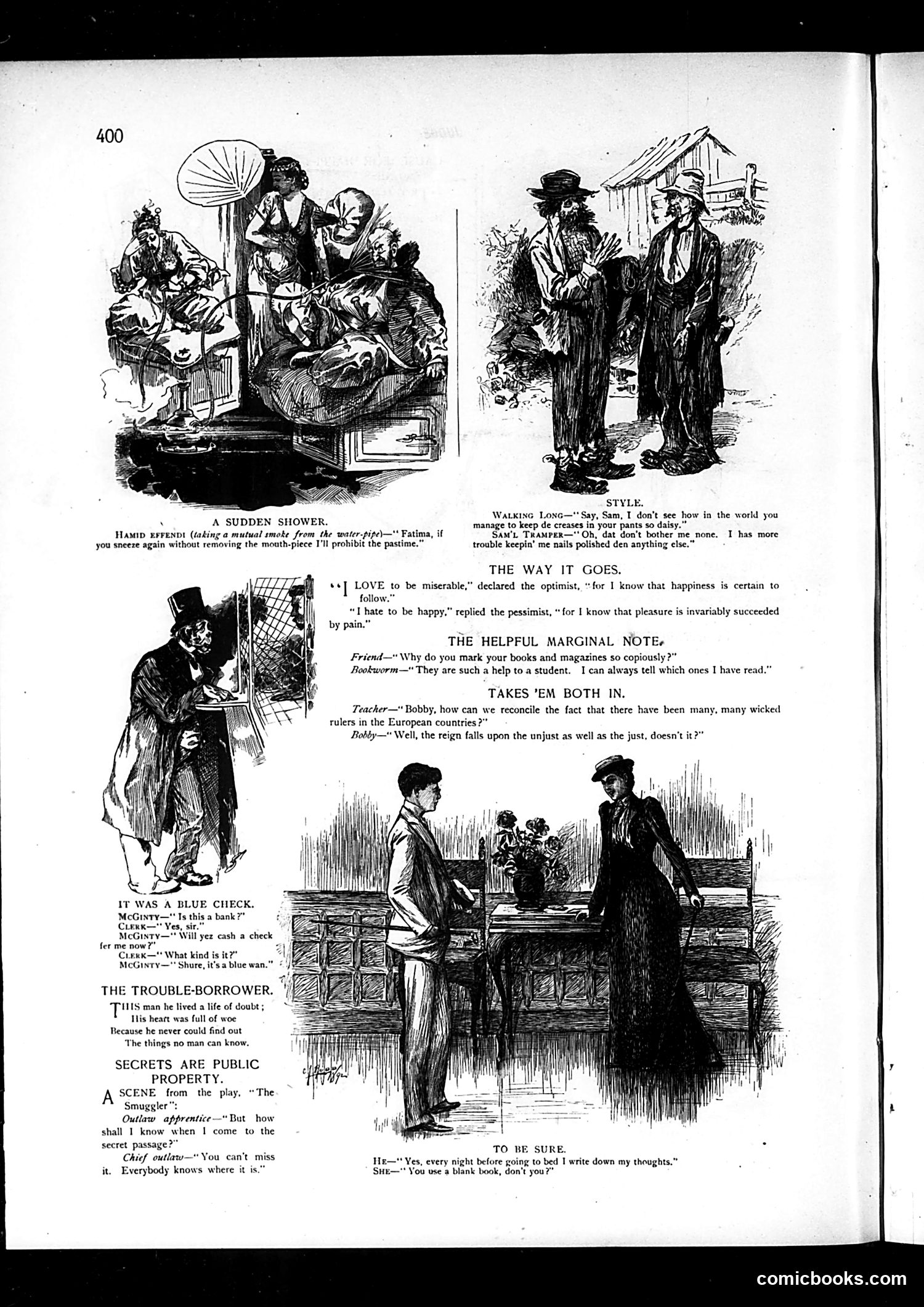
This page contains multiple humor pieces satirizing American social types and pretensions around the turn of the 20th century. "A Sudden Shower" mocks orientalism and affected exoticism—wealthy Americans adopting exotic customs (water pipes, the name "Fatima") to appear cosmopolitan. "Walking Long" and "Sam's Tramper" use dialect humor (common in this era) to joke about working-class concerns: maintaining clothing and personal grooming despite labor. "The Way It Goes" and "Takes 'Em Both In" offer gentle philosophical observations about optimism versus pessimism—popular period debate topics. "The Helpful Marginal Note" satirizes pretentious readers who mark up books not for learning but to appear well-read. "It Was a Blue Check" mocks Irish immigrants (McGinty is a stereotypical Irish name) attempting banking while unfamiliar with financial systems. The final piece jokes about keeping a diary of thoughts—contemporary self-help culture. Overall, the page satirizes social climbers, ethnic stereotypes, and middle-class affectations typical of *Judge's* humor.
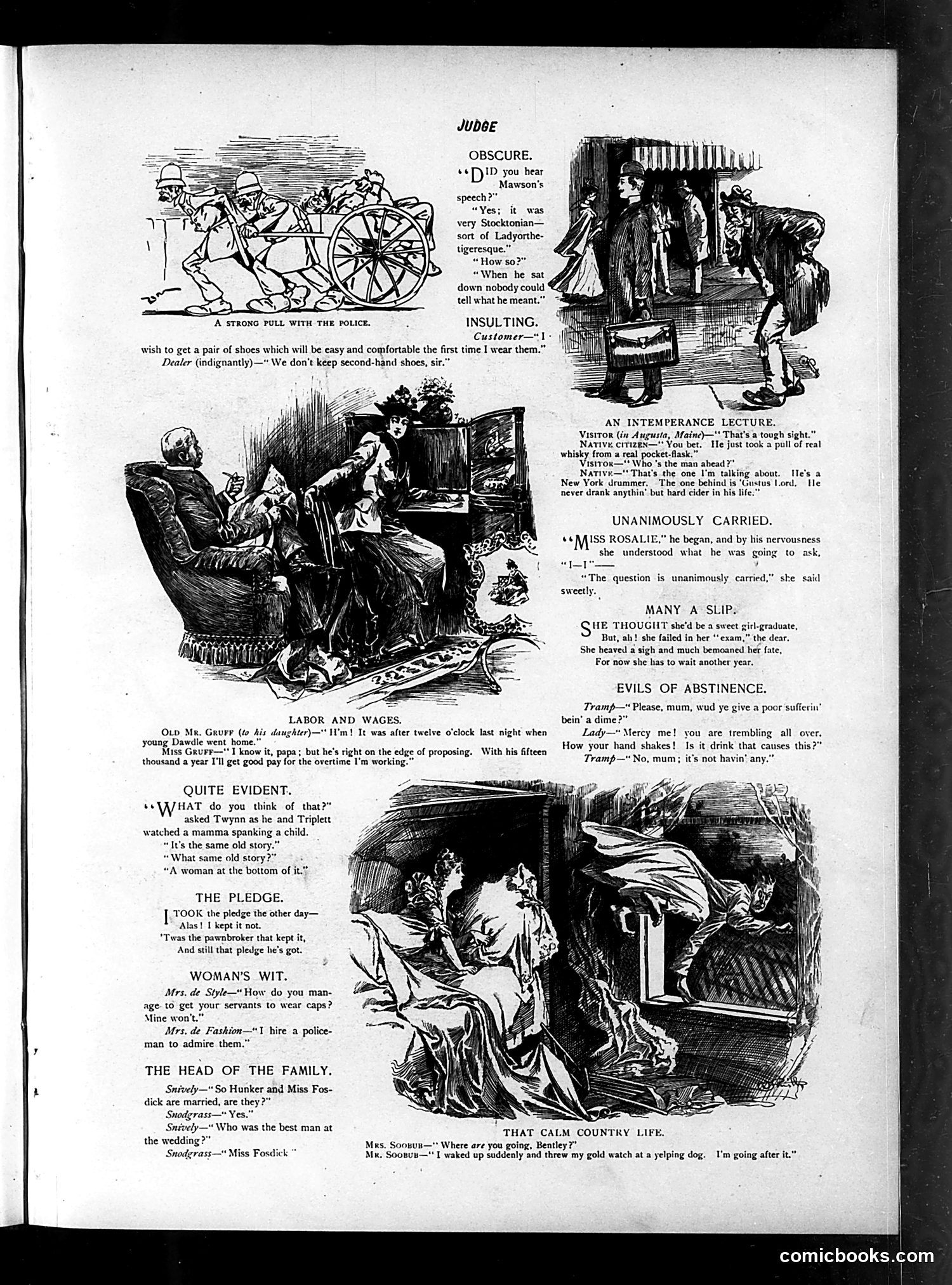
This page collects brief satirical sketches typical of late-19th-century Judge magazine. Key observations: **"A Strong Pull with the Police"** shows police struggling with what appears to be a wagon or cart—likely satirizing police incompetence or corruption. **The shoe dealer sketch** mocks a customer's unrealistic expectation that new shoes should be comfortable immediately, with the dealer's indignant response suggesting this is absurd. **The intemperance lecture** contrasts a New York traveling salesman (drummer) who drinks whisky with a local Maine man ("Gustus Lord") who claims he only drinks hard cider—satirizing regional drinking customs and hypocrisy about what counts as "drinking." **Other sketches** cover familiar domestic/romantic themes: failed exam results, a nervous marriage proposal, labor disputes, pawn shop pledges, and servant management. The humor relies on wordplay, social observation, and class commentary rather than topical politics. Most sketches depict middle-class anxieties and behavioral quirks.
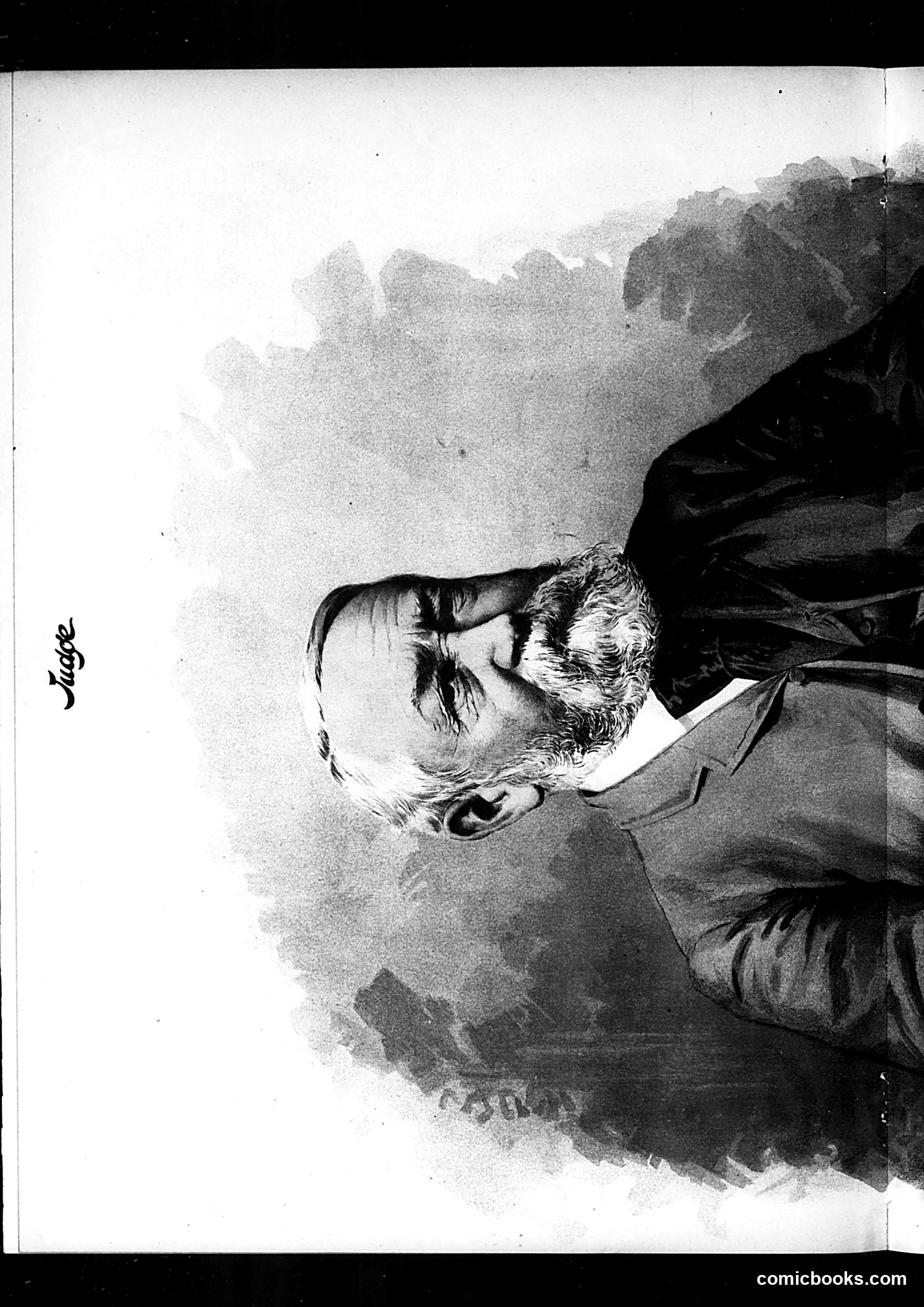
I can see this is a black and white illustration from Judge magazine, showing a man in profile facing upward and to the right, wearing what appears to be formal attire with a dark jacket. The figure has distinctive facial features including a prominent nose and beard. However, the OCR text provided is largely illegible—it appears to be corrupted characters and symbols rather than readable text. Without legible text identifying the subject, the specific political context, or the cartoon's caption, I cannot reliably determine who this figure represents or what satirical point the cartoonist intended to make. To accurately explain this cartoon's meaning to a modern reader, I would need either clearer text or additional identifying information visible in the image itself.
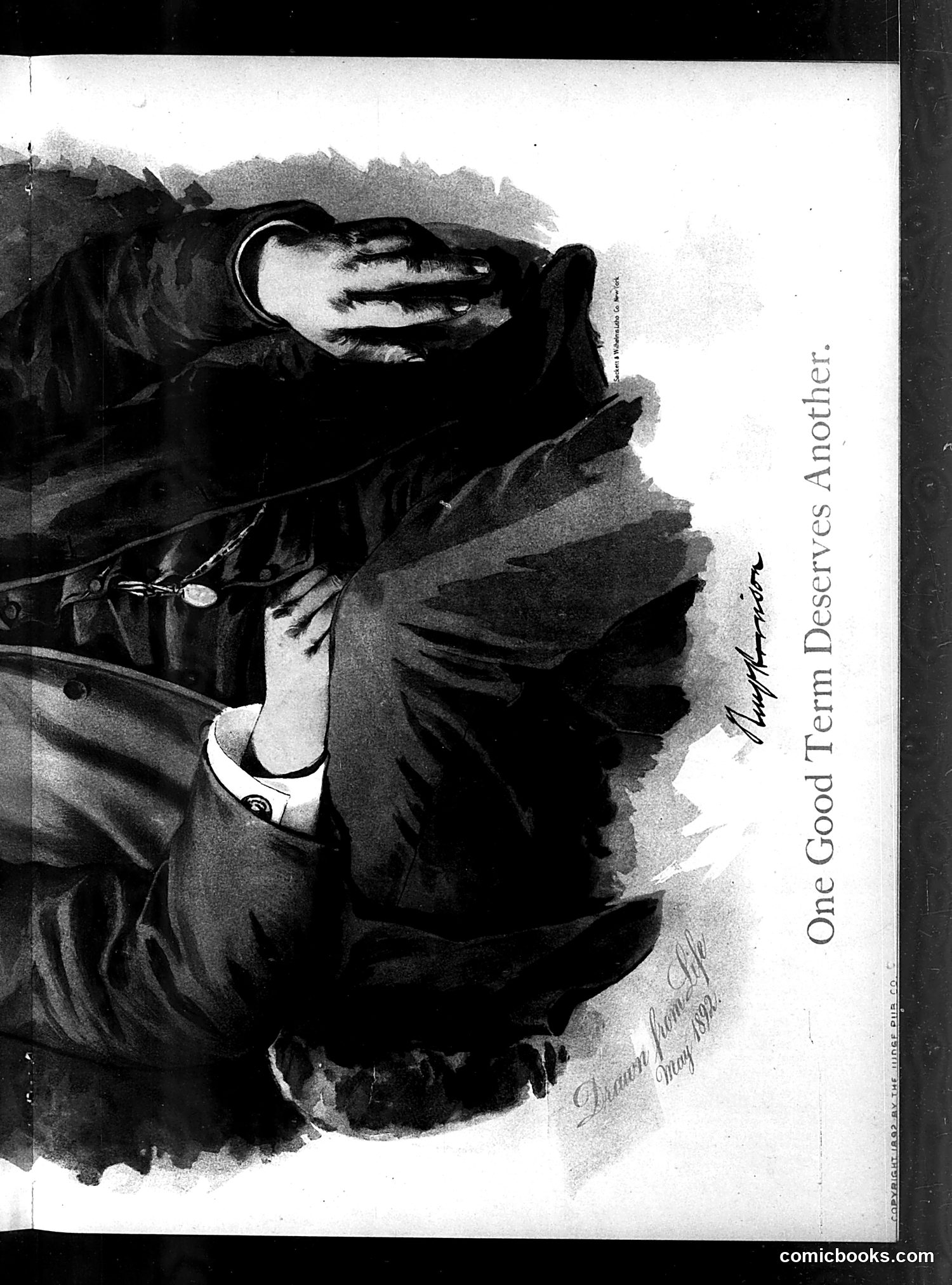
This page appears to be from *Judge* magazine and shows a satirical illustration titled "One Good Term Deserves Another." The image depicts a figure in formal attire (suit and tie visible) shown upside-down or in an inverted position, rendered in stark black and white. The caption suggests political commentary about a term of office—likely mocking or supporting a politician's continuation in power. However, without clearer visibility of the signature, precise date, or more legible OCR text, I cannot definitively identify which specific political figure or election cycle this references. The artistic style and composition suggest early-to-mid 20th century satirical commentary on American politics, but the exact target and point of the satire remain unclear from this reproduction.
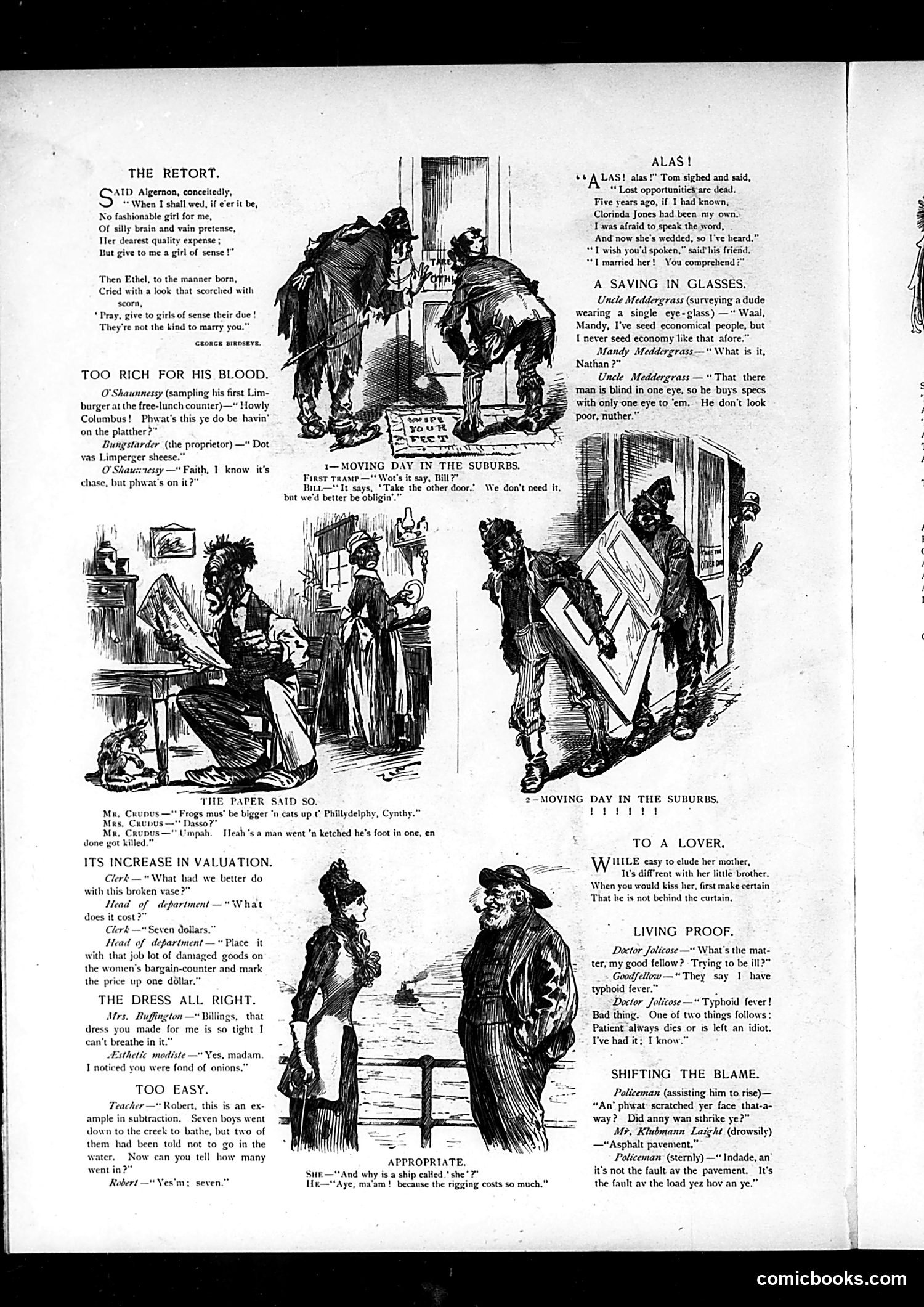
This page from *Judge* contains multiple brief satirical sketches typical of the magazine's humor: **"The Retort"** mocks a conceited man (Algernon) who claims he'll only marry a sensible woman—Ethel immediately deflates his pretensions by suggesting no sensible woman would marry *him*. **"Too Rich for His Blood"** plays on Irish immigrant stereotype (O'Shaunnessy) unable to identify Limburger cheese by smell, expecting something more exotic. **"Moving Day in the Suburbs"** depicts working-class transience with vagrants following movers, finding discarded items. **"A Saving in Glasses"** satirizes rural characters (Uncle and Mandy Meddergrass) amazed by a wealthy "dude" wearing a monocle, misinterpreting economy as blindness rather than fashion affectation. Other sketches mock pretentious aesthetes, strict teachers, and drunken Irishmen. The humor relies on period class stereotypes, ethnic caricatures, and wordplay—typical *Judge* content targeting immigrants, rural folk, and the socially ambitious for urban middle-class readers.
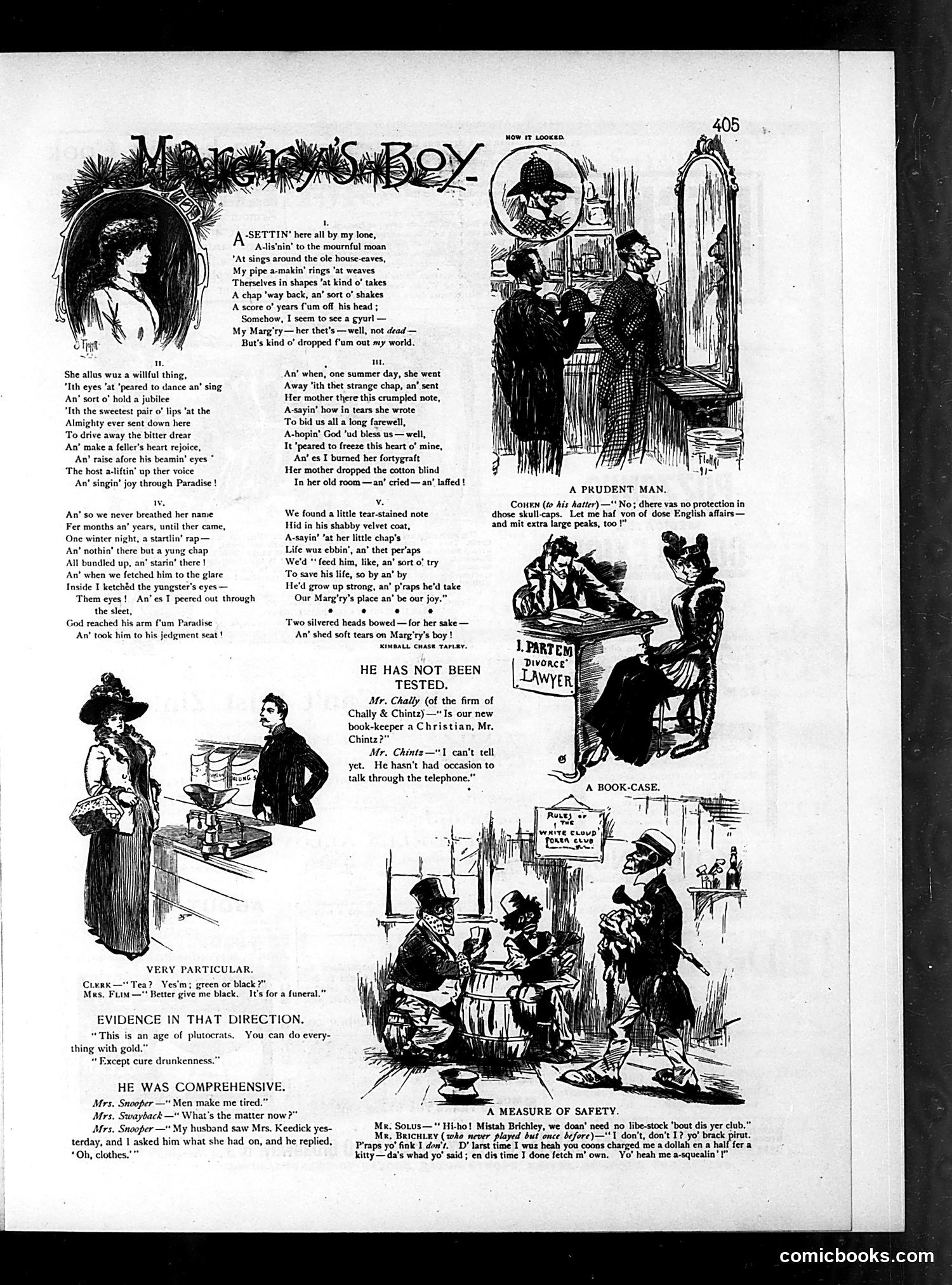
This page contains multiple brief satirical sketches typical of late 19th/early 20th-century humor magazines: **Main feature**: A sentimental poem about a rural father whose daughter elopes with a stranger, only to discover the man has an infant child. The parents ultimately accept the baby as a replacement for their lost daughter—blending melodrama with gentle social commentary about illegitimacy and redemption. **Shorter sketches satirize**: - A German immigrant's excessive caution (buying protective headgear) - A newly hired bookkeeper's untested character - A woman overly concerned with tea specifications at a funeral - A husband's vague answer about his wife's appearance (implying she wore nothing but "clothes") - Racial humor (common to the era) involving Black men negotiating billiards fees The overall tone mixes sentimentality, class humor, and period-typical racial stereotypes. Most jokes rely on wordplay, social anxieties about propriety, and immigrant/dialect humor conventions of the time.
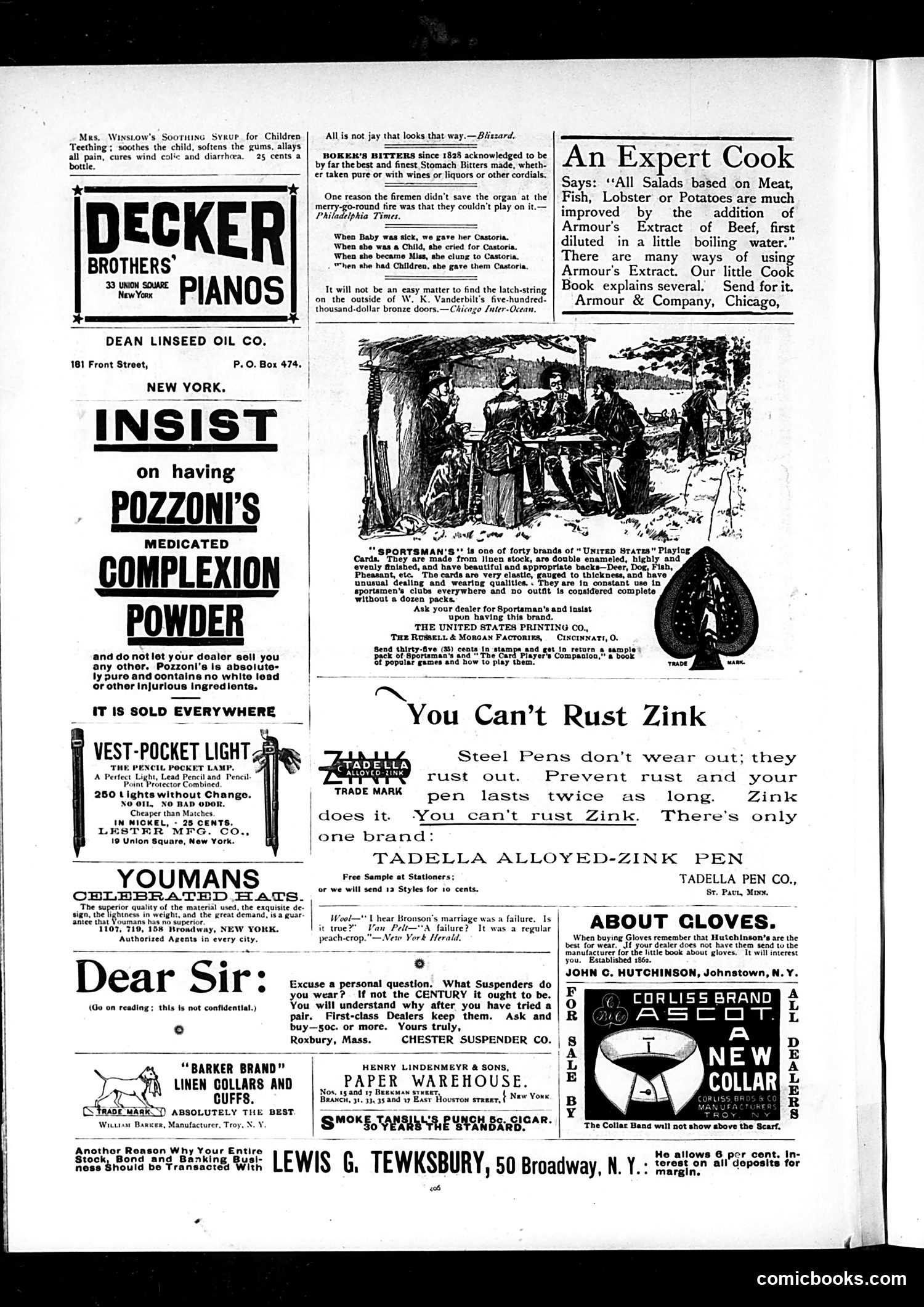
This page is primarily **advertising**, typical of early 20th-century satirical magazines that relied heavily on commercial revenue. Notable ads include patent medicines (Mrs. Winslow's Soothing Syrup, Boker's Bitters), household goods (Decker Brothers Pianos, Youmans Hats), and novelty items (Vest-Pocket Light). The few humorous items are brief jokes: - A firefighting gag about an organ at a merry-go-round fire - The Castoria jingle (recurring ad copy) - A Vanderbilt door joke about wealth and exclusivity - A marriage joke comparing divorce to a "peach-crop" These represent typical Judge humor: light social observation and upper-class mockery rather than sharp political satire. The Vanderbilt reference suggests class consciousness—poking fun at the wealthy's inaccessibility—but without substantial bite. The page reflects Judge's dual nature: a magazine balancing satirical credibility with commercial necessity through densely packed advertising.
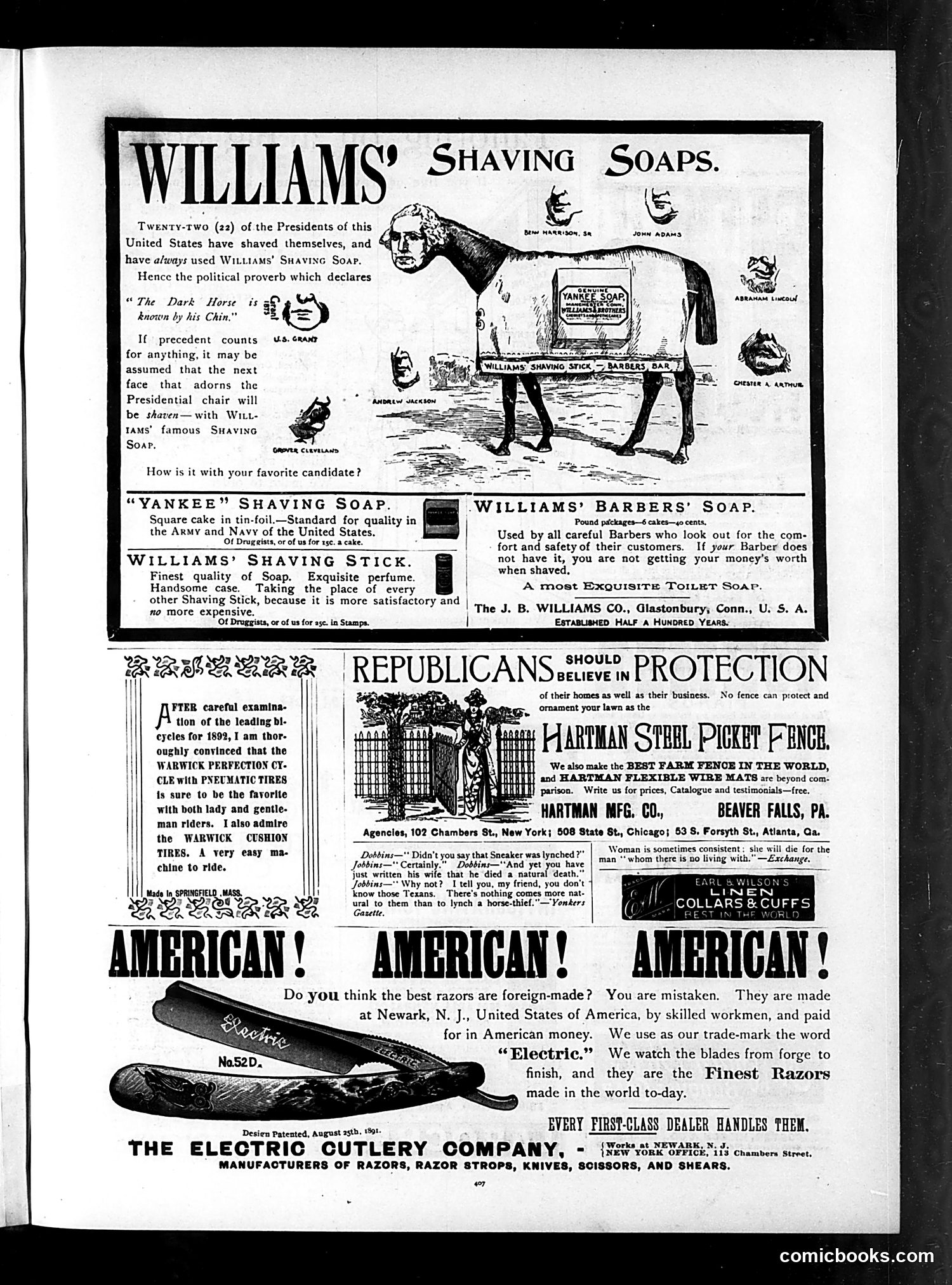
This page is primarily **advertising** rather than editorial content, featuring multiple product promotions from the 1890s. The main satirical element appears at the top: **Williams' Shaving Soaps** uses a political angle, claiming twenty-two U.S. Presidents have used their product. The accompanying illustration shows a cow labeled with presidential names (Harrison, Adams, Jackson, Lincoln, etc.), making a crude visual pun about "the Dark Horse is known by his Chin"—likely referencing an upcoming presidential election where an unknown candidate ("dark horse") might emerge. Other advertisements include: - **Hartman Steel Picket Fence** with a Republican Party reference to "Protection" (protectionist tariff policy) - **Warwick Bicycles** - A brief joke about lynching (dark frontier humor of the era) - **Electric Cutlery Company** razors, emphasizing American manufacturing versus foreign imports The page reflects 1890s commercial advertising strategies: patriotic appeals, product endorsements via authority figures, and crude political humor tied to contemporary election cycles.
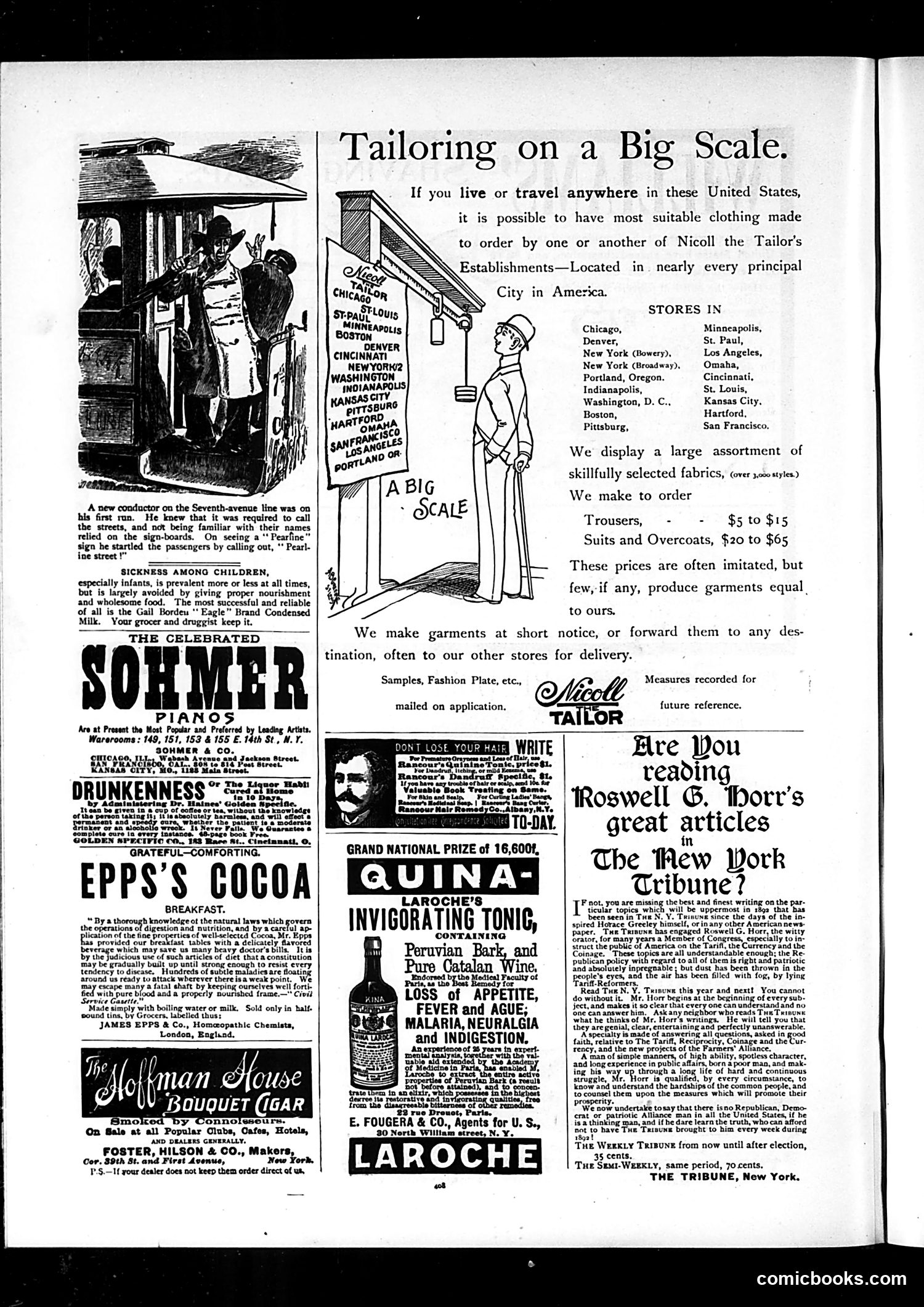
This page is primarily **advertising**, not political satire, though it opens with a brief, light comedic anecdote. The small cartoon at top shows a new subway conductor on the Seventh Avenue line calling out "Pearline street!" after misreading an advertisement for "Pearline" (a cleaning product) as an actual street sign. The joke is simple: the conductor mistakes commercial signage for official street markers, a mild critique of urban visual clutter and advertising saturation. The rest of the page comprises patent medicine and consumer product advertisements typical of the era—Sohmer pianos, Haines' Golden Specific (for alcoholism), Epps's Cocoa, Nicoll's Tailor shops, Laroche's tonic, and a promotion for Roswell G. Horr's articles in the New York Tribune. These ads reflect late-19th-century American commercial culture with dubious health claims and widespread patent medicine marketing. No significant political content or caricature appears on this page.
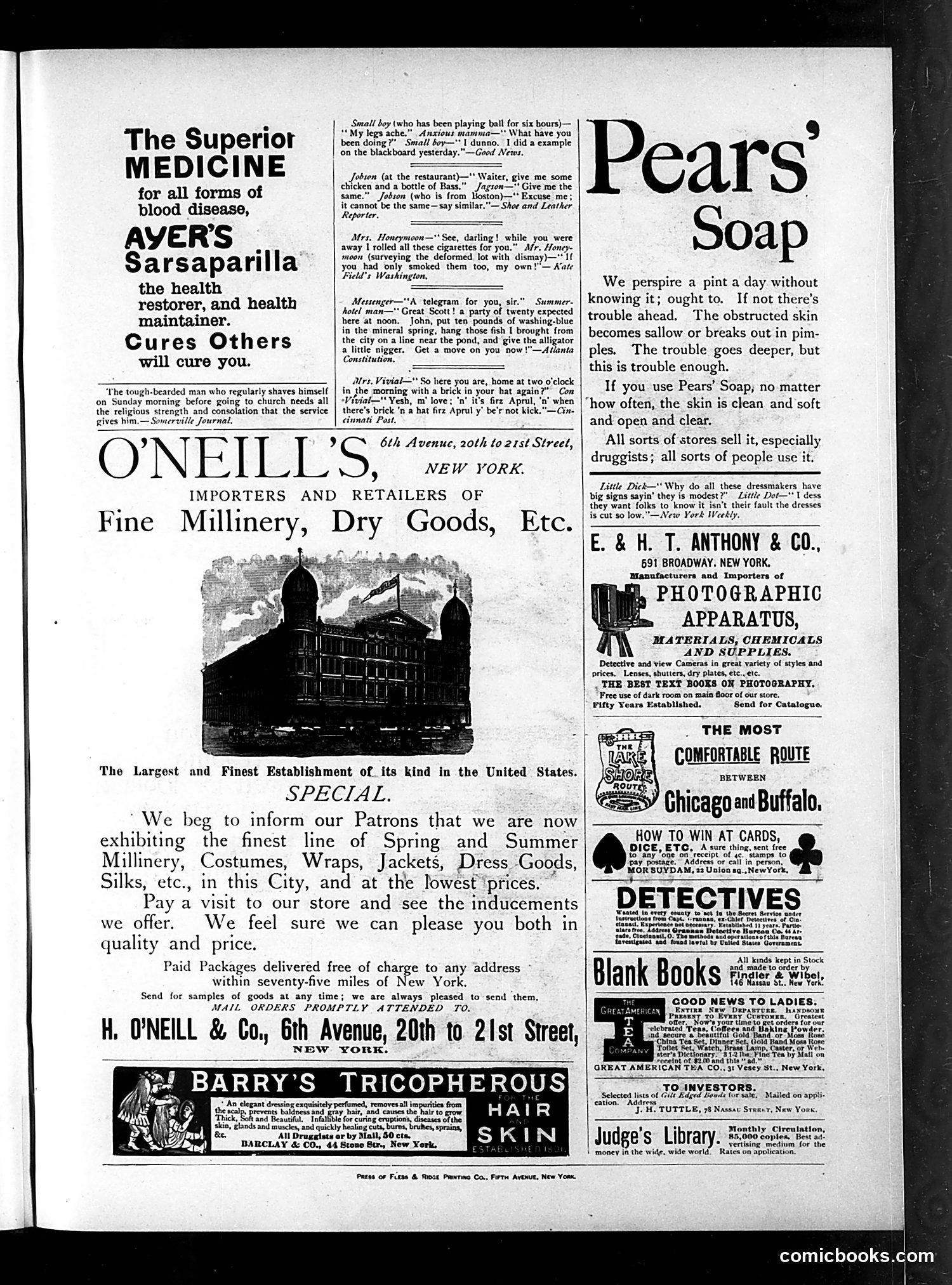
This page is primarily **advertising**, not satirical content. It contains multiple commercial advertisements for late-19th century products and services. The small humorous snippets scattered among ads are brief **joke exchanges** rather than political cartoons. They mock everyday social situations: a boy confusing math homework with physical exhaustion; a restaurant customer pedantically correcting "same" to "similar"; a husband coming home drunk at 2 a.m. with a brick in his hat (playing on April Fools' Day); and commentary on dressmakers' false modesty claims about revealing dress cuts. These jokes target **working-class and middle-class behavior**—social pretension, marital friction, and fashion hypocrisy—typical of Judge's general satirical tone. However, they lack specific political references or identifiable caricatures. The dominant content reflects the magazine's primary function: selling patent medicines (Ayer's Sarsaparilla), department store goods (O'Neill's), and photography equipment to an urban readership.
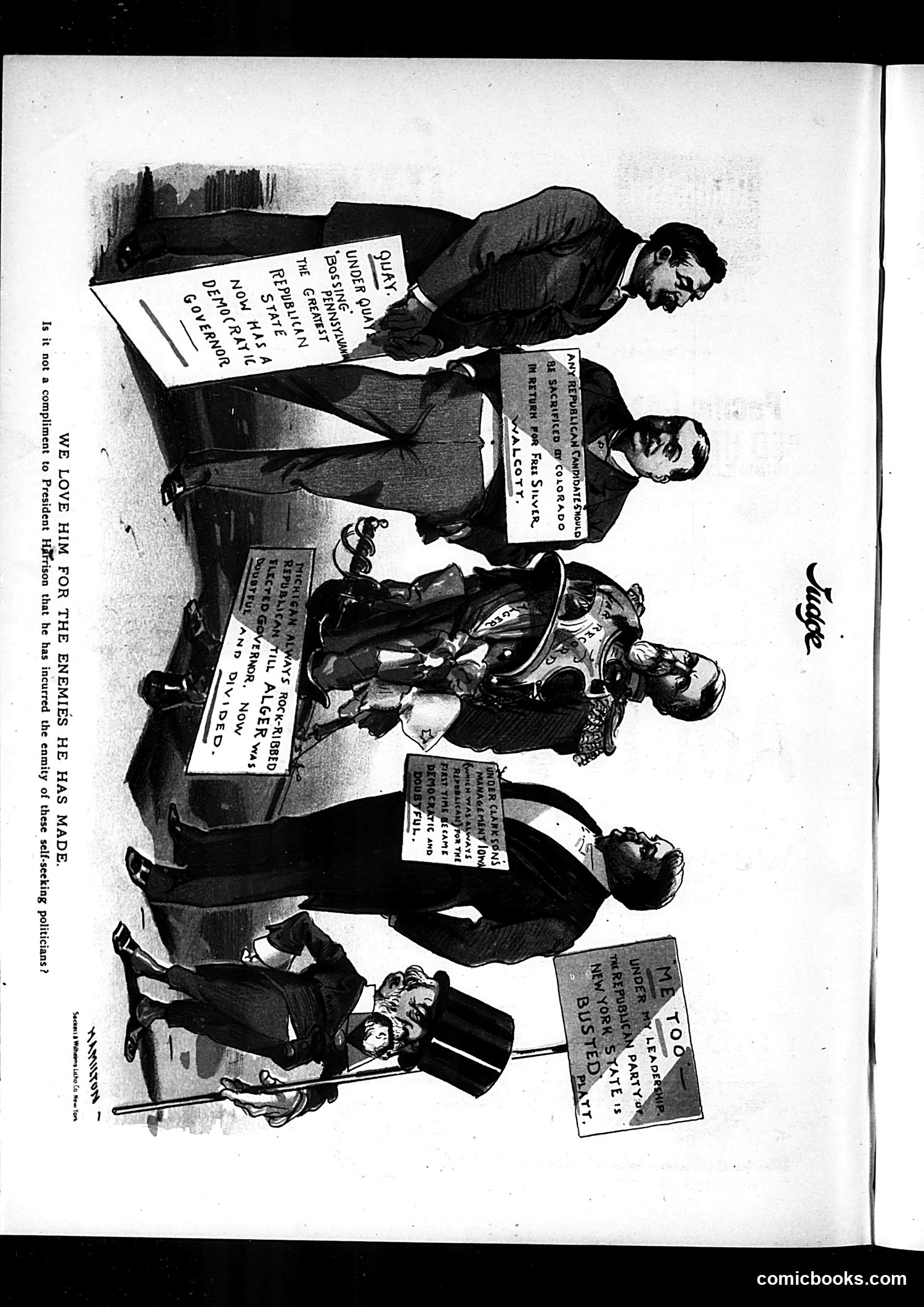
This Judge magazine cartoon satirizes President Harrison by turning a compliment into criticism. The caption "We Love Him For The Enemies He Has Made" appears ironic—while ostensibly praising Harrison for opposing corrupt politicians, the image reveals the contrary. The cartoon depicts five figures (likely prominent political opponents or "self-seeking politicians" of Harrison's era) wearing placards with grievances. The arrangement suggests these are people Harrison has angered through his actions or policies. The satire works by inverting the flattery: rather than proving Harrison's integrity, his numerous powerful enemies might instead indicate he's made poor political decisions or created unnecessary conflicts. The cartoon questions whether antagonizing so many figures actually reflects well on a president, despite the surface-level compliment. Without clearer identification of the specific figures or the exact historical moment, the precise political context remains unclear, but the fundamental satirical technique—using false praise to deliver criticism—is evident.
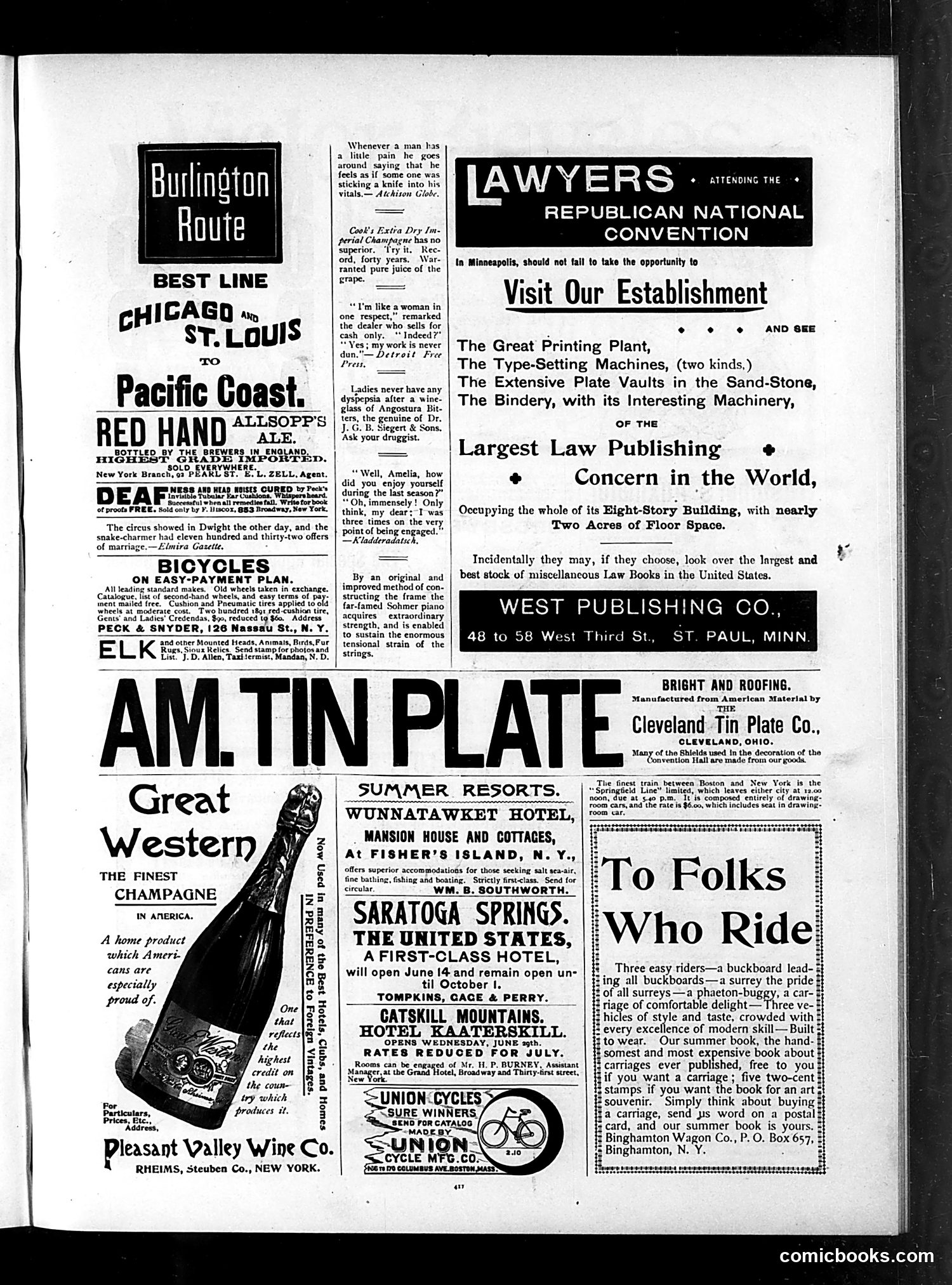
This is primarily an **advertising page** from Judge magazine, likely from the 1890s (based on the Republican National Convention reference in Minneapolis, suggesting 1892). The page contains minimal satire or political cartoons—mostly commercial advertisements. Notable content includes: - **Lawyers' ad**: West Publishing Co. invites Republican convention attendees to tour their Minneapolis facility, emphasizing their status as the "largest law publishing concern in the world." This is straightforward advertisement leveraging the convention's presence. - **Miscellaneous ads**: Travel resorts (Saratoga Springs, Catskill Mountains), alcoholic beverages (champagne, ale), bicycles, pianos, tin plate manufacturing, and railroad services. - **Brief humorous snippets** (labeled "Whenever a man has a little pain..."): These are short, genericquips about human nature—not tied to specific people or events. The page essentially serves as filler material between editorial content, designed to generate revenue through advertising rather than deliver targeted political satire.
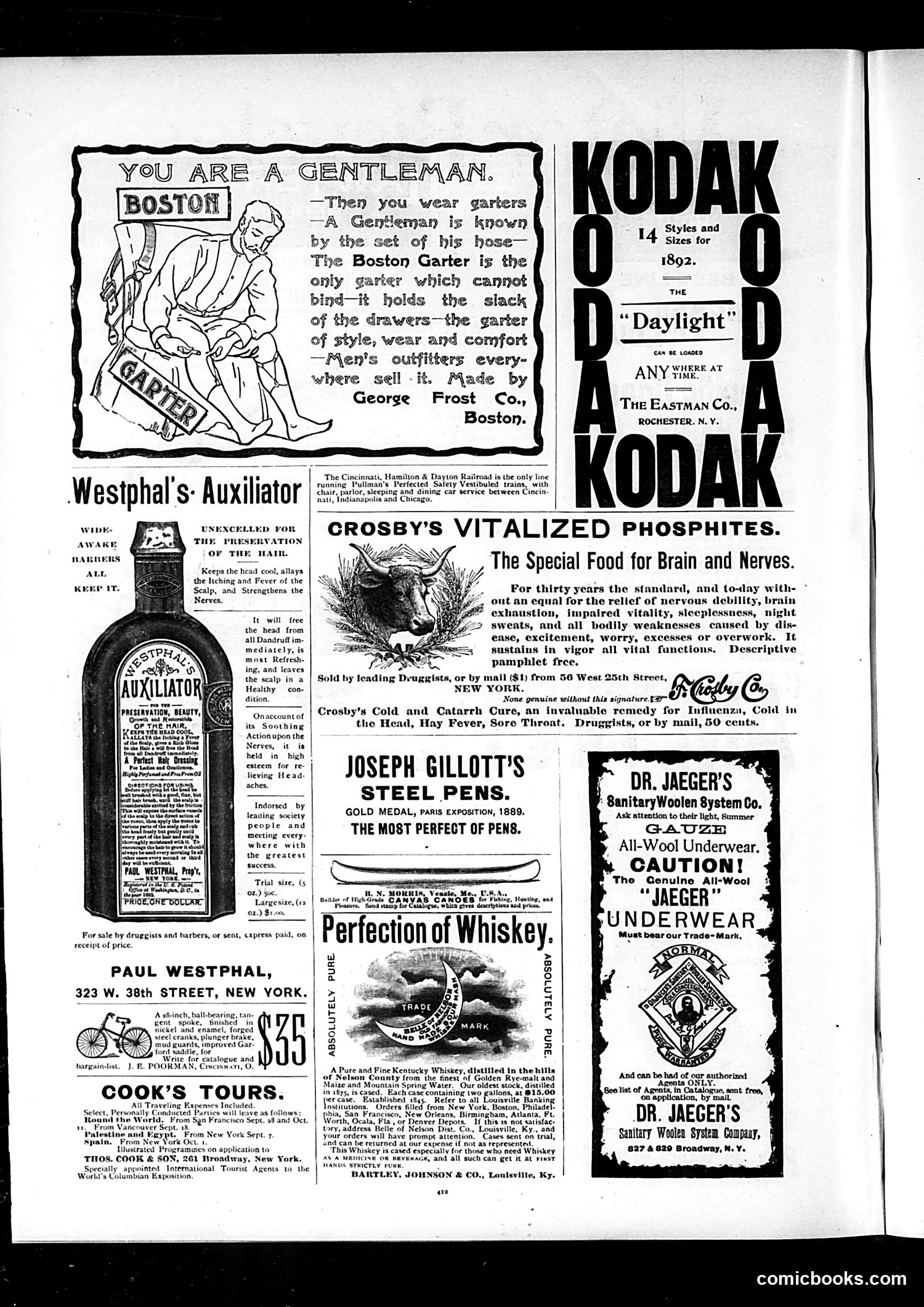
This is primarily an **advertising page** from Judge magazine, not a political cartoon. The page features product advertisements typical of the 1890s era, with one small satirical cartoon at the top. ## The Cartoon The cartoon titled "YOU ARE A GENTLEMAN" depicts a man adjusting his garters and includes text promoting the Boston Garter. It's a gentle advertisement-disguised-as-humor piece: the joke is that a gentleman is recognized by his proper hosiery and garters, and the Boston Garter is superior because it "cannot bind" and holds the slack of drawers comfortably. ## The Advertisements The remaining content advertises products including: - Hair tonics and scalp treatments - Steel pens - Kentucky whiskey (marketed as medicinal) - Photography equipment (Kodak cameras) - Dr. Jaeger's wool underwear - Tours and other goods These reflect late-19th-century consumer culture, including the widespread practice of marketing alcohol as health remedies. The page shows Judge functioned partly as an advertising medium for luxury goods aimed at affluent readers.
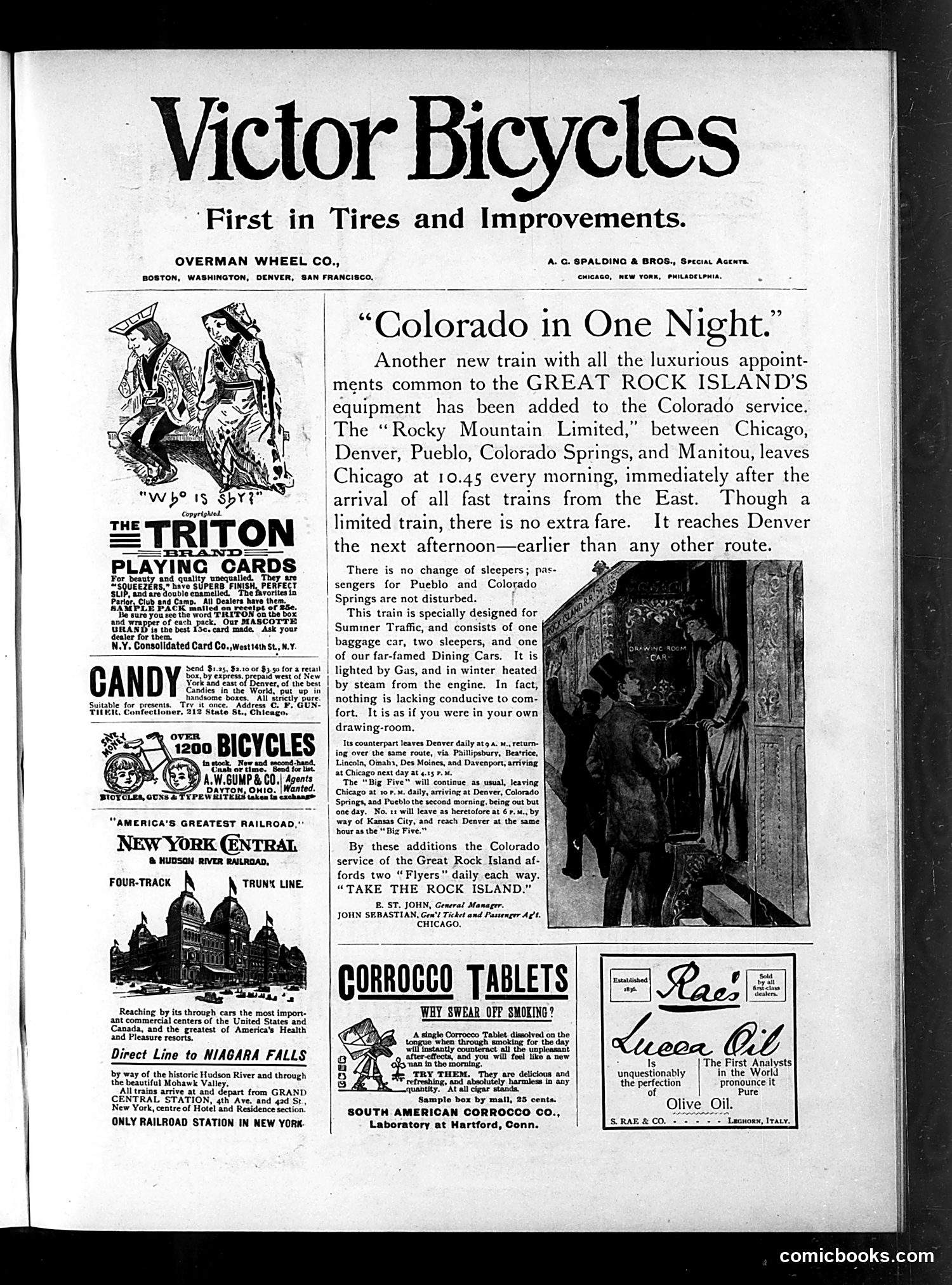
This page is primarily **advertising**, not political satire or editorial cartoons. It contains multiple commercial advertisements from the early 1900s. The main content includes: - **Victor Bicycles** advertisement (top), emphasizing tire innovations - **Triton Playing Cards** ad featuring a small illustration of what appears to be a classical or mythological figure (the Triton mascot) - **New York Central Railroad** ad promoting routes to Niagara Falls - **Rock Island Railroad** advertisement for the "Rocky Mountain Limited" train service to Colorado - **Corrocco Tablets** ad promoting smoking cessation products The only potentially satirical element is the **Triton card advertisement**, which uses a mythological sea-god figure as a brand mascot, but this is straightforward product branding rather than social commentary. The page reflects turn-of-the-century consumer culture: bicycles, rail travel, and patent medicines were major advertised categories during this era.
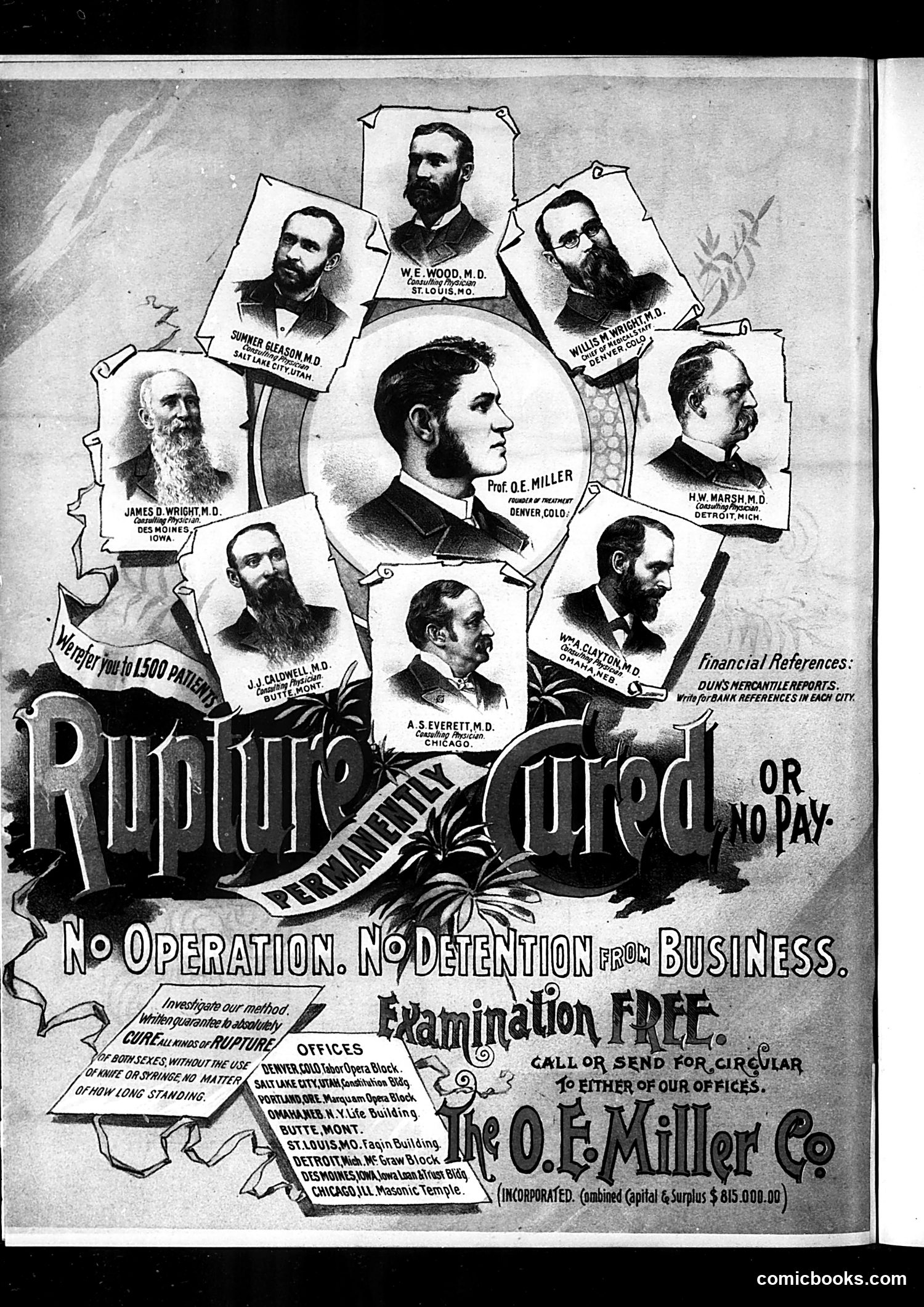
This is a **medical advertising page** from *Judge* magazine featuring the O.F. Miller Company, which offered mail-order rupture (hernia) treatment. The central figure is Prof. O.E. Miller of Denver, Colorado, surrounded by testimonial portraits of eight doctors claiming to endorse his "painless" treatment method requiring "no operation, no detention from business." The satire targets **medical quackery**—a common *Judge* target. The emphasis on "financial references" and "bank references in each city" mockingly suggests this is a business scheme rather than legitimate medicine. The promise of cure "without the use of knife or syringe" and the celebrities endorsing it were typical advertising tactics of dubious medical practitioners of this era. The joke: legitimate doctors wouldn't need to advertise like patent medicine salesmen.