
Judge, 1892-06-11 · page 7 of 24
Judge — June 11, 1892 — page 7: what you’re looking at
What you’re looking at
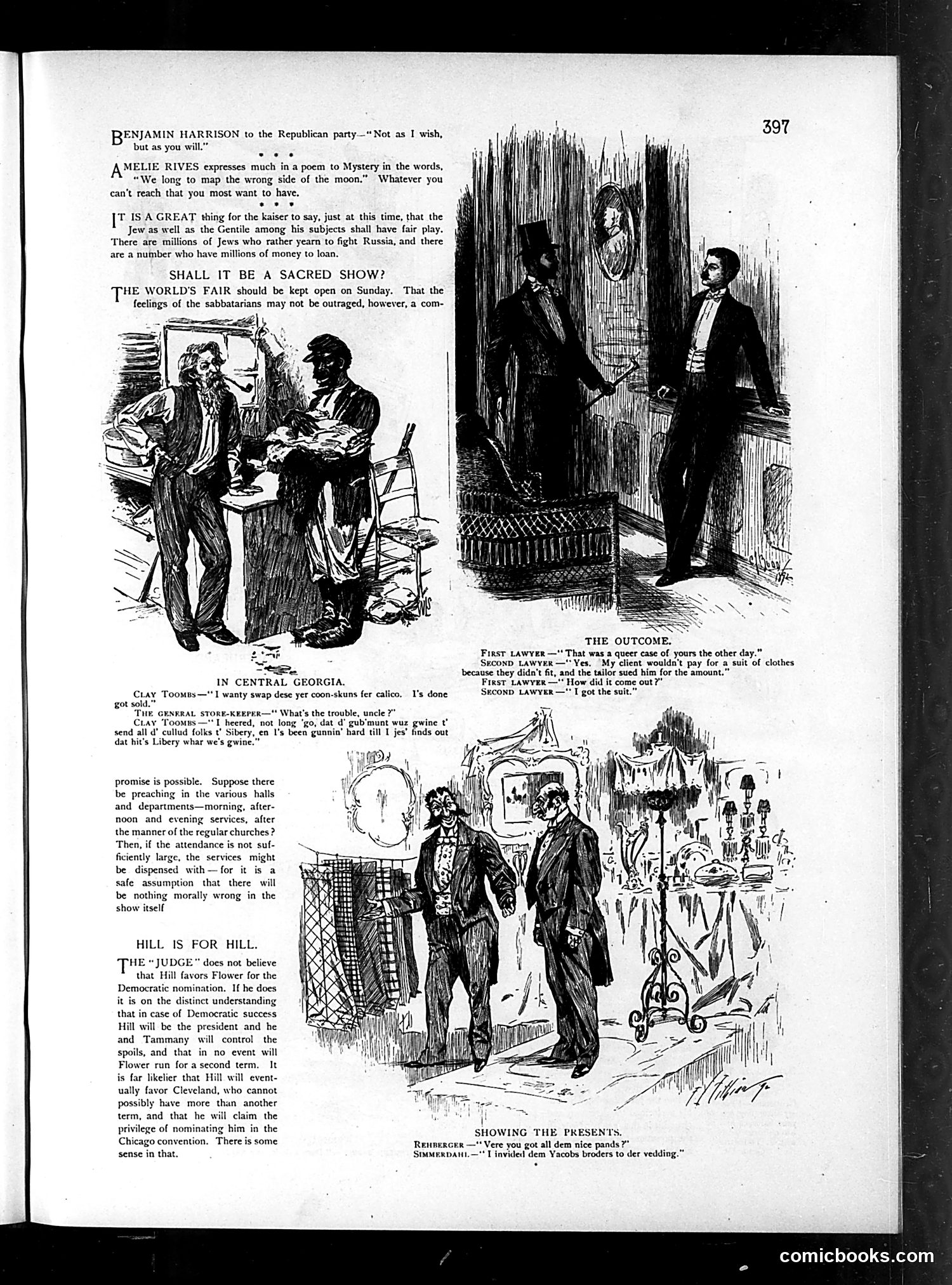
This page contains several satirical commentaries on 1890s American politics and society: **Top section**: References to Benjamin Harrison and Republican party politics, plus commentary on Kaiser Wilhelm II's claims of fair treatment for Jews—satirizing the kaiser's opportunism in courting Jewish support and their financial resources during tension with Russia. **"Shall It Be a Sacred Show?"**: Debates keeping the World's Fair open on Sundays, mocking religious objections while suggesting compromise solutions that might empty the venue anyway—satire on Sabbatarian vs. secular disputes. **Lower cartoons**: Depict ethnic stereotypes common to the era—a humorous legal dispute over clothing fit, and a Black character ("Clay Toomus") confused about government relocation rumors. **"Hill is for Hill"**: Political prediction about Democratic nomination politics involving Hill, Flower, Cleveland, and Tammany Hall—insider commentary on factional maneuvering. The cartoons employ period-typical caricature and dialect humor reflecting Judge's satirical approach to contemporary political gossip and social debates.
📄 Transcribed text from this page (OCR, searchable)
Machine-transcribed from the original scan — historical spelling and the odd misread are preserved.
BENJAMIN HARRISON to the Republican party—“Not as I wish, but as you will.” AMEDIE RIVES expresses much in a poem to Mystery in the words, “We long to map the wrong side of the moon.” Whatever you can’t reach that you most want to have. eee T IS A GREAT thing for the kaiser to say, just at this time, that the Jew as well as the Gentile among his subjects shall have fair play. There are millions of Jews who rather yearn to fight Russia, and there are a number who have millions of money to loan. SHALL IT BE A SACRED SHOW? ‘THE WORLD'S FAIR should be kept open on Sunday. That the feclings of the sabbatarians may not be outraged, however, a com- THE OUTCOME. First Lawyer —"* That was a queer case of yours the other day.” SkcOND LAWYER —"'Yes. My client wouldn't pay for a suit of clothes because they didn’t fit, and the tailor sued him for the amount.” First LAWYER —" How did it come out?” SkcOND LAWYER —"'I got the suit.” FERAL STORE-KEEPER—" What's the trouble, uncle ?” .ay ‘Toomus—"'T heered, not long ‘go, dat d’ gub‘munt wuz gwine t° send all d’ cullud folks t' Sibery, en I's been gunnin’ hard till I jes’ finds out dat hit's Libery whar we's gwine.”” promise is possible. Suppose there be preaching in the various halls and departments—morning, after- noon and evening services, after the manner of the regular churches? Then, if the attendance is not suf- ficiently large, the services might be dispensed with—for it is a safe assumption that there will be nothing morally wrong in the show itself HILL IS FOR HILL. THE “JUDGE” does not believe that Hill favors Flower for the Democratic nomination. If he does it is on the distinct understanding that in case of Democratic success Hill will be the president and he and Tammany will control the spoils, and that in no event will Flower run for a second term. It is far likelier that Hill will event- ually favor Cleveland, who cannot possibly have more than another term, and that he will claim the privilege of nominating him in the Chicago convention. There is some Cs Ss Se > fh, LOE s. s Rennercer —'* Vere you got all dem nice pands? ae ‘sense in that. SUMMERDAI Linvided dem Yacobs broders to der vedding.” comicbooks.com