
A complete issue · 18 pages · 1892
Judge — April 30, 1892
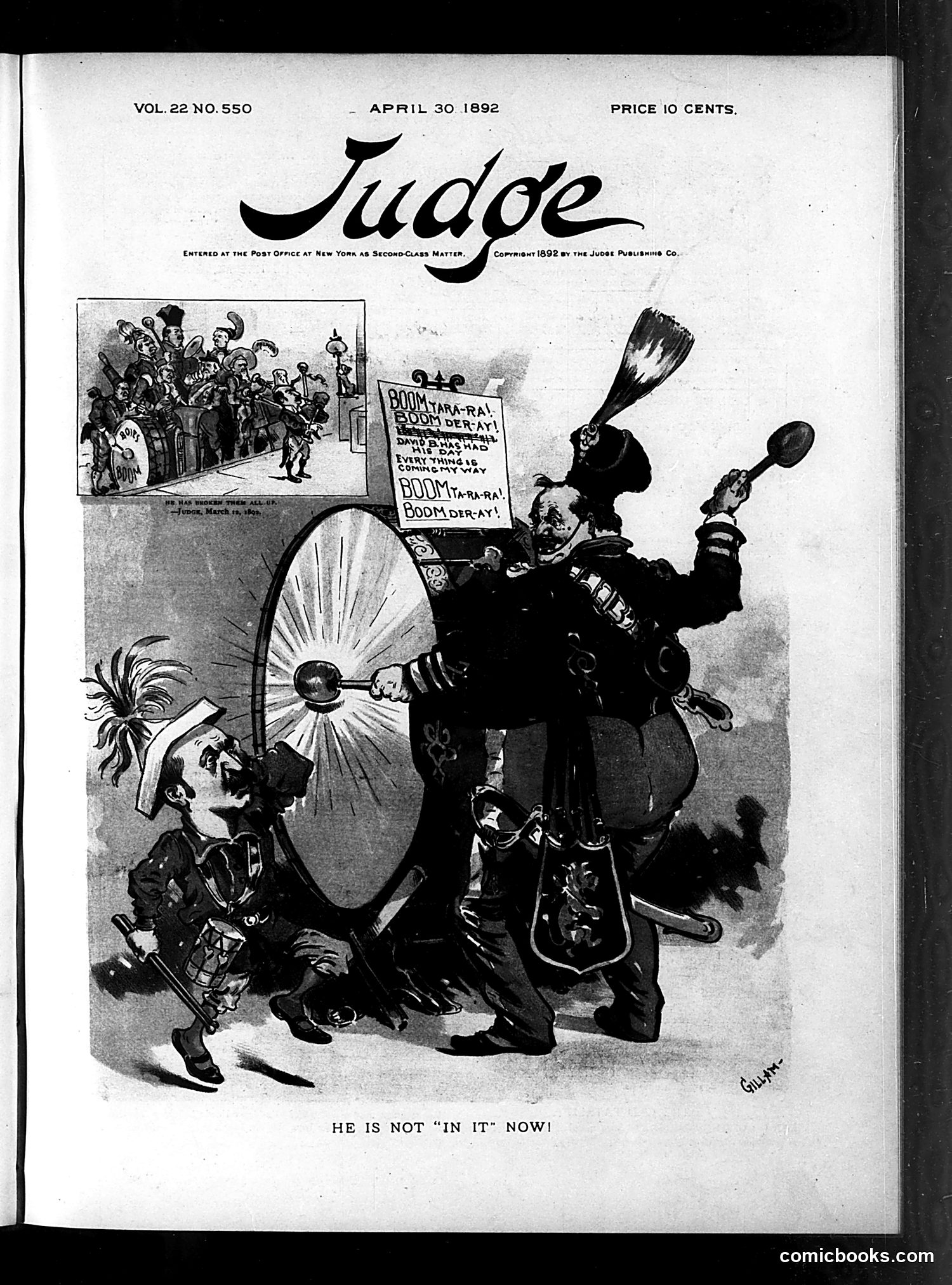
This April 30, 1892 *Judge* cartoon satirizes someone who has lost political power or influence. The central figure operates a large drum labeled "Boom-ta-ra! Boom der-ay!" with text reading "Everything is lovely / Every thing is gay"—suggesting forced, desperate cheerleading despite diminished circumstances. The smaller inset shows a crowded, celebratory scene from March 16, 1892, contrasting the figure's former popularity with present isolation. The title "He Is Not 'In It' Now" indicates the subject has fallen from prominence. Without additional context, the specific identity remains unclear, but the cartoon mocks someone attempting to maintain relevance through manufactured enthusiasm after losing actual political standing or influence.
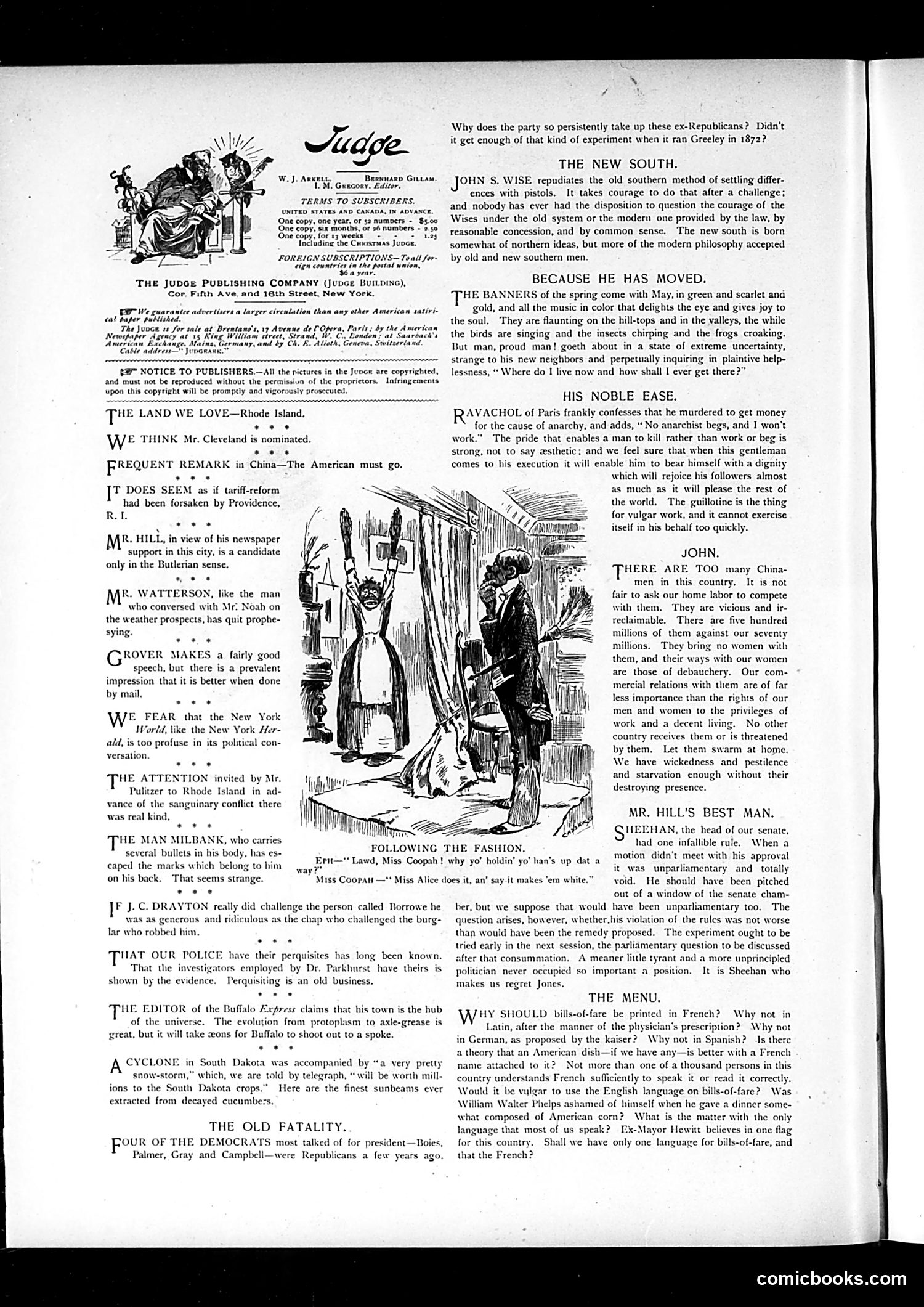
This page combines editorial commentary with satirical articles typical of Judge magazine's format. The main cartoon titled "Following the Fashion" depicts what appears to be a social interaction, though the specific figures are unclear from the image alone. The textual content addresses contemporary political and social issues: criticism of Republican policies, discussion of Chinese immigration and labor competition, commentary on police practices, and debate over language policy (specifically whether bills-of-fare should be printed in French). The articles mock various public figures and policies through sardonic commentary rather than visual caricature. Without clearer identification of specific individuals or dated context, the precise satirical targets remain somewhat obscure to modern readers, though the general thrust criticizes both political establishments and social prejudices of the era.
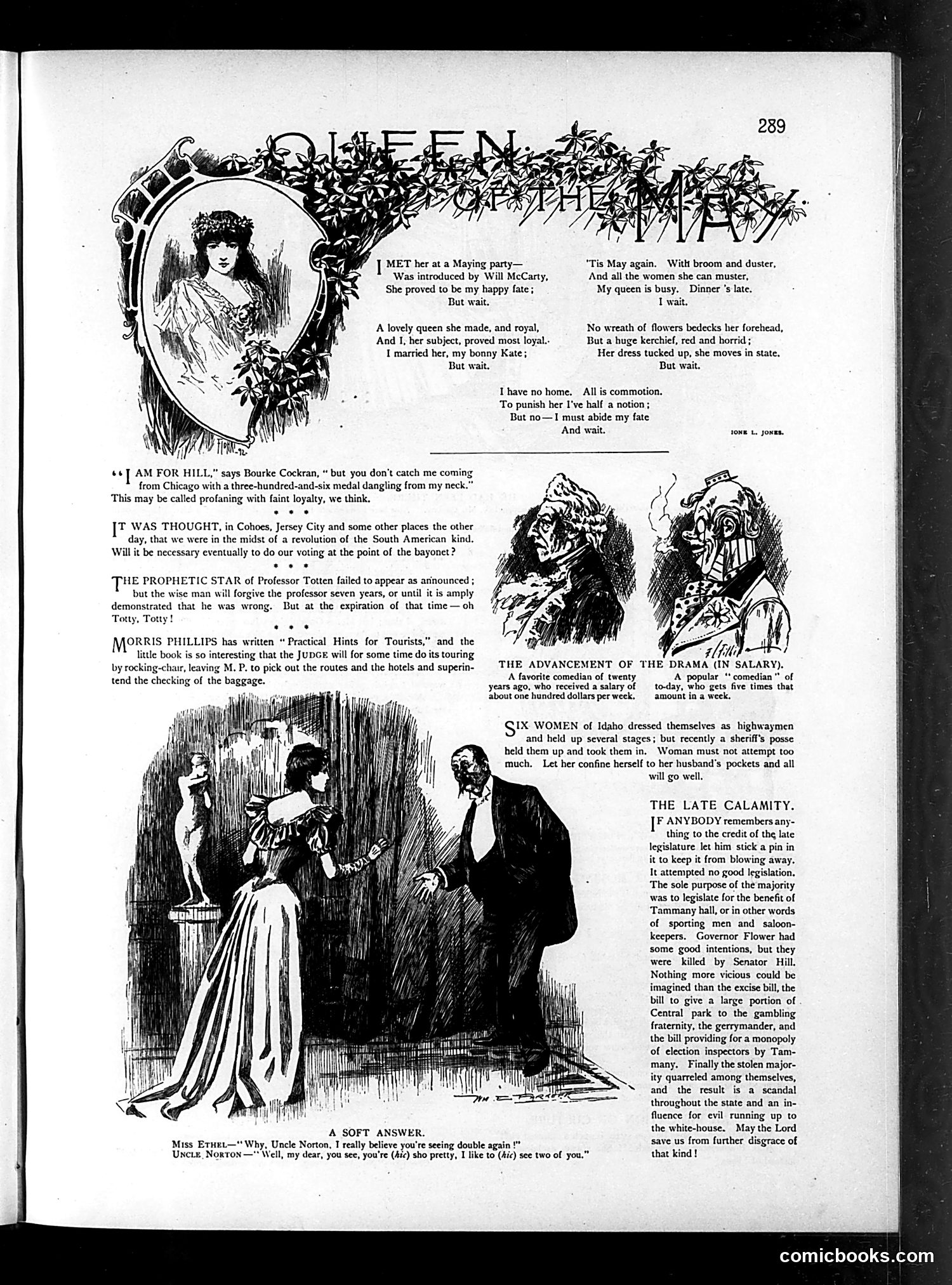
This page from *Judge* magazine contains several satirical pieces. "A Soft Answer" depicts a social interaction between Miss Ethel and Uncle Norton, where she corrects his grammar—he says she's "pretty," she corrects him that she's "too pretty"—a mild joke about feminine vanity and linguistic precision. The page also includes brief political commentary, including a reference to a "Prophetic Stare" involving Professor Totty, and notes about South American revolution and tourism. "The Advancement of the Drama in Salary" mocks theatrical salaries, while "Six Women of Idaho" satirizes female suffrage and women holding political office. "The Late Calamity" appears to reference gambling-related legislation, possibly involving Central Park and corrupt political influence—though specific figures remain unclear without additional historical context.
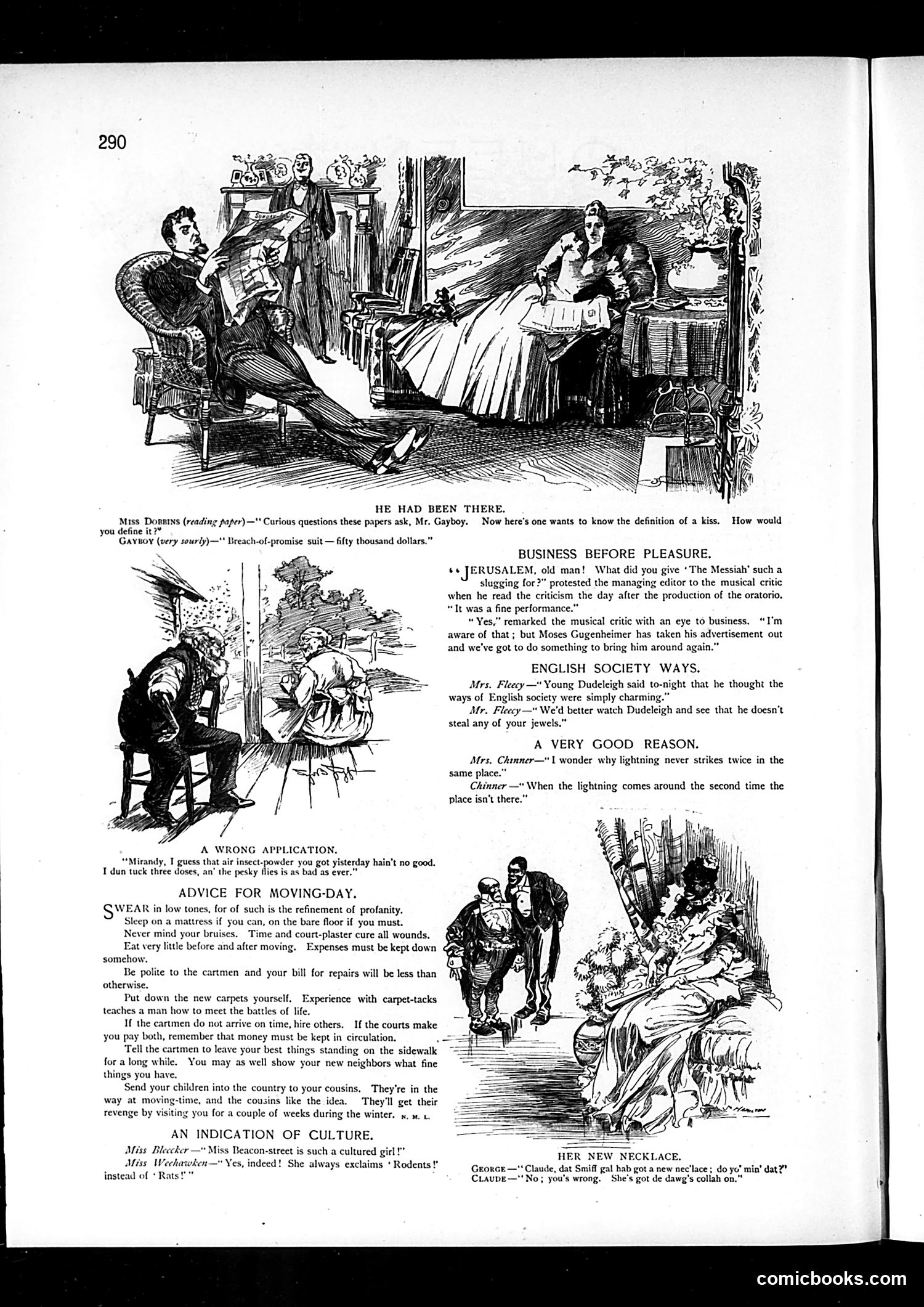
This page from *Judge* contains several brief satirical sketches mocking Victorian social conventions and human behavior: **"He Had Been There"** jokes about breach-of-promise lawsuits—a common legal action when men refused to marry women they'd courted, resulting in substantial damages ($50,000). **"Business Before Pleasure"** satirizes a music critic who savages an oratorio performance not for quality but because the wealthy Jewish patron (Moses Gugenheimer) withdrew advertising—exposing corruption in arts journalism. **"English Society Ways"** mocks upper-class social hypocrisy: assuming a young man charmed by English society etiquette must have criminal intentions. **"A Very Good Reason"** presents wordplay about lightning never striking twice because "the place isn't there"—poking fun at faulty logic. The remaining sketches offer humorous "advice" for moving day and gentle mockery of pretentious culture and racism (the final item uses dialect humor to mock both affected speech and a woman confusing jewelry with a dog collar).
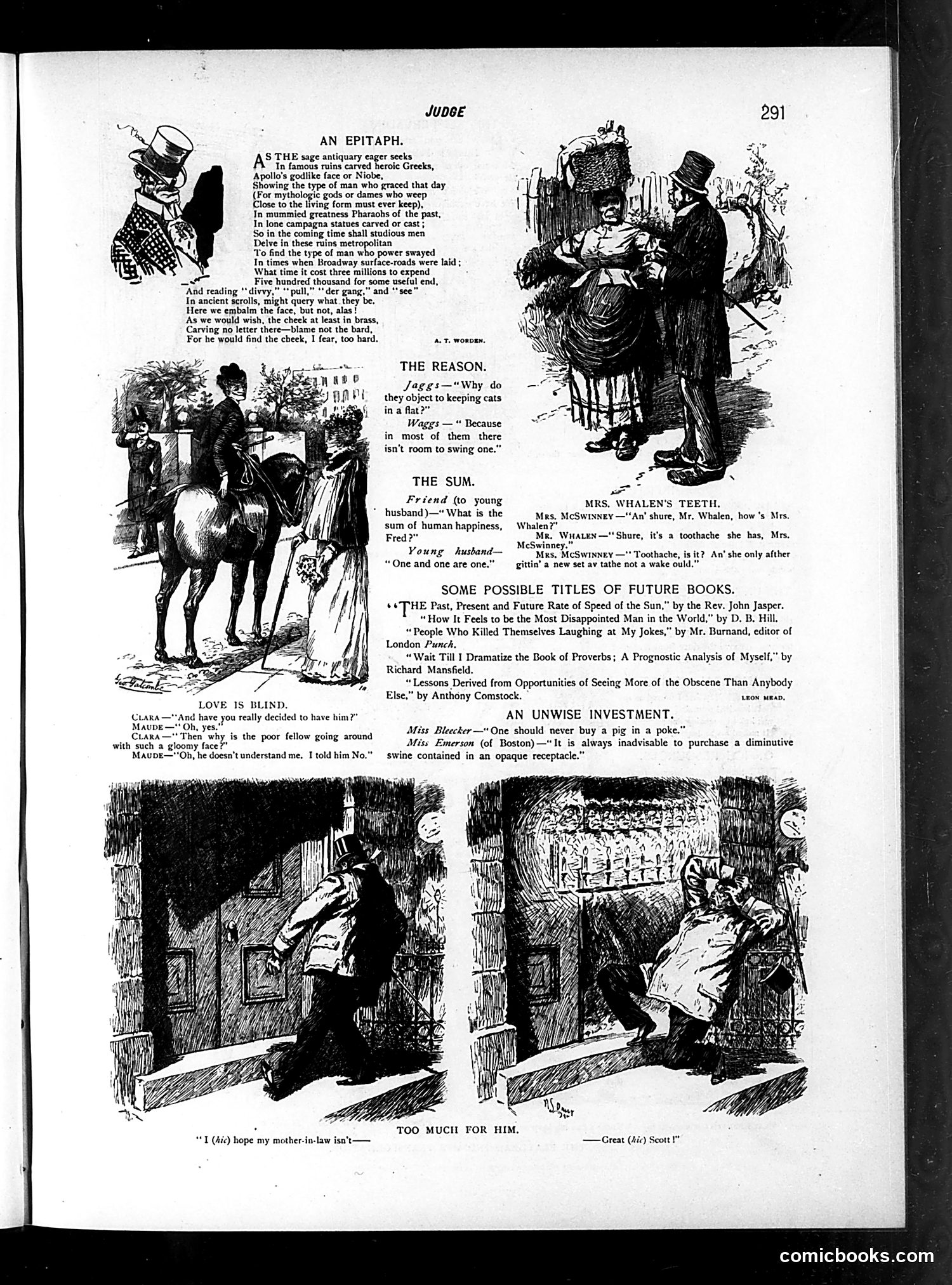
This page from Judge presents various satirical sketches and jokes typical of the magazine's format. **"An Epitaph"** mocks New York City corruption, comparing future archaeologists studying relics of the present era to those studying ancient civilizations. The satire targets politicians and contractors involved in Broadway surface-road construction, sarcastically noting millions were spent while only a fraction went to useful purposes—a clear reference to graft and kickbacks common in Gilded Age municipal politics. **Other brief jokes** include wordplay about apartment living ("swing a cat"), marital humor, and Irish-immigrant dialect humor (Mrs. Whalen's toothache). **"Some Possible Titles of Future Books"** satirizes contemporary public figures: Rev. John Jasper (known for theological pronouncements), D.B. Hill (Democratic politician), Richard Mansfield (actor), and Anthony Comstock (censorship crusader). The page is primarily humor and social commentary rather than focused political cartooning, reflecting Judge's typical satirical approach to contemporary urban life, politics, and public figures.
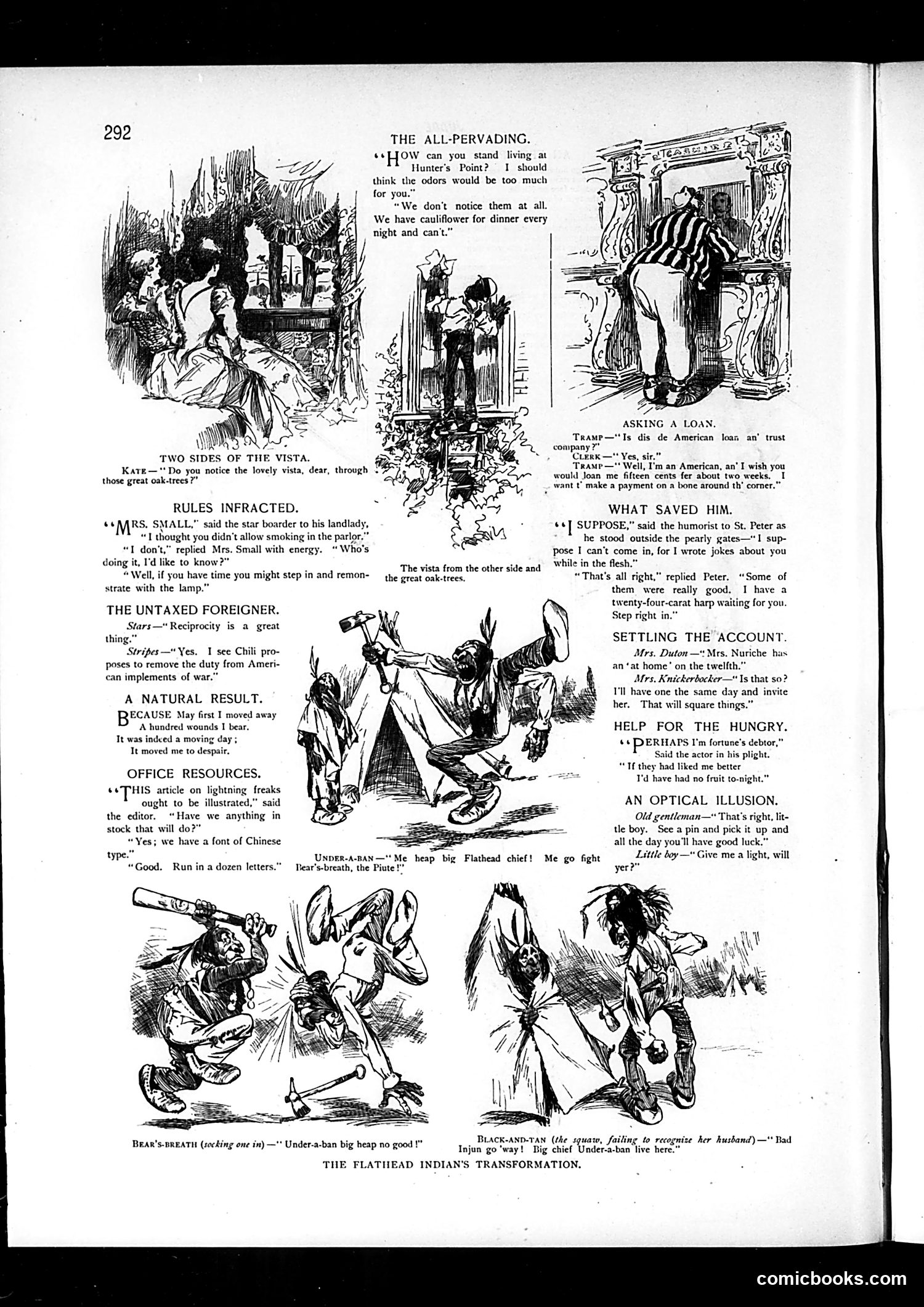
This page collects brief satirical vignettes mocking various social situations of the era: **"The All-Pervading"** jokes about offensive odors at Hunter's Point—people become so accustomed to bad smells they cease noticing them, paralleling how cauliflower's smell desensitizes diners. **"Asking a Loan"** depicts a tramp seeking an American loan from a trust company clerk, satirizing either financial institutions' opacity or the tramp's desperation. **"The Untaxed Foreigner"** references trade reciprocity debates with Chile, mocking protectionist arguments about war implements tariffs. **"The Flathead Indian's Transformation"** contains caricatured Native American dialect humor, showing an "Under-a-ban" chief being removed, with a "Black-and-Tan" squaw replacing him—likely satirizing political upheaval or social change through crude ethnic stereotyping. Remaining sketches mock moving day chaos, editorial resource absurdity, social climbing, and superstition. The humor relies on class commentary, ethnic caricature, and everyday inconveniences typical of 1890s American humor.
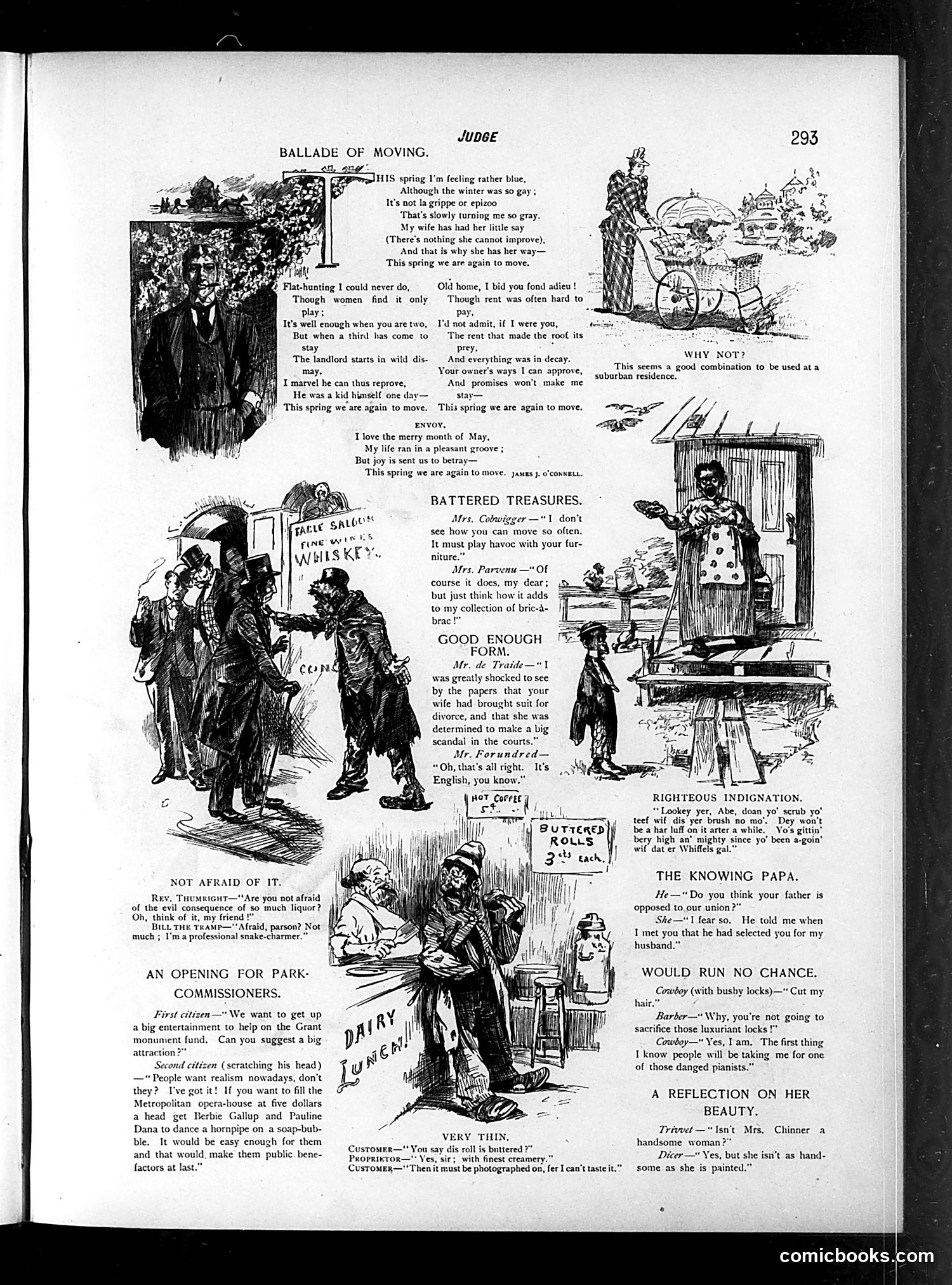
This page satirizes the domestic inconvenience of frequent relocations, a common middle-class experience of the era. The title poem laments spring moving season, with a husband resigned to repeated upheaval because his wife insists on "improving" their living situation. The satire targets both wives' dissatisfaction with housing and landlords' indifference to tenant complaints. The scattered jokes below mock various social pretensions: a vagrant's claim to be a "professional snake-charmer" (implying immunity to consequences), a woman treating damaged furniture as "bric-a-brac" to justify constant moving, and a man accepting his wife's divorce suit because "it's English" (fashionable). Other items ridicule racial dialect humor, class anxiety, and physical appearance stereotypes—typical of Judge's casual prejudices. The overall tone presents moving season as an absurd but inevitable domestic ritual.
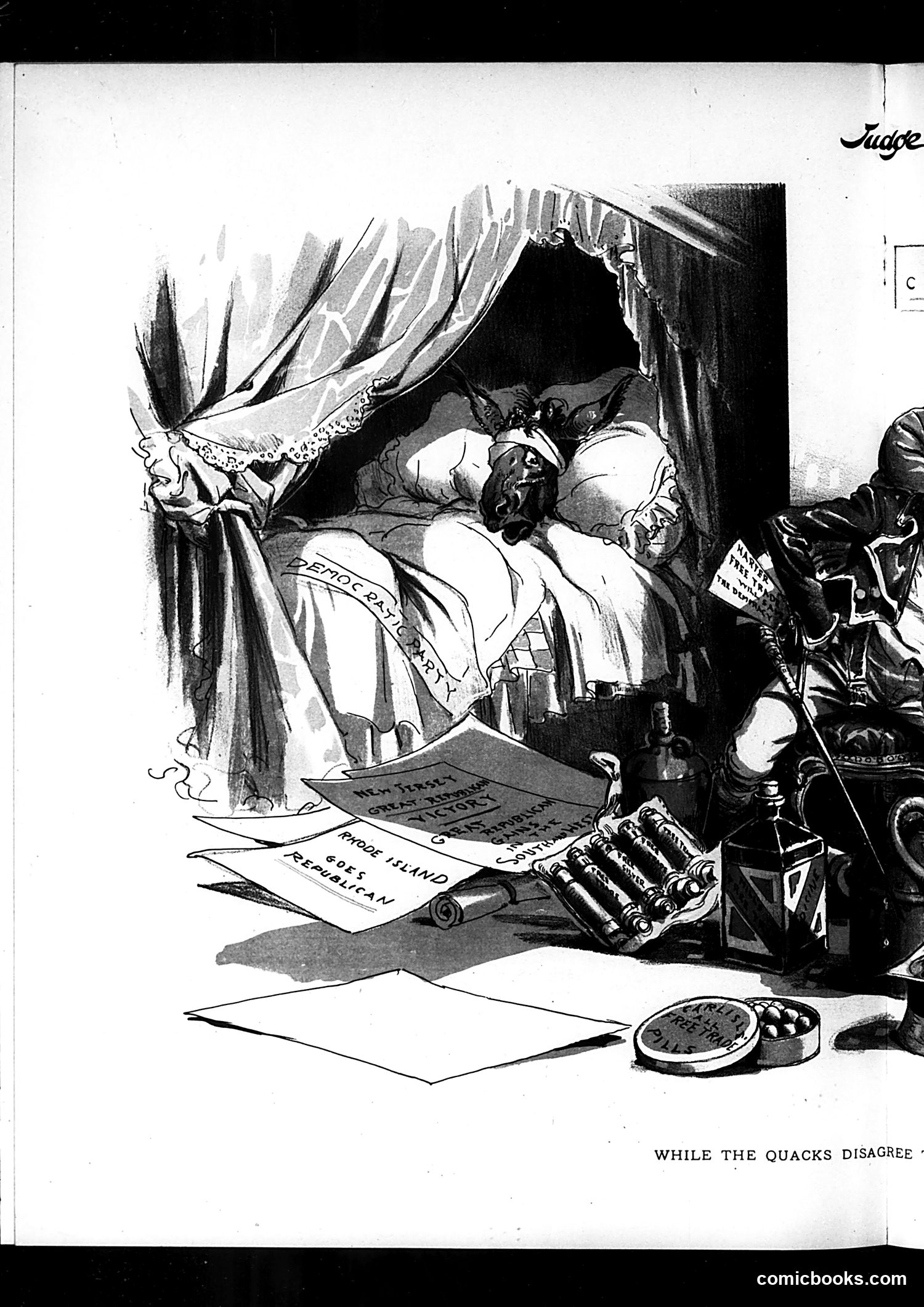
This political cartoon satirizes medical disagreement during a health crisis. The image shows a bed with a patient surrounded by various medical documents and implements labeled with different treatment plans—"NEW BLOOD," "BRAIN PLAN," and "SUPPLY PLAN" are visible among scattered papers. The title "While the Quacks Disagree" suggests incompetent doctors (quacks) cannot reach consensus on treatment, leaving the patient vulnerable. The cartoon likely critiques conflicting medical or political advice during a specific crisis, though without a date or additional context, I cannot identify the exact historical moment or the patient representing (possibly a nation or institution in distress). The satire mocks professional disagreement masking as expertise during urgent situations.
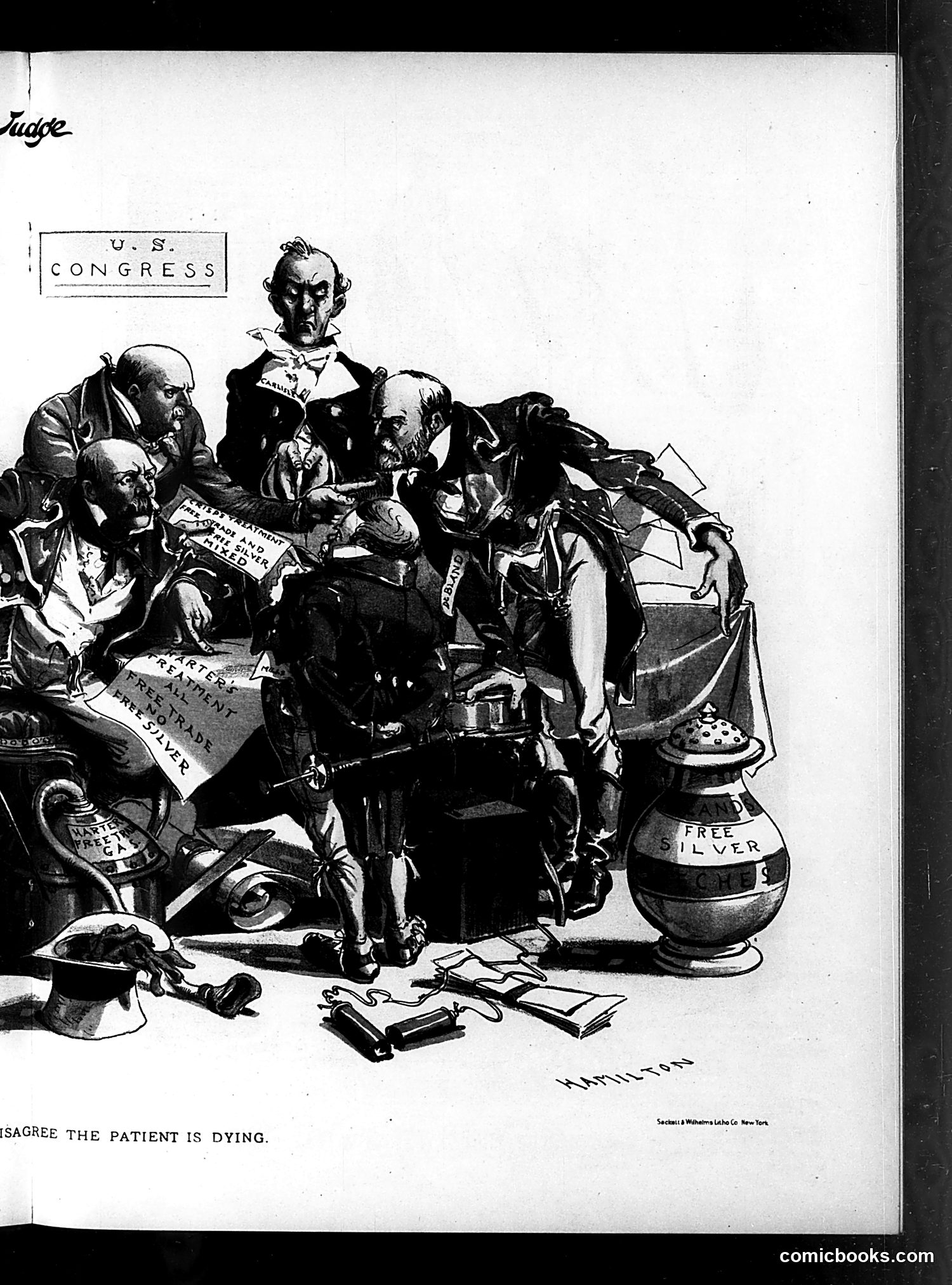
This is a satirical cartoon titled "I Disagree the Patient is Dying," depicting U.S. Congress as physicians examining a dying patient. The cartoon critiques Congressional incompetence or neglect regarding a serious national issue. The labeled medical instruments and items visible include references to "Free Silver" and "Free Trade" — major political debates of the Gilded Age/Progressive Era. The physicians (representing different Congressional factions) appear to disagree on treatment while the nation ("patient") deteriorates. The cartoon's point: Congress is so divided by partisan disputes over economic policy that it cannot effectively address the country's genuine problems. The caricatured doctors suggest incompetence and self-interest rather than genuine concern for the nation's health. The artist's signature appears to be "Hamilton."
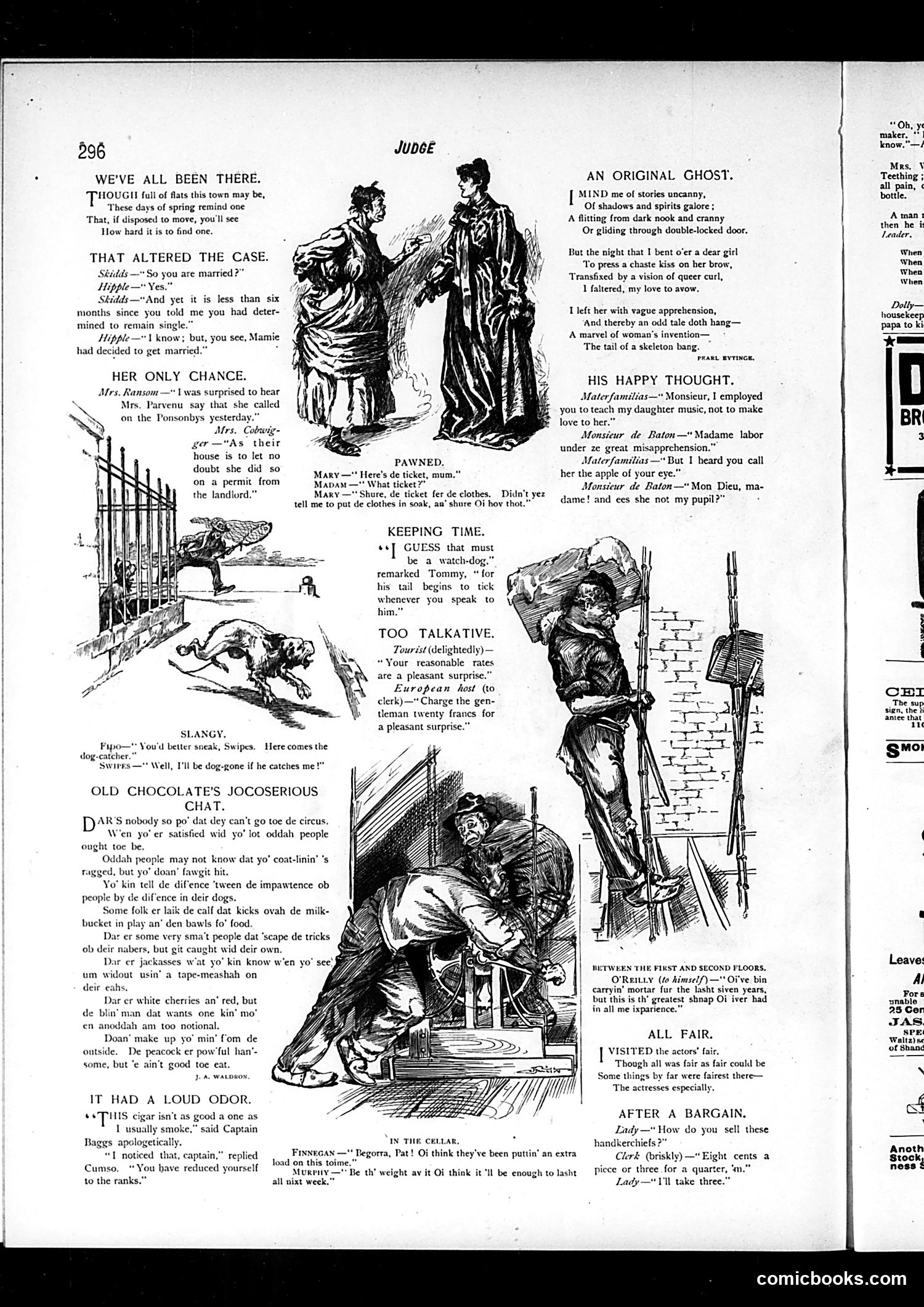
This page contains multiple short humorous pieces typical of Judge magazine's satirical approach to American life circa early 1900s. **Key content includes:** - **Housing humor**: "We've All Been There" jokes about the difficulty of finding apartments in a crowded city during spring moving season. - **"Old Chocolate's Jocoserious Chat"**: Dialect humor (written in exaggerated African American vernacular) offering folk wisdom about human nature—comparing people's character to their dogs' behavior, cautioning against judging by appearances. - **Romantic/social comedy sketches**: "An Original Ghost" plays on a woman's "skeleton bang" (a hairstyle) frightening a suitor; "His Happy Thought" depicts a music teacher's misunderstanding with a student's mother. - **Workplace humor**: References to dog-catchers, construction workers, and servants. **For modern readers**: The dialect pieces reflect period racism, while most other jokes rely on puns, social embarrassment, and class-based humor about servants and working people. The magazine targets middle-class anxieties about courtship, housing, and social mobility.
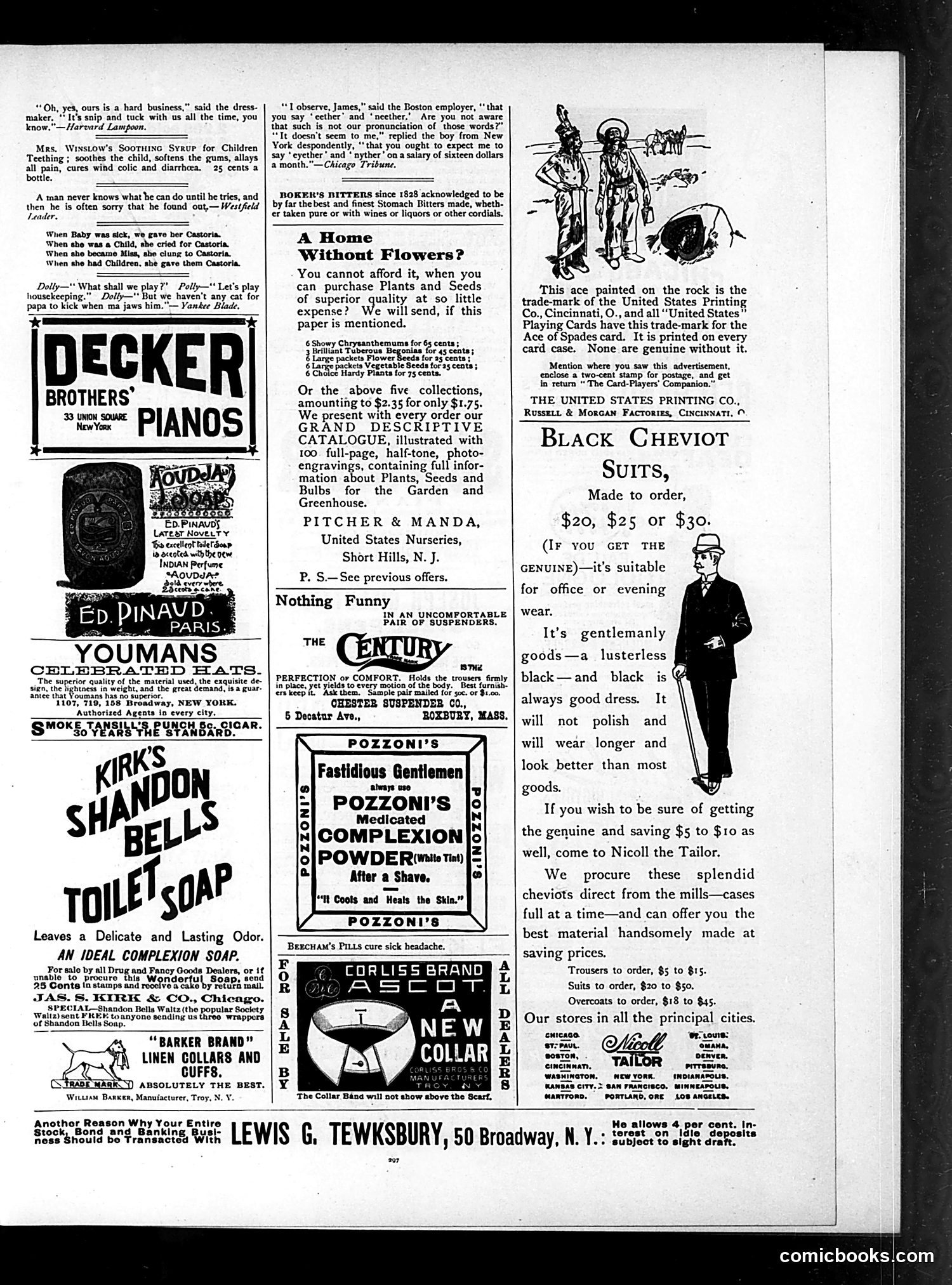
This page is primarily **advertisements** with minimal editorial cartoon content. The only illustration with satirical intent appears to be small comic snippets embedded among ads: **Identifiable humor/satire:** 1. **Dress-maker joke** (top): A pun on "snip and tuck"—describing both garment-making and financial constraints. 2. **Boston employer dialogue** (top right): Social satire about class and regional pronunciation. A New York boy defends his accent by pointing out his meager sixteen-dollar monthly salary doesn't entitle employers to demand "proper" Boston pronunciation. This reflects turn-of-century tensions between regional American dialects and class expectations. 3. **Dolly/Polly dialogue** (lower left): Dark humor about domestic violence—children casually discussing playing house, with a father kicking the cat. Satirizes the normalization of household brutality. The bulk of the page consists of period product advertisements (pianos, soaps, suspenders, patent medicines, clothing) typical of Judge's revenue model.
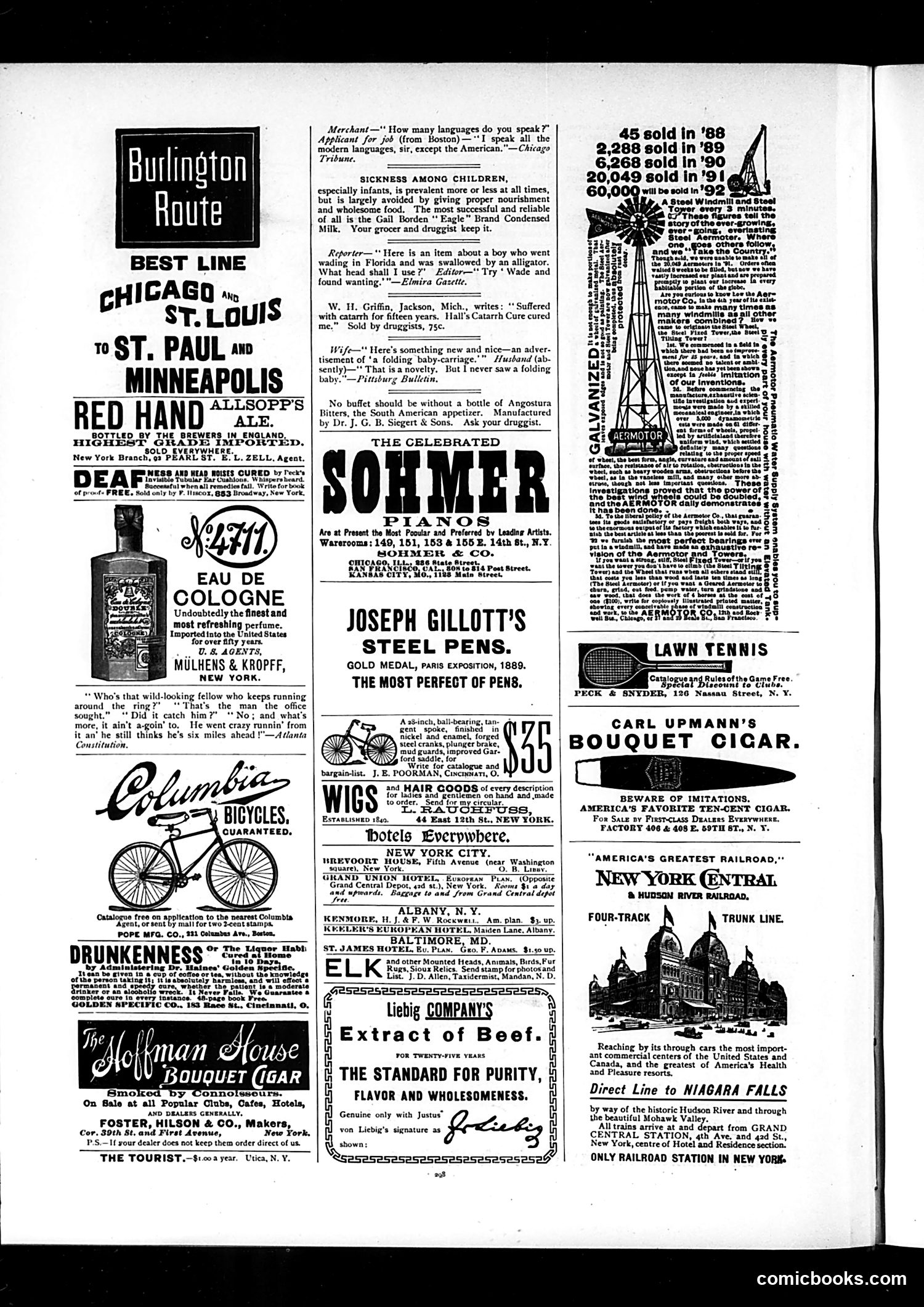
This is primarily an **advertising page** from Judge magazine, not a satirical cartoon or political commentary. The page features **commercial advertisements** for various 1890s products and services: railroad routes (Burlington), ale, perfume, bicycles, cigars, pianos, pens, hair goods, and hotels. There is one small **joke** embedded among the ads: A Boston job applicant claims to speak "all the modern languages, sir, except the American"—a mild satire on regional American dialects and Boston's distinctive accent, suggesting Bostonians speak so differently they might as well be a foreign language. This reflects late-19th-century American regional stereotyping. The rest of the page consists of testimonials and product descriptions typical of period magazine advertising. There is **no political satire or cartoon content** visible on this page.
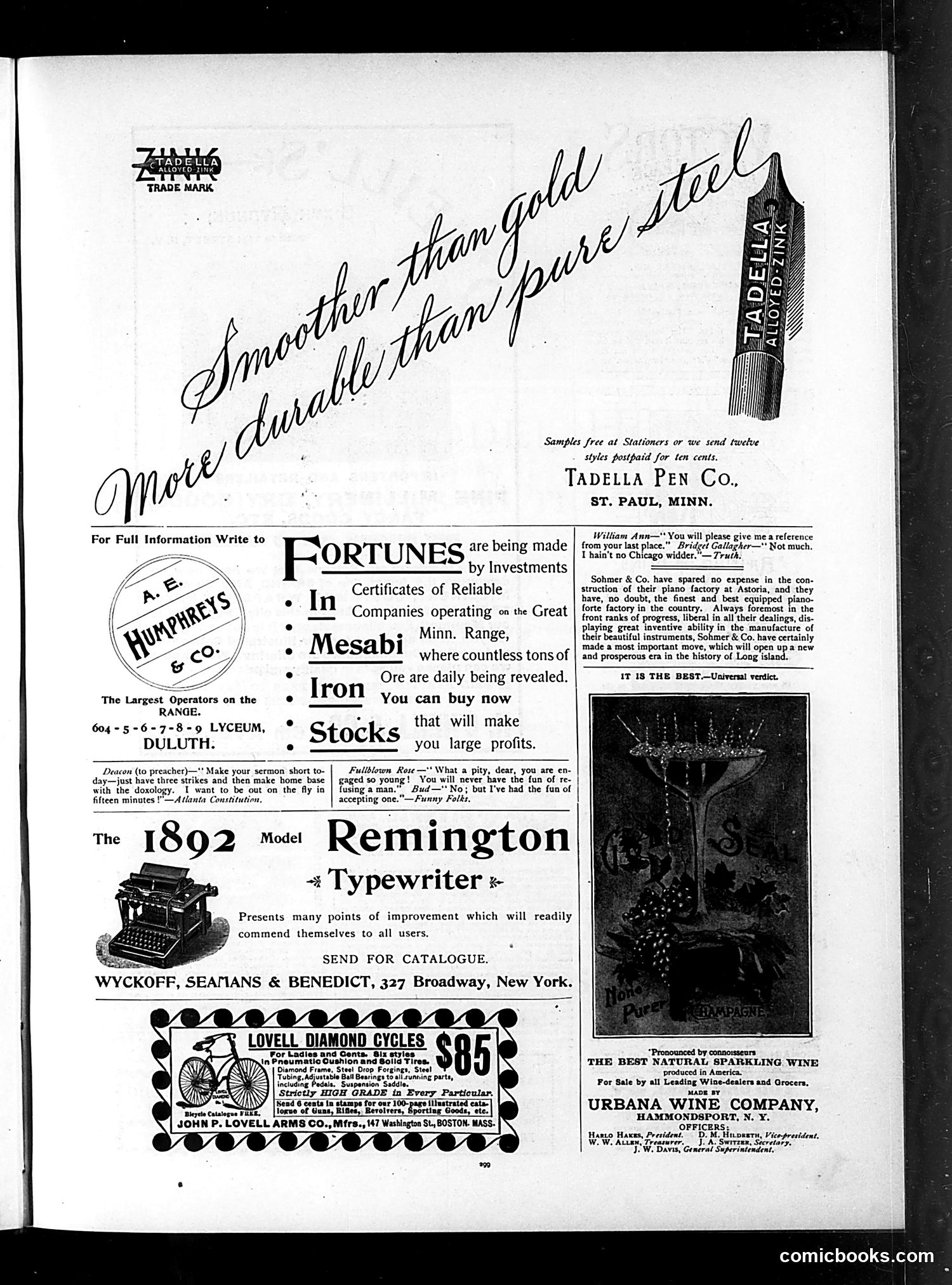
This page is primarily **advertising**, not political satire. It contains several small comic jokes interspersed among commercial ads. The visible jokes include: - A "Deacon" making a baseball metaphor about shortening a church sermon - "Fullblown Rose" and "Bud" making a pun about engagement and refusing proposals - "William Ann" seeking a reference, with an ethnic joke about Irish domestic workers ("Chicago widder") The dominant content advertises late-19th-century products: Tadella pens, investment opportunities in Mesabi iron ore mining (Minnesota), A.E. Humphreys' cycle company, Remington typewriters, Lovell Diamond bicycles, Sohmer pianos, and Urbana wine. The page reflects Gilded Age consumer culture and the investment boom around natural resource extraction. The jokes are mild, domestic humor typical of period magazines. No clear political cartoon or caricature is present on this page.
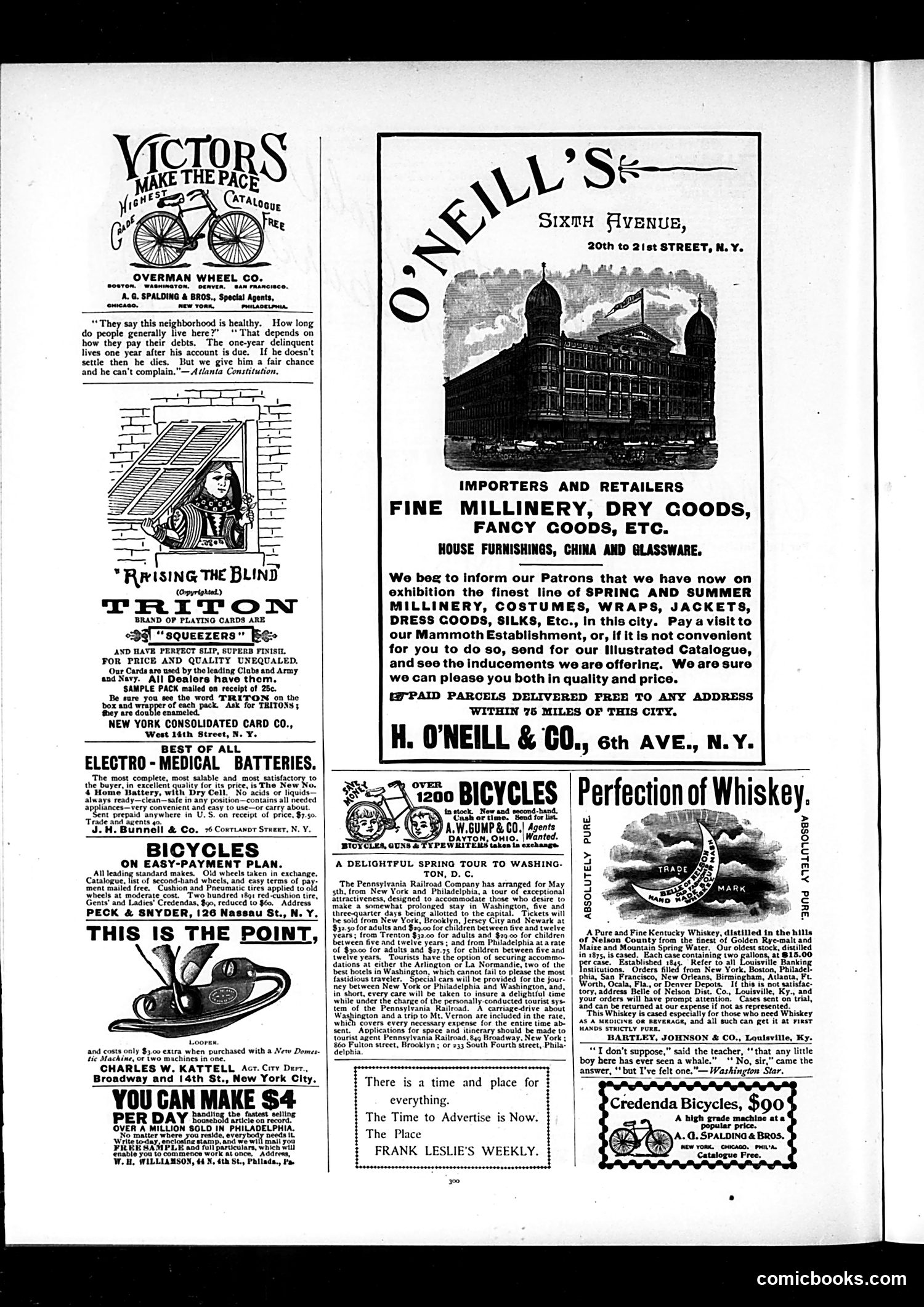
This page is primarily **advertising**, but features one notable cartoon titled **"Raising the Blind"** (copyright protected). The cartoon depicts a woman looking out a basement or ground-level window, with the accompanying text from the *Atlanta Constitution* joking darkly about neighborhood "health": delinquent debtors "live one year after his account is due" before dying—the implication being they're literally worked to death or expelled from the community for unpaid debts. **The satire targets**: Late 19th-century debt collection practices and social callousness toward the poor. The phrase "raising the blind" (opening window shutters to see outside) becomes a metaphor for exposing harsh economic realities hidden from polite society. **Modern context**: This reflects actual anxieties about urban poverty, debt slavery, and creditor brutality in the Gilded Age—serious social problems wrapped in dark humor typical of *Judge* magazine's satirical approach. The rest of the page consists of period advertisements for bicycles, batteries, playing cards, and retail goods.
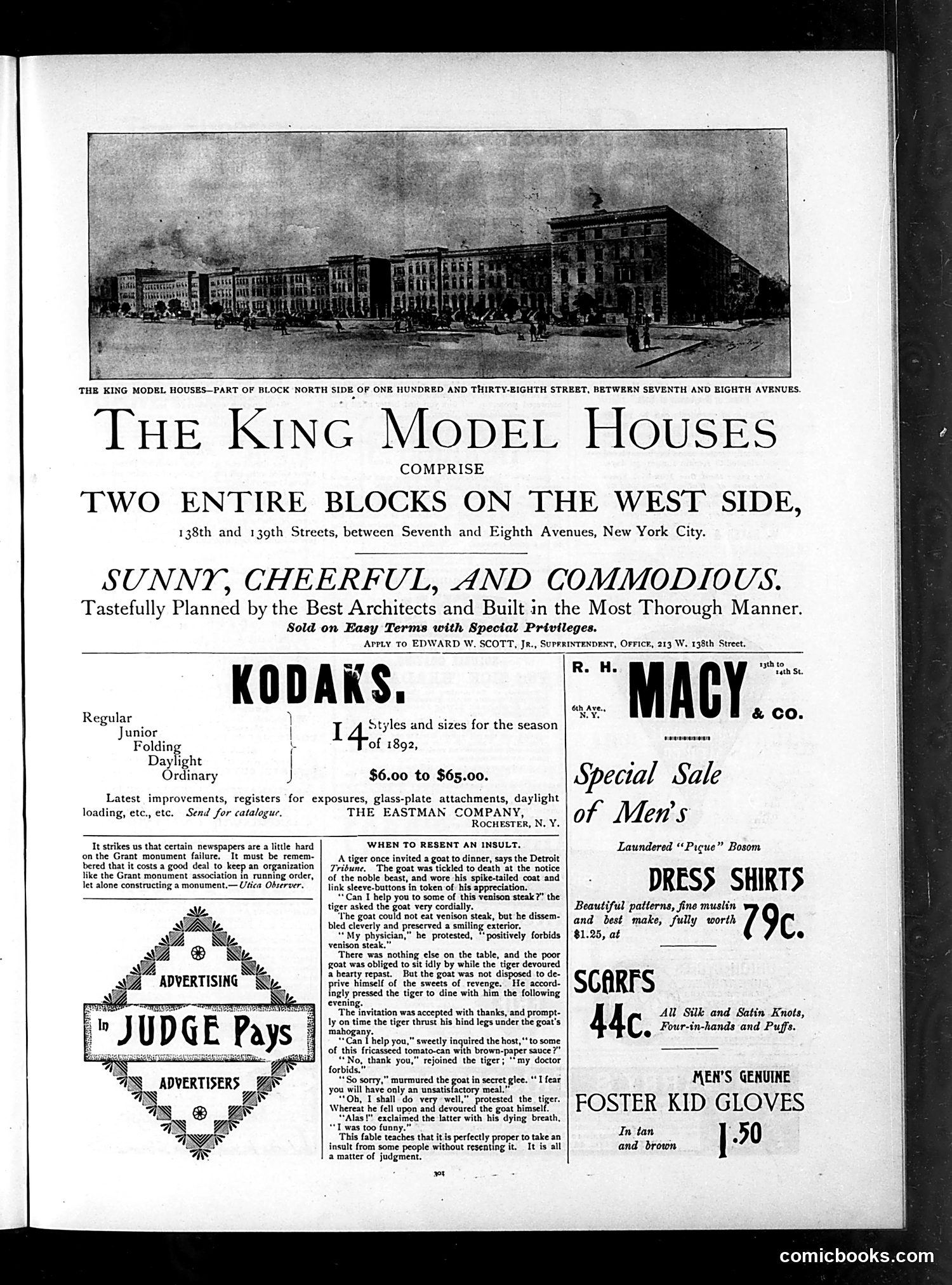
This page is primarily **advertising and real estate promotion**, not political satire. The dominant content advertises the King Model Houses, a new residential development in Manhattan's Upper West Side (138th-139th Streets), marketed as "sunny, cheerful, and commodious" with easy payment terms. The page includes period advertisements for Kodak cameras, Macy's department store (dress shirts, scarves, gloves), and Eastman Company products. The only satirical content is a **fable about resenting insults**: a tiger invites a goat to dinner and serves venison (inedible to the goat); the goat retaliates by inviting the tiger and serving only tomato cans—yet the tiger eats the goat anyway. The moral, presented ironically, suggests it's sometimes wise to accept insults without complaint, "a matter of judgment." This appears designed as light humor rather than commentary on specific contemporary figures or events. The page exemplifies how Judge mixed serious real estate marketing with genteel satirical storytelling for its educated, urban readership.
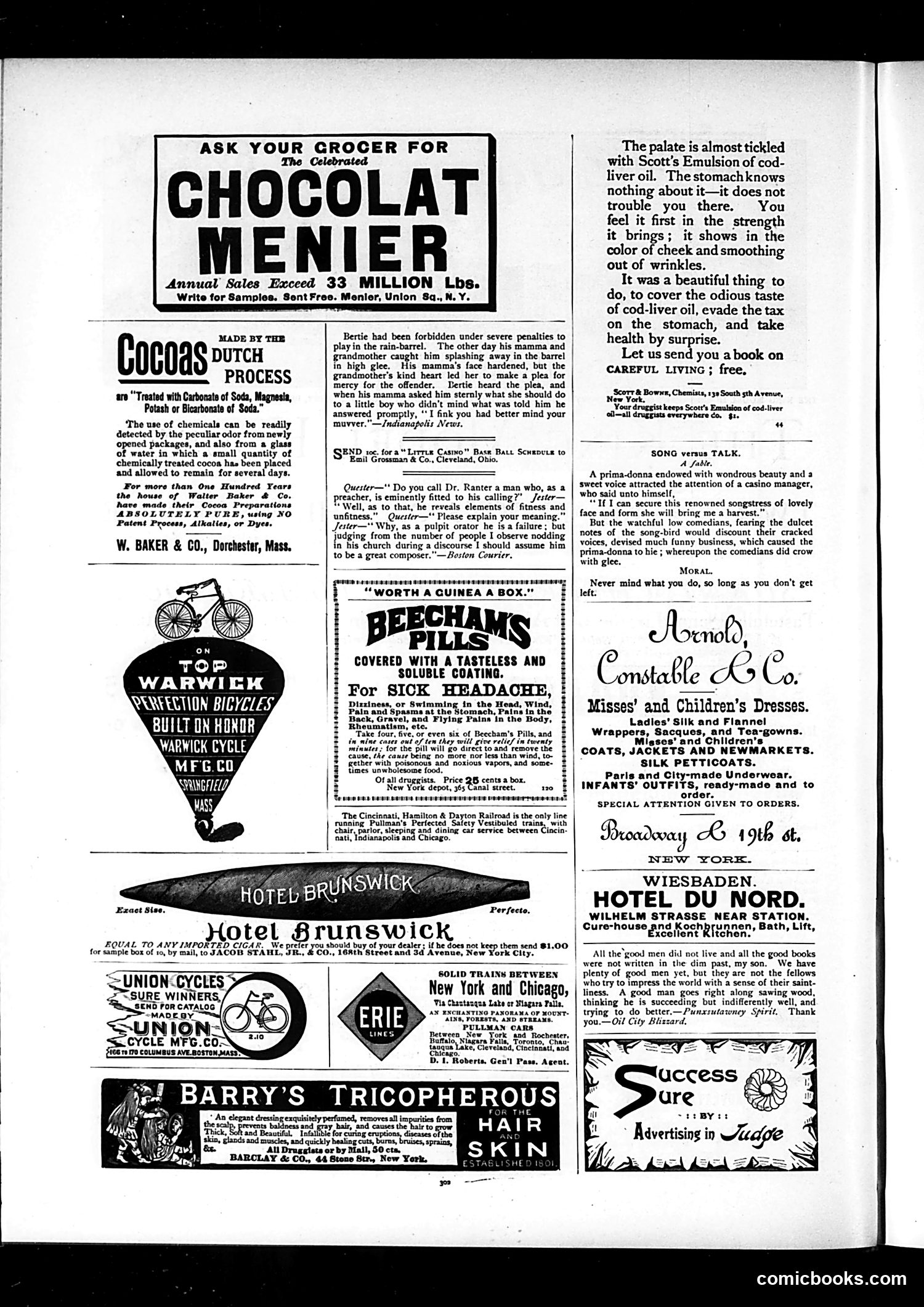
This page is primarily **advertising**, with brief humorous anecdotes scattered throughout—typical of Judge magazine's format. The main advertisements promote consumer products: cocoa (W. Baker & Co. emphasizes their cocoa is "absolutely pure" without chemical additives—addressing contemporary food-safety concerns), bicycles (Warwick), chocolate (Menier), pills (Beecham's), trains, and clothing. The small jokes reflect early 1900s domestic humor: one anecdote shows a child's cheeky back-talk to his mother about punishment; another portrays a preacher as a failure at oratory but accidentally skilled at inducing sleep in his congregation—satirizing boring sermons. The page reflects **Progressive Era anxieties** about food purity and industrial processing. Baker & Co.'s emphasis on avoiding chemicals and "patent processes" suggests consumers worried about adulteration—a legitimate concern that eventually led to food safety regulation. No specific political cartoons or caricatures of identifiable public figures appear here.
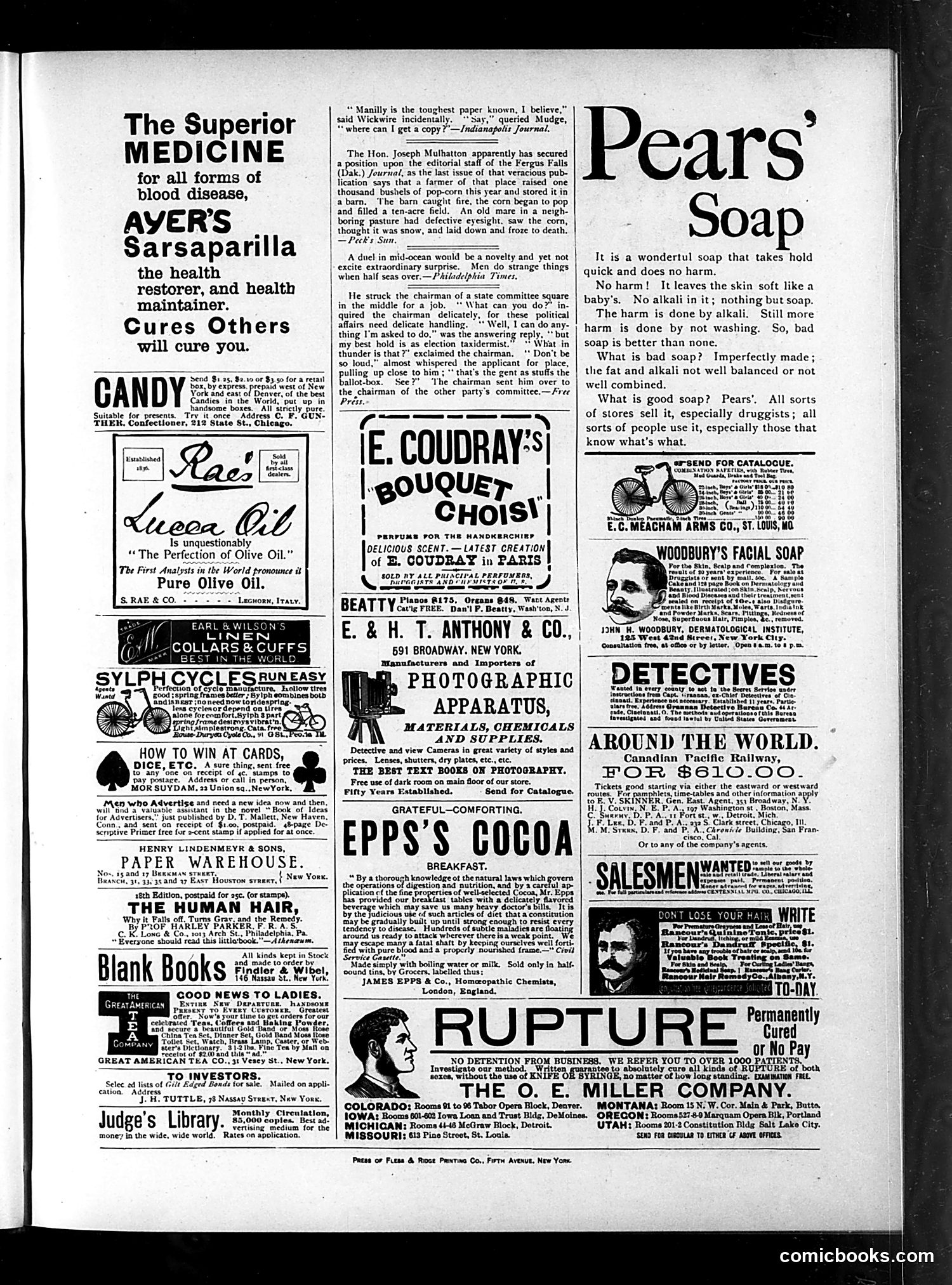
This page is **primarily advertising**, with small satirical text snippets interspersed—typical of Judge's format. The notable satirical content includes: **"Election Taxidermist" joke**: A political job-seeker tells a state committee chairman his specialty is "stuffing the ballot box"—a transparent metaphor for electoral fraud. The humor relies on the applicant's deadpan, coded language ("taxidermist" stuffing things) to describe vote manipulation, which he then refersibly sends to the opposing party's chairman. This reflects Gilded Age corruption and machine politics. **Other brief satirical items** mock journalistic absurdity (a farmer's popcorn barn catching fire and freezing a horse) and human folly (dueling at sea while drunk). The page otherwise contains period advertising for patent medicines (Ayer's Sarsaparilla), soaps, bicycles, and books—reflecting late 19th-century commercial culture. The ads themselves sometimes contain period humor or exaggeration typical of the era.
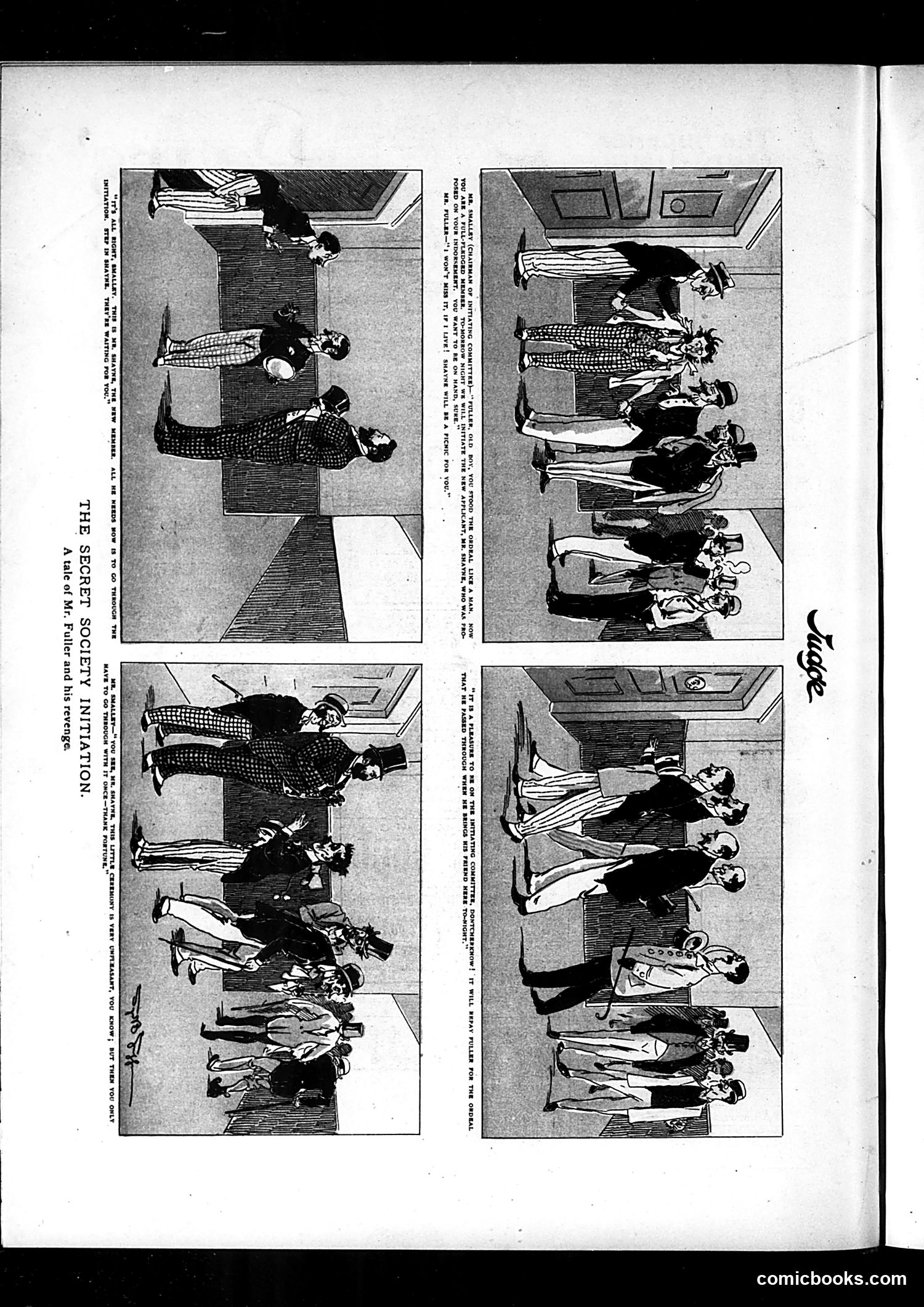
This appears to be a satirical narrative sequence about fraternal organization membership rituals. The cartoon depicts Mr. Fuller's initiation into a secret society, with the chairman (Mr. Smallry) explaining that initiation involves an unpleasant "ordeal" that must be endured once. The humor targets the pretentiousness and hazing practices of exclusive clubs and fraternal organizations popular in the era. The caption promises "a tale of Mr. Fuller and his revenge," suggesting the narrative will show Fuller's comeuppance—likely getting revenge on new initiates after suffering through his own initiation. The satire mocks both the initiation ceremonies themselves and the cycle of mistreatment perpetuated within these organizations, where members rationalize hazing as an unavoidable "fortune" of membership.