
Judge, 1892-04-30 · page 7 of 18
Judge — April 30, 1892 — page 7: what you’re looking at
What you’re looking at
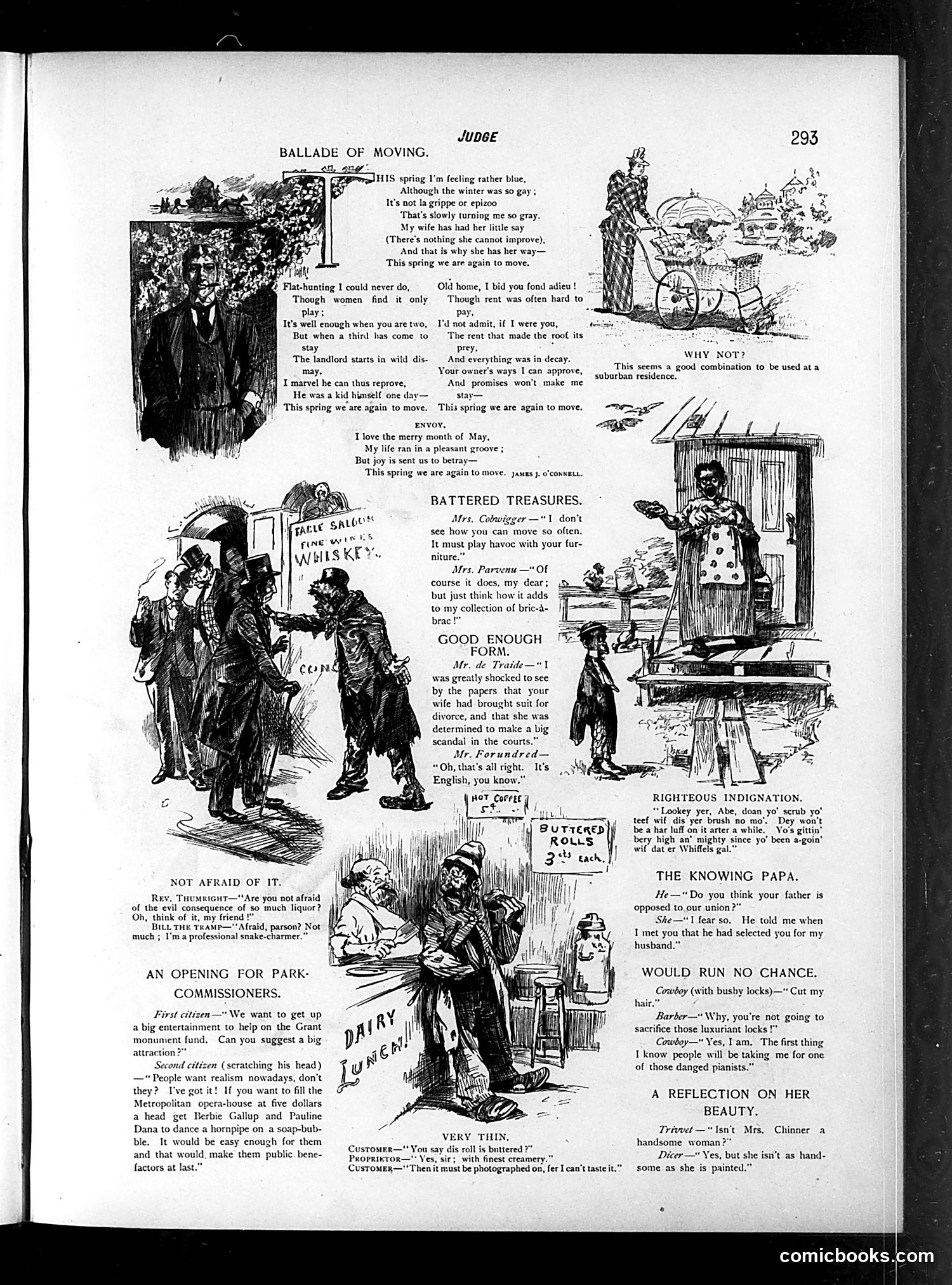
This page satirizes the domestic inconvenience of frequent relocations, a common middle-class experience of the era. The title poem laments spring moving season, with a husband resigned to repeated upheaval because his wife insists on "improving" their living situation. The satire targets both wives' dissatisfaction with housing and landlords' indifference to tenant complaints. The scattered jokes below mock various social pretensions: a vagrant's claim to be a "professional snake-charmer" (implying immunity to consequences), a woman treating damaged furniture as "bric-a-brac" to justify constant moving, and a man accepting his wife's divorce suit because "it's English" (fashionable). Other items ridicule racial dialect humor, class anxiety, and physical appearance stereotypes—typical of Judge's casual prejudices. The overall tone presents moving season as an absurd but inevitable domestic ritual.
📄 Transcribed text from this page (OCR, searchable)
Machine-transcribed from the original scan — historical spelling and the odd misread are preserved.
JUDGE BALLADE OF MOVING. IS spring I'm feeling rather blue, Although the winter was so gay ; It's not la gripe or epizoo ‘That's slowly turning me so gray. My wife has had her little say (There's nothing she cannot improve), And that is why she has her way— This spring we are again to move. Flat-hunting I could never do, Though women find it only play ; It’s well enough when you are two, But when a third has come to stay The landlord starts in wild dis- may, I marvel he can thus reprove, He was a kid himself one day— This spring we are again to move. Old home, I bid you fond adieu! Though rent was often hard to pay, T'd not admit, if I were you, ‘The rent that made the root its prey, ‘ And everything was in decay. Your owner's ways I can approve, And promises won't make me stay— ‘This spring we are again to move. NOT AFRAID OF IT. kv. THUMRIGHT—"‘Are you not afraid of the evil consequence of so much liquor? Oh, think of it, my friend !” BIL THE TkaAMP—" Afraid, parson? Not much ; I'm a professional snake-charmer.” AN OPENING FOR PARK- COMMISSIONERS. First citizen —" We want to get up a big entertainment to help on the Grant monument fund, Can you suggest a big attraction?" Second citizen (scratching his head) —* People want realism nowadays, don’t they? I've got it! If you want to fill the Metropolitan opera-house at five dollars a head get Berbie Gallup and Pauline Dana to dance a hornpipe on a soap-bub- ble. It would be easy enough for them and that would, make them public bene- factors at last.” Llove M. ENVOY, the merry month of May, life ran in a pleasant groove ; sent us to betray This spring we are again to move. yastns j. o'connaLt. xe BATTERED TREASURES. Mrs. Cobwigger —"\ don't see how you can move so often. It must play havoc with your fur- niture.” Mrs. Parvenu —“ Ot course it docs, my dear; but just think how it adds to my collection of bric-A- brac!" GOOD ENOUGH FOR. Mr. de Traide—"\ was greatly shocked to see by the papers that your wife had brought suit for divorce, and that she was determined to make a big scandal in the courts.” Mr. Forundred— “Oh, that’s all right. It's English, you know.” HOT CorrEc ‘Sita { rial fi BuTTEeRey)}i ROWS roll is buttered ?” with finest creamery.” t be photographed on, fer I can’t tasteit.” This seems a good combination to be used at a suburban residence. RIGHTEOUS INDIGNATION, “*Lookey yer, Abe, doan yo" scrub teef wif dis yer brush no mo’. Dey won't be a har luff on it arter a while. o's gittin’ bery high an’ mighty since yo’ been a-goin’ wif dat er Whiffels gal.” THE KNOWING PAPA, He—*Do you think your father is opposed to,our union ?” She—"I fear so. He told me when I met you that he had selected you for my husband.” WOULD RUN NO CHANCE. nvboy (with bushy locks)—* Cut my Barber—* Why, you're not going to sacrifice those luxuriant lock: Cowboy—"Ves, 1am, The first thing I know people will be taking me for one of those danged pianists.” A REFLECTION ON HER BEAUTY. Trévvet —“\sn't’ Mrs, Chinner a handsome woman?” Dicer — Yes, but she isn’t as hand- some as she is painted.” comicbooks.com