
Judge, 1892-04-30 · page 2 of 18
Judge — April 30, 1892 — page 2: what you’re looking at
What you’re looking at
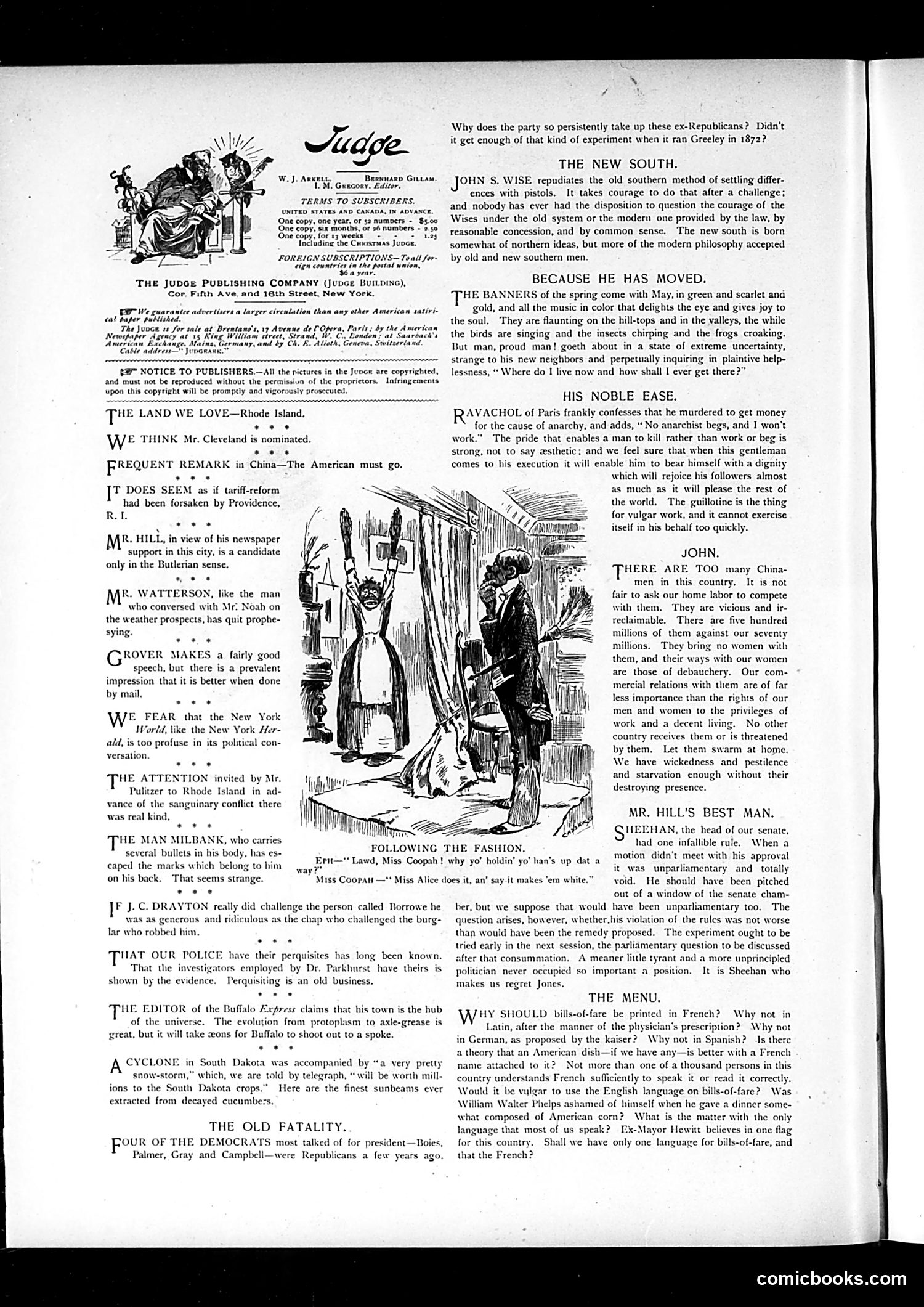
This page combines editorial commentary with satirical articles typical of Judge magazine's format. The main cartoon titled "Following the Fashion" depicts what appears to be a social interaction, though the specific figures are unclear from the image alone. The textual content addresses contemporary political and social issues: criticism of Republican policies, discussion of Chinese immigration and labor competition, commentary on police practices, and debate over language policy (specifically whether bills-of-fare should be printed in French). The articles mock various public figures and policies through sardonic commentary rather than visual caricature. Without clearer identification of specific individuals or dated context, the precise satirical targets remain somewhat obscure to modern readers, though the general thrust criticizes both political establishments and social prejudices of the era.
📄 Transcribed text from this page (OCR, searchable)
Machine-transcribed from the original scan — historical spelling and the odd misread are preserved.
Braxwarp Giitan. Editor. TERMS TO SUBSCRIBERS. UNITED STATES AND CANADA, IN. ADVANCE. One copy ye year. OF s2 numoers - $5.00 ‘One copy, six months, or 36 numbers One copy: for iy weeks === Including the Cuxistmas Juoce. FOREIGN SUBSCRIPTIONS—To ait for- ‘ign countries in the postal union, $a year, THE JUDGE PUBLISHING COMPANY (JuDce buILDING), Cor. Fifth Ave, and 16th Street, New York. [BW e guarantee advertisers a larger circulation than any other American satiri- cal paper published. The Jovcn ts for sale at Brentans's,17 Avenue del Opera, Paris: by the American Newspaper Agency at 15 King William street, Strand, W. C., London: at Saaroach's American Exchange. Mi ‘many, and by Ch. B. Alioth, Geneva, Cable address 2 NOTICE TO PUBLISHERS.—All the pictures in the Juoce are copyrighted, and must not be reproduced without the permission of the proprietors. upon this copyright will be promptly and vigorously prosecuted. Infringements, THE LAND WE LOVE—Rhode Island. THINK Mr. Cleveland is nominated. eee REMARK in China—The American must go. It DOE 1 as if tariff-reform had been forsaken by Providence, RI R. HILL, in view of his newspaper support in this city, is a candidate only in the Butlerian sense. . WATTERSON, like the man who conversed with Mr: Noah on the weather prospects, has quit prophe- sying. . GROVER MAKES a fairly good speech, but there is a prevalent impression that it is better when done by mail. WE FEAR that the New York World, like the New York Her- ald, is (00 profuse in its polit con- versation. THE ATTENTION invited by Mr. Pulitzer to Rhode Island in ad- vance of the sanguinary conflict there was real kind, HE MAN MILBANK, who carries several bullets in his body, caped the marks which belong to him on his back, That seems strange. aS eS- way, F J.C. DRAYTON really did challenge the person called Borrowe he was as generous and ridiculous as the chap who challenged the burg- lar who robbed | THAT OUR POLICE have their perquisites has long been known. That the investigators employed by Dr. Parkhurst have theirs is shown by the evidence. Perquisiting is an old business. THE EDITOR of the Buffalo Express claims that his town is the hub of the universe. The evolution from protoplasm to axle-grease is great, but it will take ons for Buffalo to shoot out to a spoke. CYCLONE in South Dakota was accompanied by “a very pretty snow-storm,” which, we are told by telegraph, “will be worth mill- ions to the South Dakota crops.” Here are the finest sunbeams ever extracted from decayed cucumbers. THE OLD FATALITY. Four OF THE DEMOCRATS most talked of for president—Boies, Palmer, Gray and Campbell—were Republicans a few yea FOLLOWING THE Lawd, Miss Coopah! why yo" holdir Miss Cooran —** Miss Alice does it, an’ say.it makes ‘em white.” Why does the party so persistently take up these ex-Republicans? Didn't it get enough of that kind of experiment when it ran Greeley in 1872? THE NEW SOUTH. JOHN S. WISE repudiates the old southern method of settling differ ences with pistols. It takes courage to do that after a challenge; and nobody has ever had the disposition to question the courage of the Wises under the old system or the modern one provided by the law, by reasonable concession, and by common sense. The new south is born somewhat of northern ideas, but more of the modern philosophy accepred by old and new southern men BECAUSE HE HAS MOVED. of the spring come with May, in green and scarlet and d all the music in color that delights the eye and gives joy to the soul. They are flaunting on the hill-tops and in the valleys, the while the birds are singing and the insects chirping and the frogs croaking. But man, proud man! goeth about in a state of extreme uncertainty, strange to his new neighbors and perpetually inquiring in plaintive help- lessness, ** Where do I live now and how shall I ever get there?” HIS NOBLE EASE. RRAVACHOL of Paris frankly confesses that he murdered to get money for the cause of anarchy, and adds, “ No anarchist begs, and I won't work.” The pride that enables a man to kill rather than work or beg is strong, not to say asthetic; and we feel sure that when this gentleman comes to his execution it will enable him to bear himself with a dignity which will rejoice his followers almost as much as it will please the rest of the world, The guillotine is the thing for vulgar work, and it cannot exercise itself in his behalf too quickly. MO ! JOHN. ARE TOO many China- men in this country. It is not fair to ask our home labor to compete with them. They are vicious and ir- reclaimable, There are five hundred millions of them against our seventy millions. They bring no women with them, and their ways with our women are those of debauchery. Our com- mercial relations with them are of far less importance than the rights of our men and women to the privileges of work and a decent living. No other country receives them or is threatened by them. Let them swarm at home. We have wickedness and pestilence and starvation enough without their destroying presence. MR. HILL’S BEST SHEEHAN, the head of our senate, had one infallible rule. When a motion didn’t meet with his approval it was unparliamentary and. totally void. He should have been pitched out of a window of the senate cham- ber, but we suppose that would have been unparliamentary too. The question arises, however, whether. his violation of the rules was not worse than would have been the remedy proposed. The experiment ought to be tried early in the next session, the parliamentary question to be discussed after that consummation, A meaner little tyrant and a more unprincipled politician never occupied so important a position. It is Sheehan who makes us regret Jones. MAN. FASHION. yo" han’s up dat a THE MENU. WHY SHOULD bills-of-fare be printed Latin, after the manner of the physician's prescription? Why not in German, as proposed by the kaiser? Why not in Spanish? Is there a theory that an American dish—if we have any—is better with a French name attached to it? Not more than one of a thousand persons in this country understands French sufficiently to speak it or read it correctly. Would it be vylgar to use the English language on bills-of-fare? Was William Walter Phelps ashamed of himself when he gave a dinner some- what composed of American corn? What is the matter with the only language that most of us speak? Ex-Mayor Hewitt believes in one flag for this country. Shall we have only one language for bills-of-fare, and that the French? French? Why not in comicbooks.com