
A complete issue · 16 pages · 1892
Judge — April 9, 1892
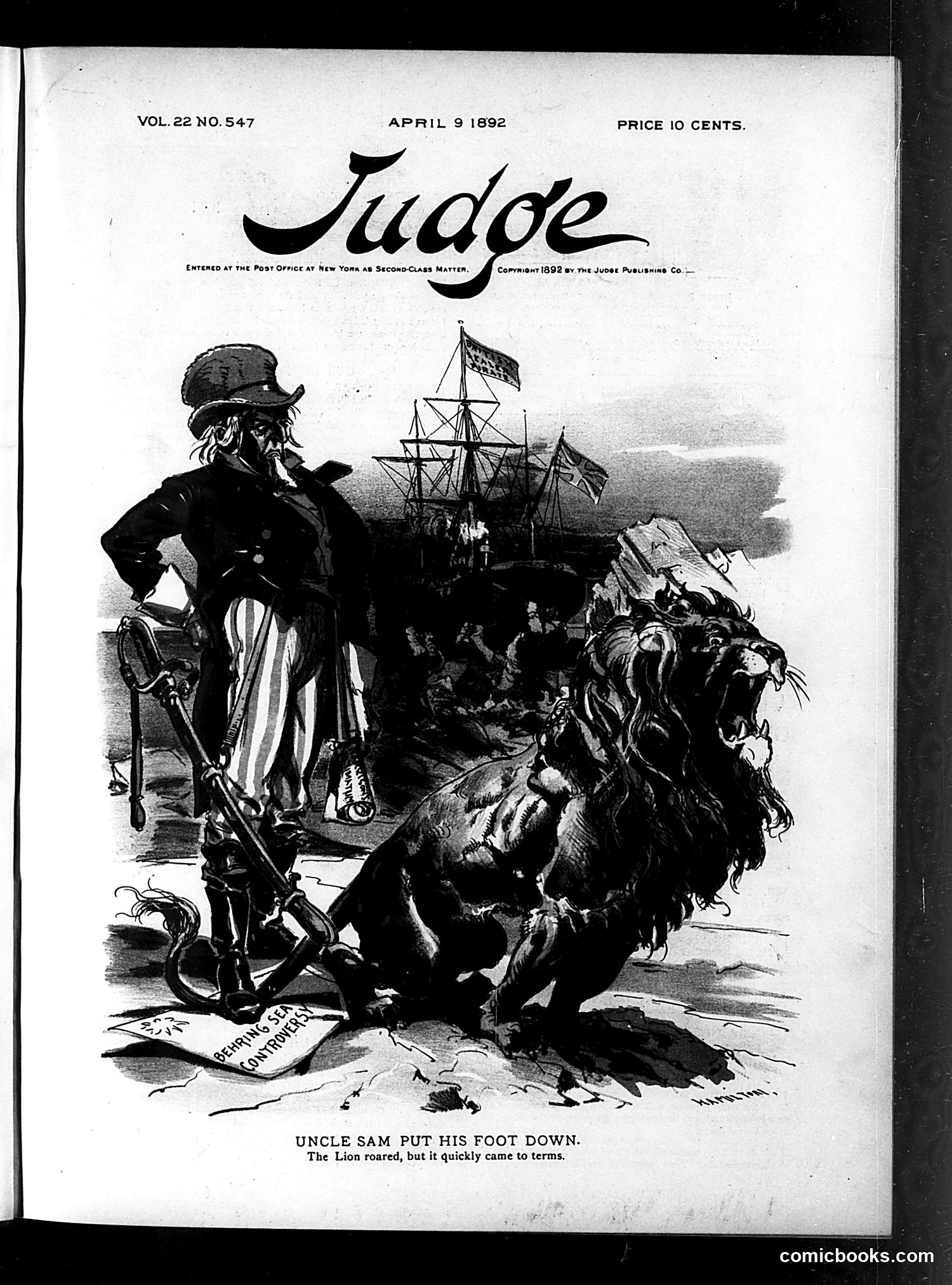
This political cartoon depicts Uncle Sam standing firmly over a roaring lion, with the caption "Uncle Sam Put His Foot Down. The Lion roared, but it quickly came to terms." The lion likely represents Britain, a common symbolic representation in 19th-century American political cartoons. The "foot down" suggests U.S. assertion of power or resolve in a diplomatic dispute. The document beneath appears labeled (though unclear in reproduction), possibly referencing a specific trade or territorial disagreement. The warship in the background emphasizes military strength backing the diplomatic stance. This appears commentary on American assertiveness against British interests during the 1890s—a period of rising U.S. imperial ambitions and Anglo-American tensions over various colonial and commercial matters.
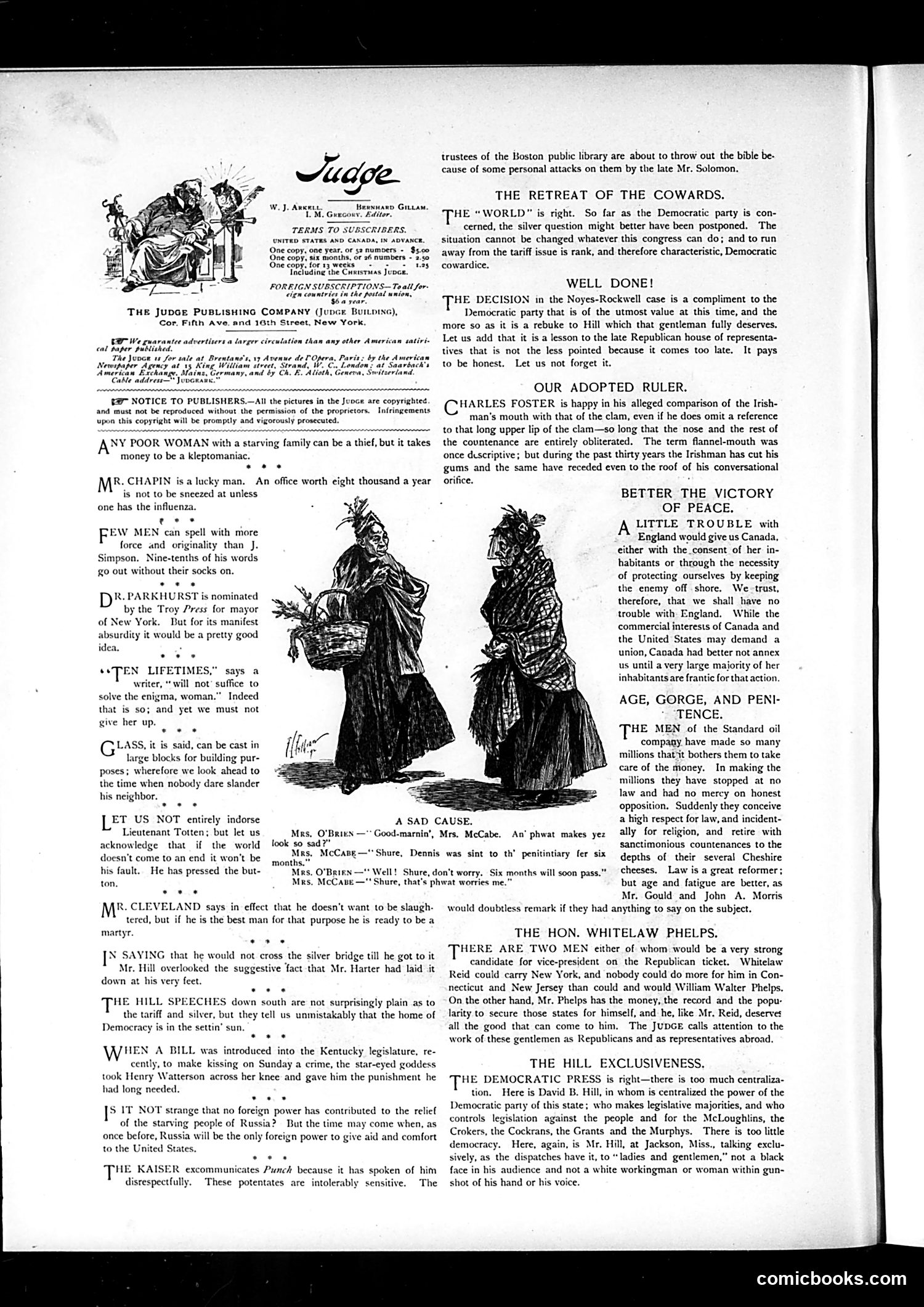
This page contains political commentary rather than a primary cartoon. The main illustrated piece shows two women in conversation, labeled "A SAD CAUSE," discussing a man named Dennis who was apparently jailed for six months—likely a contemporary scandal referenced without full context here. The text sections mock various political figures and issues of the era (date unclear from this excerpt). References include Charles Foster's "Irish" comparison, Dr. Parkhurst's nomination for New York mayor, and extended commentary on David B. Hill's political dominance in New York State. The satire targets Democratic Party politics, particularly Hill's control of party machinery and his exclusionary leadership style. Without publication date context, specific identifications remain uncertain, though the content clearly criticizes Democratic political power consolidation and individual politicians' ambitions.
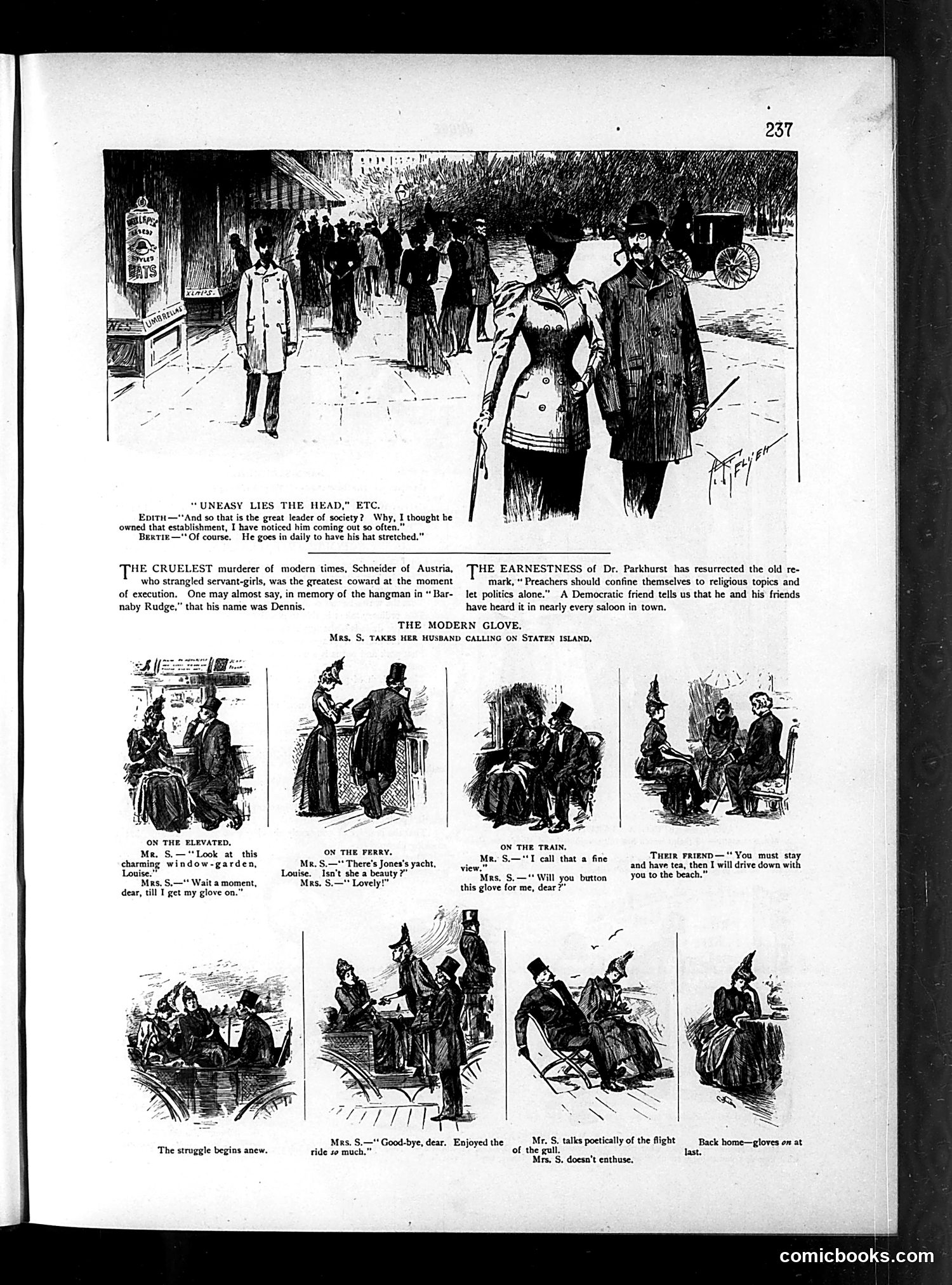
This page satirizes turn-of-the-century gender relations and social conventions. The top illustration mocks debate over women's public roles—specifically whether respectable women should be seen unescorted in society. "The Modern Glove" series depicts a married woman (Mrs. S.) repeatedly losing or forgetting her gloves across various public venues (elevated train, ferry, yacht, train). Each scene shows her husband or male companions expressing mild exasperation at her carelessness. The satire targets two things: women's increasing public mobility and independence during this era, and the domestic friction this created with traditional husbands. The "glove" becomes a metaphor for respectability and propriety—her repeated loss suggests women's difficulty maintaining Victorian propriety while navigating modern urban spaces. The humor relies on audience familiarity with emerging "New Woman" anxieties of the 1890s-1900s.
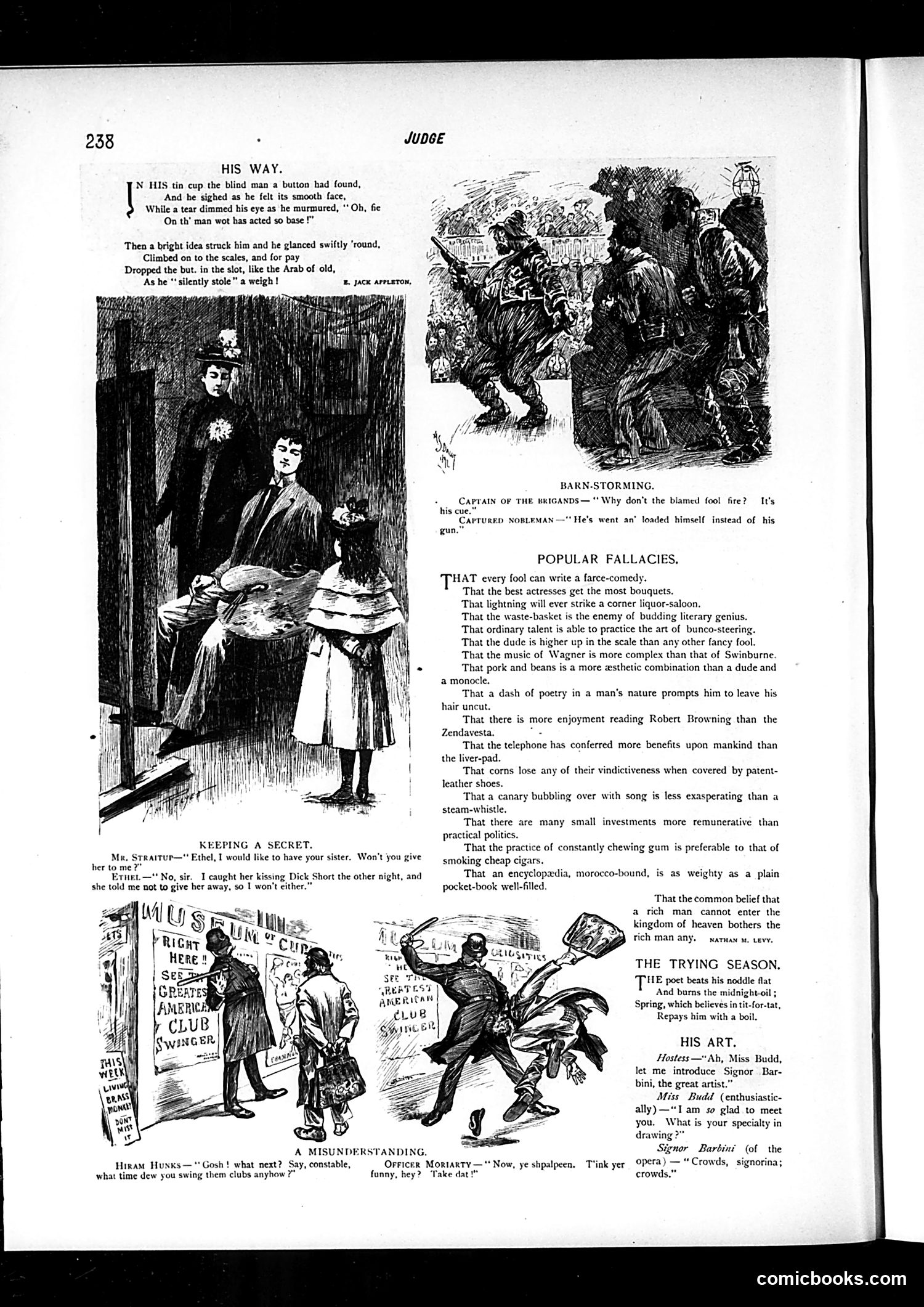
This page contains several unrelated humorous pieces typical of Judge's satirical format: **"His Way"** depicts a blind beggar finding a button, then using a weighing scale as a pun—he "silently stole a weigh" (play on "away"), combining sentiment with wordplay. **"Barn-Storming"** shows a brigand commander frustrated that his subordinate loaded himself into a cannon instead of the ammunition—dark humor about incompetence. **"Popular Fallacies"** is a list mocking contemporary pretensions: that fools can write comedy, that Wagner is complex, that telephone technology was revolutionary, that gum-chewing beats cigar-smoking, etc. These satirize both artistic and social affectations. Minor sketches follow: "Keeping a Secret" jokes about gossip, "The Trying Season" mocks poets' suffering, and "His Art" plays on an opera artist's specialty being crowd scenes rather than drawing technique. The page is primarily humor and light social satire rather than political commentary.
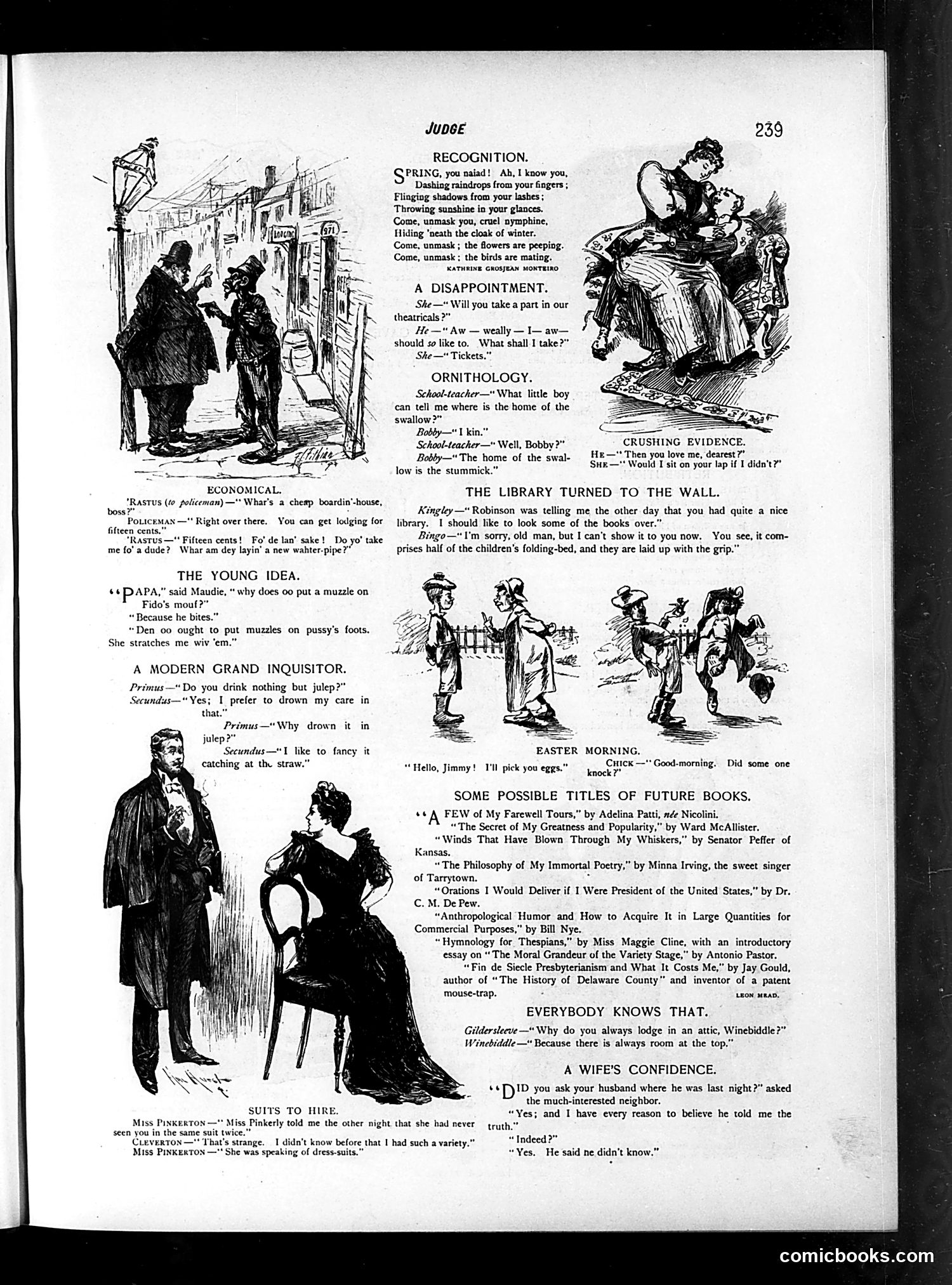
This page contains multiple short humorous pieces typical of 1890s satirical magazines: **"Recognition"** and **"Crushing Evidence"** are sentimental poem/cartoon pairs about spring and romantic relationships—gentle humor about courtship conventions. **"A Disappointment"** satirizes theatrical culture: a woman asks a man to participate in theatricals; he misunderstands, thinking she wants him as an actor, but she only wants him to sell tickets. **"Ornithology"** mocks rural dialect humor, where a boy claims the swallow lives "in the stummick" (stomach)—likely a child's malapropism joke. **"The Library Turned to the Wall"** jokes about the grip (flu epidemic), with a man unable to show his library because half the books are being used as a folding-bed for sick children. **"Some Possible Titles of Future Books"** satirizes contemporary celebrities and public figures (Adelina Patti the opera singer, Ward McAllister society figure, Senator Peffer, etc.) through mock book titles mocking their vanity or pretension. The page reflects upper-middle-class magazine humor: social satire, theatrical references, and contemporary celebrity mockery rather than political content.
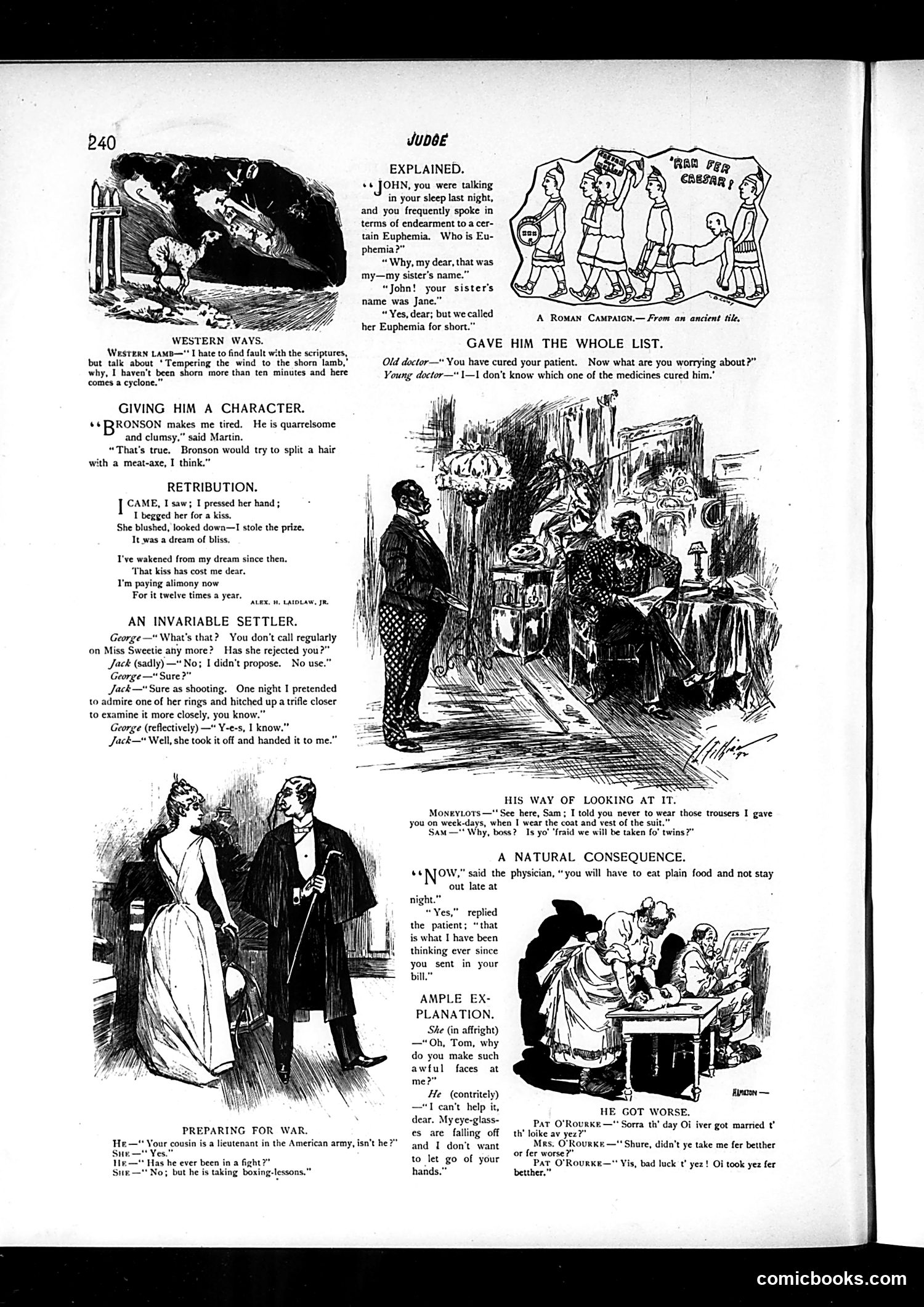
This page contains multiple unrelated humor pieces typical of Judge's satirical format: **"Explained"** mocks marital suspicion—a husband caught speaking affectionately to "Euphemia" in his sleep claims it's his sister's nickname, though his wife knew the sister as "Jane," suggesting infidelity. **"Western Ways"** jokes about frontier harshness: a sheep-shearer complains about Scripture's metaphor "tempering the wind to the shorn lamb"—he's barely shorn before a cyclone hits, offering no mercy. **"Retribution"** uses verse to satirize alimony: a man stole a kiss in a dream, now pays "twelve times a year," suggesting marriage/divorce costs. **"An Invariable Settler"** depicts a young man's failed courtship—when he pretended to admire a woman's ring to get close, she removed it and handed it to him, ending his hopes. **"His Way of Looking At It"** features ethnic humor (dialect suggests African American servant) about wearing employer's clothing. **"A Natural Consequence"** shows a patient relieved by doctor's strict diet order because the physician's bill is so expensive anyway. The remaining pieces use similar domestic/class-based humor conventions of the era.
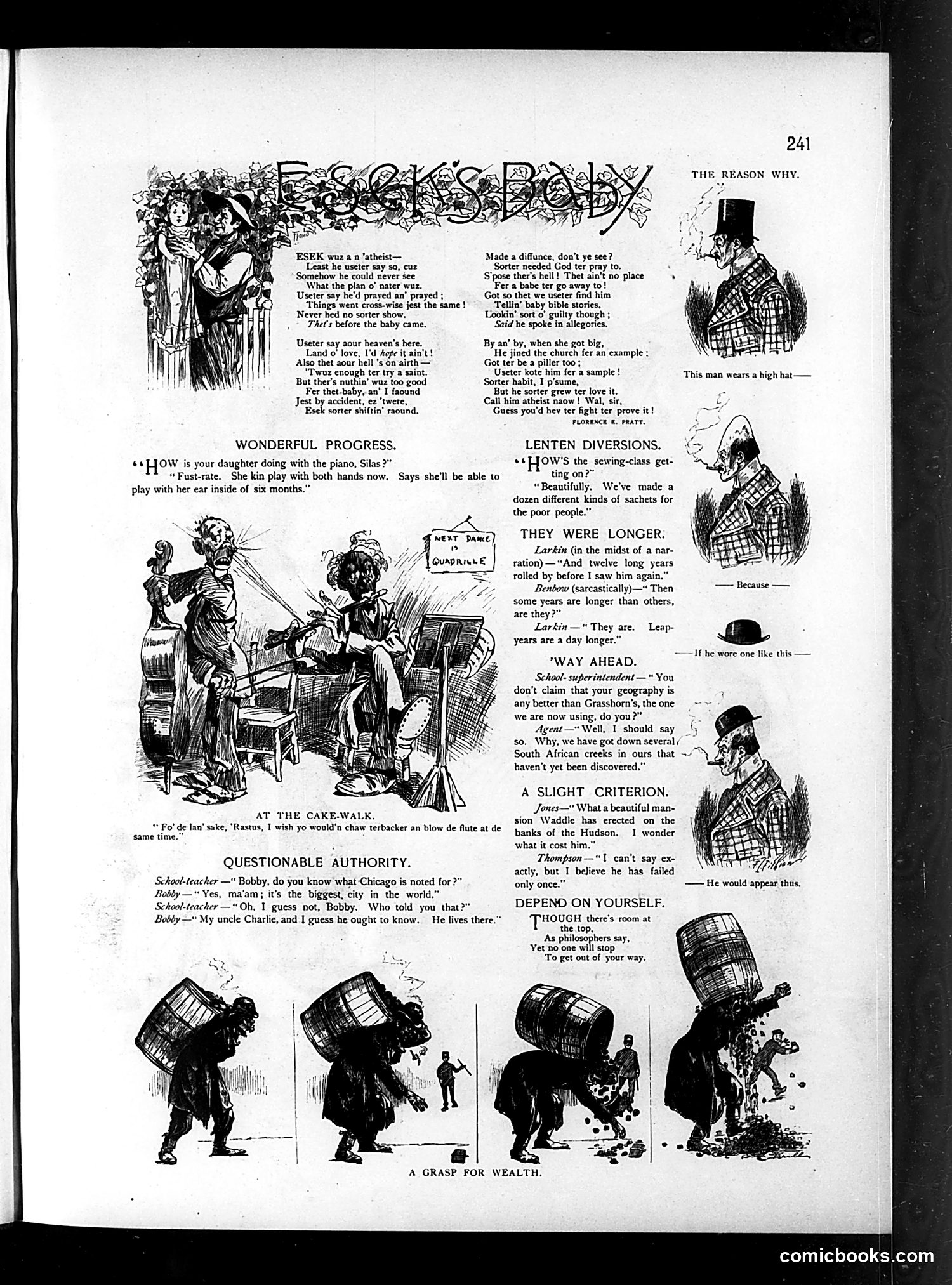
This satirical page contains multiple unrelated humor pieces typical of Judge's format: **"Esek"** (top left): A dialect poem about a man's religious conversion. Esek was an atheist who couldn't see "the plan of nature," but after having a baby, he needed God to pray to. He eventually joins the church, becoming a "pillar," though the narrator doubts calling him atheist now would provoke a fight. The satire targets inconsistent faith and social respectability over genuine belief. **Other brief sketches** mock common absurdities: a schoolmaster's factually wrong claim about Chicago; a piano student learning to play with her ear; social climbing and pretension ("Waddle's mansion"). **"A Grasp for Wealth"** (bottom): Four sequential panels showing a figure with a barrel struggling unsuccessfully—satirizing futile attempts at fortune-seeking. The page reflects late 19th/early 20th-century American concerns: religious hypocrisy, social aspiration, education, and economic anxiety—presented through humor accessible to contemporary readers familiar with these social anxieties.
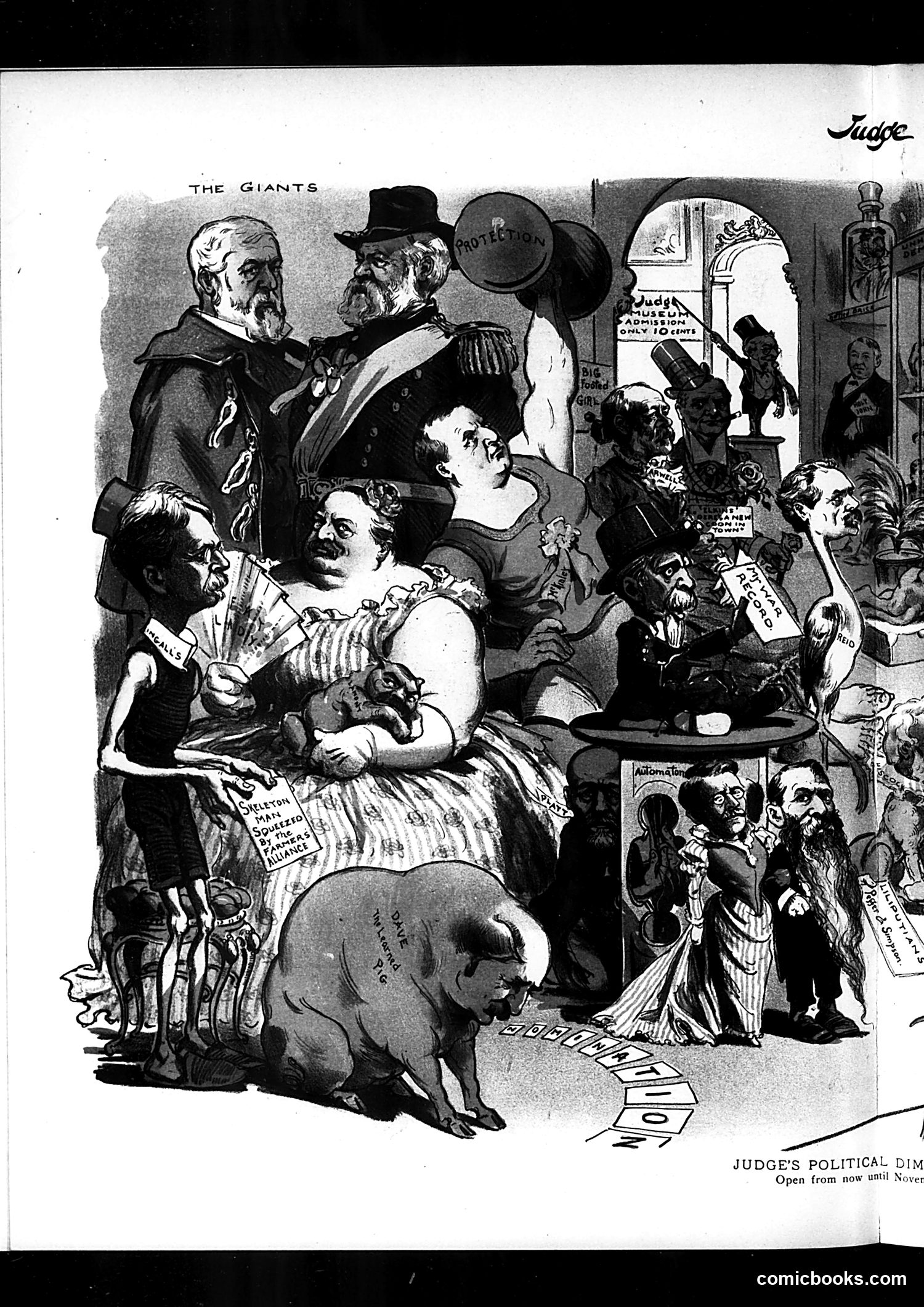
This cartoon depicts a "dime museum" or freak show labeled "THE GIANTS," satirizing prominent political figures of the era as grotesque curiosities for public exhibition. The composition shows exaggerated caricatures in military uniforms and formal dress, arranged like sideshow attractions. A woman in the center holds a fan, while various figures with distorted features surround her. The satire appears to mock the vanity and spectacle of political leadership—treating powerful men as entertainments for the masses. The reference to "Open from now until November" suggests this was published during an election season, using the dime museum concept to ridicule politicians as freakish oddities worthy only of circus-like display rather than serious governance. The specific identities remain unclear without additional context, though the military uniforms indicate these were likely prominent government or military leaders of the day.
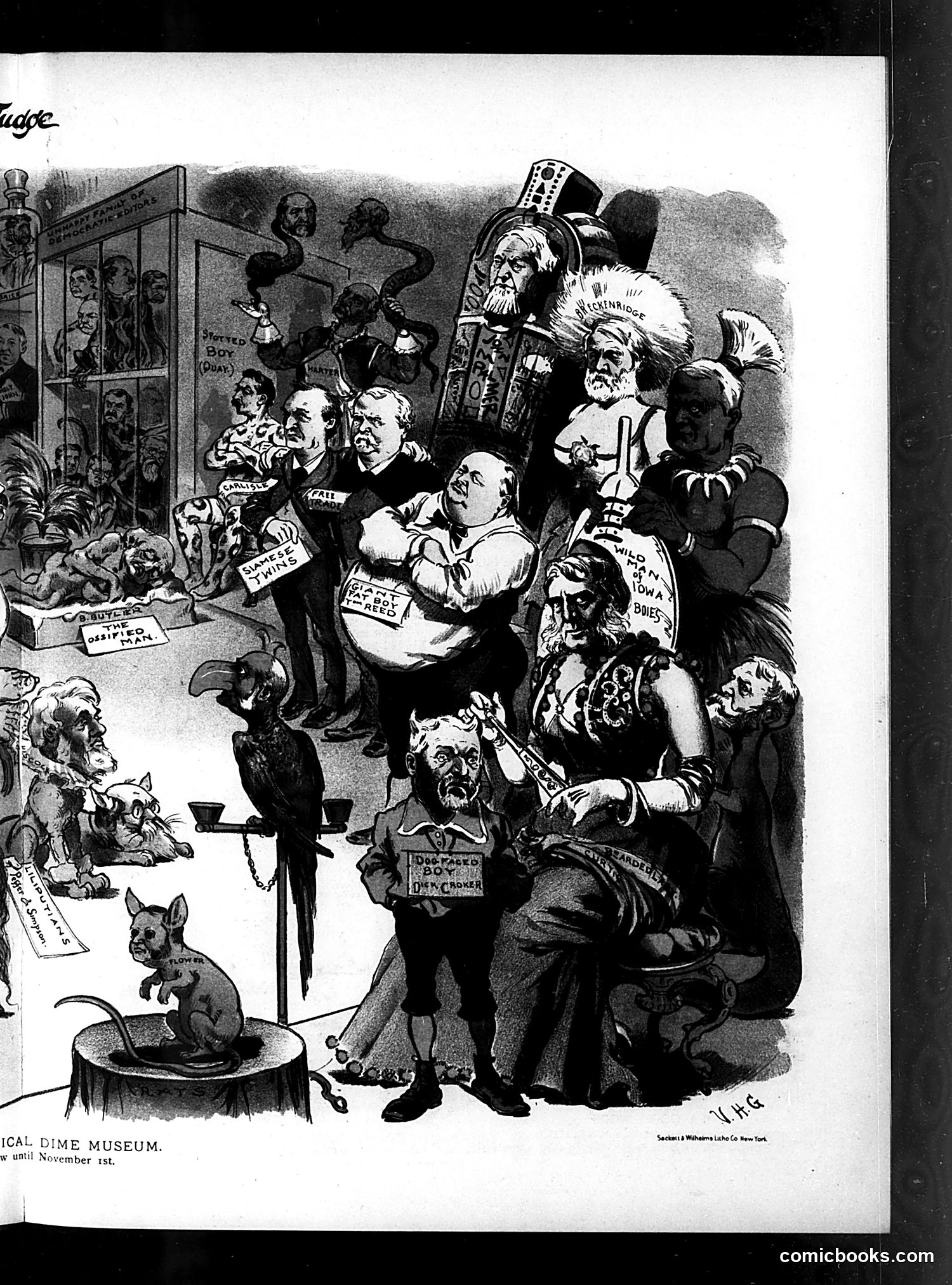
This political cartoon satirizes a "dime museum"—a popular 19th-century entertainment venue displaying oddities and curiosities. The image shows various caricatured political figures and exaggerated characters (some depicted with animal features or grotesque characteristics) gathered as if they were exhibits in such a museum. The satire appears to mock contemporary politicians as freakish oddities worthy of public display, suggesting they're curiosities rather than serious statesmen. Several figures wear sashes or labels identifying them (though specific names are difficult to read clearly in this reproduction). The caged or staged presentation emphasizes the cartoonist's contempt for these political figures, treating them as entertainment spectacles rather than legitimate leaders. The referenced "dime museum" and "November 1st" date suggest this responds to a specific historical political moment, likely an election period, though the exact context remains unclear from the image alone.
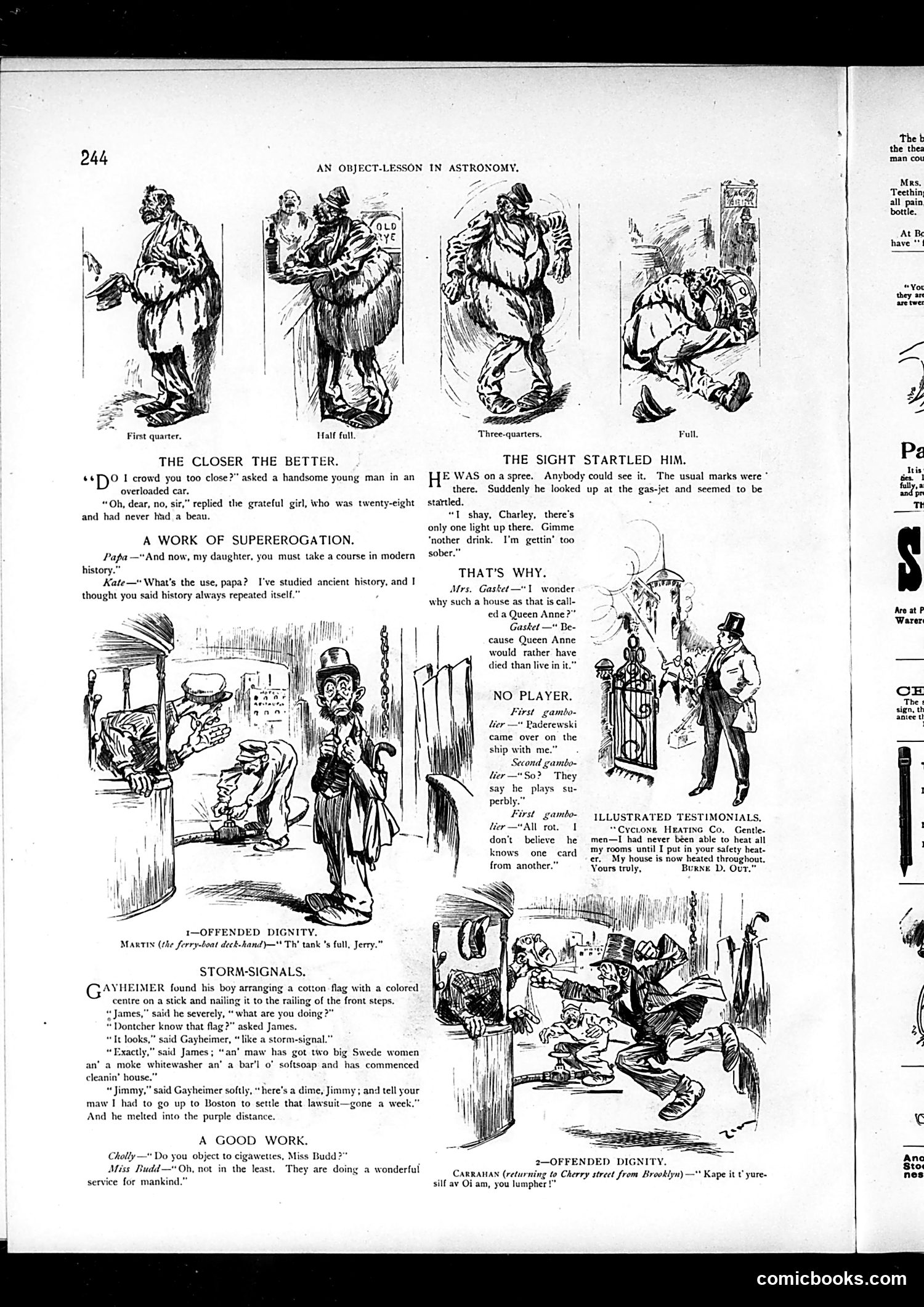
This page contains several brief humorous vignettes typical of Judge magazine's satirical format: **"The Closer the Better"** mocks courtship conventions—a homely 28-year-old woman is thrilled by minimal attention from a man in a crowded car, satirizing desperation and low expectations. **"A Work of Supererogation"** jokes that history repeats itself, so studying it is redundant—a mild critique of educational value. **"Storm-Signals"** uses visual humor: a father mistakes his son's homemade flag for a weather warning, then realizes it signals the mother's house-cleaning frenzy with hired workers. He flees, treating domestic upheaval as a genuine emergency. **"The Sight Startled Him"** depicts a drunk man so inebriated that seeing only one gas lamp (instead of two from double vision) alarms him into ordering another drink to restore his intoxicated state. The remaining items are brief social jokes about cigars, card games, and Irish dialect humor. These represent typical period comedy: domesticity anxiety, class observations, and ethnic stereotyping common to early 1900s American humor magazines.
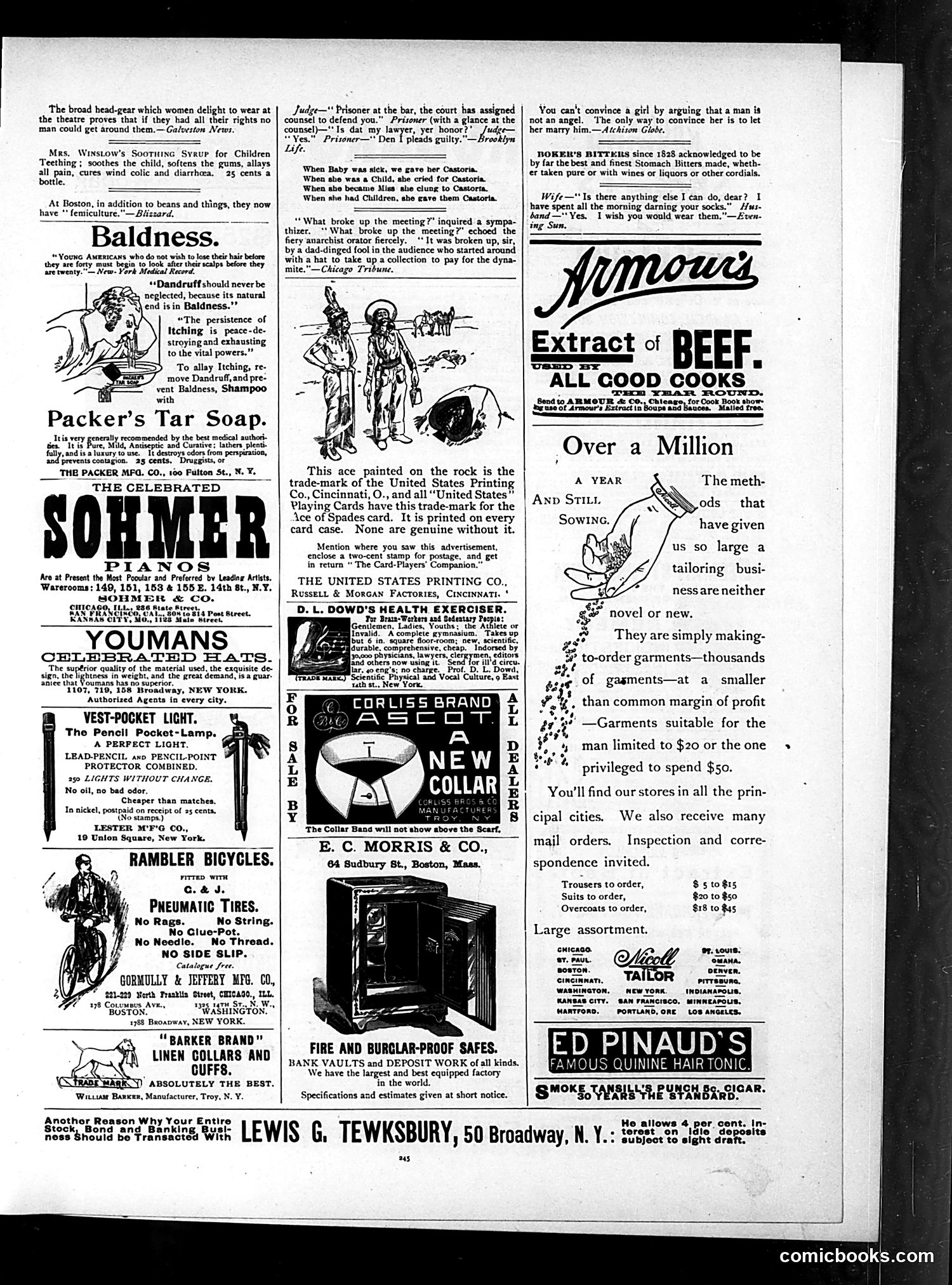
This is primarily an **advertising page** from Judge magazine with minimal satirical content. The few jokes present target contemporary social issues: 1. **Opening quote on baldness/women's rights**: A brief satirical jab suggesting women's large theatrical hats prove they'd be formidable if granted full rights—a light commentary on the women's suffrage debate of the era. 2. **Anarchist meeting joke**: A courtroom exchange mocking radical anarchists. A prisoner assumes his court-appointed counsel is incompetent, so pleads guilty. The second anecdote ridicules an anarchist orator disrupted by someone collecting money for dynamite—satirizing both anarchist rhetoric and their supposed reliance on violence. The rest is straightforward advertising: hair soap, pianos, hats, bicycles, safes, and patent medicines (notably Castoria, a children's medication). These ads reveal period consumer goods and marketing strategies.
This page is **primarily advertising** with no discernible political cartoons or satirical content targeting specific figures or events. The advertisements reflect late-19th/early-20th-century consumer culture and medical practices. Notable are the patent medicine ads (Beecham's Pills for "bilious and nervous disorders," consumption remedies) that exploit common health anxieties—standard for this era before FDA regulations. The Urbana Wine Company ad promotes wine as a "natural sparkling" product, typical of period marketing. The one editorial piece (top right) is a comparative advertisement for Scott's Emulsion cod-liver oil, using consumer logic: just as a grocer wouldn't pass off inferior coffee as "just as good," an honest druggist won't sell substitute remedies. This reflects turn-of-the-century concerns about product authenticity and consumer trust. The remaining content comprises fashion, gardening, and home goods advertisements. No political satire or identifiable caricatures appear on this particular page.
This is primarily an **advertising page** from Judge magazine, featuring various commercial products and services typical of the late 19th/early 20th century. **Notable advertisements include:** - **Victor Bicycles** (top): Pitches their tire technology as superior to competitors' pneumatic designs - **Crosby's Vitalized Phosphites**: A "brain and nerve food" marketed for mental exhaustion and nervous ailments—reflecting period anxieties about overwork and neurasthenia - **Washburn musical instruments** and **Beatty suspenders**: Consumer goods with quality claims - **New York Central Railroad**: America's major rail line advertising service to Niagara Falls - **Lovell Diamond Cycles**: Another bicycle manufacturer **The sole cartoon** (middle-right) shows two railroad drivers discussing a woman waving an umbrella—a mild joke about flirtation. The page reflects **turn-of-century consumer culture**: patent medicines, bicycles (then cutting-edge technology), mail-order education, and railroad travel dominated advertising. The emphasis on nervous disorders suggests widespread concerns about modern industrial life's psychological toll.
This is primarily an **advertising page** from Judge magazine, not a political cartoon. The page contains numerous commercial advertisements for late 19th-century products: Ayer's Pills, Gunther's Candies, Tadella Pens, and shoes. The only notable illustrated content is **"Little Tailors,"** a small cartoon showing six men in formal dress seated together. The accompanying text references a dialogue about tailoring and offers custom "Goat and Vest to Order" from Jacobs Brothers in New York for $12–$15, suggesting this is a humorous advertisement for tailoring services rather than political satire. The remaining content consists of brief jokes (about a boy hearing his mother call, and a son claiming superiority to his father) and standard commercial advertisements for everything from hair treatments to bicycles to W.L. Douglas shoes. There is **no apparent political satire or social commentary** on this page—it represents typical turn-of-the-century magazine advertising mixed with light humor.
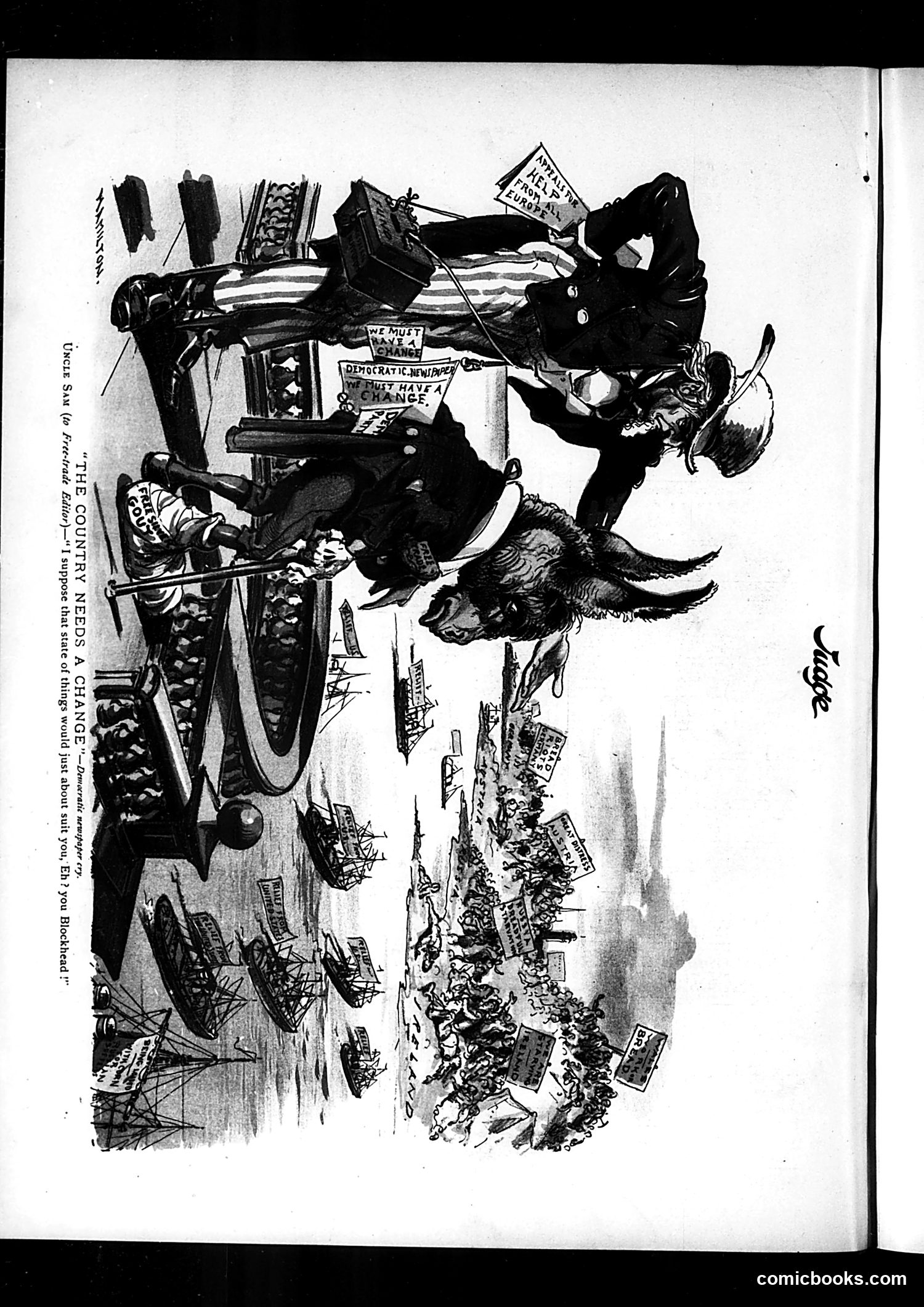
This is a political cartoon satirizing Democratic calls for change during what appears to be a tariff debate. Uncle Sam confronts a "Free-trade Editor" (representing Democratic newspapers), suggesting that the Democrats' desired "change" would benefit only the editor while harming the country. The cartoon depicts chaos—overturned carts, scattered goods, and turmoil in the streets below—implying that free-trade policies would create economic disorder. The editorial signs reading "WE MUST HAVE A CHANGE" and "DEMOCRATIC NEWS" clarify the target. The satire's point: Democratic demands for tariff reform are reckless, self-serving propaganda that would devastate ordinary Americans' livelihoods, not genuine reform. Uncle Sam's insult ("you Blockhead!") emphasizes the cartoonist's contempt for this editorial position.