A complete issue · 18 pages · 1892
Judge — March 5, 1892
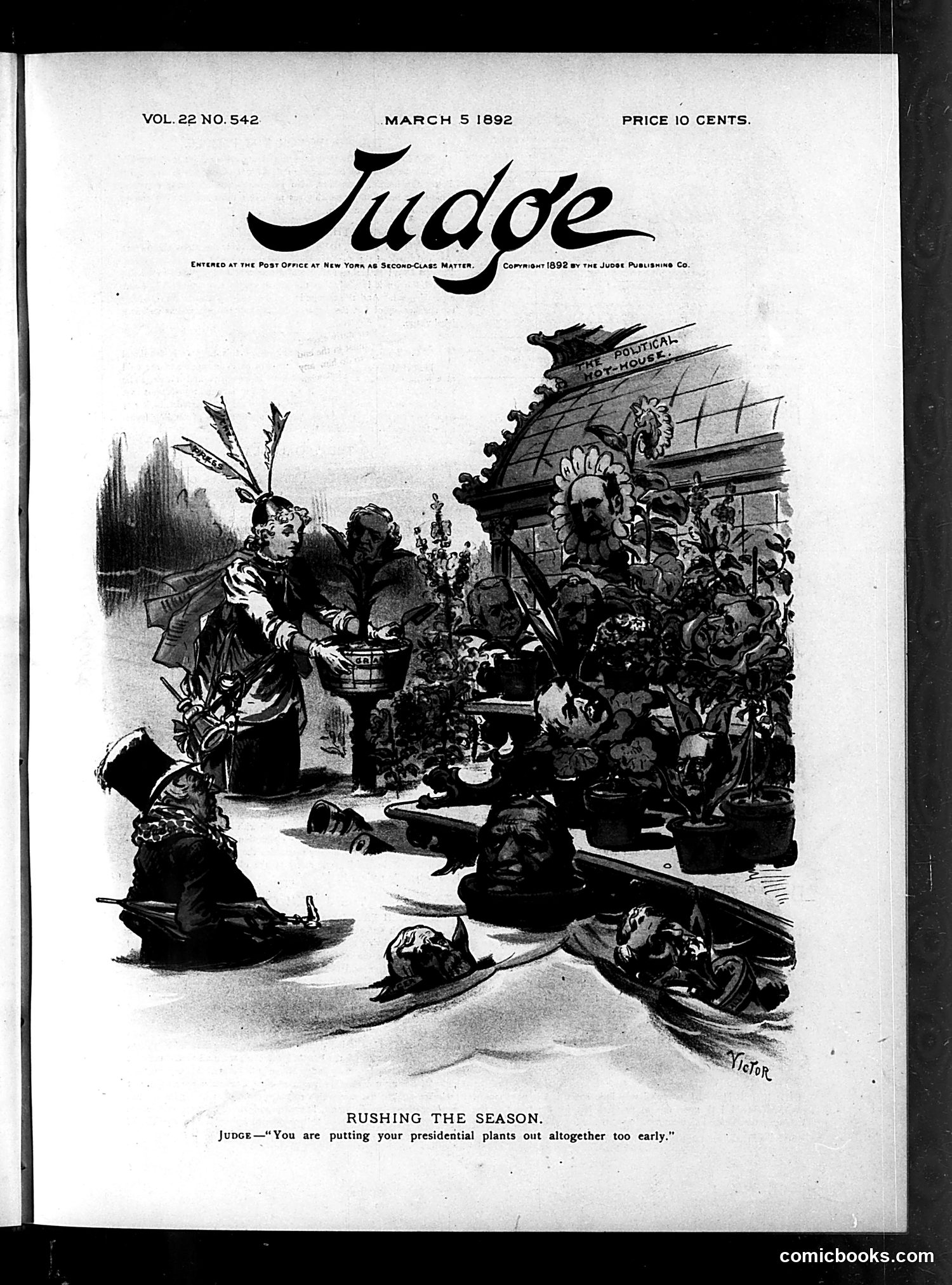
This political cartoon satirizes candidates launching their 1892 presidential campaigns too early in the election cycle. The "Judge" figure (representing the magazine's editorial voice) warns politicians they're "putting your presidential plans out altogether too early." The image shows candidates as gardeners tending "political plants" in a greenhouse labeled "Political Forcing House"—a metaphor for artificially accelerating growth. Dead or dying plants on the ground suggest previous candidates who peaked too soon and lost momentum by election day. The satire critiques the American political tendency toward extended campaigns, suggesting premature announcement and campaigning exhausts voters and candidates alike before actual voting occurs. This remains a recognizable concern in modern politics.
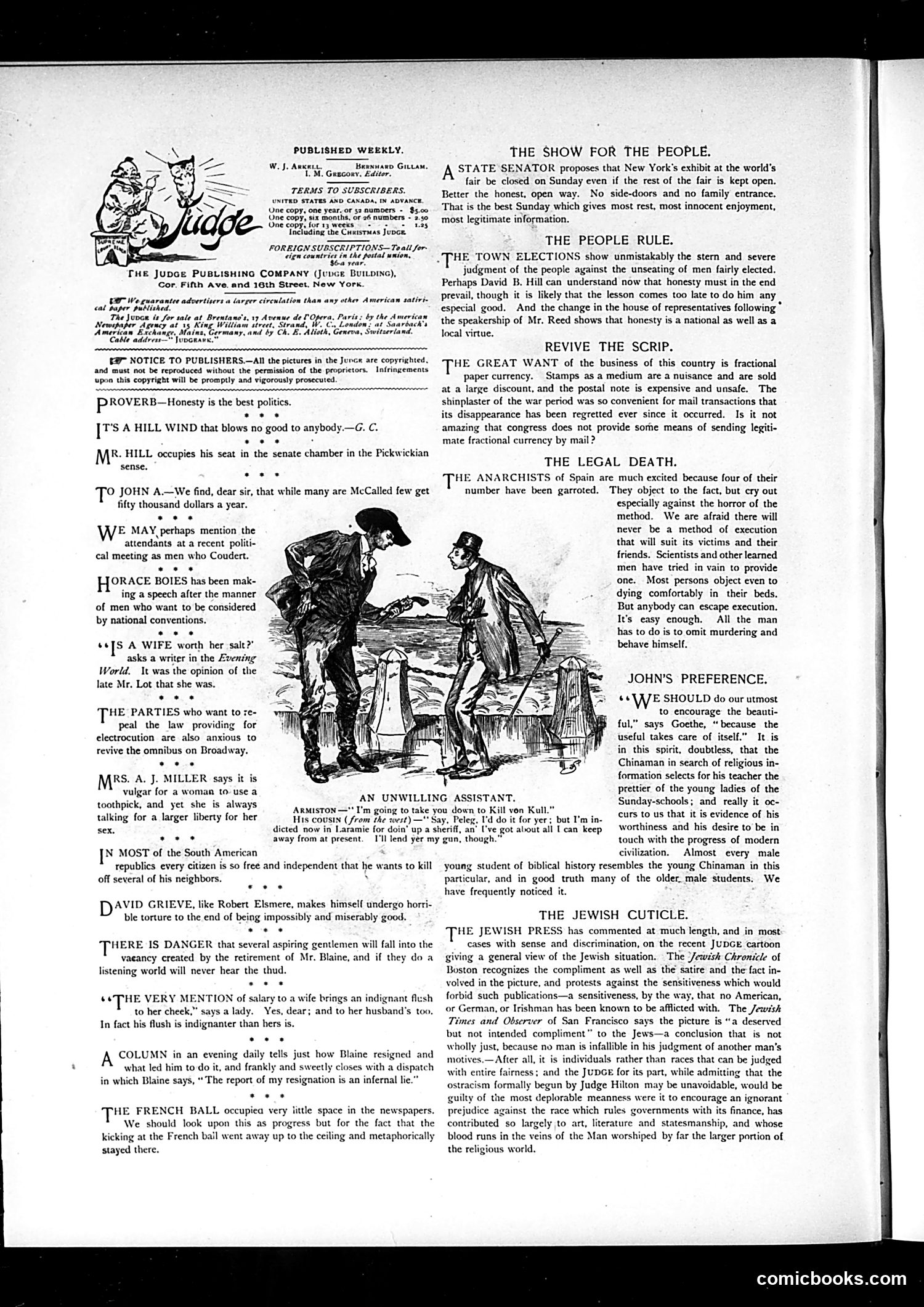
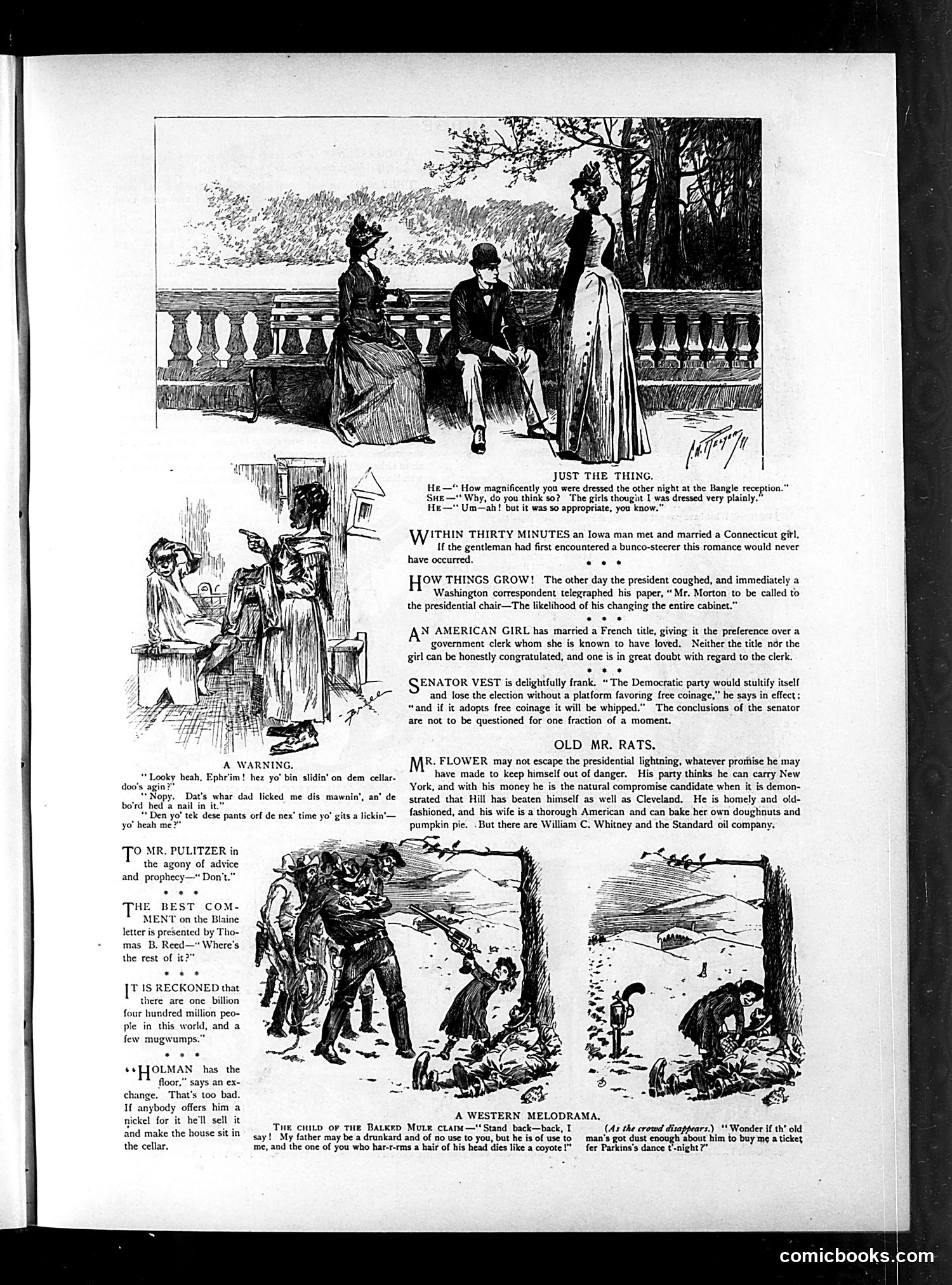
The top cartoon, "Just the Thing," depicts a social scene at what appears to be a Bangle reception. It satirizes courtship etiquette, with dialogue suggesting a gentleman compliments a woman's appearance at a formal event, prompting discussion about propriety and appropriateness of such remarks. The middle section contains brief satirical news items mocking political and social figures, including references to Senator Vest, an American girl marrying French nobility, and commentary on politicians like Flower and Pulitzer. "A Western Melodrama" (bottom) appears to be a humorous comic sequence depicting rough frontier behavior—men fighting and struggling, likely satirizing exaggerated Wild West tropes and masculine violence. The overall page combines social satire about etiquette with political commentary, typical of Judge's satirical approach.
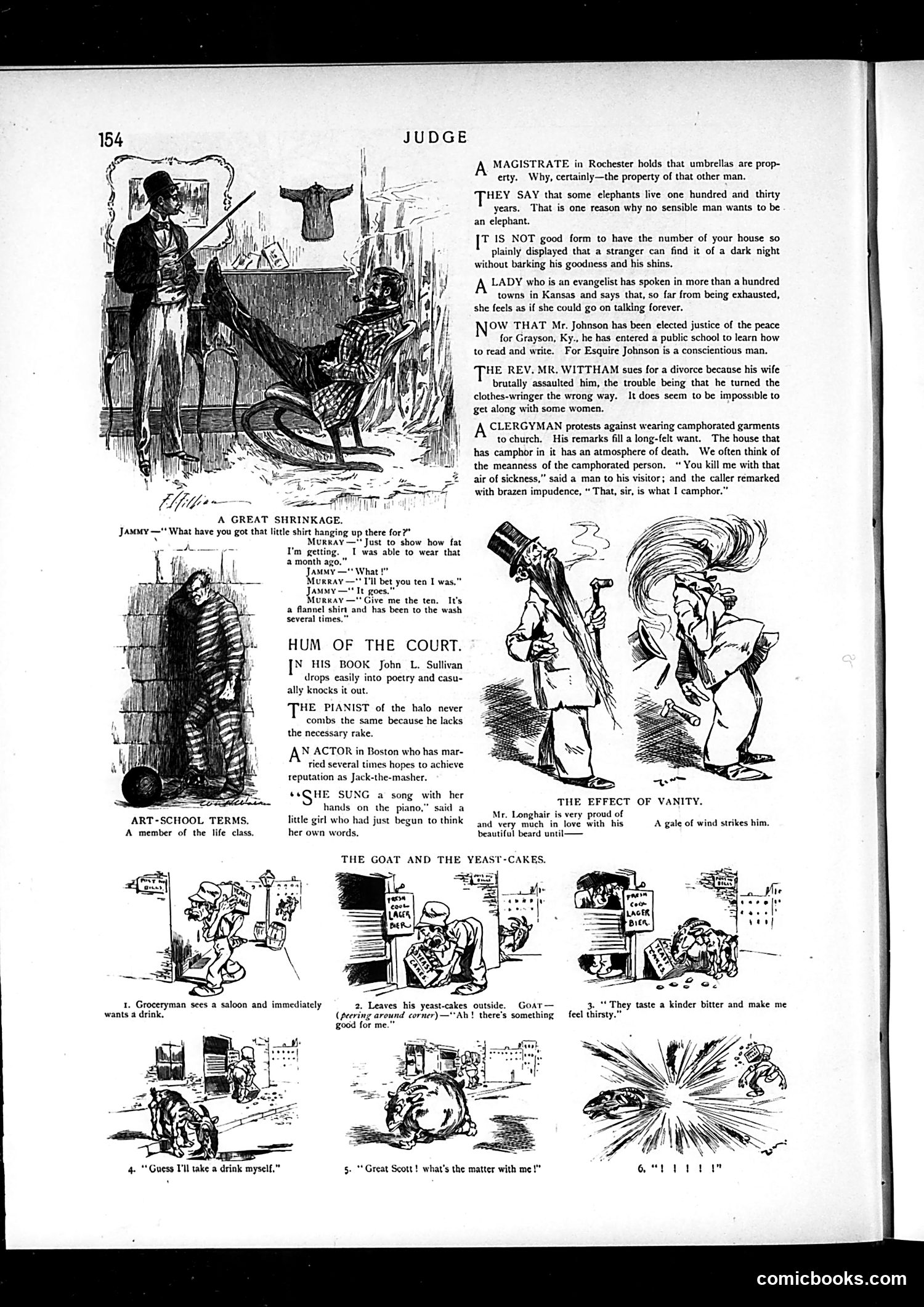
This page collects brief humorous observations and comic strips mocking Victorian-era social pretensions and absurdities. The opening items use irony to critique human behavior: umbrellas are "property" (stolen goods), elephants' longevity is undesirable, displaying house numbers is impolite, and a female evangelist's tireless talking is presented as ridiculous. The centerpiece mocks pompous or obtuse figures: a newly elected justice of the peace learning to read, a clergyman complaining about camphorated garments (a home remedy for illness), and a reverend suing over how his wife operated a clothes-wringer. The sequential comic strip "The Goat and the Yeast-Cakes" shows a grocer abandoning his baked goods to visit a saloon, a goat eating them, and the goat becoming violently ill—satirizing both alcoholism's temptation and comeuppance. Overall, Judge ridicules human vanity, poor judgment, and social pretension through quick, observational wit typical of late 19th-century American humor magazines.
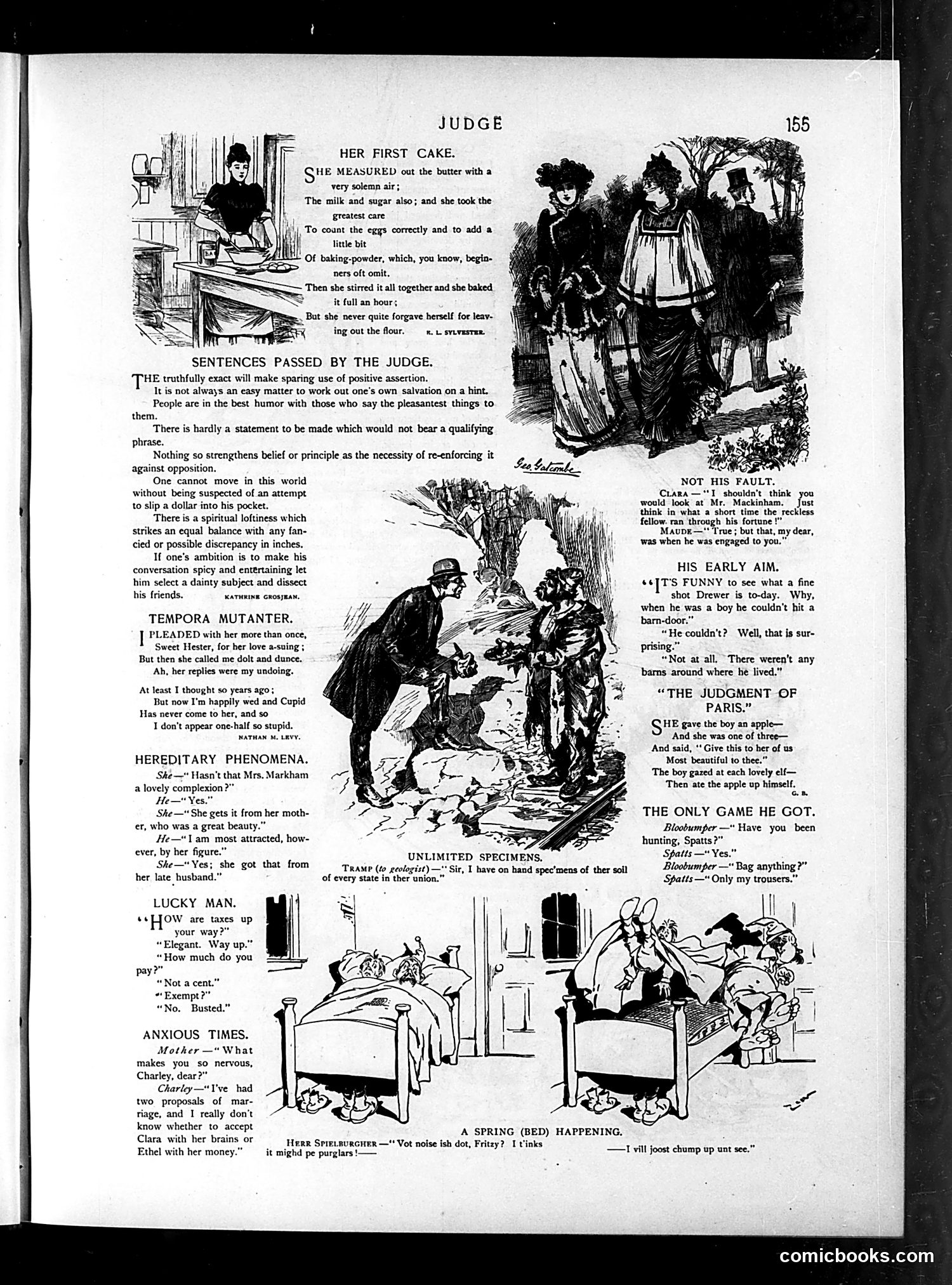
This page collects humor pieces typical of Judge's satirical format. The main content includes: **"Her First Cake"**: A cautionary verse about a novice baker who carefully measures all ingredients but forgets the flour—a gentle joke about overlooking obvious essentials despite careful preparation. **"Sentences Passed by the Judge"**: Philosophical observations about human nature, written in Judge's characteristic style of wry social commentary on honesty, ambition, and how people judge each other. **Short comic dialogues** covering familiar domestic and social situations: a man grateful his former fiancée rejected him, inheritance of physical traits, tax exemption through poverty, and marriage proposals causing anxiety. **"The Judgment of Paris"**: A twist on classical mythology—instead of goddesses competing, a boy chooses to eat the apple himself rather than award it. **"A Spring (Bed) Happening"**: Physical comedy about a broken bed causing chaos, with ethnic dialect humor (German accent) typical of the era. The page reflects Judge's blend of wordplay, domestic comedy, and light social satire aimed at middle-class readers.
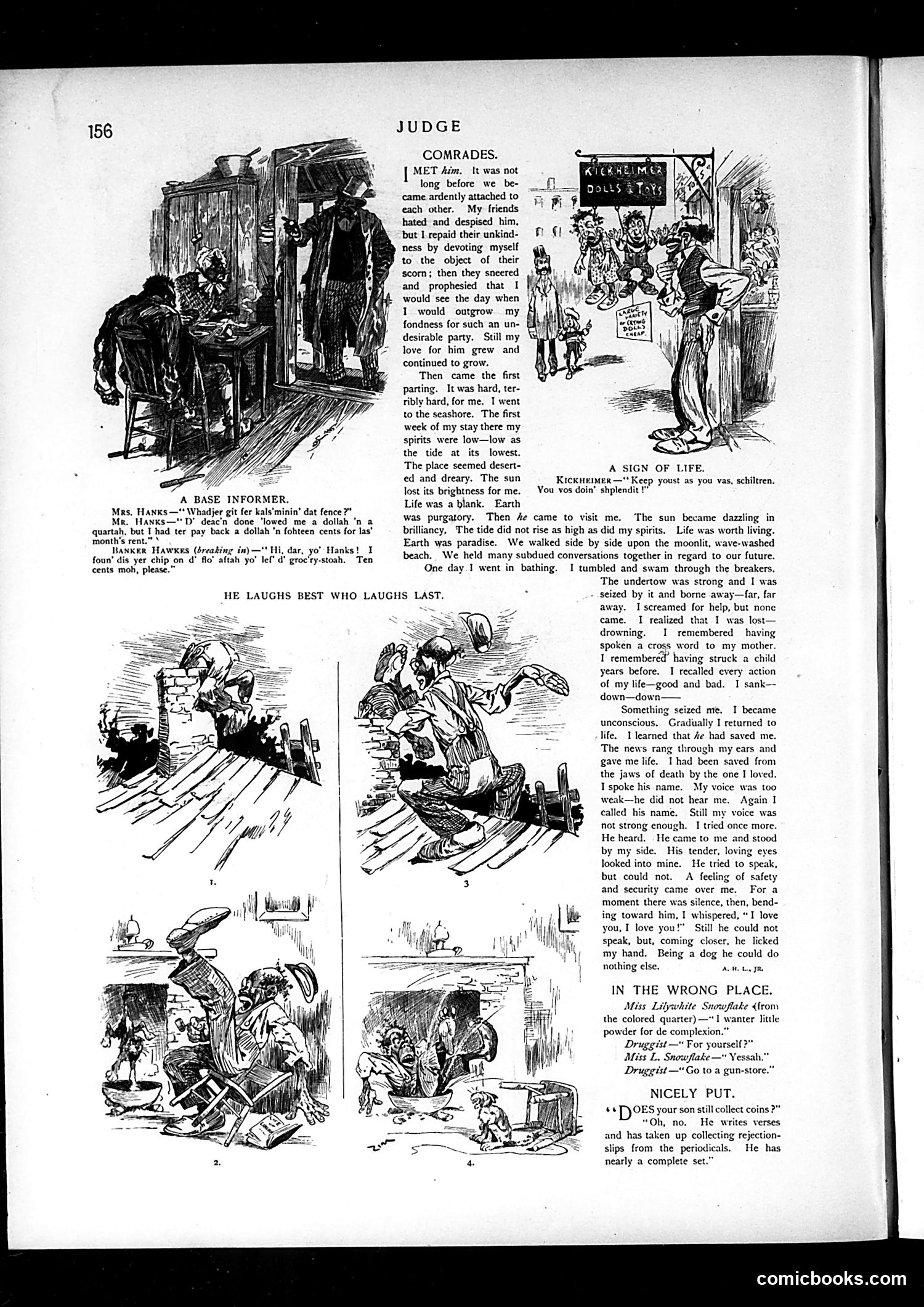
This page contains several unrelated satirical pieces typical of Judge's format: **"Comrades"** (main text): A sentimental story about romantic love for someone socially unacceptable to friends, culminating in a melodramatic near-drowning rescue—only to reveal the rescuer is a dog. The satire mocks overly earnest, flowery romantic literature popular at the time. **"A Base Informer" and "He Laughs Best"**: Brief dialect humor featuring working-class characters (likely Irish or similar immigrant stereotypes, common in period humor) discussing small money disputes and comic misadventures. These rely on heavy phonetic spelling for comedic effect. **"A Sign of Life"**: A German-accented character ("Kickhelmer") observing toy-making, likely commenting on immigrant labor or industrial conditions. **"In the Wrong Place"**: Racial satire using a Black woman character's dialect, with a druggist making a crude joke about her complexion—reflecting the era's casual racism. **"Nicely Put"**: A mild joke about a poetry-writing son collecting rejection slips rather than coins. The page reflects Judge's mix of sentimental parody, immigrant stereotypes, and period-typical racial humor.
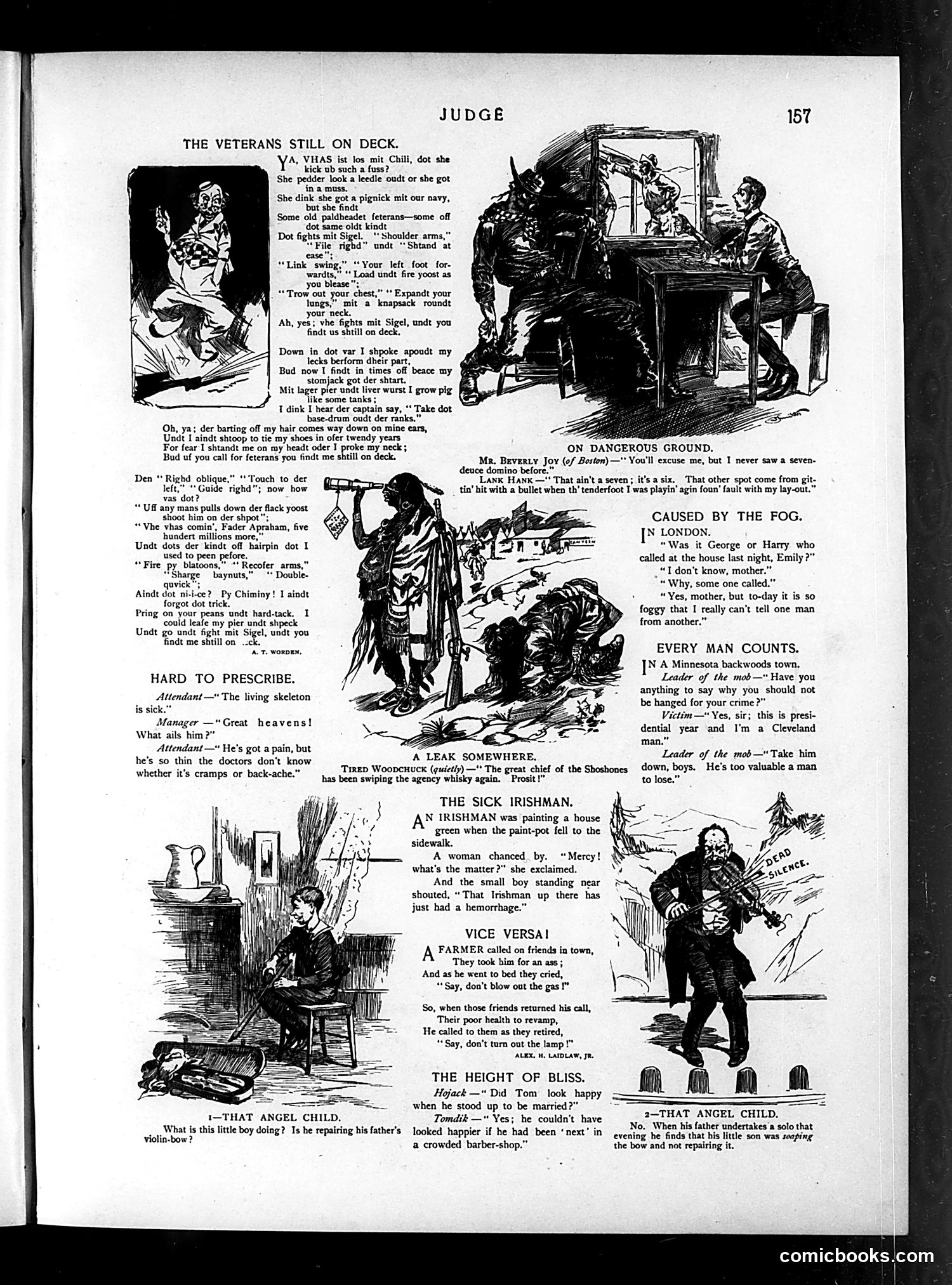
This page contains multiple satirical short comics and jokes typical of late 19th-century American humor. **"The Veterans Still on Deck"** features a German-accented immigrant character reminiscing about Civil War service under General Franz Sigel, joking that aging veterans remain ready despite physical decline. The satire mocks both veteran nostalgia and immigrant speech patterns. **"Hard to Prescribe"** jokes about a circus "living skeleton" so thin doctors cannot diagnose his ailments. **"The Sick Irishman"** presents ethnic humor: an Irish painter's accident becomes a joke about his supposed drinking problem. **Other items** include "Vice Versa" (farmer pranks), "Caused by the Fog" (London fog obscures identity), and "Every Man Counts" (a criminal is spared because it's a presidential election year and votes matter). These pieces reflect Judge's reliance on ethnic caricature, physical comedy, and topical political references for humor—conventions that seem crude by modern standards but were mainstream entertainment then.
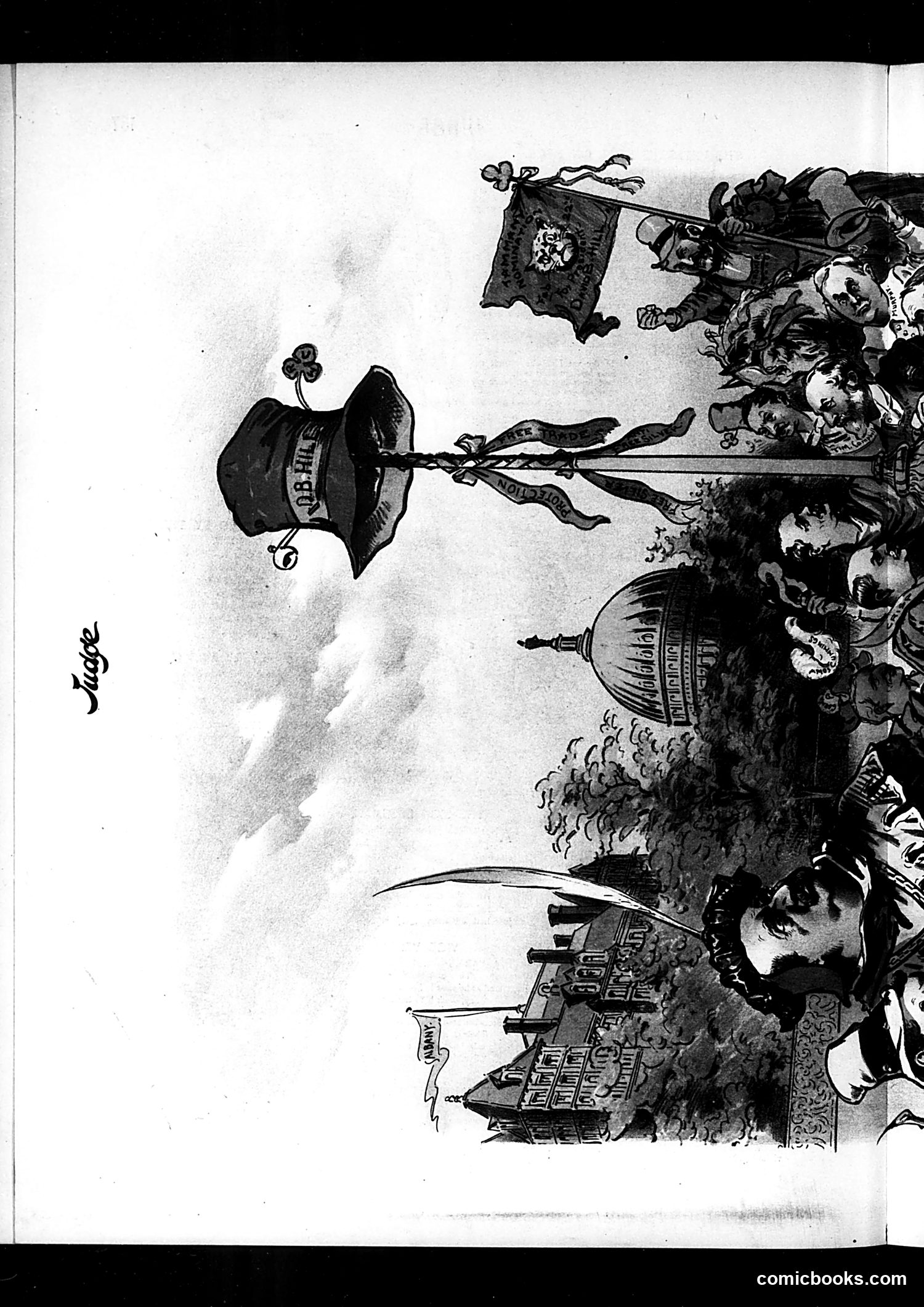
This page appears to be rotated 90 degrees, making full interpretation difficult. However, the visible elements show a political cartoon in Judge's characteristic satirical style. On the left is a figure wearing a top hat labeled "LIFE" holding what appears to be a shamrock or clover symbol. On the right are multiple figures in period dress, including what appears to be military or governmental officials, with a building structure below. The composition suggests commentary on Irish-American political or social issues, likely from the late 19th or early 20th century, given the artistic style and the prominence of Irish symbolism. The specific political context—whether addressing immigration, labor, political representation, or another contemporary issue—remains unclear without being able to read any caption text clearly or see the page oriented correctly.
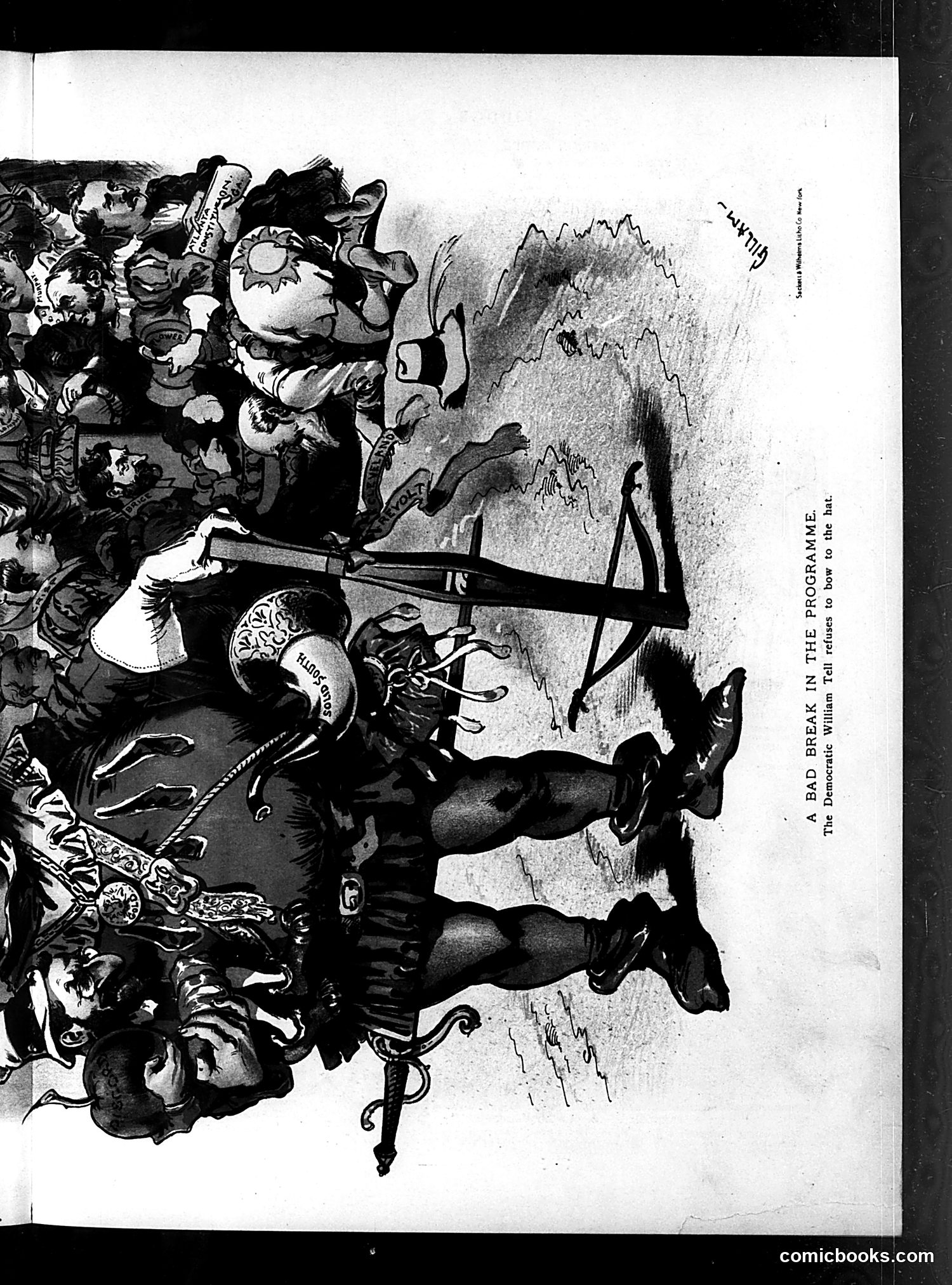
This is a satirical cartoon titled "A Bad Break in the Programme" showing a figure attempting to conduct or control a chaotic mass of grotesque characters and demons. The central figure appears to be struggling to manage pandemonium—suggesting a leader or authority figure losing control of social or political forces. The cartoon likely critiques a political figure's failed attempt to manage or direct public opinion, social movements, or governmental chaos during a particular period. The "bad break" refers to an unexpected disruption of plans. The mass of wild, demonic figures represents uncontrollable forces—possibly corruption, public disorder, or political opposition. Without clearer text or date context, the specific historical event remains unclear, but the satire targets incompetence or loss of control by those in power.
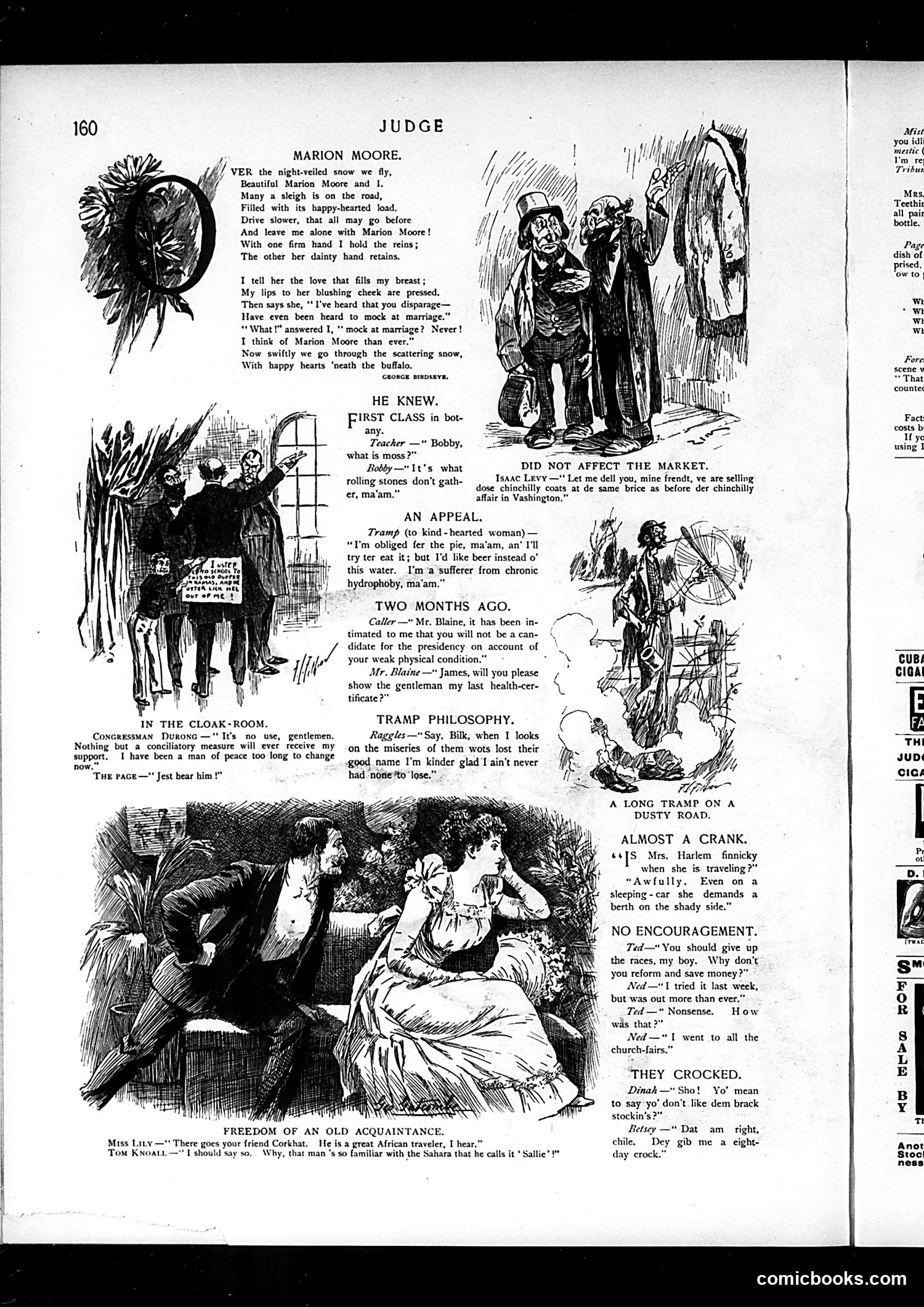
This page contains multiple short satirical pieces typical of Judge magazine's format: **"Marion Moore"** is a sentimental poem about a sleigh ride, likely satirizing overwrought romantic verse popular in the era. **"He Knew"** mocks a schoolboy's literal interpretation of "moss" — standard classroom humor. **"An Appeal"** shows a tramp claiming hydrophobia to justify requesting beer instead of water — satirizing vagrants' dubious excuses. **"Two Months Ago"** references James G. Blaine (likely the 1884 presidential candidate), joking about his claimed health problems that supposedly disqualified him from running. **"In the Cloak-Room"** depicts Congressman Duborg claiming pacifism while others suspect political calculation. **Other vignettes** satirize various social types: overly-fastidious travelers, unsuccessful reformers, and African Americans in stereotypical dialect humor (standard for the era, now offensive). The page emphasizes Judge's formula: political references mixed with everyday social satire and broad character humor.
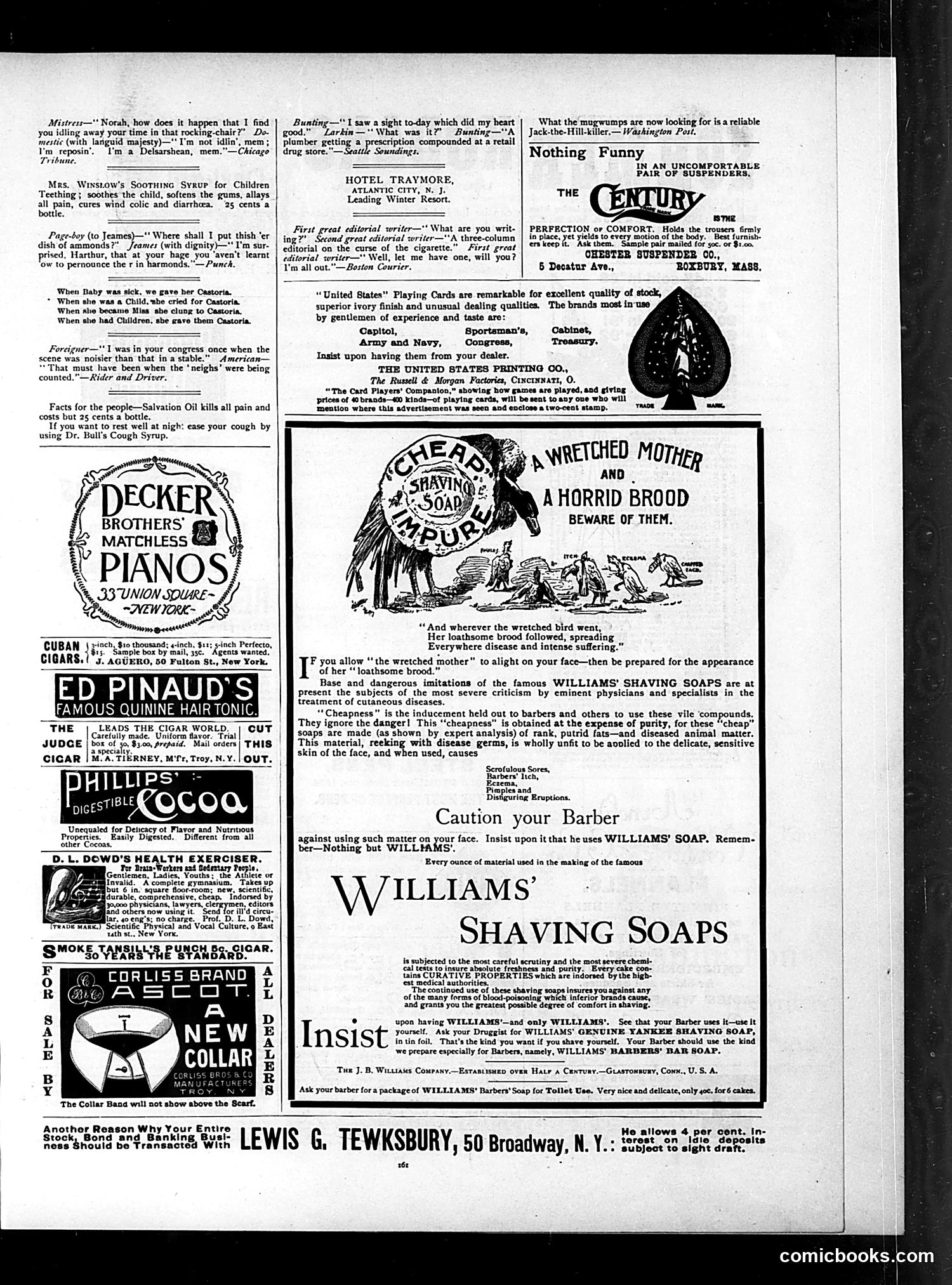
This page is primarily **advertising**, with minimal satirical content. The few humor items present are brief quips rather than substantial cartoons: **Humor pieces:** - A domestic servant claiming to "rest" rather than idle, invoking "Delsartean" (likely referencing the Delsarte movement, a late 19th-century theatrical/movement philosophy) - A servant mispronouncing "almonds" as "harmonds" - A congressman joke about "neighs" (puns on horses and congressional noise) - A mugwump reference to "Jack-the-Hill-killer" (unclear specific reference) **Dominant content:** The page consists almost entirely of period advertisements for pianos, cigars, hair tonic, cocoa, health equipment, collars, suspenders, shaving soap, and playing cards. The large Williams' Shaving Soaps advertisement features a dramatic illustration warning against inferior products. The page reflects Judge's business model: satirical humor interspersed with paid advertising. Without stronger visual satirical content or clearer historical references in the quips, this appears to be a relatively ordinary issue focused on revenue generation through advertising.
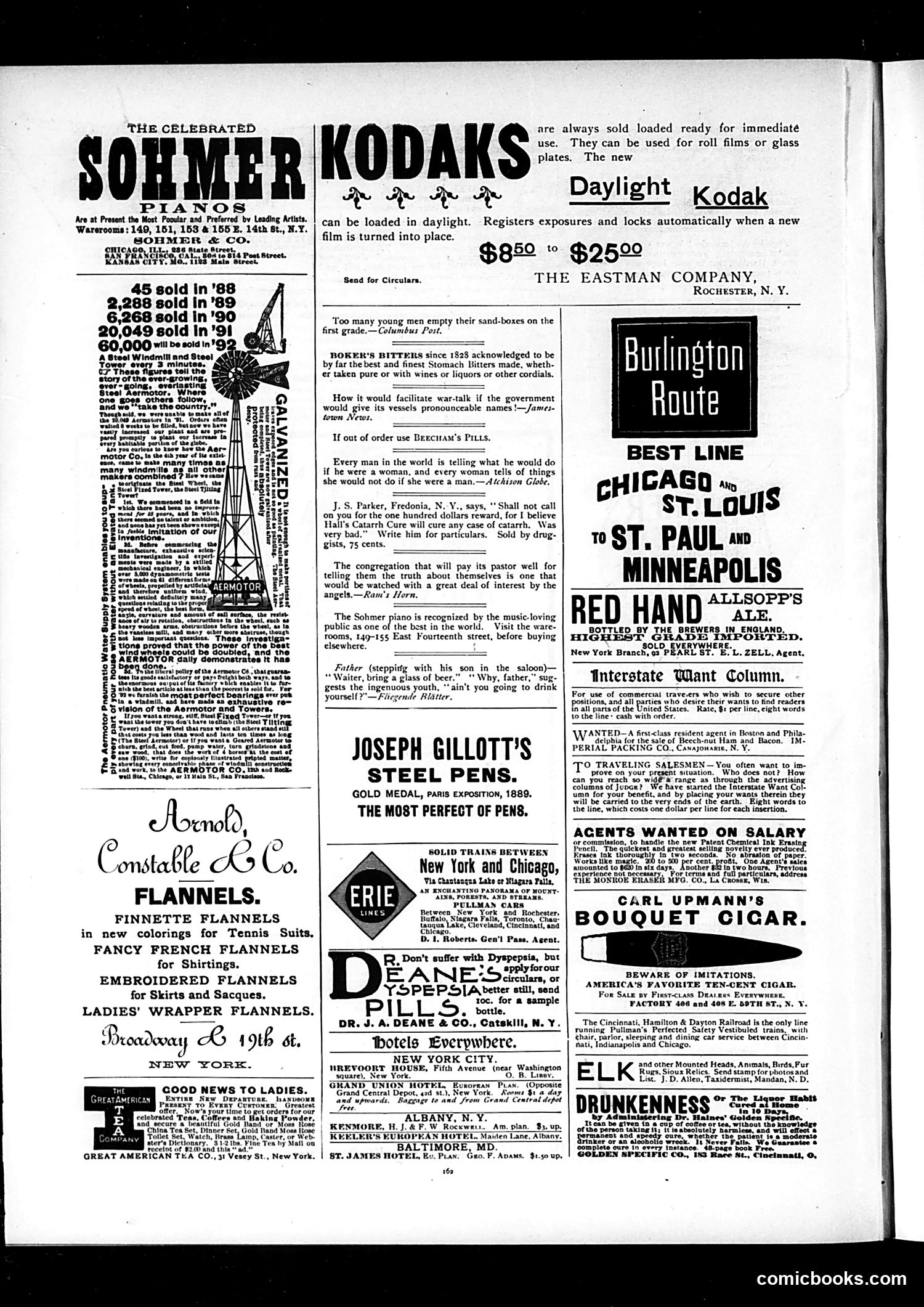
This is primarily an **advertising page** from Judge magazine, not a satirical cartoon section. The page contains numerous commercial advertisements for consumer products and services popular in the 1890s. Notable ads include: - **Sohmer Pianos**: Emphasizes sales figures (45 sold in 1888, climbing to projected 60,000 by 1892) - **Kodak cameras**: The "Daylight Kodak" innovation allowing loading in daylight - **Aermotor windmills**: Agricultural technology - **Joseph Gillott's Steel Pens**: Writing instruments - **Various patent medicines**: Beecham's Pills, Hall's Catarrh Cure, Dr. Greene's Nervura Interspersed are brief humorous **one-liners** (typical Judge filler content)—jokes about young men, gender relations, and religion—but these are disconnected quips rather than coordinated satirical cartoons. The page reflects late-19th-century consumer culture and advertising practices, with minimal political commentary.
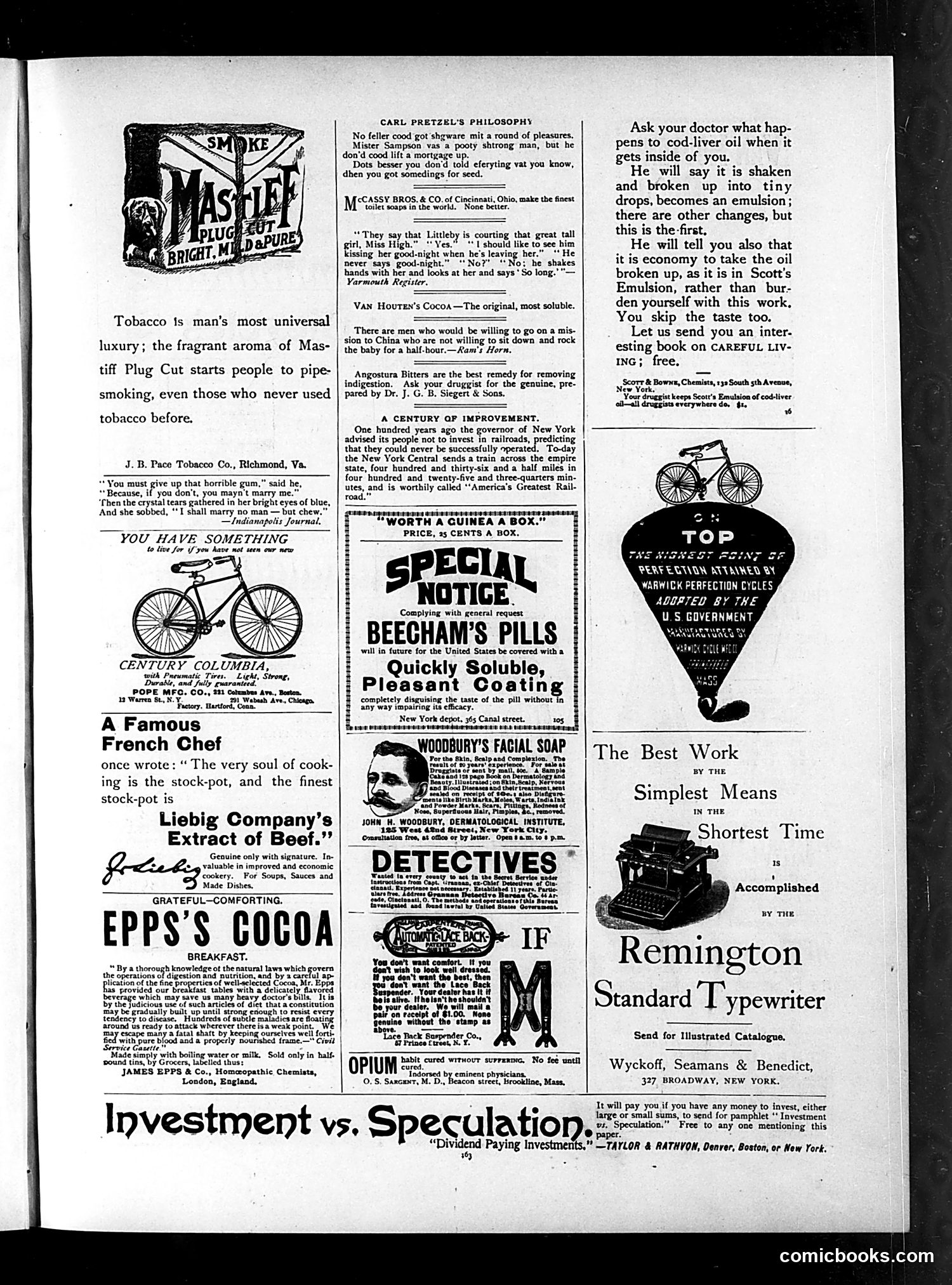
This page is primarily **advertisements and humorous filler content** from Judge magazine, with minimal political satire. **What's here:** - Tobacco, bicycle, cocoa, and patent medicine ads (typical late 19th/early 20th-century marketing) - "Carl Pretzel's Philosophy": ethnic dialect humor featuring a German-accented character offering folksy wisdom—a common comedic trope of the era - Brief joke items: absurdist humor about a woman choosing chewing tobacco over marriage, a man unwilling to babysit, and railroad progress - Product endorsements using pseudo-scientific claims (Epps's Cocoa curing "maladies," Beecham's Pills) **The satire, if any:** The "Investment vs. Speculation" headline at bottom suggests financial commentary, but no actual content appears. **For moderns:** Most humor relies on now-outdated ethnic stereotyping and patent medicine absurdity. The page illustrates how advertising and entertainment were indistinguishable in this era, and how products made wildly unsubstantiated health claims without regulation.
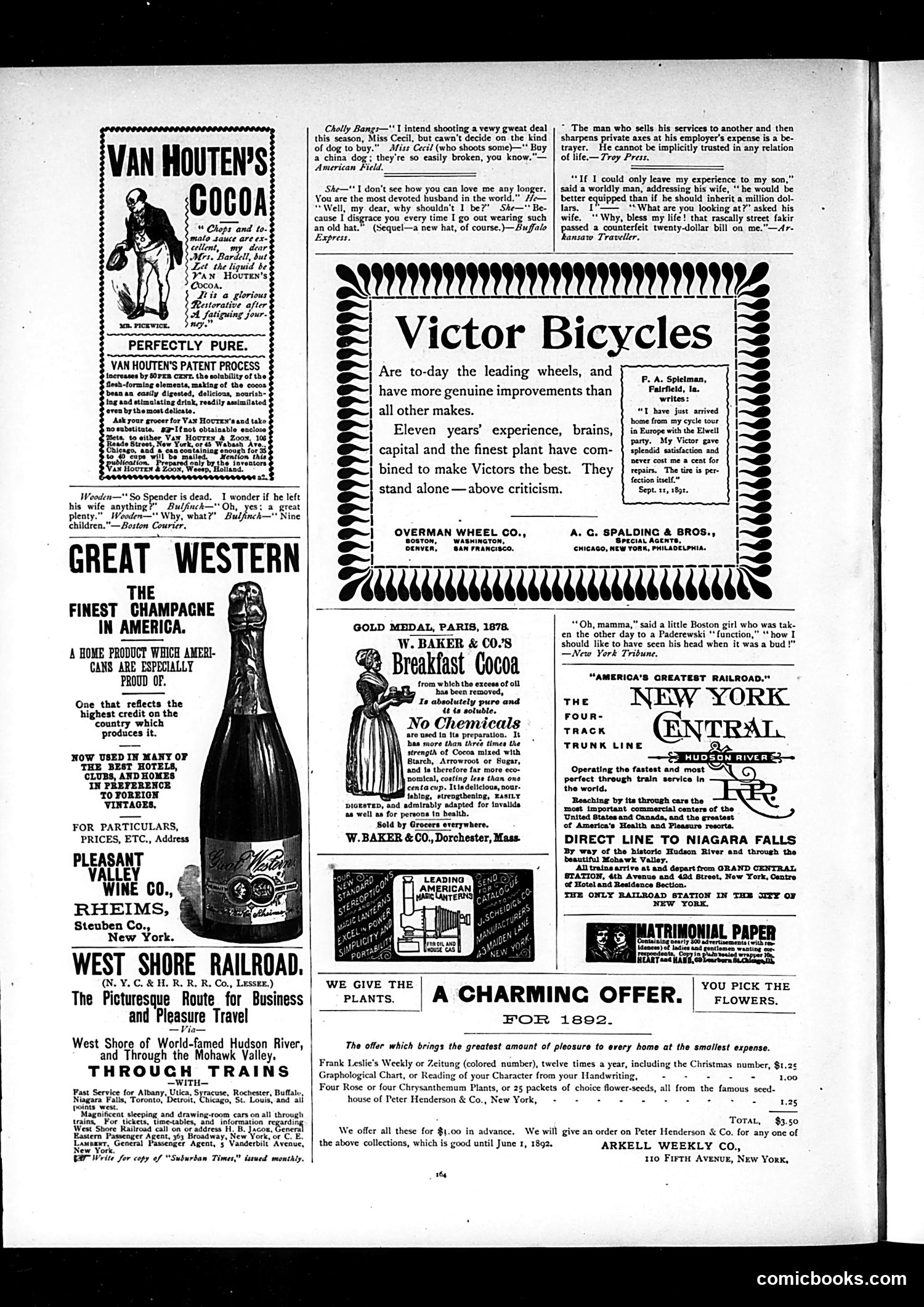
This page is primarily **advertising**, with some brief comic anecdotes scattered throughout. The cartoons/jokes are short, contemporary witticisms typical of Judge magazine: - **"Cholly Bangs"** exchanges with Miss Cecil about shooting dogs—a light satire on upper-class affectation (Cholly's exaggerated speech pattern mocks wealthy "society" types). - **Domestic humor** about marriage, infidelity, and hats plays on gender roles and marital dynamics of the era. - **A Boston girl's Paderewski joke** mocks pretentious cultural attendance—she wishes to see the famous pianist's head "when it was a bud" (as a child), a nonsensical but innocent comment treated as cute. The bulk of the page features ads for **Van Houten's Cocoa**, **Victor Bicycles**, **Baker's Breakfast Cocoa**, **Great Western Champagne**, and railroad services. These ads reflect 1890s consumer goods and industrial progress. There is no significant political satire visible—this appears to be a typical late-19th-century magazine mixing lightweight social humor with extensive commercial advertising.
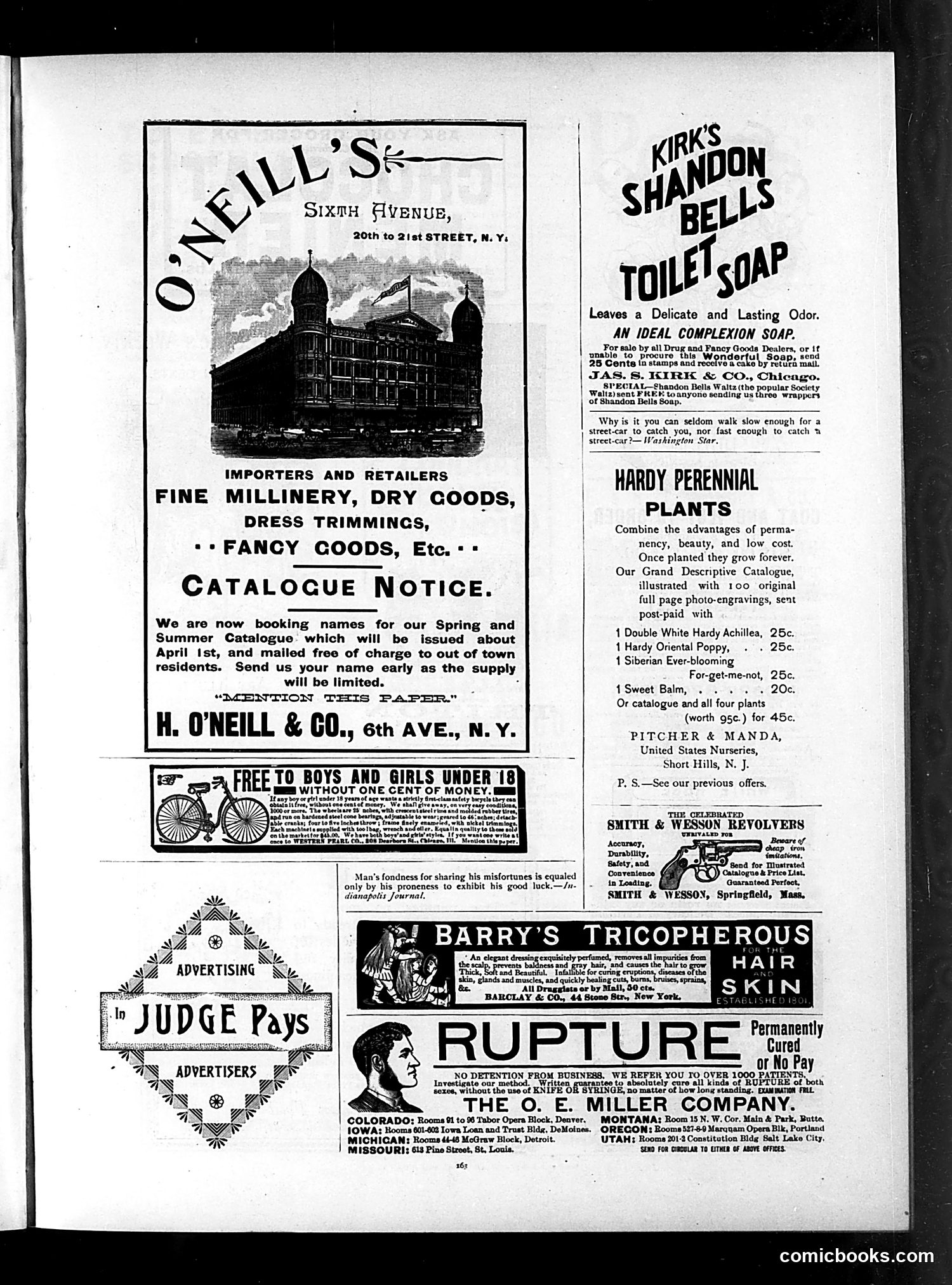
This page is primarily **advertisements** with minimal editorial content. The main items are: **Notable Ads:** - O'Neill & Co. department store catalog announcement - Kirk's Shandon Bells toilet soap (includes a joke about walking speed and street cars) - Hardy Perennial Plants nursery catalog - Smith & Wesson revolvers - Barry's Tricopherous hair/skin product - The O.E. Miller Company's rupture (hernia) treatment cure **Small Editorial Content:** - A single quote about human nature: "Man's fondness for sharing his misfortunes is equaled only by his proneness to exhibit his good luck" - A joke about street cars (public transportation) **Historical Context for Modern Readers:** This reflects late 19th/early 20th-century American consumer culture—mail-order catalogs were major distribution channels, and patent medicines/medical devices (like rupture cures) were commonly advertised in magazines without FDA regulation. The street car joke references the then-ubiquitous urban transit system. The page contains no political satire or cartoons despite Judge's satirical reputation.
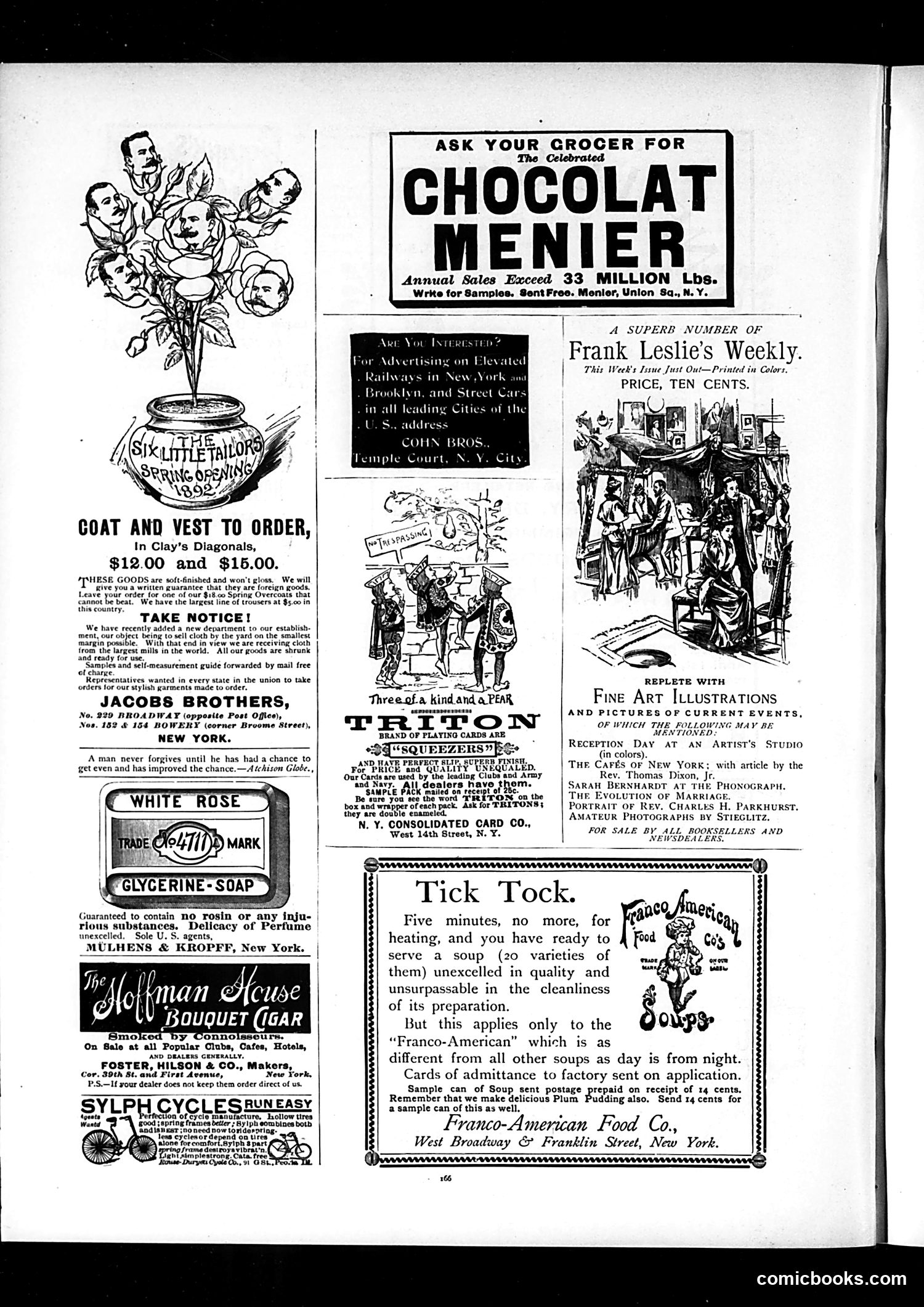
This is primarily an **advertising page** from Judge magazine, circa late 19th century. The page contains numerous commercial advertisements for products including clothing (Jacobs Brothers), soap (White Rose), cigars (Hoffman House), bicycles (Sylph Cycles), chocolate (Menier), and prepared foods (Franco-American soups). The only satirical element is a small cartoon labeled "Three of a Kind and a PEAR" showing playing cards, which appears to be a visual pun on poker terminology—though the specific joke is unclear from this reproduction. The page primarily serves as revenue-generating advertising space rather than editorial content. Notable is the "Tick Tock" advertisement for Franco-American soup, emphasizing convenience and cleanliness—appeals typical of late Victorian consumer culture. The detailed product claims and free samples reflect advertising strategies of the era.
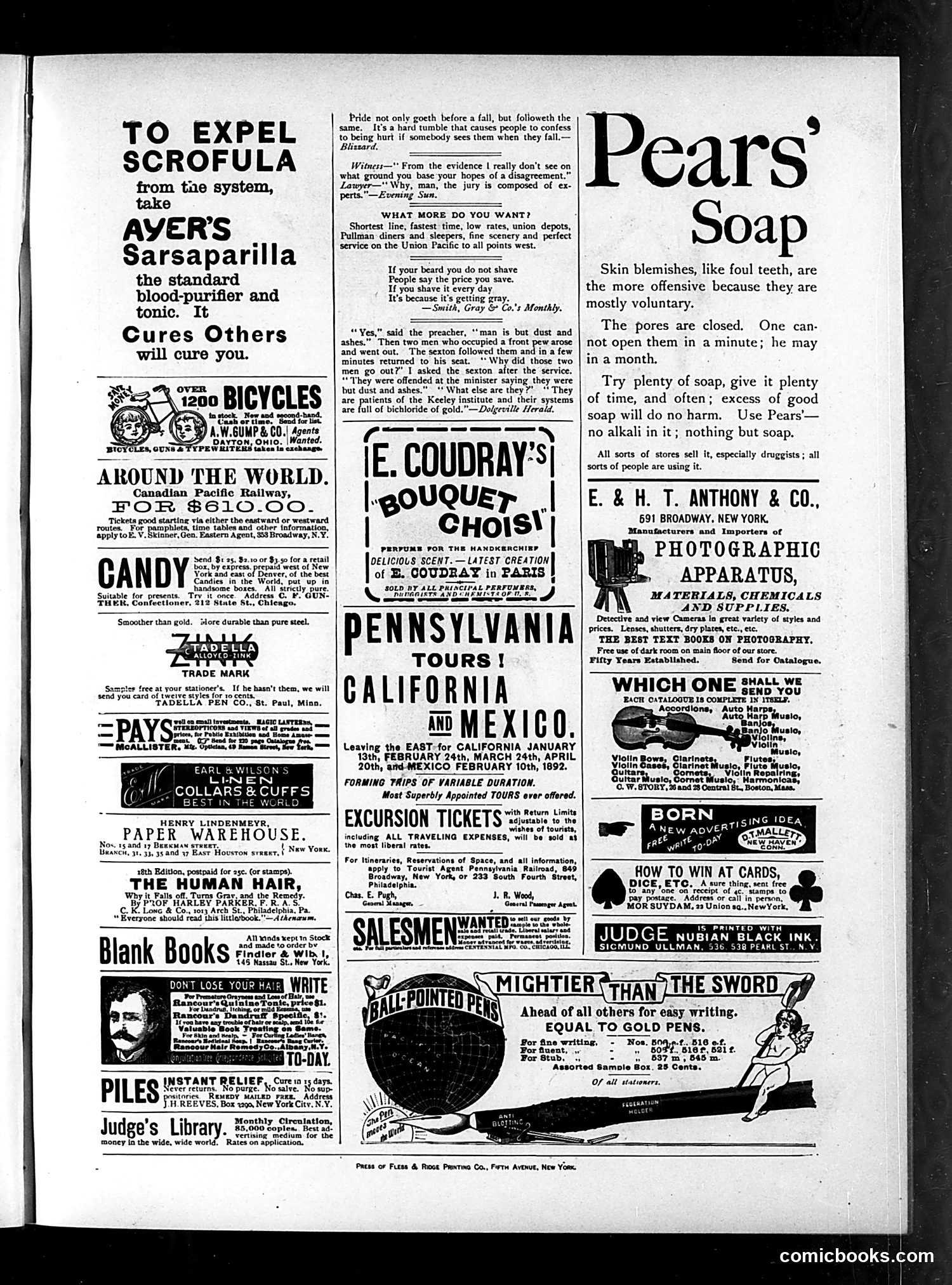
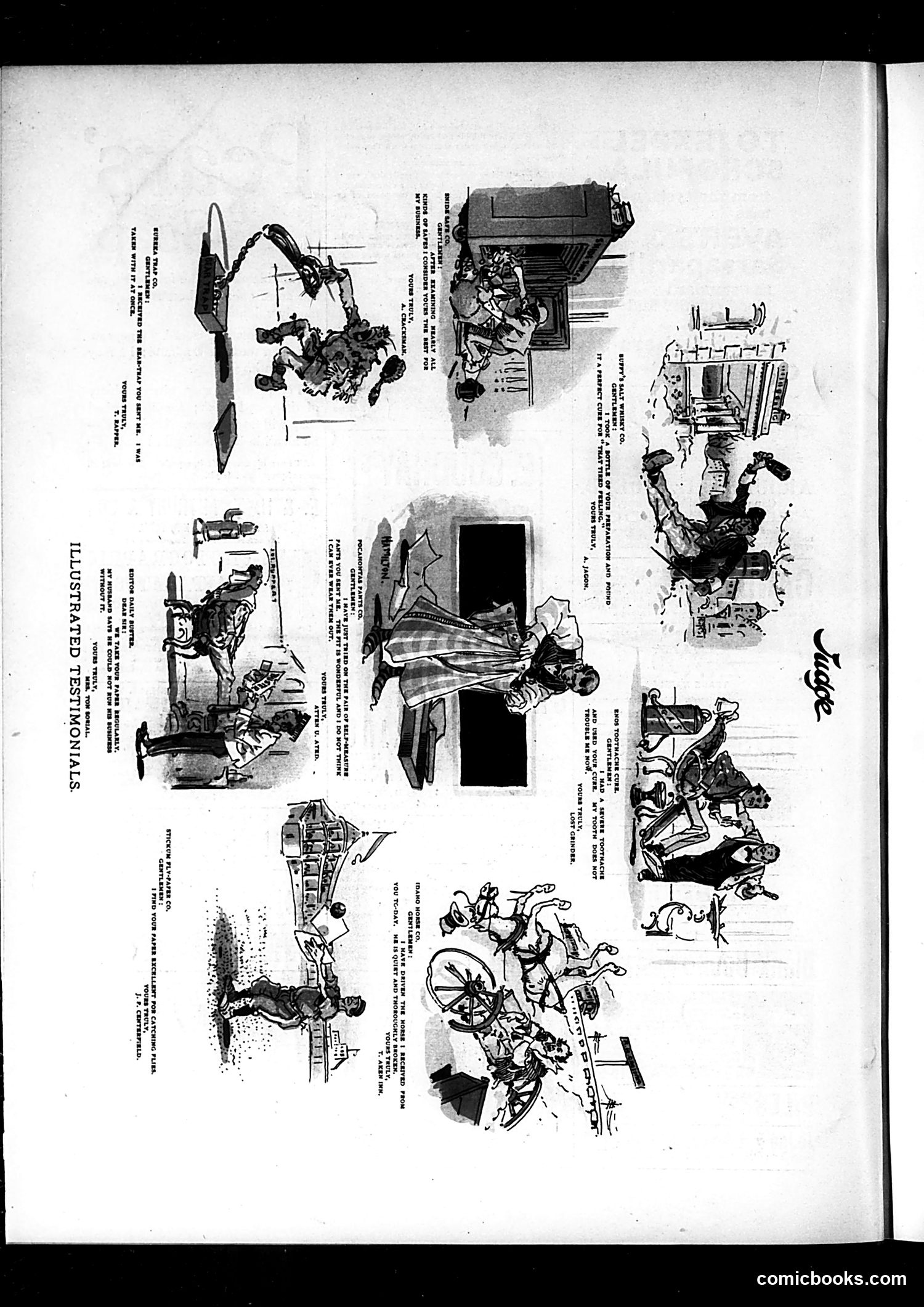
This is primarily an **advertising page** from Judge magazine (a satirical weekly), featuring mostly commercial ads with small humorous text snippets interspersed. The cartoon content is minimal. The main visual element is a large **ball-pointed pen advertisement** showing a pen compared favorably to a sword, claiming superiority for writing. The scattered jokes and quotes address **social concerns of the 1890s**: - A preacher's sermon about humans being "dust and ashes" offends parishioners who are patients at the **Keeley Institute** (an addiction treatment facility), suggesting they're full of "bichloride of gold" (the Keeley cure's purported ingredient) - Jokes about shaving, beards turning gray, and jury expertise - A quip about pride in falling The advertisements themselves reflect period anxieties: **Ayer's Sarsaparilla** for "scrofula" (a tuberculosis-related disease), hair loss remedies, and pile/hemorrhoid cures—suggesting common health preoccupations of the era. Rather than satirical cartooning, this page relies on **advertising revenue and brief humorous commentary** typical of late-19th-century magazine humor.