
A complete issue · 16 pages · 1892
Judge — January 30, 1892
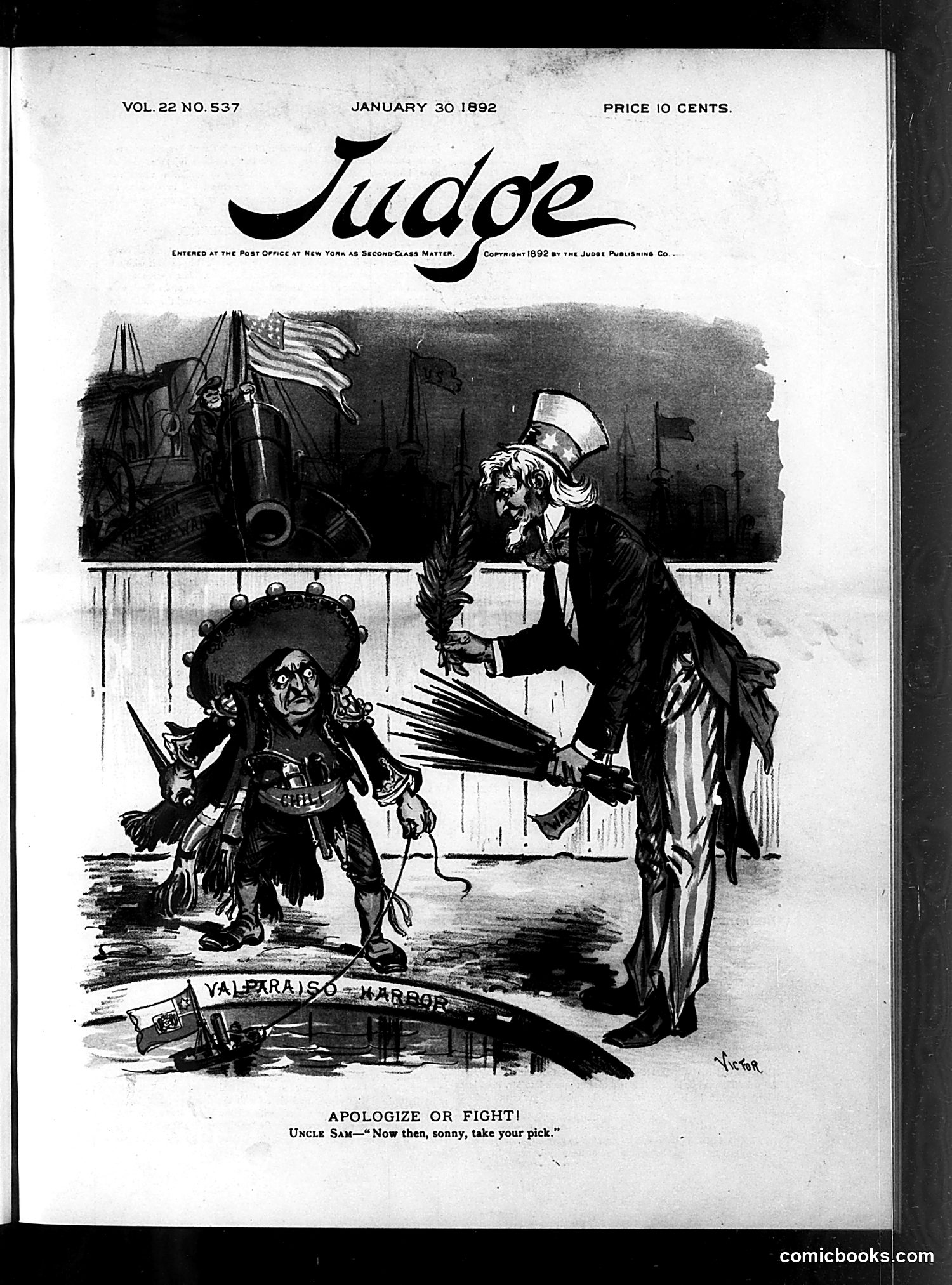
This political cartoon depicts Uncle Sam (tall figure, right) confronting a smaller, menacing character labeled "Valparaiso Marauder" over the Valparaiso Harbor incident. The caption reads: "Apologize or Fight! Uncle Sam—'Now then, sonny, take your pick.'" The cartoon references the 1891 Baltimore Incident and likely a related confrontation involving Chile. American ships and military presence appear in the harbor background. The "marauder" figure represents Chilean aggression or a Chilean leader, while Uncle Sam demands either an apology or military engagement. This satirizes American foreign policy assertiveness in Latin America during the 1890s, presenting U.S. intervention as righteous enforcement of international respect, though modern viewers would recognize this as reflecting imperialist attitudes of the era.
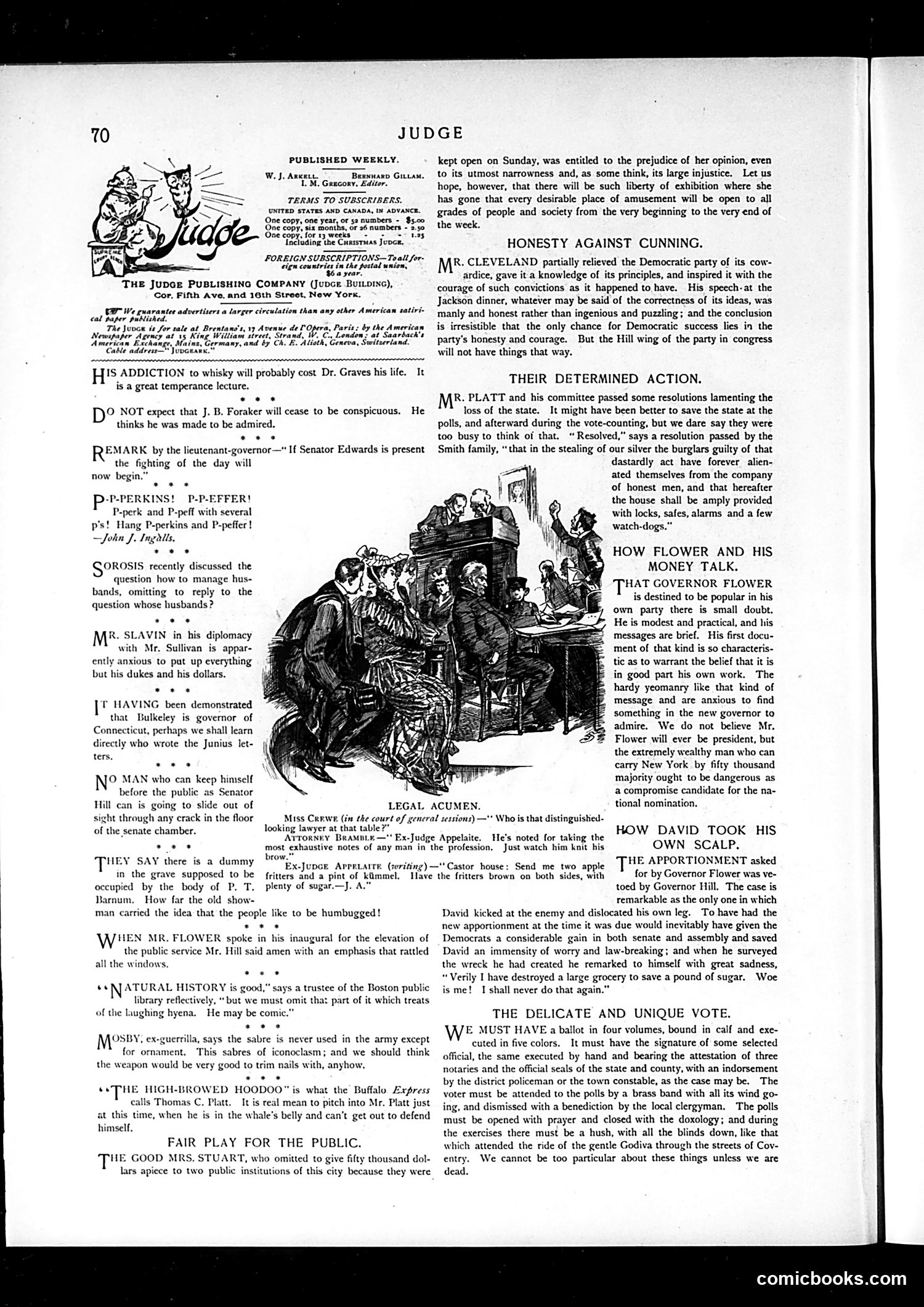
This page contains political commentary and brief satirical items rather than full cartoons. Key sections include: **"Honesty Against Cunning"**: Praises President Cleveland for relieving the Democratic party of "cowardice" at a Jackson dinner, contrasting his honest approach with the party's congressional wing's dishonesty. **"Their Determined Action"**: References Mr. Platt and committee resolutions about state election losses, sarcastically suggesting they'll recover through burglary—implying Democratic corruption. **"How Flower and His Money Talk"**: Questions whether Governor Flower, described as "modest and practical," is too wealthy (fifty thousand majority) to be a suitable compromise presidential candidate. **"How David Took His Own Scalp"**: Appears to criticize Governor Flower for losing a Democratic apportionment advantage through his own actions. The page reflects 1890s Democratic Party internal divisions and succession debates.
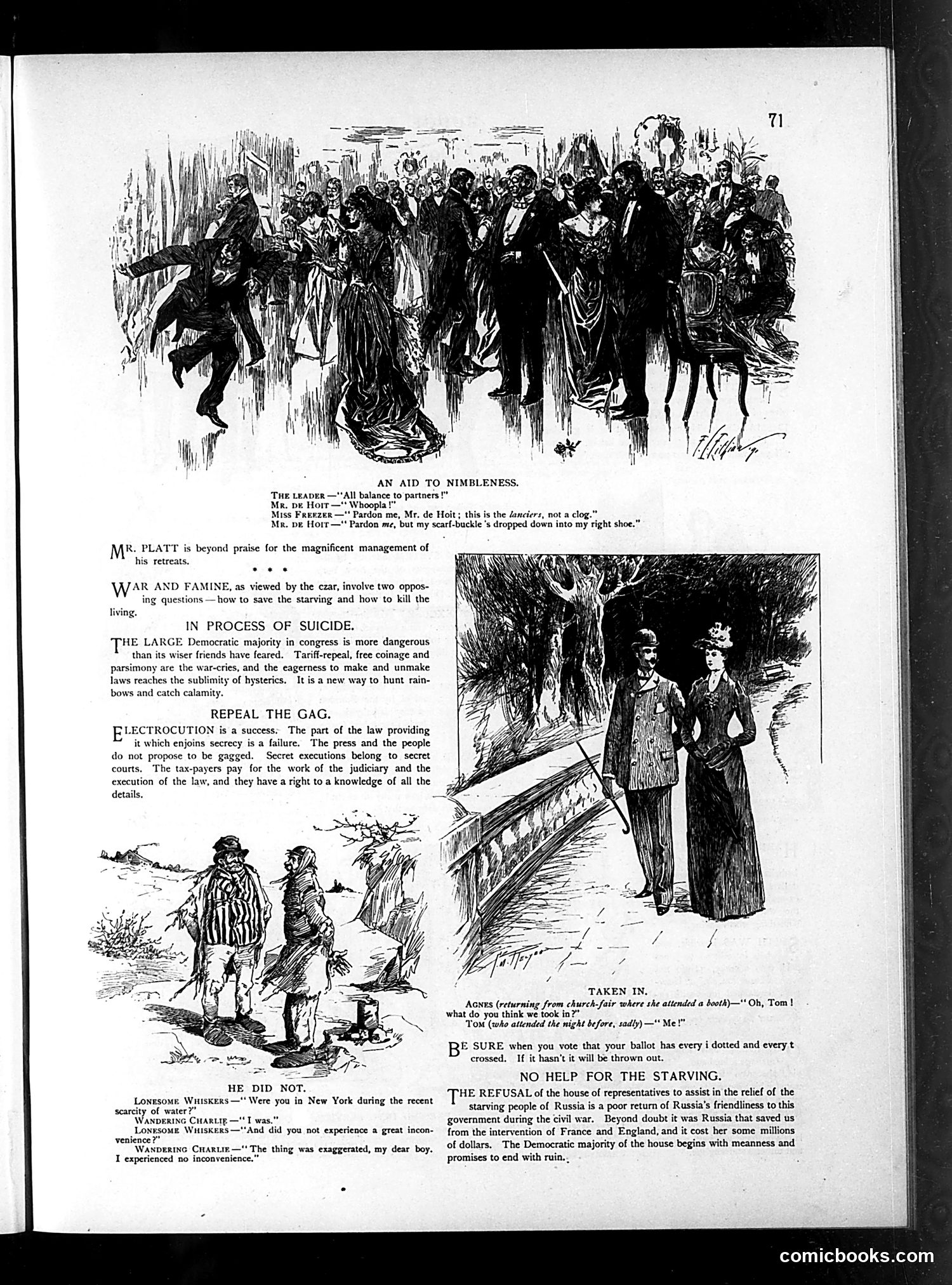
This page contains multiple political cartoons critiquing early 20th-century American governance and social issues. **"An Aid to Nimbleness"** (top) depicts a formal gathering where a leader asks partners to "balance," while references to "scarf-buckle" suggest mockery of politicians' evasiveness or inability to take clear positions. **"In Process of Suicide"** and **"Repeal the Gag"** sections criticize laws restricting free speech and press freedom, arguing such restrictions are self-destructive for democracy. **"Taken In"** (middle right) shows a couple being deceived, likely satirizing public gullibility regarding political promises. **"No Help for the Starving"** criticizes Congress's refusal to aid Russian famine victims, arguing partisan politics prevented humanitarian relief during the civil war period. The cartoons collectively attack political corruption, hypocrisy, and governmental indifference to human suffering.
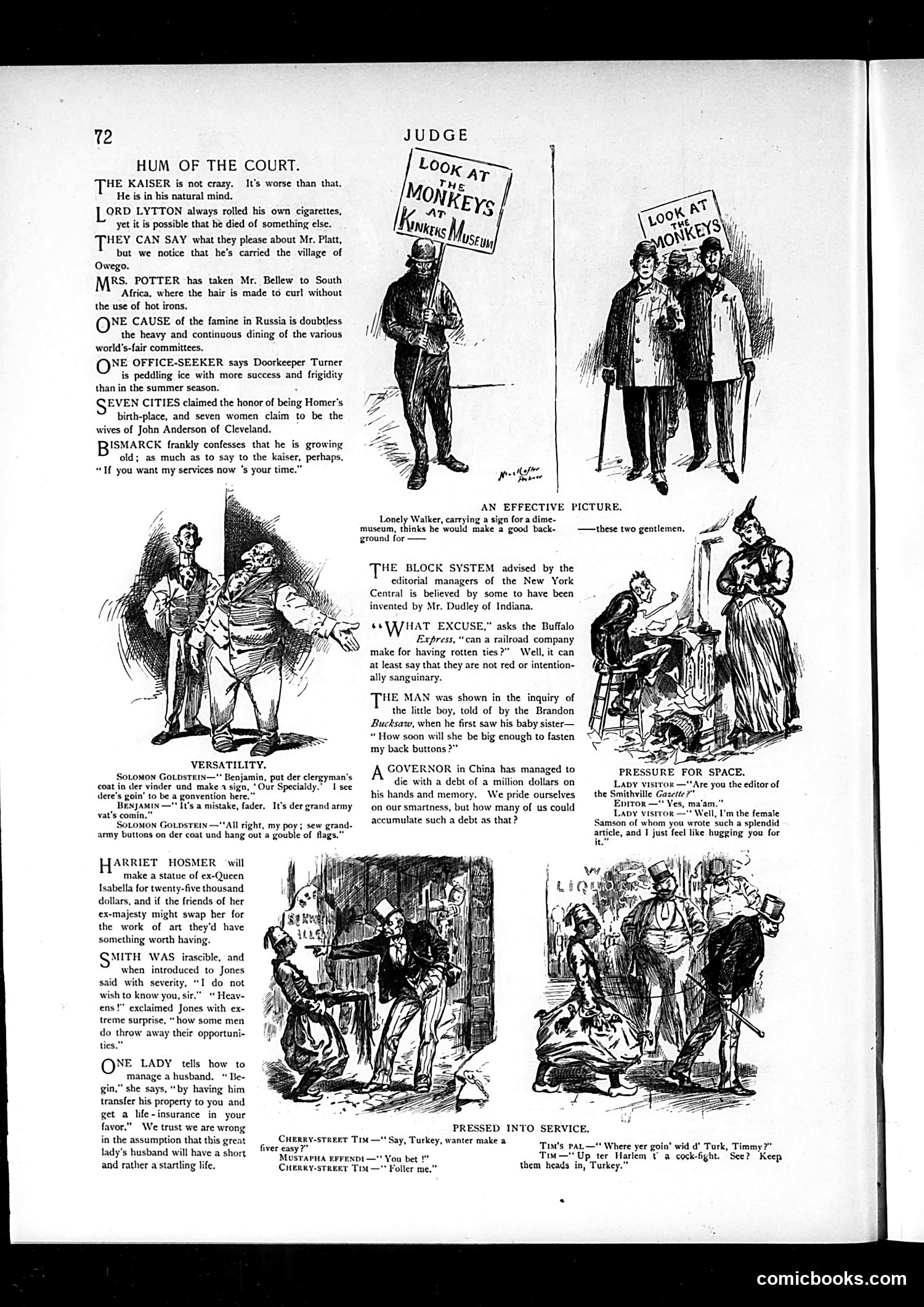
This page from Judge magazine (appears to be early 1890s based on references) is primarily a collection of brief satirical quips and jokes rather than elaborate political cartoons. **Key content includes:** - **"Hum of the Court"** section: Short jabs at public figures—the German Kaiser's sanity, Lord Lytton, and political operative Platt - **Social commentary**: Mockery of Russian famine relief committees' lavish dining, world's fair bureaucrats, and office-seekers - **Illustrated jokes**: Including one about a Jewish peddler (Solomon Gotstein) converting a clergyman's coat into multiple patriotic costumes for profit, satirizing immigrant entrepreneurship and costume versatility - **Gender satire**: A woman's "marriage advice" about transferring property suggests women marry for financial gain - **Streetside humor**: Vignettes of working-class characters (Lonely Walker, Cherry-street Tim) in minor comedic situations The satire targets political figures, immigrant stereotypes (represented through dialect), women's materialism, and railroad industry practices. Most jokes are mild by modern standards—topical humor aimed at readers familiar with contemporary public figures and social debates.
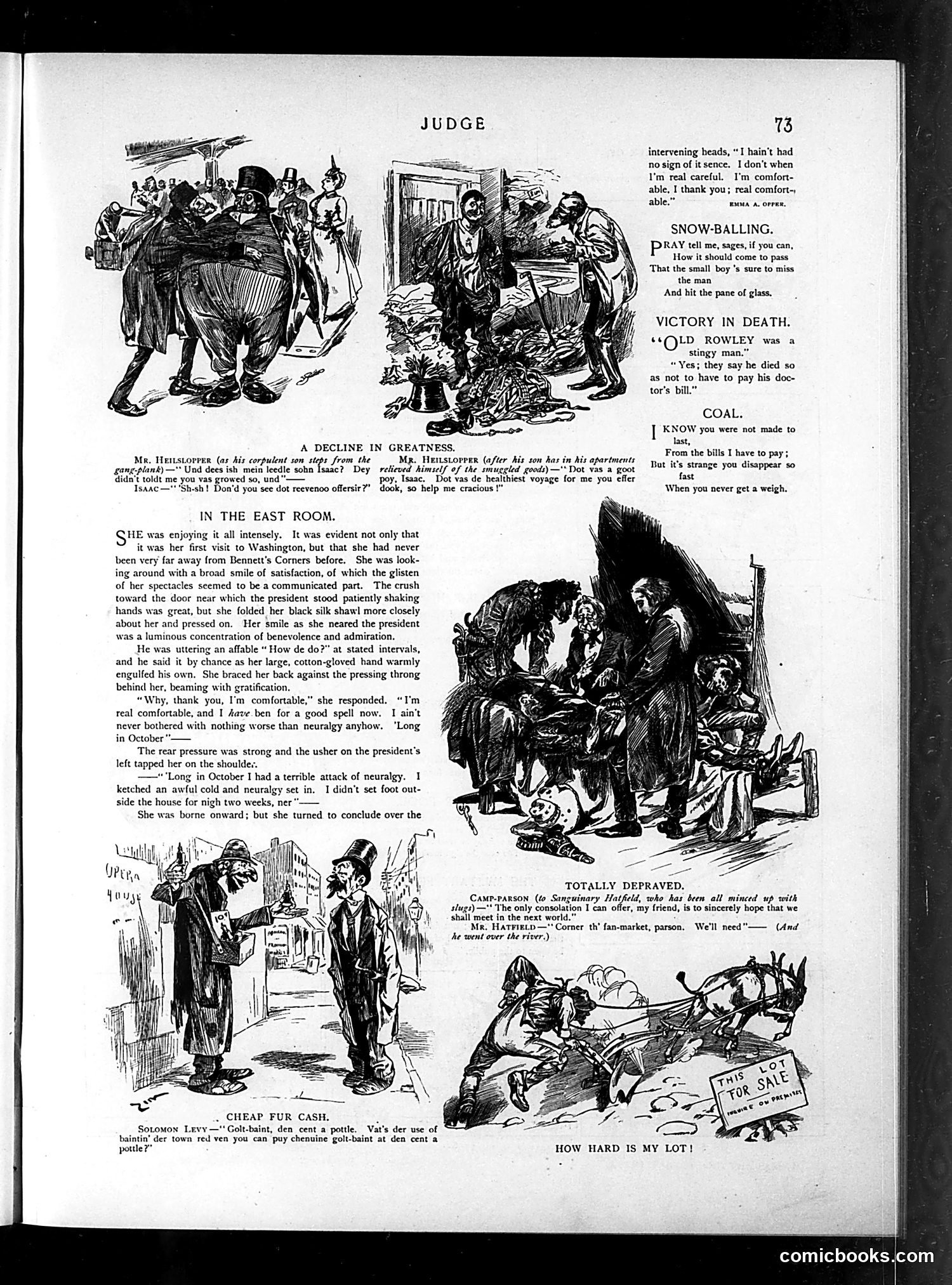
This page contains multiple satirical cartoons and brief humor pieces typical of Judge magazine's social commentary: **"In the East Room"** depicts a provincial woman visiting the White House, meeting the President. The satire mocks her unsophisticated enthusiasm and rural mannerisms (references to "Bennett's Corners," neuralgia complaints, cotton gloves). She monopolizes the President's time with mundane health details, highlighting the contrast between small-town simplicity and Washington formality. **"A Decline in Greatness"** shows German immigrants (indicated by heavy accents), satirizing both their wealth accumulation and their children's assimilation into American excess. **Other brief pieces** joke about: - Snowball-throwing boys missing their targets - A stingy man dying to avoid paying doctors - Coal prices and economic hardship - A Jewish peddler's business practices The cartoons collectively satirize immigrant communities, rural visitors, economic inequality, and petty human nature—common Judge themes reflecting late 19th/early 20th-century American attitudes toward outsiders and social change.
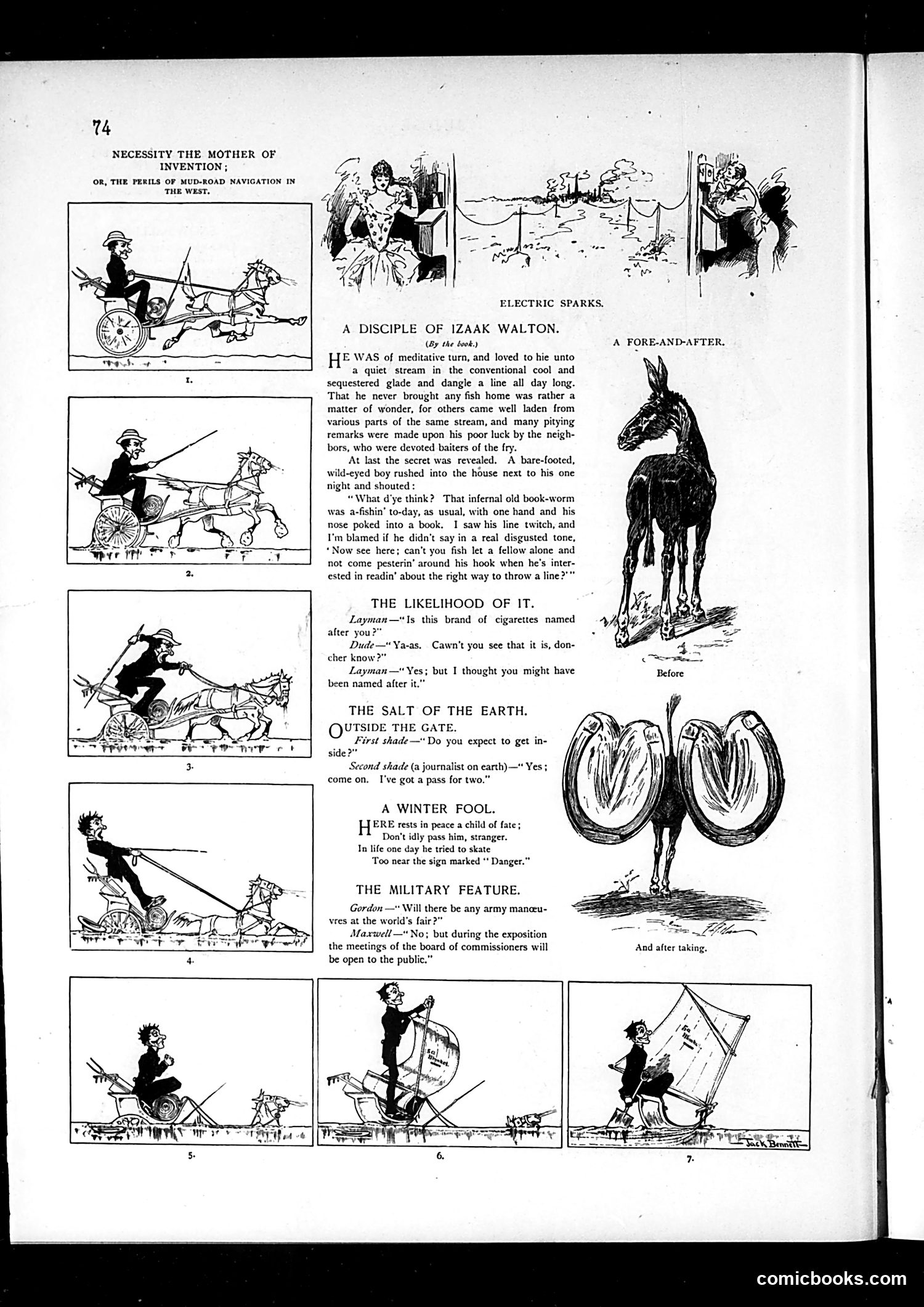
This page contains multiple unrelated satirical items typical of late-19th-century American humor magazines. **"A Disciple of Izaak Walton"** mocks an absent-minded fishing enthusiast so absorbed in reading *about* fishing technique that he ignores actual fish biting his line—satirizing impractical intellectualism. **"The Likelihood of It"** jokes about a man so unremarkable he might be named *after* a cigarette brand rather than vice versa—social commentary on celebrity endorsements. **"The Salt of the Earth"** contains a dark joke: a deceased journalist boasts of having "a pass for two" to heaven, implying journalists lack moral character. **"A Winter Fool"** is a cautionary epitaph about ignoring danger warnings. **"The Military Feature"** suggests that contentious board meetings at the World's Fair constitute the exposition's main "military" spectacle—satirizing bureaucratic infighting. The left panels show sequential comic strips depicting muddy road transportation mishaps, illustrating the title's reference to "necessity" driving invention in rural navigation challenges.
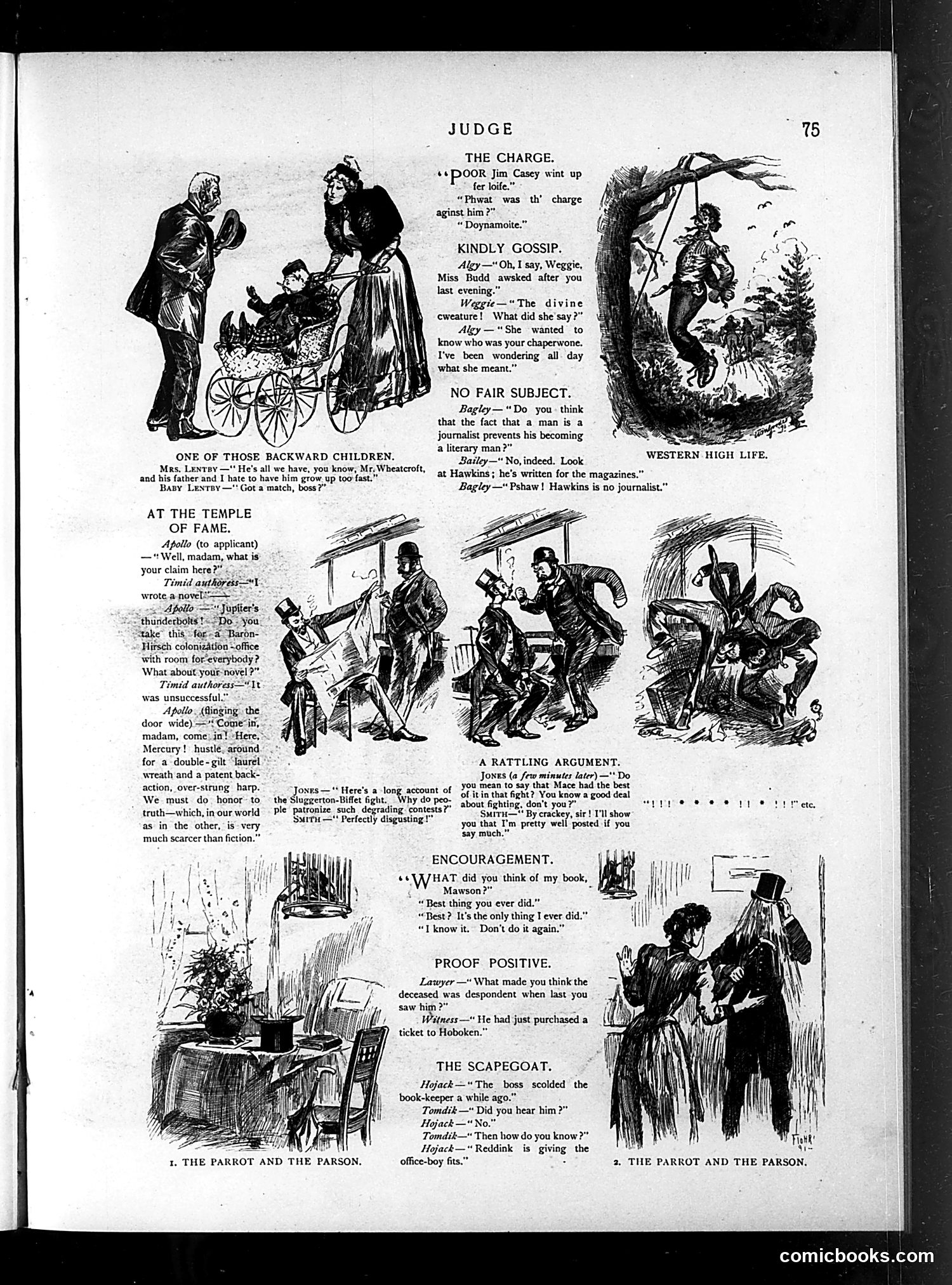
This page contains multiple satirical vignettes typical of 1890s American humor, targeting contemporary social pretensions and professions: **"The Charge"** mocks Irish immigrant speech ("wint up fer loife") and dynamite associations—likely referencing anarchist violence concerns of the era. **"No Fair Subject"** critiques journalists' literary ambitions, suggesting journalism and serious literature are incompatible professions—a class-based snobbery about what constitutes "real" writing. **"Temple of Fame"** satirizes unsuccessful authors receiving laurels while successful ones are denied entry, inverting merit-based recognition to mock publishing gatekeepers. **"Rattling Argument"** depicts two men debating prize-fighting's morality while contradicting themselves about its merits—poking fun at hypocritical moral posturing. **Other sections** lampoon parental indulgence, romantic gossip conventions, and workplace dynamics. The repeated "Parrot and Parson" sketches suggest running characters trading witticisms. The overall tone mocks Victorian social pretension, professional pretentiousness, and logical inconsistency in middle-class discourse.
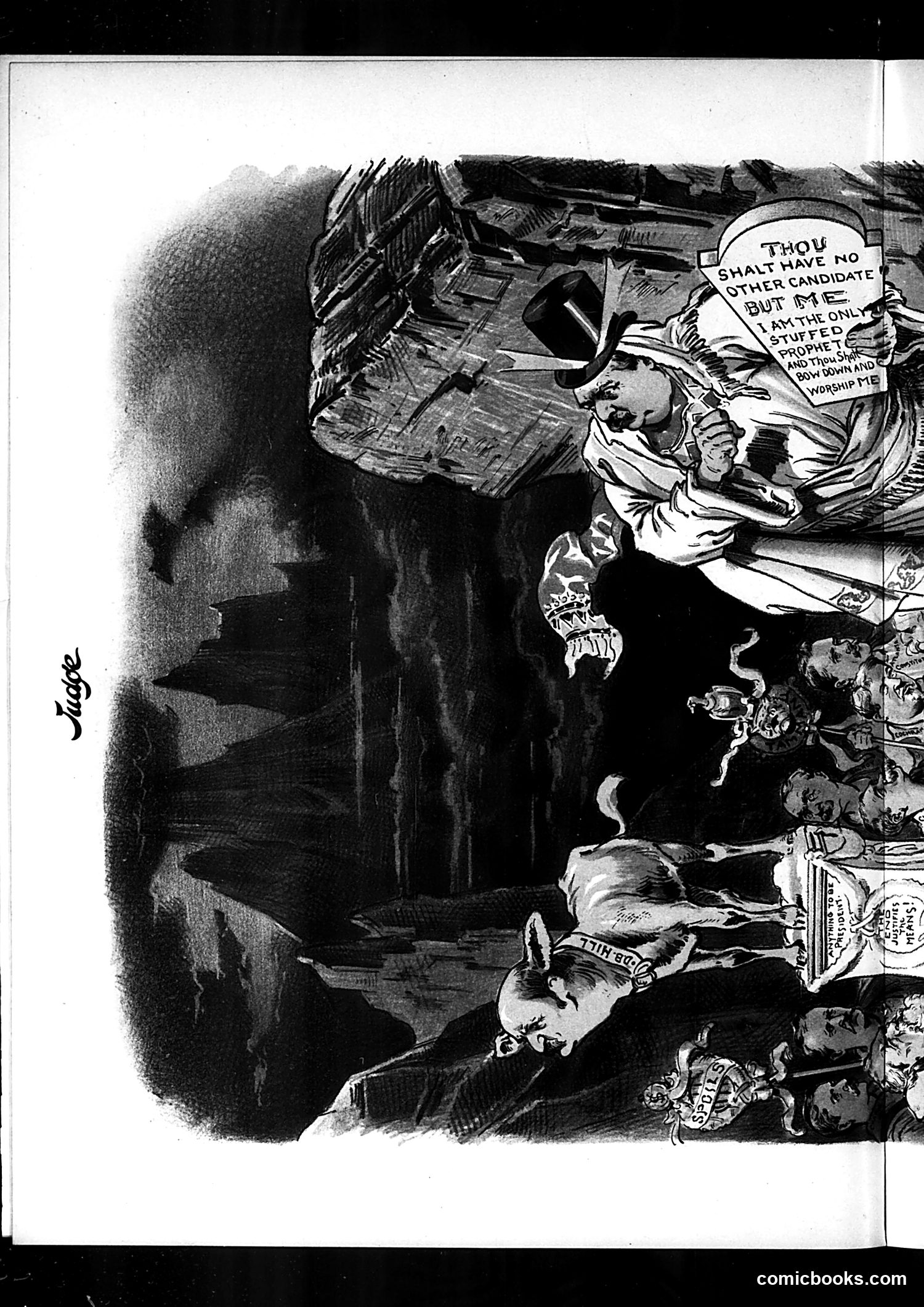
This appears to be a satirical cartoon from Judge magazine depicting a political candidate or officeholder. The figure in the upper right, wearing a hat and gesturing expressively, declares: "Thou shalt have no other candidate but I am the only stuff and prophet is and thou shalt worship it." The speech parodies the First Commandment, satirizing the subject's perceived arrogance and monopolistic political ambitions. The surrounding crowd of smaller figures at the bottom likely represents the electorate or political rivals being marginalized or dismissed. The heavy use of shadow and dramatic shading emphasizes the authoritarian nature being mocked. The cartoon critiques what the artist saw as autocratic political behavior or excessive self-promotion, though the specific candidate and historical context remain unclear without additional publication information.
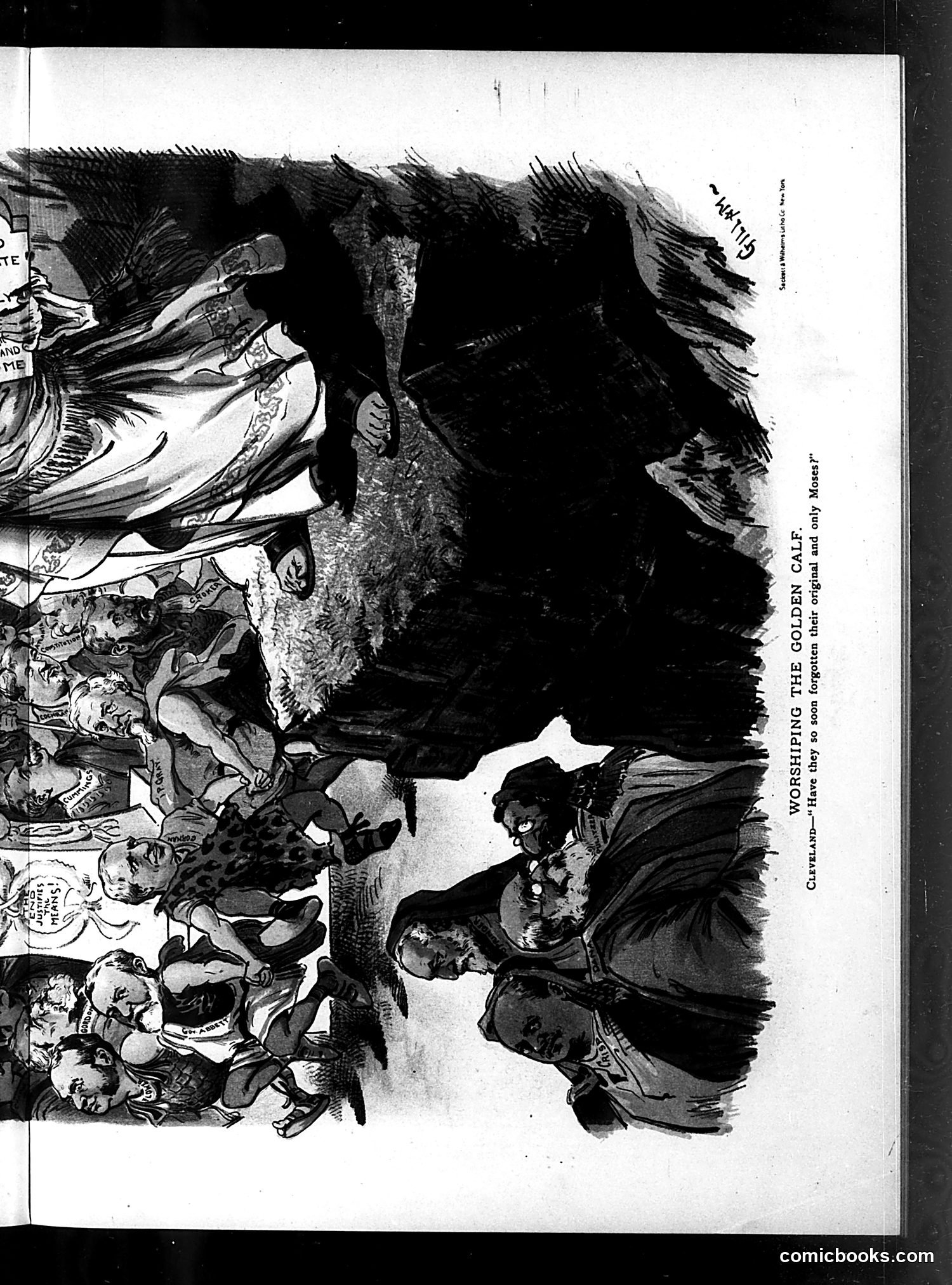
This appears to be a satirical cartoon titled "Worshipping the Golden Calf," referencing the Biblical story of idol worship. The image shows figures in elaborate dress bowing before or worshipping what appears to be a golden calf or similar idol figure positioned centrally. The satirical point likely critiques American materialism or greed during the Gilded Age/Progressive Era when *Judge* magazine was active. The biblical allusion suggests the cartoonist viewed contemporary wealthy Americans' pursuit of money and luxury as spiritually corrupt "idol worship." The elaborate costumes and formal dress of the worshippers underscore the irony—respectable society engaged in base materialism. Without clearer identifying details visible, I cannot specify which particular political figures or events this targets, though the general critique of capitalist excess is evident.
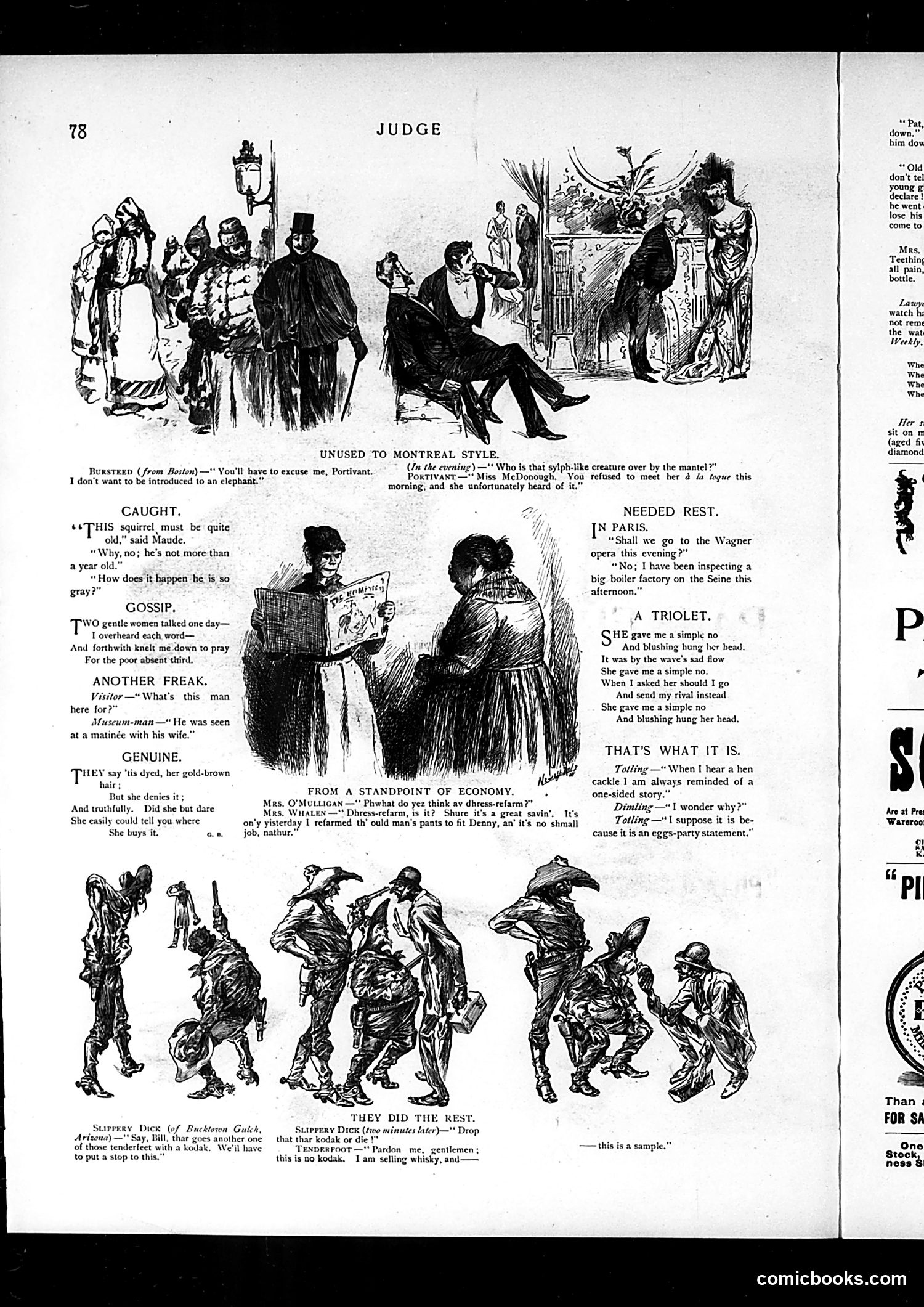
This page from Judge magazine contains multiple short satirical comics and jokes typical of late 19th/early 20th-century American humor: **Top cartoon** mocks social pretension—a Boston visitor refuses introduction to an "elephant" (likely a wealthy or socially awkward person being compared unfavorably). **"Caught"** and **"Gossip"** jokes target women's vanity and gossip-mongering—standard period stereotypes. **"Unused to Montreal Style"** presents ethnic Irish caricatures (O'Mulligan, etc.) with heavy dialect humor, common in Judge's era. **"Slippery Dick"** depicts a Western frontier scenario where a tenderfoot tourist with a camera is threatened by a locals before a twist—the "tenderfoot" is actually selling whisky illegally. This satirizes both tourist naïveté and Prohibition-era bootlegging. **Lower sketches** include various puns and domestic humor ("dress reform," "eggs-party statement"). The humor relies on ethnic caricature, gender stereotypes, and contemporary social anxieties about tourism, modernization, and changing social customs—all standard Judge fare of its era.
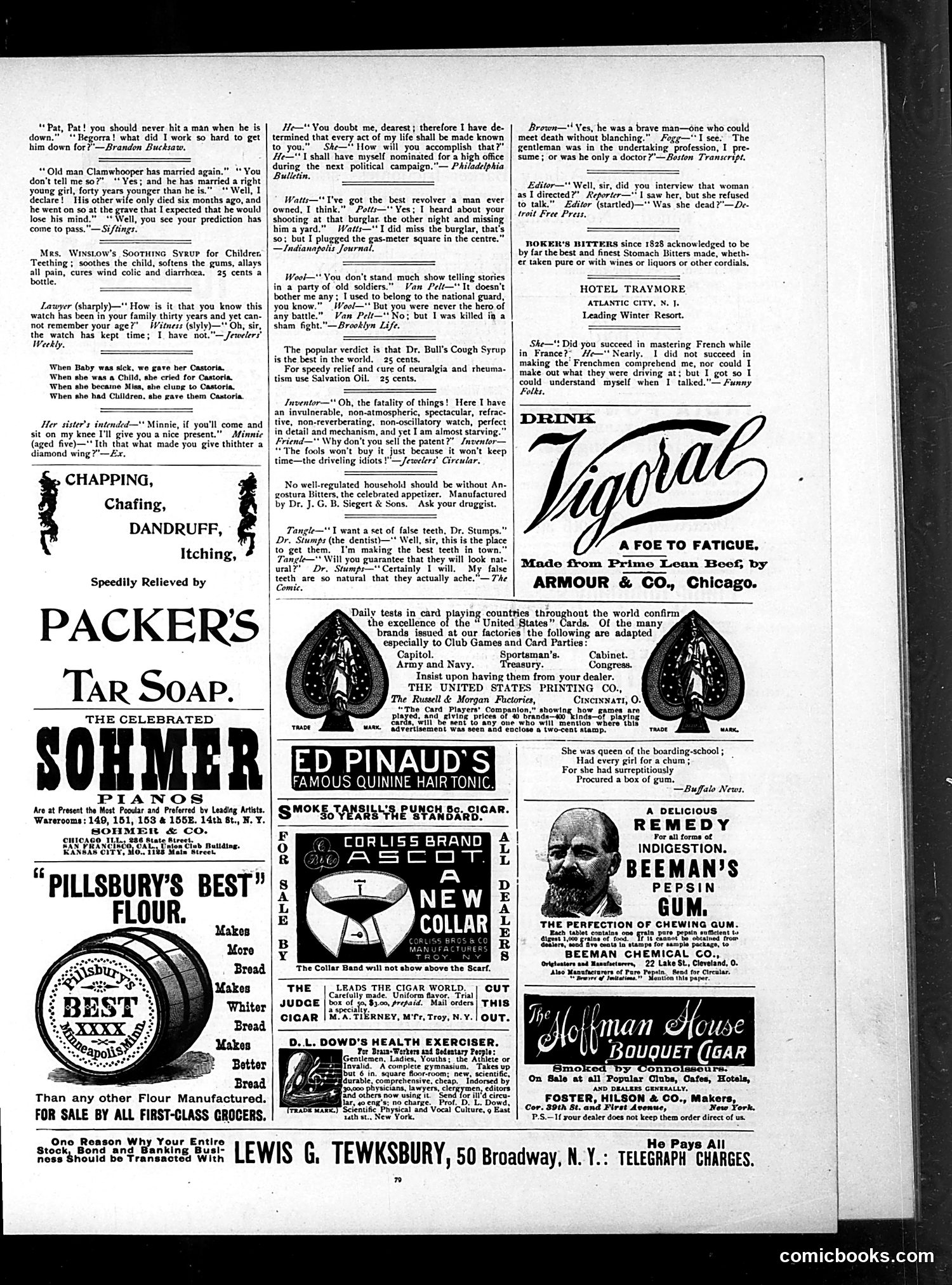
This page is primarily **advertising**, with interspersed brief humorous anecdotes rather than political cartoons. The ads promote patent medicines (Vigorol beef tonic, Beeman's Pepsin Gum, Ed Pinaud's Hair Tonic), household products (Pillsbury Flour, Packer's Tar Soap, Sohmer Pianos), and services (Lewis G. Tewksbury telegraph charges). The scattered jokes reflect turn-of-the-century American humor: an Irishman's malapropism about hitting a man ("Regorra!"), a newlywed's callousness after his wife's death, a man bragging about accidentally shooting a gas-meter while missing a burglar, and a soldier's dubious war credentials. One anecdote satirizes an inventor obsessed with designing a perfect watch that "won't keep time"—mocking impractical innovation detached from utility. The page reflects early 1900s sensibilities: casual racism/ethnic stereotyping, domestic violence played for laughs, and skepticism toward modern gadgetry. Overall, it's a typical period magazine page mixing light satire with commercial interests.
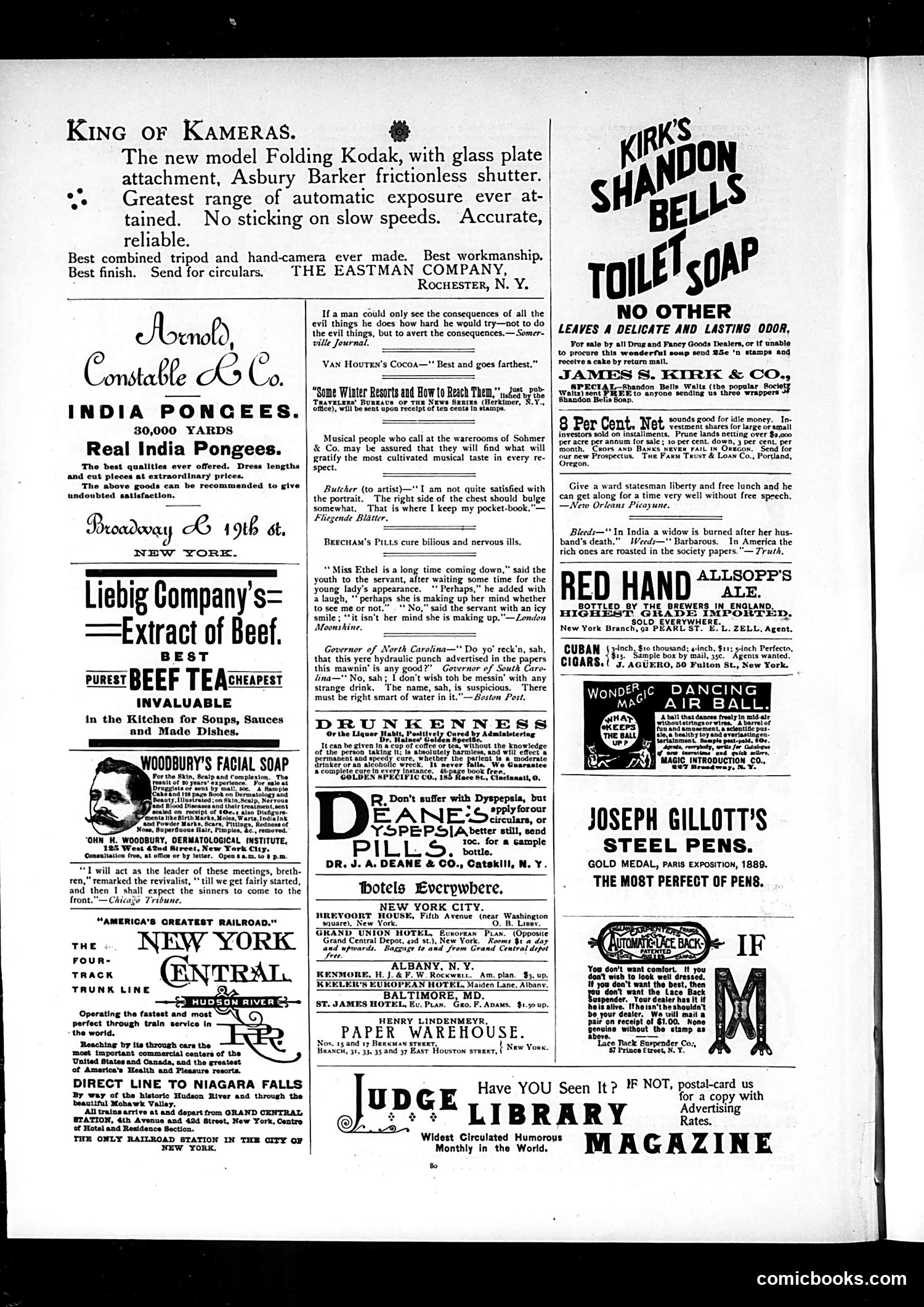
This page is predominantly **advertising with no visible political cartoons**. It represents a typical late 19th-century American magazine advertisement section. The content includes commercial promotions for cameras (Eastman Kodak), fabrics, beef extract, soap, and other goods common to the era. Scattered among these are brief humorous quotes and jokes—typical of *Judge* magazine's style—such as a butcher worried his portrait doesn't show his pocket-book bulge, and Southern governors joking about suspicious "hydraulic punch" drinks. The only potentially satirical element is the Governor dialogue mocking Southern dialect and suspicion of unfamiliar beverages, reflecting period stereotypes. The page primarily demonstrates how 19th-century magazines funded themselves: through dense advertising revenue rather than editorial content.
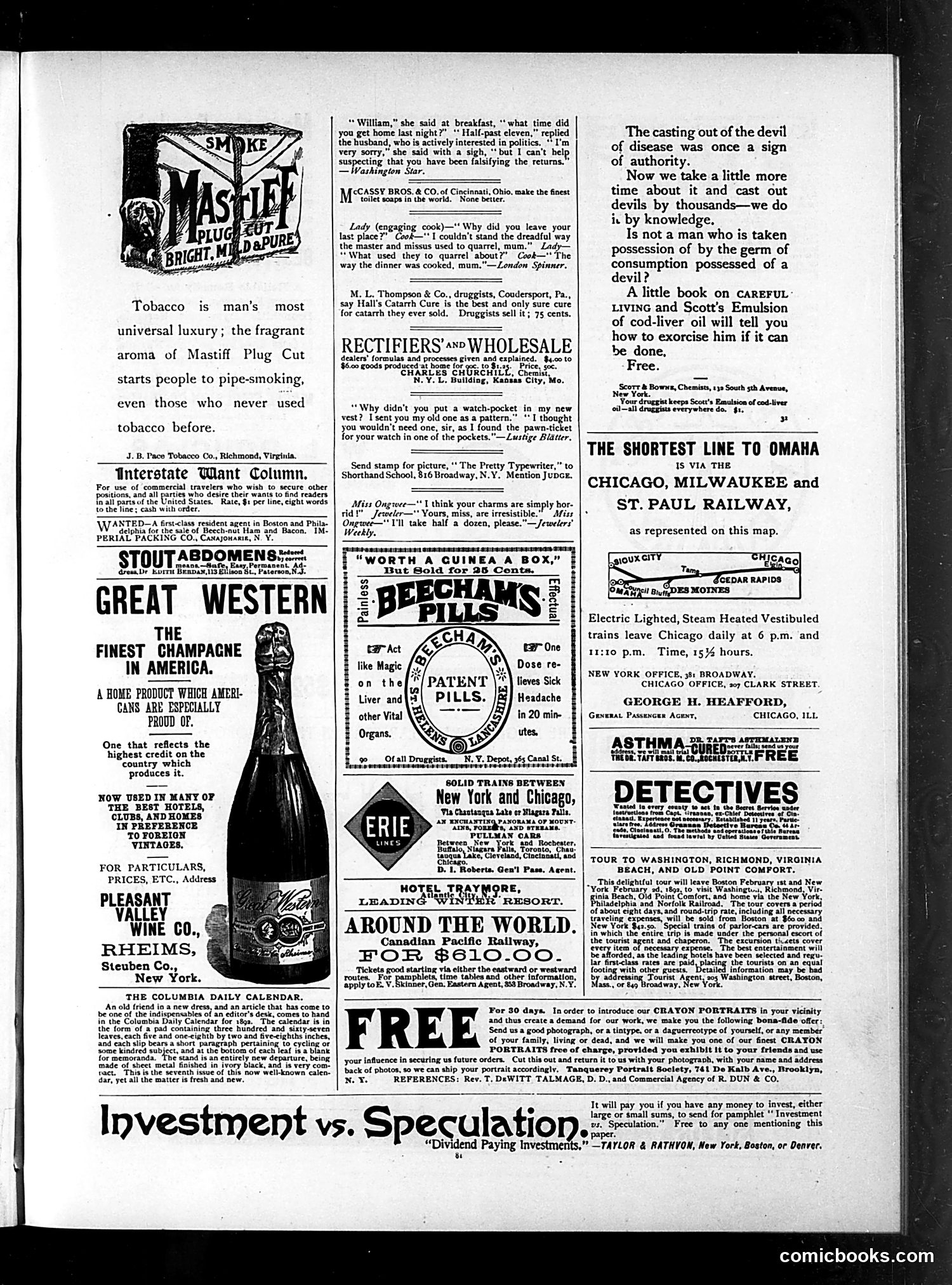
This page is primarily **advertising and filler content** typical of late-19th century magazines—not political satire or cartoon commentary. The small humorous items scattered throughout are brief jokes, not editorial cartoons: - A wife suspects her husband of "falsifying returns" (a political reference) after he stays out late, playing on contemporary election fraud concerns - Servant/employer comedy about quarrels over dinner preparation - Jeweler's pun about "charms" (jewelry vs. personal appeal) - Tailor joke about a pawn ticket **The bulk of the page comprises advertisements**: tobacco, champagne, patent medicines (Beech-ams Pills, catarrh cure), railroad services, and hotels. The only substantial illustrated ad is for **Great Western Champagne**, marketed as superior American-made product. There is **no coherent political cartoon or unified satirical message**. This appears to be a standard Judge magazine page from approximately the 1890s, where editorial humor was minimal and revenue from advertisements dominated layout and content.
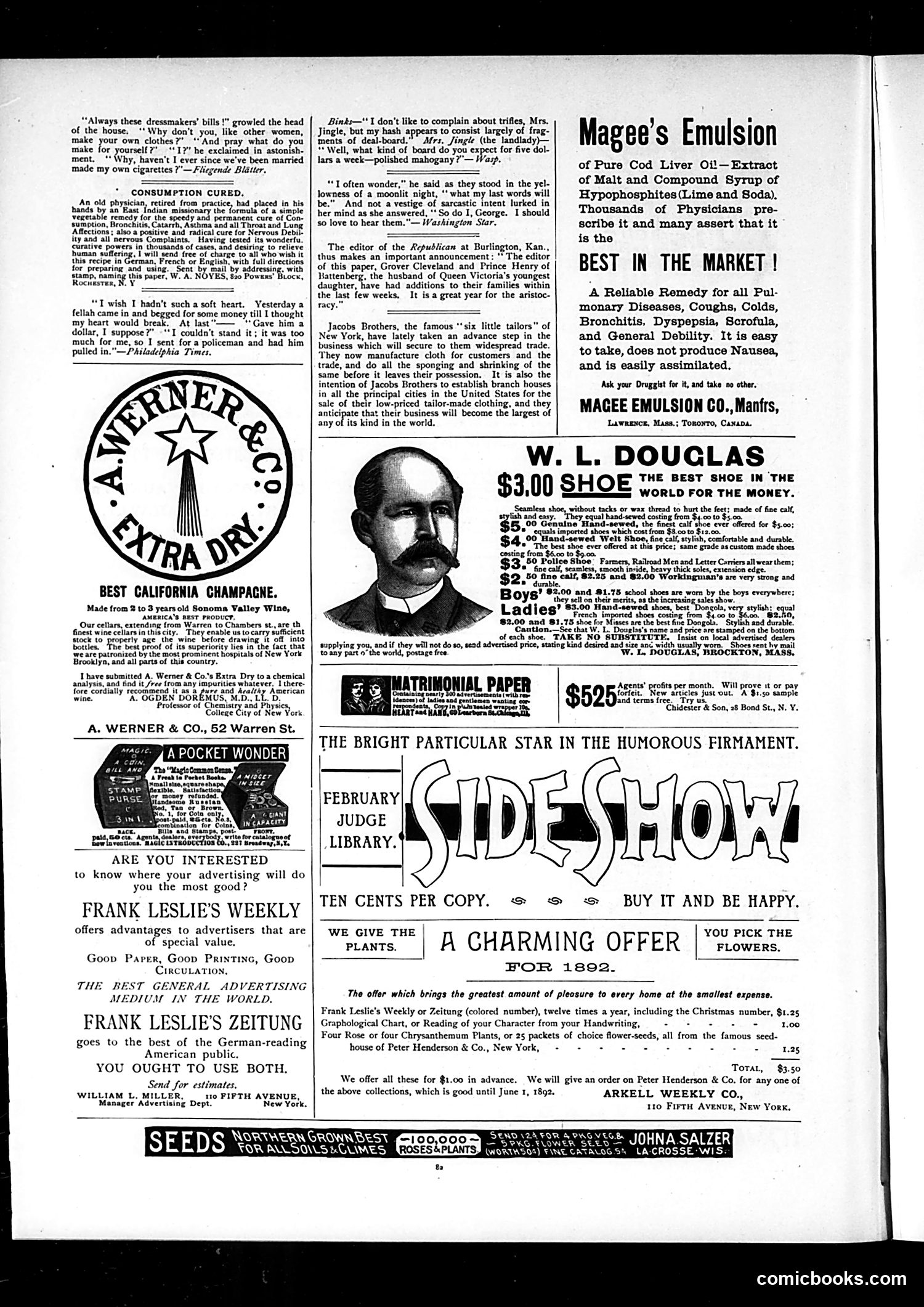
This page is primarily **advertising**, with scattered short humorous anecdotes typical of Judge magazine's format. The visible cartoons/jokes include: 1. **"Dressmakers' Bills"** — A domestic comedy about a husband complaining his wife buys ready-made clothes while he "makes his own cigarettes." The satire mocks male hypocrisy: men expect women to economize on clothing while they spend freely on personal indulgences. 2. **"Soft Heart"** anecdote — A man claims to help a beggar but actually calls police. Dark humor based on false charity and self-deception. 3. **"Hash complaint"** — A boarding-house tenant jokes that his hash contains "fragments of deal-board" (cheap wood). Landlady sarcastically asks what quality he expects for five dollars weekly. Social commentary on poor-quality boarding-house food and class economics. The remainder is **medical and consumer advertisements** (champagne, shoes, emulsions, seeds) typical of 1890s magazines, including questionable health claims now recognized as fraudulent.
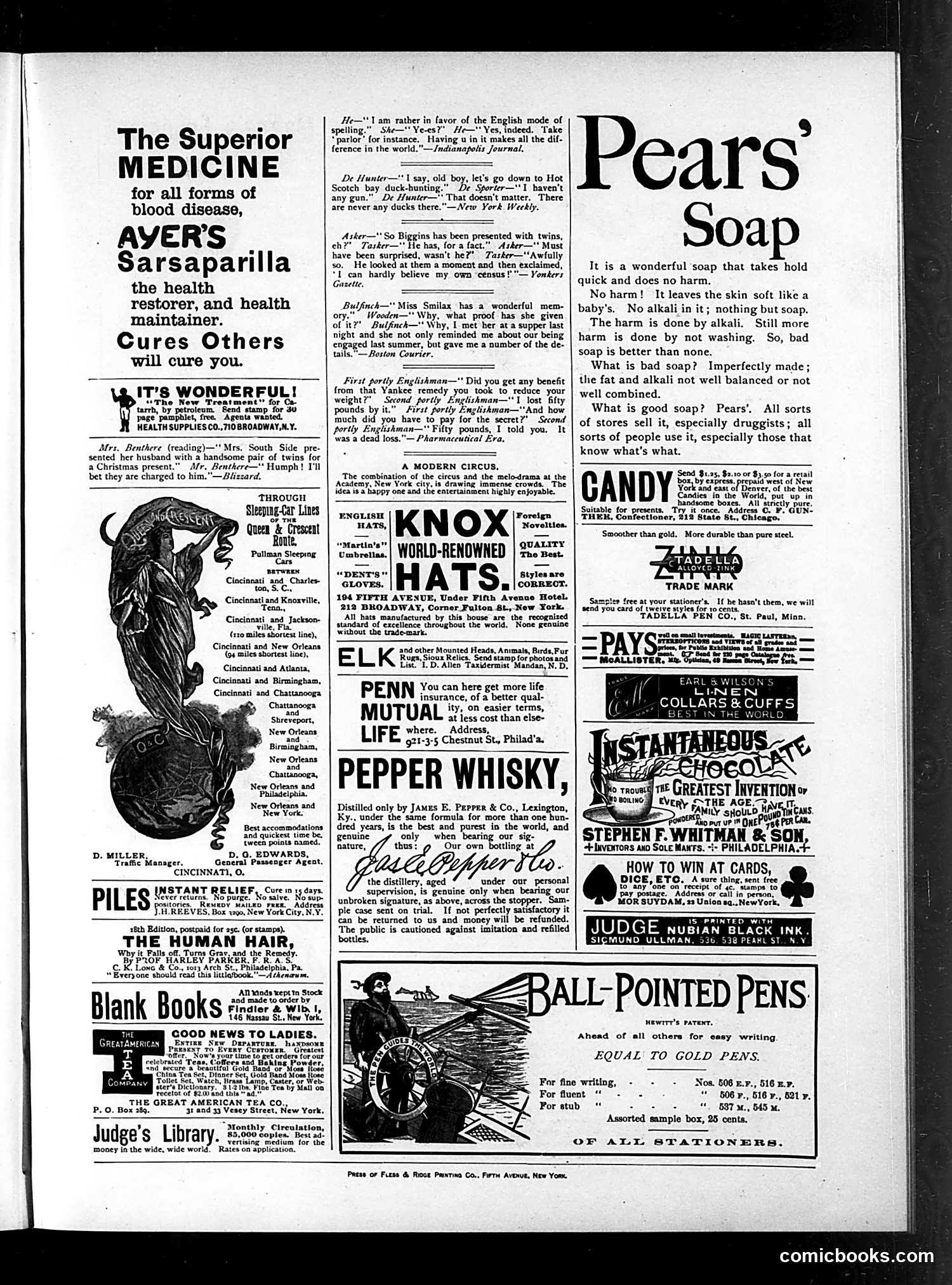
This page is primarily **advertising and humor filler** typical of late 19th-century satirical magazines. There are no significant political cartoons or social commentary requiring historical context. The content consists of: 1. **Product advertisements** (Ayer's Sarsaparilla, Pears' Soap, Knox Hats, etc.) — standard commercial placement 2. **Brief comic anecdotes** — short jokes about contemporary domestic life: a wife gifting twins as a "Christmas present" (implying expense), a couple debating English spelling, duck hunters without guns, newlyweds surprised by twins, and Englishmen discussing weight-loss remedies. These are mild humor relying on wordplay and everyday situations rather than satire. 3. **Illustrated advertisements** including railroad lines, medical remedies, and office supplies. The page reflects Judge's business model: mixing light humor with paid advertising to subsidize the magazine's cost. No specific political figures or events are referenced; the jokes are generic observations about middle-class life.
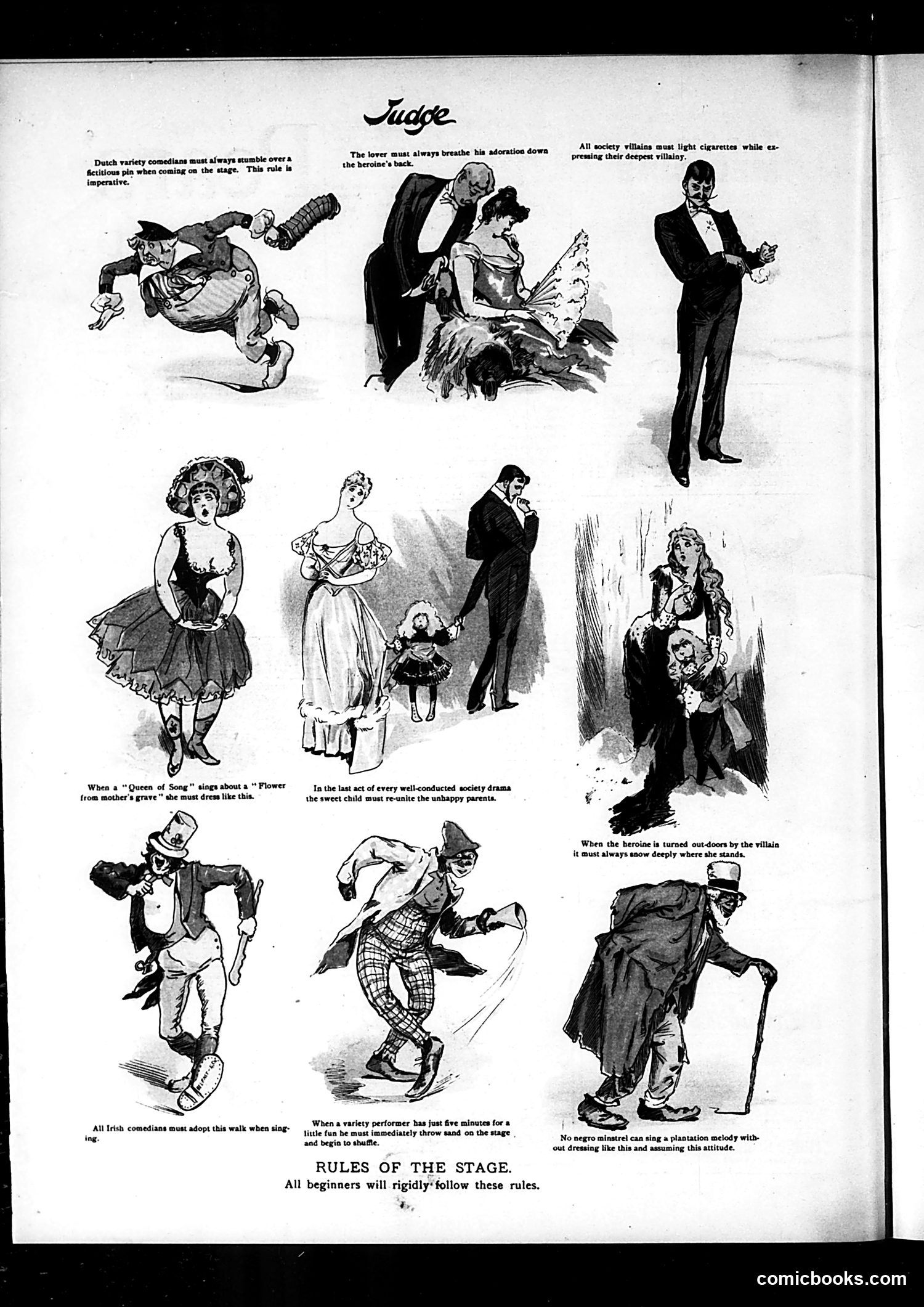
This page satirizes melodramatic theatrical conventions of the late 19th/early 20th century. Through humorous illustrations and exaggerated "rules," it mocks the overwrought formulas that dominated popular theatre. The satirized tropes include: actors stumbling awkwardly during entrances, lovers breathing "adoration" dramatically, villains looking villainous, emotional singers in elaborate costumes, weeping heroines with conveniently placed snow during dramatic rejections, reunited families resolving plots, and comedians adopting ethnic stereotypes (the "Irish" walk noted). The satire targets both performers who relied on these clichés and audiences who accepted such artificial, predictable storytelling. By presenting these conventions as rigid "rules," Judge mocks theatrical pretension and suggests performers mindlessly followed formulas rather than creating authentic art. The overall message critiques a theatrical culture that prioritized melodramatic spectacle over genuine dramatic innovation.