
Judge, 1892-01-30 · page 7 of 16
Judge — January 30, 1892 — page 7: what you’re looking at
What you’re looking at
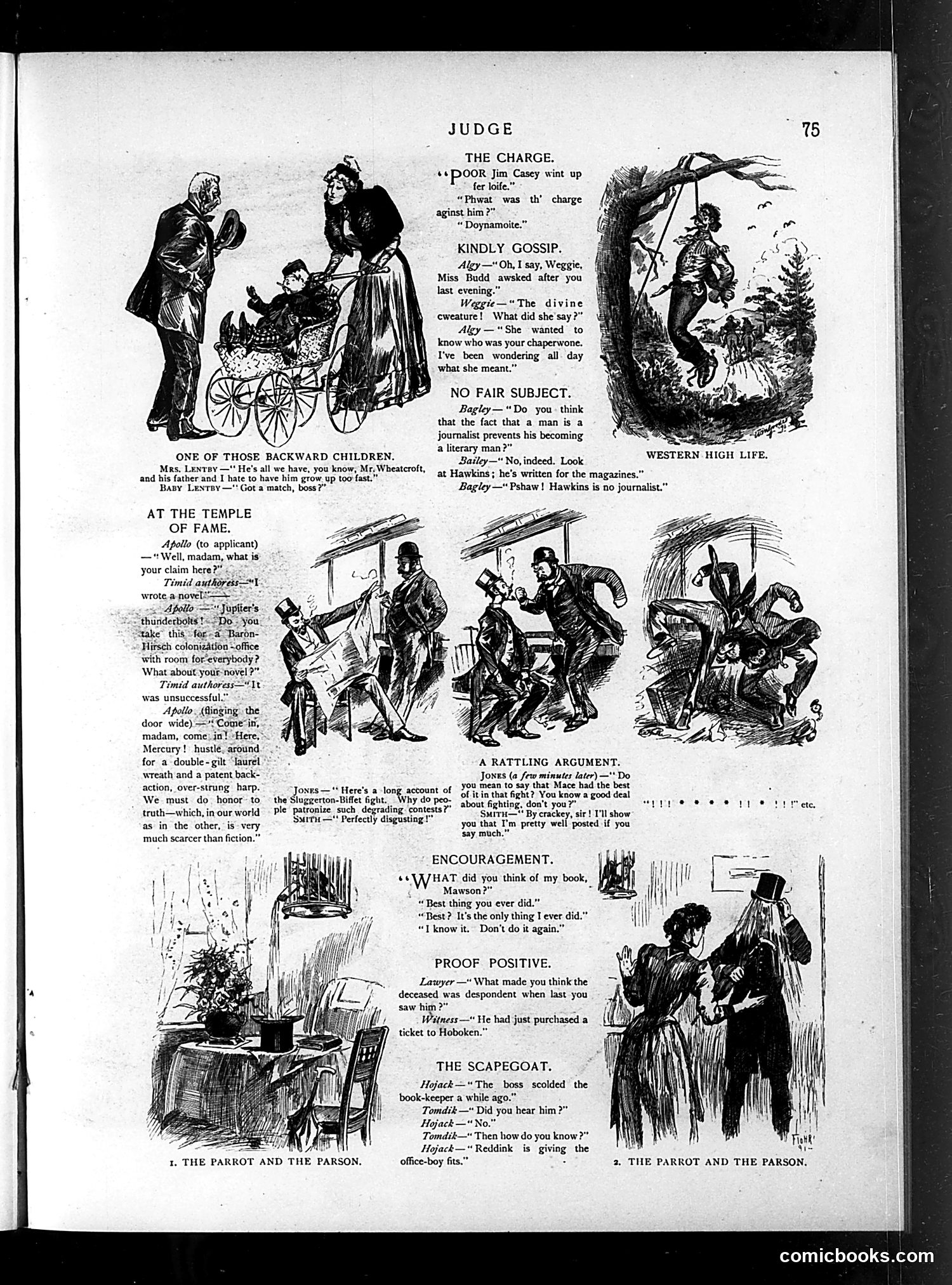
This page contains multiple satirical vignettes typical of 1890s American humor, targeting contemporary social pretensions and professions: **"The Charge"** mocks Irish immigrant speech ("wint up fer loife") and dynamite associations—likely referencing anarchist violence concerns of the era. **"No Fair Subject"** critiques journalists' literary ambitions, suggesting journalism and serious literature are incompatible professions—a class-based snobbery about what constitutes "real" writing. **"Temple of Fame"** satirizes unsuccessful authors receiving laurels while successful ones are denied entry, inverting merit-based recognition to mock publishing gatekeepers. **"Rattling Argument"** depicts two men debating prize-fighting's morality while contradicting themselves about its merits—poking fun at hypocritical moral posturing. **Other sections** lampoon parental indulgence, romantic gossip conventions, and workplace dynamics. The repeated "Parrot and Parson" sketches suggest running characters trading witticisms. The overall tone mocks Victorian social pretension, professional pretentiousness, and logical inconsistency in middle-class discourse.
📄 Transcribed text from this page (OCR, searchable)
Machine-transcribed from the original scan — historical spelling and the odd misread are preserved.
JUDGE THE CHARGE. ++POOR Jim Casey wint up fer loife.” “Phwat was th’ charge aginst him 2” “ Doynamoite.” KINDLY GOSSIP. Algy —" Oh, I say, Weggie, Miss Budd awsked after you last evening.” Weggie—“The divine cweature! What did she’say ?” Algy —“She wanted to know who was your chaperwone. I've been wondering all. day what she meant.” NO FAIR SUBJECT. Bagley—“Do you. think that the fact that a man is a journalist prevents his becoming a literary man?” ONE OF THOSE BACKWARD CHILDREN. Bailey—" No, indeed. Look WESTERN HIGH LIFE. Mas, Lentay —" He's all we have, you know, Mr, Wheatcroft, raha ee and his father and T hate to have him grow up too fast.” at Hawkins ; he’s written for the magazines. Basy Lextsy—''Got a match, boss?” —Pshaw! Hawkins is no journalist.” AT THE TEMPLE OF FAME. Apollo (to applicant) —"!Well, madam, what is your claim here?” « Sake” this fora Baron- Hirsch colonization office with room for'everybody ? What about your-novel ?” Timid authoress—“1t was unsuccessful.” Apollo. (finging the door wide) =" Come’ in, madam, come: in! "Here, * Mercury! hustle, around.» @ for a double-gilt “laurel . A RATTLING ARGUMENT. wreath and a patent back- Jones (a few minutes later)—"*Do ‘action; over-stiung? harp. ones —** Here's a long aceount of YOU mean to say that Mace had the best We must do. honor to the Sluggerton-Biffet fight. Why do peo- truth—which, in our world Pl patronize such degrading. contests?” . . Saurtu—"* Perfectly disgusting ! as in the other, is-very x of it in that fight? You know a good deal about fighting, don’t you ?” wpe ee 8 | ‘Surrn—" By crackey, sir! I'll show you that I'm pretty well posted if you much scarcer than fiction.”” say match, ENCOURAGEMENT. SCYVHAT did you think of my book, é Mawson?” F “Best thing you ever did.” “Best? It's the only thing I ever did.” “I know it. Don't do it again.” PROOF POSITIVE. Lawyer —* What made you think the deceased was despondent when last you saw him 2” ‘ Witness —" He had just purchased a ticket to Hoboken.” THE SCAPEGOAT. Hojack—“The boss scolded the book-keeper a while ago.” Tomdik—* Did you hear him ?” Hojack —" No.” Then how do you know?” t Reddink is giving the 1, THE PARROT AND THE PARSON. office-boy fits.” 2, THE PARROT AND THE PARSON. comicbooks.com