
A complete issue · 16 pages · 1892
Judge — January 16, 1892
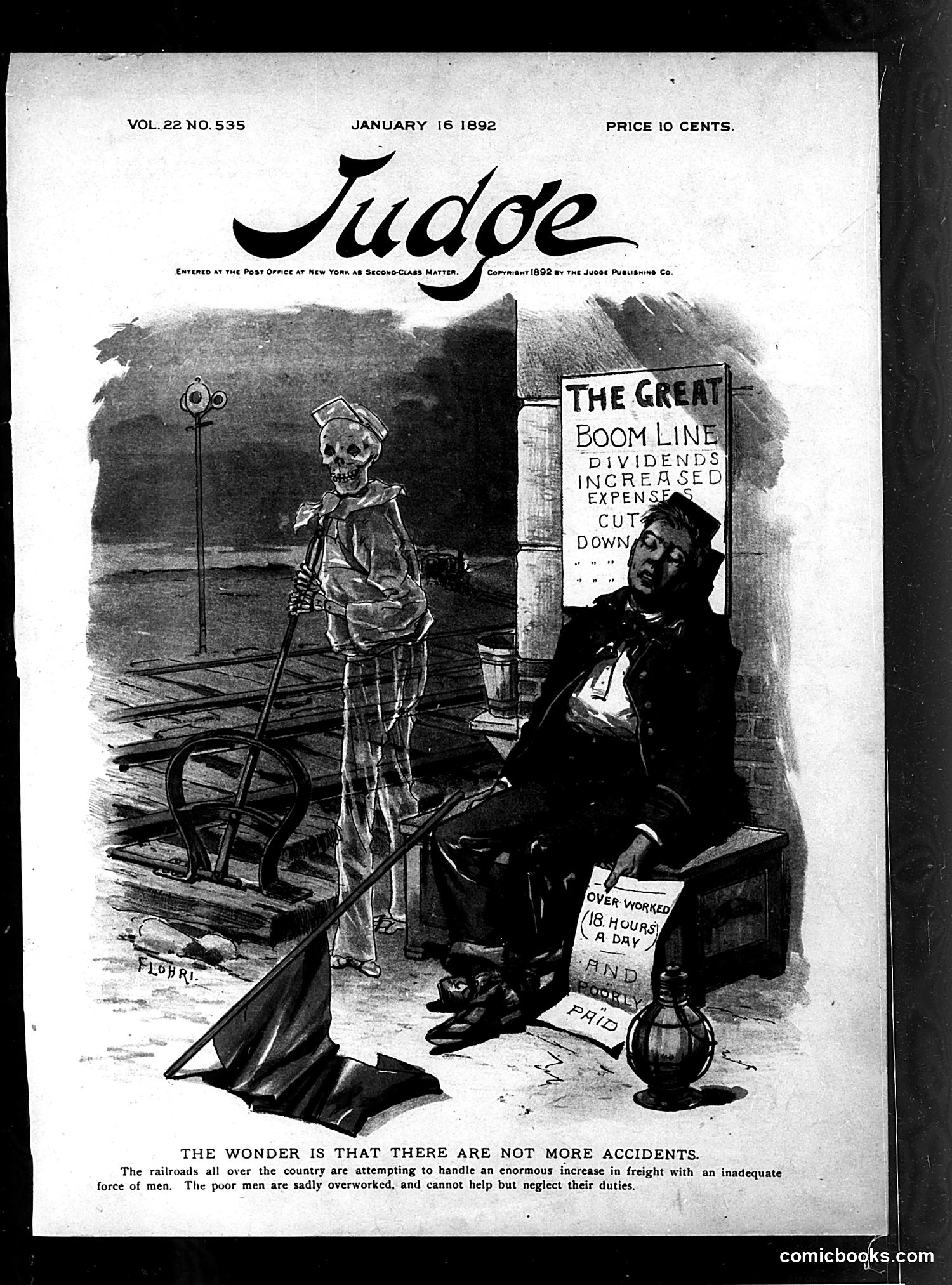
This 1892 *Judge* cartoon critiques railroad safety conditions. The skeletal figure represents Death, standing watch over an exhausted railroad worker slumped on a crate. A sign reading "The Great Boom Line" references railroad expansion during the 1880s-90s economic boom. Posted notices detail the worker's plight: "Dividends Increased," "Expenses Cut Down," "Overworked 18 Hours a Day," and "Poorly Paid." The satire argues that railroad companies prioritized profits over worker safety—cutting costs while demanding excessive labor from underpaid workers. The accompanying text explicitly blames "an inadequate force of men" handling freight increases, with poor workers unable to "neglect their duties." Death's presence suggests fatal consequences of this exploitative system.
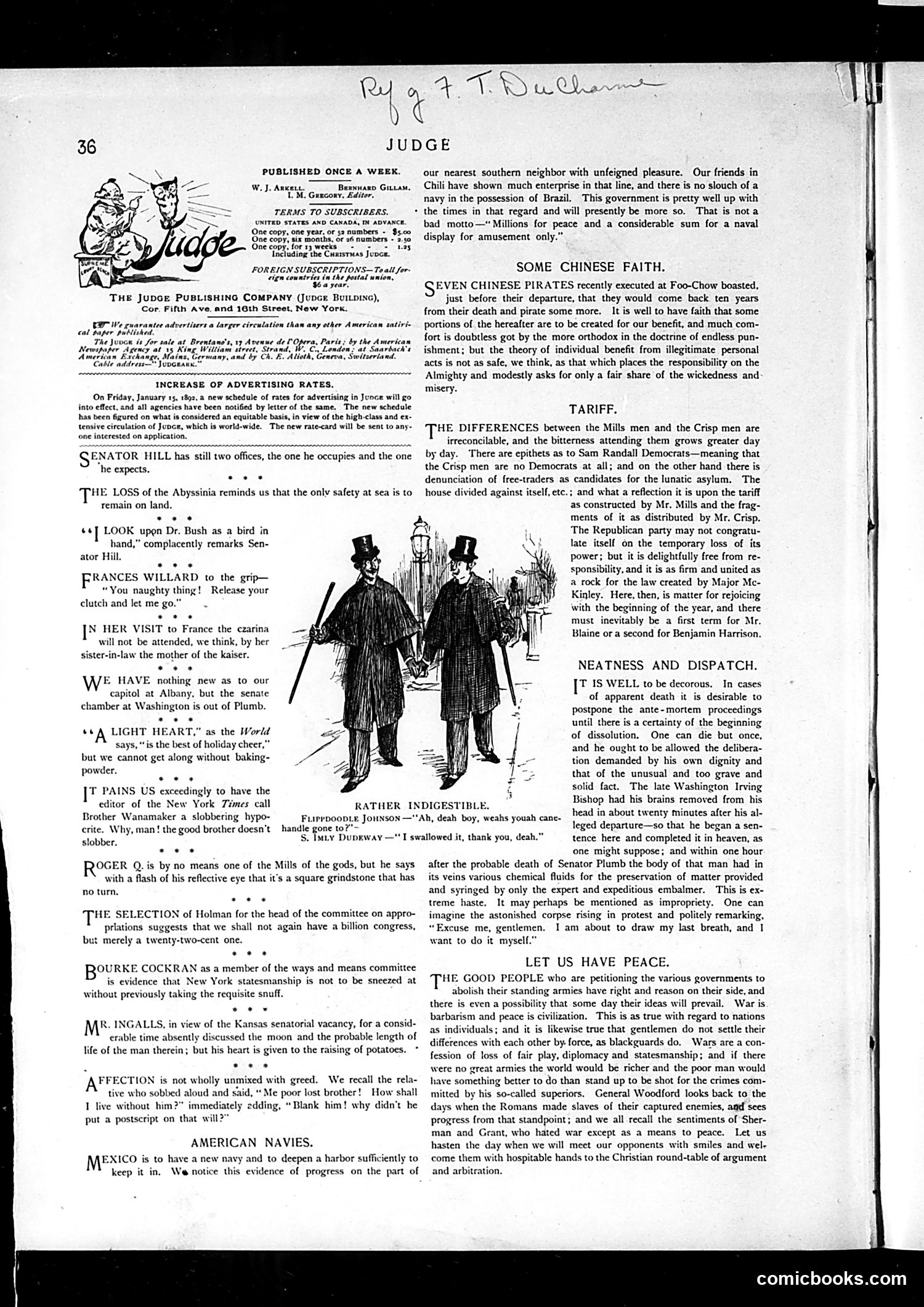
The main cartoon depicts two figures in formal attire labeled "RATHER INDIGESTIBLE." The caption attributes quotes to "Fitz-Doodle Johnson" and "Emily Dickinson," suggesting these are fictionalized personas commenting on contemporary politics. The surrounding text discusses various political topics including tariff disputes between "Mills men" and "Crisp men" (likely referencing competing political factions), criticisms of Democratic positions, and commentary on naval power. References to "Mr. Mills" and debate over trade policy suggest this addresses late-19th-century protectionist debates. The cartoon's "indigestible" theme appears to satirize political figures or policies that are difficult to accept or support. Without clearer identification of the specific historical moment, the precise targets remain uncertain.
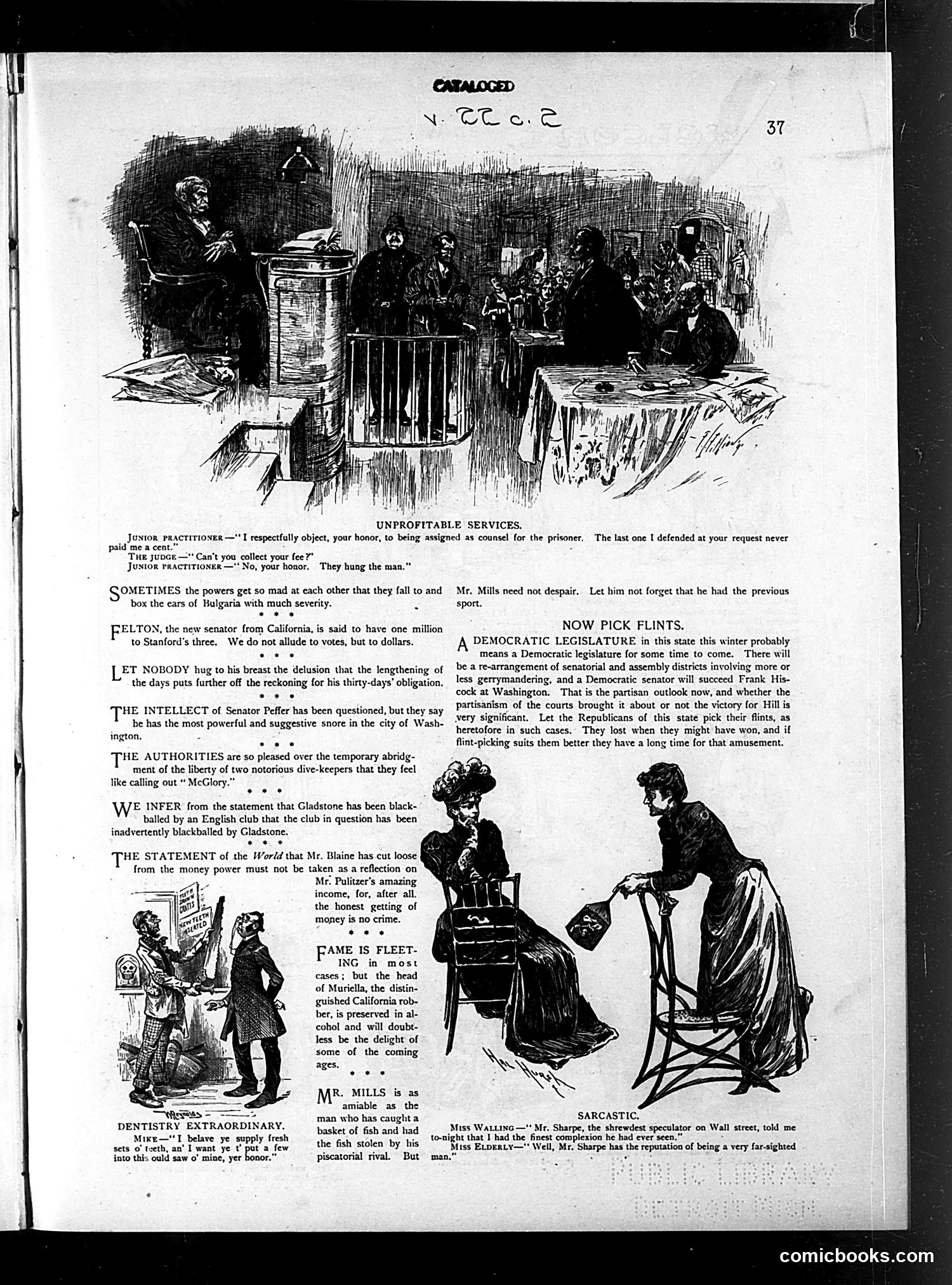
This page satirizes late 19th-century legal and political incompetence. The top cartoon depicts a court scene where a junior practitioner defends a prisoner pro bono (unpaid), with dialogue mocking the arrangement's futility—"They hang the man." The text below contains political jabs: it references Senator Felton's million-dollar Stanford donation as evidence money matters more than votes; criticizes Senator Pfeffer's limited Washington influence; and mocks the authorities' relief at temporary labor strikes ending. "Now Pick Flints" section discusses potential Democratic legislative gains, predicting political realignment and suggesting Republicans lose courtroom cases through incompetence. The "Dentistry Extraordinary" and "Sarcastic" illustrations appear unrelated vignettes mocking various professions and social pretensions, typical of Judge's scattershot satirical approach.
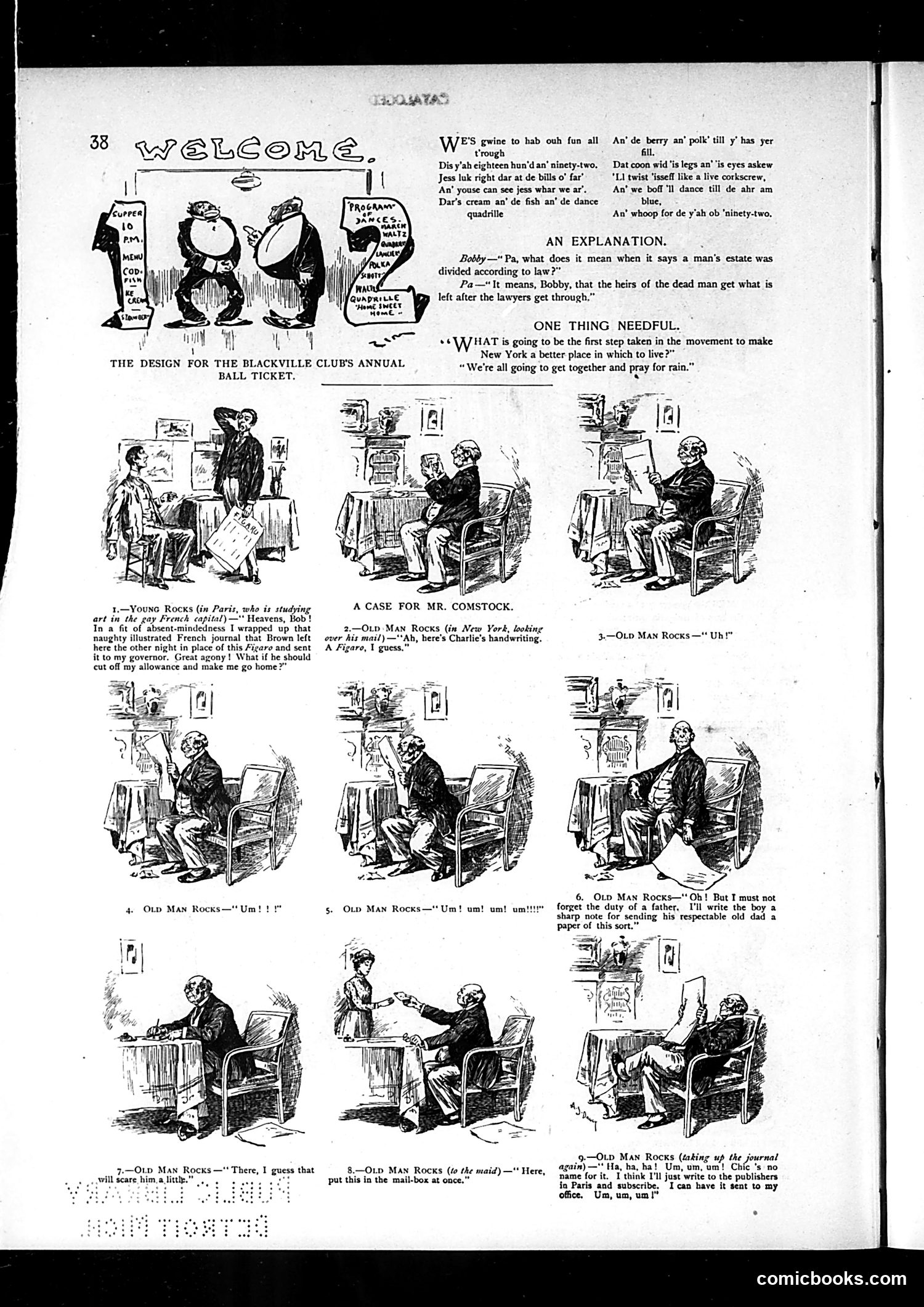
This nine-panel comic satirizes hypocrisy and moral inconsistency. "Old Man Rocks," a wealthy New York father, discovers his son in Paris accidentally mailed him an explicit French illustrated journal instead of a respectable newspaper (Figaro). Rocks initially reacts with moral outrage, planning to punish the boy and scold him about propriety. However, by the final panels, the old man becomes fascinated by the publication, ultimately deciding to subscribe to it himself for delivery to his office—completely reversing his sanctimonious stance. The satire targets Victorian-era moralizing: respectable gentlemen publicly condemned such materials while privately consuming them. The comic mocks the gap between stated principles and actual behavior, suggesting that "Old Man Rocks" was never genuinely offended, merely performing respectability until temptation overcame him. This was a familiar Judge magazine theme—exposing the hypocrisy of the wealthy and supposedly virtuous.
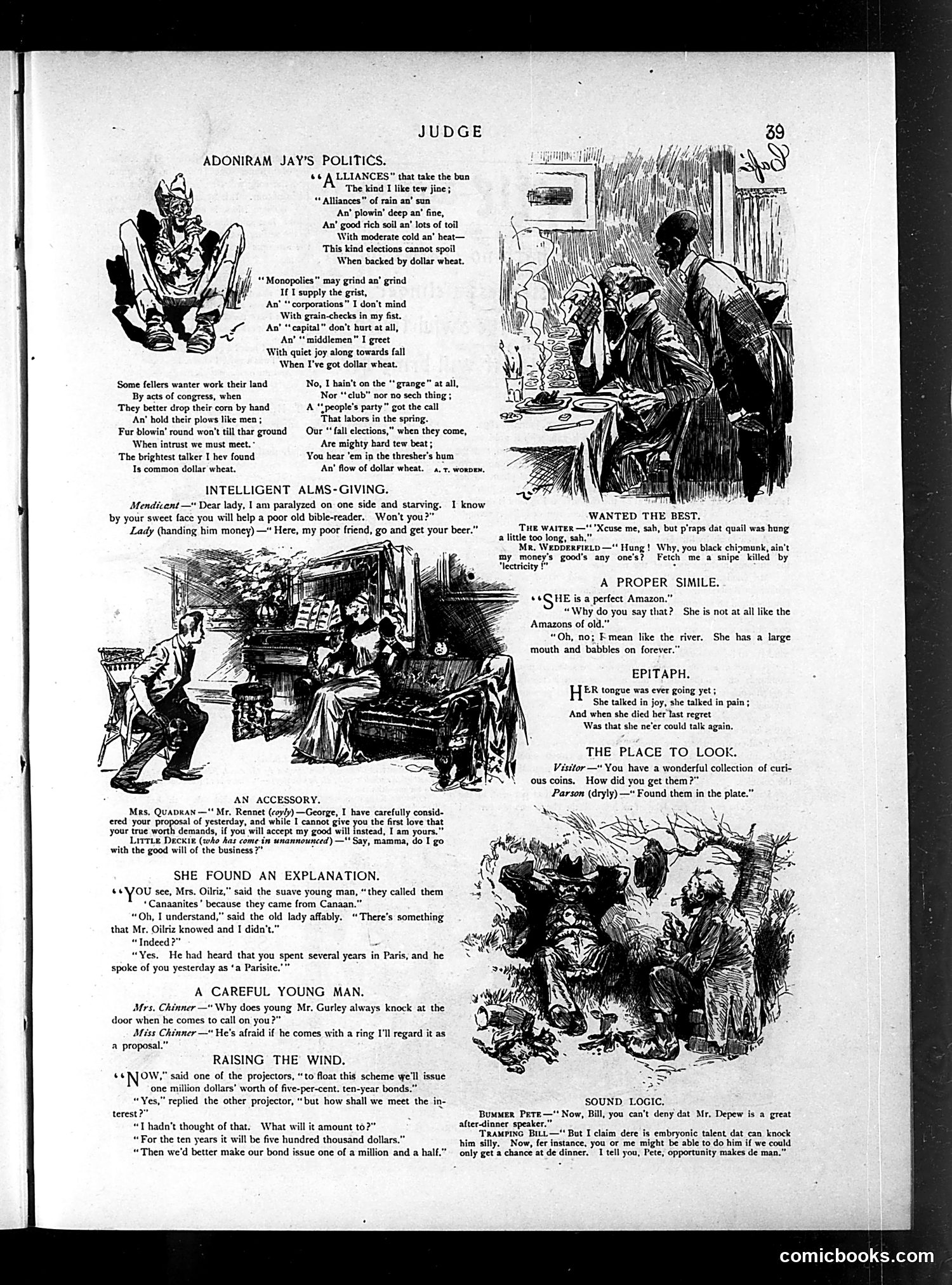
This page from Judge magazine contains multiple unrelated satirical sketches typical of the publication's format. The primary political cartoon, "Adoniram Jay's Politics," satirizes a Populist or agrarian politician whose principles conveniently align with his economic interests. The figure advocates against "monopolies," "corporations," and political intervention—but only when it threatens his wheat profits. Once he has "dollar wheat," these same institutions don't bother him. This mocks the hypocrisy of politicians whose populist rhetoric masks self-interest. The remaining content consists of short humorous sketches on various topics: alms-giving, marriage proposals, colonial history misunderstandings, and financial schemes. These are social satire rather than political commentary. The "Raising the Wind" sketch satirizes speculative finance—projectors proposing bonds while openly admitting they haven't considered how to pay interest, suggesting financial recklessness of the era. Overall, this page reflects Judge's focus on mocking political hypocrisy, financial folly, and social pretension among American elites and middle classes.
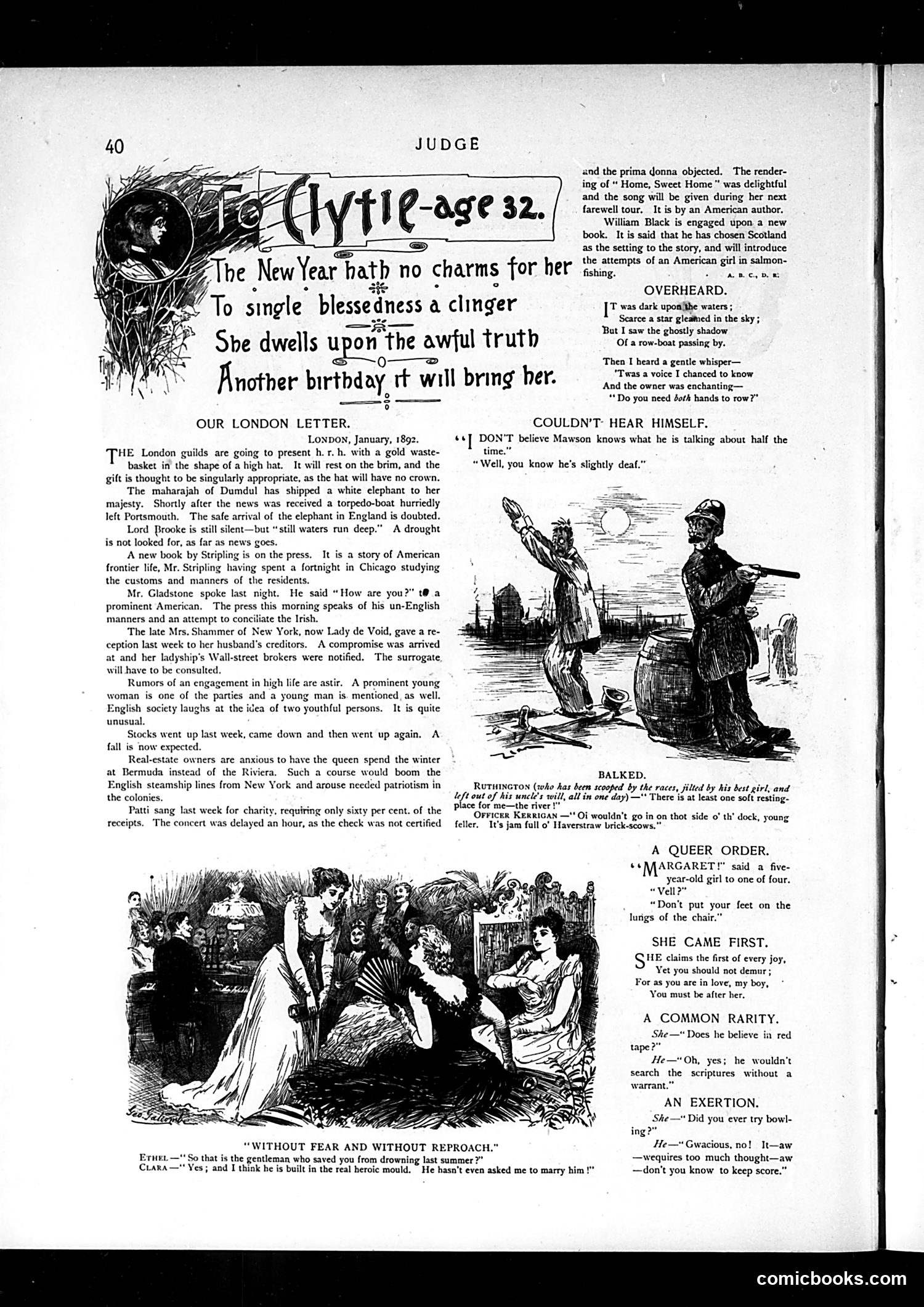
This page combines British gossip with American satirical humor typical of the era. **"Our London Letter"** mocks British high society and American pretension. Key targets include: a useless gold wastebasket "gift" to royalty (shaped like a high hat with "no crown"—insulting); a Chicago businessman who spent one fortnight studying frontier life before writing a novel about it (mocking superficial Americanism); and a wealthy American widow (formerly "Mrs. Shammer") now titled "Lady de Void" who hosts creditors at receptions—suggesting both her questionable past and nouveau-riche absurdity. The cartoon **"Without Fear and Without Reproach"** satirizes romantic expectations: a woman recalls her hero rescuer, but he "hasn't even asked me to marry him"—exposing that self-interested motives underlie supposedly noble acts. Other small jokes mock deafness, class pretension, and marital dynamics—typical Judge fare targeting both American social climbers and British affectation.
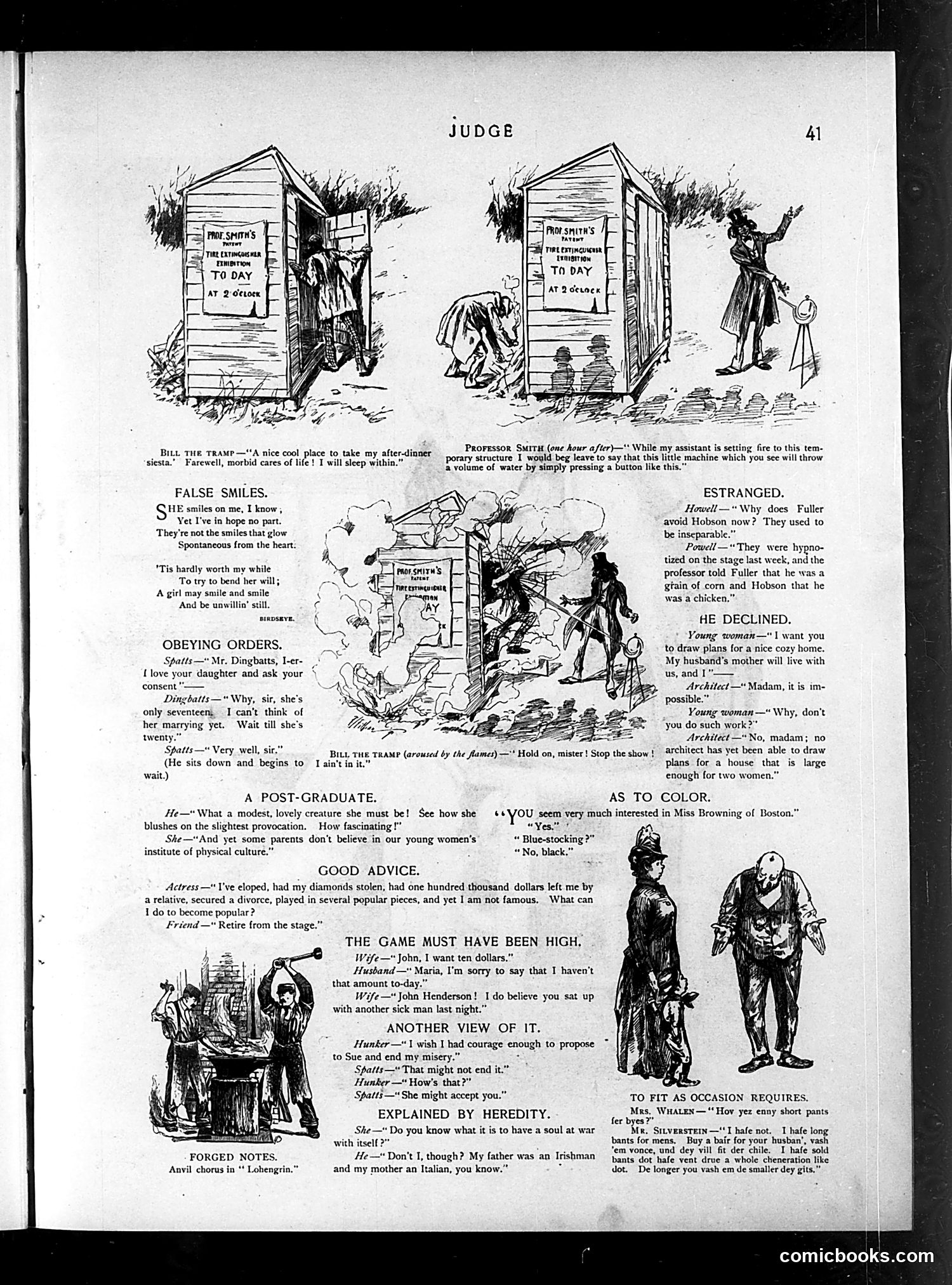
This page from *Judge* presents a collection of short satirical vignettes typical of late-19th/early-20th-century American humor. The cartoons mock social conventions and gender relations of the era: **Key themes:** - **"False Smiles"** and **"Obeying Orders"** satirize courtship rituals, with men passively accepting rejection or arbitrary parental rules - **"The Game Must Have Been High"** mocks husbands caught in lies about their whereabouts - **"He Declined"** jokes about architects refusing to design homes for two women, reflecting contemporary anxieties about women's independence and household authority - **"Bill the Tramp"** uses slapstick humor about a vagrant mistaking a burning structure for shelter - **"Explained by Heredity"** stereotypes Irish-Italian temperament as inherently conflicted The humor relies on period assumptions: rigid gender roles, ethnic stereotyping, and working-class dialect comedy. References to hypnotism, physical culture institutes, and stage performances reflect contemporary entertainments and pseudo-scientific trends.
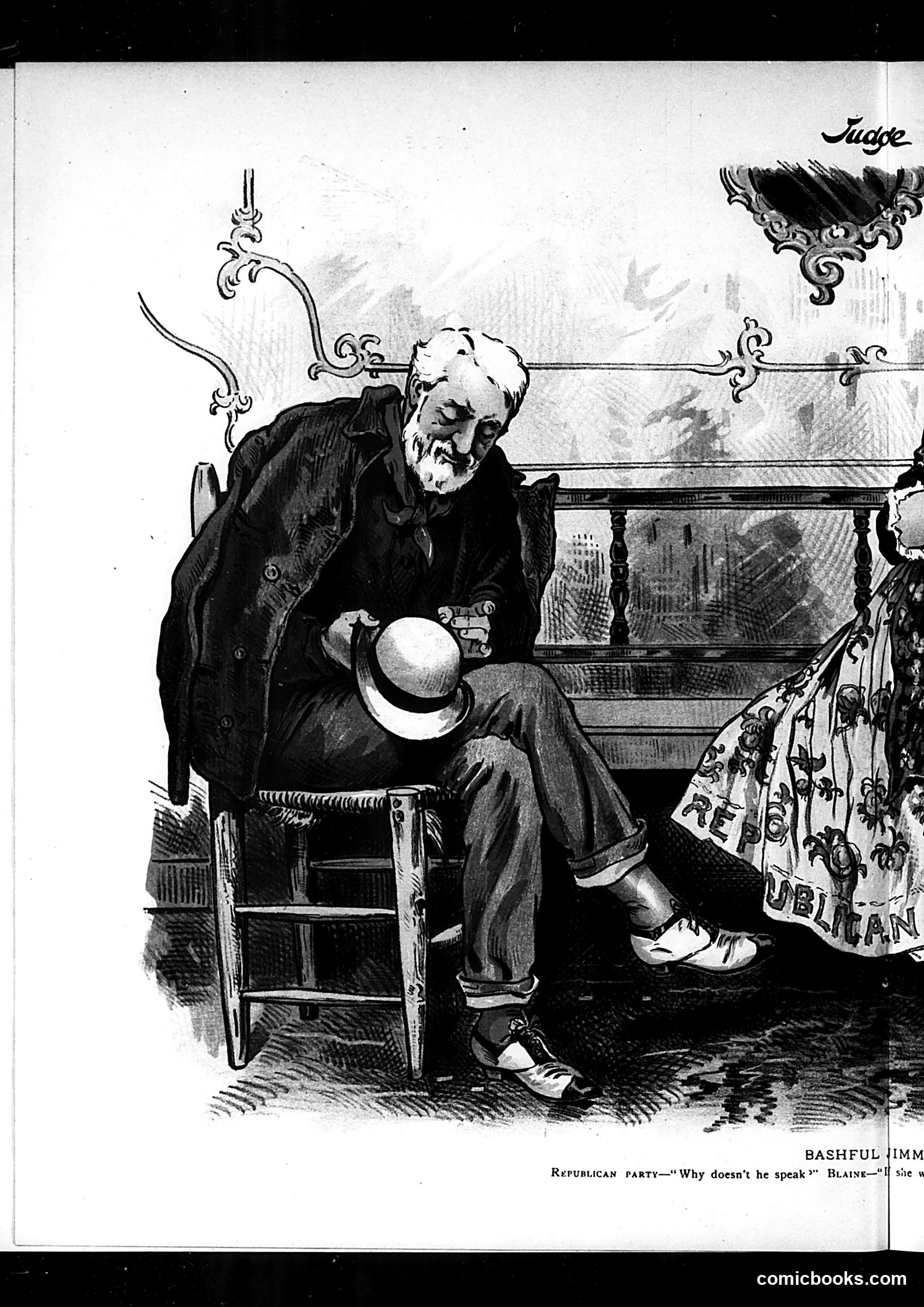
This **Judge** magazine cartoon satirizes the Republican Party's silence on a political issue. The image depicts an elderly bearded man (representing the Republican Party) sitting bashfully on a chair, holding his hat. A woman labeled "Blaine" (likely James G. Blaine, a prominent Republican politician) demands "Why doesn't he speak?" The cartoon criticizes the Republicans for failing to publicly address or comment on something—possibly a scandal or controversial policy issue. The "bashful" characterization suggests cowardice or deliberate avoidance. The woman's exasperation conveys frustration at this silence. Without the complete OCR text and publication date, I cannot identify the specific issue referenced, but the cartoon clearly mocks Republican reticence during what appears to be a significant political moment.
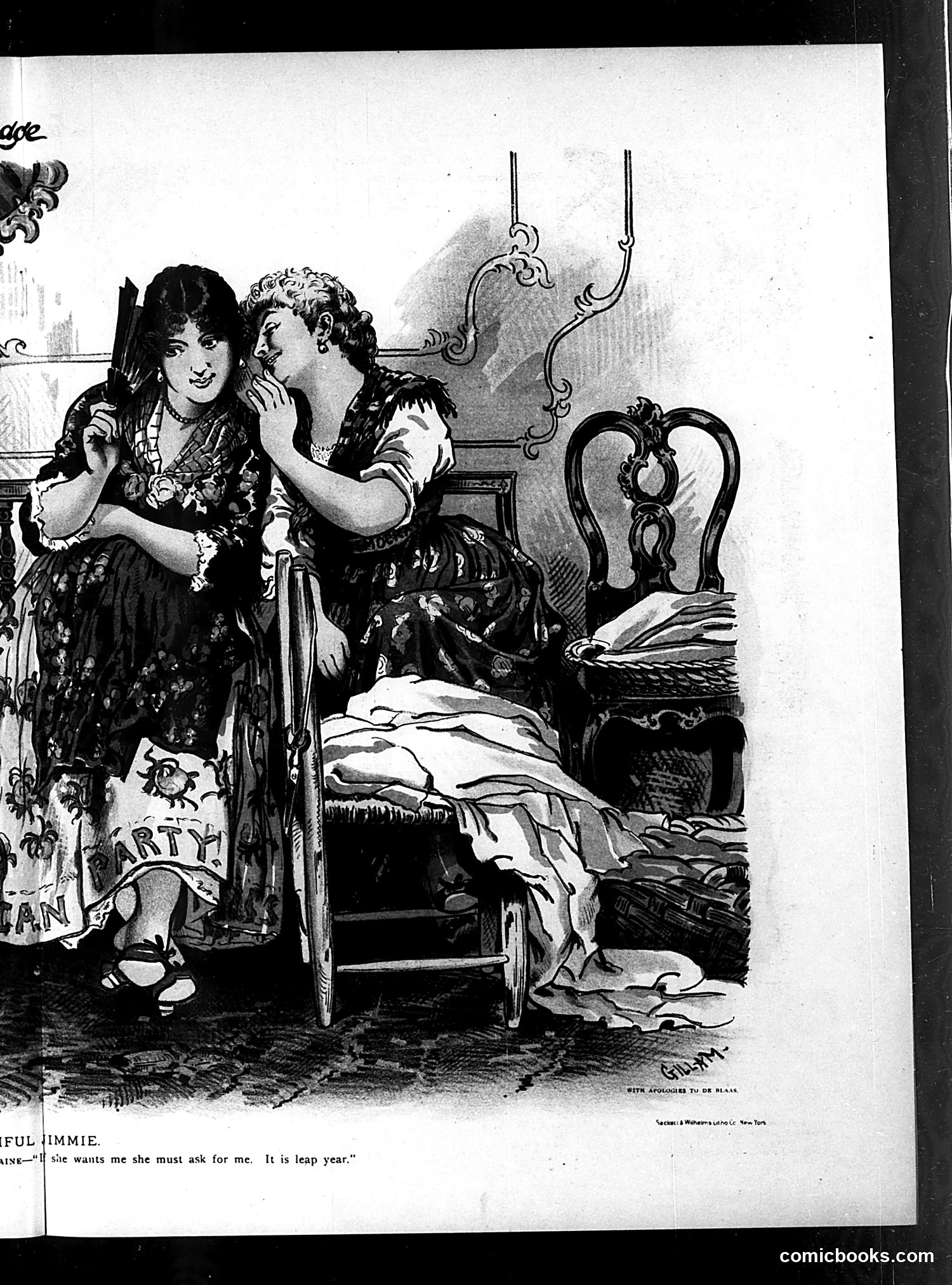
This satirical cartoon plays on the custom of **Leap Year**, when tradition allowed women to propose to men rather than vice versa. The scene depicts two women enthusiastically pursuing a reluctant man, who declares smugly: "If she wants me she must ask for me. It is leap year." The joke inverts gender expectations—the man refuses to propose despite women's interest, hiding behind leap year conventions to avoid commitment. He's essentially calling their bluff: if they want him, *they* must do the asking, reversing traditional courtship dynamics. The cartoon satirizes both male reluctance toward marriage and the limited agency women had in romance, even during the brief window leap year supposedly granted them.
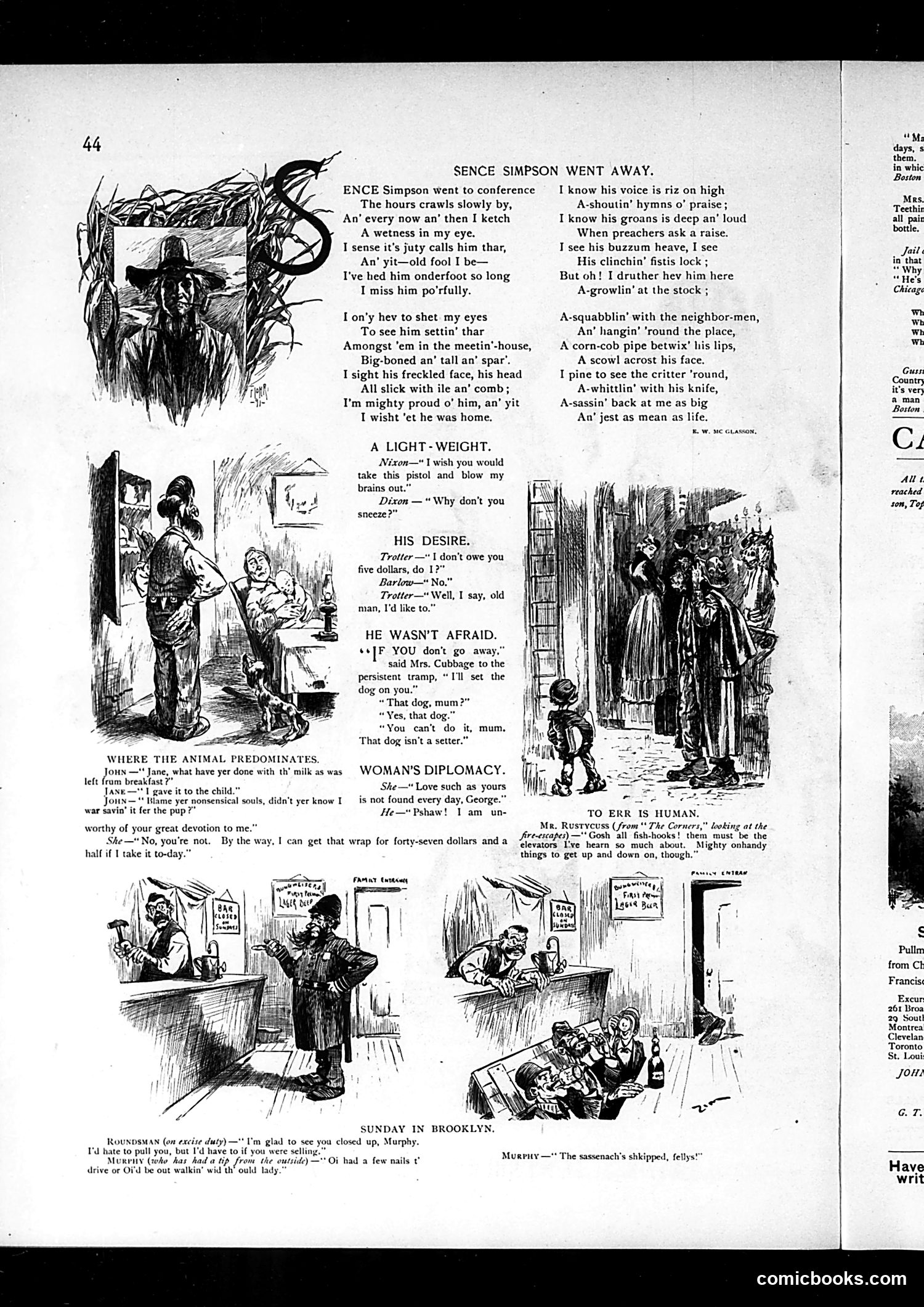
This page from Judge contains several short satirical pieces typical of late-19th-century humor magazines: **"Since Simpson Went Away"** is a sentimental dialect poem about a rural wife missing her cranky, quarrelsome husband while he's at a religious conference. The humor lies in the contradiction: she complains he's ornery and argumentative, yet misses him terribly—a gentle mockery of domestic life. **The other brief jokes** mock various social types: a suicidal man too weak to act, a debtor wishing he owed money, a tramp unfazed by threats, marital disagreements, and a Brooklyn police roundsman. **"Sunday in Brooklyn"** depicts working-class Irish characters (suggested by dialect like "ould lady" and "Sassenach"), with one avoiding work on Sunday by pretending his cart is broken. The cartoons use exaggerated facial features and working-class settings typical of Judge's approach to humor—mocking rural folk, immigrants, and lower-class characters through dialect and caricature. The tone is lighthearted mockery rather than vicious satire.
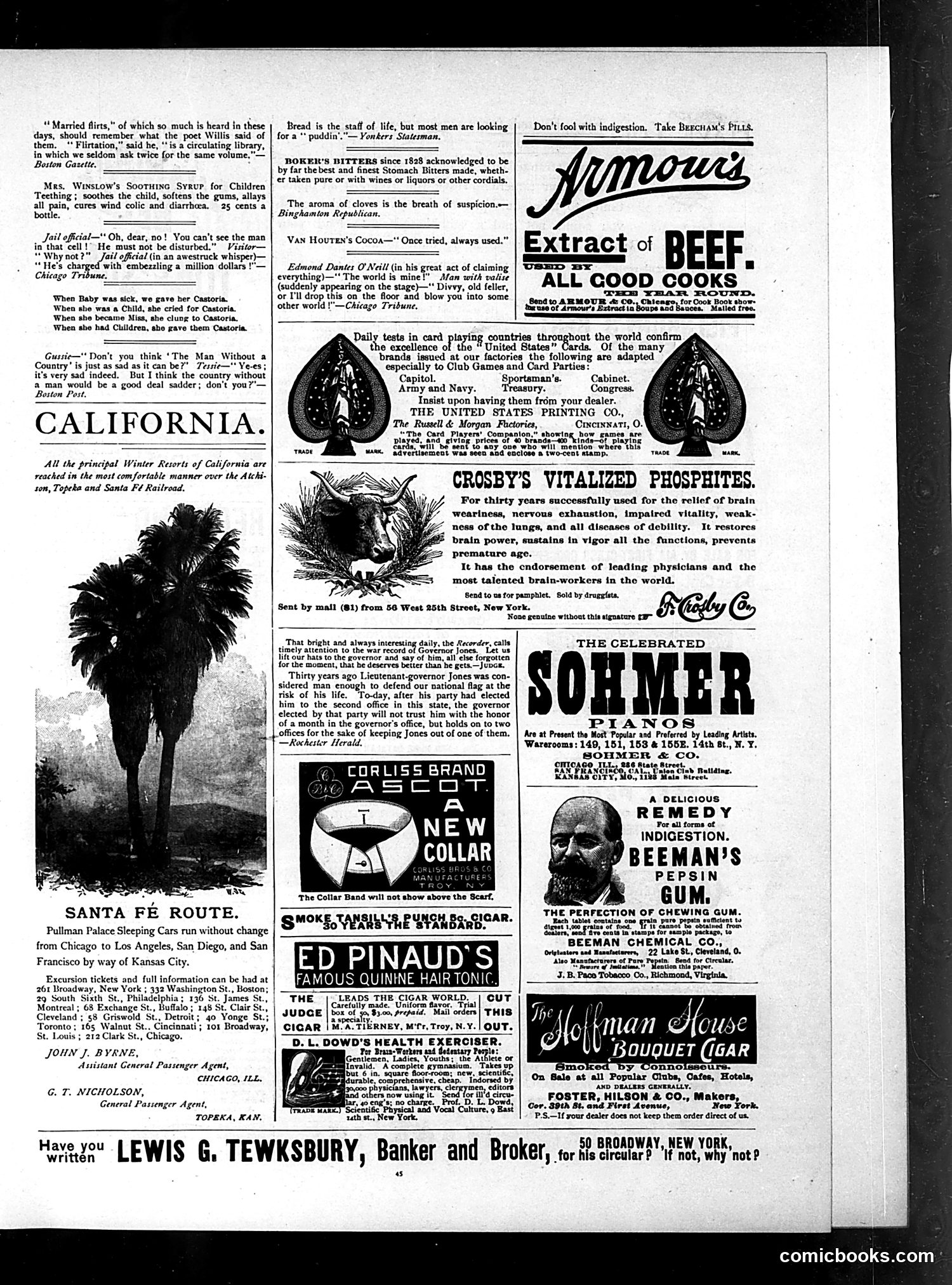
This page is primarily **advertisements and filler humor** rather than political cartoons. The advertisements—for patent medicines (Crosby's Phosphites, Beeman's Pepsin Gum), tonics, cigars, and railways—dominate the layout. The brief text items are social humor jokes typical of the era: - A quip about "married flirts" being like circulating libraries - A jail official joke playing on the irony that an embezzler must not be "disturbed" - A gender-role joke: "The Man Without a Country" is sad, but "the country without a man would be sadder" The California section promotes the Atchison, Topeka & Santa Fé Railroad's winter travel routes—typical commercial content. The theater reference to "Edmond Dantes O'Neill" appears to be a theatrical in-joke rather than political satire. **Overall:** This appears to be a standard advertising-heavy issue rather than one focused on political commentary or notable cartoons.
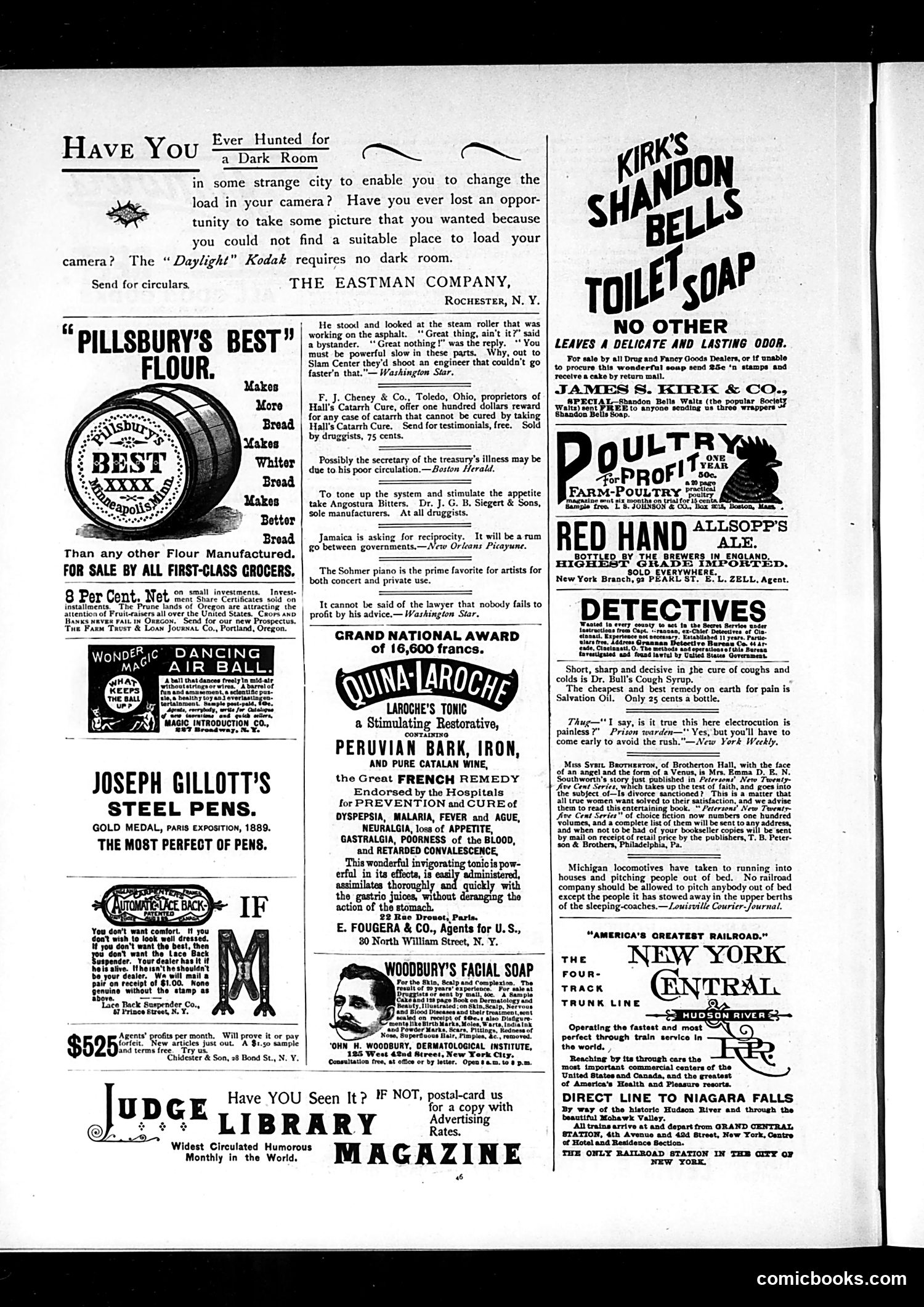
This page from Judge magazine is primarily **advertising**, not political satire. It showcases consumer products typical of the 1890s era. The advertisements include: - **Kodak cameras** (promoting "Daylight" film requiring no darkroom) - **Pillsbury's Best Flour** - **Joseph Gillott's Steel Pens** (gold medal winner) - **Laroche's Tonic** (a patent medicine containing Peruvian bark and iron) - **Hall's Catarrh Cure** - **Woodbury's Facial Soap** - **New York Central Railroad** (promoting Hudson River service to Niagara Falls) The only satirical content appears as brief one-liners scattered between ads—humorous quips about steam rollers, treasury secretaries' circulation problems, and lawyers. These are generic jokes rather than political commentary. The page reflects the magazine's revenue model: Judge sustained itself through advertising while maintaining its reputation as "the widest circulated humorous monthly in the world."
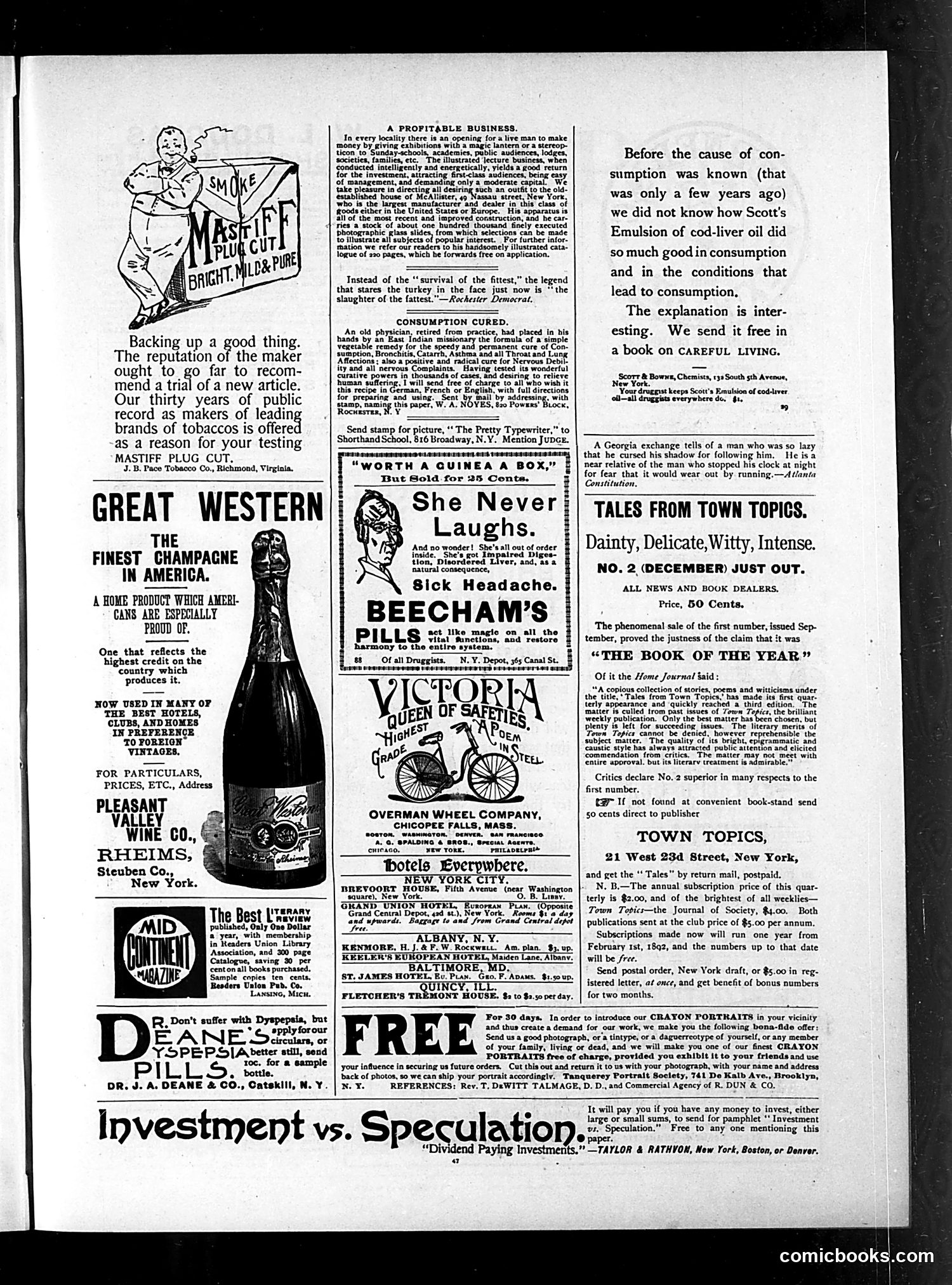
This page is primarily **advertising**, typical of Judge magazine's business model. The content includes: **Main Advertisements:** - Mastiff Plug Cut tobacco (leveraging 30 years of reputation) - Great Western Champagne (emphasizing American product pride) - Pleasant Valley Wine Company - Beecham's Pills (for "sick headache") - Various hotel listings and patent medicine ads **Notable Content:** The page includes a brief text item about a Rochester Democrat quote regarding turkeys facing "slaughter of the fattest" rather than "survival of the fittest"—a darkly humorous reference to holiday season slaughter practices. **Social Context for Modern Readers:** This reflects Gilded Age America's patent medicine culture (dubious "consumption cures"), aggressive advertising in humor magazines, and the normalization of alcohol and tobacco promotion. The emphasis on "American" products over "foreign" reflects period nationalist sentiment. The page demonstrates how Judge subsidized humor content through extensive paid advertising.
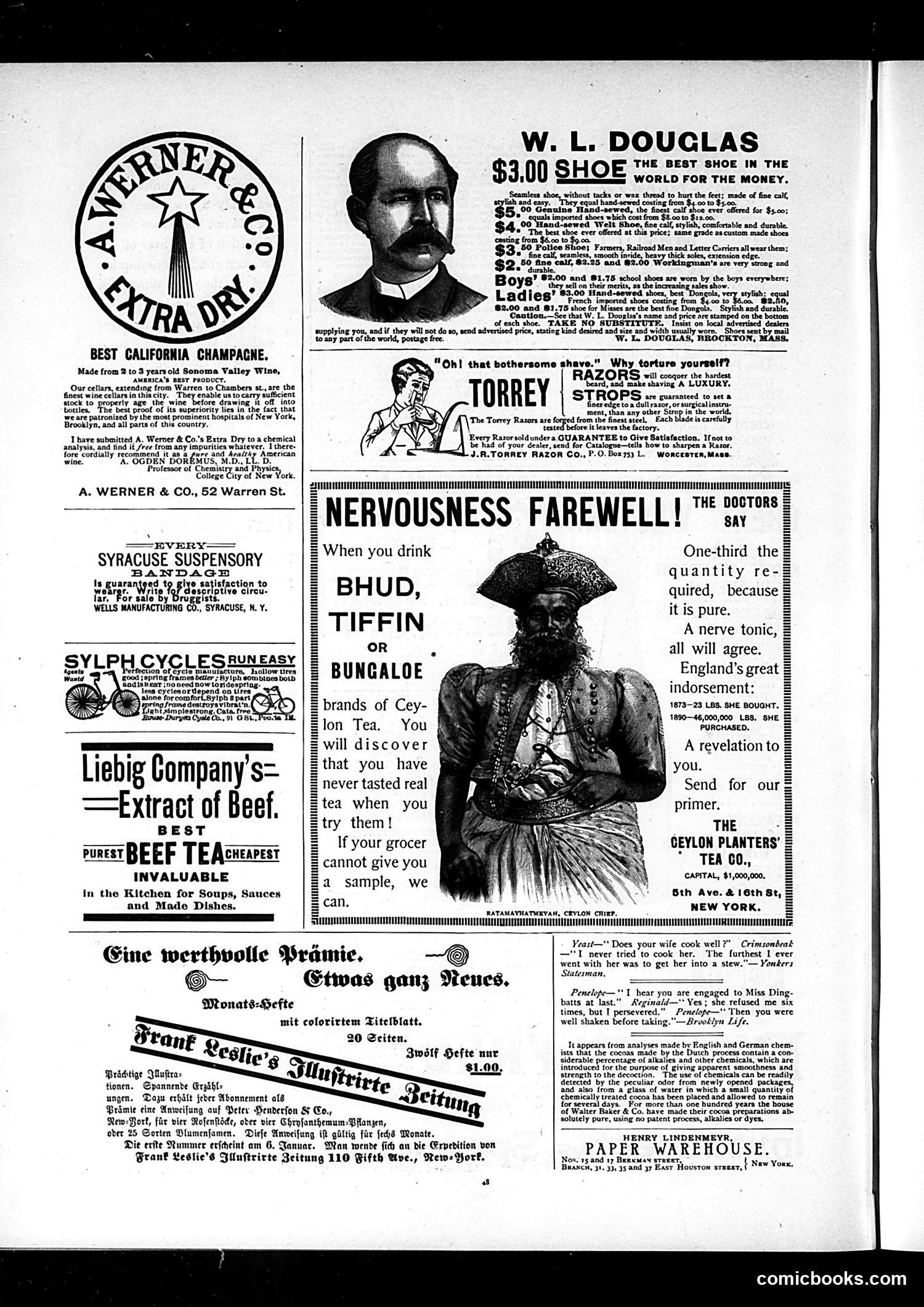
This page is primarily **advertising**, with minimal satirical content. The main advertisements include: **W.L. Douglas Shoes** dominates the upper right with a portrait of the shoe manufacturer, promoting "$3.00 shoes" as "the best shoe in the world for the money"—a common late-19th-century sales pitch emphasizing quality and value. **Torrey Razors** features a cartoon man suffering whisker irritation, with copy playing on male grooming anxieties ("Oh! that bothersome...torture yourself?"). The joke hinges on the product solving a relatable problem. **Ceylon Planters' Tea** uses an orientalist image of a Ceylonese woman to sell tea as a "nerve tonic," reflecting period assumptions about women's nervousness and exotic products as remedies. Other ads include champagne, bicycles, beef extract, and a German-language publication. The single joke at bottom ("Yeast—Does your wife cook well?") is fragmentary in this OCR. **Overall**: This is a typical Judge page where advertising revenue—not satire—dominates the layout.
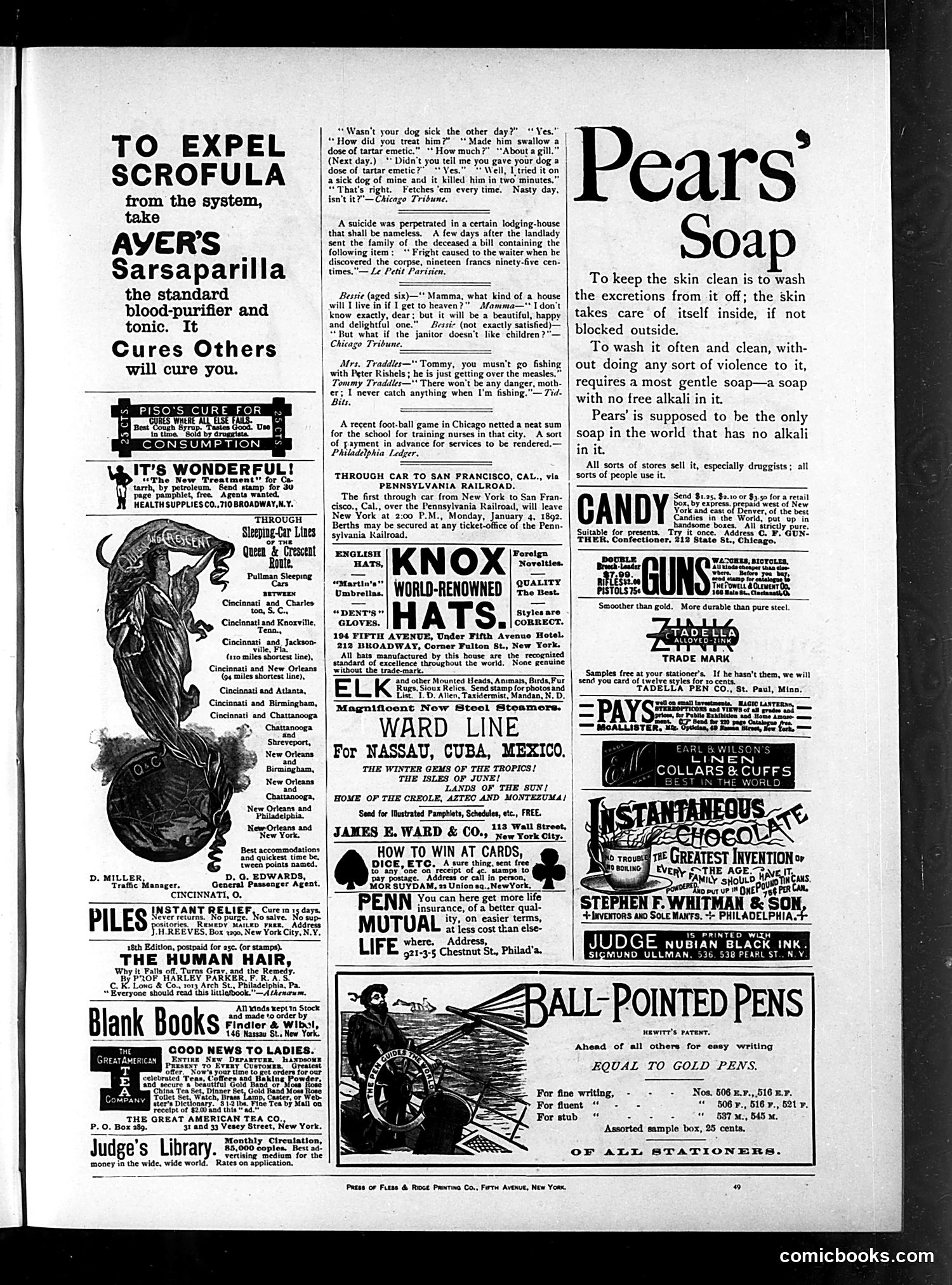
This page is primarily **advertisements**, not political cartoons. Judge magazine was a satirical weekly, but this particular page contains mostly commercial ads for patent medicines, travel services, and consumer goods typical of the 1890s era. The few editorial items are brief anecdotes rather than political commentary: - A **dark joke about tartar emetic** (a poison used medically)—an example of casual Victorian gallows humor - A **French anecdote mocking landlord greed**, charging bereaved families for "fright" caused by discovering a corpse - **Children's comic dialogue** about heaven and fishing The rest is advertising: Ayer's Sarsaparilla (a patent "blood-purifier" for scrofula), Piso's consumption cure, railroad sleeping cars, Pears' Soap, Knox hats, and Judge's Library magazine subscription. These ads reveal period anxieties about disease, travel, and consumer status—but contain no discernible political satire or caricature.
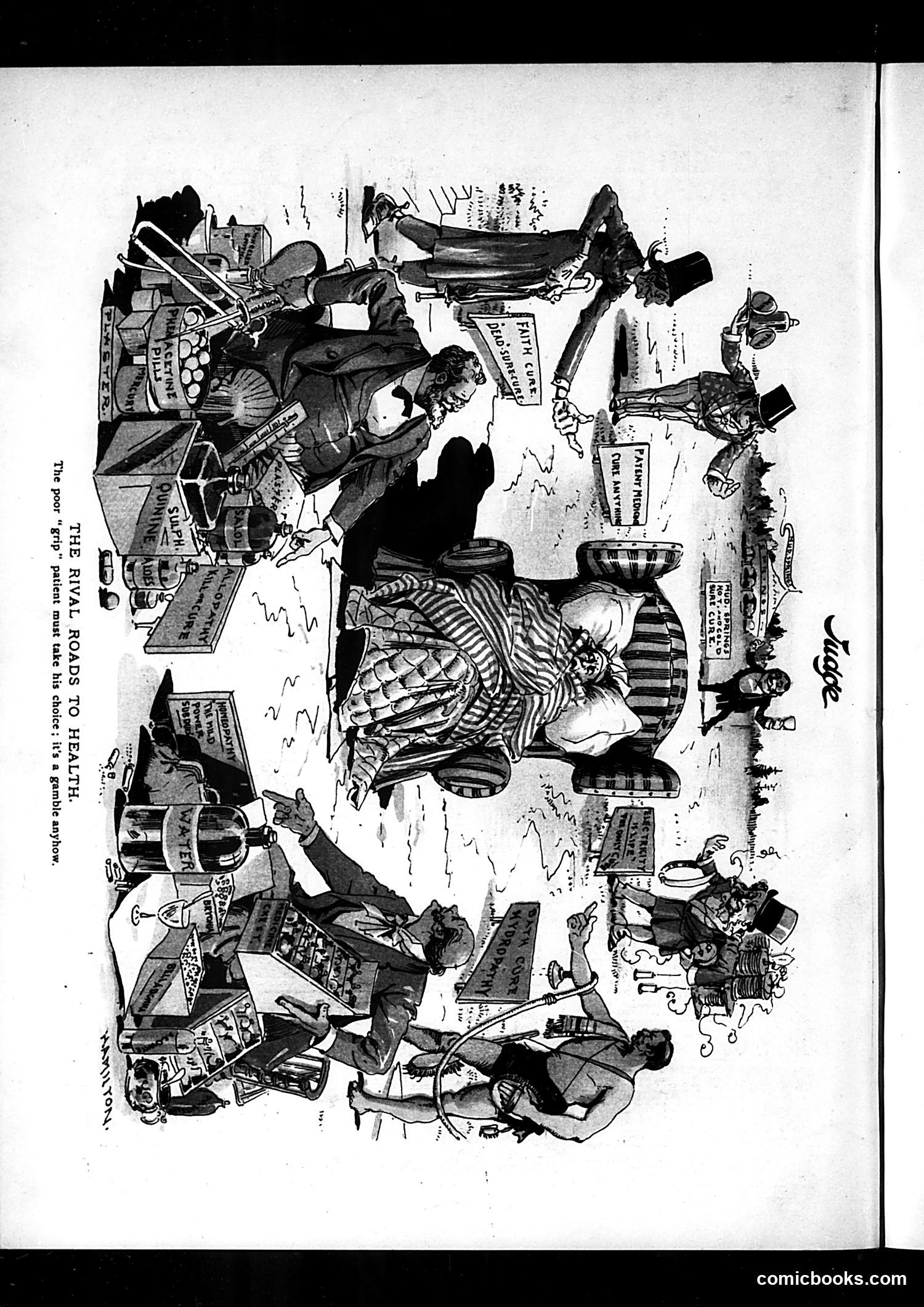
I cannot reliably read the OCR text on this page—it appears corrupted or reversed. While I can see this is a satirical illustration featuring a central figure in striped clothing surrounded by smaller figures and what appear to be labeled boxes or documents, I cannot confidently identify the specific individuals caricatured, the political events referenced, or the intended satire without legible text. To properly explain this cartoon's meaning to a modern reader, I would need either: clear OCR text, the publication date, or the cartoon's title. Without these, identifying the figures and historical context would require speculation, which violates the accuracy-first approach requested. If you can provide a clearer text version or additional publication details, I can offer a proper analysis.