
A complete issue · 18 pages · 1891
Judge — November 21, 1891
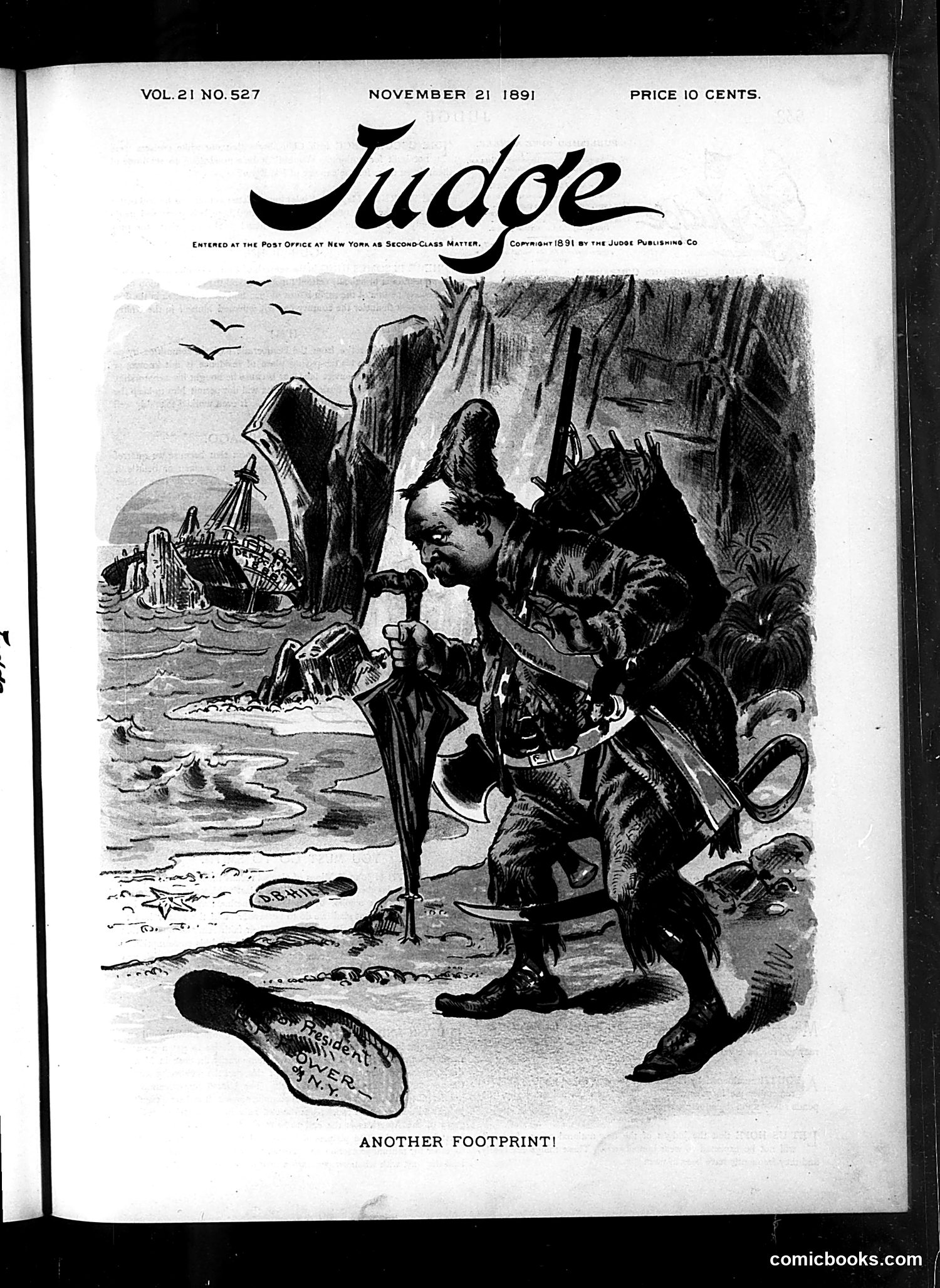
This political cartoon depicts a figure examining a footprint on a beach, with a wrecked ship visible in the background. The title "Another Footprint!" suggests discovery of evidence—likely referencing a contemporary scandal or political controversy. The caricatured style and nautical setting suggest this relates to a shipwreck or maritime disaster of 1891. The figure's formal military or official dress indicates he represents an authority investigating the incident. Without additional context from the magazine's other content, the specific event remains unclear. However, the cartoon appears to satirize either governmental incompetence in investigating the disaster or the discovery of incriminating evidence implicating officials. The "footprint" metaphor suggests uncovering hidden culpability.
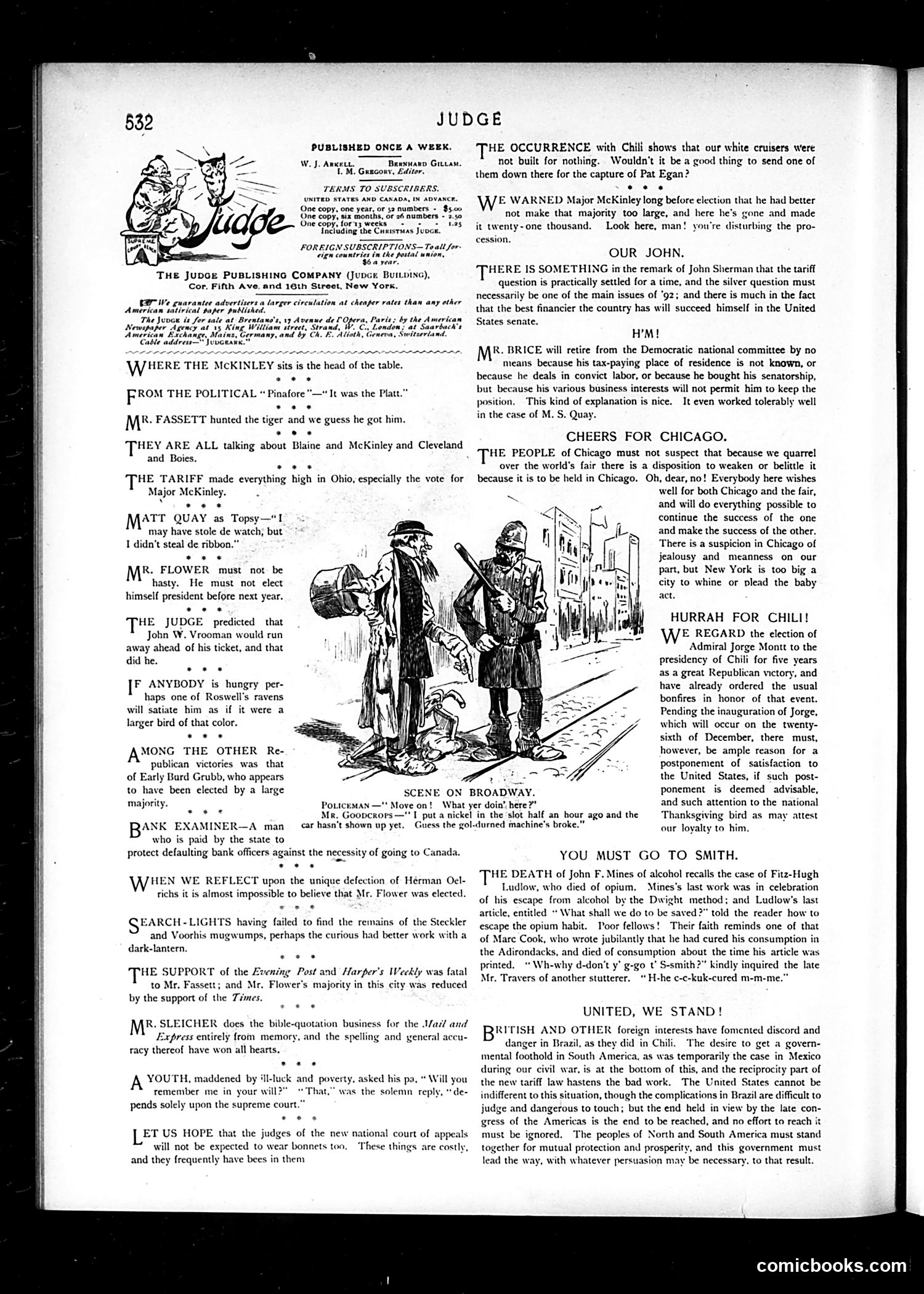
This page contains political commentary from the McKinley era (referenced multiple times). The main cartoon, "Scene on Broadway," depicts three figures on a city street, likely commenting on urban social conditions or political corruption. The text discusses: - McKinley's tariff policies and their effects on Ohio voters - Republican victories, including Admiral Dewey's election to the Chili presidency - Criticism of various political figures (Flower, Fassett, Sleicher) - International affairs, mentioning Brazil and Mexico The satirical tone targets Democratic opposition to McKinley's policies while defending Republican economic positions. References to "the Steckler and Veazie murders" and broader social issues suggest commentary on crime and governance. The overall thrust appears to be pro-Republican partisan satire typical of Judge's editorial stance during this period.
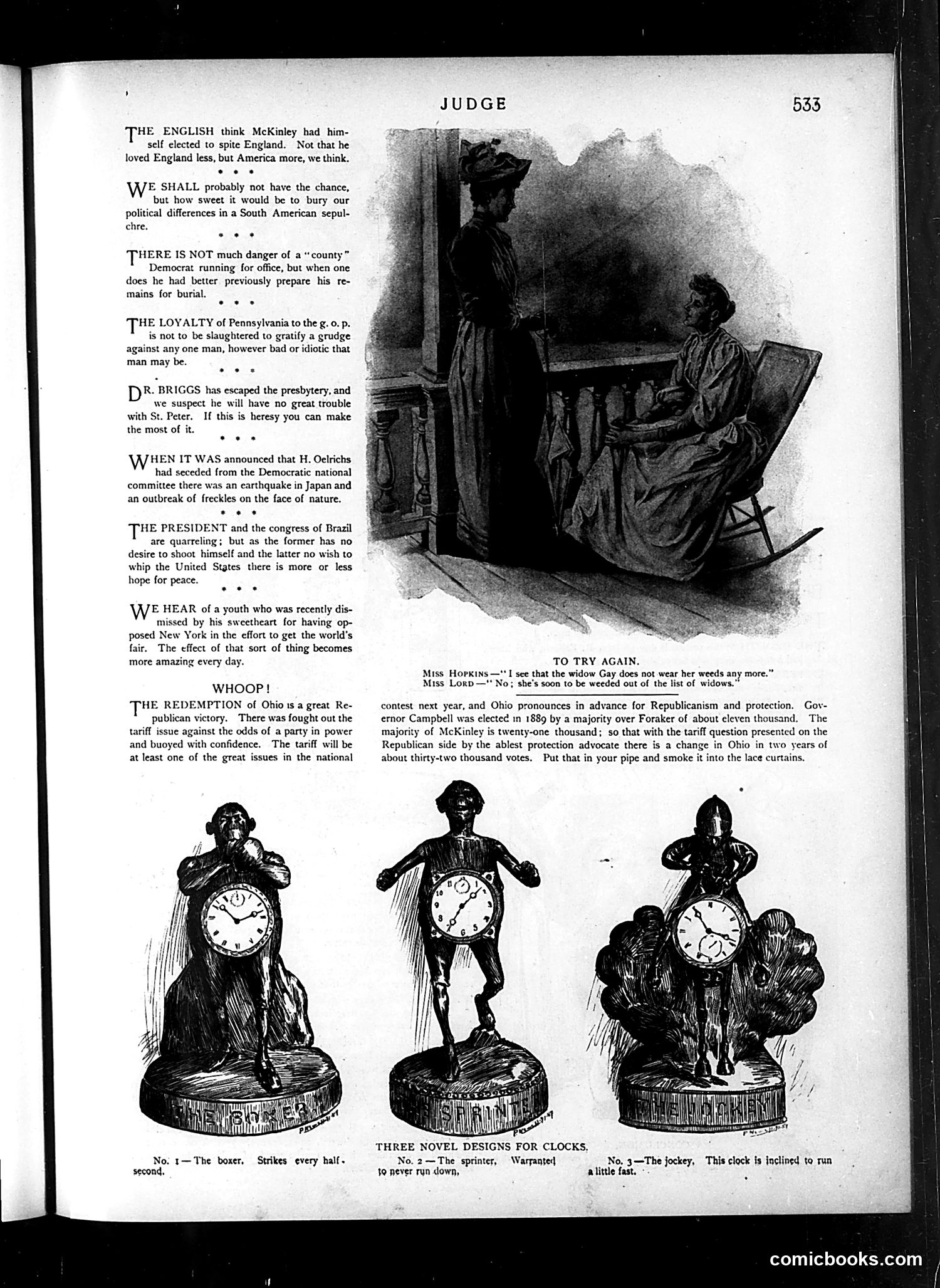
The page contains political commentary and a satirical illustration titled "To Try Again," depicting two women in conversation. The caption quotes Miss Hopkins saying the widow Gay doesn't wear her weeds (mourning clothes) anymore, with Miss Lord replying she'll soon be "weeded out of the list of widows"—likely mocking remarriage prospects or social standing. The lower section discusses Ohio politics, mentioning Governor Campbell's election in 1889 and McKinley, referencing Republican tariff policy debates. Three novelty clock designs at the bottom appear decorative rather than satirical. The page's upper text comments on McKinley, Pennsylvania politics, and Brazilian affairs, suggesting this is from the 1890s Republican era when McKinley and tariff issues dominated American political discourse.
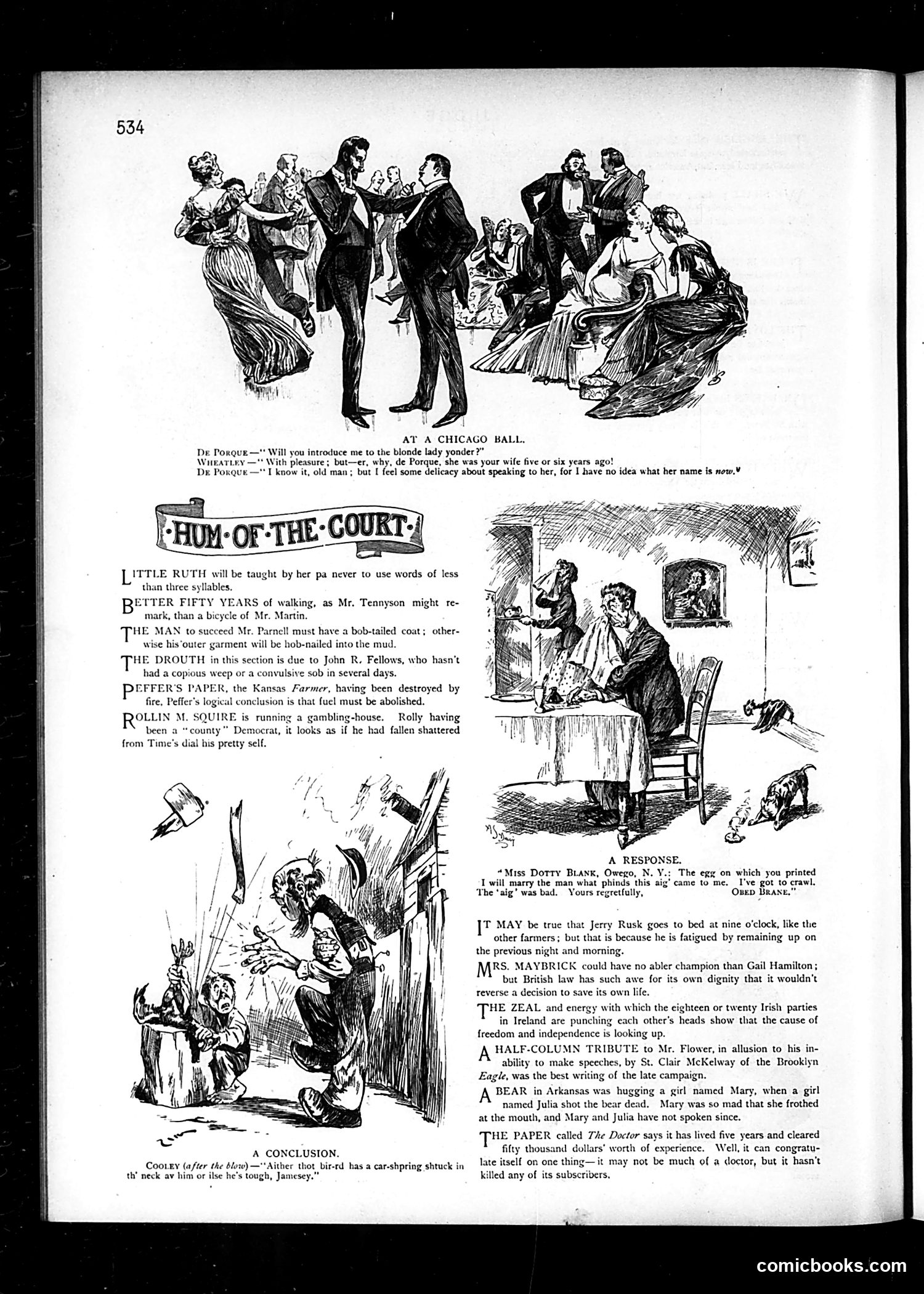
This page collects brief satirical items typical of Judge's humor. The main cartoon, "At a Chicago Ball," mocks the fluidity of identity and marriage in the Gilded Age—a man encounters his ex-wife at a social event but claims not to recognize her, suggesting either deliberate coldness or that remarriage has made her identity uncertain to him. The surrounding "Hum of the Court" section contains short quips targeting contemporary figures: Parnell (Irish nationalist leader), Jerry Rusk (likely politician), Mrs. Maybrick (likely the famous murder case), and Irish political factions. One item references a Kansas newspaper editor named Peffer. The satirical approach is consistent: mocking politicians' incompetence, lampooning social pretension, and finding dark humor in current events. The cartoons use exaggerated illustration to reinforce the verbal jokes. The tone is irreverent toward authority and celebrates cynical worldview—typical of Judge's irreverent 1880s-90s sensibility.
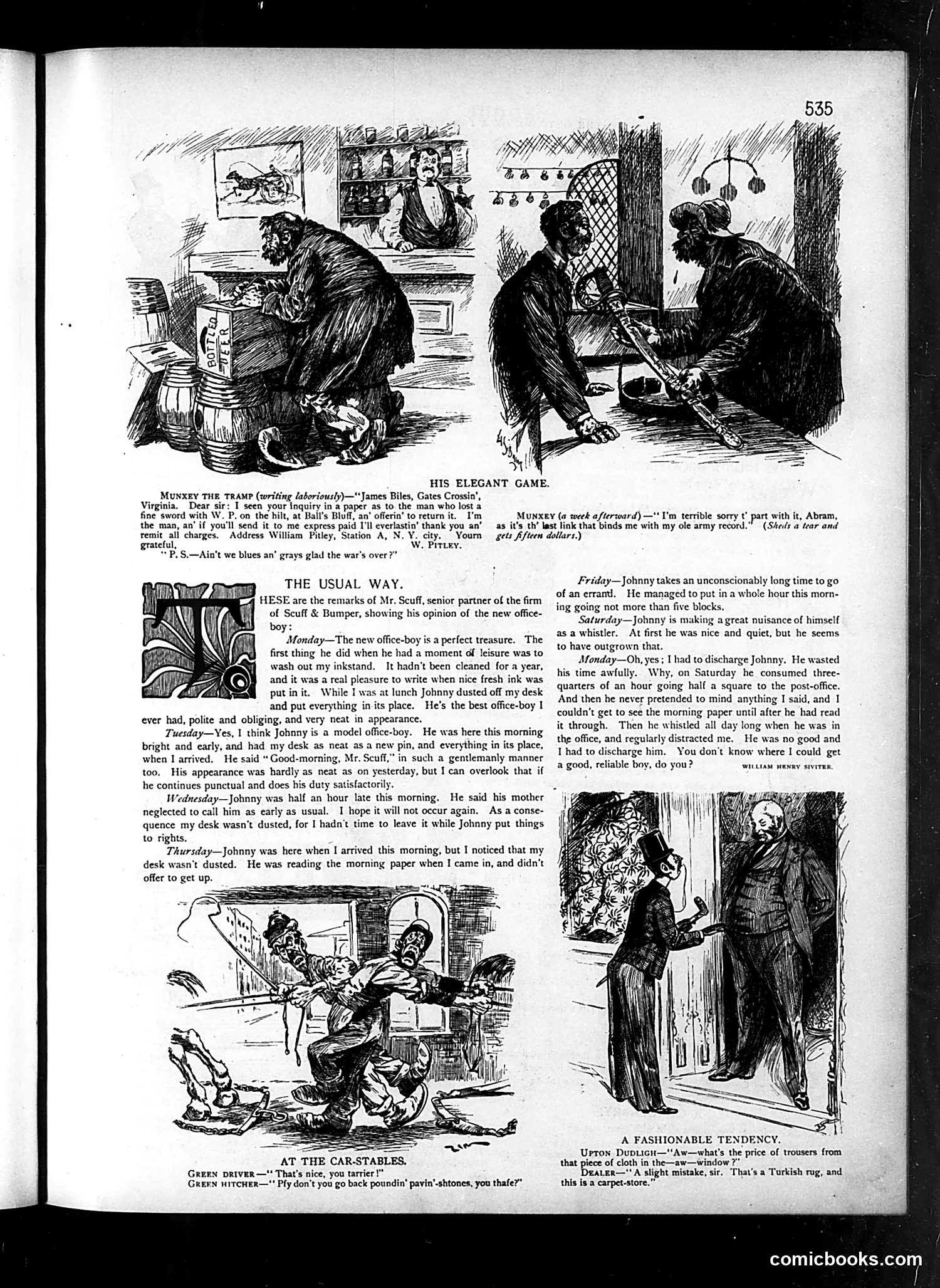
This page contains multiple satirical sketches reflecting late 19th-century American concerns: **"His Elegant Game"** mocks a tramp's attempt at literary con artistry—writing a fake letter claiming to return a lost Civil War sword ("W.P.") to extract reward money, signing it with the same initials. The post-script's sentimental reference to "blues an' grays" (Union and Confederate soldiers) adds cruel irony to his scheme. **"The Usual Way"** satirizes employer fickleness through Mr. Scuff's changing opinions of his new office boy Johnny over a week. The boy starts exemplary but gradually appears lazier, yet the employer's standards drop correspondingly—revealing how bosses rationalize mediocre employee performance rather than address it directly. **"At the Car-Stables"** appears to be ethnic humor involving Irish workers. **"A Fashionable Tendency"** jokes about urban pretension: a fashionable gentleman mistakes a Turkish rug for cloth, exposing his ignorance despite his affected mannerisms. The sketches collectively critique working-class schemes, employer hypocrisy, and nouveau-riche affectation.
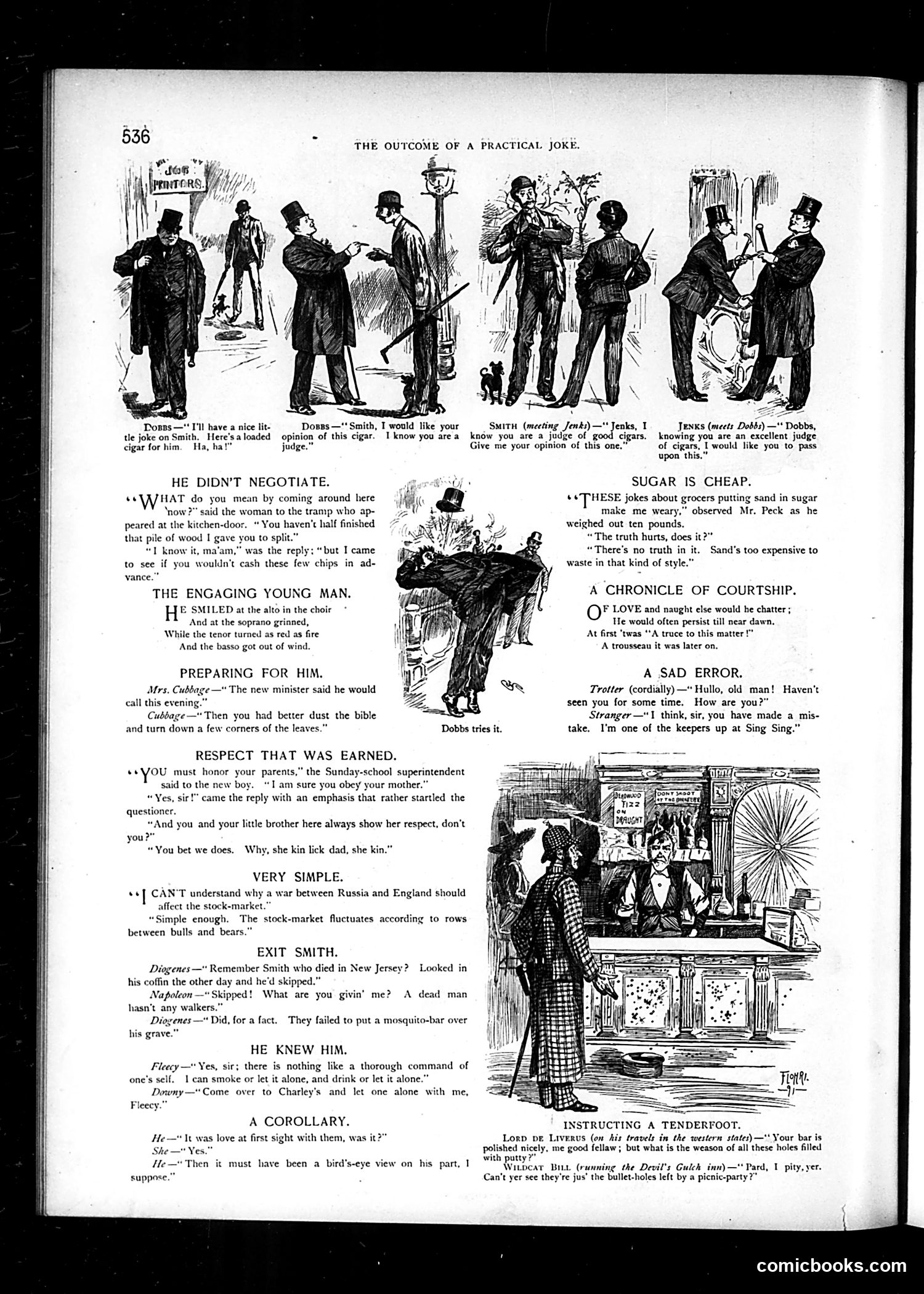
This page collects short humorous anecdotes and jokes typical of late 19th-century *Judge* magazine. The sketches satirize everyday social situations: **"A Practical Joke"** depicts men passing around a cigar, each claiming expertise as a "judge" to avoid honest criticism—poking fun at social pretense. **"Sugar is Cheap"** mocks grocer-fraud urban legends; a customer notes sand adulteration is too expensive to bother with, deflating the sensational scandal. **"Exit Smith"** contains a classical reference: Diogenes searches for an honest man; the joke plays on "walkers" (removable pallbearers) and mosquito netting over graves—absurdist humor. **"Instructing a Tenderfoot"** stereotypes Western frontier violence. An inexperienced traveler learns bullet holes in a saloon bar supposedly came from a "picnic party"—exaggerating the Old West's lawlessness for comedic effect. Most jokes rely on wordplay, social pretension, or exaggeration rather than specific political content. The page reflects middle-class Victorian humor values.
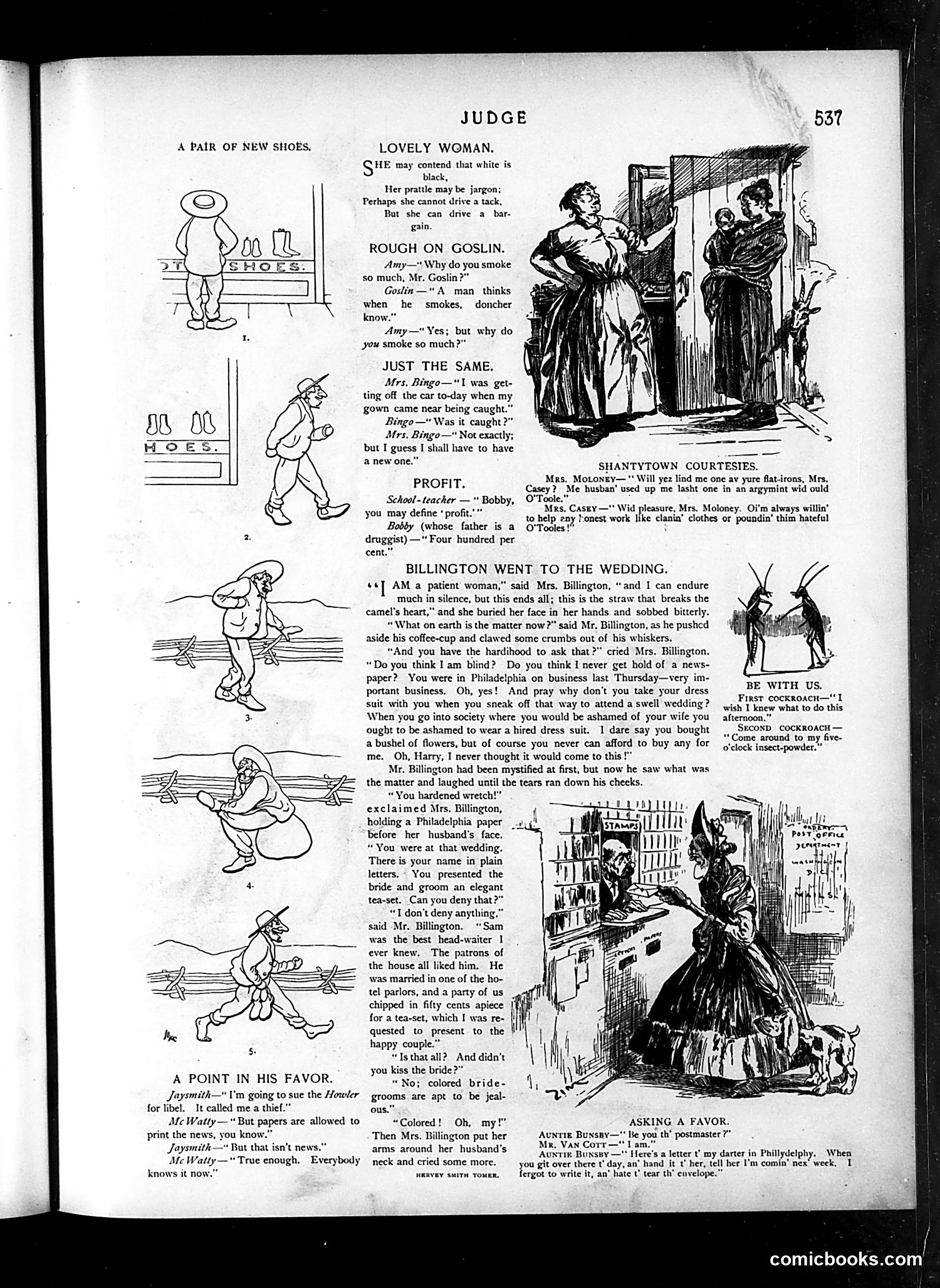
This page contains multiple brief humorous sketches typical of late 19th/early 20th-century American satire: **"Lovely Woman"** mocks women's negotiating skills—she cannot perform practical tasks but excels at "driving a bargain" (getting deals). **"Rough on Goslin," "Just the Same," and "Profit"** are brief domestic jokes: a man smokes excessively, a woman needs a new dress after a near-accident, and a druggist's son defines profit at an inflated rate. **"Billington Went to the Wedding"** satirizes class consciousness: Mr. Billington wore a rented suit to a Philadelphia wedding, embarrassing his wife who discovered his name in the society pages. The twist reveals he'd actually been a guest honoring his former waiter's wedding—a sentimental gesture she initially misinterpreted as social climbing. **"Shantytown Courtesies"** uses Irish-accented dialect to portray working-class women borrowing household items, common in tenement communities. The remaining sketches are brief one-liners about libel law and postal delivery. The humor relies on domestic situations, class pretensions, and ethnic stereotypes typical of the era.
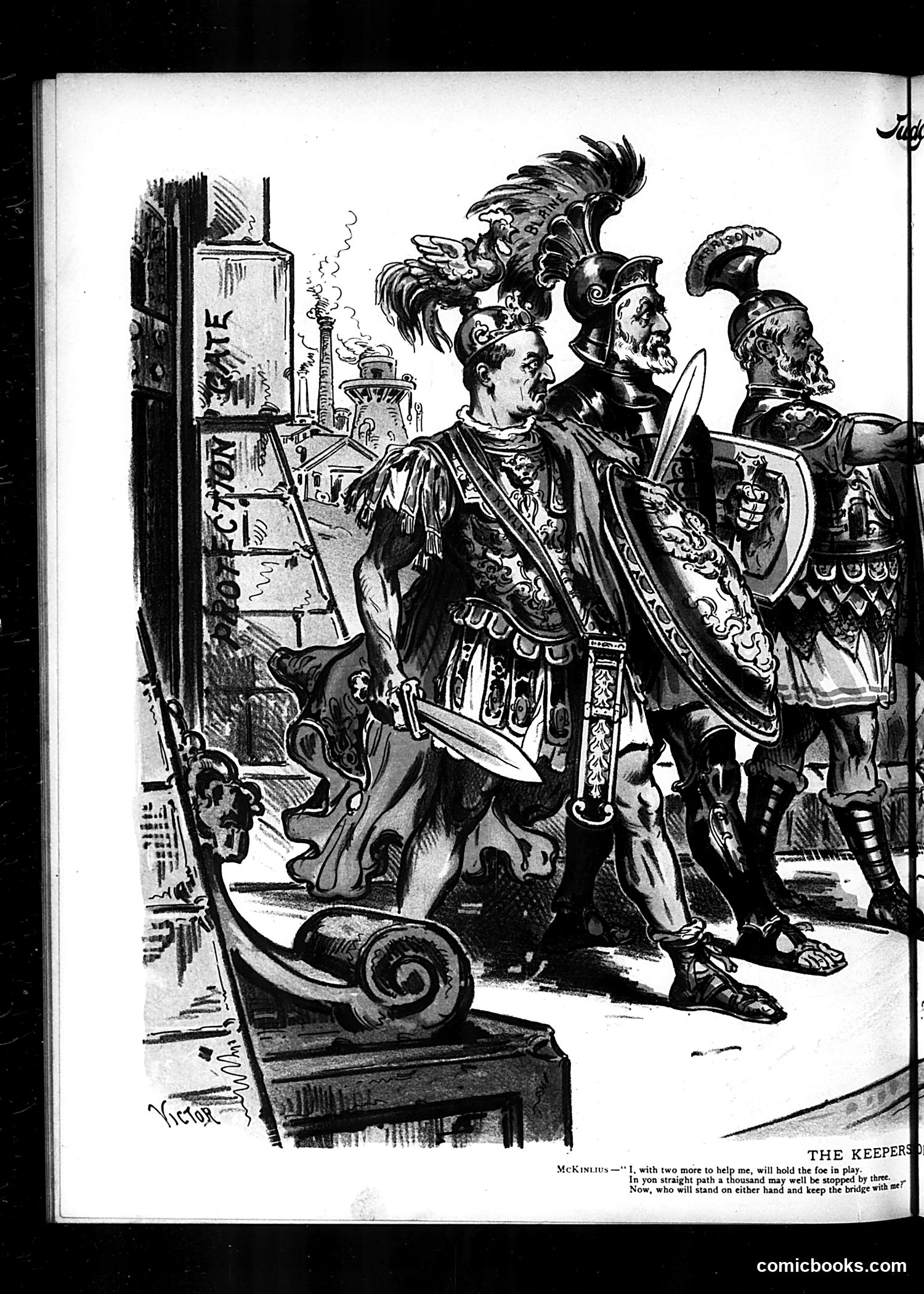
This political cartoon depicts four military or political figures in ornate uniforms and armor, apparently guarding or defending something. The caption references McKinley (likely President William McKinley) saying "with two more to help me, will hold the foe in play" and mentions stopping "a thousand" enemies "in you straight path" and keeping "the bridge with me." The satire appears to criticize McKinley's military strategy or diplomatic positioning, suggesting he needs additional support to maintain his position against opposition forces. The "bridge" likely represents a strategic or political boundary he's attempting to defend. The elaborate military dress and dramatic posturing suggest mockery of inflated military rhetoric or overconfidence in America's strategic capabilities during the McKinley era, though without a date visible, the specific conflict referenced remains unclear.
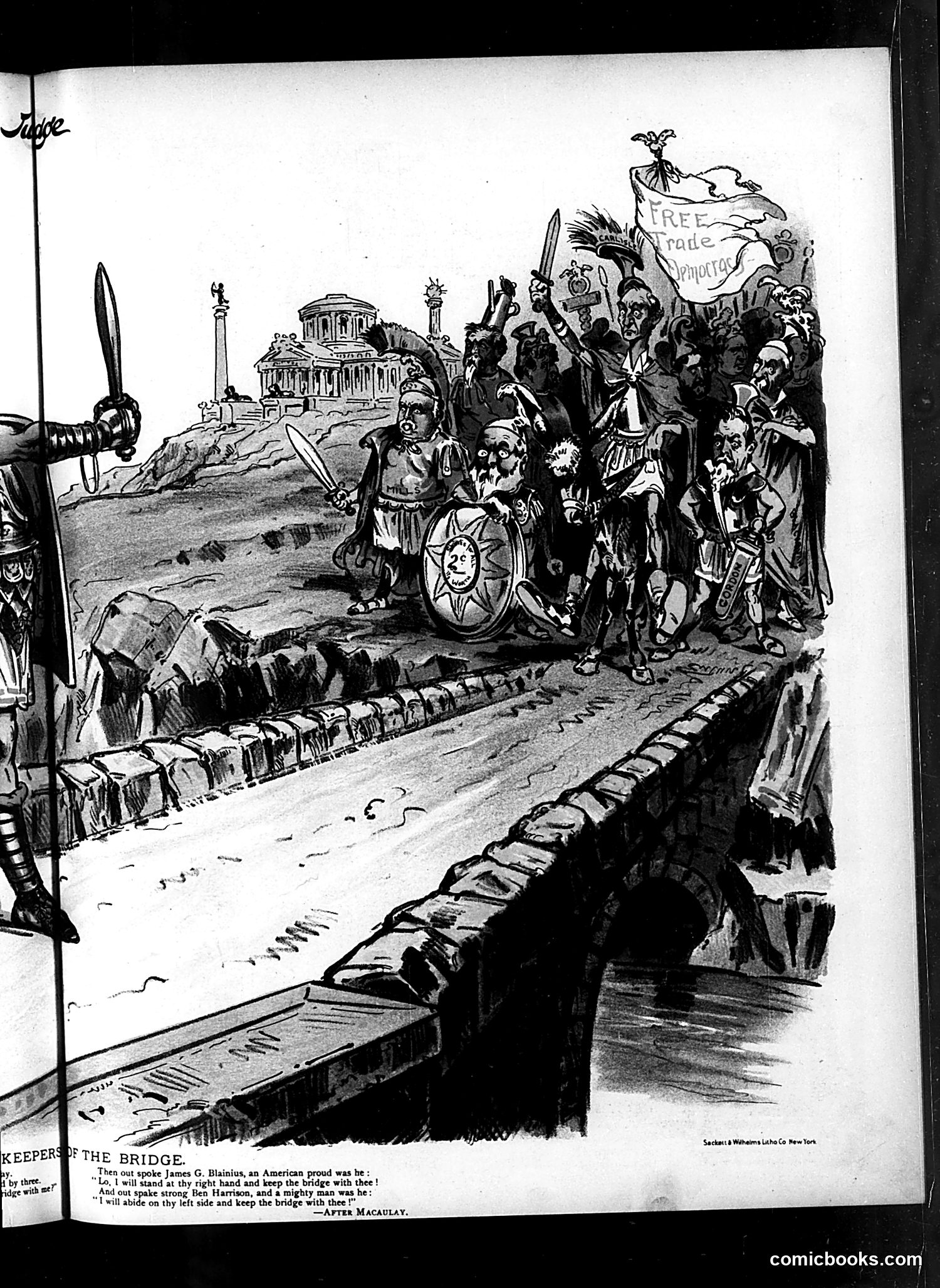
This political cartoon satirizes American leadership during what appears to be a crisis involving national defense or constitutional principles. The classical architectural setting (Capitol dome visible) and the reference to Macaulay's famous poem about defending a bridge suggest the cartoonist is invoking heroic historical precedent. The quote attributes declarations to "James G. Blaine" and "Ben Harrison"—both prominent late-19th century Republican politicians—positioning them as protectors of American values ("the bridge"). The military figures and banner reading "Free Trade" and "Democracy" indicate this concerns economic or political ideology. The satire likely criticizes these politicians for claiming to defend American interests while actually pursuing questionable policies. The cartoon uses mock-heroic classical rhetoric to deflate their pretensions to statesmanship.
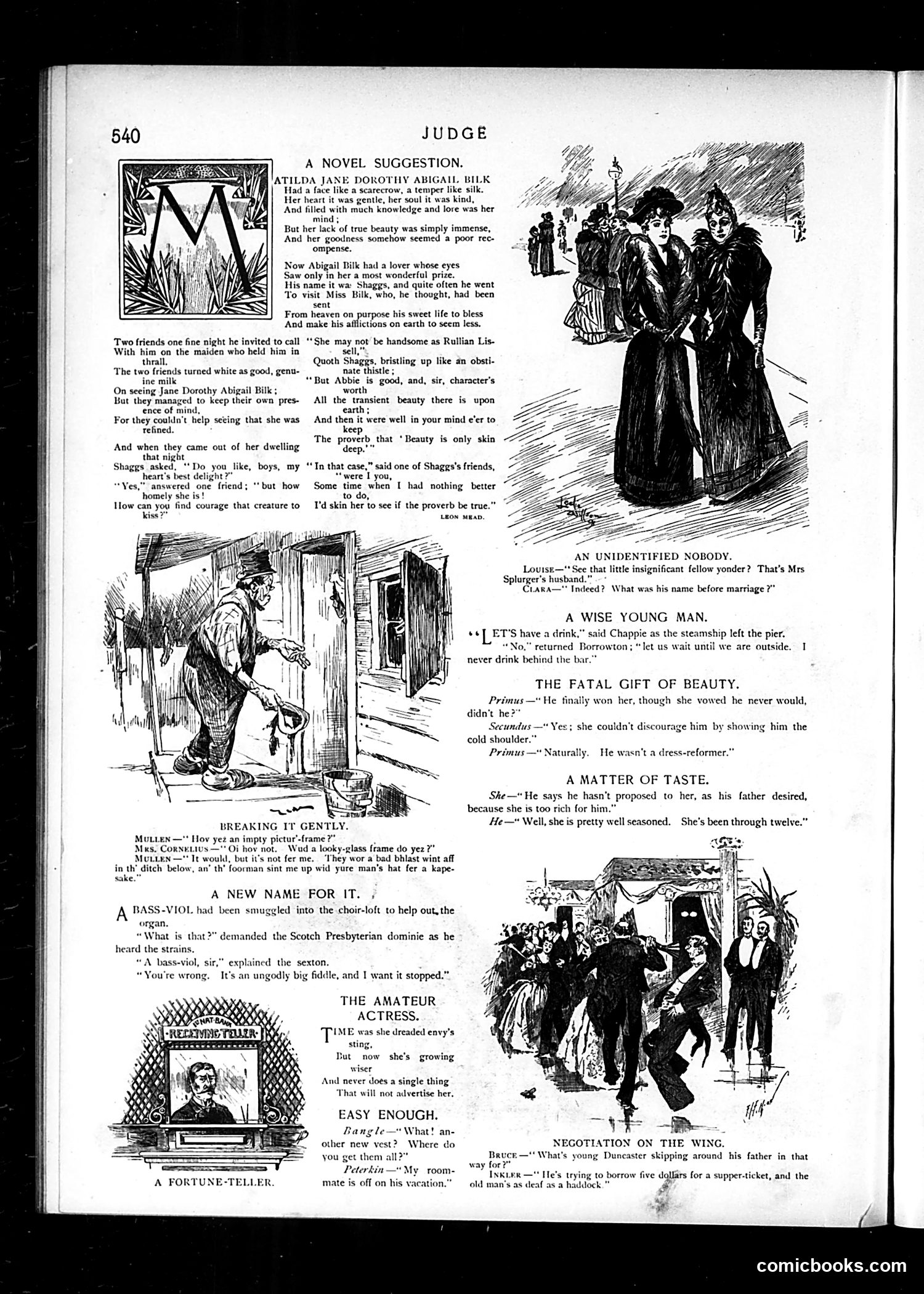
This page contains multiple brief satirical pieces typical of Judge's format: **"A Novel Suggestion"** (main story with illustrations): A poem mocking the saying "beauty is only skin deep." A homely woman named Abigail Bilk has a devoted lover, Shaggs, who values her character over appearance. His friends question how he can kiss her, prompting one to suggest he literally "skin her to see if the proverb be true"—dark humor exposing the hypocrisy of those claiming to value inner beauty while fixating on looks. **Other short pieces** include marriage jokes ("A Matter of Taste" about a woman "seasoned" through twelve relationships), social observation humor (the insignificant husband), and workplace/domestic comedy (the bass-viol confusion, the steamship etiquette joke). The overall theme: satire of Victorian platitudes about character versus beauty, presented through quick, cynical jokes typical of Gilded Age satirical magazines targeting middle-class pretension and hypocrisy.
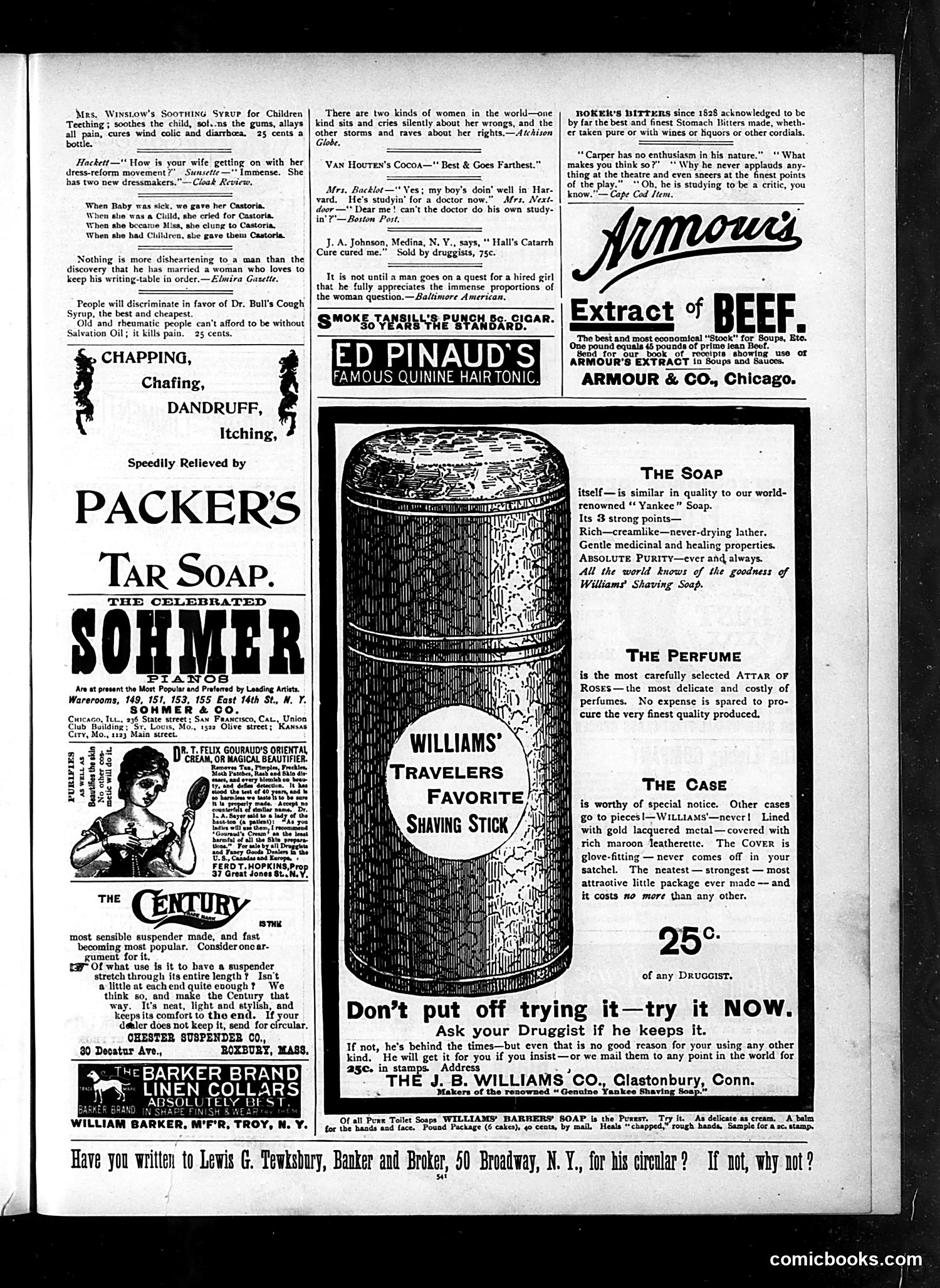
This page is **primarily advertising** with minimal satirical content. The brief humorous items are: 1. **"Dress-reform movement" joke**: References the contemporary women's dress reform movement (late 1800s), which advocated for less restrictive clothing. The humor is that the woman promoting reform simply hired new dressmakers rather than actually reforming her wardrobe—satirizing superficial activism. 2. **Castoria medicine jingle**: A humorous rhyme about a patent medicine, presented as social commentary on women's dependency (girl cries, woman clings, mother gives to children). 3. **"Woman question" quip**: A satirical observation that hiring domestic servants reveals the complexity of "the woman question"—contemporary debates about women's rights and roles. The page is dominated by **patent medicine and consumer product advertisements** (soap, hair tonic, suspenders, pianos)—typical of Judge magazine's revenue model. These ads reflect Gilded Age consumer culture and dubious health claims now considered fraudulent.
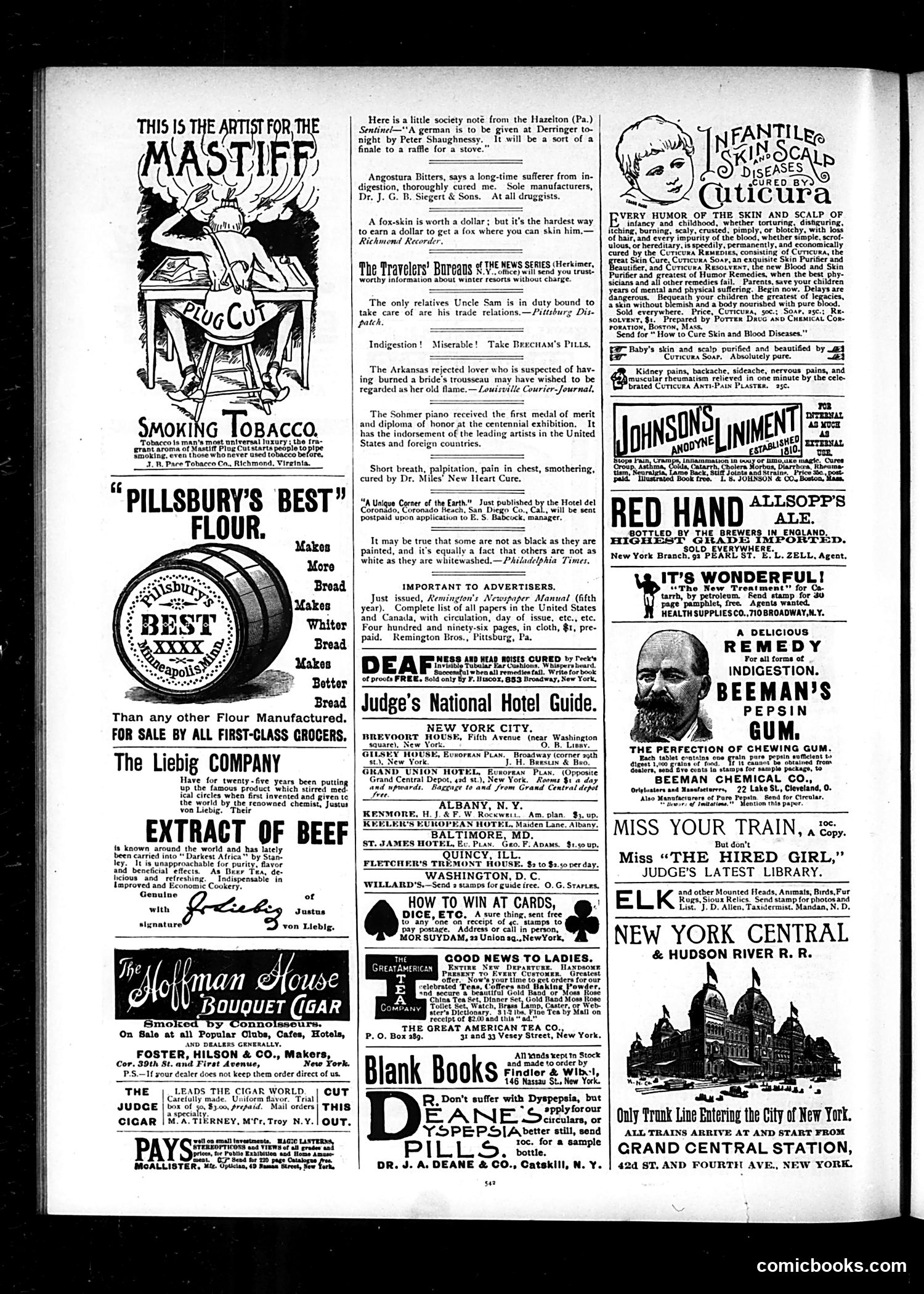
This page is primarily an advertisement section from *Judge* magazine, with only brief satirical content at the top. The main cartoon features "The Mastiff Plug Cut"—a cigar/tobacco advertisement using a caricatured figure, likely representing a German or working-class immigrant based on visual stereotyping of the era, crushed in a cigar cutter. This reflects period attitudes toward immigrants and their association with smoking products. The page includes several short joke items scattered among patent medicine and product advertisements typical of late-nineteenth-century publications. Notable is a quip about Uncle Sam's trade relations and a joke about an Arkansas lover suspected of burning a bride's trousseau. The humor is crude and reflects attitudes of that period, including casual references to German immigrants and domestic violence as comedic material. The overwhelming majority consists of advertisements for remedies (Cuticura, Beecham's Pills, etc.), hotels, and products—the true commercial purpose of the publication.
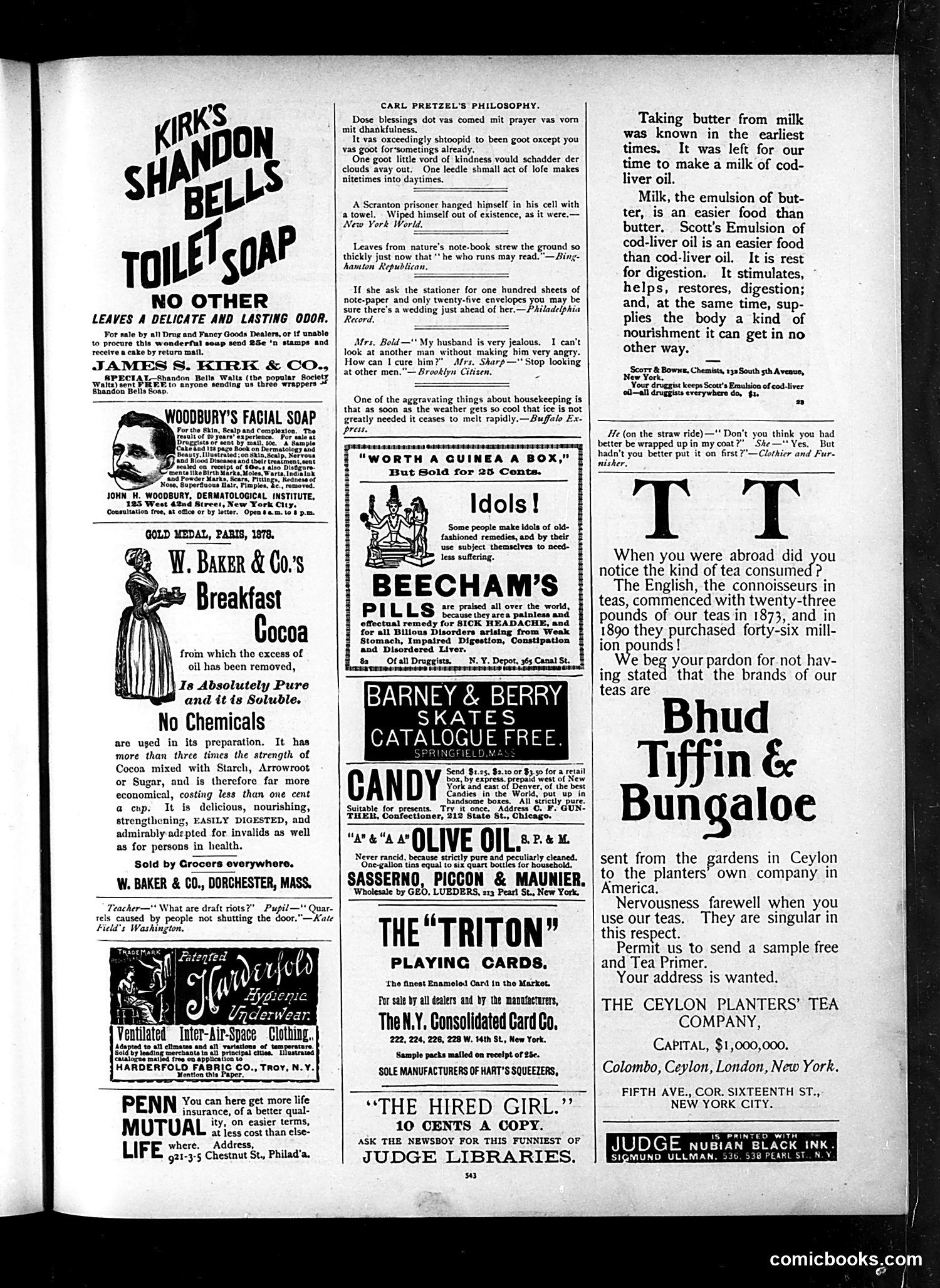
This is primarily an **advertisement page** from Judge magazine, not a political cartoon page. It contains numerous Victorian-era product advertisements typical of late 19th-century magazines. Notable content includes: - **Kirk's Shandon Bells Toilet Soap** (top left) - **Woodbury's Facial Soap** advertisement - **W. Baker & Co's Breakfast Cocoa** (emphasized as chemically pure) - Various other products: playing cards, cocoa, candy, olive oil, skates The page includes one **humorous quote section** titled "Carl Pretzel's Philosophy"—ethnic humor featuring a German-accented character offering folk wisdom and observations about human nature. There's also a small joke about draft riots and a domestic humor exchange between married characters. The page reflects **commercial priorities over editorial content**, showing how Judge balanced satire with revenue through advertisements. The heavy advertising presence indicates the magazine's business model depended significantly on product promotion to affluent readers.
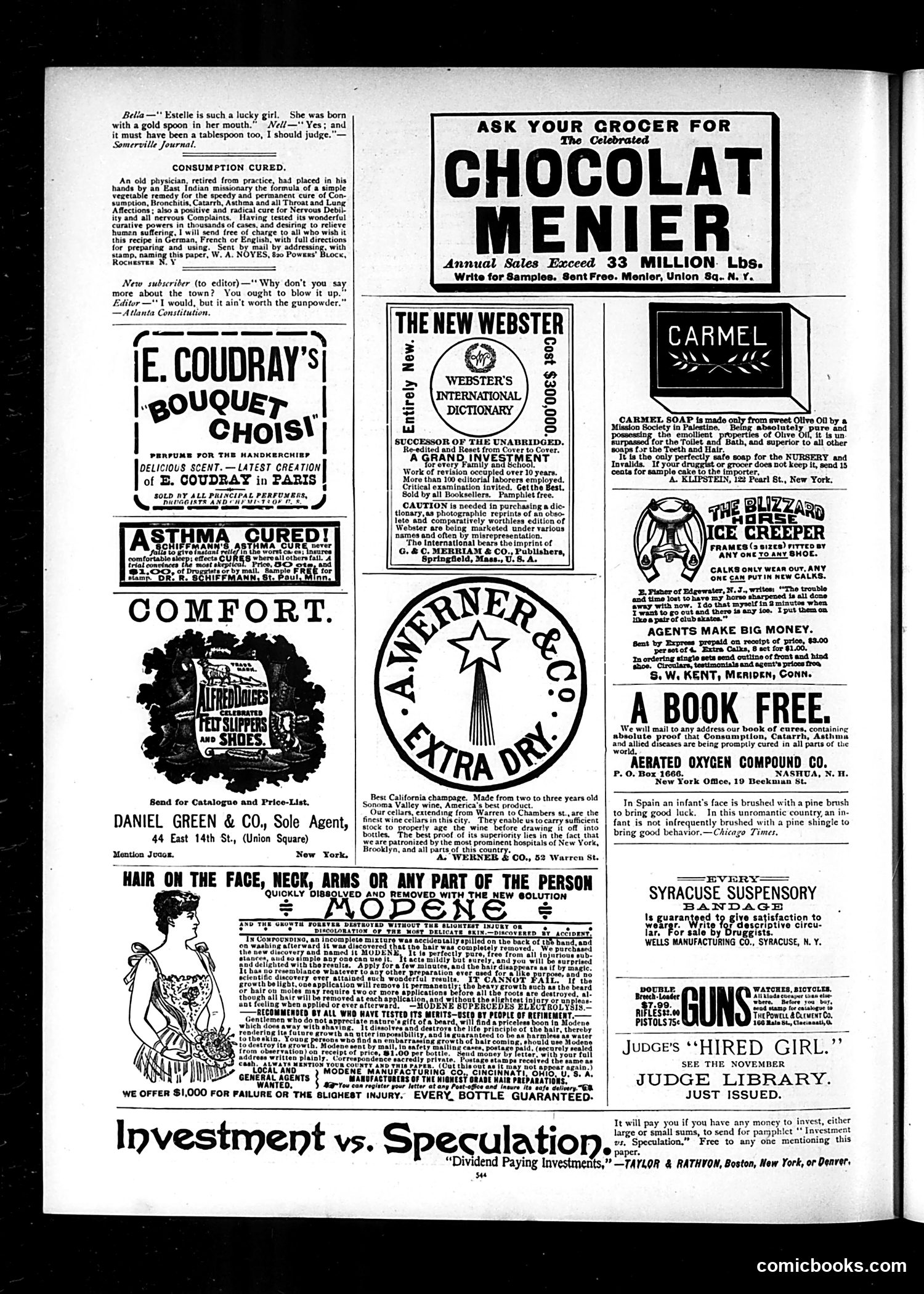
This page consists primarily of **advertisements** interspersed with brief humorous items typical of Judge magazine's satirical style. **The Humor:** Two short jokes appear: one mocking a girl's wealthy birth ("gold spoon"), and another where a newspaper editor dismisses his town as not worth promoting—mild social satire on provincial life and journalism. **The Advertisements:** The page advertises dubious **patent medicines and products** common to the era—remedies for consumption (tuberculosis), asthma, and "nervous debility"; hair-removal solutions; and various commercial goods. These reflect turn-of-the-century American marketing of largely unproven cure-alls. Notably, there's a **warning against counterfeit dictionaries** (Webster's), showing period concerns about intellectual property fraud. The ads reveal what consumers were sold: medical snake oil, foreign perfumes, and imported chocolates—reflecting both American gullibility about health claims and aspirational consumption of European luxury goods. This is representative advertising-heavy magazine content, not primarily political cartooning.
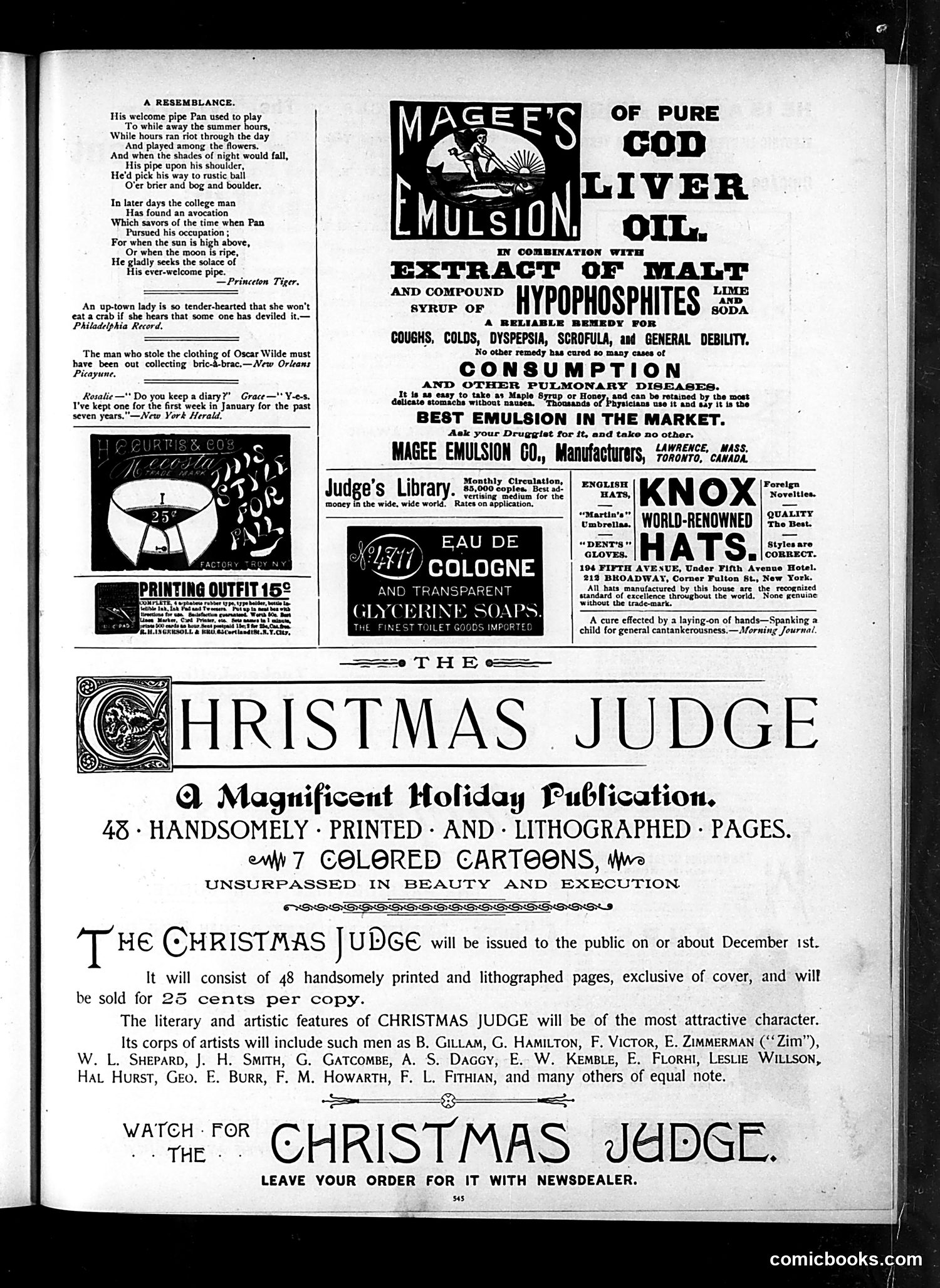
This page is primarily **advertising and promotional content** rather than editorial cartoons. The bulk of the space announces Judge's upcoming Christmas issue (December 1st), a 48-page illustrated holiday publication selling for 25 cents. The top section contains brief **humorous items** typical of Judge's satirical style: - A poem comparing college men's love of pipes to the Greek god Pan's pastoral music-making - Short jokes about tender-hearted ladies, Oscar Wilde's stolen clothing, and women's diary-keeping habits These are **gentle social satire**—poking fun at college culture, sentimental women, and the Oscar Wilde scandal (likely referencing his 1895 imprisonment). The remaining space features **patent medicine advertisements** (Magee's Cod Liver Oil Emulsion, Knox Hats, Eau de Cologne) typical of late-Victorian periodicals, plus prominent promotion of the Christmas Judge issue, listing notable artists like E.W. Kemble. The page reflects Judge's dual function as both satirical publication and commercial advertising vehicle.
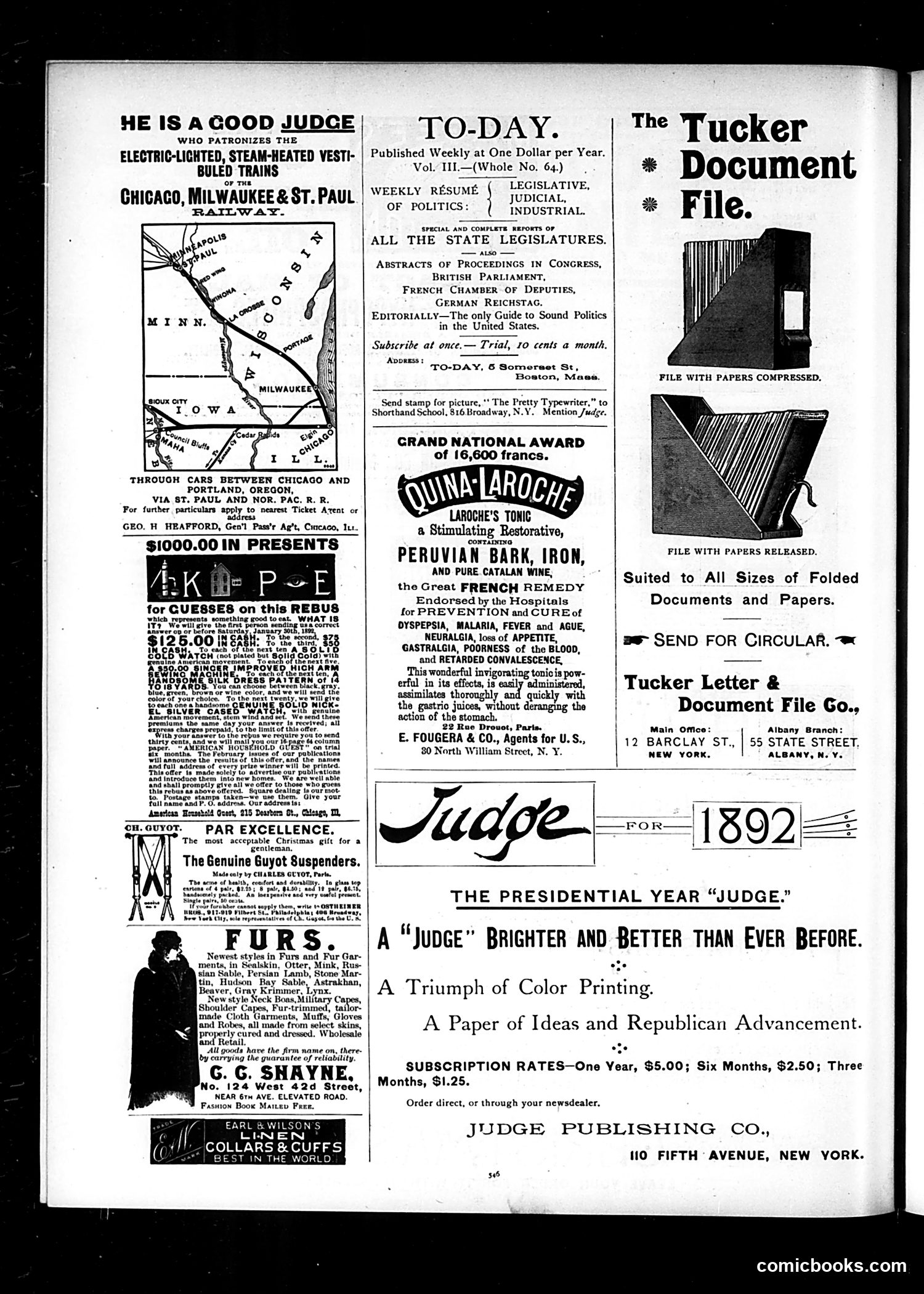
This is primarily a **title/advertising page** for Judge magazine's presidential election issue of 1892, rather than a satirical cartoon page. ## Key Content: **Main Feature**: The masthead "Judge for 1892" announces this as "The Presidential Year 'Judge'" — a special election-year edition. Judge identifies itself as "A Paper of Ideas and Republican Advancement," making its partisan allegiance explicit. **Left Column Ads**: Include railroad service (Chicago-Milwaukee-St. Paul line), a "$1,000 in Presents" contest for "Curios," and advertisements for fur garments, hair products, and suspenders — typical magazine advertising. **Center/Right**: Promotion for "TO-DAY" magazine and the Tucker Document File (a filing product), plus Laroche's Tonic (a patent medicine claiming to cure various ailments through Peruvian bark and iron). **Significance**: The page reflects Judge's role as a **Republican-leaning satirical weekly** during the 1892 election period, alongside mainstream commercial advertising. The magazine's self-promotion emphasizes its political influence and "sound politics" guidance.
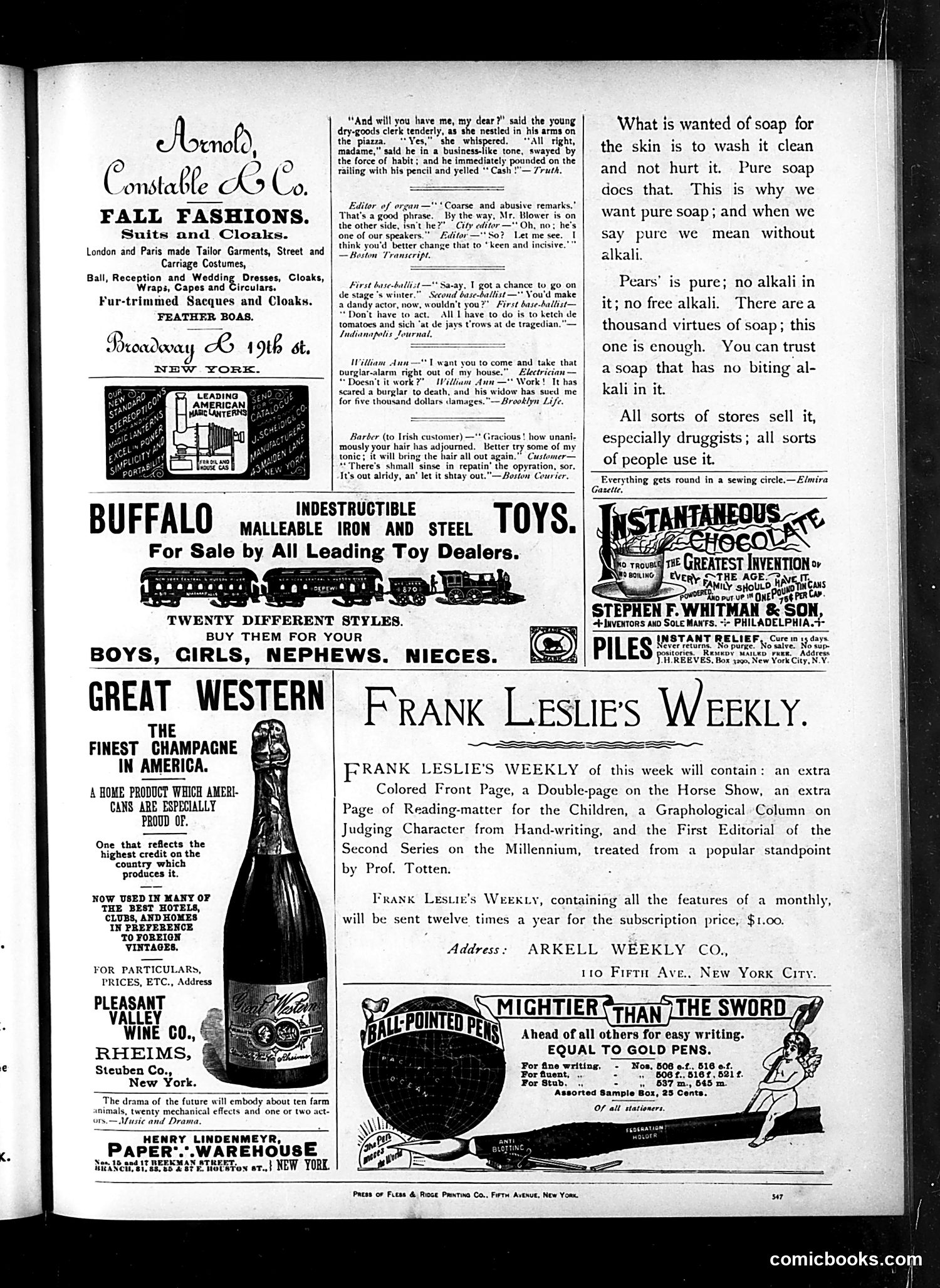
This page is primarily **advertising with minimal cartoon content**. The few humor pieces present are brief editorial jokes rather than political cartoons: **The Jokes:** - A dry-goods clerk proposes to his girlfriend but, "swayed by the force of habit," pounds the railing and yells "Cash!"—mocking the mercenary mindset of retail workers - A barber and Irish customer exchange about hair loss, playing on ethnic dialect humor - A homeowner's burglar alarm worked *too well*, killing an intruder whose widow sued him **The Advertisements:** The page features typical late-19th-century product ads: Arnold Constable (fashion), Buffalo toys, Pears' soap, champagne, pens, and medical remedies. The Pears' soap ad includes substantive copy about soap purity and alkali content—reflecting genuine consumer education concerns of the era. **No Political Satire:** There are no identifiable political figures, elections, or social movements being lampooned. This appears to be a typical commercial/humor page rather than Judge's satirical core content.
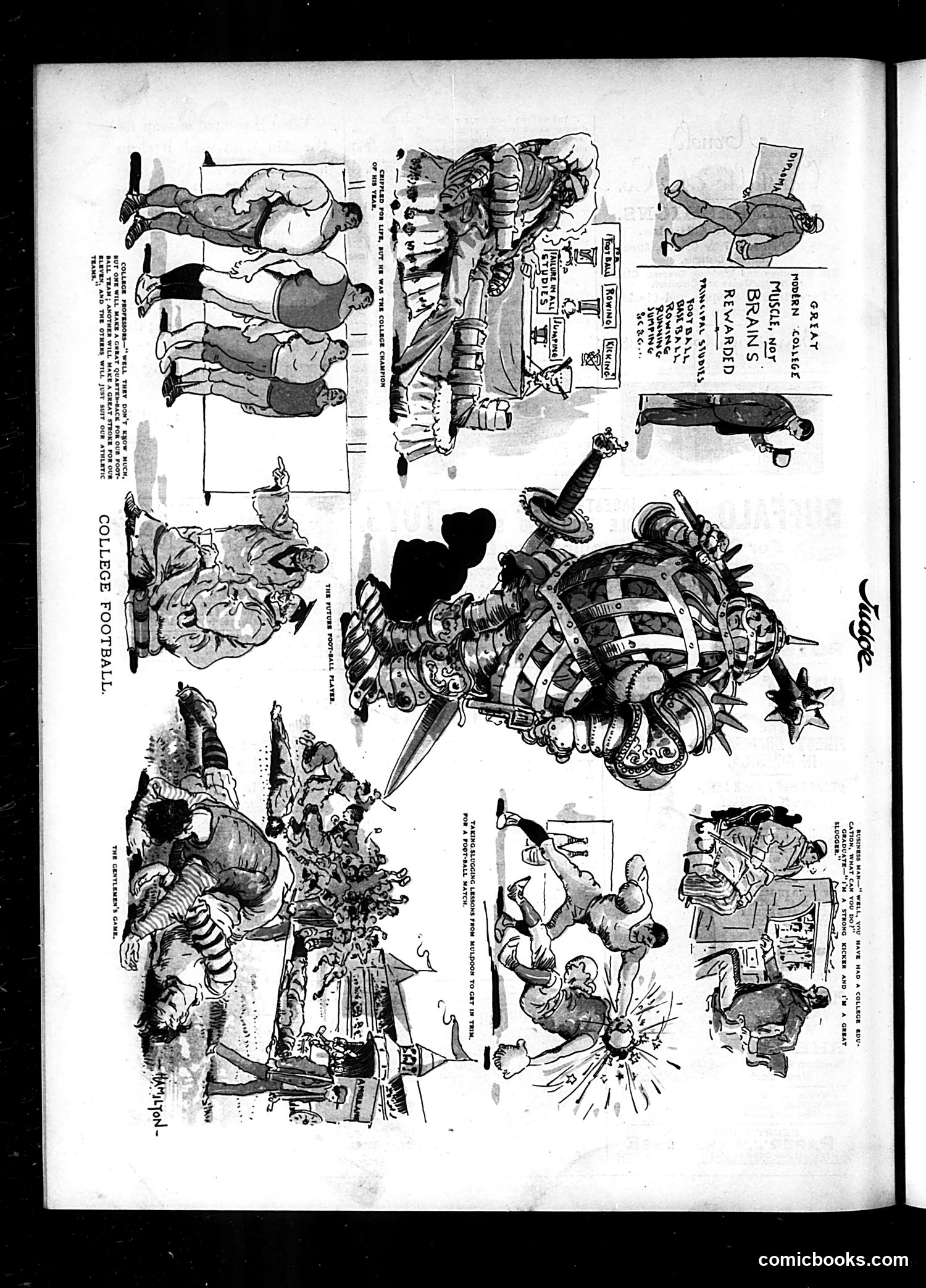
I cannot reliably read the OCR text on this page due to significant corruption and reversal. While I can see multiple satirical cartoon panels featuring exaggerated figures in various scenarios—including what appears to be college football, military/mechanical imagery, and social situations—I cannot confidently identify the specific political figures, events, or satirical targets being referenced without legible text labels or captions. The cartoons appear to use Judge magazine's typical style of grotesque caricature and visual humor common to early-to-mid 20th century American satire, but determining the precise subjects and satirical points requires readable source material, which this page does not provide.