
A complete issue · 16 pages · 1891
Judge — November 14, 1891
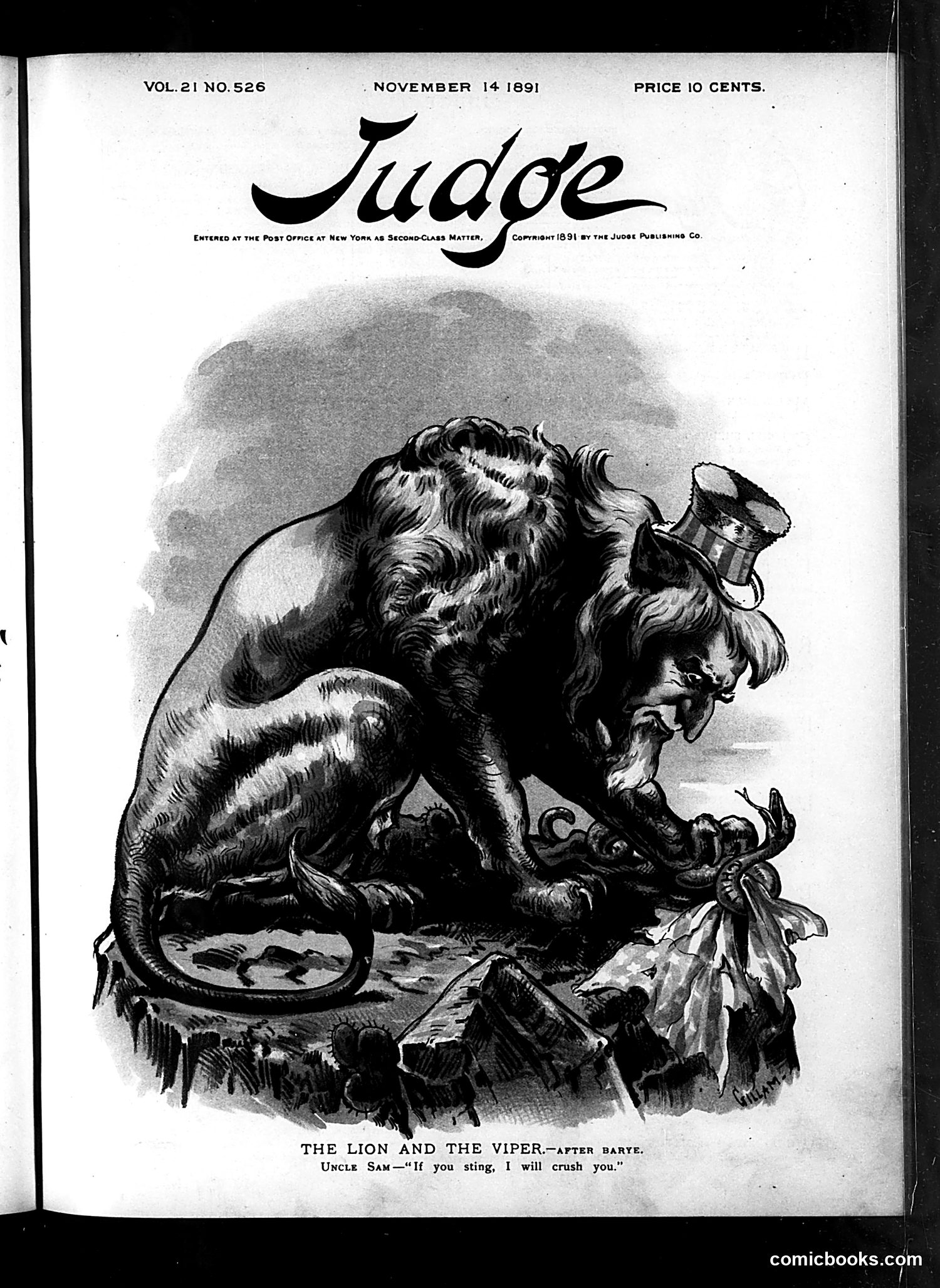
This *Judge* cover from November 14, 1891 presents a political allegory titled "The Lion and the Viper—After Barte," with the caption: "Uncle Sam—'If you sting, I will crush you.'" The image depicts Uncle Sam (identified by his distinctive appearance) as a lion confronting a viper. This appears to reference a foreign threat or diplomatic dispute of 1891. The "after Barte" attribution suggests it's based on Aesop's fable about a lion and viper, where the weaker creature poses danger despite size disparity. The specific historical context remains unclear without additional documentation, but the cartoon warns that while America appears dominant ("the lion"), an adversary ("the viper") risks severe consequences if it provokes conflict. This likely comments on contemporary international tensions.
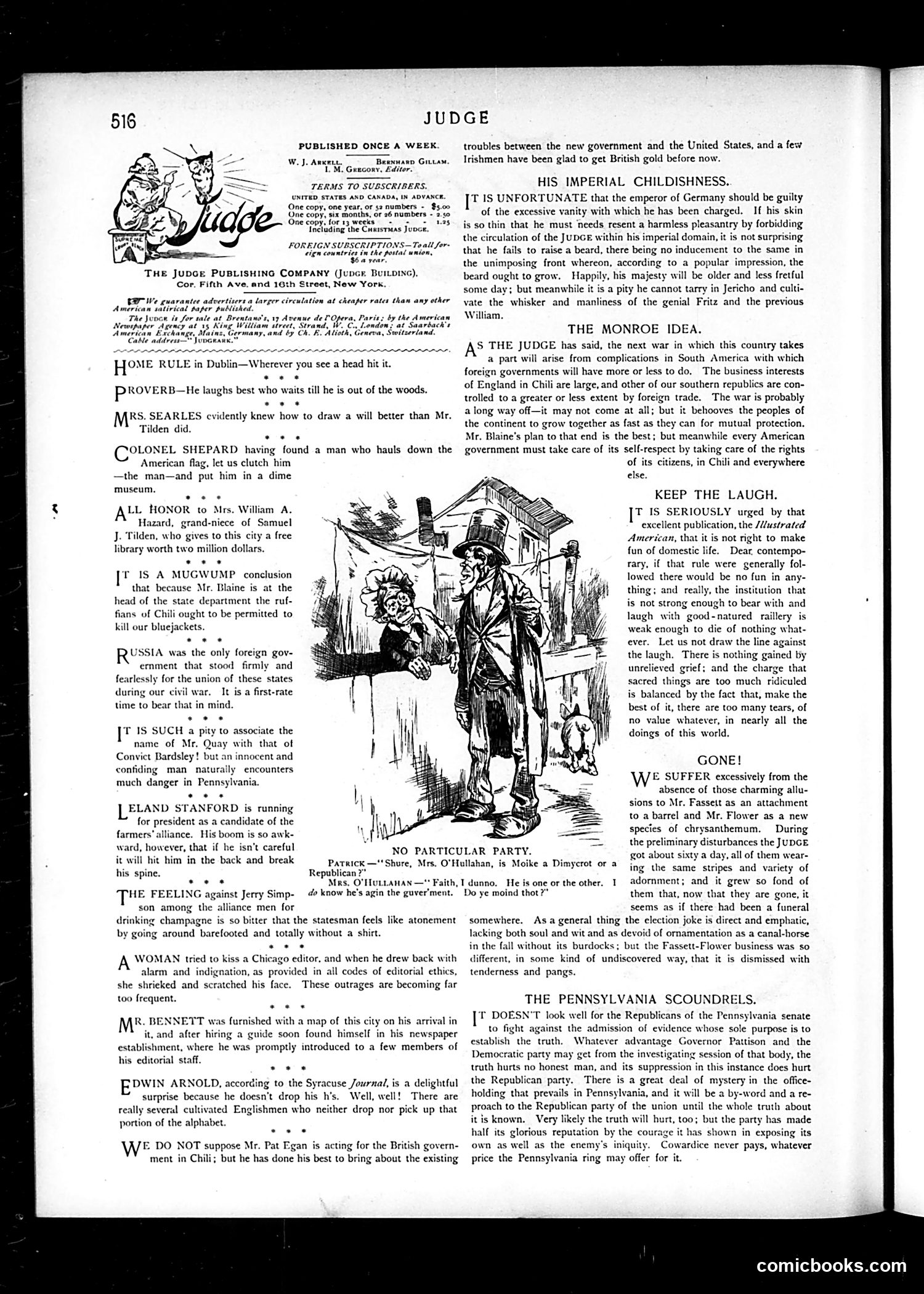
The central cartoon depicts a man in formal attire confronting a woman at a doorstep, likely illustrating domestic discord. This relates to the article "KEEP THE LAUGH," which argues against mocking domestic life. The piece defends the institution of marriage against those who ridicule it through comedy, asserting that sacred subjects shouldn't be excessively ridiculed. The page also contains brief political commentary on various topics: German Emperor Wilhelm II's "imperial childishness," American interests in Chile and trade protectionism, and Pennsylvania Republican politics regarding election fraud allegations. The overall tone suggests Judge is defending traditional institutions (marriage, government legitimacy) while criticizing both foreign leaders and domestic political misconduct through satirical commentary rather than direct mockery.
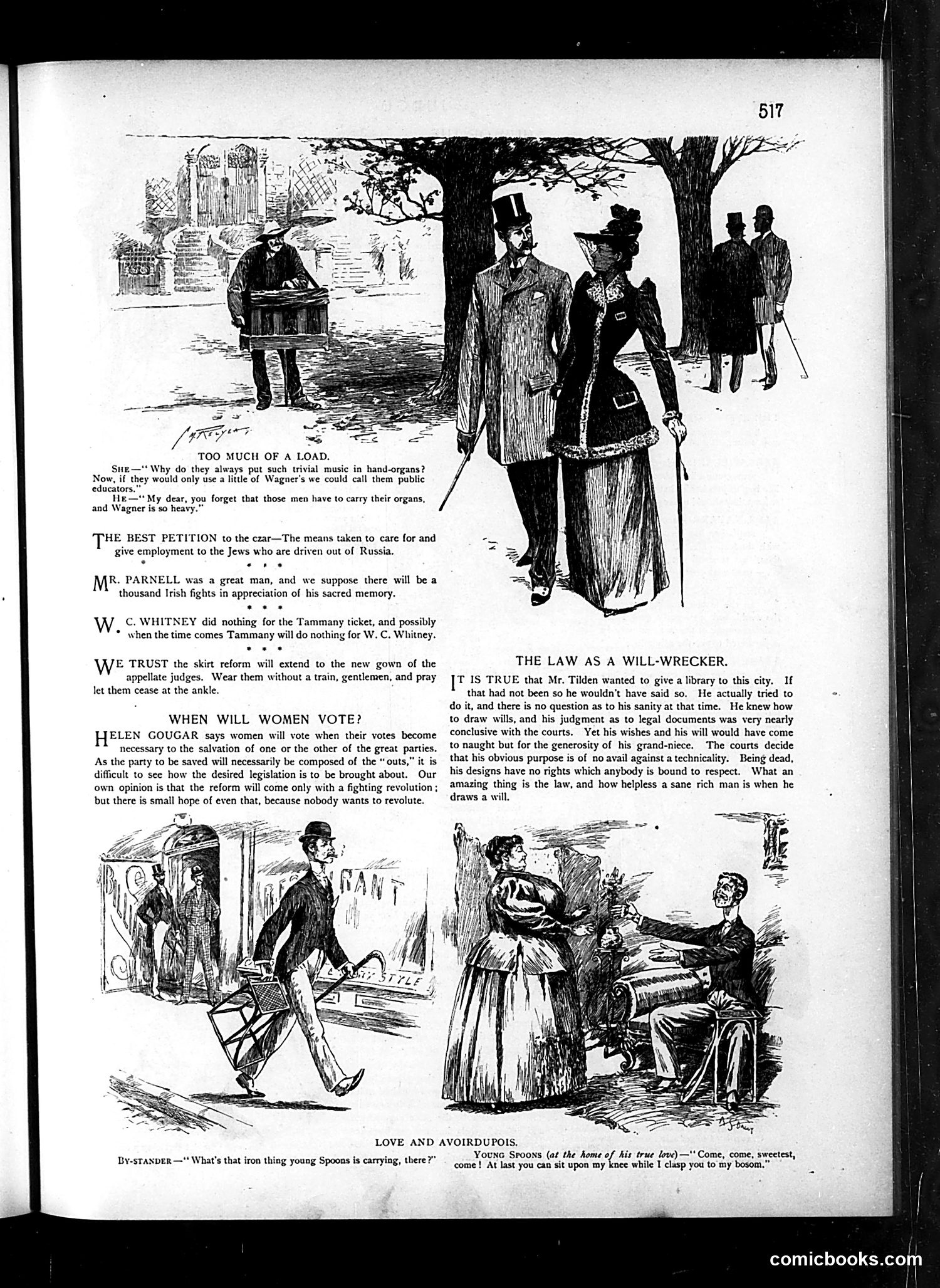
**"Too Much of a Load"** (top cartoon): Satirizes hand-organ players in public spaces. The caption complains that street musicians playing Wagner are too trivial, suggesting if Wagner's work must be performed publicly, these musicians should at least be compensated and not forced to carry heavy organs themselves. **"The Law as a Will-Wrecker"**: Criticizes Mr. Tilden's attempted library donation. The satire argues that legal technicalities and court interference prevented his generosity, exposing how laws can frustrate noble intentions through bureaucratic obstruction. **"When Will Women Vote?"**: Helen Cougar's commentary argues women's voting rights depend on necessity—when their votes become essential to political outcomes, reform will follow. **Lower cartoons** appear to be romantic/domestic humor with limited political content.
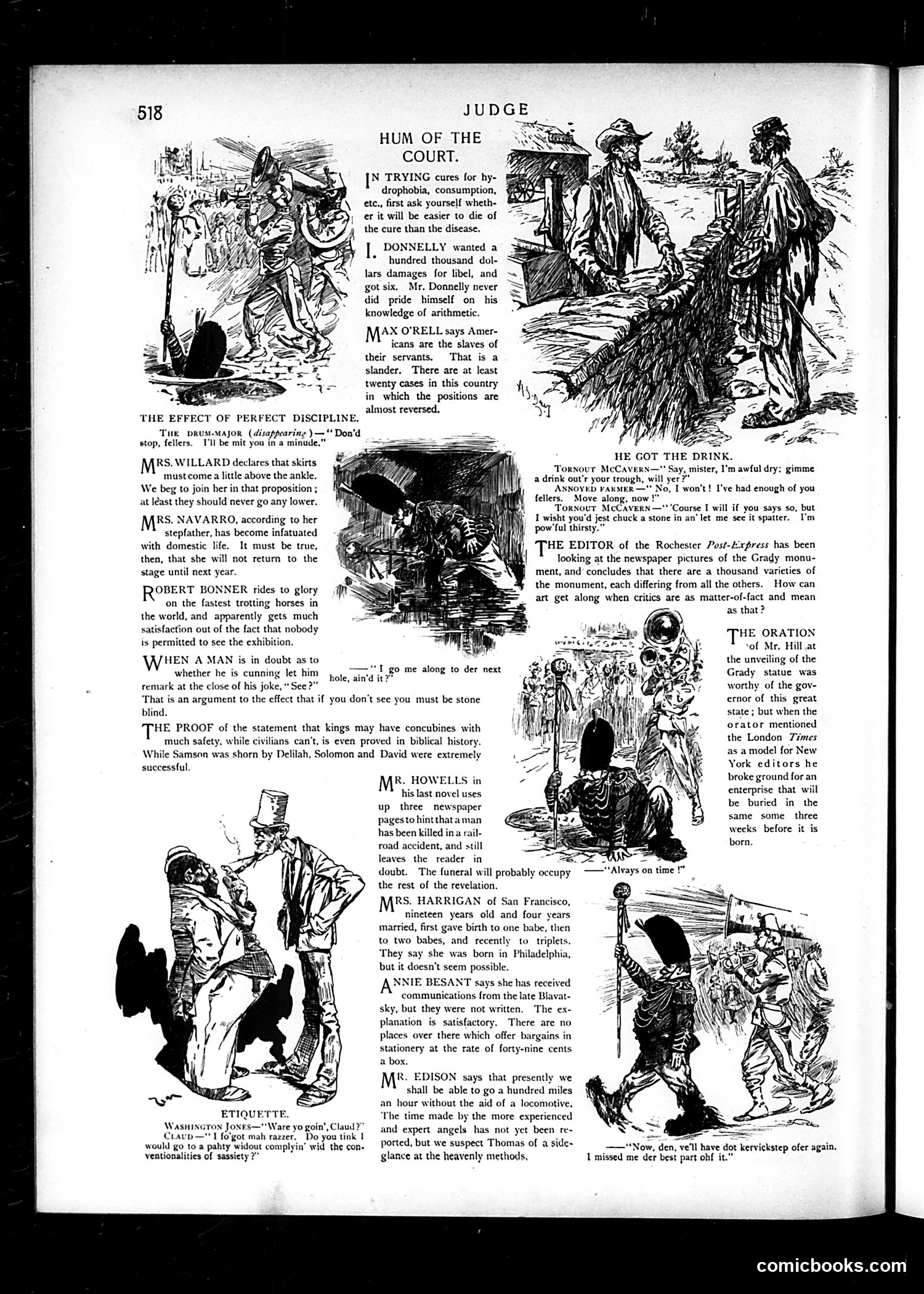
This page from Judge contains brief satirical observations on contemporary figures and events, typical of the magazine's "Hum of the Court" humor column. **Key references include:** - **Donnelly's libel suit**: A figure (likely Ignatius Donnelly, a Populist politician) sought $100,000 in damages but received only $6—the joke being his poor arithmetic. - **Max O'Rell's comment on American servitude**: The satire subverts his observation that Americans are "slaves of their servants" by claiming the reverse is sometimes true. - **Various social commentary**: Skirt lengths, domestic life preferences, and newspaper practices are mocked through brief anecdotes. - **The Grady monument**: Editors criticize inconsistent artistic depictions and verbose newspaper coverage (referencing W.D. Howells' lengthy narrative style). The accompanying sketches show everyday scenes—a farm confrontation, social interactions—illustrating the satirical points. The humor relies on understated deflation of contemporary figures' pretensions and common social absurdities.
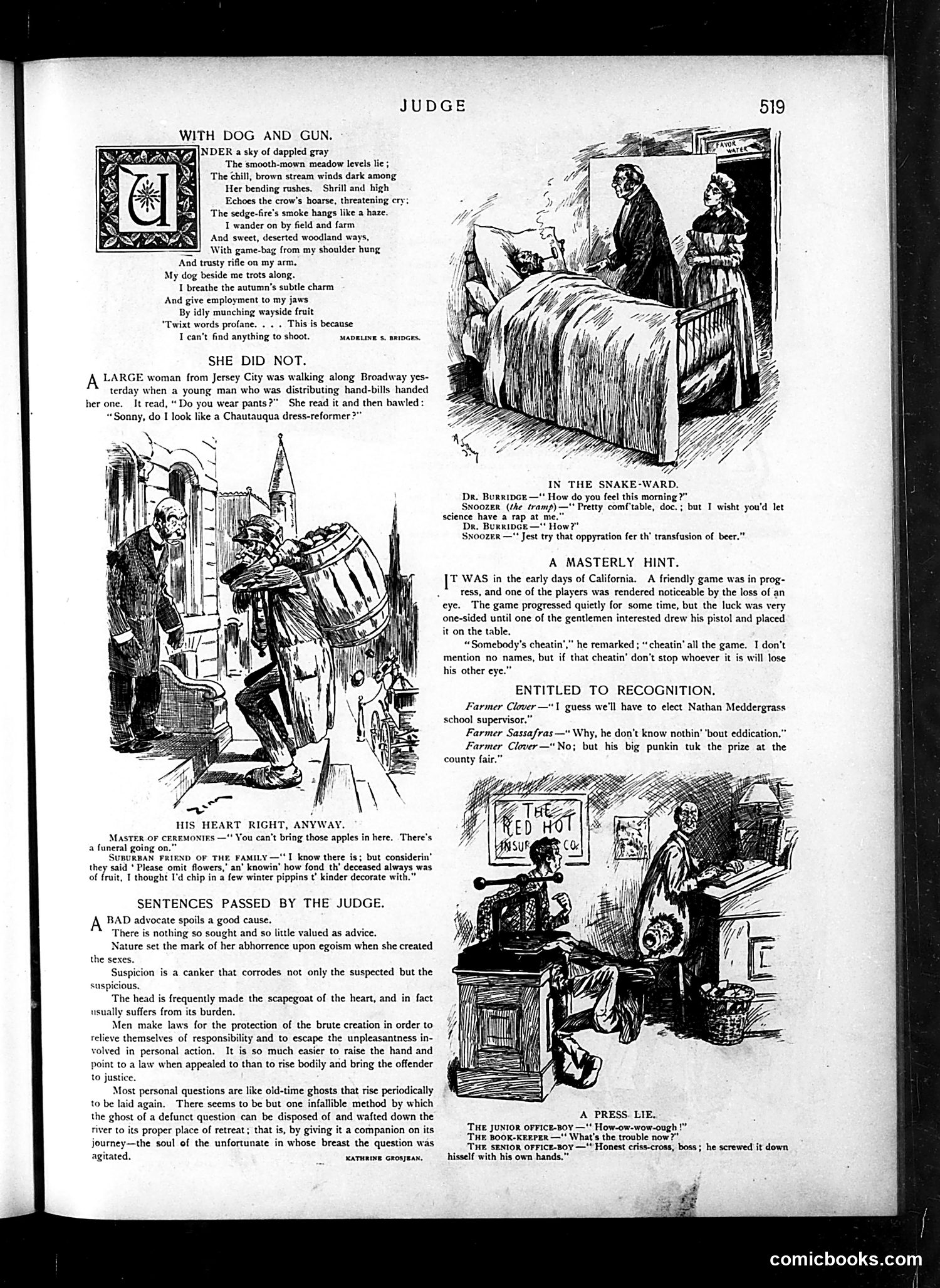
This page contains multiple short humorous pieces typical of Judge's satirical format: **"With Dog and Gun"** is a poem about autumn hunting that subverts expectations—the hunter finds no game to shoot, only fruit to eat. **"She Did Not"** mocks a Chautauqua dress-reform movement (a real 1890s-1900s crusade promoting women wearing practical clothing like pants). A Jersey City woman indignantly rejects the implication she'd wear pants. **"A Masterly Hint"** is a frontier anecdote where a card player subtly threatens a cheater with pistol-point violence while maintaining plausible deniability—dark humor about Wild West justice. **"Entitled to Recognition"** satirizes rural electorate priorities: a farmer lacking education but winning a county fair pumpkin prize gets elected school supervisor anyway. The remaining pieces are brief gags and moral aphorisms ("Sentences Passed by the Judge"). The cartoons depict everyday absurdities—a tramp requesting experimental beer transfusion, a mourner bringing apples to a funeral, office workers bickering. Overall, the page reflects Judge's focus on American social foibles, rural/urban contrasts, and period-specific reform movements.
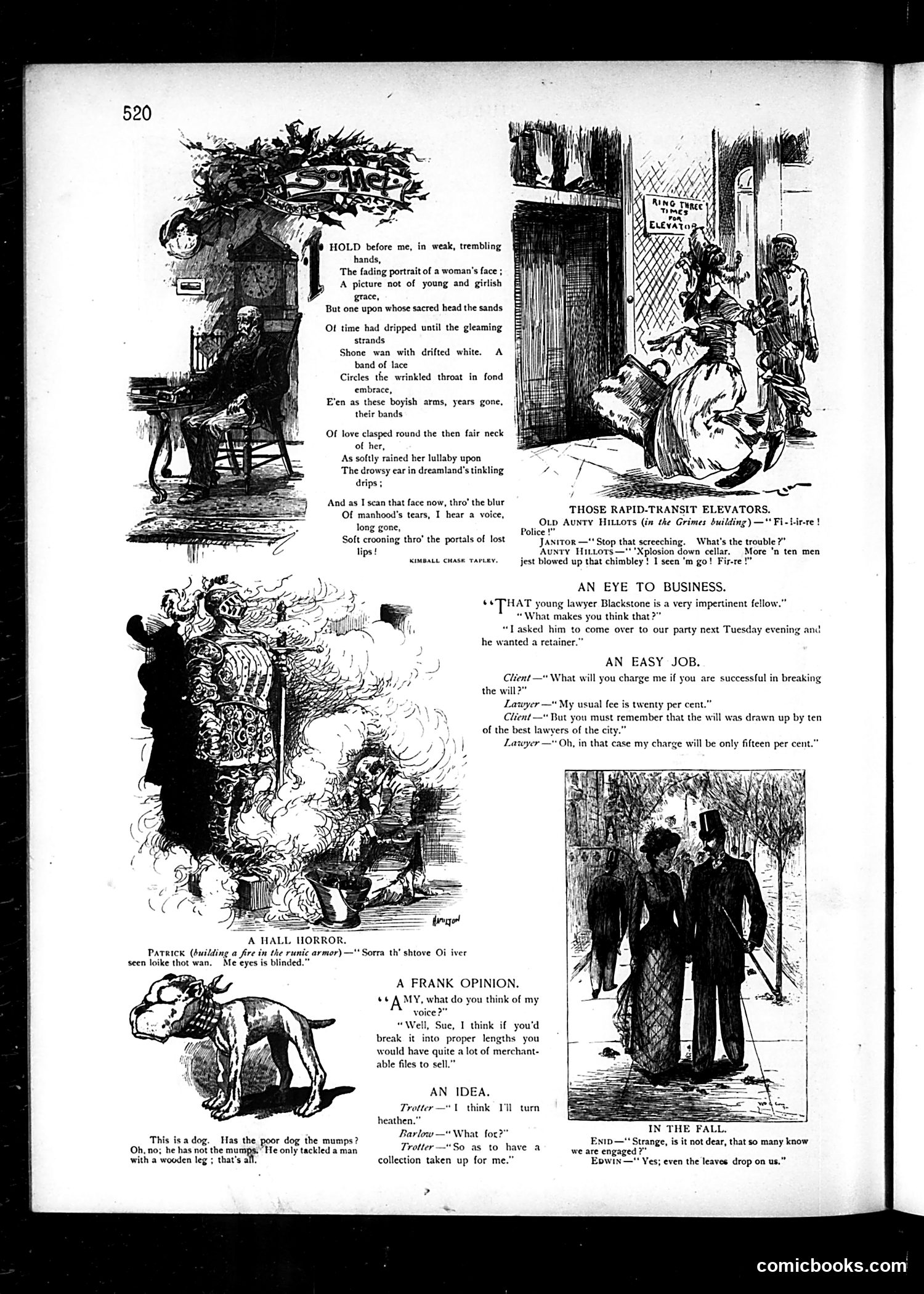
This page contains multiple unrelated short humor pieces typical of Judge magazine's format: **"Those Rapid-Transit Elevators"** mocks a building explosion in an elevator, with Aunty Hittots reporting the disaster to a janitor—satirizing the danger of early rapid-transit systems. **"An Eye to Business"** jokes about a lawyer's impertinence: when invited to a party, he demands a "retainer" (legal fee), treating social invitations as business opportunities. **"An Easy Job"** satirizes lawyers' fee-cutting: a lawyer reduces his usual twenty percent to fifteen percent when learning a will was drafted by ten competing attorneys—implying the document is so poorly constructed it's easy to break. Other sketches include building-fire mishaps, voice criticism, and a dog-attack joke. The page also features sentimental poetry about remembering an elderly woman. These pieces reflect late-19th/early-20th-century concerns: urban infrastructure dangers, lawyer greed and opportunism, and general social absurdities. No specific political figures appear identifiable.
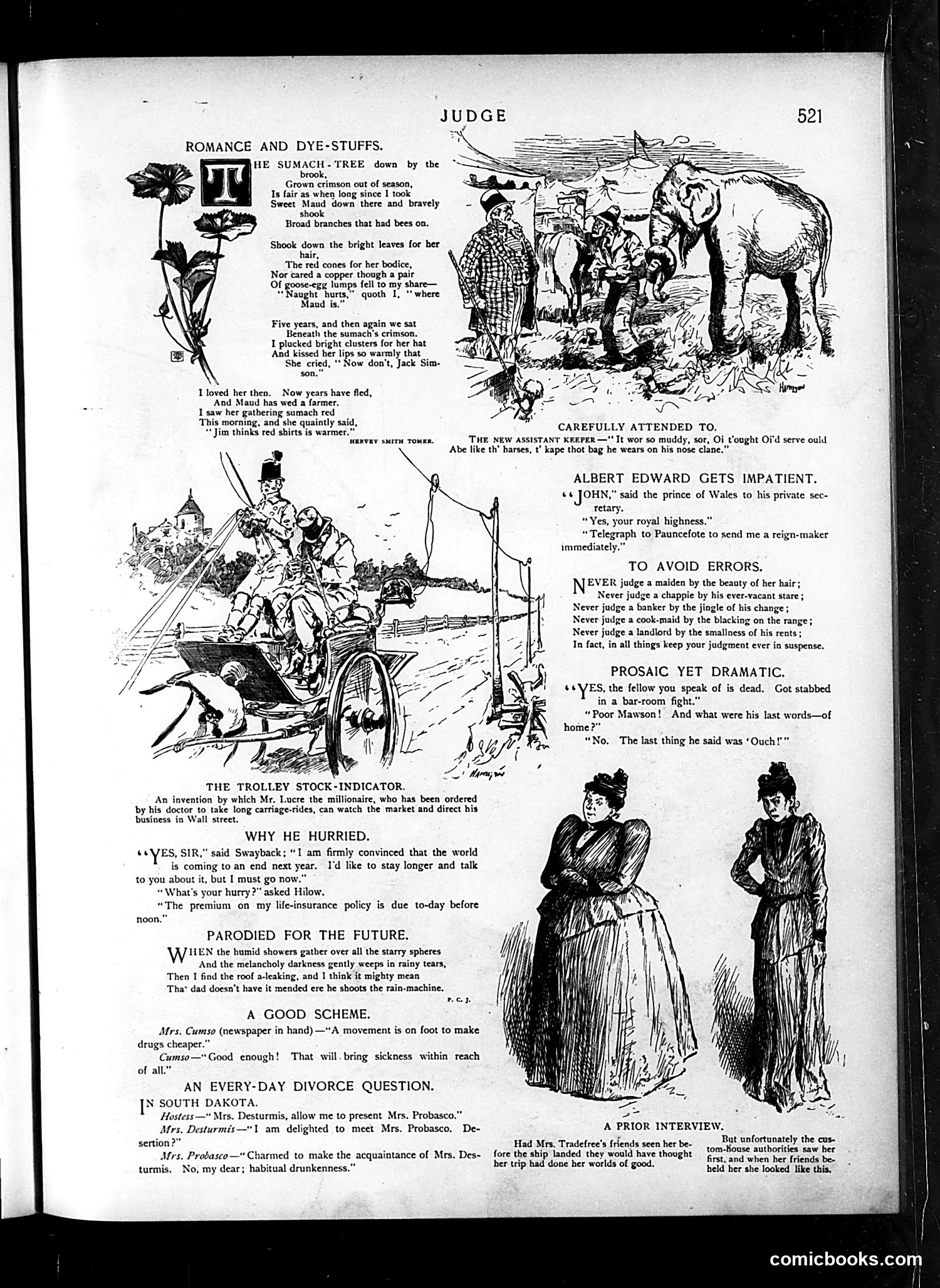
This page from *Judge* contains multiple satirical pieces reflecting late 19th-century American concerns: **"Romance and Dye-Stuffs"** presents nostalgic verse about a man remembering romantic moments with "Maud," now a farmer's wife—contrasting youthful romance with mundane domesticity. **"Albert Edward Gets Impatient"** references the Prince of Wales (later Edward VII) humorously requesting a "reign-maker," satirizing his long wait to become king while his mother Queen Victoria lived. **"To Avoid Errors"** offers mock-serious advice about not judging people by appearances—a common satirical format. **"The Trolley Stock-Indicator"** jokes about a wealthy businessman using a mechanical device to monitor stock markets during doctor-ordered carriage rides. **"An Every-Day Divorce Question"** mocks South Dakota's reputation as an easy-divorce jurisdiction, featuring casual introductions between divorced women. The cartoons mock social pretension, marital instability, class anxiety, and technological change—typical *Judge* targets for educated, prosperous readers.
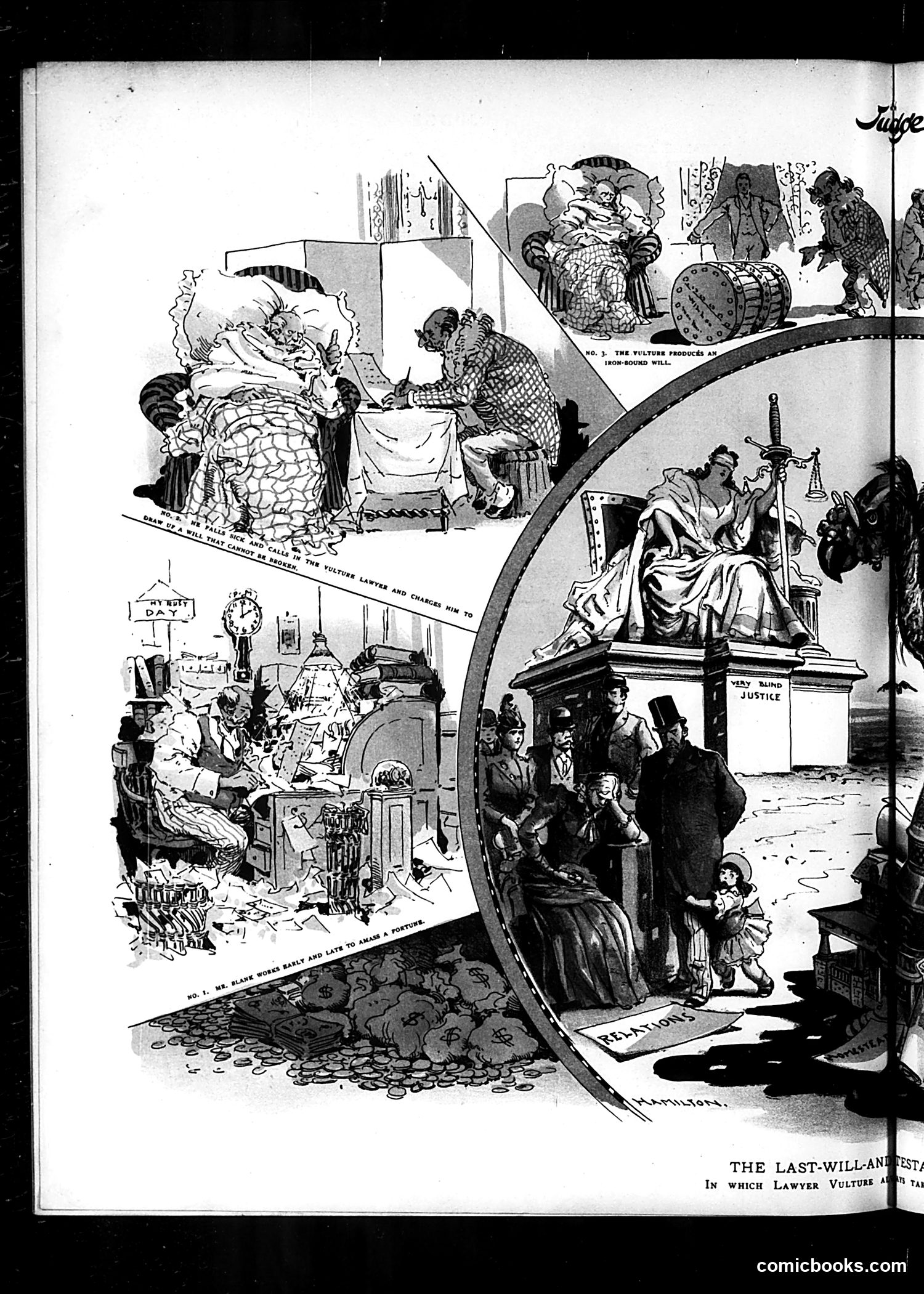
This appears to be a satirical cartoon titled "The Last-Will-and-Testament in Which Lawyer Vulture..." The visible panels depict a vulture (representing a scheming lawyer) engaged in corrupt legal practices. The cartoon critiques predatory lawyers who exploit vulnerable people—particularly the wealthy or dying—to enrich themselves through fraudulent wills and estates. Panel 3 shows the vulture "producing an iron-bound will," suggesting the fabrication of false legal documents. The surrounding scenes show various victims and chaotic circumstances, emphasizing the cartoon's message about legal corruption and exploitation of the vulnerable. This reflects late-19th/early-20th-century American concerns about unscrupulous attorneys taking advantage of clients during estate settlements.
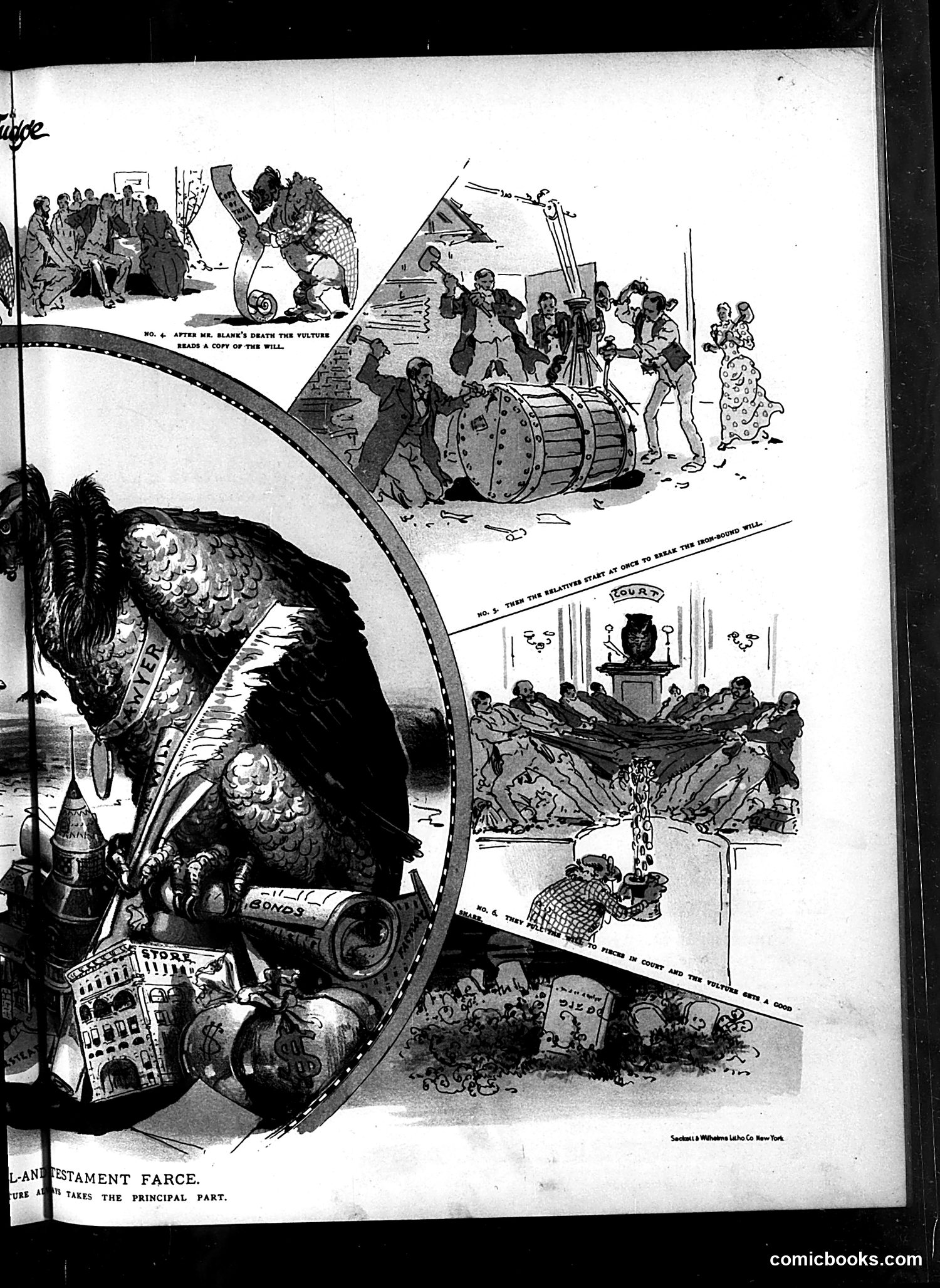
This appears to be a multi-panel political cartoon satirizing what the title calls a "Testament Farce," with someone identified as "M" playing "the principal part." The imagery suggests a will or inheritance dispute being treated as theatrical comedy. The left panel shows an ornate figure (possibly representing wealth, authority, or a deceased estate) surrounded by eager participants. Subsequent panels depict scrambling over resources—notably large barrels and disputed property—while officials or legal authorities preside. The satire likely mocks either a specific contested will, inheritance dispute, or political succession struggle of the period, treating serious legal/financial matters as absurd theater. Without clearer context on who "M" represents or the specific date, I cannot identify the exact historical reference, though the visual language suggests critique of greed and legal manipulation.
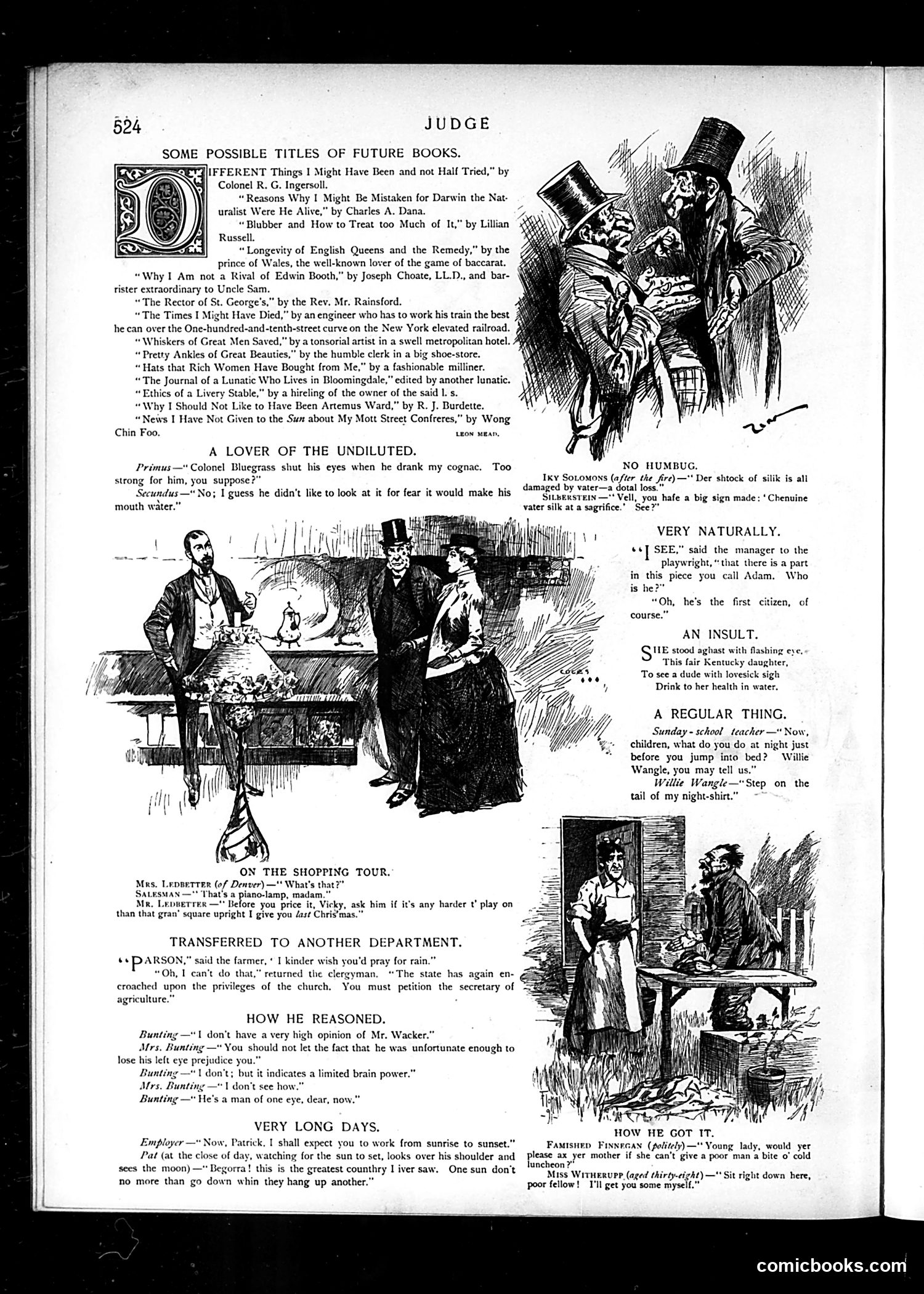
This page from the satirical magazine *Judge* contains several distinct humor pieces mocking contemporary figures and social types of the Gilded Age era. The top section parodies future book titles by prominent figures—Colonel Ingersoll (famous atheist), Charles Dana (newspaper editor), and Lillian Russell (actress known for her weight). The jokes rely on personal characteristics: Ingersoll's agnosticism, Darwin comparisons to Dana, and Russell's size. Below are several short comedic dialogues: a drunk man with poor taste in cognac, a woman asking about a piano lamp (with an Irish servant's pun), a farmer asking a clergyman to pray for rain but being told the state now controls agricultural matters (critiquing government overreach), and a man judging another's intelligence based on having "one eye" (crude logic). Other jokes target Irish immigrants (Patrick working sunrise-to-sunset), Jewish merchants (exaggerating accents and insurance fraud), and general social pretension. The recurring ethnic caricatures and stereotypes reflect period attitudes, though the satire often targets pompousness rather than the groups themselves.
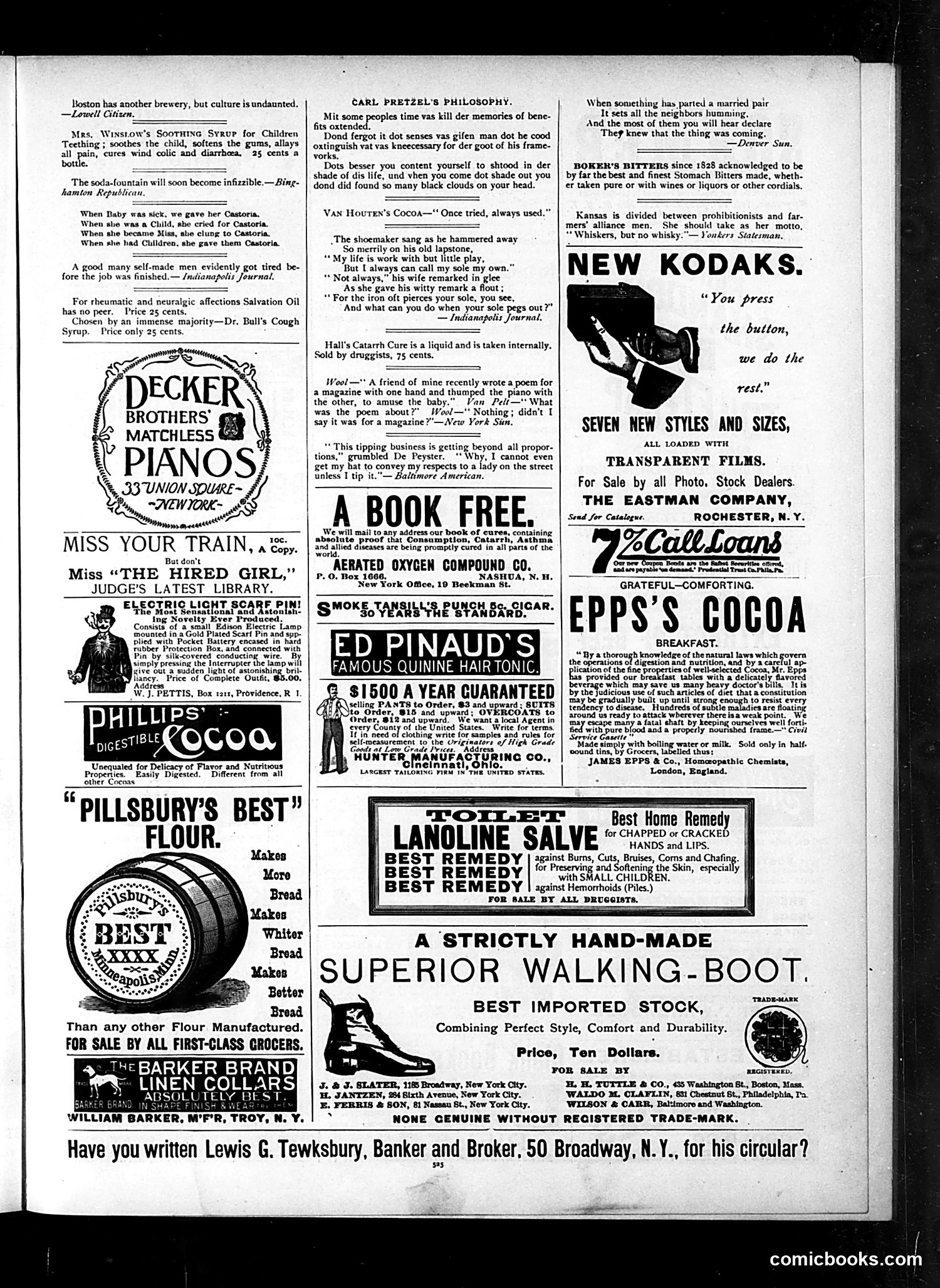
This is primarily an **advertising page** with minimal editorial content. The few jokes and observations present reflect late 19th/early 20th-century American attitudes: **Editorial Content:** - Short quips about Boston's cultural pretensions despite having "another brewery" - A "Carl Pretzel" ethnic-dialect joke (heavy German accent) offering homespun philosophy about accepting life's limitations - Wordplay jokes about shoes, piano-playing, and tipping etiquette **Notable Advertisement:** The "Electric Light Scarf Pin" offering sudden brilliant illumination—remarkable as an early electric novelty item marketed as a luxury good. **Social Context for Modern Readers:** The page reveals period concerns: children's patent medicines (soothing syrups, Castoria), folk remedies (Salvation Oil), and ethnic humor presented through exaggerated dialect. The "Carl Pretzel" philosophy represents how German-American immigrants were stereotyped and humorously exploited for entertainment in mainstream publications. The layout and content typify Judge's mixed editorial-advertising format during this era.
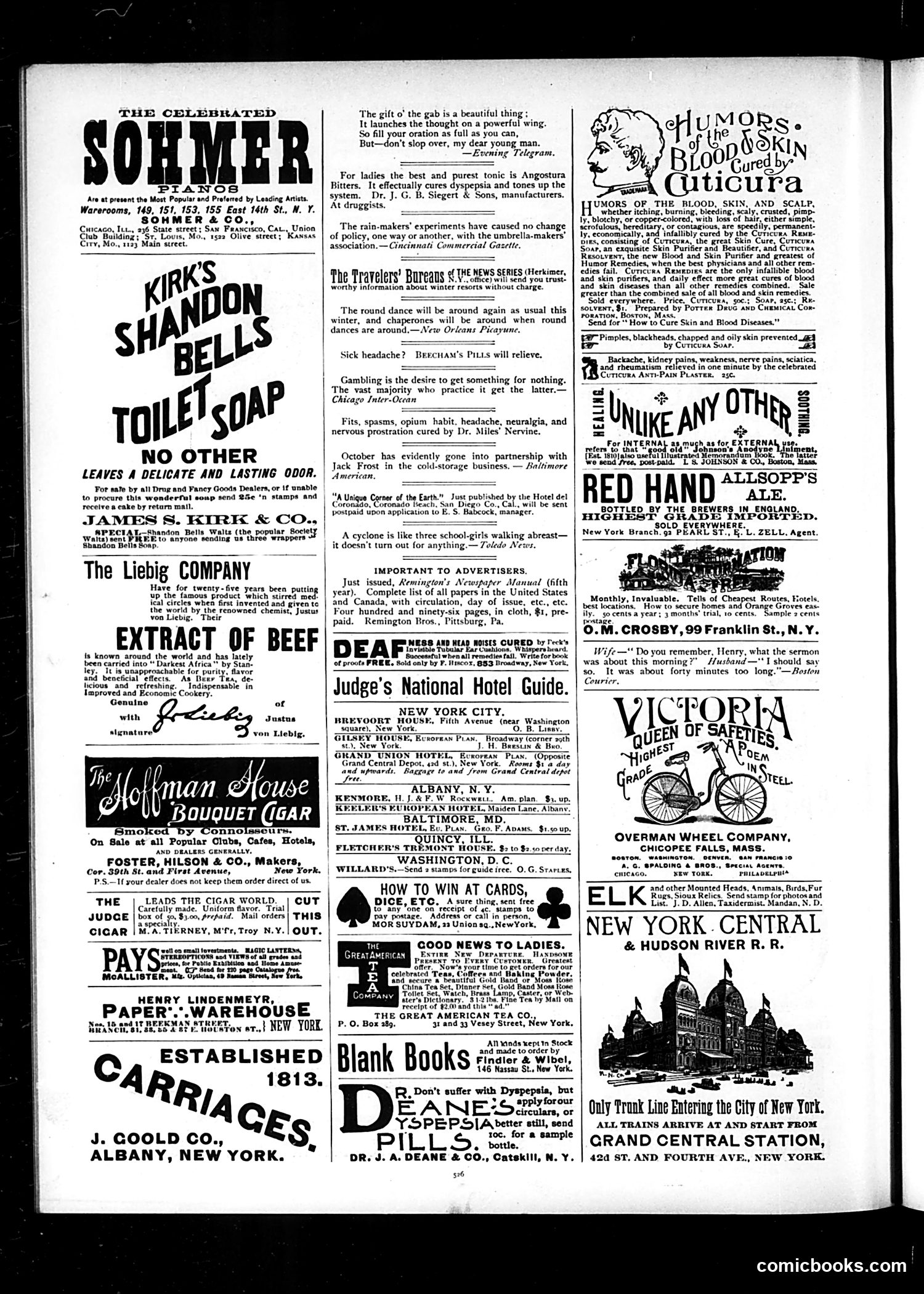
This is primarily an **advertising page** from Judge magazine, not a satirical cartoon page. The layout consists almost entirely of commercial advertisements for late 19th-century products and services. The page features ads for: - **Sohmer pianos** (top) - **Shandon Bells soap** and Kirk & Company products - **Liebig Extract of Beef** (a meat concentrate/broth product) - **Cigars** (Hoffman House, Judge brand) - **Hotels and transportation** (New York Central & Hudson River Railroad, Grand Central Station) - **Miscellaneous products** (paper warehouse, carriages, blank books, patent medicines) Interspersed are brief **humorous quotations** from newspapers about everyday observations—rain-makers, round dances, gambling, and October weather—representing the magazine's satirical voice, but these are minor filler content. The page demonstrates how Judge relied on advertising revenue. There are **no political cartoons or caricatured figures** to interpret; it's a snapshot of Gilded Age consumer culture and commercial messaging.
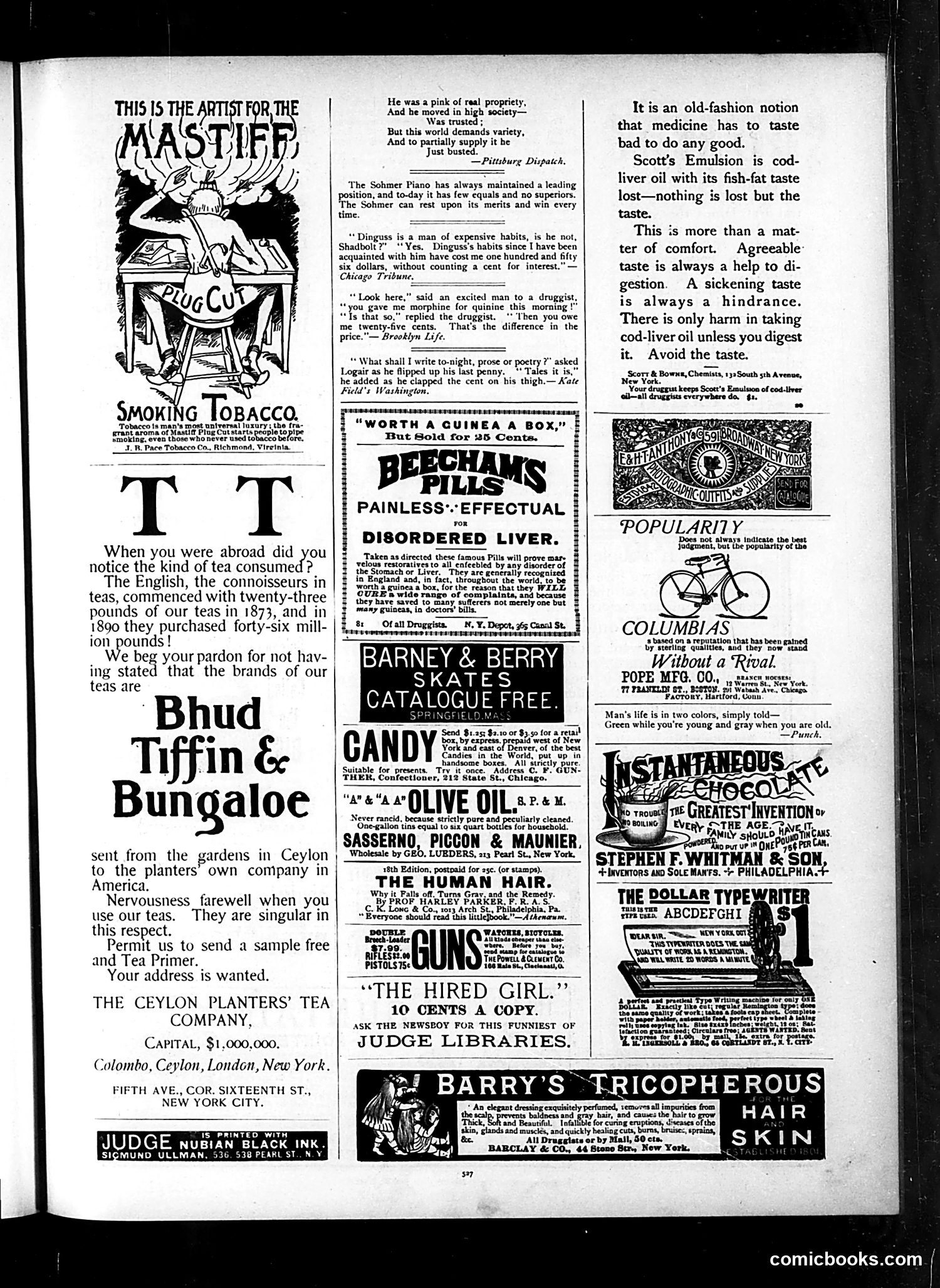
This page is primarily **advertising**, with minimal editorial content. The dominant feature is a large advertisement for **Bhud Tiffin & Bungaloe tea** from The Ceylon Planters' Tea Company, emphasizing that English consumers dramatically increased purchases of American-imported Ceylon tea (from 23 pounds in 1873 to 46 million by 1890). The page includes several brief humorous anecdotes and jokes typical of Judge's satirical content—such as a story about a man ruined by expensive habits, and a druggist's quip about morphine versus quinine pricing. These illustrate Judge's signature light social commentary. The remaining space features period advertisements for patent medicines (Beecham's Pills, Scott's Emulsion cod-liver oil), bicycles (Columbias), skates, candy, and hair products—reflecting late-19th-century consumer culture. No specific political cartoons or caricatures appear on this page.
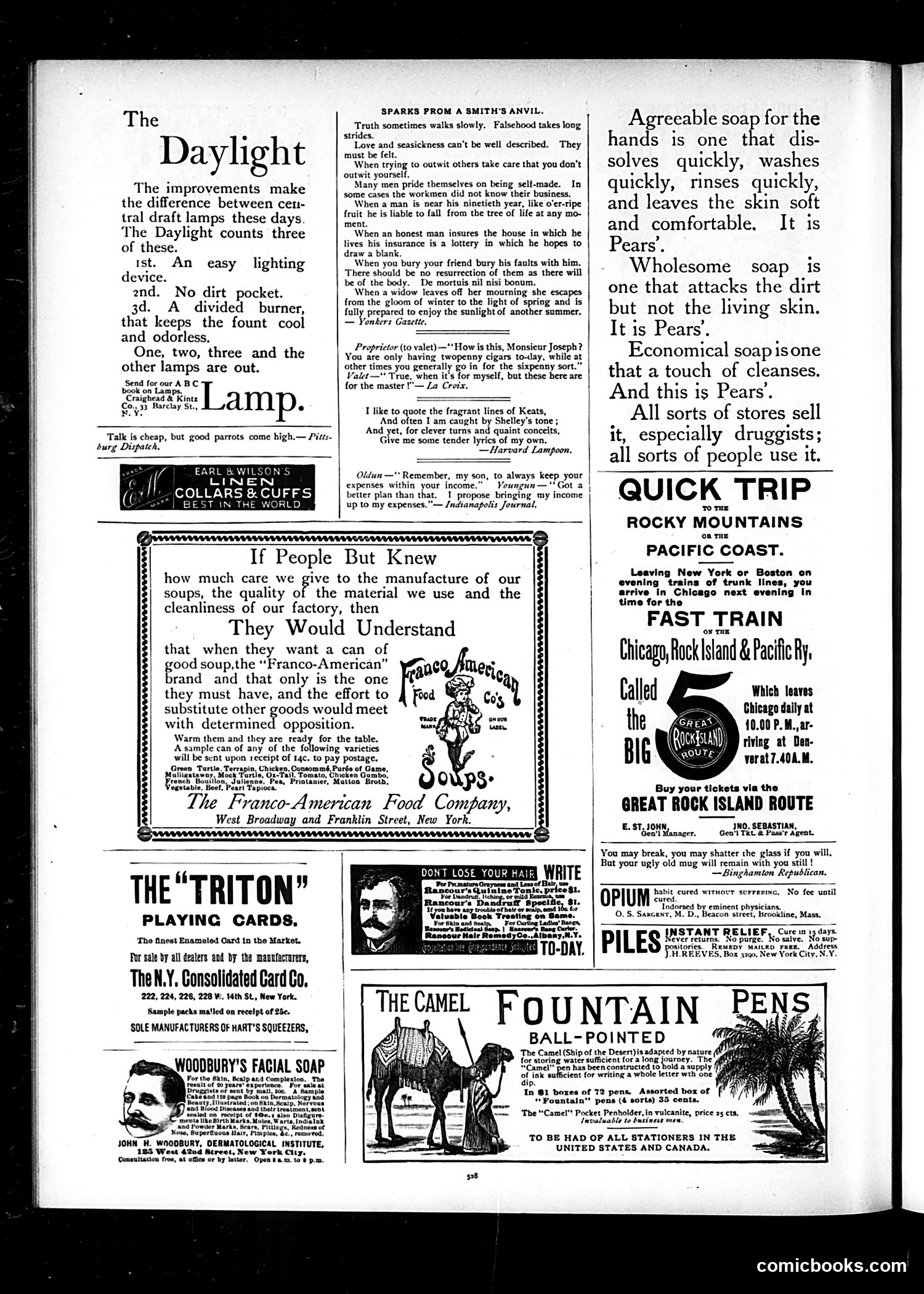
This page is primarily **advertising**, with some brief satirical snippets interspersed. The main content consists of advertisements for consumer goods (lamps, soap, playing cards, trains, food products) and patent medicines typical of the era. The few satirical elements include: - **"Sparks from a Smith's Anvil"**: Brief moralizing aphorisms ("Truth sometimes walks slowly. Falsehood takes long strides"), including one about honest men insuring houses and hoping "to draw a blank"—subtle social commentary on insurance's nature as gambling. - **Valet joke**: A servant buys cheap cigars for himself but expensive ones for his master—a class-based gag about servant hierarchy. - **Income vs. expenses dialogue**: A young man proposes raising his income to match his spending rather than reducing expenses—mocking financial irresponsibility. The page reflects Judge's satirical voice through these scattered quips, but it's primarily a revenue-generating advertising page with minimal sustained cartoon or political commentary. No specific caricatured political figures appear.
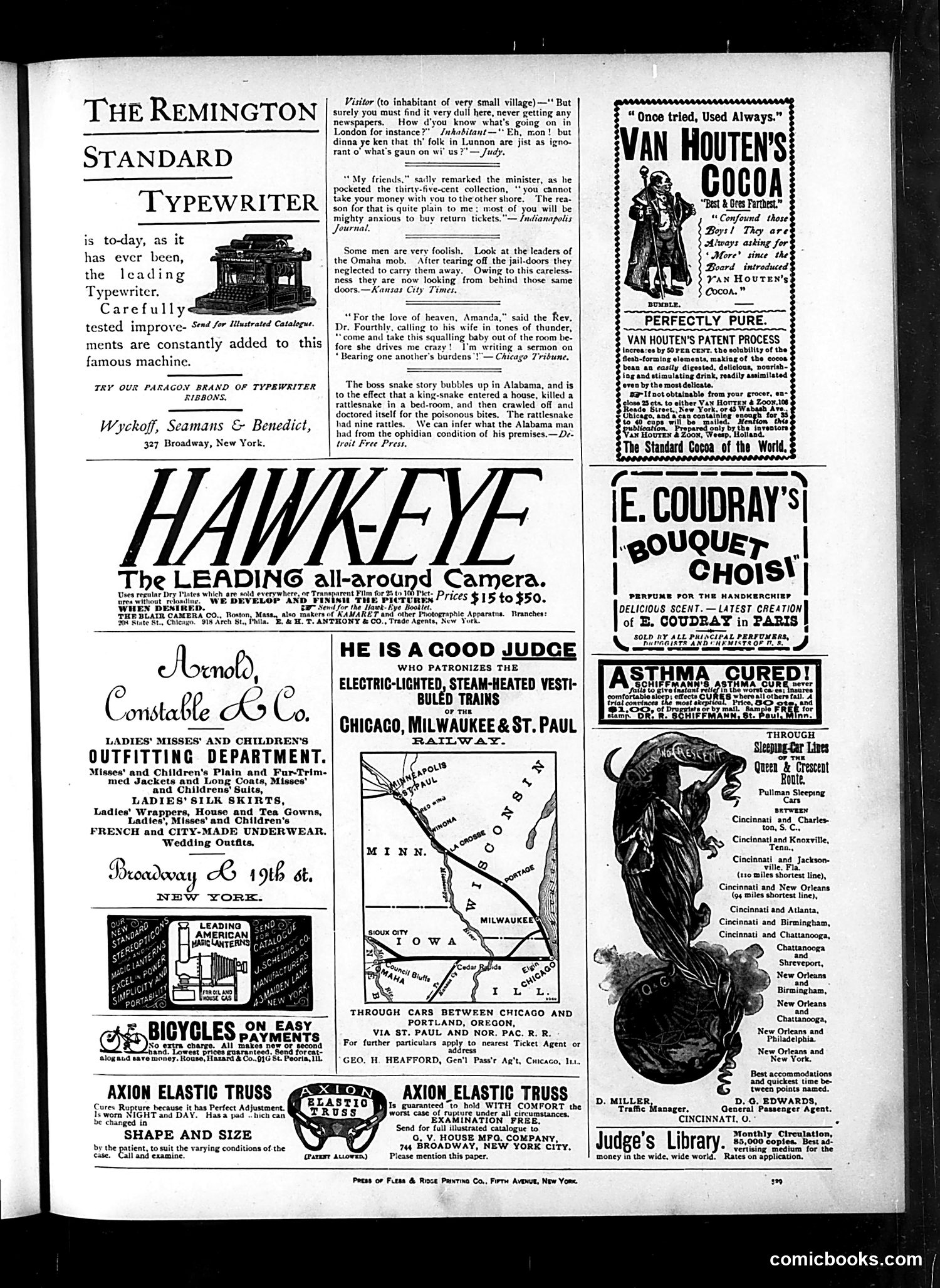
This page is primarily **advertisements and filler jokes**, not political cartoons. The content includes: **Text Jokes**: Brief satirical quips from various sources (Judy, Indianapolis Journal, Kansas City Times, etc.) mocking human nature—village ignorance, stingy church collections, mob stupidity, a minister interrupted by a crying baby, and a tall tale about snakes. **Advertisements**: The page features ads for typewriters (Remington), cameras (Hawk-Eye), clothing (Arnold, Constable & Co.), trains (Chicago, Milwaukee & St. Paul Railway), medical devices (Axion Elastic Truss for rupture), bicycles, and food products (Van Houten's Cocoa, E. Coudray's Bouquet Chois perfume). **No identifiable political figures or satirical cartoons appear**. The humor is generic, observational comedy typical of early 1900s magazines—poking fun at universal human foibles rather than specific events or people. This is a standard commercial magazine page mixing light entertainment with revenue-generating advertisements.
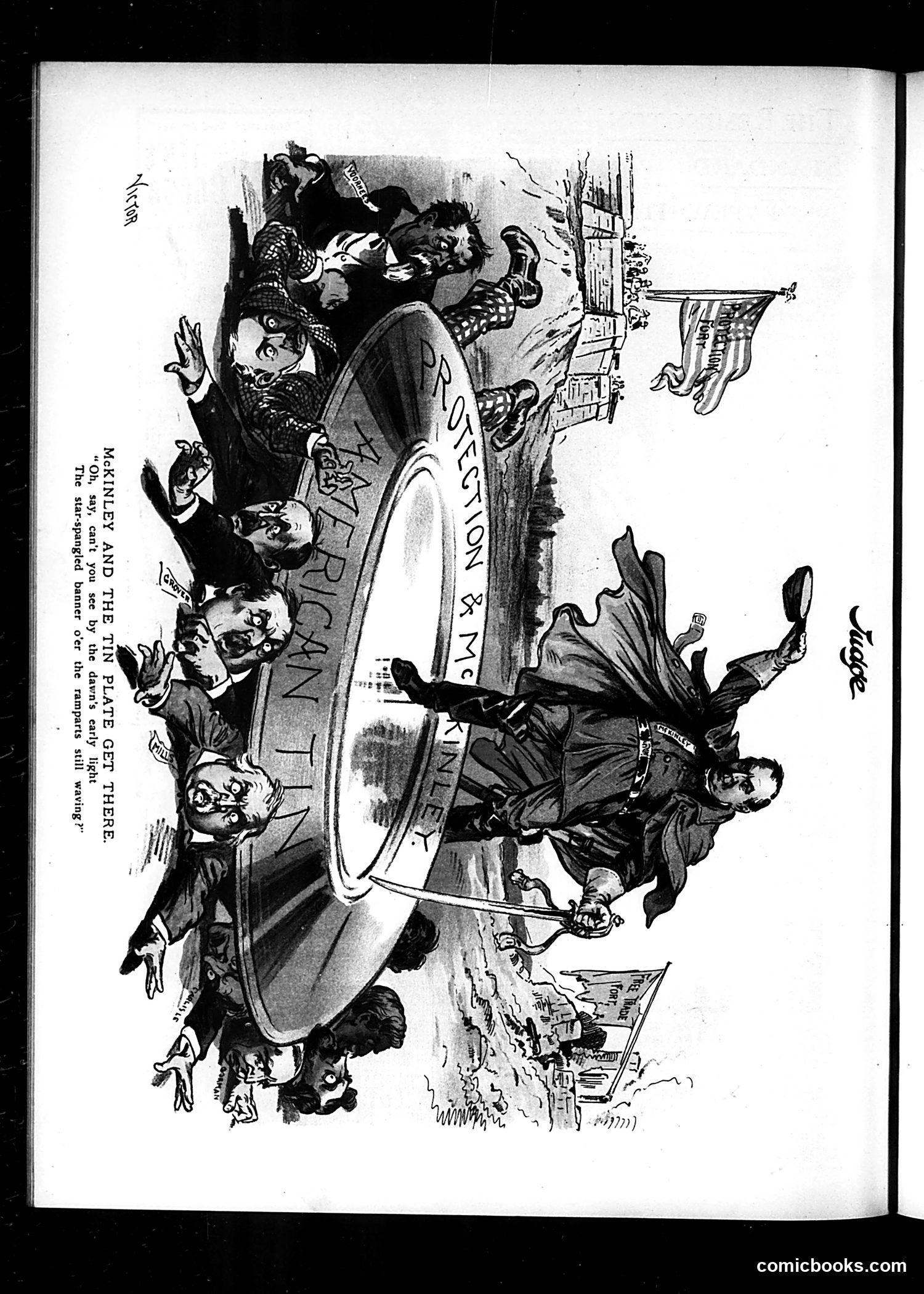
This political cartoon satirizes President William McKinley's tariff policy on tin plate. The central image shows a large tin plate being carried like a banner, with McKinley and other figures triumphantly parading it through a street scene. The caption references the opening lines of "The Star-Spangled Banner," substituting the American flag with a tin plate—suggesting McKinley treats industrial protectionism with the same patriotic fervor as national symbols. The satire mocks McKinley's support for protective tariffs on tin plate, a policy benefiting American manufacturers but criticized as economically harmful. The figures surrounding the plate appear to represent various political interests celebrating or pushing this trade policy. The cartoon implies that McKinley has prioritized industrial interests over broader national concerns.