
Judge, 1891-11-14 · page 5 of 16
Judge — November 14, 1891 — page 5: what you’re looking at
What you’re looking at
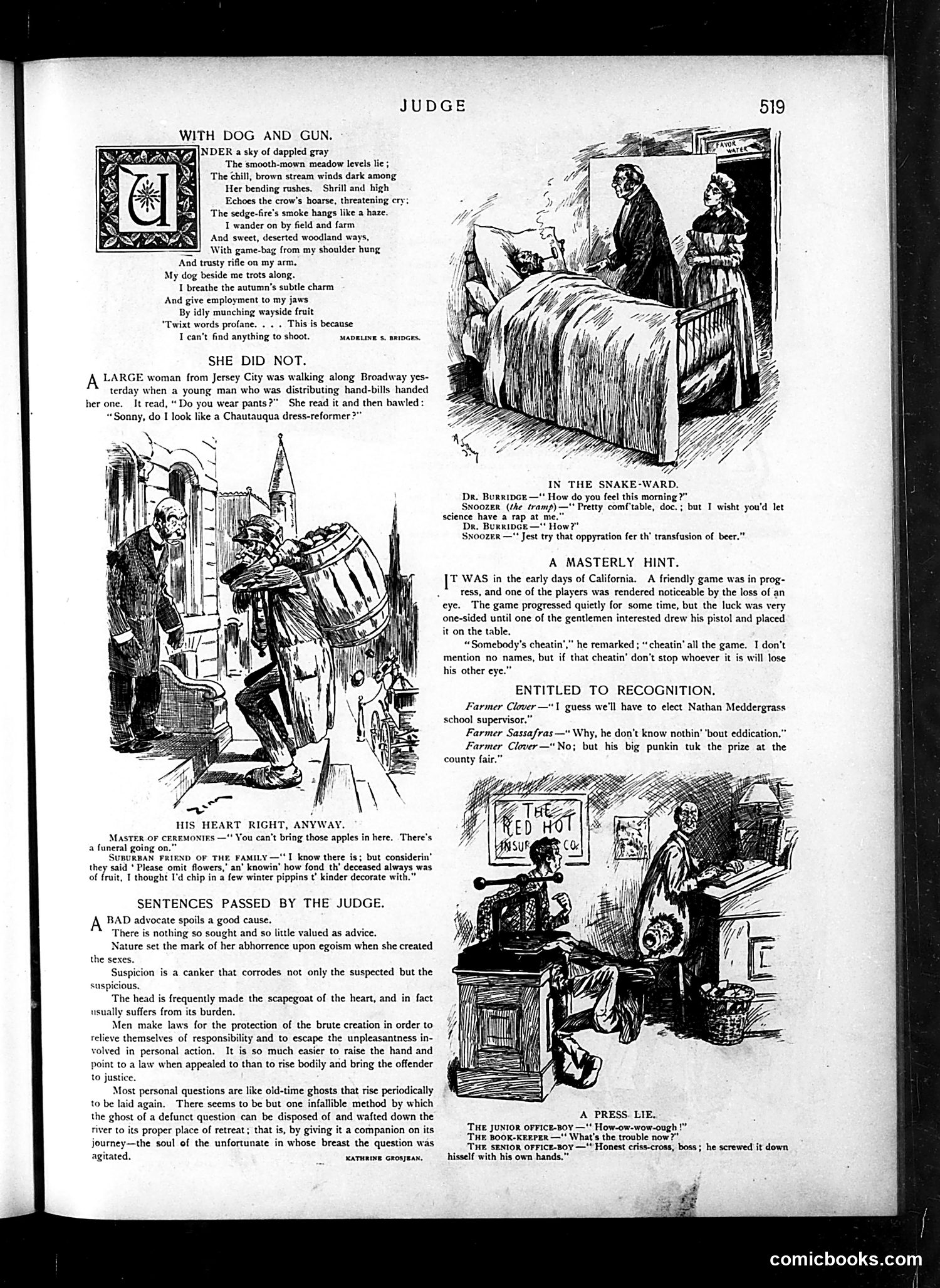
This page contains multiple short humorous pieces typical of Judge's satirical format: **"With Dog and Gun"** is a poem about autumn hunting that subverts expectations—the hunter finds no game to shoot, only fruit to eat. **"She Did Not"** mocks a Chautauqua dress-reform movement (a real 1890s-1900s crusade promoting women wearing practical clothing like pants). A Jersey City woman indignantly rejects the implication she'd wear pants. **"A Masterly Hint"** is a frontier anecdote where a card player subtly threatens a cheater with pistol-point violence while maintaining plausible deniability—dark humor about Wild West justice. **"Entitled to Recognition"** satirizes rural electorate priorities: a farmer lacking education but winning a county fair pumpkin prize gets elected school supervisor anyway. The remaining pieces are brief gags and moral aphorisms ("Sentences Passed by the Judge"). The cartoons depict everyday absurdities—a tramp requesting experimental beer transfusion, a mourner bringing apples to a funeral, office workers bickering. Overall, the page reflects Judge's focus on American social foibles, rural/urban contrasts, and period-specific reform movements.
📄 Transcribed text from this page (OCR, searchable)
Machine-transcribed from the original scan — historical spelling and the odd misread are preserved.
WITH DOG AND GUN. STERN |NDER a sky of dappled gray ak BANE The Socios ie levels lie; The chill, brown stream winds dark among Her bending rushes. Shrill and high Echoes the crow’s hoarse, threatening cry; The sedge-fire’s smoke hangs like a haze. I wander on by field and farm And sweet, deserted woodland ways, mee! With game-bag from my shoulder hung And trusty rifle on my arm. My dog beside me trots along. I breathe the autumn’s subtle charm And give employment to my jaws By idly munching wayside fruit “Twixt words profane. . . . This is because I can’t find anything to shoot. MADRLINE 8. BRIDGES. SHE DID NOT. A EARGE woman from Jersey City was walking along Broadway yes- terday when a young man who was distributing hand-bills handed her one. It read, “Do you wear pants?" She read it and then bawled : “Sonny, do I look like a Chautauqua dress-reformer 2” IN THE SNAKE-WARD. Dr. Burripce—'‘ How do you feel this morning ?” SNoozeR (the tramp)—'* Pretty comf'table, doc. ; but I wisht you'd let science have a rap at me.” Dr. BurripGe—" How?" SNoozeR —"' Jest try that oppyration fer th’ transfusion of beer.” A MASTERLY HINT. T WAS in the early days of California. A friendly game was in prog- ress, and one of the players was rendered noticeable by the loss of an eye. The game progressed quietly for some time, but the luck was very one-sided until one of the gentlemen interested drew his pistol and placed it on the table, “Somebody's cheatin’,” he remarked ; ‘cheatin’ all the game. I don’t mention no names, but if that cheatin’ don’t stop whoever it is will lose his other eye.” ENTITLED TO RECOGNITION. Farmer Clover —"1 guess we'll have to elect Nathan Meddergrass school supervisor.” Farmer Sassafras —* Why, he don't know nothin’ ‘bout eddication.” Farmer Clover—No; but his big punkin tuk the prize at the county fair.” HIS HEART RIGHT, ANYWAY. MASTER OF CEREMONIES —"' You can't bring those apples in here. ‘There's a funeral going on.” SUBURBAN FRIEND OF THE FAMILY —"'I know there is; but considerin’ they said * Please omit flowers,’ an’ knowin’ how fond th’ deceased always was of fruit, T thought I'd chip in a few winter pippins t’ kinder decorate with.” SENTENCES PASSED BY THE JUDGE. BAD advocate spoils a good cause. There is nothing so sought and so little valued as advice. Nature set the mark of her abhorrence upon egoism when she created the sexes. Suspicion is a canker that corrodes not only the suspected but the suspicious. The head is frequently made the scapegoat of the heart, and in fact usually suffers from its burden, Men make laws for the protection of the brute creation in order to relieve themselves of responsibility and to escape the unpleasantness in- volved in personal action. It is so much easier to raise the hand and point to a law when appealed to than to rise bodily and bring the offender to justice. Most personal questions are like old-time ghosts that rise periodically to be laid again. There seems to be but one infallible method by which the ghost of a defunct question can be disposed of and wafted down the A PRESS. LIE. river to its proper place of retreat ; that is, by giving it a companion on its THE JUNIOR OFFICE-BOY —"' How-ow-wow-ough !” journey—the soul of the unfortunate in whose breast the question was ANE BOOK-KrEPER-—" What'sthe trouble now?) agitated. MATHRINE GROSJEAN. hisself with his own hands.” comicbooks.com