
A complete issue · 16 pages · 1891
Judge — September 19, 1891
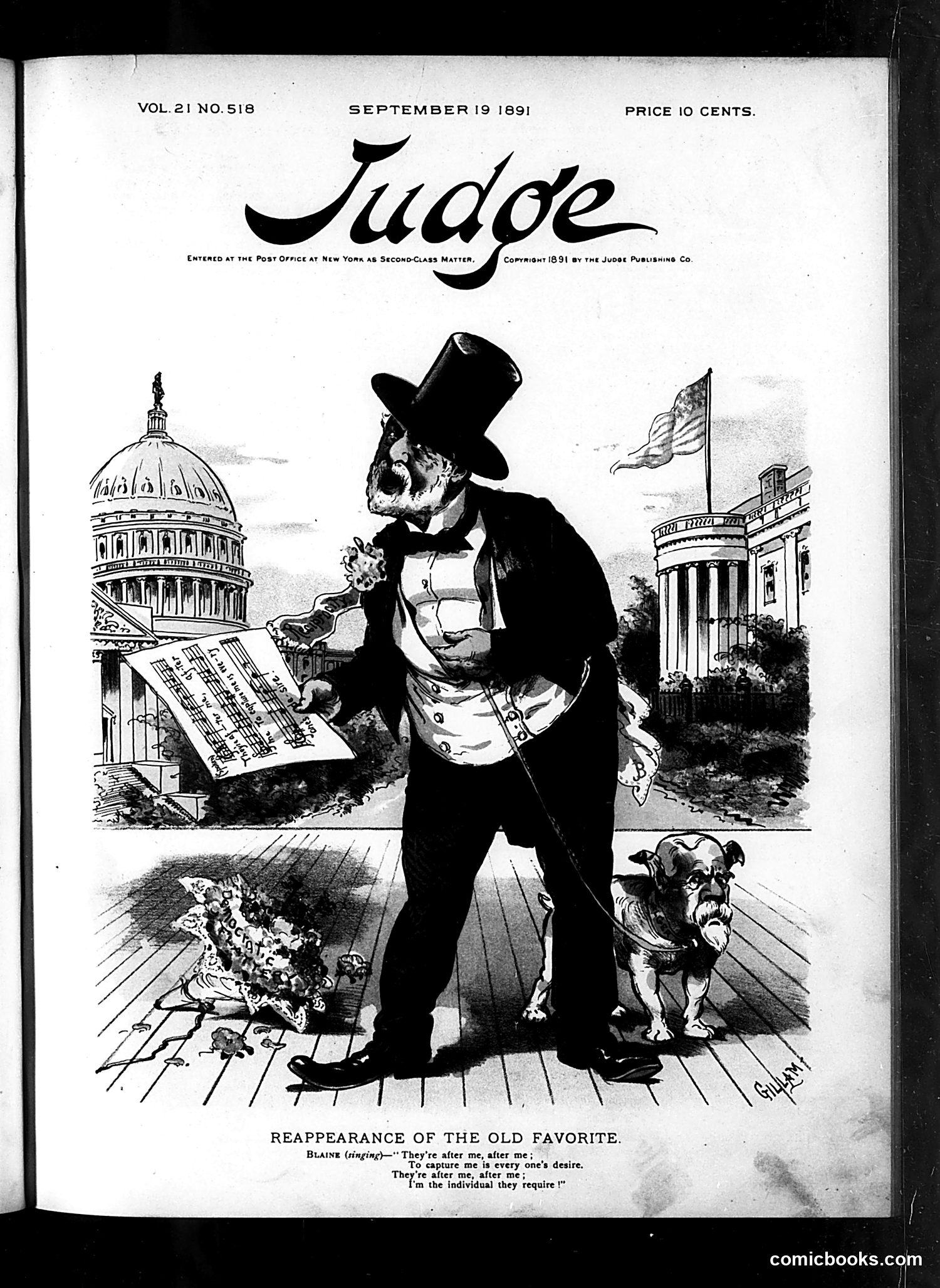
This political cartoon depicts a caricatured figure in formal dress standing before the U.S. Capitol and White House, holding what appears to be architectural plans. A dog accompanies the figure. The title references "the old favorite," and the caption quotes Blaine (likely James G. Blaine, the prominent Republican politician), suggesting his political return or comeback bid. The plans he holds likely reference policy proposals or a political platform. The satirical point appears to mock Blaine's reappearance in politics—suggesting he seeks to recapture political power or that his ambitions remain persistent despite previous setbacks. The exaggerated caricature and accompanying dog emphasize ridicule of his political reemergence. The Washington monuments establish the specifically political context of this satire.
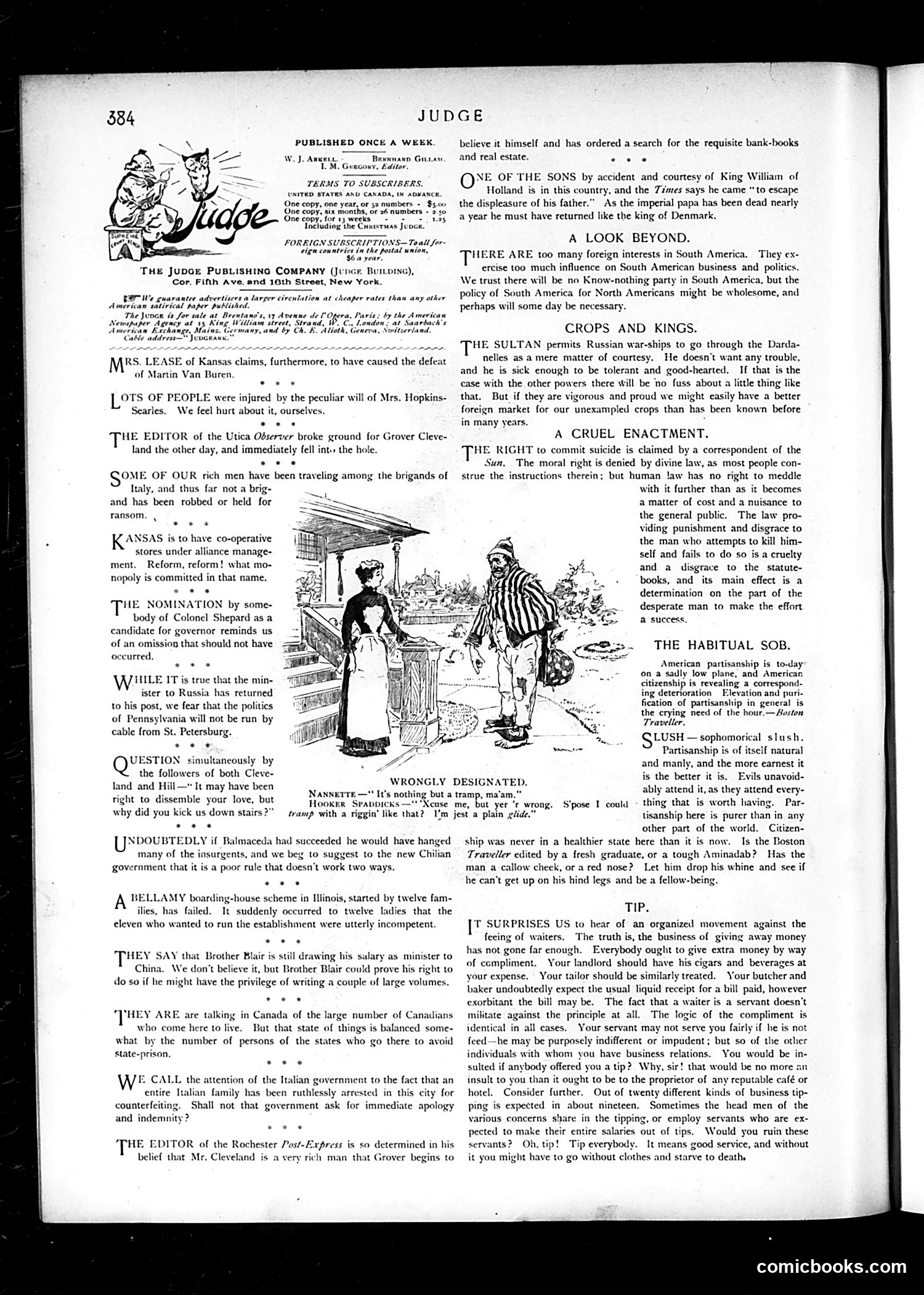
The main cartoon depicts two figures at a market stall: a woman in black dress and a man in striped clothing labeled "WRONGLY DESIGNATED." The dialogue identifies him as a "tramp" posing as someone respectable ("I'm jest a plain gude"). This appears to satirize concerns about fraudulent or deceptive street vendors and con artists misrepresenting themselves in urban marketplaces. The humor lies in the obvious contrast between the man's shabby appearance and his claimed respectability. The surrounding text discusses various political and social topics including Russian warships, suicide laws, and American partisanship—typical Judge magazine commentary. The specific historical context of this issue remains unclear without a visible date, though the content suggests early-to-mid 20th century concerns.
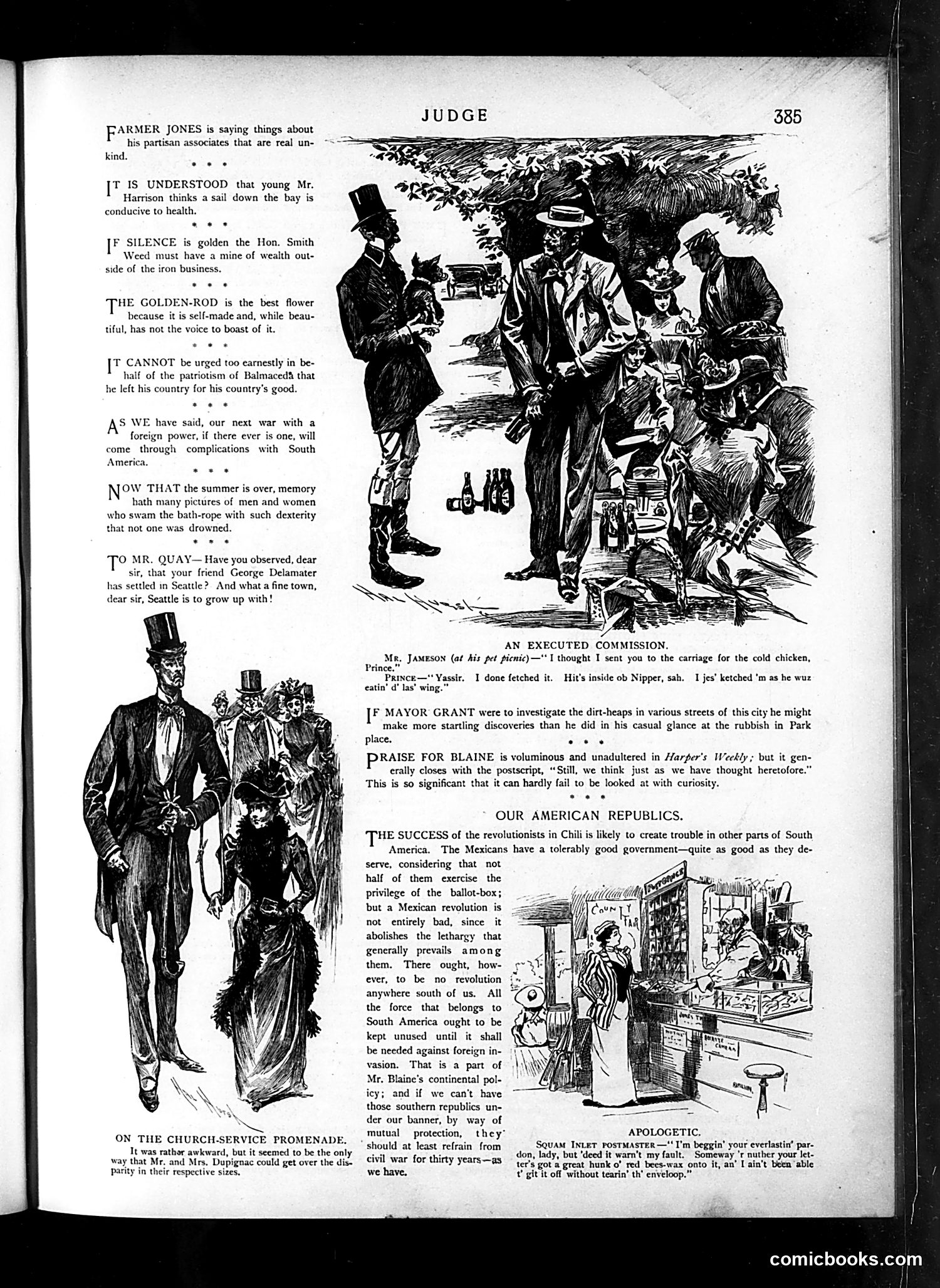
This page contains several satirical brief items and illustrations typical of Judge's political commentary: **"An Executed Commission"** depicts what appears to be a street scene with vendors and bottles, likely satirizing municipal corruption or inadequate city services. **"On the Church-Service Promenade"** illustrates well-dressed figures, apparently mocking upper-class social pretension during religious occasions. **"Our American Republics"** discusses South American revolutions, particularly Mexico's instability, suggesting American concerns about regional political chaos and advocating for protective measures against foreign intervention. The page combines local New York satirical observations with commentary on international affairs. Without specific dates or clearer context for individual items, precise identification of all figures remains uncertain, though the overall tone criticizes political incompetence, social hypocrisy, and foreign policy anxieties characteristic of Judge's editorial approach.
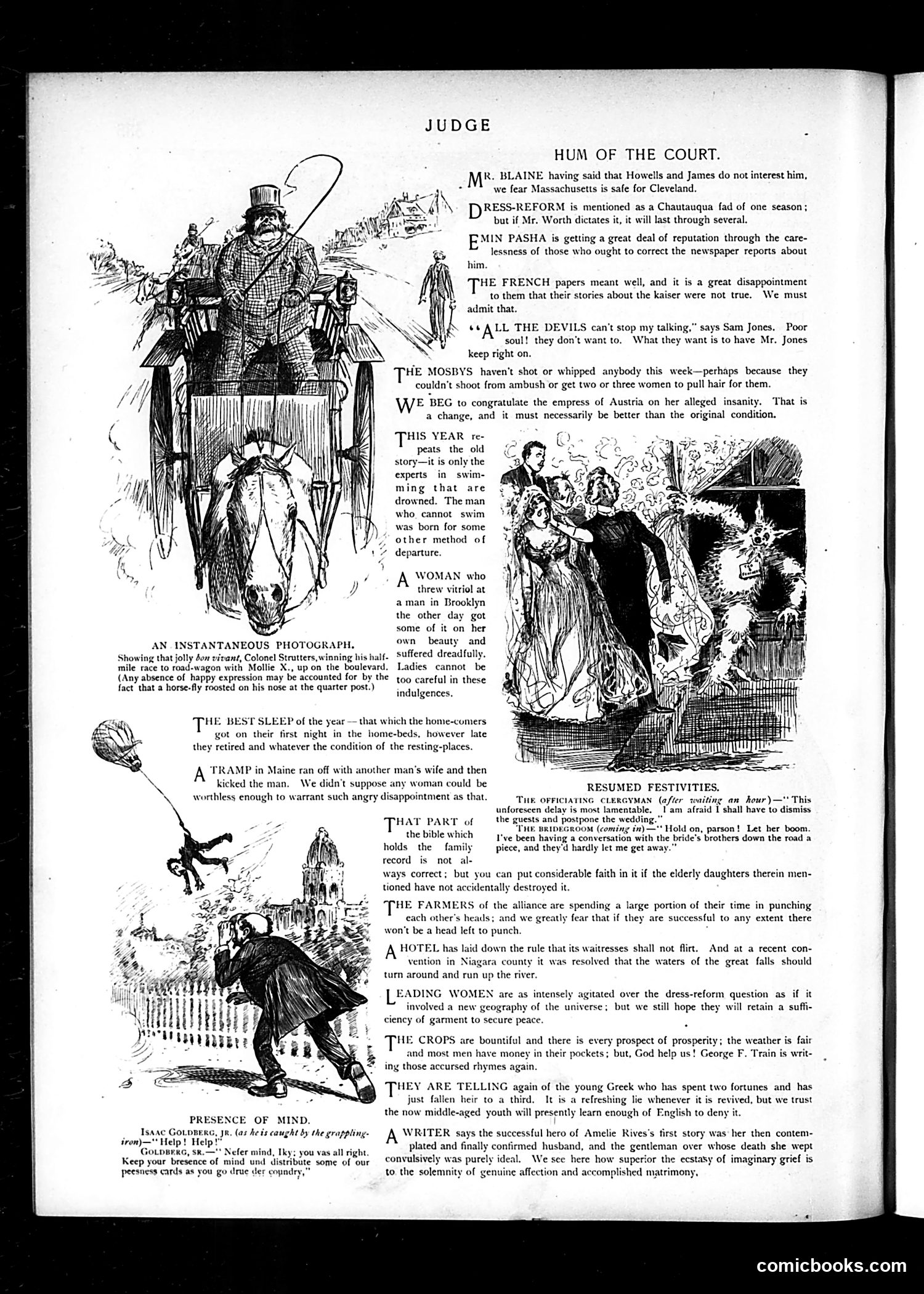
This page contains political and social commentary typical of 1880s-90s American humor. Key references include: **Political figures**: Blaine (likely James G. Blaine, prominent politician) and Cleveland (presidential candidate/president); mentions of Emin Pasha (African colonial figure). **Social satire**: The items mock various targets—dress reform activism ("leading women"), the Farmers' Alliance (a populist movement), Sam Jones (likely a preacher known for outspoken rhetoric), the Mosby gang (violent criminals), and George F. Train (eccentric writer/activist). **The cartoons** show exaggerated situations: a pompous judge on horseback, domestic scenes involving flirtation and marriage delays. **The humor** relies on period assumptions—women's vanity, racial/ethnic stereotypes, political cynicism, and social anxiety about reform movements. Most references require historical knowledge to fully appreciate today; the satire's targets are largely forgotten figures.
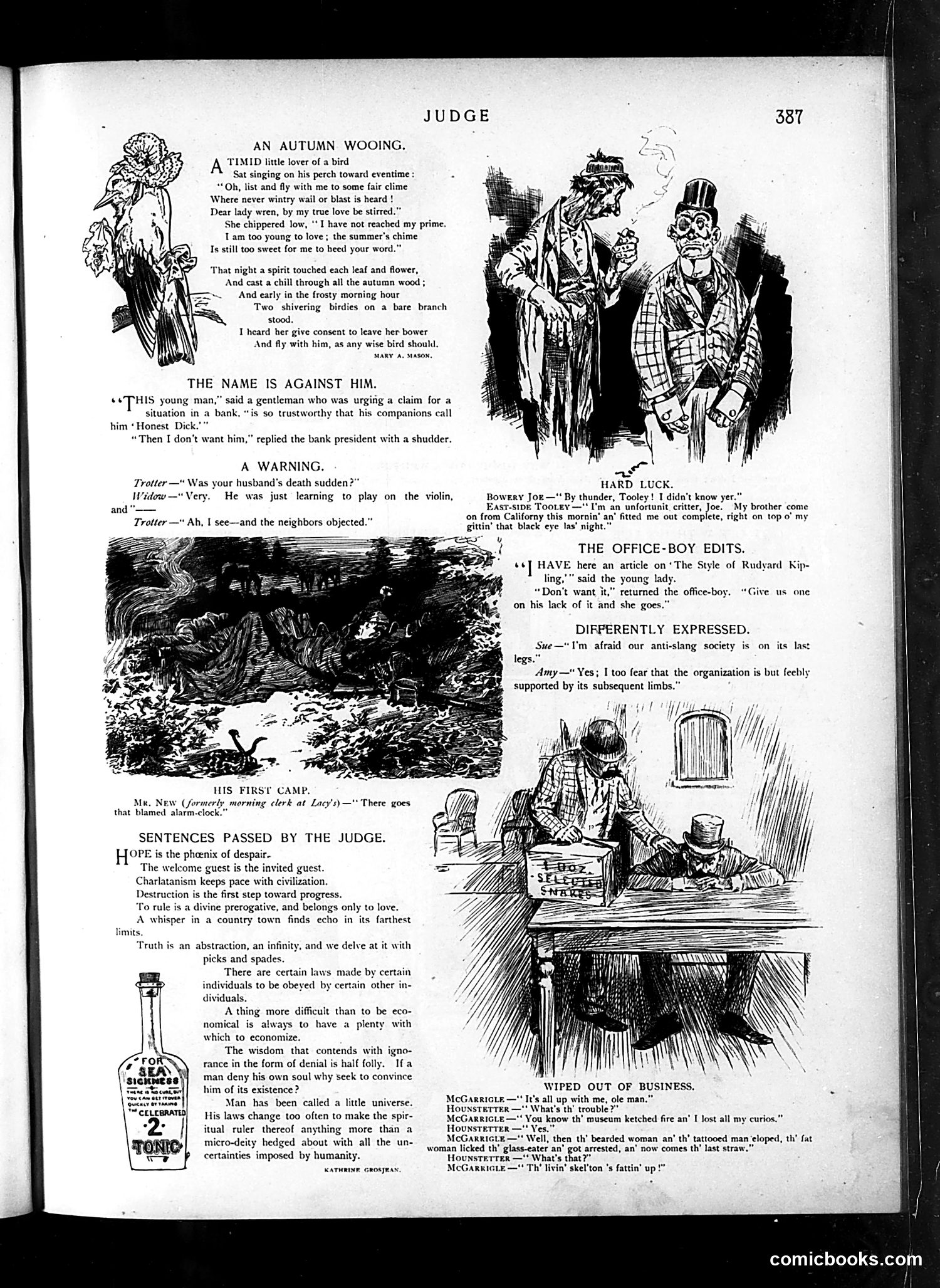
This page contains multiple humorous short pieces typical of Judge's satirical format: **"An Autumn Wooing"** is a sentimental poem about bird courtship, where a male bird's romantic advances are rejected until autumn's cold forces the female to accept him—a mild commentary on how hardship drives compromise in relationships. **"The Name Is Against Him"** satirizes banking institutions' suspicion of virtue. A job applicant is rejected specifically *because* he's known as "Honest Dick"—the joke being that banks apparently prefer less scrupulous employees, mocking corporate hypocrisy about morality. **"A Warning"** and other brief comedic dialogues mock contemporary concerns (violin-playing husbands, dialect humor, office management). **"Sentences Passed by the Judge"** presents pseudo-philosophical observations that are either contradictory or absurdly obvious—satirizing pretentious moralizing. **"Wiped Out of Business"** depicts a museum owner whose business collapses when his attractions (bearded woman, tattooed man, glass-eater) disappear through elopement, arrest, and medical change—mocking carnival/sideshow culture. The page reflects turn-of-century American attitudes, including casual ethnic dialect humor and skepticism toward institutions.
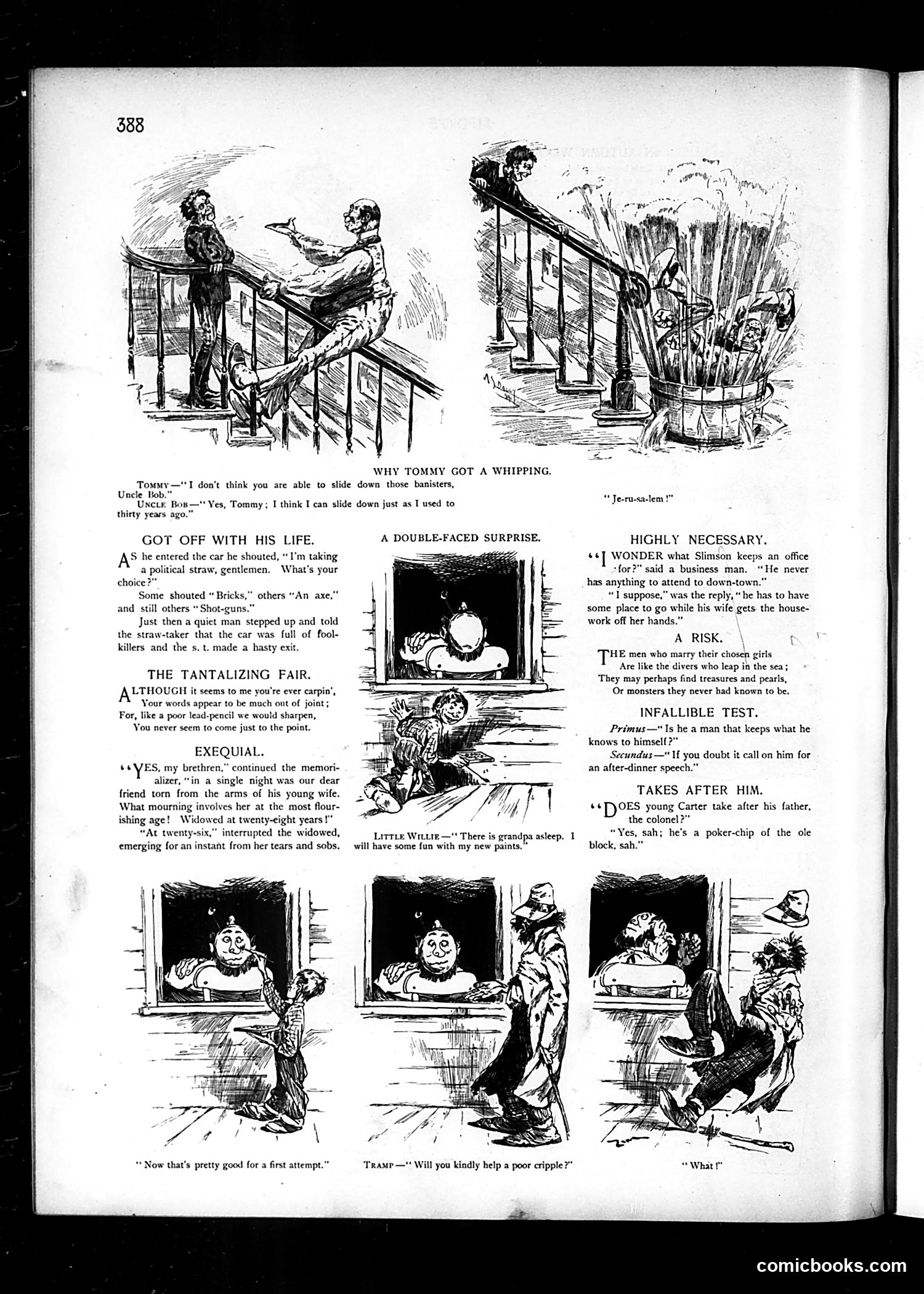
This page contains multiple unrelated humorous sketches typical of Judge's satirical format: **"Why Tommy Got a Whipping"**: A generational joke where Uncle Bob confidently claims he can slide down banisters "just as I used to thirty years ago"—implying he'll fail and get hurt, explaining Tommy's punishment for doubting him. **"Got Off With His Life"**: Political satire mocking streetcar passengers' casual violence. When a man asks for their "political straw" (voting preference), some shout weapons ("Bricks," "An axe," "Shot-gun"). A quiet man claims the car is full of "fool-killers," driving the pollster away—suggesting political discourse was so contentious that asking people's views risked violence. **Other sketches** include wordplay about women ("The Tantalizing Fair"), a funeral joke, and social commentary on marriage and business. The page reflects 19th-century American anxieties about political polarization, gender roles, and urban life, presented through slapstick and puns rather than sophisticated satire.
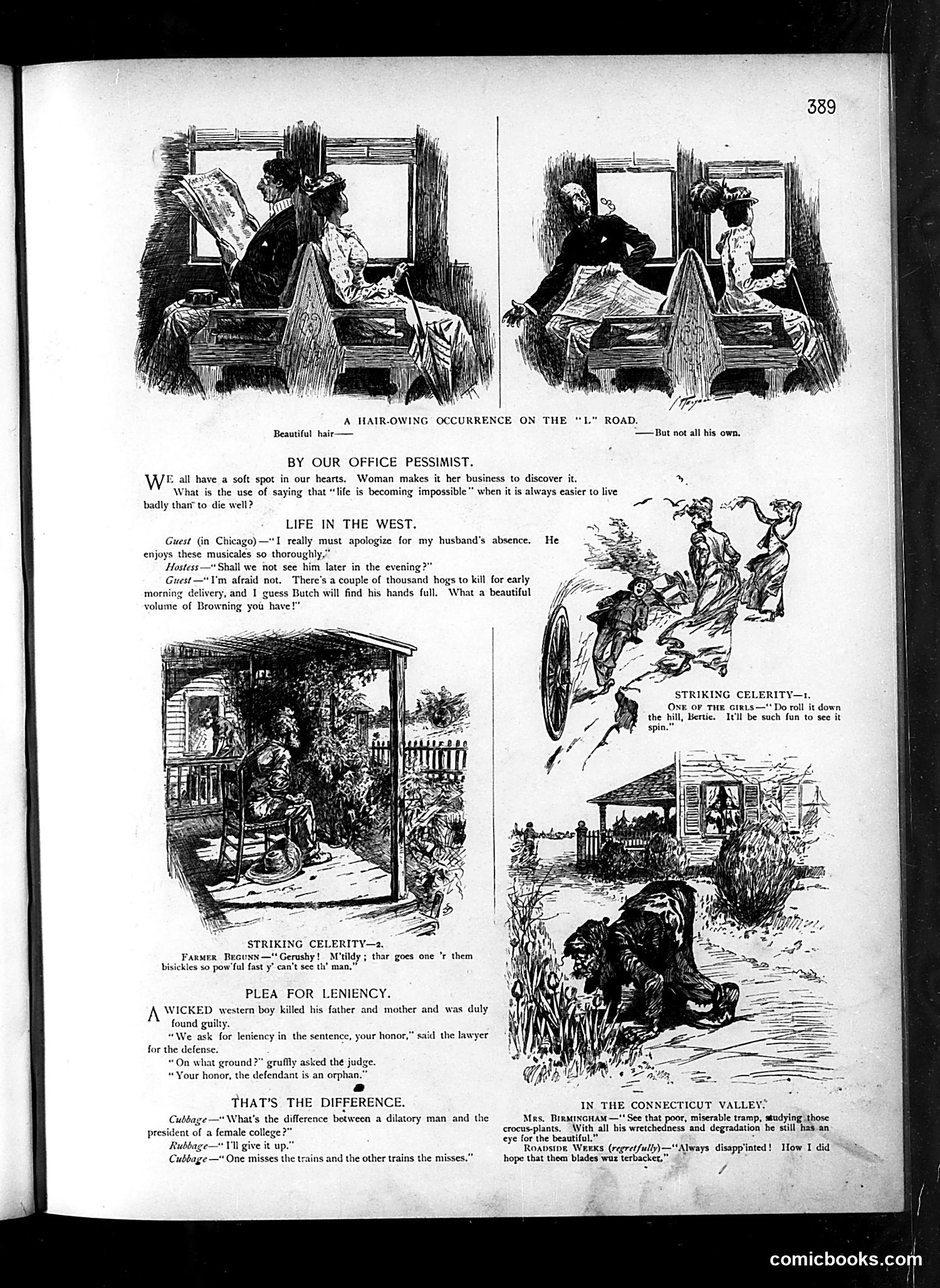
This page collects brief satirical pieces mocking American social conventions and attitudes circa early 1900s. **Top cartoons** mock pretentious urban behavior—particularly women's elaborate hairstyles on public transit ("L" Road = elevated train) and their self-conscious display. **"Life in the West"** satirizes Midwestern hospitality and priorities: a Chicago hostess accepts a guest's husband's absence because he's occupied killing hogs for commercial butchering—implying raw materialism trumps refined culture (Browning poetry). **"Striking Celerity"** mocks rural dialect and farmers' amazement at bicycles. **"Plea for Leniency"** is dark humor: a lawyer argues for leniency for a parricide because the defendant is now orphaned—absurd circular reasoning. **"That's the Difference"** is a pun on "misses" (trains vs. young women). **"Connecticut Valley"** contrasts urban sentimentality about rural poverty with actual rural priorities—a tramp admires flowers while poor farmers wish they were profitable tobacco plants. Throughout: satirical jabs at class pretension, regional differences, and hypocritical sentiment.
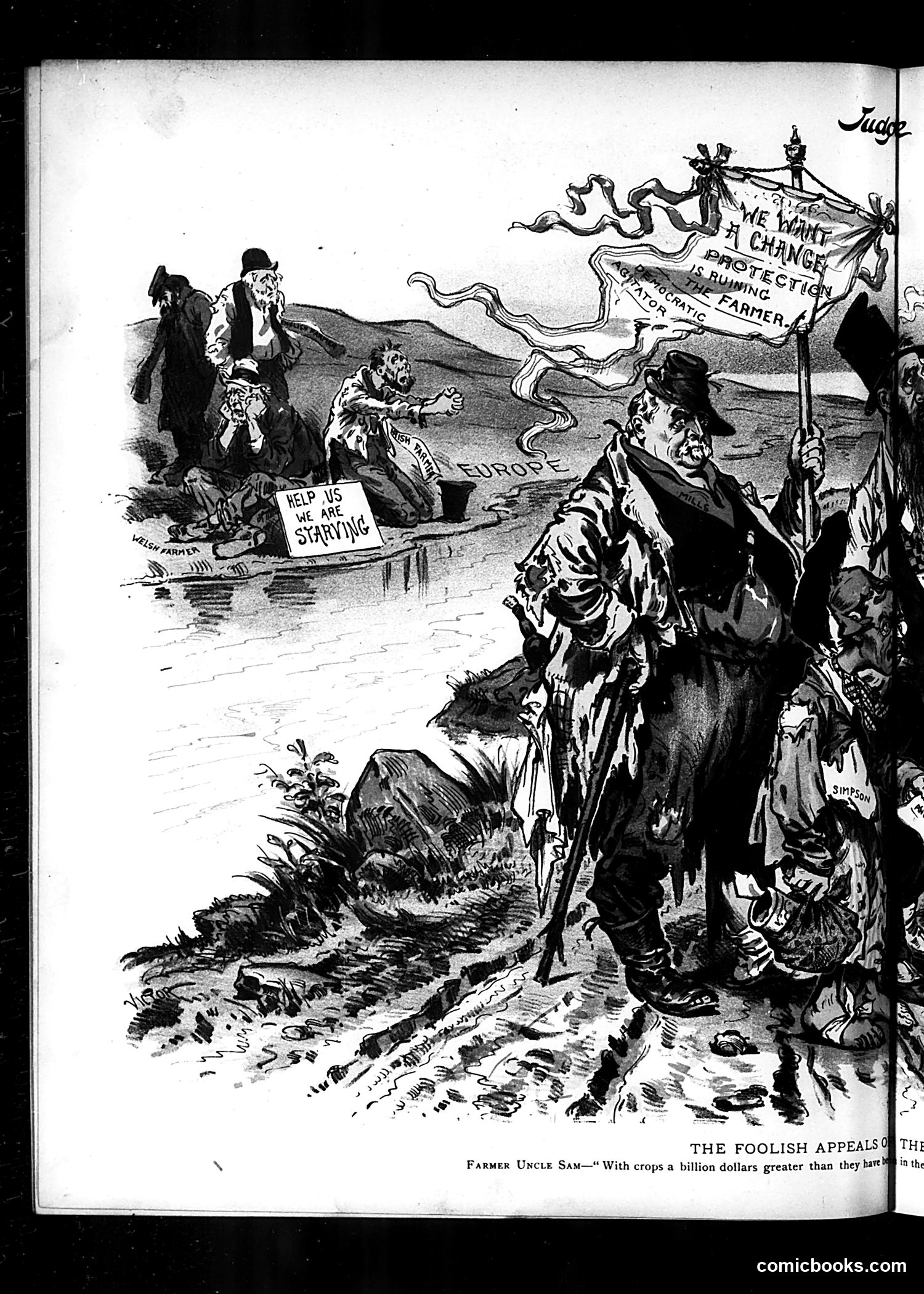
This political cartoon depicts Uncle Sam (representing the U.S. government) on the right, appearing distressed or defensive. On the left, a group of impoverished figures hold a sign reading "HELP US WE ARE STARVING." A banner above references "PROTECTION" and "TARIFF" policy. The satire critiques protective tariffs—trade policies that raised prices on imported goods. The cartoon suggests these policies harmed ordinary Americans and farmers by making goods expensive, while benefiting wealthy interests. The "foolish appeals" of the title indicates the government ignored desperate citizens' pleas for economic relief in favor of maintaining tariff protection for business. This likely reflects early 20th-century debates over tariff policy and its economic impact on working Americans.
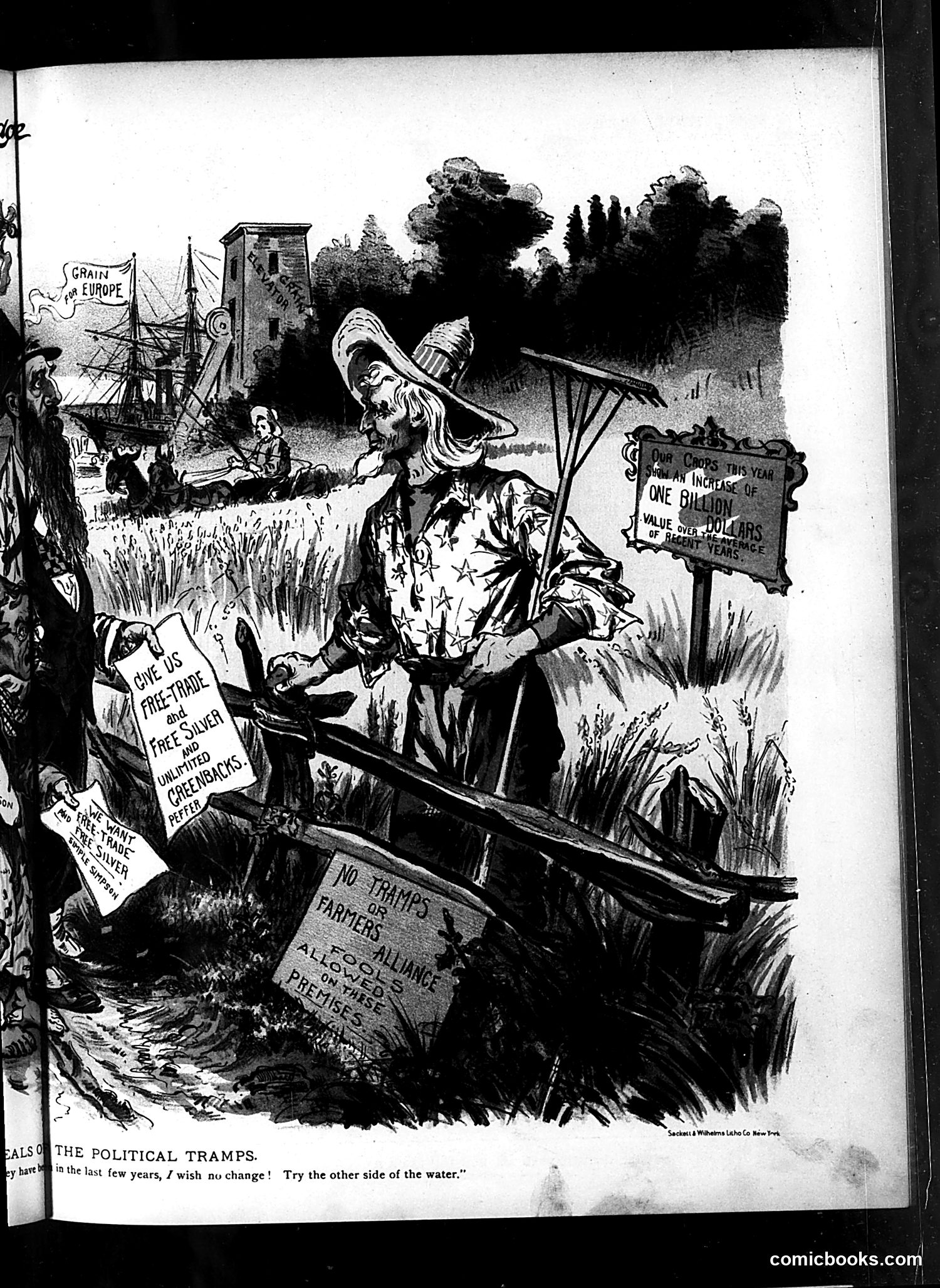
This political cartoon satirizes American politicians as vagrants or drifters. Uncle Sam (identifiable by his star-spangled outfit and characteristic hat) stands amid various signs representing failed or unpopular policies: "Free Trade," "Free Silverism," "Unlimited Greenbacks," "No Tramps," and "Farmers Alliance." The caption—"Been in the last few years, I wish no change! Try the other side of the water"—suggests Sam is weary of domestic political turmoil and considers emigrating to Europe (visible in the background with ships). The cartoon critiques the period's political instability and competing economic platforms (protectionism vs. free trade, currency debates). The "tramps" metaphor implies American politicians are rootless drifters offering contradictory solutions, leaving the nation exhausted and considering escape rather than remaining to fix problems.
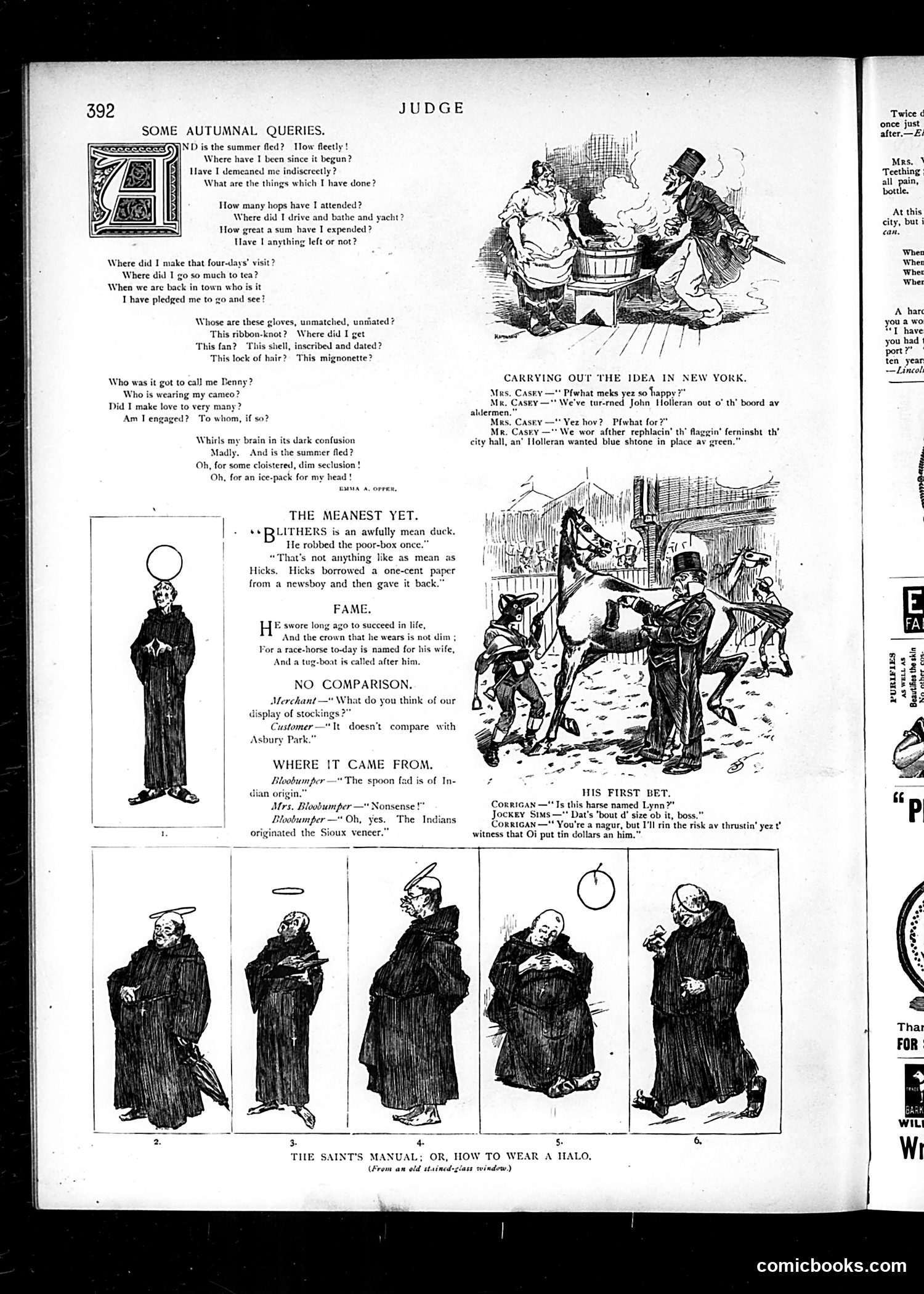
This page contains multiple satirical pieces typical of Judge magazine's humor: **"Some Autumnal Queries"** mocks upper-class anxiety about summer social activities—the speaker obsessively catalogs social engagements, expenditures, and romantic entanglements, revealing vanity and shallow concerns about status. **"Carrying Out the Idea in New York"** features Irish immigrant characters (Caseys) using thick dialect humor. They celebrate removing "John Holleran" from the city's board of aldermen over a trivial dispute about stone colors—satirizing ethnic politics and petty municipal corruption. **"The Meanest Yet," "Fame," and other brief pieces** use wordplay and irony to mock human behavior: stolen charity funds, fame through marriage, and social pretension. **"His First Bet"** depicts Irish working-class characters betting on horses, using caricatured dialect. **"The Saint's Manual"** shows six sequential illustrations demonstrating how to properly wear a halo—absurdist visual humor about religious hypocrisy. The page reflects Judge's target audience: educated, affluent readers who enjoyed mocking both social climbers above them and working-class immigrants below them through ethnic stereotypes.
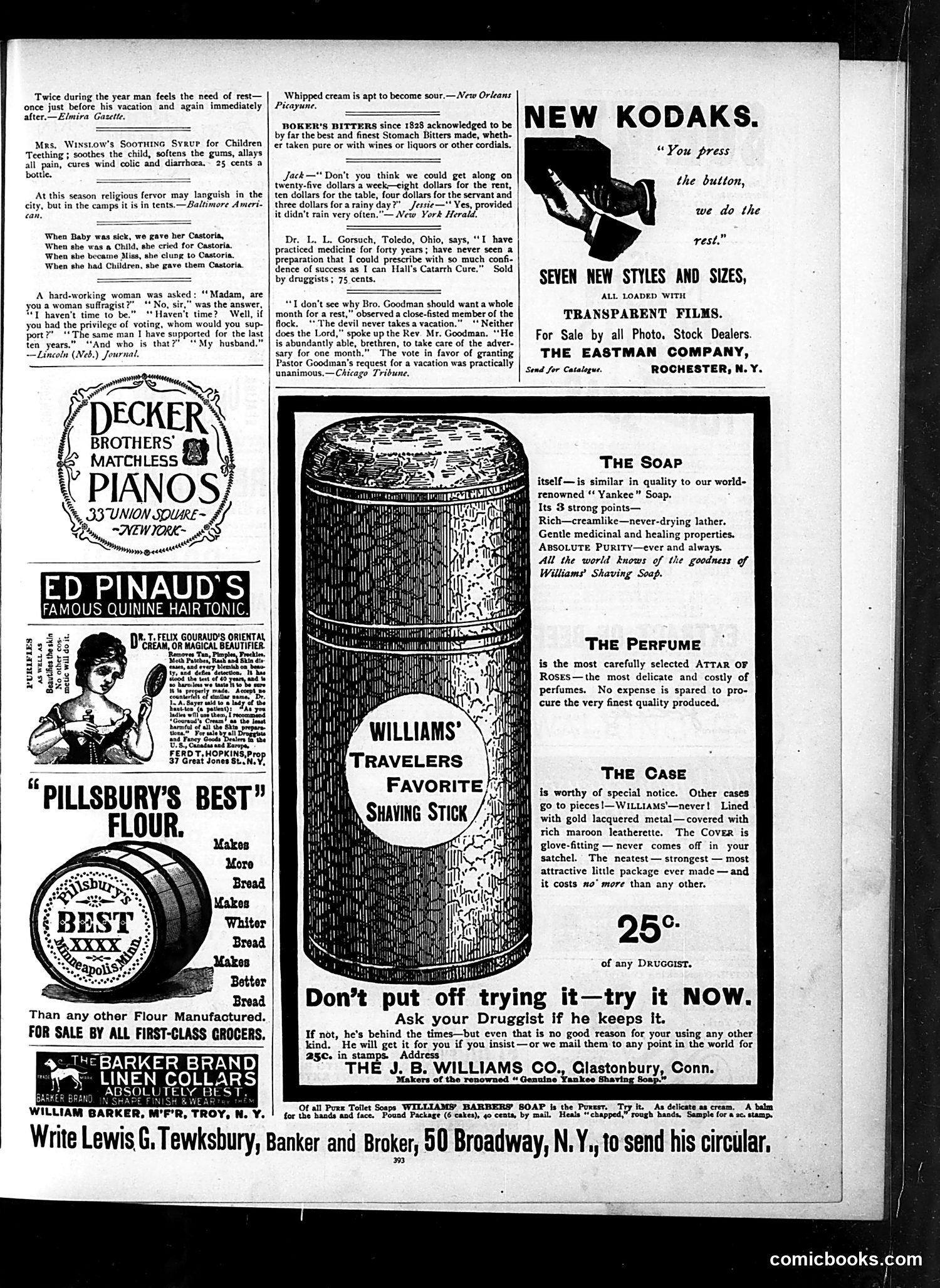
This page is primarily **advertising content** with minimal satirical cartoons. The main illustrated advertisements are for consumer products (Decker pianos, Pillsbury flour, Ed Pinaud's hair products, and Williams' Shaving Stick). The few brief text jokes scattered throughout are typical Judge humor—short quips on contemporary domestic and social topics: - A joke about a couple budgeting on $25/week, debating whether they can afford a servant - A clerical anecdote mocking a stingy parishioner who objects to the pastor taking a vacation - A women's suffrage joke where a hard-working woman says she's "too busy" to be a suffragist, then admits she'd vote for her husband anyway These reflect **early 1900s concerns**: working-class finances, church life, and skepticism about women's political participation. The humor assumes readers will find it amusing that a woman wouldn't (or couldn't) consider independent political thought. The page is otherwise dominated by period advertising showcasing consumer goods marketed to middle-class readers.
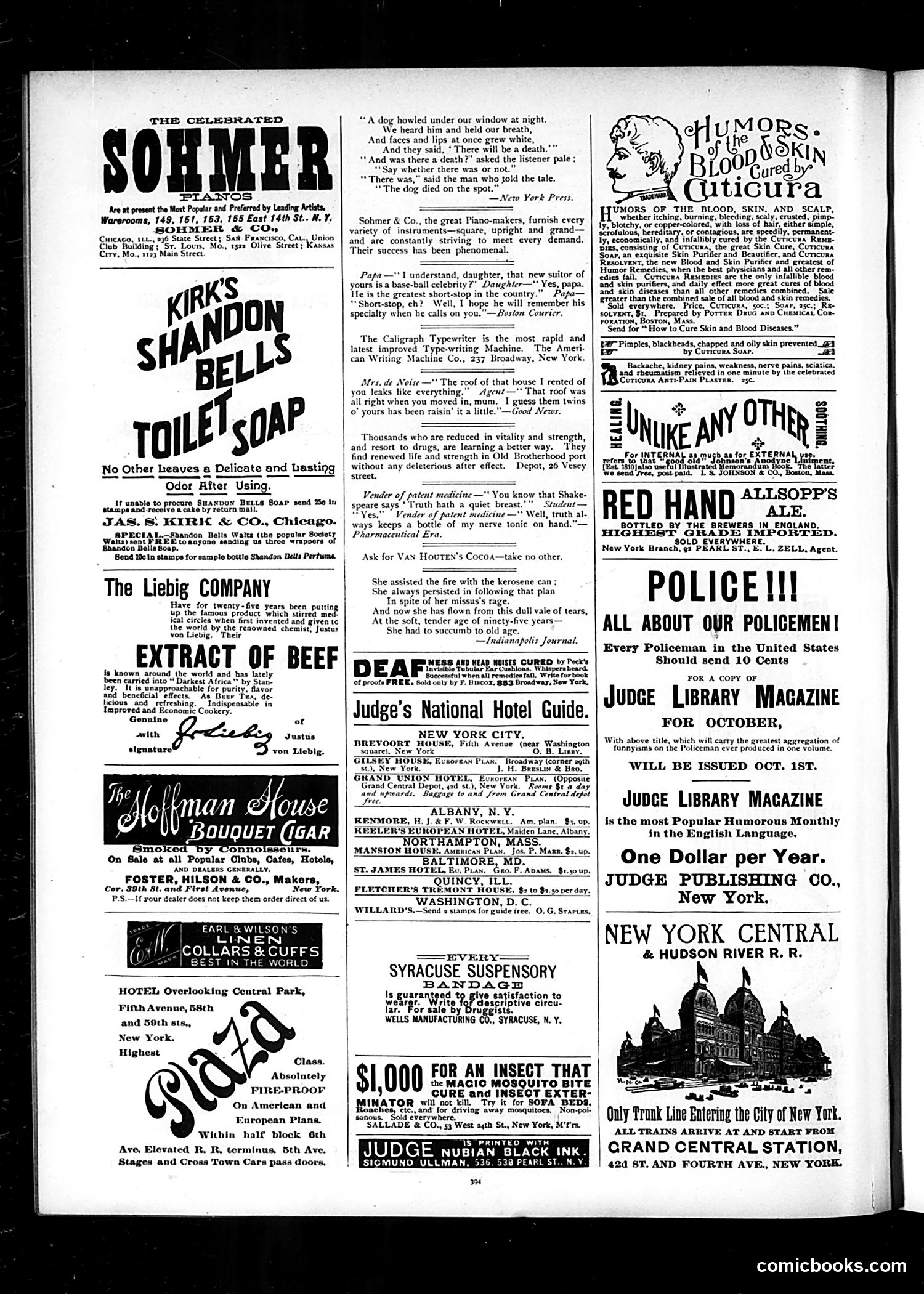
This is primarily a **advertisements page** from Judge magazine, with minimal cartoon content. The page consists almost entirely of product advertisements typical of late 19th-century American magazines. The only narrative content includes brief humorous anecdotes scattered among ads—small jokes about relationships, landlord-tenant disputes, and domestic situations that reflect period concerns. Notable elements: - Heavy advertising for pianos, soap, beef extract, cigars, hotels, and patent medicines - A recurring motif of "patent medicine" vendors (satirizing quack remedies common in the era) - Domestic humor depicting gender roles and class relations - References to popular culture (baseball, typewriters) The page lacks explicit political satire or caricatures. Instead, it mirrors Judge's satirical approach through advertisements themselves—the very act of promoting dubious products and patent medicines was itself Judge's form of social commentary on American commercial culture and consumer gullibility of the period.
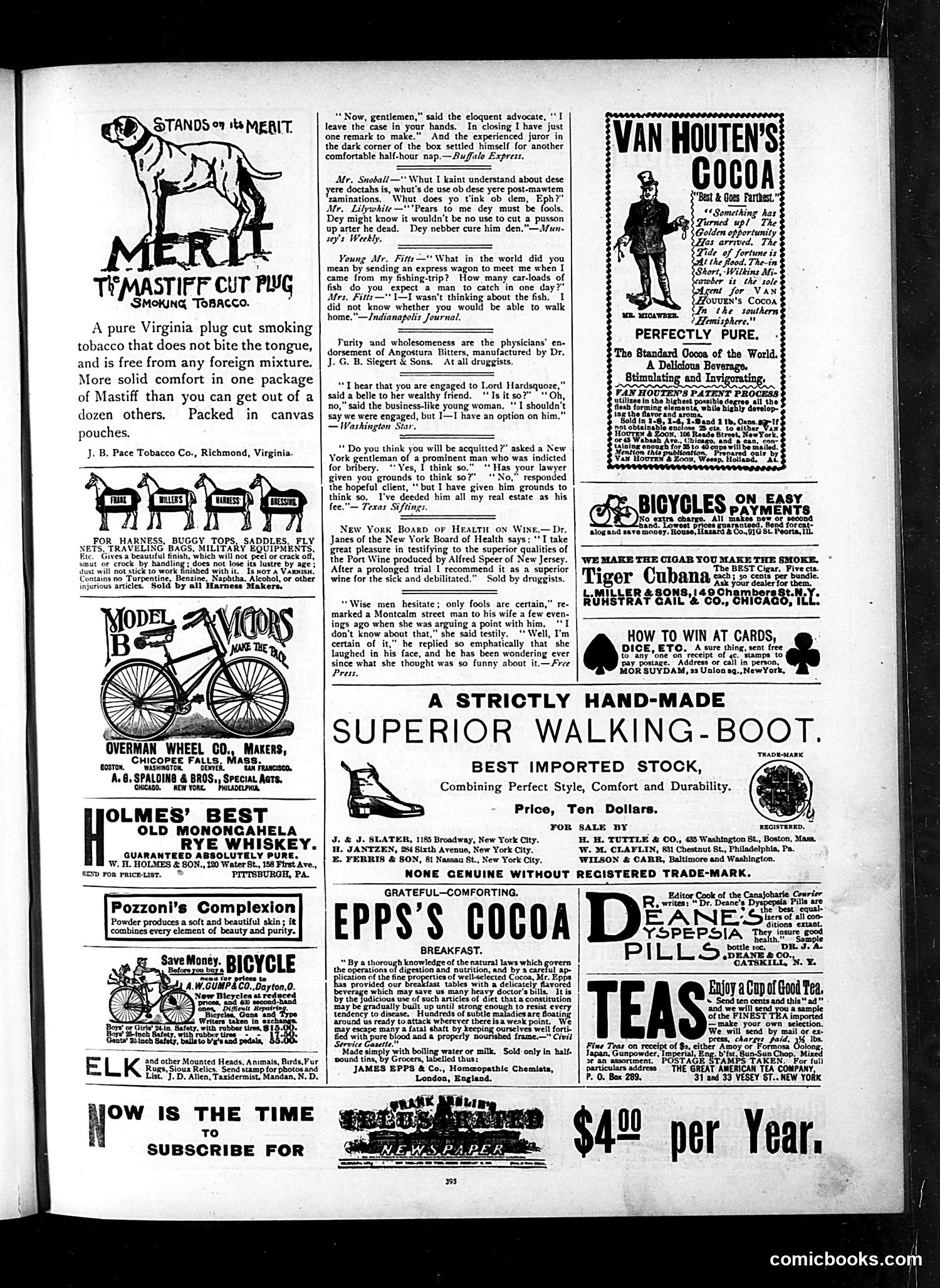
This is primarily an **advertising page** from Judge magazine, featuring product advertisements interspersed with brief humor pieces and jokes. The **cartoon element** is minimal—just the "Mastiff Cut Plug" tobacco mascot (a dog) at top left, which serves as a brand logo rather than political satire. The **humor pieces** are short, genteel jokes typical of the era: - A lawyer's closing argument puts jurors to sleep - Two African American men (rendered in dialect) discuss autopsies - A woman reveals she sent a wagon to meet her fishing husband because she doubted his ability to walk home sober - A wealthy man jokes about "optioning" an engagement - A defendant admits he paid his lawyer with real estate These jokes reflect **period attitudes**: they rely on stereotypes, marital dynamics, class humor, and legal cynicism—all presented as lighthearted. The dialect humor would be considered offensive today. The rest is **commercial advertising** for tobacco, whiskey, bicycles, cocoa, and other products—typical magazine revenue.
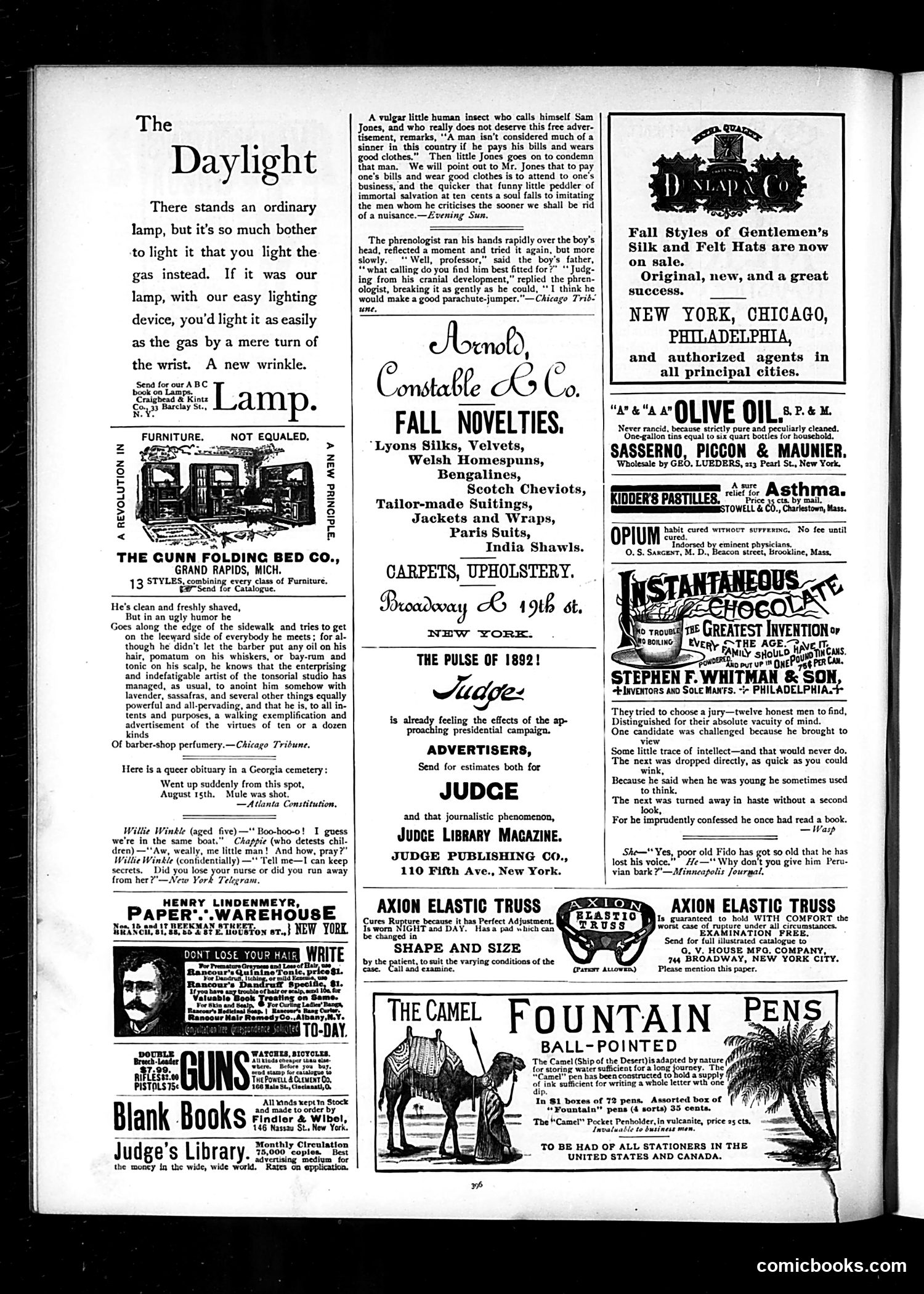
This page is primarily composed of **advertisements and editorial filler**—typical content for Judge magazine circa 1892. The text reveals Judge's satirical voice through several short comedic items: **Notable Editorial Content:** A piece mocking **Sam Jones**, an evangelical preacher of the era, criticizing him for condemning respectable people who pay bills and dress well while Jones himself profits from religious sales ("immortal salvation at ten cents a soul"). Another item humorously describes a fastidious, freshly-shaved man trying to avoid the barber shop's overpowering perfumes, presenting him as a "walking advertisement" of pomatum and cologne—satire on masculine vanity and barber culture. **The "Pulse of 1892" reference** acknowledges the approaching 1892 presidential campaign affecting the magazine's content and reader interest. Otherwise, the page is dominated by period **product advertisements** (furniture, pens, trusses, books) typical of late-19th-century magazine layout. No prominent political cartoons are visible here.
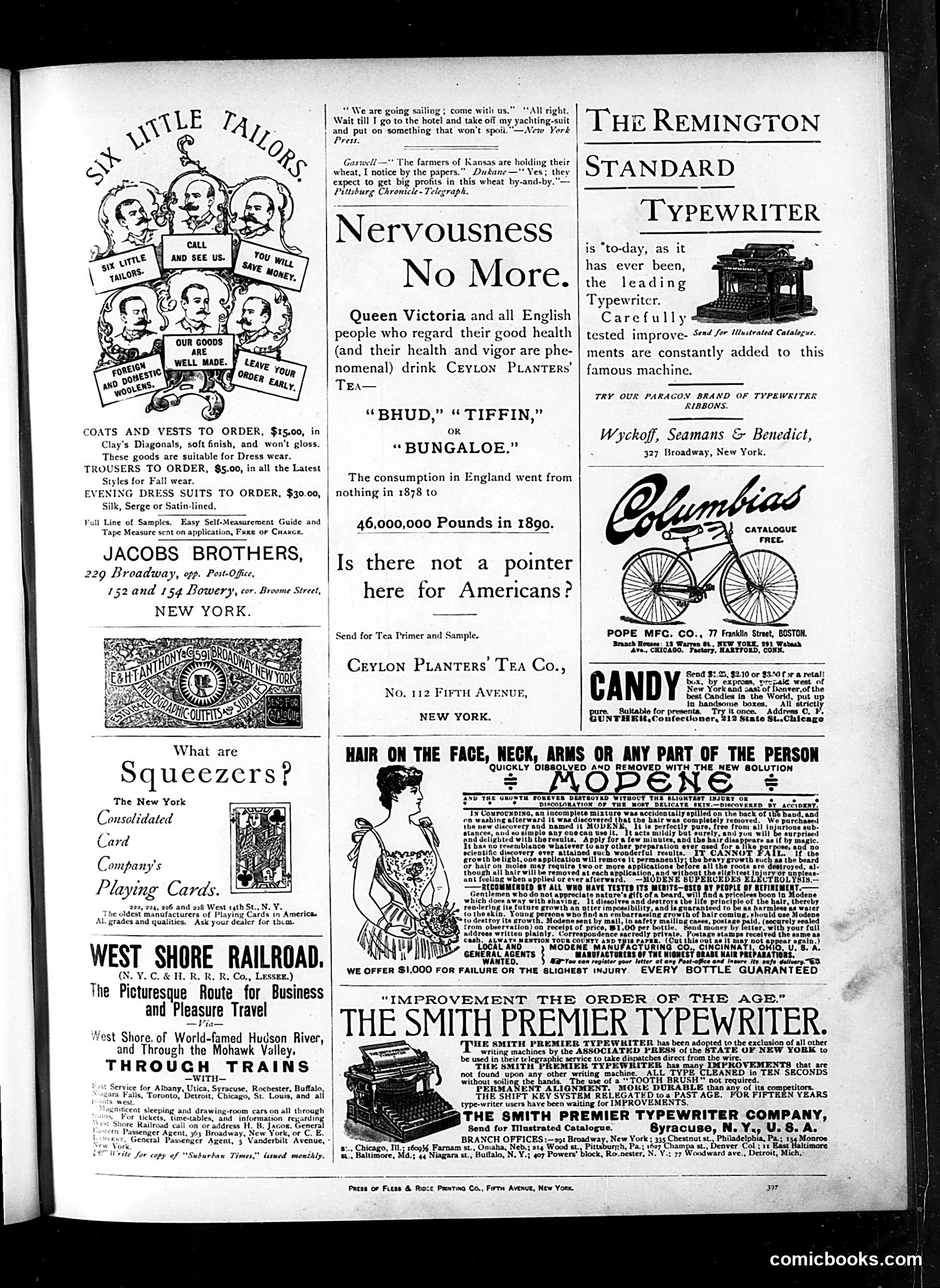
This page is primarily **advertisements**, not satirical cartoons. The small dialogue snippets at the top are humorous observations rather than political satire: The first joke concerns a man refusing to go sailing because he'd have to remove his expensive yachting suit—satirizing wealthy vanity and impracticality. The second references Kansas farmers expecting wheat profits, likely a topical economic commentary on agricultural markets of the era. The bulk of the page advertises **typewriters** (Remington Standard, Smith Premier), **Ceylon tea** (leveraging Queen Victoria's endorsement), **bicycles** (Columbia brand), **railroad service**, **hair removal products**, and other consumer goods. One notable ad promotes a "hair removal solution" with sensational claims and a "$1,000 guarantee" against injury—typical of period patent medicines with dubious efficacy. The overall content reflects **late-1890s consumer culture** and advertising strategies targeting affluent readers: status goods, imperial British associations, and pseudoscientific products.
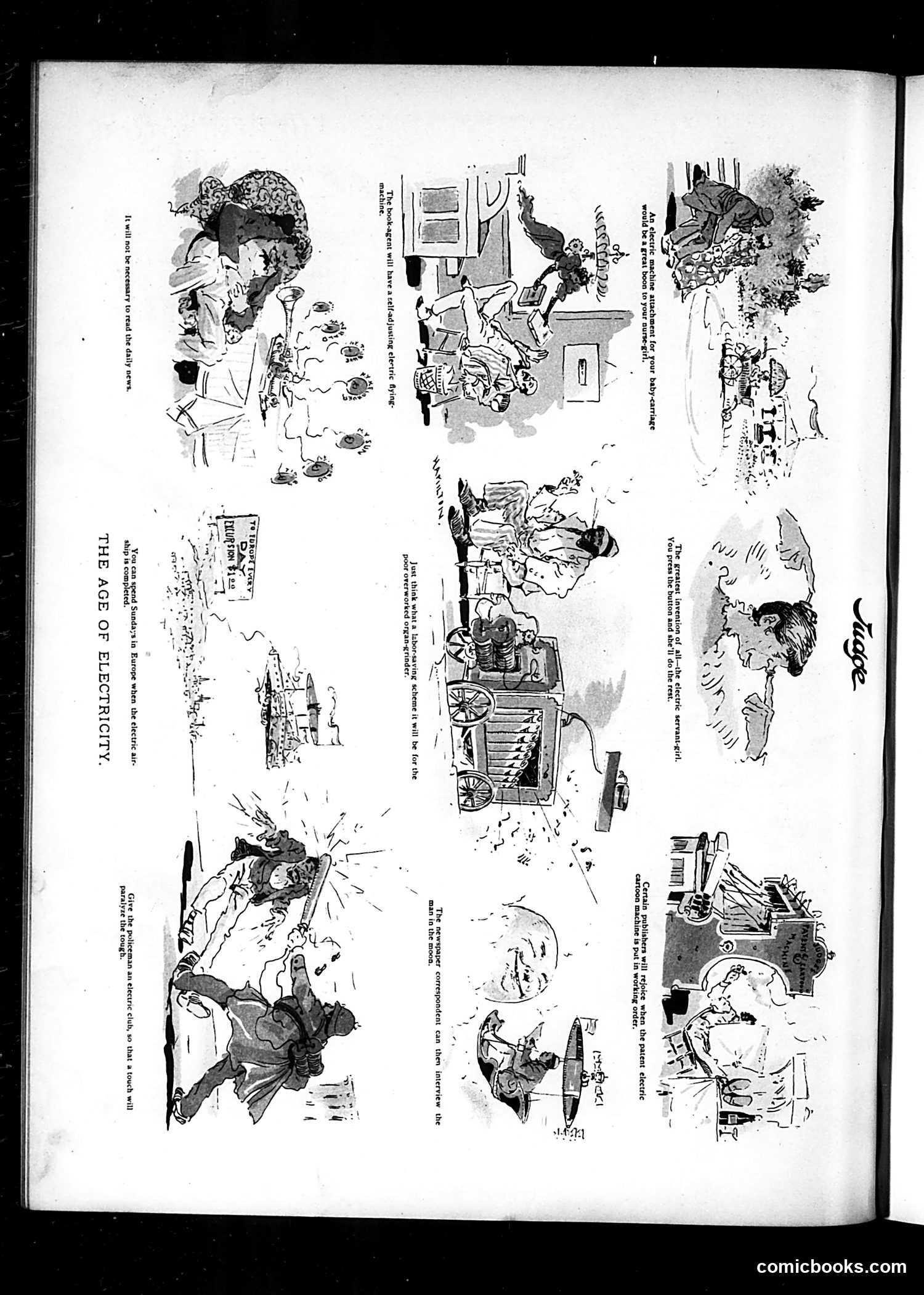
This page satirizes the turn-of-the-century obsession with electricity as a cure-all technology. The cartoons humorously imagine absurd applications of electric power to everyday problems: - An **electric baby-carriage attachment** to help nurses - A **cartoon-making machine** for publishers (suggesting cartoons could be mass-produced) - Relief for the **organ-grinder** (street musicians playing hand-cranked instruments) - An **electric police club** to incapacitate criminals ("toughs") The satire mocks both technological utopianism and the notion that mechanization could solve social issues. Each vignette presents increasingly ridiculous scenarios, poking fun at the era's faith that electricity would revolutionize labor and society. The implicit joke: not every problem needs—or should have—an electrical solution. This reflects genuine anxiety about rapid industrialization and its social consequences during the early electrification era.