
Judge, 1891-09-19 · page 3 of 16
Judge — September 19, 1891 — page 3: what you’re looking at
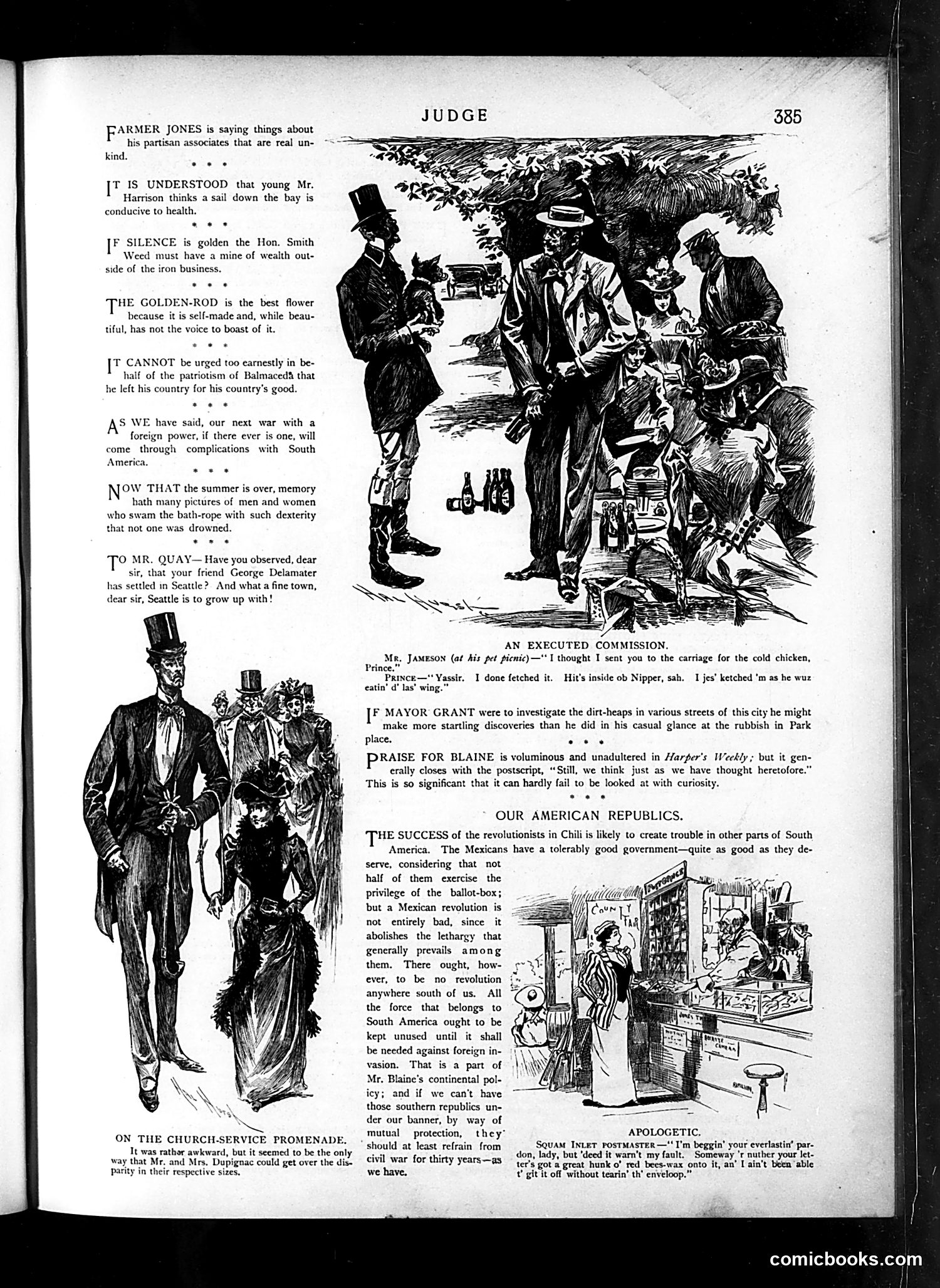
What you’re looking at
This page contains several satirical brief items and illustrations typical of Judge's political commentary: **"An Executed Commission"** depicts what appears to be a street scene with vendors and bottles, likely satirizing municipal corruption or inadequate city services. **"On the Church-Service Promenade"** illustrates well-dressed figures, apparently mocking upper-class social pretension during religious occasions. **"Our American Republics"** discusses South American revolutions, particularly Mexico's instability, suggesting American concerns about regional political chaos and advocating for protective measures against foreign intervention. The page combines local New York satirical observations with commentary on international affairs. Without specific dates or clearer context for individual items, precise identification of all figures remains uncertain, though the overall tone criticizes political incompetence, social hypocrisy, and foreign policy anxieties characteristic of Judge's editorial approach.
📄 Transcribed text from this page (OCR, searchable)
Machine-transcribed from the original scan — historical spelling and the odd misread are preserved.
FARMER JONES is saying things about his partisan associates that are real un- kind. ewe T IS UNDERSTOOD that young Mr. Harrison thinks a sail down the bay is conducive to health. F SI ‘CE is golden the Hon. Smith Weed must have a mine of wealth out- side of the iron business. HE GOLDEN-ROD is the best flower because it is self-made and, while beau- tiful, has not the voice to boast of it. [7 CANNOT be urged too earnestly in be- half of the patriotism of Balmaced’ that he left his country for his country's good. S WE have said, our next war with a foreign power, if there ever is one, will come through complications with South America. NOW THAT the summer is over, memory hath many pictures of men and women who swam the bath-rope with such dexterity that not one was drowned. ‘0 MR. QUAY— Have you observed, dear sir, that your friend George Delamater has settled in Seattle? And what a fine town, dear sir, Seattle is to grow up with! AN EXECUTED COMMISSION. Mr. JAMESON (af Ais pet pienic)—'* I thought I sent you to the carriage for the cold chicken, Prince.” Prince—"' Yassir. I done fetched it. Hit's inside ob Nipper, sab. I jes’ ketched ‘m as he wuz eatin’ d’ las’ wing.” [F MAYOR GRANT were to investigate the dirt-heaps in various streets of this city he might make more startling discoveries than he did in his casual glance at the rubbish in Park place. Soh) PRAISE FOR BLAINE is voluminous and unadultered in Harper's Weekly; but it gen- erally closes with the postscript, “Still, we think just as we have thought heretofore.” This is so significant that it can hardly fail to be looked at with curiosity. OUR AMERICAN REPUBLICS. TH SUCCESS of the revolutionists in Chili is likely to create trouble in other parts of South America. The Mexicans have a tolerably good government—quite as good as they de- serve, considering that not half of them exercise the privilege of the ballot-box; but a Mexican revolution is not entirely bad, since it abolishes the lethargy that generally prevails among them. There ought, how- ever, to be no revolution j anywhere south of us. All ~ the force that belongs to South America ought to be kept unused until it shall be needed against foreign in- vasion. That is a part of Mr. Blaine’s continental pol icy; and if we can’t have those southern republics un- der our banner, by way of mutual protection, they” APOLOGETIC, should at least refrain from SQUAM INLET PostMASTER—"'I'm beggin’ your everlastin’ par- don, lady, but ‘deed it warn’t my fault. Someway 'r nuther your let- ter’s got a great hunk o' red becs-wax onto it, an’ [ain't been ‘able ’ git it off without tearin’ th’ envelop.” ON THE CHURCH-SERVICE PROMENADE. It was rathor awkward, but it seemed to be the only °° : way that Mr, and Mrs, Dupignac could get over the dis- Civil war for thirty years—as Parity in their respective sizes. we have. comicbooks.com