
A complete issue · 16 pages · 1891
Judge — August 29, 1891
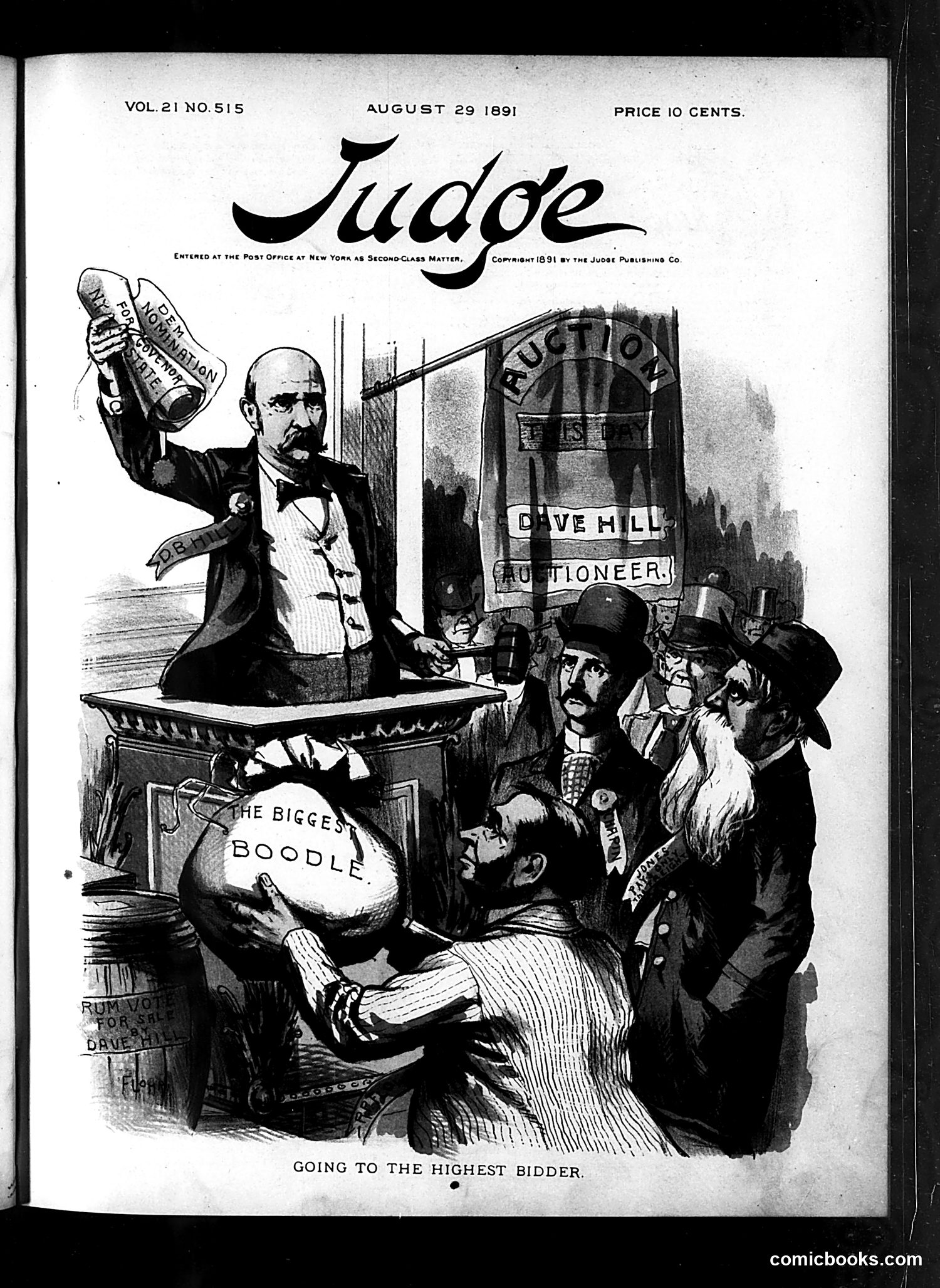
This August 1891 *Judge* cartoon satirizes government auctioning. An auctioneer stands at a podium labeled "AUCTION" and "DAVE HILL" (likely a contemporary political figure), holding aloft what appears to be a "MONOPOLY" item. Below, a bidder clutches an enormous egg labeled "THE BIGGEST BOODLE"—slang for bribes or ill-gotten political money. The satire targets corruption: government assets and influence are being sold to the highest bidder, with "boodle" (corrupt money) driving the sale. The crowd of eager bidders suggests this was seen as systemic—everyone involved in politics was complicit in buying and selling government favors. The cartoon critiques the Gilded Age's notorious political corruption and monopolistic practices.
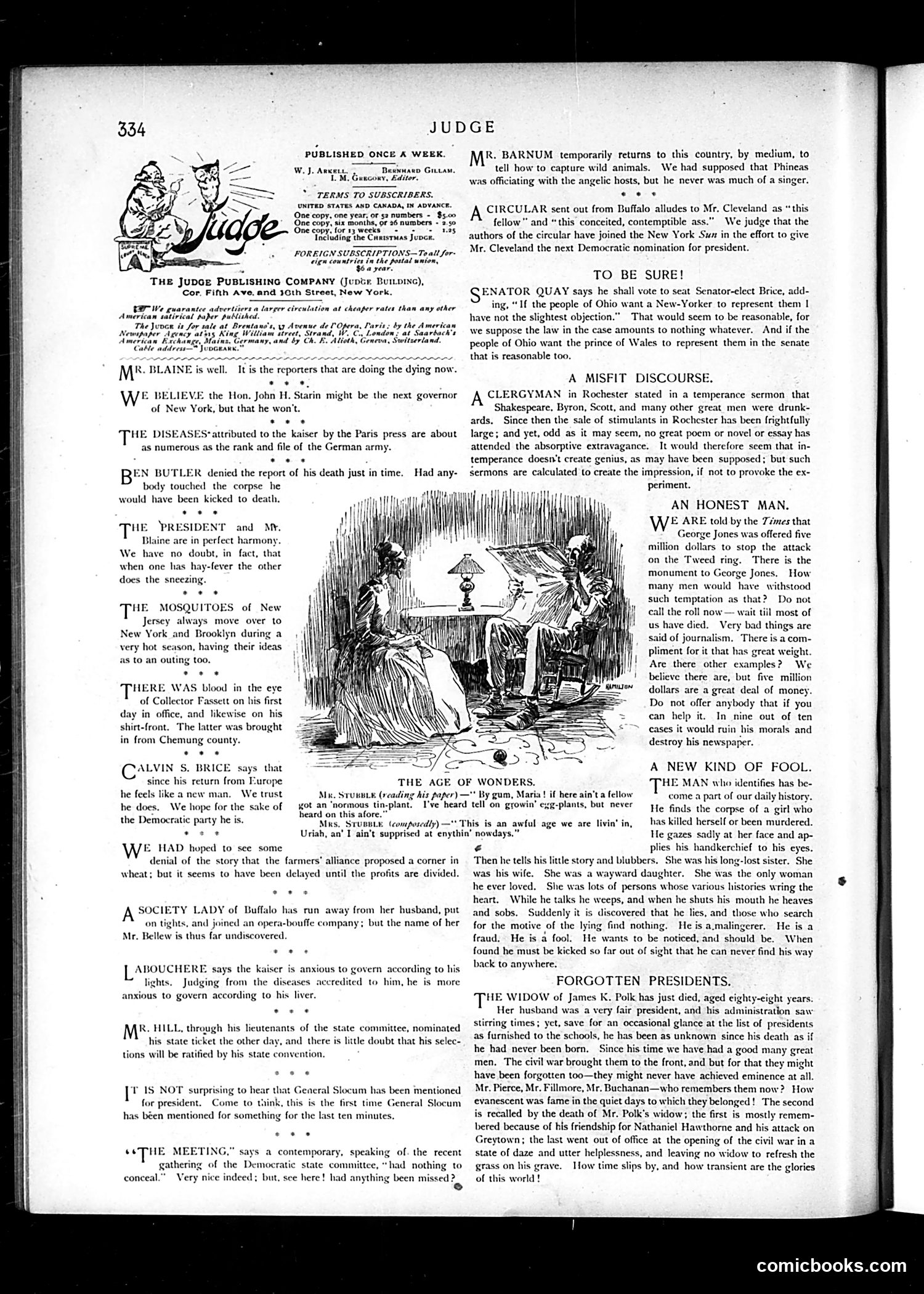
The main cartoon depicts two figures in what appears to be a domestic dispute or confrontation. Based on the surrounding text snippets, the figures are labeled "Mr. Stubble" and "Mrs. Stubble," suggesting this is social satire about working-class married life rather than political commentary. The text references temperance issues, journalism ethics, and presidential succession, but without clearer labeling or dates visible in the image, I cannot definitively identify which specific political figures or events are being satirized. The cartoon's style and the magazine's format indicate this is primarily social commentary on everyday life—marital discord, economic struggles, and moral questions—rather than focused political satire about identifiable contemporary figures.
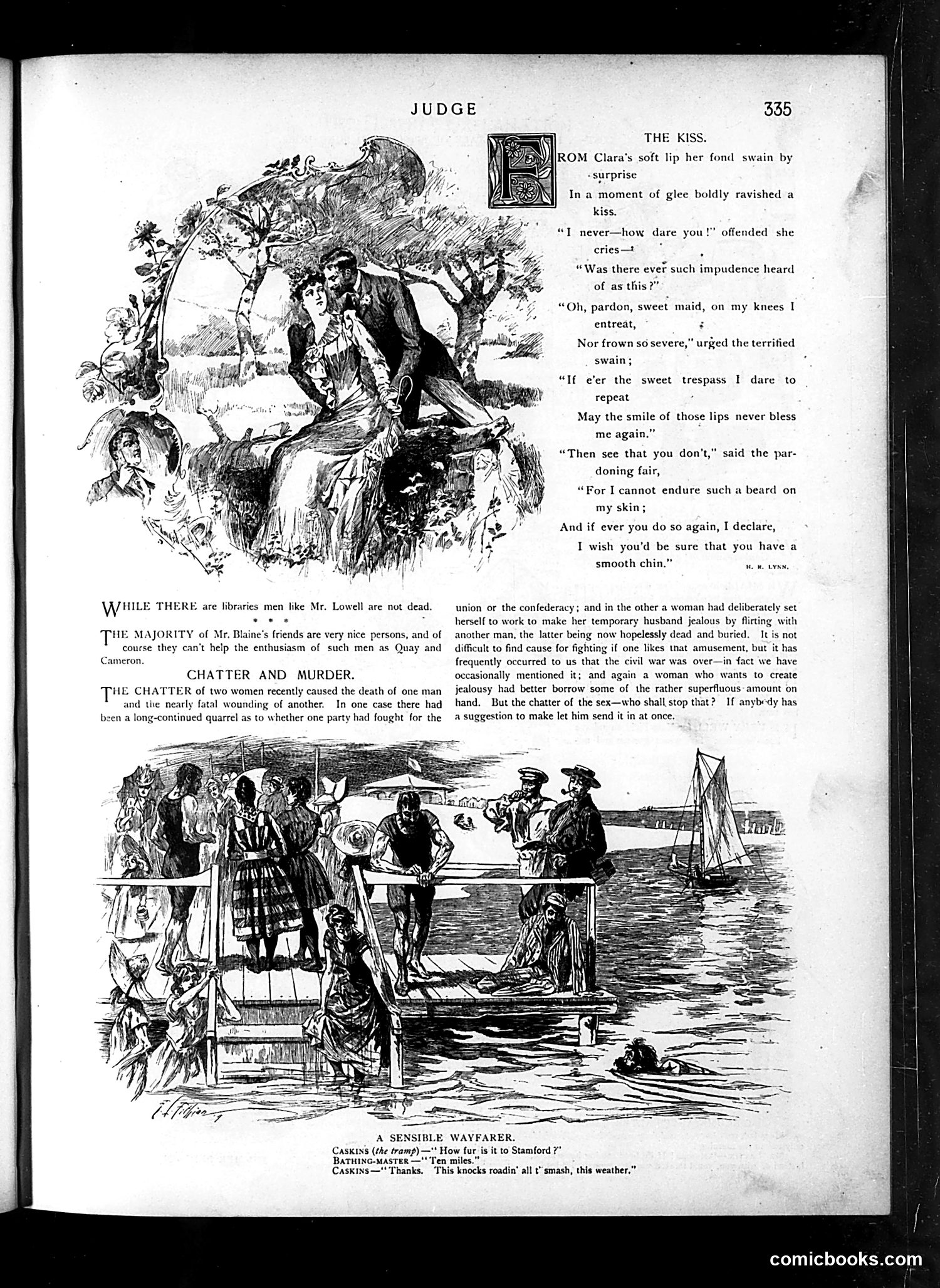
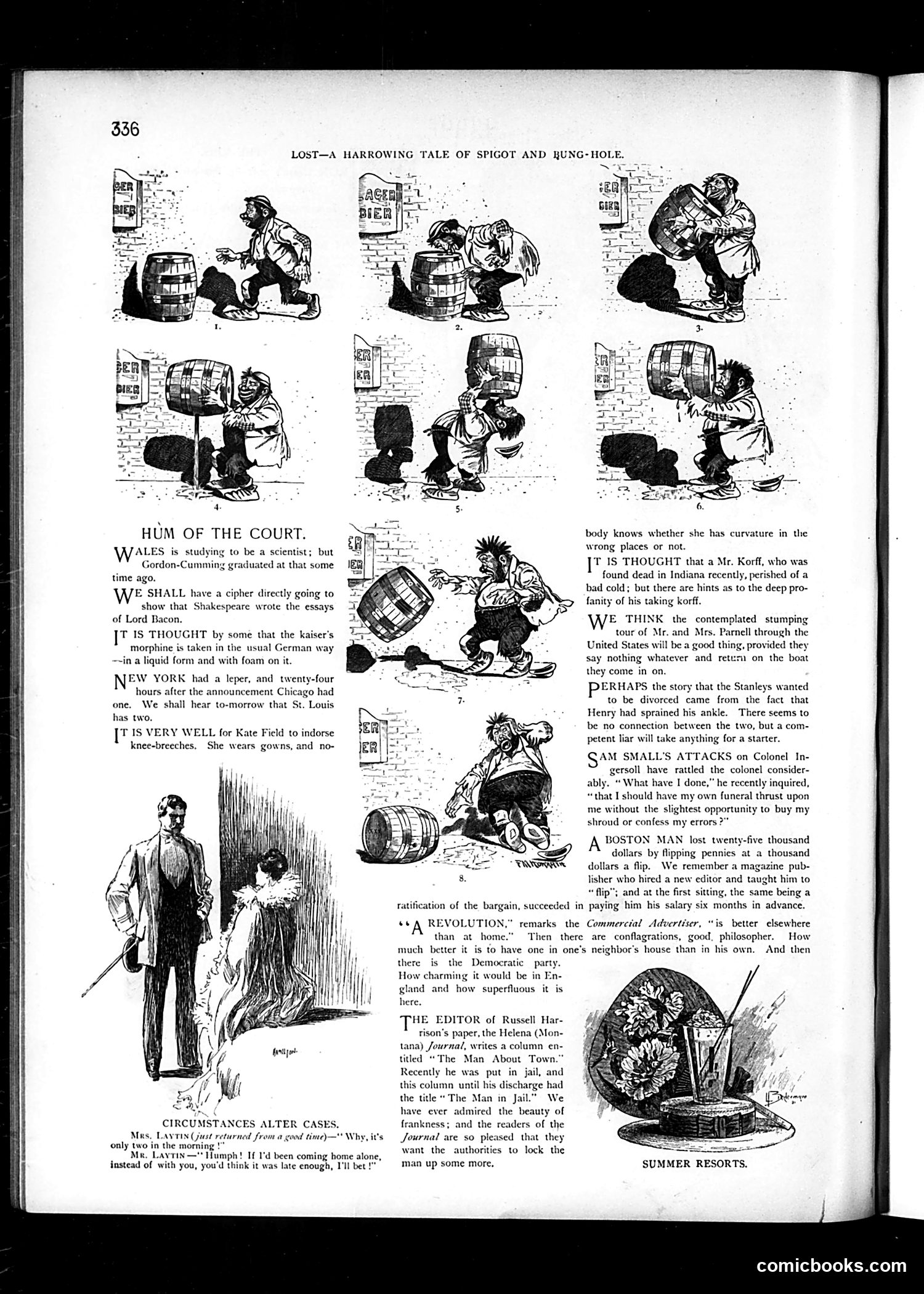
This page contains multiple brief satirical commentaries typical of Judge's "Hum of the Court" section. Key targets include: **Gordon-Cumming**: References a Scottish nobleman involved in a cheating scandal (the "Baccarat Case"), implying he's no scientist despite claims. **The Kaiser's morphine**: Mocks German affectations, suggesting the German emperor takes drugs in an affected manner. **Kate Field**: A women's rights advocate; the joke ridicules her endorsing "knee-breeches" (men's clothing) while wearing dresses herself—hypocrisy on gender norms. **Parnell**: The Irish politician and his wife's planned U.S. tour; Judge suggests they should stay silent to avoid controversy. **Colonel Ingersoll**: A famous agnostic lecturer; Sam Small (a Christian) attacked him; the joke mocks Ingersoll's complaint about unsolicited "funerals" (religious attacks). **Helena Journal editor**: Praise for his column title change from "Man About Town" to "Man in Jail"—celebrating blunt honesty about his incarceration. The humor relies on contemporary scandal knowledge and political figures now obscure to modern readers.
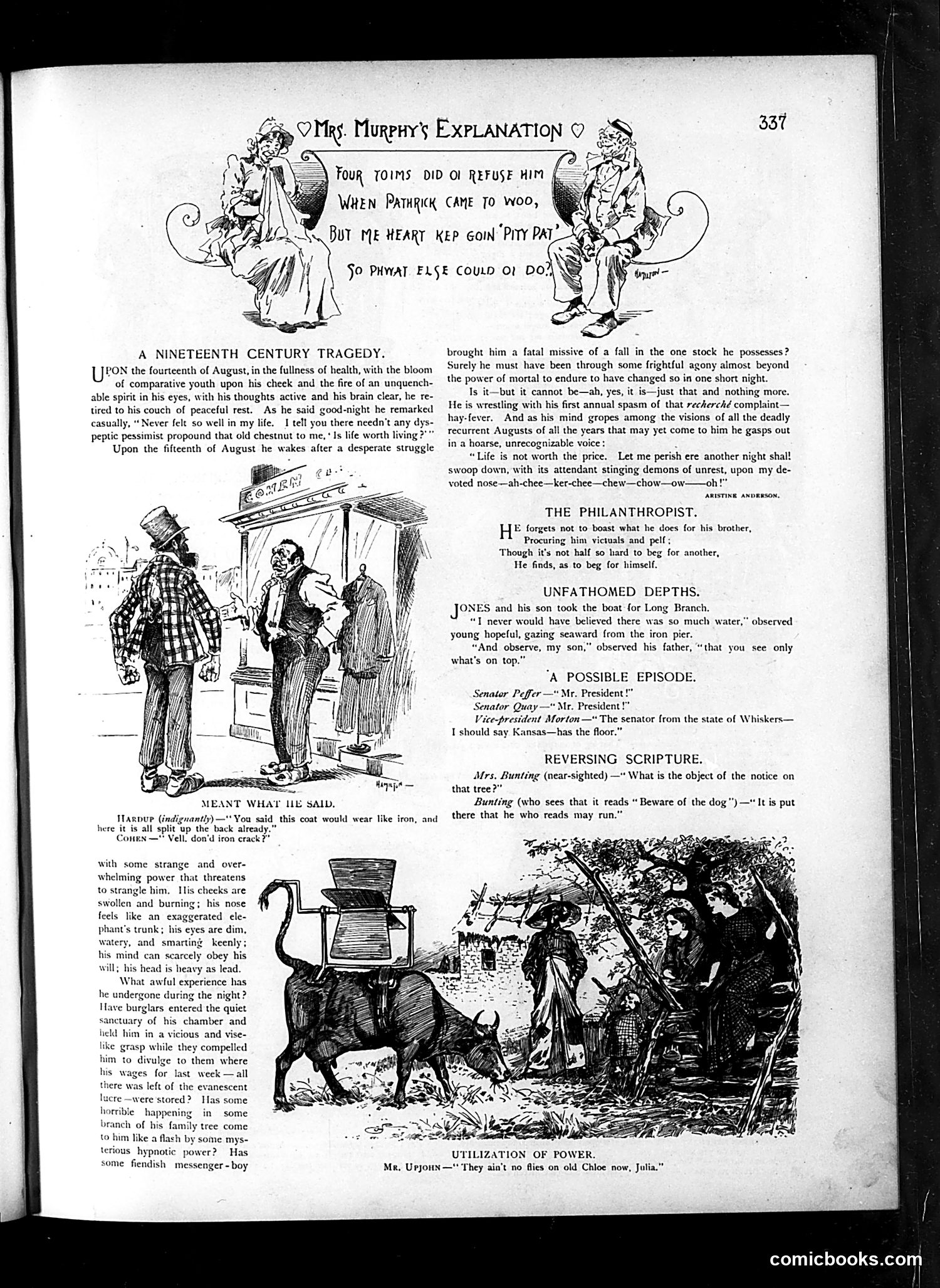
This page contains multiple satirical vignettes typical of Judge magazine's humor: **"A Nineteenth Century Tragedy"** (main story): Mocks hypochondriacs and hay-fever sufferers. A perfectly healthy man on August 14th wakes August 15th convinced he's dying—but it's merely seasonal allergies. The satire targets both the melodramatic overreaction to minor ailments and the Victorian tendency toward nervous complaint. **Other brief jokes** include: - "The Philanthropist": Criticizes performative charity—boasting about helping others while avoiding self-reliance - "Unfathomed Depths": A father-son exchange playing on surface vs. hidden knowledge - Political humor referencing **Senator Peffer** and **Senator Quay** (Kansas and Pennsylvania politicians) and VP Morton, joking about Kansas senators' prominence - Wordplay jokes about coats "wearing like iron" (cracking), biblical misquotation, and a dog-warning sign The illustrations show period working-class scenes. Overall, the page exemplifies Judge's mix of social commentary, political jabs, and light domestic humor aimed at educated, middle-class readers.
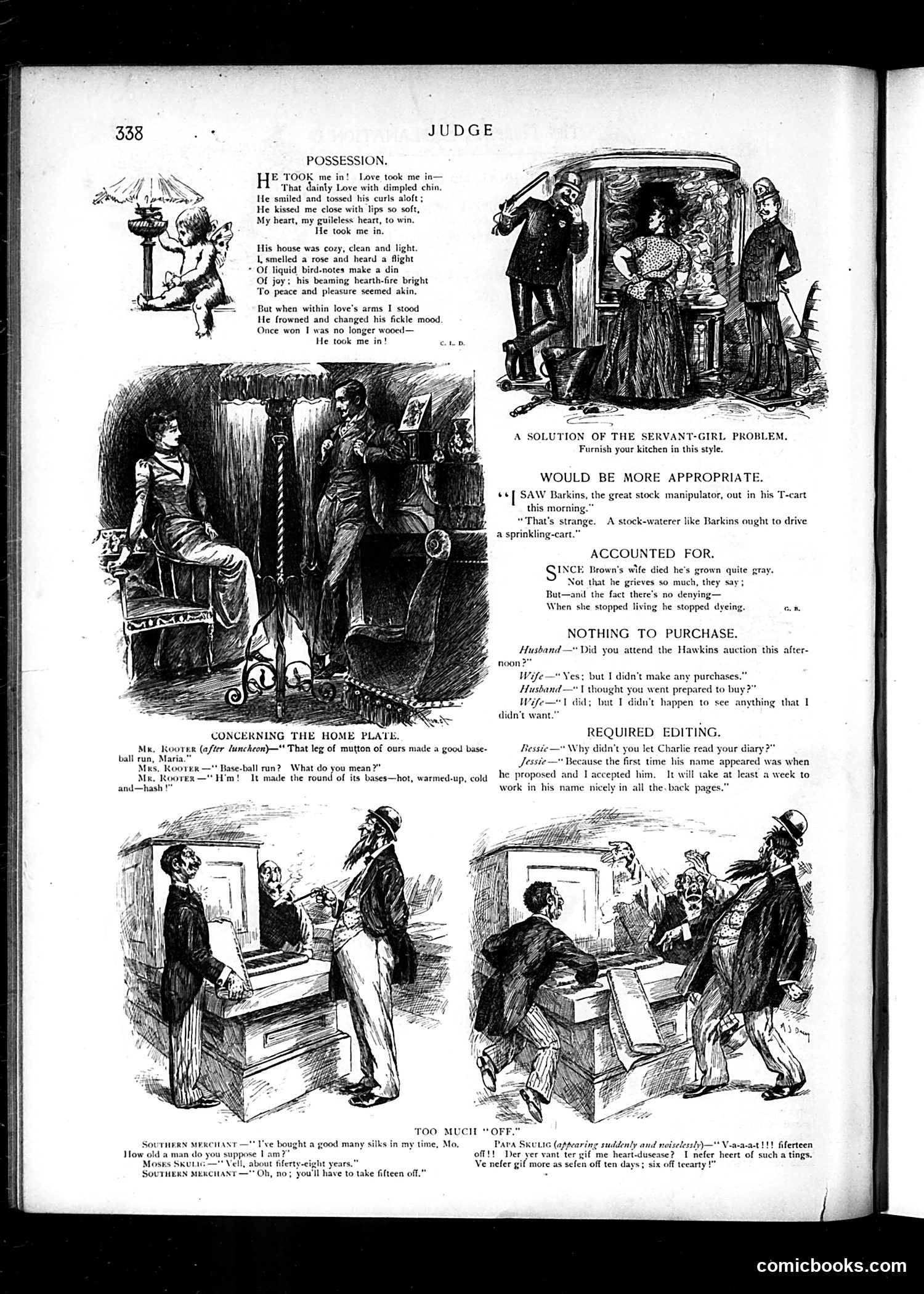
This page contains multiple short satirical pieces typical of late 19th/early 20th-century humor: **"Possession"** (top left poem): A woman's lament about romantic deception—a man courts her charmingly but becomes cold and neglectful once married. Standard domestic disillusionment satire. **"Servant-Girl Problem"** (top right): Social commentary on the difficulty of hiring household help. The ornate kitchen illustration suggests overly fancy furnishings are impractical for servants' work. **Stock market/Barkins joke**: Satire of financial manipulation. "Stock-waterer" implies Barkins artificially inflates stock values (watering stock)—so he'd be better suited to literally watering plants with a sprinkling-cart. **Remaining pieces**: Quick jokes about grief (Brown stopped dyeing his hair after wife died), marital shopping habits, and spousal diary-reading. The page exemplifies Judge's formula: domestic humor, financial satire, and gentle social observation aimed at educated middle-class readers. No major political figures or events appear to be referenced.
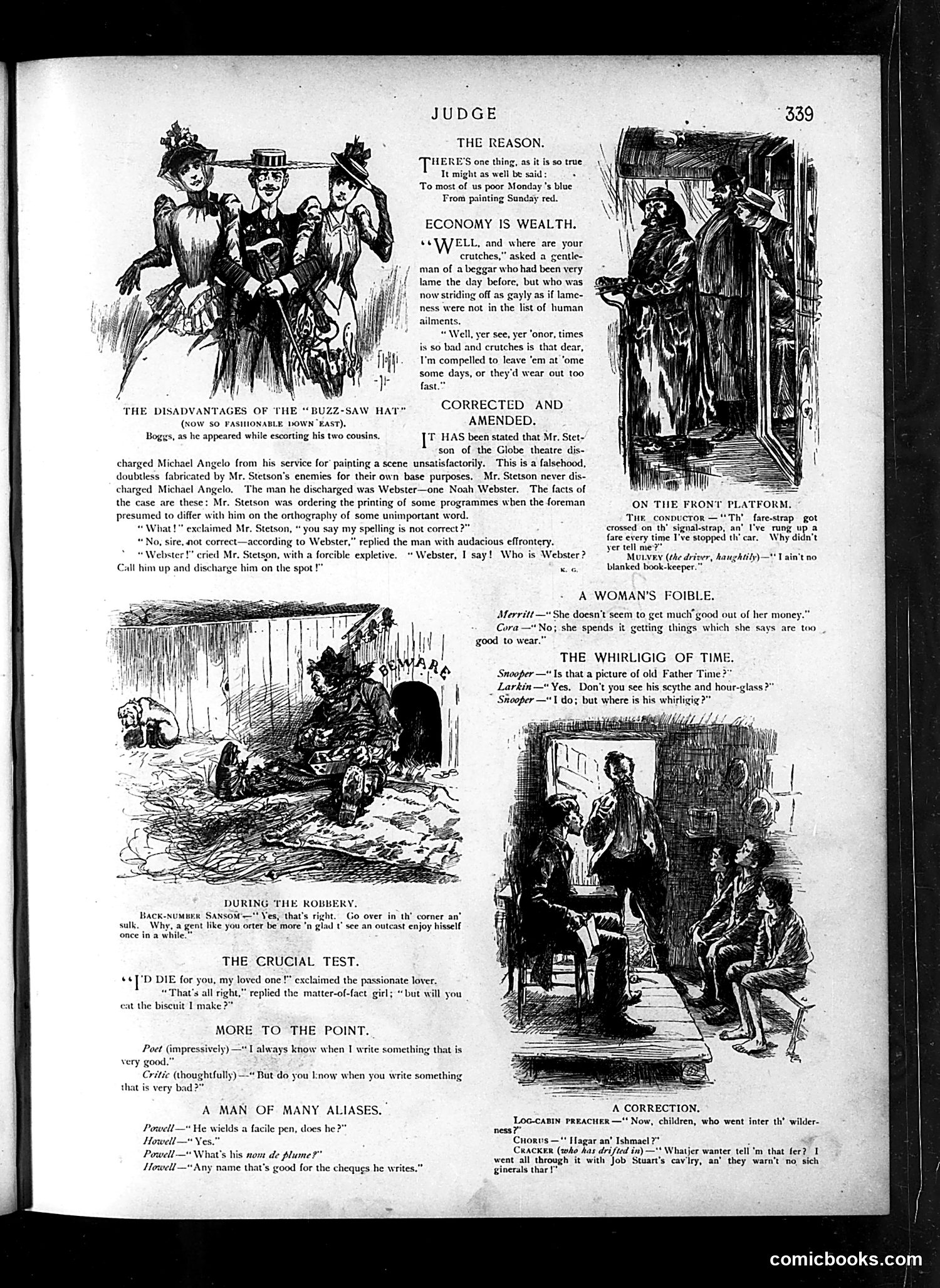
This page contains multiple brief satirical sketches typical of Judge's format: **"Economy is Wealth"** mocks working-class poverty. A beggar claims he abandoned his crutches because they wear out too fast—implying destitution forces people to abandon even necessary aids, turning desperation into comic absurdity. **"Corrected and Amended"** defends theater manager Stetson against rumors he fired artist Michael Angelo. The joke: he actually fired a man named Noah Webster for questioning his spelling—satirizing autocratic bosses who punish employees for minor corrections. **"A Woman's Foible"** jokes about frivolous female consumers who buy expensive items claiming they're "too good to wear"—period satire of women's spending habits. The remaining sketches are brief joke exchanges about romance, poetry, and religion, typical of Judge's humor formula. The cartoons accompanying these texts feature period-typical illustration styles depicting everyday social situations.
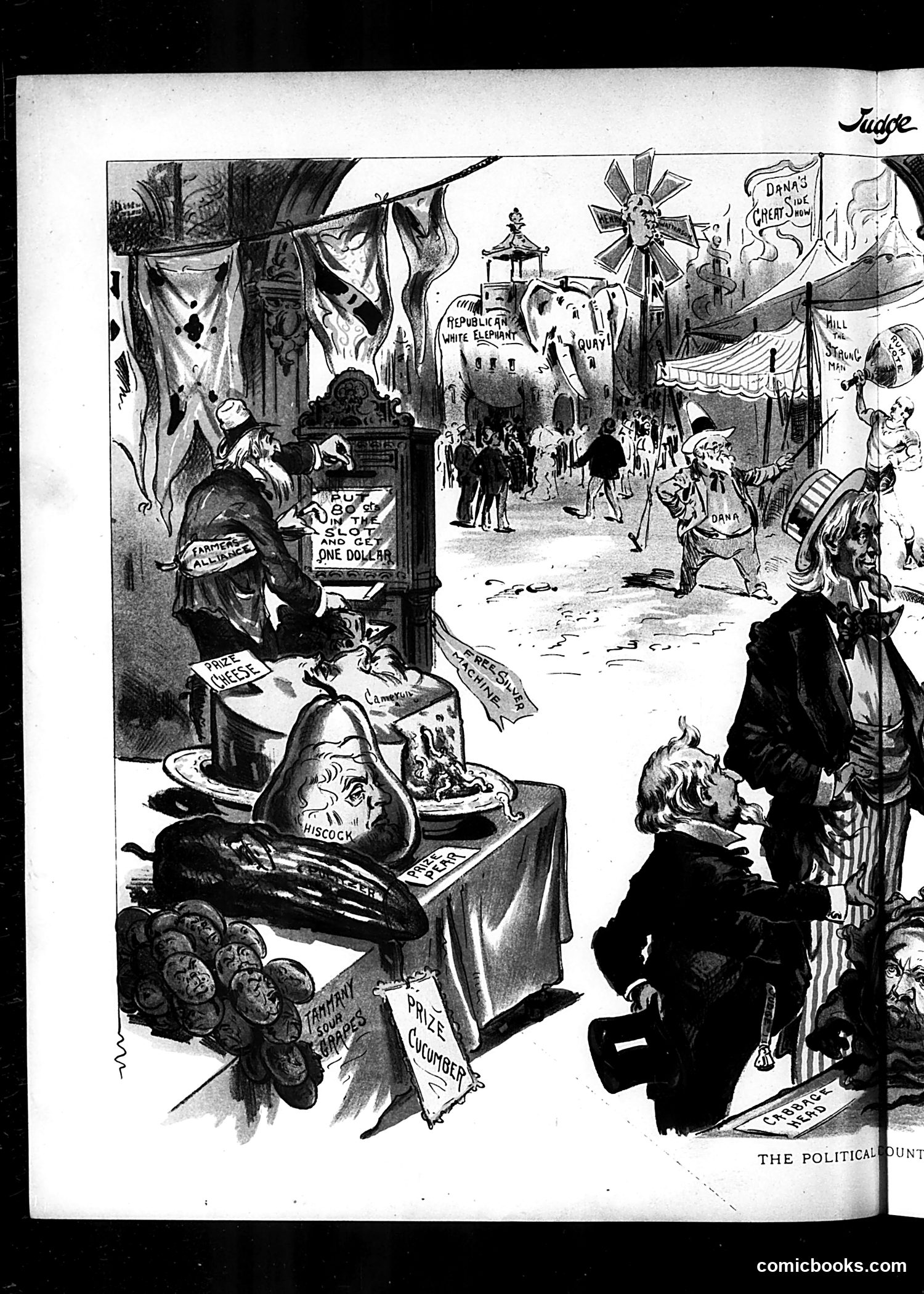
This satirical cartoon depicts a fairground or carnival scene titled "The Political Hunt." The foreground shows various caricatured figures at what appears to be a vendor's stall, with labels visible including "Republican," "White Elephant," and references to acquiring items "for one dollar." The scene satirizes political activities as a marketplace or game where political factions and ideas are commodified and traded like carnival attractions. The ornate structures in the background (including what appears to be a "Durbar" reference) and flags suggest competing political spectacles or exhibits. The specific political figures or controversies referenced are unclear without additional context, but the overall satire mocks how politicians and political movements are packaged, sold, and consumed by the public as entertainment rather than serious governance.
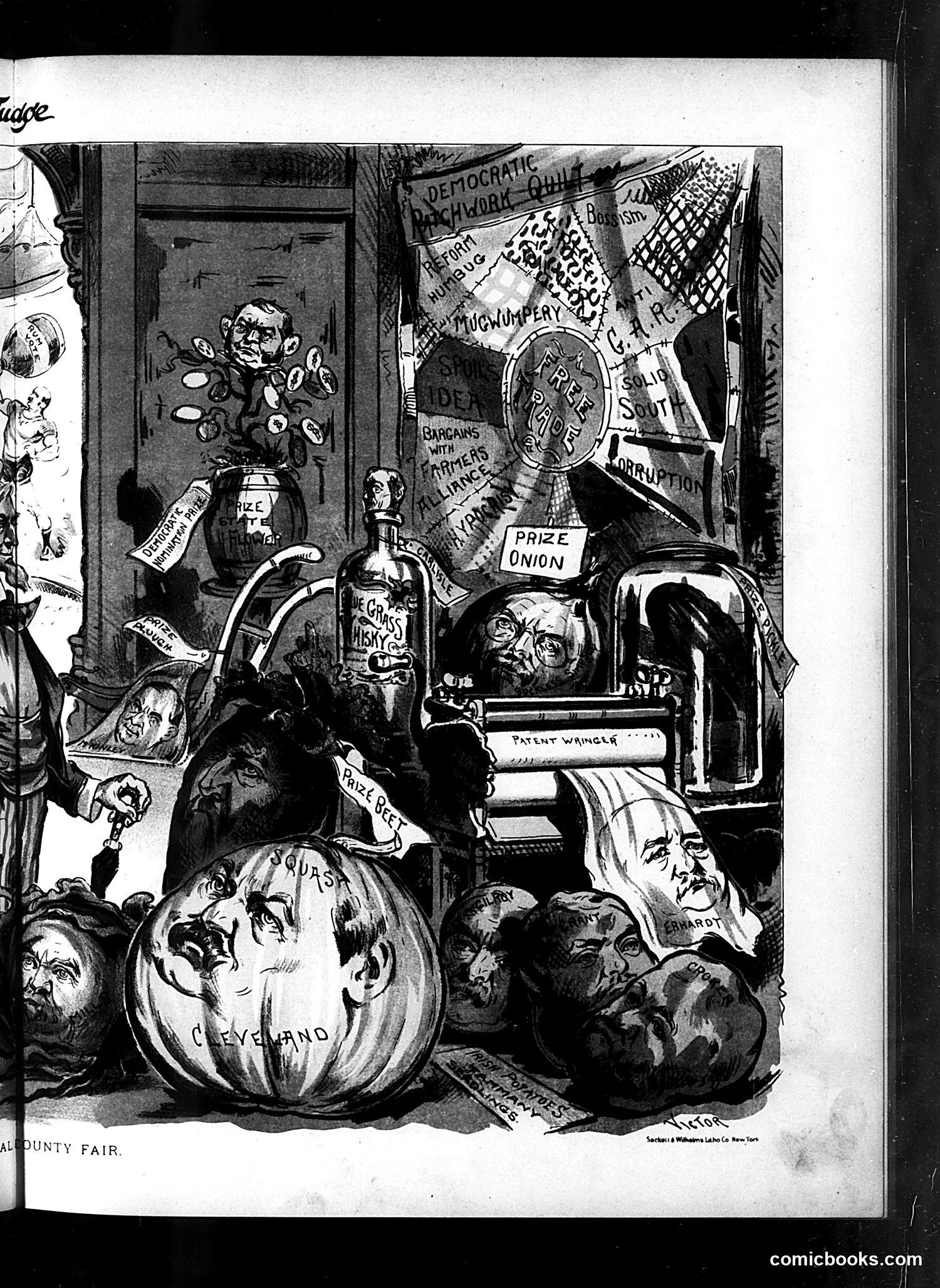
This appears to be a political cartoon titled "COUNTY FAIR" from Judge magazine. The satire depicts corruption as a carnival or fair display, with various caricatured figures representing political malfeasance. Visible labels include "PRIZE ONION," "CORRUPTION," "DEMOCRATIC MACHINERY," and references to "BARGAINS WITH POLITICIANS" and "PATENT WANGLER." The cartoon uses the county fair metaphor to mock political corruption as a public spectacle where dishonest dealings are openly displayed and rewarded like prize-winning produce. Large heads at the bottom appear to represent specific politicians or types (labeled "CLEVELAND" is visible), though their exact identities are unclear from this reproduction. The overall message critiques how corruption flourishes openly in American politics.
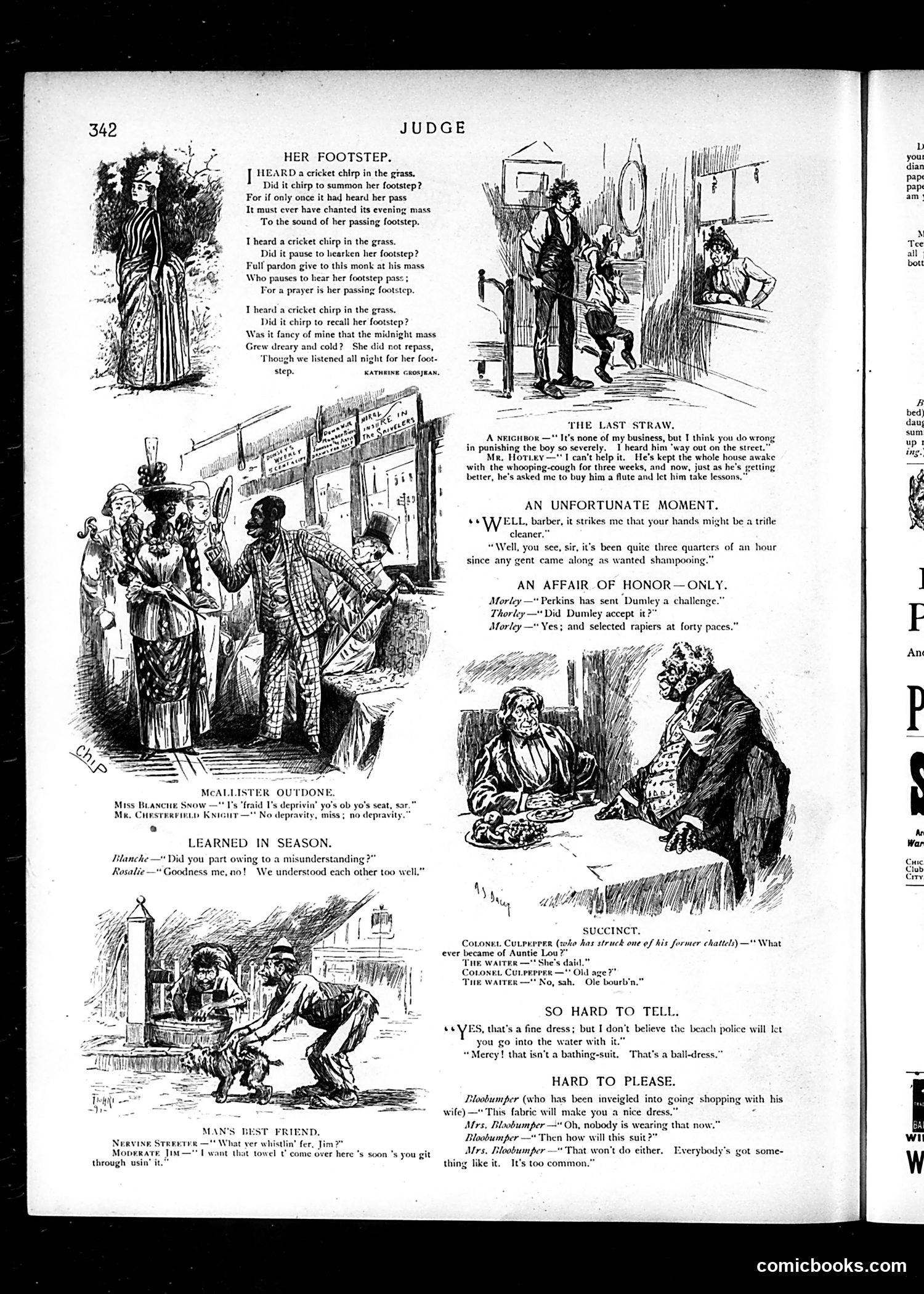
This page contains multiple unrelated satirical vignettes typical of Judge magazine's humor format. The content includes: **"Her Footstep"** — A romantic poem by Katherine Goreham about a man haunted by a woman's absence, using cricket sounds as metaphor. **Short comic sketches** addressing everyday social frustrations: - A barber's poor hygiene excused by lack of customers - A dispute over whether a fashionable ball gown is appropriate beachwear - A husband's exasperation with his wife's shopping pickiness (nothing fashionable enough, nothing common enough) - References to marital discord and child-rearing complaints **Social commentary** on: class dynamics (the barber sketch), women's fashion obsession, domestic discord, and marital tension. The humor targets recognizable middle-class problems—impatient wives, impractical fashion choices, and the gap between male practicality and female consumer desires. These sketches reflect turn-of-century anxieties about changing gender roles and marriage dynamics, presented through gentle domestic satire rather than political commentary.
This is primarily an **advertising page** with minor editorial content. The page contains no significant political cartoons requiring historical context. The editorial pieces are light humor: a burglar joke about a man whose family's summer vacation has left him broke (relatable domestic satire), and poetry mocking businessmen who don't advertise versus those who do ("Broke, broke, broke" / "Flush, flush, flush"). A "Philosophy from Texas" section offers folk wisdom observations about social behavior and courtship. The vast majority of the page consists of **period advertisements** for products now recognized as harmful or quackish: Mrs. Winslow's Soothing Syrup (containing opiates), various patent medicines (Packer's Tar Soap, Allcock's Porous Plasters), and cigars. These ads are historically notable as examples of 19th-century medical marketing before FDA regulation, but they contain no satire requiring explanation—they represent genuine commercial pitches of the era.
This short comic narrative depicts a father receiving distressing news via telegram while his daughter pleads to know what's wrong. The setup builds tension—the child notices his worry and asks repeatedly if something is amiss at work or with her mother at sea. The punchline reveals the "terrible" news: "The gray mare won, and we're in the soup to-day." The satire targets gambling, specifically horse racing. The father's melodramatic despair over losing money on a race appears ridiculous when contrasted with the daughter's genuine concerns about family tragedy. The joke mocks men who gamble on horses and treat betting losses with the gravity of real catastrophes, suggesting this is a common enough vice that readers would recognize the absurdity of prioritizing race results over actual family welfare.
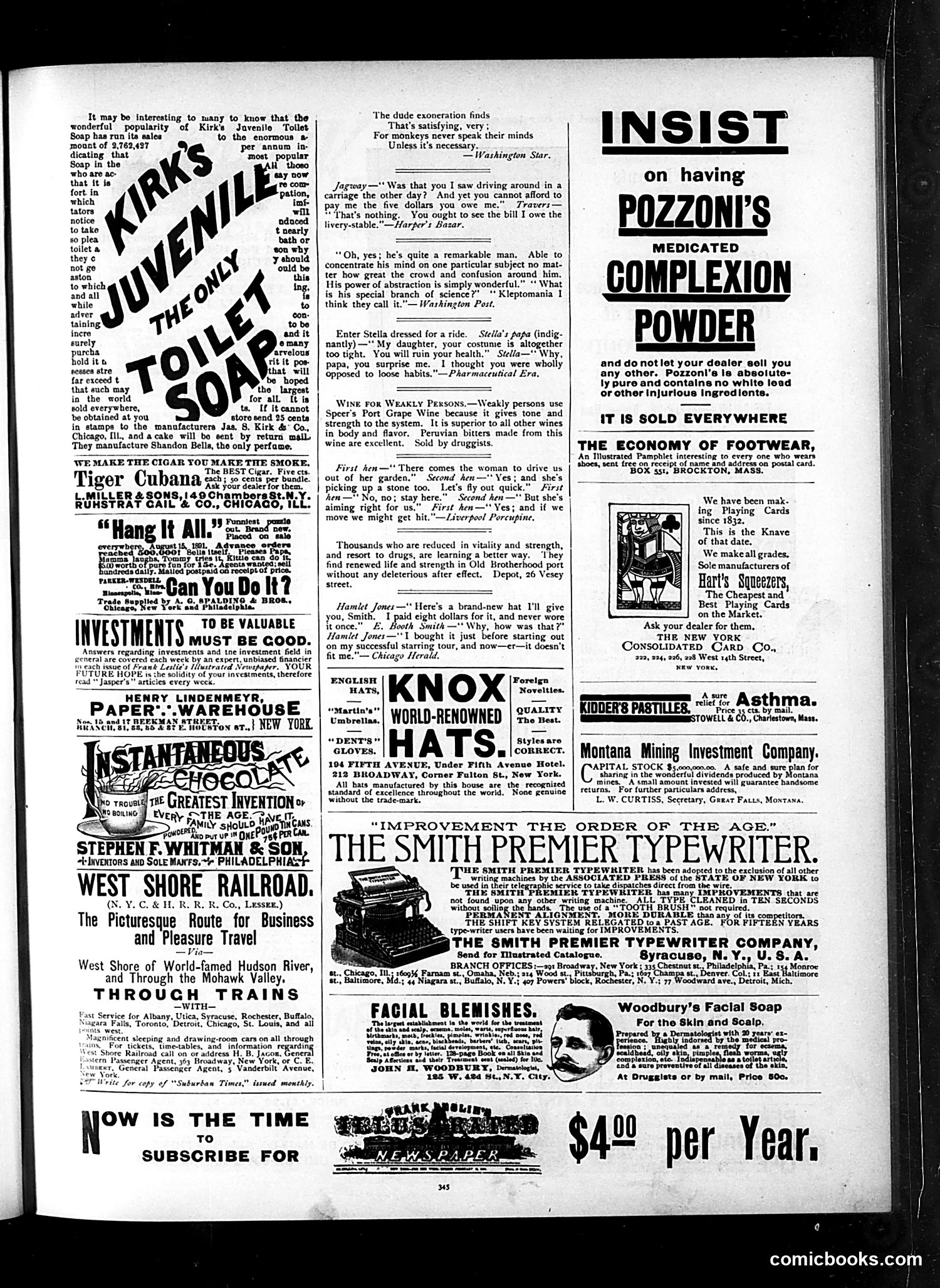
This is primarily an **advertising page** from Judge magazine, with minimal editorial cartoon content. The dominant visual element is a large advertisement for **Kirk's Juvenile Toilet Soap**, promoting its claimed sales of 2,762,427 units annually. The page includes several brief **humorous anecdotes** (not political cartoons): - A joke about a man who can't pay debts but owns an expensive carriage - Satire on "kleptomania" as a man's "special branch of science" - A comment on women's tight corsets damaging health - A scene of hens avoiding a woman in her garden These represent typical light social humor of the era—targeting dude culture, women's fashion choices, and domestic absurdities—rather than political satire. The rest of the page consists of various product advertisements (cigars, railroads, typewriters, chocolate, wine). This appears to be a back cover or filler page prioritizing revenue from advertising over editorial content.
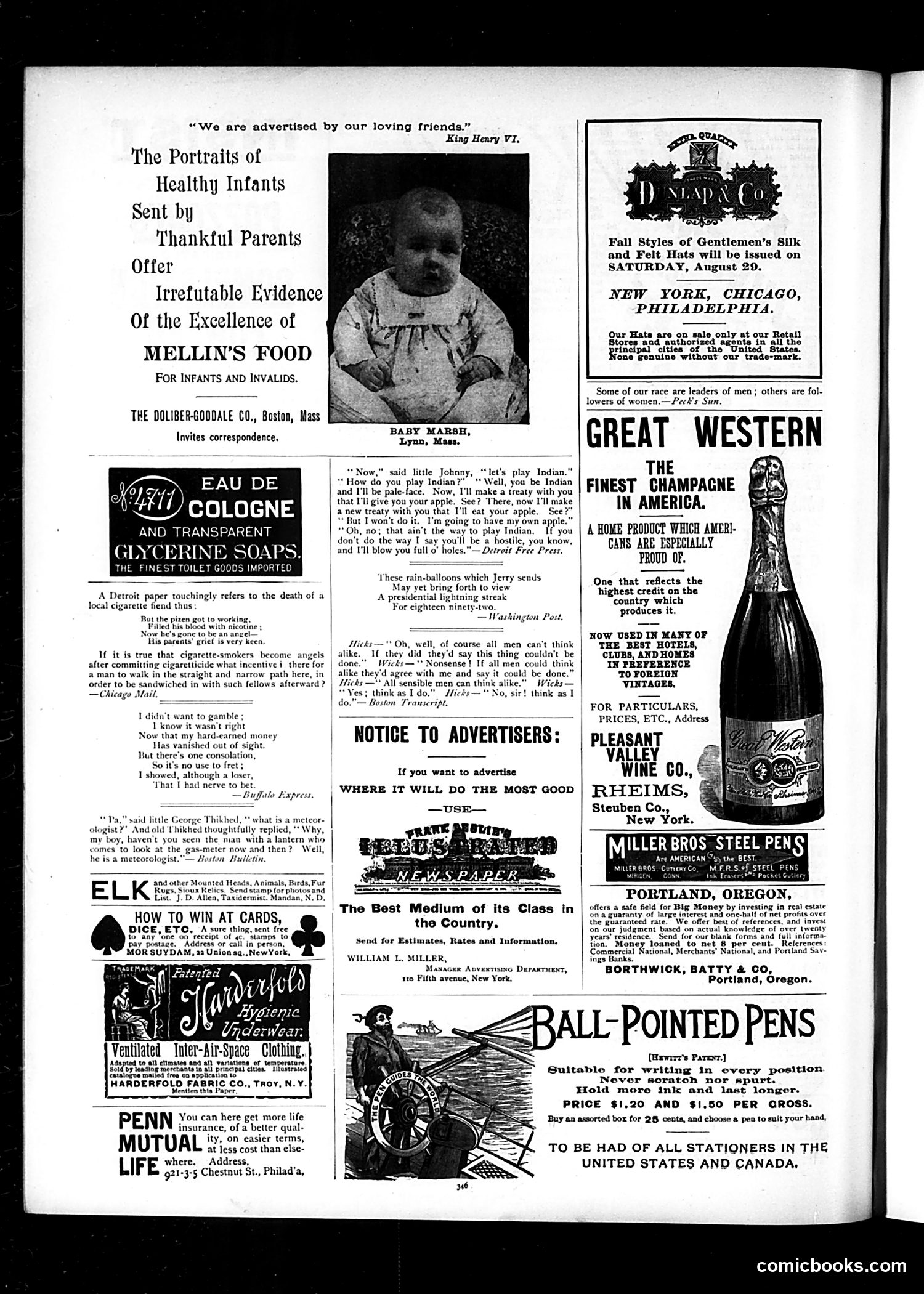
This page is primarily **advertisements with minor satirical content**, typical of Judge's format in the 1890s. The main satirical jokes are short pieces: - **"Cigarette fiend" death commentary**: Dark humor mocking a Detroit newspaper's sentimental obituary—if smoking kills you and sends you to heaven with other smokers, why be moral? - **"Indian" children's game**: A child refuses to honor treaties, mirroring real U.S. government behavior toward Native Americans. The joke mocks American duplicity in Indian affairs. - **"Rain-balloons" and 1892 lightning**: Unclear reference, likely topical to an 1892 political event (possibly presidential election). - **"All men think alike" debate**: Satirizes male stubbornness—men claiming all sensible men agree with them specifically. The rest is commercial advertising for infant food, cologne, wine, pens, and insurance—reflective of Judge's revenue model. The "healthy infant portraits" advertisement ironically appears amid cigarette-death commentary, creating unintended dark juxtaposition rather than intentional satire.
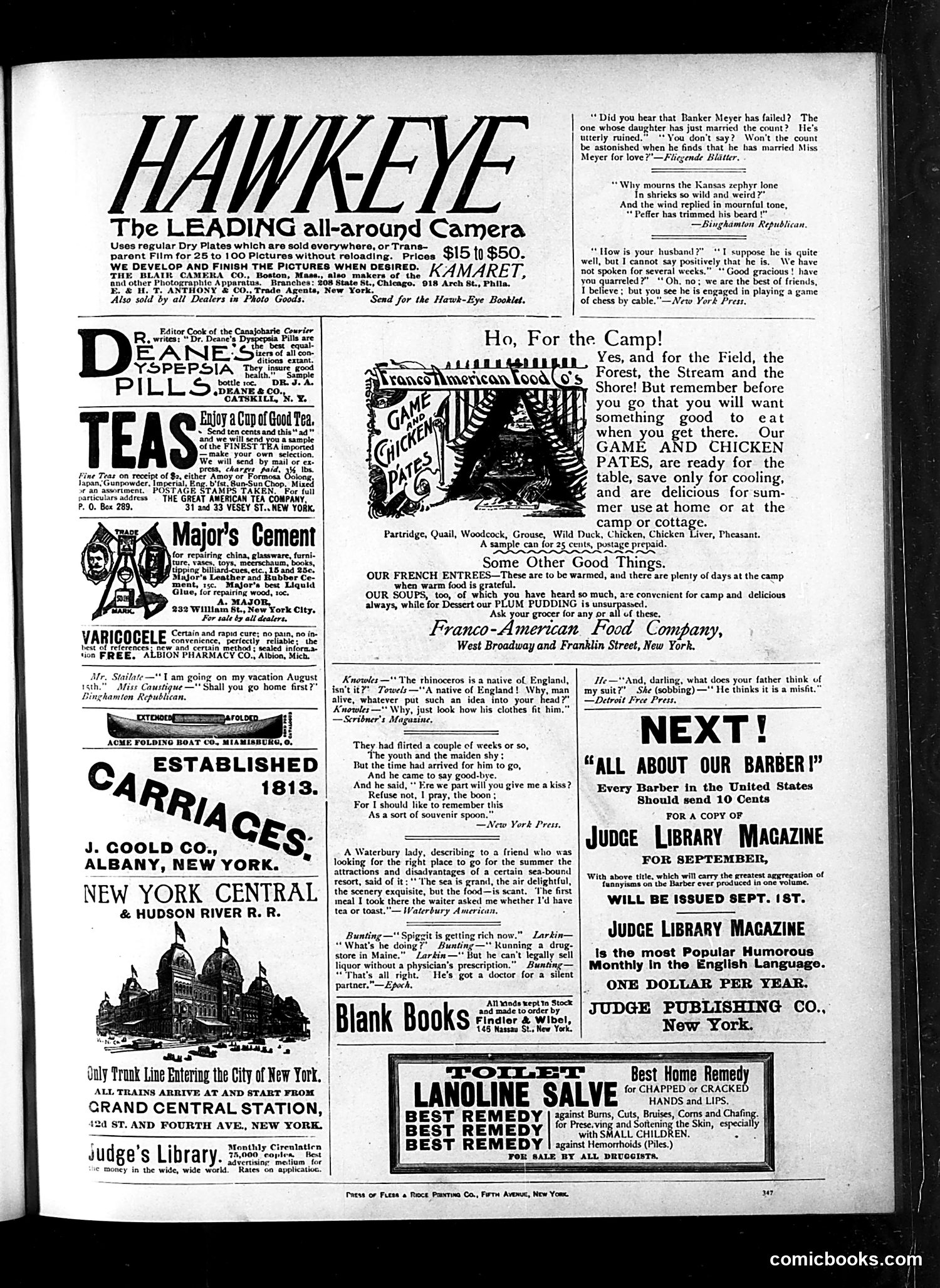
This page is primarily **advertising** for various products (cameras, pills, tea, cement, food) with scattered short jokes and social commentary typical of Judge magazine's satirical format. The notable satirical content includes brief quips: - **"Banker Meyer" joke**: Mocks wealthy Americans marrying off daughters to European nobility, suggesting the count married for money rather than love. - **"Kansas zephyr" verse**: A political jab at Senator John J. Peffer (a Kansas Populist), ridiculing his appearance, specifically his beard-trimming. - **Chess by cable joke**: Gentle satire on a married couple so distant they communicate only through long-distance games. - **Rhinoceros joke**: Plays on clothing fit as evidence of origin—absurdist humor. The page reflects late 19th-century American concerns: anxiety about foreign aristocracy exploiting American wealth, domestic discord, and political figures as objects of ridicule. Most humor is light domestic comedy rather than hard-hitting political satire.
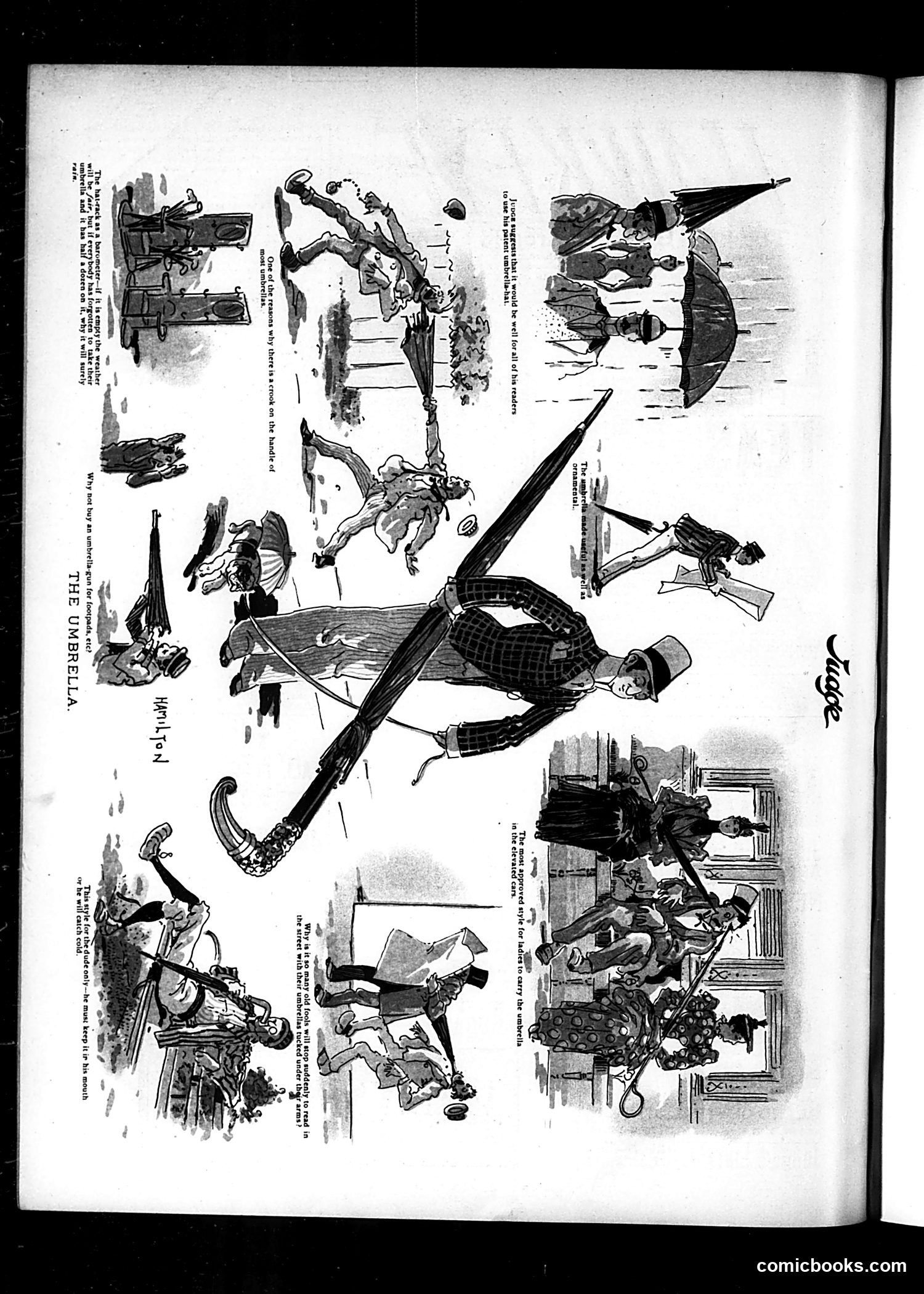
This appears to be a humorous editorial feature about umbrellas from *Judge* magazine. The central cartoon shows a man with an oversized umbrella-hat contraption, presented as an invention by someone named Joven. The page discusses practical umbrella problems: why people lose umbrellas on elevated trains, why umbrella handles have curved crooks (the OCR suggests this relates to theft or loss), and suggests novelty solutions like "umbrella-guns" for self-defense against "footpads" (street robbers/muggers). The surrounding smaller illustrations likely depict various umbrella-related mishaps or comedic scenarios. This reflects period concerns about urban crime, public transit theft, and the satirical promotion of absurd gadgets—common *Judge* themes mocking both social problems and inventor culture of that era.