
A complete issue · 20 pages · 1891
Judge — August 1, 1891
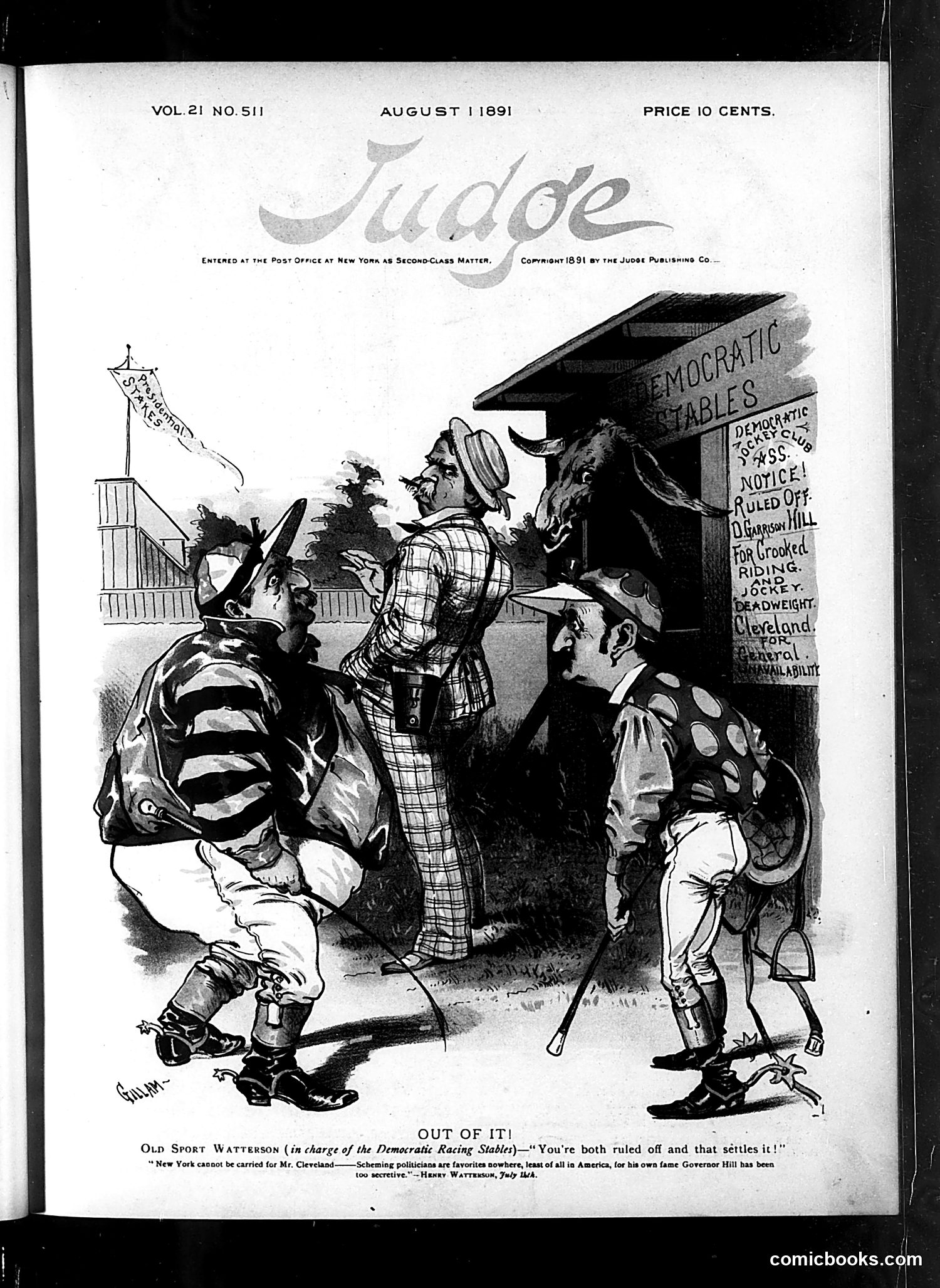
This political cartoon depicts a confrontation at the "Democratic Stables." Old Sport Watterson (identified in the caption as managing the Democratic Racing Stables) rules off two jockeys, declaring "You're both ruled off and that settles it!" The cartoon satirizes internal Democratic Party conflict, likely regarding the 1892 presidential race. The two disqualified jockeys represent competing Democratic factions or candidates being excluded from consideration. The racing metaphor suggests political competition, with the Democratic Party as an unstable operation. The notice board behind lists violations including "crooked riding" and "jockey deadweight," implying the party leadership views certain members as corrupt or burdensome. The satire targets Democratic infighting and authoritarian party management.
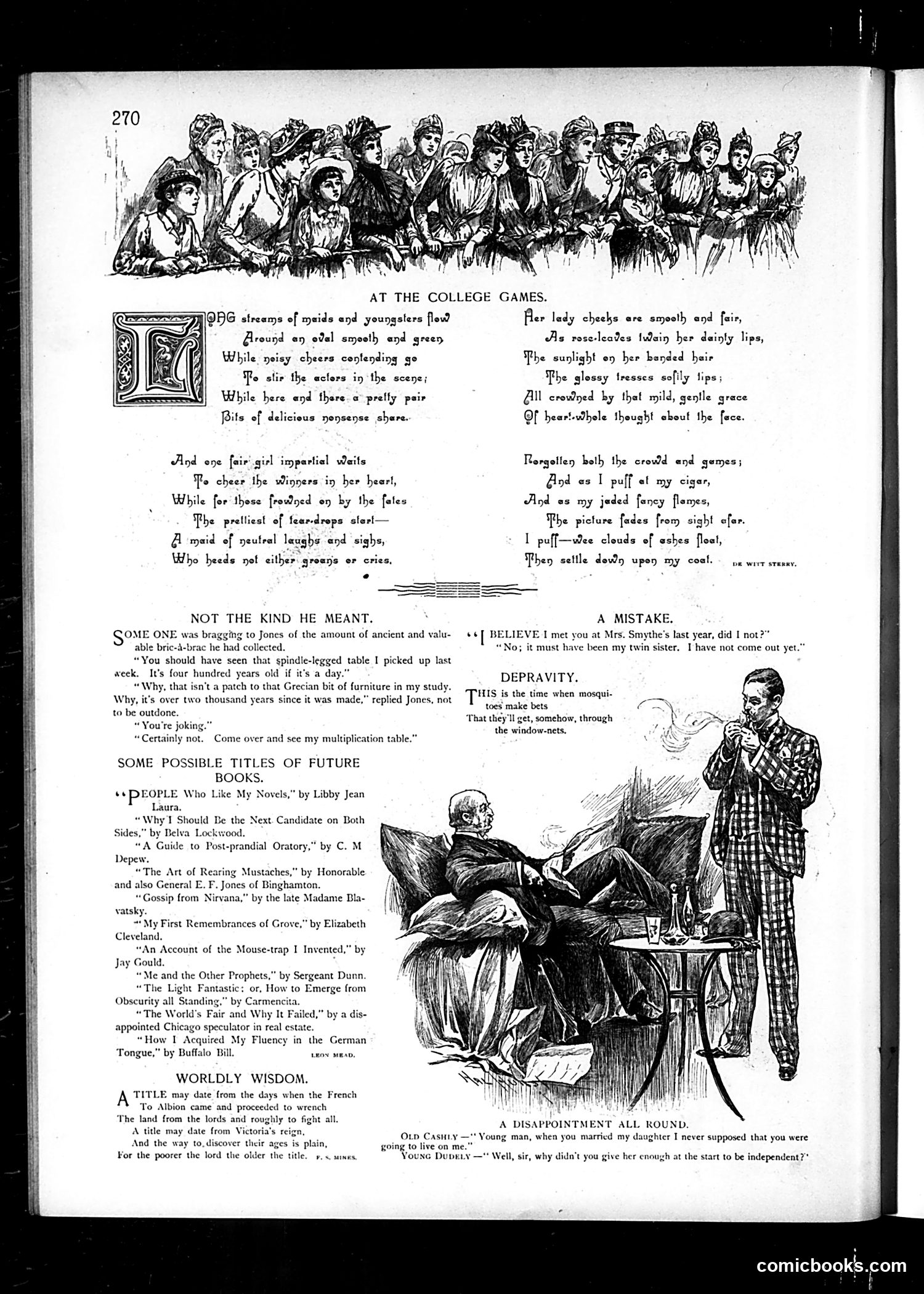
This page from *Judge* contains several distinct satirical pieces: **"At the College Games"** (top): A poem mocking young women at college sporting events, portraying them as frivolous—more interested in appearing attractive and impressing male admirers than in the games themselves. The satire reflects turn-of-century anxieties about "New Women" and their public visibility. **"Depravity"** (right illustration): Shows a man smoking and gambling at window-bets, satirizing vice among the upper classes. **"A Disappointment All Round"** (bottom): A domestic quarrel between husband and wife—likely satirizing marriage expectations and financial independence debates of the era. The page also includes humorous proposed book titles parodying contemporary literature trends. Overall, the content reflects period concerns about women's changing roles, morality, and social behavior.
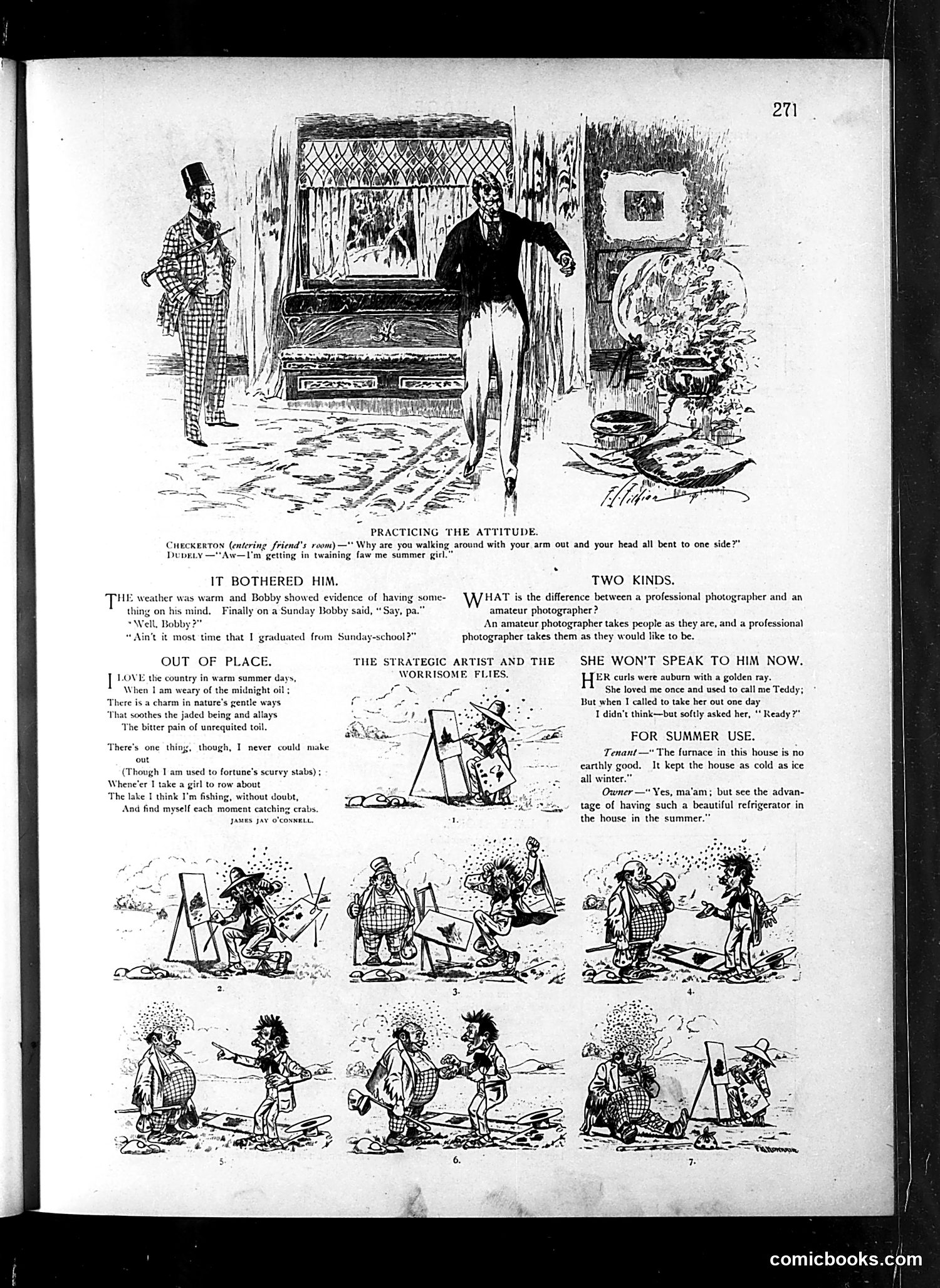
This page contains several humorous sketches and short comedic pieces typical of Judge's satirical style. "**Practicing the Attitude**" shows a man walking with exaggerated posture in a friend's room—apparently practicing an affected gait, likely mocking vanity or social pretension. "**It Bothered Him**" is a brief joke about someone avoiding summer weather by staying indoors. "**Two Kinds**" contrasts professional and amateur photographers—a standard joke format comparing different practitioners of a skill. The bottom section, "**For Summer Use**," depicts a comic sequence (panels 2-7) showing what appears to be an artist or painter struggling with equipment and circumstances outdoors, likely illustrating the humorous difficulties of plein-air painting or outdoor artistic work during summer. The overall page emphasizes domestic humor and social observations typical of early 20th-century American satirical magazines.
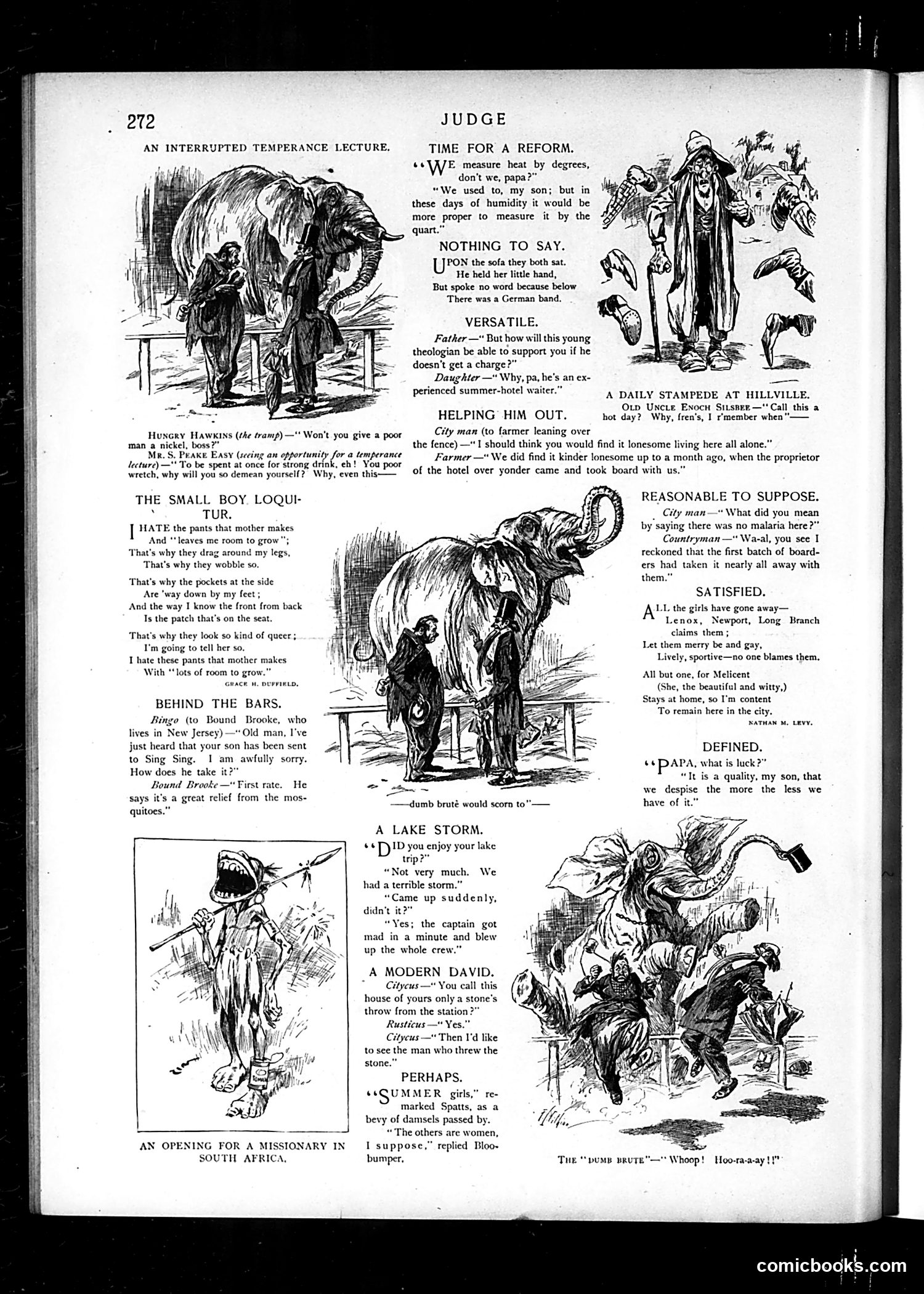
This page from Judge magazine contains multiple satirical sketches targeting social and domestic issues of the era (appears to be late 19th century). **Key satires include:** - **"Time for a Reform"**: Mocks excessive drinking by suggesting "measuring heat by the quart" instead of degrees—a dig at alcohol consumption during humid weather. - **"Small Boy Loquitur"**: A child complains about poorly-fitting pants with "room to grow," satirizing mothers' impractical sewing. - **"Reasonable to Suppose"**: A countryman jokes that malaria disappeared because boarders carried it away—mocking rural superstition and anti-urban sentiment. - **"Behind the Bars"**: Dark humor about a man imprisoned at Sing Sing prison who considers it relief from mosquitoes. - **"A Lake Storm"**: A captain's anger described as literally "blowing up the crew"—exaggerated absurdist humor. The illustrations depict genteel middle-class life with its petty frustrations: social pretense, domestic complaint, and class tensions between city and country dwellers. The humor is gentle satire rather than biting political commentary.
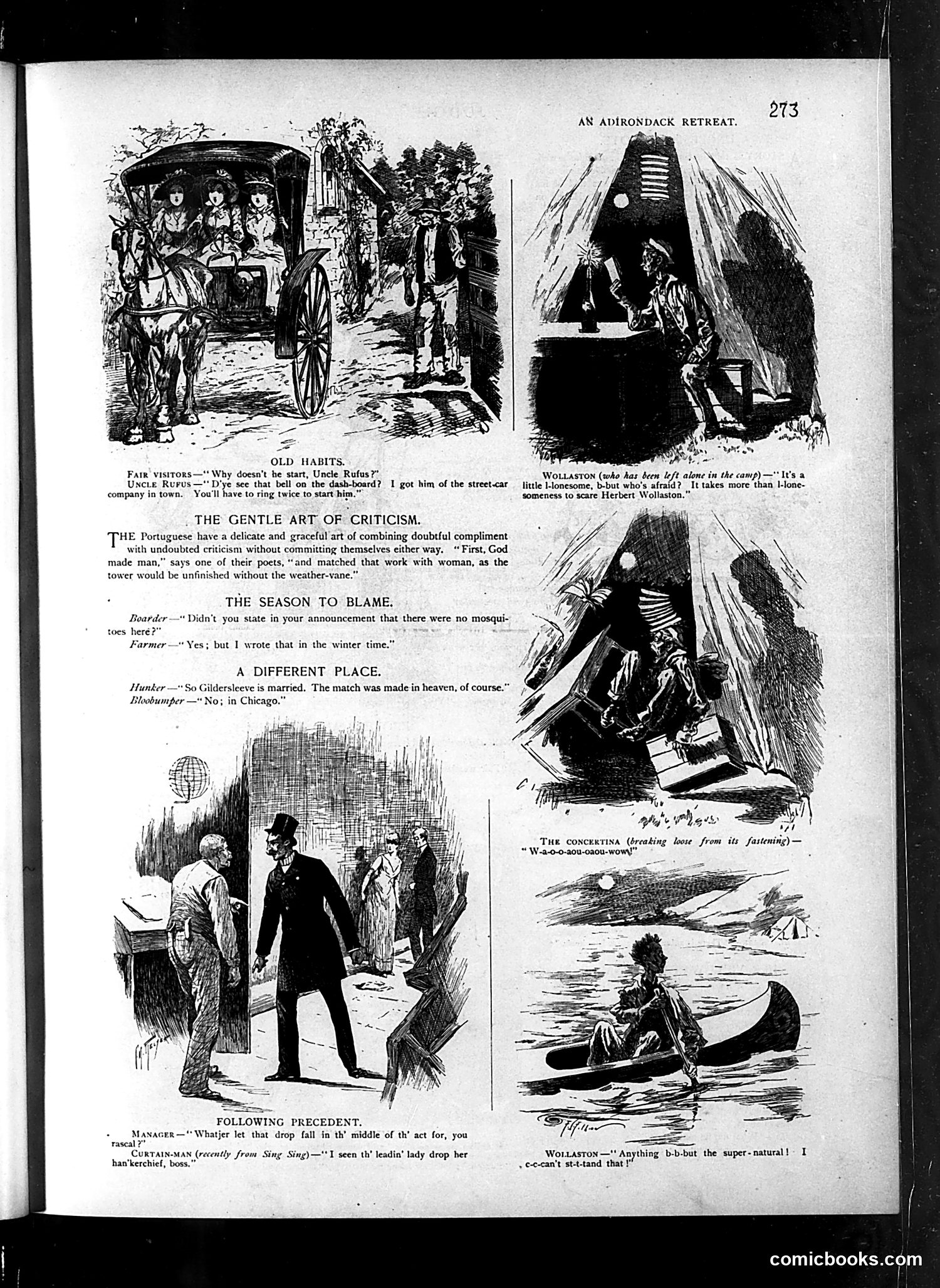
This page contains multiple satirical cartoons and jokes typical of late 19th/early 20th-century American humor: **"Old Habits"**: A city dweller visiting an Adirondack retreat rings a bell expecting a streetcar to arrive—satirizing urban visitors' unfamiliarity with rural life. **"The Gentle Art of Criticism"**: A brief essay mocking Portuguese compliments that insult women, comparing them to weather vanes on towers—a dig at both Portuguese culture and female inferiority tropes. **"Season to Blame" and "Different Place"**: Quick jokes exploiting rural/urban contradictions—a farmer falsely advertised no mosquitoes because he wrote the ad in winter; marriage "made in heaven" actually occurred in Chicago (implying Chicago lacks heavenly qualities). **"Concertina" and "Following Precedent"**: Visual gags about a musical instrument escaping and a theater worker copying an actress's mistake. **Boating scene**: Features "Wollaston," appearing to reference a contemporary figure known for bravado. The humor relies on period class distinctions, ethnic stereotypes, and observational comedy about urban-rural cultural gaps.
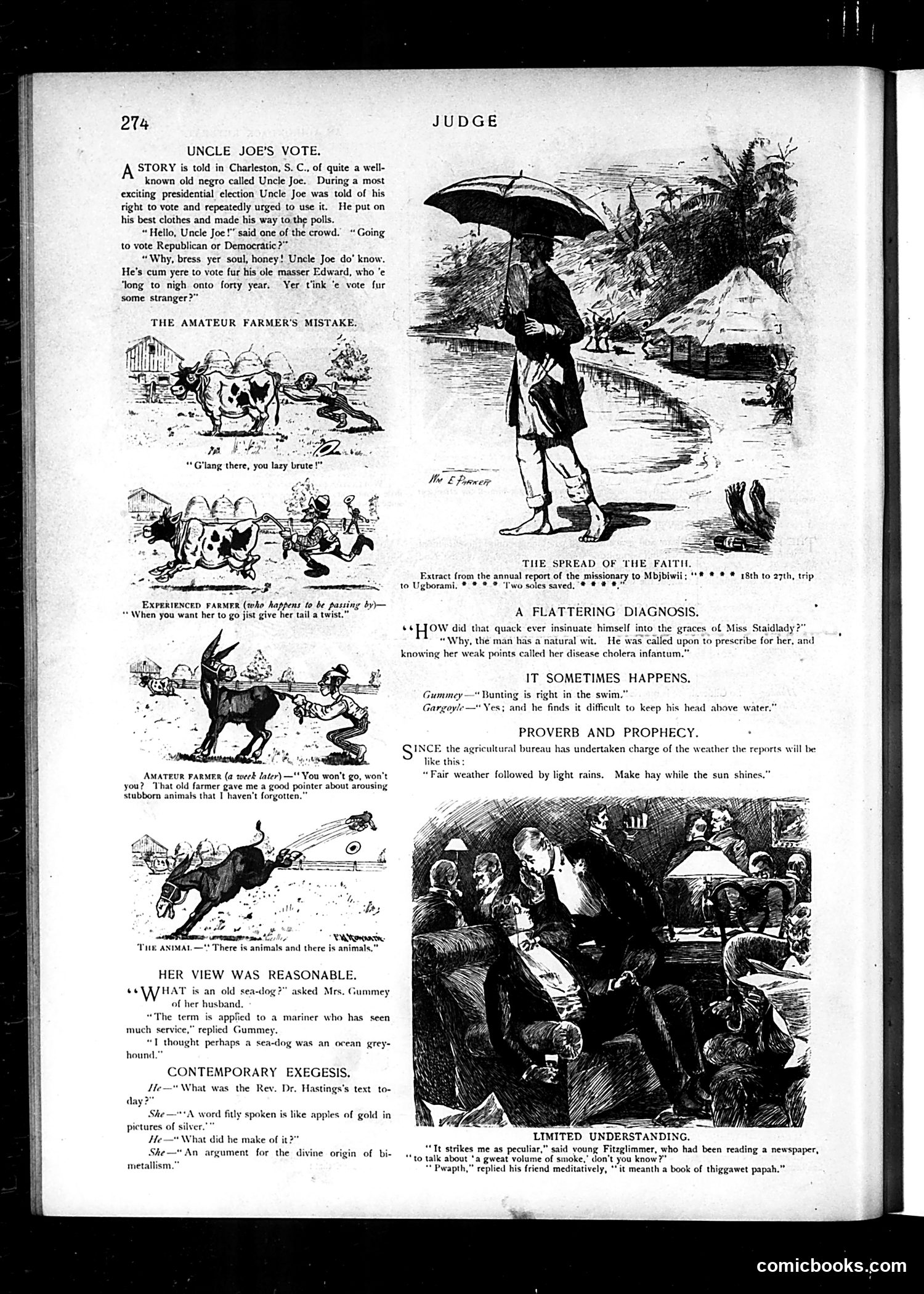
This page contains multiple brief satirical pieces typical of Judge's humor: **"Uncle Joe's Vote"** mocks post-Reconstruction voting patterns through dialect humor. An elderly formerly enslaved man, given his newfound right to vote, chooses to vote for his former enslaver "Masser Edward" out of long-standing loyalty rather than exercising independent political choice. The satire targets both the illusion of Black political freedom and the persistence of ante-bellum social hierarchies. **"The Amateur Farmer's Mistake"** shows a farmer misapplying advice about handling animals to his wife—the joke relying on period gender dynamics and domestic comedy. **Other brief items** include wordplay jokes ("sea-dog," bimetallic currency puns) and observational humor about social pretension and medical quackery. The cartoons use exaggerated illustrations and dialect to amplify the satire. The overall tone reflects Judge's late-19th-century sensibilities: racist caricature, class-based humor, and mockery of social pretension were standard comedic fare for this publication's educated, affluent readership.
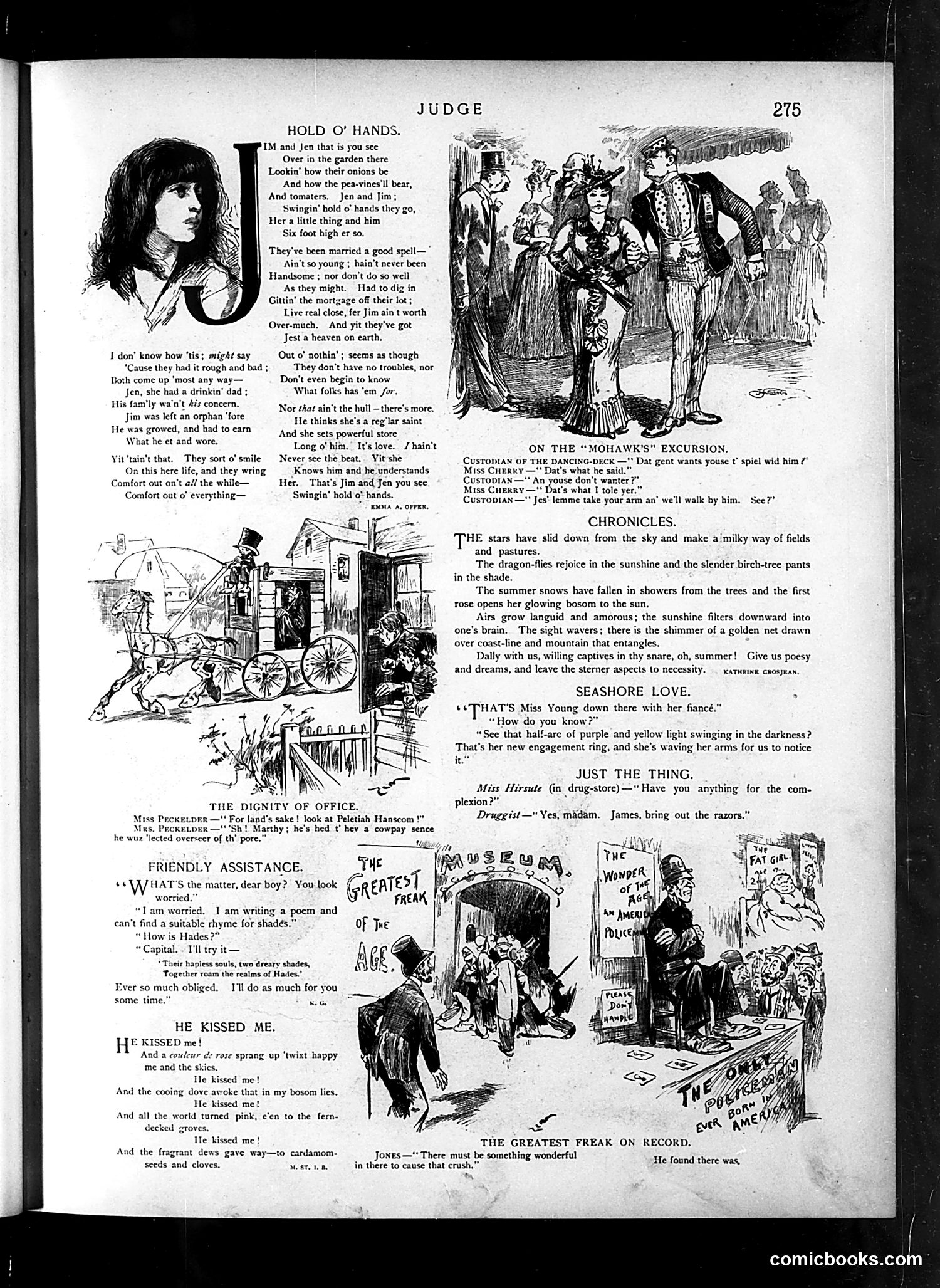
This page contains several pieces of light satirical humor typical of early 20th-century American magazines: **"Hold O' Hands"** is a sentimental poem celebrating working-class marriage—Jim and Jen, poor but content despite hardship (orphanhood, alcoholic relatives, mortgage struggles). The satire is gentle: the joke is that happiness comes from love rather than wealth, presented as almost surprising to the narrator. **"Mohawk's Excursion"** appears to reference a steamboat or cruise, with a female performer ("Miss Cherry") reluctant to flirt with a male passenger despite a custodian's encouragement. The humor relies on the woman's refusal and the custodian's attempted matchmaking. **Other brief items** include humorous observations about summer, seashore romance, and a drugstore joke where a pharmacist recommends razors for a woman's complexion problem—implying facial hair. **"The Greatest Freak on Record"** shows a carnival attraction drawing crowds; the punchline reveals it contains only wax, mocking sensationalism. The overall tone is whimsical rather than politically pointed—domestic comedy and mild social observation rather than sharp satire.
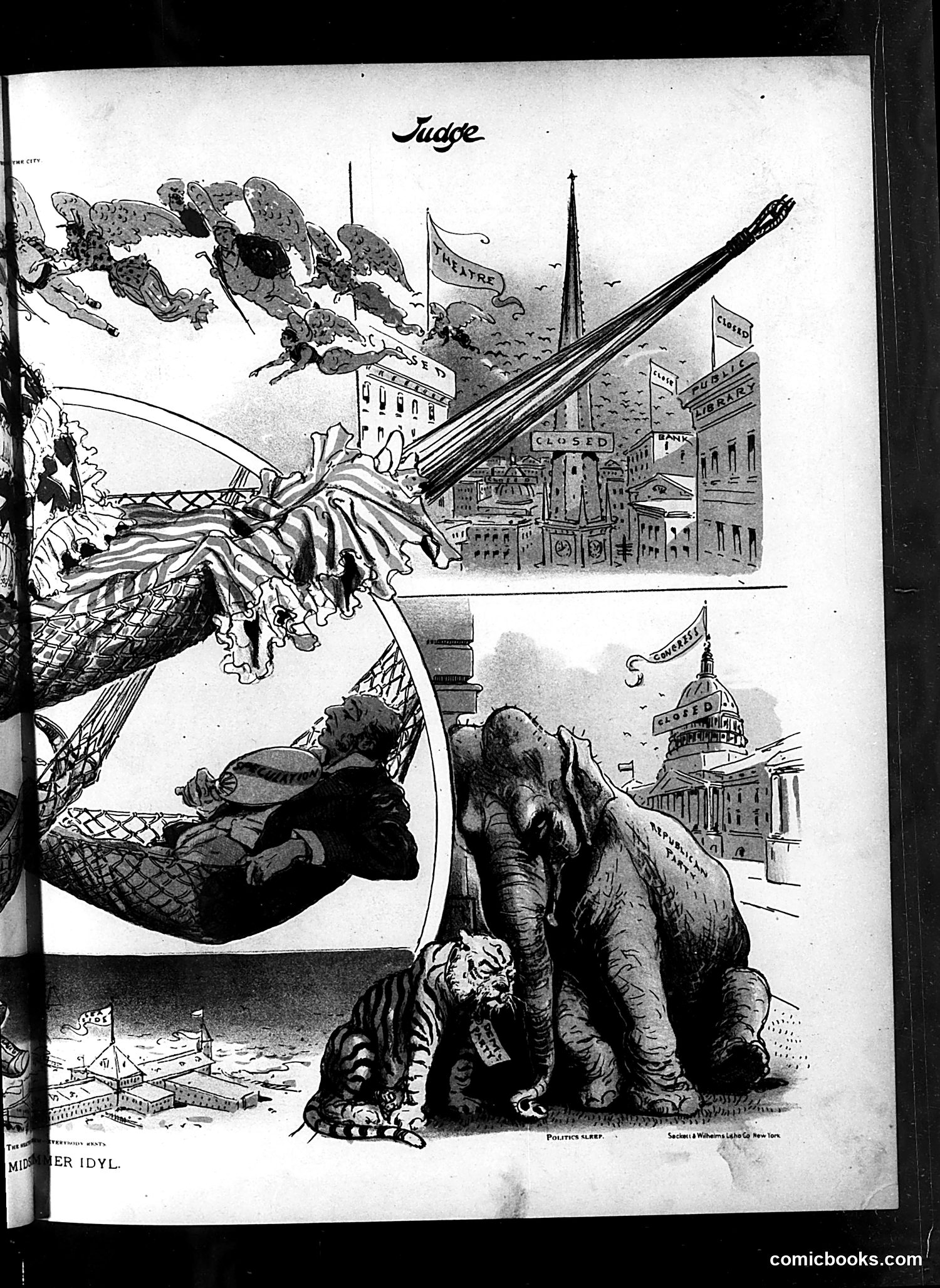
This page features **"Judge,"** a satirical magazine, with what appears to be political allegory using animals and architectural imagery. The main cartoon depicts an **elephant** (the Republican Party symbol) observing chaos in an urban setting marked "CLOSED" and "BANK." Above, demons or chaos-figures swirl over a cityscape with a prominent Capitol building, suggesting governmental dysfunction or crisis. The lower panel shows the elephant alongside a tiger, both positioned near the Capitol building, also marked "CLOSED." The imagery likely satirizes **financial or governmental crisis**—possibly a bank panic or economic collapse—during a Republican administration. The closed institutions and Capitol building suggest commentary on government's inability or unwillingness to address economic problems. Without a visible date or caption text, the specific historical event remains unclear, though this format is consistent with early-20th-century American political cartooning.
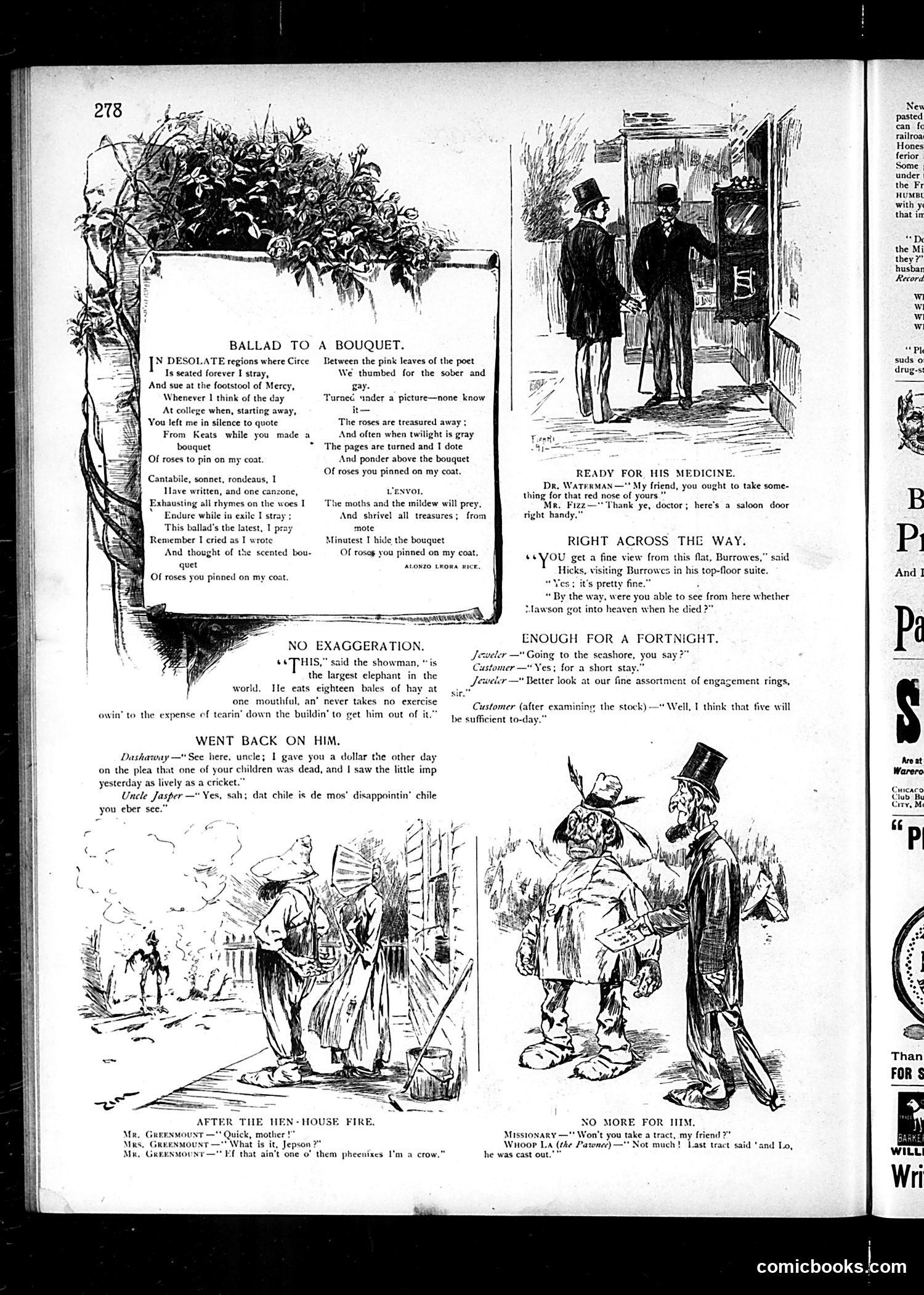
This page contains six unrelated comic sketches and satirical pieces typical of Judge magazine's format: **"Ballad to a Bouquet"** is a sentimental poem about a lover cherishing roses from a departed beloved—gentle romantic satire of overwrought Victorian poetry. **"No Exaggeration"** mocks circus showmen's exaggerated claims through a deadpan joke about an elephant eating eighteen bales of hay daily at ruinous expense. **"Ready for His Medicine"** is a crude joke: a man with a red nose (suggesting alcoholism) is advised to seek medical help, but responds that a nearby saloon door suffices as his "medicine." The remaining sketches are brief punchline jokes about flat views, seashore engagements rings, a broken promise about a child, a burnt-out hen house, and a Native American rejecting Christian tracts. The page reflects Judge's blend of literary parody, visual humor, and topical jokes—here mostly apolitical domestic comedy reflecting Gilded Age attitudes, including a casually offensive Native American caricature.
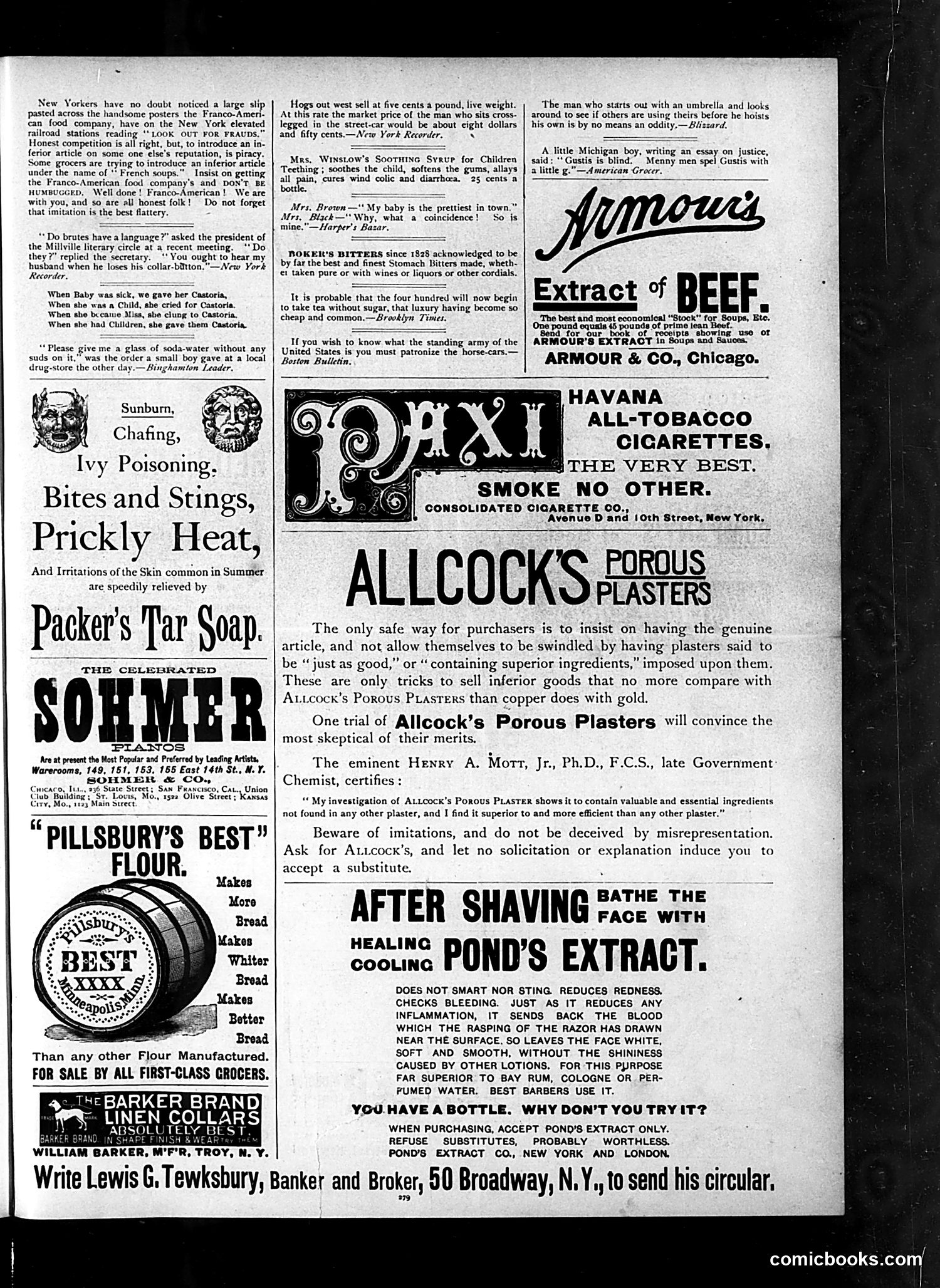
This page is primarily **advertising**, not satirical cartooning. It contains product advertisements (Armour's Beef Extract, Pillsbury's Flour, Pond's Extract, Allcock's Plasters) interspersed with short humorous anecdotes. The notable content includes: 1. **Franco-American Food Company notice** (top): A warning against counterfeit "French soups"—competitors selling inferior products under similar names. This reflects late-19th-century concerns about product fraud and brand protection. 2. **Brief jokes** scattered throughout, typical of *Judge* magazine's humor format—observations about New York life (elevated railroad passengers, drug-store orders, baby products). 3. **Allcock's Plasters advertisement** emphasizes the danger of imitations and counterfeit medical goods—a recurring concern in this era before FDA regulation. The page illustrates how *Judge* mixed satirical commentary with commercial advertising and light social humor, reflecting consumer anxieties about fraudulent products in unregulated markets.
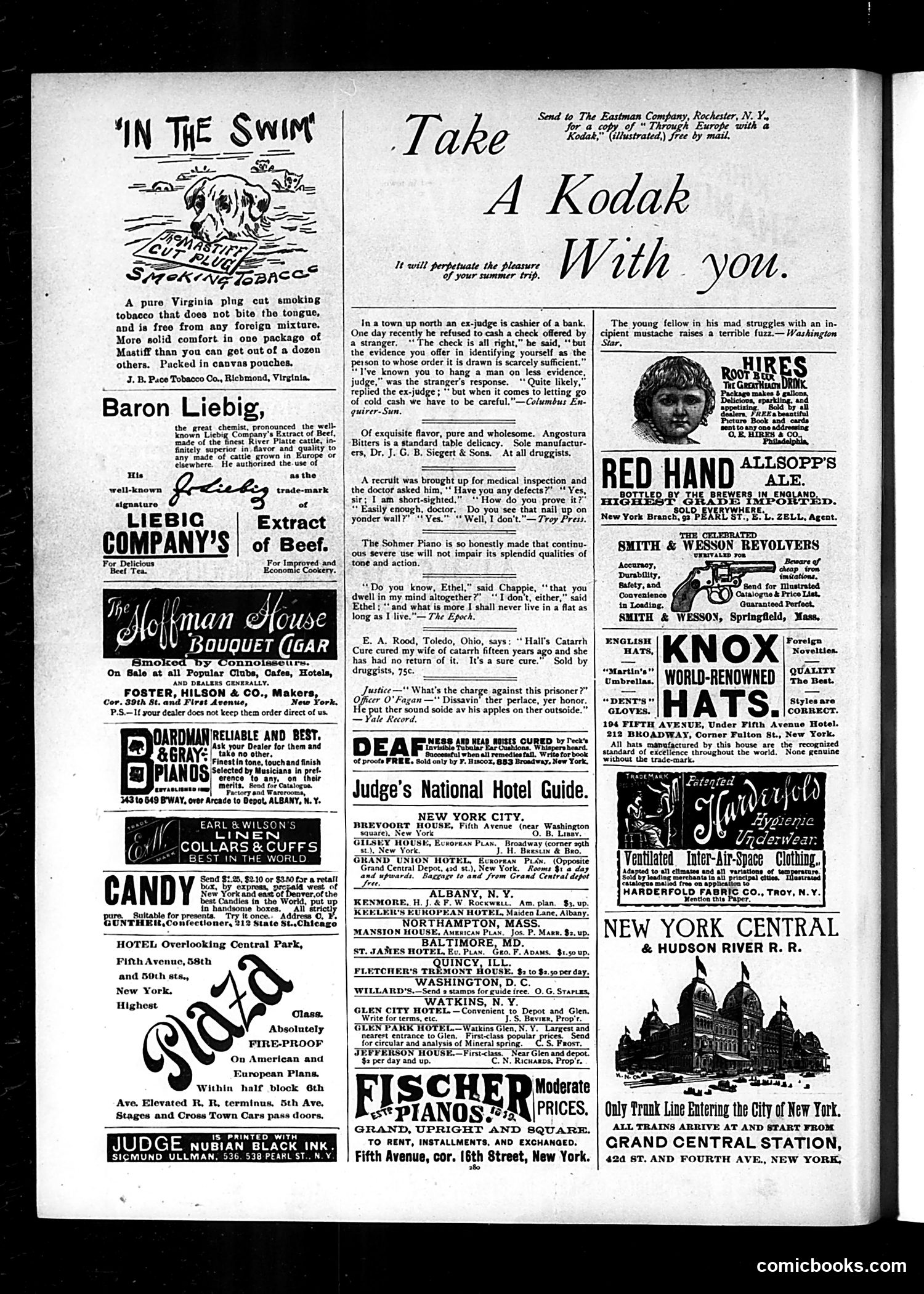
This is primarily an **advertising page** from Judge magazine, with one substantive humor piece embedded among product advertisements. The main cartoon, "In the Swim," illustrates a joke about an ex-judge who's now a bank cashier. A stranger tries to cash a check, but the judge demands better identification—despite having previously convicted people on far less evidence. The stranger sarcastically points out this contradiction ("I've known you to hang a man on less evidence, judge"). The ex-judge's response—that hanging someone requires less rigor than giving out cash—is the satirical point: it mocks judicial carelessness and the questionable justice system, while implying that protecting money matters more than protecting innocent lives. The surrounding content consists entirely of period product advertisements (Kodak cameras, tobacco, liquor, firearms, pianos, hotels, etc.), typical of Judge's revenue model. No other editorial content or political satire appears on this page.
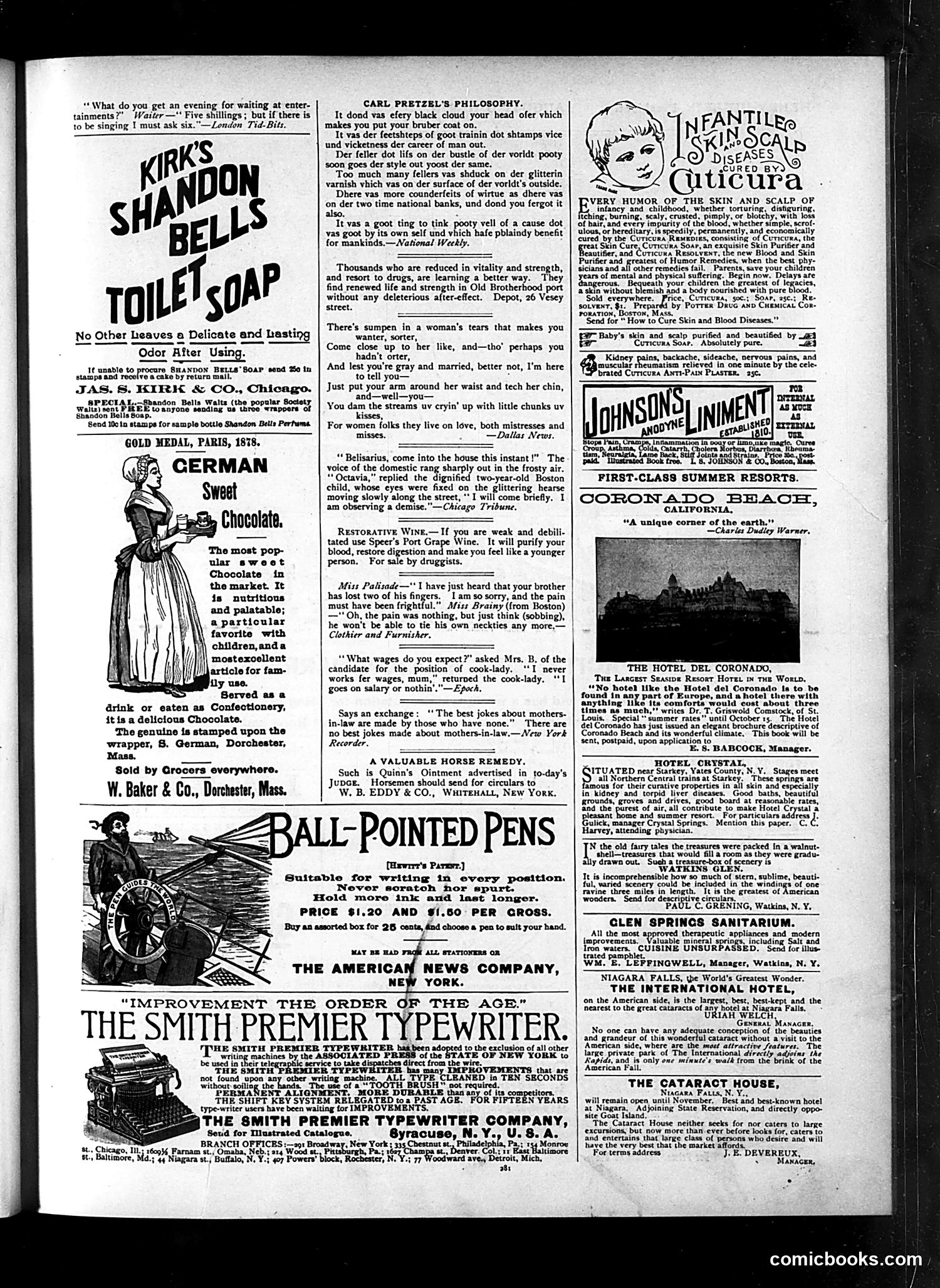
This page from Judge magazine (date unclear from OCR) is primarily **advertisements and humor fillers** rather than political cartoons. The featured content includes: **"Carl Pretzel's Philosophy"** — A humor column featuring a character with a thick German accent offering folk wisdom. Pretzel comments on human nature using malapropisms and dialect humor—a common ethnic comedy trope of the era. Jokes about superficiality, counterfeiting, and genuine virtue. **Lighter humor pieces** include observations about women's tears, a Boston child using pretentious language ("observing a demise"), and a joke about mothers-in-law. **The remainder consists of period advertisements** for consumer goods: Shandon Bells soap, German sweet chocolate, Ball-Pointed pens, Smith Premier typewriters, and various restorative wines and remedies. There are no identifiable political figures or references to specific events. This appears to be a typical magazine page mixing advertising revenue with light entertainment content—not satirical commentary.
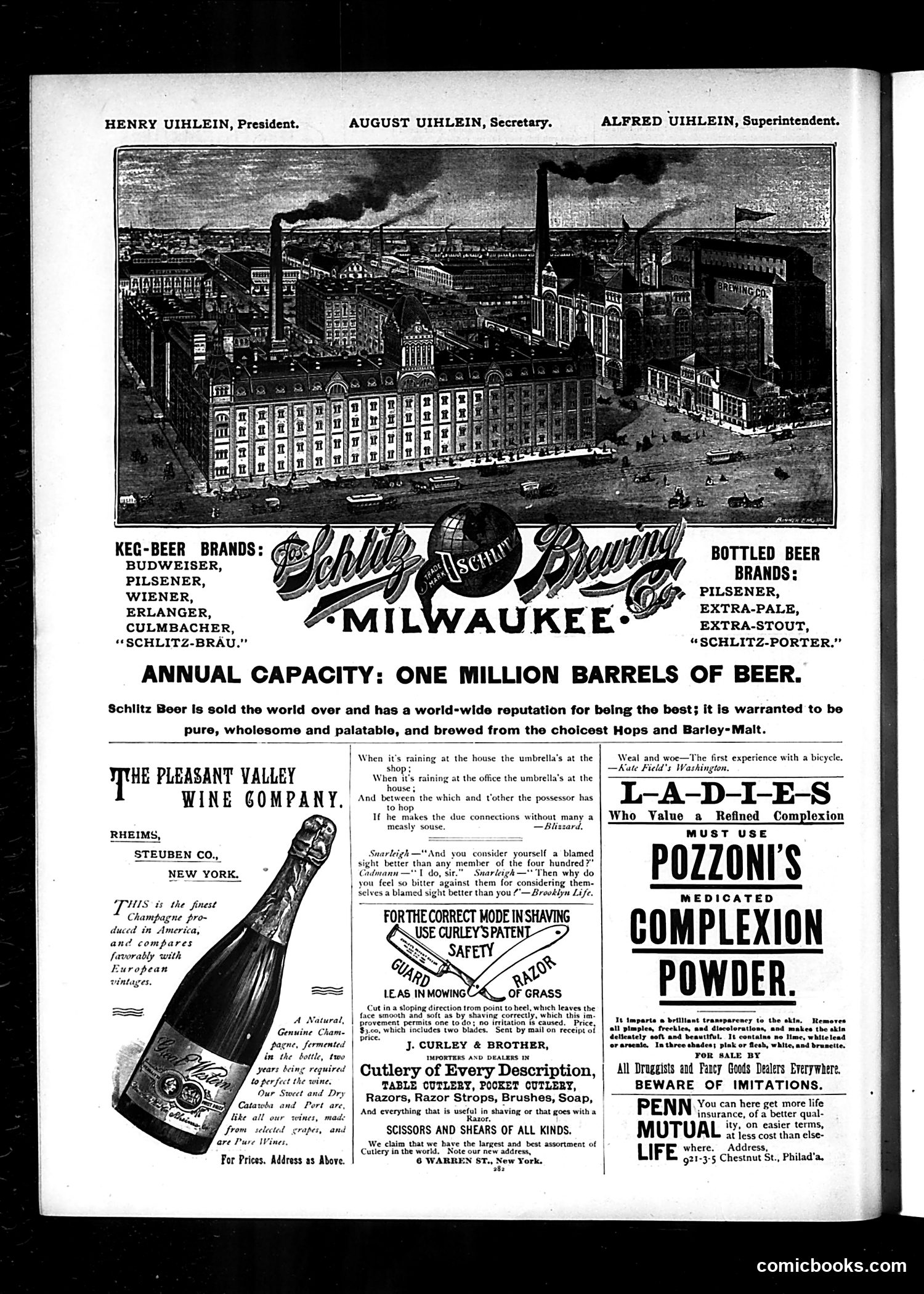
This is primarily an **advertising page** from Judge magazine, not a satirical cartoon page. It features: **Main advertisements:** - Schlitz Brewery (Milwaukee) dominates the top half with an industrial complex illustration and lists of beer brands - Pleasant Valley Wine Company (New York) advertises champagne - J. Curley & Brother (cutlery/razors) - Pozzoni's Complexion Powder (for ladies) - Penn Mutual Life Insurance **Minimal satirical content:** The page includes only two brief joke items: a weather-related quip about umbrellas and a short dialogue between "Snarleigh" and "Cadmann" about class attitudes (from Brooklyn Life). A caption about bicycle experiences also appears. **Context:** This reflects Judge's mixed content model—satirical commentary shared space with lucrative advertisements targeting middle and upper-class readers. The ads themselves (beauty products, insurance, imported goods) reveal target audience demographics of the era.
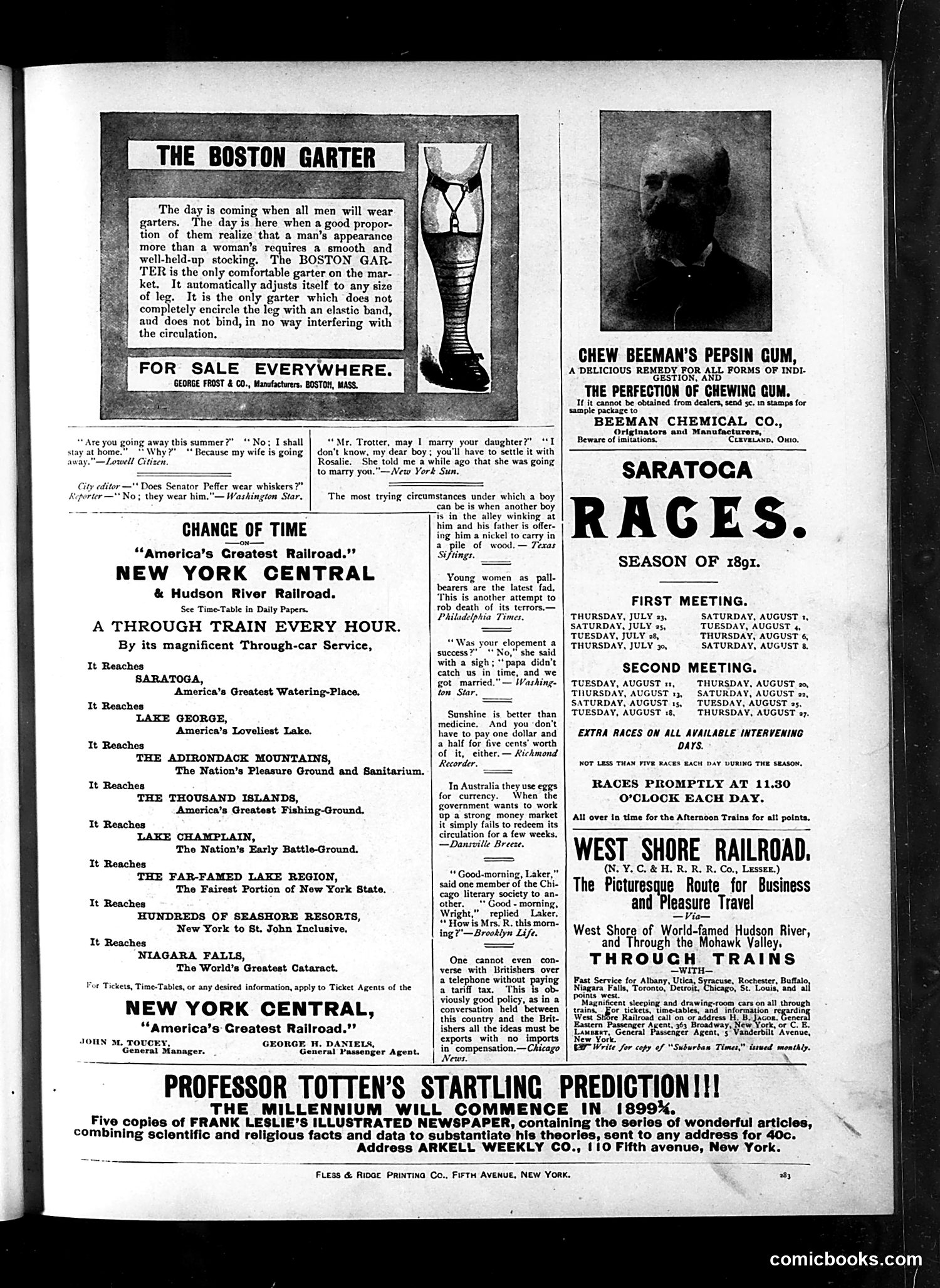
This is primarily an **advertising page** from Judge magazine's 1891 season. The top half contains product ads (Boston Garter, Beeman's Pepsin Gum) interspersed with short humorous dialogue snippets—standard filler content typical of period magazines. The right side features a substantial ad for **Saratoga Races** (horse racing season) with detailed meeting schedules, plus railroad advertisements promoting the New York Central and West Shore Railroad as transportation to leisure destinations. The lower portion includes jokes about period social life: a husband glad his wife is leaving, a father permitting a suitor only if the couple settles things themselves, and references to pallbearers as fashion and Australian egg-based currency. **For modern readers**: This reflects 1890s-era commerce, leisure culture, and male-oriented humor. The garter ad's emphasis on "circulation" reflects contemporary health concerns about tight clothing. Saratoga Springs was America's premier racing and resort destination. The jokes are genteel domestic humor rather than biting satire.
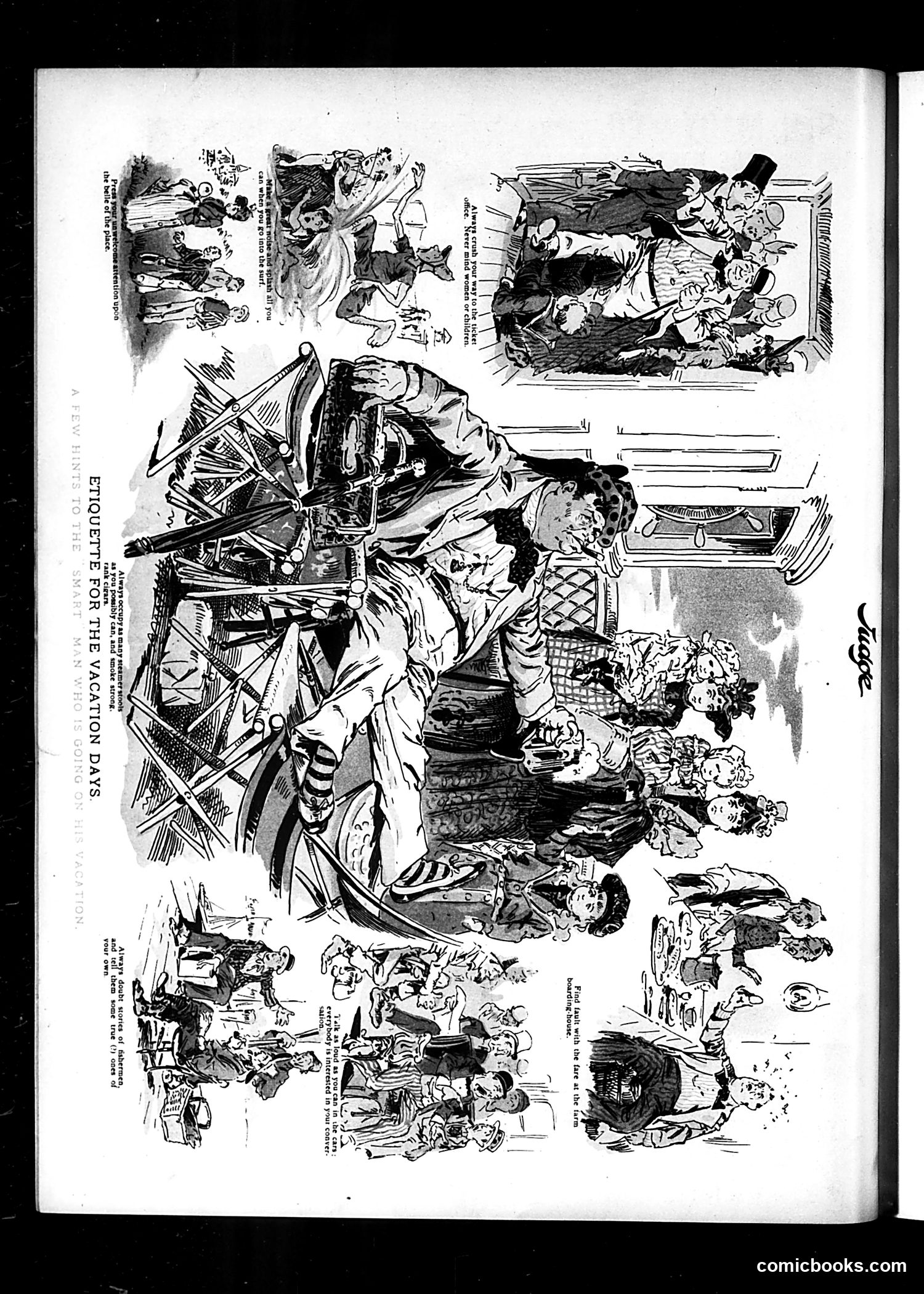
This page from *Judge* magazine appears to be a satirical cartoon about social pretension and courtship dynamics, though the OCR text is too fragmentary to fully reconstruct the narrative. The central large illustration depicts what appears to be a fashionably dressed woman surrounded by admiring men in formal attire, suggesting a social gathering or ball. The smaller vignettes around it likely show related scenes of romantic pursuit or social climbing. The phrase "the belle of the place" suggests the cartoon satirizes a woman's social ambitions or vanity—a common *Judge* theme. The various male figures and their interactions probably illustrate different suitors or social types competing for attention. Without clearer text or date information, the specific political or social commentary remains unclear, but the overall mockery appears directed at aristocratic pretension and romantic absurdity.
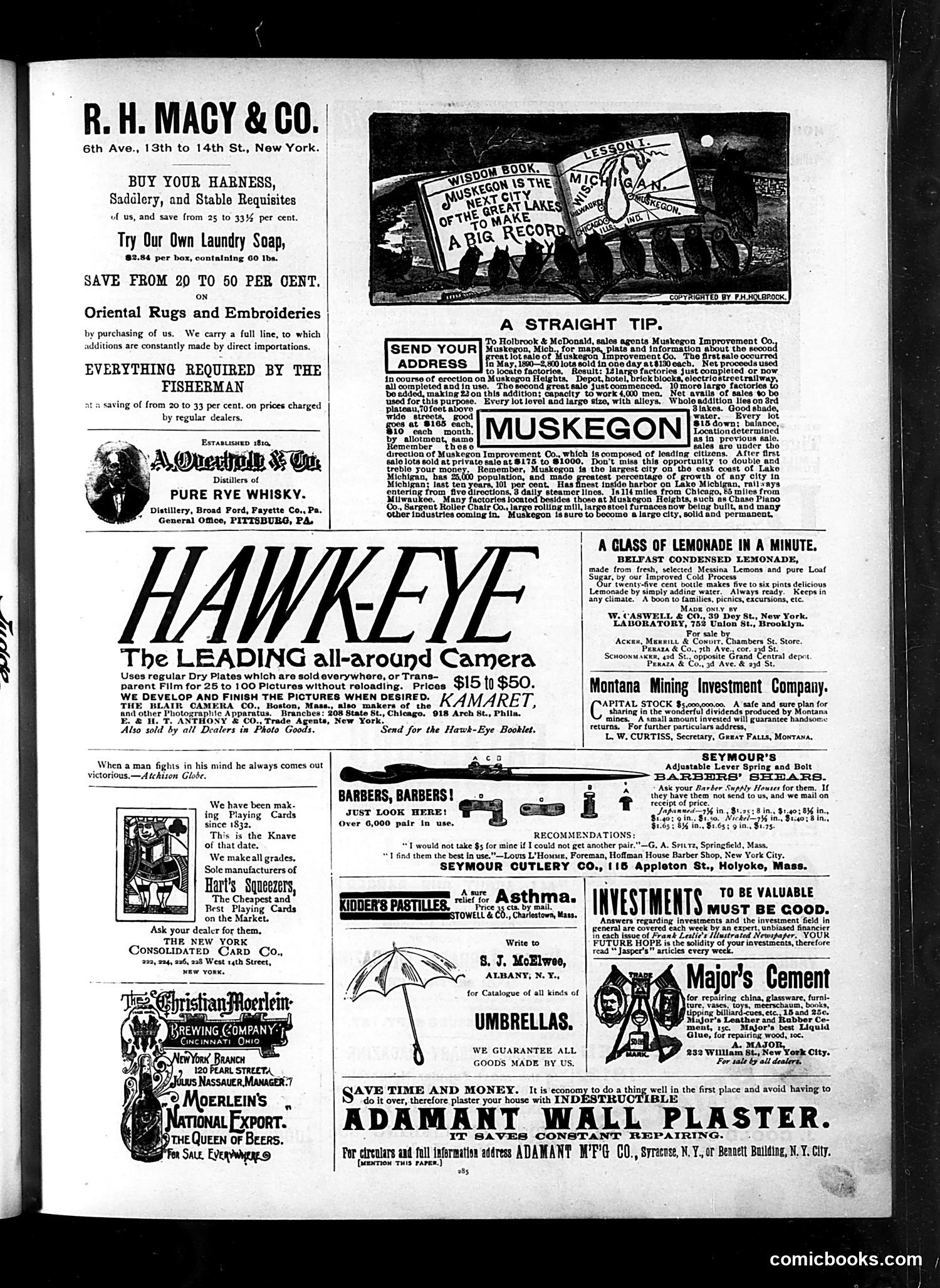
This page is primarily **advertising**, not political satire. It's a late-19th-century commercial compilation featuring department stores (R.H. Macy & Co.), whiskey, cameras, mining schemes, and barber supplies. The one satirical element appears to be **"A Straight Tip,"** which advertises Muskegon, Michigan land sales. The text promotes factory lots as investment opportunities, claiming the city will become "a large city, solid and permanent." This reads as promotional hype rather than genuine satire, though the hyperbolic language about doubling/trebling money and promised industrial growth could be mildly mocking speculative investment schemes common in the era. The page otherwise contains standard period advertisements: condensed lemonade, the Hawk-Eye camera, mining stock offerings, and grooming products. Without visible caricatures or political commentary, this appears to be filler content from Judge magazine's advertising section rather than its satirical editorial material.
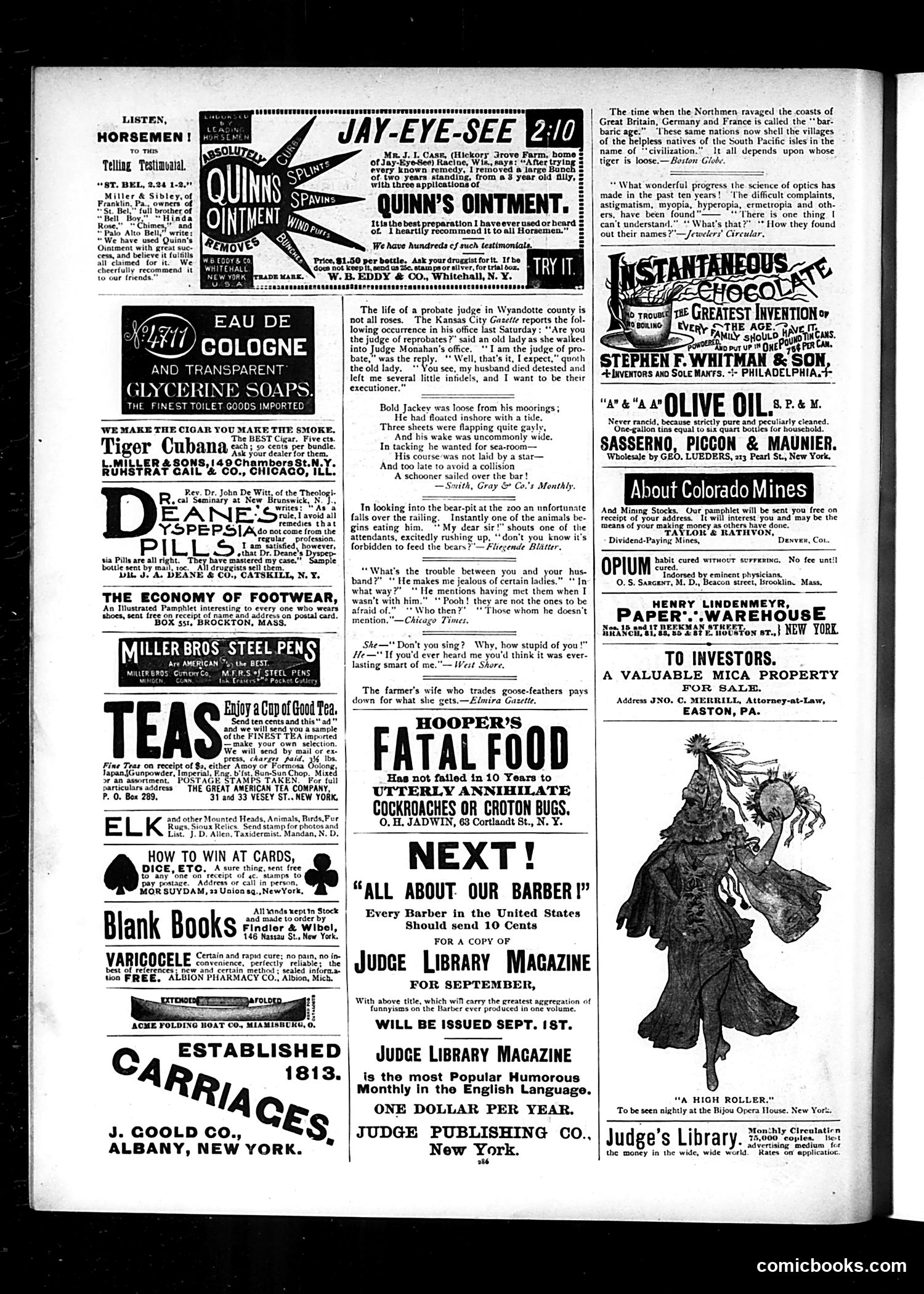
This page is primarily **advertising**, typical of late 19th-century magazine layouts. The ads promote patent medicines, consumer goods, and services—reflecting common commercial practices of the era. **Notable content includes:** - **Quinn's Ointment** ads featuring testimonials from horse owners (Jay-Eye-See was apparently a famous racehorse), claiming to cure lameness - **Dr. Deane's Pills** for dyspepsia, using clergy endorsements as marketing - Humorous **filler jokes** about a probate judge called "judge of reprobates," a drunk sailor, and marital jealousy—typical light humor of the period - **Steel pens, tea, blank books, and other goods** hawked via mail order The page reflects the advertising-heavy model of magazines like *Judge*, where satirical content coexisted with commercial pitches. The remedies advertised (many likely ineffective or dangerous by modern standards) exemplify the largely unregulated patent medicine industry of the time.
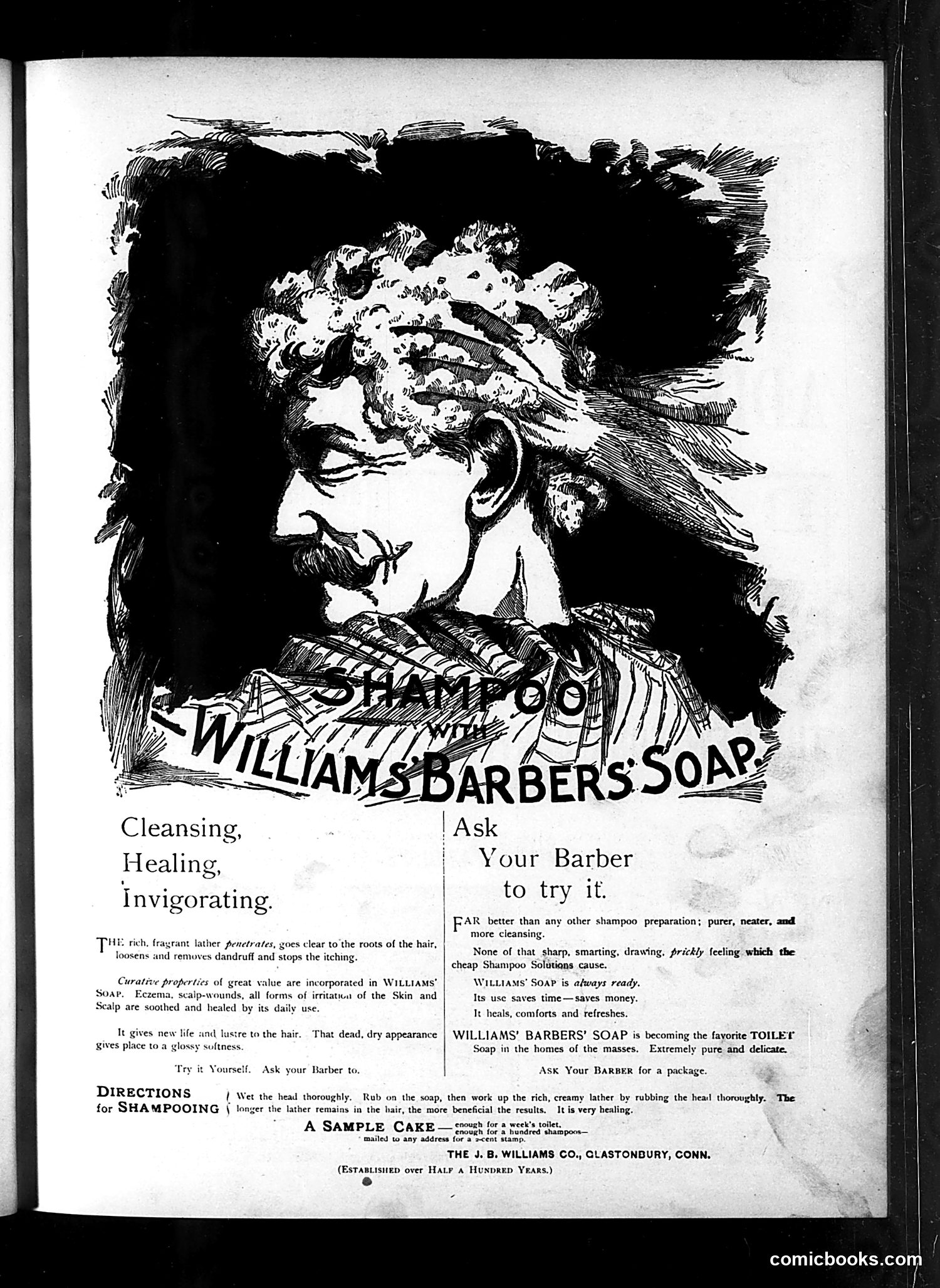
This is **not a political cartoon or satire**—it's a full-page advertisement for Williams' Barbers' Soap, published in *Judge* magazine. The image shows a bearded man's head in profile, rendered in a classical engraving style, serving as the product's trademark. The ad promotes the soap's purported benefits: cleansing, healing, and invigorating properties for hair and scalp conditions like dandruff and eczema. The advertisement emphasizes the product's superiority over "cheap shampoo solutions" (which allegedly cause a "prickly feeling"), targets barbers as endorsers, and offers a sample cake for one cent. It notes the company was established over 150 years prior, suggesting longevity and reliability. This represents typical late 19th/early 20th-century advertising strategy: using classical imagery, testimonial appeals, and competitive positioning to market personal grooming products.
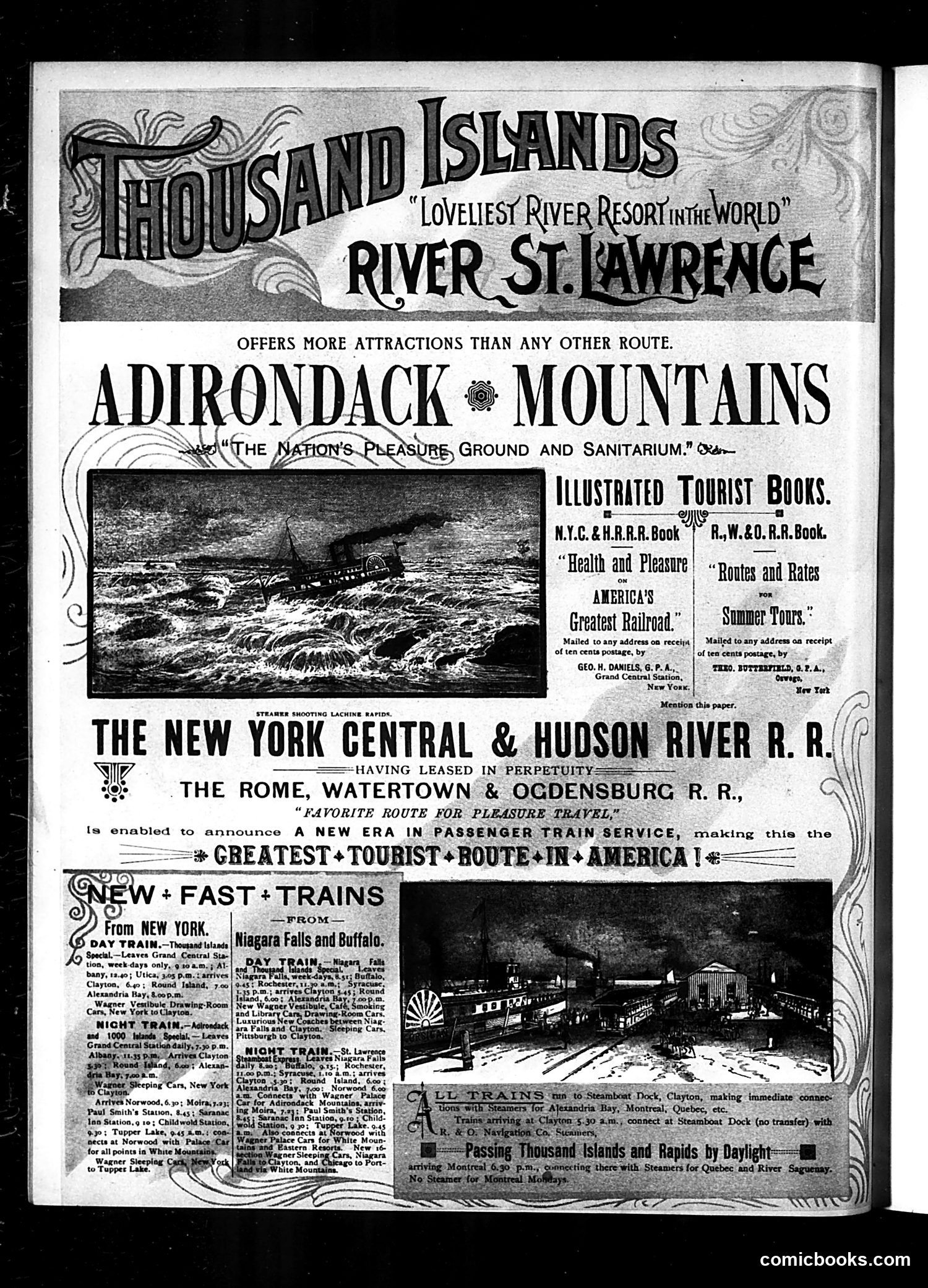
This is a **railroad advertisement**, not political satire or a cartoon. The page promotes tourist travel via the New York Central & Hudson River Railroad and its leased Rome, Watertown & Ogdensburg line. The content advertises: - Thousand Islands and Adirondack Mountains as vacation destinations - New fast train services from New York to Niagara Falls, Buffalo, and Montreal - Illustrated tourist guidebooks available for ten cents postage - Specific train names like the "Thousand Islands Special" and "Adirondack" The decorative illustrations show scenic landscapes and railway infrastructure typical of late-19th/early-20th-century promotional materials. This represents the era when railroads heavily marketed leisure travel to affluent Americans, positioning scenic upstate New York regions as desirable tourist destinations. There is no political commentary or satire visible on this page.