
A complete issue · 20 pages · 1891
Judge — July 25, 1891
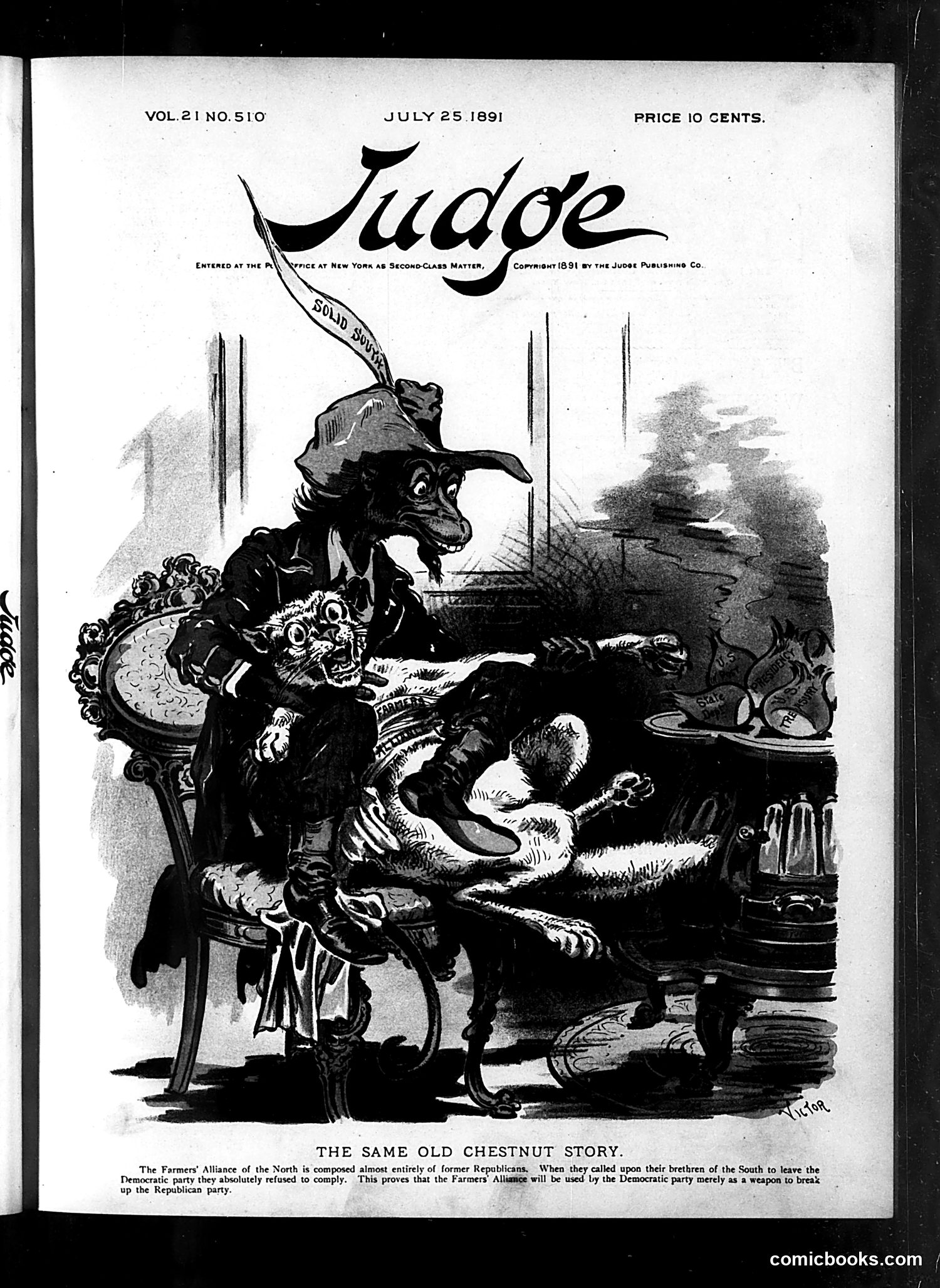
This 1891 *Judge* cartoon satirizes the Farmers' Alliance of the North. According to the caption, Northern Alliance members—composed mostly of former Republicans—refused to join their Southern counterparts in leaving the Democratic party as a unified protest against Republican policies. The devil-like figure represents the Democratic party, manipulating Northern farmers (depicted as a gullible character being duped). The satire's point: Northern farmers are being foolishly used as a political weapon by Democrats to weaken Republicans, rather than achieving genuine reform. The "chestnut story" reference suggests this was a tired, repeated political ploy. The cartoon reflects tensions within the 1890s Populist movement regarding North-South farmer alliances and party loyalty.
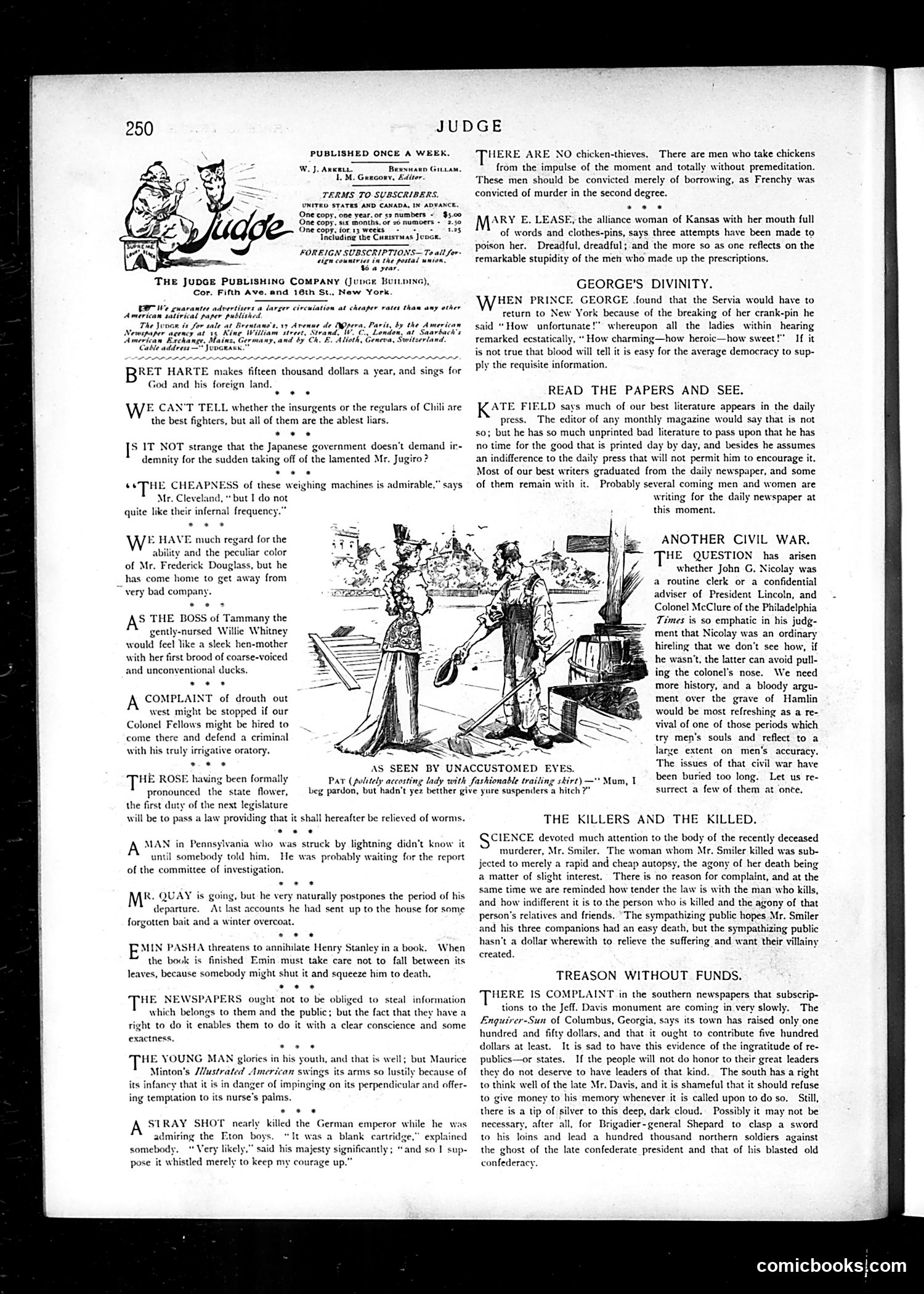
This page contains multiple brief satirical commentaries rather than a single cartoon. The visible illustration depicts two figures in period dress, though their specific identities aren't clear from the image alone. The text covers various social and political topics typical of Judge's format: commentary on government inefficiency, press freedom, civil service issues, and military matters. One section references "Another Civil War," discussing John G. Nicolay's role as Lincoln adviser versus a Philadelphia newspaper's claim he was a confidential adviser—a dispute about historical accuracy. The overall tone reflects typical late-19th/early-20th-century American satire: skeptical of government competence, protective of press independence, and concerned with historical record-keeping. Without clearer identification of the illustration's figures or the magazine's publication date, specific political references remain uncertain.
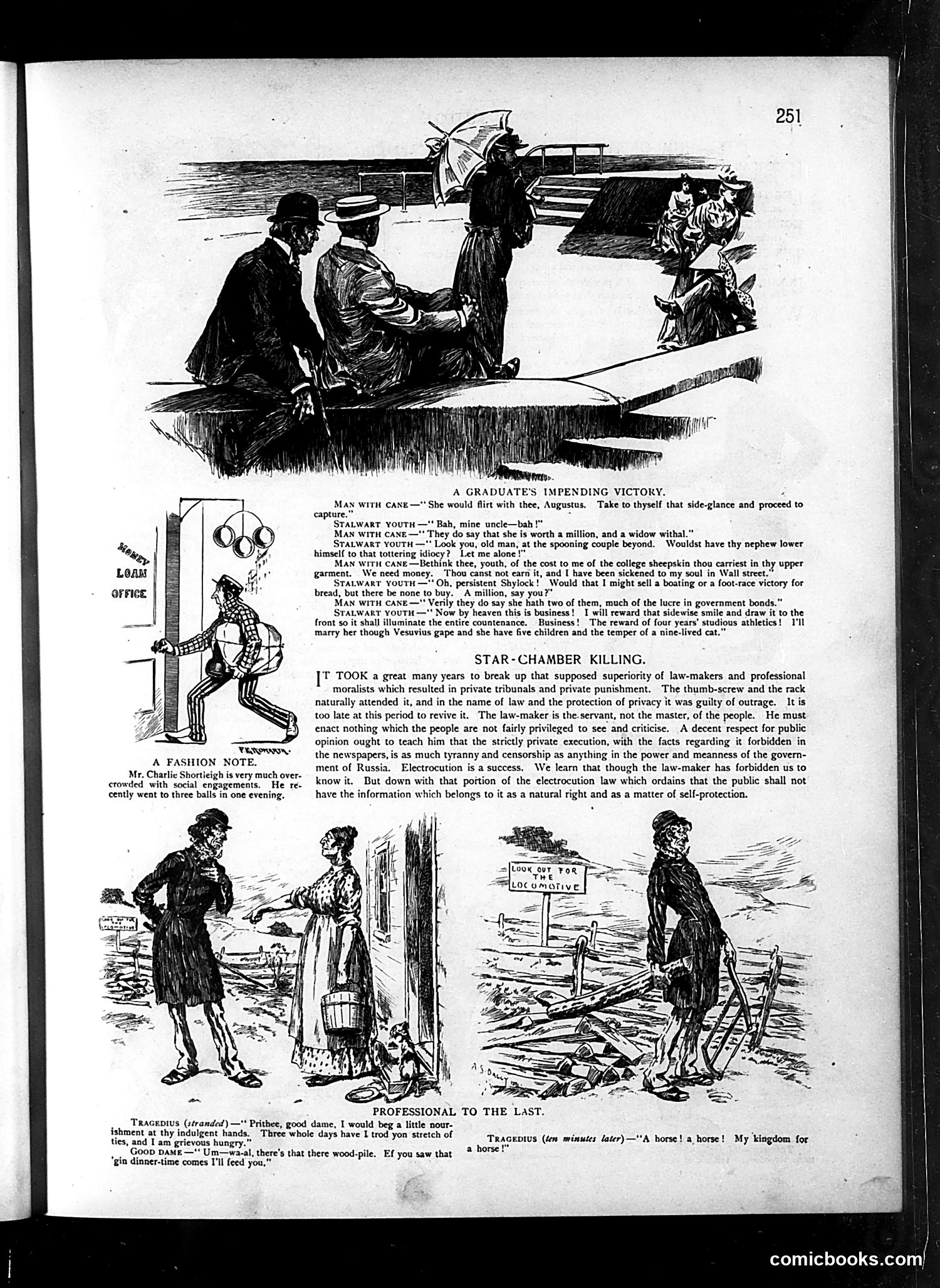
This page contains three satirical pieces mocking wealth inequality and professional pretense during the Gilded Age. **"A Graduate's Impending Victory"** depicts a wealthy man with a cane negotiating with a young woman, suggesting he'll buy her as a wife—a critique of marriage as financial transaction among the rich. **"Star-Chamber Killing"** argues that private punishment by the wealthy mirrors historical tyranny. It attacks law-makers who escape public accountability, contrasting this with ordinary people's lack of privacy protections. **"A Fashion Note"** and **"Professional to the Last"** mock aristocratic pretension through brief vignettes showing the wealthy behaving absurdly while maintaining false dignity. The overarching theme: the wealthy operate by different rules, evading justice while ordinary people suffer scrutiny—a common Progressive Era complaint about plutocracy.
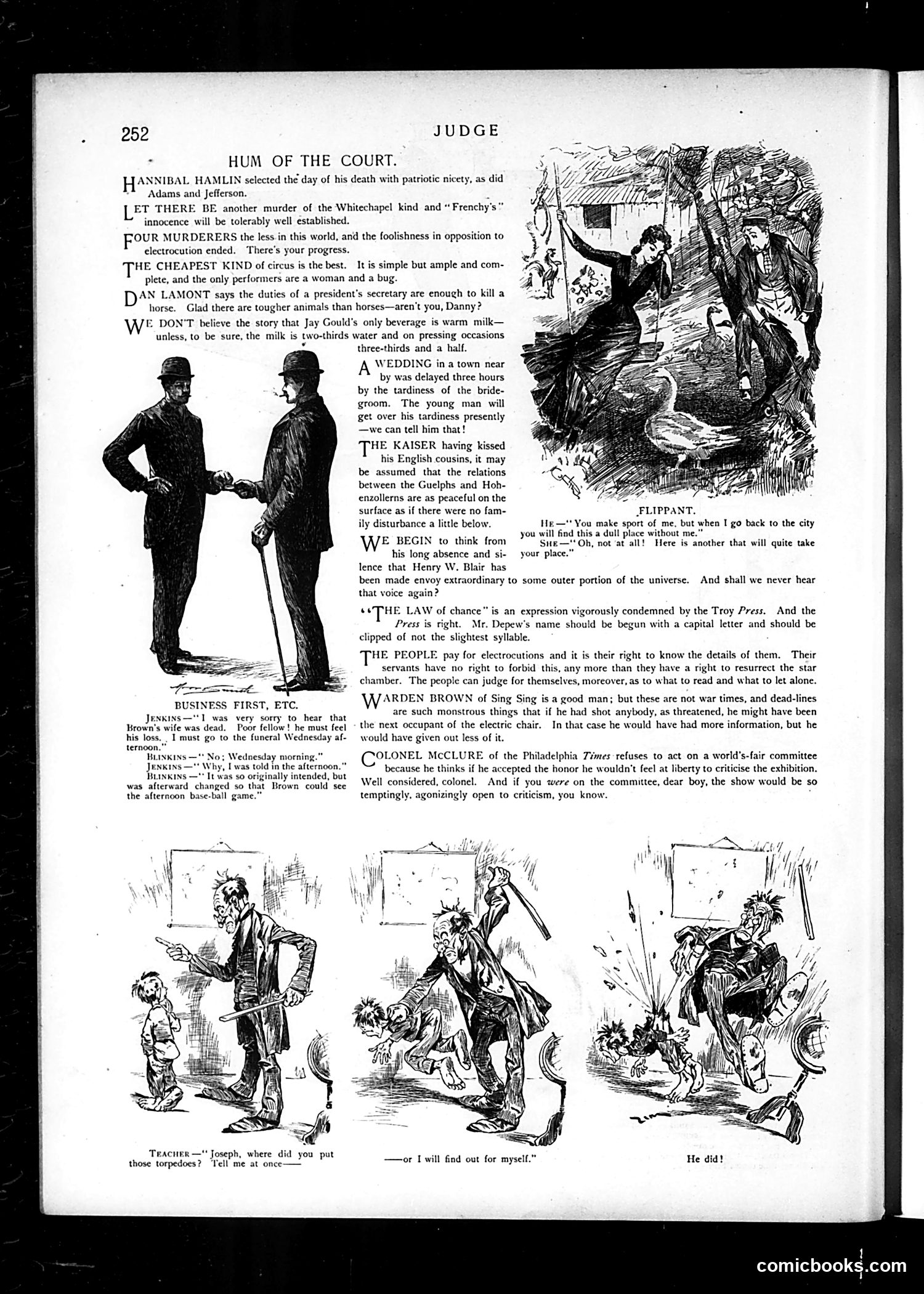
This page compiles brief satirical commentary on contemporary figures and issues, circa late 19th century. Key targets include: **Political figures**: References to Henry W. Blair (diplomat), Jay Gould (industrialist), and the Kaiser's relations with English cousins (likely commenting on international diplomacy). Hannibal Hamlin's death is noted with patriotic irony. **Social commentary**: The text mocks capital punishment debates—electrocution is presented as "progress" while defending public access to execution details. A jab at "Frenchy" references an unclear criminal case (possibly Whitechapel-related). **Institutional critique**: Colonel McClure's refusal to join a world's-fair committee because he wants editorial independence is praised as principled—a swipe at conflicts of interest. **The cartoon strips** (bottom) appear to depict a teacher-student interaction about tortoises, and a romantic quarrel, typical Judge humor of domestic/educational mishaps. The page's tone is cynical, mocking both politicians and public institutions while defending democratic transparency.
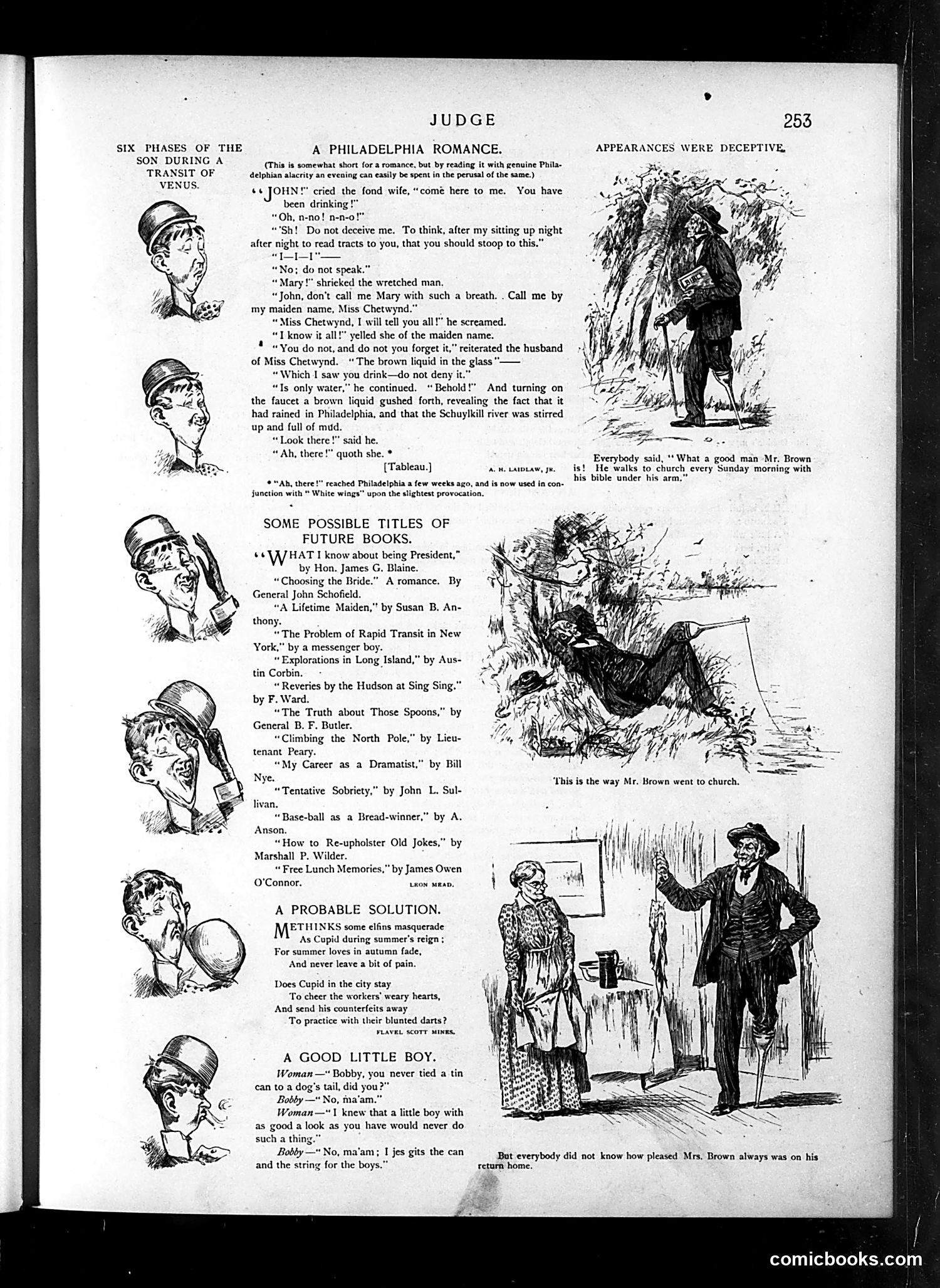
This page contains satirical humor typical of late 19th-century American magazines. **"A Philadelphia Romance"** mocks melodramatic domestic disputes. A husband appears drunk; his wife condemns him morally. The twist: the "brown liquid" is actually Philadelphia's contaminated tap water from the Schuylkill River—a real contemporary problem. The satire targets both marital dramatics and the city's notoriously poor water quality. **"Some Possible Titles of Future Books"** lists humorous fake book titles by prominent figures of the era (James G. Blaine, John L. Sullivan, General Butler, etc.), suggesting ironic or contradictory autobiographies—a standard satirical format poking fun at public personalities. **"A Good Little Boy"** presents a darker joke: a child isn't cruel to animals himself but profits by providing materials for other boys to be cruel—commentary on indirect complicity or moral hypocrisy. **"Appearances Were Deceptive"** illustrates Mr. Brown, presented publicly as pious (church attendance with Bible), but the caption reveals his wife's private relief—implying he's unbearable at home despite his respectable facade. The illustrations throughout use exaggerated facial expressions typical of period cartooning.
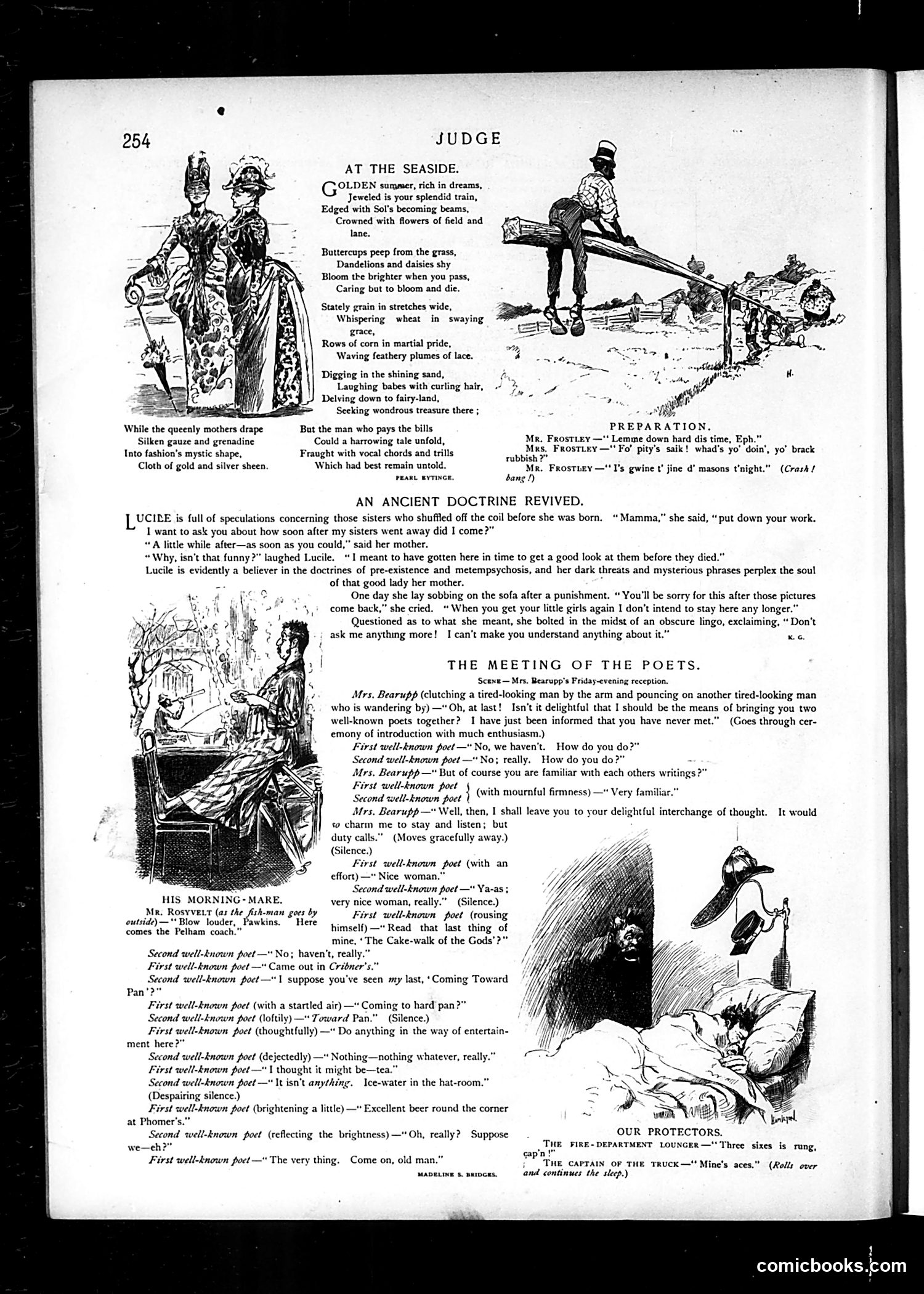
This page contains three distinct satirical pieces typical of late 19th-century American humor: **"At the Seaside"** contrasts romantic poetry about summer leisure with the harsh reality facing working-class fathers who "pay the bills" while their families enjoy vacation. The titled couple enjoys seaside pleasures; the laborer bears financial burden—classic Judge commentary on class disparities. **"An Ancient Doctrine Revived"** mocks a child's belief in reincarnation and pre-existence. Young Lucile's pseudo-philosophical pronouncements about meeting dead siblings before birth perplex her practical mother, satirizing both childhood pretension and trendy spiritualist ideas popular in the period. **"The Meeting of the Poets"** ridicules famous but mutually unfamiliar writers at a society reception. Mrs. Bearupp, an enthusiastic literary hostess, assumes they know each other's work; their awkward silence and stilted conversation reveal the emptiness behind literary reputations and salon culture. All three pieces target familiar Judge targets: class hypocrisy, pseudointellectual affectation, and fashionable society's pretensions.
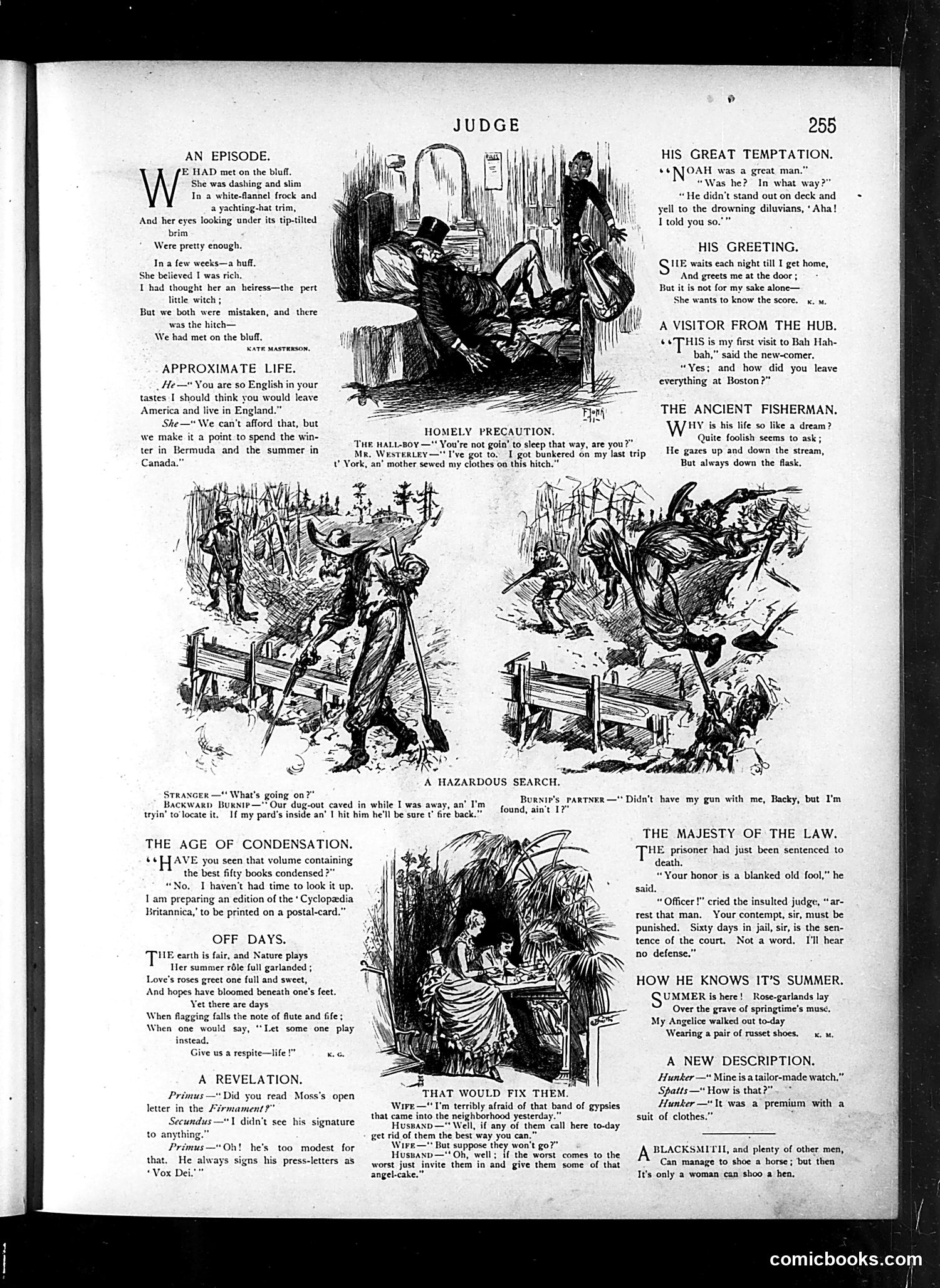
This page from the satirical magazine *Judge* contains roughly a dozen brief humorous sketches typical of late 19th/early 20th-century American humor. The cartoons mock: **Social pretension**: "Approximate Life" satirizes Americans' obsession with appearing wealthy by summering in fashionable locations they can't afford. **Modern absurdity**: "Age of Condensation" jokes about the era's obsession with time-saving shortcuts—condensed books, even a postal-card encyclopedia. **Gender dynamics**: Multiple sketches play on marital relationships and female behavior ("His Greeting" suggests wives only greet husbands to learn sports scores; "How He Knows It's Summer" implies women wear unfashionable shoes in warm weather). **Class and rurality**: Rural sketches like "Homely Precaution" and "Hazardous Search" portray unsophisticated country folk in dialect. **Legal/institutional humor**: "Majesty of the Law" mocks judicial pomposity. The drawings are modest line-sketches accompanying each item. Overall, this represents genteel Victorian-era satire targeting urban pretension, modernization anxieties, and domestic life, with period-typical gender stereotypes.
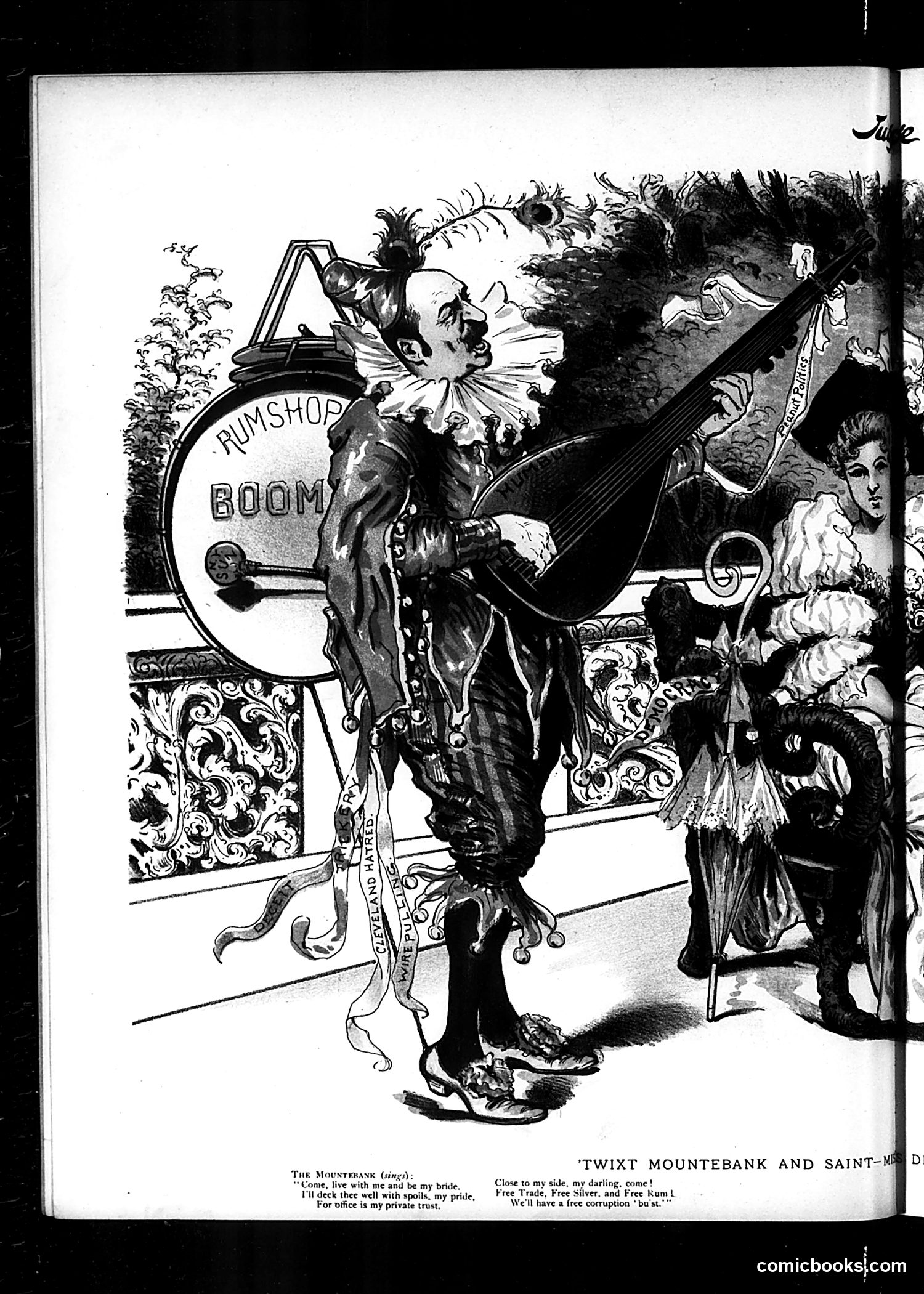
This Judge cartoon satirizes political corruption through a theatrical metaphor. A caricatured figure (likely a politician or candidate) plays a lute while singing seductively to an audience, presenting himself as a trustworthy leader. His song ironically reveals his actual intentions: he promises "Free Trade, Free Silver, and Free Rum" while admitting that "office is my private trust" and they'll "have a free corruption bust." The satire exposes the gap between politicians' public rhetoric and private motives—using the "mountebank" (con artist/charlatan) metaphor to suggest the candidate is a fraud seducing voters with false promises. The ornate, decorative setting and theatrical staging emphasize the performative nature of political campaigning. The cartoon critiques late 19th-century political corruption and opportunistic appeals to voters.
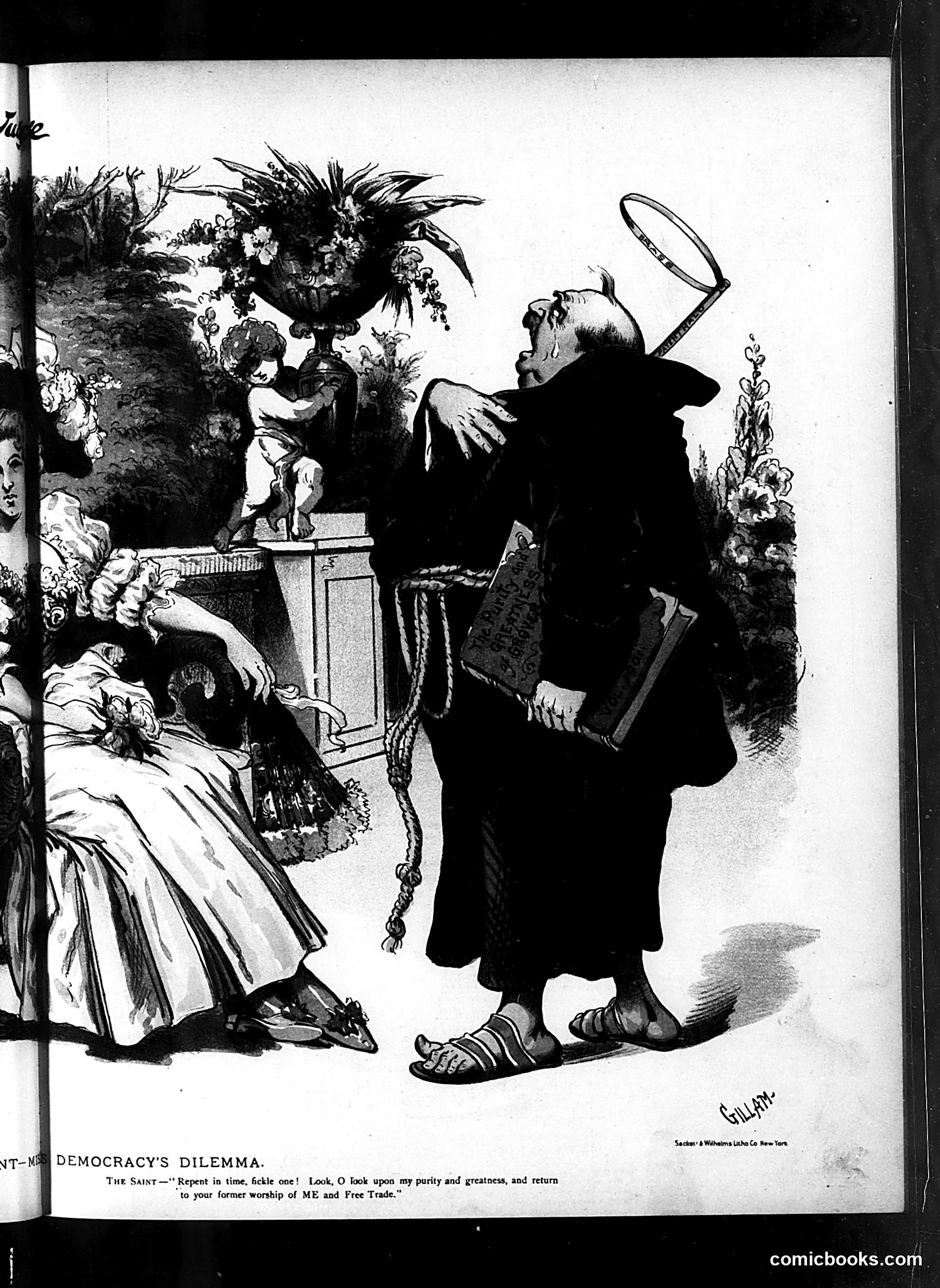
This political cartoon depicts a figure labeled "The Saint" (appearing as a sanctimonious character in dark robes) addressing a reclining woman representing Democracy. The Saint demands she "repent" and return to worshipping "ME and Free Trade." The satire targets protectionist political opponents who, the cartoonist suggests, hypocritically invoke moral virtue while opposing free trade policies. The figure's exaggerated piety contrasts with his self-serving demands. This reflects late 19th-century American debate over tariffs versus free trade—a major political dividing line between parties and factions. The cartoon mockingly portrays free-trade advocates as self-righteous while accusing them of manipulating democratic sentiment for economic gain.
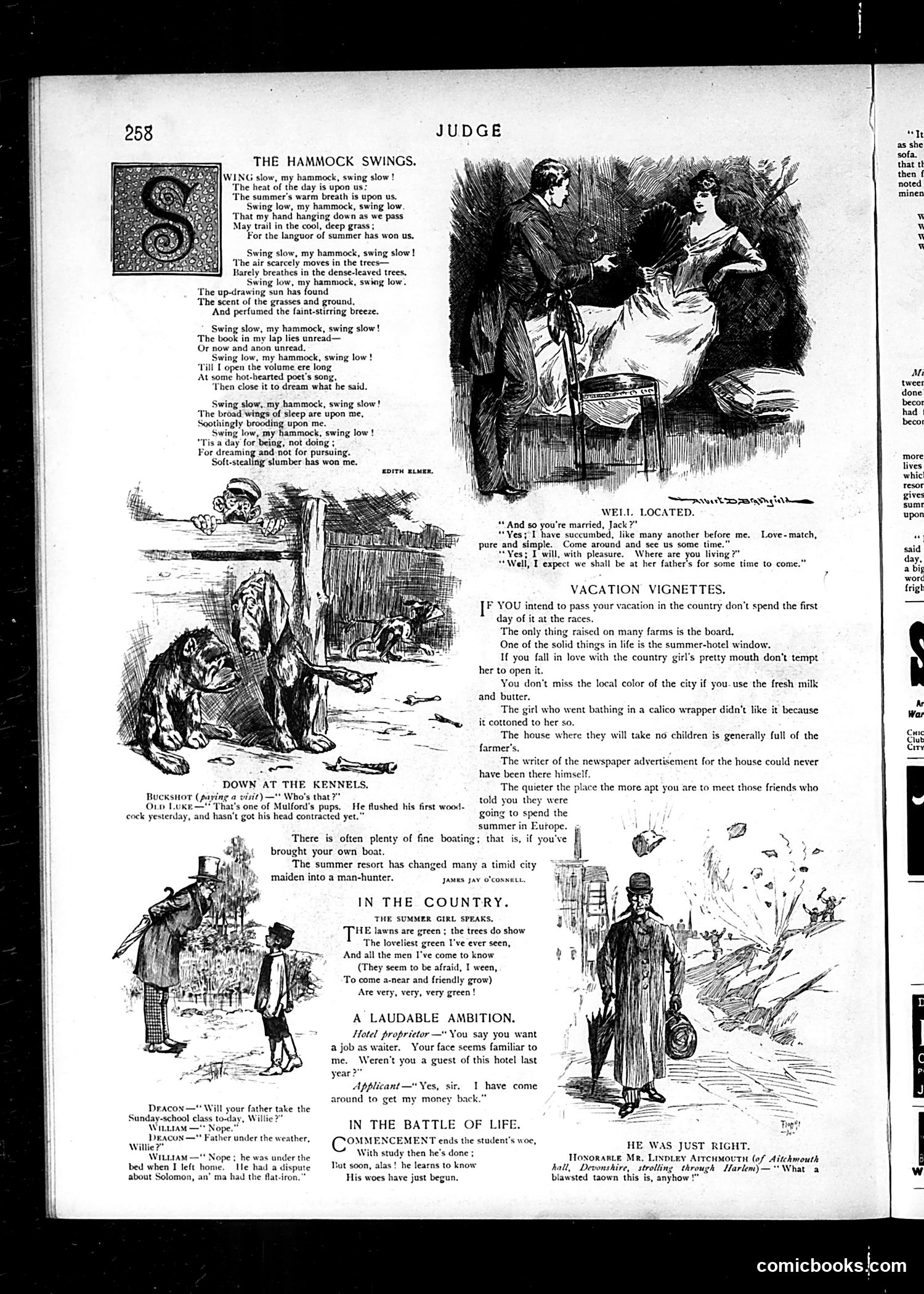
This page from Judge magazine contains several satirical pieces targeting middle-class American life circa the early 1900s: **"The Hammock Swings"** is a sentimental poem by Edith Elmer celebrating summer leisure—mocking the aspirational lifestyle of wealthy Americans who could afford vacation relaxation. **"Well Located"** jokes that a newly married man will live with his wife's parents indefinitely, satirizing economic dependence and loss of independence in marriage. **"Vacation Vignettes"** offers sharp observations about summer-country vacations: farmers' poor hospitality, city people's romantic naiveté, and the contradiction of seeking "local color" while using store-bought goods. The "summer girl" becoming a "man-hunter" mocks female social climbing. **"Down at the Kennels"** contains a brief joke about a hunting dog's poor breeding. **Other sketches** target social pretension (a failed waiter seeking revenge on a hotel) and religious hypocrisy (a deacon's marital discord). The overall tone ridicules American middle-class vacation fantasies and social pretensions.
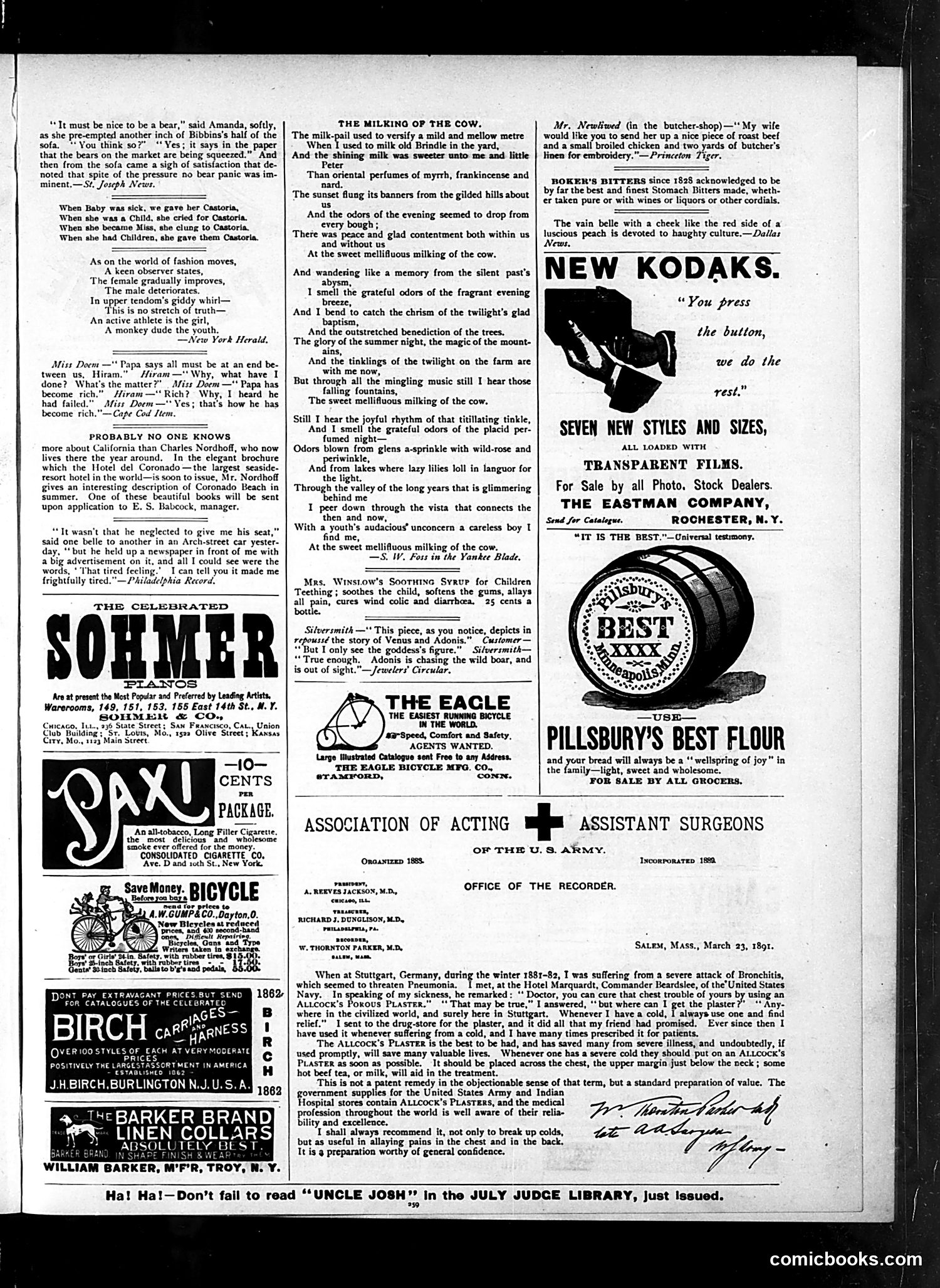
This page is primarily **advertising and light humor**, not political satire. The content includes: **Short Humorous Anecdotes:** - A joke about "bears" being "squeezed" on the market (stock market reference) - A piece about a man becoming rich through failure - Social commentary on gender roles (women athletes vs. "monkey dude" youth) **The Main Literary Content:** A sentimental poem, "The Milking of the Cow," romanticizing rural farm life with nostalgic imagery of sunset, milk pails, and nature. **Advertisements:** Multiple product ads dominate the page: pianos, cigarettes, bicycles, flour, medical plasters, and collars—typical of Judge's revenue model. **Notable Ad:** A testimonial letter from a German officer endorsing Allcock's Plaster for treating bronchitis, adding credibility through military authority. The page reflects late-19th-century American consumer culture and editorial practice: mixing light humor, sentimental verse, and commercial promotion for a middle-class readership.
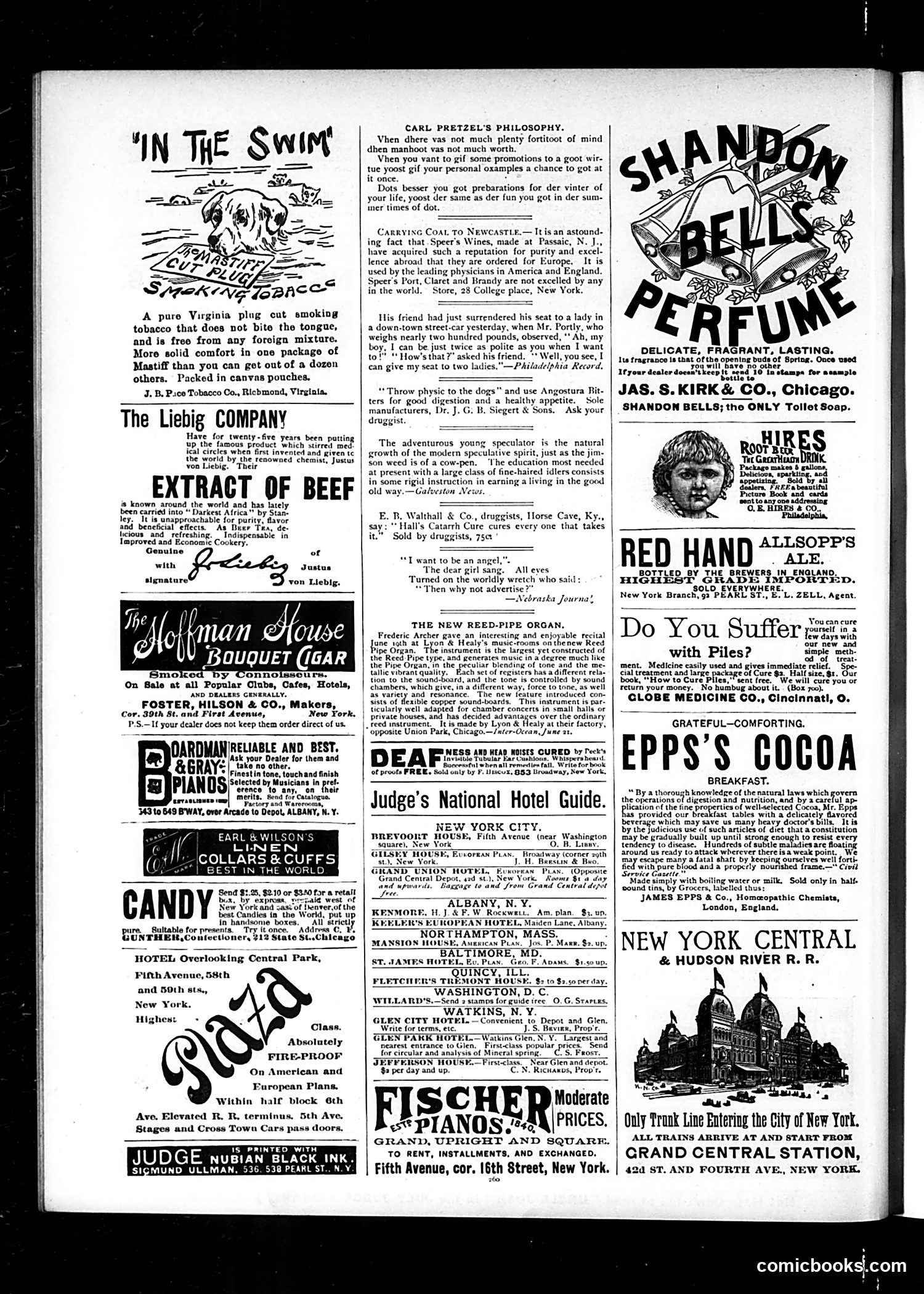
This is primarily an **advertising page** from Judge magazine, not a political cartoon. The dominant feature is a humorous illustration of a pig smoking tobacco, labeled "In the Swim," promoting J.B. Pace Tobacco Company's Virginia plug cut. The page contains numerous product advertisements typical of late 19th-century publications: Extract of Beef, piano dealers, shirt collars, cigars, and various patent medicines (Angostura Bitters, Hall's Catarrh Cure). The satirical content is minimal—primarily **"Carl Pretzel's Philosophy,"** which offers folksy immigrant wisdom in exaggerated dialect ("dhere vas not much plenty," "goot virtue"). This was typical Judge humor mocking ethnic speech patterns. The remaining text includes brief humorous anecdotes about politeness and advertising, but nothing with specific political significance. The page functions mainly as commercial real estate for advertisers rather than as satirical commentary.
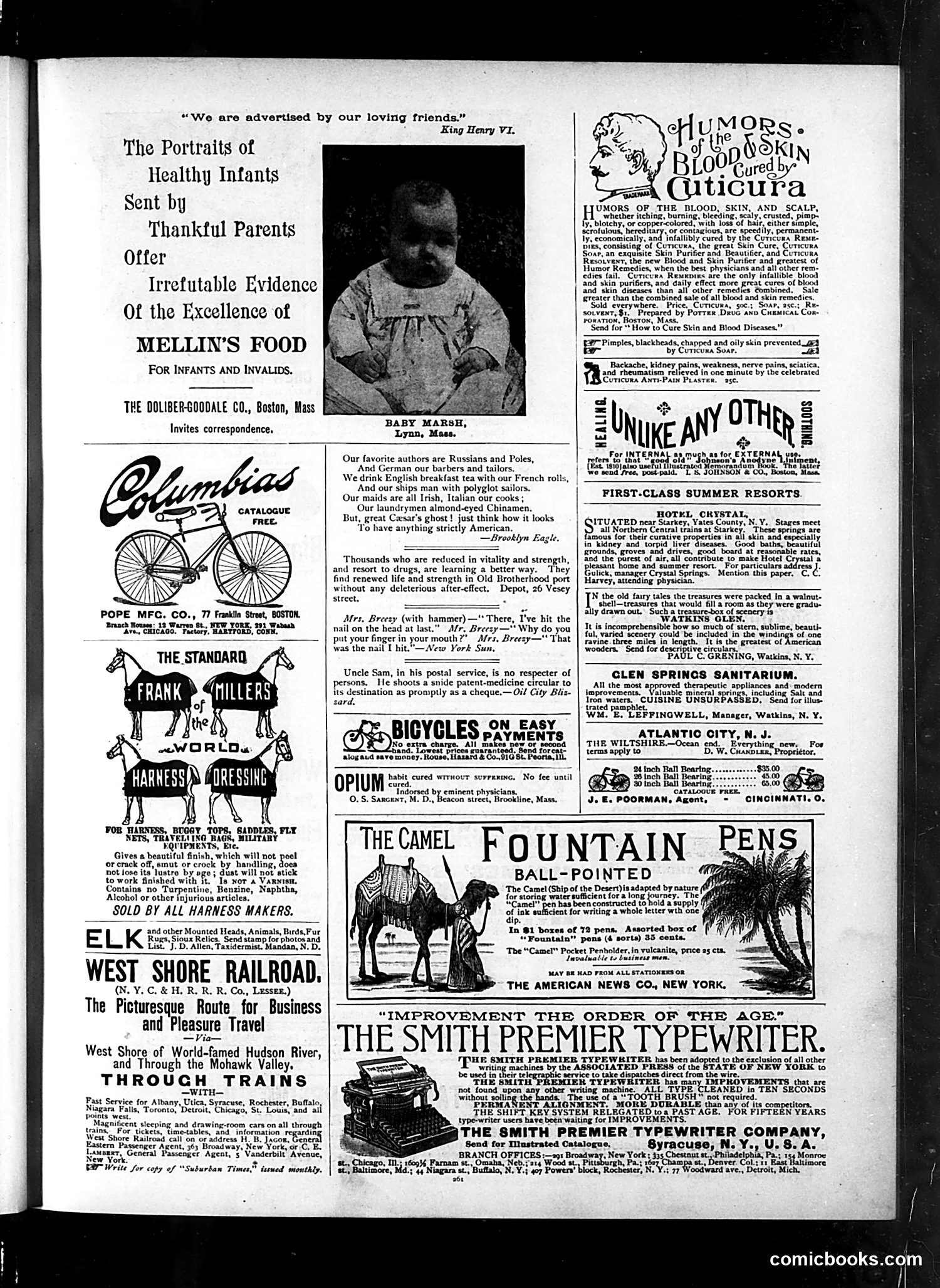
This is primarily an **advertising page** with no political cartoon content. The page features various late 19th-century commercial advertisements interspersed with a brief satirical poem. The notable satirical element is the **Brooklyn Eagle poem** mocking American dependence on foreign labor and immigrants: > "Our favorite authors are Russians and Poles, / And German our barbers and tailors..." The poem humorously catalogues how Americans employ foreign workers—Irish maids, Italian cooks, Chinese laundrymen, French chefs, English servants—while ironically lamenting the lack of "anything strictly American." This reflects **period anxieties about immigration and American identity** during the late 1800s, when large waves of European and Asian immigration sparked nativist sentiment. The satire gently mocks the contradiction: Americans complain about foreign influence while actively hiring immigrants for nearly every service. The remaining content consists of product advertisements (bicycles, typewriters, railroad services, medical remedies), including a baby portrait promoting Mellin's infant food—a common advertising format of the era.
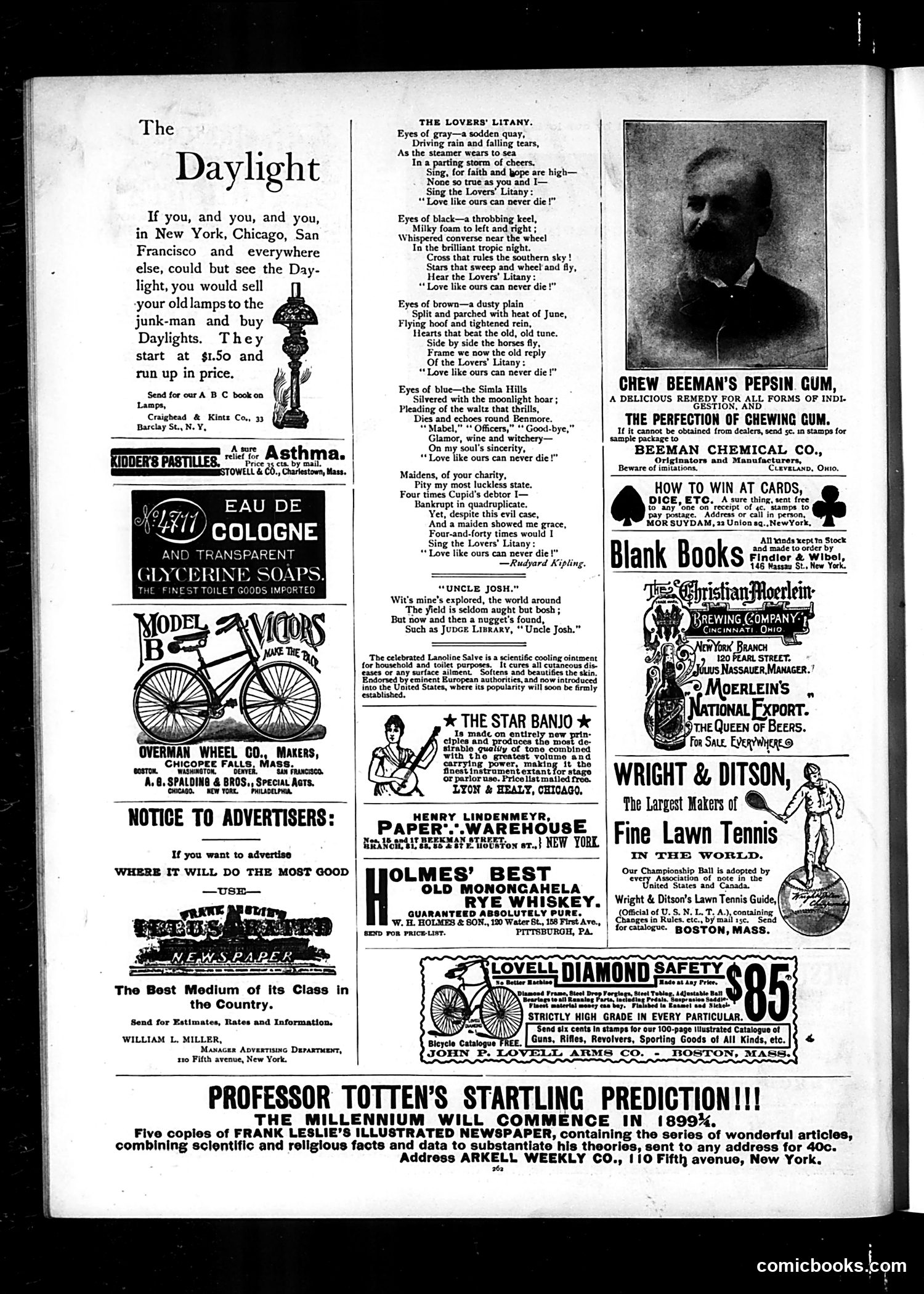
This is primarily an **advertising page** from Judge magazine, with one notable literary contribution. The main content is **"The Lovers' Litany"** by Rudyard Kipling—a sentimental poem describing romantic devotion across different settings (seaports, tropics, plains, Indian hills). Each stanza uses eye color as a metaphor and repeats the refrain "Love like ours can never die!" It's romantic verse, typical of late-Victorian popular literature. The page is otherwise dominated by period advertisements for consumer goods: Daylight lamps, bicycles, chewing gum, whiskey, cologne, lawn tennis equipment, and banjos. There's also a humorous filler piece titled "Uncle Josh" about finding rare wisdom. **No political cartoons or satire appear on this page.** The only visual content is product advertisements and a photograph of a man (unclear who) promoting Beeman's Pepsin Gum. The page represents Judge functioning partly as a literary magazine and partly as an advertising vehicle—common for 1890s American periodicals.
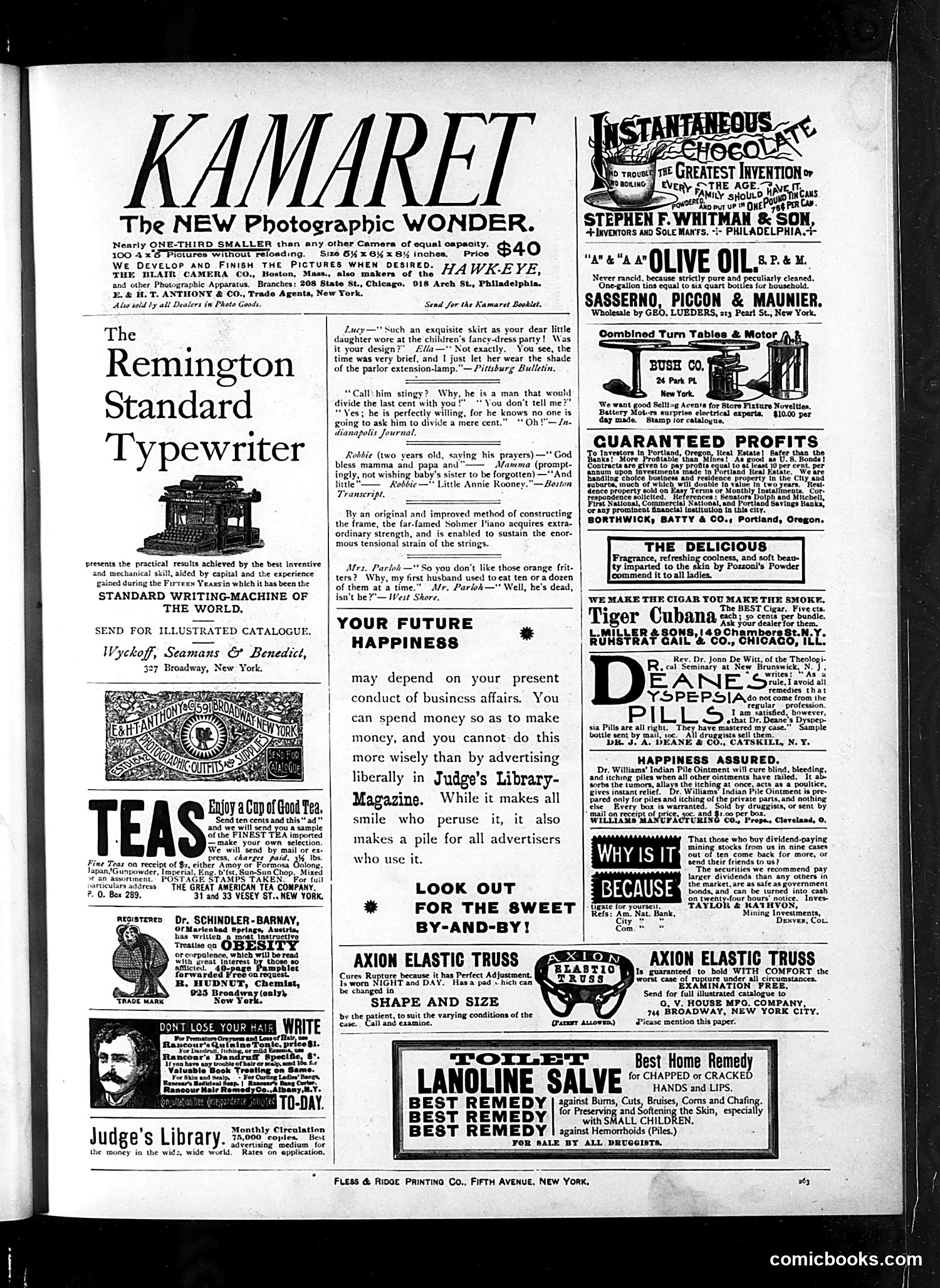
This page is primarily a collection of advertisements from Judge magazine, with minimal editorial cartoon content. The few satirical pieces present are brief humor items: The jokes scattered throughout mock everyday situations—a woman claiming her daughter's fancy outfit was borrowed from a lamp shade, a man's stinginess about dividing a penny, a widow's comment about her late husband's appetite. These are gentle domestic humor, typical of the era's magazine filler. The dominant content consists of product advertisements: cameras, typewriters, pianos, teas, medical devices, and beauty products—reflecting consumer goods marketed to Judge's middle-class readership. The "Your Future Happiness" section advertises Judge's own magazine as an advertising platform. No significant political satire or caricature appears on this page. It represents the revenue-generating advertising model that supported American magazines of this period.
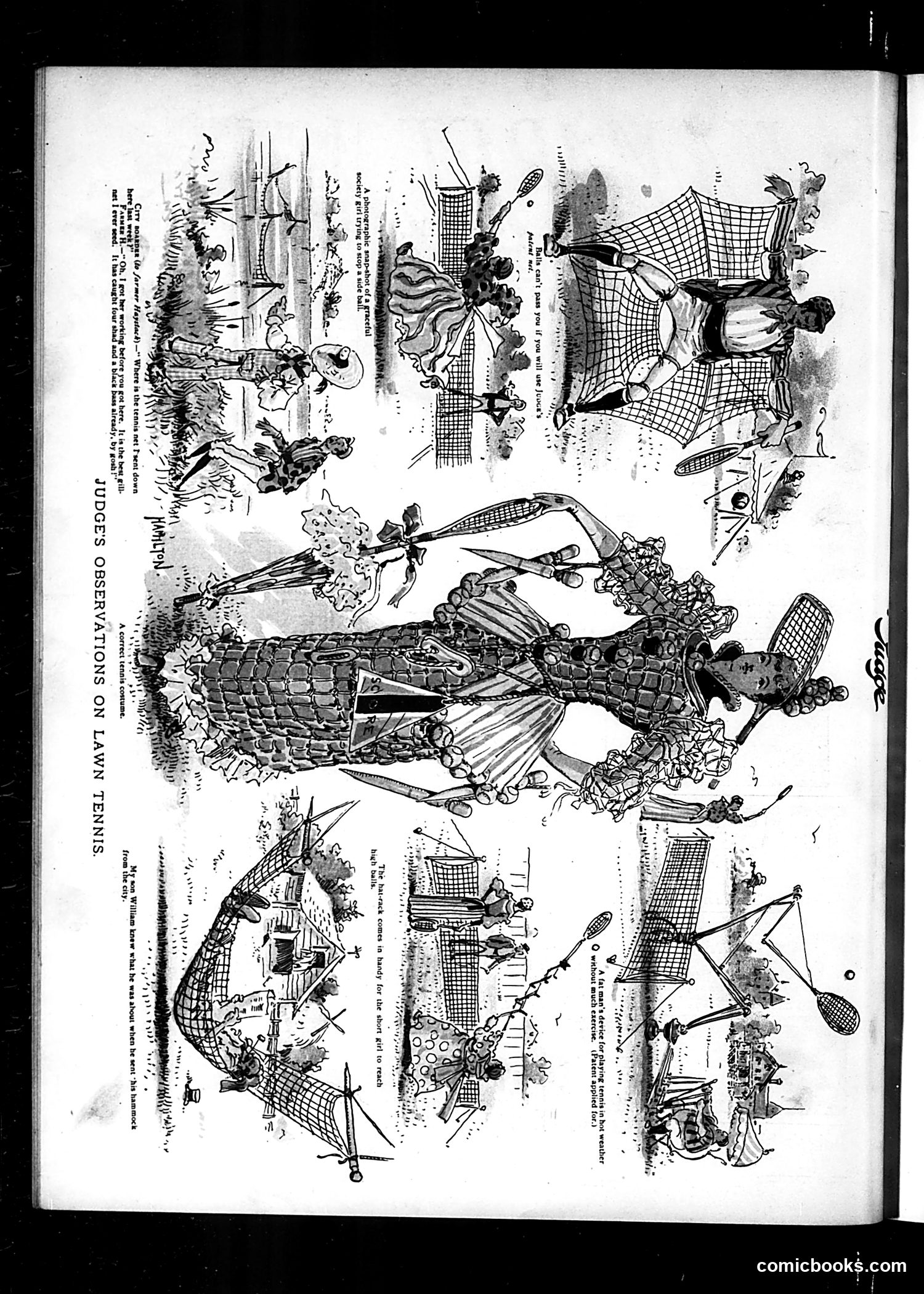
This page satirizes the late-19th-century craze for lawn tennis among America's wealthy classes. The cartoons mock both the sport itself and the people who play it. The central large illustration depicts an elaborately dressed society woman attempting tennis—her ornate outfit and corseted figure make athletic movement absurd. Surrounding vignettes ridicule various players: a portly man struggling in heat, a "society girl" failing at basic shots. The farmer's dialogue at bottom provides the satirical punch: when sent a tennis net from the city, he repurposes it as a fishing gill net—more practical and productive. This contrasts working-class utility with upper-class leisure, suggesting wealthy urbanites waste resources on frivolous fashions while farmers put equipment to "real" use. The humor targets both tennis as an impractical fad and the incompetence of society people attempting it.
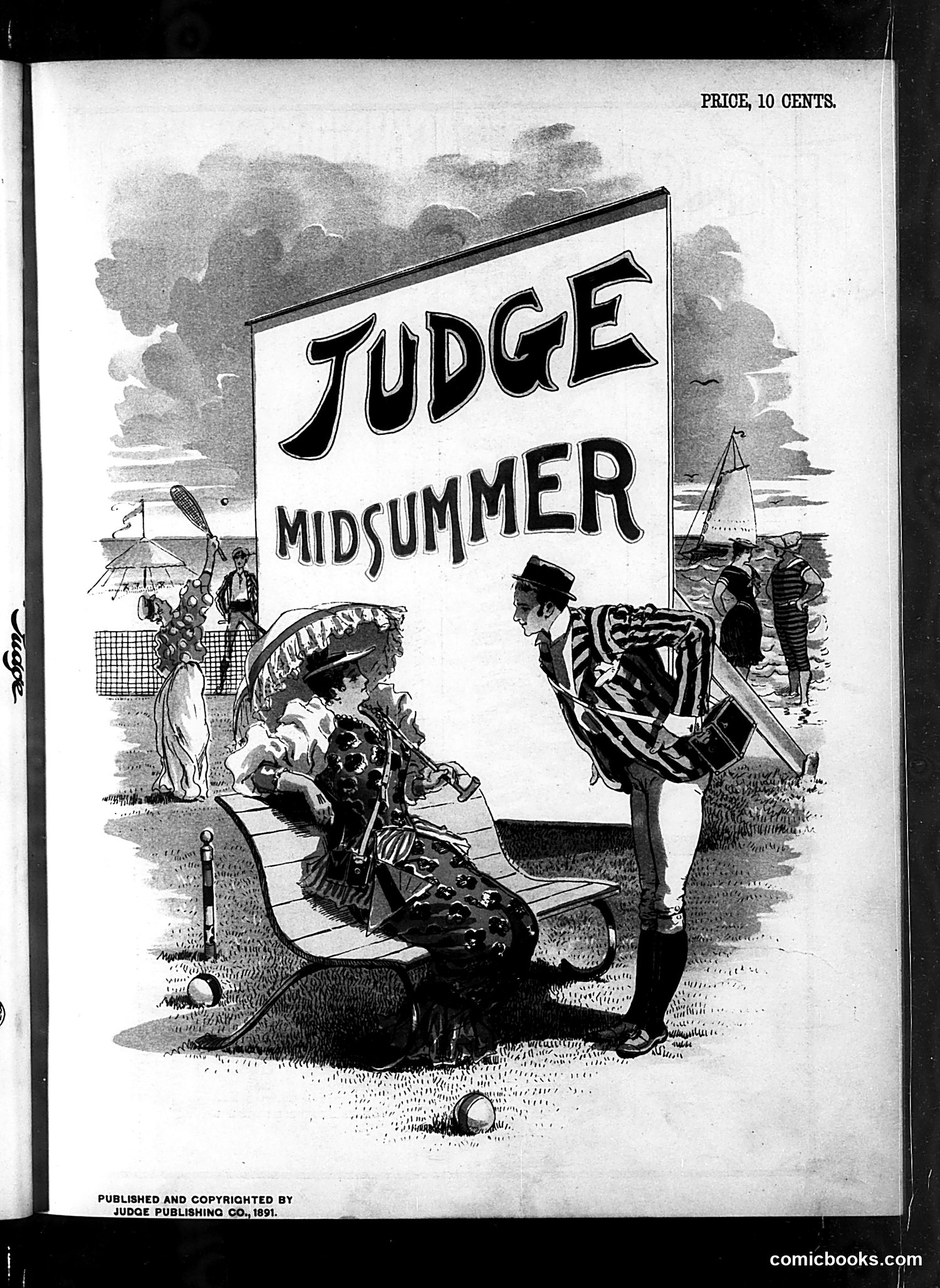
This is the cover of *Judge* magazine's midsummer issue, priced at 10 cents. The illustration depicts a seaside scene with Victorian-era figures in summer leisure attire. A man in formal dress (top hat, striped jacket) appears to be courting or entertaining a woman seated on the beach; she wears a decorative hat and fashionable dress. In the background, other beachgoers enjoy typical midsummer activities—sailing, swimming, and relaxation. The satire likely comments on upper-class summer vacation culture and courtship rituals of the 1890s. The exaggerated formal clothing at the beach humorously contrasts with the casual setting. Without additional context or visible captions, the specific social critique remains unclear, though it probably mocks Victorian social pretensions or romantic conventions of the era.
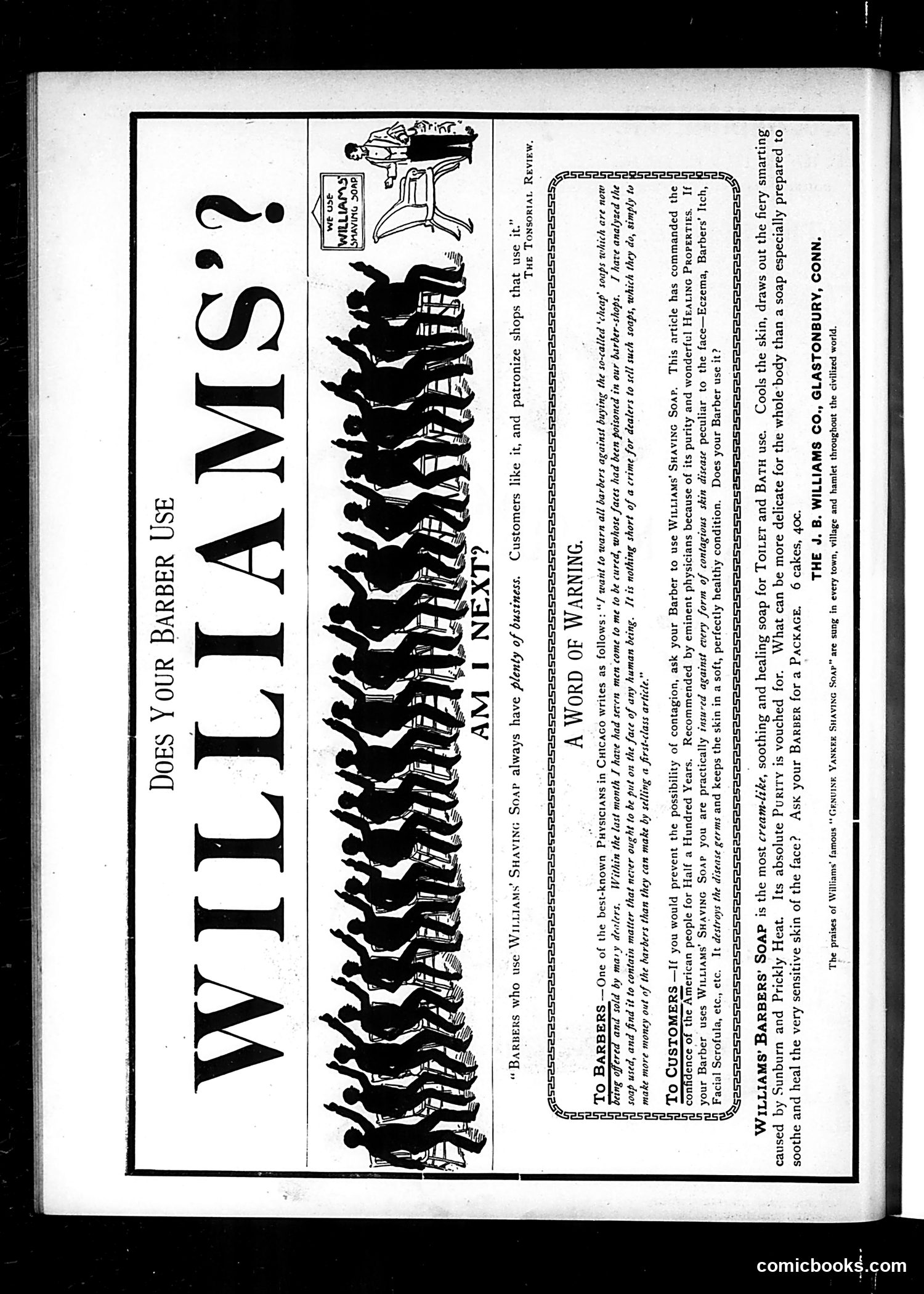
This is primarily a **product advertisement** for Williams' Barber Soap, not political satire. The page features large illustrated text reading "Does Your Barber Use WICK CLAIMS?" alongside an image of a barber shop interior with multiple figures. The ad uses a common early-20th-century marketing strategy: establishing product credibility through testimonials and practical benefits. The text promotes the soap's qualities—it's economical, produces good lather, and is safe for sensitive skin. The phrase "A Word of Warning" suggests competitors exist, and the copy emphasizes this product's superiority. The barber shop illustration serves as visual proof of the product's professional use. The satirical magazine *Judge* carried such advertisements alongside actual editorial cartoons, making this a standard commercial page rather than political commentary.
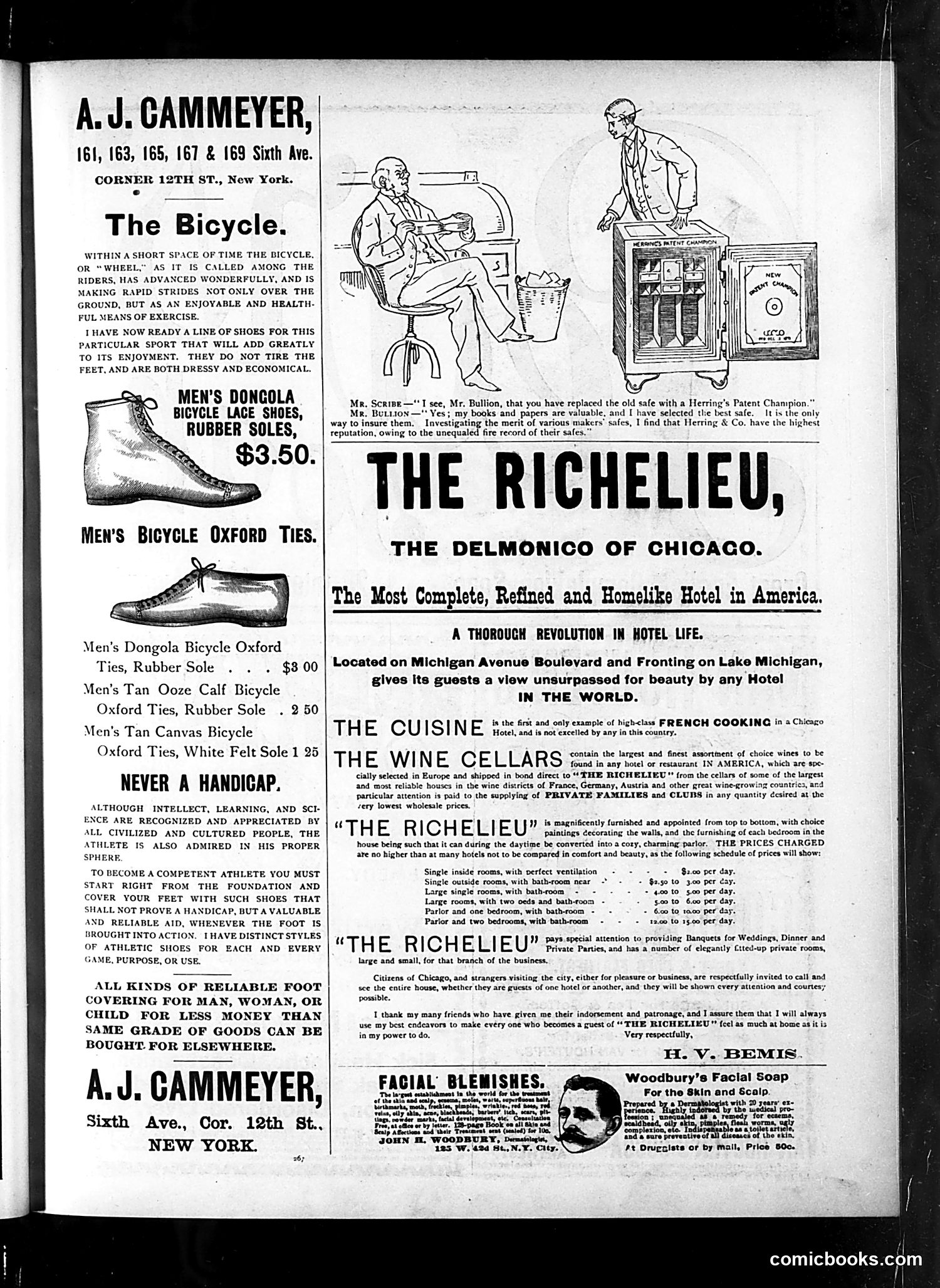
This page is primarily **advertising**, not political satire. It contains commercial advertisements for: 1. **A.J. Cammeyer shoes** — promoting bicycle footwear for the then-fashionable sport of cycling, with illustrations of men on bicycles 2. **Herring & Co. safes** — a brief dialogue between "Mr. Scripe" and "Mr. Bullion" (generic business names suggesting money/wealth) discussing the superiority of Herring's fireproof safes 3. **The Richelieu Hotel in Chicago** — a lavish advertisement claiming it's "the Delmonico of Chicago" (referencing a famous New York restaurant), boasting French cuisine, imported wines, and luxurious rooms 4. **Woodbury's Facial Soap** — for treating skin blemishes The content reflects Gilded Age consumer culture: bicycling as an emerging leisure activity, business prosperity, luxury hospitality, and personal grooming products. There is minimal satirical content; this appears to be a revenue-generating advertising section rather than editorial satire.
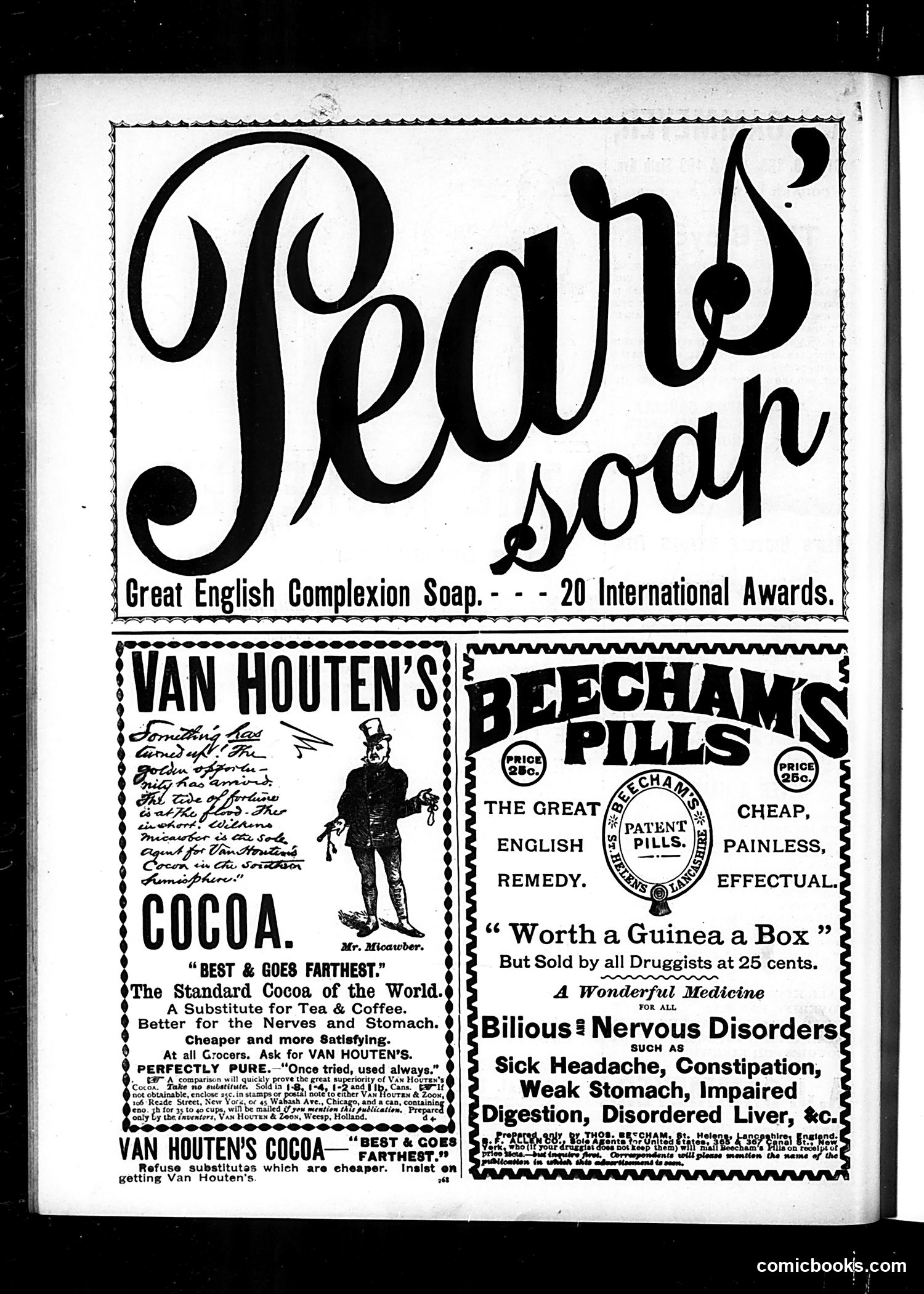
This page is **primarily advertising**, not satire or editorial cartoon content. It contains three separate commercial advertisements typical of late 19th/early 20th-century publications: 1. **Pears' Soap** (top): A "Great English Complexion Soap" claiming 20 International Awards—standard beauty product advertising. 2. **Van Houten's Cocoa** (bottom left): Markets cocoa as a healthful substitute for tea and coffee, emphasizing purity and nervous system benefits—reflecting Victorian-era health marketing claims. 3. **Beecham's Pills** (bottom right): Patent medicine advertising "a wonderful medicine" for digestive complaints, nervous disorders, and various ailments. The phrase "Worth a Guinea a Box / But Sold by all Druggists at 25 cents" emphasizes value. These ads reflect the era's largely unregulated patent medicine industry, where extravagant health claims were commonplace. No political satire or cartoon content appears on this page—it's a commercial advertising section typical of magazine revenue models from this period.