
Judge, 1891-07-25 · page 6 of 20
Judge — July 25, 1891 — page 6: what you’re looking at
What you’re looking at
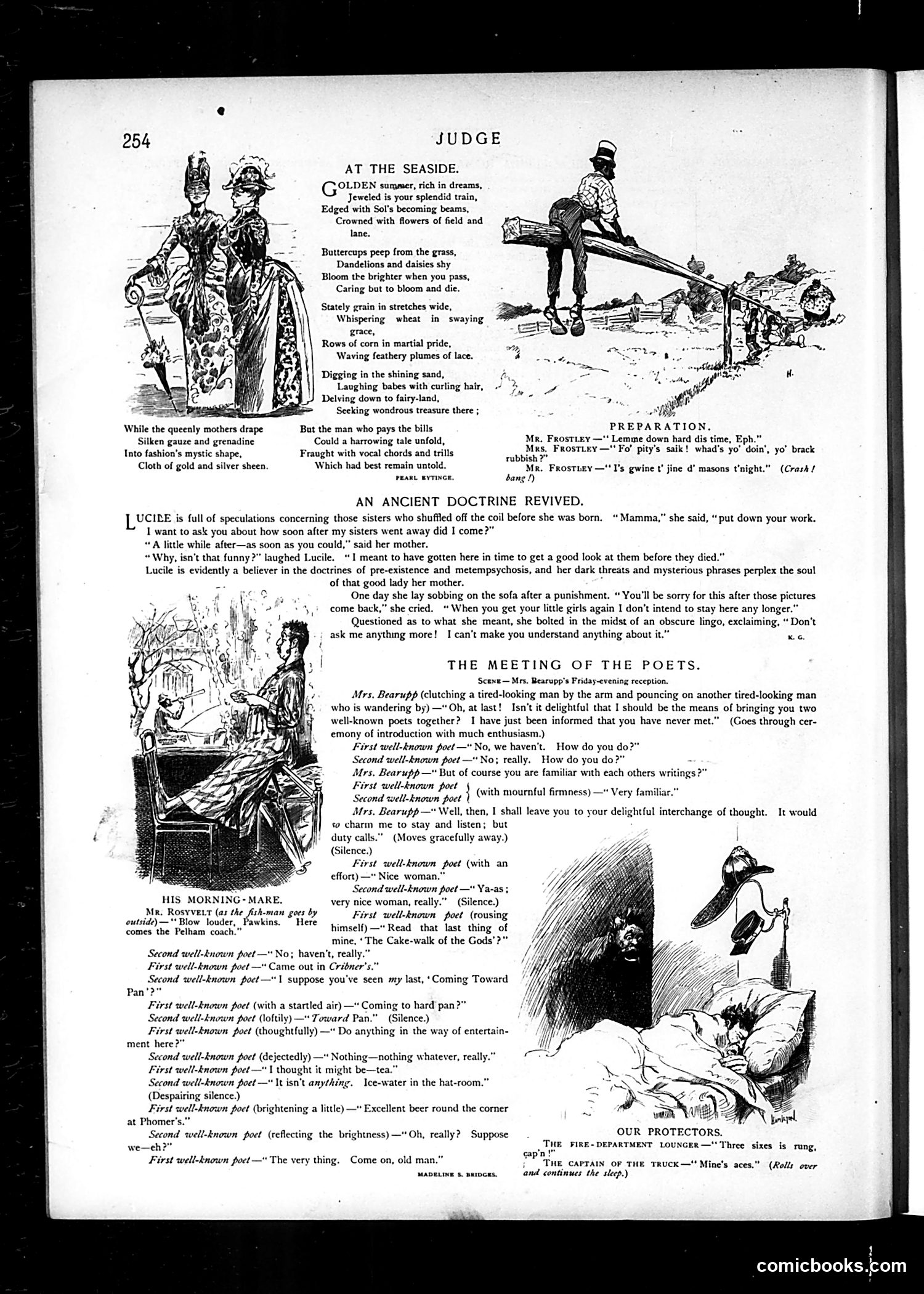
This page contains three distinct satirical pieces typical of late 19th-century American humor: **"At the Seaside"** contrasts romantic poetry about summer leisure with the harsh reality facing working-class fathers who "pay the bills" while their families enjoy vacation. The titled couple enjoys seaside pleasures; the laborer bears financial burden—classic Judge commentary on class disparities. **"An Ancient Doctrine Revived"** mocks a child's belief in reincarnation and pre-existence. Young Lucile's pseudo-philosophical pronouncements about meeting dead siblings before birth perplex her practical mother, satirizing both childhood pretension and trendy spiritualist ideas popular in the period. **"The Meeting of the Poets"** ridicules famous but mutually unfamiliar writers at a society reception. Mrs. Bearupp, an enthusiastic literary hostess, assumes they know each other's work; their awkward silence and stilted conversation reveal the emptiness behind literary reputations and salon culture. All three pieces target familiar Judge targets: class hypocrisy, pseudointellectual affectation, and fashionable society's pretensions.
📄 Transcribed text from this page (OCR, searchable)
Machine-transcribed from the original scan — historical spelling and the odd misread are preserved.
JUDGE AT THE SEASIDE. OLDEN summer, rich in dreams, Jeweled is your splendid train, Edged with Sol’s becoming beams, Crowned with flowers of field and lane, Buttercups peep from the grass, Dandelions and daisies shy Bloom the brighter when you pass, Caring but to bloom and die. Stately grain in stretches wide, Whispering wheat in swaying grace, Rows of corn in martial pride, Waving feathery plumes of lace. Digging in the shining sand, Laughing babes with curling hatr, Delving down to fairy-land, Seeking wondrous treasure there ; While the queenly mothers drape But the man who pays the bills PREPARATION Silken gauze and grenadine Could a harrowing tale unfold, Mr. Frostiey —"* Lemme down hard dis time, Eph.” Into fashion’s mystic shape, Fraught with vocal chords and trills muppets Feosruny—"'Fo! pity’s salk! whad's yo" doin’, yo! brack Cloth of gold and silver sheen. Which had best remain untold. Mr. Frostuey—''I's gwine t' jine d’ masons t'night.” (Crash! Peat ayTINGE bang !) AN ANCIENT DOCTRINE REVIVED. LUCIRE is full of speculations concerning those sisters who shuffled off the coil before she was born. “Mamma,” she said, “put down your work, I want to ask you about how soon after my sisters went away did I come?” A little while after—as soon as you could,” said her mother. “Why, isn’t that funny?" laughed Lucile. 1 meant to have gotten here in time to get a good look at them before they died.” Lucile is evidently a believer in the doctrines of pre-existence and metempsychosis, and her dark threats and mysterious phrases perplex the soul of that good lady her mother. ; One day she lay sobbing on the sofa after a punishment. “ You'll be sorry for this after those pictures come back,” she cried. “When you get your little girls again I don’t intend to stay here any longer.” Questioned as to what she meant, she bolted in the midst of an obscure lingo, exclaiming, “ Don't ask me anything more! I can’t make you understand anything about it.” we THE MEETING OF THE POETS, ‘Scune — Mrs. Bearupp's Friday-evening reception, Mrs, Bearupp (clutching a tired-looking man by the arm and pouncing on another tired-looking man wandering by) —“Oh, at last! Isn't it delightful that I should be the means of bringing you two nown poets together? I have just been informed that you have never met.” (Goes through cer- emony of introduction with much enthusiasm.) First well-known poet —" No, we haven't. How do you do?” Second well-known poet —"No; really. How do you do?” Mrs. Bearupp —" But of course you are familiar with each others writings?” First well-known poet Second well-known poet Mrs, Bearupp—* Well, then, 1 shall leave you to your delightful interchange of thought. It would so charm me to stay and listen; but duty calls.”” (Moves gracefully away.) lence.) st well-known poet (with an effort) —" Nice woman.” : Second well-known poet —" Ya-as 5 MORNING: MARE very nice woman, really.” (Silence.) ‘comes the Pelham coach.” himself) —" Read that last thing of mine, ‘ The Cake-walk of the Gods’ ?" Second well-known poet — No; haven't, really First well-known poet —* Came out in Cribner's.” Second well-known poet—"\ suppose you've seen my last, ‘Coming Toward Pan'?” First well-known poet (with a startled air) —" Coming to hard’ pan?” Second well-known poet (loftily)—" Toward Pan.” (Silence.) First well-known poet (thoughtfully) — Do anything in the way of entertain- ment here?” Second well-known poet (dejectedly) —" Nothing—nothing whatever, really.” First well-known poet—" | thought it might be—tea.” Second well-known poet —"\t isn't anything. Ice-water in the hat-room.” (Despairing silence.) First well-known poet (brightening a little) —" Excellent beer round the corner s at Phomer's. NE Second well-known poet (reflecting the brightness) —" Oh, really? Suppose OUR PROTECTORS. we-eh?” THE FIRE-DEPARTMENT LOUNGER—Three sixes is rung, First well-known poet —" The very thing. Come on, old man. PP 'TWe CAPTAIN OF THE TRUCK—"' Mine's aces." (Rolls over man and continues the sleep.) { (with mournful firmness) —" Very familiar.” ! comicbooks.com