
A complete issue · 16 pages · 1891
Judge — February 21, 1891
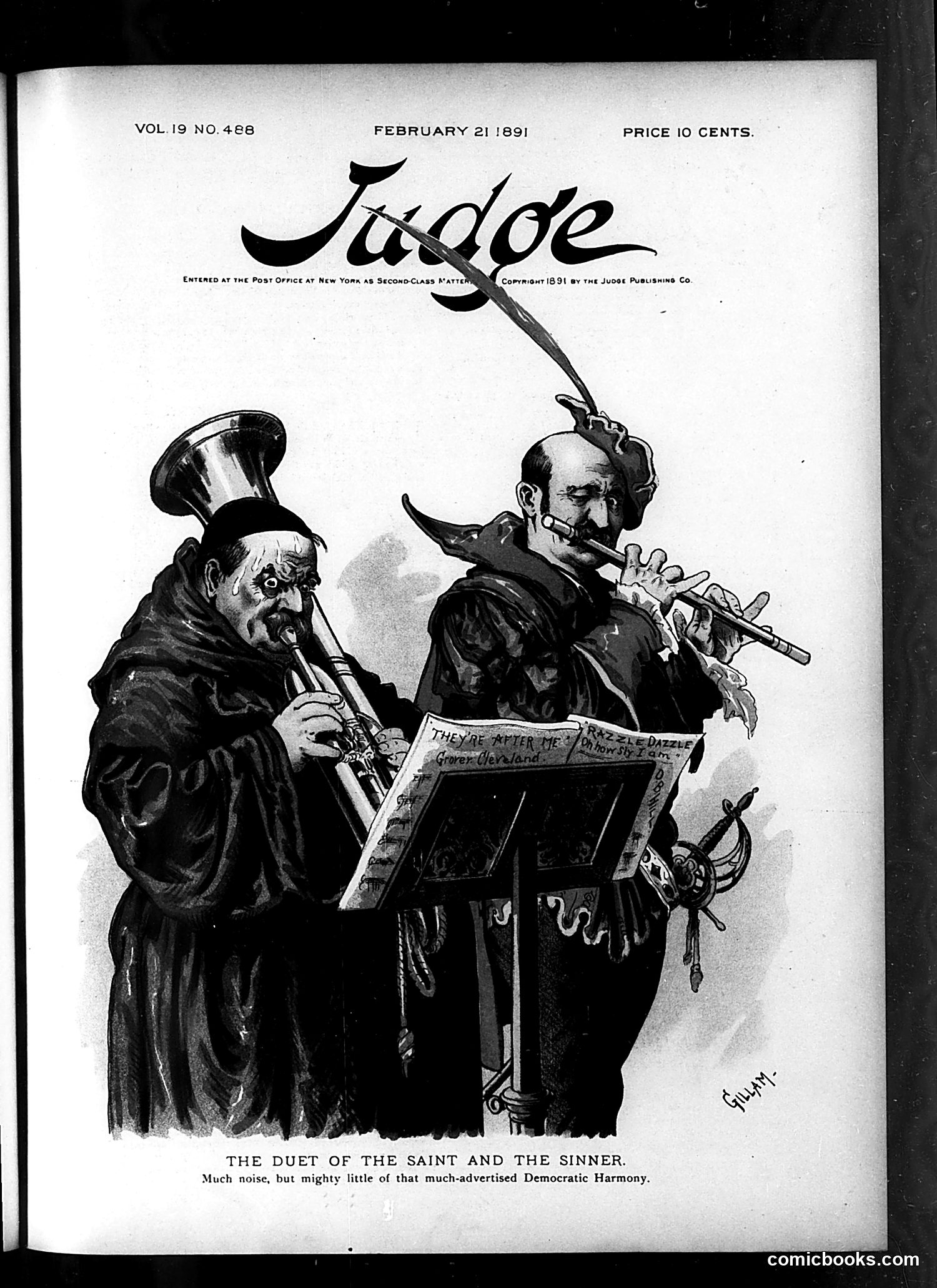
This *Judge* magazine cover from February 21, 1891 satirizes Democratic political discord. The caption subtitle reads: "Much noise, but mighty little of that much-advertised Democratic Harmony." Two caricatured figures play instruments while reading sheet music labeled with names including "Grover Cleveland" and what appears to be "Razzle Dazzle." The "Saint" (likely Cleveland, representing the party establishment) and "Sinner" (possibly a rival faction) are depicted making a loud but ineffectual "duet"—satirizing the Democratic Party's public claims of unity while experiencing significant internal conflict. The imagery mocks the gap between Democratic rhetoric about party harmony and the visible fighting between factions during this period of American politics.
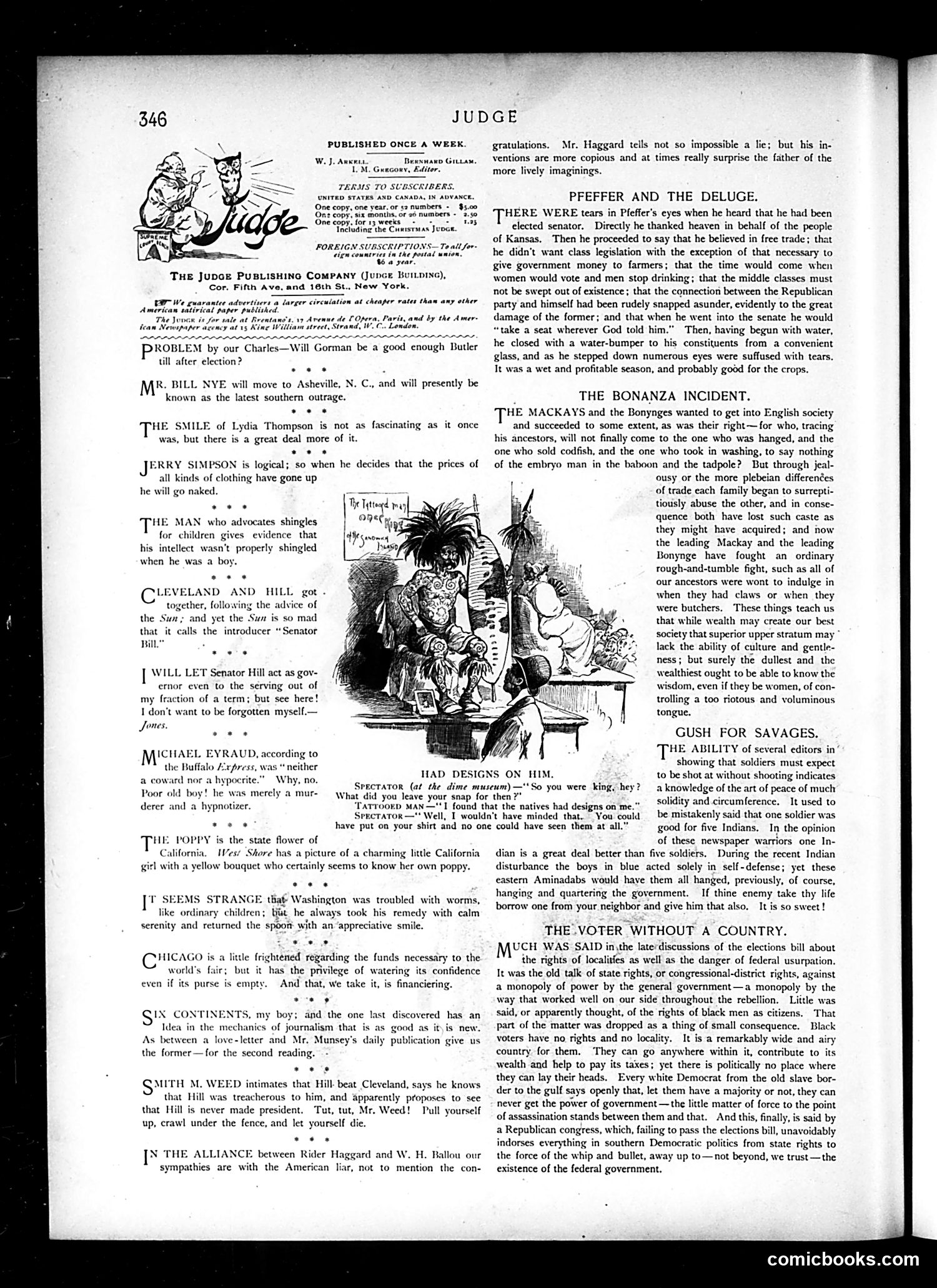
This page contains brief satirical commentary snippets typical of Judge's format. The most substantive piece is "The Voter Without a Country," discussing federal versus state power—a recurring late-19th/early-20th-century debate. The author criticizes both Republican and Democratic handling of civil rights, particularly regarding Black voters' status as citizens with "no rights and no locality." The cartoon illustration (center-left) appears to depict social class conflict, showing figures in confrontation, likely related to the "Bonanza Incident" article discussing wealth disparities between Mackays and Bonanzas (prominent Nevada mining families), their rivalry, and how wealth alone doesn't confer cultural refinement or gentility. Other brief items mock contemporary political figures and events in typical Judge fashion—pointed but cryptic without historical context.
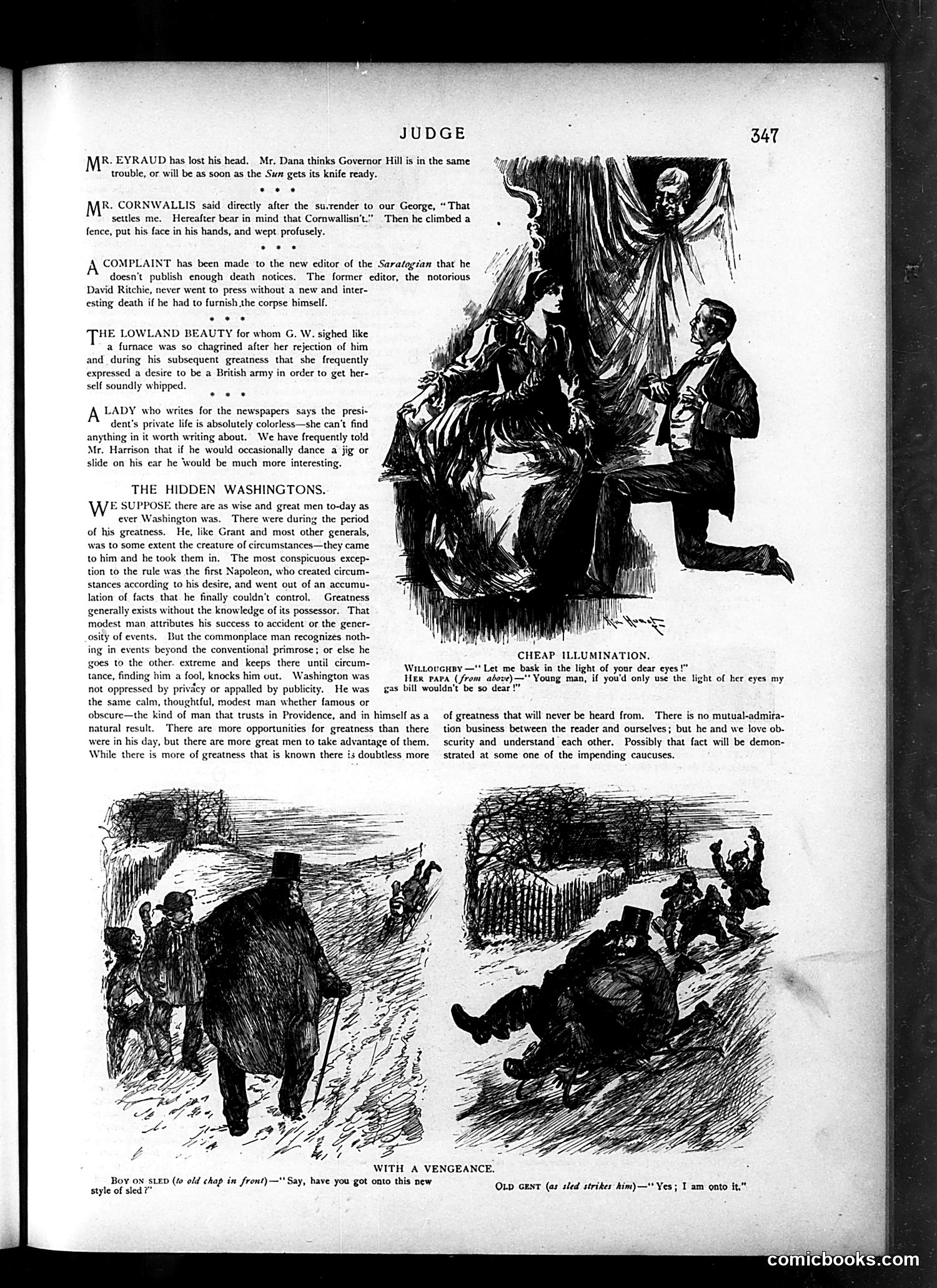
This page contains satirical commentary and illustrations, though specific figures aren't clearly identified in the visible text. **"The Hidden Washingtons"** section discusses how great men's private lives remain unknown—suggesting contrast between public personas and private conduct. The author notes that Washington's modest character and lack of publicity likely concealed more greatness than publicized actions reveal. The main illustration titled **"Cheap Illumination"** appears to depict a social scene with exaggerated character expressions, typical of Judge's satirical style mocking social pretension or intimate relationships. The lower illustrations **"With a Vengeance"** show winter sledding scenes with humorous captions about sledding styles, likely satirizing class differences or social behaviors of the era. Without clearer contextual markers, the specific political targets remain uncertain.
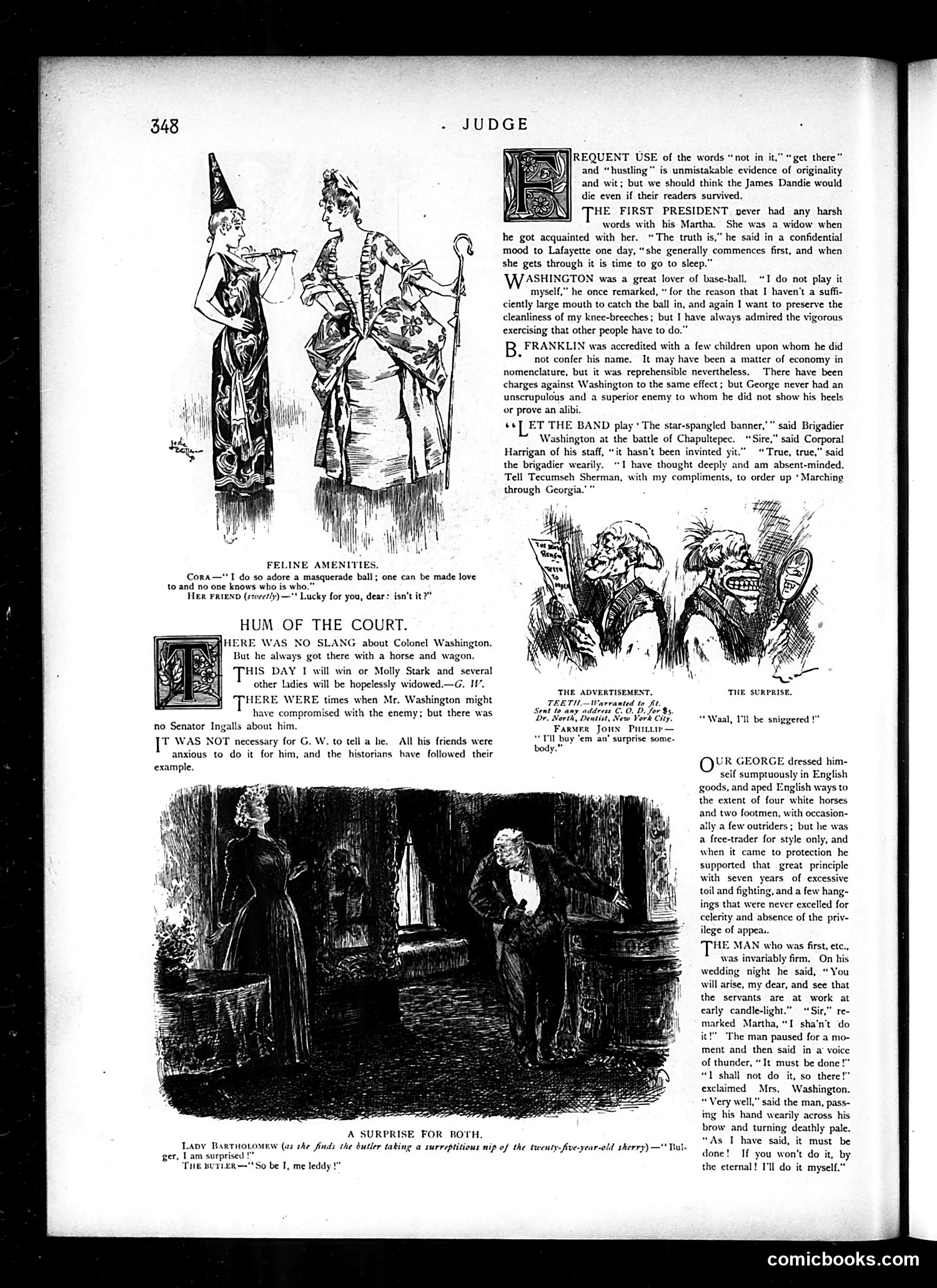
This page satirizes early American historical figures through irreverent anecdotes. The "Hum of the Court" section mocks George Washington and the Founding Fathers with fabricated stories designed to deflate their heroic reputations. Key satirical points: **Washington**: Portrayed as vain (avoiding baseball to preserve his appearance), reliant on others to lie for him, and henpecked by his wife Martha, who dominates their household. **Franklin**: Accused of fathering unnamed children, implying moral hypocrisy. **Historical mythology**: Judge ridicules how historians uncritically perpetuate legends, suggesting the Founders weren't the dignified figures popular memory celebrates. The cartoons and accompanying text suggest these were powerful men with very human flaws—vanity, marital discord, questionable ethics—contradicting their sanctified public image. This irreverent debunking was typical of Judge's satirical approach to American institutions and celebrated figures.
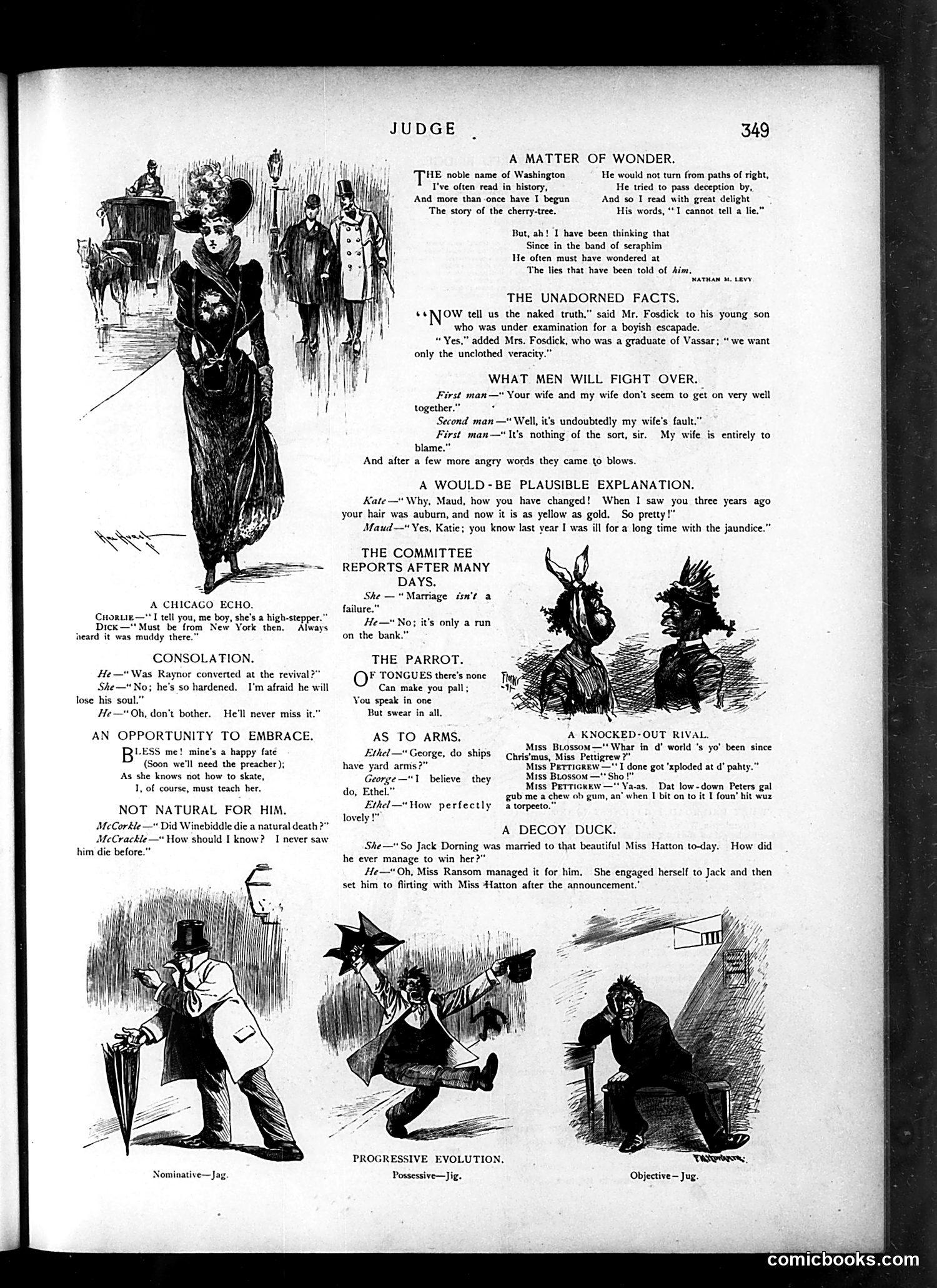
This page from Judge magazine contains brief comedic vignettes and visual gags typical of turn-of-the-century American humor. Most items mock social pretensions and marital discord. **Key content:** - "A Matter of Wonder" presents ironic commentary on George Washington's famous honesty, suggesting even virtuous figures might question the lies told *about* them. - Multiple jokes center on marriage conflicts—wives and husbands blaming each other for marital failure, wives changing appearance (the jaundice explanation for hair color change), and romantic deception (the "decoy duck" where Miss Ransom manipulates Jack Dorning). - "What Men Will Fight Over" satirizes masculine vanity: two men quarrel over whose wife is at fault, then fight—the absurdity being that men will battle over trivial relationship matters. - Three cartoon panels labeled "Progressive Evolution" show the progression of a drunk ("Jag," "Jig," "Jug"), using grammatical terms as visual puns. The humor relies on period-specific social anxieties about marriage, gender relations, and respectability.
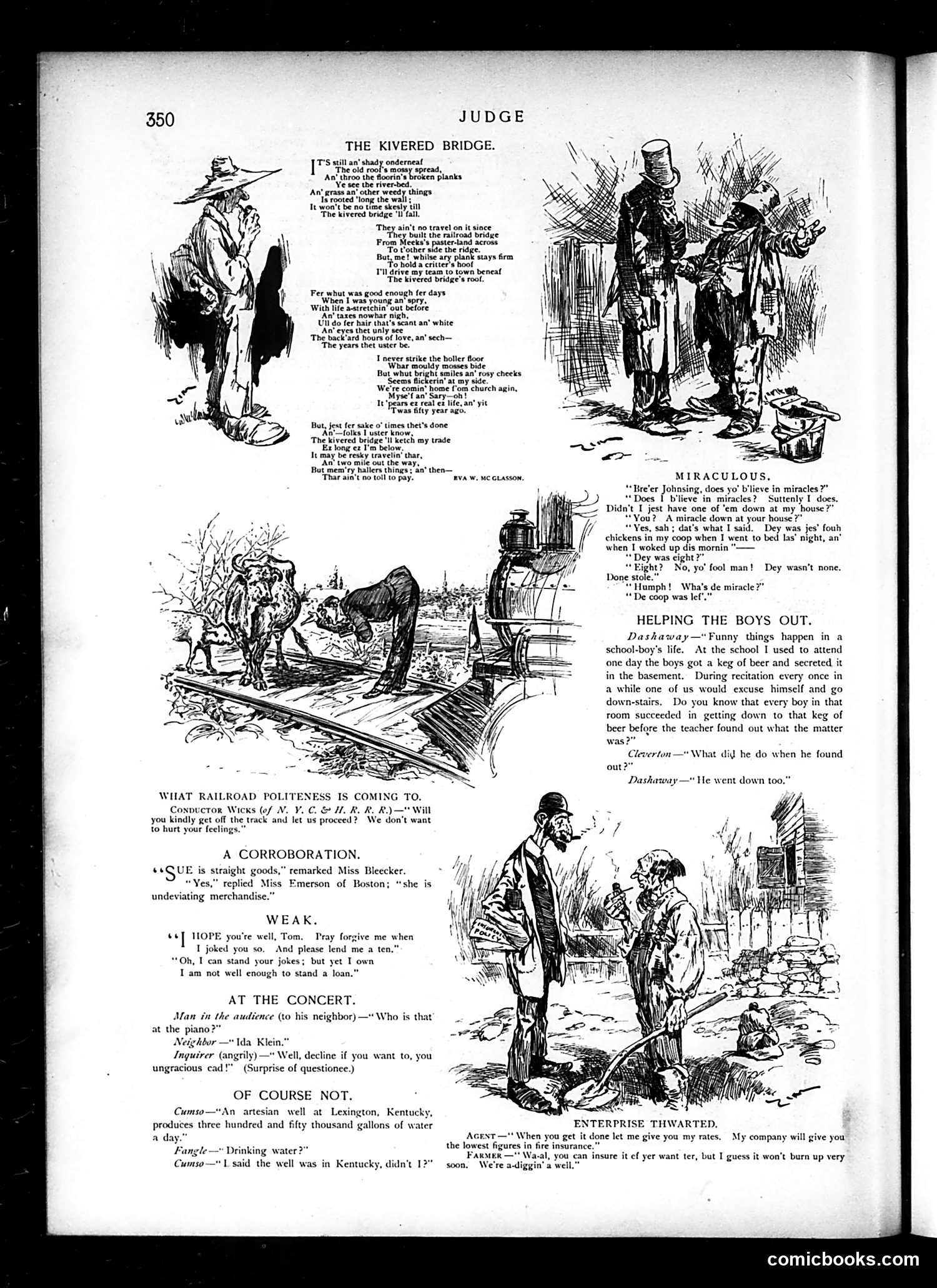
This page contains multiple brief humorous sketches typical of late 19th-century American satirical magazines. **"The Kivered Bridge"** is a sentimental rural poem by an elderly farmer reminiscing about traveling through a covered bridge, where memories of courting his wife "Sary" still seem vivid fifty years later. **"Miraculous"** is a dialect joke playing on Black vernacular speech: a man claims a miracle occurred when his four chickens mysteriously became none overnight—the "miracle" being their theft, which he describes as vanishing. **"Helping the Boys Out"** describes schoolboys sneaking beer from a basement keg during class; when the teacher discovers the scheme, all the boys have already gone downstairs. The remaining items are brief one-liners: a conductor politely asking someone off railroad tracks, wordplay about a woman named "Sue" being "straight goods" and "undeviating merchandise," a weak loan request joke, and a misunderstanding at a concert about declining an invitation. These sketches represent typical Judge humor: rural nostalgia, racial stereotypes, schoolboy mischief, and puns.
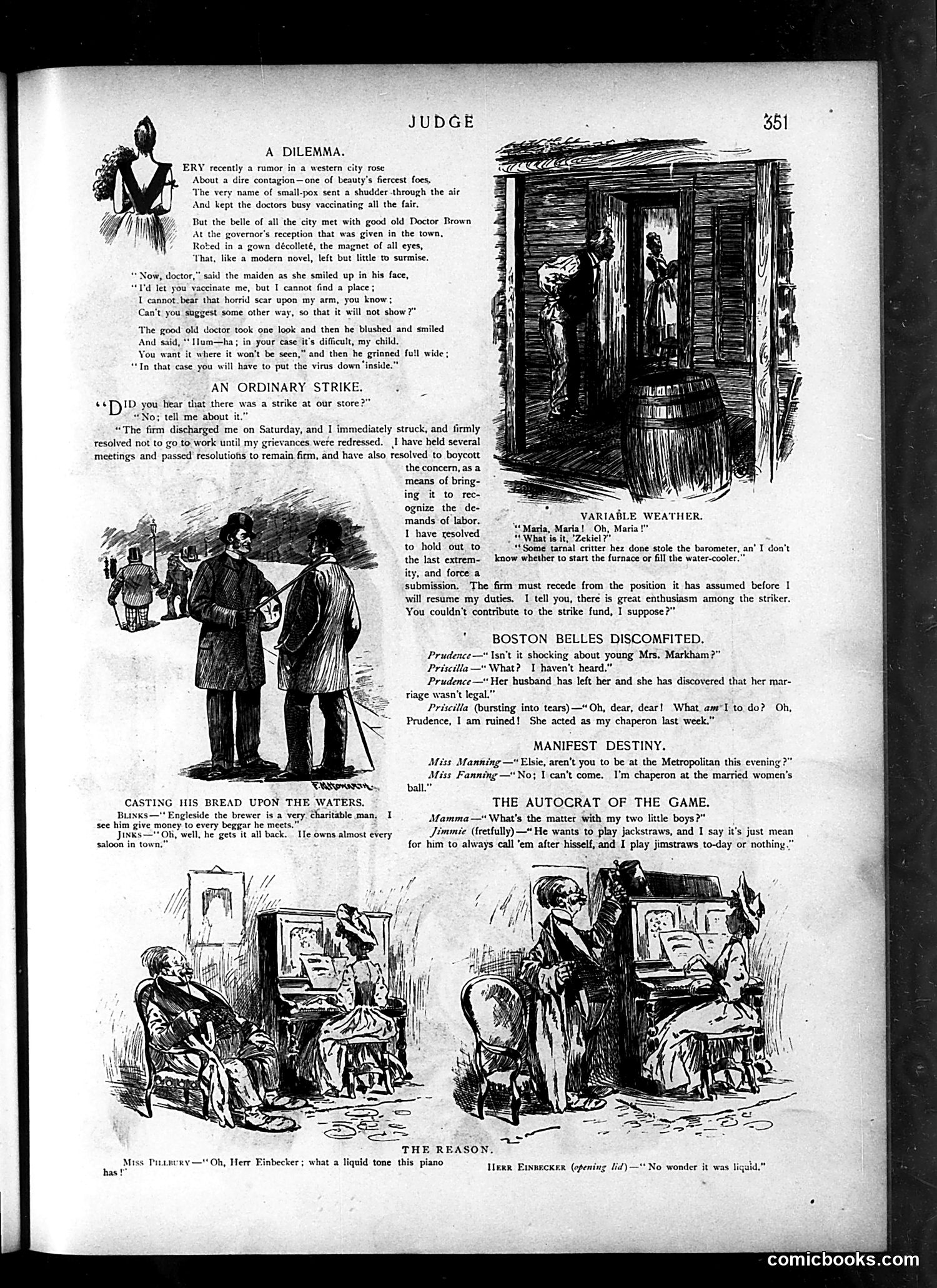
This page contains multiple brief satirical sketches typical of Judge's social humor: **"A Dilemma"**: A doctor and fashionable woman discuss smallpox vaccination during an outbreak in a western city. The satire targets vanity—the belle refuses visible scarring on her arm, leading the doctor to make an awkward (sexually suggestive) innuendo about alternative placement. The joke mocks upper-class women's prioritization of appearance over health. **"An Ordinary Strike"**: A discharged worker describes his "strike" against his employer with grandiose rhetoric about labor solidarity and boycotts—but he's merely refusing to work after being fired. The satire ridicules workers who adopt inflated revolutionary language while undertaking petty personal disputes. **Other brief sketches** include gossip about marital scandal, a charity donor who profits through saloons, and a child's quarrel over game rules. These represent common Judge fare: mocking social pretension, domestic drama, and children's misbehavior. The cartoons use ink illustrations in Victorian melodramatic style.
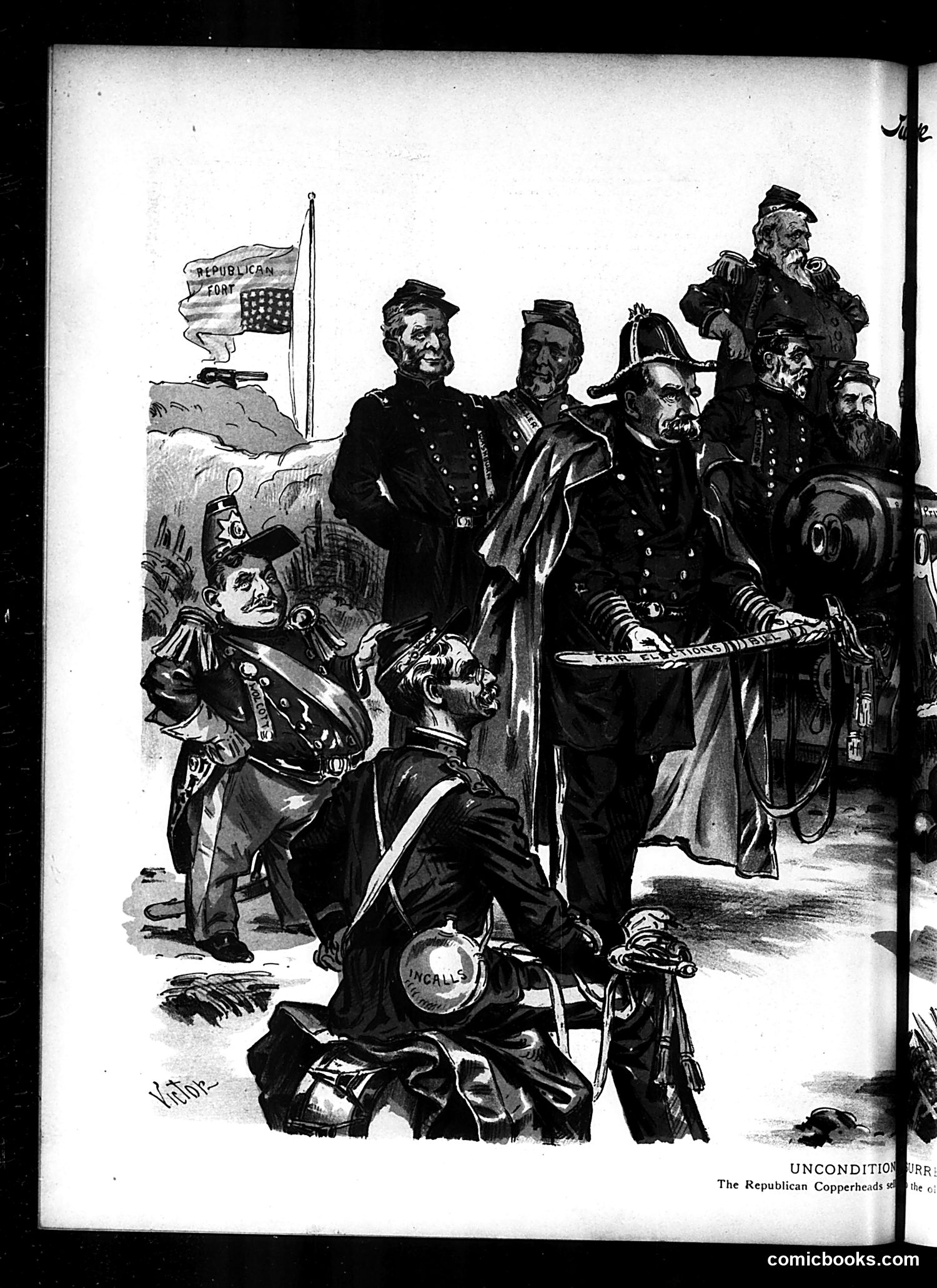
This Judge magazine cartoon satirizes "Republican Copperheads"—a term referring to Republicans the cartoonist views as disloyal or obstructionist. The image shows military officers in Civil War–era uniforms gathered at what appears to be a fortified position (marked "Republican Fort"). The cartoon likely criticizes Republican politicians for undermining Union war efforts or post-war Reconstruction policy, using "Copperhead" (originally a term for Northern Civil War opponents of the Union) to suggest they're traitors to Republican principles or national interests. The figures' caricatured faces and military dress emphasize their warlike rhetoric versus actual loyalty. Without the publication date visible, the specific political context remains unclear, but the satire targets Republican hypocrisy or inconsistency.
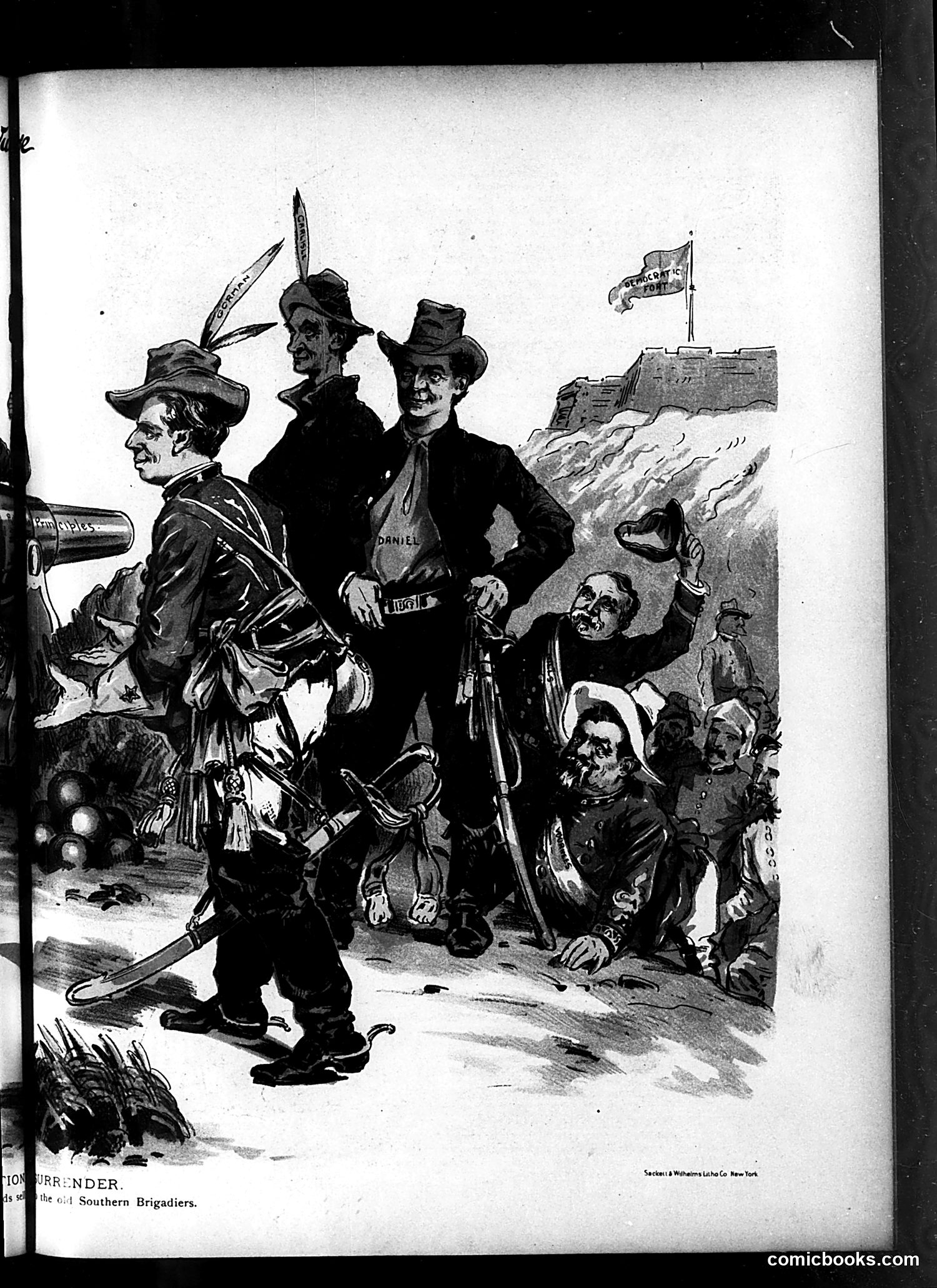
This Civil War-era cartoon depicts Confederate military leaders surrendering. Three prominent figures stand triumphantly in center—likely Union commanders—while smaller caricatured figures below (labeled as "Southern Brigadiers") appear defeated and submissive, some on their knees. The fort in the background flies what appears to be a Union flag, symbolizing Northern victory. The composition emphasizes the power differential: tall, confident Union officers tower over diminished Confederate leaders. The satire mocks Southern military leadership as broken and humiliated by Union forces. The exaggerated caricatures of the surrendering figures reflect period satirical conventions. While the exact brigadiers aren't individually labeled in visible text, the cartoon celebrates Union triumph during or shortly after the Civil War.
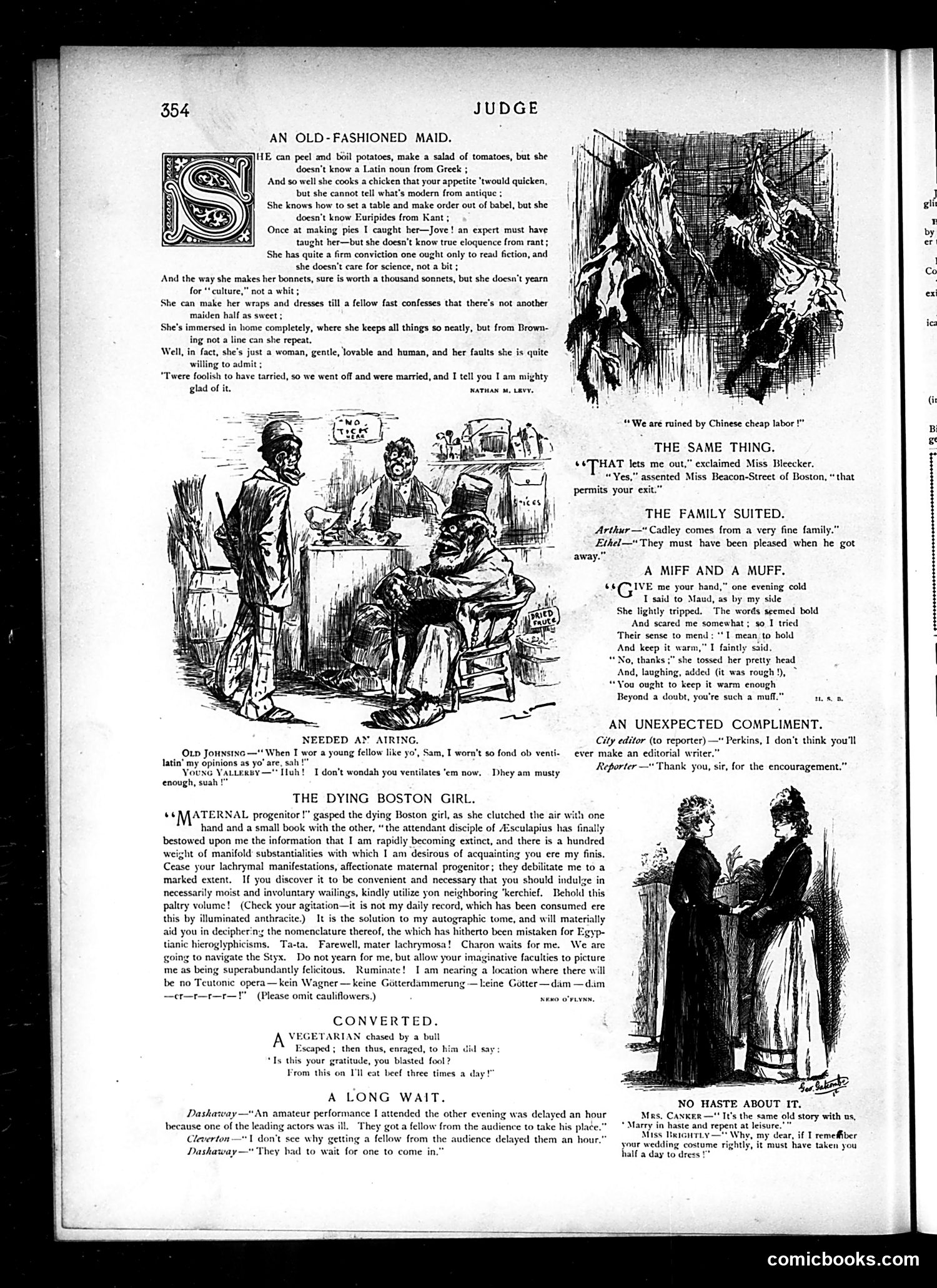
This page contains several short humorous pieces satirizing American social pretensions and gender dynamics of the late 19th/early 20th century. **"An Old-Fashioned Maid"** celebrates a domestic servant who excels at practical household tasks (cooking, cleaning, sewing) but lacks "culture"—knowledge of classical literature, philosophy, and modern refinement. The satire targets *both* the snobby elite who value such "culture" and the working-class woman's contentment with practical skills. The narrator ultimately marries her, suggesting practical virtue trumps pretension. **"The Dying Boston Girl"** mocks Boston's educated upper class through a dying girl's overwrought, pedantic speech ("maternal progenitor," "lachrymal manifestations"). Her excessive vocabulary and references to high culture (Wagner, Egyptian hieroglyphics) parody the region's intellectual pretension, suggesting such education produces absurdity rather than wisdom. The shorter pieces ("The Same Thing," "A Miff and a Muff") are mild romantic/social humor with wordplay. Overall theme: Judge satirizes class-based "culture" and intellectual pretension while poking fun at both the affected educated elite and those who aspire to their status.
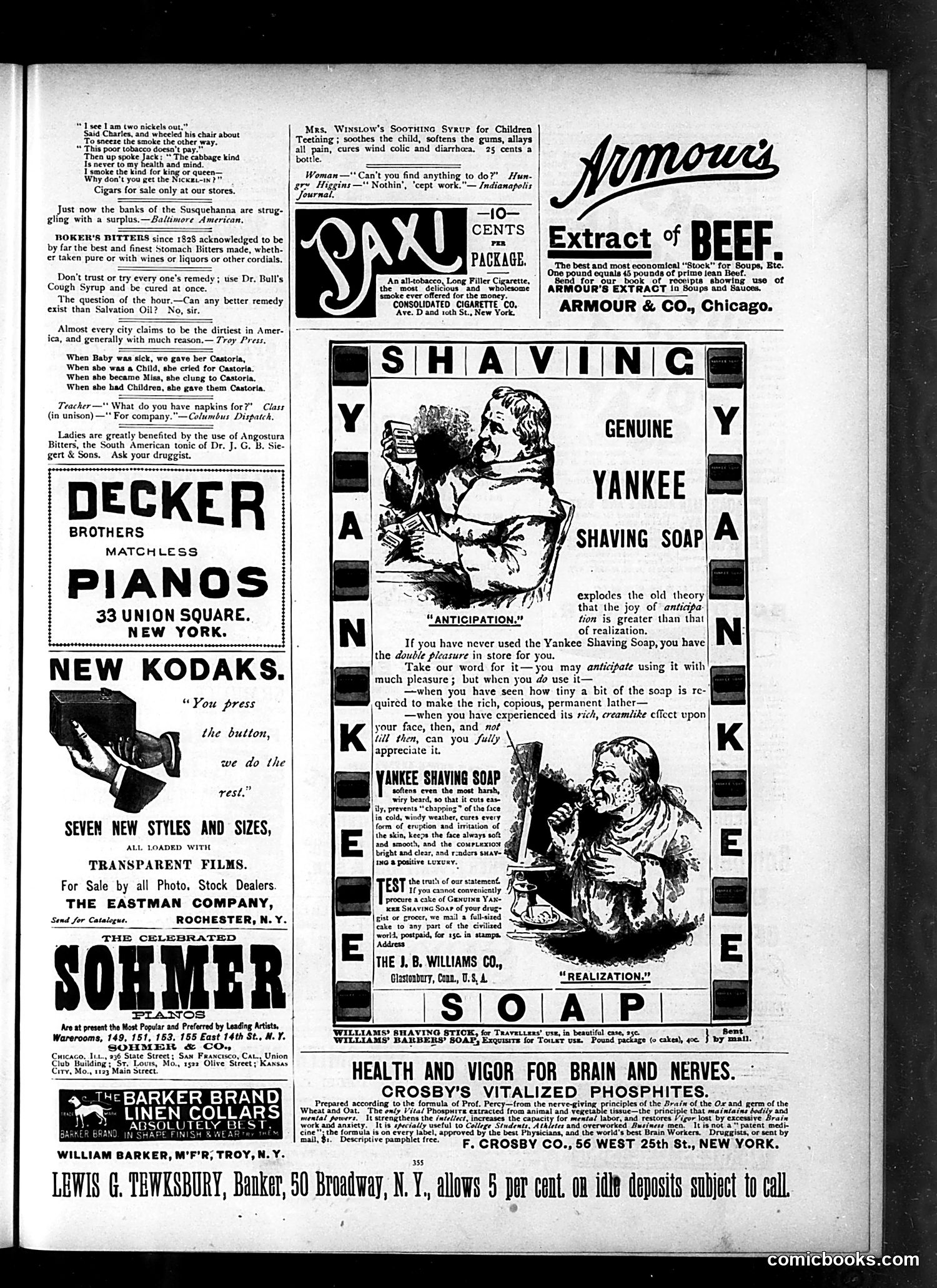
This page is primarily **advertising**, typical of late 19th-century American magazines. The main visual content is a large advertisement for **Yankee Shaving Soap** featuring two illustrated scenes labeled "Anticipation" and "Realization"—showing a man eagerly awaiting the shaving experience, then satisfied after using the product. The advertisement's humor plays on a philosophical conceit: it "explodes the old theory that the joy of anticipation is greater than that of realization," arguing the soap's actual performance exceeds expectations. This reflects Victorian-era consumer marketing psychology. The page also contains numerous other period product ads (Kodak cameras, pianos, linen collars, patent medicines) and brief comic snippets about contemporary concerns—tobacco quality, surplus banking issues, Castoria for babies, and women's labor ("cept work"). No identifiable political figures or satire appears; this is straightforward commercial promotion typical of *Judge*'s advertising-heavy format.
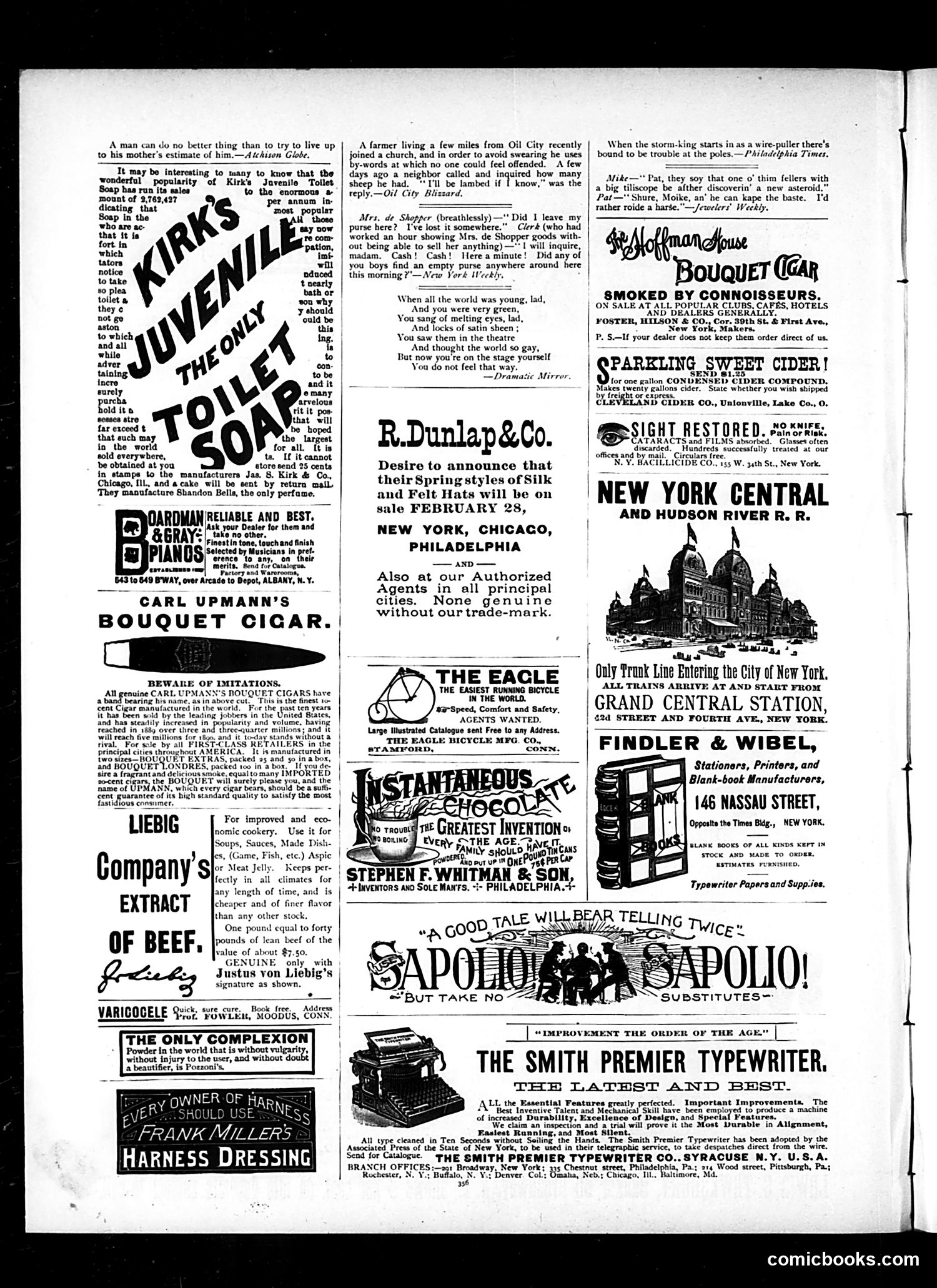
This page is primarily **advertising** rather than political cartoons or satirical commentary. The dominant content comprises commercial advertisements for various products: Kirk's Juvenile Toilet Soap, pianos, Carl Upmann's Bouquet cigars, Liebig's beef extract, typewriters, and other consumer goods. These ads occupy approximately 70% of the page space. The **satirical content** appears minimal and scattered. A few brief humorous anecdotes are included—such as the farmer avoiding swearing by saying "I'll be lambed" instead of a curse word, and a joke about Mrs. de Shopper's empty purse. These are short, conventional jokes typical of period humor magazines. There are **no clearly identifiable political cartoons** or caricatures of public figures visible. The page lacks the pointed social or political satire one might expect from *Judge*, a publication known for sharper commentary. This appears to be a typical magazine page where advertising revenue drove content, with modest humorous filler between ads.
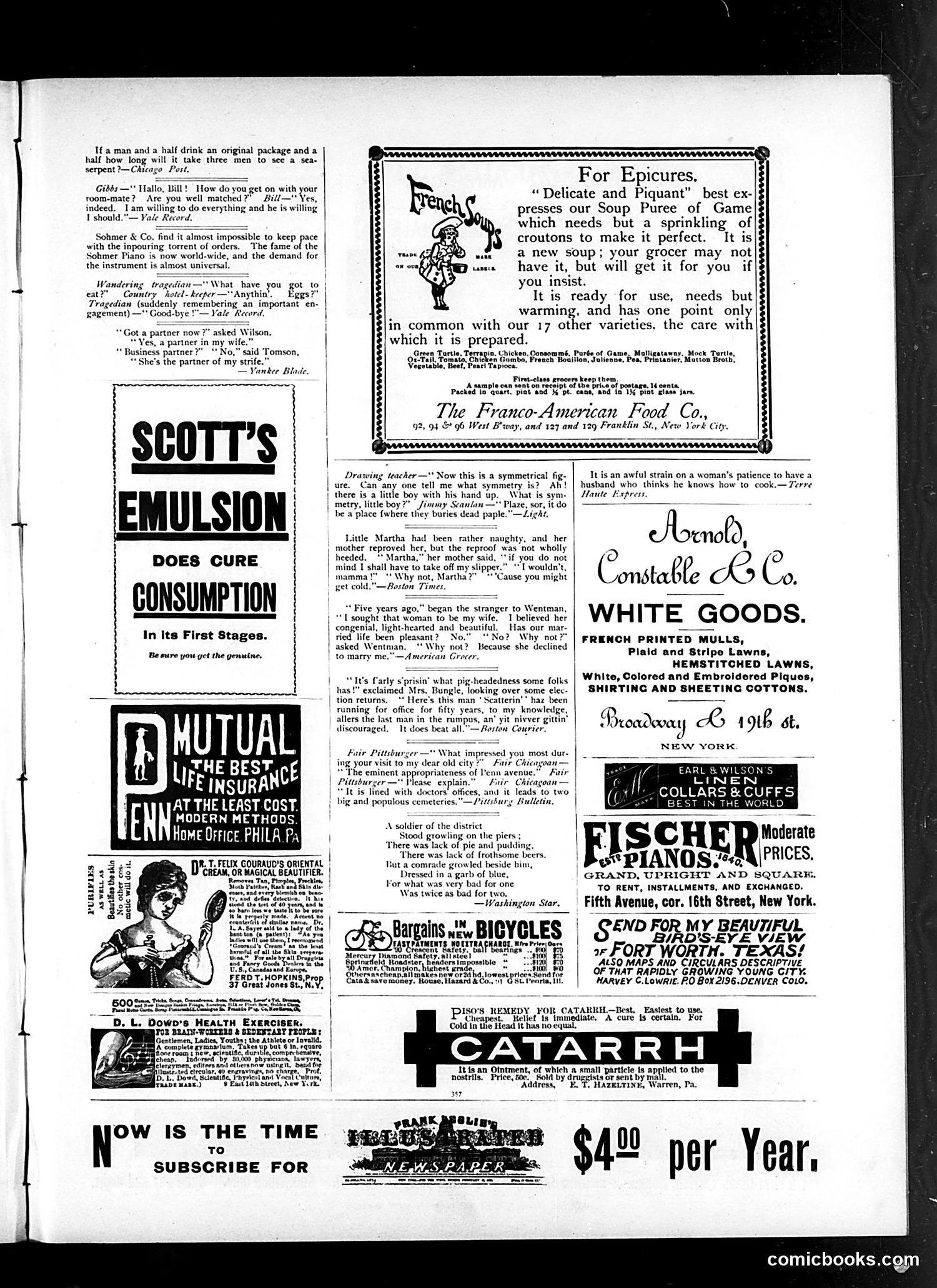
This is primarily an **advertising page** from Judge magazine, with brief humorous quips interspersed between ads. The actual satirical content is minimal. The few jokes present are mild, genteel humor typical of early 1900s magazines: - A drawing teacher's joke about a student's malapropism (confusing "symmetry" with a cemetery) - Domestic humor about a naughty child and marital misunderstandings - Light jabs at political candidates and wives' cooking abilities The advertisements dominate the page, hawking products spanning health (Scott's Emulsion for consumption, D.L. Down's exerciser), beauty (Oriental Cream, Gouraud's cosmetics), pianos, bicycles, and clothing. Notably, these ads contain **problematic racial imagery and medical claims** that reflect period attitudes—treatments for "brain-workers," beauty products promising skin transformation. The page represents Judge's function as entertainment plus advertising revenue. There's no coherent political commentary or cartooning in the modern sense—just scattered domestic and mild social humor padding product pitches.
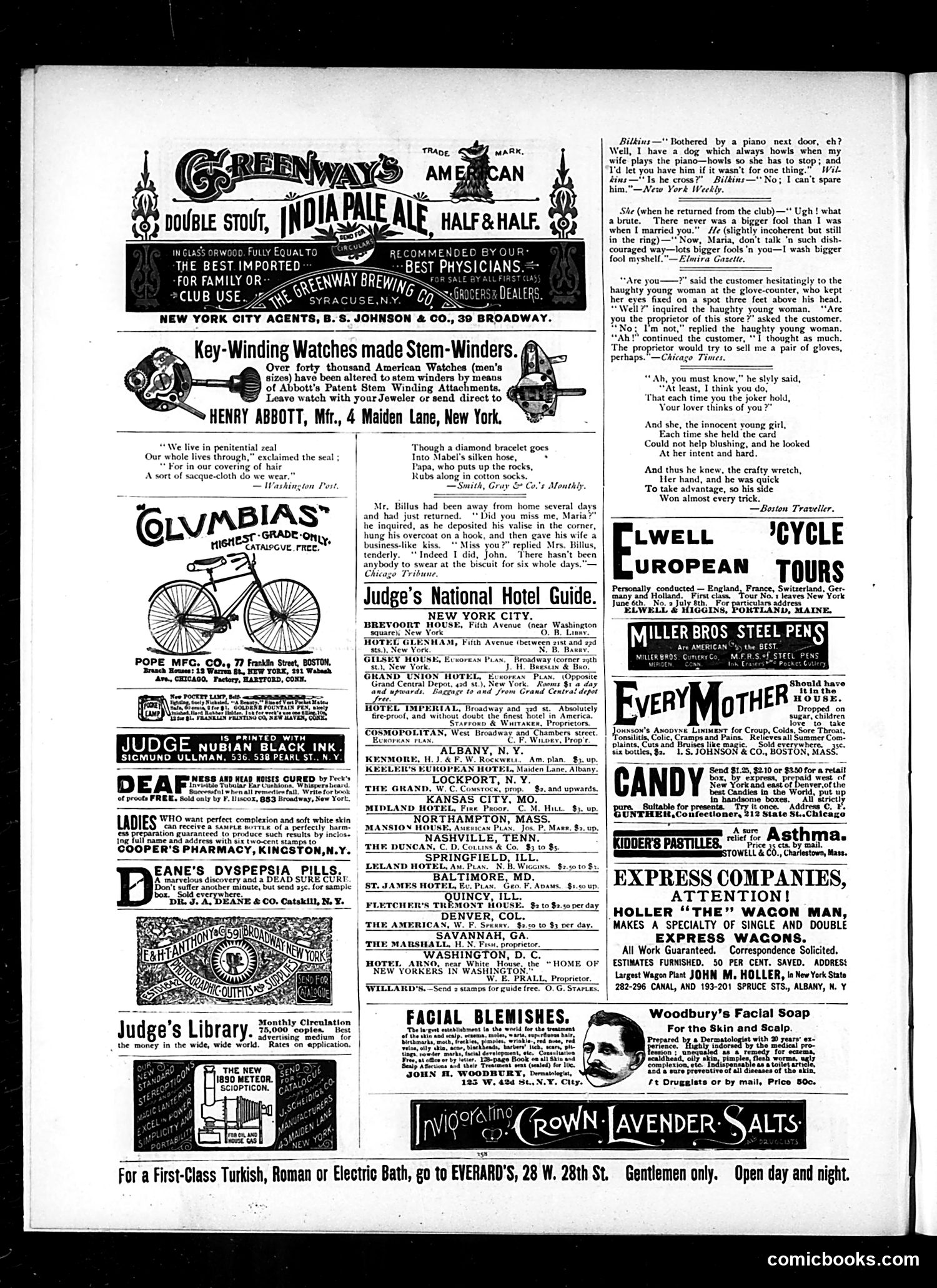
This page from *Judge*, a late 19th-century American satirical magazine, is primarily **advertising with embedded humorous short anecdotes** rather than political cartoons. The cartoons present are social satire about everyday married life and consumer interactions: 1. **The piano complaint sketch**: Mocks domestic annoyance—a husband brags his dog howls at his wife's piano playing, forcing her to stop. The humor turns when he drunkenly admits he's an even bigger fool than she is for marrying him. 2. **The glove-counter sketch**: A customer notices a shop assistant is unhelpful and snobbish (staring above his head), assumes she's not the owner, and sarcastically suggests the proprietor would actually try to make a sale. 3. **The card-game sketch**: A man exploits an innocent girl's vanity and shyness by making her believe he's thinking of her each time she holds a playing card—actually using her distraction to cheat at cards. These reflect typical *Judge* humor: gentle mockery of social pretension, marital discord, and dishonest commercial behavior. The advertisements surrounding them are period standard.
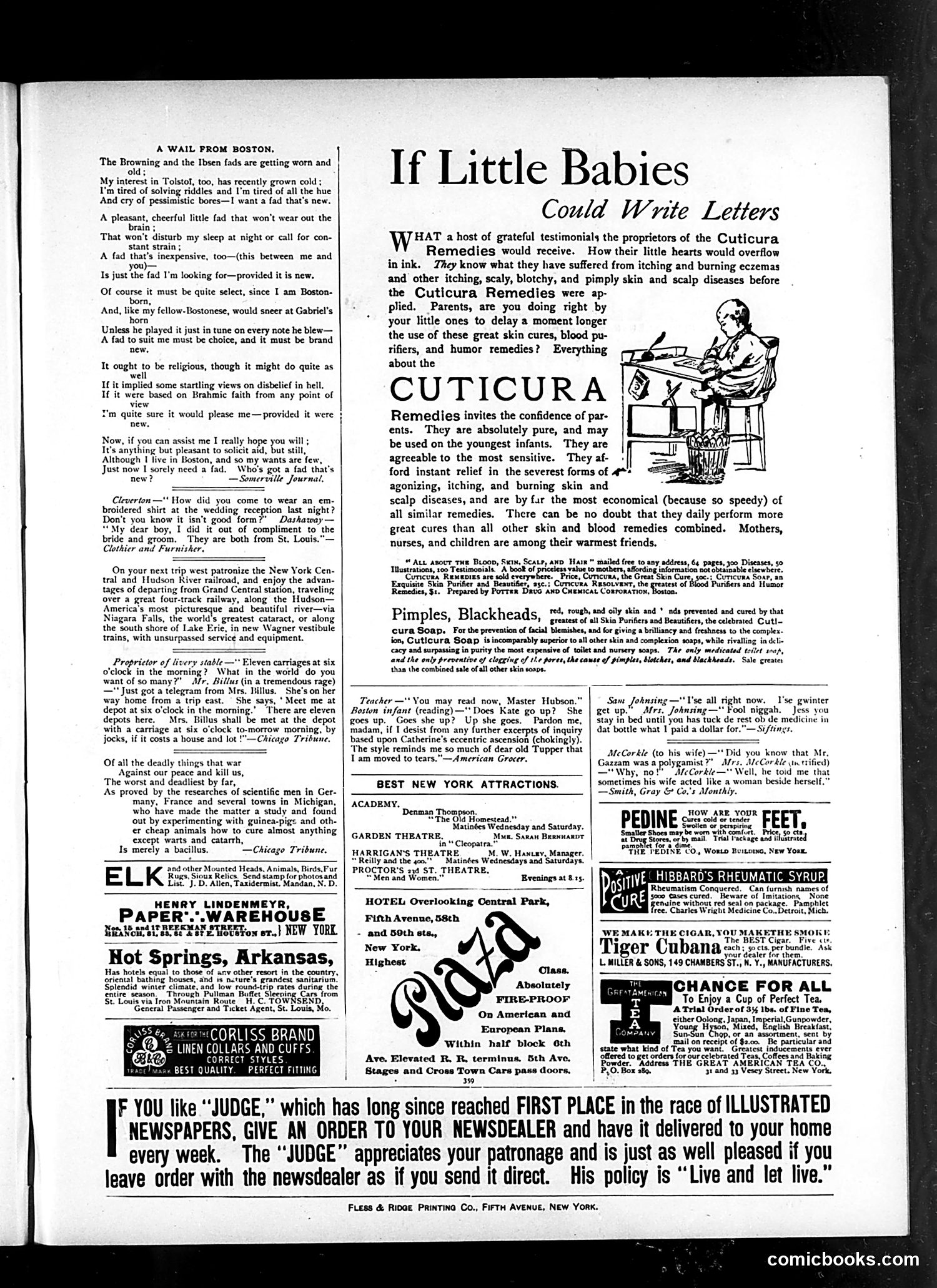
This page contains primarily **advertisements and light humor columns** rather than political cartoons. The main content is a humorous poem titled "A Wail from Boston" mocking Boston's intellectual pretentiousness. The speaker complains of being exhausted by fashionable literary and philosophical fads—references to Browning, Ibsen, Tolstoy—and desperately seeks a new, "select" fad befitting Boston society. The satire targets Boston's well-known snobbery and compulsive adoption of high-minded cultural trends. The page also includes several comic anecdotes about social embarrassment and domestic mishaps (wearing embroidered shirts, ordering multiple carriages). The dominant visual element is a **large Cuticura Remedies advertisement** featuring a child writing letters, promoting skin treatments for babies. This reflects the era's patent medicine marketing, which frequently used appeals to motherhood and child welfare. The remaining space comprises travel, hotel, and product advertisements typical of period magazines.
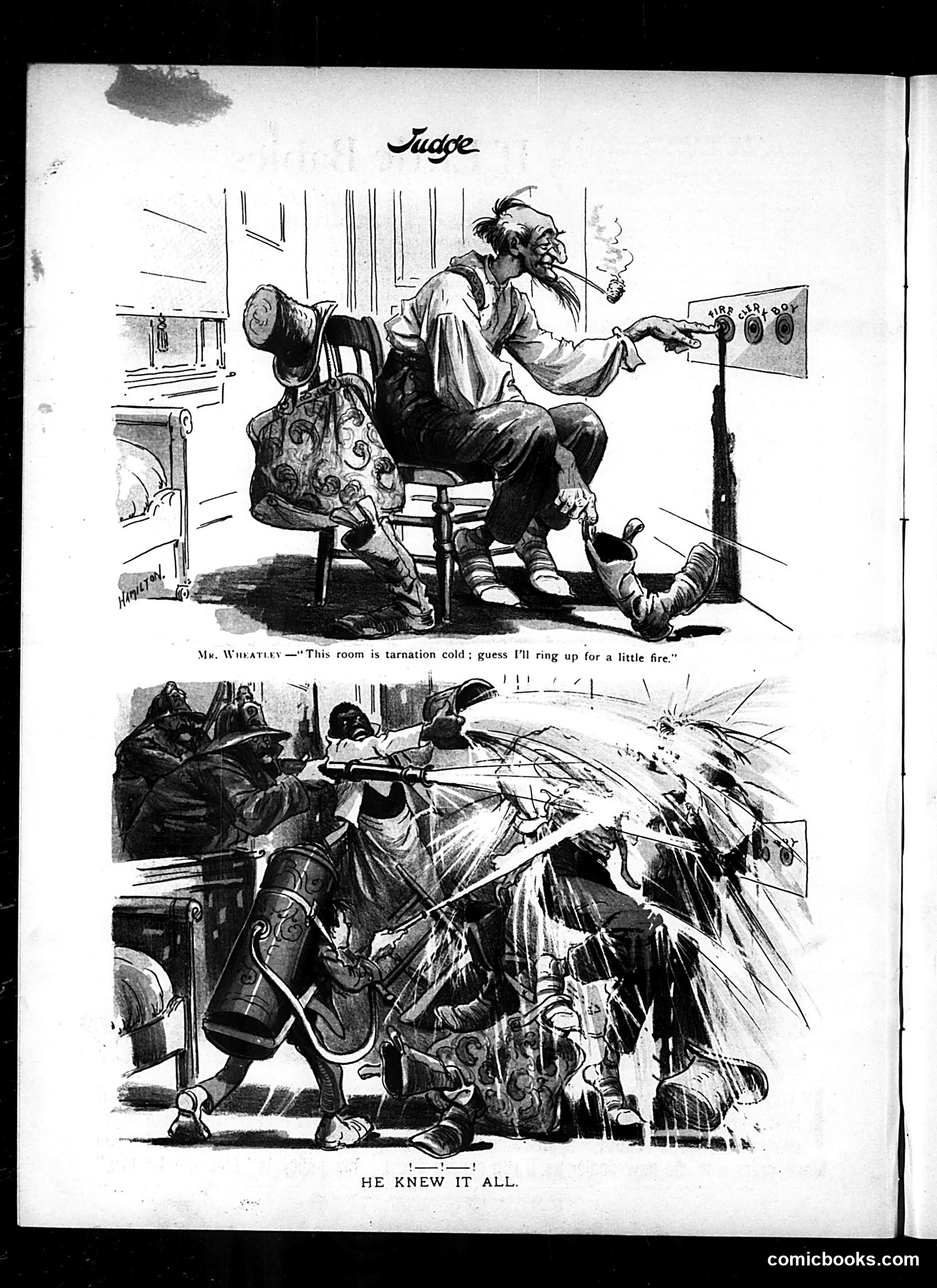
This two-panel cartoon satirizes a man identified as "Mr. Wheatley." In the top panel, he sits comfortably indoors, remarking "This room is tarnation cold; guess I'll ring up for a little fire"—showing casual indifference to minor discomfort. The bottom panel, titled "HE KNEW IT ALL," depicts the chaotic consequences: firefighters battle a massive, raging inferno consuming the building. The satire suggests Wheatley's casual request for "a little fire" resulted in catastrophic destruction through incompetence, carelessness, or misunderstanding. The cartoon likely mocks someone whose arrogant overconfidence or thoughtless actions caused disproportionate damage. Without additional context about who Wheatley was or what specific incident this references, the broader satirical point appears to be criticism of ignorant decision-making with serious consequences.