
Judge, 1891-02-21 · page 2 of 16
Judge — February 21, 1891 — page 2: what you’re looking at
What you’re looking at
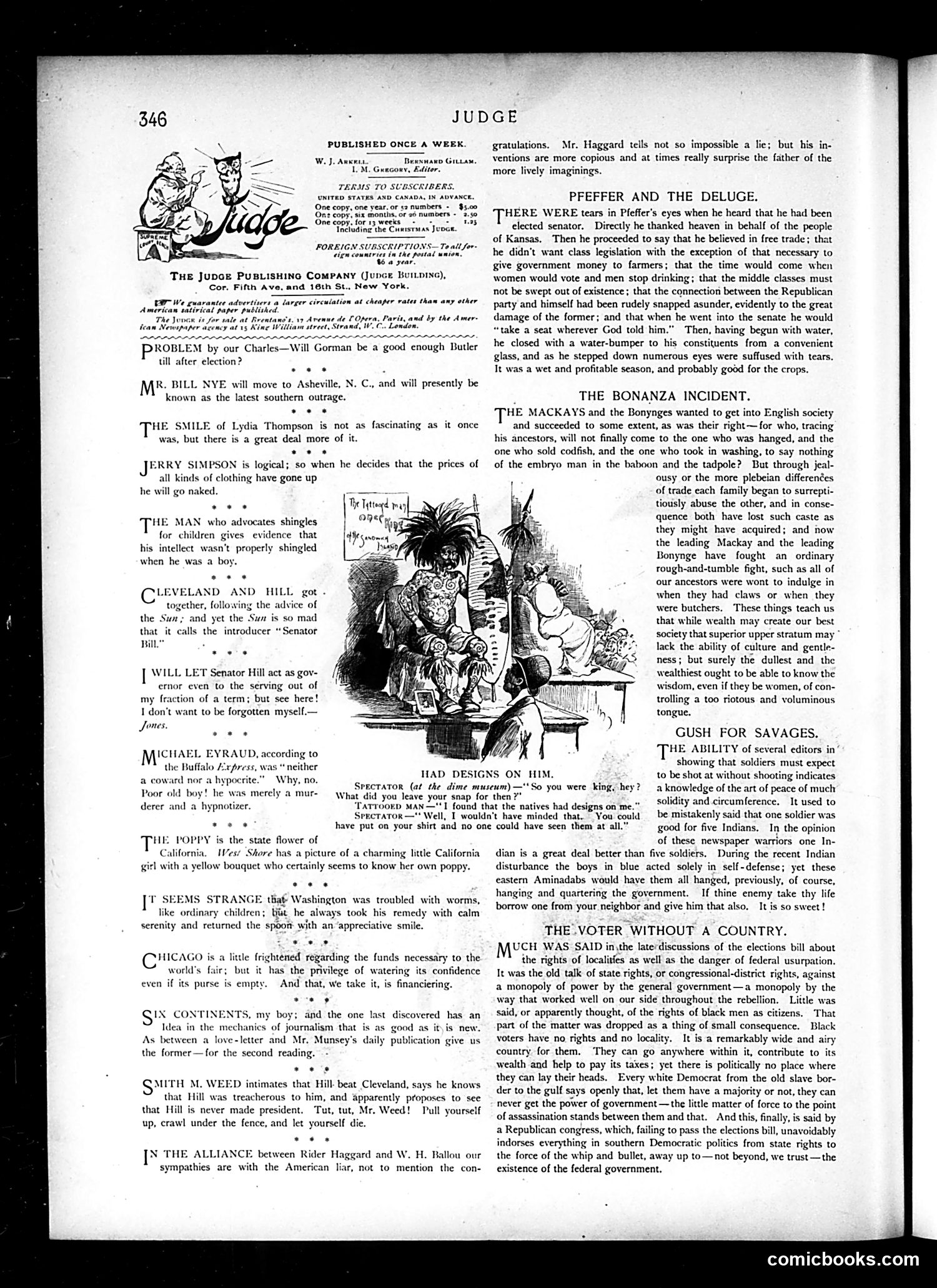
This page contains brief satirical commentary snippets typical of Judge's format. The most substantive piece is "The Voter Without a Country," discussing federal versus state power—a recurring late-19th/early-20th-century debate. The author criticizes both Republican and Democratic handling of civil rights, particularly regarding Black voters' status as citizens with "no rights and no locality." The cartoon illustration (center-left) appears to depict social class conflict, showing figures in confrontation, likely related to the "Bonanza Incident" article discussing wealth disparities between Mackays and Bonanzas (prominent Nevada mining families), their rivalry, and how wealth alone doesn't confer cultural refinement or gentility. Other brief items mock contemporary political figures and events in typical Judge fashion—pointed but cryptic without historical context.
📄 Transcribed text from this page (OCR, searchable)
Machine-transcribed from the original scan — historical spelling and the odd misread are preserved.
JUDGE PUBLISHED ONCE A WEEK. W. J. Ament Bexxnaro Giitas. 1. M. Guncony, Sutiter. TERMS TO SU! BERS. UNITRD STATES AND CANADA, IN ADVANCE, One copy, one year.or sa numbers - $5.00 Ons copy, six months, or 26 numbers - 2.50 One copy. for 13 wee! Including the Ci FOREIGN SUBSC ONS—Te all for- cigm countries in the postal wnion. $6 @ year THE JUDGE PUBLISHING ComPANY (Jupce bui.pinc), Cor. Fifth Ave. and 16th St., New York. (H-We guarantee advert American satirical paper pubi The Juv ie for sale at Brentano's. ry Avenue de COpera. Paris, and by the Amer- ican Newspaper acency at 13 Kine William street, Strand, W, Cu. London. PROBLEM by our Charles—Will Gorman be a good enough Butler till after election? «a larger circulation at cheaper rates than any other id. R. BILL NYE will move to Asheville, N. C., and will presently be known as the latest southern outrage. THE SMILE of Lydia Thompson is not as fascinating as it once was, but there is a great deal more of it. JERRY. SIMPSON jis logical; so when he decides that the prices of all kinds of clothing have gone up he will go naked. HE MAN who advocates shingles for children gives evidence that his intellect wasn't properly shingled when he was a boy. CLEVELAND AND HILL got - yether, following the advice of the Suz; and yet the Suz is so mad that it calls the introducer “Senator Bill.” WILL LET Senator Hill act as gov- nor even to the serving out of my fraction of a term; but see here! I don’t want to be forgotten myself.— MICHAEL EYRAUD, according to the Buffalo £: neither a coward nor a hypocrite.” Why, no. Poor old boy! he was merely a mur- ress, Wa! derer and a hypnotizer. eae THE POPPY is the state flower of alifornia, MWes/ Shore has a picture of a charming little California girl with a yellow bouquet who certainly seems to know her own poppy. eee that Washington was troubled with worms, y children; iat he always took his remedy with calm serenity and returned the spoon with an appreciative smile. one HICAGO is a little frightened regarding the funds necessary to the world’s fair; but it has the privilege of watering its confidence even if its purse is empty. And that, we take it, is financiering. see :NTS, my boy; and the one last discovered has an the mechanics of journalism that is as good as itis new. As between a love-letter and Mr. Munsey's daily publication give us the former—for the second reading. ses GMITH M. WEED intimates that Hill beat Cleveland, says he knows that Hill was treacherous to him, and apparently proposes to see that Hill is never made president, Tut, tut, Mr. Weed! Pull yourself up, crawl under the fence, and let yourself die. N THE ALLIANCE between Rider Haggard and W. H. Ballou our sympathies are with the American liar, not to mention the con- HAD DESIGNS ON Spectator (at the dime museum) —''So you were king, hey? What did you leave your snap for then ? ‘TATTOOED MAN—"'T found that the natives had designs on me.” SpECTATOR—" Well, I wouldn't have minded that. have put on your shirt and no one could have seen them at all.” gratulations. Mr. Haggard tells not so impossible a lie; but his in- ventions are more copious and at times really surprise the father of the more lively imaginings. PFEFFER AND THE DELUGE. “THERE WERE tears in Pfeffer's eyes when he heard that he had been elected senator. Directly he thanked heaven in behalf of the people of Kansas. Then he proceeded to say that he believed in free trade; that he didn’t want class legislation with the exception of that necessary to give government money to farmers; that the time would come when women would vote and men stop drinking; that the middle classes must not be swept out of existence; that the connection between the Republican party and himself had been rudely snapped asunder, evidently to the great damage of the former; and that when he went into the senate he would “take a seat wherever God told him.” Then, having begun with water, he closed with a water-bumper to his constituents from a convenient glass, and as he stepped down numerous eyes were suffused with tears. It was a wet and profitable season, and probably good for the crops. THE BONANZA INCIDENT. ‘THE MACKAYS and the Bonynges wanted to get into English society and succeeded to some extent, as was their right—for who, tracing his ancestors, will not finally come to the one who was hanged, and the one who sold codfish, and the one who took in washing, to say nothing of the embryo man in the baboon and the tadpole? But through jeal- ousy or the more plebeian differenées of trade each family began to surrepti- tiouisly abuse the other, and in conse- quence both have lost such caste as they might have acquired; and now the leading Mackay and the leading Bonynge have fought an ordinary rough-and-tumble fight, such as all of our ancestors were wont to indulge in when they had claws or when they were butchers. These things teach us that while wealth may create our best society that superior upper stratum may © lack the ability of culture and gentle- ness; but surely the dullest and the wealthiest ought to be able to know the wisdom, even if they be women, of con- trolling a too riotous and voluminous tongue. GUSH FOR SAVAGES. HE ABILITY of several editors in’ showing that soldiers must expect to be shot at without shooting indicates a knowledge of the art of peace of much solidity and circumference. It used to be mistakenly said that one soldier was good for five Indians. In the opinion of these newspaper warriors one In- dian is a great deal better than five soldiers. During the recent Indian disturbance the boys in blue acted solely in self-defense; yet these eastern Aminadabs would have them all hanged, previously, of course, hanging and quartering the government. If thine enemy take thy life borrow one from your neighbor and give him that also. It is so sweet ! HIM, You could THE.VOTER WITHOUT A COUNTRY. MUCH WAS SAID inthe late’ discussions of the elections bill about the rights of localities as well as the danger of federal usurpation. It was the old talk of state rights, or congressional-district rights, against a monopoly of power by the general government—a monopoly by the way that worked well on our side throughout the rebellion. Little was said, or apparently thought, of the rights of black men as citizens. ‘That part of the matter was dropped as a thing of small consequence. Black voters have no rights and no locality, It is a remarkably wide and airy country for them. ‘They can go anywhere within it, contribute to its wealth and help to pay its taxes; yet there is politically no place where they can lay their heads. Every white Democrat from the old slave bor- der to the gulf says openly that, let them have a majority or not, they can never get the power of government —the little matter of force to the point of assassination stands between them and that. And this, finally, is said by a Republican congress, which, failing to pass the elections bill, unavoidably indorses everything in southern Democratic politics from state rights to the force of the whip and bullet, away up to—not beyond, we trust — the existence of the federal government. comicbooks.com