
A complete issue · 16 pages · 1891
Judge — January 31, 1891
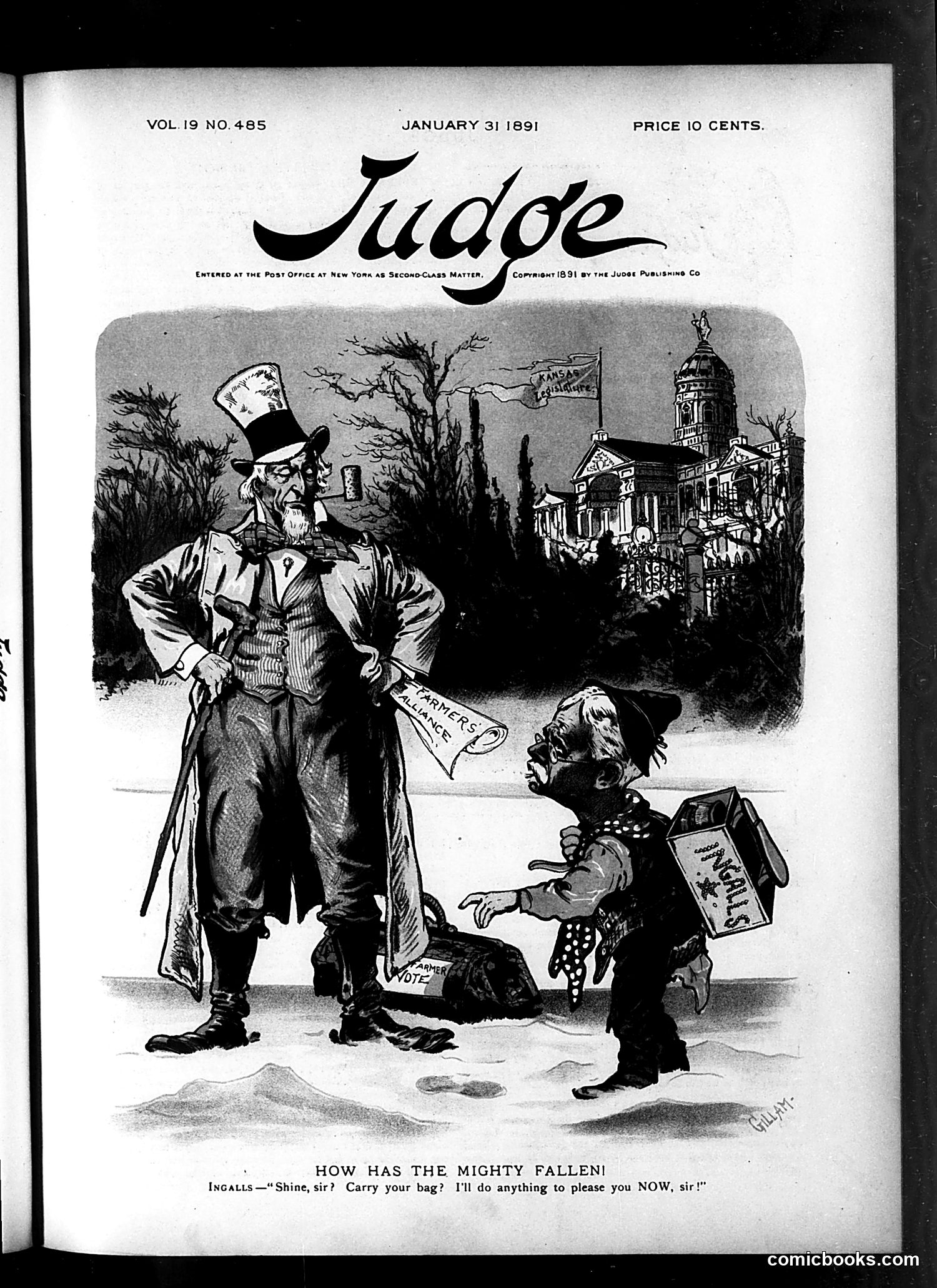
This January 1891 cartoon satirizes the downfall of a prominent political figure through the caricature of a once-dignified gentleman now reduced to begging. The title—"How Has the Mighty Fallen"—references biblical language about pride preceding a fall. The well-dressed man in the top hat appears to represent a former Kansas politician or leader (a banner reading "Kansas" is visible). Now impoverished, he's approached by children or street urchins asking charity. The contrast between his former status and current degradation is the joke's core: his loss of power and respectability. The specific identity of this figure and the exact political event referenced remains unclear without additional historical documentation, but the cartoon clearly mocks a Kansas politician's spectacular reversal of fortune.
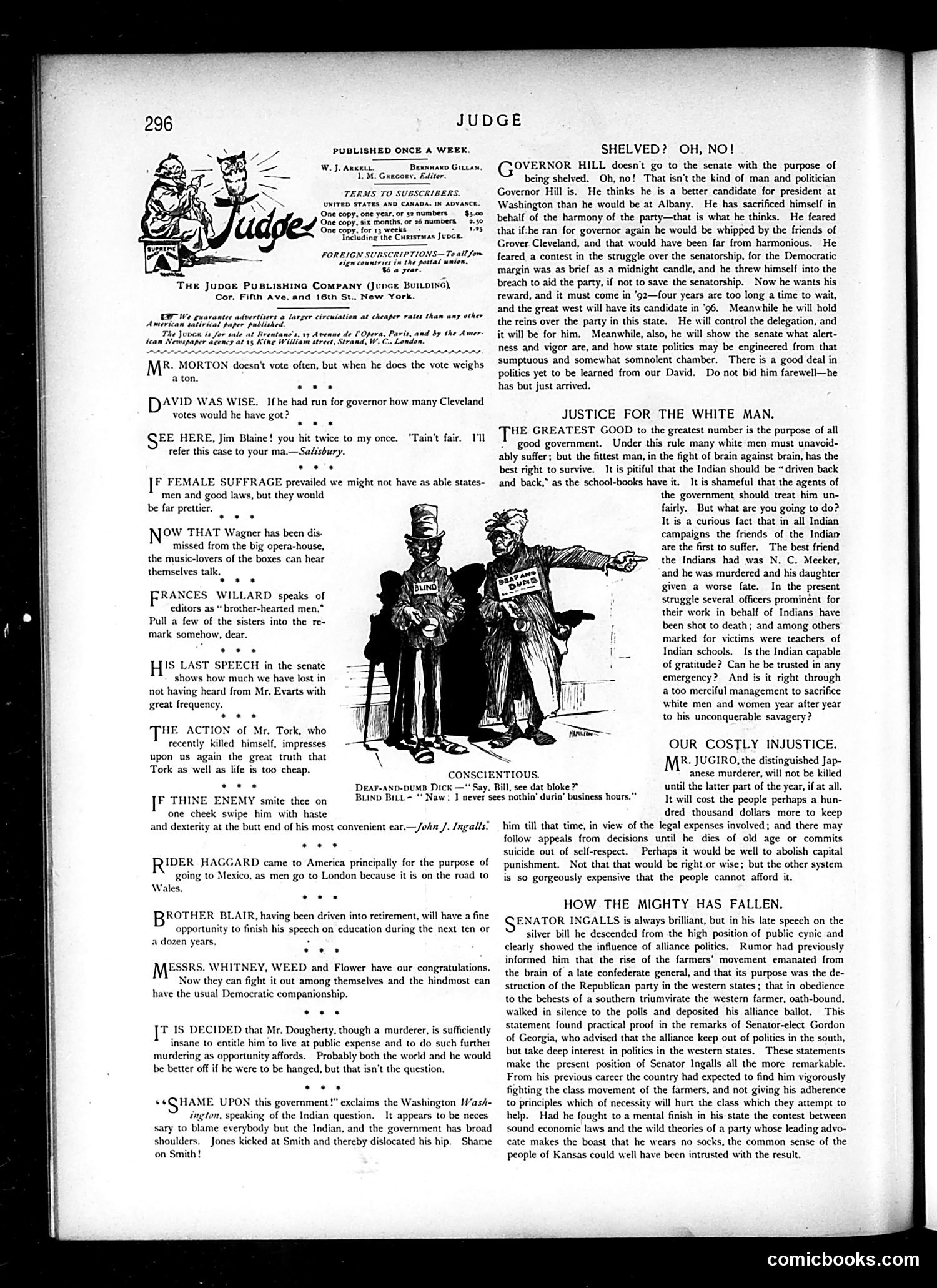
This page contains satirical political commentary typical of Judge magazine's style. The main cartoon titled "CONSCIENTIOUS" depicts two figures labeled with signs—appearing to represent political or judicial figures in a debate or confrontation about justice and morality. The surrounding text includes brief satirical quips about contemporary political figures and issues, including references to Governor Hill, suffrage debates, and Indian rights controversies. One section titled "JUSTICE FOR THE WHITE MAN" critiques what the author sees as unfair treatment of white citizens compared to Native Americans in legal proceedings. The overall tone reflects late 19th or early 20th-century American political tensions around race, suffrage, and governance—though specific figures and events referenced are difficult to identify with certainty without additional historical context.
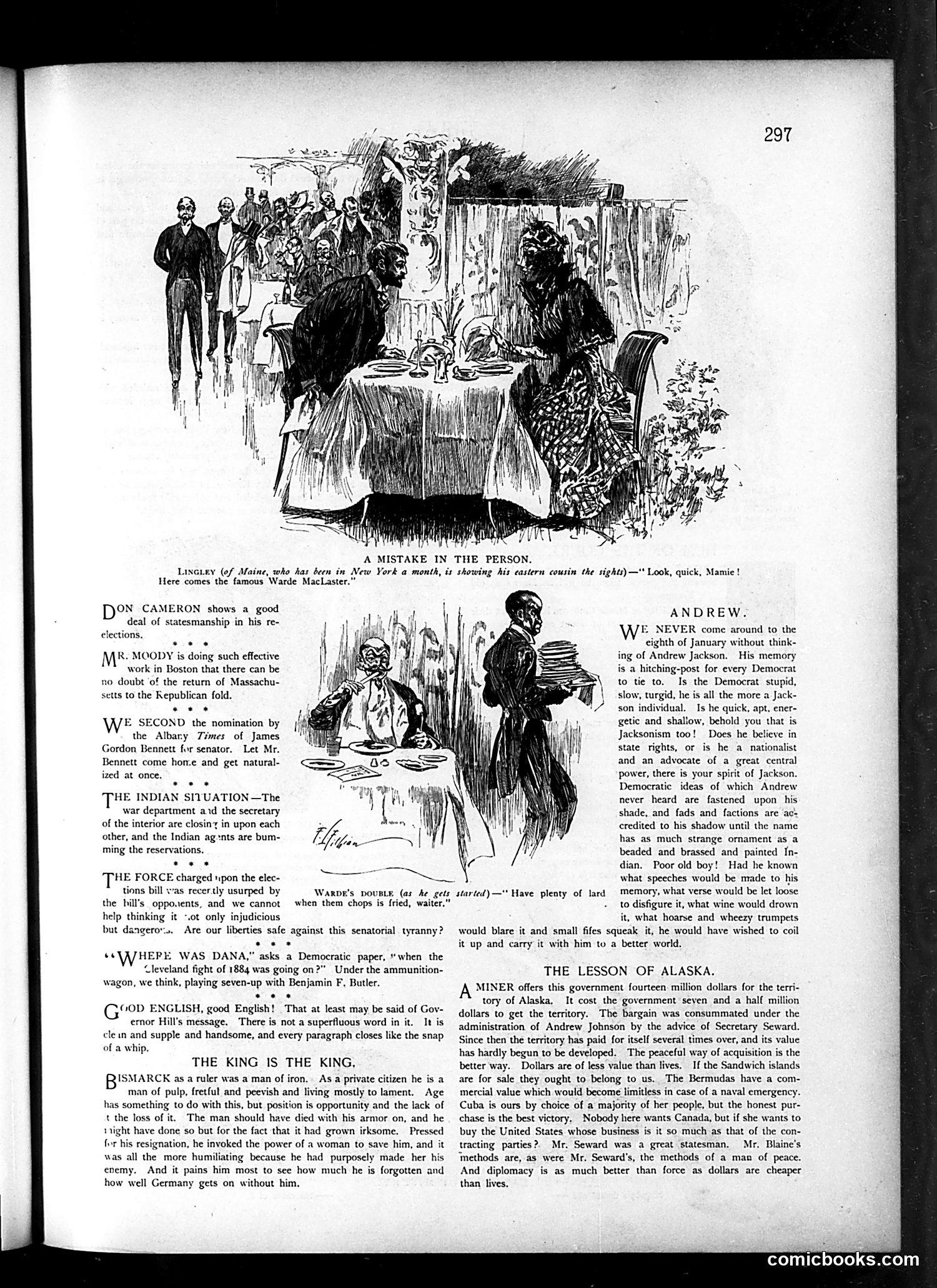
**Top Cartoon: "A Mistake in the Person"** Shows two figures dining while others observe. The caption indicates it involves "Lindley of Maine" and his cousin, creating confusion over identity. This appears to be a social satire about mistaken identity at a formal dinner. **Text Sections:** The page critiques several political figures and issues: - Don Cameron and statesmanship - Mr. Moody's effectiveness in Massachusetts politics - James Gordon Bennett's nomination - The Indian situation and interior department - Electoral bill debates regarding "senatorial tyranny" **"The Lesson of Alaska" section** discusses a miner's offer of fourteen million dollars for Alaskan territory, satirizing the government's acquisition and development approach to Alaska. The page exemplifies Judge's typical 1880s-90s political commentary on governance and public figures.
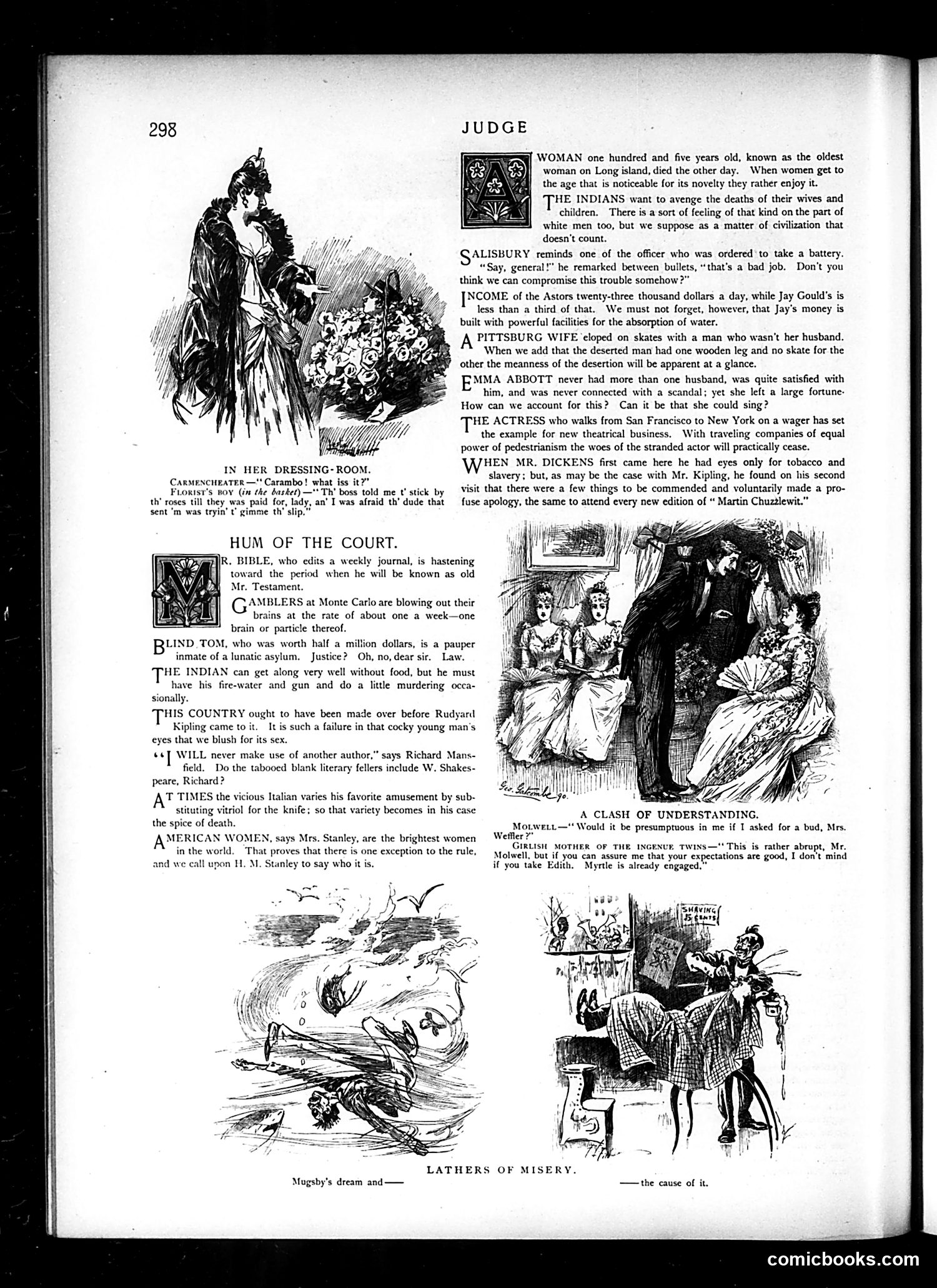
This page contains typical Judge satirical commentary from the late 19th century, mixing brief social observations with visual cartoons. **Key References:** The text mocks various contemporary figures and trends: Salisbury (likely the British Prime Minister), the Astor and Gould fortunes (comparing wealth disparity), actress Emma Abbott (whose virtue is humorously attributed to her talent), and Charles Dickens's observations on America (tobacco and slavery on first visit). **The Cartoons:** "In Her Dressing Room" depicts theatrical backstage life with exaggerated dress and flourish. "Lathers of Misery" shows two contrasting scenes—one depicting someone's troubled dream versus its mundane cause (appears to be about Mugsby, though context is unclear). "A Clash of Understanding" shows a suitor's awkward request for a flower from a widow, misinterpreting her mention of her daughters' engagements. The overall tone is **genteel mockery** of American social pretension, wealth, theater culture, and romantic mishaps—typical Judge humor aimed at educated urban readers.
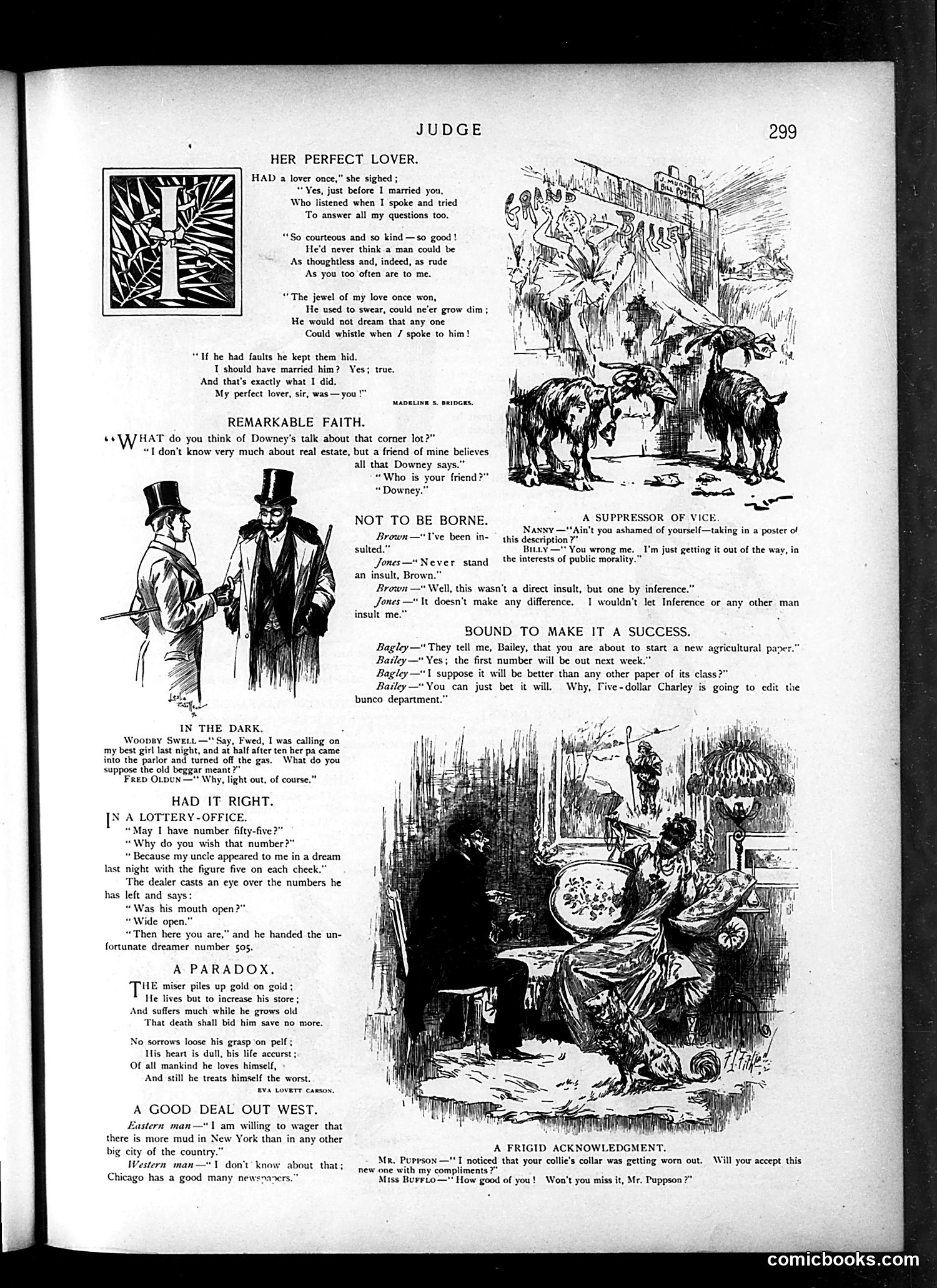
This page from **Judge** (a late 19th-century American satirical weekly) contains multiple brief humorous sketches typical of the era: **"Her Perfect Lover"** is a domestic comedy about a woman lamenting her husband's lack of courtesy, contrasting him with an idealized past lover—who, the punchline reveals, was actually him before marriage. The satire targets how courtship behavior changes after wedding vows. **"Remarkable Faith"** mocks circular reasoning: a man believes real estate claims because his friend does, but his friend is the person making the claims. **"Not to Be Borne"** satirizes oversensitivity about insults through semantic hair-splitting. **"Bound to Make It a Success"** jokes about a new agricultural newspaper allegedly being edited by "five-dollar Charley" in the "bunco department"—implying it will succeed through fraud rather than merit. **"In the Dark"** contains a mild innuendo about a young man's visit being interrupted when the father turns off the gas lamp. **"Had It Right"** presents lottery-office absurdism: a dreamer seeks number 55 based on an uncle's appearance; shown "505" (five on each cheek), he takes it literally. The remaining items are brief poems and witticisms about miser paradoxes and regional boasting.
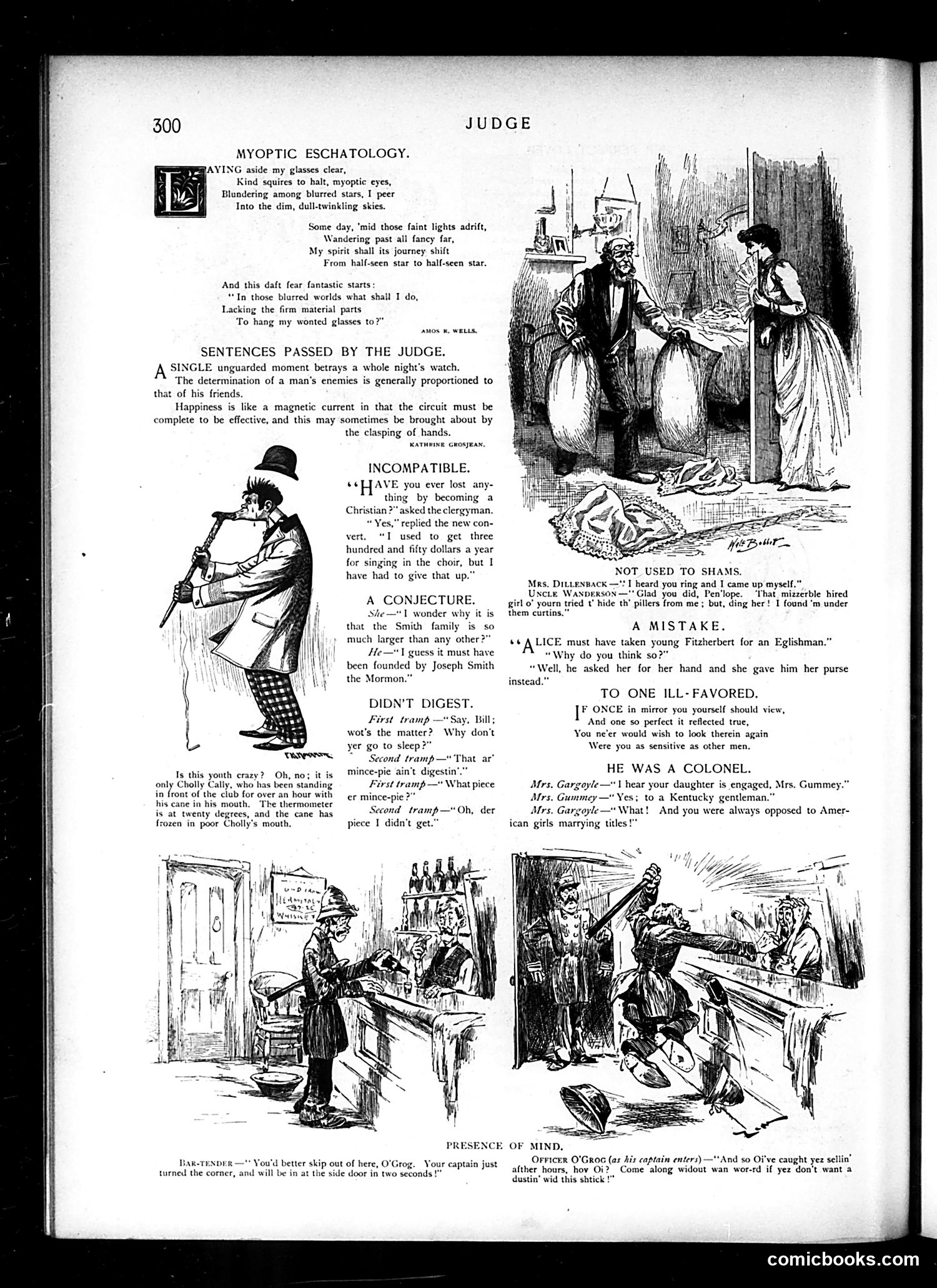
This page collects humorous anecdotes and brief comic sketches typical of late 19th-century American satirical journalism. **Key sections:** The opening poem "Myoptic Eschatology" jokes about a nearsighted person worried about retrieving their glasses in the afterlife—absurdist humor about mortality and material dependence. **Social satire includes:** - A convert losing choir income after becoming Christian (religious hypocrisy) - A "conjecture" mocking Mormon founder Joseph Smith's large family - Ethnic humor featuring Irish characters (O'Grog, the bartender dialogue) - Class commentary on wealthy idlers and servants - A joke about an Englishman's politeness (asking for a hand, receiving a purse instead) - A woman's snobbery about American daughters marrying foreign titles The illustrations feature caricatured working-class and ethnic figures common to period humor. The content reflects Victorian-era attitudes: religious skepticism, anti-Mormon sentiment, ethnic stereotyping, and class consciousness—perspectives modern readers would find dated or offensive.
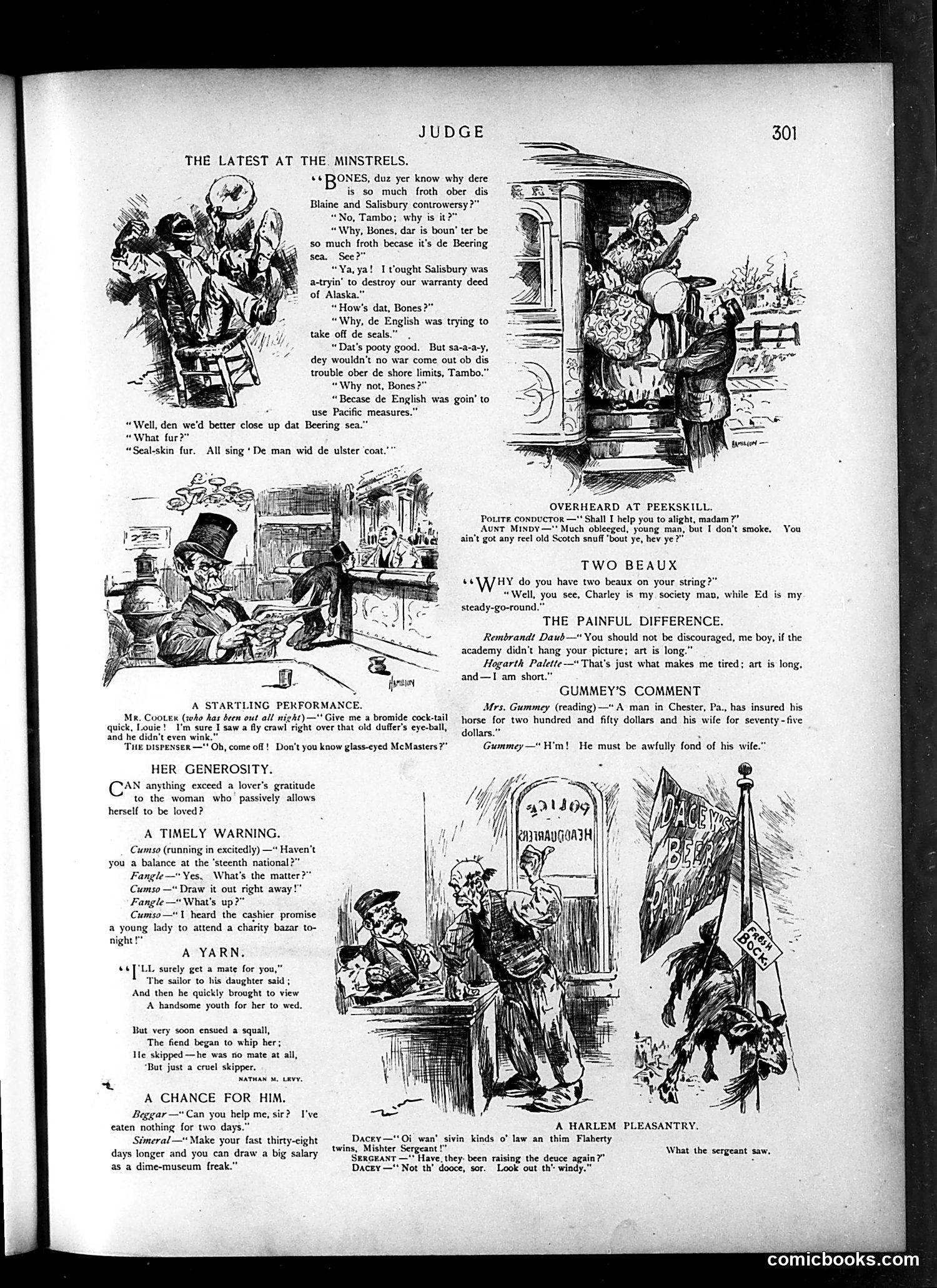
This page from *Judge* contains multiple brief satirical pieces typical of 1890s American humor. The primary political cartoon concerns the **Bering Sea dispute** between the United States and Britain over seal hunting rights and territorial claims in Alaska. The minstrel-show dialogue mockingly addresses this diplomatic controversy through racist dialect humor (then standard in American comedy), with puns on "Beering sea," "seals," and "Pacific measures." Other items are lighter social humor: observations about courtship, artistic frustration, and street characters. The recurring format—short jokes, puns, and one-liners—reflects *Judge's* typical satirical style. The Bering Sea controversy (likely 1890-1893) was a genuine diplomatic tension, making that piece's topical reference clear. Most other sketches are timeless social commentary requiring no specific historical context—they mock vanity, poverty, and romantic absurdity familiar to any era.
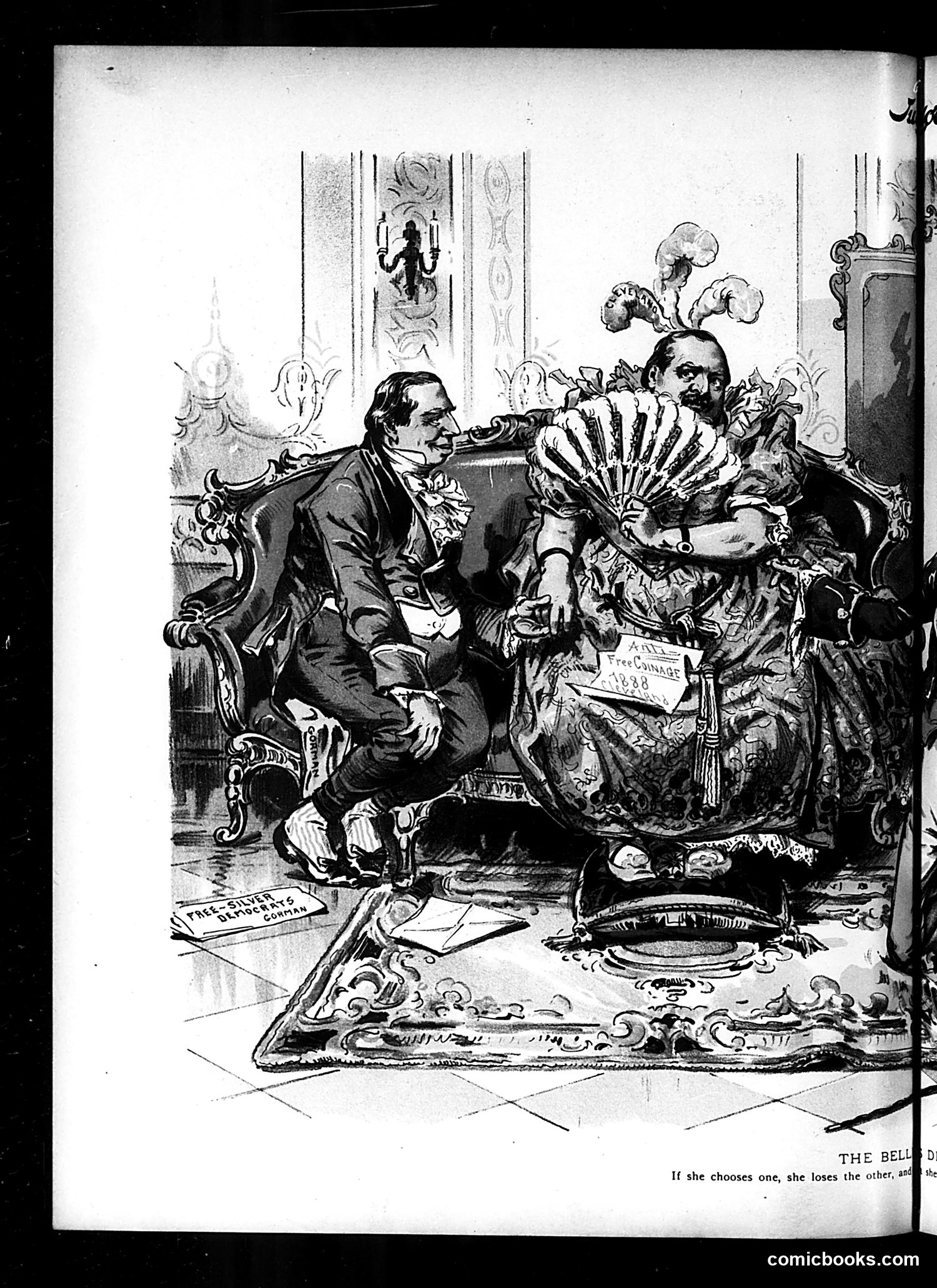
This appears to be a satirical cartoon from *Judge* magazine depicting a woman in elaborate dress holding a large fan, seated between two men in a parlor setting. The caption "THE BELLE'S DILEMMA" with text reading "If she chooses one, she loses the other" suggests a romantic or social predicament—likely satirizing a woman forced to choose between two suitors or competing interests. The ornate interior and the woman's fashionable attire indicate commentary on upper-class courtship or social maneuvering. However, without clearer identification of the specific figures or visible dates on documents in the cartoon, I cannot definitively identify which historical political or social figures are being lampooned. The satire appears to target romantic entanglement or the social constraints women faced when making consequential personal choices.
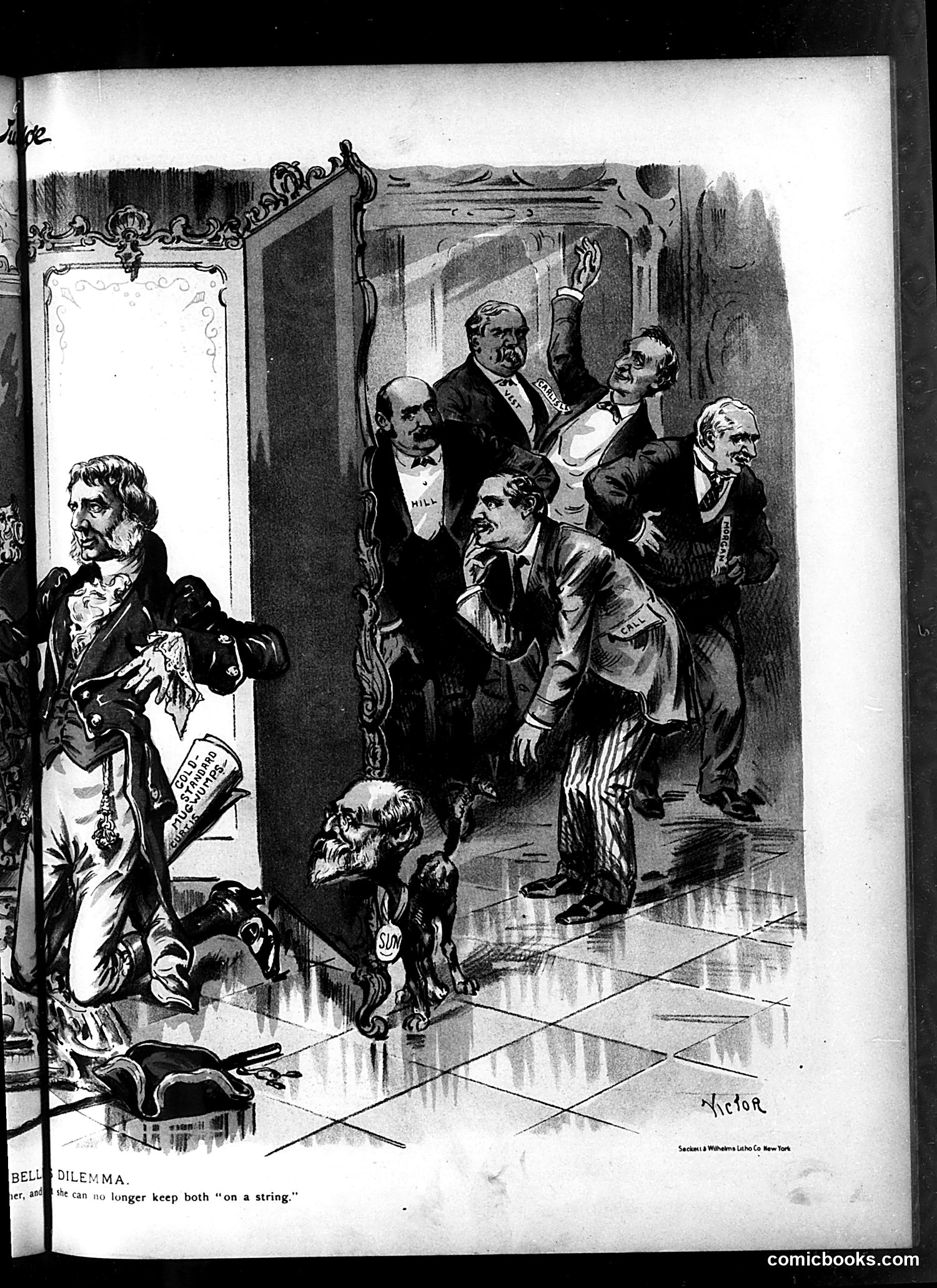
This Judge magazine cartoon depicts a woman (appearing to represent a female political figure or nation) unable to maintain control over two suitors simultaneously—"keeping both on a string." On the left stands a dignified military or aristocratic figure; on the right, several men in formal dress emerge from a doorway, with one appearing agitated. A small dog labeled "SUN" observes the scene. The satire concerns a woman's inability to juggle competing political or romantic interests. The specific identities of the figures remain unclear without additional context, but the cartoon mocks the predicament of divided loyalty or attention, a common theme in Judge's political commentary. The "dilemma" suggests she must choose between competing factions or suitors rather than maintain her previous control over both.
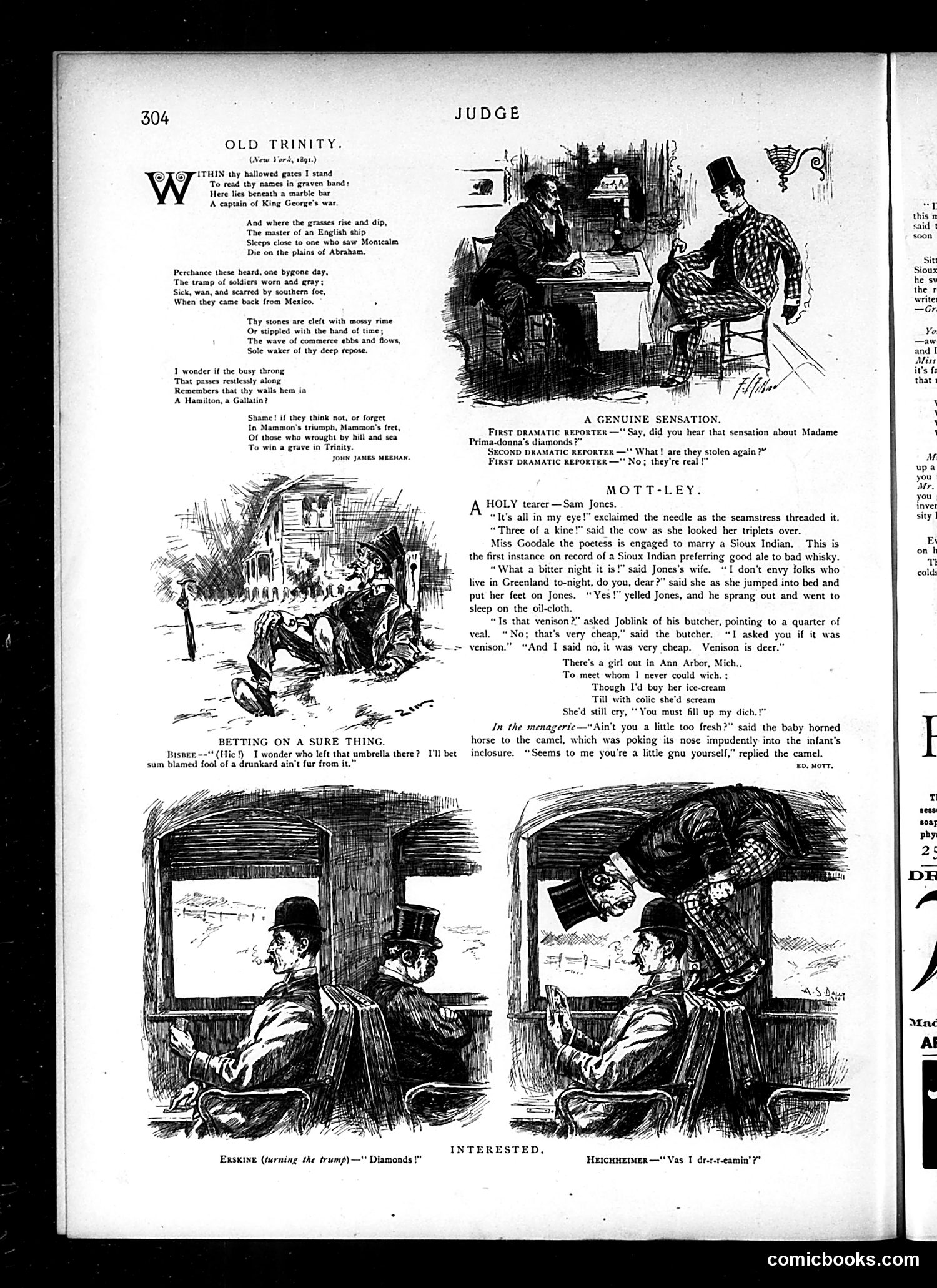
This page from Judge magazine (1891) contains poetry, humor pieces, and satirical cartoons typical of the era. **"Old Trinity"** is a nostalgic poem about Trinity Church in New York, lamenting that modern busy crowds forget the historical figures buried there—including Alexander Hamilton and Albert Gallatin—as they pursue commercial gain ("Mammon's triumph"). **"A Genuine Sensation"** satirizes theatrical gossip: a drama critic's "shocking" revelation that an opera singer's diamonds are actually *real* (not stolen, as one might assume), mocking the triviality of theater world scandals. **"Mott-Ley"** is a humor column with puns and brief jokes, including one about a Sioux Indian marrying a poet (playing on stereotypes), and animal jokes (a camel and horned horse bickering). **The cartoon sketches** appear to depict Victorian-era social scenes with men in top hats—likely satirizing financial dealings or social pretension, though specific references are unclear without more context. The overall tone reflects Judge's satirical approach to 1890s American culture, commerce, and social pretension.
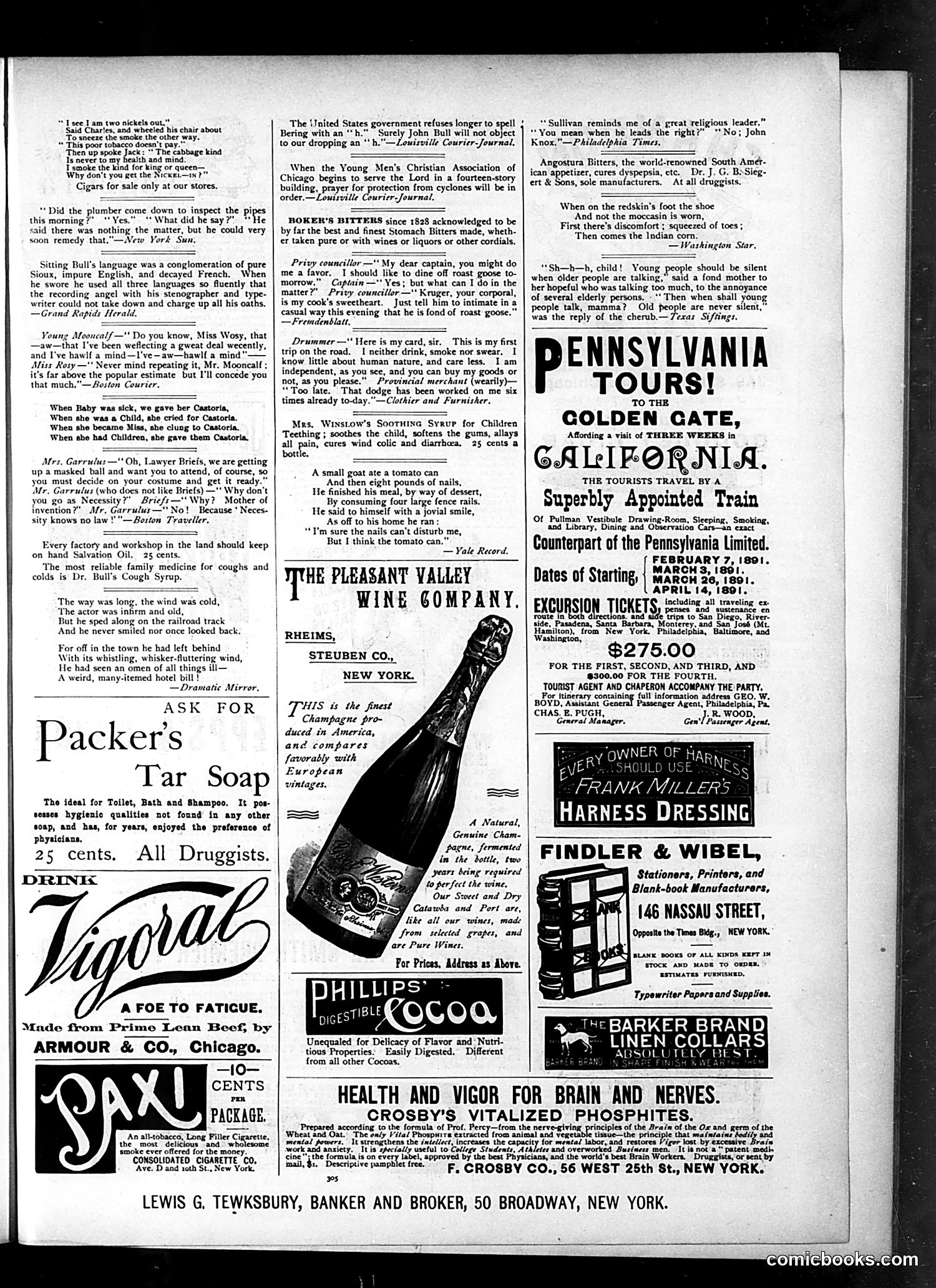
This page is primarily **advertising**, with scattered brief satirical jokes typical of Judge magazine's format. The visible jokes mock: 1. **Cigar advertising disguised as dialogue** — two men debate tobacco quality, leading to a pitch for "Nickri" brand cigars. 2. **A plumber's con** — a joke about a plumber claiming to "fix" pipes that aren't broken, implying he's dishonest. 3. **Sitting Bull's language** — a stereotypical jab at Native American speech as incomprehensible gibberish mixing Sioux, English, and French. 4. **Marriage/courtship humor** — jokes about lawyers avoiding masked balls and a young man's predictable romantic fumbling. 5. **A traveling salesman's pitch** — mocking a naive drummer (salesman) who boasts of his virtuous character while selling goods. The page reflects **late-19th-century attitudes**: ethnic stereotyping, gender roles in courtship, commercial skepticism, and working-class caricature. Most jokes rely on wordplay or social observation rather than visual cartooning.
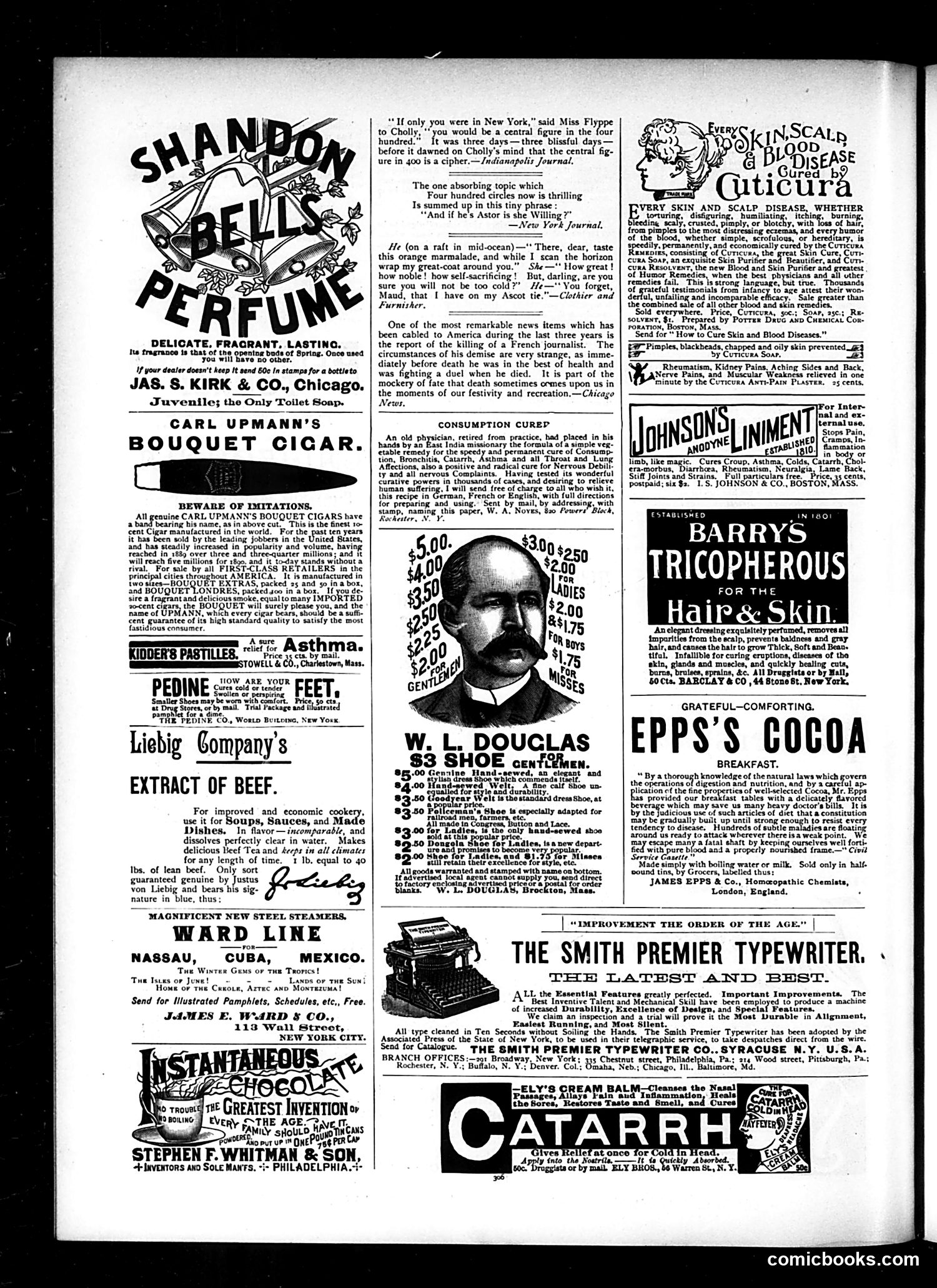
This page is primarily **advertisements and brief satirical jokes**, not political cartoons. The satirical content includes: 1. **"Cholly" joke** (top right): Mocks a wealthy but dim society figure. The humor: Miss Flyppe tells "Cholly" he'd be important in New York's "Four Hundred" (the elite social circle). Cholly takes three days to realize that in a group of 400, the "central figure" is mathematically a zero—mocking both his stupidity and the pretentiousness of high society. 2. **"Ascot tie" joke** (middle): A man on a raft in the ocean prioritizes his expensive Ascot necktie over warmth, suggesting upper-class vanity even in life-threatening situations. 3. **French journalist duel joke** (below): Dark humor about a French journalist killed in a duel—the irony being that death comes during moments meant for pleasure or leisure. The remainder is **commercial advertising**: Shandon Belle Perfume, Carl Upmann cigars, Liebig beef extract, patent medicines, steamship lines, and various other period products. This reflects Judge's business model of mixing satire with revenue-generating ads.
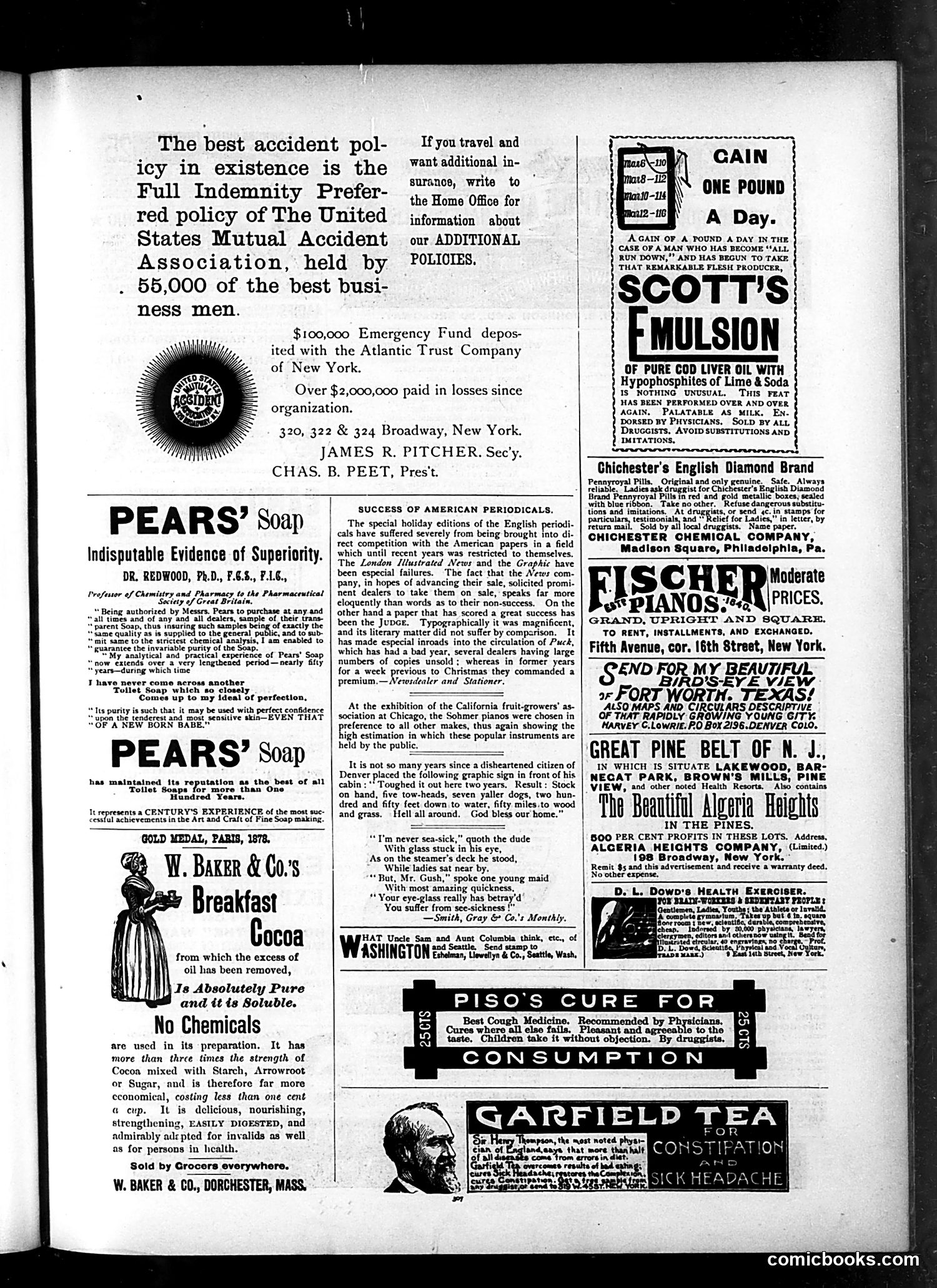
This page is primarily **advertisements and commercial content** rather than satirical cartoons. It contains product endorsements from the late 19th century, including: - **Insurance advertisements** (United States Mutual Accident Association) - **Scott's Emulsion** (cod liver oil tonic), **Pears' Soap**, **W. Baker & Co.'s Breakfast Cocoa**, and **Chichester's Pills** (a contraceptive, euphemistically marketed) - **Fischer Pianos** and real estate promotions The only substantive editorial content discusses **American periodicals' success**, noting that British publications like the *London Illustrated News* and *Graphic* have suffered from competition with American papers, while *Judge* magazine itself has "scored a great success" with superior typography and literary content. There are **no political cartoons or satirical illustrations** of identifiable figures on this page. It functions as a **revenue-generating advertising section**, typical of period magazines.
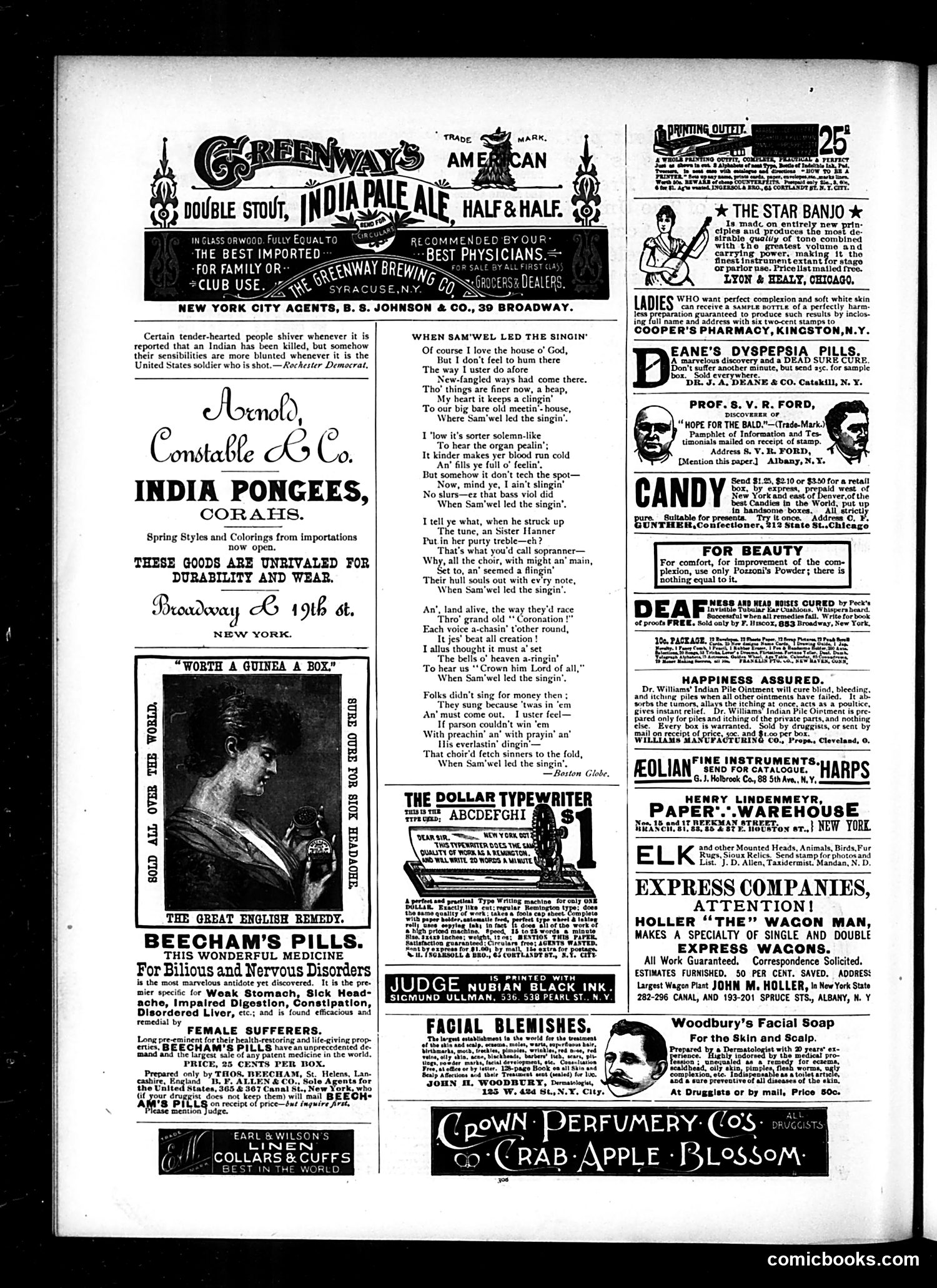
This page consists primarily of **period advertisements and a sentimental poem**; it is not primarily a political cartoon. The notable content is "When Sam'wel Led the Singin'"—a nostalgic poem contrasting rural religious life with modernization. The poem laments the loss of emotional authenticity when a small-town congregation ("Sam'wel") who led heartfelt singing is replaced by formal organ-driven worship in a newer church. The narrator prefers the old "bare meetin' house" to refined "new-fangled ways," suggesting the poem critiques urbanization and loss of traditional community. The rest of the page consists of era-typical patent medicines (Beecham's Pills, Eane's Dyspepsia Pills), consumer goods (collars, typewriters, banjos), and beauty products—advertising staples of period magazines. A brief quoted snippet criticizes selective sympathy for dead Native Americans while ignoring dead U.S. soldiers, but context is insufficient to identify its satirical target.
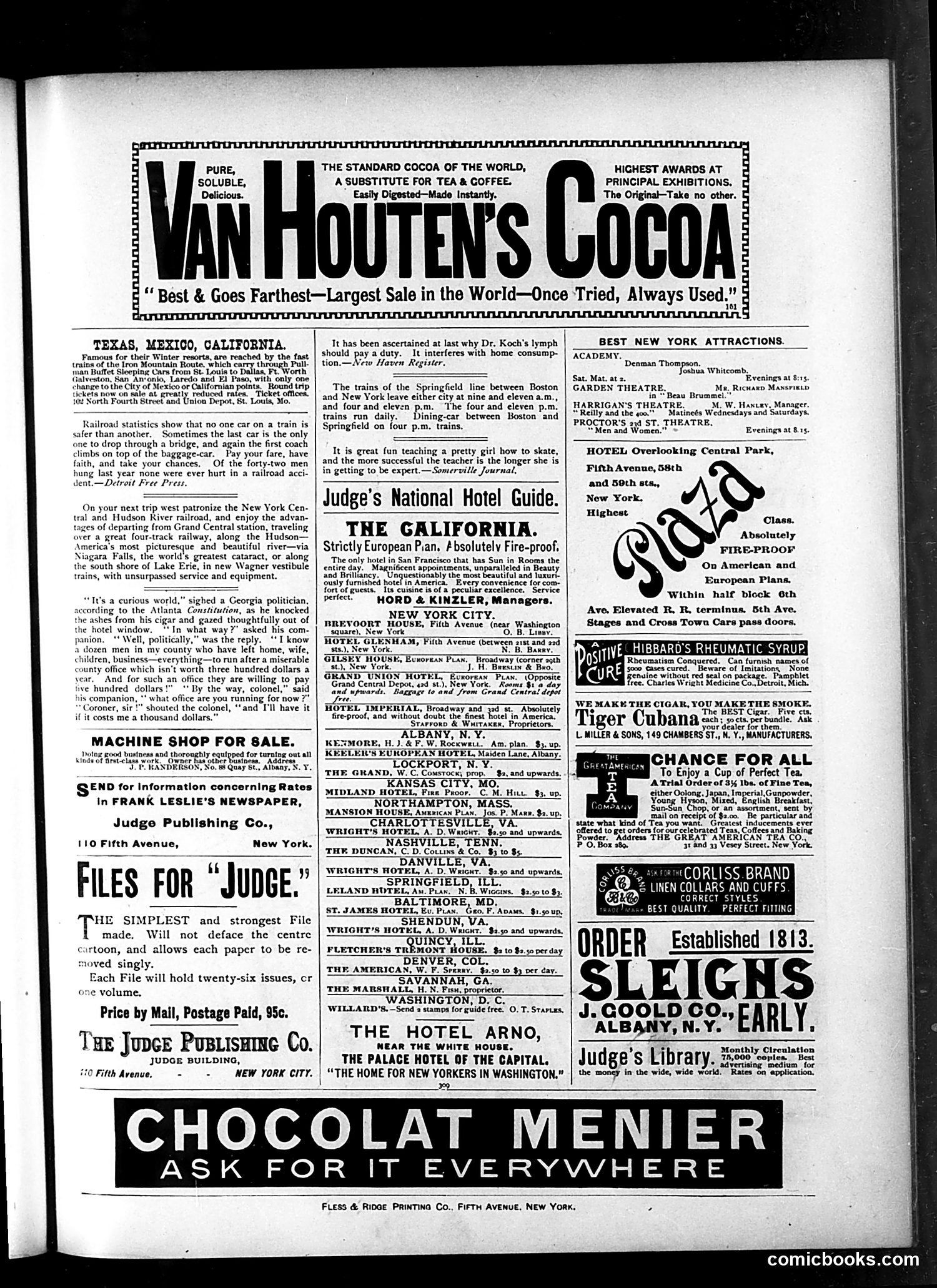
This page is primarily **advertising and directory listings**, not a satirical cartoon section. The main content includes: 1. **Product advertisements** for Van Houten's Cocoa, railroad travel services, and various hotels across America 2. **A humorous anecdote** about a Georgia politician willing to spend $500 to win a $300/year county office, satirizing the absurdity of political ambition and corruption—common Judge magazine fare mocking American politics 3. **Short satirical quips** (typical of Judge's style): jokes about railroad safety being random, about teaching pretty girls to skate, and about Dr. Koch's lymph interfering with "home consumption" 4. **Judge's National Hotel Guide** and business directories There are **no identified political figures or caricatures** visible. The page reflects late 19th-century publication mixed content—humor scattered among advertising that subsidized the magazine's publication.
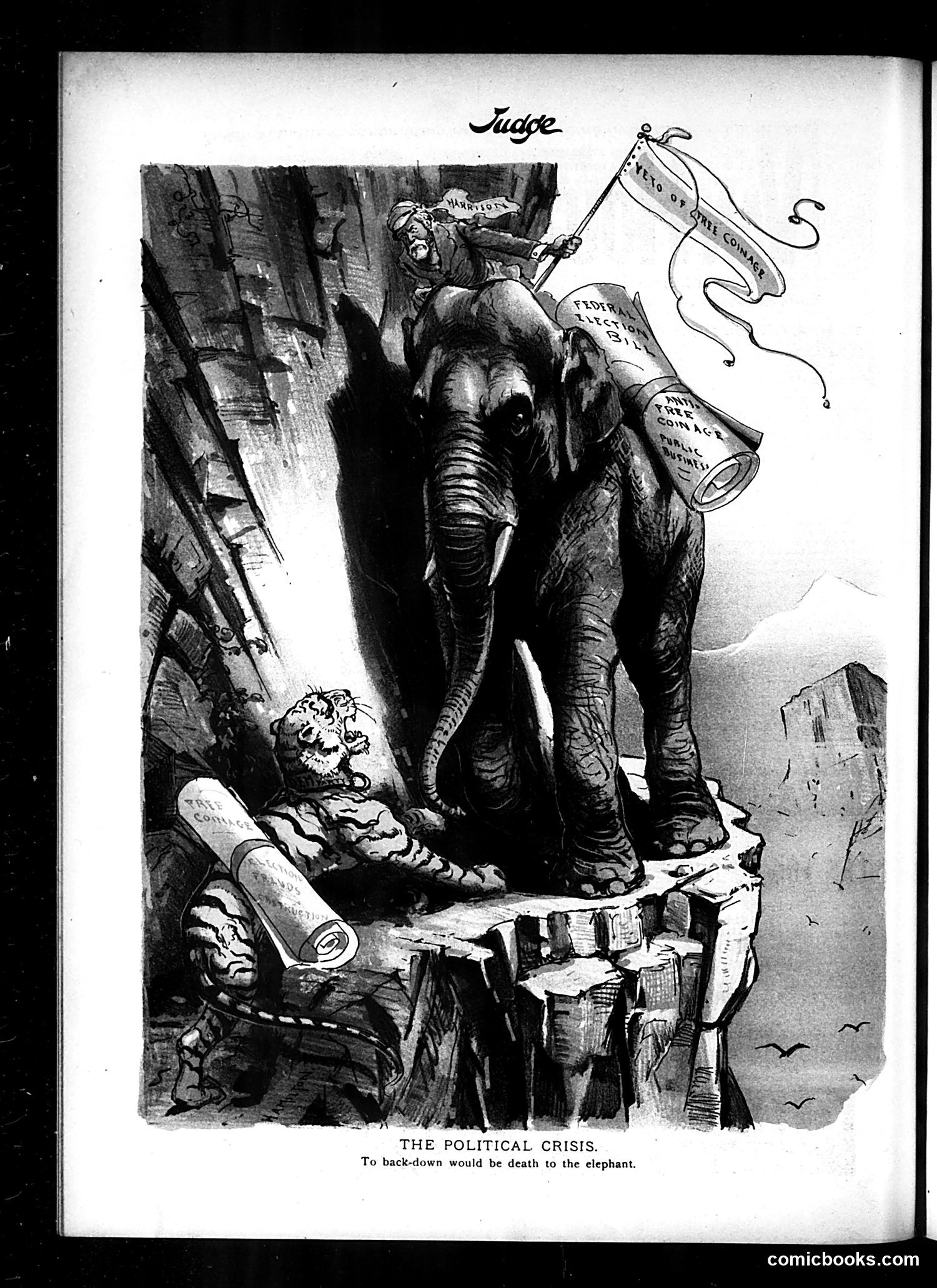
This is a political cartoon titled "The Political Crisis" from Judge magazine. The central figure is an elephant—the symbol of the Republican Party—being ridden by a figure labeled "Judge" who holds a flag reading "Veto of Free Coinage" (visible on the banner). Below the elephant lies a tiger, suggesting a political opponent or threat. The caption states "To back-down would be death to the elephant," indicating the Republicans face a dilemma: they cannot retreat from their position on free coinage (a monetary policy debate of the era) without suffering fatal political consequences. The cartoon satirizes Republican political inflexibility during a currency crisis, suggesting the party is trapped between competing pressures and cannot safely change course.